Eur J Neurosci. 2019;50:2663–2682. wileyonlinelibrary.com/journal/ejn © 2019 Federation of European Neuroscience Societies
|
2663and John Wiley & Sons Ltd
1
|
INTRODUCTION
Drug self‐administration procedures have proved invaluable for isolating how drug use can change the brain in ways that promote the development of addiction‐like behavior (Ahmed, 2018; Weeks, 1962). However, mere drug‐taking does not
necessarily produce the loss of control and aberrant motiva-tion that defines addicmotiva-tion. For this reason, there has been considerable interest in the development of self‐administra-tion procedures and condiself‐administra-tions (here we focus on cocaine) that most reliably produce addiction‐like behavior (Ahmed, 2012; Ahmed & Koob, 1998; Deroche‐Gamonet, Belin, &
R E S E A R C H R E P O R T
Incentive and dopamine sensitization produced by intermittent
but not long access cocaine self‐administration
Alex B. Kawa
1|
Alec C. Valenta
2|
Robert T. Kennedy
2|
Terry E. Robinson
1Abbreviations: DA, dopamine; IC, infusion criteria; IntA, intermittent access; LgA, long access; LimA, limited access.
1Department of Psychology (Biopsychology Program), University of Michigan, Ann Arbor, Michigan
2Department of Chemistry, University of Michigan, Ann Arbor, Michigan
Correspondence
Terry E. Robinson, Department of Psychology, University of Michigan, 530 Church Street, East Hall, Ann Arbor, MI 48109.
Email: [email protected]
Funding information
National Institute of Biomedical Imaging and Bioengineering, Grant/Award Number: EB003320; National Institute on Drug Abuse, Grant/Award Number: DA007281, DA031656 and DA044204
Abstract
The temporal pattern of drug use (pharmacokinetics) has a profound effect on the ability of self‐administered cocaine to produce addiction‐like behavior in rodents, and to change the brain. To further address this issue, we compared the effects of long access (LgA) cocaine self‐administration, which is widely used to model the transition to addiction, with intermittent access (IntA), which is thought to better re-flect the pattern of drug use in humans, on the ability of a single, self‐administered injection of cocaine to increase dopamine (DA) overflow in the core of the nucleus accumbens (using in vivo microdialysis), and to produce addiction‐like behavior. IntA experience was more effective than LgA in producing addiction‐like behav-ior—a drug experience‐dependent increase in motivation for cocaine assessed using behavioral economic procedures, and cue‐induced reinstatement—despite much less total drug consumption. There were no group differences in basal levels of DA in dialysate [DA], but a single self‐administered IV injection of cocaine increased [DA] in the core of the nucleus accumbens to a greater extent in rats with prior IntA experi-ence than those with LgA or limited access experiexperi-ence, and the latter two groups did not differ. Furthermore, high motivation for cocaine was associated with a high [DA] response. Thus, IntA, but not LgA, produced both incentive and DA sensitization. This is consistent with the notion that a hyper‐responsive dopaminergic system may contribute to the transition from casual patterns of drug use to the problematic pat-terns that define addiction.
K E Y W O R D S
addiction, cocaine, dopamine, intermittent access, sensitization
Edited by Michel Barrot. Reviewed by Steve Mahler, Pascal Romieu and Anonymous. All peer review communications can be found with the online version of the article.
Piazza, 2004; Vanderschuren & Everitt, 2004; Zimmer, Oleson, & Roberts, 2012). To this end, Ahmed and Koob (1998) first introduced what has become known as the long access (LgA) self‐administration procedure, which is argu-ably the most widely used rodent model of addiction. During LgA, rats are typically allowed to self‐administer cocaine on a fixed ratio (FR) schedule for 6 + hr/daily session; and rel-ative to rats allowed short, or more limited access (LimA) to cocaine (1–2 hr/session), LgA experience is reported to result in the emergence of a number of addiction‐like behaviors, including escalation of intake, increased motivation for drug, and continued drug‐seeking in the face of an adverse con-sequence (for reviews see, Ahmed, 2012; Edwards & Koob, 2013; Kawa, Allain, Robinson, & Samaha, 2019).
Studies on the neurobiological consequences of LgA co-caine experience suggest that LgA decreases dopamine (DA) neurotransmission in the nucleus accumbens core (relative to rats with more limited experience), at least when tested soon after the discontinuation of self‐administration. For ex-ample, LgA experience decreases cocaine‐induced inhibition of DA uptake, electrically evoked DA release when measured ex vivo, and cocaine‐induced DA overflow in vivo mea-sured with microdialysis (Calipari, Ferris, & Jones, 2014; Calipari, Ferris, Zimmer, Roberts, & Jones, 2013; Ferris, Mateo, Roberts, & Jones, 2011). In addition, LgA cocaine self‐administration experience has been associated with a progressive decrease in nucleus accumbens DA release ac-companying operant responding measured using voltam-metry in vivo (Willuhn, Burgeno, Groblewski, & Phillips, 2014). Although there are exceptions (e.g., Ahmed, Lin, Koob, & Parsons, 2003), these findings have been interpreted as support for the idea that cocaine addiction is due, in part, to a cocaine‐induced hypo‐dopaminergic state, and contin-ued drug‐seeking is motivated by a desire to overcome this DA deficiency (e.g., Caprioli, Calu, & Shaham, 2014; Koob & Volkow, 2016; U.S. Department of Health and Human Services, 2016; Volkow, Koob, & McLellan, 2016).
A fundamental assumption of the LgA model is that the amount of drug exposure is the critical factor in the emer-gence of addiction‐like behavior. As stated by Ahmed (2012), “addiction‐causing neuropathological processes could be set in motion only when rats can expose themselves sufficiently to cocaine to cross the ‘threshold of addiction’ … below this critical level of cocaine exposure, there would be no drug‐ induced neuropathological changes, and drug use would re-main under control, at least in the majority of drug‐exposed individuals” (p. 110). However, studies using a more recently introduced model of the transition to cocaine addiction have challenged this assumption (Allain, Minogianis, Roberts, & Samaha, 2015; Kawa et al., 2019; Zimmer, Dobrin, & Roberts, 2011; Zimmer et al., 2012).
During a LgA session, rats first “load up” and then maintain relatively high brain concentrations of cocaine for the duration
of the 6 + hr session. However, Zimmer et al. (2012) noted that this may not reflect the pattern of cocaine use in humans, which is much more intermittent both between and within bouts of use. Thus, Zimmer et al. (2012) developed what they called the intermittent access (IntA) cocaine self‐administra-tion procedure to better model the repeated spikes in brain co-caine concentrations thought to reflect the pattern of use in humans within a bout of use, especially during the transition to addiction. To this end, rats were allowed 5 min of unlim-ited access to cocaine followed by a 25 min period when drug was not available, and this repeated throughout the session, resulting in successive spikes in brain cocaine concentrations. The important finding was that IntA experience produced greater motivation for cocaine than LgA, despite much less total drug consumption. There are now a number of reports that IntA not only increases motivation for cocaine to a greater extent than LgA, but is more effective in producing a number of other addiction‐like behaviors (Allain, Bouayad‐Gervais, & Samaha, 2018; Allain, Roberts, Lévesque, & Samaha, 2017; Allain & Samaha, 2018; James et al., 2018; Kawa, Bentzley, & Robinson, 2016; Kawa & Robinson, 2019).
Furthermore, unlike LgA, which blunts DA neurotrans-mission, several studies have suggested that IntA does exactly the opposite; it sensitizes DA neurotransmission. For exam-ple, IntA experience is reported to increase the ability of co-caine to inhibit DA uptake and to increase electrically evoked DA release in brain slices (Calipari et al., 2013). Of course, this raises questions concerning the role of a hypo‐ versus hyper‐dopaminergic state in addiction, especially given that IntA is more effective than LgA in producing addiction‐like behavior. However, to date, the only studies on the effects of IntA on DA neurotransmission have been in brain slices, ex vivo. Therefore, given the theoretical implications, it is important to determine whether IntA cocaine experience pro-duces similar effects in freely moving rats, in vivo. That was the purpose of the present experiment, in which we used in vivo microdialysis in freely moving rats to quantify changes in [DA] (and other analytes) in response to a single self‐ad-ministered injection of cocaine, following LimA, LgA, or IntA cocaine self‐administration experience.
2
|
MATERIALS AND METHODS
A total of 50 male Sprague‐Dawley rats (Envigo, Haslett, MI) weighing 250–275 g upon arrival were housed individually in a climate‐controlled colony room, on a reverse 12‐hr light/12‐ hr dark cycle (lights on at 20:00). Rats were housed individ-ually to prevent one rat from irritating the surgical site and catheter port of another rat. Individually housing rats is con-sidered a stressor and may have affected their motivation for cocaine, although the effect of social isolation in male rats on cocaine self‐administration largely depends on experimental
conditions (Boyle, Gill, Smith, & Amit, 1991; Bozarth, Murray, & Wise, 1989; Phillips et al., 1994; Schenk, Lacelle, Gorman, & Amit, 1987; for review see, Lu, Shepard, Scott Hall, & Shaham, 2003) and in this study it is unlikely to have differentially affected the groups. All testing was conducted during the 12‐hr lights off period. After arrival, rats were given 1 week to acclimate to the colony room before surgery. Water and food were available ad libitum until 2 days before the first day of self‐administration, at which point the rats were mildly food restricted to maintain a stable body weight for the remain-der of the experiment (20–24 g/day). There is evidence that maintaining adult, male rats at a stable body weight is more healthy than ad libitum feeding (Rowland, 2007). Although food restriction affects cocaine self‐administration (Carroll, France, & Meisch, 1981; De Vry, Donselaar, & Van Ree, 1989), it is unlikely to have differentially affected the groups in this study. Furthermore, the procedure used here did not reduce body weight, but maintained a stable body weight. All procedures were approved by the University of Michigan Committee on the Use and Care of Animals (UCUCA).
2.1
|
Apparatus
Behavioral testing was conducted in standard (22 × 18 × 13 cm) test chambers (Med Associates, St Albans, VT) located inside sound‐attenuating cabinets. A ventilating fan masked background noise. Within the test chambers, two nose poke ports were located 3 cm above the floor on the left and right side of the front wall, and one port was des-ignated active and the other inactive (side counter‐balanced across chambers). A red house light was located at the top, center of the back wall opposite the nose ports. During self‐ administration, intravenous cocaine infusions were delivered by a pump mounted outside the sound attenuating cabinet, through a tube connected to the rat's catheter back port. The infusion tube was suspended into the chamber via a swivel mechanism, allowing the rat free movement. All measures were recorded using Med Associates software.
Microdialysis test sessions were conducted in separate but identical chambers to those described above. The only difference was that the swivel system in these boxes allowed for the microdialysis inlet tubing, outlet tubing, and the drug delivery tubing to be connected simultaneously.
2.2
|
Intravenous catheter surgery
Rats underwent intravenous catheter surgery as described previously (Crombag, Badiani, Maren, & Robinson, 2000). Briefly, rats were anesthetized using ketamine hydrochloride (90 mg/kg i.p.) and xylazine (10 mg/kg i.p.) and a catheter was inserted into the right jugular vein and tubing was run subcutaneously to a port located on the rat's back. Rats were administered the analgesic carprofen (5 mg/kg s.c.) once
immediately prior to surgery and once each day on the first and second days post‐surgery. Following surgery, catheters were flushed daily with 0.2 ml sterile saline containing 5 mg/ml gentamicin sulfate (Vedco, MO). Catheter patency was tested periodically with intravenous injection of 0.1 ml methohexi-tal sodium (10 mg/ml in sterile water; JHP Pharmaceuticals). If a rat did not become ataxic within 10 s of the injection, the catheter was considered not patent and the rat was removed from the study. No rat was tested with methohexital more than three times and the tests for patency were always done at least 16 hr before the next self‐administration session.
2.3
|
Self‐administration: acquisition
Rats were given ~7 days to recover from the catheter surgery, and then self‐administration training commenced (Figure 1a). The rats were placed into the chamber with the house light il-luminated. After 2 min, the house light was extinguished and this signaled the beginning of each session. At that time, a nose poke into the active port, detected by an infrared photo beam, resulted in an intravenous infusion of cocaine hydro-chloride (NIDA) dissolved in 0.9% sterile saline (0.4 mg/kg per infusion, weight of the salt, in 50 μl delivered over 2.6 s) on a fixed ratio‐1 (FR‐1) schedule. Each infusion was paired with the illumination of a cue light in the active nose port for 20 s. Nose pokes during this 20 s period were recorded but had no consequences. An inactive nose port was also present at all times and pokes there were recorded but had no consequences. To ensure that during initial training all rats received the same amount of cocaine and cue exposure an infusion criteria (IC) procedure was used, as described previously (Saunders & Robinson, 2010). During these acquisition sessions, session length was determined by how long it took each rat to reach the predetermined number of infusions, not by an explicit time limit. Each rat had two sessions at IC10 (10 infusions), three sessions at IC20, and four sessions at IC40. If a rat did not reach the IC within 6 hr, the session was terminated. If a rat failed to self‐administer all of the infusions available in 6 hr on two consecutive days, that rat was excluded from further testing. In addition, if a rat failed to make twice as many ac-tive nose pokes as inacac-tive nose pokes on each of the last three acquisition sessions that rat was given up to three additional sessions, and if the rat did not reach criteria in those three ses-sions it was excluded from further testing. A total of five rats were excluded during acquisition training because they failed to reach the IC or failed to discriminate between the active nose port and the inactive nose port.
2.4
|
Self‐administration: within‐session
threshold procedure
The day after the final acquisition session, all rats were trained on a within‐session threshold procedure and demand curves
were generated, as described previously (Bentzley, Fender, & Aston‐Jones, 2013; Kawa et al., 2016). Briefly, each ses-sion (one per day) was 110 min in length, FR‐1 throughout, and every 10 min the dose of drug was decreased on a quarter logarithmic scale (1.28, 0.72, 0.40, 0.23, 0.13, 0.072, 0.040, 0.023, 0.013, 0.007, 0.004 mg/kg per infusion). During the threshold procedure, the nose port cue light was illuminated for the duration of each infusion. Rats could take another infusion immediately after the preceding one (i.e., the only time out period was during the duration of the infusion).
The threshold procedure yields a number of behavioral economic metrics. Q0 is a theoretical measure of consumption when no effort is required; that is, an inherent extrapolation of the individual's consumption at very low prices (Bentzley et al., 2013; Hursh & Silberberg, 2008; Oleson, Richardson, & Roberts, 2011). PMax is defined as the price that elicits maximum responding; that is, the maximum price (in effort) an individual is willing to pay to maintain Q0 (Bentzley et al., 2013; Hursh, 1991). Consumption remains relatively stable at prices lower than PMax but falls rapidly at prices higher than PMax. Finally, α is a measure of demand elasticity and is equivalent to the slope of the demand curve (Bentzley et al., 2013; Hursh & Silberberg, 2008). Demand elasticity describes how susceptible the consumption of a commodity is to changes in cost. Motivation is inversely proportional to
α, meaning a larger α value corresponds to lower motivation. Both PMax and α measure the extent to which an animal is willing to work to defend their preferred level of cocaine in-take (Q0) that is achieved at a very low cost (in effort). Each rat was tested daily for at least four sessions and until it pro-duced three consecutive sessions with less than 25% variation in α. For baseline data analysis α, PMax, and Q0 values (see below) were averaged over these last three sessions for each rat. A total of three rats were excluded for failure to stabilize or loss of catheter patency.
Following the baseline threshold procedure, all rats were assigned to one of three groups: LimA (n = 10), prolonged IntA (n = 20), or prolonged LgA (n = 12). Groups were as-signed following the baseline threshold test, so that there were no group differences in baseline measures of α, PMax, or Q0. Following the baseline threshold procedure, rats in the LimA group underwent surgery to implant a microdialysis guide cannula (described below). After 3 days of recovery, each rat in the LimA group was habituated to the microdial-ysis chamber in which they would be tested for ~1 hr. Then, these rats were given three more IC40 self‐administration sessions and at least one of these sessions was conducted in the microdialysis chamber in which they would be tested, so each rat had at least one habituation session and one self‐ administration session in the microdialysis chamber. Thus,
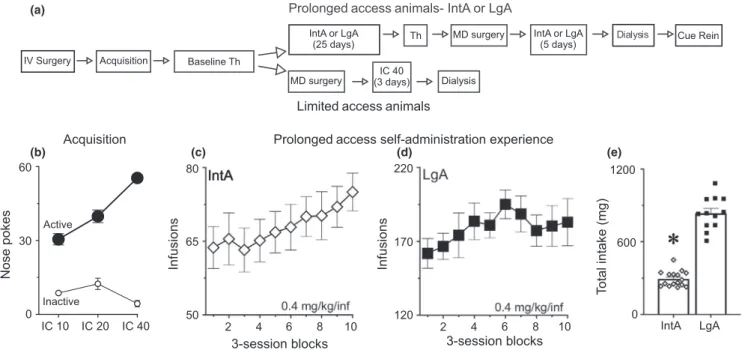
FIGURE 1 The flow diagram shows the overall experimental design and timeline for the experiment (a) (see methods for details). An infusion criterion (IC) procedure was used for the acquisition of cocaine self‐administration (b). Both IntA rats and LgA rats escalated their intake/ session to a similar extent across all 30 self‐administration sessions (c, d). LgA rats consumed far more cocaine on average than IntA rats over the course of 30 self‐administration sessions (e). In panels c and d, each point represents the average of three consecutive self‐administration sessions. See methods for the number of rats included in each group and panel. Values represent means ± SEMs, *represents a significant difference (p < 0.05) between IntA and LgA groups (IntA: intermittent access, IV/MD surgery: intravenous catheter/microdialysis guide cannula surgery, LgA: long access, Th: threshold test)
Dialysis
Prolonged access animals- IntA or LgA
*
MD surgery Baseline Th
Th Cue Rein
IntA or LgA
(25 days) IntA or LgA (5 days)
IC 40 (3 days) IV Surgery Acquisition Dialysis MD surgery Self-administration experience
Limited access animals
To
tal intake (mg
)
Prolonged access self-administration experience Acquisition IntA LgA Infusions 2 4 6 8 10 Nose pokes 3-session blocks 0 600 1200 Active Inactive IntA LgA IC 10 IC 20 IC 40 60 30 0 50 65 80 2 4 6 8 10 3-session blocks 120 170 220 Infusions (a) (b) (c) (d) (e)
the LimA group had the same amount of training during ac-quisition and the threshold test, plus three additional days at IC40, but unlike the IntA and LgA groups, had no further cocaine self‐administration experience prior to the dialysis test session—their cocaine self‐administration was relatively limited. Due to complications on the microdialysis test day 1 LimA rat had to be excluded.
2.5
|
Self‐administration: intermittent
access or long access procedures
After their behavior stabilized on the threshold procedure, the rats in the prolonged access groups were given 30 self‐ administration sessions (Figure 1a). These rats were trained using either an IntA procedure similar to that described previ-ously (Kawa et al., 2016; Zimmer et al., 2012) or a LgA pro-cedure, also similar to that described previously (Ahmed & Koob, 1998). During the IntA procedure, the rats were placed into the chamber with the house light illuminated. The begin-ning of the first 5‐min Drug‐Available period started 2 min after the rat was placed into the chamber and was signaled by extinguishing the house light. During the Drug‐Available period, a nose poke into the active port resulted in an intra-venous infusion of cocaine hydrochloride (NIDA) as during acquisition. Each infusion was paired with the illumination of a cue light in the nose port for the duration of the infu-sion. However, unlike during acquisition, rats could take an-other infusion immediately after the preceding one (i.e., the only time out period was during the 2.6 s infusion). After the 5‐min drug‐available period, the house light turned on and signaled a 25‐min no‐drug available period. Nose pokes dur-ing the no‐drug available period were recorded but had no consequence. After 25‐min, the house light was extinguished and another 5‐min Drug‐Available period began. Each IntA session lasted 4 hr (eight cycles of drug‐availability).
During the LgA procedure, the rats were placed into the chamber with the house light illuminated. After 2 min, the house light was extinguished and the rats were able to self‐ad-minister cocaine. Each LgA session lasted 6 hr and throughout the session, a nose poke into the active port resulted in an in-travenous infusion of cocaine hydrochloride (NIDA) on a FR‐1 schedule, as during acquisition. Each infusion was paired with the illumination of a cue light in the nose port for 20 s. Nose pokes during this time were recorded but had no consequences. With the exception of this timeout period, cocaine was available to the rats throughout the 6‐hr session. An inactive port was also present at all times and pokes there had no consequences.
Rats in both groups underwent one self‐administration session/day for an average of 5 days/week. We varied the number and pattern of days off each week to model the inter-mittency between bouts of drug use seen in human cocaine users (Cohen & Sas, 1994; Simon et al., 2002)—for exam-ple, one week the rats may have had only 1 day off and then
the next week the rats may have had 3 days off. However, rats were never given the day directly before a probe test off. The rats were given 25 self‐administration sessions and then were tested again using the within‐session threshold proce-dure. This probe test was identical to the baseline threshold test except that the rats were only tested for 2 days, and the respective values were averaged across the two test days. Two rats in the IntA group were removed from testing prior to this threshold test due to loss of catheter patency. After two threshold test sessions, the rats underwent surgery to implant a microdialysis guide cannula above the nucleus ac-cumbens core, as described below. After 3 days of recovery, the rats were given five additional IntA or LgA self‐admin-istration sessions. Also, each rat was first habituated to the microdialysis chamber in which they would be tested for ~1 hr and then at least one of the five additional self‐admin-istration sessions was conducted in the microdialysis cham-ber. Thus, each rat had at least one habituation session and one self‐administration session in the microdialysis cham-ber. Then 1–3 days after the last self‐administration session, these rats underwent a microdialysis test and collection ses-sion identical to the LimA rats and described below. Due to complications during surgery or the microdialysis test ses-sion, 2 IntA rats and 3 LgA rats were excluded, leaving 16 and 9 successful collections, respectively.
2.6
|
Extinction and cue‐induced
reinstatement test
Following the microdialysis test session, a subset of the Prolonged Access rats was tested for the ability of the co-caine‐paired discrete cue (light in the nose port) to reinstate drug‐seeking (n = 10 IntA; 9 LgA). The rats underwent 2‐hr extinction sessions (1/day) for at least 5 days and until they made <20 active nose pokes for two consecutive sessions. The extinction sessions consisted of placing the rats into a chamber with the house light on and the session started 2 min later. Upon the session starting, the house light turned off and remained off for the duration of the session. Responses into the nose ports during these sessions were recorded but had no consequences. The day after a rat met the extinction criterion it underwent a day of testing identical to extinction except on this day pokes in the active port resulted in the illumination of the cue light for 2.6‐sec. After the cue‐induced reinstatement test, these rats were perfused to verify cannula placement.
2.7
|
Microdialysis
2.7.1
|
Intracranial placement of cannula
for microdialysis
After their behavior stabilized on the baseline threshold proce-dure (LimA group) or after 25 additional self‐administration
sessions (IntA and LgA groups), the rats underwent surgery to implant a microdialysis guide cannula above the nucleus accumbens core. Rats were anesthetized with a ketamine xy-lazine cocktail as described for the catheter implantation and placed in a stereotaxic instrument (David Kopf Instruments, Tujunga, CA). A guide cannula (CMA, CMA12 Guide Cannula) was lowered such that its tip was just above the nucleus accumbens core. The coordinates were +1.6 mm anterior, ±1.6 mm lateral, and −6.2 mm ventral, relative to bregma (Paxinos & Watson, 2007). Hemisphere (right/left) was counter‐balanced across all groups. To prevent clog-ging, a stainless steel stylet was inserted into the cannula. The guide cannula was secured to the skull using three stain-less steel screws and acrylic dental cement. The rats were administered the analgesic carprofen (5 mg/kg s.c.) once im-mediately prior to surgery and once each day on the first and second days post‐surgery. Rats were allowed at least 3 days of recovery before any subsequent testing.
2.7.2
|
Probe construction and test session
The microdialysis probes were custom made similar to those described previously (Pitchers, Kane, Kim, Robinson, & Sarter, 2017). Briefly, two silica capillaries (75 μm inner diameter; 150 μm outer diameter; TSP075150; Polymicro Technologies) were glued together and inserted into a 24‐ gauge stainless steel tube that served as the shaft to be in-serted into the guide cannula. The portion of each capillary tube that was not inserted into the shaft was sheathed in 22‐ gauge stainless steel tubing and one was used for the inlet capillary and one for the outlet capillary. The capillary tip extending from the shaft was sheathed in an 18 kDa molecu-lar weight cutoff regenerated cellulose membrane (Spectrum Labs). The tip and base of the membrane was sealed with an epoxy resin. The membrane extended 2 mm in length be-yond the shaft, such that a 2 mm probe would extend into the center of the accumbens core.
In all groups, the microdialysis test session was con-ducted 1–3 days after the last self‐administration session. Approximately 12–16 hr before the microdialysis test ses-sion, the stylet was removed from the guide cannula and a probe was inserted. The rat was placed into the microdial-ysis test chamber with the house light on. The probe was perfused at a rate of 0.5 μl/min with artificial cerebrospinal fluid (aCSF) overnight and the rate was increased to 1 μl/ min approximately 4 hr prior to collection. The aCSF was comprised of 145 mM NaCl, 2.7 mM KCl, 1.0 mM MgSO4, 1.2 mM CaCl2, 1.55 mM NaHPO4, and 0.45 mM NaH2PO4. In addition, 100 nM 13C
6‐DA was added to the aCSF which allowed for in vivo calibration of the probes (Hershey & Kennedy, 2013) in all but a small subset of the rats (3 LimA, 4 IntA). In this latter subset of rats, recovery rates for each probe were calculated ex vivo by placing the membrane in
known concentrations of DA and correcting for the con-centration collected in the dialysate sample. These rats did not differ on any measures from rats tested with 13C
6‐DA added to the aCSF and thus were combined for analysis. Approximately 4 hr prior to collection, the rats were also at-tached to the drug delivery tubing. Dialysate samples were collected every 3 min.
The test session and collection started with 10 baseline samples (30 min). After 30 min, the house light turned off which signaled that cocaine was available, as it had during all of the previous self‐administration sessions. No samples were collected until the rat had made one response in the active nose port and self‐administered a single 1.25 mg/kg cocaine infusion. The light cue that had been paired with cocaine in-fusions during self‐administration testing was not presented, to better isolate the effect of cocaine alone. As soon as the rat made a response and the infusion ended the house light turned back on and no additional cocaine was available to the rat. After accounting for the time it took for the dialysate to travel from the brain to the outlet collection, dialysis samples were collected for 1 hr (20 samples) that corresponded to the onset of the cocaine infusion. One hour after the cocaine in-fusion, the house light again turned off and the light in the active nose port that had previously been a conditioned stim-ulus paired with cocaine delivery during self‐administration was flashed 14 times for 2.6 s per flash over a 3‐min period. We collected a single sample that corresponded to this 3‐min cue‐presentation and five more samples following the cue presentation. Nose pokes in both the active and inactive nose ports were recorded throughout the test session. In summary, 3‐min samples were collected over a 30‐min baseline period, for 1‐hr following a cocaine infusion, for 3 min during which the cue was presented non‐contingently, and then for 15 min following cue presentation.
2.7.3
|
Analysis of neurochemical levels
in dialysate samples using high performance
liquid chromatography coupled with mass
spectrometry
All reagents, drugs, and chemicals were purchased from Sigma‐Aldrich (St. Louis, MO) unless otherwise noted. Samples were analyzed using benzoyl chloride derivatiza-tion and a modified LC‐MS method previously described (Song, Mabrouk, Hershey, & Kennedy, 2012). Briefly, the 3 μl samples were derivatized by adding 1.5 μl of 100 mM sodium carbonate monohydrate buffer, 1.5 μl of 2% benzoyl chloride in acetonitrile, and 1.5 μl of an internal standard mixture (to improve quantification), in order, briefly vor-texing between each addition. A Thermo Fisher (Waltham, MA) Vanquish UHPLC system automatically injected 5 μl of the sample onto a Phenomenex Kinetex C18 HPLC column (2.1 mm × 100 mm, 1.7 μm). Mobile phase A consisted of
10 mM ammonium formate and 0.15% formic acid. Mobile phase B was pure acetonitrile. Analytes were detected using positive electrospray ionization with a Thermo Fisher TSQ Quantum Ultra triple‐quadrupole mass spectrometer operat-ing in multiple‐reaction monitoroperat-ing mode.
Inclusion of 13C
6 DA in the aCSF perfusate allowed us to calculate an extraction fraction (Ed) for each sample (Hershey & Kennedy, 2013). The Ed (Ed = 1−(Cin/Cout) is the ratio of the amount of the isotope that exits the probe to the amount retained in the dialysate sample. Absolute extracellular con-centrations of DA were determined by dividing the dialysate concentration of DA by the Ed value. Finally, in a subset of rats we switched the perfusate to aCSF that lacked 13C
6 DA at the conclusion of the test session. After allowing this aCSF to run for ~1 hr, we collected several samples in the same manner as the samples collected during the test. We ana-lyzed these samples and compared them to samples from the baseline portion of the test session. This analysis, along with comparisons between rats that did not have 13C
6‐DA added to the aCSF at any point, confirmed that there were no ef-fects of infusing 100 nM 13C
6‐DA on endogenous DA levels (Figure 3a).
2.8
|
Histological analysis
After the microdialysis test session, rats were anesthetized using sodium pentobarbital (270 mg/kg; i.p.) and perfused intracardially with 50 ml of 0.9% saline, followed by 500 ml of 4% paraformaldehyde in 0.1 M phosphate buffer (PB). After being perfused, brains were removed, post‐fixed in the same paraformaldehyde solution for 2 hr, then immersed in 20% sucrose and 0.01% sodium azide in 0.1 M PB for 48 hr at 4°C. Coronal sections (40 μm) were cut with a freezing microtome (SM 2000R; Leica), collected in PB, and mounted on to a slide immediately. Sections were imaged at 4× mag-nification using a Leica DM400B digital microscope to ver-ify cannula placement.
2.9
|
Statistical analysis
Linear mixed‐models (LMM) analyses were used for all be-havioral repeated measures data. The best‐fitting model of repeated measures covariance was determined by the lowest Akaike information criterion score (West, Welch, & Galecki, 2007). Depending on the model selected, the degrees of free-dom may have been adjusted to a non‐integer value. Data for the α measure were not normally distributed and therefore all statistical tests involving α were run on log transformed data, consistent with previous reports (Bentzley, Jhou, & Aston‐ Jones, 2014). Planned post hoc contrasts (and Bonferroni corrections) were done to compare between the different self‐ administration procedures and within the Prolonged Access groups across the two test periods. Active and inactive nose
pokes from the cue‐induced reinstatement test were com-pared to the last day of extinction and between the IntA and LgA groups. Similar LMM analysis and planned post hoc analysis were used to analyze neurochemical levels from the microdialysis test session. Statistical significance was set at p < 0.05.
3
|
RESULTS
3.1
|
LgA resulted in much greater cocaine
consumption than IntA, but rats in both groups
escalated their intake to a similar extent
The overall timeline of the experiment is shown in Figure 1(a). Figure 1(b) shows the acquisition of cocaine self‐administration as a function of Infusion Criterion for all rats, prior to group assignment. Across sessions, the number of responses in the active nose port increased (effect of IC, F(2,40.4) = 38.7, p < 0.001), and the number of responses in the inactive nose port decreased (effect of IC, F(2,75.1) = 3.5, p = 0.04). After group assignments, there were no group dif-ferences on any measure of acquisition.
A subset of rats was given 30 self‐administration sessions using either the IntA or LgA procedure. Rats in the IntA group quickly learned to discriminate between the drug‐available and no‐drug periods, as previously reported (data not shown; see Kawa et al., 2016). When cocaine intake per session from the IntA and LgA rats was analyzed together, there was a main effect of test session (F[29,70.7] = 4.8, p < 0.001). Further analysis confirmed that when each group was an-alyzed separately both IntA (p = 0.01, Figure 1c) and LgA (p = 0.02; Figure 1d), rats escalated their intake as a function of increasing self‐administration experience. Relatedly, the rate at which consumption increased did not differ between the groups (group × session interaction, F[29,70.7] = 1.2, p = 0.24). There was, however, a large group difference in the total amount of cocaine consumed (effect of group, F[1,92.3] = 823, p < 0.001; Figure 1e). On average, LgA rats consumed ~2.8× more cocaine than IntA rats.
3.2
|
Prolonged IntA and LgA experience
had different effects on motivated behavior
All rats underwent a baseline threshold test to quantify their motivation to self‐administer cocaine following only limited self‐administration experience (Figure 2). Values for each behavioral economic metric were averaged from the last 3 days of the baseline threshold test. Within each measure, there were no differences across the 3 days nor did the vari-ability differ across days. Group assignments (LimA, IntA, LgA) were made following this test, such that there were no differences between the groups on any of the measures de-rived from this test. The rats that were placed into the IntA
and LgA groups then underwent 25 self‐administration ses-sions before another threshold probe test to determine how motivation changed as a function of IntA or LgA experience, relative to baseline. For this second threshold test, values for each behavioral economic metric were averaged from the two test days. Within each measure, there were no differences across the 2 days nor did the variability differ across days. All statistical comparisons to baseline were within‐subject.
The metric α is a measure of the elasticity of the demand curve generated during the within‐session threshold proce-dure, and is inversely proportional to motivation (Bentzley et al., 2013; Figure 2a). Prolonged IntA and LgA experi-ence had different effects on α, as indicated by a significant group × probe test interaction (F[1,69] = 7.2, p = 0.009). Post hoc within‐subject analysis revealed that IntA experi-ence decreased α (increased motivation) (p = 0.02) whereas LgA experience did not significantly change α (p = 0.12). On the second probe test, IntA rats had a lower α than LgA rats (effect of group, p = 0.04), indicating that rats with IntA ex-perience were more motivated to obtain cocaine.
The metric PMax is a measure of motivation that reflects the maximum price an individual is willing to pay (in ef-fort) to obtain a reinforcer (Bentzley et al., 2013; Figure 2b). Again, prolonged IntA and LgA had different effects on PMax,
as indicated by a significant group × probe test interaction (F[1,33.1] = 10.4, p = 0.003). Post hoc within‐subject analy-sis revealed that IntA experience increased PMax (p = 0.001), and LgA experience did not significantly change PMax (p = 0.27). On the second probe test, IntA rats had a higher PMax than LgA rats (effect of group, p = 0.005), indicating that they were more motivated to obtain cocaine, consistent with α.
Another metric derived from the threshold procedure is Q0, which measures the preferred level of cocaine con-sumption when cost is nil (Bentzley et al., 2013; Figure 2c). Again there was a significant group × probe test interaction (F[1,28.7] = 7.7, p = 0.009) indicating that IntA and LgA had different effects on Q0. Q0 differed from α and PMax as post hoc within‐subject analysis revealed that LgA experi-ence increased Q0 (p = 0.01) but IntA experience had no ef-fect on Q0 (p = 0.25). Finally, LgA rats had higher Q0 than IntA rats after prolonged self‐administration (effect of group, p = 0.03). These differential effects of LgA and IntA on Q0 are consistent with several reports (Bentzley et al., 2014; James et al., 2018; Kawa et al., 2016; Oleson & Roberts, 2009; Singer, Fadanelli, Kawa, & Robinson, 2018).
Representative demand curves generated from the threshold procedure are shown from a LimA rat on the
FIGURE 2 Cocaine demand was assessed using a threshold procedure in rats with different self‐administration experience. In panels a–c, “baseline” measures are shown for all three groups (n = 42) and a subset of rats went on to experience intermittent access (IntA) self‐administration (n = 18) while a separate group of rats went on to long access (LgA) self‐administration (n = 12). Group assignments were made to insure there were no group differences on these measures at baseline. Baseline α values for all three groups are shown in panel (a), which also shows that IntA experience decreased α (increased motivation) relative to LgA experience (a). Similarly, IntA, but not LgA, increased PMax (increased motivation) (b). LgA experience increased Q0 (preferred cocaine intake when effort is not a factor) relative to IntA experience (c). Panels d–f show representative demand curves from a rat after LimA experience (d), prolonged IntA (e), and prolonged LgA (f). In panels b and c, baseline values from the LimA group are plotted but difficult to see as they overlap with the baseline LgA values. Values represent means ± SEMs, α values shown in (a) are calculated values multiplied by 100, * represents a significant difference (p < 0.05) between IntA and LgA groups
0.0 0.12 0.24 800 400 0 . 0 0 0.75 1.5 α (x100 ) PMa x (resp/mg) Q (mg0 )
*
*
*
Consumption (mg coc) 10.0 1.0 0.01 0.1LimA LgA IntA
Cost (responses/mg coc) Cost (responses/mg coc) Cost (responses/mg coc)
0 10 100 1000 0 10 100 1000 0 10 100 1000
PMax = 310 PMax = 133 PMax = 628
5 0 0 0 . 0 = α 4 1 0 0 . 0 = α 1 0 0 . 0 = α Q0 = 0.50 Q0 = 0.83 Q0 = 0.55
Motivation following IntA and LgA
Baseline Test 2 Baseline Test 2 Baseline Test 2
(a) (b) (c)
(d) (e) (f)
LimA IntA LgA
baseline threshold test (Figure 2d), and from a LgA rat (Figure 2e) and an IntA rat (Figure 2f) on the second threshold test.
3.3
|
Infusion of stable‐isotope labeled
dopamine did not affect endogenous
dopamine levels
Use of extraction fraction (Ed) to calculate in vivo concentra-tion accounts for possible differences in recovery associated with the probe and brain environment in different rats. In vivo calibration therefore improves the accuracy of such measures and allows comparison between rats. 100 nM stable‐isotope labeled DA (13C
6‐DA) was included in the aCSF that was perfused during the microdialysis test session to calculate an Ed for each sample (see methods; Hershey & Kennedy, 2013). As a control, we determined if the infusion of this concentration of 13C
6‐DA affected DA levels in dialysate [DA]. For this control measurement, the input solution was switched to aCSF that lacked 13C
6‐DA at the end of each di-alysis test session and after allowing the lines to clear of any 13C
6‐DA aCSF three more dialysate samples were collected to compare to the last samples collected with 13C
6‐DA aCSF. As we have reported previously (Hershey & Kennedy, 2013), the presence of 13C
6‐DA did not affect [DA] (Figure 3a). In addition, the calculated Ed did not differ between groups nor did they change across the dialysis test session (all p‐values >0.1; Figure 3b). These results provide confidence that the calibrated [DA] concentrations reported can be compared be-tween rats and groups.
3.4
|
Prolonged IntA (but not LgA)
sensitized cocaine‐induced dopamine overflow
Following the collection of baseline dialysate for 30 min, rats with LimA, prolonged IntA, or prolonged LgA experi-ence were allowed to self‐administer a single IV injection of 1.25 mg/kg cocaine (see Figure 4a for timeline), and di-alysate was then collected for an additional 60 min. There were no group differences in the latency to self‐adminis-ter the cocaine infusion as most rats nose poked as soon as the house light turned off signaling drug availability. We first analyzed the average concentration of [DA] in the 10 baseline samples and the first 10 post‐cocaine samples in all three groups (Figure 4b). When analyzing all 20 sam-ples, there was a main effect of group (F[2,326] = 10.2, p < 0.001) and the cocaine infusion increased [DA], rela-tive to baseline, in all groups (main effect of cocaine, F[1,331] = 8.93, p = 0.003; Figure 4b). Planned post hoc analysis revealed that the main effect of group was due to a differential response to the cocaine infusion. That is, there were no group differences in baseline [DA] (all p‐values >0.1) but following the cocaine infusion, [DA] increased to
a greater extent in IntA rats, relative to LgA rats (p < 0.001) and LimA rats (p = 0.004). The latter two groups did not differ (p = 0.21). The largest [DA] response to cocaine reli-ably occurred within the first three samples (9 min) after the infusion, but there was individual variation in the time that elapsed from infusion to peak response. To better visualize the peak response to cocaine in all individuals, Figure 4(c) shows [DA] in all three groups when each rat's peak re-sponse was aligned.
Given that there were no group differences in baseline [DA], we averaged the baseline values together for each group to de-termine the percent change from baseline produced by cocaine (Figure 4d). For this analysis, we aligned each rat's peak [DA] response. There was a main effect of group (F[2,672] = 6.04, p = 0.003) and the cocaine infusion increased [DA] in all groups (F[1, 673] = 40, p < 0.001). Further, the cocaine infu-sion increased [DA] to a different extent in the three groups evidenced by a group × cocaine interaction (F[2,672] = 6.04, p = 0.003). Planned post hoc analysis revealed that the cocaine infusion increased [DA] to a greater extent in IntA rats than
FIGURE 3 Stable‐isotope labeled DA (13C
6‐DA) was included in the artificial cerebrospinal fluid (aCSF) perfusate during the dialysis test session in order to calculate an extraction fraction (Ed) for each sample collected. Infusing 13C
6‐DA did not affect endogenous dopamine concentration in dialysate [DA] (here not corrected for probe recovery) when compared to aCSF that lacked 13C
6‐DA (a). The average calculated Ed throughout the test did not differ between LimA, LgA, or IntA groups (10 baseline and 10 post‐cocaine samples shown) (b). Values represent means ± SEMs
0.0 0.4 0.8 Endogenous [DA] (nM) aCSF 13C 6-DA aCSF Time (min) 0 15 30 45 60 LimA IntA LgA Extraction fraction Cocaine infusion In vivo calibration for microdialysis 0.0 0.4 0.8 (a) (b)
LgA rats (p < 0.001) or LimA rats (p = 0.016), and the latter two groups did not differ (p = 0.1), consistent with the analysis of [DA] that was not normalized to baseline.
Active nose pokes that were made in the hour following the single self‐administered cocaine infusion during the mi-crodialysis test session were recorded and analyzed as a mea-sure of cocaine‐induced drug seeking. A one‐way ANOVA comparing the three groups revealed no effect of group on nose pokes, although there was a trend toward IntA rats mak-ing more responses than LimA or LgA rats (effect of group, F[2] = 2.7, p = 0.08; Figure 4e).
3.5
|
IntA rats showed greater cue‐induced
reinstatement than LgA rats
The day after the microdialysis test session, a subset of the rats in the IntA group and the LgA groups underwent extinc-tion training followed by a test for cue‐induced reinstatement of cocaine‐seeking (conditioned reinforcement). There were no group differences during extinction training in the num-ber of responses made or the numnum-ber of sessions required to
reach extinction criteria (all p‐values >0.1; Figure 5a). On the test day, when responding was reinforced by the presenta-tion of the cue that had previously been paired with cocaine, both IntA and LgA rats reinstated their drug‐seeking relative to extinction levels (F[1,20.1] = 100, p < 0.001; Figure 5b), specifically at the active nose port (effect of inactive nose port × session, F[1,18.1] = 2.3, p = 0.15). However, rats with IntA experience showed more robust cue‐induced re-instatement than rats with LgA experience (effect of group, F[1,20.1] = 22, p < 0.001).
3.6
|
Cocaine‐seeking on multiple tests of
addiction‐like behavior predicted cocaine‐
evoked dopamine overflow
Given the role of DA in motivated behavior, we asked whether [DA] in response to self‐administered cocaine cor-related with cocaine‐seeking behavior and/or motivation for cocaine. Figure 6 shows that the magnitude of the in-crease in [DA], as a percent of baseline, on the microdialy-sis test day was positively correlated with cocaine‐seeking
FIGURE 4 [DA] in response to a self‐administered cocaine infusion was tested in rats with different self‐administration experience. A timeline of the microdialysis test day is shown in panel (a). Data from the conditioned stimulus (CS presentation) are not shown as there was no change in [DA]. Cocaine‐evoked [DA] was greater in rats trained with IntA (n = 16) than rats trained with LgA (n = 9) or LimA (n = 9) (b). Panel c shows the same data with each rat's peak response to cocaine aligned. When peak [DA] was analyzed as a percent of baseline, cocaine evoked a greater increase in [DA] in IntA rats than LgA or LimA rats (d). The number of active nose pokes made in the 60 min following the cocaine infusion is shown in panel e. Microdialysis probes were targeted to the nucleus accumbens core (f). Values represent means ± SEMs, * represents a significant difference (p < 0.05) between groups. [Colour figure can be viewed at wileyonlinelibrary.com]
21 24 27 0 6 12 21 24 27 0 4 8 Cocaine infusion +2.2 mm +1.7 mm +1.2 mm IntA LgA
Probe insertion Start collection Self-administered cocaine infusion CS+ presentations
~14 hr circulation 30 min baseline 60 min collection 18 min collection
Baseline
Time from peak (min)
0 15 30
[DA] (nM)
[DA] (% baseline
)
Time from peak (min)
0 15 30
Aligned to peak cocaine-evoked [DA]
Time from infusion (min)
0 15 30 Baseline 100 250 400 LimA [DA] (nM) LimA Lg A
IntA LimA LgA IntA
Inactive Active
Nose pokes
0 50 100
Microdialysis: [DA] efflux
*
*
*
(a) (b) (d) (c) (e) (f)on the dialysis test day, assessed by the number of nose pokes into the active port (R2 = 0.14, p = 0.03; Figure 6a). There was a similar correlation between cocaine‐induced [DA] and motivation for cocaine (PMax) assessed on the most recent threshold test (baseline test for LimA; sec-ond test for IntA/LgA) (R2= 0.32, p < 0.001; Figure 6b). This correlation was evident even when the analysis was restricted to the IntA group (R2 = 0.29, p = 0.03). There was a similar correlation between [DA] and α (R2 = 0.13,
p = 0.04; data not shown). In contrast, Q0 did not correlate with [DA] when all groups were combined (R2 = 0.07,
p = 0.17; Figure 6c) or within any individual group (all p‐values >0.1).
IntA experience reliably produces multiple addiction‐ like behaviors and this has been shown to be particularly
robust in susceptible individuals (Kawa et al., 2016; Singer et al., 2018). In an effort to quantify this vari-ation in behavior, we developed an “IntA Addiction Score”, similar to the oft‐used addiction‐criteria analysis (Deroche‐Gamonet et al., 2004; Kawa et al., 2016; Singer et al., 2018), but differing in the behaviors that were an-alyzed. Rats that were trained with the IntA procedure
FIGURE 5 After the dialysis test session, a subset of intermittent access (IntA) rats (n = 10) and long access (LgA) rats (n = 9) were tested for the ability of a cocaine‐paired cue to reinstate drug‐seeking. IntA and LgA rats did not differ in responding during extinction training (a). In a test for conditioned reinforcement, when a nose poke in the previously active port was reinforced by presentation of the cue that had previously been associated with cocaine but no cocaine, IntA rats made more responses than LgA rats (b). Nose pokes at the inactive port are represented by the smaller lines in panel a and dashed lines in panel b. Values represent means ± SEMs, * represents a significant difference (p < 0.05) between IntA and LgA groups
0 25 50 Extinction Nose pokes IntA LgA Cue-induced reinstatement
*
Nose pokes 0 300 600 1 2 3 4 5 6 Sessions (a) (b)FIGURE 6 Each rat's peak [DA] response to a self‐administered cocaine infusion, as a percent of baseline, was correlated with that rat's performance on several tests of addiction‐like behavior. The peak [DA] response, as a percent of baseline, predicted cocaine‐induced nose pokes (measured during the microdialysis test session) (a) and PMax
from the most recent threshold test (b), but did not predict Q0 from the most recent threshold test (c)
0 600 1200 0 50 100 R2 = 0.14 p = 0.03 0 600 1200 0 2 4 0 600 1200 0 600 1200 R2 = 0.32 p < 0.001 LimA IntA LgA Addiction-like behaviors and DA release Cocaine-induced nose pokes Q (mg)0 PMa x [DA] (% baseline) R2 = 0.07 p = 0.17 (a) (b) (c)
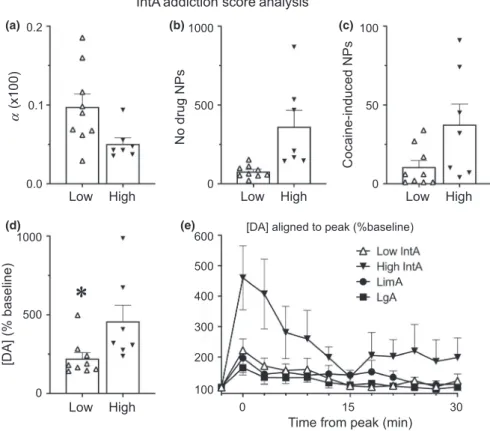
were separated into those that had a score of 2/3 (“High”) and those that had a score of 0/1 (“Low”). Briefly, a rat was given an “Addiction Score” point if it was within the top third of the population on a given measure. The measures used here were α, active nose pokes during the no‐drug period of IntA, and active cocaine‐induced nose pokes during the microdialysis test session (Figure 7; see discussion for rationale of using these measures). There were nine rats that scored 0/1 points (“Low”) and seven rats that scored 2/3 points (“High”). Not surprisingly, the low and high groups differed in their performance on the behavioral measures for which they were classified (Figure 7a–c). In addition, the low and high groups dif-fered in PMax but did not differ in Q0 (data not shown). Importantly, high rats showed greater cocaine‐evoked [DA] than low rats (p = 0.05; Figure 7d). Finally, when High IntA rats (the most “addict‐like”) were compared to LimA and LgA rats (that largely did not show addic-tion‐like behavior), the cocaine infusion increased [DA] to a greater extent in High IntA rats (group × cocaine interaction, F[2,484] = 19.5, p < 0.001; Figure 7e).
3.7
|
Self‐administered cocaine increased
extracellular glutamate and 3‐MT levels
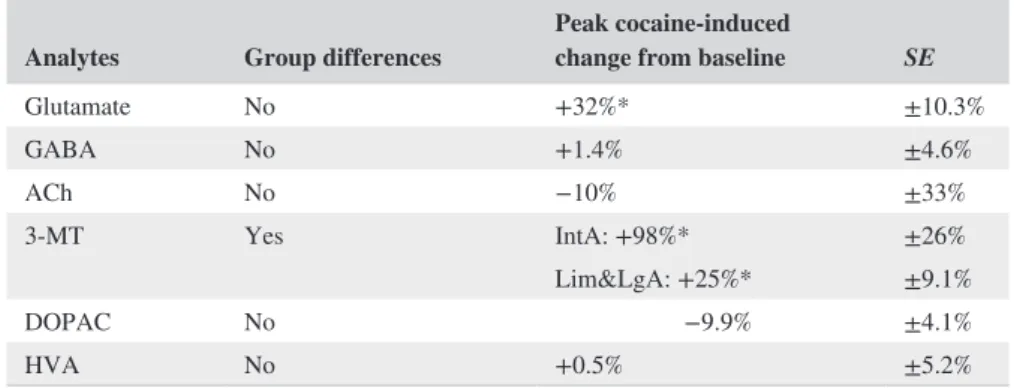
The high performance liquid chromatography coupled with mass spectrometry (HPLC‐MS) technique used here allows for the analysis of a number of analytes, in addition to DA (Table 1). There were no group differences in the baseline levels of any of the analytes quantified, although there was a trend toward group differences in baseline glutamate levels (effect of group, F[2,328] = 2.7, p = 0.08; post hoc analy-sis revealed this to be driven primarily by elevated baseline levels in LimA rats). Therefore, all values were normalized to baseline and cocaine‐induced changes relative to baseline were calculated. Self‐administered cocaine increased extra-cellular glutamate levels relative to baseline in all groups (ef-fect of cocaine, F[1,671] = 3.97, p = 0.04), but there were no group differences (p > 0.1). In addition, self‐administered cocaine increased 3‐MT, a DA metabolite formed extracel-lularly, in all groups (effect of cocaine, F[1,581] = 10.5, p < 0.001). Further, cocaine increased 3‐MT to a greater extent in IntA rats than LgA or LimA rats (group × cocaine
FIGURE 7 Analysis based on “IntA Addiction Score”. Intermittent access (IntA) rats were separated based on their “Addiction Score” (see methods). Rats that scored 2/3 points (n = 7) were classified as “High” and showed increased motivation relative to rats that scored 0/1 points (n = 9), classified as “Low”, as indicated by alpha (α) (a), active nose pokes (NPs) made during the no-drug periods of IntA (b), and cocaine‐ induced active nose pokes (measured during the microdialysis test day) (c). A self‐administered infusion of cocaine evoked a greater increase in [DA], shown as a percent of baseline, in “High” rats than “Low” rats (d). Panel e shows the timecourse of [DA] (% baseline) following cocaine in “High” and “Low” IntA rats, LimA rats, and LgA rats. Values represent means ± SEMs, α values shown in (a) are calculated values multiplied by 100, * indicates a significant (p < 0.05) difference between groups
*
IntA addiction score analysis
0.0 0.1 0.2 (x100) No drug NP s 0 500 1000 0 50 100 Cocaine-induced NP s
Low High Low High Low High
[DA] (% baseline)
0 500 1000
Low High 0 15 30
Time from peak (min) 100 200 300 400 500 600 A [DA] aligned to peak (%baseline)
α
(a)
(d) (e)
interaction, F[2,580] = 4.93, p = 0.008; post hoc analysis re-vealed this to be driven by IntA rats). We also analyzed ex-tracellular GABA, ACh, DOPAC, and HVA levels but none of these differed between groups or changed significantly following cocaine.
3.8
|
Presentation of the cocaine‐
paired cue did not affect extracellular
neurochemical levels
One hour after the self‐administered cocaine infusion, the conditioned stimulus that had been paired with cocaine in-fusions during self‐administration training was presented non‐contingently for 3 min. Presentation of the conditioned stimulus did not produce any detectable changes in any of the analytes that we measured (data not shown; see discussion).
4
|
DISCUSSION
The purpose of this study was to compare the ability of pro-longed LgA and IntA cocaine self‐administration experience to produce addiction‐like behavior (relative to LimA), and how this influenced the ability of self‐administered cocaine to change the concentration of DA in dialysate [DA] in the nucleus accumbens core in vivo. The main findings were: (a) as expected, LgA resulted in much greater total cocaine con-sumption than IntA. (b) Both IntA and LgA produced escala-tion of intake with increasing self‐administraescala-tion experience. (c) IntA (but not LgA) experience increased motivation for cocaine, as indicated by a decrease in α and increase in PMax. (d) IntA rats showed greater cue‐induced reinstatement of co-caine‐seeking than LgA rats. (e) LgA (but not IntA) experi-ence increased the preferred level of cocaine intake when no effort was required (Q0). (f) There were no group differences in the basal levels of [DA], but a single self‐administered IV injection of cocaine increased [DA] in the core of the nu-cleus accumbens to a greater extent in rats with prior IntA experience than those with LgA or LimA experience, and the
latter two groups did not differ. (g) Across all groups, high motivation for cocaine was associated with a greater [DA] response. (h) There were no group differences in dialysate concentrations of glutamate, GABA, ACh, DOPAC or HVA, although cocaine increased 3‐MT to a greater extent in IntA than LimA or LgA rats, consistent with the effects on DA.
4.1
|
IntA experience was more effective
in producing addiction‐like behavior than
LgA experience
Since its introduction in 1998 (Ahmed & Koob, 1998) the LgA procedure has been widely adopted to model the transi-tion to cocaine addictransi-tion in rats, because it was thought to be especially effective in producing a number of addiction‐ like behaviors, relative to short or more LimA procedures (for reviews see, Ahmed, 2012; Edwards & Koob, 2013). In their 1998 paper, Ahmed and Koob reported that LgA, but not shorter access, resulted in escalation of intake. Since that time, it has also been reported that, relative to shorter ac-cess, rats with LgA experience are more motivated to seek cocaine (Paterson & Markou, 2003; Wee, Mandyam, Lekic, & Koob, 2008), take more cocaine in the face of adverse consequences (Xue, Steketee, & Sun, 2012; Bentzley et al., 2014; also see Vanderschuren & Everitt, 2004), and show greater reinstatement of cocaine‐seeking behavior following extinction (Ahmed & Cador, 2006; Kippin, Fuchs, & See, 2006; Mantsch, Yuferov, Mathieu‐Kia, Ho, & Kreek, 2004; Mantsch et al., 2008). As indicated by the excerpt cited in the Introduction from Ahmed (2012), it has been suggested that the critical factor necessary for the emergence of escalation and other addiction‐like behavior is the amount of drug con-sumed. As put by Edwards and Koob (2013), “excessive drug exposure likely remains an indispensable element driving the development of addiction”. However, the findings presented here add to a growing literature indicating that this is not the case.
IntA self‐administration results in much less total co-caine consumption than LgA. Yet as reported here, IntA also
Analytes Group differences Peak cocaine‐induced change from baseline SE
Glutamate No +32%* ±10.3% GABA No +1.4% ±4.6% ACh No −10% ±33% 3‐MT Yes IntA: +98%* ±26% Lim&LgA: +25%* ±9.1% DOPAC No −9.9% ±4.1% HVA No +0.5% ±5.2%
3‐MT, 3‐methoxytyramine; ACh, acetylcholine; DOPAC, 3,4‐dihydroxyphenylacetic acid; GABA, gamma‐ aminobutyric acid; HVA, homovanillic acid.
TABLE 1 Other analytes of interest following a cocaine infusion. Microdialysis allows for the analysis of a number of analytes in addition to DA. Select neurochemicals of interest are shown here. A self‐administered cocaine infusion increased extracellular levels of glutamate and 3‐MT (a dopamine metabolite) in all rats. Cocaine‐evoked 3‐MT was greater in IntA rats than LimA rats or LgA rats. * indicates a significant (p < 0.05) change in analyte concentration following the cocaine infusion relative to baseline
produced escalation of intake and was more effective than LgA in increasing motivation for cocaine and in produc-ing cue‐induced reinstatement of cocaine‐seekproduc-ing behavior. These findings are consistent with a number of recent studies that also report IntA produces escalation of intake, height-ened motivation for cocaine, continued cocaine‐seeking in the face of an adverse consequence, continued cocaine‐seek-ing when it is not available, and greater cue‐induced rein-statement (Allain & Samaha, 2018; Allain et al., 2018; James et al., 2018; Kawa & Robinson, 2019; Kawa et al., 2016; Singer et al., 2018; Zimmer et al., 2012). Collectively, these studies have established that the consumption of the large amount of cocaine associated with LgA is not necessary for the development of addiction‐like behavior and other phar-macokinetic factors appear to be more important (for reviews see Allain et al., 2015; Kawa et al., 2019).
The failure of LgA experience to increase motivation for cocaine in the present study is inconsistent with several pre-vious studies using either the same behavioral economic indi-cators used here (Bentzley et al., 2014; Zimmer et al., 2012) or progressive ratio (PR) tests (Paterson & Markou, 2003; Wee et al., 2008). However, the effects of LgA reported in these studies were often only assessed at a single time point and compared to shorter access, and did not involve within‐ subject comparisons. In the studies that measured how mo-tivation changed with increasing LgA experience (Bentzley et al., 2014), the effects were modest relative to the changes that occur following IntA. Our findings are consistent with other reports that LgA experience does not increase motiva-tion for cocaine, as assessed with either behavioral economic metrics (Oleson & Roberts, 2009) or PR tests (Liu, Roberts, & Morgan, 2005; Quadros & Miczek, 2009; Willuhn et al., 2014 supplementary). In addition, it has been reported that changes in motivation produced by LgA experience are very transient, lasting for only a few days after the last self‐ad-ministration session (Bentzley et al., 2014; James et al., 2018), whereas the increased motivation produced by IntA experience is long‐lasting—still evident after 50 days of ab-stinence (James et al., 2018). In summary, evidence that LgA increases motivation for cocaine is somewhat mixed, whereas IntA has been consistently reported to do so.
When allowed to self‐administer cocaine under low FR schedules of reinforcement, rats generally titrate their re-sponding to achieve a preferred brain concentration of co-caine, which they defend within a wide range of doses (Ahmed & Koob, 1999; Gerber & Wise, 1989; Lynch & Carroll, 2001). This preferred level of consumption was quantified here by the metric Q0—the preferred level of consumption when cost is nil. Q0 presumably represents the brain level of cocaine that produces some optimal desired effect, such that neither more nor less cocaine is better. Some have referred to Q0 as a “hedonic set‐point” (Bentzley et al., 2013), although “settling‐point” may be more appropriate (see Berridge,
2004). Of course, it is not possible to know if Q0 actually reflects subjective hedonic effects in rodents. Nevertheless, LgA experience does increase the preferred level of cocaine consumption, as reported here and by others (Bentzley et al., 2014; James et al., 2018; Oleson & Roberts, 2009). The pres-ent results suggest, therefore, that LgA experience produces tolerance to whatever desired effect of cocaine is defended as price increases, without any change in motivation for cocaine. In contrast, IntA increases motivation for cocaine without any concomitent change in cocaine's desired effects. Although speculative, this may reflect a dissociation between cocaine “wanting” and “liking” (Berridge & Robinson, 2016; Robinson & Berridge, 1993). It also suggests that cocaine intake may escalate with both LgA and IntA, but for very dif-ferent reasons—because of tolerance to cocaine's desired ef-fect in the case of LgA and incentive‐sensitization in the case of IntA (Kawa & Robinson, 2019; Kawa et al., 2016). The idea that consummatory and motivational aspects of behavior are psychologically (and neurobiologically) dissociable has been suggested frequently (e.g., Guillem, Ahmed, & Peoples, 2014; Nicola & Deadwyler, 2000; Oleson et al., 2011; Sharpe & Samson, 2001).
4.2
|
Neither LgA nor IntA experience
altered basal dopamine
A decrease in basal DA levels has been reported when test-ing occurred soon after the discontinuation of high‐dose and/ or high‐intake cocaine self‐administration procedures (Ferris et al., 2011; Mateo, Lack, Morgan, Roberts, & Jones, 2005). However, in the present study neither LgA nor IntA experi-ence had any effect on basal [DA]. Also, we included 13C
6 DA in the aCSF, which allowed us to calculate an extraction fraction for each sample, and thus more accurately estimate basal [DA]. There were no group differences in the extraction fraction, thus bolstering our conclusion that neither LgA nor IntA changed basal [DA] (relative to LimA). This result is consistent with other reports that LgA experience does not alter baseline [DA], relative to rats with shorter access to co-caine (Ahmed et al., 2003) or drug‐naive rats (Calipari et al., 2014). In addition, baseline [DA] did not correlate with any of our measures of addiction‐like behavior, consistent with other studies (Ahmed et al., 2003; Hurd, Weiss, Koob, And, & Ungerstedt, 1989).
4.3
|
IntA, but not LgA, sensitizes cocaine‐
evoked dopamine overflow
There have been very few studies on the neurobiological consequences of IntA experience, and those available have all involved ex vivo measures. Most relevant to the present study are reports by (Calipari et al. 2013; Calipari, Siciliano, Zimmer, & Jones, 2015) that IntA experience sensitizes
![FIGURE 6 Each rat's peak [DA] response to a self‐administered cocaine infusion, as a percent of baseline, was correlated with that rat's performance on several tests of addiction‐like behavior](https://thumb-us.123doks.com/thumbv2/123dok_us/9569254.2833708/11.892.460.820.66.802/response-administered-infusion-baseline-correlated-performance-addiction-behavior.webp)