A New Bayesian Unit Root Test in Stochastic
Volatility Models
Yong Li & Jun Yu
October 2010
A New Bayesian Unit Root Test in Stochastic
Volatility Models
∗Yong Li
Sun Yat-Sen University
Jun Yu
Singapore Management University
September 29, 2010
Abstract: A new posterior odds analysis is proposed to test for a unit root in volatility dynamics in the context of stochastic volatility models. This analysis extends the Bayesian unit root test of So and Li (1999, Journal of Business Economic Statistics) in two im-portant ways. First, a numerically more stable algorithm is introduced to compute the Bayes factor, taking into account the special structure of the competing models. Owing to its numerical stability, the algorithm overcomes the problem of diverged “size” in the marginal likelihood approach. Second, to improve the “power” of the unit root test, a mixed prior specification with random weights is employed. It is shown that the poste-rior odds ratio is the by-product of Bayesian estimation and can be easily computed by MCMC methods. A simulation study examines the “size” and “power” performances of the new method. An empirical study, based on time series data covering the subprime crisis, reveals some interesting results.
Keywords: Bayes factor; Mixed Prior; Markov Chain Monte Carlo; Posterior odds ratio; Stochastic volatility models; Unit root testing.
∗Li gratefully acknowledges the hospitality during his research visit to Sim Kee Boon Institute for
Financial Economics at Singapore Management University. Yu gratefully acknowledges support from the Singapore Ministry of Education AcRF Tier 2 fund under Grant No. T206B4301-RS. Yong Li, Business School, Sun Yat-Sen University, Guangzhou, 510275, China. Jun Yu, School of Economics and Sim Kee Boon Institute for Financial Economics, Singapore Management University, 90 Stamford Road, Singapore 178903. Email: [email protected].
1
Introduction
Whether or not there is a unit root in the volatility of financial assets has been a long-standing topic of interest to econometricians and empirical economists. There are several reasons for this. First, the property of the unit root has important implications for risk premium and asset allocations. For example, compared to a stationary volatility, volatility with a unit root implies a stronger negative relation between the return and the volatility (Chou, 1988). When there is a unit root in volatility, a rational investor should constantly and permanently change the weighting of assets whenever a volatility shock arrives. Sec-ond, owing to the fact that volatility of financial assets is typically highly persistent, econometric models which allow for a unit root in volatility have emerged. Leading ex-amples include the IGARCH model of Engle and Bollerslev (1986) and the log-normal stochastic volatility (SV) model of Harvey, Ruiz and Shephard (1994). However, there is mixed empirical evidence as to whether non-stationarity exists in volatility. Third, if there is a unit root in volatility, the frequentist’s inference, which is often based on asymptotic theory, is often more much complicated; see, for example, Park and Phillips (2001) and Bandi and Phillips (2003) for the development of asymptotic theory for nonlinear models with a unit root.
In a log-normal SV model, the volatility is often assumed to follow an AR(1) model with the autoregressive coefficient ϕ. The test for the unit root amounts to testing ϕ= 1. The estimation of ϕ is complicated by the fact that volatility is latent. In recent years, numerous estimation methods have been developed to estimate SV model; see, Shephard (2005) for a review. It is possible to test for a unit root in volatility without estimating the entire SV model, however. Harvey, Ruiz and Shephard (1994) suggested a classical unit root test by estimating ϕin the log-squared return process. There are two problems with such a test. First, ϕ is less efficiently estimated. Second, all the classical unit root tests suffer from large size distortions because the log-squared return process follows an ARMA(1,1) model with a large negative MA root. This problem is well known in the unit root literature; see, for example, Schwert (1989). To overcome the second problem, Wright (1999) proposed using the unit root test of Perron and Ng (1996), in which the severe distortion in size is nicely mitigated although there are still some distortions left in some parameter settings.
To deal with the first problem, So and Li (SL, hereafter, 1999) proposed a Bayesian unit root test approach based on the Bayes factors (BFs). The test is implemented in two stages. At stage 1, the two competing models are estimated by the Bayesian MCMC
method. As a full likelihood-based method, MCMC provides a more efficient estimate ofϕ
than the least square estimate ofϕ in the log-squared return process, provided the model is corrected specified. At stage 2, the BF is obtained from the MCMC samples. The BF is a very important statistic in Bayesian literature and has served as the gold standard for Bayesian model testing and comparison for a long time (Kass and Rafety, 1995; Geweke, 2007). However, it is necessary to point out that the impact of prior specifications to the BF is different from that of estimation. As for estimation, it is well-known that in large samples, prior distributions can be picked for convenience because their effects are insignificant (Kass and Raftey, 1995). For the BF, standard improper noninformative priors cannot be applied since such priors are defined only up to a constant; hence the resulting BF is a multiple of an arbitrary constant. In fact, as pointed out by Kassand Raftey (1995), if a prior with a very large spread is used on some parameter under a model to make it “noninformative”, this behavior will force the BF to favor its competitive model. This problem is well-known as Jeffreys-Lindley-Bartlett’s paradox in Bayesian literature. Consequently, great care should be taken when applying the uninformative prior for a unit root testing problem.
To avoid the difficulty, the prior distributions are generally taken to be proper and not having too big a spread. Moreover, it is often suggested that for Bayesian model comparison, an equal model prior should be used. This practice was followed by SL. However, it is now known in the unit root literature that if a proper prior is adopted for parameters and an equal weight is used to represent the prior model ignorance, there is a bias toward stationary models; see, for example, Phillips (1991) and Ahking (2008).
To overcome this problem, the first contribution of our paper is to propose a mixed prior distribution with a random weight for the unit root test. The main idea is that when the prior information is not available, we can obtain an estimate for the random weight when a vague prior is assigned. If the data are generated from a unit root process, it can be expected that a larger weight is assigned to the unit root process. In other words, this larger weight is used to adjust the bias towards stationarity in the posterior odds analysis for unit root with the estimated weight. This idea seems to be new to the unit root literature.
Our second contribution lies in the computation of the BF. The computation of the BF often involves high-dimensional integration and, hence is numerically demanding. SL (1999) applied the marginal likelihood approach proposed by Chib (1995) to estimate the BF for the unit root test. This approach is very general and has a wide applicability. How-ever, for the SV models, since the dimension of the parameters and the latent volatility is
very high, the marginalization of the joint probability density over the parameters and the latent variable poses a formidable computational challenge. In this paper, instead of cal-culating the marginal likelihood, we derive a novel form for the BF by taking into account the special structure of the competing models. This new form requires no marginalization and hence numerically, it is more stable. We also show that this evaluation of the BF in the new form is a by-product of Bayesian MCMC estimation and, hence, it is easy to compute.
Our third contribution is that we have performed the unit root test in a more general model which allows for a fat-tailed conditional distribution, and uses real data from a period which cover the recent subprime crisis. This test under this general set-up and with new data suggests that the unit root model is more difficult to reject.
This paper is organized as follows. In Section 2, the simple log-normal SV model and the problem of the unit root test are described. In Section 3, the new approach for the posterior odds analysis of unit root is discussed. The performances of the proposed unit root test procedure are examined using simulation data in Section 4. Section 5 considers some empirical applications. Section 6 concludes.
2
Stochastic Volatility Models and a Unit Root Test
The simple log-normal SV model is expressed in the form:
yt= exp(ht/2)ut, ut∼N(0,1), (1)
ht=τ +ϕ(ht−1−τ) +σvt, vt∼N(0,1), (2)
where t = 1,2,· · · , n, yt is the continuously compounded return, ht the unobserved
log-volatility, h0 ∼ N (
τ,1−σ2ϕ2
)
when |ϕ| < 1, h0 ∼ N(τ, σ2) when ϕ = 1, and (ut, ηt)
independently standard normal variables for all t. This model explains several important stylized facts in the financial time series including volatility clustering, and its continuous time version has been used to price options.
The primary concern of our paper is to testϕ= 1 against|ϕ|<1. SL (1999) proposed a test by first estimating two competing models by a powerful MCMC algorithm – Gibbs sampler. This Bayesian simulation based method generates samples from the joint pos-terior distribution of the parameters and the latent volatility (so the data augmentation technique is adopted here). After that, the posterior odds ratio was calculated using the marginal likelihood method of Chib (1995).
(τ, σ, ϕ) of (τ, σ) in the unit root case), y = (y1,· · · , yn) the observation vector, h =
(h1,· · · , hn) the vector of the latent variables. Exact maximum likelihood methods are
not possible because the likelihoodp(y|θ) does not have a closed-form expression. Bayesian methods overcome this difficulty by the data-augmentation strategy (Tanner and Wong, 1987), namely, the parameter space is augmented from θ to (θ,h). By successive condi-tioning and assuming prior independence inθ, the joint prior density is
p(τ, σ, ϕ,h) =p(τ)p(σ)p(ϕ)p(h0)
n
∏
t=1
p(ht|ht−1, θ). (3)
The likelihood function is
p(y|θ,h) =
n
∏
t=1
p(yt|ht). (4)
Obviously, both the joint prior density and the likelihood function are available analyti-cally, provided that the analytical expressions for the prior distributions ofθare supplied. By Bayes’ theorem, the joint posterior distribution of the unobservables given the data is given by: p(τ, σ, ϕ,h|y)∝p(τ)p(σ)p(ϕ)p(h0) n ∏ t=1 p(ht|ht−1, θ) n ∏ t=1 p(xt|ht). (5)
Gibbs sampler was used by SL to generate correlated samples from the joint posterior distribution (5). In particular, it samples each variate, one at a time, from (5). When all the variates are sampled in a cycle, we have one sweep. The algorithm is then re-peated for many sweeps with the variates being updated with the most recent samples, producing draws from Markov chains. With regularity conditions, the draws converge to the posterior distribution at a geometric rate. By the ergodic theorem for Markov chains, the posterior moments and marginal densities may be estimated by averaging the corre-sponding functions over the sample. For example, one may estimate the posterior mean by the sample mean, and obtain the credible interval from the marginal density. When the simulation size is very large, the marginal densities can be regarded as exact, enabling exact finite sample inferences.
To explain the unit root test of SL, letM0 be the model formulated in the null
hypoth-esis (i.e. ϕ= 1), M1 the model formulated under the alternative hypothesis (i.e. ϕ is an
unknown parameter), π(Mk) the prior model probability density, p(y|Mk) the marginal
likelihood of model k, and p(Mk|y) the posterior probability densities, where k = 0,1.
Under the Bayesian framework, testing the null hypothesis versus the alternative is equiv-alent to comparing the two competing models, M0 versus M1. Given the prior model
probability density π(M0) andπ(M1) = 1−π(M0), the datayproduce a posterior model
density, p(M0|y) and p(M1|y) = 1−p(M0|y).
Bayes’ theorem gives rise to
p(M0|y) p(M1|y) = p(y|M0) p(y|M1) × π(M0) π(M1) ; (6) that is,
Posterior Odds Ratio (POR) = Bayes Factor (BF)×Prior Odds Ratio, (7) or
log10(POR) = log10 (BF) + log10(Prior Odds Ratio), (8)
where the BF is defined as the ratio of the marginal likelihood of the competing models. If the prior odds ratio set to 1, as is done in much of the Bayesian literature, the posterior odds ratio takes the same value as the BF. When the posterior odds ratio is larger than 1, M0 is favored over M1, and vice versa. In SL, the sign of log10(BF) was checked. If it
is positive, M0 is favored over M1. In general, one has to check the sign of log10(POR).
The marginal likelihood,p(y|Mk), can be expressed as:
p(y|Mk) =
∫ Ωk∪Ωh
p(y,h|θk, Mk)p(θk|Mk)dhdθk, (9)
where Ωk and Ωh are the support of θk and h, respectively. Alternatively, the marginal
likelihood can be expressed as:
p(y|Mk) =
∫ Ωk∪Ωh
p(y|θk, Mk)p(θk|Mk)dθk. (10)
As solving the integrals in (9) and (10) requires high-dimensional numerical integration, Chib (1995) suggested evaluating the marginal likelihood by rearranging Bayes’ theorem
p(y|Mk) =
p(y|θk, Mk)p(θk|Mk)
p(θk|y, Mk)
.
Thus, the log-marginal likelihood may be calculated by:
lnp(y|θk, Mk) + lnp(θk|Mk)−lnp(θk|y, Mk), (11)
where θk is an appropriately selected high density point in estimated Mk and Chib
sug-gested using the posterior mean, θk. The first term of Equation (11) is the log-likelihood
evaluated at θk. Since it is marginalized over the latent volatilities, h, it is
density evaluated atθk and it has to be specified by the econometrician. The third
quan-tity involves the posterior density which is only known up to a normality constant. The approximation can be obtained by using a multivariate kernel density estimate, based on the posterior MCMC sample of θk.
To estimate θ, SL used the flat normal prior for τ, an inverse Gamma prior for σ2. Forϕ, four different priors were used – uniform on the interval (0,1), truncated normal on (0,1), two truncated Beta’s on (0,1). For the unit root test, the prior odds ratio is set to 1. This choice was argued to reflect prior ignorance. Simulation studies were conducted by SL to check the performances of their Bayesian unit root test. While in general, their test performs reasonably well, we have identified two problems. First, the “size” diverges with the sample size. That is, when the sample size gets larger, the probability for the test to pick M0 when the data are simulated from M0 gets smaller. Since their
empirical results suggest that M1 is favored overM0, concerns about the diverged “size”
are especially important. Second, whenϕis very close to 1, the test does not seem to have good “power” properties.
We argue that there is an obvious inconsistency between the choice of the prior ofϕ
and the choice of the prior odds. On the one hand, using a prior density whose support exclude ϕ= 1 means that the researcher has no prior confidence aboutM0. On the other
hand, setting the prior odds ratio to 1 implies that the researcher is equally confident about the two competing models. It is well-known in the unit root literature that the posterior distribution is sensitive to the prior specification; see, for example, Phillips (1991), and the discussion and the rejoinder in the same issue. From Equation (6), it is obvious that the prior odds ratio is important. As a result, it is reasonable to believe that the diverged “size” may be due to the choice of the priors.
Consequently, we suggest two ways to improve the unit root test of SL. First, a com-putationally easier and numerically more stable algorithm is introduced to compute the BF, taking into account the special structure of the competing models. Our method com-pletely avoids the calculation of marginal likelihood. Second, different priors for ϕ and the model specification are employed. Our priors of ϕ allow for a positive mass at unity. More important, a mixed model prior with random weights is used.
3
New Bayesian Unit Root Testing
3.1 A New Set of Priors
Since we are concerned about the suitability of a prior forϕover (−1,1) for the unit root test, we have firstly broadened the support of the prior distribution. In particular, we consider the prior densities that assign a positive mass at unity. To be more specific, the prior is set to:
f(ϕ) =πI(ϕ= 1) + (1−π)fC(ϕ)I(−1< ϕ <1), (12)
where I(x) is the indicator function such that I(x) = 1 if x is true, and 0, if otherwise,
π the weight that represents the prior probability for model M0, and fC(ϕ) a proper
distribution that will be specified later. Whenπ >0, a positive mass is assigned to model
M0.1The mixed prior of this kind has been widely used in the unit root literature; see, for
example, Sim (1988) and Schotman and van Dijk (1991).
As discussed earlier, when π(M0) = π(M1) = 0.5, POR takes the same value as the
BF, justifying the use of the BF for Bayesian model comparison. However, since we assign probability π to modelM0, when we specify the prior forϕ, we have to assignπ(M0) =π
to be logically consistent. In this case, the prior odds ratio is π/(1−π). One choice is to setπ = 1/2. If so, POR is the same as the BF and we cannot improve the “power” of the unit root test of SL. It is known in the unit root literature that this prior tends to favor stationary or trend-stationary hypothesis; see, for example, Ahking (2008).
Alternatively, we can choose π to be a uniform distribution over [0,1]. Ideally, a training sample should be selected to help determine the mean ofπ(denoted byπ), which may be used to compute the prior odds ratio π/(1−π). When π ̸= 0.5, the POR no longer takes the same value as the BF. If π >0.5, log10(π/(1−π))>0, and more weight will be assigned to the positive mass at unity. In this case, compared with the BF, the POR will be more in favor of the unit root hypothesis. It is expected that this feature 1In the unit root literature, for the autoregressive coefficient, an “objective” ignorance prior is the so-called Jeffreys or reference prior of Jeffreys (1961) and Berger and Bernardo (1992). As shown in Phillips (1991) these priors are intended to represent a state ignorance about the value of the autoregression coefficient and are very different from flat priors in the unit root testing problem. Unfortunately, these priors are improper andp(θk|Mk) =Ckf(θk) wheref(θk) is a nonintegrable function andCkis an arbitrary
positive constant. As a result the posterior odds ratio can be rewritten as: POR = BF = C0 C1 ∫ Ω0∪Ωhp(y,h|θ0, M0)f(θ0)dhdθ0 ∫ Ω1∪Ωhp(y,h|θ1, M1)f(θ1)dhdθ1 (13) Thus, the posterior odds ratio and the BF are not well defined since they both depend on the arbitrary constantsC0/C1. This is the reason why we decide not to use the Jeffrey’s prior to do the posterior odds analysis for unit root.
should improve the “power” of the test because if the data indeed come from a unit root model, it is expected thatπ > 0.5. When data are generated from a stationary model, it is expected that π < 0.5. Instead of splitting the entire sample into the training sample and the sample for estimation, we estimate π from the entire sample in order to get a precise estimate of π. The idea of estimatingπ was partly inspired by Aitkin (1991) and Schotman and van Dijk (1991). In Aitkin (1991) the data are re-used to get the prior distributions for the parameters while in Schotman and van Dijk (1991) the threshold parameter of the defined interval for ϕis dependent on the data.
3.2 Computing Posterior Odds
Although the marginal likelihood approach proposed by Chib (1995) is very general and has been applied in various studies (Kim, et al 1998; Chib et al, 2002; Berg et al, 2004), it requires one to calculate the log-likelihood functions lnp(y|θk, Mk),k= 0,1. For the SV
models, this is a challenging task. In this paper, we acknowledge that unit root testing is a special model comparison problem which has the special structure to link the competing models. The structure is that the two marginal likelihood functions have the common latent variable which may be exploited to facilitate the computation of BF. Instead of calculating the two marginal likelihood functions as suggested in Chib (1995), our method only requires us to compute the BF directly.
In a recent contribution, Jacquier, Polson and Rossi (2004) proposed an efficient method to compute BF for comparing the basic SV model with the fat-tailed SV model. Their method shows that the BF can be written as the expectation of the ratio of un-normalized posteriors with respect to the posterior under the fat-tailed SV model. Here we generalize the idea by showing that the BF for unit rooting testing also can be rewritten as a simple function of posterior quantities by introducing an appropriate weight function. To fix the idea, note that:
BF = ∫ Ω0∪Ωh p(θ0|M0)p(y,h|θ0, M0) p(y|M1) dθ0dh = ∫ Ω1∪Ωh p(θ0|M0)p(y,h|θ0, M0)w(ϕ|θ0) p(y|M1) dϕdθ0dh = ∫ Ω1∪Ωh p(θ0|M0)p(y,h|θ0, M0)w(ϕ|θ0) p(h,θ1|y, M1) p(y, h, θ1|M1) dϕdθ1dh = ∫ Ω1∪Ωh p(θ0|M0)w(ϕ|θ0)p(y,h|θ0, M0) p(θ1|M1)p(y,h|θ1, M1) p(h,θ1|y, M1)dϕdθ1dh,
where w(ϕ|θ0) is an arbitrary weight function ofϕconditional on θ0 such that ∫
w(ϕ|θ0)dϕ= 1.
In practice, the prior distribution of the common parameter vectorθ0under two models
is often specified as the same, that isp(θ0|M0) =p(θ0|M1). Furthermore, for the purpose
of the posterior odds analysis, p(ϕ|θ0, M1) is required to be a proper conditional prior
distribution. This distribution can be regarded as a weight function. Hence,
BF = ∫ Ω1∪Ωh p(θ0|M0)p(ϕ|θ0, M1)p(y,h|θ0, M0) p(θ1|M1)p(y,h|θ1, M1) p(h,θ1|y, M1)dϕdθ1dh = ∫ Ω1∪Ωh p(θ0|M0)p(ϕ|θ0, M1)p(y,h|θ0, M0) p(θ1|M1)p(y,h|θ1, M1) p(h,θ1|y, M1)dϕdθ1dh = ∫ Ω1∪Ωh p(y,h|θ0, M0) p(y,h|θ1, M1) p(h,θ1|y, M1)dϕdθ1dh=E { p(y,h|θ0, M0) p(y,h|θ1, M1) } ,(14)
where the expectation is with respect to the posterior distribution p(h,θ1|y, M1).
From (14), it can be seen that the BF is only a by-product of Bayesian estimation of the SV model in the alternative hypothesis, namely, under the stationary case. Once draws from Markov chains are available, the BF can be approximated conveniently and efficiently by averaging over the MCMC draws. In fact, only one line of code is needed to compute the BF. In detail, let{h(s),θ1(s)},s= 1,2,· · ·, S, be the draws, generated by the MCMC technique, from the posterior distributionp(h,θ1|y, M1). The BF is approximated
by: BF ≈ 1 S S ∑ s=1 { p(y,h(s)|θ(0s), M0) p(y,h(s)|θ(1s), M1) . }
When the prior odds ratio is known, one can easily obtain the posterior odds ratio as in (6) for the unit root test.
In the context of the simple log-normal SV model, supposeθ(1), ..., θ(S)andh(1), ..., h(S)
are the MCMC draws, then:
BF ≈ 1 S S ∑ s=1 exp { − ∑n t=2(1−ϕ(s))(µ(s)−h (s) t−1)(2h (s) t −h (s) t−1(1 +ϕ(s))−µ(s)(1−ϕ(s))) 2(τ(s))2 } . (15)
4
A Simulation Study
In this section, we check the reliability of the proposed Bayesian unit root test procedure using simulated data. For the purposes of comparison, the same design as in SL is adopted. In particular, for ϕ, three true values are considered – 1,0.98,0.95, corresponding to the
nonstationary case, the nearly nonstationary case, and the stationary case. The other two parameters are set at τ =−9 andσ2 = 0.1. These values are empirically reasonable for daily equity returns. Three different sample sizes have been considered – 500, 1000 and 1500. The number of replications is always fixed at 100.
For the mixed prior of ϕ, three distributions have been considered forfC(ϕ) in (12),
namely,U(0,1), Beta(10,1), Beta(20,2).2 These three distributions were used as the priors forϕin SL. A key difference is that we have mixed them with a point mass at unity with probability π and estimateπ from actual data. Both the pure priors and the mixed prior are implemented in combination with our new way of computing the posterior odds. The Bayesian estimator obtained from a pure prior is denoted by ϕe and that obtained from the mixed prior of the form (12) is denoted byϕb.
It is important to emphasize that our proposed unit root approach involves two steps. In the first step, the uniform prior defined in the interval (0,1) is assigned to the weight
π and a MCMC algorithm is implemented to fit the stationary model and to produce a Bayesian estimate for π. In the second step, based on the estimated weight, we compute log10(POR) for the unit root test using the same MCMC output.
Following the suggestion of Meyer and Yu (2000), we make use of a freely available Bayesian software, WinBUGS, to do the Gibbs sampling. WinBUGS provides an easy and efficient implementation of the Gibbs sampler. It has been extensively used to estimate various univariate and multivariate SV models in the literature; see for example, Yu (2005), Huang and Xu (2009), and Yu and Meyer (2006). In each case, we simulated 15000 samples with 10000 discarded as burn-in samples. The simulation studies are implemented using R2WinBUGS (Sturtz, Ligges, and Gelman, 2005).
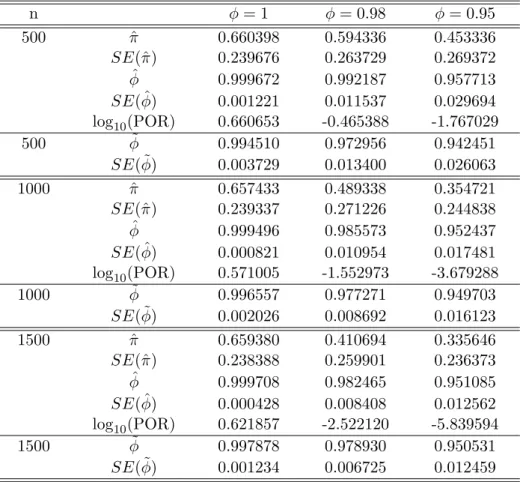
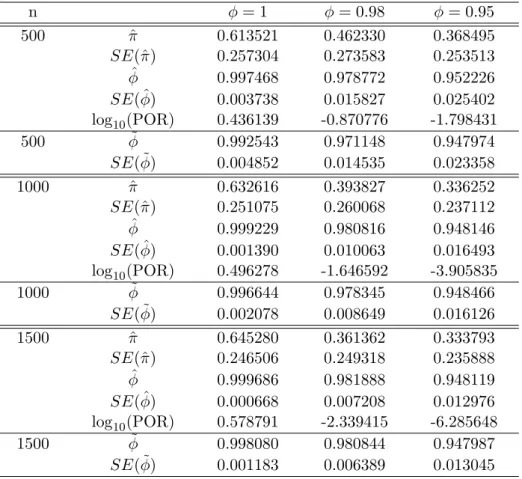
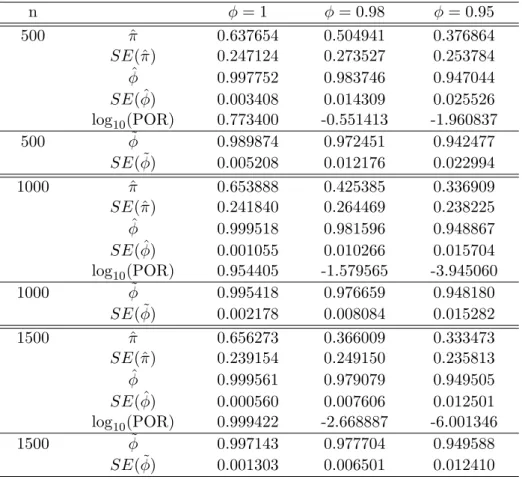
Tables 1-3 reports the estimates ofϕ(obtained as the posterior mean ofϕ), the standard errors ofϕ(SE, hereafter, defined as the mean of the standard errors ofϕ, averaged across the replications), the estimate of π, and the mean values of log10(POR) when the mixed priors are used. When the pure priors are used, we report the estimates ofϕand the SE of
ϕ. The three tables correspond to the three different priors, respectively, and are compared to Table 1 in SL where the BF is calculated using the marginal likelihood method.
The following conclusions may be drawn after we examine the three tables and compare them to Table 1 in SL. First, the estimates ofϕare always close to the true value and the SEs are always small, suggesting MCMC provides reliable estimates on ϕ with both sets
2
SL used four prior distributions for ϕ. When implementing them in WinBUGS, unfortunately, we found there was a trap error with the truncated normal prior. As a result, the truncate normal is not considered here.
of priors. Furthermore, the behavior of estimates improves (smaller bias and SE) when the sample size increases. Second, when data are generated from a unit root model, using a mixed prior always leads to better estimates of ϕ than using a pure prior. The bias is smaller and the SE is also reduced. Third, in the two stationary cases, no prior dominates the other although the pure priors tend to lead to a slightly smaller SE. There is no pattern in the bias, however. Fourth, when 500 observations are generated from a stationary model withϕ= 0.98 and a pure uniform prior is used, SL found that log10(P OR) took a wrong sign, suggesting that on average a unit root model cannot be rejected even though data are simulated from the stationary model. When the mixed priors are used, the sign of log10(P OR) becomes negative which is the correct sign. This piece of evidence suggests that the mixed priors improve the power of the test. Fifth, when data are generated from a unit root model, our estimate of π is always larger than 0.5. This result is encouraging and, as it is shown below, helps improve the “size” and “power” performances of our test relative to the test of SL.
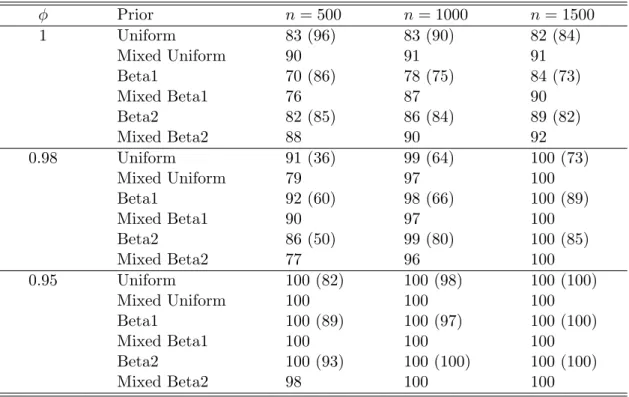
Table 4 reports the proportion of the correct decision over the 100 replications when both the mixed priors and the pure priors are used in conjunction with the BF (15). The results for the pure priors are compared to those reported in Table 2 of SL where the marginal likelihood method was used. Several results emerge from Table 4 and the comparison of Table 4 with Table 2 of SL.
First, when the marginal likelihood method is used to compute the BF, the “size” of the unit root test diverges. For example, the test of SL chooses the correct model 96%, 86% and 85% of the time when 500 observations are used but only 84%, 73% and 82% of the time when 1500 observations are used for the three priors, respectively. This result is by no mean satisfactory because it suggests that the more data does one has, the less reliable the unit root test is. When the BF is computed using (15), without changing the priors of SL, we find the “size” does not diverge any more. The correct model is chosen 83%, 70%, and 82% of the time when 500 observations are used and 82%, 84%, and 89% of the time when 1500 observations are used. However, the “type I” errors are not in acceptable range.
Second, comparing the performance of the pure priors and the mixed priors, the pure priors seem to be have higher “power” than the mixed priors. However, when the sample size is large or ϕis not so close to unity, the difference in power disappear. Moreover, the gain in “power” comes with the cost of lower “size”. This is true even when the sample size is 1500. Third, formula (15) not only ensures a diverged size, but also increases the power of the unit root tests, when either the pure priors or the mixed priors are used. For
example, when ϕ= 0.98 and the sample size is 1000, the marginal likelihood approach of SL has a power of 66% while the pure and the mixed priors have a power of 98% and 97%, respectively. The gain is remarkable because there is also a substantial gain in the “size” at this sample size.
Table 1: Posterior mean of π and ϕ and log10(P OR) from simulated data. ˆπ, ˆϕ, and
SE(ϕ) are obtained using the mixed prior with fC beingU(0,1). ˜ϕ,SE( ˜ϕ) are obtained
using the pure prior U(0,1).
n ϕ= 1 ϕ= 0.98 ϕ= 0.95 500 πˆ 0.660398 0.594336 0.453336 SE(ˆπ) 0.239676 0.263729 0.269372 ˆ ϕ 0.999672 0.992187 0.957713 SE( ˆϕ) 0.001221 0.011537 0.029694 log10(POR) 0.660653 -0.465388 -1.767029 500 ϕ˜ 0.994510 0.972956 0.942451 SE( ˜ϕ) 0.003729 0.013400 0.026063 1000 πˆ 0.657433 0.489338 0.354721 SE(ˆπ) 0.239337 0.271226 0.244838 ˆ ϕ 0.999496 0.985573 0.952437 SE( ˆϕ) 0.000821 0.010954 0.017481 log10(POR) 0.571005 -1.552973 -3.679288 1000 ϕ˜ 0.996557 0.977271 0.949703 SE( ˜ϕ) 0.002026 0.008692 0.016123 1500 πˆ 0.659380 0.410694 0.335646 SE(ˆπ) 0.238388 0.259901 0.236373 ˆ ϕ 0.999708 0.982465 0.951085 SE( ˆϕ) 0.000428 0.008408 0.012562 log10(POR) 0.621857 -2.522120 -5.839594 1500 ϕ˜ 0.997878 0.978930 0.950531 SE( ˜ϕ) 0.001234 0.006725 0.012459
5
Empirical Studies
In the empirical studies, two sources of data are used. The first empirical study is based on the data used by SL.3 To preserve space, however, we only report the empirical results for the Taiwan Stock Exchange Weighted Stock Index (TWSI). The empirical results for the
Table 2: Posterior mean of π and ϕ and log10(P OR) from simulated data. ˆπ, ˆϕ, and
SE(ϕ) are obtained using the mixed prior with fC being Beta(10,1). ˜ϕ, SE( ˜ϕ) are
ob-tained using the pure prior Beta(10,1).
n ϕ= 1 ϕ= 0.98 ϕ= 0.95 500 πˆ 0.613521 0.462330 0.368495 SE(ˆπ) 0.257304 0.273583 0.253513 ˆ ϕ 0.997468 0.978772 0.952226 SE( ˆϕ) 0.003738 0.015827 0.025402 log10(POR) 0.436139 -0.870776 -1.798431 500 ϕ˜ 0.992543 0.971148 0.947974 SE( ˜ϕ) 0.004852 0.014535 0.023358 1000 πˆ 0.632616 0.393827 0.336252 SE(ˆπ) 0.251075 0.260068 0.237112 ˆ ϕ 0.999229 0.980816 0.948146 SE( ˆϕ) 0.001390 0.010063 0.016493 log10(POR) 0.496278 -1.646592 -3.905835 1000 ϕ˜ 0.996644 0.978345 0.948466 SE( ˜ϕ) 0.002078 0.008649 0.016126 1500 πˆ 0.645280 0.361362 0.333793 SE(ˆπ) 0.246506 0.249318 0.235888 ˆ ϕ 0.999686 0.981888 0.948119 SE( ˆϕ) 0.000668 0.007208 0.012976 log10(POR) 0.578791 -2.339415 -6.285648 1500 ϕ˜ 0.998080 0.980844 0.947987 SE( ˜ϕ) 0.001183 0.006389 0.013045
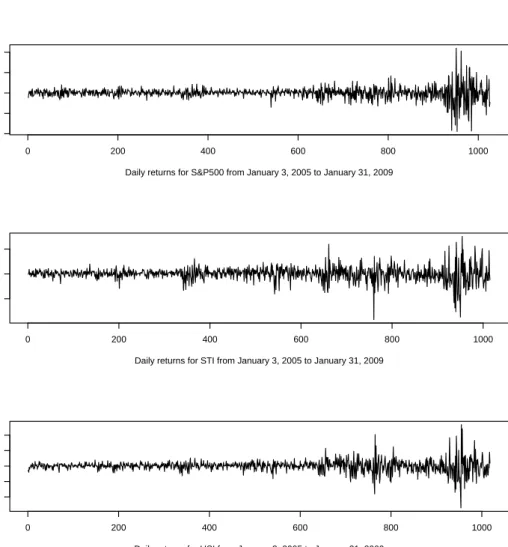
other indices are qualitatively the same. The second empirical study is based on six indices, all taking from the period of the 2007-2008 subprime crisis. These are the de-meaned daily returns for S&P 500, Straits Times Index (STI) in Singapore, Hang Seng Index (HSI) of Hong Kong, Taiwan Weighted Index (TWI), NIKKEI 225, and Shanghai Composite Index (SSE). Daily closing prices for all the indices are collected from Yahoo.finance for the period of January 3, 2005 to January 31, 2009. There are 1026, 1015, 1018, 997, 1000, 1048 observations for the six indices, respectively. The six return series are plotted in Figures 1-2. It is known that all the markets were more volatile during the period of the financial crisis. From the plots, the nonstationarity in volatility seems to be more pronounced in S&P500 and Nikkei 225.
In all cases, we only use one common mixed prior for ϕ in which fC(ϕ∗) is assumed
to be Beta(20,1.5) where ϕ = 2ϕ∗−1. We always simulate 35000 random samples with 10000 discarded as burn-in samples.
0 200 400 600 800 1000 −10 −5 0 5 10
Daily returns for S&P500 from January 3, 2005 to January 31, 2009
0 200 400 600 800 1000
−5
0
5
Daily returns for STI from January 3, 2005 to January 31, 2009
0 200 400 600 800 1000
−10
0
5
10
Daily returns for HSI from January 3, 2005 to January 31, 2009
Figure 1: Time series plot for S&P500, STI and HSI returns over the period from January 3, 2005 to January 31, 2009.
0 200 400 600 800 1000 −6 −2 2 4 6
Daily returns for TWI from January 3, 2005 to January 31, 2009
0 200 400 600 800 1000
−10
0
5
10
Daily returns for Nikkei225 from January 3, 2005 to January 31, 2009
0 200 400 600 800 1000
−10
−5
0
5
Daily returns for SSE from January 3, 2005 to January 31, 2009
Figure 2: Time series plot for TWI, Nikkei225 and SSE returns over the period from January 3, 2005 to January 31, 2009.
Table 3: Posterior mean of π and ϕ and log10(P OR) from simulated data. ˆπ, ˆϕ, and
SE(ϕ) are obtained using the mixed prior with fC being Beta(20,2). ˜ϕ, SE( ˜ϕ) are
ob-tained using the pure prior Beta(20,2).
n ϕ= 1 ϕ= 0.98 ϕ= 0.95 500 πˆ 0.637654 0.504941 0.376864 SE(ˆπ) 0.247124 0.273527 0.253784 ˆ ϕ 0.997752 0.983746 0.947044 SE( ˆϕ) 0.003408 0.014309 0.025526 log10(POR) 0.773400 -0.551413 -1.960837 500 ϕ˜ 0.989874 0.972451 0.942477 SE( ˜ϕ) 0.005208 0.012176 0.022994 1000 πˆ 0.653888 0.425385 0.336909 SE(ˆπ) 0.241840 0.264469 0.238225 ˆ ϕ 0.999518 0.981596 0.948867 SE( ˆϕ) 0.001055 0.010266 0.015704 log10(POR) 0.954405 -1.579565 -3.945060 1000 ϕ˜ 0.995418 0.976659 0.948180 SE( ˜ϕ) 0.002178 0.008084 0.015282 1500 πˆ 0.656273 0.366009 0.333473 SE(ˆπ) 0.239154 0.249150 0.235813 ˆ ϕ 0.999561 0.979079 0.949505 SE( ˆϕ) 0.000560 0.007606 0.012501 log10(POR) 0.999422 -2.668887 -6.001346 1500 ϕ˜ 0.997143 0.977704 0.949588 SE( ˜ϕ) 0.001303 0.006501 0.012410
Additionally, in our testing for a unit root, we also estimate the following SV-t model,
yt= exp(ht/2)ut, ut∼t(k), (16)
ht=τ +ϕ(ht−1−τ) +σvt, vt∼N(0,1), (17)
and test for a unit root under the more general setting. It is well known in the literature that the simple log-normal SV model cannot produce enough kurtosis as it is observed in actual data. This is the main motivation for introducing a fat-tailed conditional distribu-tion of the error termut. Here we use atdistribution. Relative to the normal distribution,
the t distribution will absorb some abnormal behavior in ht, as a result, we expect that
the volatility process is smoother, making the unit root model more difficult to reject. Fol-lowing much of the literature, we rewrite thetdistribution with a mixture representation, namely,
ut|wt∼N(0, wt), wt∼
1 Γ(k/2, k/2).
Table 4: Proportion of correct decisions by the two methods ϕ Prior n= 500 n= 1000 n= 1500 1 Uniform 83 (96) 83 (90) 82 (84) Mixed Uniform 90 91 91 Beta1 70 (86) 78 (75) 84 (73) Mixed Beta1 76 87 90 Beta2 82 (85) 86 (84) 89 (82) Mixed Beta2 88 90 92 0.98 Uniform 91 (36) 99 (64) 100 (73) Mixed Uniform 79 97 100 Beta1 92 (60) 98 (66) 100 (89) Mixed Beta1 90 97 100 Beta2 86 (50) 99 (80) 100 (85) Mixed Beta2 77 96 100 0.95 Uniform 100 (82) 100 (98) 100 (100) Mixed Uniform 100 100 100 Beta1 100 (89) 100 (97) 100 (100) Mixed Beta1 100 100 100 Beta2 100 (93) 100 (100) 100 (100) Mixed Beta2 98 100 100
Table 1: Both the pure priors and mixed priors are used in conjunction with the proposed method of computing the BF. The numbers are obtained from 100 replications. The numbers in parentheses are extracted from Table 2 of SL where the marginal likelihood method is used to compute the BF.
It is easy to show that for the SV-t model, the BF has the same expression as in (15). Table 5 reports the posterior mean of ϕ, π, log10(BF) and log10(POR) for TWSI as used by SL. The empirical results based on the simple log-normal SV model suggest that although the posterior mean ofϕis so close to unity and the estimate ofπis large than 0.5, we still reject the unit root hypothesis. The marginal likelihood of the estimated stationary model is so much larger than that of the estimated unit root model that the adjustment from the estimated π is not able to change the sign of log10(BF) in log10(POR). This result perhaps explain why SL got conflicting empirical results when different priors are used. Interestingly, when the SV-t model is estimated, the estimated degrees of freedom parameter is very large (29.17), suggesting that the t-distribution does not make much contribution to the model. Not surprisingly, the results for the unit root test remain nearly the same. However, the estimated volatility process is smoother in the SV-t model.
Table 5: Empirical results from TWSI
Model ϕ π k log10(BF) log10(POR)
SV 0.9994 0.6204 NA -0.9335 -0.7109
SV-t 0.9997 0.6358 29.17 -0.7688 -0.5268
STI, HSI, TWI, Nikkei225 and SSE. Several interesting empirical results arise from Table 6. First, in all cases, the estimates ofϕare very close to unity, and this is more so in all the estimated SV-t models; the estimated π is always larger than 0.5, and this is more so in all the estimated SV-t models, with one exception in the SSE when the pure prior is used. Second, if the unit root test is performed based on the pure prior in the simple SV model (i.e. using log10(BF)), we cannot reject the unit root model in S&P500, STI, Nikkei; we have to reject the unit root model in TWI and SSE; we are not sure in HSI. Third, if the unit root test is performed based on the mixed prior in the simple SV model (i.e. using log10(POR)), HSI is now clear nonstationary and TWI becomes nonstationary. Fourth, if the unit root test is performed based on the pure prior in the SV-t model (i.e. using log10(BF)), SSE is the only nonstationary series. Fifth, if the unit root test is performed based on the mixed prior in the SV-t model (i.e. using log10(POR)), all the series have a unit root. Finally, there are two cases where the mixed prior leads to a different result from the pure prior, namely, TWI in the context of simple SV model and SSE in the context of SV-t model. In both cases, the estimated π is much large than 0.5 so that log10(π/(1−π)) is much larger than 0, which makes the sign of log10(POR) different from that of log10(BF).
6
Conclusion
The main purpose of this paper is to provide a new Bayesian approach to testing the unit root hypothesis in volatility in the context SV models. The test procedure is based on the posterior odds. Unlike the parameter estimation which permits the use of objective and uninformative priors, the BF is ill-defined because it depends on the arbitrary constants. As a result, an informative prior has to be used in order to do the posterior odds analysis. To overcome this difficulty, one simple method suggested in Kass and Raftey (1995) is to use part of the data as a training sample which is combined with the noninformative prior distribution to produce an informative prior distribution. The BF is then computed from the remainder of the data. However, the selection of the training sample may be arbitrary. Other empirical measures, such as intrinsic BF of Berger and Pericchi (1996)
Table 6: Empirical results from six indices for the period covering the subprime crisis
Data Model ϕ π k log10(BF) log10(POR)
S&P SV .9999 .6578 NA .2597 .5435 SV-t .9999 .6646 15.17 .4058 .7027 STI SV .9997 .6517 NA .1480 .4200 SV-t .9999 .6604 17.07 .5155 .8044 HSI SV .9997 .6545 NA .0006 .2779 SV-t .9998 .6594 15.62 .1820 .4688 TWI SV .9993 .6345 NA -.1645 .0919 SV-t .9998 .6562 13.41 .1301 .4109 Nikkei SV .9997 .6537 NA .3697 .6456 SV-t .9998 .6557 19.46 .2766 .5563 SSE SV .9896 .4974 NA -1.134 -1.138 SV-t .9994 .6441 7.148 -.2459 .0118
and fractional BF of O’Hagan (1995), also involve theoretical or practical problems. To the best of our knowledge, there is no satisfactory method to solve this Jeffreys-Lindley-Bartlett’s paradox. In this paper, we propose to use a mixed informative prior distribution with a random weight for the Bayesian unit root testing. The new method for computing the BF is numerically stable and easy to implement. We have illustrated this method by using both simulated data and real data. Simulations show that our method improves the performance of the unit root test of So and Li (1999) in terms of both the “size” and the “power”. Empirical analysis, based on the equity data covering the period of the subprime crisis, shows that the unit root hypothesis is not rejected when our method is used in the context of the SV-t model.
Although our test suggests that the stationary AR model in volatility is inferior to the unit root model, by no mean is the unit root model the only way to produce high persistency in volatility. Other models, which can potentially explain high persistency in volatility, include the fractionally integrated SV models and the SV model with a shift in mean and/or a shift in persistency. Although we do not pursue this direction of research here, our method can be adopted and modified to compare some of these alternative models. In spite that neither the leverage effect nor the Poisson jump is allowed in our model, our approach is general and can be easily extended to deal with models with the leverage effect and the jump.4
4Empirical applications have been carried out using the SV models with the leverage effect and the jump. To save space, we choose not to report the results but the results may be obtained from the authors.
References
Ahking, F,W. (2008) The Power of the “Objective” Bayesian Unit-Root Test. Working papers, University of Connecticut, Department of Economics.
Aitkin, M. (1991). Posterior Bayes factor (with discussion). Journal of the Royal Statis-tical Society. Series B, 53(1), 111-142.
Bandi, F.M. and Phillips, P.C.B. (2003). Fully Nonparametric Estimation of Scalar Diffusion Models. Econometrica, 71(1), 241-83.
Berger, J.O. and Bernardo, J.M. (1992). On the development of reference prior method. In J.M. Bernardo, J.O. Berger, A.P. Dawid, and A.F.M. Smith. Bayesian Statistics, vol 4, pp.35-60. Oxford University Press,Oxford.
Berg, A., Meyer, R., and Yu, J. (2004) Deviance information criterion for comparing stochastic volatility models. Journal of Business and Economic Statistic, 22, 107-120.
Berger, J.O. and Pericchi, L.R. (1996). The intrinsic Bayes factor for model selection and prediction. Journal of the American Statistical Association, 91, 109-122. Chib, S. (1995) Marginal likelihood from the Gibbs output. Journal of the American
Statistical Association, 90, 1313-1321.
Chib, S., Nardari, F., and Shephard, N. (2002). Markov chain Monte Carlo methods for stochastic volatility models. Journal of Econometrics, 108, 281-316.
Chou, R.Y. (1988). Volatility Persistency and stock valuation: some empirical evidence using GARCH. Journal of Applied Econometrics, 3, 279-294.
Engle, R.F. and Bollerslev, T. (1986). Modeling the persistence of conditional variances.
Econometric Reviews, 5, 1-50.
Harvey, A.C., Ruiz, E. and Shephard, N. (1994). Multivariate stochastic variance models.
Review of Economic Studies, 61, 247–264.
Geweke, J. (2007). Bayesian model comparison and validation. American Economic Review, 97(2), 60-64.
Huang, J. and L. Xu (2009), A Markov Chain Monte Carlo Analysis of Credit Spread, Penn State University, Working Paper.
Jacquier, E., Polson, N. G. and Rossi, P. E. (2004). Bayesian analysis of stochastic variance models with fat-tails and correlated errors. Journal of Econometrics, 12, 371-389.
Kass, R. E. and Raftery, A. E. (1995). Bayes Factor. Journal of the Americana Statistical Association, 90, 773-795.
Kim, S., Shephard, N., and Chib, S. (1998). Stochastic volatility: likelihood inference and comparison with ARCH models. Review of Economic Statistics, 12, 361-393. Meyer, R. and Yu, J. (2000). BUGS for a Bayesian analysis of stochastic volatility
models. Econometrics Journal, 3, 198-215.
O’Hagan, A. (1995). Fractional Bayes factor of model comparison (with discussion).
Journal of Royal Statistical Society, Series, B, 57, 99-138.
Park, J.Y. and Phillips, P.C.B. (2001), Nonlinear regressions with integrated time series.
Econometrica, 69, 117-161.
Perron, P. and Ng, S. (1996). Useful Modifications to some Unit Root Tests with De-pendent Errors and their Local Asymptotic Properties. The Review of Economic Studies, 63, 435-463.
Phillips, P.C.B. (1991). Bayesian routes and unit roots: De rebus prioribus semper est disputandum. Journal of Applied Econometrics, 6, 435-474.
Poon, S.H. and Taylor, S.J. (1992). Stock return and volatility: An empirical study of stock mark. Journal of Banking and Finance, 16, 37-59.
Schotman, P. and van Dijk, H.K. (1991). A Bayesian analysis of the unit root in real exchange rates. Journal of Econometrics, 49(1-2), 195-238.
Schwert, G.W. (1989). Tests for Unit Roots: A Monte Carlo Investigation. Journal of Business and Economic Statistics, 7(2), 147-59.
Shephard, N. (2005). Stochastic Volatility: Selected Readings. Oxford: Oxford University Press.
Sim, C.A. (1988). Bayesian skepticism on unit root econometrics. Journal of economic dynamics and control, 12, 463-464.
So, M.K.P. and Li, W.K. (1999). Bayesian unit-root testing in stochastic volatility mod-els. Journal of Business and Economic Statistics, 17(4), 491-496.
Sturtz, S., Ligges, U., Gelman, A. (2005). R2WinBUGS: A Package for Running Win-BUGS from R.Journal of Statistical Software, 12(3), 1-16.
Wright, J.H. (1999). Testing for a Unit Root in the Volatility of Asset Returns. Journal of Applied Econometrics, 14(3), 309-18.
Yu, J. (2005). On leverage effect on stochastic volatility models. Journal of Econometrics, 127(2), 165-178.
Yu, J. and Meyer, R. (2006). Multivariate Stochastic Volatility Models: Bayesian Esti-mation and Model Comparison. Econometric Reviews, 25, 361-384.