M E T H O D O L O G Y A R T I C L E
Open Access
On the simple calculation of walking
efficiency without kinematic information
for its convenient use
Daijiro Abe
1*, Yoshiyuki Fukuoka
2and Masahiro Horiuchi
3Abstract
Background:Since walking is a daily activity not to require the maximal effort in healthy populations, a very few universal bio-parameters and/or methods have been defined to evaluate individual walking characteristics in those populations. A concept of“economy”is a potential candidate; however, walking economy highly depends on speed, so direct comparisons of economy values are difficult between studies. We investigated whether the vertical component of net walking“efficiency”(Effvert; %) is constant across speed. In that case, direct comparisons of Effvert
will be possible between studies or individuals at any voluntary speed.
Methods:Thirty young male participants walked at eight speeds on the level or ± 5% gradients, providing vertical speeds (vvert). Differences in energy expenditure between level and uphill or downhill gradients (ΔEE) were
calculated. The metabolic rate for vertical component (MRvert) was calculated by multiplyingΔEE with body mass
(BM). The mechanical power output for vertical component (Pmech) was calculated by multiplying BM, gravitational
acceleration, andvvert. Effvertwas obtained from the ratio of Pmechto MRvertat eachvvert. Delta efficiency (Delta-E; %)
was also calculated from the inverse slope of the regression line representing the relationship of Pmechto MRvert.
Results:Upward Effvertwas nearly constant at around 35% and downward Effvertranged widely (49–80%). No
significant differences were observed between upward Delta-E (35.5 ± 8.8%) and Effvertat any speeds, but not
between downward Delta-E (44.9 ± 12.8%) and Effvert.
Conclusions:UpwardΔEE could be proportional tovvert. Upward, but not downward, Effvertshould be useful not only
for healthy populations but also for clinical patients to evaluate individual gait characteristics, because it requires only two metabolic measurements on the level and uphill gradients without kinematic information at any voluntary speed. Trial registration:UMIN000017690 (R000020501; registered May 26th, 2015, before the first trial) and UMIN000031456 (R000035911; registered Feb. 23rd, 2018, before the first trial).
Keywords:Bipedalism, Locomotion, Gait, Model analysis
Background
Walking and running are two of the major gait patterns in the erect bipedal locomotion. Previous literatures have evaluated individual running capacities using already established physiological parameters. However, except for race walking, walking is a daily activity not to require individual maximal effort, so relatively fewer biomechan-ical parameters or methods have been developed to
evaluate individual walking characteristics in healthy populations and clinical patients [1]. A concept of “ effi-ciency” is a potential and universal candidate; however, the evaluation of walking efficiency takes considerable technical effort because of the need to process kinematic information using expensive devices and specialized software [1,2]. Nevertheless, it still involves various un-certainties in the quantification of the mechanical work done by multiple body segments (internal work), as well as the“negative”work [2]. Thus, literatures often use the concept of “economy,” the energy cost of transport per unit distance (CoT; J·kg−1·km−1), because this only requires metabolic information [3]. However, walking
© The Author(s). 2019Open AccessThis article is distributed under the terms of the Creative Commons Attribution 4.0 International License (http://creativecommons.org/licenses/by/4.0/), which permits unrestricted use, distribution, and reproduction in any medium, provided you give appropriate credit to the original author(s) and the source, provide a link to the Creative Commons license, and indicate if changes were made. The Creative Commons Public Domain Dedication waiver (http://creativecommons.org/publicdomain/zero/1.0/) applies to the data made available in this article, unless otherwise stated.
* Correspondence:[email protected]
1Biodynamics Laboratory, Center for Health and Sports Science, Kyushu
Sangyo University, 2-3-1 Matsukadai, Higashi-ku, Fukuoka City, Fukuoka 813-8503, Japan
economy is highly dependent on speed, with a U-shaped relationship between CoT values and walking speed [4–7]. Thus, as far as we know, the economical speed could be the only index for evaluating walking ability in each individual [4–11]. However, it is difficult to measure the entire CoT-speed curve for people with poor physical fitness, such as patients after surgery [8], elderly popula-tions [7,9,10], and pregnant women [11], for safety con-siderations. This may limit the number of metabolic measurements only at slower speeds. Differences in walk-ing speed also make it difficult to directly compare econ-omy values between studies.
For a given walking speed, whole-body energy expend-iture (EE; J·kg−1·s−1) differs between the level and uphill/ downhill gradients (ΔEE; J·kg−1·s−1); thus, the vertical component of metabolic rate (MRvert; watt) can be
ob-tained by multiplying ΔEE with body mass (BM; kg). The vertical component of mechanical power output (Pmech; watt) can be calculated by multiplying BM,
gravi-tational acceleration (g; m·s−2), and the vertical compo-nent of walking speed (vvert; m·s-1) [12–16]. The ratio of
the Pmech to MRvertgives the vertical component of net
walking efficiency (Effvert; %). Here, Effvertat each speed
will be possible to calculate without kinematic information.
The net“horizontal”walking efficiency calculated from both metabolic and kinematic information has varied widely between literatures (25–40%) [17–20]. It has also been reported to have an inverse U-shaped profile as a function of horizontal walking speed [18, 20]. In con-trast, Effvertas a function of speed has been estimated to
be constant for each individual during uphill running [21] and climbing ergometer exercise [22]. This is be-cause the EE required to lift the body was proportional to the gradient when walking at a given speed [23]. If Effvert is constant across speeds, then an assessment of
Effvert requires only two metabolic measurements while
walking at any voluntary speed along the level and a gentle uphill gradient. Indeed, several previous studies have used Effvertto evaluate effects of maximal strength
training on gait characteristics in elderly cardiorespira-tory patients [13, 14], schizophrenia patients with gait disturbance [12], and healthy elderly populations [16]. The metabolic measurement in those studies was always conducted at a particular speed (1.0 m·s−1); however, only one study measured healthy young populations [16], suggesting that we merely know about a potential usage of Effvertfor other populations, particularly at
fas-ter walking speeds.
Delta efficiency (Delta-E; %), defined as the inverse slope of the regression line representing the relation-ship of mechanical power output to energy consump-tion rate, might also be useful for evaluating walking efficiency “without” kinematic information. Although
Delta-E has been used for running in previous studies (e.g., [21]), it still requires several sets of metabolic measurements. There has been limited information for evaluating both Effvert and Delta-E for walking [24,
25]. For an individual, there is only one Delta-E value for each gradient, so it is impossible to evaluate whether Effvert is dependent on vvert. It is interesting
to note that downhill Effvert gradually decreases as a
function of walking speed [25]. This could be due to changes in the recovery rate of pendular energy trans-duction between kinetic energy and gravitational po-tential energy [2, 25, 26] and greater eccentric muscle contractions during downhill walking, being associated with the utilization of stored elastic energy [19, 20,
25]. Contrary to downhill walking, uphill walking makes us more exhausted compared to level walking, because more “positive” work in the exercising muscles is necessary during uphill walking than level or down-hill walking [25]. We hypothesized that upward, but not downward, Effvert values would be constant across
various vvert. To test this hypothesis and to expand a
potential procedure of previous studies [12–16, 21, 23,
24], the aim of this study was to obtain Effvert and
Delta-E values for a range of vvert in healthy young
participants without kinematic information.
Methods
Participants
As shown in Fig. 1, this study used additional data from already published investigations [4–6] from an entirely different perspective. Since several partici-pants were overlapped among those investigations, the data from the first measurement in those overlapped participants were used in this study. Thirty males were involved in the level and uphill conditions with a mean age of 19.9 ± 1.0 years, stature of 170.5 ± 5.7 cm, and body mass of 59.8 ± 6.8 kg, respectively (mean ± standard deviation [SD]). Downhill gradient (− 5%) was not tested in one of the previous studies [6], so 20 of the 30 males (20.0 ± 1.1 years, 170.0 ± 6.3 cm, and 59.8 ± 5.5 kg) were involved in a downhill condition. An ethical committee of Kyushu Sangyo University approved all procedures of this study (H240324, H27-0002, and H28-0001).
Study procedures
Exercise protocols were also described in Fig.1. All par-ticipants continuously walked on a motor-driven tread-mill (LABORDO LXE1200, Senoh, Japan) at eight horizontal walking speeds from 0.667 to 2.028 m s−1on the level (± 0%) and uphill (+ 5% = + 2.862°) gradients. These horizontal speeds and gradients provided vvert
vvert¼each walking speed sin 2:862ð °Þ ð1Þ
Measurements and analysis
Oxygen uptake (VO2; mL·kg–1·min–1) and carbon
diox-ide output (VCO2; mL·kg–1·min–1) were continuously
measured for 4 min at each speed with a breath-by-breath system (Additional file 1: Figure S1) (AE-310S, Minato Ltd, Japan). The average of VO2 and VCO2for
the final 2 min at each speed was used to calculate the energy expenditure (EE; J·kg−1·s−1) as follows [27].
EE¼4:186ð3:869V O2þ1:195VCO2Þ
60 ð2Þ
ΔEE (J·kg–1·s–1) at each vvertwas multiplied by BM to
obtain the MRvert:
MRvert ¼ΔEEBM ð3Þ
Pmech was obtained by multiplying the BM, g, and vvert [12–16, 21]:
Pmech¼BMgvvert ð4Þ
Effvertis given by the following equation. BecauseΔEE
was obtained by a subtraction between different gradi-ents, the calculated Effvertwas the net value.
Effvert¼ Pmech
MRvert
100 ð5Þ
We also calculated the relationship betweenPmechand
MRvert across eight measured vvert for each participant
on both gradients as follows:
MRvert ¼aPmechþb ð6Þ
whereaandbare constants. Delta-E is the inverse slope of the regression line given in Eq.6[23,24], so it can be calculated as follows:
Delta−E¼1
α100 ð7Þ
Equation 7 means that each individual has only one Delta-E value for each gradient.
Statistical analysis
The efficiency values were compared with one-way re-peated measures ANOVA within participants on each gradient. When a significantFvalue was obtained, it was examined by Bonferroni/Dunn’s post hoc test. Statistical significance was accepted atp< 0.05.
Results
Upward Effvertvalues (range, 34.1–39.9%) did not differ
significantly across measured vvert(F= 1.045,p= 0.403;
Fig.2a and Additional file2: Table S1). Downward Effvert
values (range, 48.5–79.6%) were significantly higher at slower vvertthan at fastervvert(F= 5.116, p< 0.001; Fig.
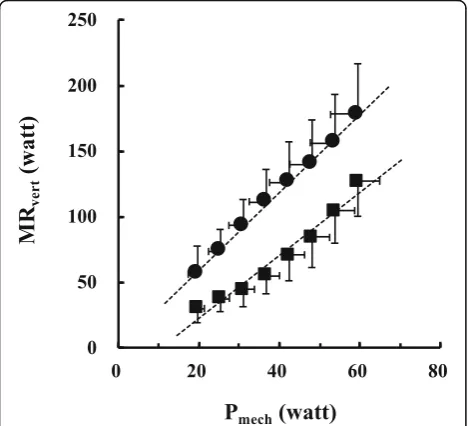
2b and Additional file 2: Table S1). Upward and down-ward Delta-E values were 35.5 ± 8.8% and 44.9 ± 12.8%, respectively (Fig. 3). There were significant differences between downward Delta-E and Effvert(Fig.2b), but not
between upward Delta-E and Effvert(Fig.2a). Discussion
A striking finding of our study was that upward Effvert
values did not vary significantly across the range of mea-sured vvert (Fig. 2a). However, downward Effvert values
were significantly higher at slowervvert than at fastervvert
(Fig. 2b). These results fully supported our hypothesis. The results indicated that ΔEE for the upward direction was proportional tovvert. That is,ΔEE for the upward
dir-ection can directly be explained by the amount of active muscles generating the accelerating force. This interpret-ation is consistent with those of some previous studies [18,21,22]. Because Effvertis a“dimensionless”value (%),
it can directly be compared with the results of other stud-ies, even if measured speed and/or gradient were different.
On the basis of these interpretations, participant’s attribu-tion could not be a limitaattribu-tion. For example, upward Effvert
was significantly improved in schizophrenia patients with gait disturbance by 19.7% after 8-week maximal strength training [12]. This percent increase in Effvertis not
surpris-ing, because more considerable improvement was ob-served in healthy elderly populations [16] and cardiorespiratory patients [13, 15] after that training. A possible mechanism has been reported to be a high level of stress on all motor units including muscle activation [15]. Of note, these upward Effvert values in the previous
studies were evaluated only at 1.00 m s−1[12–16].
As far as we know, economical speed (ES) has been the most potential index to evaluate individual walking“ abil-ity,” however, it is necessary to obtain the ES using 5–8 sets of metabolic measurements at various speeds [4–8,
11]. Each set of metabolic measurement requires 4–5 min, so the participants need to walk at least for more than 20 min. This could not be a heavy exercise for healthy young participants; however, it may be somewhat heavy for phys-ically poor people, such as prosthetic pedestrians, patients after surgery, obese people, pregnant women, and elderly people to execute the whole sets of metabolic measure-ments. We found that Effvertwas not dependent on
walk-ing speeds, at least from 0.667 to 2.028 m s−1on the uphill gradient (Fig.2a), indicating that it can be evaluated at any designated speed. Furthermore, only two sets of metabolic measurements on the level and shallow uphill gradients without kinematic information are required. This could be a significant reduction of participants’physical strain dur-ing metabolic measurement.
It is worth noting that upward Delta-E value was not significantly different from upward Effvert values at any
speed (Fig.2a). Methodological considerations should be necessary. Previous studies fixed the horizontal walking speed at 1.2–1.3 m s−1 and changed treadmill gradient incrementally [23,24]. Conversely, we fixed the treadmill gradient at ± 5%, and varied the walking speed incre-mentally. The pendular energy transduction between kinetic energy and gravitational potential energy became maximal at around 1.4 m s−1[28, 29]. The minimum of the U-shaped relationship between CoT and horizontal walking speed occurs at around 1.4 m s−1, irrespective of the gradient [4–6]. These previous findings suggest that the grade incremental protocol may underestimate the EE (≒higher Delta-E). However, Delta-E reflects the in-verse of an increasing rate of mechanical power output to energy consumption rate, so it may not be influenced by walking speed. Indeed, upward Delta-E of 35.5 ± 8.8%
Fig. 3Upward (circles) and downward (squares) delta efficiency (Delta-E) was calculated from the inverse of the relationships of
Pmechto MRvertacross eight measured vertical speed (vvert). MRvert= 2.968·Pmech–0.573 (r= 0.999) for upward Delta-E, and MRvert= 2.399·Pmech–25.665 (r= 0.981) for downward Delta-E, respectively. Data are mean ± SD
was in good agreement with the result of a previous study in young adults involving both genders [23]. Given these considerations, our speed incremental protocol would be equivalent to the grade incremental protocol. We need to remind that Delta-E always requires the in-verse “slope” of the regression line of MRvert to Pmech
(Eq. 6). That is, a series of metabolic measurements are necessary to obtain the “slope” from which it is calcu-lated, so it is practically available only for fit populations, but not for clinical patients.
A trend for significantly higher downward Effvert
values at slower vvert than at faster vvert (Fig. 2b and
Additional file2: Table S1) was consistent with a previ-ous result [25], indicating that the amount of active muscles needed to generate the accelerating force could not be proportional tovvertduring downhill walking.
In-deed, “negative” work rather than “positive” work be-comes dominant during downhill walking [25, 26]. The recovery rate of pendular energy transduction gradually decreased at fastervvert[26]. This individual variation of
the recovery rate of the pendular energy transduction is associated with the muscular EE during negative and positive work. Indeed, the EE of negative work is one third of that of“positive”work [30]. Stored elastic energy in the Achilles tendon and gastrocnemius medialis can be utilized even during level walking at 0.75 m s−1[20]. These interactions would be expected to vary consider-ably between individuals during downhill walking, given that relatively greater variations were observed in down-ward Effvertvalues than in upward Effvertvalues (Fig.2b). Conclusions
It is possible to evaluate vertical component of walking efficiency without kinematic information. Upward Effvert
values were nearly constant across a wide range ofvvert,
suggesting that EE to lift the body could be proportional to vvert. Therefore, upward Effvert should be useful for
people with poor physical fitness to evaluate their gait characteristics. This is because only two metabolic mea-surements are required to obtain individual upward
Eff-vert on the level and uphill gradients at any voluntary
speed. However, this interpretation could not be applied to downhill walking. Delta-E was compatible with up-ward Effvert, but not with most of the downward Effvert.
Supplementary information
Supplementary informationaccompanies this paper athttps://doi.org/10. 1186/s40101-019-0211-4.
Additional file 1: Figure S1.Relationships between cardiorespiratory responses and walking speed at different gradients.
Additional file 2: Table S1.Summary of measured and calculated variables at each speed. Pmech; mechanical power output for vertical directions,ΔEE; differences of energy expenditure between uphill and
level gradients or between level and downhill gradients, MRvert; metabolic rate for vertical directions, and Effvert; vertical efficiency. Values are mean (±SD).
Abbreviations
ANOVA:Analysis of variance; BM: Body mass; CoT: Energy cost of transport per unit distance; Delta-E: Delta efficiency; EE: Whole-body energy expenditure; Effvert: Vertical component of net walking efficiency;; MRvert: Vertical component of metabolic rate;Pmech: Vertical component of mechanical power output; VCO2: Carbon dioxide output; VO2: Oxygen uptake;vvert: Vertical component of walking speed;ΔEE: Difference of EE between the level and uphill/downhill gradients
Acknowledgements
We especially thank Dr. Herman Pontzer (Duke University) for providing us a noble viewpoint on the basis of“climbing efficiency”to start up this study.
Authors’contributions
DA, YF, and MH designed the study and interpreted the results. DA performed measurements and data analysis and prepared the tables, figures, and first manuscript. YF and MH revised the manuscript. All authors have read and approved the final manuscript.
Funding
This study was supported in part by Grant-in-Aid for Scientific Research from the Japan Society for the Promotion of Science (26440266JP and 19 K11541 to DA, 26650175JP to YF, 18K11012JP and 26440268JP to MH), Japan Society of Physio-logical Anthropology Research Grant for Young Scientists to DA, and Grant-in-Aid for KSU Scientific Research and Encouragement of Scientists to DA (No.58).
Availability of data and materials
All data used in this study were summarized and in the supplementary information.
Ethics approval and consent to participate
In accordance with the Declaration of Helsinki, all participants were provided all information about the purposes, benefits, possible risks, and experimental protocols. A written informed consent was obtained from all participants. An ethical committee established in Kyushu Sangyo University approved all procedures of this study (H240324, H27-0002, and H28-0001).
Consent for publication
Not applicable
Competing interests
The authors declare that they have no competing interests.
Author details
1Biodynamics Laboratory, Center for Health and Sports Science, Kyushu
Sangyo University, 2-3-1 Matsukadai, Higashi-ku, Fukuoka City, Fukuoka 813-8503, Japan.2Faculty of Health and Sports Science, Doshisha University, Kyotanabe City, Kyoto, Japan.3Division of Human Environmental Science,
Mount Fuji Research Institute, Fujiyoshida City, Yamanashi, Japan.
Received: 2 April 2019 Accepted: 27 October 2019
References
1. McCamley JD, Cutler EL, Schmid KK, Wurdeman SR, Johanning JM, Pipinos II, Myers SA. Gait mechanics differences between healthy controls and patients with peripheral artery disease after adjusting for gait velocity stride length and step width. J Appl Biomech. 2019;35:19–24.
2. Cavagna GA, Kaneko M. Mechanical work and efficiency in level walking and running. J Physiol. 1977;268:467–81.
3. Pontzer H. Economy and endurance in human evolution. Curr Biol. 2017;27: R613–R21.
5. Abe D, Fukuoka Y, Horiuchi M. Muscle activities during walking and running at energetically optimal transition speed under normobaric hypoxia on gradient slopes. PLoS One. 2017;12:e0173816.
6. Abe D, Fukuoka Y, Maeda T, Horiuchi M. Energy cost and lower leg muscle activities during erect bipedal locomotion under hyperoxia. J Physiol Anthropol. 2018;37:18.
7. Horiuchi M, Endo J, Horiuchi Y, Abe D. Comparisons of energy cost and economical walking speed at various gradients in healthy, active younger and older adults. J Exerc Sci Fit. 2015;13:79–85.
8. Wezenberg D, van der Woude LH, Faber WX, de Haan A, Houdijk H. Relation between aerobic capacity and walking ability in older adults with a lower-limb amputation. Arch Phys Med Rehabil. 2013;94:1714–20. 9. Ortega JD, Beck ON, Roby JM, Turney A, Kram R. Running for exercise mitigates
age-related deterioration of walking economy. PLoS One. 2014;9:e113471. 10. Mian OM, Thom JM, Ardigò LP, Narici MV, Minetti AE. Metabolic cost,
mechanical work, and efficiency during walking in young and older men. Acta Physiol. 2006;186:127–39.
11. Wall-Scheffler CM, Myers MJ. Reproductive costs for everyone: how female loads impact human mobility strategies. J Hum Evol. 2013;64:448–56. 12. Heggelund J, Morken G, Helgerud J, Nilsberg GE, Hoff J. Therapeutic effects
of maximal strength training on walking efficiency in patients with schizophrenia - a pilot study. BMC Res Notes. 2012;5:344.
13. Hoff J, Tjønna AE, Steinshamn S, Høydal M, Richardson RS, Helgerud J. Maximal strength training of the legs in COPD: a therapy for mechanical inefficiency. Med Sci Sports Exerc. 2007;39:220–6.
14. Høydal KL, Helgerud J, Karlsen T, Støylen A, Steinshamn S, Hoff J. Patients with coronary artery- or chronic obstructive pulmonary disease walk with mechanical inefficiency. Scand Cardiovasc J. 2007;41:405–10.
15. Karlsen T, Helgerud J, Støylen A, Lauritsen N, Hoff J. Maximal strength training restores walking mechanical efficiency in heart patients. Int J Sports Med. 2009;30:337–42.
16. Wang E, Nyberg SK, Hoff J, Zhao J, Leivseth G, Tørhaug T, Husby OS, Helgerud J, Richardson RS. Impact of maximal strength training on work efficiency and muscle fiber type in the elderly: implications for physical function and fall prevention. Exp Gerontol. 2017;91:64–71.
17. Floreani M, Rejc E, Taboga P, Ganzini A, Pišot R,ŠimuničB, Biolo G, Reggiani C, Passaro A, Narici M, Rittweger J, di Prampero PE, Lazzer S. Effects of 14 days of bed rest and following physical training on metabolic cost, mechanical work, and efficiency during walking in older and young healthy males. PLoS One. 2018;13:e0194291.
18. Griffin TM, Roberts TJ, Kram R. Metabolic cost of generating muscular force in human walking: insights from load-carrying and speed experiments. J Appl Physiol. 2003;95:172–83.
19. Umberger BR, Martin PE. Mechanical power and efficiency of level walking with different stride rates. J Exp Biol. 2007;210:3255–65.
20. Farris DJ, Sawicki GS. The mechanics and energetics of human walking and running: a joint level perspective. J R Soc Interface. 2012;9:110–8. 21. Hoogkamer W, Taboga P, Kram R. Applying the cost of generating force
hypothesis to uphill running. PeerJ. 2014;2:e482.
22. Hanna JD, Schmitt D, Griffin TM. The energetic cost of climbing in primates. Science. 2008;320:898.
23. Ortega JD, Farley CT. Effects of aging on mechanical efficiency and muscle activation during level and uphill walking. J Electromyogr Kinesiol. 2015;25:193–8. 24. Yano T. Oxygen uptake and efficiency related to external work rate during
loaded walking. J Sports Med Phys Fitness. 1989;29:388–93. 25. Minetti AE, Ardigò LP, Saibene F. Mechanical determinants of gradient
walking energetics in man.J Physiol. 1993;472:725–35.
26. Dewolf AH, Ivanenko YP, Lacquaniti F, Willems PA. Pendular energy transduction within the step during human walking on slopes at different speeds. PLoS One. 2017;12:e0186963.
27. Brouwer E. On simple formulae for calculating the heat expenditure and the quantities of carbohydrate and fat oxidized in metabolism of men and animals, from gaseous exchange (Oxygen intake and carbonic acid output) and urine-N. Acta Physiol Pharmacol Neerl. 1957;6:795–802.
28. Minetti AE, Capelli C, Zamparo P, di Prampero PE, Saibene F. Effects of stride frequency on mechanical power and energy expenditure of walking. Med Sci Sports Exerc. 1995;27:1194–202.
29. Willems PA, Cavagna GA, Heglund NC. External, internal and total work in human locomotion. J Exp Biol. 1995;198:379–93.
30. Aura O, Komi PV. Mechanical efficiency of pure positive and pure negative work with special reference to the work intensity. Int J Sports Med. 1986;7:44–9.
Publisher’s Note