Workplace racial composition, perceived discrimination,
and organizational attachment
Kevin Stainback
a,⇑, Matthew Irvin
b aPurdue University, Stone Hall, 700 W. State Street, West Lafayette, IN 47907-2059, United States b
Eastern Kentucky University, Keith Building, 521 Lancaster Avenue, Richmond, KY 40475-0001, United States
a r t i c l e
i n f o
Article history: Received 18 December 2009 Revised 8 November 2011 Accepted 21 November 2011 Available online xxxx Keywords: Racial discrimination Organizational demography Workplace inequality Race/ethnicity Organizational attachmenta b s t r a c t
Prior research has devoted considerable attention to the relationship between the racial and ethnic composition of jobs and various indicators of organizational attachment. Fewer studies, however, examine how workplace racial composition affects individuals’ experi-ences of racial discrimination or how these experiexperi-ences impact workers’ organizational attachment. To address this lacuna, we first examine the effects of workplace racial com-position on perceived racial and ethnic discrimination. Next, we examine whether per-ceived racial discrimination mediates the association between racial composition and organizational attachment observed in prior studies. Finally, we explore whether these relationships are similar (symmetric) or different (non-symmetric) for non-Whites and Whites. The analyses indicate: (1) working with predominately same-race coworkers tends to diminish perceptions of racial discrimination, (2) perceived racial discrimination medi-ates some of the effects of racial/ethnic composition on organizational attachment, and (3) some non-symmetric effects between non-Whites and Whites are found. We conclude with implications for future research.
Ó2011 Elsevier Inc. All rights reserved.
1. Introduction
Contemporary scholars of workplace inequality have developed a substantial literature examining the effects of work-place racial and ethnic composition on organizational attachment.1In general, the previous research suggest that racial and ethnic similarity with coworkers and managers promotes stronger social relationships, enhances organizational commit-ment (Mueller et al., 1999; Pelled et al., 1999; Riordan and Shore, 1997; Tsui and O’Reilly, 1989), and reduces job search inten-tions (Kmec, 2007; O’Reilly et al., 1991; Tsui et al., 1992). Although the association between racial/ethnic composition and organizational attachment is widely documented, numerous researchers have recommended that future studies seek to uncover mediating factors (e.g.,Mueller et al., 1999; Zatzick et al., 2003).
We contribute to the previous research in this article by examining a potentially important mediating factor explaining how work group racial/ethnic composition affects organizational attachment—perceived racial discrimination. We suspect that perceived racial/ethnic discrimination—the subjective assessment that one has been treated unfairly on the basis of his/her race or ethnicity—may be highly responsive to the racial and ethnic composition of the work group. Racial and ethnic composition is likely to be a critical trigger for invoking racial and ethnic categorizations and stereotyping, which in turn
0049-089X/$ - see front matterÓ2011 Elsevier Inc. All rights reserved. doi:10.1016/j.ssresearch.2011.11.016
⇑Corresponding author. Fax: +1 4 765 496 1476.
E-mail addresses:[email protected](K. Stainback),[email protected](M. Irvin).
1The term organizational attachment refers to a condition that is temporally prior to employee exit. Previous research has incorporated measures that can be described as psychological (e.g., loyalty, commitment) and associational (e.g., job search intentions, absences, exits) attachment (e.g., seeTsui et al., 1992; Mueller et al., 1999).
Contents lists available atSciVerse ScienceDirect
Social Science Research
affects interactional dynamics within and between social groups (e.g., tokenism, competition-threat). It is precisely these social dynamics that are expected to shape the ‘‘naming’’ of an experience as racial discrimination. Hence, perceived racial discrimination may be a powerful mediating factor between the racial and ethnic composition of jobs and organizational attachment identified in previous research.
This research examines two related processes: (1) the organizational context of discrimination and (2) perceived discrim-ination as a mediating factor between workplace attachment and work group composition. Using data from the National Study of the Changing Workforce (NSCW), and drawing from theoretical perspectives related to group composition and rela-tional dynamics (Blalock, 1967; Kanter, 1977; Pfeffer, 1983; Tsui et al., 1992), we examine these processes by addressing four questions regarding the relationship between racial composition, perceived discrimination, and organizational attachment. First, does the race and ethnicity of co-workers influence the likelihood that workers report experiencing racial discrimina-tion? Second, does work group racial composition affect organizational attachment? Third, does perceived discrimination mediate the effects of racial and ethnic composition on organizational attachment? Fourth, do these relationships differ between non-Whites and Whites (the non-symmetry hypothesis)? For brevity, the term ‘‘race’’ is used to refer to both race and ethnic distinctions throughout the remainder of this article.
2. Racial composition and relational dynamics
2.1. Organizational demography, tokenism, and competition threat
The organizational demography theoretical perspective asserts that the status composition of workplaces holds impor-tant consequences for workers (Baron and Pfeffer, 1994; Pfeffer, 1983; Reskin et al., 1999). The old adage ‘‘birds of a feather flock together’’ lies at the heart of the postulated effect of group homogeneity on individual-level outcomes (e.g., employer loyalty, job search intentions). The organizational demography perspective draws from a variety of social-psychological par-adigms to explain how the racial composition of one’s immediate work environment (coworkers, manager) affects work related attitudes and behaviors. Self-categorization and social identity theories, for instance, suggest that individuals cate-gorize themselves and others on the basis of status distinctions, especially visible ones such as race (Tajfel and Turner, 1986). Characteristics individuals hold as salient components of their own self identities become favorable bases for the evaluation of others, while individuals characterized as different are viewed less favorably (see alsoBielby, 2000; Reskin, 2000). Con-sistent with these views, the similarity-attraction paradigm posits that without individuating information, people tend to develop stronger affinities and trust with others whom they categorize as ‘‘like me’’ (Byrne, 1971). All of these perspectives focus on demographic similarity and in-group preference, but each emphasizes a slightly different interactional mechanism (e.g., heightened status categorizations, in-group affinity). One implication of this perspective is that being racially different from one’s coworkers may prevent the development of social bonds, sentiment, and trust, thus reducing attachment to coworkers and employers (e.g., seeKmec, 2007).
Drawing from the organizational demography perspective, the previous literature shows that having the ability to devel-op intra-racial ties with coworkers tends to strengthen social bonds and enhance organizational attachment.Popielarz and McPherson’s (1995)analysis of voluntary associations finds that individuals who are the same race as the majority of mem-bers tend to develop stronger organizational commitment and are less likely to leave the group, while being racially dissim-ilar promotes exit from voluntary associations. Subsequent research findings examining workplaces are largely consistent with their findings.Zatzick et al. (2003)find an inverse relationship between percent same-race coworkers and voluntary turnover.Sørensen’s (2004)longitudinal study of a large banking firm finds that the higher the same-race composition of coworkers at the time an employee enters the firm, the lower the odds of firm exit. Additionally his research indicates that, over time, as the proportion of same-race coworkers declines, the odds of turnover increase. Positive associations between racial homogeneity and work related attitudes have also been observed. For example,Wharton et al. (2000)analysis of majority and minority workers in university departments indicates job satisfaction levels are higher in homogeneous groups than heterogeneous groups.
Previous research also finds evidence of in-group preference between manager-subordinate dyads. For example, workers receive higher performance evaluations from same-race managers and supervisors (Elvira and Town, 2001; Lefkowitz and Battista, 1995; Tsui and O’Reilly, 1989).Ensher and Murphy (1997), using data collected from a large West Coast media orga-nization, find that racially matched supervisor-subordinate dyads had greater liking for one another and subordinates reported receiving better mentoring from same-race supervisors. Research also indicates that racial similarity between supervisors and subordinates affects organizational attachment.Zatzick et al. (2003)examine data collected from a Fortune 500 company and find that having same-race representation among upper-level management reduces voluntary turnover. Using data collected from a retail firm,Giuliano et al. (2006)find higher turnover rates (quits and dismissals) for workers with a racially dissimilar manager. It is within these social contexts that workers are likely to build trust and supportive environments.
In one of the few studies examining how workplace racial composition influences racial discrimination, Hirsh and Kornrich (2008)analyze formal discrimination complaints filed with the US Equal Employment Opportunity Commission. They find an inverse relationship between individuals filing racial discrimination complaints and the percentage of same-race employees in the workplace. However, a recent study conducted byHirsh and Lyons (2010), using the Multi City Study
of Urban Inequality (MCSUI) data, finds that perceived discrimination is greater among workers in non-White work groups. Although, they do not examine the effects of being in a predominately same-race work group, their research suggests that the relationship between same-race work groups and perceived racial discrimination may not be the same for all racial groups. We discuss the possibility of non-symmetry below.
These previous studies suggest that having a larger percentage of same-race coworkers, as well as having a same-race manager may reduce perceptions of racial discrimination, increase employer loyalty, and diminish job search intentions through strengthened social relations and greater perceptions of fairness.
Beyond the expectation that increasing racial homogeneity should reduce perceived discrimination and increase attach-ment, other perspectives suggest that the relational dynamics between social groups may differ depending on compositional thresholds.Kanter (1977)suggested that when workers are the demographic minority in a work group, which she called tokens, they are more likely to be seen as different, which may result in increased stereotyping of tokens, biased evaluations of their job performance, and exclusion from informal workplace relations (Ibarra, 1993, 1995; Kanter, 1977). This theory would suggest that, due to the stress emerging from token status, workers in token jobs will be more likely to name a neg-ative workplace experience racial discrimination and exhibit weaker organizational attachment (e.g., lower organizational commitment and greater job search intentions) compared to workers in other compositional thresholds.
The relational dynamics posited by tokenism are supported in some of the empirical literature examining formal racial discrimination complaints. Roscigno’s (2007)analysis of Ohio Civil Rights Commission data indicates that, among Black workers, serious cases of workplace racial discrimination decline precipitously with increases in the percentage of Black coworkers. Moreover, discrimination against Black workers was particularly pronounced in workplaces where Blacks com-prised less than 25% of employees. This research indicates that the odds of perceiving racial discrimination should decrease with increases in the percentage of same-race coworkers as suggested by the organizational demography perspective. Fur-ther, tokens, which we define as less than 25% same-race coworkers, may be especially prone to perceiving racial discrim-ination at work compared to non-tokens because they are more visible and become potential targets for hostility, abuse, and other forms of workplace incivility. Because they may become the targets of abuse and hostilities, tokens may also have less organizational attachment than people in other compositional thresholds.
Racial composition may also influence the likelihood of experiencing racial discrimination by inducing a sense of compe-tition and threat between racial groups, especially once a particular compositional threshold is reached. The pioneering work ofBlalock (1967)is informative in this regard. He argued that as the numerical size of a minority group begins to approach the size of the majority group, the majority group will feel increasingly threatened and often engage in discriminatory acts to protect their resources and advantages. This perspective contends that perceived racial discrimination should be most pro-nounced in more integrated workplace environments, most notably when individuals are among the numerical minority and their proportional representation begins to encroach upon the majority’s compositional threshold, which we define as 25– 49.99% same-race coworkers.
2.2. The non-symmetry hypothesis
The preceding discussion assumes that these group processes are symmetric for all racial groups. In other words, numeric dominants and minorities should experience the workplace in similar ways. The non-symmetry hypothesis, however, sug-gests that the composition effects discussed previously may differ for Whites and non-Whites (e.g., seeMueller et al., 1999). Whites in majority non-White work environments may be affected more negatively by perceived discrimination, with regards to organizational attachment, than non-White workers in majority White work environments. This is predicated on the idea that minority workers are accustomed to being in small numbers in work environments and other social contexts throughout US society (Mueller et al., 1999). From this perspective, the effects of racial composition and racial discrimination may have more detrimental effects on Whites’ organizational attachment compared to non-White workers.Muller et al.’s (1999)analysis of school teachers in a major metropolitan school district finds that White teachers in schools where the majority of coworkers are non-White indicate less job satisfaction and employer loyalty than do non-White workers in majority White coworker schools. In contrast, Black teachers job satisfaction and employer loyalty was unaffected by the racial composition of coworkers.
In addition, Whites and non-Whites may also experience occupying a work group that is predominately same-race dif-ferently.Collins’ (1997)work, for example, suggests that due to the pressure of legal mandates and internal and external constituencies, organizations have created ‘‘racialized’’ jobs that may be considered middle class managerial and profes-sional jobs, but that typically entail serving racially similar constituencies both within the organization and the larger com-munity. Blacks and Latinos may be more likely to perceive racial discrimination when they occupy ‘‘racialized’’ jobs because the institutional discrimination shaping their life chances is more visible compared to similarly situated Whites in non-racialized jobs with regards to both compensation and advancement opportunities (Collins, 1997). In addition to middle class professional jobs, other research indicates that jobs with greater percentages of Blacks and Latinos are associated with lower wages (Catanzarite, 2003; Huffman and Cohen, 2004; Kmec, 2003; Semyonov and Herring, 2007). From this perspec-tive, Whites and non-Whites may experience racial composition thresholds in different ways. Hence, high levels of racial segregation may increase the naming of an experience racial discrimination for Blacks and Latinos, while reducing these experiences for Whites. Because Whites are cultural dominants, they are unlikely to interpret working in White dominated
work groups as racial discrimination. This explanation is consistent with the results ofHirsh and Lyons (2010), who found that perceived racial discrimination is highest in non-White work groups.
The relationship between manager’s race, perceived discrimination, and organizational attachment may be non-symmetrical as well.Elliott and Smith (2001)assert that organizations may intentionally match minority workers and managers on the basis of race to maintain control by increasing workers’ assessment of fairness in the allocation of organizational authority, which diminishes perceived racial discrimination. These findings from the Multi City Study of Urban Inequality (MCSUI) support this assertion. A recent study conducted byHirsh and Kornrich (2008), using a sample of private sector US organizations, demon-strates that formal racial discrimination complaints filed with the Equal Employment Opportunity Commission (EEOC) decline with increases in minority representation in managerial jobs at the workplace level.
The relational dynamics outlined above are used to make theoretical predictions regarding the immediate work group context (work group members and manager’s race), not the entire workplace. Although, these data preclude us from parcel-ing out the effects of work group racial composition and workplace racial composition, it is important to note that the effects of work group racial composition may vary based on the racial composition of upper management and other workers in the workplace. As one anonymousSocial Science Researchreviewer suggested, ‘‘in terms of legitimacy, control, and social net-works, for a person of color it may be just as consequential to have other persons of color in positions of authority anywhere in the organization as it is to have one’s own supervisor be a person of color.’’Hirsh and Kornrich’s (2008)organization-level study finds that greater minority group representation among managers reduces formal discrimination filings with the EEOC, however, their data are unable to distinguish which managers manage which work groups. It seems reasonable to expect that greater organizational power should curtail perceived discrimination; however, data limitations do not allow us to examine this possibility.
2.3. Summary of hypotheses
Based on the theoretical perspectives and empirical evidence outlined above, individuals with same-race coworkers and managers are hypothesized to have stronger in-group cohesion leading to reductions in perceived discrimination and greater organizational attachment. Beyond the specific hypotheses outlined below, we also examine whether each of these relation-ships are symmetric for Whites and non-Whites. Hypotheses 1a–c examine discrimination contexts and are explored in the first part of our analyses.
Hypothesis 1a: Perceived workplace racial discrimination will be most pronounced in token jobs (0–24.99% same-race coworkers) and decline with increases in the percentage of same-race coworkers.
Hypothesis 1b: Perceived workplace racial discrimination will be most pronounced where numerical minorities approach majority thresholds (25–49.99% same-race coworkers).
Hypothesis 1c: Perceived workplace racial discrimination is reduced when working for a same-race manager compared to a cross race manager.
Hypotheses 2 and 3 are examined in the second part of our analyses, which explore the effect of work group composition on organizational attachment and the potential mediating effect of perceived discrimination.
Hypothesis 2: Racial similarity with coworkers (manager) increases organizational attachment.
Hypothesis 3: Perceived racial discrimination mediates the effect of racial composition on organizational attachment.
3. Method 3.1. Data
This study analyzes data from the 2002 National Study of the Changing Workforce (NSCW) collected by the Families and Work institute. The 2002 NSCW selected respondents with an unclustered random probability design using random digit dial-ing methods. Surveys were administered usdial-ing computer assisted telephone interviewdial-ing techniques. Eligible respondents included adults ages 18 and older, living in the continental United States, working for wages, and living in non-institutional residences with an operating home telephone. The response rate was 52%. Of the 2810 completed interviews we deleted 254 cases who reported not having an immediate supervisor and 39 who did not have a work group. We further limit the sample to Whites, Blacks, and Latinos between the ages of 18 and 65 who are not self-employed. After excluding the sample of cases with missing data on independent variables, the working sample size is 2062.
3.2. Measurement of dependent variables 3.2.1. Racial discrimination
Respondents in the NSCW were asked, ‘‘Do you feel in ANY way discriminated against on your job because of your race or national origin?’’ A binary indicator variable was created, with responses coded 1 for respondents who reported experiencing
workplace racial discrimination and 0 for those who did not. Similar measures of discrimination have been used in previous research (e.g.,Stainback et al., 2011).
3.2.2. Organizational attachment
We include two measures of organizational attachment used in previous research. The first measure,employer loyalty, captures workers’ psychological attachment to their employers. Respondents were asked, ‘‘How loyal do you feel to your employer—extremely loyal, very loyal, somewhat loyal, not very loyal, or not loyal at all?’’ ‘‘Not very loyal’’ and ‘‘not loyal at all’’ were collapsed into one category due to small cell sizes.2The variable was then coded so that higher values indicate
greater employer loyalty.
The second measure of organizational attachment,job search intentions, is a widely accepted indicator of behavioral attachment in the organizational demography literature (e.g., seeTsui et al., 1992; Tsui and O’Reilly, 1989). Although actual turnover would be a better indicator, such a variable is not available in the cross-sectional NSCW data. It is important to note, however, thatO’Reilly et al.’s (1991)longitudinal study revealed that job search intentions are a powerful predictor of turn-over behavior. Intention to search for a new job is an indicator of weak social bonds and reduced association workers share with their employers. Respondents were asked, ‘‘Taking everything into consideration, how likely is it that you will make a genuine effort to find a new job with another employer within the next year—very likely, somewhat likely, or not likely at all?’’ The variable was reverse coded so that higher values indicate greater job search intentions.
3.3. Measurement of independent variables 3.3.1. Respondent’s race
Race/ethnic differences in perceived discrimination and organizational attachment are accounted for with two binary indicator variables, Black and Latino, with White serving as the reference category.
3.3.2. Coworker racial composition
In the NSCW data, respondents were asked, ‘‘About what percent of your coworkers are people from your racial, ethnic, or national background?’’ Response categories include: 100%, 75–99.99%, 50–74.99%, 25–49.99%, 1–24.99%, and 0%. Only eight Blacks reported working with 100% same-race coworkers and 12% with 0% same-race coworkers. Whites and Latinos also had few respondents reporting 0% same-race coworkers, with 12 and 14 respondents respectively. Given these small cell sizes this variable was collapsed into four racial composition categories: Dominant (75–100% same-race), tilted same-race (50–74.99% same-race), tilted other-race (25–49.99 same-race), and token (0–24.99% same-race). Dummy variables are included in the analyses for dominant (75–100%), tilted same-race (50–74.99%), and tilted other-race (25–49.99). Token jobs serve as the reference category. Self-reported measures of racial and gender composition have been widely used in previous research (e.g.,Elliott, 2001; Stainback, 2008; Stainback et al., 2011) and have been shown to be both reliable and valid (e.g., seeTomaskovic-Devey, 1993).
3.3.3. Manager’s race
In the NSCW data respondents were asked ‘‘is your supervisor or manager of the same racial or ethnic background as you?’’ If the respondent’s race/ethnicity matched the manager’s, a dummy variable was created (coded 1) for same-race manager.
3.4. Control variables
3.4.1. Job and workplace characteristics
A variety of job and workplace characteristics are controlled for that may affect perceived discrimination and organiza-tional attachment. Indicators of job quality including hourly wage (natural logarithm) and hours worked per week are included in the analyses. Higher quality jobs, those offering higher wages and more hours, are likely to be associated with reduced perceptions of discrimination and greater organizational attachment.
Structural features of workplaces are also likely to influence perceptions of discrimination and organizational attachment. Organizations with formalized human resource management (HRM) structures are likely to provide greater equality in the distribution of organizational resources (Kalev et al., 2006). For example, formal wage setting and promotion policies and practices, as well as formal grievance procedures, are likely to diminish perceptions of discrimination and increase organi-zational attachment. While our data do not have specific measures of formalized policies and procedures, we do observe whether the job is covered by a union, in the public sector, and establishment size. Each of these characteristics is associated with greater formalization of an organization’s HRM function. It is important to note, however, that larger more formalized organizations are also more likely to have equal employment opportunity offices and provide employee and managerial diversity training programs, which may actually increase formal racial discrimination complaints rather than reduce them. This effect is theorized to occur because it potentially heightens legal consciousness and the naming of a discriminatory
2
experience (e.g., seeHirsh and Kmec, 2009). To account for both possibilities dummy variables are included for jobs that are unionized (coded 1) and in the public sector (coded 1), and establishment size is the natural logarithm of total employment.
3.4.2. Demographic characteristics
Individuals’ demographic and human capital characteristics are controlled for in the analyses that follow. Supply side explanations of workplace racial segregation suggest that workplace racial composition can be explained, in part, by racial differences in human capital (education, skills, and experience). Because jobs composed primarily of racial minorities require less education and skill on average compared to White dominated jobs (Semyonov and Herring, 2007), controls for individ-uals’ human capital are included to separate the effects of racial composition from job quality. Failing to account for these differences may lead to a confounding of workplace racial composition with job quality. For example,Maume and Sebastian (2007)examined White respondents in the 2002 NSCW data and found that Whites working in non-White work groups reported lower levels of job satisfaction, however, the differences became statistically non-significant once job quality controls were included.
Educational attainmentis measured with three indicator variables—2-year technical degree, 4 year college degree, and graduate/professional degree (high school or less is the reference).Job tenureis measured as the number of years with cur-rent employer. Individual controls include respondent’s age in years and a dichotomous measure ofsex(female coded 1). Dummy variables are also included for suburban and rural (urban is the reference category) to account for potential
urban–rural residenceeffects.
3.5. Statistical analyses
We estimate our dichotomous measure of perceived racial discrimination using binomial logistic regression. The work-place attachment measures, employer loyalty and job search intentions, are categorical variables with ordered response cat-egories. As such, ordered logistic regression models are the most appropriate analytic approach. These models provide an advantage over ordinary least squares (OLS) analyses in that they do not assume that each one-unit change in the dependent variable is equivalent. In SAS statistical software the procedure calculates a series of threshold parameters, or cut points, based on the log odds of falling into a particular threshold or below (Allison, 1999). The ordered logit model is denoted as:
log p1 1p1 ¼
a
1þbx log p1þp2 1p1p2 ¼a
2þbx .. . log p1þp2þþpk 1p1p2pk ¼a
k1þbx where p1 1p1is the probability of falling into category 1 (e.g., extremely loyal) of an ordinal dependent variable compared to the remaining categories (e.g., very loyal, somewhat loyal, not very loyal, not loyal at all); p1þp2
1p1p2
is the likelihood of falling into categories 1 and 2 (extremely loyal, very loyal) compared to the remaining categories (e.g., not very loyal, not loyal at all). This continues fork1 equations. In SAS, the procedure calculates a series of threshold parameters (
a
1,. . .,a
k1), calledcut points, based on the log odds of falling into a particular threshold or below (Allison, 1999). While the model allows the cut points to vary, the slope parameters are assumed to exert the same effect across equations. To affirm the parallel regres-sion assumption we conducted tests of proportional odds for each model and found the log odds to be proportional in all equations, except one, which we discuss later in the article.
4. Results
4.1. Workplace racial composition and perceived racial discrimination
The effects of workplace racial composition on perceived discrimination are examined inTable 2. Model 1 (Table 2) provides a baseline estimate of racial differences in perceptions of workplace discrimination net of job, workplace, and demographic characteristics. Not surprisingly, the model shows that Blacks and Latinos are more likely to report experienc-ing racial discrimination compared to Whites. The baseline estimates (model 1), net of controls, indicate that Blacks and Lati-nos, are 6.41 (e1.858= 6.41) and 3.86 (e1.351= 3.86) times more likely, respectively, to feel that they have been discriminated
against at work because of their race compared to Whites.
Model 2 includes racial composition measures. The organizational demography perspective suggested that perceived ra-cial discrimination should decline as the relative size of a group increases reasoning that greater numbers provide relative power vis-à-vis other racial groups. However, this pattern only holds when workers are part of the numeric racial majority. The results also indicate that the likelihood of perceiving racial discrimination does not differ between individuals in token jobs and those in tilted other–race jobs (25–49.99% same-race). In other words, the likelihood of naming a negative work-place experience ‘‘discrimination’’ appears to be the same for individuals working in token and tilted other-race contexts; however, the interactional dynamics shaping those experiences are likely to be different shifting from stereotyping and
exclusion to conflict generated by group based threat. By way of comparison, individuals working in a token job (<25% same-race) are approximately 73% (1e1.290= .725) less likely to report experiencing discrimination than those who work in a
tilted same-race job (50–74.99% same-race). Additionally, individuals working in dominant jobs (75–100% same-race) are 88% (1e2.132
= .881) less likely to perceive racial discrimination compared to those working in a token job. In general, the model provides support for both tokenism (Hypothesis 1a) and competition-threat (Hypothesis 1b) dynamics.
The findings also indicate that having a same-race manager, albeit marginally significant (.05 <p< .10), reduces perceived racial discrimination by about 42% (1e.540
= .417) compared to having a cross-race manager. This provides support for Hypothesis 1c.
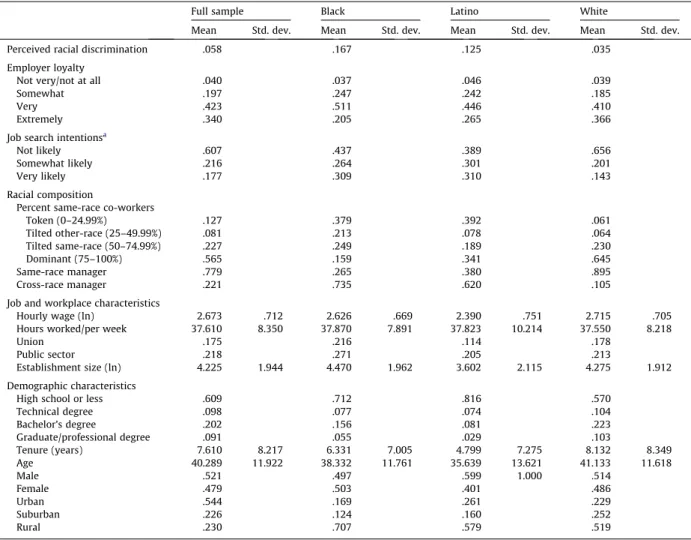
Beyond the specific hypothesis regarding the effect of racial composition on perceived racial discrimination, we are also interested in the extent to which racial differences in perceived racial discrimination can be explained by the differential sorting of Whites, Blacks, and Latinos into jobs that either serve to heighten or diminish discriminatory experiences (e.g., token and tilted other-race jobs). Because Whites make up the majority of the US labor force they are less likely to experience working in token or tilted other-race jobs compared to non-Whites (seeTable 1). Conversely, Blacks and Latinos represent smaller segments of the labor force and therefore are more likely to find themselves in token and tilted other-race jobs. The change in the Black and Latino coefficients from model 1 to model 2 indicates that the differential sorting of individuals into jobs with same-race coworkers and managers explains more than two-thirds of the Black–White gap ([1.858.593]/ 1.858 = .68) and the entire of Latino–White gap (the coefficient is no longer statistically significant) in perceived workplace racial discrimination observed in model 1. This indicates that the racial composition of workplaces is an important structural feature of organizations with important implications for individuals’ perceptions of equity and fairness at work. Indeed, the model indicates that the Latino–White difference in perceived discrimination is explained by the differential sorting into jobs that are more or less susceptible to perceived racial discrimination. Moreover, the majority of the Black–White difference in perceived racial discrimination is also explained.
These findings indicate that much of the racial gaps in perceived racial discrimination result from differential exposure to the specific contexts where these experiences are most likely to occur. For example, only 12.5% of Whites occupy jobs in which they are the numeric minority (<50%)—the context in which perceived racial discrimination is most pronounced. Blacks (59.2%) and Latinos (47.0%) are far more likely to find themselves in these job environments.
In addition, it is notable that Blacks perceive greater discrimination than Whites net of composition effects, while Latinos perceive discrimination only when they are underrepresented in their work groups. This is analogous to findings for Cana-dian workers that indicate that more recent immigrants tend to be less likely to perceive discrimination, while minorities in the labor force for longer periods may perceive discrimination regardless of context (Banerjee, 2008). This could indicate that differences between Blacks and Latinos may reflect the history of racial discrimination in the United States as longer for Blacks than for Latinos.
Models 3 and 4 examine the non-symmetry hypothesis. The non-symmetry hypothesis suggests that the effects of racial composition on perceived racial discrimination may differ for Whites and non-Whites. Among Blacks and Latinos, and con-sistent with the previous model, work group racial homogeneity does not reduce perceived racial discrimination until work-ers are a member of the racial majority. The coefficients for dominant work groups and tilted same-race work groups are not statistically different from one another.3
The fact that non-Whites do not report fewer discriminatory experiences in dominant settings (75–100% same-race) com-pared to tilted same-race settings (50–74.99% same-race) is consistent with the work ofCollins (1997), who suggests that rather than protect workers from harassment, hostilities, and other forms of workplace incivility, being in a segregated job with same-race others may reveal institutional discrimination. Blacks and Latinos may recognize that they are being sorted into jobs with racially similar others, which offer fewer resources and opportunities for advancement. Hence unequal treatment may become increasingly visible.
Having a same-race manager is not statistically significant for Blacks and Latinos. It is important to reemphasize that for Blacks and Latinos having a same-race manager anywhere in the organization may be as important as having a same-race direct supervisor. The data utilized in this article, however, do not indicate the racial composition of managers at the organization level. This will be an important question for future research to pursue.
Among Whites, the pattern in model 2 is largely confirmed. Perceived discrimination is lower for Whites once they oc-cupy the racial majority of their work group and perceptions of discrimination continue to decline as they become domi-nants. The difference in coefficients for tilted same-race and dominant work group is statistically significant.4Having a
same-race manager is marginally significant (.05 <p< .10), but indicates that Whites who have a White manager are 48% less likely to report experiencing racial discrimination (e.656
= .481) compared to Whites working for a non-White manager. This finding is consistent with the non-symmetry hypothesis. Because Whites are cultural dominants in the US they rarely find themselves working for non-White managers. Indeed, less than 11% of Whites (10.5%) report working for a cross-race manager compared to 73.5% and 62% of Blacks and Latinos respectively (seeTable 1). For non-Whites, working for White managers is commonplace. For Whites, however, the rarity of having a non-White superior increases the likelihood that Whites identify an experience as racial discrimination.
3This difference was determined by simply re-estimating the model (not reported) using dominant as the reference category. 4
4.2. Racial composition, perceived discrimination, and organizational attachment
The remaining analyses examine if perceived racial discrimination mediates the effects of work group composition on organizational attachment. We followBaron and Kenny’s (1986)method for establishing statistical mediation. For mediation to take place, a relationship between the primary independent variable (racial composition) and the mediator (perceived racial discrimination) must be established, which we demonstrated in the previous analyses. Next, the independent variable (racial composition) must be correlated with the dependent variable (organizational commitment, job search intentions). Then, the inclusion of the mediator must exert a statistically significant effect on the dependent variable in the presence of the independent variable. Finally, the effect of the independent variable must be reduced when the mediator is in the model either completely (total mediation) or in part (partial mediation).
Table 3examines employer loyalty. Model 1 provides a baseline model which includes individual, job, and workplace controls found in the previous models, model 2 adds the workplace racial composition variables, and finally the perceived discrimination measure is added in model 3 to test for mediation. The baseline estimates indicate that Blacks report less em-ployer loyalty than Whites. Latinos, however, do not differ from Whites. The model also shows that emem-ployer loyalty is lower in larger unionized workplaces and higher in the public sector.
The racial composition variables are included in model 2. Compared to working in token jobs, working in dominant jobs appears to facilitate employer loyalty (b= .318,p< .05). The tilted same-race work group coefficient is similar in magnitude, although it is marginally significant (b= .295, .05 <p< .10). Tilted other-race contexts do not statistically differ from token jobs. In general, this suggests that workers exhibit greater loyalty when the majority of their coworkers are of the same race. Having a same-race manager, however, does not significantly influence employer loyalty. These findings provide partial sup-port for Hypothesis 2.
Table 1
Descriptive statistics for variables used in analyses.
Full sample Black Latino White
Mean Std. dev. Mean Std. dev. Mean Std. dev. Mean Std. dev.
Perceived racial discrimination .058 .167 .125 .035
Employer loyalty
Not very/not at all .040 .037 .046 .039
Somewhat .197 .247 .242 .185
Very .423 .511 .446 .410
Extremely .340 .205 .265 .366
Job search intentionsa
Not likely .607 .437 .389 .656
Somewhat likely .216 .264 .301 .201
Very likely .177 .309 .310 .143
Racial composition
Percent same-race co-workers
Token (0–24.99%) .127 .379 .392 .061 Tilted other-race (25–49.99%) .081 .213 .078 .064 Tilted same-race (50–74.99%) .227 .249 .189 .230 Dominant (75–100%) .565 .159 .341 .645 Same-race manager .779 .265 .380 .895 Cross-race manager .221 .735 .620 .105
Job and workplace characteristics
Hourly wage (ln) 2.673 .712 2.626 .669 2.390 .751 2.715 .705
Hours worked/per week 37.610 8.350 37.870 7.891 37.823 10.214 37.550 8.218
Union .175 .216 .114 .178
Public sector .218 .271 .205 .213
Establishment size (ln) 4.225 1.944 4.470 1.962 3.602 2.115 4.275 1.912
Demographic characteristics
High school or less .609 .712 .816 .570
Technical degree .098 .077 .074 .104 Bachelor’s degree .202 .156 .081 .223 Graduate/professional degree .091 .055 .029 .103 Tenure (years) 7.610 8.217 6.331 7.005 4.799 7.275 8.132 8.349 Age 40.289 11.922 38.332 11.761 35.639 13.621 41.133 11.618 Male .521 .497 .599 1.000 .514 Female .479 .503 .401 .486 Urban .544 .169 .261 .229 Suburban .226 .124 .160 .252 Rural .230 .707 .579 .519
Note: Data are weighted. SampleN= 2062. a N= 2059.
Table 2
Binomial logistic regression estimates of perceived racial discrimination.
Baseline model Race composition Non-Whitea
Whiteb Race/ethnicity Black 1.858 (.254)*** .593 (.309) .467 (.379) Latino 1.351 (.315)*** .240 (.363) Racial composition
Percent same-race co-workers
Token (0–24.99%) Reference Reference Reference
Tilted other-race (25–49.99%) .241 (.304) .014 (.456) .343 (.456) Tilted same-race (50–74.99%) 1.290 (.325)*** 1.456 (.593)* 1.450 (.430)*** Dominant (75–100%) 2.132 (.357)*** 1.293 (.619)* 2.514 (.460)*** Same-race manager .540 (.284) .022 (.470) .656 (.347)
Job and workplace characteristics
Hourly wage (ln) .219 (.173) .184 (.180) .009 (.312) .269 (.226)
Hours worked/per week .003 (.015) .007 (.016) .022 (.026) .011 (.020)
Union .367 (.266) .358 (.275) .141 (.455) .570 (.370) Public sector .202 (.277) .185 (.286) 1.252 (.503)* .403 (.372) Establishment size (ln) .048 (.055) .036 (.057) .083 (.093) .131 (.078) Intercept 4.189 (.818)*** 2.301 (.878)** 2.706 (1.401) 1.206 (1.061) PseudoR2 .1179 .2099 .2116 .1948 Chi-square (df) 80.233 (15)*** 145.048 (19)*** 44.027 (18)*** 82.259 (17)***
Note: Standard errors shown in parentheses. Models include control for education, job tenure, age, sex, and urban–rural residence. N= 2062. p< .10. *p< .05. ** p< .01. *** p< .001. aN= 1702. bN= 360. Table 3
Ordered logistic regression estimates of employer loyalty.
Model 1 Model 2 Model 3
Race/ethnicity
Black .530 (.140)*** .497 (.161)** .440 (.162)**
Latino .256 (.159) .224 (.173) .219 (.174)
Racial composition
Percent same-race co-workers
Token (0–24.99%) Reference Reference
Tilted other-race (25–49.99%) .132 (.191) .109 (.191)
Tilted same-race (50–74.99%) .295 (.161)
.197 (.163)
Dominant (75–100%) .318 (.156)* .207 (.159)
Same-race manager .160 (.129) .187 (.129)
Job and workplace characteristics
Hourly wage (ln) .087 (.068) .087 (.068) .091 (.068)
Hours worked/per week .005 (.005) .005 (.005) .005 (.005)
Union .442 (.116)*** .440 (.116)*** .431 (.116)*** Public sector .490 (.109)*** .483 (.110)*** .478 (.110)*** Establishment size (ln) .126 (.022)*** .126 (.023)*** .125 (.023)*** Racial discrimination .888 (.198)*** Cut 1 1.261 (.301)*** 1.425 (.336)*** 1.308 (.338) Cut 2 .672 (.300)* .512 (.335) .643 (.337) Cut 3 2.732 (.316)*** 2.573 (.349)*** 2.722 (.351) PseudoR2 .0683 .0709 .0809 Chi-square (df) 131.55 (15)*** 136.56 (19)*** 156.60 (20)***
Note: Standard errors shown in parentheses. Models include control for education, job tenure, age, sex, and urban–rural residence. N= 2062.
p< .10.
*p< .05. **p< .01. *** p< .001.
Model 3 includes perceived discrimination. As expected, perceived racial discrimination has a strong negative association with employer loyalty (b=.888,p< .001) net of other variables in the model. The racial composition effect shown in model 2 is mediated once perceived discrimination is included in the model. This suggest that racial composition does not have a direct effect on employer loyalty, but rather racial composition provides the social context in which perceived racial discrim-ination is reduced or enhanced, which in turn reduces loyalty. This result supports Hypothesis 3.
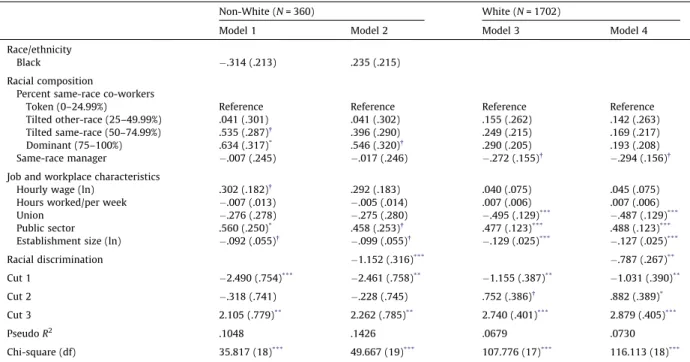
Table 4explores whether or not these relationships are similar for non-Whites and Whites. For non-Whites, perceived racial discrimination partially mediates the relationships between racial composition and employer loyalty. For Whites, however, there is no relationship between racial composition and employer loyalty. For non-Whites and Whites, perceived discrimination has a strong negative effect on employer loyalty.
InTable 5we examine workers’ job search intentions. The baseline model (model 1) indicates that Blacks and Latinos have greater job search intentions than Whites. The model also reveals that job search intentions are reduced with increases in hourly wages and the number of hours worked per week, as well as in unionized jobs, and in the public sector. Model 2 demonstrates a relationship between racial composition and job search intentions. Compared to workers in token jobs, job search intentions are lower in tilted same-race and dominant job contexts, while job search intentions do not differ between token and tilted other-race jobs. Having a same-race manager has no effect on job search intentions. These results provide partial support for Hypothesis 2.
In model 3, perceived racial discrimination has a strong positive association (b= .870,p< .001) with job search intentions. The effects of racial composition are partially mediated by perceived racial discrimination. The fact that racial similarity with coworkers diminishes job search intentions provides partial support for the mediation hypothesis (Hypothesis 3).
InTable 6, we examine job search intentions separately for non-Whites and Whites. The proportional odds assumption could not be met for the non-White ordered logistic models. Upon further inspection, this was being driven by the hourly wage variable. The reported model excludes the hourly wage variable for non-Whites and the proportional odds assumption was confirmed. The coefficients are practically the same and our substantive conclusions are identical with or without the inclusion of the hourly wage variable.
Among non-Whites, we do not find an association between racial composition and job search intentions. Perceived racial discrimination, however, continues to exert a marginally significant effect on job search intentions (.618, .05 <p< .10). Among Whites, there is a relationship between racial composition and job search intentions, which is partially mediated by perceived racial discrimination. Taken together these results provide evidence of non-symmetry effects. The experience of discrimination increases job search intentions for non-Whites, however, racial composition has no direct effect. This is
Table 4
Ordered logistic estimates of employer loyalty.
Non-White (N= 360) White (N= 1702)
Model 1 Model 2 Model 3 Model 4
Race/ethnicity
Black .314 (.213) .235 (.215)
Racial composition
Percent same-race co-workers
Token (0–24.99%) Reference Reference Reference Reference
Tilted other-race (25–49.99%) .041 (.301) .041 (.302) .155 (.262) .142 (.263) Tilted same-race (50–74.99%) .535 (.287) .396 (.290) .249 (.215) .169 (.217) Dominant (75–100%) .634 (.317)* .546 (.320) .290 (.205) .193 (.208) Same-race manager .007 (.245) .017 (.246) .272 (.155) .294 (.156) Job and workplace characteristics
Hourly wage (ln) .302 (.182) .292 (.183) .040 (.075) .045 (.075)
Hours worked/per week .007 (.013) .005 (.014) .007 (.006) .007 (.006)
Union .276 (.278) .275 (.280) .495 (.129)*** .487 (.129)*** Public sector .560 (.250)* .458 (.253) .477 (.123)*** .488 (.123)*** Establishment size (ln) .092 (.055) .099 (.055) .129 (.025)*** .127 (.025)*** Racial discrimination 1.152 (.316)*** .787 (.267)** Cut 1 2.490 (.754)*** 2.461 (.758)** 1.155 (.387)** 1.031 (.390)** Cut 2 .318 (.741) .228 (.745) .752 (.386) .882 (.389)* Cut 3 2.105 (.779)** 2.262 (.785)** 2.740 (.401)*** 2.879 (.405)*** PseudoR2 .1048 .1426 .0679 .0730 Chi-square (df) 35.817 (18)*** 49.667 (19)*** 107.776 (17)*** 116.113 (18)***
Note: Standard errors shown in parentheses. Models include control for education, job tenure, age, sex, and urban–rural residence.
p< .10. *p< .05. ** p< .01. ***p< .001.
Table 5
Ordered logistic regression estimates of turnover intentions (N= 2059).
Model 1 Model 2 Model 3
Race/ethnicity
Black .758 (.151)*** .638 (.175)*** .592 (.176)***
Latino .660 (.168)*** .544 (.184)** .534 (.184)**
Racial composition
Percent same-race co-workers
Token (0–24.99%) Reference Reference
Tilted other-race (25–49.99%) .158 (.207) .135 (.209) Tilted same-race (50–74.99%) .494 (.178)** .394 (.181)* Dominant (75–100%) .428 (.170)* .317 (.174) Same-race manager .084 (.145) .112 (.146)
Job and workplace characteristics
Hourly wage (ln) .383 (.081)***
.389 (.081)***
.397 (.081)***
Hours worked/per week .012 (.006)*
.012 (.006)* .013 (.006)* Union .261 (.144) .265 (.144) .292 (.145)* Public sector .419 (.132)** .410 (.132)** .402 (.132)** Establishment size (ln) .016 (.025) .020 (.026) .019 (.026) Racial discrimination .870 (.212)*** Cut 1 1.309 (.332)*** 1.654 (.372)*** 1.535 (.373)*** Cut 2 2.557 (.336)*** 2.908 (.376)*** 2.797 (.377)*** PseudoR2 .1737 .1783 .1864 Chi-square (df) 322.70 (15)*** 331.98 (19)*** 348.24 (20)***
Note: Standard errors shown in parentheses. Models include control for education, job tenure, age, sex, and urban–rural residence.
p< .10. *p< .05. **p< .01. *** p< .001. Table 6
Ordered logistic estimates of job search intentions.
Non-White (N= 360) White (N= 1699)
Model 1 Model 2 Model 3 Model 4
Race/ethnicity
Black .138 (.221) .105 (.222)
Racial composition
Percent same-race co-workers
Token (0–24.99%) Reference Reference Reference Reference
Tilted other-race (25–49.99%) .095 (.312) .101 (.314) .357 (.287) .370 (.291)
Tilted same-race (50–74.99%) .401 (.301) .313 (.304) .672 (.236)** .582 (.240)*
Dominant (75–100%) .161 (.321) .231 (.324) .663 (.222)**
.548 (.227)*
Same-race manager .028 (.254) .027 (.255) .147 (.181) .191 (.183)
Job and workplace characteristics
Hourly wage (ln) .338 (.089)*** .352 (.089)***
Hours worked/per week .021 (.014) .023 (.014)
.013 (.007)* .013 (.007) Union .583 (.299) .599 (.300)* .126 (.165) .160 (.166) Public sector .004 (.257) .071 (.260) .553 (.157)*** .583 (.158)*** Establishment size (ln) .047 (.057) .041 (.057) .035 (.029) .031 (.029) Racial discrimination .618 (.325) 1.113 (.285)*** Cut 1 1.857 (.689)** 1.820 (.693)** 1.610 (.432)*** 1.442 (.436)*** Cut 2 3.127 (.704)*** 3.103 (.707)*** 2.862 (.436)*** 2.704 (.439)*** PseudoR2 .1715 .1813 .1525 .1612 Chi-square (df) 58.82 (17)*** 62.50 (18)*** 226.33 (17)*** 240.26 (18)*** Note: Standard errors shown in parentheses. Score tests of proportional odds were statistically significant for the non-White models (p< .05) suggesting that proportional odds cannot be assumed. Further analyses revealed that hourly wage was the only variable in the model violating the proportional odds assumption. In order to meet the proportional odds assumption, we dropped the variable from the model. The substantive findings do not change with the inclusion or exclusion of the hourly wage variable. Models include control for education, job tenure, age, sex, and urban–rural residence.
p< .10. *p< .05. ** p< .01. *** p< .001.
likely the result of commonly experiencing non-dominant status. Whites, on the other hand, have greater job search inten-tions when they are a numeric minority in their work group—a finding consistent withTsui et al. (1992)who reported that the effects of work group heterogeneity on organizational attachment were more adverse for Whites than non-Whites.
Mueller et al. (1999)provide a similar finding among school teachers and suggest that Whites may experience ‘‘culture shock’’ because they so rarely occupy numeric minority status in society.
5. Conclusion
Nearly 10 years ago,Vallas (2003)encouraged scholars to ‘‘rediscover the color line’’ in studies of workplace inequality. In particular, he was concerned that the qualitative research examining the labor process was almost entirely focused on class relations and the quantitative literature examining racial inequality was focused on the allocation of tangible organizational resources, such as jobs, wages, and promotions. Largely absent from both qualitative and quantitative studies of racial inequality at work was the ‘‘nature of workplace relations, the structure of worker affiliations, and the patterns of interaction that occur across the color line’’ (Vallas, 2003, p. 393).
In this article we seek to contribute to the research aimed at rediscovering the relational aspects of race in the workplace. This research also addresses recent calls for stratification scholars to explore not only the objective dimensions of inequality (e.g., segregation, wages), but also how organizational context shapes interactional and experiential inequalities (Stainback et al., 2010). In particular, we explore (1) how the racial composition of work groups influences perceived racial discrimina-tion, (2) whether racial discrimination mediates the observed association between racial composition and organizational attachment observed in previous research, and (3) whether these relationships are the same for Whites and non-Whites.
Deriving theoretical expectations from perspectives linked to group composition and relational dynamics (Blalock, 1967; Kanter, 1977; Pfeffer, 1983), we find that Whites, Blacks, and Latinos are less likely to experience discrimination when the majority of their coworkers are of the same-race. Interestingly, having a same-race manager has no effect on perceived dis-crimination among non-Whites, but reduces Whites’ reports of racial disdis-crimination. This finding is consistent with the work ofMueller et al. (1999)who suggest that because Whites rarely find themselves working for a racialized minority manager, they experience a ‘‘culture shock’’ and race becomes prominent in interpreting their environment. Conversely, Blacks and Latinos often find themselves in positions where they are supervised by Whites. As such, Whites are more likely to report an experience of racial discrimination when working for a non-White manager.
For all racial groups, perceived racial discrimination reduced employer loyalty and increased job search intentions. Our results also indicate that perceived discrimination mediates some of the effects of racial composition on organizational attachment. Among Blacks and Latinos, the effects of racial composition on employer loyalty are partially mediated; how-ever, we do not find an association between racial composition and employer loyalty among Whites. In retrospect this non-symmetric finding makes sense. Net of job quality and experiencing racial discrimination, non-Whites are more likely to form social relations with similar others, which in turn enhances their identification with the firm based on the more proximate social connections within the work group. Because Whites are often found in majority White work groups and this factor is less likely to influence their employer loyalty net of job characteristics.Maume and Sebastian (2007), for exam-ple, show that Whites’ in non-White jobs report significantly lower levels of job satisfaction; however, the effect disappeared once job quality controls were included.
Racial differences in job search intentions were also observed between Whites and non-Whites. Net of statistical controls, racial composition had no effect on Blacks’ or Latinos’ job search intentions. Perceived discrimination did, however, partially mediate the racial composition and job search intention relationship for Whites; although, the direct effects of racial com-position on job search intentions remained strong. The perception of discrimination by Whites and its effect on the relation-ship between racial composition and job search intention found reiterates earlier findings by researchers that White workers do not respond to diverse work groups in the same manner as minority workers (Tsui et al., 1992).
The findings regarding job search intentions, in particular, hold important implications for organizational decision mak-ers, human resource management (HRM) practitionmak-ers, and corporate policies and practices. Kmec, for example, has noted that racial and ethnic composition ‘‘stems from who entersandwho leaves a workplace’’ (Kmec, 2007, p. 484). Blacks’ and Latinos’ job search intentions are unaffected by work group racial composition, while Whites job search intentionsare af-fected by group composition. Net of statistical controls, Whites appear to be uncomfortable working in work groups where they are the numeric minority. This reality, and the tension between diversity on the one hand and in-group solidarity on the other, will pose a challenge in the coming years as employers continue to seek inclusive and racially integrated work envi-ronments. Specifically, the findings suggest that integrating non-White jobs may be especially challenging given Whites more adverse reaction to working with other races compared to non-Whites.
While the data we employ provide important insights into understanding how the racial composition of the workplace affects perceived racial discrimination and organizational attachment, they are not without limitations. For example, our theoretical framework is dynamic; however, cross-sectional data cannot demonstrate how racial composition affects per-ceived discrimination and organizational attachment in a dynamic way. Future longitudinal data collection designs should include measures that consistently capture racial composition effects in order to enhance our understanding of how orga-nizational demography influences the path and rate of workplace integration. Future data collection strategies should also seek to capture data on the frequency and intensity of perceived workplace discrimination.
We encourage a diversity of methods to approach race and workplace relations in the future. Because there are few work-place ethnographies exploring how racial categories are enacted and recreated in concrete settings, we see such research efforts as particularly fruitful for understanding: (1) the organizational contexts that minimize experiential inequalities, (2) the coping strategies that individuals deploy to navigate perceived discriminatory workplace environments, and (3) how various racial groups may differentially construct cultural narratives to define an unfair experience as racial discrimination.
Acknowledgements
We would like to thank Sharon Collins, Cedric Herring, Kylie Parrotta, Sheryl Skaggs, Don Tomaskovic-Devey, Nick Vargas, the Social Science Research editor, and anonymous reviewers for their helpful comments and suggestions on this article.
References
Allison, P., 1999. Logistic Regression Using the SAS System: Theory and Application. SAS Institute, Cary, NC.
Banerjee, R., 2008. An examination of factors affecting perception of workplace discrimination. Journal of Labor Research 29 (4), 380–401. Baron, J.N., Pfeffer, J., 1994. The social psychology of organizations and inequality. Social Psychology Quarterly 57, 190–209.
Baron, R.M., Kenny, D.A., 1986. The moderator–mediator distinction in social psychological research: conceptual, strategic, and statistical considerations. Journal of Personality and Social Psychology 51, 1173–1182.
Bielby, W.T., 2000. Minimizing workplace bias. Contemporary Sociology 29, 120–129. Blalock, H.M., 1967. Toward a Theory of Minority-Group Relations. Wiley, New York. Byrne, D., 1971. The Attraction Paradigm. Academic Press, New York.
Catanzarite, L., 2003. Race–gender composition and occupational pay degradation. Social Problems 50, 14–37.
Collins, S.M., 1997. Black Corporate Executives: The Making and Breaking of a Black Middle Class. Temple University Press, Philadelphia.
Elliott, J.R., 2001. Referral hiring and ethnically homogeneous jobs: how prevalent is the connection and for whom? Social Science Research 30, 401–425. Elliott, J.R., Smith, R.A., 2001. Ethnic matching of supervisors to subordinate work groups: findings on ‘bottom-up’ ascription and social closure. Social
Problems 48, 258–276.
Elvira, M., Town, R., 2001. The effects of race and worker productivity on performance evaluations. Industrial Relations 40, 571–590.
Ensher, E.A., Murphy, S.E., 1997. Effects of race, gender, perceived similarity, and contact on mentor relationships. Journal of Vocational Behavior 50, 460– 481.
Giuliano, L., Levine, D.I., Leonard, J., 2006. Do Race, Age, and Gender Differences Affect Manager–Employee Relations? An Analysis of Quits, Dismissals, and Promotions at a Large Retail Firm. Institute for Research on Labor and Employment. Institute for Research on Labor and Employment Working Paper Series. Paper iirwps-151-07. <http://repositories.cdlib.org/iir/iirwps/iirwps-151-07>.
Hirsh, C.E., Kornrich, S., 2008. The context of discrimination: workplace conditions, institutional environments, and sex and race discrimination charges. American Journal of Sociology 113, 1394–1432.
Hirsh, C.E., Kmec, J.A., 2009. Human resource structures: reducing discrimination or raising rights awareness? Industrial Relations 48, 512–532. Hirsh, E., Lyons, C.J., 2010. Perceiving discrimination on the job: legal consciousness, workplace context, and the construction of race discrimination. Law
and Society Review 44, 269–298.
Huffman, M.L., Cohen, P.N., 2004. Racial wage inequality: job segregation and devaluation across US labor markets. American Journal of Sociology 109, 902– 936.
Ibarra, H., 1993. Personal networks of women and minorities in management: a conceptual framework. Academy of Management Review 18, 46–87. Ibarra, H., 1995. Race, opportunity and diversity of social circles in managerial networks. Academy of Management Journal 38, 673–703.
Kalev, A., Dobbin, F., Kelly, E., 2006. Best practices or best guesses? Assessing the efficacy of corporate affirmative action and diversity policies. American Sociological Review 71, 589–617.
Kanter, R.M., 1977. Men and Women of the Corporation. Basic Books. Kmec, J.A., 2003. Minority Concentration and Wages. Social Problems 50, 38–59.
Kmec, J.A., 2007. Ties that bind? Race and networks in job turnover. Social Problems 54, 483–503.
Lefkowitz, J., Battista, M., 1995. Potential sources of criterion bias in supervisor ratings used for test validation. Journal of Business and Psychology 9, 389– 414.
Maume, D.J., Sebastian, R., 2007. Racial composition of workgroups and job satisfaction among Whites. The Annals of the American Academy of Political and Social Science 609, 85–103.
Mueller, C.W., Finley, A., Iverson, D.R., Price, J.L., 1999. The effects of group racial composition on job satisfaction, organizational commitment, and career commitment. Work and Occupations 26, 187–219.
O’Reilly, C.A., Chatman, J., Caldwell, D.F., 1991. People and organizational culture: a profile comparison approach to assessing person-organization fit. The Academy of Management Journal 34, 487–516.
Pelled, L.H., Ledford, G.E., Mohrman, S.A., 1999. Demographic dissimilarity and workplace inclusion. Journal of Management Studies 36, 1013–1031. Pfeffer, J., 1983. Organizational Demography. Research in Organizational Behavior, vol. 5. JAI Press, Greenwich, CT, pp. 299–357.
Popielarz, P.A., McPherson, J.M., 1995. On the edge or in between: niche position, niche overlap, and the duration of voluntary association memberships. The American Sociological Review 101, 698–720.
Reskin, B.F., 2000. The proximate causes of employment discrimination. Contemporary Sociology 29, 319–328.
Reskin, B.F., McBrier, D.B., Kmec, J., 1999. The determinants and consequences of workplace sex and race composition. Annual Review of Sociology 25, 335– 361.
Riordan, C., Shore, L.M., 1997. Demographic diversity and employee attitudes: examination of relational demography with work unit. Journal of Applied Psychology 82, 342–358.
Roscigno, V.J., 2007. The Face of Discrimination: How Race and Gender Impact Work and Home Lives. Rowman and Littlefield, New York.
Semyonov, M., Herring, C., 2007. Segregated jobs or ethnic niches? The impact of racialized employment on earnings inequality. Research in Social Stratification and Mobility 25, 245–257.
Sørensen, J., 2004. The racial demography of racial employment segregation. American Journal of Sociology 110, 626–671. Stainback, K., 2008. Social contacts and race/ethnic job matching. Social Forces 87, 857–886.
Stainback, K., Ratliff, T.N., Roscigno, V.J., 2011. The organizational context of sex discrimination: sex composition, workplace culture, and relative power. Social Forces 89, 1165–1188.
Stainback, K., Tomaskovic-Devey, D., Skaggs, S., 2010. Organizational approaches to inequality: inertia, relative power, and environments. Annual Review of Sociology 36, 225–247.
Tajfel, H., Turner, J.C., 1986. The social identity theory of inter-group behavior. In: Worchel, S., Austin, L.W. (Eds.), Psychology of Intergroup Relations. Nelson-Hall, Chicago.
Tomaskovic-Devey, D., 1993. Racial and Gender Inequality at Work: The Sources and Consequences of Job Segregation. ILR Press, Ithaca, NY.
Tsui, A.S., O’Reilly, C.A., 1989. Beyond simple demographic effects: the importance of relational demography in superior-subordinate dyads. The Academy of Management Journal 32, 402–423.
Tsui, A.S., Egan, T.D., O’Reilly, C., 1992. Being different: relational demography and organizational attachment. Administrative Science Quarterly 37, 549–579.
Vallas, S.P., 2003. Rediscovering the color line within work organizations: the ‘knitting of racial groups’ revisited. Work and Occupations 30, 379–400. Wharton, A., Rotolo, T., Bird, S., 2000. Social context at work: a multilevel analysis of job satisfaction. Sociological Forum 15 (1), 65–90.
Zatzick, C.D., Elvira, M.M., Cohen, L.E., 2003. When is more better? The effects of racial composition on voluntary turnover. Organization Science 14, 483–496.