Simulation of Thrombin Generation During
Plasmatic Coagulation and Primary Hemostasis
Pascal Ballet (l), Jean-Franqois Abgrall(2), Vincent Rodin (1) and Jacques Tisseau ( I ) (1) PhD
-
Software Engineering Laboratory - French National School of Engeenering - Brest - France (2) Physician-
Hematology Laboratory - French Medical School - Brest-
FranceContact: Pascal Ballet
Laboratoire d'hformatique Industrielle
-
EA 22 15 Ecole Nationale d'IngCnieurs de BrestTechnopBle Brest-Iroise CP 30815
-
29608 Brest Cedex Phone: +33 298 056 665 Fax: 4-33 298 056 629 E-Mail: [email protected] URL: http://www.enib.fi/-ballet AbstractThis paper describes a simulation of the platelet agglutination into a damaged vein. This agglutination, called plasmatic coagulation, appears into the human body and its malfunction involves dramatic disease like thromboses or hemophilia [SI.
We designed an in-machina
experimentation that is very difficult to do in-vitro. The first aim of this simulation is to verify one of the biological models of plasmatic coagulation and primary hemostasis. The second one is to test different ways to regulate the thrombin production. Then, we simulate a like haemophilia disease and one of its possible treatment.
Introduction
Artificial Immune System is a growing field of computer science, Several applications have already been develop. This field is based on the various abilities of the immune system. We distinguish two types of investigation. The first one consists in the development of algorithms using the immune system as a metaphor
[l]. The other one is the use of computer to simulate immune phenomena. For instance, simulation of immune response [2] [3] [4] [ 5 ] , in-vitro experimentation [6] or affinity maturation [7]. The models 0-7803-6583-6/00/$10.00 0 2000 IEEE
developed for these simulations can be differential equation based or, more recently agent based.
Our model uses the multiagent system developed by Pascal Ballet [9] which is specialized for in-vitro experimentation. It includes full cell and molecule description, blood flow, physical constraints and result visualization.
The first part of this paper describes the coagulation phenomena. We introduce the molecules and cells involved into the plasmatic coagulation and the primary hemostasis. The amplification and regulation mechanisms, which are fundamental, are also detailed.
The second part is about the multiagent model. We see the different cell and molecule agents, their behaviors, their functions, their receptors and their interactions.
The third part shows the results of our simulations. That is the thrombin and platelet regulation, the agglutination phenomena and the flow influence.
Then, we focus on the thrombin regulation implied into the thrombosis diseases. We modify the concentration of molecules implied into the thrombosis malfunction. Using the simulator, we observe the over- production of platelet thrombus like that appears in-vivo. Then, we test the introduction of a molecule able to regulate this over-production.
Finally, we conclude about this simulation that is how we can translate in-machina results to use them in-vitro. For example, what experimentation must be done to verify our assumptions about the regulation molecule introduction and at which dosage?
and hemostasis as a tool for education of medical students, for anadysis of biological defects responsible for venous and arterial thrombosis and to mimick the action of anticoagulants.
Phvsiolonv of hemostasis and coanulation Biological introduction
Plasmatic coagulation and primary hemostasis are intricate physiological phenomena involved in maintenance of blood constituents into vessels in case of disruption of the vessel wall causing bleeding. Failure of these systems can lead to haemorrhage and their inappropriate activation can cause thrombosis. These two systems involve cells and proteins which act to form a clot.
Several cells are involved in this process: platelets, endothelial cells, monocytes, red blood cells and polymorphonuclear cells. Dozen of proteins, coagulation factors and inhibitors act together to produce fibrin, a fibrillar protein which is the main constituent of clot.
All these cellular and protein actors are present in vessel where they are submitted to blood flow and projected on the vessel wall.
Coagulation and primary hemostasis are routinely studied in-vitro in glass or plastic tubes, by measuring several phases of coagulation or the levels of coagulation factors. But these measurement are made in a static system where blood flow cannot be applied.
Using desendothelialized animal vessels, primary hemostasis can be studied in-vitro under flow but this technique is restricted to few research laboratories.
The aim of our work is to make a simulation of coagulation and primary hemostasis under blood flow in a computer, using many of the known mechanisms in the field of coagulation and hemostasis.
The main objectives of our research are to use our computerized model of coagulation
When a lesion occurs in the vessel wall, bleeding ensues. Endothelial cells are destroyed and subendothelial constituents are exposed to blood. Platelets adhere to subendothelial proteins by mean of membrane receptors, forming a platelet thrombus. These process are known as primary hemostasis.
Coagulation process start when coagulation factor VII, a membrane component of fibrobllasts present in subendothelium, is exposed to other plasmatic proteins. Many proteins are involved in the coagulation process, leading to action of enzymes on the platelet surface, generating the formation of thrombin, the responsible enzyme for transformation of soluble fibrinogen into fibrin, the main proteinic constituent of thrombus.
Thrombin generation thus appears to be
crucial for thrombus formation.
These enzymes are inhibited by other enzymes in order to limit the extension of the thrombus. All these protein mechanisms are known as plasmatic coagulation.
Plasmatic coagulation is formed by factors or proteins: factors 11, V, VIII, IX, X, XI, and XII. Coagulation inhibitors are represented by antithrombin 111, protein C, protein S and thrombomodulin.
Red blood cells act by pushing platlets on the subendothelial surface. Monocytes act by expression of factor VI1 on their surface and endothelial cells act by limiting the coagulation process.
These different mechanisms are influenced by blood flow which dilute coagulation proteins and bring far from vessel lesion. The precise quantity of cells and proteins by unit of blood volume are well known
and the intensity of blood flow is also well known in arteries, veins and small capillaries.
Many data are thus perfectly known and susceptible to be introduced in a computerized model of hemostasis and coagulation
Now, we present the model used to simulate the phenomena.
Multiagent System
The simulation is made using the multiagent model we developed to model and simulate immune mechanisms
[BAL98]. Each agent represents a cell or a
molecule. An agent is made with receptors on its surface to get information from the environment. It possesses a behavior according to the cell behavior that it is supposed to represent. Thanks to its internal state and the information coming from receptors, the agent takes decisions (figure 1). In our simulation, we need 23 molecules-agent and 4 cell-agent.
Receptors\
I
centerI
xo
Decision (agent creation
for example)
Figure 1 : simple agent description We model two types of cells: the platelet and the endothelial cells. The platelet is the most complex cell modeled here. It owns five types of receptors. The first one is the receptor allowing the cell to become activated. The second type fixes the platelet on the under endothelial layer. The receptors having the factor VIIIa allow the platelet to bind the factor IXa. Like this, the factor X can bind the complex factor VIIIa+IXa. Thus, the factor X becomes
activated (Xa). Then, the receptor with the factor Va can bind the factor Xa. This connection involved the transformation of the prothrombin into thrombin. This is the last phenomenon we study.
All these agents are placed into an environment decribed into the next section.
Environment
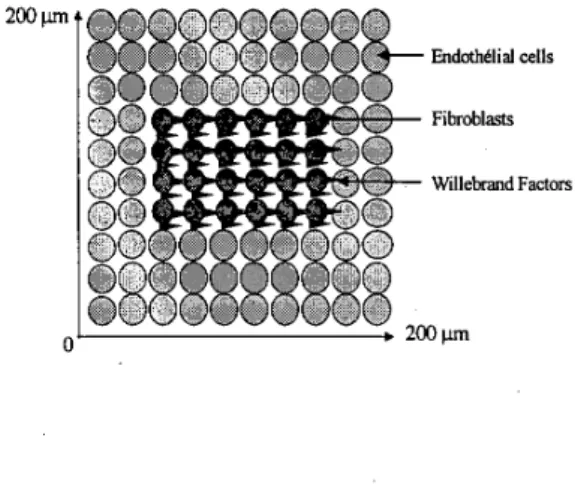
The agents move into a 3D environment. This environment represents a stretch of a vessel. Its dimensions are 200x200~50 micrometers. There are endothelial cells covering the vessel and a lesion revealing subendothelial cells and molecules (figure
2). This is this last area that will initiate the coagulation. Endothklial Fibroblasts Willebrand t 2 W ~ m 1 cells Factors
Figure 2: 2D projection of the vessel wall constitution
The blood flow is important for the regulation of the coagulation. That is why we have to simulate the blood flow. Several works treat the model problem
[I.
We decided to simplify those models to be coherent with the accuracy of our molecule-cell model. We just simulate the flow variation according to the time and the distance to the vein center (figure 3).-
Vein
I
I
Flowb, time) = (l+cos(time))*(1/(y~2+1))Figure 3: vein flow definition Like this, we observe variations according to the time and the distance to the vessel wall (figure 4).
1 . .
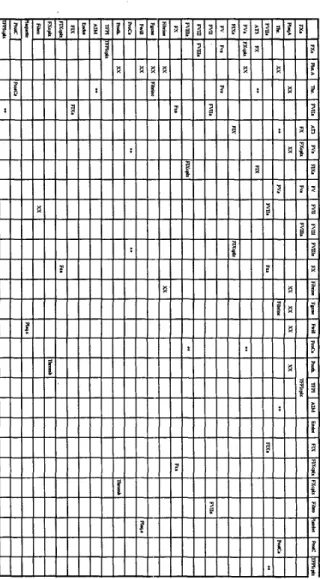
molecule is too important, we need a new interaction model specialized to compensate the little number of agents. That is done by limiting and amplifying the interaction forces. In fact, an agent sudden the influence of just one another (the most influent), but the interaction forces are considerably increased.
There are 28 types of interaction between the agents. They are surnmary in the figure 5.
Figure 4: definition of the blood flow into the vein
Interactions
The interactions are fundamental into our model. Because the number of real
Figure 5: agent's interactions. XX = agent fixation,
*
= agent destruction. There are three consequences of a link between two agents. The first is the creation of a new agent corresponding to a complex. The second oae is the destruction of the bind agents and the third one is thefixation of one of the agents onto the other one.
Another problem is the big difference between two molecule populations.
VI1 (Proconvertin)
I
5,7.1OZ4 VI11 (Antihaemophilia A)I
2,7.1OZ3Determination of the number of agents
63 10 For example, in-vivo, there are 2,7.1023 molecule of factor VI11 and 5,3.1027 molecule of factor I. For simulation time reason, we are limited to one thousand of agents. So, we use a logarithmic transformation with two constraints to calculate the number of each agent population. The first constraint is that the total number of agent equal one thousand. The second constraint enforce the minimal number (10 for example) of agents for the less representative population.
We can see the correspondence of in-vivo and in-machina in the figure 6 .
Coagulation factors 1 In-vivo ( n b m l ~ u l d ) I In-machina (nbagenrr)
I (Fibrinoeen) I 5.3.1OZ7 I 181 I1 (Prothrombin)
1
1.1027I
153 V (Proaccelerin) I 1,4.102' 1 78 IX (Antihaernoohilia B) I 4.2.1OZ5 I 97 X (Stuart)I
1,2.1026I
116 coagulation Inhibitors I Antithrombin111 (fixed)I
2.2.1027I
166 I Proteine c I 4.2.lOz5 I 97 I I Aloha2 macroalobulin I ND I 10 I Figure 6: correspondence of the number ofmolecules in-vivo and the number of agents in-machina.
The next section shows the results obtained with our simulations.
Simulations
We made three kinds of simulations. The first one is a simulation supposed to reproduce a normal coagulation phenomenon. The second one is the coagulation produced by an haemophiliac. The third one reproduces the action of a
medicine acting to compensate the haemophilia disease.
0 Normal 0 Haemophiliac
0 Treated haemophiliac
Figure 7: curves of thrombine generation for a normal person, an haemophiliac and a
treated haemophiliac
For the haemophiliac, we just put the number of factor VI11 to zeo. We observe a lesser initial slope (-55%) and a smaller maximum (-17%) as compared to the normal coagulation.
To treat our virtual haemophiliac, we introduce an activated factor VI1 [lo] during the simulation. We observe an increase of the initial slop but the maximum of the curve keeps lower than a normal coagulation.
All these results are biologicaly relevant and we hope we will be able to simulate other diseases and medicines.
Conclusion
We saw that coagulation phenomenon can be modeled and simulated using our multiagent approach. The results are encouraging but many problems remain like the difference between the number of molecule in-vivo
and
the number of agents in-machina. Moreover, during coagulation, numerous other and important phenomena take place that we do not include into our model.The next stage of our research will be the improvement of the simulated model.
References
[I] Dipankar Dasgupta, Artificial Immune Systems and their Applications, Springer
-
Verlag, ISBN 3-540-64390-7, November 1998.
[2] Derek J. Smith, David H. Ackley, Stephanie Forrest and Alan S. Perelson, Modeling the effect of prior infection on vaccine efficacy, IEEE, Systems Man and Cybemetics 97, pages 363368, Orlando, Florida, USA, 12-15 October 1997.
[3] Franco Celada and Philip E. Seiden, A model for simulating cognate recognition and response in the immune system, Joumal of Theorical Biology, volume 158, pages 329-357,1992.
[4] Franco Celada and Philip E. Seiden, Afinity maturation and hypemutation in a simulation of the humoral immune response, European Journal of
Immunology, volume 26, pages 1350-1358,1996.
[5] P. Ballet, J. Tisseau and F. Harrouet, A multiagent system to model an human humoral answer, page 357- 362, IEEE lntemational Conference on Systems Man and Cybemetics, SMC'97, Orlando, Florida, USA, 12- 15 October 1997.
[SI P. Ballet, J.O. Pers, V. Rodin and J. Tisseau, A multiagent system to model and simulate RCD5 apoptosis, IEEE lntemational Conference on Systems Man and Cybemetics, SMC'98, San Diego, Caliiomia, USA, 12-1 5 October 1998.
m
Franco Celada and Phlilip E. Seiden, Affinity maturation and hypemutation in a simulation of the humoral immune response, European Joumal of Immunology, volume 26, pages 1350-1358,1996.[8] H. Coenraad Hemker and Suzette B@uin,
Thrombin Generation in Plasma: its Assessment Via the Endogenous Thrombin Poltential, Thrombosis and Haemostasis
-
F-K Schattauier Verlagsgesellschaft mbH (Stuttgar!) 74(1), pages 134-138,1995[9] P. Ballet, V. Rodin and .I. Tisseau, A Multiagent System to model an simulate in-vifm experimentations,
S. Cybemetics and Informatics SC1'98, Orlando, USA, 12-1 7 Juillet 1998.
[IO] Novo Seven medicine, describes in