University of South Florida
Scholar Commons
Graduate Theses and Dissertations Graduate School
4-5-2016
Perceptions of College Instructors Toward
Accented English Measured by the Auditory
Multifactor Implicit Association Test
Eunkyung Na
Follow this and additional works at:http://scholarcommons.usf.edu/etd
Part of theAnthropological Linguistics and Sociolinguistics Commons, and theSocial Psychology Commons
This Dissertation is brought to you for free and open access by the Graduate School at Scholar Commons. It has been accepted for inclusion in Graduate Theses and Dissertations by an authorized administrator of Scholar Commons. For more information, please contact
Scholar Commons Citation
Na, Eunkyung, "Perceptions of College Instructors Toward Accented English Measured by the Auditory Multifactor Implicit Association Test" (2016).Graduate Theses and Dissertations.
Perceptions of College Instructors Toward Accented English Measured by the Auditory Multifactor Implicit Association Test
by
Eunkyung Na
A dissertation submitted in partial fulfilment of the requirements for the degree of
Doctor of Philosophy in Curriculum and Instruction with an emphasis in Adult Education
Department of Leadership, Counseling, Adult, Career, and Higher Education College of Education
University of South Florida
Major Professor: Waynne B. James, Ed.D. Jeffrey D. Kromrey, Ph.D.
Tony X. Tan, Ed.D. William H. Young III, Ed.D.
Date of Approval: March 22, 2016
Keywords: Implicit language attitudes, accent bias, nonnative English speakers Copyright © 2016, Eunkyung Na
Dedication
I dedicate this to three men who have had profound influence on me: Drs. Wonwha Na, Charles W. Voris, and Michael K. Voris
Acknowledgments
I would like to thank my committee members with all my heart for helping me with this process. Dr. William Young has been a positive force. Dr. Tony Tan set the sky as my limit early on. Without his patient guidance, this research would not have been possible. Dr. Jeffrey Kromrey provided me with a solid statistical foundation through earlier coursework. His keen observation and timely advice made significant
improvements to this research study. And my major professor, Dr. Waynne James… she was there for me every step of this journey. Words cannot describe my gratitude to Dr. James.
I would also like to thank Drs. Phil Smith, Sarah Kiefer, Vonzell Agosto, and Deidre Cobb-Roberts for their continued care and support for many years.
I would like to thank my fellow doctoral students and friends, Gianina Hayes, Kelly McCarthy, Arthur “Ray” McCrory, Robert Miller, Diep Nguyen, and Thanh Pham for sharing many stressful and joyful moments with me.
Special thanks to Travis Marn and Rica Ramirez, my IAT research mates. They have tirelessly collected the data for me during the training years, tested new
instruments numerous times, and lent me sympathetic ears when things got tough. I also want to thank the faculty and teaching assistants who participated in this study.
Table of Contents
List of Tables iv
List of Figures v
Abstract vi
Chapter 1 Introduction 1
Statement of the Problem 4
Statement of Purpose 6
Research Questions 6
Theoretical Framework 7
Significance of the Study 8
Limitations of the Study 9
Delimitations of the Study 9
Definition of Terms 9
Organization of Study 11
Chapter 2 Review of Related Literature 13
Structure of Attitudes 13
Nature of an Attitude 14
Attitude Formation 15
Attitude and Behavior 16
Importance of Language Attitudes 17
Process in Language Attitudes 18
Attitudes Toward Nonnative-accented English 19
Accent Acquisition of Adults 21
Evaluative Dimensions of Accented Speech 22
Reasons for Negative Reactions Toward Nonnative Accent 23
Language Attitudes and Accent Research 25
Nonnative Accent Research 26
Attitudes Toward Nonnative Accent in Higher Education 26
Chinese-accented English 29
Korean-accented English 30
Hispanic-accented English 31
Measuring Language Attitudes 34
Direct Measures 34
Indirect Measures 36
Summary 39
Chapter 3 Methods 40
Research Design 40
Population and Sample 40
Instrumentation 41
Method of the IAT 41
Validity and Reliability of the IAT 43
Creating the Auditory Multifactor IAT 45
Audio Stimuli 45 Text Stimuli 46 Task Description 47 Reliability 48 Field Tests 48 Test 1 49 Test 2 49 Test 3 50 Data Collection 50 Data Analysis 51 Research Questions 51 Summary 52 Chapter 4 Findings 53 Research Design 53
Demographic Characteristics of Study Participants 54
Findings of Research Questions 58
Research Question 1 Findings 60
Research Question 2 Findings 67
Research Question 3 Findings 71
Research Question 4 Findings 73
Findings for Secondary Variables 75
Race/ethnicity 75
Rank 77
Observations 79
Summary 79
Chapter 5 Summary, Conclusions, Implications, and Recommendations 81
Summary 81
Conclusions 83
Implications 85
Recommendations 85
For Instrumentation 86
Controlling Confounding Variables 86
Adding Alternative Comparison Methods 86
Adding Socioeconomic Status (SES) 87
For Further Research 87
Other Accented Languages 88
Alternative Locations 88
Alternative Populations 88
Hispanic-accented Speakers 88
Impact of Exposure 89
Different Sectors in Society 89
References 90
Appendices 102
Appendix A: Demographic Questionnaire 103
Appendix B: Verbal Task Instructions for the Auditory Multifactor IAT 104 Appendix C: Screen Images of the Auditory Multifactor IAT 105
Appendix D. Informed Consent Form 107
Appendix E. Consent to Take Part in the Research Study 110 Appendix F: Institutional Review Board Research Approval Letter 111
List of Tables
Table 1 Correlation Coefficients for Test-Retest Administrations 48 Table 2 Demographic Characteristics of Study Participants 56
Table 3 Place of Birth of Study Participants 57
Table 4 Language Background of Study Participants 58 Table 5 Means, Standard Deviations, and 95% Confidence Intervals of
the Auditory Multifactor IAT d Scores 59
Table 6 Interpretations of d Scores of the IAT 60 Table 7 Skewness and Kurtosis of the Residuals from the Regression
Models 66
Table 8 Regression Analyses for Outcome of Standard- vs. Chinese-accented
English Model 67
Table 9 Regression Analyses for Outcome of Standard- vs. Hispanic-accented
English Model 68
Table 10 Regression Analyses for Outcome of Standard- vs. Korean-accented
English Model 69
Table 11 Regression Analyses for Outcome of Chinese- vs. Hispanic-accented
English Model 70
Table 12 Regression Analyses for Outcome of Chinese- vs. Korean-accented
English Model 70
Table 13 Regression Analyses for Outcome of Hispanic vs. Korean-accented
List of Figures
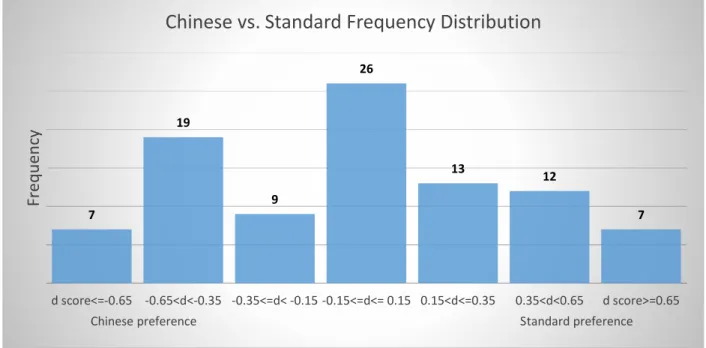
Figure 1 Chinese vs. Standard Frequency Distribution of Preferences to Paired
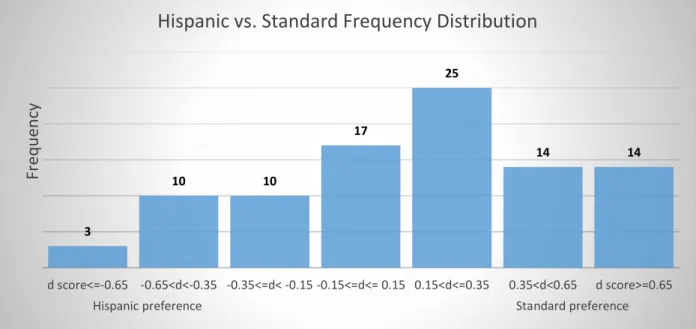
Samples of Accented Speech. 62 Figure 2. Hispanic vs. Standard Frequency Distribution of Preference to Paired
Samples of Accented speech. 63
Figure 3 Korean vs. Standard Frequency Distribution of Preference to Paired
Samples of Accented Speech. 63
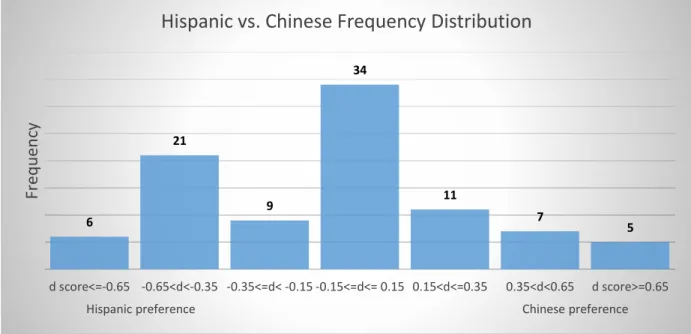
Figure 4. Hispanic vs. Chinese Frequency Distribution of Preference to Paired
Samples of Accented Speech. 64
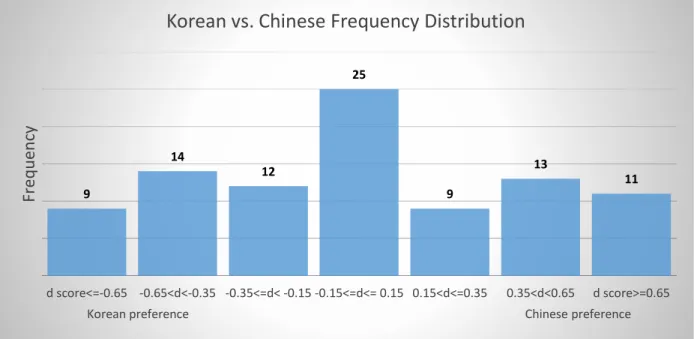
Figure 5. Korean vs. Chinese Frequency Distribution of Preference to Paired
Samples of Accented Speech. 65
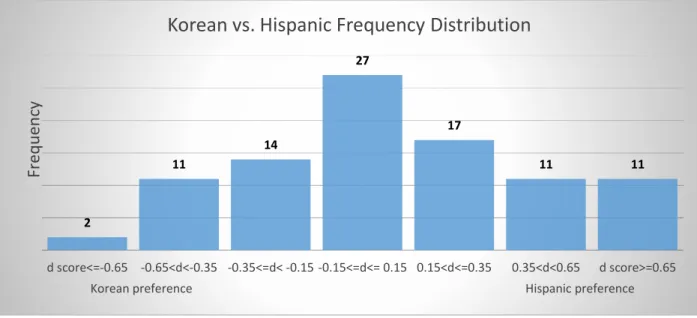
Figure 6. Korean vs Hispanic Frequency Distribution of Preference to Paired
Abstract
The purpose of this study was to examine the implicit language attitudes of college-level instructors toward accented English and the effect of gender, teaching experience, and home language background on those attitudes. The auditory multifactor Implicit Association Test (IAT) was used to measure the implicit attitudes toward Standard, Chinese, Hispanic, and Korean accented English. For the current study, audio stimuli were embedded into the multifactor IAT, which became available for the first time in 2014. The auditory multifactor IAT generated implicit preference scores of six pairs of accented English: Standard vs. Chinese, Standard vs. Hispanic, Standard vs. Korean, Chinese vs. Hispanic, Chinese vs. Korean, and Hispanic vs. Korean
accented English.
Participants (N = 93) included college instructors at an urban university in Florida. Statistical analysis results suggested that college instructors in this study exhibited
some bias towards speakers of Hispanic-accented English, but no bias toward the other five. However, analysis of the frequency distributions of the responses showed bi-polar accent biases did exist. It was possible that the similar numbers for the polar opposites balanced each other in the statistical results of no bias. Gender and home language background had no effect on implicit preference scores. The years of teaching
experience had significant effect in Hispanic vs. Korean-accented English, but not in the other five accented language pairs. However, close examination of the beta coefficient
Faculty, administrators, and students could use test results as a topic of discussion in faculty development, teaching assistant training, student services, and diversity training in higher education institutions. The discussions might help awareness of hidden-yet-present accent bias and prevent potential prejudice toward other accented English speakers.
The administrators need to be aware that preferences do exist toward accented English speakers. These preferences--or biases--toward an accent may be important in selecting instructors.
Chapter 1 Introduction
Language is more than just a tool to convey messages among humans. It
instantly establishes a speaker’s social identity just as with gender or race (Lippi-Green, 2012). A person’s spoken language identifies the speaker’s national and cultural group memberships (Lambert, Hodgson, Gardner, & Fillenbaum, 1960). In a similar fashion, accented language can reveal an even more important part of speaker’s social identity and other information about them such as national origins, homelands, ethnicities, or social classes (Edwards, 1999; Giles & Johnson, 1987; Gluszek & Dovidio, 2010a; Lippi-Green, 2012; Neuliep & Speten-Hansen, 2013).
A listener’s evaluative reactions (i.e., attitudes) to language varieties whether it be accent types associated with standard accent, regional accent, or nonnative accent reflect the listener’s language attitudes. Previous research (Fuertes, Gottdiener, Martin, Gilbert, & Giles, 2012; Lambert et al., 1960; Nesdale & Rooney, 1996) has supported this notion by showing that listeners tended to make value judgments and formed linguistic prejudices based on the speaker’s spoken language. The listeners even attributed certain group traits to an individual speaker based on the perception of what group the listeners thought the speaker belonged to, based on their speech alone (Lambert et al., 1960; Tajfel & Turner, 1986).
English and French speakers among subjects in Montreal, Canada. Montreal is a city where English-speaking Canadians have the dominant position. Their findings showed that speakers of both non-stigmatized language (a language spoken by a socially dominant group or a language perceived to be more prestigious, i.e., English in Montreal) and stigmatized language(a language spoken by a socially less dominant group or a language perceived to be less prestigious, i.e., French in Montreal) held prejudiced attitudes toward the stigmatized language. Language attitudes research since then has shown that individuals who spoke a language with a nonnative accent were perceived more negatively than were those with a native accent (Bradac, 1990; Brown, 1992; Edwards, 1999; Fuertes et al., 2012; Lindemann, 2003, 2005). The data collected in both English-speaking countries and non-English speaking countries showed the same results (Fuertes et al., 2012; Gluszek & Dovidio, 2010b). Particular native regional accents and dialects have also been associated with a range of negative stereotypic trait perceptions and viewed as less intelligent, less loyal, and less
competent (Derwing & Munro, 2009; Lippi-Green, 2012).
Language attitudes permeate everyday lives. For example, an American may think a stranger is cultured and refined simply because his or her accent is deemed British (Cargile & Giles, 1997). One study found a speaker with a standard British accent was judged as more competent than a speaker of nonstandard British accent (Giles, Henwood, Coupland, Harriman, & Coupland, 1992). Non-black Americans tend to judge African American Vernacular English (AAVE) as coming from ignorance or stupidity because of a lack of education (Lippi-Green, 2012). Soukup (2001) found that language attitudes toward southern American English were rather negative in
comparison to a more neutral accent in America. Even American presidents could not evade language prejudice. Former president Jimmy Carter took a beating and hazing from upperclassmen for his soft southern accent while he was attending the U.S. Naval Academy (Nelson, 2015). Another former president, Bill Clinton, was ridiculed by some for talking like a hillbilly during his 1992 presidential campaign (Kumaravadivelu, 2004). In the higher education setting, students have complained about nonnative accents of faculty, while on the other hand, they may consider the European accents of an instructor as showing prestige (Wyld, 1996-97). The issues of nonnative accents of graduate teaching assistants who speak English as a second language have become one of the most contentious ones on large college campuses (Lippi-Green, 2012).
As this past research and these examples show, language attitudes clearly impact the cultural, economic, educational, political, and psychological aspects of an individual and society. When it is associated with critical decisions such as those involving jobs, promotions, probations, witness testimonies, tenure, or academic
achievement, such prejudiced language attitudes can bias social interactions. However, decision makers (listeners) may not be aware of their negative language attitudes as being a form of discrimination as clearly as they might for the more high-profile issues of gender and race.
Understanding prejudiced linguistic attitudes, particularly toward those speaking nonnative accented English in the United States, has become more important as many highly-educated adults have been coming to America to live, work, and study. The number of foreign born in the United States was nearly 40 million, which was about 13% of the total population (U.S. Census Bureau, 2010a). About 62 million U.S. residents
spoke a language other than English at home (Center for Immigration Studies, 2014) although this did not mean all of them spoke nonnative accented English. The U.S. Census Bureau (2010b) also reported that during 1980-2007 time period, the
percentage of speakers of non-English languages increased by 140% while the nation’s overall population grew by 34%. The number of international students has been
increased steadily over the years. In 2014-2015 academic year, 974,926 international students studied at U.S. colleges and universities (Institute of International Education, 2016). The number of international scholars working at colleges and universities in the United States as researchers, instructors, and professors also rose to 115,000 in 2010 from 86,000 in 2001 (Foderaro, 2011).
In essence, language is a powerful social force that does more than convey intended referential information (Cargile & Giles, 1997, 1998; Cargile, Giles, Ryan, & Bradac, 1994). Prejudiced language attitudes can negatively impact many people in personal and professional interactions. Therefore, it is important to research language attitudes to highlight and bring more clarity to this issue.
Statement of the Problem
There has been a rich body of literature since language attitudes study began in and around 1931. The majority of these studies have focused on listener’s evaluative reactions to a host of accents and languages (Cargile & Giles, 1997). However, researchers have been raising questions about data gathering methods while acknowledging that measuring language attitudes is not an easy task (Agheyisi & Fishman, 1970; Zahn & Hopper, 1985). Language attitudes research has traditionally measured only explicit attitudes through self-reported measures, interviews, and scaled
and weighted measures. However, measuring prejudiced language attitudes with explicit measures might be more difficult due to participants’ concern about social desirability. Listeners may self-report inaccurately to avoid revealing their socially unacceptable attitudes (Hendren & Blank, 2009). In 1960, Lambert and his colleagues developed the Matched Guise Technique (MGT) to capture socially stereotyped
impressions on language varieties and it has been widely used since then. In the MGT procedure, one speaker who had equal fluency in chosen language varieties read the same neutral-content passage of prose. Listeners evaluated the tape-recorded speech not knowing that the same person was using realistic guises (external presentations) of the particular accents, dialects, and languages under study. Care was taken to ensure that the listeners perceived those guises as authentic.
In 1998, Greenwald, McGhee, and Schwartz introduced a more advanced instrument called the Implicit Association Test (IAT). The implicit attitudes are the attitudes people do not express openly or even realize they hold while explicit attitudes are the ones people are consciously revealing. Greenwald and Banaji (1995), in introducing the IAT for the first time, defined the implicit attitudes as introspectively unidentified or inaccurately identified traces of past experiences that mediate favorable or unfavorable feeling, thought, or action toward social object. Banaji and Greenwald (2013) claimed that the effectiveness of the IAT lies in the premise that individuals hold stereotypes or biases as a result of the accumulated past experiences stored in the human brain. They further explained that the participants cannot set aside these established stereotypes while they perform the IAT tasks.
The IAT has been used as a tool to measure implicit attitudes of people toward race (Baron & Banaji, 2006), age (Levy & Banaji, 2002), sexuality (Steffens, 2005), and other social concepts. The audio stimuli have been used in the IAT to assess listener’s implicit attitudes toward accented speakers in several studies. This approach might uncover discrepancies in language attitudes that are not easily captured with other types of measures.
In addition, there has been a lack of research on accent-based implicit language attitudes of instructors in the higher education environment. This may pose a problem for nonnative-accented English speakers as there may be consequences of hidden prejudice that can negatively impact teacher-student interactions.
Statement of Purpose
The purpose of this study was to examine the implicit language attitudes of college-level instructors toward accented English. This study used a computer-based auditory multifactor Implicit Association Test (IAT). This study was the first auditory multifactor IAT used in the research of attitudes toward accented English in the higher education environment.
Research Questions
The main purpose of this study was to examine implicit attitudes toward accented English among instructors in higher educational settings. Four types of accented
English (Standard, Chinese, Hispanic, and Korean) were used for the purpose of this study. The following specific research questions guided this study to achieve these purposes:
1. What are the implicit preferences of college instructors toward accented English as measured by the auditory multifactor Implicit Association Test (IAT)?
2. Do these implicit preferences differ by gender of the college instructors? 3. Do these implicit preferences differ by years of teaching experience of the
college instructors?
4. Do these implicit preferences differ by language background of the college instructors?
Theoretical Framework
The Social Identity Theory (SIT) served as the theoretical framework of this study. The SIT assumes individuals tend to categorize the social world and perceive their social identities as group members (Tajfel & Turner, 1986). Various group memberships may include gender, race, age, nationality, ethnic group, religion, occupation, and socioeconomic status. According to Tajfel (1982), social identity is a part of the individuals’ self-concept which derives from their knowledge of their
memberships in a social group or groups together with the value and emotional importance of that membership. The SIT involves intergroup relations between in-groups (our own in-groups) and out-in-groups (other in-groups). Tajfel (1982) argued that individuals vied for positive social identity by striving to achieve favorable comparison with out-groups. Language is one of the categories in which individuals acquire positive social identities.
In this study, the SIT was relevant as more language attitude research has been based on an intergroup (relationship between an in-group and out-groups) perspective (Ryan, 1983). In addition, language influences the perceptions of others (Giles &
Johnson, 1981) and the language varieties speakers use, particularly accents and dialects, influences the perceptions of listeners (Eisenstein, 1983; Fishman, 1977; Garner & Rubin, 1986; Giles & Johnson, 1981; McKirnan & Hamayan, 1984). Many studies have indicated nonnative accented speech signaled in-group and out-group membership status (Bresnahan, Ohashi, Nebashi, Liu, & Shearman, 2002; Reid & Giles, 2005). Listeners quickly make judgments or evaluations of what they had perceived. According to Fuertes et al. (2012), it has been an accepted fact that evaluative judgments are formed by listening to an utterance of one word such as “hello.” Most studies of language attitudes in the SIT framework, then, would be about the social perceptions of the speakers of the language variety and/or accent or the group the speakers belonged to rather than the language variety itself (Edwards, 1999; Giles & Billings, 2004; Giles & Ryan, 1982).
Significance of the Study
The higher education environment in America has become multicultural, diverse, and multilingual as many adults from different parts of the world have been coming to colleges and universities in America to work and to study. Understanding language attitudes of college instructors toward accented English has become important and necessary. However, language attitude studies in college levels are mostly perceptions of students about instructors (Garrett, 2010). There was a lack of research about
language attitudes of college instructors toward accented English.
This study attempted to access hidden language attitudes of college instructors using an indirect measuring instrument and bring this knowledge to the educational
arena. This would provide an opportunity to improve teacher-student interactions, teaching practices, and teacher education.
Limitations of the Study
For the audio clips of the instrument, auditory multifactor IAT, attempts were made to control voice tone, accent strength, and speech rate of four accented English speakers.
Delimitations of the Study
Participation was limited to the full-time and part-time faculty members and paid graduate teaching assistants in a public university in an urban area in the Southeastern United States. This study was delimited to four types of accented English (Chinese-, Hispanic-, Korean-, and Standard-accented English) by male speakers. The findings may neither be generalizable to other types of accents nor any accented English spoken by female speakers.
Definition of Terms
The following terms used in this research were operationally defined as:
Accent: Distinctive way of speaking that involves elements of prosodic features (intonation, pitch, stress patterns, and rates of speaking) and segmental features (vowels and consonants).
Attitude: A learneddisposition to respond favorably or unfavorably to a stimulus or class of stimuli. It is relatively stable, long-lasting. Attitude is noteasily observable and expresses itself through more explicit forms such as beliefs, stereotypes, and value judgments.
Explicit attitudes: Conscious awareness of a particular attitude and how the attitude is expressed.
Implicit attitudes: Introspectively unidentified traces of past experience that mediate favorable or unfavorable feeling, thought, or action toward a social object (Greenwald & Banaji, 1995).
Implicit preferences: Automatically activated judgments of favoring or liking to a stimulus or a class of stimuli without the participant’s voluntary control of responses.
Instructors: Full-time and part-time (including adjunct) faculty members and paid graduate teaching assistants.
L1: Acronym for language onereferring to a first or native language. The language a person learned as a child at home usually from their parents.
L2: Acronym for language two referring to a second or nonnative language. Language attitudes: People’s views, reactions, and value judgments to different
language varieties or their speakers.
Nonnative accent: Distinctive way of speaking salient in people who learned a
language as a second language or foreign language. It involves elements of prosodic features such as intonation, pitch, stress patterns, and rates of speaking, and segmental features such as vowels and consonants. These specific language traits may be the result of the L1 (native language) interference to L2 (second language), not from pathological origin.
Prejudice: Any preconceived negative attitudes, feelings, or opinions formed without knowledge, thought, or reason.
Regional accent: Language variations that are usually marked over geographic area (i.e., dialect). Examples include an Appalachian accent, a Southern accent, or a New York accent. Also included in regional accent are social features accent such as Black accents and Native American Indian accents, and other social identities accents marked by race, ethnicity, income, religion, and gender.
Response latencies: In the Implicit Association Test (IAT), response latencies refer to the time it takes for a participant to categorize the stimuli.
Standard accent: The way the majority of the population speak. It is often associated with high socioeconomic status, power, and is used in the media (Giles & Billings, 2004).
Stereotype: A cognitive representation or impression of a social group that stems from the association of particular characteristics with that group (Garrett, 2010).
Organization of Study
Chapter 1 describes the statements of the problem and purpose, research
questions, theoretical framework, significance of the study, limitations, delimitations, and operational definitions of terms used in this study. Chapter 2 reviews the pertinent literature related to the study. The literature review includes these major strands: (a) structure of attitudes, (b) importance of language attitudes, (c) attitudes toward nonnative-accented English, (d) evaluative dimensions of accented speech, (e)
language attitudes and accent research, and (f) measuring language attitudes. The last section is a summary of the chapter. Chapter 3 presents a rationale for the research methods used in this study. This includes the research design, population and sample, instrumentation, data collection process, and data analysis procedures. The last
section is a summary of the chapter. Chapter 4 presents the findings of this study. It includes the research design, demographic characteristics, of the study participants, findings of the research questions, observations, and summary. Chapter 5 includes the summary, conclusions, implications, and recommendations for further research.
Chapter 2
Review of Related Literature
The purpose of this study was to examine the implicit language attitudes of
college instructors toward accented English. This chapter provides a review of literature relevant to this study in six major strands. The first section is a summary of literature about the structure of attitudes. The second section provides an overview of
importance of language attitudes. The third section provides a summary of attitudes toward nonnative-accented English. The fourth section provides an overview of evaluative dimensions of accented speech. The fifth section provides a summary of literature about language attitudes and accent research. The sixth section includes literature about measuring language attitudes. The final section is a summary of the chapter.
Structure of Attitudes
The term attitudes is a key construct in social psychology (Baker, 1992; Jaspars, 1978; Oppenheim, 1982). According to Garrett (2010), there is a rich body of literature about attitudes.
Baker (1992) posited three reasons for the importance of attitudes. First, the word attitude is widely used by the general public, as well as being a term used by scholars of social psychology. Although the meaning of the word to the general public may not have the rigor and narrowness of the one used by scholars, the definitions are
close enough to allow a strong point of connection between scholarly theory, research, practice, and public policy. Second, because of the wide usage and common
understanding of the concept of attitudes, surveys of attitudes have become indicators of the current views and beliefs held by individuals, a community, and the public in general. Surveyed attitudes provide signs of changing beliefs that may affect important societal issues and public policies. Third, the concept of attitudes has proven itself to be useful and has been developed into valuable tools in scholarly theory building and research. In other words, it has withstood the test of time. These three reasons provide support for the importance and use of attitudes in understanding the beliefs of people about language.
Nature of an attitude. Attitudeis a psychological and hypothetical construct that indicates human behavior. According to Garrett (2010), many have attempted to define attitude, but it has been challenging to explain the concept clearly. Among the many attempted definitions, the one by Allport has been the most frequently cited one
(Garrett, 2010, p.19): “Attitude is a learned disposition to think, feel and behave toward a person or object in a particular way.” Agheyisi and Fishman (1970) claimed that practically everybody believed attitude was a learned disposition. Other researchers agreed that an attitude was a favorable or unfavorable predisposition to a stimulus or a class of stimuli (Ito & Cacioppo, 2007; Sarnoff, 1970). Oppenheim (1982) viewed an attitude as a psychological construct and offered a more elaborate definition:
An attitude is a construct, an abstraction which cannot be directly apprehended. It is an inner component of mental life which expresses itself, directly or
indirectly, through much more obvious processes as stereotypes, beliefs, verbal statements or reactions, ideas and opinions, selective recall, anger or satisfaction or some other emotion and in various other aspects of behavior. (p. 39)
To summarize the characteristics of an attitude from the above definitions, an attitude is a learned disposition, is relatively stable and long-lasting, and is an evaluative orientation to a stimulus or class of stimuli. An underlying attitude is not easily
accessible and expresses itself through more explicit forms such as beliefs, stereotypes, and value judgments.
Attitude formation. Numerous researchers seem to agree that attitude is a psychological construct that had three components: cognition (knowledge, thoughts, and beliefs), affect (feelings and evaluations), and behavior (action) (Agheyisi & Fishman, 1970; Baker, 1992; Bradac, Cargile, & Hallett, 2001; Cargile et al., 1994; Garrett, 2010). Ajzen and Fishbein (1980) proposed a three-component model of attitude. This model shows a hierarchical form with the three components of cognition, affect, and behavior at the foundation and they merge into one construct of attitude at the top level.
Regardinghow attitudes are formed, the explanation by Bradac et al. (2001) is relevant to the current study of language attitude. They delineated three sources of attitudes: cultural, functional, and biological factors. For cultural factors, they claimed certain views and beliefs were more valued in certain cultures and children learned these types of preferences at an early age. According to Bradac et al. (2001), attitudes also arose from functional factors such as people using attitudes to manage their complex social world in an orderly and predictable way. Attitudes which are more functional in a person’s life, even if they are biased ones, will endure longer. Lastly, for the biological source of attitudes, Bradac et al. (2001), argued that humans were born with tendencies to judge objects and situations.
Knowing the elements of how people view attitudes that hold importance may help explain and predict their behavior in different contexts at different times. Boninger, Krosnick, and Berent (1995) conducted studies and established three sources of
attitude importance: social identity, value reference, and self-interest. First, attitudes that affected social identity with social groups were deemed important. Second,
attitudes related to values such as equality, democracy, and capitalism held importance. Third, attitudes relevant to self-interest such as lifestyles, material benefit, and cost-cutting were viewed as important. Boninger et al. (1995) explained attitudes that held importance were the ones that resulted in more stability and were more resistant to change.
Attitude and behavior. The relationship between attitudes and behavior,
specifically regarding predictive validity of behavior, is a very important issue in attitudes research (Garrett, 2010). Numerous researchers have frequently investigated the congruence between attitudes and behavior, but many concluded that there was little or sporadic research evidence of a link between the two (Festinger, 1964; Kim & Hunter, 1993; Wicker, 1969). Baker (1992) presented the most famous example of a weak link between attitudes and behavior using the research conducted by LaPiere in 1934 when there was considerable prejudice against Asians in the USA. According to Baker
(1992), LaPiere traveled with a Chinese couple and stayed at 66 hotels and dined at 184 restaurants. They were refused service only once. A letter sent to these same establishments six months later revealed that 92% said they would refuse to serve a Chinese couple.
Some later attitudes research showed stronger relationship between attitudes and behavior than previous research claimed. Garrett (2010) posited there were many situational constraints on attitudes along the path leading up to behavior. Ajzen and Fishbein (1980) asserted attitudes and behavior were likely to be more strongly linked when they were both defined and investigated at a similar level of specificity. Ajzen and Fishbein (1977) found strong association between attitudes and behavior where target and action measurement were highly correlated. Kim and Hunter (1993) conducted a meta-analysis of attitudes and behavior studies leading up to 1993 and concluded there was a strong relationship between attitudes and behavior when attitudinal relevance existed. Kim and Hunter also suggested methodological problems of sampling and measurement errors as the reason why many investigators found no relationship between attitudes and behavior.
Importance of Language Attitudes
Language attitudes, positive or negative, refer to people’s views, reactions, and value judgments to different language varieties and speech styles or to their speakers. According to Ryan, Giles, and Sebastian (1982, p. 7), language attitudes are defined as “any affective, cognitive, or behavioral index of evaluative reactions toward different language varieties or their speakers.” Language attitudes are not stable entities, but they are dynamic and fluctuate depending upon social situations (Garret, 2010). Bradac (1990) explained the process of how listeners perceived salient and influential language attitudes during their initial interactions with speakers. He also detailed the various linguistic features that trigger beliefs (i.e., her way of talking leads me to think she is a professor) and evaluations (i.e., she is intelligent) in listeners regarding speakers and
that these beliefs and evaluations are most likely to affect behaviors of listeners toward speakers in context of low mutual familiarity. In this sense, the study of language attitudes is an attempt to understand the processing and dispositions of people toward various language varieties and subsequent reactions toward users of such forms (Cargile et al.,1994).
At the macro sociological level, the perceptions of language telecast on media have a large role in shaping the culture and society, and at the micro level, language varieties and styles of speech influence interpersonal relationships and communicative behaviors (Giles & Billings, 2004). Language attitudes and their impact on social decision making are directly related to everyday life and social interactions. In educational settings, at the K-12 level, children’s poor speech may lead teachers to make negative inferences about their personalities, social backgrounds, and academic achievement are well-researched (Giles & Billings, 2004). In recent years, the research on the effect of language attitudes and nonnative accent in the healthcare (Rubin, Healy, Gardiner, Zath, & Moore, 1997), employment (Giles, Wilson, & Conway, 1981; Purkiss, Perrewé, Gillespie, Mayes, & Ferris, 2006), criminal justice (Dixon, Mahoney, & Cocks, 2002; Frumkin, 2007) and housing (Massey & Lundy, 2001; Rice, 2006) areas has been emerging.
Process in language attitudes. In the current study, the process of triggering beliefs about linguistic varieties in listeners is explained using the Social Identity Theory (SIT) (Tajfel & Turner, 1986). According to the SIT, individuals tend to categorize the social world to maintain order and perceive their social identity as group members. Group memberships may include, but are not limited to, educational attainment, gender,
language varieties, professional groups, race, and social class. This social
categorization makes it easier to predict, navigate, and negotiate within the complex and unfamiliar social milieu. The SIT involves intergroup relations between an in-group and other out-groups. Tajfel (1982) asserted that, at the intergroup level, individuals vied for positive social identity by striving to achieve favorable comparison with out-groups. Tajfel and Turner (1986) collected evidence from the findings of numerous researchers including themselves about intergroup relationships and concluded,
the mere perception of belonging to two distinct groups--that is, social
categorization per-se, is sufficient to trigger intergroup discrimination favoring the in-group. In other words, the mere awareness of the presence of an out-group is sufficient to provoke interout-group competitive or discriminatory
responses on the part of the in-group. (p. 13)
In linking the above statement to this study, perceptions of nonnative-accented speech could trigger beliefs about a speaker and group membership by a listener and provoke intergroup competitiveness and desire for in-group favor and out-group discrimination. Stereotypes, a cognitive representation of a social group that stems from the association of particular characteristics with that group (Garrett, 2010), may be used to enhance this discrimination.
Attitudes Toward Nonnative-accented English
Everyone, native or nonnative speaker, has an accent (Derwing & Munro, 2009; Gluszek & Dovidio, 2010b; Lippi-Green, 2012; Matsuda, 1991). However, even the linguists have had difficulty in defining the word accent accurately. Pennington (1996) expressed her frustration and declared it was impossible to define the construct called accent clearly. Lippi-Green (2012) attempted to define an accent as a loose reference to a specific way of speaking. According to Lippi-Green, an accent involves two widely
recognized elements: prosodic features (intonation, pitch, stress patterns, and rates of speaking) and segmental features (vowels and consonants).
Lippi-Green emphasized the importance of distinguishing between the two types of accents: First Language (L1) accent and Second Language (L2) accent. In case of America, L1 accent is the native variety of spoken American English. According to Lippi-Green, every native speaker of American English has an L1 accent. L1 accent is usually marked by geographic area with examples such as Appalachian accent,
Southern accent, and New York accent. L1 accent is also marked by social features such as Black accents and Native American Indian accents and further by other social identity accents such as race, ethnicity, income, religion, and gender.
L2 accent, which is the focus of this study, includes prosodic features (intonation, pitch, stress patterns, and rates of speaking) and segmental features (vowels and
consonants) distinctive in people who learned English as a second language or a foreign language. L2 accent is usually the result of the L1 interference, which means prosodic and segmental features of the native language transfer into the second
language (Lippi-Green, 2012; Parker & Riley, 2010). It is worth repeating that language attitudes are closely related to the listeners’ evaluative judgment of speakers (Bradac et al., 2001). Therefore, in language attitude studies including this one, how listeners perceive L2 accent is more meaningful than how an individual speaks with the L2 accent.
L2 accent, referred to as nonnative accent in this study, is an extremely salient feature among speech varieties (Major, 2007; Scovel, 1988). Many studies have shown people could accurately detect nonnative accent (Derwing & Munro, 2009). Flege
(1984) found American listeners were able to detect French-accented English speakers reliably on the basis of 30-millisecond speech. Major (2007) conducted a research on accent detection in languages people did not speak. The result of that study showed people could distinguish nonnative from native accent in languages they did not even speak. The meta-analysis of 20 published accent studies indicated that the effect of accents in social evaluations was very strong with the effect size of d = 0.82 (Fuertes et al., 2012). Fuertes et al. (2012) claimed listeners made evaluative judgments as soon as they heard a single word such as “hello.”
Accent acquisition of adults. Researchers generally agree that the majority of adults who learn a second language will speak with an accent with very few exceptions (Derwin & Munro, 2009; Scovel, 1988). Many researchers explained the importance of the start age of L2 acquisition for an accent-free L2, but the critical age varied slightly according to researchers (Tahta, Wood, & Loewenthal, 1981). Scovel (1988) suggested that nearly all individuals who started learning L2 after the age of 12 had a detectable accent. Tahta et al. (1981) presented the following accent study results and claimed their results matched well with those of other studies: accent-free L2 if L2 is acquired by age 6, slight accent if acquired by the ages 7-11, and usually very marked accent if acquired after the ages 12-13. Their study showed the chances to speak accent-free L2 were minimal if L2 was acquired past the language acquisition period. In addition, levels of nonnative accent, from light to heavy, correlated with number of factors such as age of L2 acquisition, formal L2 instruction, gender, length of residence in L2 country, L2 use at home, and experience (Major, 2007; Tahta et al., 1981).
The above studies implied that adults who started to learn English after the ages of 12-13 had to speak with their nonnative accents all their adult lives. Considering the strong effect of accents in social evaluations (Fuertes et al., 2012), this could be a huge disadvantage to these adult speakers as they would be evaluated initially based on nonnative accent. The disadvantage would be greater with the impact of accent by context. The study result by Fuertes et al. (2012) indicated standard accent was favored with much stronger effect in formal and high stakes contexts such as job interviews and sales positions.
Evaluative Dimensions of Accented Speech
Evaluative dimensions and speaker traits have had central roles in understanding language attitudes toward different language varieties (Giles & Ryan, 1982; Ryan,
1983). Past research showed that listeners often evaluated nonnative-accented speakers more negatively than those who were perceived to speak standard-accented American English (Brown, 1992; Gluszek & Dovidio, 2010a; Gluszek & Dovidio, 2010b; Lev-Ari & Keysar, 2010; Lippi-Green, 2012; Neuliep & Speten-Hansen, 2013; Pantos, 2010). However, the evaluative reactions of listeners were not uniformly negative across all the traits. They were different based on the type of speaker trait (Cargile & Giles, 1997; Ryan, 1983).
In order to categorize speaker traits, Ryan (1983) proposed dichotomous
evaluative dimensions of solidarity and status. Zahn and Hopper (1985) suggested the third dimension of dynamism after reviewing speaker traits in previous language attitude research. Later, Fuertes et al. (2012) examined 20 accent studies and collected 116 speaker traits. They claimed that speaker traits could be placed under one of three
evaluative dimensions: solidarity, status, and dynamism. Ryan (1983)explained that solidarity referred to the evaluations of language variants as a symbol of in-group identification and interpersonal attraction. Solidarity dimension included the speaker traits such as friendliness, kindness, warmth, likeability, attractiveness, and
trustworthiness. Status referred to the standardness of language variants and the socioeconomic status of speakers. Status dimension included speaker traits such as competence, intelligence, ambition, knowledge, social class, education, success, and wealth. The dynamism dimension referred to how active, confident, aggressive, and energetic the speaker sounded (Fuertes et al., 2012; Zahn & Hopper, 1985). However, dynamism is a relatively new dimension in language attitude study and has mostly been a neglected dimension (Cargile & Giles, 1998). Many studies have focused on
measuring status and solidarity dimensions.
Language attitudes study results related to evaluative dimensions have shown a consistent pattern of standard-accented language variety being rated high with status dimension across the world (Cargile & Giles, 1998; Dixon et al., 2002; Giles &
Coupland, 1991; Ryan, Hewstone, & Giles, 1984). Speakers of non-standard accent were not evaluated favorably on the status dimension even by listeners who were themselves speakers of a non-standard accent. However, the study results revealed speakers of non-standard accent were rated high on traits that belonged to solidarity dimension such as kindness, likeability, and attractiveness.
Reasons for negative reactions toward nonnative accent. What are the reasons for the negative reactions of listeners toward nonnative-accented speakers? Previous research suggested a few possible reasons. First, researchers seemed to
agree that nonnative accents signaled intergroup relations in listeners (Fuertes et al., 2012; Giles & Ryan, 1982; Lambert, 1967; Lev-Ari & Keysar, 2010). Listeners identified the out-group status of the speakers, interpreted the situation with the speakers’ social identities, and associated them with stereotyped impressions of the out-group (Tajfel & Turner, 1986). However, Lindemann (2003) cautiously pointed out that her respondents (N = 39) seemed to react immediately to speakers’ foreignness before categorizing
different ethnic groups. Lindemann said listeners could misidentify nationalities and suggested the most salient social categories were native versus foreign regardless of different nationalities.
Second, the perceived existence of standard language had a role in evaluating nonnative accented English negatively (Garrett, 2010; Lippi-Green, 2012). The
emphasis of standardization in language was on correctness, uniformity, and invariance (Milroy, 2007), and any variety that was different from it was considered deviations. Garrett (2010) argued that accent and language could not be fixed to standard as they were a social phenomenon characterized by changes and varieties. Matsuda (1991) and Lippi-Green (2012) claimed further that the standard in standard language was a label created by the powerful and dominant group in society for the language the group was speaking.
Third, Munro, Derwing, and Morton (2006) proposed that difficulty to understand and longer time to process nonnative accents could cause the listeners to rate them negatively. Listeners had to take more cognitive resources to understand nonnative accents. Several studies showed listeners who understood the nonnative-accented
speech still displayed irritation and downgrading attitudes toward speakers because of the accent (Munro & Derwing, 1995).
Some research results suggested nonnative-accented speakers were perceived as less credible than standard-accented speakers (Lev-Ari, 2010). Even as a
messenger of native speaker, when delivered with accented speech, listeners misattributed the difficulty of understanding the speech to the truthfulness of the statement (Lev-Ari, 2010).
Language Attitudes and Accent Research
Empirical research in modern language attitudes has begun with Pear’s 1927 voice experiment inviting audiences of the British Broadcasting Company to participate (Garrett, 2010; Giles & Billings, 2004). According to Giles and Billings (2004), Pear had nine people, who used different regional accents in Britain, read a passage from the
Pickwick Papers on air and requested the listeners to describe the impressions on the
speakers. He got almost 5,000 responses. Pear’s findings showed that, based only on voice, people made strong impressions ranging from personality to physical bearings. Since then, researchers in social psychology and sociolinguistic disciplines have investigated the different issues in language attitudes.
Ryan, Giles, and Hewstone (1988) grouped previous language attitude research into three categories; interviews or questionnaires, speaker evaluation paradigm, and analysis of public treatment of language varieties. According to Ryan et al. (1988), direct measures such as interviews or questionnaires were used to find out attitudes toward speaking two languages, dialects, and accented speeches. These measures were also frequently used to examine motivations to learn language. The second
category, speaker evaluation paradigm, referred to a method of assessing language attitudes indirectly. The research by Lambert et al. (1960) was the classic example. Lambert (1967) named two elements involved in his speaker evaluation model: identification of the speaker’s group on the basis of language and eliciting of
stereotypes associated with that group. He claimed these were the strengths of his model that helped elicit spontaneous attitudes that might be difficult to capture by direct measures. A lot of speaker evaluation studies have been conducted since the study of Lambert et al. (1960) was published (Ryan et al., 1982). Profiling people’s evaluative reactions to accent and language varieties has been the focus of the majority of
language attitude research (Cargile & Giles, 1997). The third category includes studies about how society treats language varieties in terms of status, worth, and function. Language attitude research in this category includes the analyses of educational language policies, literature, government documents, broadcasting, and print media.
Nonnative accent research. Past research on language attitudes showed that listeners evaluated nonnative-accented speakers more negatively than those who were perceived to speak native-accented American English simply based on accent of the nonnative speakers (Brown, 1992; Fuertes et al., 2012; Lippi-Green, 2012; Williams, Hewett, Miller, Naremore, & Whitehead, 1976). Numerous studies have examined attitudes toward accented English (Giles & Johnson, 1987; Lindemann, 2005; Pantos, 2010; Rubin & Smith, 1990; Rubin, 1992; Côté & Clément, 1994).
Attitudes toward nonnative accent in higher education. Most accent
research in higher education (Brown, 1982; Kavas & Kavas, 2008; Rubin, 1992; Rubin & Smith, 1990) seemed to have focused on the perceptions and attitudes of
undergraduate students toward foreign-accented faculty and international graduate assistants.
Brown (1992) investigated language attitudes of 438 American college students toward nonnative instructors. The researcher used a 15-item semantic differential and measured the perception of students on nonnative instructors’ personal aesthetic qualities, language competence, and teaching competency. The nonnative instructors’ country of origin (Iran, Italy, Sudan), status (professor, teaching assistant), and native
speakerness (bilingual, English in high school or college) were varied but this
information was not given to the control group. The results suggested that the country of origin was a statistically significant factor on judgment of language competence and educational status was a significant factor on personal aesthetic quality. The
researcher stated that the country of origin, status, and native speakerness did not have main effects on teaching competence.
Kavas and Kavas (2008) surveyed 91 undergraduate students’ attitudes toward foreign-accented faculty. The researchers reported 29.7% of students agreed with the statement that foreign accent of a faculty did not affect their ability to learn. However, Lippi-Green (2012) claimed that this result did not reveal the true nature of the
relationship between nonnative-accented faculty and the students. The data were collected through a self-administered questionnaire. The students knew what they were supposed to believe and responded accordingly.
Rubin and Smith (1990) studied the perceptions of American undergraduate students’ toward nonnative English-speaking teaching assistants (NNSTA) using the MGT. The more foreign accentedness (Chinese in this case) that American
undergraduates perceived in speakers, the poorer they evaluated them as teachers. The result contradicted common notions that the problem of nonnative English speaking teaching assistants was lack of English language proficiency. Although 40% of students revealed they avoided the courses NNSTA taught, the measured outcome revealed that the accents of NNSTA did not have direct effects on their findings. When students perceived NNSTA had strong accents, they stereotypically judged the NNSTA as poor teachers. Rubin and Smith (1990) indicated these perceptions of students might be either right or wrong.
Subsequent study by Rubin (1992) showed that student listeners even imagined non-existent nonnative accents and their false beliefs lead them to poor comprehension. Rubin showed pictures of an Asian and a Caucasian individual to two groups of
American college students while they listened to the same taped lecture by the identical speaker who spoke standard-accented American English. Participants who were
shown the picture of the Asian perceived more foreign accent and they scored less than the other group on a cloze test recalling the lecture. Fought (2006) called this
phenomenon accent hallucination in which the mind of the listener created accents where none existed.
Hundreds of studies have been conducted throughout the world exploring peoples’ reactions to a host of accents and languages (Bradac, 1990; Lindemann, 2003). Negative reaction results toward nonnative accent were abundant. A number of study results regarding the attitudes of native speakers of American English toward nonnative-accented speakers of Mexico, Malaysia, China, Italy, Norway, and Eastern Europe showed negative reactions (Lindemann, 2005; Pantos, 2010). Meanwhile, the
research on the attitudes of standard American English speakers toward varieties of Asian-accented English seemed to be rare (Cargile, 1997). The following section discusses previous nonnative accent research relevant to this study.
Chinese-accented English. Cargile (1997) conducted two studies on the attitudes toward Chinese-accented speech employing the MGT in which one speaker spoke with both Chinese and English guises. Cargile used the same speech content in both studies, but in study 1, it was as a job interview extract, and in study 2, it was as a professor’s classroom presentation. In the context of a job interview, a
Chinese-accented English speaker was evaluated similarly to a standard-Chinese-accented English speaker in attractiveness, status, or dynamism. However, in the context of a college classroom, the same Chinese-accented speaker was evaluated as unattractive, less status, and less dynamism. Cargile asserted that the result suggested context had some role in shaping attitudes toward Chinese-accented English.
Rubin and Smith (1990) investigated the perceptions of American undergraduate students toward nonnative Chinese-accented English speaking teaching assistants using the MGT. Rubin and Smith found that perceived accent, not actual accent, was negatively related to poor teacher effectiveness ratings. In a subsequent study, Rubin (1992) examined the factors in undergraduate student attitudes that could contribute to the ratings in the above study. Rubin added new stimulus audio tapes to the Chinese and English guise tapes he used in 1990 study. The result showed the more foreign the accent was perceived, the lower the ratings of teacher effectiveness of the Chinese-accented teaching assistants. Meanwhile, the ratings were positively correlated to the students’ belief that the nonnative accented teaching assistants were in the same major.
Korean-accented English. Several language attitudes studies conducted by Lindemann focused on Korean-accented English. Lindemann (2000, 2002, 2003) investigated the relationship between native listeners’ attitudes toward nonnative accent (Korean) and their comprehension of the accented English speakers. The researcher used the same data collected from undergraduate students in Michigan (N = 39) who were native English speakers. A Verbal Guise Technique (VGT) along with open
questions and a language background questionnaire were used. The VGT procedure is similar to the MGT. In the VGT, different accents are produced by different speakers unlike the MGT in which different accents are spoken by the same person. The study participants rated six traits each in status (e.g., intelligent, ambitious) and solidarity (e.g., friendly, likeable) dimensions. The study findings suggested their evaluation of the Korean-accented speakers was more negative than American English speakers in the status dimension. There were no significant differences in the solidarity dimension. Lindemann (2005) also examined the perception and belief system of American
undergraduate students (N = 195) toward nonnative-accented English speakers from 58 countries including Korea. The respondents evaluated East Asian-accented English, particularly Chinese accent, and Latin American-accented English negatively. These two groups happened to include the largest number of recent immigrants to America (Lindemann, 2005; Lippi-Green, 2012).
Pantos (2010) described his 2008 Study investigating the effect of Korean-accented English on attitudes toward expert witnesses and their testimony in a context of a fictional medical malpractice trial. Participants (N = 128) listened to two recorded audio testimonies of two physicians, one in Korean-accented English and the other in
American-accented English spoken by two male actors respectively. The researcher assessed six factors that were known to influence juror decision. Those factors (e.g., competence, likeability) also fit the language attitude traits in the two-factor model of status and solidarity dimensions. The seventh criterion was about case outcome. The result suggested no significant difference for the participants’ preference of U.S. and Korean-accented English in status dimension. However, the participants did favor a US-accented physician as an expert witness in solidarity dimension.
Pantos (2010) investigated language attitudes of undergraduate students (N = 165) toward Korean- and English-accented speech in a context of a hypothetical medical malpractice trial. The participants were instructed to imagine themselves as jurors who were listening to expert witness testimony. Pantos used two male actors, one for native English speaker and the other for Korean-accented English speaker. The IAT measured the participants’ reactions to the short audio stimuli. The IAT results indicated that participants had more positive implicit attitudes toward the native American English speaker in relation to the Korean-accented speaker.
Hispanic-accented English. In previous research, Hispanic-accented English speakers were frequently downgraded compared to native English speakers (Fuertes & Gelso, 2000; Giles, Williams, Mackie, & Rosselli, 1995). Regarding speech evaluation dimension, the speakers of Hispanic varieties were perceived to be lower in status dimension (e.g., competence) than speakers of native English varieties in the United States (Bradac & Wisegarver, 1984; Carranza, 1982; Fuertes & Gelso, 2000) and worldwide (Giles et al., 1995). Ryan and Sebastian (1980) also found Hispanic- accented English speakers were judged to be of lower status and socio-economical
class compared to standard-accented speakers. A few Hispanic accent studies are described below.
Frumkin (2007) examined the effect of foreign accent (Mexican, German, and Lebanese) and ethnic background in eyewitness testimony in a criminal trial setting. The researcher prepared three-minute videotaped speeches with six accent variations (Mexican, German, and Lebanese compared to both accented and accent free English). The text of the testimony was identical. Participants were undergraduate students (N = 174). The researcher measured the perception of mock jurors on four favorability variables (i.e., credibility, accuracy, deceptiveness, and prestige) in eyewitness
testimony using a self-report measure. Results indicated there was a significant main effect of accent for the four favorability variables. That meant the participants perceived the eyewitness who delivered the testimony with an accent as less favorable even when the text of the testimony was identical and the witness was the same person. In regard to the accent condition, the German-accented eyewitness was rated as the most
favorable followed by the Mexican-accented one. The Lebanese-accented eyewitness was the least favored.
Fuertes and Gelso (2000) conducted a study on the perception of European American college students (N = 212) toward Hispanic counselors’ accent and race. For
accent condition, they used a Hispanic actor to create two one-minute recordings; Hispanic accent and no accent. The content was identical. The researchers employed the Counselor Rating Form-Short, Working Alliance Inventory-Short, Willingness Scale, and the Universality-Diversity Orientation (UDO) Scale (tolerance to diverse cultures and people) as outcome measures. The result showed that the respondents preferred
to work with nonaccented counselors rather than with the accented counselors in long-term therapy. The result also suggested that the respondents with low UDO scores rated the nonaccented counselors higher in attractiveness, trustworthiness, and expertness than the accented counselors.
Giles et al. (1995) examined the affective reactions and national identity of undergraduate students (N = 83) in southern California toward Anglo- and Hispanic-accented English. The researchers used Zahn and Hopper’s (1985) Speech Evaluation Instrument (SEI) and the researcher-devised (Giles et al., 1995) National Identity
Measure which attempted to assess the strength of the identification with their own country. The content of the recorded speech used in the study discussed the English-only controversy. The SEI adopted a three-factor model of language evaluation: superiority, attractiveness, and dynamism dimensions. The result showed Hispanic-accented speakers were rated low in superiority, but high in attractiveness. It also revealed that when an ethnically similar sounding speaker argued against the English only recorded speech, Anglo-accented respondents’ affective reactions and national identity scales were rated high. The authors claimed this was the first research to investigate affective reactions and national identity in language attitude domain.
Ryan and Carranza (1975) evaluated reactions toward speakers of standard-accented English and Mexican-standard-accented English. Participants were 21 European American and 21 African American high school students and 21 Mexican Americans. Participants listened to the Mexican-accented English and rated the speaker on 15 pairs of traits such as educated-uneducated and kind-cruel. The results showed standard-accented English speakers received higher ratings in both status and solidarity
dimensions. With regard to the effect of accent on initial impressions, Niestas (2005) reported European American college students (N = 107) evaluated standard-accented English speakers more positively than Hispanic-accented English speakers.
According to Lindemann (2005), American undergraduate students rated nonnative English speakers from Mexico and China as the most incorrect English speakers among many countries and evaluated most negatively. Lindemann asserted sociopolitical factors and familiarity of the countries may contribute to positive and negative evaluation of the nonnative speakers of those countries.
Measuring Language Attitudes
In this section, measurement methods used in previous language attitude research are presented and organized by direct and indirect measures.
Direct measures. The direct measures of language attitudes employed
interviews or questionnaires to investigate explicit attitudes about the specific aspects of language. The specific aspects may include attitudes toward speaking two languages (e.g., English vs. Spanish), contrasting regional accents (standard American accent vs. the Southern accent), and contrasting accented speech (e.g., standard American-accented English vs. Chinese-American-accented English). The direct measures were also used to measure attitudes toward second language learning and bilingual education.
According to Ryan et al. (1988), direct measures have been valuable in predicting second language learning and language use and in examining language policy issues and language learning motivation. The above researchers argued that the most frequently used direct measure instrument in this category has been the questionnaire developed by Gardner and Lambert (1972) examining language learning motivation.
The instrumental orientation to language learning motivation dealt with the students’ interest in that culture and its members at the same time their interest in a practical reason of getting a job in the future.
The researchers also employed direct measures to investigate how speakers’ choice of language varieties effect the listeners’ impressions and evaluations on the speakers. Zahn and Hopper (1985) pointed out an issue in language evaluation measurement in general. They argued that researchers often designed their own instruments to meet the specific purpose of each study. For this reason, the types of instruments have varied widely and, often, the number of items have partially
overlapped. In spite of the problem raised, a couple of direct measure instruments were frequently used: the Speech Dialect Attitudinal Scale (SDAS) and the Speech
Evaluation Instrument (SEI).
The SDAS has been the most frequently used instrument in language attitude research according to Zahn and Hopper. The SDAS was developed by Mulac, Hanley, and Prigge (1974) to measure attitudes and perceptions towards speech variations including accents. It was based on a three-factor model of socio-intellectual status, aesthetic quality, and dynamism dimensions. The SDAS has 21 items that use a 7-point Likert scale. Seven items assessing socio-intellectual status dimension included educated-uneducated, rich-poor, and high social status-low social status. Eight items for aesthetic quality dimension included pleasing-displeasing, beautiful-ugly, and nice-awful. Six items for dynamism dimension included strong-weak,