A new method of screening
cooling water and process water
for
Legionella pneumophila
KWR 2009.004 (Eng;P)
May 2009
PO Box 1072 3430 BB Nieuwegein T +31 (0)30 606 95 11 F +31 (0)30 606 11 65 E [email protected] I www.kwrwater.nl
A new method of screening
cooling water and process water
for
Legionella pneumophila
KWR 2009.004 (Eng;P)
May 2009
© 2008 KWR All rights reserved.
No part of this publication may be reproduced, stored in a retrieval system, or transmitted, in any form or by any means, electronic, mechanical, photocopying, recording or
Colophon
Title
A new method of screening cooling water and process water for Legionella pneumophila.
Project number
A307531
Project manager
Frank Oesterholt
Client
Corus, DOW Chemical, Emmtec Services, Laborelec, EdeA, Shell Global Solutions, Koninklijke VNP (Royal Association of Dutch Paper and Cardboard Manufacturers), Ministry of Housing, Spatial Planning and the Environment
Quality assurer
Dick van der Kooij
Authors
Frank Oesterholt, Daniëlle van der Linde, Bart Wullings, Harm Veenendaal
Sent to
Ministry of Housing, Spatial Planning and the Environment
Wilfred Reinhold
Corus Antoine van Hoorn
Shell Global Solutions Guillo Schrader
Emmtec Services Dries Buitenwerf
Koninklijke VNP Marco Diekstra; Rob de Dalie (Solidpack)
DOW Chemical Lambèr Paping
EdeA Hai Vu; Arjan van Vlerken
Laborelec Lieve Verelst; Jonas Behets
Pall GeneSystems Eric Samuels
Nalco Anja de Reus
New screening method for Legionella pneumophila in cooling water and process water
New screening method for Legionella pneumophila in cooling water and process water
© KWR - 5 - May 2009
Summary
The industry needs a fast and reliable analytical method for Legionella detection or monitoring, to
enable optimal management and control of Legionella concentrations in cooling water and
process water systems.
Taking the latest developments in the field of analysis as the starting point, over a 6-week period this study used 10 different analytical techniques to examine a total of 52 samples from 15 cooling water
systems and 4 process water systems for the presence of Legionella and/or Legionellapneumophila. The
main aim of the study was to test and evaluate the usefulness of an analytical scheme for cooling water
and process water samples, which involved using Q-PCR analysis for Legionella pneumophila (in
accordance with draft NEN 6254) and following this in the case of a positive result with a specific
cultivation method for Legionella pneumophila (based on NEN 6253 with MWY medium). KWR developed
both methods.
The other project objectives were:
• Development of a standard monitoring protocol that enables a representative sample to be taken of a
complex cooling water or process water system.
• Comparison of the analysis results obtained using the aforementioned analytical techniques with the
results of similar Q-PCR techniques (Applied Biosystems, according to protocol v.2.0; Pall
Genesystems according to AFNOR XPT90-471) and other cultivation methods for Legionella
(according to NEN 6265, NEN 6265:2007 with MWY medium and ISO 11731) and Legionella
pneumophila (according to draft NEN 6253).
• Testing and evaluating the accuracy of a qualitative field test on the basis of an
immunochromatographic assay for Legionella pneumophila sero-group 1 (Nalco, FastpathTM).
The sampled process water systems were systems in the paper industry. This process water has a high concentration of undissolved substances, organic matter and micro-organisms. This makes performing a specific microbiological assessment in the field particularly difficult, for example one involving a
Legionella sp. cultivation method. As the conditions in a paper factory appear to be favourable for the growth of legionella bacteria, the paper industry also needs a robust analytical technique to provide greater clarity about the presence of these micro-organisms in process water.
The following method of working was adopted in this study:
• Each participating company selected 3 cooling water or process water systems with a demonstrable
‘legionella history’ (select sample).
• Each participating company assigned responsibility to one or more people for taking samples in
accordance with the protocol, which KWR provided (appendix I), and for registering the current operating data for the selected systems (appendix II).
• All the participating companies were given 27 sterilised 1-litre bottles with a standard content
comprising a thiosulphate solution for neutralising oxidising biocides and an NTA solution for complexing heavy metals.
• The company then sampled each cooling water or process water system on three different days, after
which it sent the samples to KWR by courier. Three sample bottles were filled for each system. A note of the current operating data for each system was made on the information sheet.
• The contents of the three bottles with samples from the same system were homogenised by KWR on
the same day and divided into new sample bottles. These sample bottles were sent to the participating laboratories by courier on the same day (see table 2).
• Analysis started the day after sampling.
• The participating laboratories sent the analysis results to KWR for further processing.
The analysis results have been processed and partially tested statistically. This has led to the following conclusions and recommendations:
New screening method for Legionella pneumophila in cooling water and process water
© KWR - 6 - May 2009
• This study has demonstrated the usefulness and added value for analysing cooling water and
process water samples in accordance with the analysis scheme based on using Q-PCR analysis for
Legionella pneumophila, followed in the case of a positive result by a specific cultivation method for
Legionella pneumophila. Besides providing managers of cooling water and process water systems with information faster, this new screening methodology also provides them with more specific
information on the presence of Legionella pneumophila in the system. The choice of the specific Q-PCR
for Legionella pneumophila in the scheme does not affect the result. The choice of the specific
cultivation method should be based on the recommendations of this study and possibly the results of a further study.
• Variance analysis showed for the cooling water and process water samples used in this study that
there were no significant statistical differences between the results of three Q-PCR techniques for
detecting Legionella pneumophila performed by three different laboratories in accordance with three
different standards.
• In most cases, the results of the Q-PCR techniques for the cooling water samples studied meet the
requirement for a detection limit of at least 1,000 units/litre, based on table 12 of Health & Safety Information Sheet AI-32. If using Q-PCR technology systematically leads to more units per litre being detected than the number detected using the cultivation method, table 12 of the Health & Safety Information Sheet will have to be expanded for the interpretation of Q-PCR results. With regard to the specific situation at a company, when switching to Q-PCR, the method should preferably be used in parallel for a while with the cultivation method normally used up to that point, so that the results of the old and new method can be correlated. This can then be used as a basis for adjusting the action levels in the legionella control plan.
• The practical usefulness of the analysis scheme based on Q-PCR, followed by a cultivation method
specifically for Legionella pneumophila, may be limited by the observation that using Q-PCR for the
specific detection of Legionella pneumophila in the cooling water samples analysed does not lead to
less positive samples than detection based on a cultivation method for Legionella in total. In
comparison with drinking water systems, Legionella pneumophila is apparently fairly generally
present in cooling water systems.
• This study has shown that applying NEN 6265 with BCYE medium for cooling water and process
water samples leads to unsatisfactory results, owing to disruptive additional growth on the culture medium. NEN 6265 was revised for this in 2007 by also describing the MWY medium for samples with excessive additional growth.
• This study has shown that pretreating cooling water and process water samples with acid in
accordance with ISO 11731:1998(E) and counting more frequently on day 3 and day 5 after incubation, leads to fewer outcomes for which no result can be stated on account of additional growth on the culture medium.
• Variance analysis has shown for the cooling water and process water samples used in this study that
there are no significant statistical differences between the results of the cultivation method according to ISO 11731 and the cultivation method according to NEN 6265:2007 using an MWY culture
medium, provided that the agar plates are also assessed on day 3 and day 5.
• Taking into account the method's limitations, the FastpathTM method is a useful addition to the set of
instruments available to the process operator responsible for the daily management of cooling water systems. The method's main benefits are speed, simplicity and the possibility of on-site
implementation. However, it is important to realise that specificity in respect of Legionella
pneumophila sero-group 1 means that the other sero-groups are not taken into account. (Nevertheless
Legionella pneumophila sero-group 1 is the main cause of legionella pneumonia; up to 90% of
registered cases worldwide). Moreover, the information is of such a qualitative nature that it cannot replace the measurements that are normally made.
• This study has not provided any indications of the presence of high concentrations of legionella
bacteria in process water samples from the paper and cardboard industry. Nevertheless, the results
indicate that Legionella or Legionella pneumophila can be detected, at least in a number of samples.
• It was notable for practically every cooling water system examined in this study that disinfection
hardly ever consistently resulted in a legionella bacteria concentration of less than 1,000 cfu/l.
• The laboratories participating in this study have demonstrated that it is possible to achieve reliable
New screening method for Legionella pneumophila in cooling water and process water
© KWR - 7 - May 2009
to this was that these laboratories were experienced and did everything possible to achieve good analytical results, without attempting to cut costs or avoid difficulties. The interlaboratory
comparisons organised by KWR also confirmed that a certain degree of reliability can be achieved using a cultivation method.
Recommendations:
• It is recommended on the basis of the experiences from this study that the specific cultivation
method for Legionella pneumophila, with an MWY cultivation medium based on NEN 6265:2007 and
the draft version of NEN 6253, should be further optimised by means of pretreatment with acid and more frequent counting.
• As good results in this study were obtained using the cultivation method according to ISO 11731, it
would be advisable to examine the extent to which the method could also be made suitable for the
specific cultivation of Legionella pneumophila.
• A further recommendation – assuming a sufficiently large non-select sample of industrial cooling
water systems – is that the two specific cultivation methods for detecting Legionellapneumophila
should be checked both separately and in combination with Q-PCR assessment to determine their performance in terms of yield and cost.
• It would be advisable to set up interlaboratory comparisons for the Q-PCR techniques, as is done for
the cultivation method.
• The cultivation method in accordance with ISO 11731 is recommended for detecting Legionella in
process water from the paper and cardboard industry, subject to pretreating the sample with acid and reading the culture medium counts more frequently after incubation.
• A further examination of the role that ‘full stream’ or ‘side stream’ filtration plays in the
effectiveness of disinfection in cooling water systems is recommended. Relevant variables in this are the type of disinfectant and the dose and method of dosing (continuous/discontinuous).
New screening method for Legionella pneumophila in cooling water and process water
New screening method for Legionella pneumophila in cooling water and process water © KWR - 9 - May 2009
Contents
Summary 5 Contents 9 1 Introduction 11 1.1 Background 11 1.2 Project objectives 131.3 Companies and laboratories involved 13
2 Methods 15
2.1 Sampling protocol 15
2.2 Analytical methods 16
2.2.1 Summary of analytical methods used in this study 16
2.2.2 Differences in performing the various cultivation methods 17
2.2.3 Differences in performing the three Q-PCR techniques 17
2.2.3.1 Q-PCR according to the draft version of NEN 6254 17
2.2.3.2 Q-PCR according to Pall Genesystems Technology 17
2.2.3.3 Q-PCR according to the Applied Biosystems detection kit 18
2.3 Method used in the study 18
2.4 Comparison of the analysis results of the various analytical methods 18
3 Results and discussion 21
3.1 General 21
3.2 Comparison of FastpathTM with other techniques 22
3.3 Comparison of Q-PCR techniques 23
3.4 Comparison of cultivation methods 26
4 Evaluation and conclusions 31
4.1 General 31
4.2 Process water in the paper and cardboard industry 32
4.3 Pricing 33
4.4 Conclusions and recommendations 33
5 References 37
I Appendix: Sampling protocol (partly in English) 39
II Appendix: Information sheet 47
III Appendix: Overview research results 49
New screening method for Legionella pneumophila in cooling water and process water
© KWR - 10 - May 2009
V Appendix: Comparison Fastpath and Q-PCR/ISO 11731 57
VI Appendix: overview Q-PCR results 61
VII Appendix: Details statistical analysis 65
VIII Appendix: Comparison cultivation methods 69
New screening method for Legionella pneumophila in cooling water and process water
© KWR - 11 - May 2009
1
Introduction
1.1 Background
Employer's obligations under the Dutch Working Conditions Act include the requirement to take appropriate measures to prevent employees from being exposed to legionella bacteria. The introduction of health and safety policy rule 4.87-1 obliged employers to conduct a hazard
identification and risk assessment (HIRA) for possible growth of Legionella in their cooling water
and process water systems. In practice, the HIRA often results in management and control measures in the systems concerned. Experiences at Corus and Dow in recent years showed that
the complex matrix of cooling water makes it particularly difficult to monitor Legionella in
cooling water using the existing cultivation method in accordance with NEN 6265 (as described in the policy rule, as well as the alternative cultivation method according to ISO 11731). Moreover, there are major differences between the analysis results of different laboratories and the result can only be determined after at least 7 days.
The industry clearly needs a fast and reliable analytical method for Legionella detection or
monitoring, to enable optimal management and control of Legionella concentrations in cooling
water and process water systems. On the grounds of the limit values stipulated in Health &
Safety Information Sheet (AI-32)5 for Legionella in cooling water, an analytical method of this kind
should have a detection limit of at least 1,000 legionella bacteria per litre.
Three recent developments at KWR concerning the analysis of legionella bacteria were recently extensively reported in the journal H2O[1][2][3]:
• The newly developed quantitative real-time PCR method (Q-PCR) enables the concentration
of Legionella pneumophila in a water sample to be measured within a few hours[1]. The Q-PCR
method's reproducibility is better than that of the standard cultivation method. Chemical
disinfection reduced the concentration of L. pneumophila, by more than 90 percent but
thermally disinfecting mains water had hardly any effect on the results of the Q-PCR method. Correctly interpreting the results obtained therefore requires information on the water sample's origin/history.
• A cultivation method was developed at KWR that specifically demonstrates the presence of
Legionella pneumophila on the basis of an increase in pH in the culture medium and a higher incubation temperature[2].
• Existing information has shown that Legionella pneumophila is by far the most important cause
of legionella pneumonia. The researchers therefore concluded in a third article that the policy
in the Netherlands should primarily focus on combating Legionella pneumophila in mains
water/water systems[3].
A fourth development concerns an amendment of the existing standard NEN 6265 for the
analysis of Legionella. A revised version of NEN 6265 was published in October 2007, and
included a modified method of working for “isolating Legionella in a sample expected to contain
disruptive flora” (such as cooling water and process water). In addition to making use of the usual BCYE medium, this method of working uses plates with an MWY medium
1.
1 MWY = Modified Wadowsky Yee Agar; BCYE = Buffered Charcoal Yeast Extract Agar
The selective detection methods for Legionella pneumophila (Q-PCR and cultivation) make it
possible to specifically tackle this organism in water systems. The most obvious use of these detection methods in practice is for rapidly screening a series of samples (e.g. from cooling tower
New screening method for Legionella pneumophila in cooling water and process water
© KWR - 12 - May 2009
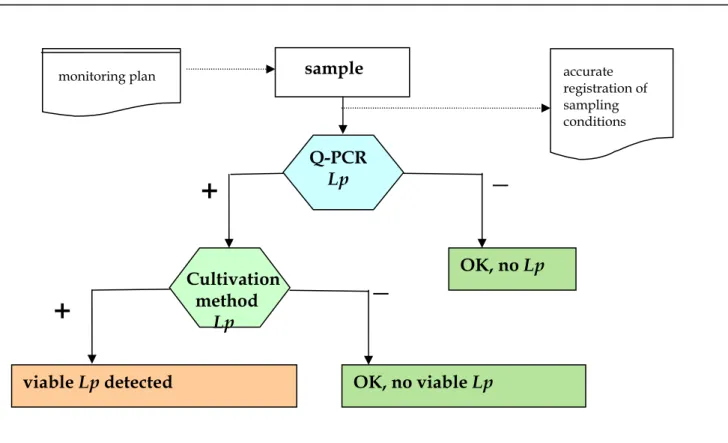
pneumophila, if Legionella pneumophila is detected in excess of a certain concentration (see scheme below).
Figure 1. Proposed scheme for Legionella pneumophila screening in cooling and process water.
If the scheme shown in figure 1 proves to be economically and technically successful, it could provide an alternative to present cultivation methods referred to in documents such as the Health & Safety
Information Sheet5 (also referred to as AI-32) as standard methods for sampling and analysing Legionella
in cooling water systems. It should be noted in connection with this that the government has not yet
taken the step from detection of all viable varieties of legionella to specific detection of Legionella
pneumophila.
The results of an analysis to detect Legionella or Legionellapneumophila may have major consequences that
affect a factory's business operations and the environment. It is essential in connection with this to have a representative water sample from the water system being investigated. In practice, the analysis and analysis results receive a great deal of attention but not enough attention is paid to the quality of sampling. It is difficult to take a representative sample in a large cooling water or process water system. A standard sampling protocol is therefore required, in which the best options for the time, place and method of sampling are laid down. Moreover, to enable interpretation of the analysis results, it is important to keep a meticulous record of the conditions under which samples were taken.
Besides a reliable analytical technique that can be used for testing against statutory frameworks and company-specific guidelines, operators in the industry also need a fast, simple and cheap method for daily system monitoring. In practice, ATP measurements and colony number measurements (dip slides for example) are often used for this, both of which provide an idea of the system's general
microbiological state. The immunochromatographic assay is a new development in this field and can be
used for qualitative detection (present/absent) of Legionella pneumophila sero-group 1 (Lp SG1). This
method is fast, simple and can be used on site. A major advantage of using this method is that it
provides specific information on the presence of the most relevant pathogen of the Legionella genus. The
immunochromatographic assay thereby offers a potentially useful addition to the operator's set of instruments.
sample
Q-PCR
Lp
+
_
OK, no
Lp
accurate registration of sampling conditions_
OK, no viable
Lp
+
viable
Lp
detected
Cultivation
method
Lp
monitoring planNew screening method for Legionella pneumophila in cooling water and process water
© KWR - 13 - May 2009
1.2 Project objectives
The project objectives are:
• Development of a standard monitoring protocol that enables a representative sample to be taken of a
complex cooling water or process water system.
• Testing and evaluating the usefulness of the scheme in figure 1 for cooling water and process water
samples.
• Comparison (at KWR) of the analysis results obtained using the analytical techniques shown in
figure 1 with the results of similar Q-PCR techniques and cultivation methods at other laboratories.
• Testing and evaluating the accuracy of the qualitative immunochromatographic assay for Legionella
pneumophila SG 1 in cooling water and process water.
1.3 Companies and laboratories involved
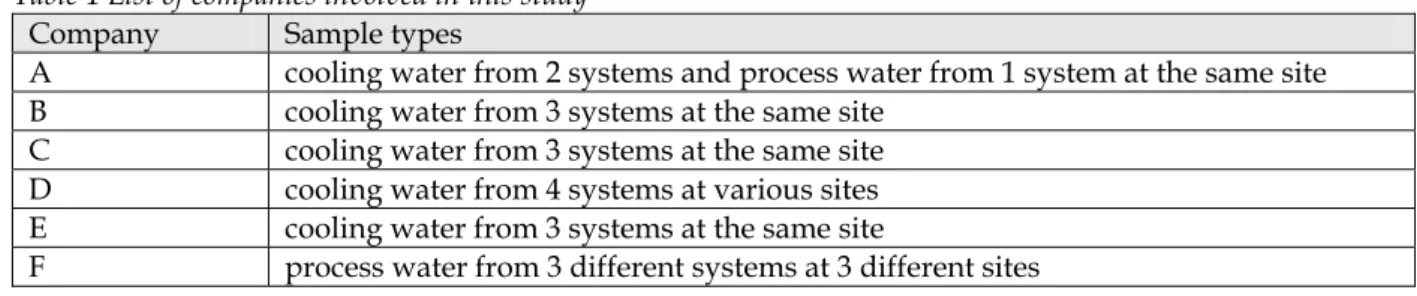
This project was initiated as a multi-client project in which the aim was for all the project's industrial participants to supply cooling water and process water samples from their own systems. Table 1 provides a list of companies that provided samples for this project.
Table 1 List of companies involved in this study
Company Sample types
A cooling water from 2 systems and process water from 1 system at the same site
B cooling water from 3 systems at the same site
C cooling water from 3 systems at the same site
D cooling water from 4 systems at various sites
E cooling water from 3 systems at the same site
F process water from 3 different systems at 3 different sites
The Royal Association of Dutch Paper and Cardboard Manufacturers (Koninklijke VNP) represents 21 paper and cardboard manufacturers in the Netherlands. These factories make repeated use of their process water. This results in water with a high concentration of undissolved substances, organic matter and micro-organisms. It is therefore particularly difficult to perform a specific microbiological
assessment, for Legionella, for instance. Besides it being difficult to filter sufficient water for detection purposes, there is also often excessive additional growth on the culture medium. Conditions in a paper factory (high temperatures, much aerosol formation, high humidity) constitute all the reasons for
monitoring the process water for Legionella. VNP is consequently extremely interested in evaluating new
methods, such as the ones that are the subject of this project.
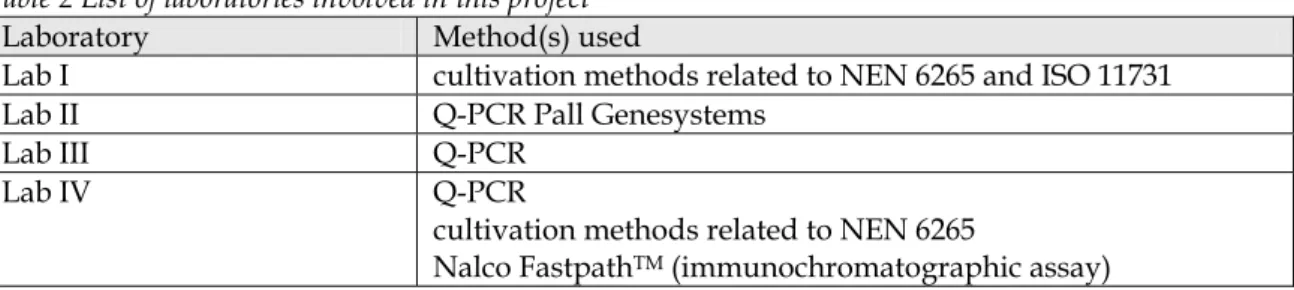
Table 2 provides a list of laboratories participating in this study. Chapter 2 provides a more detailed description of the methods used.
New screening method for Legionella pneumophila in cooling water and process water
© KWR - 14 - May 2009
Table 2 List of laboratories involved in this project
Laboratory Method(s) used
Lab I cultivation methods related to NEN 6265 and ISO 11731
Lab II Q-PCR Pall Genesystems
Lab III Q-PCR
Lab IV Q-PCR
cultivation methods related to NEN 6265
New screening method for Legionella pneumophila in cooling water and process water
© KWR - 15 - May 2009
2
Methods
2.1 Sampling protocol
A small committee of representatives from the industry and cooling water technology experts drew up a sampling protocol for sampling cooling water and process water systems in aid of legionella analysis. The complete protocol is included in appendix I. The protocol includes an information sheet (list for completion) for recording current data on the sampled system. This information sheet is included in appendix II.
The protocol was primarily intended for sampling within the scope of this project and was distributed to the participating companies. It can also be seen as a general sampling protocol for cooling water and process water systems.
In summary, the following recommendations apply to sampling cooling water systems:
• Discontinuously disinfected cooling water systems should be sampled at the end of the disinfection
cycle, which means just before introducing a new dose of disinfectant. The time of sampling is irrelevant in systems that are continuously disinfected. However, the position where samples are taken is important. Samples should preferably be taken just before the location of the dosing point.
• The following preferred order for the position where samples are taken should be used when
sampling cooling water systems:
o Sampling of the falling water in the free space above the cooling tower basin (at least 1 metre
from the side and using special tools).
o Sampling of the water in the cooling tower basin from a position as close as possible to the
recirculation pump's suction pipe (at least 1 metre from the side and within 10 to 20 cm below the
water's surface).
o Sampling from a sampling tap in a main pipe on the outlet side of the recirculation pump, as
close as possible to the cooling tower (tap-out pipe should preferably not be made of rubber or
plastic, should be shorter than 3 metres and should be flushed for 3 minutes before samples are taken). The starting point for the preferred order is that the sample should represent the quality of the cooling water as far as possible at the point where it is sprayed and could be spread into the surrounding area as an aerosol. Spraying of cooling water takes place above the cooling section, which is generally an unsuitable place for sampling. The positions suggested here are intended to provide samples that are as close as possible to the aforementioned representative quality. Wall effects, namely factors which affect the quality of the sample owing to a biofilm or sediment (in the basin or in a pipe), are a key factor here and should be prevented as far as possible. This is the reason for the chosen distances to the wall of the cooling tower and the flushing time for the sampling point.
• It is particularly important to ensure homogeneous water distribution across the cooling tower when
directly sampling falling water. This is also a standard precondition for a cooling tower to operate properly and is therefore in practice an important point for the operator's attention. Poor distribution is an indicator of local clogging in the cooling section, which reduces the system's cooling capacity and increases the likelihood of legionella bacteria growing.
• It is important to keep a record of the conditions under which samples were taken and especially of
the disinfection regime.
In the case of process water systems, large variations in the types of systems make it impossible to provide standard recommendations for the best place to take samples. A few recommendations are provided in appendix II for the paper and cardboard industry and for the steel industry. The following general recommendations apply for process water flows:
• Discontinuously disinfected process water systems should be sampled at the end of the disinfection
cycle. The time of sampling is irrelevant in systems that are continuously disinfected. However, the position where samples are taken is important. Samples should preferably be taken just before the location of the dosing point.
New screening method for Legionella pneumophila in cooling water and process water
© KWR - 16 - May 2009
• It is important to keep a record of the conditions under which samples were taken and especially of
the disinfection regime.
2.2 Analytical methods
2.2.1 Summary of analytical methods used in this study
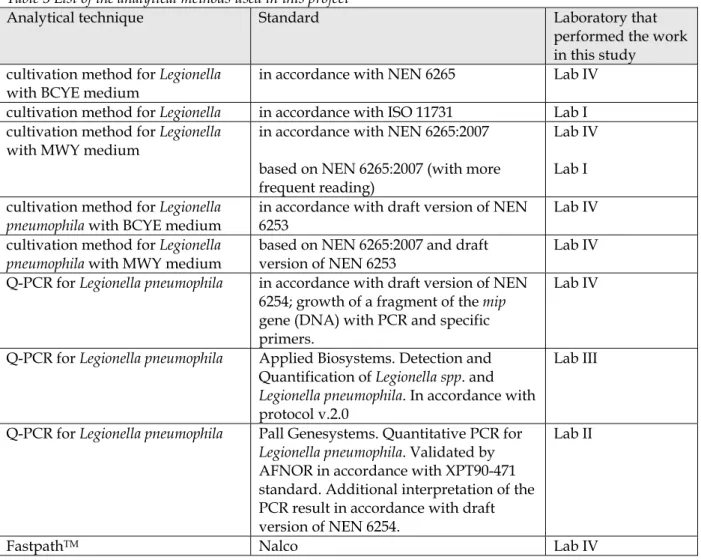
Table 3 provides a list of the analytical methods and associated standards used in this study.
Table 3 List of the analytical methods used in this project
Analytical technique Standard Laboratory that
performed the work in this study
cultivation method for Legionella
with BCYE medium
in accordance with NEN 6265 Lab IV
cultivation method for Legionella in accordance with ISO 11731 Lab I
cultivation method for Legionella
with MWY medium in accordance with NEN 6265:2007
based on NEN 6265:2007 (with more frequent reading)
Lab IV Lab I
cultivation method for Legionella
pneumophila with BCYE medium
in accordance with draft version of NEN 6253
Lab IV
cultivation method for Legionella
pneumophila with MWY medium
based on NEN 6265:2007 and draft version of NEN 6253
Lab IV
Q-PCR for Legionellapneumophila in accordance with draft version of NEN
6254; growth of a fragment of the mip
gene (DNA) with PCR and specific primers.
Lab IV
Q-PCR for Legionellapneumophila Applied Biosystems. Detection and
Quantification of Legionellaspp. and
Legionellapneumophila. In accordance with protocol v.2.0
Lab III
Q-PCR for Legionellapneumophila Pall Genesystems. Quantitative PCR for
Legionella pneumophila. Validated by AFNOR in accordance with XPT90-471 standard. Additional interpretation of the PCR result in accordance with draft version of NEN 6254.
Lab II
FastpathTM Nalco Lab IV
FastpathTM is a qualitative field test especially for detecting Legionella pneumophila sero-group 1. The
method is based on a chromatographic test that uses an immunoassay in which a reaction occurs
between antibodies on the detection equipment and antigens of Lp SG1. The method uses a test strip on
which the preconcentrated sample has to be placed. The sample has to be pretreated by filtration to obtain a sufficiently low detection limit. The test strip has a test band and a control band. The control
band always indicates a red line; the test band shows a second red line for the presence of Legionella
pneumophila sero-group 1 in excess of the detection limit. The detection limit is 100 cfu/l following pretreatment of 250 ml of the sample by filtration and 100,000 cfu/l without filtration. All pretreatment and detection requirements were provided by Nalco. Laboratory technicians have been trained to use the method.
New screening method for Legionella pneumophila in cooling water and process water
© KWR - 17 - May 2009
2.2.2 Differences in performing the various cultivation methods
The analytical method described in NEN 6265 is generally used for Legionella detection in
water/drinking water samples in the Netherlands. The method requires use of a specific culture medium (BCYE = Buffered Charcoal Yeast Extract). This culture medium is known to lead to problems when used for water samples with a high concentration of disruptive flora.
The internationally used ISO 11731 method is based on the same type of medium but with the addition of various other substances, the names of which are indicated in the name of the medium (GVPC = Glycine Vancomycine Polymixine Cycloheximide agar).
The KWR study of 2005[4] showed that for samples with a high concentration of disruptive flora – such as
samples of cooling water and process water – additional growth is best inhibited by using MWY medium (MWY = Modified Wadowsky Yee agar) as the culture medium. This medium was consequently introduced in 2007, in the revised version of NEN 6265.
Besides the culture medium's composition, the pH value and incubation temperature are also important
parameters, in connection with the Legionella yield in the analysis. Research has established that the
variation in pH and incubation temperature can be used to make the cultivation method specific for
detecting Legionella pneumophila[2]. With respect to NEN 6265:2007, the culture medium's pH is increased
from 6.9 ± 0.1 to 7.3 ± 0.5 and the incubation temperature from 36 ± 2 ˚C to 40 ± 0.5 ˚C. The method for
the specific analysis of Legionellapneumophila has been set out in the draft version of NEN 6253.
When performing the method set out in NEN 6265:2007, using MWY medium, lab I adopted a method that differed in the following way from the usual standard:
• The culture media were assessed after 3, 5, 7 and 10 days. Standard practice is to count the colonies
on a culture medium after an incubation period of at least 7 days. Reading the culture media more frequently makes the method more labour intensive and more expensive but may offer the advantage of better assessment, as additional growth is still limited.
2.2.3 Differences in performing the three Q-PCR techniques
The quantitative PCR method, referred to simply as Q-PCR, is based on the Polymer Chain Reaction, in which a specific DNA fragment can be amplified to produce large numbers of copies under the influence of thermal cycles and with the aid of enzymatic reactions. Specific amplification is made possible by using short synthetic DNA molecules, known as primers. The base sequence or DNA sequence in the
primers is chosen so that it binds selectively to the DNA, in this case of Legionella pneumophila. An
enzymatic chain reaction occurs in the PCR once the primers bind to the DNA obtained from the water sample and the DNA fragment is amplified between the primers during each temperature cycle.
Amplification can only occur if the sample contains this specific L. pneumophila DNA. In Real-time PCR,
the formation of the amplified DNA is measured during each cycle (real-time). A synthetic DNA molecule known as the probe is used for this and is labelled with a fluorescent dye. The fluorescence occurs after the DNA has formed. Quantification is possible because there is a clear link between the
time in the reaction at which it becomes possible to detect the DNA fragment that has formed (CT value)
and the L. pneumophila DNA concentration in the sample.
2.2.3.1 Q-PCR according to the draft version of NEN 6254
The Q-PCR method according to the draft version of NEN 6254 was developed and validated at KWR.
Detection of L. pneumophila is carried out by specific primers that amplify a small fragment of the mip
gene. The possibility of inhibiting the PCR and yield of DNA isolation is quantified by adding control DNA to every sample. The control is quantified at the same time in a multiplex PCR. The quantitative
result of L. pneumophila detection is corrected using the yield produced by the control. Around 20
samples can be analysed per analysis.
2.2.3.2 Q-PCR according to Pall Genesystems Technology
The Q-PCR method is based on a method that uses a completely standardised PCR system comprising a DNA extraction, a specific PCR machine and a gene disc that includes everything necessary for the
New screening method for Legionella pneumophila in cooling water and process water
© KWR - 18 - May 2009
method also includes various quality controls, such as an external quantitative positive control. No information is available on the DNA fragment that is amplified, the DNA sequence of primers or the probe. Six or 12 samples can be analysed simultaneously per analysis run. The method was validated by AFNOR. The interpretation was also performed (limit of detection (LOD) and lowest quantity
determinable (LQD)) in accordance with the draft version of NEN 6254 when the results in this study were evaluated.
2.2.3.3 Q-PCR according to the Applied Biosystems detection kit
Applied Biosystems developed and marketed the Q-PCR method. The Q-PCR detection and
quantification kit for L. pneumophila includes an internal positive control and Amperase UNG. Amperase
UNG treatment prevents the reamplification of PCR DNA fragments that were formed in earlier PCR experiments. This method also lacks information on the DNA sequence of primers, probes and controls.
2.3 Method used in the study
As described in section 1.3, the project's participants supplied samples form 15 cooling water systems and 4 process water systems. KWR collected and homogenised the water samples and then distributed them to the participating laboratories for further analysis.
The following method of working was used for this:
• Each participating company selected 3 cooling water or process water systems with a demonstrable
‘legionella history’ (select sample).
• Each participating company assigned responsibility to one or more people for taking samples in
accordance with the protocol, which KWR provided (appendix I), and for registering the current operating data for the selected systems (appendix II).
• All the participating companies were given 27 sterilised 1-litre bottles with a standard content
comprising a thiosulphate solution for neutralising oxidising biocides and an NTA solution for complexing heavy metals.
• The company then sampled each cooling water or process water system on three different days, after
which the samples were sent to KWR by courier. Three sample bottles were filled for each system. A note of the current operating data for each system was made on the information sheet.
• The contents of the three bottles with samples from the same system were homogenised by KWR on
the same day and divided into new sample bottles. These sample bottles were sent to the participating laboratories by courier on the same day (see table 2).
• Analysis started the day after sampling.
• The participating laboratories sent the analysis results to KWR for further processing.
The samples were consecutively coded from OPIW1 to OPIW54. The contents of sample bottles OPIW 1, OPIW 2 and OPIW 3 from company D were mistakenly mixed with each other while the work was underway. The resulting sample was further analysed as OPIW 1 and codes OPIW 2 and OPIW 3 were removed from the overviews.
The study led to a results matrix for 52 samples analysed using 10 analytical techniques, which produced 520 results. The matrix is shown in appendix III.
2.4 Comparison of the analysis results of the various analytical methods
A more in-depth statistical examination of some parts of the study was conducted by a statistician with the aid of variance analysis (ANOVA method, see appendix VI).
International standard ISO 16140 was also used for a qualitative comparison of the analysis results. The aforementioned ISO standard includes a protocol which describes how alternative microbiological
New screening method for Legionella pneumophila in cooling water and process water
© KWR - 19 - May 2009
analytical methods can be compared with a reference method. The following parameters and definitions are important for this:
• Relative accuracy (AC). Degree of accordance between the result of the reference method and the
result obtained with the alternative model using the same samples.
• Relative sensitivity (SE). Ability of the alternative method to analyse for the parameter concerned
when it is detected by the reference method.
• Relative specificity (SP). Ability of the alternative method not to analyse for the parameter concerned
when it is not detected by the reference method.
These parameters can be calculated using a results matrix, as shown in table 4, and using the following formulas:
• AC = (PA + NA)/N * 100%
• SE = PA/N+ * 100% = PA/(PA + ND) *100%
• SP = NA/N- * 100% = NA/(NA + PD) * 100%
Table 4. Results matrix for the qualitative comparison of various analytical methods
Results (total N samples) Reference method positive (N+ samples) Reference method negative (N- samples) Alternative method Positive
+/+ number of samples with a positive accordance (PA)
-/+ number of samples with a positive deviation (PD) Alternative method
Negative
+/- number of samples with a negative deviation (ND)
-/- number of samples with a negative accordance (NA)
New screening method for Legionella pneumophila in cooling water and process water
New screening method for Legionella pneumophila in cooling water and process water
© KWR - 21 - May 2009
3 Results and discussion
3.1 General
The main aim of this study was to test and evaluate the usefulness of the scheme in figure 1 for cooling
water and process water samples. It essentially involves using Q-PCR for Legionellapneumophila, possibly
followed by a cultivation method specifically for Legionellapneumophila to confirm the viability of the
bacteria.
Appendix IV includes a summary of the results achieved after applying the analytical methods referred to in figure 1, on the understanding that the specific cultivation method according to the draft version of NEN 6253 was used in every case and not only when Q-PCR produced a positive result.
The results can be summarised as follows:
• 33 of the 52 samples (63.5%) showed a positive result after using Q-PCR in accordance with the draft
version of NEN 6254.
o A positive result was also obtained for 16 of the 33 corresponding samples when the specific
cultivation method was used.
o Excessive additional growth on the agar plate meant that no result could be stated for 9 of
the 33 corresponding samples when the specific cultivation method was used.
o However, DNA copies were found for 8 of the 33 corresponding samples when Q-PCR was
used but no viable bacteria were detected using the specific cultivation method ( < detection limit).
• The result for both Q-PCR and the cultivation method was below the detection limit for 11 of the 52
samples (21%).
• No Q-PCR could be stated for 5 of the 52 samples (9.6%) because the yield of the internal control was
below the limit value for reliable analysis of the sample.
• For 3 of the 52 samples (5.8%), the result using Q-PCR was below the detection limit and too much
additional growth on the culture medium meant that no result could be stated for the cultivation method.
• No false negative results were obtained using the Q-PCR method, which means that no DNA copies
were found using Q-PCR but colonies were found on the culture medium when using the cultivation method.
The case in which 8 of the 33 results were positive using Q-PCR and negative using the cultivation
method indicates that, although there may not have been any viable Legionellapneumophila bacteria in the
sample at the time of sampling, it nevertheless contained insufficiently lysed legionella bacteria which would still be detected. (The DNA of dead legionella bacteria that has completely disintegrated or lysed is fairly present in the solution, so it passes through the filter during filtration and no longer affects the PCR result.) This is a typical result after using the scheme in figure 1 when thermal or chemical
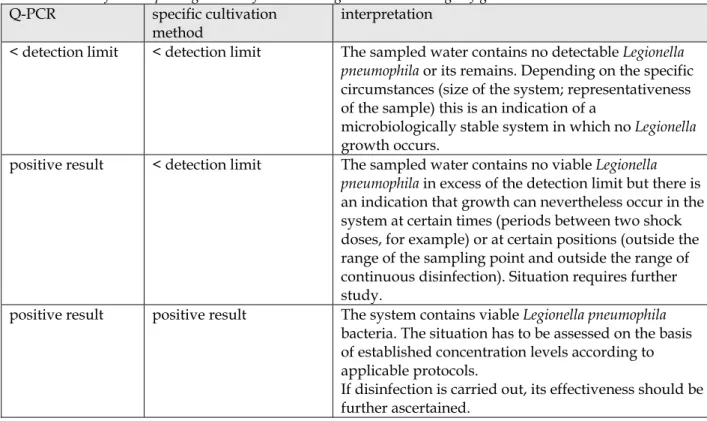
disinfection has been used in the sampled system. In such situations it indicates effective disinfection but also the presence of legionella bacteria during certain periods (such as between disinfection operations) or in certain parts of the system. The latter may apply in the case of continuous disinfection, for example. The overview in appendix IV, which also includes a summary of the disinfection method used per system, shows that this is indeed the case in systems that undergo discontinuous disinfection by means of shock dosing and in systems that are continuously disinfected. Table 5 shows a simplified scheme with a proposal for a general qualitative interpretation of the screening according to figure 1.
New screening method for Legionella pneumophila in cooling water and process water
© KWR - 22 - May 2009
Table 5 Scheme for interpreting results of the screening method according to figure 1
Q-PCR specific cultivation
method
interpretation
< detection limit < detection limit The sampled water contains no detectable Legionella
pneumophila or its remains. Depending on the specific circumstances (size of the system; representativeness of the sample) this is an indication of a
microbiologically stable system in which no Legionella
growth occurs.
positive result < detection limit The sampled water contains no viable Legionella
pneumophila in excess of the detection limit but there is an indication that growth can nevertheless occur in the system at certain times (periods between two shock doses, for example) or at certain positions (outside the range of the sampling point and outside the range of continuous disinfection). Situation requires further study.
positive result positive result The system contains viable Legionellapneumophila
bacteria. The situation has to be assessed on the basis of established concentration levels according to applicable protocols.
If disinfection is carried out, its effectiveness should be further ascertained.
3.2 Comparison of FastpathTM with other techniques
The FastpathTM method was executed at lab IV using test kits provided by the supplier. During
execution, it emerged that reading the test strip can actually be a point for discussion, in the sense that interpretation of some results involves a certain degree of subjectivity.
The results of FastpathTM - as an alternative method - were compared with those of the Q-PCR carried
out by lab IV (see appendix V). As Q-PCR focuses on Legionellapneumophila and the immunoassay only
on Legionella pneumophila sero-group 1, the interpretation also took into account the results of serotyping carried out by lab III, in the case of the ISO 11731 and NEN 6265 analysis. This makes it possible to
determine whether, for example, a negative result of the FastpathTM method is correct.
The results can be summarised as follows:
• A total of 47 samples were assessed (there was no result for 5 samples when Q-PCR was used as the
reference method).
• The Fastpath method gave a false positive result 4 times, a false negative result 5 times and a correct
negative result 6 times. It should be noted in connection with this that two false positive results were obtained for samples from the paper industry, whereby the detection limit for Q-PCR was much higher.
• The relative accuracy (AC) of FastpathTM was 81% of that of Q-PCR.
• The method's relative sensitivity (SE) was 85%.
• The relative specificity (SP) was 71%.
• When determining these parameters, a correct negative result of FastpathTM was interpreted as a
positive accordance (PA). A correct negative result arises when Legionella pneumophila is detected
using Q-PCR, for example, but the serotyping indicates that sero-group 1 has not been found in the sample concerned.
In view of the good results obtained using the ISO method (see section 3.4), this cultivation method's
New screening method for Legionella pneumophila in cooling water and process water
© KWR - 23 - May 2009
The results can be summarised as follows:
• A total of 49 samples were assessed (no results for 3 samples with ISO method as reference method).
• The Fastpath method gave a false positive result 5 times, a false negative result 5 times and a correct
negative result 10 times. The sample codes for the 5 false negative results correspond exactly with those obtained from the comparison with Q-PCR. In two of the 5 false negative results, relatively low concentrations were measured using the ISO method (200 and 530 cfu/l) but in the three other cases the concentrations were around 60,000 cfu/l.
• The relative accuracy (AC) of FastpathTM was 80% of that of ISO.
• The method's relative sensitivity (SE) was 86%.
• The relative specificity (SP) was 58%.
• When determining these parameters, a correct negative result of FastpathTM was interpreted as a
positive accordance (PA).
On the basis of these results, the degree of accordance of FastpathTM with the two reference methods is
approximately 80%. It is ultimately up to the users to determine according to their own criteria whether this level of accuracy is sufficient for using this fast screening method in practice. It is also important to
realise that the method is limited to Legionella pneumophila sero-group 1; however, this is the main cause
of legionella pneumonia (up to 90% of registered cases worldwide).
3.3 Comparison of Q-PCR techniques
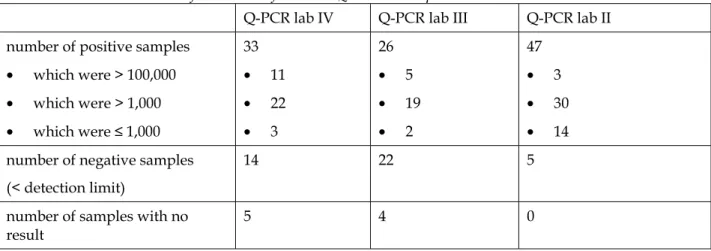
Appendix VI provides an overview of the Q-PCR analysis results obtained by three different laboratories using three different methods. The main characteristics are summarised in the table below.
Table 6. Main characteristics of the results of the three Q-PCR techniques
Q-PCR lab IV Q-PCR lab III Q-PCR lab II
number of positive samples
• which were > 100,000 • which were > 1,000 • which were ≤ 1,000 33 • 11 • 22 • 3 26 • 5 • 19 • 2 47 • 3 • 30 • 14 number of negative samples
(< detection limit)
14 22 5 number of samples with no
result
5 4 0
No value could be determined for 5 of the Q-PCRs performed by lab IV, as the yield of the internal
control was below the limit value for reliable quantitative analysis. However, in 4 of the 5 cases Legionella
pneumophila was detected. In 4 samples in the Q-PCR performed by lab III the level of inhibition produced an unreliable result. No value is stated for these cases.
Figure 2 sets out the Q-PCR results of each of the three laboratories against each other in a double logarithmic diagram. An analysis result below the detection limit is shown here as the logarithm of half of the detection limit concerned (log{detection limit/2}). The good accordance between the three methods is striking. It is also notable that the Q-PCR at lab IV detected a higher number of copies more often than the other two methods. No immediate explanation is available for this but it may be an effect of the yield correction that was made.
New screening method for Legionella pneumophila in cooling water and process water
© KWR - 24 - May 2009
Q-PCR Pall GeneSystem s vs Q-PCR laborelec
2,0 2,5 3,0 3,5 4,0 4,5 5,0 5,5 6,0 6,5 2,0 2,5 3,0 3,5 4,0 4,5 5,0 5,5 6,0 6,5
log [copies/l] Q-PCR Pall GS
log [c opi es ]/ l Q -P C R -La bo re le c Q-PCR KWR vs Q-PCR laborelec 2,0 2,5 3,0 3,5 4,0 4,5 5,0 5,5 6,0 6,5 2,0 2,5 3,0 3,5 4,0 4,5 5,0 5,5 6,0 6,5 log [copies/l] Q-PCR KWR log [c opi es ]/ l Q -P C R -La bor el ec Q-PCR KWR vs Q-PCR Pall Genesystem s 2,0 2,5 3,0 3,5 4,0 4,5 5,0 5,5 6,0 6,5 2,0 2,5 3,0 3,5 4,0 4,5 5,0 5,5 6,0 6,5 log [copies/l] Q-PCR KWR lo g [ co p ies] /l Q -P C R -P all G S
Table 7 Results of the qualitative assessment of the three Q-PCR techniques vis-à-vis ISO 11731 as the reference method.
Q-PCR lab IV Q-PCR lab III Q-PCR lab II
relative accuracy (AC) 91% 78% 82%
relative specificity (SP) 89% 82% 33%
relative sensitivity (SE) 92% 76% 97%
A comparison was made in accordance with ISO 16140 (see section 2.4) to enable an initial qualitative assessment of the results of the three Q-PCR methods and the results of the cultivation method according to ISO 11731 as a reference. When making comparisons it must be remembered that the Q-PCR is
concerned with Legionella pneumophila and the ISO method with Legionella as a whole. The ISO method's
serotyping was therefore also taken into account, to ascertain whether a negative Q-PCR result was correct. A correct negative result was then deemed to be a positive accordance (PA) in the qualitative comparison. Table 7 shows a summary of this qualitative comparison's results. The calculations shown in
Figure 2. Comparison of numbers of Legionella pneumophila detected using the three different Q-PCR techniques in the water samples that were studied. The dotted lines show the relationship between the numbers detected using the two methods that have been compared (respectively a factor of 10 higher and a factor of 10 lower).
New screening method for Legionella pneumophila in cooling water and process water
© KWR - 25 - May 2009
tabular form in appendix VI only included those samples for which both analytical methods produced a result. Table 7 generally shows a high level of accordance between the Q-PCR results and the results obtained in accordance with the method of ISO 11731. Only the specificity of the Pall Genesystems Q-PCR was relatively low. This was because this method detected a quantifiable number of legionella cells in 92% of the samples examined, which is a relatively high figure (8% of the samples were below the detection limit).
A variance analysis was used to compare the results of the three different Q-PCR techniques with each other (see appendix VII). The zero hypothesis was tested in this analysis that the mean of the analysis results is the same for the three different Q-PCR methods. It is 95% certain that this hypothesis cannot be rejected. Statistically, this means that there are no significant differences between the three methods. The detection limit of the various Q-PCR techniques was generally lower than 1,000 copies/litre for cooling water samples. It was only necessary to state a higher detection limit than that on a number of occasions when using the Q-PCR of lab III. The 1,000 cfu/l requirement stated in the Health & Safety Information Sheet could not be met in those cases. However, the question is whether the table in
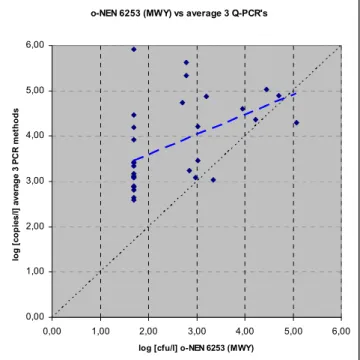
question, which was drawn up on the basis of the interpretation of results of the cultivation method, can still be used for interpreting Q-PCR results. The main point is whether using Q-PCR is a reason for significantly higher numbers of copies per litre with respect to the number of colony-forming units per litre. This is examined in figure 3 by setting out the average results of the Q-PCR methods against those
of the specific cultivation method for Legionella pneumophila using MWY medium (in accordance with the
draft version of NEN 6253). In both cases, values below the detection limit have been included in the graph with a value corresponding with half the value of that detection limit.
o-NEN 6253 (MWY) vs average 3 Q-PCR's
0,00 1,00 2,00 3,00 4,00 5,00 6,00 0,00 1,00 2,00 3,00 4,00 5,00 6,00
log [cfu/l] o-NEN 6253 (MWY)
log [c opi es /l] a ve ra g e 3 P C R me thods
Figure 3.Comparison of the specific cultivation results for Legionella pneumophila, according to the draft version of NEN 6253 using MWY medium, and the average of the results of the three Q-PCR techniques. The finely dotted line shows the relationship between the numbers detected with the two methods that have been compared. The other line is a linear trend line.
An initial glance at figure 3 shows that there is a wide spread in the analysis results. The spread is partially accounted for by disinfection in the systems examined (see explanation in section 3.1). In any case, it is clear from figure 3 that in 94% of the samples DNA copies were found in larger numbers when using Q-PCR than the numbers of colony-forming units that were found when using the cultivation method. This is possibly explained by the fact that, unlike with the cultivation method, corrections are made for the detection yield when Q-PCR is used. Poor correlation makes it impossible to establish a fixed relationship.
New screening method for Legionella pneumophila in cooling water and process water
© KWR - 26 - May 2009
3.4 Comparison of cultivation methods
A total of five different cultivation techniques were used in this study (see table 3 and appendix VIII). The method according to NEN 6265:2007 using MWY medium was applied by two laboratories (lab IV and lab I).
The results of the ‘normal’ NEN 6265 using BCYE medium were disappointing because no result could be provided for 31 of the 52 samples (60%) owing to excessive additional growth on the culture medium. This is as expected, given the complex matrix of the cooling water and process water samples and is also the reason why the MWY medium was included in the NEN standard. Poor results were also obtained with the cultivation method using BCYE medium with a higher pH culture medium (pH 7.3) and
samples at a higher incubation temperature (40 ˚C), which was specifically for Legionella pneumophila
analysis. In that case, no result could be stated for 34 of 52 samples (65%) owing to excessive additional growth on the culture medium.
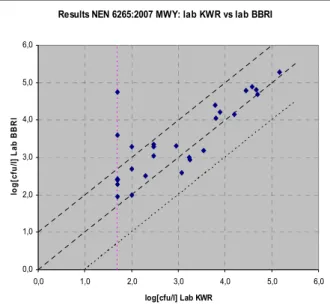
Using MWY medium in accordance with NEN 6265:2007 considerably reduced the amount of disruptive additional growth. This analytical method was used by lab IV as well as lab I, whereby it should be noted that lab I also made counts on day 3 and 5. The summary in appendix VIII shows that there was too much additional growth on the culture medium for respectively 15 (29%) and 16 (31%) of the 52 samples. That is half of the figure vis-à-vis the results when BCYE medium was used. Figure 4 shows the results of the two assessment methods using MWY medium alongside each other. It should be noted here that in the results of lab IV a figure of “< 100 cfu/l” is shown as 50 cfu/l (detection limit with a log value of 1.7) and in the results of lab I a figure of “< 500 cfu/l” is shown as 250 (log value 2.7).
Results NEN 6265:2007 MWY: lab KWR vs lab BBRI
0,0 1,0 2,0 3,0 4,0 5,0 6,0 0,0 1,0 2,0 3,0 4,0 5,0 6,0 log[cfu/l] Lab KWR lo g [c fu/ l] La b B B R I
Figure 4.Comparison of the results of lab IV and lab I obtained using NEN 6265:2007 (MWY). The dotted lines show the relationship between the numbers detected using the two methods that have been compared (respectively a factor of 10 higher and a factor of 10 lower).
Two of the results shown in the graph differ markedly because they were below the detection limit in the analysis of lab IV whereas lab I stated figures of 4,000 and 65,000 cfu/l. These higher figures for these two specific samples appear to be more in line with the corresponding results obtained using the Q-PCR and ISO 11731 methods. Moreover, there is exceptionally good accordance between the results, whereby the yields were generally slightly higher for the detection method used by lab I. This may be a
consequence of the extra treatment with acid applied during sample pretreatment.
Table 8 provides details of a qualitative assessment carried out in accordance with the ISO 16140 method (see section 2.4) of the results of the two NEN 6265:2007 methods using MWY medium vis-à-vis ISO 11731 as the reference method. This shows a high level of accordance although in the case of lab I the specificity of the detection method using MWY medium was relatively low. Low specificity may point to
New screening method for Legionella pneumophila in cooling water and process water
© KWR - 27 - May 2009
a benefit of using MWY medium, as in cases in which the reference method is unable to detect anything, NEN6265:2007 using MWY medium is able to do so.
Table 8 Results of the qualitative assessment of the NEN 6265:2007 (MWY) vis-à-vis ISO 11731 as the reference method.
NEN 6265:2007 (MWY) Lab IV
NEN 6265:2007 (MWY) Lab I
relative accuracy (AC) 81% 83%
relative specificity (SP) 89% 50%
relative sensitivity (SE) 79% 90%
Appendix VIII's summary of the cultivation methods shows that the cultivation method according to ISO 11731 performed best. In that case only 3 samples (5.7%) displayed excessive additional growth on the culture medium, so that no value could be stated. In the ISO method, lab I applied pretreatment with acid (in accordance with the standard) and also made counts more frequently after 3, 5, 7 and 10 days. This makes the method more laborious but produces a better result. In 37 of the 52 samples (71%)
Legionella was detected and in 18 of those cases it was in concentrations of 10,000 cfu/l or higher. The comparison in figure 5 of the results from lab I obtained with ISO 11731 and those obtained with NEN 6265:2007 (MWY) indicates a turning point at 1,000 cfu/l. The ISO method's yield is higher when the sample contains higher numbers of legionella bacteria; the yield is lower when the numbers are lower. The significance of the measurement is lower for a figure below 1,000 cfu/litre.
results ISO 11731 vs NEN 6265:2007 MWY Laborelec
de te ct io n limi t IS O 1 17 31 1,0 1,5 2,0 2,5 3,0 3,5 4,0 4,5 5,0 5,5 6,0 1,0 1,5 2,0 2,5 3,0 3,5 4,0 4,5 5,0 5,5 6,0
log [cfu/l] ISO 11731
lo g [cfu /l ] NE N 626 5:200 7 M W Y
Figure 5.Comparison of the results from lab I obtained using ISO 11731 and NEN 6265:2007 (MWY). The dotted lines show the relationship between the numbers detected using the two methods that have been compared
(respectively a factor of 10 higher and a factor of 10 lower).
The relationship between the two methods was also examined using variance analysis (see appendix VII). The zero hypothesis was tested in this analysis that the mean of the analysis results is the same for both methods. It is 95% certain that this hypothesis cannot be rejected. Statistically, this means that there were no significant differences between the results of the two methods (noting that the plates were also assessed for both methods after 3 and 5 days).
Finally, this study also applied a cultivation method specifically for Legionella pneumophila analysis in
accordance with figure 1 (see also section 3.1). The method is based on the draft version of NEN6253 using MWY medium, with a different culture medium pH and incubation temperature to inhibit growth
New screening method for Legionella pneumophila in cooling water and process water
© KWR - 28 - May 2009
of non-pneumophila varieties. The statements below are based on a comparison of results of this cultivation method and those lab I obtained with NEN 6265:2007 using MWY medium and the associated serotyping:
• The results of both analyses were positive for 13 samples and in accordance with serotyping in every
case (i.e. the presence of Legionella pneumophila was confirmed by serotyping).
• In 6 samples Legionella was detected and the concentration of Legionella pneumophila was below the
detection limit. However, only Legionella pneumophila sero-group 1 or sero-groups 2 – 14 were
confirmed by serotyping, so this might point to a discrepancy.
• In 5 samples Legionella was detected and the concentration of Legionella pneumophila was below the
detection limit, and serotyping did indeed point to the presence of non-pneumophila varieties.
• The results of both methods of analysis were below the detection limit for 6 of the samples.
• No result was stated for the remaining 22 samples, as there was too much additional growth on the
culture medium in 13 cases for one of the methods and in 9 cases for both of the methods.
In any case, it follows from this that there was accordance between the analytical techniques for 24 of the 30 samples. Serotyping indicated possible poor accordance between the two methods for the remaining 6 samples but it should be noted here that serotyping always involves making a selection from the colonies on the culture medium.
3.5 Effect of cooling water disinfection on the analysis results
Cooling water disinfection is a normal part of conditioning cooling water systems. The main aim of disinfection is to prevent biofilm formation in cooling water systems. Biofilm formation in
heat-exchangers reduces thermal transfer and can reduce the cooling capacity of cooling water sections, as it
restricts air flow. Disinfection is also intended to inhibit Legionella sp. growth in order to reduce exposure
risks in the surrounding area.
A distinction should be made in cooling water disinfection between continuous application of a disinfectant and discontinuous application by means of shock dosing. Extensive use is still made of sodium hypochlorite (NaOCl) for disinfection but a move is underway towards more sustainable
disinfection, using hydrogen peroxide, ozone or physical techniques such as ultrasound or cavitation, for example. It is also relevant to distinguish between systems with and without filtration (full stream filtration or side stream filtration). Filtration is usually used to remove undissolved substances in the circulating cooling water. This can have a positive as well as a negative effect. On the one hand, removing undissolved substances may reduce the likelihood of the cooling system becoming microbiologically contaminated. On the other hand, microbiological accumulation in the actual filter leads to increased use of sodium hypochlorite and can reduce the effectiveness of disinfection. In this study, samples were taken from 15 different cooling water systems in which the following disinfection strategies are used:
• No disinfection (1 system).
• Use of Sonoxide (1 system).
• Continuous addition of sodium hypochlorite (NaOCl) (3 systems).
• Discontinuous addition of sodium hypochlorite (NaOCl) / shock dosing (7 systems).
• Continuous addition of hydrogen peroxide (2 systems).
• Continuous addition of ozone (1 system).
Three systems also used filtration in a side stream (1 system) or in the entire circulating water flow (2 systems).
The limited scope of this study cannot justify any statistically sound statements on the effect of a
particular disinfection strategy on the presence of legionella bacteria in the cooling water. Moreover, the participating companies selected cooling tower systems with a known legionella history, so the sample of industrial cooling water systems was emphatically not non-select.
New screening method for Legionella pneumophila in cooling water and process water
© KWR - 29 - May 2009
If the results of using the ISO 11731 method are taken as the starting point, it is nevertheless clear that disinfection was practically never sufficiently effective in any cooling water system. Two systems of company C and one of company E formed an exception to this but it should be pointed out that extremely high doses of chlorine were used in the systems of company C during the sampling period, owing to a defective chlorine measurement system.
The following statements on the cooling water systems covered by this study apply, if the analysis results obtained using the ISO 11731 method are used as a basis for making a rough qualitative assessment of the performance of the aforementioned disinfection strategies:
• Practically all disinfection strategies that make use of a shock dose without sand filtration perform
reasonably.
• All disinfection strategies involving the continuous addition of disinfectant in combination with a
sand filter (full stream and/or side stream) perform poorly (ozone with side stream filtration and sodium hypochlorite with full stream filtration).
• However, disinfection strategies involving continuous addition without sand filtration perform
reasonably (Sonoxide, sodium hypochlorite, and hydrogen peroxide).
This may point to an unwanted effect of using side stream or full stream filtration in the cooling water systems covered by this study. In practice, it may be assumed that considerable biofilm formation occurs on the large internal area of a sand filter. From the operational point of view that appears to be an advantage because in that case no biofilm forms on the heat-exchanger's pipes or on the cooling section. However, in the case of continuous disinfection or if filtration is not stopped during discontinuous disinfection, the biofilm in the sand bed may consume so much disinfectant that the amount of disinfectant received by the rest of the system after the sand bed is insufficient. Depending on the position where filtration takes place with respect to the point where disinfectant is added, this may lead to inadequate disinfection in parts of the system.
New screening method for Legionella pneumophila in cooling water and process water