eScholarship provides open access, scholarly publishing services to the University of California and delivers a dynamic research platform to scholars worldwide.
UCLA
A University of California author or department has made this article openly available. Thanks to
the Academic Senate’s Open Access Policy, a great many UC-authored scholarly publications
will now be freely available on this site.
Let us know how this access is important for you. We want to hear your story!
http://escholarship.org/reader_feedback.html
Peer Reviewed
Title:
The Multidisciplinary Management of Osteosarcoma
Journal Issue:
Current Treatment Options in Oncology, 10(1)
Author:
Federman, Noah; Bernthal, Nicholas; Eilber, Fritz C.; Tap, William D.
Publication Date:
2009
Series:
UCLA Previously Published Works
Also Available:
Permalink:
http://escholarship.org/uc/item/7jm2207t
DOI:
http://dx.doi.org/10.1007/s11864-009-0087-3
Abstract:
Patients with suspected or confirmed osteosarcoma should be evaluated and treated at
a comprehensive cancer center within a multidisciplinary sarcoma program that includes
pediatric, medical and radiation oncologists, orthopedic and surgical oncologists, musculoskeletal
pathologists, and radiologists. Successful treatment involves proper diagnosis, neoadjuvant and
adjuvant multi-agent chemotherapy, and aggressive surgery with an emphasis toward
limb-preserving procedures. Treatment of osteosarcoma should be undertaken within the framework
of large cooperative group clinical trials for children, adolescents, and adults. Patients treated with
osteosarcoma should be followed closely both for recurrence of disease and for development of
late effects of the treatment of their cancer. The treatment of metastatic, recurrent and/or refractory
disease is more controversial. Despite advances in systemic treatment, surgical technique, and
supportive care, the overall outcome is still poor.
Copyright Information:
All rights reserved unless otherwise indicated. Contact the author or original publisher for any
necessary permissions. eScholarship is not the copyright owner for deposited works. Learn more
at http://www.escholarship.org/help_copyright.html#reuse
Bone Cancer
The Multidisciplinary
Management of Osteosarcoma
Noah Federman, MD
Nicholas Bernthal, MD
Fritz C. Eilber, MD
William D. Tap, MD*
Address*Division of Hematology/Oncology, Department of Medicine, David Geffen School of Medicine at UCLA, UCLA Sarcoma Program, 10833 Le Conte Avenue, Los Angeles, CA 90095, USA.
E-mail: [email protected]
ªThe Author(s) 2009. This article is published with open access at Springerlink.com
Opinion statement
Patients with suspected or confirmed osteosarcoma should be evaluated and treated at a comprehensive cancer center within a multidisciplinary sarcoma program that in-cludes pediatric, medical and radiation oncologists, orthopedic and surgical oncolo-gists, musculoskeletal patholooncolo-gists, and radiologists. Successful treatment involves proper diagnosis, neoadjuvant and adjuvant multi-agent chemotherapy, and aggres-sive surgery with an emphasis toward limb-preserving procedures. Treatment of osteosarcoma should be undertaken within the framework of large cooperative group clinical trials for children, adolescents, and adults. Patients treated with osteosarcoma should be followed closely both for recurrence of disease and for development of late effects of the treatment of their cancer. The treatment of metastatic, recurrent and/or refractory disease is more controversial. Despite advances in systemic treatment, surgical technique, and supportive care, the overall outcome is still poor.
Introduction
Osteosarcoma is the most common primary malignant neoplasm of bone in children and adolescents. It is characterized by the proliferation of malignant mes-enchymal cells that are capable of producing osteoid or immature bone [1]. Although rare, with only 400 new cases diagnosed per year in the United States, osteo-sarcoma represents the sixth most common malig-nancy in adolescents and young adults [2]. Prior to 1970, the overall prognosis for patients with osteosar-coma was dismal with a 10%–20% overall survival rate for patients with localized disease treated with aggres-sive surgery. Over the past 30–40 years with the intro-duction of neoadjuvant and adjuvant systemic
chemotherapy, the survival has increased dramatically to about 65%–75% for patients without clinically evi-dent metastatic disease at presentation [3]. The improvements in chemotherapy have been paralleled by improvements in surgical techniques that achieve local control with limb-sparing procedures, and improvements in diagnostic and imaging techniques.
This chapter will review the current multidisci-plinary treatment of osteosarcoma and recent devel-opments in the management of this aggressive neoplasm, as well as stress the importance of treating and evaluating patients with osteosarcoma within a multidisciplinary sarcoma program or cancer center
that offers comprehensive care through the input and contributions of pediatric, medical, and radiation
oncologists, orthopedic and surgical oncologists, and musculoskeletal pathologists and radiologists.
Clinical presentation, diagnostic evaluation, and biopsy
• The vast majority of patients with osteosarcoma present with localized pain at the primary tumor site. The most commonly affected bones are the metaphyseal region of long bones such as the distal femur, proximal tibia, and proximal humerus although osteosarcoma can arise in any bone in the body [4]. A detailed history with a complete physical exam should be performed prior to any evaluation. Physical examination may reveal the presence of a tender and firm soft tissue mass at the primary site. If a diagnosis of osteosarcoma or another malignant bone or soft tissue tumor is suspected, the patient should be transferred to a comprehensive cancer center with a multidisci-plinary sarcoma program for further evaluation and treatment. Lab-oratory evaluation is generally normal. However, serum alkaline phosphatase and lactate dehydrogenase levels have been reported elevated in 30%–40% of patients and have been associated with a poorer prognosis [5,6].
• Plain radiographic films are usually the first diagnostic imaging study undertaken and should include the entire affected bone. The classical appearance of osteosarcoma on plain films shows destruction of the normal trabecular bone with presence of a Codman’s Triangle formed by new periosteal formation and elevation of the cortex [7]. CT and MRI scanning are used to delineate the extent of the primary tumor and planning of definitive surgery. MRI is particularly useful to determine the intra and extraosseous extent, soft tissue, and contigu-ous structure involvement of the tumor. Care again must be taken to image the entire involved bone. Metastatic evaluation at diagnosis should include a Chest CT scan to detect pulmonary metastasis. Nu-clear medicine imaging techniques are being used increasingly to aid in the initial staging/metastatic evaluation and response to therapy. Technetium–99-m bone scans are a standard part of the metastatic evaluation as they are very sensitive in detecting bony metastases, present in 10% of patients with osteosarcoma [8]. 18-Fluorodeoxy-glucose Positron emission tomography(18FDG-PET) with or without the combination of a whole body CT is also being increasingly used in the initial staging and treatment monitoring although a clear benefit has not been demonstrated [9,10]. A consensus on the imaging guidelines for children, adolescents and young adults with osteosar-coma has been put forward by the Children’s Oncology Group (COG) [11•].
• Tissue biopsy of osteosarcoma must be obtained to confirm the diagnosis even though radiographic imaging is highly suggestive. The biopsy should be carefully planned with multidisciplinary input from the musculoskeletal radiologist, pathologist, and orthopedic and surgical oncologists so as to ensure the feasibility of procedure, the adequacy of specimen, and above all to maintain the viability of a definitive surgery with possibility of limb salvage. At our institution, we find that CT-guided core biopsies performed by a skilled inter-ventional musculoskeletal radiologist will yield the diagnosis the majority of the time. The advantage of CT-guided core biopsy is that this can often be done more rapidly and require only local anesthesia versus an open biopsy. Multiple large core needle biopsies are often necessary to yield enough tissue to make the diagnosis and consider
differential diagnoses with sufficient tissue for immunostains and cytogenetic studies. Core biopsy at our institution approaches 95% accuracy in establishing a diagnosis, and is our diagnostic method of choice. However, the decision to utilize CT-guided biopsy versus open biopsy should be made on a case by case basis as a 25% non-diag-nostic rate has been reported by other institutions [12]. When a core biopsy is either non-diagnostic or not technically possible, an open biopsy can be performed. The principles of open biopsy for osteo-sarcoma and other malignant bone tumors is to obtain adequate tis-sue without jeopardizing opportunity for limb salvage by
contaminating tissue with malignant cells, and should be performed by a skilled orthopedic or surgical oncologist. The biopsy should be performed with a longitudinal incision so that the entire biopsy tract can be excised during later surgery, and careful hemostatic control should be attained to minimize the development of a hematoma contaminated with malignant cells [13].
Systemic therapy
• Prior to the introduction of adjuvant systemic chemotherapy the overall survival of osteosarcoma was less than 20% with the majority of patients developing metastatic disease presumably from the pres-ence of microscopic subclinical metastatic disease present at the time of diagnosis[14]. With modern multimodality therapy combining systemic chemotherapy and complete surgery, the cure rate now ap-proaches over 70% for patients with non-metastatic osteosarcoma [15].
• Many trials investigating adjuvant chemotherapy in osteosarcoma patients have been performed in the past 30 years. Some of the notable trials over the past 10 years are summarized in Table1. Initial efforts defined active agents as high-dose methotrexate with leucovo-rin rescue, doxorubicin, cisplatin, and ifosfamide with or without etoposide [16–20•]. The development of combination chemotherapy with administration of the aforementioned active agents has been mostly empiric though is now the cornerstone of chemotherapy. • The initial rationale for administering neoadjuvant chemotherapy was
based on the development of limb-salvage procedures. Originally, limb-salvage endoprostheses were custom made taking several weeks to months to manufacture. Neoadjuvant therapy was employed as a means of bridging the gap from biopsy to resection [21,22]. However, it had been suggested that neoadjuvant therapy might improve sur-vival as well as improve limb-salvage rates. A randomized study (POG–8651) conducted by the Pediatric Oncology Group from 1986 to 1993 compared immediate surgery followed by post-operative chemotherapy versus presurgical chemotherapy followed by surgery. The event-free survival (EFS) was similar in both groups: 65% for immediate surgery and 61% for neoadjuvant therapy with similar incidence of limb salvage (50%–55%) in both [23••]. Another rationale for using neoadjuvant chemotherapy is the capability of individualizing therapy based on tumor response. It has been reported from numerous trials that histologic response with tumor necrosis greater than 90% confers a better prognosis [22–26••]. The strategy of intensifying or altering post-operative therapy based on poor tumor necrosis has been used successfully in the 1980s by investigators at the Memorial Sloan Kettering Cancer Center on the T10 trial and later confirmed by the Rizzoli Institute [27,28]. However, the impressive
results on these trials improving the overall outcome of ‘‘poor responders’’ by tailoring post-operative therapy were not duplicated in other large cooperative group studies [25,29,30]. The question of intensification and individualization of therapy based on tumor necrosis is currently being investigated in the current large cooperative trial through the European and American Osteosarcoma Group (EURAMOS1, AOST0331, ClinicalTrials.gov/NCT00134030) a multi-national collaboration of the COG, Cooperative Osteosarcoma Group (COSS), the Scandinavian Sarcoma Group (SSG), and the European Osteosarcoma Intergroup (EOI). Patients with poor necrosis are ran-domized to receive high-dose methotrexate, doxorubicin, cisplatin, with or without the addition of ifosfamide and etoposide. On the other hand, patients with a good response will continue high-dose methotrexate, cisplatin, and doxorubicin are then randomized to a maintenance arm with pegylated interferon alpha. Currently, over 1000 patients have been enrolled on this trial as of January 2009. • The addition of ifosfamide with or without etoposide to 3 drug
regi-mens of high-dose methotrexate, cisplatin, and doxorubicin in the treatment of primary localized osteosarcoma is controversial. Several groups have obtained favorable results with ifosfamide containing regimens. However, in a recent large randomized controlled American collaborative trial (INT–0133) the addition of ifosfamide to standard therapy was investigated as well as the addition of the immuno-modulator muramyl-tripeptide-ethanolamine (MTP-PE). The addition of ifosfamide did not affect overall survival or EFS. Although the addition of MTP-PE did result in a statistically significant improve-ment in overall survival (78% vs 70%) [31••]. The standard use of MTP-PE will likely be the subject of future confirmatory trials.
Surgical management
• Over the last 30 years, advances in chemotherapy, imaging, surgical technique, and biomaterial engineering have ushered in a new era of surgical management for osteosarcoma. The basic tenet for the treat-ment of osteosarcoma is that complete resection is a prerequisite for cure [24]. Whereas radical resection by amputation was the mainstay of therapy into the 1970s, currently more than 85% of patients un-dergo wide resection with limb-sparing surgery [36]. Although no randomized studies have been done, large retrospective studies have
Table 1. Selected recent large studies of chemotherapy for localized osteosarcoma
Study Protocol Years conducted Patients, n Chemotherapy OS/EFS
COSS-86 [32] 1986–1988 171 DOXO, MTX, CDDP,±IFOS 72%/66% POG-8651 [23••] 1986–1993 100 DOXO, BCD, CDDP 78%/65% IOR-OS4 [33] 1993–1995 133 DOXO, MTX, CDDP, IFOS 71%/56% INT–0133, CCG-7921,
POG-9351 [31••]
1993–1997 662 DOXO, MTX, CDDP,±IFOS,±MTP 78%/67% for MTP arm. EOI-3 [34••] 1993–2002 497 DOXO, CDDP,±GCSF 56%/40%
ISG/SSG-1 [35•] 1997–2000 182 DOXO, MTX, CDDP, IFOS 77%/64%
COSS—Cooperative Osteosarcoma Study Group, POG—Pediatric Oncology Group, IOR—Istituto Ortopedico Rizzoli, CCG—Children’s Cancer Group, EOI—European Osteosarcoma Intergroup, ISG/SSG—Italian Sarcoma Group/Scandinavian Sarcoma Group, DOXO—Doxorubicin, MTX—Methotrexate, CDDP—Cisplatin, IFOS—ifosfamide, BCD—bleomycin, cytoxan, actinomycin D, GCSF—granulocyte colony-stimulating factor.
shown no survival advantage to amputation over limb-salvage pro-cedures [37,38]. Negative surgical margins (defined as at least 1 cm in bone with 2–5 cm recommended) and tumor responsiveness are di-rectly associated with local recurrence. In patients with marginal resections and with tumor necrosis less than 90% after preoperative chemotherapy, local recurrence has been reported as high as 30% [39]. Therefore, limb salvage is recommended when adequate surgical margins can be achieved. Only surgeons with adequate experience should perform limb-preserving procedures [40].
• Reconstructive options for limb-salvage surgery include autogenous bone grafts (vascularized or devascularized), structural bone grafts (osteoarticular and intercalary), and metallic endoprosthetics. The technique selected is a function of the location of the tumor, age of the patient, and types of adjuvant therapies that will be employed, as well as the surgeon’s comfort level with a particular procedure. Our institution primarily utilizes endoprosthetic reconstruction. We have reported low rates of infection, mechanical failure, revision, and local recurrence with this technique [41,42]. Significant improvements in biomaterial engineering over the past 20 years including circumfer-ential porous coating, modular components, and hydroxyapatite-coating have led to excellent outcomes [43]. Most recently, exciting data is emerging on the Compress implant, an endoprosthesis de-signed to mitigate complications of aseptic loosening by preventing stress shielding and particle-induced osteolysis through compressive forces at the bone-implant interface [44].
• A unique challenge in reconstruction after osteosarcoma resection in the pediatric population is the issue of limb growth. Prior to the advent of extendable prostheses, a complex surgical procedure was required to replace one modular component with a longer one [45]. More sophisticated lengthening systems have entered the market including the redesigned Phenix prosthesis (Phenix Medical, Paris, France), which uses an electromagnet outside the body to heat a tube of plastic inside the prosthesis, thus expanding an internal spring [46]. A British endoprothesis (Stanmore Implants Worldwide, United Kingdom) uses an external rotating magnetic field to induce a magnet embedded in the prosthesis to rotate and power a small motor that elongates the prosthesis [36]. While these technologies are still in development and are expensive, they hold great promise for the future of endoprosthetic reconstruction as they eliminate the need for sub-sequent surgeries in skeletally immature patients.
Radiation therapy
• Osteosarcoma is a relatively radioresistant malignancy. For this rea-son, adjuvant chemotherapy and surgery have been the mainstays of therapy. Prophylactic whole lung irradiation was used in the late 1970s as a means of reducing lung metastases post-operatively [47,48]. However, the addition of prophylactic lung irradiation has not demonstrated a clear advantage over adjuvant chemotherapy [49]. • Radiation therapy in the primary local control setting should be
re-served on a case-by-case basis for patients with unresectable tumors and/or where margins of resection are positive [50,51]. Typically these tumors involve the head and neck or spinal region. For definitive radiation therapy, doses of 55–60 Gy are given with conventional daily fractionation of 1.8 Gy.
• The use of radiation therapy in the treatment of osteosarcoma may need to be re-investigated with modern radiation delivery techniques such as intensity modulated radiation therapy and proton beam therapy where the delivery of radiation to a target volume is improved while scatter to surrounding organs can be minimized [52]. At our institution, we have used stereotactic radiosurgery to treat small un-resectable primary tumors and unun-resectable metastases usually to the brain and spinal cord.
• Radiation therapy can be used as an effective palliative measure par-ticularly for painful bony metastases. Samarium–153 ethylene dia-mine tetramethylene phosphonate (153Sm-EDTMP) is a bone-seeking radiopharmaceutical that was approved by the United States Food and Drug Administration in 1998 for palliation of bone metastases [53]. Standard dose (1 mCi/kg) and high-dose 153Sm-EDTMP (30 mCi/ kg) have been used with palliative benefit for patients with osteosar-coma and skeletal metastases [54,55]. However, autologous stem cell rescue is necessary due to myeloablation with high doses of 153Sm-EDTMP.
Management of recurrent and/or metastatic osteosarcoma
• In contrast to the 60%–70% long-term survival of patients who present with localized osteosarcoma, patients with clinically evident metastatic disease at diagnosis have a poor prognosis. About 20% of patients will present with metastatic osteosarcoma, and the overall survival is reported from 10% to 50% [56••,57•]. There is no standard approach for treatment of patients with metastatic disease at diagnosis despite multiple clinical trials. Combination chemotherapy with doxorubicin, ifosfamide, etoposide, cisplatin, and high-dose metho-trexate are currently used at our institution for treatment. A Pediatric Oncology Group Trial with high-dose ifosfamide and etoposide induction therapy followed by adjuvant high-dose methotrexate, doxorubicin, and cisplatin chemotherapy with lower dose ifosfamide and etoposide had a 59% overall response rate with a 2 year projected survival of 39% for lung only and 58% for bone only involvement [20]. Although these results appear to be superior, the long-term survival data have not been reported. In most studies, however, pa-tients with bony metatases fared poorly versus those with pulmonary metastases, and survival appears to inversely correlate with the num-ber of metastases [56,58]. Notwithstanding that there is no standard for treatment of metastatic disease at diagnosis, we recommend aggressive multi-agent chemotherapy, primary local control, and metastasectomy if possible.
• A total of 30%–40% of patients with localized osteosarcoma will develop a recurrence in spite of incredibly aggressive chemotherapy and surgery. In several large series, the 5-year survival has been re-ported between 23% and 29% [59,60•], and complete surgery was required to achieve cure. In both studies, survival also correlated with the number of metastases at the time of recurrence as well as the recurrence-free interval. Patients with pulmonary metastases should have resection of disease by a skilled thoracic surgeon. Bilateral pul-monary disease is not a contraindication to resection and these pa-tients should have staged thoracotomies. The use of chemotherapy in the adjuvant setting for metastatic osteosarcoma continues to be studied. Although controversial, many centers including ours advocate use of adjuvant chemotherapy when there is a solitary lung recurrence
occurring less than 24 months from initial diagnosis, and a period of close observation for greater than 24 months from initial diagnosis [61,62]. Ifosfamide with or without etoposide is the favored salvage regimen. As there is no standard other than complete surgical me-tastasectomy, the decision of adjuvant chemotherapy is made on an individual basis. Hence, it is of paramount importance that a skilled thoracic oncologic surgeon be involved in the management of these patients.
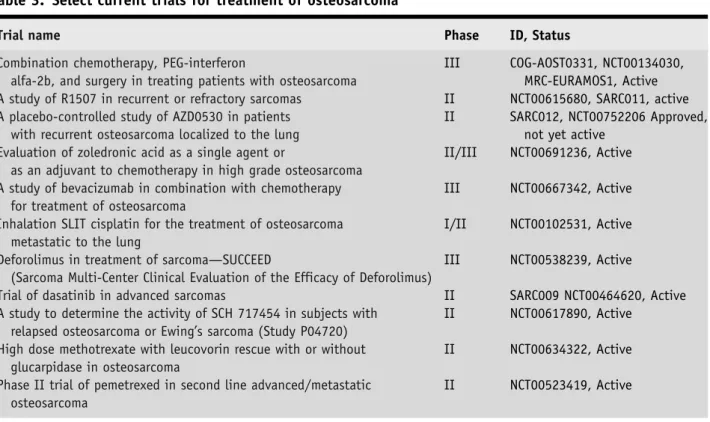
• Other therapeutic approaches to the management of metastatic and/ or recurrent disease are mentioned elsewhere in this review, and in-clude radiation to sites of metastases, Samarium–153, bisphospho-nates, and other new promising investigational agents currently in clinical trials (Table 3).
Surveillance
• Judicial surveillance for recurrence is required in all patients with osteosarcoma. At our institution we generally follow the recently published recommended guidelines from the Children’s Oncology Group Bone Tumor Committee [11]. Patients are screened for recur-rence for 10 years after therapy is completed. The guidelines for sur-veillance post-chemotherapy are summarized in Table2. It is important that careful attention be paid to cumulative radiation doses and that the ALARA (as low as reasonably achievable) principle is utilized for imaging associated radiation in particular for PET/CT scans, which can confer a substantial amount of whole body radiation for pediatric patients [63].
Late effects
• Clearly, tumor recurrence is the most significant problem for patients with osteosarcoma. However, as the overall survival of patients with osteosarcoma has improved over the last several decades, the
long-Table 2. Recommended guidelines for tumor directed surveillance [11]
Site Imaging Frequency/Duration
Primary AP and lateral radiographs Every 3 months92 years, Every 6 months93 years, Every 12 months95 years MRI with gadolinium and/or CT with contrast If abnormal imaging or symptoms
Chest CT non-contrast Every 3 months92 years,
Every 6 months93 years, Every 12 months95 years
AP and lateral radiographs Every 12 months95 years after last CT Bone metastases AP and lateral radiographs Every 3 months92 years,
Every 6 months93 years, Every 12 months95 years MRI with gadolinium and/or CT with contrast If abnormal imaging or symptoms Whole body (99 m)Tc-MDP Bone Scan If abnormal imaging or symptoms Whole body FDG-PET If abnormal imaging or symptoms and
PET positive on prior scan
AP—anterior posterior; MRI—magnetic resonance imaging; CT—computerized tomography; 99 mTc-MDP—99 m technetium methylene disphosphonate; FDG-PET—fluorodeoxyglucose positron emission tomography.
term side effects of treatment have become more evident. Aside from the recurrence of primary cancer, another worrisome long-term con-sequence is the development of a secondary malignancy. The inci-dence of a second malignancy in several large retrospective cohorts has been reported between 2.2% and 3.4% [64–66]. Leukemia was most prevalent followed by breast, soft tissue, lung, kidney, central nervous system, and other cancers.
• The long-term effects of therapy for osteosarcoma are numerous, potentially life threatening and debilitating. Although relatively infrequent, anthracycline-induced cardiac toxicity can be fatal. Careful observation of cumulative anthracycline dosage, avoidance of rapid infusion [67], and surveillance of cardiac function with routine serial echocardiography or multi-gated acquisition (MUGA) scans should be part of routine practice. Evidence supporting the use of cardiopro-tective agents such as dexrazoxane is debatable [68] and we recom-mend using dexrazoxane on an individual basis for patients with high risk of developing cardiac effects.
• Other late sequelae include, but are not limited to, nephrotoxicity from ifosfamide and cisplatin, ototoxicity from cisplatin, and male infertility likely from ifosfamide [69,70].
• We recommend life-long screening for late sequelae at a compre-hensive cancer center with an established long-term follow up or cancer survivorship program.
Emerging therapies
• Over the past several decades, new chemotherapeutic agents have been added to the armamentarium of anticancer drugs. However, few agents have shown activity or clinical benefit in osteosarcoma. Com-bination therapy with gemcitabine and docetaxel in refractory bone sarcomas was well tolerated and demonstrated antitumor activity [71]. • Immune approaches to osteosarcoma therapy continue to be
investi-gated. Immunotherapy has been utilized in the therapy for osteosar-coma for several decades notably with the administration of
interferon-alpha [72]. The effect of maintenance pegylated interferon alpha is currently being studied in the EURAMOS1 trial in patients with a good response to neoadjuvant chemotherapy. Another ap-proach has been to use the immuno-stimulant muramyl-tripeptide phosphatidyl-ethanolamine (MTP-PE), which is derived from Bacille Calmette-Guerin and is a potent macrophage activator. Recently, addition of liposomal MTP-PE in combination with adjuvant che-motherapy resulted in a statistically significant increase in overall survival (78% OS) versus standard combination chemotherapy (70% OS) [31]. Other immune strategies have focused on generating T-cell responses by vaccination with the anti-idiotypic antibody mimicking CD55, a complement regulatory protein expressed by many solid tu-mors including osteosarcoma [73,74]. The use of dendritic cell vac-cines to enhance cytotoxic T-cell activation is being evaluated in xenograft models as well.
• Small molecule therapy with inhibition of the Src kinase pathway involved in osteoclast activity has been shown to have anti-prolifer-ative and pro-apoptotic activity in osteosarcoma cell lines and xeno-graft models [75,76]. The orally available Src tyrosine kinase inhibitor AZD0530 is currently being investigated in a phase II clinical trial in osteosarcoma with pulmonary recurrence post-metastasectomy con-ducted by the Sarcoma Alliance Research through Collaboration
(SARC) global cooperative network (SARC012, NCT00752206). Other recent trials using small molecule biologic therapy have focused on targeting the insulin like growth factor receptor (IGFR) with the monoclonal antibody R1507 (SARC011, NCT00615680) expressed in osteosarcoma and other sarcomas as well as targeting HER–2 with the monoclonal antibody trastuzumab overexpressed in 30%–40% of osteosarcoma tumors (COG-AOST0121, NCT00023998, study com-pleted). A summary of selected current open trials for osteosarcoma is listed in Table3.
Summary
• The prognosis of localized osteosarcoma has improved dramatically over the past 30 years with multi-modality treatment of aggressive surgery and combination chemotherapy. Despite these advances for localized disease and with the development of newer chemothera-peutic agents, the prognosis for metastatic, refractory and recurrent osteosarcoma is still dismal. Multidisciplinary management within a comprehensive cancer center is extremely important to the diagnosis, medical, surgical, and overall care of patients with osteosarcoma. A concerted effort should be made to treat osteosarcoma within the scope of a large international collaborative trial such as the EURA-MOSI trial. For patients that have completed treatment, oncologists must be particularly attentive to long-term surveillance for recurrence and development of late-effects from chemotherapy. Finally, a con-tinued emphasis should be placed on preclinical basic science and translational research aimed at furthering our understanding of oste-osarcoma with the ultimate goal of providing patients new, molecu-larly targeted therapies.
Table 3. Select current trials for treatment of osteosarcoma
Trial name Phase ID, Status
Combination chemotherapy, PEG-interferon
alfa-2b, and surgery in treating patients with osteosarcoma
III COG-AOST0331, NCT00134030, MRC-EURAMOS1, Active A study of R1507 in recurrent or refractory sarcomas II NCT00615680, SARC011, active A placebo-controlled study of AZD0530 in patients
with recurrent osteosarcoma localized to the lung
II SARC012, NCT00752206 Approved, not yet active
Evaluation of zoledronic acid as a single agent or
as an adjuvant to chemotherapy in high grade osteosarcoma
II/III NCT00691236, Active A study of bevacizumab in combination with chemotherapy
for treatment of osteosarcoma
III NCT00667342, Active Inhalation SLIT cisplatin for the treatment of osteosarcoma
metastatic to the lung
I/II NCT00102531, Active Deforolimus in treatment of sarcoma—SUCCEED
(Sarcoma Multi-Center Clinical Evaluation of the Efficacy of Deforolimus)
III NCT00538239, Active
Trial of dasatinib in advanced sarcomas II SARC009 NCT00464620, Active A study to determine the activity of SCH 717454 in subjects with
relapsed osteosarcoma or Ewing’s sarcoma (Study P04720)
II NCT00617890, Active High dose methotrexate with leucovorin rescue with or without
glucarpidase in osteosarcoma
II NCT00634322, Active Phase II trial of pemetrexed in second line advanced/metastatic
osteosarcoma
Open Access This article is distributed under the terms of the Creative Commons Attribution Noncommercial License which permits any noncommercial use, distribution, and
reproduc-tion in any medium, provided the original author(s) and source are credited.
References and Recommended Reading
Papers of particular interest, published recently, have been highlighted as: • Of importance•• Of major importance
1. Huvos A.:Bone Tumors: Diagnosis, Treatment Prognosis (2nd ed.). Philadelphia: WB Saunders, 1991.
2. Gurney JG, Swensen AR, Bulterys M:Malignant bone tumors. InCancer Incidence and Survival Among Chil-dren and Adolescents: United States SEER Program 1975– 1995. SEER program, National Cancer Institute, Be-thesda, MD; 1999: 99–110.
3. Link MP, Gebhardt MC, Meyers PA:Osteosarcoma. In Principles and Practice of Pediatric Oncology.Edited by Pizzo A, Poplack G 4th ed. Philadelphia: Lippincott Williams and Wilkins; 2002:1051–1089.
4. Meyers PA, Gorlick R:Osteosarcoma.Pediatr Clin North Am1997,44:973. doi: 10.1016/S0031-3955(05)70540-X.
5. Ferrari S, Bacci G, Picci P,et al.: Long-term follow-up and post relapse survival in patients with non-met-astatic osteosarcoma of the extremity treated with neoadjuvant chemotherapy.Ann Oncol1997,8:765. doi:10.1023/A:1008221713505.
6. Thorpe WP, Reilly JJ, Rosenborg SA:Prognostic sig-nificance of alkaline phosphatase measurements in patients with osteogenic sarcoma receiving chemo-therapy.Cancer1979,43:2178–2181. doi:10.1002/ 1097-0142(197906)43:6<2178::AID-CNCR2820430 603>3.0.CO;2-9.
7. Kesselring FO, Penn W:Radiological aspects of ‘‘classic’’ primary osteosarcoma: value of some radiological investigations: a review.Diagn Imaging 1982,51:78–92.
8. McKillop JH, Etcubanas E, Goris ML:The indications for and limitations of bone scintigraphy in osteo-genic sarcoma: a review of 55 patients.Cancer1981,
46:2603–2606.
9. McCarville MB, Christie R, Daw NC, Spunt SL, Kaste SC:PET/CT in the evaluation of childhood sarcomas.
AJR Am J Roentgenol2005,184:1293–1304.
10. Volker T, Denecke T, Steffen I, Misch D, Schonberger S, et al.: Positron emission tomography for staging of pediatric sarcoma patients: results of a prospective multicenter trial.J Clin Oncol2007,25:5435–5441. doi:10.1200/JCO.2007.12.2473.
11• Meyer JS, Nadel HR, Marina N, Womer RB, Brown KL, et al.:Imaging guidelines for children with ewing sarcoma and osteosarcoma: a report from the Chil-dren’s Oncology Group Bone Tumor Committee. Pe-diatr Blood Cancer2008,51: 163–170.
Consensus guidelines from the Children’s Oncology Group Bone Tumor Committee for imaging children, adolescents and young adults with osteosarcoma and ewing sarcoma. 12. Hau A, Kim I, Kattapuram S, Hornicek FJ,et al.:Accuracy
of CT-guided biopsies in 359 patients with musculo-skeletal lesions.Skeletal Radiol2002,31:349–353.
13. Peabody TD, Simon MA:Making the diagnosis: keys to a successful biopsy in children with bone and soft-tissue tumors.Orthop Clin North Am1996,
27:453–459.
14. Friedman MA, Carter SK:The therapy of osteogenic sarcoma: current status and thoughts for the future.J Surg Oncol1972,4:482–510.
15. Meyers P:Osteosarcoma. InPediatric Bone and Soft Tissue Sarcomas. Edited by Pappo A. Berlin: Springer-Verlag; 2006; 219–233.
16. Jaffe N, Frei E, Traggis D,et al.: Adjuvant methotrexate and citrovorum-factor treatment of osteogenic sar-coma.N Engl J Med1974,291:994–997.
17. Cortes EP, Holland JF, Wang JJ,et al.: Amputation and adriamycin in primary osteosarcoma.N Engl J Med 1974,291:998–1000.
18. Gasparini M, Rouesse J, van Oosterom A,et al.: Phase II study of cisplatin in advanced osteogenic sarcoma. European Organization for Research on Treatment of Cancer Soft Tissue and Bone Sarcoma Group.
Cancer Treat Rep1985,69:115–117.
19. Marti C, Kroner T, Remagen W,et al.: High-dose if-osfamide in advanced osteosarcoma.Cancer Treat Rep 1985,69:115–117.
20• Goorin AM, Harris MB, Bernstein M, et al.: Phase II/ III trial of etoposide and high-dose ifosfamide in newly diagnosed metastatic osteosarcoma: a pedi-atric oncology group trial. J Clin Oncol 2002, 20: 426–433.
A Pediatric Oncology Group study of etoposide and high-dose ifosfamide therapy in patients with metastatic osteosarcoma at diagnosis. Response rates and projected progression free survival was favorable compared to previ-ous trials. However, long term data has not been reported. 21. Rosen G, Tan C, Sanmaneechai A,et al.: The rationale
for multiple drug chemotherapy in the treatment of osteogenic sarcoma.Cancer1975,35:936–945. 22. Rosen G, Marcove RC, Caparros B,et al.: Primary
osteogenic sarcoma: the rationale for preoperative chemotherapy and delayed surgery.Cancer1979,
43:2163–2177.
23••Goorin AM, Schwartzentruber DJ, Devidas M,et al.:
Presurgical chemotherapy compared with immediate surgery and adjuvant chemotherapy for nonmeta-static osteosarcoma: Pediatric Oncology Group Study POG-8651.J Clin Oncol2003,21: 1574–1580.
24••Bielack SS, Kempf-Bielack B, Delling G,et al.: Prog-nostic factors in high-grade osteosarcoma of the extremities or trunk: an analysis of 1,702 patients treated on neoadjuvant cooperative osteosarcoma group protocols.J Clin Oncol2002,20: 776.
Very large series of patients from a multicenter database reviewing prognostic factors in high grade osteosarcoma. 25. Winkler K, Beron G, Delling G,et al.: Neoadjuvant
chemotherapy of osteosarcoma: results of a ran-domized cooperative trial (COSS-82) with salvage chemotherapy based on histological tumor response.J Clin Oncol1988,6:329–337.
26. Hudson M, Jaffe MR, Jaffe N,et al.: Pediatric osteo-sarcoma: therapeutic strategies, results and prog-nostic factors derived from a 10 year experience.J Clin Oncol1990,8:1988–1997.
27. Rosen G, Caparros B, Huvos AG,et al.: Preoperative chemotherapy for osteogenic sarcoma: selection of postoperative adjuvant chemotherapy based on the response of the primary tumor to preoperative che-motherapy.Cancer1982,49:1221–1230.
28. Bacci G, Picci P, Ferrari S,et al.: Primary chemother-apy and delayed surgery for nonmetastatic osteo-sarcoma of the extremities. Results in 164 patients preoperatively treated with high doses of metho-trexate followed by cisplatin and doxorubicin.Cancer 1993,72:3227–3238.
29. Saeter G, Alvegard TA, Elomaa I,et al.: Treatment of osteosarcoma of the extremities with the T–10 pro-tocol, with emphasis on the effects of pre-operative chemotherapy with single-agent high-dose metho-trexate: a Scandinavian Sarcoma Group Study.J Clin Oncol1991,9:1766–1775.
30. Provisor AJ, Ettinger LJ, Nachman JB,et al.: Treatment of nonmetastatic osteosarcoma of the extremity with preoperative and postoperative chemotherapy: a re-port from the Children’s Cancer Group.J Clin Oncol 1997,15:76–84.
31••Meyers PA, Schwartz CL, Krailo MD,et al.: Osteosar-coma: the addition of muramyl tripeptide to che-motherapy improves overall survival—A report from the Children’s Oncology Group.J Clin Oncol2008,
26: 633–638.
Large randomized trial of patients with localized osteosar-coma. Although a significant survival advantage was con-ferred with addition of MTP-PE, the study has been criticized for its analysis and interpretation of event free survival and overall survival.
32. Fuchs N, Bielack SS, Epler D,et al.: Long-term results of the co-operative German-Austrian-Swiss osteo-sarcoma group’s protocol COSS–86 of the intensive multidrug chemotherapy and surgery for osteosar-coma of the limbs.Ann Oncol1998,9:893–899. 33. Bacci G, Briccoli A, Ferrari A,et al.: Neoadjuvant
chemotherapy for osteosarcoma of the extremity: long-term results of the Rizzoli’s 4th protocol.Eur J Cancer2001,37:2030–2039.
34••Lewis IJ, Nooij MA, Whelan J,et al.:Improvement in histologic response but not survival in osteosarcoma patients treated with intensified chemotherapy: a randomized phase III trial of the European Osteo-sarcoma Intergroup.J Natl Cancer Inst2007,99: 112– 128.
A large randomized trial comparing dose intensification with doxorubicin and cisplatin. Dose intensification significantly increased favorable histologic response though had no increase in event free survival or overall
survival questioning histologic response as an outcome measure.
35• Ferrari S, Smeland S, Mercuri M,et al.Neoadjuvant chemotherapy with high-dose ifosfamide, high-dose methotrexate, cisplatin and doxorubicin for patients with localized osteosarcoma of the extremity: a joint study by the Italian and Scandinavian Sarcoma groups.J Clin Oncol2005,23: 8845–8852. A joint study by the Italian and Scandinavian Sarcoma Groups exploring the effect of the addition of high-dose ifosfamide to standard therapy. There was no benefit of high-dose ifosfamide over standard dose ifosfamide. 36. Grimer R:Surgical options for children with
osteo-sarcoma.Lancet Oncol2005,6:85–92.
37. Simon MA, Aschliman MA, Thomas N, Mankin HJ:
Limb salvage treatment versus amputation for oste-osarcoma of the distal end of the femur.J Bone Joint Surg Am1986,68:1331–1337.
38. Gherlinzoni F, Picci P, Bacci G,et al.:Limb sparing versus amputation in osteosarcoma. Correlation between local control, surgical margins, and tumor necrosis: Istituto Rizzoli experience.Ann Oncol1992;
3 (Suppl 2): S23–S27.
39. Picci P, Sangiori L, Bahamonde L,et al.: Risk factors for local recurrences after limb-salvage surgery for high-grade osteosarcoma of the extremities.Ann Oncol1997,8:899–903.
40. Bacci G, Forni C, Longhi A,et al.: Local recurrence and local control of non-metastatic osteosarcoma of the extremities: a 27 year experience in a single institution.J Surg Oncol2007,96:118–123.
41. Wirganowicz PZ, Eckardt JJ, Dorey FJ,et al.: Etiology and results of tumor endoprosthesis revision surgery in 64 patients.Clin Orthop Relat Res1999,358:64–74. 42. Torbert JT, Fox EJ, Hosalkar HS,et al.: Endoprosthetic
reconstructions: results of long-term followup of 139 patients.Clin Orthop Relat Res2005,438:51–59. 43. Chao EY, Fuchs B, Rowland CM,et al.: Long-term
results of segmental prosthesis fixation by extracor-tical bone-bridging and ingrowth.J Bone Joint Surg Am2004,86:948–955.
44. Kramer MJ, Tanner BJ, Horvai AE, O’Donnell RJ:
Compressive osseointegration promotes viable bone at the endoprosthetic interface: retrieval study of Compress implants.Int Orthop2008,32:567–571. 45. Eckardt JJ, Safran MR, Eilber FR,et al.: Expandable
endoprosthetic recontruction of the skeletally immature after malignant bone tumor resection.Clin Orthop Relat Res1993,297:188–202.
46. Neel MD, Wilkins RM, Rao BN, Kelly CM:Early mul-ticenter experience with a non-invasive expandable prosthesis.Clin Orthop Relat Res2003,415:72–81. 47. Rab GT, Ivins JC, Childs DS Jr,et al.: Elective whole
lung irradiation in the treatment of osteogenic sar-coma.Cancer1976,38:939–942.
48. Breur K, Cohen P, Schweisguth O,et al.Irradiation of the lungs as an adjuvant therapy in the treatment of osteosarcoma of the limbs. An E.O.R.T.C. random-ized study.Eur J Cancer1978,14: 461–471.
49. Whelan JS, Burcombe RJ, Janinis J,et al.: A systematic review of pulmonary irradiation in the management of primary bone tumours.Ann Oncol2002,13:23–30.
50. Machak GN, Trachev SI, Solovyev YN,et al.: Neoad-juvant chemotherapy and local radiotherapy for high grade osteosarcoma of the extremities.Mayo Clinic Proc2003,78:147–155.
51. Delaney TF, Park L, Goldberg SI,et al.: Radiotherapy for local control of osteosarcoma.Int J Radiat Oncol Biol Phys2005,61:492–498.
52. Delaney TF, Liebsch NJ, Pedlow FX,et al.:Phase II study of high-dose photon/proton radiotherapy in the management of spine sarcomas.Int J Radiat Oncol Biol Phys2009, 1–8 (in press).
53. Anderson PM, Wiseman GA, Dispenzieri A,et al.:
High-dose samarium–153 ethylene diamine tetra-methylene phosphonate: low toxicity of skeletal irradiation in patients with osteosarcoma and bone metastases.J Clin Oncol2002,1:189–196.
54. Bruland OS, Skretting A, Solheim OP,et al.: Targeted radiotherapy of osteosarcoma using 153Sm-EDTMP.
Acta Oncol1996,35:381–384.
55. Anderson PM, Nunez R:Samarium lexidronam (153Sm-EDTP): skeletal radiation for osteoblastic bone metastases and osteosarcoma.Expert Rev Anti-cancer Ther2007,7:1517–1527.
56. Harris MB, Gieser P, Goorin AM,et al.: Treatment of metatastatic osteosarcoma at diagnosis: a Pediatric Oncology Group study.J Clin Oncol1998,16:
3641–3648.
57• Kager L, Zoubek A, Potschger U,et al.:Primary meta-static osteosarcoma: presentation and outcome of patients treated on neoadjuvant Cooperative Osteo-sarcoma Study Group protocols.J Clin Oncol2003,21: 2011–2018.
Large retrospective analysis of osteosarcoma patients pre-senting with metastasis treated on COSS group studies. 58. Thompson RC Jr, Cheng EY, Clohisy DR,et al.: Results
of treatment for metastatic osteosarcoma with neo-adjuvant chemotherapy and surgery.Clin Orthop Relat Res2002,397:240–247.
59. Ferrari S, Bricolli A, Mercuri M,et al.: Postrelapse survival in osteosarcoma of the extremities: prog-nostic factors for long-term survival.J Clin Oncol 2003,21:710–715.
60• Kempf-Bielack B, Bielack SS, Jurgens H,et al.: Osteo-sarcoma relapse after combined modality therapy: an analysis of unselected patients in the Cooperative Osteosarcoma Group (COSS).J Clin Oncol2005,
20:559–568.
Retrospective analysis of a large cohort of relapsed osteo-sarcoma patients. Time to relapse and tumor burden at re-lapse were correlated with survival.
61. Chou AJ, Merola PR, Wexler LH,et al.: Treatment of osteosarcoma at first recurrence after contemporary therapy. The Memorial Sloan Kettering Cancer Cen-ter Experience.Cancer2005,104:2214–2221. 62. Hawkins DS, Arndt CA:Pattern of disease recurrence
and prognostic factors in patients with osteosarcoma treated with contemporary chemotherapy.Cancer 2003,98:2447–2456.
63. Federman N, Feig SA.:PET/CT in evaluating pediatric malignancies: a clinician’s perspective.J Nucl Med 2007,48:1923–1931.
64. Bacci G, Ferrari C, Longhi A,et al.: Second malignant neoplasm in patients with osteosarcoma of the extremities treated with adjuvant and neoadjuvant chemotherapy.J Pediatr Hematol Oncol2006,28:774– 780.
65. Aung L, Gorlick RG, Shi W,et al.: Second malignant neoplasms in long-term survivors of osteosarcoma: Memorial Sloan-Kettering Cancer Center experience.
Cancer2002,95:1728–1734.
66. Goldsby R, Burke C, Nagarajan R,et al.: Second solid malignancies among children, adolescents, and young adults diagnosed with malignant bone tumors after 1976.Cancer2008,113:2597–2604. 67. Van Dalen EC, Van der Pal HJ, Caron HN, Kremer LC:
Different dosage schedules for reducing cardiotox-icity in cancer patients receiving anthracycline che-motherapy.Cochrane Database Syst Rev2006,4:1–22. 68. Van Dalen EC, Caron HN, Dickinson HO, Kremer LC:
Cardioprotective interventions for cancer patients receiving anthracyclines.Cochrane Database Syst Rev 2008,4:1–44.
69. Longhi A, Macchiagodena M, Vitali G, Bacci G: Fer-tility in male patients treated with neoadjuvant chemotherapy for osteosarcoma.J Pediatr Hematol Oncol2003,35:292–296.
70. Stohr W, Paulides M, Bielack SS,et al.:Nephrotoxicity of cisplatin and carboplatin in sarcoma patients: a report from the late effects surveillance system. Pediatr Blood Cancer2007,48: 140–147.
71. Navid F, Willert JR, McCarville MB,et al.: Combina-tion of gemcitabine and doetaxel in the treatment of children and young adults with bone sarcoma.
Cancer2008,113:419–425.
72. Muller CR, Smeland S, Bauer HC,et al.: Interferon-alpha as the only adjuvant treatment in high-grade osteosarcoma: long term results of the Karolinska Hospital series.Acta Oncol2005,44:475–480. 73. Pritchard-Jones K, Spendlove I, Wilton C,et al.:
Im-mune responses to the 105AD7 human anti-idiotypic vaccine after intensive chemotherapy, for osteosar-coma.Br J Cancer2005,92:1358–1365.
74. Ullenhag GJ, Spendlove I, Watson NG,et al.: T-cell responses in osteosarcoma patients vaccinated with an anti-idiotypic antibody, 105AD7, mimicking CD55.Clin Immunol2008,128:148–154. 75. Shor AC, Keschman EA, Lee FY,et al.: Dasatinib
inhibits migration and invasion in diverse human sarcoma cell lines and induces apoptosis in bone sarcoma cells dependent on SRC kinase for survival.
Cancer Res2007,67:2800–2808.
76. Manetti F, Santucci A, Locatelli GA,et al.: Identifica-tion of a novel pyrazolo[3, 4-d]pyrimidine able to inhibit cell proliferation of a human osteogenic sarcoma in vitro and in a xenograft model in mice.J Med Chem2007,50:5579–5588.
![Table 2. Recommended guidelines for tumor directed surveillance [11]](https://thumb-us.123doks.com/thumbv2/123dok_us/10329749.2943025/8.890.100.804.751.1078/table-recommended-guidelines-tumor-directed-surveillance.webp)