Jefferson Digital Commons
Department of Occupational Therapy Faculty
Papers
Department of Occupational Therapy
3-25-2018
Perceptions about Authentic Leadership
Development: South African Occupational
Therapy Students' Camp Experience
Fatima Hendricks
OTASA, Vlaeberg
Susan Toth-Cohen
Thomas Jefferson University, [email protected]
Let us know how access to this document benefits you
Follow this and additional works at:
https://jdc.jefferson.edu/otfp
Part of the
Occupational Therapy Commons
This Article is brought to you for free and open access by the Jefferson Digital Commons. The Jefferson Digital Commons is a service of Thomas
Jefferson University'sCenter for Teaching and Learning (CTL). The Commons is a showcase for Jefferson books and journals, peer-reviewed scholarly
publications, unique historical collections from the University archives, and teaching tools. The Jefferson Digital Commons allows researchers and interested readers anywhere in the world to learn about and keep up to date with Jefferson scholarship. This article has been accepted for inclusion in Department of Occupational Therapy Faculty Papers by an authorized administrator of the Jefferson Digital Commons. For more information, please contact: [email protected].
Recommended Citation
Hendricks, Fatima and Toth-Cohen, Susan, "Perceptions about Authentic Leadership Development:
South African Occupational Therapy Students' Camp Experience" (2018).
Department of
Occupational Therapy Faculty Papers.
Paper 62.
https://jdc.jefferson.edu/otfp/62
Research Article
Perceptions about Authentic Leadership Development:
South African Occupational Therapy Students’ Camp Experience
Fatima Hendricks
1and Susan Toth-Cohen
2 1OTASA, Vlaeberg, P.O. Box 15809, Cape Town 8018, South Africa2Department of Occupational Therapy, Thomas Jefferson University, 130 S. 9th Street, 632 Edison, Philadelphia, PA 19107, USA Correspondence should be addressed to Fatima Hendricks; [email protected]
Received 15 October 2017; Accepted 19 February 2018; Published 25 March 2018 Academic Editor: Lynette Mackenzie
Copyright © 2018 Fatima Hendricks and Susan Toth-Cohen. This is an open access article distributed under the Creative Commons Attribution License, which permits unrestricted use, distribution, and reproduction in any medium, provided the original work is properly cited.
Background.Twenty-three years into democracy, concern is deepening regarding the slow progress of Occupational Therapy (OT) in South Africa, especially with regard to diversity and inclusion within OT.Methods.This study explores authentic leadership development primarily among Black OT students attending a pilot Occupational Therapy Association of South Africa (OTASA) National Student Leadership Camp. It seeks to ascertain their perceptions on leadership and leadership development. This descriptive pilot study employs in-depth interviews and subsequent content analysis, with 12 OT students from six university OT programs in South Africa.Findings.Four categories of participant perceptions on authentic leadership development emerged from the analysis: (1) perceptions about oneself as a leader based on personal narrative, self-awareness, self-control, and psychological capital; (2) perceptions about others, specifically current leaders, with regard to their moral crisis, including continuing inequality, insincerity, greed, and selfishness; (3) goals and aspirations for leadership development via student camps; and (4) effects of leadership on the system.Conclusions.Recommendations for future practice include promotion of storytelling as a means of personal reflection for authentic leadership development and focused investment in camps for developing student leadership skills and building authentic leadership knowledge.
1. Introduction
The South African OT community continues to grapple with issues related to the slow pace of social transformation, particularly racial transformation, diversity, and inclusion [1]. Exploring emerging OT student leaders’ perceptions of their leadership journeys and engagement with authentic leadership may provide insight into student leaders’ implicit theories of leadership in a postcolonial context. This, in turn, may enable greater understanding of OT students’ leadership development needs and lead to a more informed approach to developing transformational plans to enhance diversity within the OT profession in South Africa.
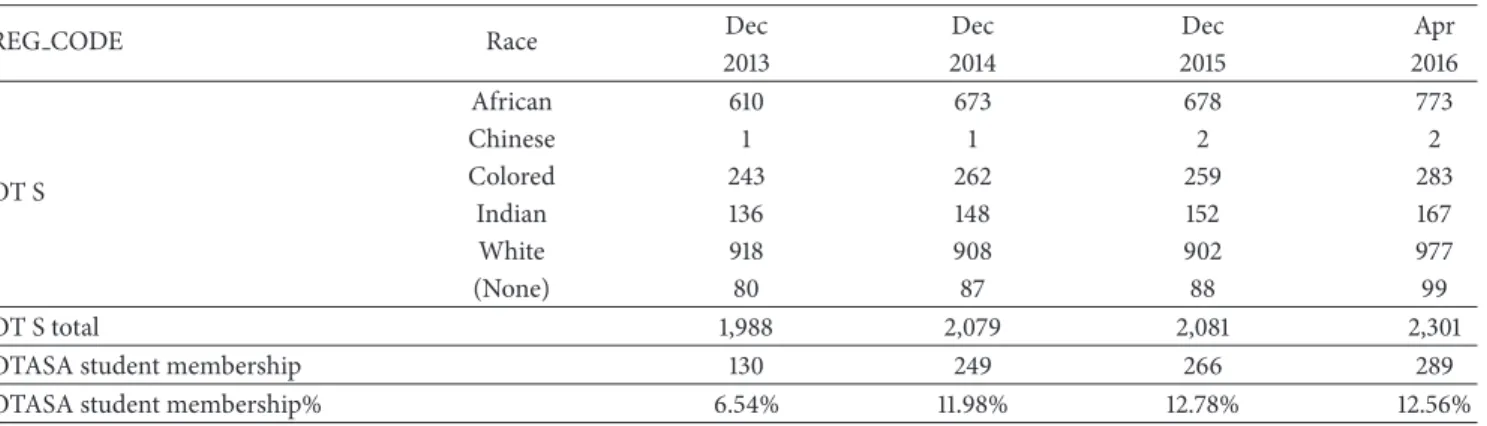
As per OTASA’s vision for 2020, students are an important strategic driver in the OT community in South Africa for their potential contribution to societal transformation [2], and, as OTASA’s future leadership pipeline at the branch and national level, they reflect diversity and inclusion. Table 1
represents the number of OT students registered with the Health Professions Council and their demographic profiles [3]. Approximately 12% of the students are members of OTASA, and there is significant opportunity for growth in student membership and participation [1].
The data in Table 1 reveal that the racial profile of the students relative to South Africa’s demographics is skewed toward minority group overrepresentation, with 997 White students in OT programs compared with 773 Black African, 283 Colored, 167 Indian, and 2 Chinese students. At the same time, the number of Black students enrolling in OT programs is increasing, also illustrated in Table 1 [3]. Black African OT student admission has increased by 26.7% from 2013 to 2016 when compared to a 6.4% increase in White students during the same period. Diversity and inclusion to promote an Occupational Therapy community that reflects the demo-graphics of the country is a key issue in the preliminary results of OTASA’s National Listening & Dialogue Campaign,
Hindawi
Occupational erapy International Volume 2018, Article ID 1587906, 9 pages https://doi.org/10.1155/2018/1587906
Table 1: Demographic profile of OT students (OT S) and membership in OTASA.
REG CODE Race Dec Dec Dec Apr
2013 2014 2015 2016 OT S African 610 673 678 773 Chinese 1 1 2 2 Colored 243 262 259 283 Indian 136 148 152 167 White 918 908 902 977 (None) 80 87 88 99 OT S total 1,988 2,079 2,081 2,301
OTASA student membership 130 249 266 289
OTASA student membership% 6.54% 11.98% 12.78% 12.56%
Source. Health Professions Council of South Africa (2016); OTASA (2016).
a series of ongoing national consultative workshops [4]. From these discussions, it is evident that gaps exist in engaging emerging Black OT leaders among students, hence the strate-gic importance of the National Student Leadership Camp and its focus on authentic leadership development for Black emerging student leaders.
Another strategic drivers for transformation, diversity, and inclusion is the recent student protests, manifested by #feesmustfall and #rhodesmustfall, which have been accom-panied by a vibrant student movement reemphasizing the role of students in leading change for accessible and relevant education [5]. In addition, there is the upcoming World Federation of OT (WFOT) Congress 2018, to be hosted in South Africa, titled “Connected in Diversity: Positioned for Impact” [6], which requires student engagement across the racial and social spectrum as a prerequisite for its success.
Hence, to engage emerging Black student leaders in leadership development, a pilot leadership camp was con-ducted to meet the strategic needs of the OT community and promote diversity within the profession. The residential student leadership camp drew primarily emerging Black student leaders from OT programs across the country. The research question for this pilot study focused on examining individual student perceptions of authentic leadership devel-opment during camp participation; hence, personal narrative in-depth interviews were conducted with OT student camp participants.
Authentic leadership [7–12] was chosen as the organizing framework for the pilot study, because it includes a develop-mental focus appropriate for emerging leadership in students [13]. At its core, authentic leadership contains key concepts related to the self—such as self- awareness, self-knowledge, self-regulation, and personal values—which can be con-trolled by students desiring to effect change. Walumba et al. [9] describe four dimensions of authentic leadership: self-awareness, balanced processing, relational transparency, and internalized moral perspective; these are significant in the context of constructing a life story narrative, as elucidated by Shamir and Eilam [8]. Self-awareness is the extent to which leaders know and understand their own true selves. Balanced processing refers to unbiased analysis of all relevant informa-tion and taking into account others’ opinions and input before
making a decision. Relational transparency involves openly sharing information and expressing one’s true thoughts and emotions with others. Internalized moral perspective refers to the extent to which leaders’ behaviors are guided by internal moral standards and values rather than by external pressures [14].
Shamir and Eilam [8] also define four characteristics of authentic leaders: they are (1) true to themselves (rather than conforming to the expectations of others); (2) motivated by personal convictions, rather than by status, honor, or other personal benefits; (3) original, leading from their own per-sonal point of view; and (4) spurred to action based on their personal values and convictions.
The construction of a life story is a major element in the development of authentic leadership. Shamir and Eilam [8] further argue that authentic leadership “rests heavily on the self-relevant meanings the leader attaches to his or her life experiences, and these meanings are captured in the leader’s life-story.” They suggest that self-knowledge, self-concept clarity, and person-role merger are derived from the life story, making the construction of life story critical to the develop-ment of authentic leaders. This model provides a meaningful system of feeling, thinking, and acting [8], which is partic-ularly relevant in the evolving sociopolitical, historical, and cultural contexts of South Africa. Hence, this pilot study aims to fill an important gap by focusing on authentic leadership development for primarily emerging Black OT student lead-ers by asking them how they perceive authentic leadlead-ership and its development. The descriptive findings from the study may contribute to theory development by revealing informa-tion about Black South African OT students’ implicit the-ories of leadership. Greater understanding of these implicit theories of leadership may then inform development of strategies to help Black OT students in South Africa to further develop their leadership capacity and contribute their unique perspectives to leadership within the OT profession.
2. Materials and Methods
2.1. Aim of the Study. This descriptive pilot study explored the personal narratives of Black OT students attending the
Occupational Therapy International 3 first OTASA National Student Leadership Camp designed to
promote authentic leadership development, from September 23 to 25, in Limpopo, South Africa.
3. Method
The project was approved by the Institutional Review Board (IRB) of the authors’ university and was part of a larger study using mixed methods to explore leadership development among South African OT students. Data were gathered from structured interviews based on key concepts of authentic leadership [7, 8, 10–12, 15].
Participants comprised 12 Occupational Therapy students from six university OT programs in South Africa. The purpo-sive sample was drawn from first- to third-year OT students (𝑛 = 34), who attended the first pilot National Student Leadership Camp prior to commencement of the camp (see demographics in Table 2). Two students from each university were selected for the interviews, and six of the eight OT programs in South Africa were represented.
3.1. Data Collection and Analysis
Data Collection. A structured interview questionnaire was used, consisting of six questions based on the principles of authentic leadership according to Gardner et al. [11] and Shamir and Eilam [8]: life story and life purpose, positive psy-chological capital, positive moral perspective, self-regulation, self-awareness, and aspirations for the student leadership camp; these aspects were developed as a discussion guide. The questionnaire was developed from the principles of authentic leadership and formulated into a grid of key elements of authentic leadership, like positive psychological capital and other elements, to serve as a rubric. The rubric assess-ment for categorizing their responses as awareness, explora-tion/engagement, or generativity was then used after each response was recorded (see Table 3). Responses were cap-tured in writing by the first author prior to student participa-tion in the camp.
Data Analysis. Data analysis began with open coding of participants’ survey responses using NVivo. Constant com-parative analysis within and across survey data allowed the researchers to reduce categories and create a structured cod-ing system through organizcod-ing and codcod-ing with nodes in trees in NVivo [16]. The investigators completed the coding pro-cesses separately and compared coded statements that dem-onstrated strong consensus, hence establishing intercoder reliability.
4. Results and Discussion
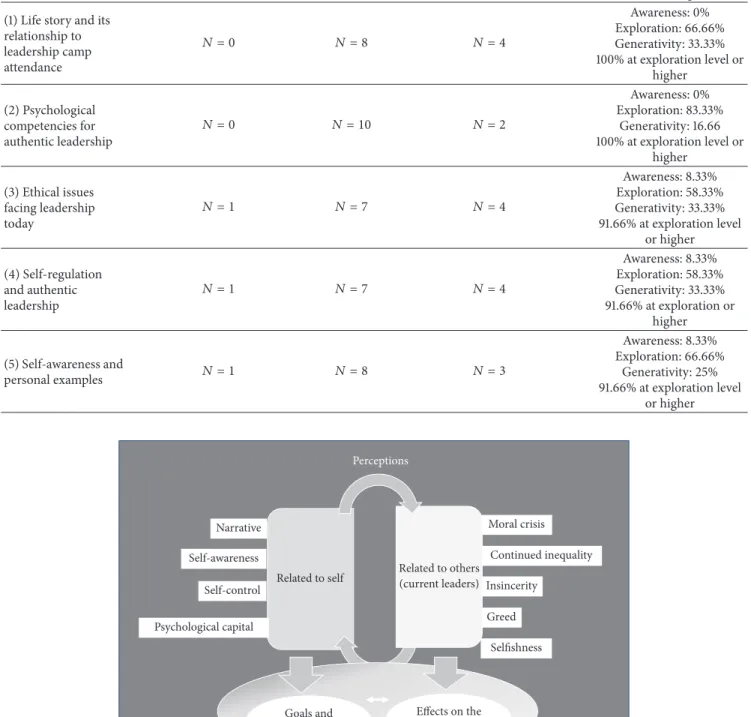
The findings of this study revealed participants’ perceptions of leadership as reflective of their internalized beliefs and expectations of leaders (implicit leadership theories). The data in Figure 1 show that the primary themes can be divided into four main categories: (1) perceptions of authentic leadership in relation to self; (2) perceptions of key issues with
Table 2: Participant demographics of personal narrative interviews.
Attribute Description 𝑁 = 12 Gender Male 5 Female 7 Age 18–20 7 21–23 3 24–26 2 27+ 0 Race Black 7 Colored 2 Indian 2 White 1 Year of study First 5 Second 5 Third 2 Fourth 0 University
University of Cape Town 0 University of Free State 0 University of Kwa-Zulu Natal 2 University of Pretoria 2 Sefako Makgatho Health Sciences University 2 University of Stellenbosch 2 University of Western Cape 2 University of Witwatersrand 2
current leaders; (3) goals and aspirations for authentic lead-ership development via camps; and (4) effects of leadlead-ership on the system.
4.1. Grading Rubric. The rubric outlined in Table 3 was based on the core elements of authentic leadership [8, 11]. This rubric was used to grade each participant according to the quality of their responses in terms of the awareness, explo-ration, or generativity levels for each of the five key questions asked, the sixth being a question on camp goals and aspira-tions.
For Question 1, 67% of the participants were found to be on the exploration level because they were able to briefly describe leadership components in relation to life goals or life story, whereas 33% were graded at the generativity level for their ability to engage in a thorough discussion of life goals or life story relating to the key components of leadership. In terms of the framework, authentic leaders are self-concordant individuals who pursue life goals expressing their authentic choices rather than following externally imposed duties or conventions and are motivated by internal commitment, which is a commitment to a self-concept [8].
Regarding Question 2, 83% were graded at the exploration level for demonstrating some understanding of the psy-chological competencies for becoming an authentic leader, whereas 17% were placed at the generativity level for demon-strating understanding that having confidence, a vision of success, perseverance, and resilience are key psychological competencies for becoming an authentic leader. According to Luthans et al. [17], an individual’s positive psychological
Table 3: Grading rubric of the level of engagement with authentic leadership.
Question Awareness Exploration Generativity Percentage
(1) Life story and its relationship to leadership camp attendance 𝑁 = 0 𝑁 = 8 𝑁 = 4 Awareness: 0% Exploration: 66.66% Generativity: 33.33% 100% at exploration level or higher (2) Psychological competencies for authentic leadership 𝑁 = 0 𝑁 = 10 𝑁 = 2 Awareness: 0% Exploration: 83.33% Generativity: 16.66 100% at exploration level or higher (3) Ethical issues facing leadership today 𝑁 = 1 𝑁 = 7 𝑁 = 4 Awareness: 8.33% Exploration: 58.33% Generativity: 33.33% 91.66% at exploration level or higher (4) Self-regulation and authentic leadership 𝑁 = 1 𝑁 = 7 𝑁 = 4 Awareness: 8.33% Exploration: 58.33% Generativity: 33.33% 91.66% at exploration or higher (5) Self-awareness and personal examples 𝑁 = 1 𝑁 = 8 𝑁 = 3 Awareness: 8.33% Exploration: 66.66% Generativity: 25% 91.66% at exploration level or higher Related to self Goals and aspirations Narrative Self-control Self-awareness
Psychological capital Greed
Continued inequality Selfishness Insincerity Effects on the system 1 Moral crisis Perceptions Related to others (current leaders)
Figure 1: Student perceptions of authentic leadership.
state of development is characterized by (1) confidence, (2) being optimistic about succeeding, (3) perseverance toward goals and, when necessary, redirecting paths toward goals (i.e., showing hope) in order to succeed, and (4) when beset by problems and adversity, sustaining and bouncing back and even beyond (i.e., resilience) to attain success.
For Question 3, 8% of participants were graded at the awareness level for their ability to suggest some core ethical issues in relation to leadership and moral capacity, moral courage, and resiliency; 58% at the exploration level for discussing, in some detail, core ethical issues in relation to leadership and moral capacity, moral courage, and resiliency;
Occupational Therapy International 5 and 33% at generativity for their ability to analyze, with depth
and clarity, core ethical issues in relation to leadership and moral capacity, moral courage, or resiliency. In terms of pos-itive moral perspective, May et al. [18] provide an extensive discussion of this moral component, describing an ethical and transparent decision-making process whereby authentic leaders develop and draw upon reserves of moral capacity, efficacy, courage, and resiliency to address ethical issues and achieve authentic and sustained moral actions.
Among the participants for Question 4, 8% were graded at the awareness level for referring to certain details on the importance of self-control and the need to assess and manage alternate, divergent, or contradictory perspectives or ideas in comparison with internal standards. At the exploration level, 58% were graded for being able to highlight the importance of self-control and the need to assess and manage alternate, divergent, or contradictory perspectives or ideas in comparison with internal standards in an exploratory way, whereas 33% were graded at the generativity level. Self-regulation involves processes whereby people exert self-control by (1) setting internal (either existing or newly formu-lated) standards, (2) assessing discrepancies between these standards and actual or expected outcomes, and (3) identify-ing intended actions for reconcilidentify-ing these discrepancies [19]. George [20] describes self-awareness as an emerging process and not a destination point, in which individuals con-tinually come to understand their unique talents, strengths, sense of purpose, core values, beliefs, and desires that include basic and fundamental awareness of their knowledge, experi-ence, and capabilities. Gardner et al. [21] further describe four components: values, cognitions regarding identity, emotions, and motives/goals. Thus, among the participants for Question 5, 8% were graded at the awareness level for mentioning some strengths and weaknesses but with little connection to life goals or purpose, values, identity, and emotions, whereas 67% of participants were able to analyze personal strengths and weaknesses with some connection to life goals or purpose, values, identity, and emotions (exploration level), and 25% of the participants were able to effectively analyze strengths and weaknesses with a strong connection to life goals or purpose, values, identity, and emotions (generativity level).
Overall, for each of the questions, over 90% of the participants were graded at the exploration or generativity levels. The next section outlines the content of the in-depth interviews in terms of key themes that emerged.
4.2. Key Themes. Figure 1 illustrates the four categories of participant perceptions that emerged on authentic leadership development: (1) perceptions about self as a leader based on personal narrative, self-awareness, self-control, and psy-chological capital; (2) perceptions about others, specifically current leaders, relating to their moral crisis, continued inequality, insincerity, greed, and selfishness; (3) goals and aspirations for leadership development via camps; and (4) effect of leadership on the system.
Figure 1 outlines the subthemes in relation to perceptions of authentic leadership pertaining to leadership of the self as follows: (a) life narrative—the self as leader/role model, the influence of family and significant others on leadership
development, and the relationship among leadership, OT, and life purpose; (b) self-awareness—being true to self, conscious of self, and accepting of self; (c) self-control—self-mastery, leading carefully through careful thinking, emotional control, and using a moral compass; and finally (d) positive psycho-logical capital—perseverance/resilience, positivity, and open-ness. For example, relating to perceptions of authentic leader-ship pertaining to self in the subtheme of positive psycholog-ical capital, one student said,
I have a lot of zeal and persistence to press forward. I could have given up but I never gave up. I have to be positive, and I have to make a contribution. (Black, female)
This statement is typical of the perceptions of the partic-ipants’ highlighting their perseverance and resilience within the context of their personal life narratives.
Figure 1 also outlines the subthemes of critiquing current leaders in relation to their authentic leadership as follows: (a) moral crisis in leadership; (b) continued societal inequality as a serious leadership challenge; (c) insincerity of leadership; (d) greed and corruption; and (e) selfishness in looking out for one’s own self-interests over the needs of the people. In a critique of current leaders on the subtheme of moral crisis, a student stated,
It is disconcerting with fraud, corruption and with misplaced values. I think it is because it is lonely at the top and they have become addicted to power and lost their moral compass. (Black, male)
Finally, Figure 1 outlines camp goals and aspirations for authentic leadership development via camps, the subthemes being listed as follows: (a) pursuit of leadership knowledge and skills, (b) aspirations for becoming a leader, and (c) building confidence for leadership. Students perceived them-selves as active agents of or catalysts for change in the OT profession because, by pursing their leadership goals and aspirations, they could effect positive change in the societal system. As an example of a statement representing camp goals and aspirations for authentic development as a leader through leadership camps, a student noted,
When I work with children, I look at them and say to myself—look at that dance, it’s so imperfectly perfect. And that’s what I want to be to the children—to sincerely help them, encourage them. It starts with the self—this commitment and desire I have to do good. We forget about ourselves in terms of pretending to care but rather the leadership must come from within. The way I lead will be different after this camp. I will spend time reflecting and evaluating myself, and then I want to go back and share my camp experience with the rest of the class. (Colored, female)
In summary, the results indicate that over 90% of the participants were graded by the rubric at the exploration or generativity level in terms of exploring their authentic leadership development, and four themes emerged in terms
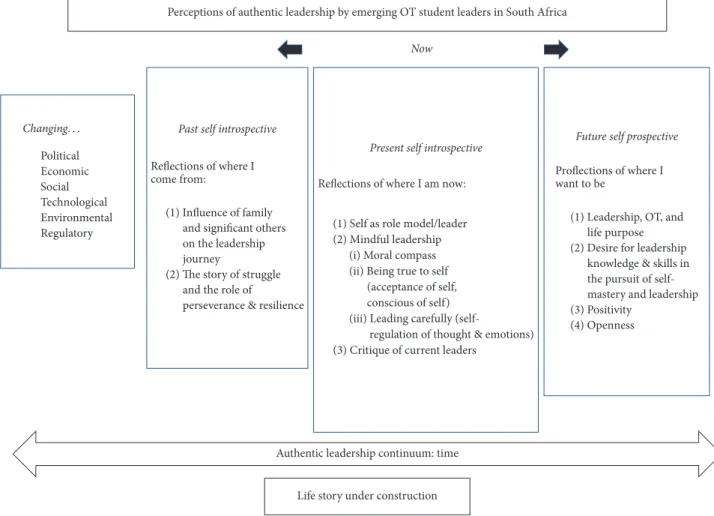
Perceptions of authentic leadership by emerging OT student leaders in South Africa
Present self introspective Reflections of where I am now:
(1) Self as role model/leader (2) Mindful leadership
(i) Moral compass (ii) Being true to self
(acceptance of self, conscious of self) (iii) Leading carefully
(self-regulation of thought & emotions) (3) Critique of current leaders
Future self prospective Proflections of where I want to be
(1) Leadership, OT, and life purpose (2) Desire for leadership
knowledge & skills in the pursuit of self-mastery and leadership (3) Positivity
(4) Openness Past self introspective
Reflections of where I come from:
(1) Influence of family and significant others on the leadership journey
(2) The story of struggle and the role of
perseverance & resilience
Now
Authentic leadership continuum: time
Life story under construction Political Economic Social Technological Environmental Regulatory Changing. . .
Figure 2: Working model of authentic leadership development for South African students.
of (a) perceptions of self as a leader, (b) perceptions of others, specifically current leaders, (c) goals and aspirations for leadership development using camps, and (d) effect of lead-ership on the system.
5. Discussion
A working model of the authentic leadership development model for students (Figure 2) is proposed based on the in-sights garnered from the results.
Preliminary findings from this pilot study indicate that the students are on a leadership continuum, given that they describe themselves retrospectively in terms of their “past self,” such as where they come from; in subthemes like the important role of family and significant others in leadership development; the story of their struggle; and the role of per-severance and resilience in shaping their journeys. Students spent a significant amount of time describing themselves in terms of their “present self,” such as in their reflections on role modeling, mindful leadership, and current leaders. The students “proflected”; that is, they began to consider the thoughts, feelings, and perceptions of their future, linking them to OT, life purpose, leadership, and a desire for lead-ership and self-mastery knowledge and skills, all the while valuing positivity and openness on the journey.
Interestingly, Erikson’s developmental theory [22, 23] is not without its critics, especially in the area of identity formation and gender. Hoare [24] and Archer [25] describe the ages between 13 and 19, extending into the twenties, as the stage of fidelity in terms of identity versus role confusion in answering the questions, “Who am I, and what can I become?” It is characterized by an emerging sense of self through forging past experiences with anticipations of the future state with sufficient time for gaining clarity about val-ues and convictions, exploring the role of leadership central to self-concept, developing self-resolution, and displaying self-expressive behavior with goals that are self-concordant [8].
Through a critical lens, this is where Shamir and Eilam’s [8] proposition of authentic leadership development falters in presenting the notion of the life story as a “narrative” of leadership development. It is perhaps better considered as the life story “question” or “construction” rather than a “narra-tive” because, through a postcolonial lens, issues of contested identities exist [26], which have the potential to be in conflict with the concepts presented by both Shamir and Eilam [8] and Walumbwa et al. [14]: self-concept clarity, self-awareness, and self-knowledge for authentic leadership development. These concepts appear to be singular rather than hybrid or plural in nature. Postcolonial theories [26] present the notion
Occupational Therapy International 7 that identities are multiple and evolving, whereas a
self-concept is a combination of social categories comprising a set of social identities that is part of a collective of inter-woven stories rather than an individual story—which in the South African context is called “Ubuntu.” Ubuntu became prominent in mainstream discourse on race and identity during the transition from Apartheid into democracy and raises two important principles: the human being as being becoming (not static); and the importance of community. Whether Ubuntu can be claimed as the way South Africans experience their lived social realities and its relationships, order, and identities is debatable; however it can be described as a discursive South African social imaginary. Taylor [27] defines social imaginary as “common understanding that makes possible common practices and a widely shared sense of legitimacy.” Ubuntu is important for the discussion of authentic leadership development in the context of the per-sonal narrative of students’ retrospective views of self in the past, introspective views of self in the present, and prospective views into the future shaping identities which are in a fluid state of construction and negotiation. This is consistent with the notion of authenticity of identity as contested at the intersection of racial and professional identities for OT students that was revealed in the narrative interviews.
Ubuntu is an African concept of philosophy according to which no one is self-sufficient, and all are interdependent:
umntu ngumntu ngabantumeans a person is a person because of others. Radically, Bujo [28] argues that an individual cannot be spoken about outside the notion of a community because “the human person in Africa is from the very beginning in a network of relationships that constitute his inalienable dignity,” and that “African ethics does not define the person as self-realization or as ontological act; rather, it describes a person as a process of coming into existence in the reciprocal relatedness of individual and community, where the latter includes not only the deceased but also God” [28].
Hence, the proposed model of authentic leadership
development includes students’ retrospective views of self
in the past, introspective views of self in the present, and
prospectiveviews into the future. These views of leadership are considered aspects of students’ implicit theories of leadership and located within the macro context of the ever-changing social web of political, economic, social, technological, envi-ronmental, and regulatory environments in South Africa.
Within the historical context of a contested description of being “Born Frees” (i.e., born into Democratic South Africa), students face significant challenges from the macro environment in terms of socioeconomic-political struggles, requiring positive psychological capital. Furthermore, the need for positive psychological capital is amplified by the myriad of ethical and moral crises facing leaders today. Students described these challenges as having leaders who are corrupt and self-serving, power hungry, and morally decayed—leaders who lack discipline and respect for the rule of the law and are greedy.
In summary, the potential benefits of the proposed model of authentic leadership development are as follows: (1) leadership development is ongoing, a continuum, from youth till late adulthood; (2) leadership development is located in
particular times and historical contexts that shape leadership, its formation, and expression and is therefore dynamic and responsive; (3) personal storytelling in camps is valuable in deconstructing and reconstructing life stories, individually or collectively, to facilitate leadership growth in self-knowledge, self-awareness, and other elements of mindful leadership; (4) leadership development requires follower development in a mutually symbiotic way, in consideration of the collective; (5) leadership development recognizes life purpose, values, morality, and God as elements of authenticity; (6) leadership development employs a scoring rubric designed for the youth. The insights build a bridge between the conceptual under-standing of authentic leadership and student perceptions of Occupational Therapy student leadership development through camping as a means of OT student leadership capac-ity building. It advocates for retrospective, introspective, and prospective views of leadership on a personal level as an enabler for Occupational Therapy students to engage in their own personal and professional leadership develop-ment through a diversity and inclusion approach of targeted student leadership development.
5.1. Limitations. The qualitative interviews were limited to 12 students from six of the eight universities of South Africa, of whom seven were Black African participants. Participation from all eight OT universities while maintaining the same racial demographics is a consideration for future work.
6. Conclusions
This exploratory pilot study provides insights into the poten-tial for authentic leadership development for OT students based on four categories of authentic leadership: (1) per-ceptions about self as a leader based on personal narrative, self-awareness, self-control, and psychological capital; (2) perceptions about others, specifically current leaders, relating to moral crises, continued inequality, insincerity, greed, and selfishness; (3) goals and aspirations for leadership develop-ment via camps, and (4) the effect of leadership on the system. Although the sample size was relatively small, these findings provide insights into the potential for authentic leadership development and can be a springboard for further elaboration of student leadership development, particularly for emerging Black student leaders in OT. Findings may also contribute to further theory development in regard to students’ own implicit theories of leadership.
Recommendations for future research and practice asso-ciated with authentic student leadership development include (1) the important role of storytelling in shaping leadership development narratives after 1994 for the so-called “Born Frees” as a means of sense-making and dreaming—in search of answers to the questions, “From where? To where?”; (2) the need for specific focused investment in the development of Black OT student leadership and the harnessing of all tools available in the context of the roles that family, educators, and the environment play in shaping leadership development; (3) authentic leadership and authentic leadership development from an African perspective, with particular consideration
for postcolonial theorizing; and (4) enhancing camp expe-riences as a means of youth leadership development in the health professions sector, particularly OT, based on activity participation and experiential learning.
In conclusion, the proposed new model for authentic leadership development for OT students in South Africa has been built on OT students’ perceptions of key issues with current leaders, perceptions about authentic leadership in relation to self, and student goals and aspirations for authentic leadership development via camps. This model can help the OT profession gain more understanding of the leadership development needs of emerging young Black leaders and may assist in theory development related to implicit theories of leadership. For example, as part of a mixed methods study, a survey could be designed to gather additional data on South African OT students’ attitudes and perceptions of Occupational Therapy student leadership—with particular focus on diversity and inclusion. Together with a continued focus on storytelling and qualitative analysis of student narratives, results of the survey could provide insights for the formulation of transformational and leadership skills development plans for the OT profession in South Africa.
Conflicts of Interest
The authors declare that there are no conflicts of interest related to this pilot study.
Acknowledgments
The pilot study was partly funded by the Occupational Ther-apy Association of South Africa (OTASA) and was completed in partial fulfillment of a post-professional doctorate in occu-pational therapy at Thomas Jefferson University in Philadel-phia.
References
[1] OTASA Membership Office, “Membership demographics. In-ternal database,” 2016.
[2] OTASA, “About, mission, vision & values,” 2016, http://www .otasa.org.za/.
[3] Health Professions Council of South Africa (HPCSA), “Student register,” 2016.
[4] OTASA Western Cape National Listening & Dialogue Cam-paign, “Preliminary results: internal report,” 2015.
[5] S. Badat, ‘‘Deciphering the meanings, and explaining the South African higher education student protests of 2015-16,” https://www.ru.ac.za/media/rhodesuniversity/content/uhuru/ documents/Dr%20Saleem%20Badat%20-%20The%20Student% 20Protests%20of%202015-16%20Final%20Draft-10March2016 .pdf.
[6] World Federation of Occupational Therapy, “WFOT congress,” http://www.wfotcongress.org.
[7] B. J. Avolio, F. Luthans, and F. O. Walumbwa,Authentic Lead-ership: Theory Building for Veritable Sustained Performance, The Gallup Leadership Institute, Lincoln, Neb, USA, 2004.
[8] B. Shamir and G. Eilam, “What’s your story? A life- stories ap-proach to authentic leadership development,”The Leadership Quarterly, vol. 16, no. 3, pp. 395–417, 2005.
[9] F. Walumba, B. Avolio, W. Gardner, T. Wernsing, and S. Peter-son,Authentic Leadership: Development and Validation of a The-ory-Based Measure, Management Department Faculty Publica-tions, 2008, http://digitalcommons.unl.edu/managementfacpub/ 24.
[10] B. J. Avolio, W. L. Gardner, F. O. Walumbwa, F. Luthans, and D. R. May, “Unlocking the mask: a look at the process by which authentic leaders impact follower attitudes and behaviors,”The Leadership Quarterly, vol. 15, no. 6, pp. 801–823, 2004. [11] W. L. Gardner, B. J. Avolio, B. J. Avolio, and F. O. Walumbwa,
Authentic Leadership Theory And Practice: Origins, Effects, and Development, W. L. Gardner, B. J. Avolio, B. J. Avolio, and F. O. Walumbwa, Eds., Elsevier, San Diego, Calif, USA, 2005. [12] B. J. Avolio and W. L. Gardner, “Authentic leadership
develop-ment: getting to the root of positive forms of leadership,”The Leadership Quarterly, vol. 16, no. 3, pp. 315–338, 2005. [13] F. Luthans and B. J. Avolio, “Authentic leadership development,”
in Positive Organizational Scholarship, K. S. Cameron, J. E. Dutton, and R. E. Quinn, Eds., pp. 241–258, Berrett-Koehler, San Francisco, Calif, USA, 2003.
[14] F. O. Walumbwa, P. Wang, H. Wang, J. Schaubroeck, and B. J. Avolio, “Retracted: Psychological processes linking authentic leadership to follower behaviors,”The Leadership Quarterly, vol. 21, no. 5, pp. 901–914, 2010.
[15] F. Luthans, C. M. Youssef-Morgan, and B. J. Avolio,Psychological Capital and Beyond, Oxford University Press, New York, NY, USA, 1st edition, 2015.
[16] P. Bazeley and P. Jackson,Qualitative Data Analysis with Nvivo, Sage, Los Angeles, Calif, USA, 2013.
[17] F. Luthans, C. M. Youssef, and B. J. Avolio,Psychological Capital, Oxford University Press, New York, NY, USA, 2007.
[18] D. R. May, A. Y. L. Chan, T. D. Hodges, and B. J. Avolio, “Devel-oping the moral component of authentic leadership,” Organiza-tional Dynamics, vol. 32, no. 3, pp. 247–260, 2003.
[19] A. D. Stajkovic and F. Luthans, “Social cognitive theory and self-efficacy: going beyond traditional motivational and behavioral approaches,”Organizational Dynamics, vol. 26, no. 4, pp. 62–74, 1998.
[20] W. George,Authentic Leadership: Rediscovering The Secrets to Creating Lasting Value, Jossey-Bass, San Francisco, Calif, USA, 2003.
[21] W. L. Gardner, B. J. Avolio, F. Luthans, D. R. May, and F. Wal-umbwa, “Can you see the real me? A self-based model of authentic leader and follower development,” The Leadership Quarterly, vol. 16, no. 3, pp. 343–372, 2005.
[22] R. Stevens,Erik Erikson: An Introduction, St. Martin’s Press, New York, NY, USA, 1983.
[23] E. H. Erikson,The Life Cycle Completed: A Review, W. W. Norton & Co, New York, NY, USA, 1985.
[24] C. H. Hoare,Morality, Ethics, Spirituality, and Prejudice in The Writings of Erik H. Erikson, Psychosocial Press, Madison, Conn, USA, 2000.
[25] S. L. Archer, “Commentary on ‘Feminist perspectives on Erik-son’s theory: their relevance for contemporary identity develop-ment research’,”Identity, vol. 2, no. 3, pp. 267–270, 2002. [26] K. V. Korostelina,Social Identity and Conflict: Structures,
Dy-namics and Implications, Palgrave Macmillan, New York, NY, USA, 2007.
Occupational Therapy International 9
[27] B. Taylor,Modern Social Imagineries, Duke University Press, North Carolina, NC, USA, 2003.
[28] B. Bujo,Foundations of an African Ethic: Beyond The Univer-sal Claims of Western Morality, Pauline’s Publications Africa, Kenya, 2003.
Stem Cells
International
Hindawi www.hindawi.com Volume 2018 Hindawi www.hindawi.com Volume 2018 INFLAMMATIONEndocrinology
International Journal of Hindawi www.hindawi.com Volume 2018 Hindawi www.hindawi.com Volume 2018Disease Markers
Hindawi www.hindawi.com Volume 2018 BioMed Research InternationalOncology
Journal of Hindawi www.hindawi.com Volume 2013 Hindawi www.hindawi.com Volume 2018Oxidative Medicine and Cellular Longevity
Hindawi
www.hindawi.com Volume 2018
PPAR Research
Hindawi Publishing Corporation
http://www.hindawi.com Volume 2013 Hindawi www.hindawi.com
The Scientific
World Journal
Volume 2018 Immunology Research Hindawi www.hindawi.com Volume 2018 Journal ofObesity
Journal of Hindawi www.hindawi.com Volume 2018 Hindawi www.hindawi.com Volume 2018 Computational and Mathematical Methods in Medicine Hindawi www.hindawi.com Volume 2018Behavioural
Neurology
Ophthalmology
Journal of Hindawi www.hindawi.com Volume 2018Diabetes Research
Journal of Hindawiwww.hindawi.com Volume 2018
Hindawi
www.hindawi.com Volume 2018
Research and Treatment
AIDS
Hindawi
www.hindawi.com Volume 2018
Gastroenterology Research and Practice
Hindawi www.hindawi.com Volume 2018