by
THABSILE MARGARET BHEMBE
submitted in accordance with the requirements for the degree of
MASTER OF ARTS
in the subject
HEALTH STUDIES
at the
UNIVERSITY OF SOUTH AFRICA
SUPERVISOR: PROF LIZETH ROETS
DECLARATION
I declare that the CHALLENGES FACED BY NURSE EDUCATORS IN TEACHING
RESEARCH TO UNDERGRADUATE NURSING STUDENTS is my own work and that the sources that I have used or quoted have been indicated and acknowledged by means of complete references.
November 2014
SIGNATURE DATE
UNDERGRADUATE NURSING STUDENTS
STUDENT NUMBER: 34724273
STUDENT NAME: THABSILE MARGARET BHEMBE
DEGREE: MASTERS OF ARTS
DEPARTMENT: HEALTH STUDIES
SUPERVISOR: PROF L ROETS
ABSTRACT
The aim of nursing practice is to provide evidence-based care that ensures quality outcomes for patients, families, healthcare providers and the health care system. This may only occur with increased exposure to nursing research. Nursing education institutions should therefore ensure that students are prepared to provide evidence-based care by participating in and conducting research.
The purpose of the study is to explore and describe the challenges faced by nurse educators in teaching research methodology and supervising undergraduate nursing students at a university in order to make recommendations to support nurse educators in teaching research and supervising research projects. Qualitative, explorative, contextual and descriptive research was conducted to explore and describe the challenges experienced by nurse educators. Data were collected through a focus group discussion. Nine nurse educators participated in the research study.
Participants acknowledged that they faced challenges in teaching research
methodology and supervising research projects. The challenges described pertained to
human resources; research experience, competencies and guidelines; physical resources; and a lack of support from their institution’s management.
Based on the challenges, recommendations were made to address the lack of specific competencies, research guidelines, student/educator ratios, physical resources and technology issues.
KEY CONCEPTS
I would like to acknowledge the comprehensive tutorial guidance and experience of my supervisor, Professor Lizeth Roets at UNISA who kept me focused and well informed, ensuring me of an interesting learning experience and guidance throughout the research process.
I would also like to pass my gratitude on to the Southern Africa Nazarene
University for granting me permission to conduct the study, for their contributions and the information they provided during the study.
Thank you to the participants for sharing their experiences of teaching research
to undergraduate nursing students with me and trusting me with the information they provided. This made it possible for me to explore their challenges in research and develop the strategies to meet those challenges.
I thank my family: husband, Daniel Bhembe; children Ntokozo, Siboniso,
Siphosethu, Nomfundo; and all the other members of my family for giving me support and encouragement to realise my dream.
May I thank the Almighty God for granting me the opportunity, time, life, health
TABLE OF CONTENTS
CHAPTER 1
ORIENTATION OF THE STUDY
1.1 INTRODUCTION ... 1
1.2 BACKGROUND TO THE PROBLEM ... 1
1.3 PROBLEM STATEMENT ... 3
1.4 PURPOSE OF THE STUDY ... 4
1.5 OBJECTIVES OF THE STUDY ... 4
1.6 DEFINITION OF KEY CONCEPTS ... 4
1.7 METHODOLOGY ... 5
1.7.1 Study design ... 5
1.7.2 Population ... 6
1.7.3 Unit of analysis ... 6
1.8 DATA COLLECTION INSTRUMENTS ... 6
1.8.1 Trustworthiness ... 7
1.8.2 Data analysis ... 7
1.8.3 Ethical considerations ... 7
1.9 SIGNIFICANCE OF THE STUDY ... 7
1.10 CONCLUSION ... 8
1.11 OUTLINE OF THE DISSERTATION OF LIMITED SCOPE ... 8
CHAPTER 2
RESEARCH DESIGN AND METHODOLOGY
2.1 INTRODUCTION ... 10 2.2 RESEARCH DESIGN ... 10 2.2.1 Explorative ... 11 2.2.2 Descriptive ... 11 2.2.3 Contextual ... 11 2.3 RESEARCH SETTING ... 112.4.1 Population ... 12
2.4.2 Sampling (unit of analysis) ... 12
2.5 ENTRY INTO THE FIELD ... 13
2.6 DATA COLLECTION ... 13
2.6.1 Data collection instrument ... 13
2.6.2 The facilitator ... 15
2.6.3 Exploratory interview ... 16
2.6.4 Findings of exploratory interview ... 17
2.6.5 The focus group ... 18
2.6.6 The focus group discussion ... 19
2.6.6.1 Food ... 20 2.6.6.2 Mood ... 20 2.6.6.3 Introduction ... 20 2.6.7 Questions asked ... 21 2.7 TRUSTWORTHINESS ... 22 2.7.1 Credibility ... 22 2.7.2 Dependabilty ... 23 2.7.3 Confirmability ... 23 2.7.4 Transferability ... 23 2.8 ETHICAL CONSIDERATIONS ... 24 2.8.1 Beneficence ... 24 2.8.2 Privacy ... 24
2.8.3 Respect individual autonomy ... 24
2.8.4 Justice... 25 2.8.5 Permission ... 25 2.8.6 Consent ... 25 2.8.7 Confidentiality ... 25 2.8.8 Post-research relationships ... 26 2.9 DATA ANALYSIS ... 26 2.10 CONCLUSION ... 27
CHAPTER 3
DATA PRESENTATION, ANALYSIS, INTERPRETATION AND LITERATURE CONTROL
3.1 INTRODUCTION ... 283.2 BIOGRAPHICAL DATA ... 34
3.3 CHALLENGES FACED BY NURSE EDUCATORS ... 34
3.3.1 Human resources ... 35
3.3.1.2 Not enourgh IT personnel ... 36
3.3.1.3 Too few librarians ... 37
3.3.1.4 Language and technical editors ... 39
3.3.2 Physical resources ... 39
3.3.2.1 Library problems ... 40
3.3.2.2 Inadequate books/literature/journals ... 41
3.3.3 Research skills and competences ... 44
3.3.3.1 Experienced supervisors ... 44
3.3.3.2 Lack of research guidelines ... 46
3.3.3.3 Diverse educational backgrounds ... 47
3.3.4 Policies ... 48
3.3.4.1 Ethics committee matters ... 49
3.3.4.2 Time limitations ... 51
3.3.5 Student perceptions of research ... 52
3.3.5.1 Attitudes of students ... 52 3.3.6 University management ... 54 3.3.6.1 Affective support ... 55 3.3.6.2 Financial support ... 56 3.4 CONCLUSION ... 57
CHAPTER 4
CONCLUSIONS, RECOMMENDATIONS AND LIMITATIONS
4.1 INTRODUCTION ... 584.2 CONCLUSIONS ... 58
4.2.1 Human resources ... .58
4.2.2 Physical resources ... 60
4.2.3 Research skills and competencies... 60
4.2.4 Policies ... 61
4.2.5 Students’ perceptions of research ... 63
4.2.6 University management ... 63
4.3 RECOMMENDATIONS RELATED TO FURTHER RESEARCH ... 65
4.4 LIMITATIONS OF THE STUDY ... 65
4.5 CONCLUDING REMARKS ... 66
LIST OF TABLES
LIST OF ANNEXURES
ANNEXURE AETHICAL CLEARANCE CERTIFICATE: HEALTH STUDIES HIGHER DEGREES
COMMITTEE ... 77 ANNEXURE B
REQUEST FOR AUTHORISATION TO CONDUCT A RESEARCH STUDY ... 78 ANNEXURE C
APPROVAL FROM SOUTHERN AFRICA NAZARENE UNIVERSITY ... 80 ANNEXURE D
REQUEST FOR PERMISSION TO CONDUCT A RESEARCH STUDY ... 81 ANNEXURE E
CONSENT FORM ... 83 ANNEXURE F
INTERVIEW GUIDE FOR FOCUS ... 85 ANNEXURE G
LIST OF ACRONYMS AND ABBREVIATIONS
AACN American Association of College of NursingCCNE Commission on Collegiate Nursing Education IT Information Technology
SANU Southern Africa Nazarene University SNC Swaziland Nursing Council
CHAPTER 1
OVERVIEW OF THE STUDY
1.1 INTRODUCTION
Mellish, Brink and Paton (2009:324) state that “research is essential for the development of a unique scientific body of knowledge, the hallmark of a profession, and should be utilised to provide the basis for professional theory and practice. No profession can adequately improve control over, or evaluate its practice, without research, nor can an education system advance without research”. Therefore, research must be accepted as an integral part of nursing practice, education and administration. Research-mindedness should be fostered in nurses right from the beginning of their training (Mellish et al 2009:324).
Nurse educators play a pivotal role in strengthening the nursing workforce, serving as models and providing the leadership needed to implement evidence-based practice. They are also critical role players in ensuring quality educational experiences that prepare the nursing workforce for a diverse, ever-changing health care environment that is based on research (Coe 2012:1). Nursing students should also be prepared to deal with extraordinary complex client’s health issues (Kurtz, Lemley & Alverson 2010:38).
In order to encourage or cultivate a research culture in the learner and to develop competency in research, the educator needs to be clear on the nature of research and be able to teach students how to understand, evaluate and apply research (Mellish et al 2009:324). The nurse educator should be able to delineate research activities at different educational levels, incorporate research findings into lectures and engage in research or related activities as part of their professional role (Brew & Jewell 2012:47).
1.2 BACKGROUND TO THE PROBLEM
‘Nursing research’ is defined as knowledge that will directly and indirectly influence
nursing practices (Burns & Grove 2009:3). Nursing research guides nursing practice by
evidence-based care that ensures quality outcomes for patients, families, healthcare providers and the health care system. This may only occur with increased exposure to nursing research. Nurse educators should therefore ensure that students are prepared to provide evidence-based care by participating in and conducting research.
All degree nursing programmes include research as part of the curricula and thus an expected outcome of the programme (American Association of Colleges of Nursing 2006:5). In some institutions it is now also expected from diploma-prepared nurses to participate in research activities, ensure that ethical guidelines are followed, implement recommendations from research findings for improvement, share research findings with research authorities and implement research findings for improvement of care (Swaziland Nursing Council 2010b:26).
The objective of the Swaziland Nursing Strategy (Swaziland Ministry of Health 2013:16) is to improve nursing services based on results of research conducted at service stations and education stations, creating a culture of research. As a result, one college has been upgraded to a university to produce a degree nursing programme that includes a research component. Another college had to include research in the curriculum as it now has to train diploma-prepared nurses with research competencies (Good Shepherd Nursing College 2011:2). However, the level of research skills and experience among the nurse educators will have an influence on the research culture that is passed on to the future nurses. Nurse educators need to develop and teach research curricula.
Up until recently it was only the University of Swaziland that offered research theory and taught students to conduct research in Swaziland. However, it is now expected from all the diploma and degree nursing students (undergraduate students) to be able to apply the principles of drafting a research proposal, implementing the research and writing a scientific report (Mellish et al 2009:334). Application and synthesis are the cognitive functions required of the student when doing research; not only memorising. To contribute to the research culture in Swaziland and to the nursing profession, the curricula of all nursing students in Swaziland should include research, but the educators need to be supported to achieve this.
In Swaziland Nazarene Nursing College was responsible for producing diploma nursing students, but it has since been changed to the Southern Africa Nazarene University (SANU) that now offers a degree nursing programme. Good Shepherd Nursing School which was offering a Certificate in Nursing Assistant Programme will now have to offer a diploma programme that will include research methodology and research skills as part of the programme.
Research training will assist the nurses when providing evidence-based practice. The same nurse educators who were teaching the diploma nursing students and the nursing assistants respectively are now expected to teach research and supervise research projects to the degree nursing students and the students of the new diploma nursing programme. If the majority of these nurse educators, working at the university and
college do not have Master’s degrees or were not trained in research, this change can
contribute to numerous challenges. These challenges should be identified and addressed.
1.3 PROBLEM STATEMENT
The Southern Africa Nazarene University was responsible for offering the diploma nursing programme in Swaziland, while the Good Shepherd Nursing College was responsible for offering a certificate in nursing assistant programme. These same nurse educators of the above mentioned programmes are now expected to teach research methodology to degree nurses and diploma nurses respectively.
According to these nurse educators, they do not have a research background, but it will be expected of them to teach research, supervise students in preparing research proposals and contribute to the research culture in the institutions. They also need to develop a curriculum with research methodology as part of the requirements for the degree and diploma nursing programmes in Swaziland. Since the nurse educators do not have research skills, but are expected to teach research, it might be a challenge for them.
This study, therefore, seeks to identify and describe challenges faced by nurse educators at the participating nursing education institution to teach aspects of research to undergraduate student nurses in order to write recommendations to support them.
1.4 PURPOSE OF THE STUDY
The purpose of the study is to explore and describe the challenges faced by the nurse educators in teaching research methodology and supervising students at a selected university in order to make recommendations to support them in these tasks.
1.5 OBJECTIVES OF THE STUDY
The objectives of the study are to describe
challenges that are faced by nurse educators when teaching research
methodology
recommendations on how nurse educators can be supported to teach research
and supervise degree and diploma nursing students with research projects
1.6 DEFINITION OF KEY CONCEPTS
Nurse educator
A nurse educator is a registered nurse with a diploma or certificate in nursing education (South Africa 1987).
Nursing education
Nursing education is a process whereby students are guided, assisted and provided with means that enable them to learn the art of nursing so that they can apply it to the nursing care of people who need such care (Mellish et al 2009:71).
Nursing research
‘Nursing research’ can be defined as a systemic inquiry designed to develop knowledge about issues of importance to the nursing profession (Polit & Beck 2012:736).
1.7 METHODOLOGY
A qualitative research method is used in this study. Qualitative research is a systematic, interactive and subjective approach used to describe experiences and give them meaning (Burns & Grove 2009:717). The researcher explores and describes challenges experienced by nurse educators at the university and recommends strategies to support them in teaching research and supervising research projects.
1.7.1 Study design
The study design is a specific plan of the actions that is developed and implemented by a researcher to conduct a research study in order to exploit the control factors that should be taken into consideration to ensure the quality of the research findings (Burns & Grove 2009:236). The researcher uses a qualitative, explorative, descriptive and contextual design in this study.
Explorative
Exploratory research investigates the full nature of the phenomenon, the manner in which it is manifested and the other factors to which it is related (Polit & Beck 2012:18). The study is explorative because it explores the challenges faced by nurse educators in teaching research at the university and college in order to formulate strategies to address the identified challenges.
Descriptive
Descriptive design is designated when more information about individuals within a particular field of study needs to be expanded (Burns & Grove 2009:237). The study is descriptive because it was intended to describe the challenges faced by nurse educators when teaching research at the university and the college.
Contextual
The study is contextual because it aims to study the challenges faced by nurse educators when teaching research to degree and diploma nursing students within the context of the university and college in Swaziland.
1.7.2 Population
The target population refers to a particular kind of individual or component who is the centre of the research (Burns & Grove 2009:343). The population for this study is all nurse educators working at the selected university and college. The university was selected because it was upgraded from being a college to a university. The same nursing educators who were teaching diploma nursing students are now expected to teach and supervise research projects for the degree nursing students. The college was selected because it was also upgraded to deliver diploma nursing programme from the nursing assistant programme. Nurse educators need to be supported as they are expected to teach research methodology and supervise research projects to diploma nursing students at the college.
1.7.3 Unit of analysis
According to Burns and Grove (2009:343), sampling involves selecting a group of people, events, behaviours or other elements with which to conduct a study. All nurse educators, through the vice chancellor of the university and the principal of the college, were asked to volunteer to participate in the study because they all supervise students for their research projects and/or teach research methodology to students.
1.8 DATA COLLECTION INSTRUMENTS
A focus group discussion was conducted to collect data for the study. Focus group discussions are a method of qualitative data collection in which data is gathered through
group interaction on a chosen topic (Doody, Slevin & Taggart 2013:266). A discussion
guide was used during the focus group to ensure that the challenges were discussed, but the group members also elaborated on possible recommendations to support them.
1.8.1 Trustworthiness
Polit and Beck (2012:745) define ‘trustworthiness’ as the degree of confidence
qualitative researchers have in the data that they have obtained, using the criteria of credibility, transferability, dependability and confirmability. These aspects will be discussed in detail in chapter 2 in the methodology (see page 22-23).
1.8.2 Data analysis
Every respondent in the focus group is understood to have their own views and perspectives of the challenges they experience and the researcher was therefore able to describe the range of diversity in analysing the qualitative data (Bless, Higson-Smith & Sithole 2013:338). The researcher applied the qualitative analysis of texts and words
during the study and defined ‘qualitative analyses as the organisation and interpretation
of the narrative data. The narrative data was analysed and interpreted to discover underlying themes, categories and patterns of relationships regarding the challenges (Polit & Beck 2012:739).
1.8.3 Ethical considerations
Ethics approval was obtained from the Research Ethics Committee of the Department of Health Studies, University of South Africa and the Vice Chancellor of the Southern Africa Nazarene, but the Principal of the Nursing College refused consent (further detail is described on page 11). Informed consent was obtained from all volunteers who participated in the focus group discussion.
1.9 SIGNIFICANCE OF THE STUDY
The significance of the study lies in making recommendations on strategies to support the nurse educators in teaching and supervising research and to make them more equipped and knowledgeable about research and research supervision.
The university and the college would benefit in terms of applying the research recommendations that educators will have gathered during the research study. The findings would also contribute to the improvement of a research culture at the university
and the college. In addition, the nursing environment in the Manzini and Lubombo Region could be improved significantly by the application of research skills.
The researcher will gain a lot from this study because it will open up a field where various ideas on nursing research are explored. She will also obtain knowledge and skills on how to conduct research and write a scientific research report.
It is also hoped that the outcome would inspire other researchers in nursing education to take an interest in the topic, especially in Swaziland where such studies had not been carried out yet. The findings can also contribute to the improvement of the culture of research in the nursing profession if the nurse educators become competent researchers and supervisors.
1.10 CONCLUSION
This research study reveals the challenges faced by nurse educators at a university and college in teaching and supervising students’ research projects. The majority of the nurse educators at the university and college in question did not have a research background and yet they were expected to teach research to degree and diploma nursing students. In addition, they were also required to develop a curriculum that included research methodology. Supervision and guidance in their students’ research projects were also part of their duties. This study outlines the different ways that nurse educators want to be supported to improve in teaching and supervising research projects.
1.11 OUTLINE OF THE DISSERTATION OF LIMITED SCOPE
Chapter 1 is an orientation of the study and includes the research problem, purpose, objectives and research questions, definition of the main concepts as well as a short overview of the methodology.
Chapter 2 forms a description of the methodology that was followed to conduct this study in a scientific and ethical manner.
Chapter 3 reflects the data analysis, data interpretation as well as the literature control of the study.
Chapter 4 is a description of the conclusions and recommendations of this research study.
CHAPTER 2
RESEARCH DESIGN AND METHODOLOGY
2.1 INTRODUCTION
This chapter describes the research design and methodology that were utilised to identify and describe the challenges encountered by nurse educators when teaching research to undergraduate nursing students at a university.
The geographical area and the context in which the study was conducted the population, sample, and data gathering technique as well as the credibility,
dependability, confirmability and transferability of the data are described. The ethical
principles that were adhered to are also covered.
2.2 RESEARCH DESIGN
A qualitative research design was utilised in this study. Qualitative researchers are interested in understanding the meaning people have constructed, that is, how people make sense of their world and the experiences that they have in the world (Merriam 2009:13). In order to identify and describe the challenges faced by the nurse educators at the selected university, the researcher employed a qualitative research methodology as it was most suitable for describing the real-life experiences of the participants involved.
The research was conducted in a natural setting of the university where the participants were employed. The focus group interview or data collection was done at the site where the participants experienced the problem under study as advised by De Vos, Strydom, Fouché and Delport (2011:65).
A qualitative, explorative, descriptive and contextual design was considered appropriate for this study.
2.2.1 Explorative
The study was explorative in nature. Exploratory research implies an investigation into the full nature of a phenomenon, the manner in which it is manifested and the other factors to which it is related (Polit & Beck 2012:18). This study was explorative because it explored the challenges faced by nurse educators in teaching research to undergraduate nursing students and supervising their research projects.
2.2.2 Descriptive
The study was also descriptive as it was intended to gain more information about characteristics within a particular field of study (Burns & Grove 2009:237). In this case the challenges faced by nurse educators in teaching research within the study context were described.
2.2.3 Contextual
The context of this study was nurse educators teaching research to undergraduate nursing students and the research supervision of their required research projects in a specific university where a graduate nursing programme was offered for the first time. The participants were educators at the university where research was introduced to
their undergraduate students within the past two years since the start of the degree
programme.
2.3 RESEARCH SETTING
As described in chapter 1, the intention was to obtain permission to gather data from a university as well as a college of nursing in Swaziland. The study ended up being conducted only at a university, which is situated in Manzini. Despite concerted efforts the nursing college’s management did not grant permission for this study to be conducted at their site.
Neither the research proposal and the ethics approval letters nor a full explanation and motivation letter from the supervisor could convince the management about the importance of the research in their context. The study results could have been used to
their benefit in supporting the lecturers who do not have a research background but are expected to teach research. The head and chair of the Nursing College were of the opinion that they would not benefit from the research and that the researcher would gain no appropriate data from the lecturers working in the college since they do not have a research background.
The reasons stated above explains why only the one institution, the university, was used for data gathering. The University started operating in 1956 as a nursing college and is the only college that was “upgraded” in 2012 to become a University and offer a degree programme in nursing. It previously only offered a Diploma in General Nursing (SANU 2011:3).
2.4 STUDY POPULATION AND SAMPLE
2.4.1 Population
The target population of a study refers to particular types of individuals or elements who are the focus of the intended research and from whom data can be obtained (Burns & Grove 2009:343). The population of this study comprised all nurse educators who were working at the university, lecturing research to undergraduate nursing students or supervising their research projects. Ten nurse educators were involved in nursing research education at the time of data gathering and formed the population of the study.
2.4.2 Sampling (unit of analysis)
According to Burns and Grove (2009:343), sampling refers to the selection of a group of people, events, behaviours or any other element with which to conduct a study. No sampling was done as all the nurse educators were asked to volunteer to participate in the study because the number of the nurse educators was only ten. Ten participants proved enough to conduct a trustworthy focus group to gather data within this context. Generalisation was not the intent of the study. Rather the intent was to ensure that the findings might be transferred to similar context. The researcher, as the facilitator, ensured that the questions were exhausted so that all available and rich data could be analysed and interpreted.
2.5 ENTRY INTO THE FIELD
The researcher obtained ethics approval from the Research Ethics Committee of the Department of Health Studies before conducting the study. Thereafter permission from the vice chancellor of the university was sought and granted. All ten nurse educators at the university received information letters regarding the research study and they were invited to participate voluntarily. The volunteers were then asked to make their contact details available to the researcher so that a convenient time and venue could be arranged to conduct the focus group. The volunteering participants indicated that the most suitable and convenient day for them was a Wednesday, from 12 pm to 2 pm.
The researcher promised to remind the participants about the date and time to confirm the appointment. Two days before the date of the appointment, participants were reminded about the appointment and it was confirmed. They all promised to attend the discussion. On the day of the appointment nine participants attended and one formally apologised for not being able to attend.
2.6 DATA COLLECTION
Mouton (2011:123) recommends that researchers must give a clear description of the data collection process, how they gain access to the participants, how data was collected and what procedures were used.
2.6.1 Data collection instrument
The researcher chose a focus group discussion as the method for collecting the data. A focus group discussion consists of a group of people, eight to twelve, with a similar background or experiences, brought together to discuss a specific topic of interest (Shaha, Wenzel & Hill 2011:78; Doody et al 2013:266). The discussion was lead by a trained facilitator (the researcher) who guided and helped the group to participate freely and without negative implications for them.
The focus group discussion was chosen due to the specific advantages of focus group discussions as indicated by various authors (Babbie & Mouton 2007:292; Shaha et al
2011:78). The advantages as explained by Shaha et al (2011:78) prompted the researcher to use focus groups to gather the data from the participants:
The focus group was not intimidating for the interviewees and less time intensive for the researcher than would have been the case in one-on-one interviews. The focus group took two hours, while individual interviews with the ten participants might have taken more than 20 hours. The verbatim transcription of a single two-hour interview is also ultimately much less time-consuming than that of ten separate interviews. All nine participants were interviewed within two hours, but the interaction and the probing between the participants contributed to the richness of the data. The verbatim transcription, however, took sixteen hours.
The in-depth discussions and answers that were raised in the focus group made
for richer data than would have been possible through questionnaires. The interaction and discussion between participants that followed on the questions contributed to more and richer data, because the comment from one participant ensured a reaction or comment from another participant.
Participants were valued as experts because of the experience and information
needed in the research study. The researcher acknowledged the nurse educators as experts because they had their own experiences in teaching research methodology and supervising research projects to nursing students and they described the challenges and suggested strategies to assist them to improve their teaching and research skills.
In focus group discussions participants tend to be less inhibited than in an
individual interview. During the discussion participants were all free to contribute and brought all their individual ideas, which contributed to a lively discussion. The facilitator managed the discussion very well and even those who were quiet were easily observed by the facilitator and were encouraged to become involved in the discussion, which would not have been possible with questionnaires. Participants can forget to return or complete questionnaires, but in a focus group everybody participates and gives their input in a controlled environment.
There are also disadvantages of focus group discussions and the researcher was aware of that. These disadvantages were managed as follows:
To avoid bias, which could be due to the interview setting, the facilitator, faulty questions and an unrepresentative sampling (De Vos et al 2011:373), the researcher chose a venue that was identified by the participants themselves. The participants were familiar with the venue because it was the conference room at
the university where they are lecturers. The seating arrangement was a “u”
shape that enabled the facilitator to observe every participant throughout the discussion and to ensure eye contact between the participants and the facilitator.
Questions were tested through an exploratory interview (see 2.6.3) to ensure that
the questions will provide answers in line with the research purpose. The researcher was trained by the supervisor on how to conduct the focus group discussions and how to ask questions and probe further during the discussion.
Unrepresentativeness in sampling can sometimes be a limitation. In this study all
the nurse educators were asked to volunteer to participate, thus no sampling was done.
Another disadvantage can be that a focus group can be expensive. Costs may
include gifts and gratuities for the participants as well as moderator fees, refreshments and travel expenses. The researcher underwent facilitator training
at the University of South Africa where she is registered for a Master’s degree.
Only once she was found competent was she allowed to conduct the pilot study. The facilitation fees were therefore excluded and the researcher provided only a few refreshments after the discussion. No travelling costs were involved as the discussion took place in a venue at the university and this was the participant’s place of work.
2.6.2 The facilitator
The quality and the expertise of the facilitator of the focus group play a very important role in trustworthiness of the data that is gathered. Therefore, the selected facilitator should be trained (De Vos et al 2011:367). The researcher was trained as facilitator for this study, as required. After training the researcher was allowed to conduct an exploratory interview by testing her skills with a similar group of participants. An expert facilitator and focus group expert assessed the competency of the researcher as facilitator and agreed that she could continue with data gathering. De Vos et al (2011:367) revealed that the facilitator is required to possess essential skills such as
communication and group facilitating skills. The facilitator must also be welcoming, a good listener, familiar with group processes, has an interest in the topic and participants and a sense of humour.
No one else was available and trained on facilitation of the focus group discussion as a result the researcher facilitated the focus group. The facilitator was unknown to the participants and trustworthiness of the data was enhanced. The researcher is a professional nurse and has the appropriate communication skills to engage with individuals as well as groups.
2.6.3 Exploratory interview
An exploratory focus group interview was conducted (see 2.6.4) to ensure that the
facilitator is trustworthy and the data is of good quality and appropriate to address the aim of the study will be gathered. The purpose was not only to ensure that the facilitator adhered to the requirements of being a good facilitator but also to test whether the correct questions were asked. The two questions tested were:
1. Please describe the challenges that you are facing when you need to teach
research methodology to nursing students or when you have to supervise them when conducting their research projects.
2. Please describe any idea or suggestion (recommendations) on what can be done
to support you to teach students research methodology or supervise them on their research projects.
After receiving training to conduct a focus group interview, the facilitator conducted an exploratory interview with volunteer lectures from another university. After the exploratory interview was conducted, the researcher and the supervisor were satisfied that the research questions were clear, that the technique was appropriate and that the data would be gathered in a trustworthy way. The researcher was then granted permission by the supervisor to start with data gathering.
2.6.4 Findings of exploratory interview
Pre-testing of the instrument is the procedure of testing and validating an instrument by administering it to a small group of participants from the intended test population
(Barker 2003:339). Those who participate in the pilot study (exploratory interview)
should not participate in the main research study (Grinnell & Unrau 2008:179).
On 18 July 2014 the researcher conducted an exploratory focus group interview. The
group consisted of six respondents who are colleagues of the researcher. The aim of the pre-testing was to help bring out the weaknesses of the focus group discussion as a data collection technique and then inform the researcher of what to improve on when conducting the actual focus group discussion.
When the researcher started the focus group discussion, there was a lot of noise coming from people outside the room where there was a group discussion. The noise clouded the introductory remarks of the researcher making it difficult to hear. There are also echoes within the room as deliberations unfolded. These echoes could have resulted from the use of a large room with few participants. The choice of the venue for holding discussions was therefore inappropriate. When doing the actual study the focus group discussion was conducted in a venue that was more suitable for the number of participants. The researcher sought to use the board room at the university. It was also well ventilated, had adequate lighting and was isolated from lecture rooms where noise may have been heard.
An information letter was given to all the participants before commencement of the exploratory interview and the researcher decided to leave out some critical information during the introduction. Because this information was not verbally communicated, the participants asked the researcher to clarify a number of issues relating to the study. Participants required clarification on consent forms, the researcher’s university, the purpose of the topic and how the study would benefit them and their institution. When conducting the actual study, the researcher made sure to read the information to the participants and also gave them a written copy.
The researcher did not lay ground rules with the participants before going into the core discussion. This resulted in one participant dominating the discussion while the rest
contributed once or twice only. The size of the group could have also contributed to the dominance of the discussions by one participant as alluded to by Musingafi and Hlatjwayo (2012:110). According to them smaller groups are too easily dominated by one or two members. In the actual study the researcher engaged a group of nine participants and laid ground rules that pertain to participation in order to ensure that all participants contributed and shared their views.
Some respondents in the pilot study spoke softly, leading to difficulties in hearing what they were saying on the tape recording. The facilitator encouraged participants to be loud enough when speaking and provided a microphone in the middle of the table during the data gathering for the actual study.
The researcher’s first question was phrased in the following manner: “Can you please describe the challenges you faced when you are teaching research methodology to nursing students and supervising their research projects?” The responses given were valid and yet mixed up because the question required description of challenges experienced on two aspects related to research. In the actual study the researcher split the question into two so that the challenges specific to the teaching aspect and the research supervision aspect were be kept separate.
The questions that were asked in the actual study were: “Can you please describe the
challenges you face when you are teaching research methodology to nursing students?” and “Please describe the challenges you face when supervising nursing students research projects”.
2.6.5 The focus group
Preparation of the room
Focus group discussions should be conducted in a venue that is convenient,
comfortable and non-threatening (De Vos et al 2011:370). The focus group discussion
was conducted at the university. The venue was a boardroom and it was proposed by the participants due to convenience and the fact that the venue was familiar and therefore an unthreatening environment.
The researcher’s assistant sat in the corner where he was taking notes. The room had
an air-conditioner, which ensured that the room temperature was to the participants’
liking. The choice of the venue was appropriate and ideal for a focus group discussion because as (De Vos et al 2005:309) suggested it was conducted in a comfortable, non- threatening setting. The comfort of the participants was regarded as a pre-requisite to the data collection process since discussions would last for more than an hour. The absence of any of the educators’ supervisors or persons in management contributed to creating a non-threatening environment.
A table with two tape recorders was set right at the corner of the room so that it would not be consistently in sight of all the participants. The tapes were operated by the trained observer - the researcher’s assistant - who took the field notes during the interview. One tape recorder was battery operated and another one was electrically operated. They were running simultaneously in case of mechanical or electrical failure to ensure that no data would be lost.
2.6.6 The focus group discussion
On the set date and time (28 July 2014 at 12:00) the focus group discussion was conducted. Unfortunately only nine of the ten participants attended. One participant was unable to attend due to personal circumstances. The researcher greeted all the participants and introduced herself and the observer who would be taking field notes during the discussion. The researcher asked all the participants to take a chair anywhere around the table. When all were seated, the discussion officially started.
Participants were thanked for their time and honoring the invitation to participate. The facilitator again explained the purpose of the study and the content of the consent letter to all the participants to ensure that they give informed written consent. It was again emphasised that they could withdraw if they did not want to participate.
They were made aware of the tape recorder and the importance of tape recording was explained to them. Participants were assured of confidentiality and that it would be maintained. The information gathered and comments made during the discussion would not be linked to anyone who participated in the study. It is only the supervisor and the
researcher who would have access to the tape recorder and it would be kept in a safe, locked place. They were then asked to sign the consent forms.
The researcher set the ground rules for the session with the participants and came to an agreement that during the discussion only one person would talk at a time and that they would respect each other. All participants would have an equal opportunity to participate in the discussion and should feel free to raise his/her opinion. Participants were encouraged to express themselves without fear that their ideas would be criticized. They were encouraged to ask any question if they were not clear before the discussion commenced.
2.6.6.1 Food
Participants were provided with bottled water during the discussion and treated with a snack at the end of the discussion. This is supported by (De Vos et al 2005:309) who state that when conducting focus group discussions, no matter what the location, always consider providing food, since eating together tends to promote conversation and communication within the group.
2.6.6.2 Mood
Participants were in a friendly mood. The researcher had an informal talk with them just before the formal discussion started in order to create a positive and warm relationship as well as a positive attitude. This is essential for the success of the discussion. Informal talking is supported by De Vos et al (2005:310) who argue that small talk is essential prior to a focus group discussion to enhance the creation of a warm and friendly environment that will put participants at ease.
2.6.6.3 Introduction
The researcher opened the discussion by introducing herself to participants and thanking them for participating in the study. All participants were then asked to introduce themselves. The researcher introduced the observer and explained the assistant would be managing the tape recorders and asked the participants to be audible for tap recording purposes.
The researcher outlined the purpose of the study and that the information gathered from them would be kept confidential. Participants were encouraged to be free when making deliberations during the discussion. She requested them to feel free to participate and raise any issue or comment relating to the study purpose. The researcher told them that they reserved the right to withdraw from the discussion at any point if they felt like it, without any coercion or penalties. Participants were given consent forms, which they read and signed.
The introductions were conducted according to the required standard as already described and is supported by (De Vos et al 2005:310). The discussion went smoothly and the facilitator was focused on the key elements of the study. The participants were involved and everyone contributed. Those who were quiet in the beginning were invited to share their ideas with the entire group and they then did so.
2.6.7 Questions asked
The following questions were asked during the interview:
1. Please describe the challenges that you are facing when you need to teach
research methodology to nursing students.
2. Please describe the challenges that you are facing when you have to supervise
them when conducting their research projects.
3. Please describe any idea or suggestion on what can be done to support you in
teaching students research methodology.
4. Please describe any idea or suggestion on what can be done to support you in
supervising them on their research projects.
The researcher used communication skills like silence, summarising, validating and probing (Powell & Connaway 2004:152) to ensure that all participants participate and that the best possible data was gathered.
After the four questions were exhausted and no more information could be gained, the researcher concluded the group discussion by summarising the main points of the discussion to make sure that it was a true reflection of what was discussed during the focus group discussion. Everybody was then thanked for their time in participating. The
researcher’s summary was in line with De Vos et al (2011:372) who mentions that it is important to summarise the main points to make sure that all points that were discussed were captured and convey the appreciation for the participants’ contribution.
Finally, the researcher explained to participants that before the findings are finalised, she would make a presentation to them so that they can approve the accuracy and have an opportunity to comment on the extent to which the data reflects what transpired in the focus group discussion. She thanked the participants for their voluntary participation in the study and their valued contributions during the discussions. Participants were treated to a snack lunch after the discussion.
2.7 TRUSTWORTHINESS
Polit & Beck (2012:745) define ‘trustworthiness’ as the degree of confidence qualitative
researchers have in their own gathered data when using the criteria of credibility, transferability, dependability and confirmability. These criteria were used to enhance the trustworthiness of this study.
2.7.1 Credibility
De Vos et al (2011:419) explain credibility as the principle for evaluating the integrity
and quality in qualitative studies. It refers to the researcher’s confidence in the truth of
the data that was gathered. The researcher enhanced the study’s credibility by
bracketing personal feelings and experiences on research teaching and supervision that might have influenced the results of the study.
The researcher did an exploratory interview to ensure that the questions would provide answers in line with the research purpose. The researcher was trained and approved to be a competent facilitator. The research proposal went through the approval of the ethics committee of the Department of Health Studies for constructive criticism. Participants were allowed access to the summary of the findings to verify if the findings were a true reflection of what transpired during the discussion.
2.7.2 Dependability
The dependability of a study is the researcher’s account of the changes inherent in any setting plus changes to the research design as learning unfolded (Wise 2011:1). The focus group discussion took place in a safe environment that allowed the participants to participate freely and willingly. The research methodology and the context of the study were described (Botma, Greeff, Mulaudzi & Wright 2010:234) to enhance dependability. The focus group discussion was tape recorded and verbatim transcripts were made along with field notes relating to the group dynamics. The researcher coded the transcribed data and the co-coder, came up with similar codes. The data was kept secured to allow an independent audit.
The supervisor also examined the data, findings, interpretations and recommendations in order to demonstrate that all was supported by data as a further means of establishing dependability.
2.7.3 Confirmability
Confirmability refers to the degree to which the results of a study can be confirmed or
corroborated by others (Trochim 2006:1). The researcher enhanced confirmability by
documenting all the procedures used for checking and rechecking the data throughout the study. A good data trail was to be ensured by the description of the data gathering and analysis process as well as the context of the study.
2.7.4 Transferability
The transferability of a study is the extent to which the findings of a study can be applied
in other similar contexts or with other respondents (Botma et al 2010:233). The context was clearly described and a clear data trail was left. It will therefore be possible for any other researcher to assess and decide on the applicability and transferability of the gathered data to similar contexts.
2.8 ETHICAL CONSIDERATIONS
The ethical consideration of a study is the protection of the dignity of participants from harm during the study (Fouka & Mantzou 2011:3). Ethical principles are important when conducting any research study that involves human participants and therefore the following principles were adhered to.
2.8.1 Beneficence
Grinnell and Unrau (2008:36) explained beneficence as an obligation to maximise
possible benefits and to minimise possible harm. All participants participated in the research study voluntarily and it was explained to them that they could withdraw from the study at any stage without any negative results. Anxiety was allayed before the discussion started; some of the participants had a feeling that the information discussed might be disclosed to the management. Confidentiality was assured and no information could be linked to the name of the participants.
2.8.2 Privacy
Privacy in a study means keeping things to oneself (De Vos et al 2011:119). The researcher ensured privacy by not linking the gathered data to any specific participant. The participants were numbered when the transcripts were done from the tape recorders to ensure that the data gathered would not be linked to their names. The tapes were locked in a safe place and it was only the researcher and the supervisor who had access.
2.8.3 Respect individual autonomy
Autonomy in a study means the freedom to decide what to do (Australia Government National Health and Medical Research Council 2014:4). Participants were allowed to decide whether they wanted to participate in the study. They were made aware that they were free to withdraw from the study at any time without giving a reason. No one withdrew from participating in the focus group discussion.
2.8.4 Justice
Justice in this case refers to the criteria for inclusion and exclusion of participants in a research study (Australian Government National Health and Medical Research Council 2014:4) and whether all had an equal chance to be included. All the nurse educators were asked to participate in the research study therefore all had an equal chance to participate.
2.8.5 Permission
Before proceeding with the study the researcher obtained ethics approval from the Higher Degrees Committee of the Department of Health Studies (Research Ethics Committee) (see annexure A). Written permission was received from the Vice Chancellor of the Southern Africa Nazarene University, the Dean as well as the participants themselves (see annexure C). The researcher submitted a request for authorization to the university to conduct the research study (see annexure B). The researcher managed to get access to the nurse educators through the dean who acted as gate keeper and introduced the researcher to them (see annexure D).
2.8.6 Consent
Consent in a study means that the participants are given the opportunity to choose what should or should not happen to them (Grinnell & Unrau 2008:37). Written consent from the participants was obtained and they voluntarily signed the consent before participating in the study. The participants were informed of their rights to volunteer to consent or decline to participate and to withdraw participation at any time without any penalty or consequence. They were also informed about the purpose of the study and the procedures that were used to collect the data. They were assured that there were no potential risks involved in the study (see annexure E).
2.8.7 Confidentiality
Confidentiality in a study means information gathered about an individual or participant during a research study would never be divulged without their permission (Northeast Ethics Education Partnership 2012:2). Confidentiality was maintained by not revealing
the participants’ identities in the transcripts, the research report or any published material arising from the study. Identities were protected by the use of numbers instead of names and no statements could be attributed to a specific person. Hard copies of the data, paper copies of field notes and tapes were stored in a locked filing facility on the researcher’s premises. Only the researcher and research supervisor had access to the raw data from the study.
2.8.8 Post-research relationships
The research report will be available to the University of South Africa and a copy to the Southern Africa Nazarene University. The results will be communicated via a publication in a peer reviewed scientific journal.
2.9 DATA ANALYSIS
Data analysis involves working with data, organising it, breaking it into manageable units, synthesising it, searching for patterns, discovering what is important and what is to be learned as well as deciding what there is to communicate to other people (Mouton 2011:108). The researcher analysed the information obtained from the focus group discussion into themes categories and sub-themes (see table 3.1) according to the following step-by-step framework suggested by Tesch in Creswell (2009:186).
Step 1
The researcher began with careful listening and re-listening to the audio tape as well as reading the field notes many times to get the meaning from the data. It involves the consideration of words, tone, context, utterances, responses and the ideas of the interviewees. From the audio tape the researcher developed a verbatim transcript where every word and sound was written down.
Step 2
The transcript was read again to understand the underlying meaning and emerging concepts, categories were written in the transcription’s margins.
Step 3
The verbatim transcript was read many times and similar themes were grouped together.
Step 4
The researcher went back to the data and read it again to check for new themes.
Step 5
Descriptive words or phrases were identified and selected as categories and were then converted into themes to reduce the number of similar themes.
Step 6
The researcher then made a final decision on which themes and categories would be included.
Step 7
In order to highlight themes, categories and sub-themes, corresponding data were placed under each theme.
Step 8
The researcher then discussed and described the, themes, categories and sub-themes and made them simple and well understood to anyone who might be interested to use the research study.
2.10 CONCLUSION
Chapter 2 provided a description of the research methodology, the population, data collection instruments and strategies used to ensure that the ethical standards and
trustworthiness, which included transferability, confirmability, dependability and
credibility, were adhered to. Chapter 3 will provide a reflection of the data analysis, data interpretation and the literature control of the study. The data analysis and the literature control will thus be presented in an integrated way.
CHAPTER 3
DATA PRESENTATION, INTERPRETATION AND LITERATURE
CONTROL
3.1 INTRODUCTION
In chapter 2 the research design, methods and instruments used in the collection of data was outlined. In this chapter the analysed and interpreted data collected from nurse educators at the university under study will be presented. The results and data interpretation will highlight the extent to which the findings concur with existing and published literature.
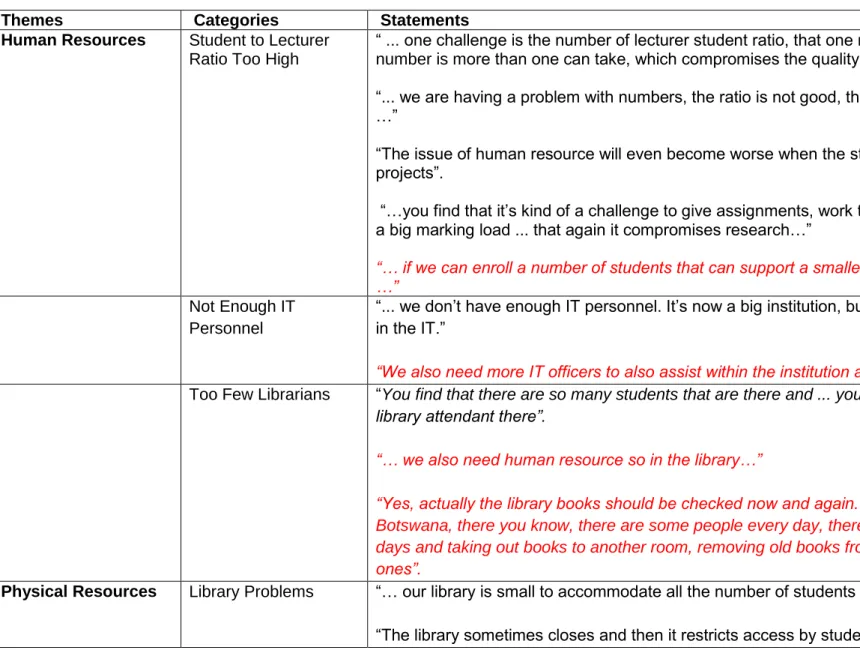
The data were analysed as explained under section 2.9. The following categories emerged as challenges experienced by the nurse educators: inadequate human resources, lack of physical resources, lack of research skills and competencies, policies, student perceptions and support from management. Under these themes, categories emerged, statements, in the format of direct relevant quotations from the participants, are used to substantiate specific themes identified during the data analysis, as indicated in table 3.1.
The participants highlighted what they proposed should be done to support them in the second question that was raised during the focus group discussion. This is indicated in red color in table 3.1 to ensure that the suggestions match, where applicable, with the already identified categories and themes.
The data, the data-interpretation and the literature control will be presented in this chapter in an integrated way. This is done to enable easy reading of the text and to illustrate the similarities and differences between this study’s results and the evidence found in relevant recent literature.
Table 3.1: Themes, Categories, and Statements Pertaining to Challenges Faced
Themes Categories Statements
Human Resources Student to Lecturer
Ratio Too High
“ ... one challenge is the number of lecturer student ratio, that one needs to supervise ... the number is more than one can take, which compromises the quality of work …”
“... we are having a problem with numbers, the ratio is not good, that of students against lecturers …”
“The issue of human resource will even become worse when the students begin to do their projects”.
“…you find that it’s kind of a challenge to give assignments, work to students because it becomes a big marking load ... that again it compromises research…”
“… if we can enroll a number of students that can support a smaller ratio of lecturers to students …”
Not Enough IT Personnel
“... we don’t have enough IT personnel. It’s now a big institution, but we just have only one person in the IT.”
“We also need more IT officers to also assist within the institution and the library”.
Too Few Librarians “You find that there are so many studentsthat arethere and ... you find that there is only one library attendant there”.
“… we also need human resource so in the library…”
“Yes, actually the library books should be checked now and again. I have been to University of Botswana, there you know, there are some people every day, there are people busy checking days and taking out books to another room, removing old books from the shelves and putting new ones”.
Physical Resources Library Problems “… our library is small to accommodate all the number of students …”
“The library sometimes closes and then it restricts access by students”.
Themes Categories Statements
“… there is need to extend our library, whether going up or sideway s…” “… we need to extend library working hours …”
Inadequate Books “… another challenge, it’s the books, some of the books are there but they are old …”
“… yes, actually the library books should be checked now and again. I have been to the University of Botswana, there you know, there are some people busy checking days and taking out books to another room, removing old books from the shelves and putting new ones…”
Lack of Journals “... also that of the journals we don’t have enough …”
“I think the issue of getting journals ... I think they need to subscribe to more journal publishers …” Lack of Data Sources “… we live in the technology era, it’s quite a challenge, and there are sites which students are not
allowed to access like YouTube …”
“They need to be told about the importance of those sites”. “You know, YouTube gives you the whole worldso it’s just a matter of making sure that they visit the relevant sites on YouTube”. Problems with
Technology/Computers
“... fine the university does have computers so that even when students want to do research there are not enough computers, number of computers does not tally with the huge number of students we have”.
“We need to get more computers”. Research Skills and
Competencies
Lack of Research Experience and
Competency
“I feel like I am dead because I do not have the experience, hence experiencing challenges …” “... this is all new and so even us, we have never supervised anybody”.
“Mine will be the standard of education for nurse educators, most of us are capacitated up to a master’s degree or beneath, somehow I feel like we are dead”.
“… yes most of us are not capacitated up to the level of a master’s degree …”
Themes Categories Statements
“... we will need a three day workshop, from an expert, to bring us on board. I believe that this workshop will help”.
“Like a workshop, I think one workshop to the educators so that they match their research skills and knowledge.”
“Think the best thing is to have more guidance, I think we all need to follow guidelines and be guided by someone with an experience in supervising research during the supervision of the research projects since we have no experience”.
Lack of Research Guidelines
“... another challenge is that we do not have a laid down framework on how to go about the research, so each and every lecturer will do what he or she knows”.
“... the only thing that is missing are the guidelines on how to conduct the projects by the students …”
“... and as for guidelines. Speed up the guidelines, make sure they are prepared before we start supervising research projects.”
Diverse Educational Backgrounds
“Even us as nurse educators, I foresee a challenge that we are coming from different institutions, I’m from there and the other one is from there.”
“We need the workshop to synchronise our different thoughts and put us on board and we need more guidance …”
Policies Ethics Committee
Matters
“... you cannot easily see the ethics committee you just see the secretary who tells you about the number of people you have never seen you are told you are not going to start your project before you get the green light from the ethics committee, so it’s a challenge”.
“I think we need to set up our own research ethics committee which can do smaller scale research that are done by students at the university.”