Load Balancing in Bounded-Latency Content Distribution
∗Chengdu Huang
†Gang Zhou
‡Tarek F. Abdelzaher
†Sang Hyuk Son
‡John A. Stankovic
‡†
Department of Computer Science
‡
Department of Computer Science
University of Illinois at Urbana-Champaign
University of Virginia
Urbana, IL 61801
Charlottesville, VA 22904
{
chuang30,zaher
}
@cs.uiuc.edu
{
gz5d,son,stankovic
}
@cs.virginia.edu
Abstract
In this paper we present a balanced data replication scheme that provides real-time latency bounds on con-tent retrieval in concon-tent distribution networks. Many network applications have ever-increasing requirements on latency sensitive data services. Data replication ser-vices have been widely used as an important perfor-mance enhancement mechanism to reduce data access latency and throughput. We investigate the problem of provisioning an underlying balanced data replication service to provide a global latency bound on data re-trieval in content distribution networks. The solution involves constructing an overlay network based on the given latency bound, and a mechanism to assign content objects to the network nodes so that the workload of all the network nodes is balanced. Our evaluation results drawn from detailed simluations show the efficacy of our load-balancing scheme in meeting the latency bound re-quirements with high confidence under heavy load.
1
Introduction
Many large-scale distributed systems, such as peer-to-peer file sharing systems, content distribution networks (CDNs), and wireless sensor networks, utilize data repli-cation to enhance the overall system performance. For example, peer-to-peer applications and many distributed file systems [19] greedily replicate large files so that the average download time of clients is reduced. In CDNs, popular content is replicated on-demand or pre-populated to CDN edge servers to support a higher vol-ume of client requests [1]. In wireless sensor networks, when some event of interest is detected in a certain area and triggers queries from different locations in the net-work, the data associated with the event may be repli-cated to prevent network congestion [6]. In these sys-tems, the locations of content replicas have a significant impact on performance. The problem of how and where
∗The work reported in this paper was supported in part by the
Na-tional Science Foundation under grants CCR-0093144, ANI-0105873, EHS-0208769, and MURI N00014-01-1-0576.
to replicate content in large-scale network systems has been studied in many different scenarios [17, 12, 21].
While data replication, in general, can improve over-all system throughput and service availability, many ap-plications in large-scale distributed systems have strin-gent timing requirements as well. Namely, many appli-cations require that requests to retrieve content be served within a global latency bound, regardless of where the requests originated. This kind of soft real-time require-ments is vital for many import network applications. For example, an online stock trading service provider would want its content to be accessible within a short amount of time for all its worldwide customers. Online gam-ing, for another example, also requires the state infor-mation of the game to be accessible to the gamers very quickly. Whether a (short) global latency bound on con-tent access can be provided has a substantial impact on the quality of many online services.
The problem we investigate in this work is how to achieve load-balancing when there are many content objects with soft real-time latency bounds in a large-scale content distribution network (CDN). When a large number of content objects are to be replicated on the CDN servers, each individual server will host only a
subset of the content objects. The fact that
differ-ent contdiffer-ent objects can have very differdiffer-ent popularities and servers have different network connectivities can cause servers to have an imbalanced workload. Load-balancing among the network nodes is of primary impor-tance to improve the utilization of the system’s resources and the system’s ability to provide latency bounds. Dif-ferent from many existing load-balancing techniques in other distributed systems [4, 14, 10], our load-balancing mechanism is coupled with the process of creating
repli-cas for content objects. This is because our
load-balancing mechanisms are subject to the constraint of content objects’ latency bound requirements. Ideally, we want to place replicas of the content objects strategically, so that (1) latency bound requirements of the content ob-jects are met; (2) workload of all the network nodes is balanced; and (3) the replication cost is low. Moreover, for a large-scale system, the algorithm has to be
decen-tralized. In this paper, we assume that the content ob-jects do not have stingent consistency requirement and hence their replicas do not need to be strictly synchro-nized with each other. In the rest of the paper, we de-scribe such a balanced data replication scheme that sat-isfies these requirements.
The remainder of the paper is organized as follows. Section 2 sketches the architecture and technical chal-lenges of our balanced data replication scheme. Sec-tion 3 gives the detailed design of the load-balancing replication algorithm. An extensive performance eval-uation of our system is presented in Section 4. Section 5 presents a survey of related work. The paper concludes with Section 6.
2
Overview
2.1
Latency Bound
In our previous work [12], we presented a content distri-bution service that can provide global latency bounds on content retrievals. For the sake of completeness, we here briefly describe the architecture of the CDN we built.
Consider a CDN that consists of a large number of CDN servers, or servers for short. Content objects can be replicated on these servers. Content objects are dis-cretized into a small number of content classes by their latency bounds. Content objects in the same content class share the same latency bound. Latency bounds of the content objects are known to all the servers.
In our CDN model, servers of the CDN provider are deployed on the edge of the Internet backbone and may be co-located with ISPs’ Internet Gateway Routers (IGRs). This is known as the colocation model in which the requests of clients can be redirected to the near-est CDN server [1, 4]. Hence, clients are presumably very close to their nearest CDN servers. When a CDN server receives a request, if the requested content object is available at the server’s local storage, a reply is sent back to the client directly. Otherwise, the request will be redirected to some replica of the requested content ob-ject (or to the origin server). When a content obob-ject is replicated on a CDN server, we say the server hosts the content object.
To provide a latency bound on content retrieval, the CDN provider needs to replicate the content objects on its servers so that when a CDN server receives a client request, it can either find the requested content object in its local storage, or can find a replica of the content object from a remote server that is within the latency bound. To achieve this goal, we first construct an overlay network based on the latency bound. The construction needs to guarantee one important property of the overlay network: neighbors on the overlay can reach each other within the given latency bound.
With an overlay network in which neighbors can
reach other within the global latency bound, to provide a latency bound on content retrieval is to find a set of repli-cas for every content object so that every CDN server can find the content from its closed neighborhood, which is defined as its neighbors plus itself, on the overlay net-work.
Note that trivially replicating all content objects to
every server can make the network latencies of
serv-ing client requests very short. This naive scheme, how-ever, is not practical because it incurs a prohibitively high replication cost. Hence, our data replication ser-vice needs to avoid creating unnecessary replicas when replicating content to meet the latency bound require-ments. Specifically, neighbors on the overlay network should largely host different content objects.
2.2
Load-balancing
Workload of a CDN server is simply the total request rate it experiences. As in many other distributed tems, load-balancing is very important for a CDN sys-tem to effectively utilize available resources. An im-balanced workload will create hotspots which can cause
many latency bound violations. Load-balancing has
been studied in many different scenarios such as dis-tributed file systems [19], peer-to-peer systems [10, 18],
and CDNs. Existing load-balancing techniques on
CDNs are mainly request redirection schemes [4, 22]In our CDN system, content objects are replicated to meet the latency bound requirements and are available on a small subset of the CDN servers only. An effective replication strategy is of ultimate importance to the sys-tem’s ability to achieve load-balancing. Request redi-rection mechanisms deal with how to efficiently redirect requests to given replicas so that servers’ workload are balanced. How to strategically create replicas for con-tent objects to facilitate load-balancing, however, is out of the scope of request redirection. Our load-balancing mechanism achieves balanced workload along with the replication process. It can also benefit from combin-ing with certain request redirection schemes. Therefore, we believe that request redirection is both orthogonal and complimentary to the load-balancing technique we present in this paper.
A D B C F1,F2,F3,F4 (a) A D B C F1 (b) F2,F3,F4 F2,F3,F4 F2,F3,F4
Figure 1. Imbalanced vs. Balanced Replication
The workload of a server is determined by the num-ber of content objects that it hosts, and their
popular-ity. Another factor is the network degree (on the overlay network) of the server. To understand this, consider the example illustrated in Figure 1. Node A has the highest degree among the 4 nodes. Both replication schemes in Figure 1(a) and (b) satisfies the latency bound re-quirement. However, the load-balance properties of the two schemes differ a lot. Assuming all the content
ob-jects share the same popularity r at all the nodes, in
Figure 1(a), node A serves all the requests while other nodes have no workload at all. In contrast, replication in Figure 1(b) enjoys a much better load-balancing:
work-load of all the nodes are4r. Note, however, the
replica-tion i Figure 1(a) enjoys the advantage of having fewer replicas. Actually, there is a trade-off between the num-ber of replicas and the load-balancing property. In Sec-tion 4, we investigate this trade-off under different sys-tem parameters.
It is worth noting that the total workload in the system is independent of the replication scheme. It is solely de-termined by request rates of all the content objects. Dif-ferent replica placements merely make the total work-load be distributed among the servers differently.
In this work, we mainly focus on controlling work-load of the CDN servers, as opposed to network band-width. We argue that server workload is the major con-cern because the CDN servers are a dedicated resource of the CDN provider. The scheme of distributing the overall workload to different CDN servers largely deter-mines the response time of the CDN servers. Network bandwidth, however, is a shared resource. Our content service is just one of the many services that are running on the internet and sharing the underlying network in-frastructure. Hence, the bandwidth consumption of our service is unlikely to noticeably affect the actual net-work latencies. In addition, our previous measurement study [12] showed that internet latencies are fairly stable for our service. Given the fact that the overlay network is created based on the latency bound and the satisfactory network latency stability, if we can find a balanced data replication scheme on the overlay network to ensure the response time of the servers are bounded, then we can achieve the latency bound guarantee. In the next sec-tion, we present the detailed design of such a scheme.
3
System Design
In this section, we present our balanced data replica-tion algorithm. Servers make independent decisions on which content objects to host based on local informa-tion about their workload and popularity of the con-tent objects. Servers only need very limited knowledge about their neighbors, making the scheme highly scal-able. The algorithm consists of three major phases. In the token calculation phase, servers first exchange their IDs with their neighbors (i.e., the servers that are
reach-able within the latency bound). Without communication, each server can locally generate a conflict-free token winning sequence using the token calculation algorithm to be described. After that, servers consolidate the token winning sequences of their neighbors and come up with a sequence that contains all the tokens within its closed neighborhood. This sequence will be used to decide on the order in which servers make content allocation de-cisions. In the content allocation phase, following the consolidated token winning sequence, servers use the content object allocation algorithm to choose appropri-ate objects to host. We also present a post-adjustment phase to deal with dynamics of network topology and changes in popularity of content objects. In what fol-lows, we describe the three phases in detail, and discuss issues related to multiple content classes.
3.1
Token Calculation
In this phase, each server first collects ID information of all of its neighbors. Note that the neighborhood of a server is the collection of CDN servers that are reachable by the server within a given latency bound. After servers obtain the IDs of their neighbors, each server will create a set of pseudo random number generators (RNGs). For each of its neighbors, a server associates a RNG seeded with the neighbor’s ID. Servers also create RNGs asso-ciated with themselves, and seed them with their own IDs. Note that all the RNGs of all servers should use the same pseudo random number generation algorithm. This scheme is inspired by the NCR algorithm used in TDMA schemes for wireless communications [3, 25].
A B C D E A B C D E A B C D 20 22 8 2 23 8 2 32 11 14 33 ... 3 12 23 6 7 43 43 2 3 10 5 ... 5 11 5 2 33 6 9 8 2 40 8 ... 7 4 2 32 15 14 11 2 22 9 5 … S e rv e r A ’s V ie w E …… … … 55 … … … … ... E …… … … 55 … … … … ... Token Winner Token Winner
Consolidated Token Sequence Consolidated Token Sequence 1 2 3 4 5 6 7 8 9 10 11 12 Index:
Figure 2. Token Allocation Example
For the ease of explanation, we take server A in Fig-ure 2 as an example. As FigFig-ure 2 depicts, servers B, C and D are neighbors of server A, while server E is B’s neighbor but not A’s. Node A first generates a ran-dom number sequence using the RNG seeded with its
own ID:{20,11,8,2,23,8,2, ...}. Similarly, it
gener-ates random number sequences for servers B, C and D by RNGs associated with IDs of B, C, and D, respec-tively.
Having the random number sequences of all four servers in its neighborhood constructed, server A scans
the four sequences in parallel in ascending order of the
index. For an indexi, we say a server wins the token
if itsith random number is greater than all theith
ran-dom numbers of its neighbors, using ID numbers for tie-breaking. Clearly, tokens are associated with index numbers. Token winners will make content allocation decisions as will be discussed in Section 3.2. From Fig-ure 2, we can tell that server A wins tokens at index 1, 8 and 11. When server A calculates the tokens locally, servers B, C and D do the same token calculation in par-allel independently. All token winners are marked as shaded blocks in Figure 2. The important feature of this process is that no two servers would win the same token if they are neighbors. This is true because all the RNGs use the same pseudo random number algorithm. When a
server sees itsith random number is greater than those of
its neighbors, the neighbors should have the same view. Having received the token winning sequences of servers B, C, and D, server A can combine all the se-quences and get a consolidated sequence, illustrated by the arrows in Figure 2. This sequence is used in the con-tent object allocation phase to be discussed in the next section.
It is worth pointing out that in index 7, no server in A’s neighborhood wins the token. This is because B’s 7th random number is greater than those of A, C, and D, but smaller than that of E. This does cause some problem in TDMA design [3] because it introduces “holes” in the sequence of token winners. Our scheme is not impacted much by these holes, because we only care about the relative decision sequence for content object allocation. It is true, though, that we need to generate more random numbers to get the same number of tokens because of the holes.
3.2
Content Object Allocation
The consolidated token sequence (illustrated as the ar-rows in Figure 2) of a server is basically a sequence of tokens of its neighbors. If a server finds that the token with the smallest index belongs to itself, it volunteers to host a content object, using the algorithm to be pre-sented later in this section. This decision or a dummy decision (to be discussed later in this section) is broad-cast to its neighbors. The token is then removed from the server’s consolidated token sequence. If a server finds that some neighbors hold tokens with smaller in-dices, it simply waits for the content object allocation decisions from those neighbors, with a time out to han-dle token loss in rare cases. Every time it hears a con-tent object allocation decision from a neighbor, the cor-responding token is removed from its consolidated token sequence and the content object selected by the neighbor is marked as “unavailable”. After all those tokens with smaller indices than its own token are removed, it can
make its own content object allocation decision again and broadcast it. For example, in Figure 2 after server A makes the first content object allocation decision, it will need to wait for decisions from C, B, D, C, B before it makes the next content objection allocation decision. Note that in the token calculation phase, the possibility of winning tokens for a server is inversely proportional to the number of neighbors of the server. Statistically, the more neighbors a server has, the fewer chances it will get to host content objects. This is ideal in our situa-tion because when a server hosts an object, its neighbors will forward their requests for the object to the server. The workload that will be brought to the server by host-ing an object is therefore proportional to the number of neighbors of the server. Hence, making servers that have more neighbors host fewer objects is helpful in making servers’ workload balanced.
To implement the mechanism described above, each server maintains an available objects list (AVL). This list maintains all content objects that have not been hosted by any server in its closed neighborhood, as well as their popularity. Servers only choose objects from their AVL to host. When new content objects are in-troduced to the CDN system, they are inserted into the servers’ AVLs. The algorithm for content object alloca-tion will then be triggered to create replicas for the new objects. Note that the popularity of objects maintained by a server are those popularity witnessed by the server locally, not global popularity. The list is sorted in the descending order of popularity of the objects. When a server hears that some neighbor has volunteered to host a content object, the content object will be removed from its AVL. Similarly, when the server decides to host a content object, the object will be removed from the AVL as well. This way, if two servers are neighbors, they would not both be replicas of the same content object, assuming no packet loss. Ideally, for each content ob-ject, there will be one and only one replica in each local neighborhood.
Note that although the tokens are associated with in-dices, the content allocation phase is not a synchronous process. All the decision making and broadcasting can happen in parallel in different neighborhoods throughput the the whole network. The decisions a server is wait-ing for do not have to arrive in order. For example, in Figure 2, D’s content allocation decision can arrive at A before those of B and C. In addition, when one server broadcasts its decision to its neighbors, it may trigger multiple servers to make decisions in parallel, which speeds up the whole process. In this scheme, there is no network wide information propagation, making it highly scalable.
We assume the popularity of content objects can be predicted based on history information. Measurement studies show that relative popularity of content objects is
pretty stable over time [17, 15]. It is true, however, that popularity of content objects can be subject to abrupt changes in some situations (e.g., flash events). We do have a mechanism (to be discussed in Section 3.4) to accommodate popularity changes. Having relatively ac-curate history information about popularity of content objects can only be beneficial.
The response time of a server obviously depends on its workload. It is well known that server response time does not linearly scale with the offered load. In fact, in many cases there exists a knee in the load-response curve. Imposing a workload that exceeds the knee will cause a substantial increase on the response time, and hence cause a lot of latency bound violations. Hence, for
a given bound on server processing timetand a target
la-tency miss ratiop, we define the capacity threshold of a
server as the workload at which1−pof the requests can
be served within t. Imposing a workload that exceeds
the capacity threshold can cause a substantial increase of latency bound violations.
From the definition of the capacity threshold, we need to keep the workload of all the servers below their
capacity thresholds if possible. Specifically, when a
server picks a content object to host, it needs to make sure this action will not bring its workload beyond its capacity threshold. Hence, a content object allocation decision actually is twofold: the server needs to decide (1) which content object to host; and (2) which neigh-bors should be allowed to forward requests for this ob-ject to the server. The goal is to minimize the servers’ chance of transcending their capacity thresholds.
We use a greedy heuristic in making the content al-location decisions. When it is the turn for a server, say
A, to pick a content object to host, it greedily chooses
the objectOthat has the highest popularity among the
objects in its AVL that does not make workload ofA
exceed its capacity threshold. If there exists such an ob-ject, the server then collects the popularity of this object on its neighbors. Note that, if all its neighbors forward
the requests for O to A, it is possible that the server
will be overloaded. Hence, the server needs to be se-lective in notifying the neighbors of its object alloca-tion decision. This notificaalloca-tion process proceeds from the neighbor with the lowest network degree (number of neighbors on the overlay) to the highest. If the available capacity of the server is sufficient to serve the requests for the picked object from a neighbor, a notification re-porting that the object is hosted is sent to the neighbor. Otherwise, a dummy decision is sent to the neighbor. A dummy decision is a placeholder just to let the neighbor know the server has already made a content allocation decision so that the neighbor can proceed if it is waiting for the server’s decision. After every notification is sent, the server updates its available capacity. In the case that
the available capacity ofAis not sufficient for any
avail-able object, the server will choose the to host the least popular object with a probability that is proportional to its degree.
Note that for the sake of simplicity, we assume that
all servers have homogeneous capacities. Our
algo-rithm can be trivially extended to handle heterogeneity of server capacities without affecting the validity of the discussions in this paper. For example, when servers have different capacities, instead of using the absolute workload as the metric of deciding load-balancing, we can use the ratio of a server’s workload over its total ca-pacity.
3.3
Multiple Content Classes
In the CDN system, content objects are categorized into different content classes by their latency bound require-ments. Content objects of the same content class share the same latency bound. Since construction of the over-lay network depends on the latency bounds, different content classes actually have different overlay networks. The token calculation and content object allocation al-gorithms presented above assume that all content ob-jects have the same latency bound. These algorithms can be easily extended to handle multiple content classes. When there are content objects that belong to multiple content classes, the system can sequentially run the algo-rithms for each content class. Since the number of con-tent classes is usually small, this is not an issue. The se-quence of running the algorithms on the content classes, however, may have an impact on the performance of load-balancing. Conceivably, the latency bounds of the content classes can affect the load-balancing property. The popularity of content objects in each content class may also be a factor that needs to be considered. In Sec-tion 4, we study the implicaSec-tions of different strategies of handling multiple content classes.
3.4
Post-Adjustment
After the process described above terminates, every server will be able to find at least one replica for any of the content objects within its one-hop closed neighbor-hood. Moreover, the workload of all the servers should be below their capacity thresholds due to the way repli-cas of the content objects are created.
A B D C x A B D C (a) (b) x x Figure 3. Post-Adjustment
However, dynamics of workload can disrupt the load-balancing. Consider the example depicted in
Fig-ure 3(a). Server D is a replica of objectx. Servers A, B,
and C, can forward requests asking forxto D because
they are neighbors of D. For the same reason, they would
not hostx. Now, ifxfor some reason (e.g., a flash event)
suddenly becomes extraordinarily popular, it can cause server D to suffer a much higher workload than the other servers, and potentially makes D overloaded.
To deal with this situation, we introduce a post-adjustment phase to readjust the content object allo-cations to achieve better load-balancing after the reg-ular replica assignment process. The post-adjustment process still proceeds in a distributed fashion, meaning servers make decisions independently based on their lo-cal knowledge about their neighbors. The basic idea of the post-adjustment algorithm is that when a server has a workload significantly higher than its capacity thresh-old, it can “push” some of the hot content objects it hosts to some of its relatively underloaded neighbors, as
illus-trated in Figure 3(b). Server D can pushxto server C
and hence create another replica ofx. After that, B can
forward requests asking forxto C. This way, the total
workload brought by objectxis shared by C and D. The
cost is that an extra replica ofxis created.
Formally, when a node, say node A, finds that its
workloadLoad(A)satisfies
∃s∈N eighbors(A), Load(A)> Load(s)and
Load(A)> F ×CapacityT hreshold(A) (1) it picks the object with the highest popularity among
all the objects it hosts, sayO, and asks its least loaded
neighbor to be a replica ofO too. The neighbor then
broadcasts an announcement to notify its neighbors that
a new replica ofOhas been created.
In order to choose the least loaded neighbor, servers periodically exchange workload information with their neighbors. This information can also be piggybacked in the content object allocation decisions. The condition specified by Eq. 1 indicates that the server is not the least loaded in its neighborhood, and its workload is currently
Ftimes higher than its capacity threshold, whereF is a
constant called tolerance factor. Obviously,F should
be greater than 1. The tolerance factor is an indicator of how much overload is tolerated by the post-adjustment algorithm. Generally, the smaller the tolerance factor, the better load balancing can be achieved, but at a higher cost. Servers periodically check their workload against the condition specified in Eq. 1, and make adjustment to content object allocations independently. Workload of those heavily loaded servers gradually gets shed off and shared by other underloaded servers.
Note that, it is possible that after a heavily loaded server pushes out a hot content object to some of its neighbors, the content object may be pushed back to the
server by some neighbor. In that case, there is a possibil-ity that this content object will be pushed back and forth indefinitely. To avoid this situation, every server needs to maintain a list of “hot-potatoes”. If a server pushes out a content object in the post-adjustment phase, and later on the content object gets pushed back to the server, the content object is added to the hot-potatoes list. Con-tent objects in the hot-potatoes list will not be picked to be pushed out by the server again within a relatively long period.
4
Evaluation
4.1
Experiment Setup
We implemented our balanced data replication service by instrumenting a Squid Proxy Cache [20] and tested it on PlanetLab [16]. Because PlanetLab is a shared platform and its servers are constantly in heavy loaded state, it is very hard to run repeatable and controllable experiments on it. In our performance evaluation study, we used a “hybrid” experiment methodology. We first selected certain servers on PlanetLab and deployed our measurement daemons to these servers. Distance maps of the servers can be constructed from the measurement results. We implemented the data replication algorithm described in Section 3 in a discrete event simulator. The distance maps constructed from PlanetLab measurement data were then fed to the simulator. We configured dif-ferent latency bounds so that difdif-ferent overlay network topologies can be generated. We used two different ex-periment scenarios. One has 30 servers, all from sites in North America. The other has 75 servers from both North America and Europe. Figure 4 shows the experi-ment scenario with 30 servers. Unless otherwise speci-fied, the experimental data presented in this section are the average of the results running on both scenarios. Be-fore embarking on presenting detailed evaluation results, we first validate the simulation results of one of our ex-periments against the results we obtained from experi-menting on PlanetLab. Figure 5 gives the workload of all the 30 servers when running the same experiment on PlanetLab and in simulation. As we can tell from the figure, the results match fairly well. This gives us confi-dence in the fidelity of our simulation results.
We evaluate our replication algorithm using the fol-lowing two primary metrics:
• Latency bound miss ratio: The latency bound miss
ratio is the fraction of requests that are served with latencies longer than the latency bounds associated with the requested objects. When there are multiple content classes, the latency bound miss ratios are the aggregated ratios of all the classes.
• Average number of replicas: As content objects are
D E D E
Figure 4. Experiment setup on PlanetLab
of interest because it is directly related to the repli-cation cost. Fewer replicas imply lower replirepli-cation cost. The average number of replicas is defined as the total number of replicas of all the content ob-jects over the number of content obob-jects.
500 600 700 800 900 1000 1100 1 2 3 4 5 6 7 8 9 10 11 12 13 14 15 16 17 18 19 20 21 22 23 24 25 26 27 28 29 30 Workload Server ID PlanetLab Simulation
Figure 5. Validation of Simulation Results
The end-to-end latency of serving a request consists of two parts. The first part is the network latency be-tween the server where the request is originated and the replica the request is forwarded to. This value is imme-diately available from our measurement data. The sec-ond part is the server end processing delay. This time is related to the workload of the CDN servers. Since we are discouraged from running overloading experiments on PlanetLab, we measured the server end latencies from using our local boxes. Basically, we setup a server in our LAN that serves client requests generated by an array of clients running SURGE [5]. The request intensities of the clients were configured according to our simulation results, which contain the information of workload ex-perienced by each CDN server. The server processing delay can then be measured on the clients. The end-to-end latency of serving a request is the sum of the two parts. When the end-to-end latency of a request exceeds its latency bound, we count it as a miss.
Our replication algorithm requires every server to know its capacity threshold. As discussed in Section 3.2, the capacity threshold of a server depends on a latency
boundtand a target miss ratiop. In our experiments, we
chooset = 100msandp = 0.01. In other words, we
make the capacity threshold of a server the workload that the server can serve 99% of the requests within 100ms.
Different content objects can have very different
popularity. Measurement studies on traffic of Web
caches [7], Web servers [2, 15], and peer-to-peer file sharing systems [11] discover that popularity of content objects in these applications follow Zipf-like distribu-tions or a variation of Zipf distribution. To understand the system performance under realistic conditions, we use a Zipf-like distribution as the popularity model. The
value of theα parameter of Zipf is 1.2 in our
experi-ments. Note that using Zipf distribution as the model of content objects’ popularity brings tremendous differ-ence of popularity among content objects.
In our experiments, we used a parameter called load
factor, defined as the sum of request rates of all the
con-tent objects on all the servers over the total capacities of all the servers, to control the overall workload of the system.
4.2
Basic Performance
We first demonstrate the efficacy of our load-balancing algorithm in achieving the latency bounds with high
confidence. As discussed in Section 2.2, there is a
trade-off between load balancing and the replication cost (i.e., the number of replicas). Greedily minimizing the number of replicas can cause imbalanced workload and hence jeopardize the system’s overall performance in meeting the latency bounds. To the best of our knowl-edge, there is no existing load-balancing algorithm in literature on content distribution services with latency bounds. We compared our replication algorithm with a simple baseline heuristic that attempts to minimize the number of replicas and avoids overloading servers when creating replicas for content objects. The purpose of this comparison is to demonstrate the necessity of consider-ing popularity of objects, servers’ capacities, as well as network topology, which is what our load-balancing al-gorithm does. In this baseline alal-gorithm, every server re-peatedly picks a content object that has not been hosted by itself or any of its neighbor randomly, and nominates the server with the highest network degree among its neighbors (including itself) that have not exceeded their capacities to host the object. If all of its neighbors have exceeded their capacities, the neighbor with the highest degree is nominated. When a server receives a nomi-nation from its neighbor, it will become a replica of the object and sends out an announcement to all of its neigh-bors.
Figure 6 gives the comparison study between our load-balancing replication algorithm and the baseline heuristic. In this experiment, there are three classes of content objects with their latency bounds being 250ms, 350ms, and 450ms, respectively. We plotted both the la-tency bound miss ratio and the average number of
0 0.04 0.08 0.12 0.16 0.2 0.24 0.28 0.32 0.36 0.4 0.5 0.6 0.7 0.8 0.9 1.0 0 1 2 3 4 5 6 7 8 9 10 Miss Ratio Number of Replicas Load Factor Avg NOR: baseline Avg NOR: our replication
Miss Ratio: baseline Miss Ratio: our replication
Figure 6. Comparison with Baseline
cas (NOR) in Figure 6. The two algorithms exhibit dif-ferent behaviors on both of performance metrics. When the load factor is low, the miss ratio is nearly 0 using our replication algorithm. The miss ratio slowly climbs as the load factor increases. Even when the load factor is close to 1.0 in which case the system’s overall workload approaches its total capacity, the miss ratio is still blow 8%. In contrast, the miss ratio of the baseline algorithm is significantly higher across all load factors. As to the average number of replicas, the baseline algorithm ex-pectedly produces fewer replicas. Note that, the number of replicas created by our replication algorithm increases with the load factor. This is reasonable because when the system’s workload gets higher, more replicas are needed to keep the servers below their capacity thresholds.
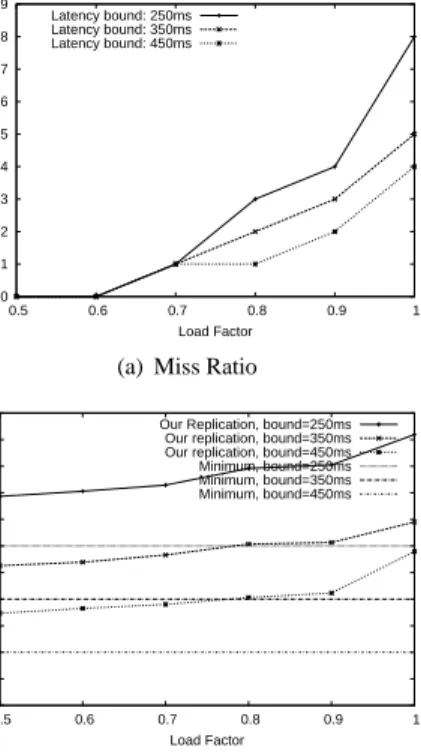
Next, we investigate the impact of the latency bounds on the performance of our load balancing algorithm. For the purpose of better understanding this impact, we made all the content objects belong to the same content class in this experiment, and varied the latency bound of the class. The latency bound can have an impact on load balancing because the overlay network is constructed based on it. A more generous latency bound makes servers generally have more neighbors on the overlay, which should be helpful in achieving load-balancing es-pecially when the load factor is high. This is because the more neighbors a server has, the better chance it has to have some neighbors to share its workload when its workload approaches its capacity threshold. Exper-imental results summarized in Figure 7(a) confirm our analysis. Regarding the number of replicas, a longer la-tency bound conceivably creates fewer replicas because the network is more connected, as shown in Figure 7(b). As mentioned above, in order to maintain servers’ workload below their capacities, our load-balancing al-gorithm may create more replicas than the minimum possible number of replicas. To understand how many more replicas are created by our algorithm, we plotted the minimum number of replicas for each latency bound in Figure 7(b). The minimum number of replicas is cal-culated using existing minimum dominating set (MDS) algorithms [13, 12]. Note, however, the minimum
0 0.01 0.02 0.03 0.04 0.05 0.06 0.07 0.08 0.09 0.5 0.6 0.7 0.8 0.9 1 Miss Ratio Load Factor Latency bound: 250ms Latency bound: 350ms Latency bound: 450ms
(a) Miss Ratio
2 3 4 5 6 7 8 9 10 11 12 13 0.5 0.6 0.7 0.8 0.9 1
Average Number of Replicas
Load Factor
Our Replication, bound=250ms Our replication, bound=350ms Our replication, bound=450ms Minimum, bound=250ms Minimum, bound=350ms Minimum, bound=450ms
(b) Average Number of Replicas
Figure 7. Impact of Latency Bound
ber of replicas shown here is just the theoretical lower bound. It could be achievable only when those servers forming the minimum dominating set have enough ca-pacity to host all the content objects. This generally is not true in practice. In reality, servers can reach their ca-pacity thresholds after hosting part of the objects only. The rest of the objects will have to be hosted by more servers, resulting in an average number of replicas that is larger than the minimum.
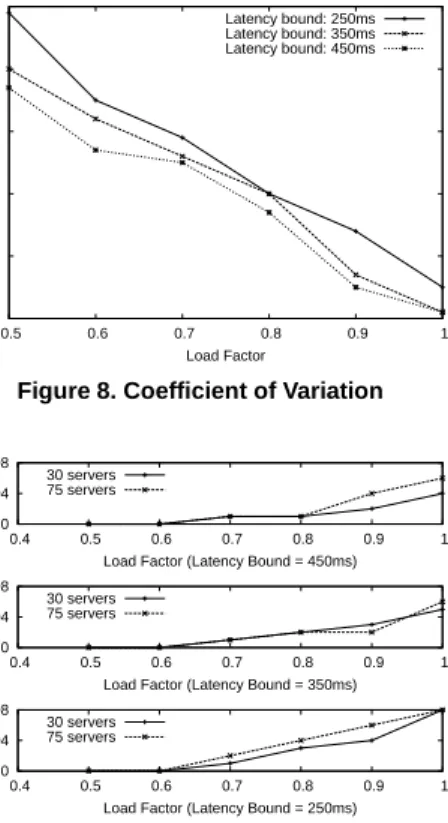
Our replication algorithm is expected to achieve good load-balancing. However, this is not to say that the workload of all servers should be strictly balanced all the time. The primary goal of our load-balancing is to keep latency bound miss ratio as low as possible. In fact, when the overall workload of the system is very low, the servers are free to have imbalanced workload as long as the miss ratio is low. When the system is heav-ily loaded, however, it is important that the workload of all the servers be balanced because when the overall system workload is high, imbalanced workload will in-evitably cause some of the servers to exceed their capac-ity thresholds. Figure 8 depicts the workload imbalance of our system under different load factors. We used
co-efficient of variation, defined as meanstdev, as the metric to
describe the workload imbalance. Large coefficient of variation values imply significant imbalance. As we ex-pected, when the system is relatively underloaded, im-balanced workload is observed. The imbalance gradu-ally diminishes when the system workload increases.
0.1 0.2 0.3 0.4 0.5 0.6 0.5 0.6 0.7 0.8 0.9 1 Coefficient of Variation Load Factor Latency bound: 250ms Latency bound: 350ms Latency bound: 450ms
Figure 8. Coefficient of Variation
0 0.04 0.08
0.4 0.5 0.6 0.7 0.8 0.9 1
Miss Ratio
Load Factor (Latency Bound = 250ms) 30 servers 75 servers 0 0.04 0.08 0.4 0.5 0.6 0.7 0.8 0.9 1 Miss Ratio
Load Factor (Latency Bound = 350ms) 30 servers 75 servers 0 0.04 0.08 0.4 0.5 0.6 0.7 0.8 0.9 1 Miss Ratio
Load Factor (Latency Bound = 450ms) 30 servers
75 servers
Figure 9. Different Network Scales
network scales (30 and 75 servers). Encouragingly, the miss ratios of the two scenarios do not have appreciable difference across all the load factors, which serves as evidence of good scalability of our algorithm.
4.3
Multiple Content Classes
When there exist multiple content classes, the replica-tion algorithm needs to run on each content class se-quentially. With content classes having different latency bounds, there are basically two options regarding the se-quence of running the algorithm on the content classes. We can start running the algorithm on the content class that has the most stringent latency bound, then on the less stringent bound class, and on forth. Alternatively, we can start from the class that has the most gener-ous latency bound and proceed to the classes with more stringent bounds. We call these options “tight-first” and “loose-first”, respectively. Besides latency bounds of the classes, the popularity of the objects in each con-tent class may also have an impact on the overall load-balancing performance.
In this section, we are going to find out the perfor-mance of the tight-first and loose-first policies. More-over, we want to reveal the impact of the objects’ popu-larity when there are multiple content classes. Again, there are three content classes (class0, class1, class2) with latency bounds of 250ms, 350ms, and 450ms, re-spectively. Each content class has the same number of content objects. Regarding the popularity, we call the
0 0.02 0.04 0.06 0.08 0.1 0.12 0.14 0.5 0.6 0.7 0.8 0.9 1 Miss Ratio Load Factor Hottest class: 450ms, Loose-First Hottest class: 450ms, Tight-First Hottest class: 250ms, Loose-First Hottest class: 250ms, Tight-First
(a) Miss Ratio
5 6 7 8 9 10 11 12 13 14 15 0.5 0.6 0.7 0.8 0.9 1.0
Average Number of Replicas
Load Factor Hottest class: 450ms, Loose-First
Hottest class: 450ms, Tight-First Hottest class: 250ms, Loose-First Hottest class: 250ms, Tight-First
(b) Average Number of Replicas
Figure 10. Multiple Content Classes
content class that has the most “hot objects” the “hottest class”. An object is a “hot object” if it has a popularity that is 10 fold greater than the average popularity of all the content objects.
Intuitively, a more generous latency bound gives servers better chances of finding some neighbors to share their workload when overloaded. When content objects are to be replicated on servers that are largely under heavy load, it would be beneficial if the latency bound of the objects was generous. Hence, we expect the tight-first policy to outperform the loose-first pol-icy. For similar reasons, the hottest class should be pro-cessed first. However, when these two conditions are at odds (i.e., when the hottest class is not the class with the most stringent latency bound), it is not obvious which factor has the dominant impact. Figure 10(a) shows the miss ratios of the 4 combinations of policies under dif-ferent load factors. As shown in the figure, tight-first policy always outperforms the loose-first policy for both cases where the hottest class has the most stringent la-tency bound, and the hottest class has the most generous bound. Furthermore, among the 4 combinations, using tight-first when the hottest class has the tightest bound is the best. Conversely, using loose-first when the hottest class has the tightest bound is the worst. This can be observed from Figure 10(a).
As to the cost of running the load-balancing algo-rithm on multiple classes, there is barely discernable difference among different policies, as shown in Fig-ure 10(b). Finally, FigFig-ure 11 gives the miss ratios of the three classes when tight-first policy is used. As can
0 0.01 0.02 0.03 0.04 0.05 0.06 0.5 0.6 0.7 0.8 0.9 1 Miss Ratio
Hottest class: 450ms, Tight-First
Class 0 Class 1 Class 2 0 0.01 0.02 0.03 0.04 0.05 0.06 0.5 0.6 0.7 0.8 0.9 1 Miss Ratio
Hottest class: 250ms, Tight-First
Class 0 Class 1 Class 2
Figure 11. Fairness of Multiple Classes
be observed in the figure, for both cases that the hottest class has the tightest bound and the hottest class has the loosest bound, fairness among the classes is achieved, which is ideal. From these experiment results, we con-clude that tight-first policy is the best policy for running our algorithm on multiple content classes. In fact, all other experiments involving multiple classes presented in this section used this policy.
4.4
Imperfect Knowledge
The evaluation results above are based on the assump-tion that the servers have perfect knowledge of the pop-ularity of the content objects. In practice, poppop-ularity of objects can be predicted from history. However, the pre-dictions can only be rough estimates. In this section, we examine the performance of our algorithm when servers have imperfect knowledge about the objects’ popularity. We hope our replication algorithm can tolerate imperfect knowledge to a certain extent. In particular, we hope the performance in terms of miss ratio will have only a graceful degradation.
Our approach is to salt the popularity of the con-tent objects with random noise, and vary the amount of noise. We used a parameter called error in adding random noise to the popularity information. With an
error of ǫ, the popularity of the content objects fed to
the servers will be a random number in the range of
[(1−ǫ)p,(1+ǫ)p], wherepdenotes the actual popularity
of the content objects. Note the way we salt the popu-larity knowledge keeps the total workload of the system unchanged from a statistical perspective. This excludes the impact of changes to the system overall workload, and hence enables us to examine the impact of imper-fect knowledge of popularity only.
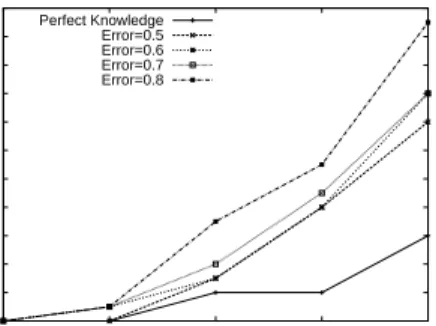
Figure 12 shows the latency bound miss ratios un-der different load factors and error levels. For compar-ison, we also gave the miss ratios when perfect knowl-edge about popularity was available. As can be observed in the figure, the miss ratio increases when the error is enlarged, which is understandable. Besides, the perfor-mance degradation becomes more noticeable when the load factor increases. The reason is that the imperfect
0 0.02 0.04 0.06 0.08 0.1 0.12 0.14 0.16 0.18 0.2 0.22 0.5 0.6 0.7 0.8 0.9 Miss Ratio Load Factor Perfect Knowledge Error=0.5 Error=0.6 Error=0.7 Error=0.8
Figure 12. Imperfect Knowledge on Popularity
knowledge of popularity basically brings imbalance to servers workload. When the system’s overall workload gets close to its capacity limit, imbalanced workload will make some of the servers overloaded and hence cause more latency bound misses. With an error of 8.0, and a load factor of 0.9, the miss ratio can reach 20%. De-spite this, our load-balancing replication algorithm ex-hibits a fairly good tolerance to imperfect knowledge of objects’ popularity. This is partly because that some of the disturbance brought by imperfect knowledge can ac-tually cancel out itself to some extent: the increase of some objects’ popularity is averaged out by the decrease of some other objects. Moreover, the post-adjustment mechanism to be evaluated in the next section mitigates the performance degradation observed here.
4.5
Post-Adjustment
In this section, we study the performance of our load-balancing replication algorithm in the presence of work-load dynamics. As discussed in Section 3.4, our work- load-balancing mechanism proceeds with the process of repli-cating content objects to provide bounded latencies. If the popularity of the content objects are stable over time, the overall workload of the system would be stable as well. However, in practice there exist various system dy-namics. The most relevant dynamics are the changes in content objects’ popularity. Operationally, the CDN sys-tem should run the replication algorithm periodically but at a low frequency, say once a day. Hence, slight or slow changes on content popularity and system’s workload can be naturally covered. It is possible, however, that the objects’ popularity can experience abrupt changes between two invocations of the algorithm. For example, a flash event can dramatically increase the popularity of a small set of content objects. This unquestionably has negative impact on the system’s performance in terms of latency bound miss ratio. Such kind of changes not only bring higher workload to the servers, but also affects the relative popularity of the content objects. We expect that abrupt changes to content popularity can substantially increase latency bound misses, especially when the sys-tem is already heavy loaded and hence lacks the cushion
to accommodate extra workload. 0 0.05 0.1 0.15 0.2 0.25 0.3 0.35 0.4 0.6 0.7 0.8 0.9 1 Miss Ratio
Load Factor After Disturbance After disturbance
1.05-Tolerant Post-Adjustment 1.10-Tolerant Post-Adjustment 1.15-Tolerant Post-Adjustment 1.20-Tolerant Post-Adjustment
(a) Miss Ratio
0 0.2 0.4 0.6 0.8 1 1.2 1.4 1.6 1.8 2 0.6 0.7 0.8 0.9 1
Extra Number of Replicas per Object
Load Factor After Disturbance 1.05-Tolerant Post-Adjustment 1.10-Tolerant Post-Adjustment 1.15-Tolerant Post-Adjustment 1.20-Tolerant Post-Adjustment
(b) Overhead (extra number of replicas per object)
Figure 13. Post-Adjustment Mechanism
The post-adjustment mechanism (Section 3.4) is de-signed to deal with this situation. Servers trigger the post-adjustment mechanism when they find out that their workload transcend their capacity thresholds by more than a tolerance factor. An overloaded server will greed-ily attempt to “push” some of its most popular content objects to some of its relatively underloaded neighbors. Post-adjustment allows servers to offload themselves at the cost of creating more replicas for some of the content objects.
Figure 4.5 summarizes the results of our experi-ments to evaluate the efficacy and overhead of the post-adjustment mechanism. We simulated the dynamics of popularity by adding random disturbance to the popu-larity of the content objects so that the system’s
over-all workload reaches a target level. In these
exper-iments, we first chose a target load factor. Pairs of
object-server were randomly picked to be disturbed in the way that the popularity of the object on the server was scaled up by a factor randomly chosen in the range
of[5,20]. Note this always increases the system’s
work-load. The disturbance process was repeated until the overall system workload reached the target load factor. The post-adjustment mechanism was then triggered to adjust the replicas of the content objects. The load fac-tor of the system before the disturbance was 0.5 for all the experiments. In Figure 13(a) we plotted the la-tency bound miss ratio with the disturbance and the miss ratio after post-adjustment settled down, varying
the target workload after disturbance. Clearly, for all the load factors post-adjustment significantly reduces the latency bound misses brought by the disturbance. Besides, post-adjustment with smaller tolerance factors generally can bring down the miss ratios further. Fig-ure 13(b) studies the major overhead of running post-adjustment, namely the extra replicas created. It gives the average extra number of replicas per content object created by post-adjustment process with different toler-ance factors, varying the target workload. From the fig-ure, it is clear that while using smaller tolerance fac-tors can create more replicas, the cost is generally fairly moderate. Another observation worth mentioning is that when the load factor increases, the difference in perfor-mance among different tolerance factors diminishes (as shown in Figure 13(a)), while the difference in overhead increases (as shown in Figure 13(b)). This is because when the system’s workload comes close to its capacity limit, many servers are saturated with their own work-load and hence can not share much of the workwork-load of those overloaded servers even though many more repli-cas are created.
5
Related Work
Existing load-balancing mechanisms for CDNs are mainly efficient request redirection algorithms. In the case of geographically distributed replicas, DNS-based request redirection has been widely adopted to spread client requests to servers because of its transparency to clients. More sophisticated approaches [8, 9, 4, 22] try to use information of servers’ workload, network prox-imity, and content availability to improve overall perfor-mance. In our system, content objects are replicated on different sets of CDN servers so that a soft real-time la-tency bound on content retrieval is provided. This prop-erty drives our load-balancing technique to be coupled with the replica selection algorithm.
With the emergence of distributed hash table (DHT) based P2P systems, researchers recently looked into the load-balancing problem in such systems. In P2P sys-tems structured by DHT, content objects are “hashed” to nodes by certain consistent hashing mechanisms. Karger and Ruhl [14] proposed an address-space balancing pro-tocol that balances the distribution of identifier space to nodes to improve overall load-balancing. Godfrey et al.[10] and Rao et al. [18] addressed the load-balancing problem by using the concept of virtual servers. A vir-tual server looks like a single node to the underlying DHT, but each physical node can be responsible for mul-tiple virtual servers. In our system, content objects are not subjected to the constraint of an underlying consis-tent hash. Instead, the placement of replicas of the con-tent objects is subject to latency bound requirements.
Xiong et al.[24] presented a concurrency control mechanism for replica management. In their application
scenario, replicas have stringent consistency require-ments, which different from our case. ten the replicas are replicated. Wei et al.[23] investigated a problem of dy-namically creating replicas of in distributed database to improve transaction processing time. Our work is very different in that our system creates replicas under the constraint of global latency bound requirment.
6
Conclusions and Future Work
In this paper, we proposed a load-balancing data repli-cation scheme for a content distribution network provid-ing latency bounds on content access. The approach in-volves a distributed algorithm to decide which servers should host which content objects. The algorithm guar-antees that every server can find all the content objects within its one-hop closed neighborhood. Most impor-tantly, the replica assignment plus a distributed post-adjustment mechanism enable the system to achieve very good load-balancing among servers. Evaluation re-sults drawn from simulations and experiments on Plan-etLab [16] using realistic content access request mod-els show that our scheme achieves good performance in terms of meeting the latency bounds and achieving load-balancing at a moderate replication cost. For future work, we are interested in extending the performance evaluation with real traces of client traffic as opposed to synthetic workload. We also plan to investigate the per-formance implications when the network latencies be-tween servers are more dynamic. Another interesting avenue for future exploration is how to extend our work to treat content classes with different tolerance to misses.
References
[1] Akamai.http://www.akamai.com.
[2] V. Almeida, A. Bestavros, M. Crovella, and A. Oliveira. Characterizing reference locality in the www. In
Pro-ceedings of PDIS’96, December 1996.
[3] L. Bao and J. J. Garcia-Luna-aceves. A new approach to channel access scheduling for ad hoc networks. In
Proceedings of ACM MobiCom 2001, July 2001.
[4] A. Barbir, B. Cain, R. Nair, and O. Spatscheck. Known content network (CN) request-routing mechanisms, July 2003.
[5] P. Barford and M. Crovella. Generating representa-tive web workloads for network and server performance evaluation. In Proceedings of ACM SIGMETRICS ’98, 1998.
[6] S. Bhattacharya, H. Kim, S. Prabh, and T. Abdelzaher. Energy-conserving data placement and asynchronous multicast in wireless sensor networks. In Proceedings
of MobiSys’03, May 2003.
[7] L. Breslau, P. Cao, L. Fan, G. Phillips, and S. Shenker. Web caching and zipf-like distributions: Evidence and implications. In Proceedings of the IEEE
INFO-COMM’99, 1999.
[8] M. Colajanni, V. Cardellini, and P. S. Yu. Dynamic load balancing in geographically distributed heterogeneous web servers. In Proceedings of IEEE ICDCS’98, 1998. [9] Z. Fei, S. Bhattacharjee, E. W. Zegura, and M. H.
Am-mar. A novel server selection technique for improving the response time of a replicated service. In Proceedings
of IEEE INFOCOM’98, 1998.
[10] B. Godfrey, K. Lakshminarayanan, S. Surana, R. Karp, and I. Stoica. Load balancing in dynamic structured p2p systems. In Proceedings of IEEE INFOCOM’04, March 2004.
[11] K. P. Gummadi, R. J. Dunn, S. Saroiu, S. D. Gribble, H. M. Levy, and J. Zahorjan. Measurement, modeling, and analysis of a peer-to-peer file-sharing workload. In
19th ACM Symposium on Operating Systems Principles,
October 2003.
[12] C. Huang and T. F. Abdelzaher. Bounded-latency con-tent distribution: Feasibility and evaluation. IEEE
Trans-action on Computers, November 2005.
[13] L. Jia, R. Rajaraman, and T. Suel. An efficient dis-tributed algorithm for constructing small dominating sets. In Proceedings of PODC’01, August 2001. [14] D. R. Karger and M. Ruhl. Simple efficient load
bal-ancing algorithms for peer-to-peer systems. In
Proceed-ings of the Third International Workshop on Peer-to-Peer Systems (IPTPS’04), February 2004.
[15] V. N. Padmanabhan and L. Qiu. The content and access dynamics of a busy web site: Findings and implications. In Proceedings of ACM SIGCOMM 2000, August 2000. [16] PlanetLab. http://www.planet-lab.org.
[17] L. Qiu, V. N. Padmanabhan, and G. M. Voelker. On the placement of web server replicas. In Proceedings of
IEEE INFOCOM’01, April 2001.
[18] A. Rao, K. Lakshminarayanan, S. Surana, R. Karp, and I. Stoica. Load balancing in structured p2p systems. In
Proceedings of the Second International Workshop on Peer-to-Peer Systems (IPTPS’03), February 2003.
[19] Y. Saito, C. Karamanolis, M. Karlsson, and M. Ma-halingam. Taming aggressive replication in the Pangaea wide-area file system. In Proceedings of OSDI’02, De-cember 2002.
[20] Squid Proxy Cache.
http://www.squid-cache.org.
[21] X. Tang and J. Xu. On replica placement for qos-aware content distribution. In Proceedings of IEEE
INFO-COM’2004, March 2004.
[22] L. Wang, V. Pai, and L. Peterson. The effectiveness of request redirection on CDN robustness. In Proceedings
of OSDI’02, Boston, MA, December 2002.
[23] Y. Wei, A. Aslinger, S. Son, and J. Stankovic. ORDER: A dynamic replication algorithm for periodic transac-tions in distributed real-time databases. In Proceedings
of RTCSA 2004, August 2004.
[24] M. Xiong, K. Ramamritham, J. Haritsa, , and J. Stankovic. Mirror: A state-conscious concurrency control protocol for replicated real-time databases.
In-formation Systems, Vol. 27, No. 4, April 2002.
[25] G. Zhou, T. He, J. A. Stankovic, and T. F. Abdelzaher. RID: Radio interference detection in wireless sensor net-works. In Proceedings of IEEE INFOCOM 2005, March 2005.