Sinnott, R.O. and Stell, A.J. and Watt, J. (2005) Experiences in teaching
grid computing to advanced level students. In,
IEEE International
Symposium on Cluster Computing and the Grid 2005 (CCGrid 2005),
9-12 May 2005
Vol
1
, pages pp. 51-58, Cardiff, Wales.
http://eprints.gla.ac.uk/3555/
2005IEEEInternational
Symposium
onClusterComputingand the GridExperiences
in
Teaching
Grid
Computing
to
Advanced
Level
Students
Dr
R.O.
Sinnott,
A.J.
Stell,
Dr J.
Watt
National
e-Science Centre
University ofGlasgow
[email protected](.uk
Abstract
The development of teachingmaterials for future software engineers is critical to thelongtermsuccessof theGrid. Atpresenthowever there isconsiderableturmoil in the Grid community both within the standards and the technology base underpinning these standards. In this context, it is especially challenging to developteachingmaterialsthathavesomesortof lifetimebeyondthe nextwaveof
Grid middleware and standards. In addition, the current way in which Grid security issupportedanddelivered hastwokeyproblems.Firstlyin thecaseofthe UK e-Science community, scalability issues arise from a central certificate authority. Secondly, thecurrentsecuritymechanisms usedbythe Gridcommunity
are notfine grained enough. In this paper we outline how these issues arebeing
addressed through the developmentofaGridComputing modulesupportedby an
advancedauthorisation infrastructureattheUniversity ofGlasgow.
1.
Introduction
Future Grid engineers require training materials that allow themto understand the way in which
current Grid know-how has been
delivered,
its limitations, and importantly to understand howsuch middleware can be used to support
e-Sciencetoday. We distinguishunderstanding the
principles and challenges associated with the development of Grid technology and its general
usage. The former we regard hereas education, whilst the latter can be seen more generally as
training. This distinction is important to make since theunderlyingchallenges faced by internet wide heterogeneous distributed systems as addressed by Grid technology remains predominantly the same. The way in which existing software has evolved to meet these challengesischanging however.
In a similar vein, the distinction between Grid usage and e-Science more generally should be made since the borderline between using Grid middleware and undertaking e-Science is often blurred. It is clear that what we would like to achieveis: to educate futurecomputer scientists
to engineer improved Grid middleware and to
educate e-Scientists to use existing middleware
tosolvescientific problems. We note here that e-Science education and training does not explicitly require or advocate use of Grid technology. Indeed there are many e-Scientists currently undertaking their research with
minimal or no Grid infrastructure. In
short,
therequirements
for education andtraining
differdepending
uponwho thetarget
audience is.At the time of
writing,
one of thegreatest
challenges
indelivering
materials foreducating
and/or
training
future Gridengineers
ande-Scientists is the
fluidity
of thetechnological
landscape.
Gridtechnology
and associated standards areperpetually
evolving
with newrecommendations and software from standards bodies and solutions
providers.
This has beenexemplified
in the lastyear with the move fromGrid infrastructures to
Open
Grid Service Infrastructure(OGSI)
based Grid services and the move towards Web Service ResourceFramework
(WSRF)
web/Grid services. The evolution of theOpen
GridService Architecture(OGSA)
is also akey
issue that makes thedevelopment
anddelivery
of any form of education or materials difficult. Trainers andeducators need to be sure that
they
aredeveloping
materialswhich hassomeexpectancyof life time.
Developing
anddelivering
educational materials based upon
explicit
technology,
e.g. Globus toolkit version 3, arefraught
withdangers
associated with a movingtechnology
base.2.
Virtual
Organisations
and
Security
One of the
primary
motivations for using ordynamically link collections of distributed
individuals and resources together to form so
called Virtual Organisations (VOs). Typically a VO will allow acollection ofindividuals andor
institutions to pool resources such as data sets, data archives, CPUs, or allow access to
specialised equipment from astronomical
radio-telescopes through to medical imaging scanners. With the open and collaborative nature of the
Grid, ensuring that local security constraints are metand notweakenedby Grid securitysolutions
is paramount. Public Key Infrastructures (PKIs)
represent the most common way in which
security in the Grid is addressed. Through PKIs,
it is possible to validate the identity ofa given user requesting access to a given resource. This
is known as authentication. For example, with the Globus toolkit [12] solution, gatekeepersare used to ensure thatsignedrequestsare valid, i.e. from known collaborators. When this is so, i.e. theDistinguished Name(DN) oftherequestor is in alocallystoredandmanagedgridmapfile,the useristypically givenaccesstothelocallysetup
accountasdefinedinthegridmapfile.
There are several key limitations with this
approach with regard to security however. For
example, the level of granularity of security is
limited. There is no mention ofwhat the user is allowed to do once they have gained access to
the resource. Further this approach works onthe
assumption that usercertificates areprovidedby
an acknowledged certificate authority (CA). In
the UK, a centrally managed CA atRutherford Appleton Laboratories exists which
(necessarily!) has strict procedures for how certificates are allocated. Users are expected to
"prove" whotheyarein ordertogetacertificate,
e.g. through presenting their passports to a trusted individual at their institution. This is a
human intensive activity and one which has scalabilityissuesonceitis rolledouttothewider community, e.g. to industry and larger groups such as students taking Grid/e-Science courses.
Havinguserspersonally takecareof theirprivate keys is another limitation of this approach.
In short, current experiences with PKIs [13, 14] as the mechanism for ensuring security on the Grid have not been too successful [15, 16].
Authorisation infrastructures offer extended and
finer grained security control when accessing
and using Grid resources. Numerous technological solutions have been put forward providing various levels of authorisation capabilities e.g. AKENTI [1], CAS [2],
CARDEA
[3],
GSI[4],
PERMIS[5,6,7]
and VOMS[8,9].
Examples
ofhow these comparetooneanotheraredescribedin
[17, 18, 19].
It istooearly
to say iflarge
scale use of attribute certificates(ACs)
for user authorisation, based on infrastructures such as PERMIS, will be successful or not. However, few otheralternatives
currently
exist, so practicalexperience is required. In order for large scale
use tobe
facilitated, dynamic
(ratherthanstatic)
delegation
ofauthority isrequired.Inthe currentPERMIS
infrastructure,
static delegation ofauthority
meansthatacentralauthority has tobecontacted, and
register
local managers in itspolicy,
before managers are entitled to assignprivileges
to subordinates. Withdynamic
delegation
of authority, local managers do not- needtoberegistered, butaregiven the
privilege
to
delegate
whenthey
arefirstgiven privilegesto use the system. Managers can then allocateprivileges
to staff and students asrequired,
without
having
to contact the centralauthority
firstto getpermission. Through this, afederatedand scalable model ofsecurityauthorisation can
be realised. In developing this federated
Privilege
Management Infrastructure(PMI)
model, key challenges have to be overcome
which are common to most, if not all, uses of Gridtechnology -thedynamic establishment of VOs. VOs allow shared use of computational
and data resources by collaborating institutions. Establishing a VO will require that efficient
access control mechanisms to the shared
resources by known individuals are in place. However, currently in the Grid community
access control is usuallydone by comparing the
authenticated name ofan entity to a name in an
Access Control List. This approach lacks scalability and manageability as discussed in
[15]. Dynamic delegation of privileges offers a
more realistic approach that could shape future
Grid security, especially when it isrolled-out to
themasses,e.g. Gridstudents,
industry.
3.
Teaching
Principles Underlying
the
Grid
In educating the future generation of Grid engineers, a balance between concepts and
principlesassociated withGrids ande-Scienceis needed. Within the Grid Computing module at the University ofGlasgow, the lecture material
developedhasbeen focusedupon the underlying principles and challenges associated with Grid technologies. Thus whilst there might be
numerous technologies say for job scheduling (Condor, Sun Grid Engine,OpenPBS,Maui, ...), the basic principles ofjob scheduling and the specific challenges of large scale, wide areajob scheduling remain the same. It is worth noting thatthe Grid Computingmodule at Glasgowhas 16 full time students registered. This has more
than exceeded initial expectations for a brand
newcourseandmodule.
Establishing a course based solely upon basic principles and challenges associated with Grid technologies applied to e-Science, is unlikely to
be suitable for a full time advanced course
however. Experiments and investigations using current state of the art in Grid technology are
needed. At Glasgow this has been through looking towards Globus toolkit version 3 (amongstothertechnologies), however,themain pointis thatthistechnologyhas notprovided the cornerstone of the educational material. Rather it has provided a vehicle through which many of thebasic principles havebeendemonstrated.Itis this perspective that underpins the difference
betweentrainingandeducationmoregenerally.
Akeyrequirementon Grid education is abroad scope and balance. Grid technology touches on
many areas from security, usability, job scheduling and data management etc and
developing single courses attempting to provide a complete picture of Grid today needs to be targeted to the right audience. For example, whilst high level overviews of Grid can be provided say to undergraduate students, it is
more likely the case that complete and detailed overview materials are best delivered to
computer science students that have the necessary grounding in related materials. At Glasgow for example, numerous pre-requisites existed forstudents to select the GridComputing module. For example, students had to be competent in Java, knowledgeable in internet technologies, have experience of distributed algorithms and systems, and done some work on databases. (As it happened numerous students didnotmeet allrequirementshence extralecture material had to beprovided, e.g. on XML based technologies and standards and web services). The Gridcomputing module contents at Glasgow
isgiven inTable 1.
Here the focus was primarily upon teaching the principles, concepts and overarching challenges present inGrids today. Forexample, the lectures
on
security provided
an overview of thechallenges
ofmaking
Grids secureincluding
concepts
such asauthentication, authorisation,
accounting,
auditing,
confidentiality,
privacy,
data
integrity,
and trust.Exploration
ofcurrent Gridsecurity
mechanisms,
e.g. PKI based authentication and GSI based individual service/user based authorisation waspresented,
with focus on the many open
challenges
to beaddressed to ensure Grid
security
is robust andmeets the needs of the different e-Science
communities.
-WeekI "Lecture I IntroductiontoGridComputing
-Lecture 2 ScalabilityandHeterogeneity
'Week2 Tutorial 1 Discussionofseminal Grdpapers eLecture3 Open standards and architectures
LectureLecture44 Implementations of the Grid
S t~~~~architecture
lWeek3 Lecture 5 W r
6 Resource discovery/information
services
s ; Exploring. web. services
> STutoial2
Exploning
web servicesTutorial
2:
technologies
withGT3 Week4 ILecture7 Gridsecurityconcepts-.Lecture8 Virtualorganizations
'Lecture9 -Securityinpractise
6.Week5
Tutorial
3;:zDiscussion
of Grid: scurityspapers/Lab
'Lecture10 Jobschedulingandmanagement -Lecture 11 Jobschedulingandmanagement
Week 6
Tutorial4
'Diusson of jb .schedulingLecture12 Workflowmanagement
ITutorial5 IQ&Aonprogrammingexercise :fWeek7 Lecture 13 tData access,I
'management
integration and,R Lecture 14 fDataprovenance andcuration
Discussion of datal
Tutorial 6 management/provenance
'Week8 "Lecture15 Bulk Data Transfer
ALecture16 Peer-to-peercommunication Tutorial7 Discussion of networkingpapers Week9 ILecture 17 tToolsforCollaboration
Tutorial 8 DiscussionComputing on future of Grid
Lecture18 ThefutureofGridComputing
Week 10 Lecture 19 Sampleapplications "Lecture20 'Reviewofmajorconcepts
Tutorial9 tQ& A
Table 1:GridComputingmodulecontents
A key requirement on rolling out any form of Grid education is to establish the infrastructure needed forthis. This isnon-trivialand the effort involved should not be underestimated. Grid technology and dependencies between packages is still a challenge for installation and general
usage. This includes getting students equipped
for working on the Grid, e.g. through X.509
certificates (issued from the UK e-Science certificate authority atRAL), or as wasthe case at Glasgow, establishing a local certificate
authority.
Forthe Gridcomputing module atGlasgow, the
following list of software for the Grid
ComputingModule wasused. Thissoftwarewas
initially built on a single machine and the disk
imageduplicated acrossthetrainingcluster. * PERMIS Privilege Allocator 1.5+,
PERMISAPI 1.3 requires:
o Java SDK 1.4.2+ (includes
JNDI)
o IAIK JCE (contained in
Privelege Allocator 1.5) * Globus Toolkit 3.3 requires:
o ApacheAnt 1.6+ o Junit3.8.1 o gcc 3.3+, YACC or Bison,
GNUtarl
* Condor6.6.5 * OGSA-DAI4.0 * Tomcat 4.1.24+ (withGT3.3) * JDBCDatabase(Postgresql)In addition, a lab server was set up with OpenLDAP 2.1 for the attribute certificates
generatedby the PERMISPrivilege Allocator.
4.
Advanced
Infrastructures
Authorisation
InaGridenvironment,authentication (being able
to establish the identity of a user) should be
augmented with authorisation capabilities, which
canbe consideredaswhat Grid users areallowed
to do on a given Grid end-system. Thus "what
usersareallowed to do" can beinterpretedasthe
privileges that the users have been allocated on
those end-systems. The X.509 standard [20] has
standardised thecertificatesof a PMI. A PMI can beconsideredasbeing relatedtoauthorisation in
'Included
in the Linux version used in the lab.much the same way as a PKI is related to
authentication.
Consequently,
there are manysimilar
concepts
inPKIs andPMIs. An outline of these concepts and theirrelationship
arediscussedindetailin
[6].
A
key
conceptfrom PMIareattributecertificates(ACs)
which,
in much thesamemanner aspublic
key
certificatesinPKI,
maintainastrongbinding
betweenauser'snameandone ormore
privilege
attributes. The
entity
thatdigitally signs
apublic
key
certificate is called aCertificationAuthority
(CA)
whilst theentity
thatsigns
anAC is calledanAttribute
Authority
(AA).
The rootoftrustofa PKI is sometimes called the root CA -which
in terms of the UK e-Science community is
given
by
the GridSupport
centre at RAL[21].
The rootoftrustof thePMI is called the sourceof
authority (SOA).
CAs may have subordinateCAs whom
they
trustand towhichthey
delegate
the powers of authentication and certification.Similarly,
SOAs maydelegate
their power ofauthorisation tosubordinate AAs.Ifa userneeds
to have their
signing key
revoked, a CA will issue a certificate revocation list.Similarly,
ifa user needs to have authorisationpermissions
revoked,
an AA willissueanattribute certificaterevocation list
(ACRL). Typically,
agiven
users'access
rights
are held as access control lists(ACLs)
within eachtarget resource. InanX.509PMI,
the accessrights
are held within theprivilege
attributes of ACs that are issued tousers. A
given privilege
attribute within an ACwill describe one or more ofthe user's access
rights.
A target resource will then read a user's AC to see ifthey
are allowed to perform theaction
being requested.
The international standard | ITU-T
recommendation X.812 [22] identifies two
key
components to support authorised access to a
target
(software/data
resource to beprotected):
an Access control Enforcement Function
(also
knownas aPolicyEnforcement Point (PEP))andan Access control Decision Function
(also
known as a Policy Decision Point (PDP)). The
PEPensuresthat all requests to accessthetarget
are authorised through checking with the PDP.
The PDP'sauthorisation decisionpolicy is often
represented through collections of rules
(policies),e.g. stored in a LightweightDirectory Access Protocol(LDAP)server.
The different authorisation infrastructures
associated with Grid technology have put
forward their own mechanisms for
realising
PEPs andPDPs.Recently however,the GGFhas
put forward a generic API - the SAML AuthZ
API - which inprinciple providesageneric PEP
that can be associated with an arbitrary authorisation infrastructure [23]. The Grid specification is an enhanced profile of the
OASIS Security Assertion Markup Language
v1.1 [24]. The OASIS SAML specification
defines a number of elements for making assertions and queries regarding authentication, authorization decisions and attributes The
OASIS SAML AuthZ specification defines a
message exchange between a PEP and a PDP, consisting of an
AuthorizationDecisionQuery
flowing from the PEP to the PDP, with an
assertion returned containing some number of
AuthorizationDecisionStatements.
TheAuthorizationDecisionQueryconsists of:
* A Subject element containing a
NameIdentifier specifying the initiator identity
* A Resource element specifying the
resource to which the request to be authorized isbeing made.
* Oneormore Actionelementsspecifying the actions being requested on the resources
Through this SAML AuthZ API, ageneric PEP
can be achieved which can be associated with
arbitrary (GT3.3) Grid services. Thus rather than developers having to explicitly engineer a PEP on a per application basis, the information contained within the deployment descriptor file (.wsdd) when the service is deployed within the container, is used.Authorisation checkson users attempting to invoke "methods" associated with this service arethen made using theinformation in the .wsdd file and the contents of the LDAP repository (PDP) together with the DN of the
user themselves. Note that this "method" authorisation basis extends current security mechanisms such as GSI which work on a per service/container basis. This generic solution can be applied to numerous infrastructures used to realise PDPs such asPERMIS.
4.1
PERMIS Background
The Privilege and Role Management Infrastructure Standards Validation (PERMIS) project [7] was an EC project that built an authorisation infrastructure to realise a scalable X.509 AC based PMI. Through PERMIS, an alternative and more scalable approach to
centrally
allocated X.509public key
certificatescanbe achieved
through
the issuance oflocally
allocated X.509 ACs.
The PERMIS software realises a Role Based
Access Control
(RBAC)
authorisation infrastructure. It offers a standards-based JavaAPI that allows
developers
ofresourcegateways(gatekeepers)
to enquire ifaparticular access toa resource should be allowed. The PERMIS
RBACsystemusesXML basedpolicies
defining
rules,
specifying which access control decisionsare to be made for
given
VO resources. These rules include definitions of:subjects
that canbeassigned roles; SOAs,
e.g.localmanagerstrustedto
assign
roles to subjects; roles and their hierarchicalrelationships;
what roles can beassigned
to which subjects by whichSOAs;
target resources, and the actions that can be
applied
to them; which roles are allowed toperform
which actionsonwhich targets, and the conditions under which access canbegranted toroles.
Roles are assigned to subjects by issuing them with X.509 Attribute Certificate(s). A
graphical
toolcalled thePrivilegeAllocator(PA)has been developedtosupportthisprocess.Once rolesare
assigned,
and policies developed, they aredigitally signed by amanagerand stored in one ormoreLDAPrepositories.
The process to set up and use PERMIS can be
split
intotwo parts:Administration and Use. Toset up and administer PERMIS requires the use
of a LDAP server to store the attribute certificates and reference the SOA root
certificate. A local CA is required to be set up
using OpenSSL [25] - this designates the SOA and all user certificates created from this CA
must have a Distinguished Name that matches the structureof theLDAPserver.The DNof the
user certificate is what is used to identify the client
making
the callonthegridservice.From the user's perspective, once the administrator has set up the infrastructure, the PERMIS service isrelativelyeasy to use.Unique identifiers are placed as parameters into the
user's grid service deploymentdescriptor (.wsdd
file). These are the Object Identification (OID) number ofthe policy in the repository, the URI
ofthe LDAP server wherethe policies are held
and the SOA associated with the policy being
implemented. Once these parameters are input
proxy certificate withthe usercertificate created
by thelocal CAtoperforn strongauthentication. The client is run and the authorisation process
allowsordisallowstheintendedaction.
5.
Experiences
of
Grid
Computing
Module
Establishing lectures and associated tutorials encompassing a broad range of Grid and
e-Science experiences and insightforthe first time is a challenge. To help minimise this difficulty,
the Grid computing module at Glasgow was
developed through a combined effort including
lecturing and tutorial duties (Drs Perkins, Sinnott andWatt) withinvited lecturesprovidedbyProf. Seamus Ross of the National Digital Curation
Centre and Dr David Ferguson of the EGEE training team. Dr Watt was largely responsible
forestablishingtheinfrastructure usedtoexplore Grid technologies and Anthony Stell for expertise in anddeploymentofsecurity policies. Thecourseitselfhas just completed andstudents
given positive comments on its content and delivery.
Aspartofthecourse, thestudentswere askedto
develop a policy through the PERMIS Policy
Editor. This policy was then used in the larger
programmingassignment. Specifically the policy
wasforaGT3.3 service(searchSortGridService)
which wraps a Condor based application (this
service offers two methods to search
(searchMethod) and sort (sortMethod) a large
(5MB) text file (the complete works of
Shakespeare).Thestudentsthemselvesweresplit
into groups (studentteaml, studentteam2) with
the authorisation policy to ensure that method
sortMethodcan only be invoked by members of
their student group and the lecturing staff, and
that method searchMethod can be invoked by
everyone. This set-up was used to illustrate the
use of Role-Based Access Control (RBAC),
where users are allocated privileges based on
what role they have been assigned rather than their localusercredentials.
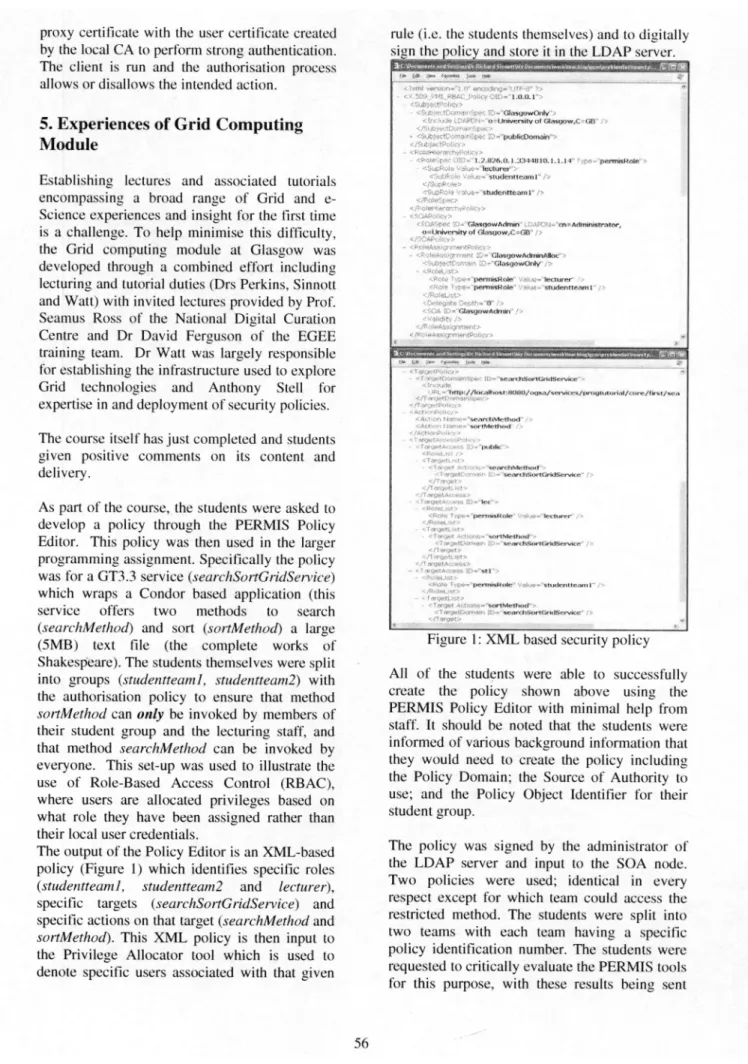
Theoutputofthe PolicyEditor isanXML-based
policy (Figure 1) which identifies specific roles
(studentteaml, studentteam2 and lecturer),
specific targets (searchSortGridService) and specificactionsonthattarget(searchMethodand
sortMethod). This XML policy is then input to
the Privilege Allocator tool which is used to
denote specific users associated with that given
rule(i.e. thestudentsthemselves)andtodigitally signthepolicyandstoreitin theLDAPserver.
Figure 1:XMLbased securitypolicy
All of the students were able to successfully
create the policy shown above using the
PERMIS Policy Editor with minimal help from staff. It should be noted that the students were
informedofvariousbackgroundinformation that
they would need to create the policy including
the Policy Domain; the Source of Authority to use; and the Policy Object Identifier for their
studentgroup.
The policy was signed by the administrator of
the LDAP server and input to the SOA node.
Two policies were used; identical in every
respect except for which team could access the
restricted method. The students were split into
two teams with each team having a specific
policy identification number. The students were
requestedtocritically evaluate thePERMIS tools for this purpose, with these results being sent
56 4ii<>ra,4.rP,r<-,.3eagsrndetternl, s9;iiS$ riOliS<47 4 o.4<.-Ji >D^' 44'>ge '-0-#erv;<r£ >X'W," '4.,ir44.4:' '7i'<''4i,4.I4 f i "''4'3'f.'i?gi' d> x4'IM*04*4, vS444r..ow di lit5a;" .4R44 444"0*fllUOk 4444 4444444. SOrMrho ;£ 474}tt',.,f <:S£ 44i4'awrn"i 'lAs¢444,<' '444SriA.. p,B,$4* II * cFZA7i444 .P3.:v >
*3-: 44444.; A.. == . i /';. ...i ii i i:fg .444444, -_4' bcrEMflbo
~~~~~~4nd,rtCtServ'ki~... ..., ,,a
-44.47 >.4a 4... f:
back to the PERMIS team for HCI
improvements and minor bug fixes, e.g. problems in cross platform (Unix/Windows) versions of the tool and functionality in the tool that has not yet been implemented (althoughthe
buttons/pull down menus exist). This
information has provided the most detailed exploration of PERMIS to date and is guiding futureworkonthePERMIStools.
The programming assignment that was used to
investigate Gridbasedsolutions wasbasedupon
exploring various performance aspects of
existing Grid middleware. Specifically the
studentswere towriteaJavabasedapplicationto perform two operations:
* search a text file (and retrievethe number oftimes a certain term occurs);
* sort the text file so that the terms and
number oftimes theyoccurisgiven.
Students were allowed to implement whatever
search/sorting algorithm they wished. Students werethenexpectedto:
* performbenchmarkingonthespeed ofthe
application on a single PC for searching
andsorting thetextfile;
* extend and parallelise the application to
make useof the training lab Condor pool
andperformbenchmarking;
* wrap the parallelised application as a
GT3.3 Grid serviceanddevelopaclientto testit and performbenchmarking;
* extend the GT3.3 based parallelised
application so that it uses the previously developedsecuritypolicy;
* extend the GT3.3 based parallelised application so that it supports individual security restrictions (can user X invoke
searchSortGridService)
through GSI.To allow the students to use the PERMIS infrastructure, they were issued with their own
individual certificatesandkeys, generatedfrom a
local CA.
At the time of writing, the student
implementations of this assignment have just
been completed. Itis clear thatthis hasproven to be a challenging assignment with somestudents beingable to getfurtherthan others. It should be noted that certain students did manage to complete their assignments. The overall
performance benchmarking of the impact on
distributing a search/sort job across a Condor
pool
anddelivering
this as an authorised Gridservice
(using PERMIS)
issignificant
however.6.
Conclusions and Future Plans
The GridComputing
module atGlasgow
University
hasprovided
a broad overview of thekey
concepts andchallenges
associated withGrids.The
exploration
oftheseconceptsthrough
existing
Grid middleware such as GT3 andCondorhas proventobea
challenge,
both for theeducators and the students themselves. It goes
without
saying
that the existence of a moremature Grid middleware and associated
standards would have
significantly
reduced the overheads inpreparing
this module and forflattening
the studentlearning
curve.The lecture material itself has been
developed
specifically
for advancedComputer
Scientistsand hence makes various assumptions on their
backgrounds.
The lecture material itself isavailable for download (see
http://csperkins.ora/teaching/2004-2005/gc5)
however it has a focus of advanced Grid
education as
opposed
to general Gridtraining.
Assuch,
the material isfocusedonchallengesof Gridtechnology
as opposed tobeing
moregeneral training
material.This work has also allowed exploration of
advanced authorisation infrastructures. The
existing
model of asingle
central CA forcertificates used in PKI based authentication is
not a scalable one, nor does it meet the
challenges
of Grid security. A more realisticmodel would be to have local CA infrastructure
to issue certificates, e.g. to students as part of
their matriculation. At Glasgow this has been
relatively
straightforward to achieve, howeverthere are issues in recognition of these
certificates
by
otherCAs,
e.g. the UK e-ScienceCA since no root of trust exists between these
CAs. Solutions to this problem might be based
uponsomeform of
bridging
technologies
[26].
Whilst PERMIS and APIs such as the GGF
SAMLAuthZ API supportageneric Grid based authorisation mechanism, there are likely to be
scalability issues in such solutions. Thus for example, theexpressionofpolicies ofindividual methods on individual services to specific end
users will have immediate maintenance and
performance overheads when such systems are
rolled out to hundreds or thousands of users
data sets. The data repository used for such
infrastructures will also need to be enhanced as
currently no tools exist that easily allow its
dynamic maintenance.
Another issue that has been fed back to the
PERMIS team and the wider authorisation
standards community is the ability to have
parameter-level authorisation (as opposed to the
purely method name based authorisation
supported bythe SAML AuthZAPI).This would
allow for greater flexibility and finer grained authorisationpossibilities.
In conclusion, there is a need for a core set of Grid and e-Science educational and training materials, as well as guidelines on how to establish local infrastructures for teaching
purposes. Whilst as demonstrated here, it is
possible to produce such materials and deploy the associated infrastructure, this is still
challenging. With the eventual consolidation of standards and associated technologies, it is
hopedthat thissituationimproves.
6.1
Acknowledgements
The authors would like to thank collaborators
from the PERMIS team (ProfDavid Chadwick and Dr Sassa Otenko) and the other Glasgow
Grid Computing lecturer (Dr Colin Perkins). This work was supported bythe JISC DyVOSE project [11] grant.
7.
References
[1] Johnston, W., Mudumbai, S., Thompson, M. Authorization and Attribute Certificates for Widely Distributed Access Control, IEEE 7th Int. Workshops
on Enabling Technologies: Infrastructure for Collaborative Enterprises, Stanford, CA, June, 1998, p340-345(http://www-itr.lbl.gov/securitv/Akenti/)
[2] L Pearlman, et al., A Community Authorisation Service forGroupCollaboration, in Proceedings of the IEEE 3rd Intermational Workshop on Policies for Distributed Systems and Networks. 2002.
[3] Lepro, R., Cardea: Dynamic Access Control in Distributed Systems, NASA Technical Report NAS-03-020,November2003
[4] Globus Grid Security Infrastructure, http:lwww-unix.globus.org/toolkit/docs/3.2/gsi/index.html [5] D.W.Chadwick, A. Otenko, E.Ball, Role-based
Access Control with X.509 Attribute Certificates,
IEEE IntemetComputing, Mar-April 2003, pp. 62-69. [6] D.W.Chadwick, A. Otenko, The PERMIS X.509 Role Based Privilege Management Infrastructure, Future Generation Computer Systems, 936 (2002)
1-13,December2002. Elsevier ScienceBV.
[71 Privilege and Role Management Infrastructure Standards Validationprojectwww.permnis.org [8] VOMS Architecture, European Datagrid Authorization Workinggroup, 5 September 2002. [91 Steven Newhouse, Virtual Organisation Management, The London E-Science centre, http://www.lesc.ic.ac.uk/proiects/oscar-n.html.
[11] Dynamic Virtual Organisations in e-Science
Education project (DyVOSE),
www.nesc.ac.uk/hub/pr-)jects/dvvose
[12] Globus,http:H/www.g.obus.org
[13] R. Housley, T. Polk, Planning for PKI: Best Practices Guide for Deploying Public Key Infrastructures,Wiley Computer Publishing, 2001. [14] ITU-T Recommendation X.509 (2001)
1
ISO/IEC 9594-8: 2001, Information technology - Open Systems Interconnection - Public-Key and Attribute Certificate Frameworks.[15] JISC Authentication, Authorisation and Accounting (AAA) Programme Technologies for Information Environment Security (TIES),
htto://www.edina.ac.uklprojects/ties/ties 23-9.pdf.
[16]Whitten, A.,andTygar, J. D. Why Johnny can't encrypt: a usability evaluation of PGP 5.0. Paper presented at the gth USENIX security symposium, Washington, 1999.
[17] D. Chadwick,0. Otenko, A Comparison of the Akenti and PERMIS Authorization Infrastructures, in EnsuringSecurity in IT Infrastructures, Proceedings of ITI First IntemationalConferenceonInformation and Communications Technology (ICICT 2003) Cairo University,Ed.Mahmoud TEl-Hadidi,pS-26,2003 [18] Conceptual AuthZ Framework and Classification,
https://forge.gridforum.org/docman2/ViewCategory.p hp?groupi_d=55&categorv id=458
[19] A.J. Stell, Grid Security: An Evaluation of Authorisation Infrastructures for Grid Computing, MScDissertation,University of Glasgow, 2004. [20] ITU-T Rec. X.509 (2000) 1ISO/IEC 9594-8. The Directory:Authentication Framework.
[21] UKe-Science CertificationAuthority.
www.grid-supportac.uk
[221 ITU-T Rec X.812 (1995) ISO/IEC 10181-3:1996, Security Frameworks for open systems: Access control framework
[23]V.Welch, F. Siebenlist. D. Chadwick, S. Meder, L.Pearlman, Use of SAML for OGSA Authorization, June 2004,
https://forge.gridforum.org/projects/orsca-authz[24] OASIS. Assertions and Protocol for the OASIS SecurityAssertionMarkup Language (SAML)vi.1,.2 September 2003, http:flwww.oasis-open.org/committees/securitv/
[25] OpenSSL to create certifilcates,
ht.tp://www.flatmtn.com/computer/Lin.uix-SSLCertificates.html
[26]J.Jokl,J.Basney and M. Humphrey, Experiences
using Bridge CAs for Grids, Proceedings of UK
Workshop on Grid Security Practice - Oxford, July
2004