1
APPLICATION OF AHP FOR DETERMINING THE BEST OF PALM OIL FRESH FRUIT BUNCH
SITI HADIJAH BINTI NORSANI
A thesis submitted
in fulfillment of the requirements for the degree of Master of Manufacturing Engineering (Manufacturing System Engineering)
Faculty of Manufacturing Engineering
UNIVERSITI TEKNIKAL MALAYSIA MELAKA
i ABSTRACT
This study covers the importance of high quality of palm oil Fresh Fruit Bunches (FFB) to ensure high production in palm oil industry. The level of palm oil FFB maturity will affect to oil extraction rate (OER) which is the main key performance indicator for palm oil industry. The most important process to classify the palm oil FFB ripeness is the grading process. Therefore, the quality grading process of FFB needs to be conducted properly to ensure that high-quality palm oil FFB is selected for production. Usually, the grading process performed by some graders in each mill manually. A sample from each lorry was taken in the grading process. However, this method takes time and may lead to errors in the classification process, especially if the graders have less experience. One of the useful tools that can be employed to make decisions in classification process is Analytical Hierarchy Process (AHP). The main concern was to ensure the reliability of AHP technique achievable. The methodology in this study consists of five phases ie; data collection from expert grader and industries visited, identifying the most important criteria, analysis by AHP method, validation by TOPSIS technique and finally the ranked of the best criteria of high quality FFB. The Expert Choice Software and Microsoft Office Excel are tools that used to analyze the data collected from expert graders in the AHP and TOPSIS technique. The main objective of this study is to determine the best quality of FFB using AHP. The result found that the number of detached fruitlets is the most important criteria to determine the FFB ripeness with 0.560 priority vector followed by color with 0.219 priority vector compared to other criteria. The sensitivity analysis performed to ensure the results are consistent and reliable. It will help the graders to conduct a proper grading process at mills to increase the quality of OER.
ii ABSTRAK
Kajian ini meliputi kepentingan minyak sawit Buah Tandan Segar (BTS) berkualiti tinggi untuk memastikan pengeluaran yang tinggi dalam industri minyak sawit. Tahap kematangan minyak sawit BTS akan memberi kesan kepada kadar perahan minyak (OER) yang merupakan utama penunjuk prestasi utama bagi industri minyak sawit. Proses yang paling penting untuk mengklasifikasikan kematangan BTS adalah proses penggredan. Oleh itu, proses penggredan bgi menentukan kualiti BTS perlu dijalankan dengan baik untuk memastikan bahawa BTS yang berkualiti tinggi dipilih untuk pengeluaran minyak. Biasanya, proses penggredan dilaksanakan oleh beberapa penggred di setiap kilang secara manual. Sejumlah sampel daripada setiap lori telah diambil dalam proses penggredan. Walau bagaimanapun, kaedah ini mengambil masa dan boleh menyebabkan kesilapan dalam proses klasifikasi, terutamanya jika penggred kurang mempunyai pengalaman. Salah satu kaedah berguna yang boleh digunakan untuk membuat keputusan dalam proses pengelasan adalah Proses Analisis Hierarki (AHP). Kebimbangan utama adalah untuk memastikan kebolehpercayaan teknik AHP dicapai. Metodologi dalam kajian ini terdiri daripada lima fasa iaitu: pengumpulan data dari pakar penggred dan lawatan industri, mengenalpasti kriteria yang paling utama, menganalisis dengan kaedah AHP, pengesahan dengan teknik untuk keutamaan perintah oleh persamaan dengan penyelesaian yang ideal (TOPSIS) dan akhirnya menentukan kedudukan kriteria BTS berkualiti tinggi. Perisian Expert Choice dan Microsoft Office Excel adalah alat yang digunakan untuk menganalisis data yang diperoleh daripada penggred pakar dalam teknik AHP dan TOPSIS. Objektif utama kajian ini adalah untuk menentukan yang kriteria kualiti BTS terbaik menggunakan AHP. Hasilnya mendapati bahawa jumlah soket gugur adalah kriteria yang paling penting untuk menentukan kematangan BTS dengan vector keutamaan 0.560 diikuti oleh warna dengan vector keutamaan 0.219 berbanding kriteria lain. Analisis sensitiviti dilakukan untuk memastikan keputusan yang konsisten dan boleh dipercayai. Ia akan membantu penggred untuk menjalankan proses penggredan yang betul di kilang-kilang bagi meningkatkan kualiti OER.
iii
ACKNOWLEDGEMENTS
Firstly, thanked to Allah S.W.T because of His bless and gives me a good health while I am doing this project. I also would like to take this opportunity to express my sincere acknowledgement to my supervisor Associate Professor Dr. Hambali Bin Arep @ Ariff from the Faculty of Manufacturing Engineering Universiti Teknikal Malaysia Melaka (UTeM) for his essential supervision, support and encouragement towards the completion of this thesis. Particularly, I would also like to express my deepest gratitude to Mr. Azmi Bin Harun (Senior grader at Kilang Ladang Kota Bahagia), Mr. Razali Bin Siham (Supervisor at Kilang Sawit Keratong 2), Mr. Mohd Faizol Hisham Bin Che Mat (Senior grader at Kilang Sawit Keratong 3) and Mr. Mohamad Ikhwan Bin Zakaria (Assistant Manager at Kilang Sawit Keratong 9), for their assistance and efforts in all the information and data collection process,gives the great cooperation during the site visit at the factory and good advices in analysis works.
Special thanks to my beloved husband, Ahmad Khomeini Bin Abdul Manaf with his endless patience; love and lack of attention just to provide me a confidence that I need to complete this thesis. Also to my kids and my loving family for their understanding and become impetus to me. To all my peers, my late father, beloved mother and siblings for their moral support in completing this master. Lastly, thank you to everyone who had been to the crucial parts of realization of this project.
iv TABLE OF CONTENTS PAGE DECLARATION DEDICATION ABSTRACT i ABSTRAK ii ACKNOWLEDGEMENTS iii TABLE OF CONTENTS iv LIST OF TABLES vi
LIST OF FIGURES viii
LIST OF APPENDICES x LIST OF ABBREVIATIONS xi CHAPTER 1. INTRODUCTION 1 1.1 Background 1 1.2 Problem Statement 2 1.3 Objective 3 1.4 Scope 4 1.5 Significant of study 4 2. LITERATURE REVIEW 5 2.0 Introduction 5
2.1 Palm Oil Fruit Bunch Classes 5
2.2 Fruit Grading System 8
2.3 Analytic Hierarchy Process (AHP) 10
2.4 AHP in Palm Oil Industry 14
2.5 TOPSIS Technique 15 2.6 Summary 17 3. METHODOLOGY 18 3.0 Introduction 18 3.1 Framework of Study 18 3.2 Data Collection 20
3.3 Model Development AHP for high-quality palm oil 20 Fruit selection
3.4 Analysis technique 23
3.4.1 Expert Choice Software 23
3.4.2 TOPSIS Technique 25
3.5 Summary 26
4. RESULTS AND ANALYSIS 27
4.1 Data Finding 27
4.1.1 Color of mesocarp 27
v
4.1.3 The number of detached fruitlets 28
4.1.4 The surface condition 29
4.1.5 The freshness of peduncle bunch 30
4.2 Sample of Fresh Fruit Bunch (FFB) 31
4.3 Grading Process 34
4.4 Analytical Hierarchy Process Procedure 36
4.5 Sensitivity Analysis 47
4.6 Validation of the results using TOPSIS method 52
5. CONCLUSION AD RECOMMENDATION 59
REFERENCES 61
vi
LIST OF TABLES
TABLE TITLE PAGE
2.1 Bunches Classification 6
2.2 Grading Standard used by MPOB 7
2.3 The fundamental scale of absolute number 12
4.1 The size of the bunch 28
4.2 The category of number of detached fruitlets 29
4.3 The criteria for the six samples 32
4.4 Rank for each criterion to select the best FFB 37 4.5 The pairwise comparison of criteria with respect to overall goal 38 4.6 Pairwise comparison the relative preference of samples 40 with respect to color
4.7 Pairwise comparison the relative preference of samples 41 with respect to size
4.8 Pairwise comparison the relative preference of samples 42 with respect to detached fruitlets
4.9 Pairwise comparison the relative preference of samples 43 with respect to surface
vii with respect to peduncle bunch
4.11 Ranking of the best FFB from TOPSIS analysis 58
4.12 The ranking of the best FFB 58
viii
LIST OF FIGURES
FIGURE TITLE PAGE
3.1 Framework of study 19
3.2 A hierarchical model of decision making problem concerning 21 high-quality palm oil fruits
3.3 Decision process using Expert Choice Software 23 4.1 Example of a bunch with dirty surface condition 30
4.2 More than 5 cm of bunch peduncle 31
4.3 a) Empty Fruits Bunches 32
b) Bunches Foul 32
4.4 Flow chart of Grading Process 35
4.5 A hierarchical model for the selected of high quality palm oil fruits 36 4.6 a) Pairwise comparisons of criteria with respect to goal by Expert Choice 39 b) The priorities of criteria with respect to goal 39 4.7 a) Pairwise comparisons the relative preference of sample with respect 40
to color by expert choice software
b) The priorities of samples with respect to color 41 4.8 a) Pairwise comparisons the relative preference of sample with respect 41
ix to Size by expert choice software
b) The priorities of samples with respect to size 42 4.9 a) Pairwise comparisons the relative preference of sample with respect 42
to Detached Fruitlets by expert choice software
b) The priorities of samples with respect to detached fruitlets 43 4.10 a) Pairwise comparisons the relative preference of sample with respect 43
to Surface by expert choice software
b) The priorities of samples with respect to surface 44 4.11 a) Pairwise comparisons the relative preference of sample with respect 44
to Peduncle Bunch by expert choice software
b) The priorities of samples with respect to peduncle bunch 45 4.12 Priority vector and consistency test for the main criteria with respect 45
to goal (CR=0.1 with 0 missing judgement)
4.13 Synthesis with respect to goal 46
4.14 a) Dynamic sensitivity for main criteria with respect to goal 47 b) Sensitivity graph of main criteria with respect to goal 47 4.15 Priority Vector of DF is increased and reduced by 30% 49 4.16 Priority Vector of CR is increased and reduced by 30% 50 4.17 Priority Vector of SZ is increased and reduced by 30% 50 4.18 Priority Vector of PB is increased and reduced by 30% 51 4.19 Priority Vector of SF is increased and reduced by 30% 52
4.20 Priority Vector of DF is reduced by 89% 52
x
LIST OF APPENDICES
APPENDIX TITLE PAGE
A Sets of questionnaire 70
B FFB Receipts By Felda Global Ventures Plantations 86
C Calculation of AHP using Microsoft Excel 87
xi
LIST OF ABBREVIATIONS
A+ Ideal solutions
A- Negative ideal solution AHP Analytical Hierarchy Process CI Consistency index
CR Color
DF Detached Fruitlets FFB Fresh fruit bunch
PB Peduncle bunch
RCi Relative closeness
RI Random index
SF Surface condition
1 CHAPTER 1
INTRODUCTION
1.0 Introduction
This chapter presents the introduction of the best selection of high-quality palm oil fresh fruit using analytical hierarchy process (AHP). In part, the briefing of the background, problem statement, objective, scope of the project and significance of the study are discussed.
1.1 Background
Malaysian Palm Oil Board (MPOB) is the premier government agency entrusted to serve the country’s oil palm industry. MPOB was incorporated by an Act of Parliament (Act 582) and established on 1 May 2000, taking over, through a merger, the functions of the Palm Oil Research Institute of Malaysia (PORIM) and the Palm Oil Registration and Licensing Authority (PORLA). Improve production efficiency and quality of products is one of the MPOB strategies to become a globally competitive and sustainable oil palm industry country.
From the Overview of the Malaysian Oil Palm Industry (2015), oil palm planted area in 2015 reached 5.64 million hectares, an increase of 4.6% as against 5.39 million hectares recorded in the previous year. This was mainly due to the increase in new planted areas, especially in Sarawak, which recorded an increase of 13.9%. Sabah is still the largest oil palm planted state, with 1.54 million hectares or 27% of the total oil palm planted area, followed by Sarawak with 1.44 million hectares or 26%, while Peninsular Malaysia accounted for 2.66 million hectares or 47%.
2
A key performance indicator for the palm oil industry is its oil extraction rate (OER), which has remained lackluster at below 20.5 per cent. The Entry Point Project (EPP) aims to increase OER to 23 per cent by 2020, chiefly by getting more mills certified under the MPOB’s Code of Practice. However, the national OER in 2015 declined by 0.8% to 20.46 percent, mainly due to lower quality of fresh fruit bunches (FFB) processed by mills (MPOB, 2016) . OER in Peninsular Malaysia and Sarawak decreased by 0.9% and 1.4% to 20.01% and 20.15% respectively. FFB maturity level is very important to improve the quality and quantity of OER in the palm oil industry. So, MPOB’s always ensure that only high quality and ripe fresh fruit bunches are accepted and processed at all mills.
1.2 Problem Statement
Research conducted by the Federal Land Development Authority (FELDA) at mills shows the estimated oil content for ripe fruit is 60%, while under ripe is 40% and unripe is only 20% minus water and dirt (Mohamad et al., 2012). This indicates the importance of the right classification of FFB during grading process to ensuring optimum yield of high quality oil.
Color is one of the most significant criteria to fruit identification and the best indicator of fruit quality and ripeness. The color of the oil palm fruits remains one of the important factors which determine the grade and quality of the palm oil. The three different classes, maturity of oil palm fruit considered are under ripe, ripe and over ripe. The current practice in the oil palm industry to grade the FFB at the mill are manually using human graders based on visual inspection of a sample of the FFB per lorry load. This method is subjective and inconsistence because each grader has its own technique based on their experience. Hence, it affects the quality and quantity of the oil that can be extracted.
3
According to MPOB manual, the grading process can only be performed by the grading staff of the mill that has the capability and experience in the grading of FFB. Grading process is a process wherein FFB is assessed and classified according to criteria of ripeness and bunch quality. The grading process must be handled properly to select the best quality FFB and to remove defective units that show signs of noncompliance with the standard criteria (Nureize et al., 2010). Unfortunately, the grading processes are conducted manually and the human mistakes might occur. With only one or two staff handling the grading proses with tens lorry a day leads to misconduct and human error while inspecting the right category of FFB for the purpose of oil palm production at the mill. Error in classifying the right category of FFB will cause error in estimating the oil quality.
In order to ensure the right classification of FFB ripeness, the grading system uses the application of Analytic Hierarchy Process (AHP) as an effective tool for determining the best of palm oil FFB will be developed. The ability of the AHP to evaluate the best selection of palm oil FFB based on several quantitative and qualitative criteria would be assisted and improved the quality inspection process.
1.3 Objective
The main objective of the project is to determine the best high quality FFB using AHP. Therefore, this study are:
a) To study the different classes maturity of oil palm fresh fruit bunches are under ripe, ripe and over ripe.
b) To determine the main criteria of oil palm fresh fruit bunches in order to meet the industrial standard.
4
c) To build a hierarchical evaluation model that characterizes the best criteria of oil palm fruits.
1.4 Scope
This study was carried out on and limited to fresh fruit bunches (FFB) based on three categories which is under ripe, ripe and over ripe. The data and samples of FFB for research were obtained from Kilang Sawit Felda Keratong 2, Kilang Sawit Felda Keratong 3, Kilang Sawit Felda Keratong 9, and Kilang Sawit Ladang Kota Bahagia, Pahang. This research intended to assist graders in performing grading process for oil palm at mills.
1.5 Significant of study
This study significant to give an alternative to oil palm industries to improve the grading system of oil palm fruit by using hierarchical evaluation model performed to standardize the quality of maturity of oil palm fruits.
5 CHAPTER 2
LITERATURE REVIEW
2.0 Introduction
This chapter presents the review study related by other researchers. There are basically containing four main sections in this chapter, such as Oil Palm Fruit Bunch Classes, Fruit Grading System, Analytic Hierarchy Process (AHP) and AHP in Palm Oil Industry.
2.1 Palm Oil Fruit Bunch Classes
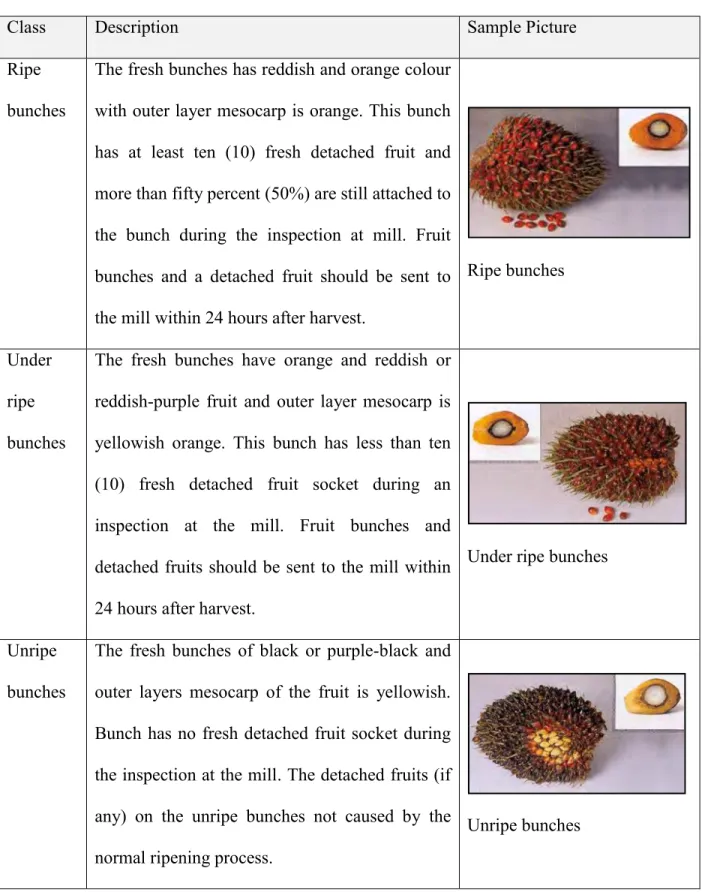
The maturity level of the oil palm fruit is divided into three main classes in overripe, ripe and under ripe. Therefore, MPOB has provided Manual Grading of Palm as a practical guide for grading oil palm in the mills. This is to improve the quality of oil palm fruits which are sold to the mill and to improve the quality of Malaysia's crude palm oil production. By referring to Oil Palm Fruit Grading Manual (MPOB, 2003), the oil palm grading classified into certain classes based on the bunch such as ripe bunches, under ripe bunches, unripe bunches, and overripe bunches. Table 2.1 explains the classification of oil palm fruit according to MPOB grading manual.
6
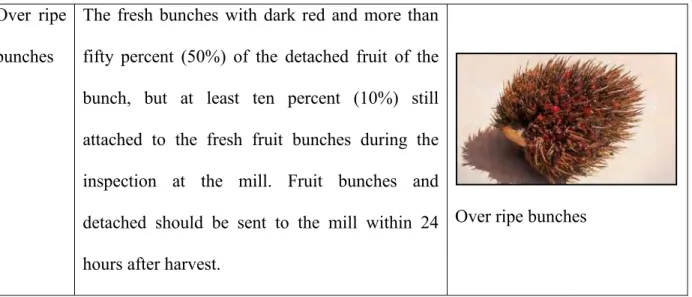
Table 2.1: Bunches Classification (MPOB, 2003)
Class Description Sample Picture
Ripe bunches
The fresh bunches has reddish and orange colour with outer layer mesocarp is orange. This bunch has at least ten (10) fresh detached fruit and more than fifty percent (50%) are still attached to the bunch during the inspection at mill. Fruit bunches and a detached fruit should be sent to the mill within 24 hours after harvest.
Ripe bunches
Under ripe bunches
The fresh bunches have orange and reddish or reddish-purple fruit and outer layer mesocarp is yellowish orange. This bunch has less than ten (10) fresh detached fruit socket during an inspection at the mill. Fruit bunches and detached fruits should be sent to the mill within 24 hours after harvest.
Under ripe bunches
Unripe bunches
The fresh bunches of black or purple-black and outer layers mesocarp of the fruit is yellowish. Bunch has no fresh detached fruit socket during the inspection at the mill. The detached fruits (if any) on the unripe bunches not caused by the normal ripening process.
7 Over ripe
bunches
The fresh bunches with dark red and more than fifty percent (50%) of the detached fruit of the bunch, but at least ten percent (10%) still attached to the fresh fruit bunches during the inspection at the mill. Fruit bunches and detached should be sent to the mill within 24 hours after harvest.
Over ripe bunches
Noor Hasmiza Harun (2013) summarizes the grading standard used by MPOB as in Table 2.2 were applied two methods for expressing the number of loose fruit sockets in determining the maturity of oil palm FFBs. One method is the number of loose fruits on the ground before the oil palm FFB is harvested while the second method is by the number of loose fruit sockets on the bunch. The mesocarp color for FFB also categorized.
Table 2.2: Grading standard used by MPOB (Noor Hasmiza Harun, 2013) Grading Method Total Number of
Empty Fruitlet Sockets Yellow Mesocarp Color Yellowish/
orange Orange Number of loose fruits
socket on the bunch 0 – 10 0 Unripe Unripe Unripe Under-ripe Ripe Ripe
>10 Unripe Ripe Ripe
Number of loose fruits
socket on the bunch Ripe 10% - 50% of fruits detached from bunch Over-ripe 50% - 90% of fruits detached from
bunch
8 2.2 Fruit Grading System
Several methods focused on fruit classification are described in the literature. Color is one of the main elements in grading process to determine the level of fruit maturity. Chandra Sekhar Nandi et al. (2014) studied about Recursive Feature Elimination (RFE) technique with Support Vector Machine (SVM) to classified mango fruit grading. The authors get 96% accuracy of maturity prediction with this technique. Meanwhile, Leeman et al. (2002) used Machine Vision to sort apple grading into four classes according to European standards. The researcher used six steps to achieve the fruit grading: image acquisition; color classification; defect segmentation; calyx and stem recognition; detects characterization and finally the fruit classification into quality classes. By this method, the results reach 78% of correct classification rates. Quite the opposite, Manuela Baietto (2015) had studied an Electronic-Nose Applications for fruit identification, ripeness and quality grading. However, this method limited to fruit that has a special aroma and flavor characteristic.
There have been several studies conducted for oil palm classification using an automated system to make decision making for grading method. May et al. (2011) developed an Artificial Intelligence using RGB Color Model and Fuzzy Logic as a decision making method to make the classification of oil palm fruits. This technique yielded 86.6% correct classification. However, Nursuriati Jamil et al. (2009) get an average 49% success rate using RGB while achieved an accuracy level of 73,3% by using Neuro-fuzzy approach in their study. While, Rashid (2015) has used Advanced Technique and Technology as an automatic grader and sorting system that separates between the different quality of FFB. This technique also uses RGB Color Model to distinguishes the level of oil palm ripeness and Artificial Neural Network (ANN) as a decision making. This was go along with by Norasyikin Fadilah
9
et al. (n.d.) and Meftah Salem et al. (2008) in their study, which used the same RGB Color Model in an automated grading system for oil palm fruit bunches.
Novel Inductive Concept frequency Technique is other method proposed by Noor Hasmiza Harun et al. (2013) to grading oil palm FFB. The research design a sensor exhibits significant potential in determining the maturity of oil palm fruits. In addition, applications in machine vision based systems in automatic grading machine for oil palm FFB have been reported by Muhammad Makky et al. (2013). The authors use Indonesian Oil Palm Research Institute (IOPRI) standard as a guideline to group classification of FFBs. The result achieved to an average success rate of 93.53%. Photogrammetric grading system also been studied by Roseleena et al. (2011) as a method to classify oil palm fresh fruit bunches. By this method, reseachers gets the fruit classification ability of the system yields above 90% accuracy and taking not more than 25 second to classify and sort each fruit.
Although many researchers have studied the ability to automate the grading method of oil palm fruits with a variety of approaches, implementation of automation to replace manual methods are still vague. It is because the limitation of the automated grading method found in previous studies. Rosdiyana et al. (2003) state in their study that to develop the grading system using computer vision techniques to evaluate the oil palm fruit maturity, the palm oil fruit bunch images need to be processed using image processing methods, which are the combination of color intensities, and filtering technique to cluster the pixels with red color. Meanwhile, Roseleena at al. (2011) found some problem when using photogrammetric to grading oil palm FFB in their research. The main problem is difficult to control the movement of the fruits from the feeder section to the inspection chamber. Therefore, they needed manual assistance or human intervention for the fruits to be properly aligned; so that the fruits are able to roll down, stop and transport to the desired position which is located approximately in the
10
middle of the inspection chamber. The wrong aligned fruit will cause misclassification and data can not be compute for that particular item due to technical error.
May et al. (2011) used Artificial Intelligence as an automated oil palm fruit grading system, found a problem due to the fruit color lies in between under ripe and ripe categories. This matter led the results being misclassify of fruit category. In addition, researchers suggested that the result from the fuzzy logic system then re-evaluated using the human graders to ensure the accuracy.
As of this limitation, this study will be focusing on decision making of selecting the best palm oil fruit bunches based on factors that will be detailed in next chapter.
2.3 Analytic Hierarchy Process (AHP)
The decision making process is an important issue, especially in quality or standard level of a thing. For example, in the product manufacturing, the decision making process focuses on producing quality products in achieving the prescribed benchmark. Plus, the decision making process is also used for evaluation of agricultural products and plays a pivotal role in agricultural production (Nureize et al., 2010). For oil palm fruit grading, the quality inspection process of FFB needs to be conducted properly to ensure that high-quality bunches are selected for production.
There are various methods of decision-making. One of the methods is by using Analytical Hierarchy Process (AHP). According to Saaty (1990), AHP is a multicriteria decision making method in which factors are arranged in a hierarchic structure. For this part, the ability to choose the most important factors in accordance with criteria to achieve the goals is very important. Saaty (2008) had listed the following steps to make a decision in an organized way to generate priorities.
11
i. Define the problem and determine the kind of knowledge sought.
ii. Structure the decision hierarchy from the top with the goal decision, then the objectives from a broad perspective, through the intermediate levels to the lowest level.
iii. Construct a set of pairwise comparison matrices. Each element in an upper level is used to compare the elements in the level immediately below with respect to it. iv. Use the priorities obtained from the comparisons to weigh the priorities in the
level immediately below. Do this for every element. Then for each element in the level below add its weighed values and obtain its overall or global priority. Continue this process of weighing and adding until the final priorities of the alternatives in the bottom most level are obtained.
In previous studies, the Analytic Hierarchy Process (AHP) was employed by Andi Arpan et al. (2016) to select the best postharvest method for preserving citrus fruits in Ehime, Japan. Among the criteria of selecting postharvest technology method chosen by the researchers are; improving quality, increasing shelf life, reducing cost and applicability for citrus fruits category. The finding showed the most importance criteria for selecting postharvest technology is improving quality followed by applicability, increasing shelf life and reducing cost accordingly.
Fresh fruit bunch is the initial input for crude palm oil production, hence, it is crucial to select the only high-quality fruit bunch to be processed. The higher quality fresh fruit bunches will be produced higher quantity and quality of palm oil (Abdullah et al., 2011 cited by Nureize et al., 2010). Fresh fruit bunches are normally evaluated using visual examination based on standard factors such as mesocarp color, size, number of detached fruitlets from
12
bunch, surface appearance and disease. Each factor carries a different weigh of priorities in the evaluation.
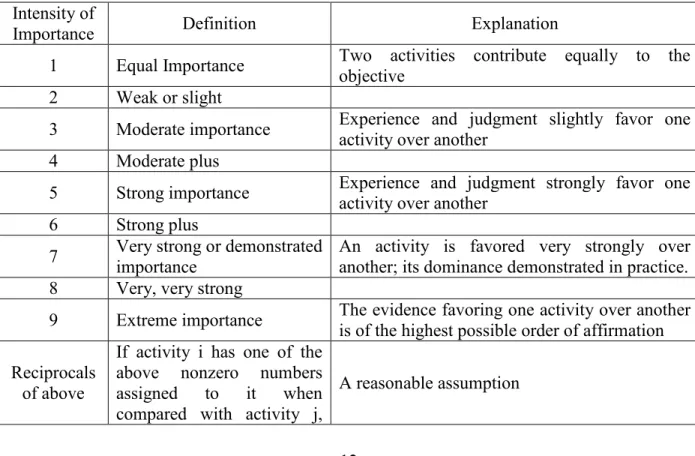
According to Asma (2006), AHP is a decision-making method that involves criteria and alternative to choose form. The criteria have different importance and the alternatives in turn, differ in preference for them on each criterion. So, on applying the AHP, the best selection of high-quality oil palm FFB sets as a goal at the top structures following the criteria like color, size, number of detached fruitlets, surface appearance and disease and alternatives of choice at the bottom. The elements in each level are compared pairwise with respect to their importance to an element in the next higher level, starting at the top of the hierarchy and working down. The number is shown in Table 2.3, used to express how much one element dominates another with respect to a common criterion.
Table 2.3: The fundamental scale of absolute numbers. (Asma, 2006) Intensity of
Importance Definition Explanation
1 Equal Importance Two activities contribute equally to the objective 2 Weak or slight
3 Moderate importance Experience and judgment slightly favor one activity over another 4 Moderate plus
5 Strong importance Experience and judgment strongly favor one activity over another 6 Strong plus
7 Very strong or demonstrated importance An activity is favored very strongly over another; its dominance demonstrated in practice. 8 Very, very strong
9 Extreme importance The evidence favoring one activity over another is of the highest possible order of affirmation Reciprocals
of above
If activity i has one of the above nonzero numbers assigned to it when compared with activity j,