ISSN (Online): 2320-9364, ISSN (Print): 2320-9356
www.ijres.org Volume 6 Issue 7 Ver. I ǁ 2018 ǁ PP. 01-13
Analysis of PV Modules Performance in Nigeria: A Guide for
Suitable System Design and Module Specifications Selection
Nduka O. Arinze
1, & Mohamed Emad Farrag
2,
1National Agency for Science and Engineering Infrastructure (NASENI) Solar Energy Limited, Nigeria. 2School of Engineering and Built Environment, Glasgow Caledonian University, Glasgow UK. Email:
Corresponding Author:Nduka O. Arinze
Abstract:
Photovoltaic (PV) cells and modules are used to generate electricity directly from the sun (solar energy). These cells and modules are tested by their manufacturers typically at 1000W/m2 solar radiation, 25oC PV-module temperature and about 1m/s wind speed (air mass of 1.5) as the Standard Test Conditions (STCs). However, the outdoor operating conditions for an installed PV module is not controlled and therefore, vary with the above standard conditions. The climatic factors influencing the performance of a PV module are mainly ambient conditions (available solar radiation at the selected location) and the location based PV-module temperature. Thus, this work uses the daily meteorological data (ambient temperature, solar radiation and wind speed) of eight Nigerian cities to calculate city-based PV-module temperature, which in-turn is used with the solar radiation data to simulate the electrical outputs and efficiencies of the three commercially available PV Module types in Nigeria. The simulated open circuit voltage Voc, short circuit current Isc, actual/real power output and efficiency of monocrystalline, polycrystalline and amorphous silicon PV modules, 100W each, are presented in this work. The city based results have been analysed in each month of the year. The analysis showed that PV-module temperature has less impact on amorphous silicon PV module’s actual power output, but the most impact is on that of polycrystalline silicon module. Also, months and locations with high module temperature, recorded low efficiency and Voc, however, high efficiency and Voc were recorded for months and locations with low module temperature. On the other hand, months and locations with high solar radiation, recorded better real power and Isc. Thus, decisions on PV specifications and PV array design suitable for any of the locations studied in this work should be guided by the above facts; in consideration of the negative and positive impacts due to the variations between the STCs and actual operation conditions.Key words:
Photovoltaic Cells, module temperature, STCs, climate data.--- --- Date of Submission: 20-07-2018 Date of acceptance: 03-08-2018 ---
---I.
INTRODUCTION
Nigeria is blessed with reasonable amount of sun shine, both during the dry and rainy seasons. Nigeria has average daily sunshine hours of 6.25 hours anually; 9.0 hours in the far northern region and 3.5 hours in the coastal areas (Bala et al, 2000). Solar PV technology converts solar energy directly to electricity through PV Cells (connected together to form a PV module). PV modules are exposed to capture the energy from the sun (solar energy) by installing them outdoor where they can receive every available sun ray. The capturing of solar radiation by the PV cells/modules results into electric power output.
The performance of a PV module strongly depends on ambient conditions such as available solar radiation at the selected location and the location based PV-module temperature (Zhou et al, 2007). According to Bücher (1997), the Standard Test Conditions (STCs) used in the rating of PV-modules are mainly 1000W/m2 irradiation and 25oC PV-module temperature. Obviously, the STCs vary with the real outdoor conditions of locations, days, and months in Nigeria. It is very needful to have a reliable knowledge and understanding of the PV-module performance under the actual climatic conditions for correct product selection criteria and accurate prediction of their energy performance (Zhou et al, 2007).
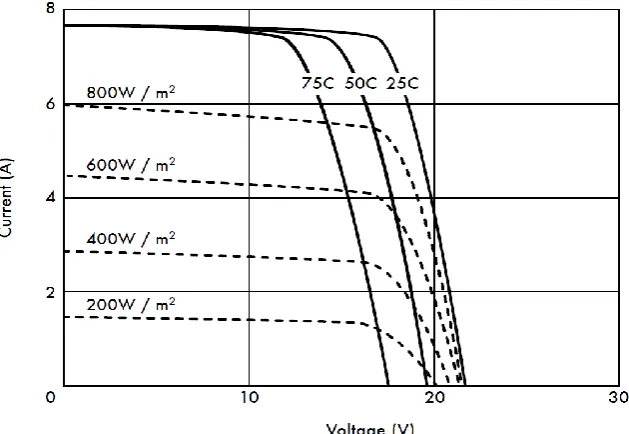
are solar irradiance of 1000W/m2 and module temperature of 25oC. Figure 1 shows a typical I-V curves for a PV cell/module at different solar radiations and temperatures.
: Solar Radiation at 1000W/m2 and different Temperatures
- - - -
: Cell/Module at 25oC and different RadiationsFig 1: typical I-V curve for current at different solar radiations and voltage at different cell/module temperatures. Source: wndw.net/pdf/wndw2-en/ch07-solar.pdf
The PV-module temperature is commonly calculated using:
T𝑚= 𝑇𝑎𝑚𝑏 +
NOCT-20
800 *G(W/m
2) (1)
Where Tm = PV-module temperature
Tamb = ambient temperature
NOCT = Normal Operating Cell Temperature of the PV module G = Solar irradiance (in W/m2)
NOCT is defined as the mean solar cell junction temperature within an open-rack mounted PV module in Standard Reference Environment (SRE) which include tilt angle at normal incidence to the direct solar beam at local solar noon, total irradiance of 800 W/m2, ambient temperature of 20oC and wind speed of 1 m/s at no electrical load (Garcia et al, 2004). It is usually included in PV module data sheets by manufacturers. Obviously, the conditions used to calculate NOCT vary with the outdoor condition where the PV modules are installed. Thus, researchers have made efforts to develop models for calculating the PV-module temperature through actual field measurements and thermal modelling.
The model that seems more acceptable was developed by King et al, (2004) at Sandia National Laboratory (SNL), USA; as testified by Skoplaki and Palyvos (2009).
Where: T
m = Back-surface module temperature, (°C). T
a = Ambient air temperature, (°C)
E = Solar irradiance incident on module surface, (W/m2) WS = Wind speed measured at standard 10-m height, (m/s) a and b are constants which depend on mount type.
For open-rack mount, equation (2) is given by:
T𝑚 = T𝑎+ E ∗ e(−3.473 −0.0594∗WS ) (3)
Electric power (active), is the product of electric current flowing into and the voltage across the PV terminals. PV modules are described based on their rated maximum power and the peak power outputs without any losses (usually theoretical). The rated maximum power is given by:
P𝑚 = I𝑚 ∗ V𝑚 (4)
Where;
Im= rated maximum power current, Vm = rated maximum power voltage
Whereas the theoretical peak power output of a PV module is given by:
P = I𝑠𝑐 ∗ V𝑜𝑐 (5)
Where;
Isc = short circuit current, Voc= open circuit voltage.
However, given the solar irradiance of a location (G, in W/m2), the estimated outdoor/site maximum power output of a PV panel with area (A, in m2) and efficiency (η, in %) is given by:
𝑃 = 𝐺 ∗ 𝐴 ∗ 𝜂 (6)
The open circuit voltage (Voc) in equation (5) at any given climatic/outdoor condition, is given by: V𝑜𝑐(at T𝑚) = V𝑜𝑐 STC − K ∗ (T𝑚− 25) (7)
Where;
Voc(STC) = rated open circuit voltage at 25oC, Tm = module temperature, and
K= Temp coeff (i.e. the rate of decrease in voltage per oC rise in temperature).
The short circuit current of PV module in equation (5) at any condition is given by:
I𝑠𝑐 (at G) = I𝑠𝑐 (STC) ∗ G
1000 (8) Where;
Isc(STC) = the rated short circuit current at irradiance of 1000W/m
2
G = the actual recorded solar irradiance (in W/m2) at a particular time and location.
The maximum power a PV module can produce under the actual outdoor operating conditions is given by: P𝑚𝑝 = I𝑠𝑐(at G) ∗ V𝑜𝑐(at T𝑚) ∗ FF (9)
Where;
Isc(at G) = the short circuit current at the actual solar irrediance G(W/m2), Voc(at Tm) = the open circuit voltage at the actual PV-module temperature and
FF = fill factor of the PV module .
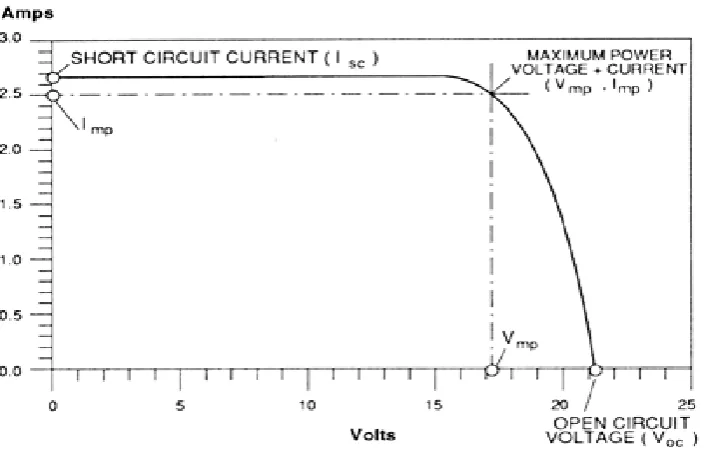
Fig 2: The I-V curve showing the maximum power point.
Source: http://www.daviddarling.info/encyclopedia/I/AE_I-V_curve.
PV Module Fill Factor (FF) is the ratio of the rated maximum power to the theoretical peack power. FF is dimensionless and is given by:
𝐹𝐹 = I∗V
I𝑠𝑐 ∗ V 𝑜𝑐 (10)
The efficiency of the PV module is a measure of the percentage of solar power (it receives on a given area) that it can convert to electric power under the operating conditions. It is given by:
𝜂 =
𝑃𝑜𝑢𝑡 ∗100 %𝑃𝑖𝑛 (11)
Where;
Pout is the output electric power and
Pin (irradiance*PV module Area) is the available solar power per m2 received by the PV module.
III.
CASE STUDY
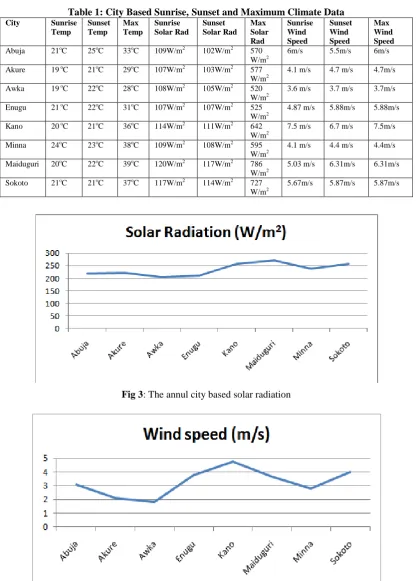
Table 1: City Based Sunrise, Sunset and Maximum Climate Data
City Sunrise
Temp Sunset Temp Max Temp Sunrise Solar Rad Sunset Solar Rad Max Solar Rad Sunrise Wind Speed Sunset Wind Speed Max Wind Speed Abuja 21oC 25oC 33oC 109W/m2 102W/m2 570
W/m2
6m/s 5.5m/s 6m/s
Akure 19 oC 21oC 29oC 107W/m2 103W/m2 577
W/m2 4.1 m/s 4.7 m/s 4.7m/s Awka 19 oC 22oC 28oC 108W/m2 105W/m2 520
W/m2
3.6 m/s 3.7 m/s 3.7m/s
Enugu 21 oC 22oC 31oC 107W/m2 107W/m2 525 W/m2
4.87 m/s 5.88m/s 5.88m/s
Kano 20 oC 21oC 36oC 114W/m2 111W/m2 642 W/m2
7.5 m/s 6.7 m/s 7.5m/s
Minna 24oC 23oC 38oC 109W/m2 108W/m2 595 W/m2
4.1 m/s 4.4 m/s 4.4m/s
Maiduguri 20oC 22oC 39oC 120W/m2 117W/m2 786 W/m2
5.03 m/s 6.31m/s 6.31m/s
Sokoto 21oC 21oC 37oC 117W/m2 114W/m2 727 W/m2
5.67m/s 5.87m/s 5.87m/s
Fig 3: The annul city based solar radiation
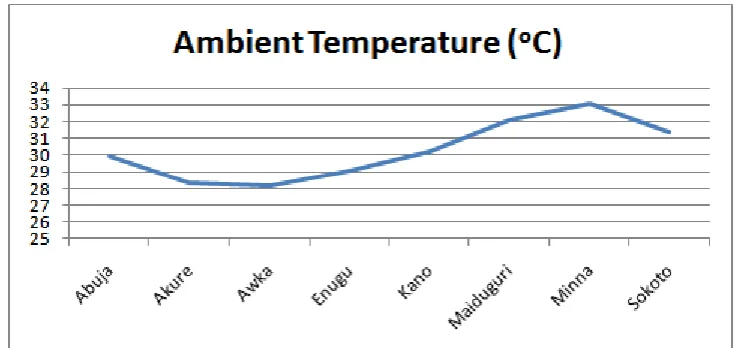
Fig 5: The annual city based ambient temperature
3.1 Procedure
Secondary data (climate data) analysis method is adopted in this work. This method is adopted based on the fact that the widely accepted equations (2) and (3) by King et al (2004) can be used for any location in the world. Hence, secondary data had been used to implement these equations.
The methodologies adopted are as follows:
i. Years 2009 and 2010 climate data (ambient temperature, solar radiation/insolation and wind speed) of eight selected cities of Nigeria were collected from the NIgerian METeorological Agency (NIMET).
ii. Microsoft Excel Spreadsheet was used to simulate city based PV-module temperature (Tm), open circuit voltage (Voc), short circuit current (Isc), real/actual power and efficiency of three PV module types (mono-crystalline, poly-crystalline and amorphous silicon), using equations (3),(7),(8),(9) and (11) respectively, based on the NIMET data.
iii. The results obtained were used to analyze the performance of each PV module type at each city and in each month of the year.
The climate data used; are the average day-time (7am to 6pm; typical sunrise to sunset period) ambient temperature, solar radiation and the corresponding wind speed. Solar radiation data from NIMET were initially given in MJ/m2/day and were converted to W/m2 using a conversion factor of 11.5741 (note: 1kWh/m2/day = 3.6 MJ/m2/day, therefore; 1 MJ/m2/day = 11.5741 W/m2). The wind speed data were given in knots and were converted to m/s by dividing the value by a factor of 2.
The manufacturer’s specified characterizations for each PV modules are stated in Table 2.
Table 2: Data Sheet Information for The Three PV Module Technologies
Characterisation Mono-crystalline Silicon
Module
Polycr-ystalline Silicon Module
Amorphous Silicon Module
Pmax 100W 100W 100W
Efficiency 18% 17% 10%
Vmax 19.0V 17.2V 77.0V
Imax 5.26 5.8A 1.293A
Voc 22.8V 21.6V 99.0V
Isc 5.68 6.46A 1.65A
Temp Coefficient of Pmax -0.44%/oC -(0.5+/-0.05)%/oC -0.33%/oC
Temp Coefficient of Voc -0.36%/oC -(80+/-10)mV/oC -0.2%/oC
Area 0.6465m2 0.77787m2 1.5752m2
IV.
PV MODULE PERFORMANCE ANALYSES
Fig 6: Graph of the average monthly solar radiation
Figure 6 above shows the average solar radiation in W/m2 received at each city. It further indicates what month of the year the cities received what magnitude of solar radiation. This figure indicates that Maiduguri (in March) recorded the highest solar radiation of about 320W/m2, while Enugu (in July) recorded the lowest solar radiation of about 170W/m2.
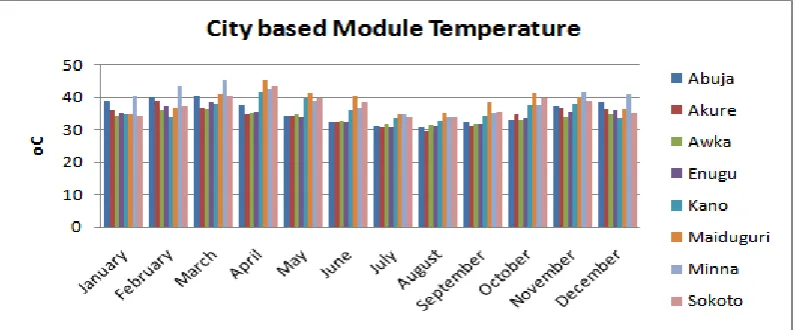
Fig 7: Graph of the average monthly PV module temperature
Figure 7 shows the PV-module temperature calculated for each city using Equation 3:
T𝑚 = Ta+ E ∗ e(−3.473 −0.0594 ∗WS )
This figure indicates that Maiduguri (in April) and Minna (in March) recorded the highest module-temperature (Tm) of above 45
o
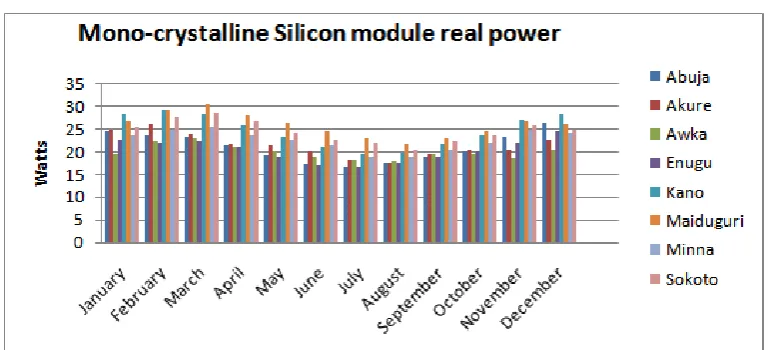
Figure 8 above shows the mono-crystalline silicon module real power recorded at each city in every month of the year. This figure indicates that mono-crystalline silicon module recorded the highest real power output of about 31W in March at Maiduguri, but its lowest output of about 17W was recorded in July at the cities of Abuja and Enugu.
Fig 9: Graph of the poly-crystalline silicon module real power average monthly output
Figure 9 above shows the poly-crystalline silicon module real power recorded at each city in every month of the year. This figure indicates that poly-crystalline silicon module recorded real power output of 30W as the highest output in March at Maiduguri, but the lowest output of about 16W was recorded in July at Abuja.
Figure 10 shows the amorphous silicon module real power recorded at each city in every month of the year. This module recorded the highest real power of about 31W in March at Maiduguri and lowest of about 16W in July at Enugu city.
All the real power values recorded for each PV modules (for the three technologies) were calculated using Equation 9: Pmp = Isc(at G) * Voc(at Tm) *FF
Fig 11: Graph of the monocrystalline silicon module average monthly efficiencies
Figure 11 above shows the mono-crystalline silicon module recorded efficiency at each city in every month of the year. The mono-crystalline module recorded its highest efficiency of about 15.2% in August at Akure, but its lowest efficiency of about 14.3% was recorded in March (at Minna) and April (at Maiduguri).
Fig 12: Graph of the polycrystalline silicon module average monthly efficiency
Fig 13: Graph of the amorphous silicon module average monthly efficiency
Figure 13 above shows the amorphous silicon module recorded efficiency at each city in every month of the year. For this module, the highest efficiency of above 6.25% was recorded in August at Akure, while the lowest efficiency of above 6.05% was recorded in March (at Minna) and April (at Maiduguri). All efficiencies recorded for each PV modules (for the three technologies) were calculated using Equation 11: 𝜂 =𝑃𝑜𝑢𝑡 ∗100 %
𝑃𝑖𝑛
Fig 14: Graph of average Monthly Voc of the mono-crystalline Silicon
Figure 14 above shows the open circuit (Voc)Voltage of mono-crystalline silicon module based on the module-temperature recorded at each city in every month of the year. The highest Voc of 22.4V was recorded in August at Akure, while the lowest Voc of about 21.2V was recorded in March (Minna) and April (Maiduguri).
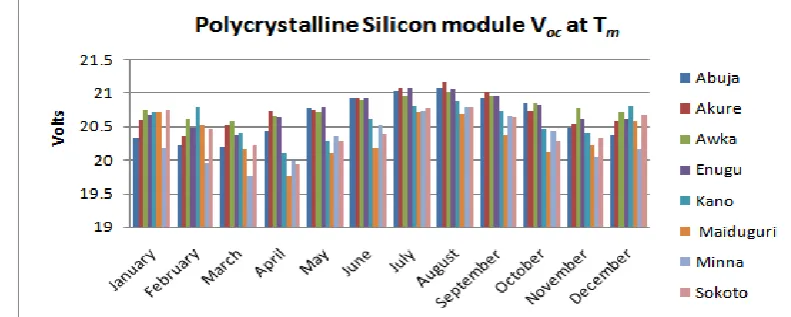
Figure 15 above shows the open circuit (Voc) Voltage of polycrystalline silicon module at the module-temperature recorded at each city in every month of the year. This module recorded a highest Voc of about 21.2V in August at Akure, while its lowest Voc of about 19.75V was recorded in March (at Minna) and April (at Maiduguri).
Fig 16: Graph of average monthly Voc of the amorphous Silicon Module
Figure 16 above shows the open circuit (Voc) Voltage of amorphous silicon module at the module-temperature recorded at each city in every month of the year. This module recorded its highest Voc of about 98.1V in August at Akure, while its lowest Voc of 95V was recorded in March (at Minna) and April (at Maiduguri). All open circuit (Voc) values recorded for each PV modules (for the three technologies) were calculated using Equation 7: V𝑜𝑐(at T𝑚) = V𝑜𝑐 STC − K ∗ (T𝑚− 25)
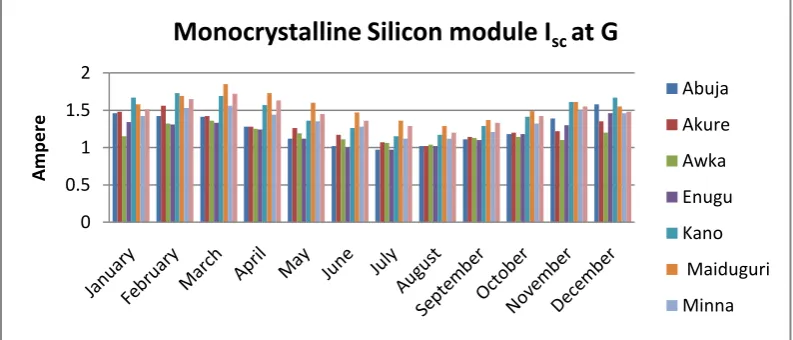
Fig 17: Graph of average Monthly Isc of the mono-crystalline Silicon Module
Figure 17 above shows the short circuit current (Isc) of the mono-crystalline silicon module, based on the average monthly solar radiation recorded at each city. This module recorded the highest monthly average of about 1.8A at Maiduguri in March, while the lowest value of about 0.9A was recorded in July at Abuja and Enugu.
0 0.5 1 1.5 2
A
m
p
e
re
Monocrystalline Silicon module I
scat G
Abuja
Akure
Awka
Enugu
Kano
Maiduguri
Fig 18: Graph of average Monthly Isc of the poly-crystalline Silicon Module
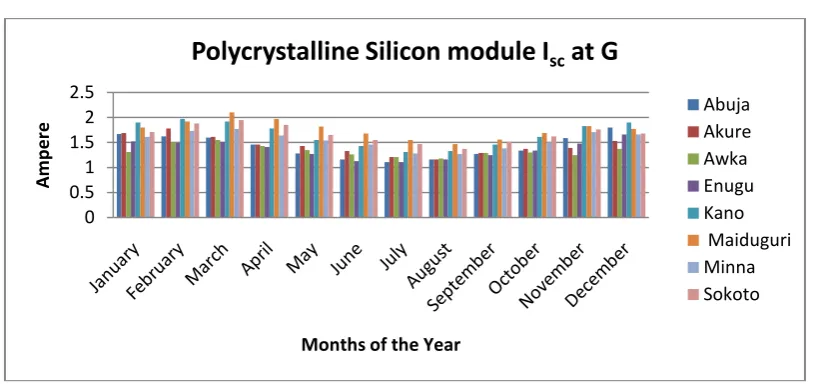
Figure 18 above shows the short circuit current (Isc) of polycrystalline silicon module based on the average monthly solar radiation recorded at each city. The highest value recorded by this module is about 2.2A in March at Maiduguri, while its lowest is about 1.2A in July at Enugu and Abuja.
Fig 19: Graph of average Monthly Isc of the amorphous Silicon Module
Figure 19 above shows the short circuit current (Isc) of amorphous silicon module based on the solar average monthly solar radiation recorded at each city. The highest value recorded is about 0.55A in March at Maiduguri; while the lowest is about 0.29A at Abuja and Enugu in July. All short circuit current (Isc) values recorded for each PV modules (for the three technologies) were calculated using Equation 8:
I𝑠𝑐 (at G) = I𝑠𝑐 (STC) ∗
G 1000
4.1 Discussions and Results
The analyses in Figures 6 – 13 show that the three PV module types produced higher electric power in locations and months of the year with higher solar radiation. However, the reverse is the case about their efficiencies, especially at locations and months with high PV module temperatures. Also, the above Figures have shown that whenever any two months with almost the same solar radiation (G) or one of them is a little lower than the other, the month that has lower module temperature Tm produces higher maximum real power.
However, the above observation was not always the case with the amorphous silicon module, especially when the difference in their module temperature between them is very little. Some of the instances are summarized in Table 3 below.
Months of the Year
0 0.1 0.2 0.3 0.4 0.5 0.6
A
m
p
e
re
Months of the Year
Amorphous Silicon module I
scat G
Abuja
Akure
Awka
Enugu
Kano
Maiduguri
Minna
Table 3: Comparison of the impact of Monthly Module Temperature Difference on the Modules
City and Year Months Month with higer
Tm & G
Month with Better output
Remarks
Abuja May & September
May September Only for monocrytalline modules
Minna July & August
July August For the 2 crystalline silicon modules
Kano March & December
March December For the 2 crystalline silicon modules
From Table 3, it means that if module temperature is kept constant and lower, and the solar radiation is increased, a PV module would perform very well. This also shows that module temperature does not affect amorphous silicon modules as much as it does to crystalline silicon modules ( both mono and poly).
Matching Figures 6 and 7, and Figures 14–16 and 17-19, indicates that most of the cities where the PV modules recorded high short circuit current Isc, have more availability of solar radiation, and are most times
where they produce low open circuit voltage Voc due to high PV-module temperature.
Therefore, in designing a PV array for cities with high ambient temperature and solar radiation, particular attention has to be paid to the maximum output voltage of the PV module that will form the array so that the number of PV modules connected in series should be more than those in parallel. Monocrystalline and Amorphous silicon PV module (connected more in series) appear more suitable for such locations (since they are known to have high maximum power voltage rating). On the other hand, array designs in the cities with low ambient temperature and low solar radiation, should have more modules connected in parallel to achieve more current output since the drop in voltage impact will be very little. PV modules (especially Poly-crystalline modules) usually with high maximum current output, should be considered for such locations.
V.
CONCLUSION
There is always difference between outdoor conditions and the PV module manufacturer’s Standard Test Conditions (STCs). Also, climatic conditions differ from location to location and from one month of the year to the other. As evident in this work, the three commercially available PV modules would perform differently at different locations in Nigeria.
The relationship between PV-module temperature and the climatic parameters such as ambient temperature and solar radiation is direct and linear; however, the PV-module temperature has a linear-inverse relationship with wind speed. Cities (mostly in the northern Nigeria) with the potential of high PV-module temperature will produce lower open circuit voltage and lower PV-module conversion efficiencies. Those with higher solar radiation produced better short circuit current and yielded better actual power at low module temperature. However, the impact of module temperature on the actual power output of the amorphous silicon module is more minimal. This resulted to its higher real/actual power output. The northern cities in Nigeria can be said to need array design that has more modules connected in series (for better voltage output), while the southern cities would need array design with more parallel connected modules (for better current output). Hence, the PV module to be installed in the northern Nigeria should have high maximum power voltage Vm
specification to cushion the negative impact from high PV-module temperature Tm likely to be experienced
there, while the once for the southern and coastal parts of the country should have high maximum power current Im specification due to the expected low solar radiation.
The results presented in this paper would be able to guide someone to decide on the suitable PV array design (in terms of series and parallel connections) and PV module specifications (in terms of the rated electrical outputs) for every location in Nigeria.
REFERENCES
[1]. Abdelkader M. R., Al-Salaymeh A., Al-Hamamre Z., and Sharaf F. (2010), A comparative Analysis of the Performance of Monocrystalline and Multiycrystalline PV Cells in Semi Arid Climate Conditions: the Case of Jordan. Jordan Journal of Mechanical and Industrial Engineering. Volume 4, Number 5, November 2010. ISSN 1995-6665, Pages 543- 552.
[2]. Bala, E.J., Ojosu, J.O. and Umar, I. H. (2000). Government Policies and Programmes on the Development of Solar-PV Sub-sector in Nigeria. Nigerian Journal of Renewable Energy, Vol. 8, No. 1&2, pp. 1-6.
[3]. Bekker B. (2007), Irradiation and PV Array Energy Output, Cost, and Optimal Positioning Estimation for South Africa. Journal of Energy in Southern Africa. Vol 18 Number 2, May 2007.
For Energy Rating. Solar Program Review Meeting 2003 NREL/CD-520-33586 Page 936.
[17]. Ugwuoke P.E., Oparaku O.U. and Okeke C.E. (2006), The Effect of Global and Diffuse Insolation on The Performance of Photovoltaic Modules Deployed at Fixed Angle Tilt in Nsukka. Nigerian Journal of Solar Energy, Vol. 1 (2006), pp. 254 -257. [18]. Zdravkovic´ M. et al (2009), Temperature Effects on Photovoltaic Components Characteristics. Scientific Publications of The State
University of Novi Pazar Ser. A: Appl. Math. Inform. and Mech. vol. 1, 1 (2009), 29-36.
[19]. Zhou W., Yang H., Fang Z. (2007), A novel model for photovoltaic array performance prediction. Journal of Applied Energy 84 (2007) 1187–1198. Elsevier