Vol. 3, Issue 2, March -April 2013, pp.1805-1809
A New Approach of Expert System for Rainfall Prediction Based
on Data Series
1
Indrabayu,
2Nadjamuddin Harun,
3M.Saleh Pallu,
4Andani Achmad
1
Student of Doctoral Program Civil Engineering, Hasanuddin University
1,2,4
Department of Electrical Engineering, Hasanuddin University
3
Department of Civil Engineering, Hasanuddin University
ABSTRACT
This paper proposed a new approach for rainfall prediction method, which combines the Support Vector Machine (SVM) and Fuzzy Logic methods.The performance of the proposed method is compared to the Neural Network (NN)–Fuzzy.The climatological data is obtained from PT LAPAN Bandung and the Meteorology, Climatology and Geophysics Region IV Makassar Indonesiafor 10 years (2001-2010) and is analysed by MATLAB 7.6.The results confirm that the SVM-Fuzzy achieves higher accuracy than NN-Fuzzy.
Keywords-Rainfall prediction, SVM-Fuzzy, Expert system and NN-Fuzzy.
I. INTRODUCTION
Rain is a natural phenomenon which has an important role in tropical countries like Indonesia.However, heavy rainfall may cause flooding and landslides that disturb the human activities, social economy, and the environment.Therefore, rainfall forecast is an essential and vital process nowadays.
Several methods have been developed to predict the rainfall in recent years, such as Neural Network (NN), Fuzzy logic and Support Vector Machine(SVM).To determine the performance of those methods, many studies have been conducted based on quantitative approach for rainfall forecasting [1]-[7].Therefore, a new approach of the rainfall prediction, which is called the SVM-Fuzzy method, is proposed in this paper which is more on qualitative based rainfall prediction.
In this paper, the rainfall data are obtainedfrom BMKG (Meteorology, Climatology and Geophysics Berau), region IV Makassar, Indonesia for 10 years (2001 - 2010) with predictor variables, such as wind speed (W), temperature (T), humidity (H) and Rainfall (R).
The rest of this paper is organized as follows.In Section II, rainfall prediction methods are described.In Section III, a new approach of rainfall predictionis proposed.In Section IV, results and analysis are discussed.Finally, Section V concludes the paper and lists the futureworks.
II. RAINFALL PREDICTION METHODS
In this section, the two rainfall prediction methods are described.It comprises of algorithms and assumptions made in each method.
II.1 Support Vector Machine (SVM)
A Support VectorMachine (SVM) is a computer algorithm that learns by example to findthe best function of classifier /hyperplaneto separate thetwoclasses in the inputspace.The SVM analyzedtwo kinds of data, i.e. linearly and non-linearly separable data [8].The example of non-linearly
separated data is shown in
Fig.1.Besthyperplanebetween twoclassescan be foundby measuring the hyperplanemarginand find out the maximumpoints.Margin is defined as the distance betweenhyperplaneand the closest pattern of each class, which is called support vector.The best hyperplaneis defined as the following equation.
f(x) = wTx+ b(1)
wherex refers to a training pattern, w is referred to as the weight vector and bas the bias term.
Fig.1 The example of linearlyseparated data
Margin
Support vectors
Vol. 3, Issue 2, March -April 2013, pp.1805-1809 II.2 Fuzzy Logic (Fuzzy)
Fuzzy Logic is a type of reasoning based on the recognition that logical statements are not only true or false (white or black areas of probability) but can also range from “almost certain” to “very unlikely” (gray areas of probability).Fuzzy logic has proven to be particularly useful in expert system and other artificial intelligenceapplications.
Fuzzy inference systems, also known as fuzzy rule-based systems or fuzzy models, areschematically shown in Fig.2.They are composed of five conventional blocks;arule-basecontaining a number of fuzzy if-then rules, adatabasewhich defines the membershipfunctions of the fuzzy sets used in the fuzzy rules, adecision-making unitwhich performs the inference operations on the rules, afuzzification interfacewhich transform thecrisp inputs into degrees of match with linguistic values, adefuzzification interfacewhichtransform the fuzzy results of the inference into a crisp output.Fig.3 shows the example of temperature membership function.
Fig.2 The general structure of a fuzzy inference system[9]
Fig.3 The example of membership function
II.3 Neural Network (NN) :Backpropagation The field of neural networks can be thought of as being related to artificial intelligence, machine learning, parallel processing, statistics, and other fields.The attraction of neural networks is that they are best suited to solving the problems that are the most difficult to solve by traditional computational methods.
Most people would consider the backpropagationnetwork to be the quintessential Neural Network.Any network structure can be trained by backpropagationwhen the desired output patterns exist and each function has been used to calculate the actual output patterns is
differentiable.The example of
backpropagationnetwork is shown in Fig.4.
Fig.4 The example of backpropagationnetwork III. THE PROPOSED SYSTEM
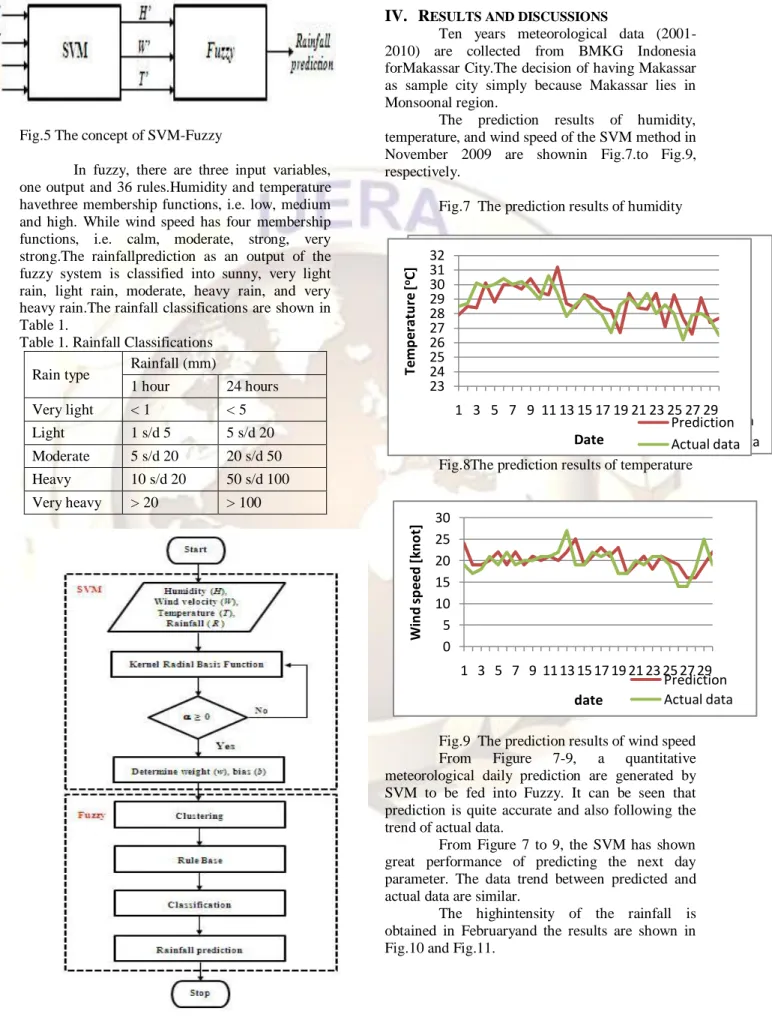
The proposed system combines the SVM and Fuzzy methods to achieve high accuracy of the rainfall prediction.The input parametersof the proposed system are humidity (H), wind velocity (W), temperature (T), and rainfall (R) for 8 years data (2001-2008).The concept of the SVM-Fuzzy and its flowchartare shown in Fig.5.and Fig.6, respectively.The SVM-Fuzzy was simulated by Matlab7.6 in this paper.
In SVM, eightyears data (2001-2008) prepared as training data aiming on 2009 observation data.Re-trainingconducted over 2001-2009 periods for predicting the humidity, wind and temperature in 2010.The input data are used in kernel Radial Basis Function (RBF) to determine the support vectors.The position of support vectors is neededto figure out the weight vector (w) and bias (b) as predictionparameters.
Vol. 3, Issue 2, March -April 2013, pp.1805-1809 0 20 40 60 80 100 1 3 5 7 9 11 13 15 17 19 21 23 25 27 29 H u mi d it y [% ] Date Prediction Actual data 23 24 25 26 27 28 29 30 31 32 1 3 5 7 9 11 13 15 17 19 21 23 25 27 29 Te m p era tu re [ oC] Date Prediction Actual data 0 5 10 15 20 25 30 1 3 5 7 9 11 13 15 17 19 21 23 25 27 29 Wi n d s p e e d [ kn o t] date Prediction Actual data Fig.5 The concept of SVM-Fuzzy
In fuzzy, there are three input variables, one output and 36 rules.Humidity and temperature havethree membership functions, i.e. low, medium and high. While wind speed has four membership functions, i.e. calm, moderate, strong, very strong.The rainfallprediction as an output of the fuzzy system is classified into sunny, very light rain, light rain, moderate, heavy rain, and very heavy rain.The rainfall classifications are shown in Table 1.
Table 1. Rainfall Classifications Rain type Rainfall (mm)
1 hour 24 hours Very light < 1 < 5 Light 1 s/d 5 5 s/d 20 Moderate 5 s/d 20 20 s/d 50 Heavy 10 s/d 20 50 s/d 100 Very heavy > 20 > 100
Fig.6 Flowchartof SVM-Fuzzy method IV. RESULTS AND DISCUSSIONS
Ten years meteorological data (2001-2010) are collected from BMKG Indonesia forMakassar City.The decision of having Makassar as sample city simply because Makassar lies in Monsoonal region.
The prediction results of humidity, temperature, and wind speed of the SVM method in November 2009 are shownin Fig.7.to Fig.9, respectively.
Fig.7 The prediction results of humidity
Fig.8The prediction results of temperature
Fig.9 The prediction results of wind speed From Figure 7-9, a quantitative meteorological daily prediction are generated by SVM to be fed into Fuzzy. It can be seen that prediction is quite accurate and also following the trend of actual data.
From Figure 7 to 9, the SVM has shown great performance of predicting the next day parameter. The data trend between predicted and actual data are similar.
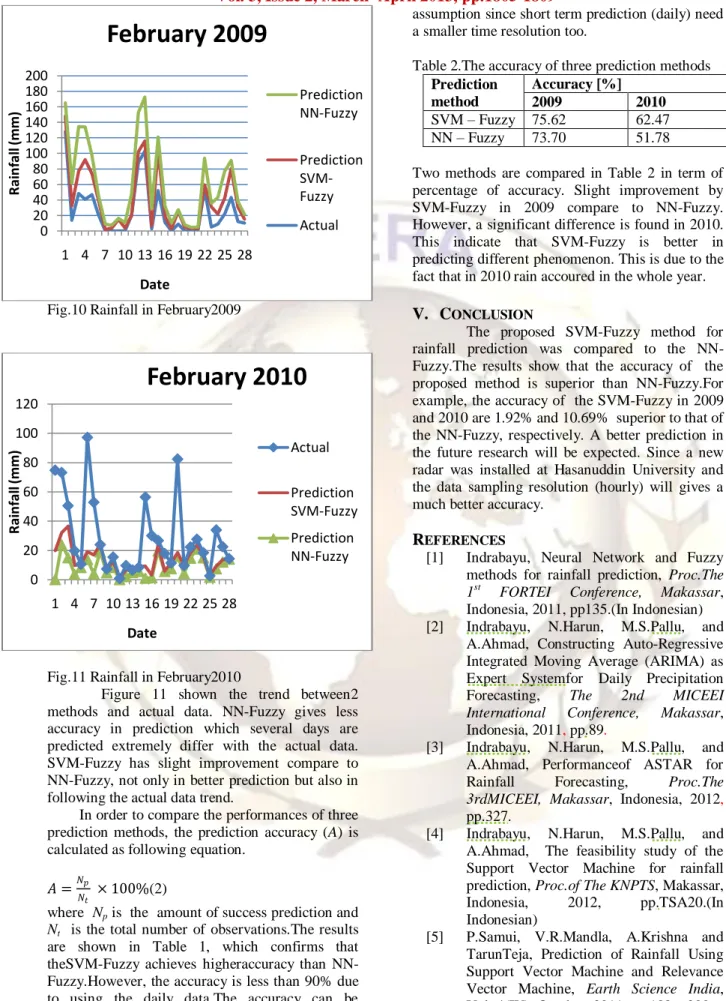
The highintensity of the rainfall is obtained in Februaryand the results are shown in Fig.10 and Fig.11.
Vol. 3, Issue 2, March -April 2013, pp.1805-1809
Fig.10 Rainfall in February2009
Fig.11 Rainfall in February2010
Figure 11 shown the trend between2 methods and actual data. NN-Fuzzy gives less accuracy in prediction which several days are predicted extremely differ with the actual data. SVM-Fuzzy has slight improvement compare to NN-Fuzzy, not only in better prediction but also in following the actual data trend.
In order to compare the performances of three prediction methods, the prediction accuracy (A) is calculated as following equation.
𝐴 =𝑁𝑝
𝑁𝑡 × 100%(2)
where Np is the amount of success prediction and
Nt is the total number of observations.The results are shown in Table 1, which confirms that theSVM-Fuzzy achieves higheraccuracy than NN-Fuzzy.However, the accuracy is less than 90% due to using the daily data.The accuracy can be
assumption since short term prediction (daily) need a smaller time resolution too.
Table 2.The accuracy of three prediction methods Prediction method Accuracy [%] 2009 2010 SVM – Fuzzy 75.62 62.47 NN – Fuzzy 73.70 51.78
Two methods are compared in Table 2 in term of percentage of accuracy. Slight improvement by SVM-Fuzzy in 2009 compare to NN-Fuzzy. However, a significant difference is found in 2010. This indicate that SVM-Fuzzy is better in predicting different phenomenon. This is due to the fact that in 2010 rain accoured in the whole year. V. CONCLUSION
The proposed SVM-Fuzzy method for rainfall prediction was compared to the NN-Fuzzy.The results show that the accuracy of the proposed method is superior than NN-Fuzzy.For example, the accuracy of the SVM-Fuzzy in 2009 and 2010 are 1.92% and 10.69% superior to that of the NN-Fuzzy, respectively. A better prediction in the future research will be expected. Since a new radar was installed at Hasanuddin University and the data sampling resolution (hourly) will gives a much better accuracy.
REFERENCES
[1] Indrabayu, Neural Network and Fuzzy methods for rainfall prediction, Proc.The 1st FORTEI Conference, Makassar, Indonesia, 2011, pp135.(In Indonesian) [2] Indrabayu, N.Harun, M.S.Pallu, and
A.Ahmad, Constructing Auto-Regressive Integrated Moving Average (ARIMA) as Expert Systemfor Daily Precipitation Forecasting, The 2nd MICEEI International Conference, Makassar, Indonesia, 2011, pp.89.
[3] Indrabayu, N.Harun, M.S.Pallu, and A.Ahmad, Performanceof ASTAR for Rainfall Forecasting, Proc.The 3rdMICEEI, Makassar, Indonesia, 2012, pp.327.
[4] Indrabayu, N.Harun, M.S.Pallu, and A.Ahmad, The feasibility study of the Support Vector Machine for rainfall prediction, Proc.of The KNPTS, Makassar, Indonesia, 2012, pp.TSA20.(In Indonesian)
[5] P.Samui, V.R.Mandla, A.Krishna and TarunTeja, Prediction of Rainfall Using Support Vector Machine and Relevance Vector Machine, Earth Science India, 0 20 40 60 80 100 120 140 160 180 200 1 4 7 10 13 16 19 22 25 28 R ai n fa ll (m m ) Date
February 2009
Prediction NN-Fuzzy Prediction SVM-Fuzzy Actual 1 4 7 10 13 16 19 22 25 28 0 20 40 60 80 100 120 Date R ai n fa ll (m m )February 2010
Actual Prediction SVM-Fuzzy Prediction NN-FuzzyVol. 3, Issue 2, March -April 2013, pp.1805-1809 Networks, Journal of Geographic
Information and Decision Analysis, vol. 2, no. 2, , 1998, pp.233 - 242.
[7] R.R.Deshpande, On The Rainfall Time Series Prediction Using Multilayer Perceptron Artificial Neural Network,
International Journal of Emerging Technology and Advanced Engineering, January 2012, Volume 2, Issue 1.
[8] N.Stanevski, D.Tsvetkov, Using Support Vector Machine as a Binary Classifier,
International Conference on Computer Systems and Technologies-CompSysTech,2005, pp.14.1-14.5.
[9] KamyarMehran, Takagi-Sugeno Fuzzy Modeling for Process Control, Tutorial, Newcastle University, 2008.
[10] Jyh-Shing, Roger Jang, ANFIS: Adaptive Network based Fuzzy Inference System, IEEE Transactions on systems, man, and cybernetics, Vol.23, No.3, May/June, 1993.