GAMING TABLES AND I.G.,
J2,324
T HE accounts in the inscription I.G., 12, 324 are a well known battleground, fought over often enough. In 1894 B. Keil wrote, " Ich halte die Versuche, die Zahlen der Inschrift namentlich in den Jahren 2-4 wiederherstellen zu wollen, fuer absolut aussichtlos ... durch langwierige Berechnungen hatte ich den Standpunkt der Resig- nation gewonnen." ' In more recent times, texts have been volleyed to and fro in an effort to recover the nature of the Athenian prytany calendar. On one side of the net are arrayed a team of scholars who insist that the document can be restored in such a way as to " prove " an irregular calendar. On the other side are experts who counter that the preserved portions clearly establish an evenly distributed calendar of pry- tanies for the period covered, and that, so far as restorations go, there must be some rules to the game. For example, if one side postulates that it takes 9 letter-spaces on the stone to restore a 6-letter word, or that the abacus operator neglected to put his pebbles in the proper column, or forgot to calculate part of a sum, then the other side should be able to hypothesize similar mistakes on the stone and in the accounting. One side, although using different and mutually contradictory texts and methods of com- putation, has claimed victory even before their opponents have touched the ball.
No restorations are acceptable unless (a) they are based on accurate texts and (b) they accord with sound principles of epigraphical methodology. Miss Lang has recently offered a text of I.G., 12, 324 with two undotted signs for one hundred drachmas in the critical third payment of Year 3 (line 32); and she quotes Meritt, writing in 1928, as an authority for this.2 My disagreement with Meritt's text was based on the report of an examination of the stone in Athens in 1949 made by six scholars, including two of our most experienced epigraphists, at a time when I was not present to prompt them in any way; and their two-page description of the traces of the two numerals has been duly published with illustrations.' Miss Lang goes on to say that she sees on my photograph of a latex squeeze " a less eroded island between the lower uprights." 4 There are places on this stele where erosion has taken
the shape of inscribed letter-forms. But the erosion in question in the third payment is of an irregular shape, extending into lines 32 and 33 and including the interspace. In other words, the inscribed stone was damaged over a two-line surface and then the erosion took place. On the stone I measure the depth of this erosion as more than
1 Herrnes, XXXIX, 1894, p. 61. I am deeply indebted to Mr. Peter Solon for help with the study of the abacus and to the scholar asking to remain anonymous who in the autumn of 1964 examined for me in Athens I.G., J2, 19, and I.G., J2, 324, line 32.
2 Hesperia, XXXIII, 1964, p. 152, note 17.
3 Ancient Athenian Calendars on Stone, Berkeley and Los Angeles, 1963, pp. 270-273.
4 Op. cit., pl. 20a. Since photographs are not three-dimensional, they cannot be relied on to
bring up features of depth.
American School of Classical Studies at Athens is collaborating with JSTOR to digitize, preserve, and extend access to
Hesperia
132 W. KENDRICK PRITCHETT
0.002 m., much greater than that of the strokes of the letters. There is an " island" to the left of the rho of line 33 where no letter was ever inscribed, and there is an " island " in the interspace. These " islands " of lines 32-33, like others on the stone, do in fact exist, but their surfaces are not on the same plane as that of the face of the stone, as can be seen when a straight-edge is placed on it. The " island " of line 32, in particular, is too small and too far below the surface to affect the reading one way or the other. Similar irregular scars can be seen in lines 16-19, where erosion is deeper along the edges of the scars, and various " islands " occur in the middle. Of equal significance, epigraphically speaking, is the fact that with regard to the one upright which is preserved to its length, the one near the left edge of the stone, one cannot say whether it was joined at the left by a cross-bar. This was brought out in Professor Caskey's drawing published on my page 272. As Caskey observed, " only the right hand side of the vertical groove is preserved, the stone being broken just along the groove." To read this stroke as an undotted H, as Miss Lang does,5 is to violate all standard canons prescribed for the publication of epigraphical texts.6 In 1963 I suggested the reading H!I; but we must go even further than this and recognize the possibility that the sum for the principal of this third payment ended in obol signs, presumably four in number. Possible readings for the two letter-spaces include []!II, HI!! HH.
The matter must not be allowed to rest here. As pointed out in A.J.P., LXXXV,
1964, p. 55, there have recently been tremendous advances in the field of structural petrology; and the critical eroded surface in I.G., J2, 324 must be earmarked for
future study under magnification by an expert crystallographer.7 In the meantime, only reports of disinterested epigraphists can be accepted.8
Hesperia, XXXIII, 1964, p. 166, line 32.
6 On other misreadings of I.G., J2, 324, see my Ancient Athenian Calendars on Stone, p. 290. 7 Also to be earmarked for similar study is I.G., 12, 19, line 3, as recently studied by Meritt in B.C.H., LXXXVIII, 1964, pp. 413-415. I welcome his lengthy discussion of letter-forms, even when plentifully spiced with polemic, since the practice of writing epigraphical commentaries has virtually disappeared in the field of Agora epigraphy. By offering the reading [ha]/[p]o8 in the concluding sentence of his article, Meritt in effect concurs in my observation that the alpha and rho are not today on the stone; nor does he report any trace of the loops of a beta. Meritt states that the stoichoi are not of equal length, but he fails to note that letters are not always perfectly aligned within their letter-space. Thus, an iota in line 16 is in the left part of the stoichos. All hinges, however, on one vertical stroke. And here Meritt's commentary fails us. He simply states: " Malcolm McGregor, studying the stone in 1961, thought the stroke was the cutting of a chisel.
GAMING TABLES AND I.G., J2, 324 133
But Miss Lang advances another argument in favor of her text of two hundred- drachma signs. She says that payments in hundreds followed by obols are highly unlikely. Whether the number preceding the possible obols was the sign for a hundred we do not know; but in this and other financial documents of the fifth century, loans and payments were frequently made not in round numbers but in odd sums. There are many examples. Large sums involving more than eleven talents were given to the fraction of an obol in I.G., 12, 302, line 54.9 An obol sign might follow a fifty drachma sign,'0 a drachma sign, or a hundred drachma sign, as it does in this and other documents." The principle involved is that loans were being made according to designated needs of funds available. If, for example, a payroll for an army totalled an odd number of drachmas or obols, the loan was presumably made accordingly; the money was not advanced in the nearest round number. Thus, in the last payment of Miss Lang's text the sum she restores is 18 talents 722 drachmas 2?2 obols-hardly a round number. One may conjecture that the third payment of the third year included the signs for hundred drachmae; but one may also say that the sum may have ended in 4 obols, or, if one follows Miss Lang in saying that an obol sign was incised when a drachma was meant (line 14), in 4 drachmas. Any system of computation in this document which does not include this possibility that the text was four obols cannot hold. In the all-important matter of text, therefore, Miss Lang's reconstruction fails us.
As to methodology, Miss Lang adopts a suggestion of Meritt's that the marble stele was damaged at the right edge before the letters were inscribed. This damage is said to have occurred at the time the stele was lifted or transported. The effect of this solution of Meritt's, which Miss Lang characterizes as " neat, economical, and almost inevitable," is that restorations of this so-called stoichedon text c'an be, and are, reduced by one, two, or three letter-spaces per line according to the restoration. As Miss Lang has it, " the surface of the stone gave out." Lang-Meritt assume
as similar to other scratches. But the matter must not rest here. I know from my collaboration with Professor Higgins as reported in A.J.P., LXXXV, 1964, pp. 40-55, esp. p. 55, where we realized the need for caution in reading Attic epigraphical texts when the original surface is defaced, that we have much to learn from structural petrologists and from eyes trained to examine crystals under magnification. We must set aside I.G., I2, 19, for such examination. Until then, something less than bold confidence seems called for, and we are on very unsafe ground in reading anything for this letter-space outside of square brackets, particularly since there is no trace of circular strokes.
8 On the subject of the extensive amount of " wishful seeing" which has taken place in texts
relating to the calendar, see my Ancient Athenian Calendars on Stone, pp. 366-373; A.J.P., LXXXV, 1964, pp. 40-50; and, in particular, B.C.H1., LXXXVIII, 1964, pp. 465-466, an account of the most revealing case where an unusual technique applied to I.G., J2, 304 B, revealed wholesale misreadings on the part of one particular scholar.
9 There are many such entries in I.G., J2, 304. 10I.G., J2, 304, line 34.
134 W. KENDRICK PRITCHETT
" damage " at the edge for eleven lines and eradicate sixteen letter-spaces. But in antiquity, as today, marble was transported from the quarry rough-hewn. Blocks intended for architectural members and for sculpture have been found in quarries. Marble was shaped, dressed, and inscribed after transportation. It is highly unlikely that a mason would begin to cut letters on a damaged surface, especially in a country abounding in marble, when all that was required was that the mason redress the surface. I have inspected myriads of stones in the Epigraphical Museum in Athens and in the Agora Museum, and I have seen no stele which supports Meritt's theory. Nor do Meritt and Lang cite any parallel, ancient or modern, for their theory. Surely it is good epigraphical methodology to insist that any restorations which depend on such an unparalleled and unlikely theory be rejected in toto. I would be unwilling, therefore, to follow the lead of Meritt and Lang and introduce into the Leyden system a new siglum, the " inverted slug," indicating a letter-space where the surface of the stone had been damaged before the inscribing took place.
On her page 162, Miss Lang also characterized as " reasonable " the assumption that " damage of one space within line 51 " occurred. This, too, must be assumed to have happened before the mason inscribed the text. A scholar using the methods of Lang and Meritt in 1964 is accordingly free to reduce the length of line by as many letters as he wishes by assuming " damage " on the right edge, left edge, or the surface between. One may go even further. Meritt in 1963 argues concerning a text which exhibits no violation of stoichedon order on the preserved portion that the broad letters omicron theta and omega nu might be inscribed in single letter-spaces."2 Following Meritt's practice, therefore, any restorer of I.G., I2, 324 has a parallel for reducing or extending any line by several letter-spaces. The lines of their stele are like a ride on a roller-coaster, bumps and depressions extend or contract the length of lines. In conclusion, by Lang-Meritt principles any line of ca. 71-76 letter-spaces should be acceptable for I.G., I2, 324. Such phrases as " will fit into the place " and " fits to perfection" are meaningless.
I have repeatedly maintained that the only acceptable methodology with regard to I.G., 12, 324, is that, since the right margin is not preserved within six letter-spaces of the right edge of the stone, we must examine what stonemasons did in similar financial records of the fifth century. Here, as I have pointed out elsewhere, one sees that perfect stoichedon order was usually observed until one got to within three letter- spaces of the edge. Then irregular spacing occurs. Letters might be crowded or stretched out. Sometimes, there was a desire for syllabic division; at other times, there seems no obvious reason for irregularities. See, for example, the photograph of I.G.,
12, 295 in A.J.A., XXXIII, 1929, p. 399. The mason might observe syllabic division
for a part of the text, not for the remainder. I.G., 12, 304B, which like I.G., 12, 324,
12 Hesperia, XXXII, 1963,
GAMING TABLES AND I.G., J2, 324 135
contains the records of the treasurers of Athena, exhibits three different line-lengths within four lines-71, 73, and 74 letters.13 At the end of one line, this same mason, who was an excellent craftsman, wrote: es V V VIV &o/3EXiav.
If one asks why do not Lang and Meritt, instead of offering what seems to be a completely unacceptable theory that the stele was badly damaged before inscribing, observe good methodology and concede not that selected lines, but that any line might be within 2 or 3 letter-spaces of the normal 74 or 75 letter-spaces, one answer would be that this would introduce so many variables that restoration of the sums for all years would be meaningless. By limiting the damage to 11 lines, they are able to get sums which they can claim " fit to perfection " in the other lines.14 The possibilities become so great as to make any one text incapable of demonstration. The epigraphist who observes good methodology, however, must concede that any line, not merely the eleven of Lang and Meritt, may be within 2. or 3 letter-spaces of the normal 74 or 75 and this applies, as well, to lines 58 and 79, as discussed in A.J.P., LXXXV, 1964, pp. 40-50.
As to the calculations of the abacus, Miss Lang is prepared to accept, and does indeed accept, errors which can be imagined to have occurred in using an abacus. These include placing the " pebble " in the wrong column, subtracting at some stage in the calculation instead of adding, neglecting to add pebbles in the proper column, and even forgetting to calculate the interest on some part of the sum.15 Many other types of mistakes are doubtless possible.16
The errors which Lang admits in her solution of I.G., 12, 324, are as follows:
1. The abacus operator made the computation for the sum 28 talents 3610 dr.
3X2 obols, instead of the 28 talents 5610 drachmas 3'2 obols on the stone. Principal
of 3rd payment of Year 1. Lang, pp. 155-156.
2. Lang divides the principal into three parts: 25 talents, 3X2 talents, and 2610
dr. 312 obols. In the computation for the third of these sums, she assumes that the
abacus operator " neglected " the pebbles for 2000 dr. and computed interest only on the 610 dr. 3X2 ob. Interest of 3rd payment of Year 1. Lang, pp. 154-156.
3. Having made an initial error of the neglect of 2000 dr. (no. 2 above), Lang
13 See B.C.H., LXXXVIII, 1964, pp. 457-459.
14 Hesperia, XXXIII, 1964, p. 154.
15 See Lang, Hesperia, XXVI, 1957, pp. 272-287; XXXIII, 1964, pp. 146 if.; and W. F.
Wyatt, Classical Journal, LIX, 1964, pp. 268-271.
136 W. KENDRICK PRITCHETT
assumes that the abacus operator recorded the total interest as 1 talent 1719 dr. 2 obols instead of 1 talent 1716 dr. 5 obols. " Three obol-pebbles were put mistakenly under the drachma sign." Interest of 3rd payment of Year 1. Lang, pp. 155-156.
4. In this case Lang claims that the interest was calculated as 1 talent 4697 dr.
4>2 obols, but the sum was recorded as 1 talent 4700 dr. Y2 obol. To borrow her
phrase, the operator, having become " muddled," added pebbles amounting to 2 dr. 3 obols to the calculated interest. In this example, the supposed error is not made by placing three pebbles in the drachma column instead of in the obol column; for the desired sum would not then be obtained. Rather, Lang hypothesizes that the abacus operator was attempting to retrieve the error of 2 dr. 3 obols which he had made in payment 3 of the same year. But instead of subtracting the sum of 2 dr. 3 obols, the operator added it.17 In reality, then, there are two parts to the error; the operator attempts to make the correction in the wrong payment and in so doing he adds instead of subtracts. Interest of Payment 4 of Year 1. Lang, p. 156.
5. Stonemason inscribed 4172 drachmas 4X2 obols for the calculated interest of 4173 drachmas 3y2 obols. Interest of 6th payment of Year 1. Lang, p. 154.
6. In this case, Lang divides the principal into three parts: 15 talents, 3 talents, and 122 drachmas 2'2 obols. She assumes that the third of these sums was cleared away in error without the interest being computed. Interest of 5th payment of Year 4. Lang, p. 157.
The most significant fact about these errors is that five are assumed in the interests, whereas the sums for only nine out of sixteen interests are preserved on the stone today. A change of a few drachmas in the sum for an interest results in a great change for the sum for a principal. Furthermore, in the 12 payments of Years 1, 2, and 4, Lang supposes that there were 6 errors. This brings us to Year 3, of which Lang writes: " It is the third year which is most crucial. The third year is also the one which requires the most restoration."
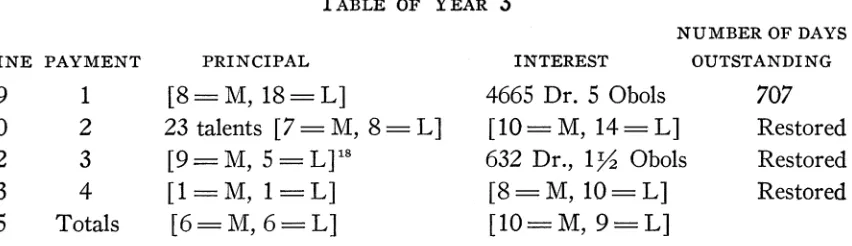
I present in tabular form the four payments for the third year, the only year of the quadrennium in which the Lang table on pages 159-161 exhibits irregular pry- tanies. The numbers within square brackets indicate the number of letter-spaces restored by M (eritt) in his 1928 text and by L(ang) in the 1964 text of Lang-Meritt.
17 This explanation carries no conviction at all. If the abacus operator, while computing the
interest for payment 4, came to realize that he had made a mistake in calculating the interest on payment 3, a simple expedient was at hand, to wit, to correct the figures for payment 3 on the papyrus or tablet on which he was entering his results. Why make the correction in the wrong payment? It is important to ask what was the function of the auditors, if not to check the work of the abacus operator. The result of subtracting 1 talent 4697 dr. 412 obols from 1 talent 4700 dr. '2 obol is 2 dr. 2 obols and not 2 dr. 3 obols, as Miss Lang would have it. Since the supposed
GAMING TABLES AND I.G., 12, 324 137
TABLE OF YEAR 3
NUMBER OF DAYS
LINE PAYMENT PRINCIPAL INTEREST OUTSTANDING
29 1 [8 M, 18 L] 4665 Dr. 5 Obols 707
30 2 23 talents [7 M, 8 L] [10-M, 14=L] Restored
32 3 [9 M, 5-L]18 632 Dr., 112 Obols Restored
33 4 [1=M, 1=L] [8=M, 10=L] Restored
35 Totals [6=M, 6=L] [10=M, 9-L]
We see at a glance that the lengths of the various lacunae are not fixed. Actually, the range is much greater than the table indicates. Thus, in the interest for the second payment, Lang restores an uninscribed space before the numeral where none is restored in the other payments of this year. After the interest of the totals, she introduced four uninscribed spaces, and so on. For payment 4 there is great freedom.
I have asked a colleague in mathematics whether it would be possible, given the Greek numerical system down to quarter obols, to discover by using a computer machine the number of possible texts which might be offered. I was told that it was impossible, but he estimates the combinations would be in the tens of thousands.19
However, overshadowing this estimate is the fact that, since Lang assumes six errors in the 12 payments of Years 1, 2 and 4, the law of averages requires us to accept the possibility that there were two errors in the four payments of Year 3. To recover these errors is not possible-not enough is preserved. Lang gives a text with no errors and concludes with regard to the prytany calendar: " This is proof then that the regular skeleton cannot be restored in the third year." 20 To use such a word
as " proof " in the light of all the variables (the text of line 32, the text along the right margin throughout, and the errors of operator and mason) is to give the word a meaning which it cannot have in scientific circles. The true text of the last two numerals of line 32 may be recovered; even so, too many other variables remain for us to regard the Lang-Meritt text even as exempli gratia in the sense used by L. Robert.21
With regard to Lang's system of calculation of the abacus, I offer the following observations:
1. Lang has not " proved " her system in a context of the history of Greek
18 For the possible numerals in the final two letter-spaces, see above.
19 This is a very conservative estimate if we follow the lead of Lang and allow for the possibility
of a wrong move with every placement of a pebble.
20 op. cit., p. 159.
21 For the remarks of L. Robert as to what should be admitted as text, see the quotation in
138 W. KENDRICK PRITCHETT
mathematics.22 Sir Thomas Heath, for example, in his History of Greek Mathematics, 1, Oxford, 1921, has shown that mathematicians such as Theon of Alexandria could handle long division, and this without an inefficient system of " rounding-off," such as assumed by Lang (see below). Heath concludes (page 51): "The Greeks in fact had little need of the abacus for calculations."
2. Lang has not " proved " her system in a context of the plentiful epigraphical evidence, particularly that available from the Delian records. Nor, as I have men- tioned above, has she tested her system on the more amenable lower half of I.G., I2,
324 itself. One who offers a system should demonstrate that it works accurately for the material available. And, even more importantly, the system should first be applied to material which requires no restoration, not to such a document as I.G., 2, 324, where few of the payments are completely preserved on the stone. Lang's method is to show that " errors in calculation " may be explained by her system. But errors can be hypothesized and then accounted for by almost any system.
3. Lang states that other types of abaci than the Salamis one were in use.23 What results would they yield if applied to I.G., P2, 324?
4. Almost simultaneously with the publication of Lang's 1964 Hesperica article, W. F. Wyatt was demonstrating in Classical Journal, LIX, 1964, pages 268-271, that the duodecimal system accounted better for the errors of Herodotos than the decimal system of Lang. Moreover, the duodecimal system, which was earlier discussed by J. H. Turner in Classical Journal, XLVII, 1951, pages 63 if., accords better with the Greek monetary system.
5. Both the decimal and duodecimal systems hinge on one piece of evidence, namely, the median line of the famous Salaminian table which is interpreted by Lang as a line of separation between units and fives (or sixes) of that unit. Sir Thomas Heath had earlier objected that the table may not be an abacus at all, but (page 50)
it may have been a scoring-table for some kind of game like trictrac or backgammon." 6. The median line, all-important in the Lang system, does not occur on any other abacus. Nagl, Miss Lang's predecessor in the field, rejected the decimal system because, as he claimed, it would not work for other boards. In the published photo- graphs of the Salaminian table, those of Kubitschek and of D. E. Smith (History of Mathematics, II, 1925, p. 163), the line appears to be so shallow as to suggest nothing more than a guide-line for the alignment of the x's. Of the four known tables with eleven lines, the Salaminian is the only one with a median line.
7. The Salaminian board has three x's. Since Lang gets position by pebbles, these x's have no significance in her system. On the other hand, Heath, who doubted that the board was for an abacus, nonetheless suggested a system of computation
22 Cf. Ancient Athenian Calendars on Stone, p. 297.
GAMING TABLES AND I.G., J2, 324 139
which accounted for all of the markings on the board (with the exception of the semi- ellipses).
8. The initial Lang article in 1957 based its solution on the Salaminian board. But Lang's 1964 solution requires an " adaptation " of this; in short, it is not the Salaminian board at all. The latter contains monetary symbols for '4 and Y8 obols in North, South, and West positions. Since these positions are used in the computa- tions, it seems reasonable to assume that, if the board were an abacus, the ancient operator could compute with numbers as small as /8 obol on the board itself.24 This is not true of the Lang system, which requires rounding-off at the end of her process.
9. Heath, who was familiar with other abaci, wrote: " The size and material of the table show that it was no ordinary abacus." 25 Wilhelm gives the dimensions
of the marble as 1.49 m. long and 0.754 m. broad. The weight alone would render such a table virtually immobile. Heath was acquainted with the abaci of all lands and was apparently impressed with the unusual nature of the Salaminian board.
10. The possibility that the Salaminian board is some sort of gaming table is not diminished by the fact that there are two semicircles or ellipses which extend from the innermost of the five lines. Lang omits all mention of these, although the exact measurements of these ellipses were given in the descripion of the board written by one of our greatest epigraphists, A. Wilhelm.26 These ellipses, of different sizes, can be seen on the photograph published by Kubitschek in Wiener numismatische Zeit- schrift, XXXI, 1899, pl. XXIV.27 It is to be noted that the Epidaurian gaming table, which the author of the article on Lusoria tabula (p. 1403) in Daremberg-Saglio, Dictionnatire, regards as being used for the Greek game pentegrammai, likewise has sixteen lines and two semi-ellipses.28 One of the semi-ellipses, as on the Salamis board, projects from the center of the fifth line, as counted from the right. But, as with abaci, so with many ancient games, they are incapable of solution. Lamer's lengthy
24 In one of our earlier references to an oibakion, Polybios (V, 26, 13) mentions the psephos being used now as a chalkous (Y8 obol), now as a talent; so the ancient operator was able to reckon with '8 obols.
25 Op. cit., p. 50.
26As quoted by W. Kubitschek in Wiener numismatische Zeitschrift, XXXI, 1899, pp. 394-395. Wilhelm noted other features about the board, which I do not repeat here. The size of the semi- ellipses seems hardly sufficient for them to be regarded as a resting place for the large number of pebbles required in the computations.
27 I have never examined the Salaminian table. It is my intent to do so on my next visit to Greece. Photographs and accurate measurements must be presented.
28 J. D. Beazley (Attic Vase Paintings in the Museum of Fine Arts, Boston, III, Boston, 1963,
140 W. KENDRICK PRITCHETT
article in the Real-Encyclopaedie (1927) lists pages of games, but describes very few boards on which they were played.
11. That the Salaminian board is a gaming table is almost assured by the fact that the markings on the so-called western half are identical with markings on the gaming table illustrated in W. Deonna, Delos, XVIII, plate XCV, no. 831. Both have eleven parallel lines. Both have x's on each third line. These points of identity seem too striking to be coincidental. The Delian table has no numerals and its identity seems assured. It follows, too, that the Amphiareian table, which likewise has the eleven perpendicular lines with x's at the center of the third, sixth, and ninth lines, is a gaming table.29 The Salaminian and Amphiareian tables share the 5-line groups, and the small semi-ellipses. Both have monetary symbols; and it is this point alone which has led to their being regarded as abaci. The monetary symbols, as explained by Rangabe in the editio princeps of the Salaminian table, are for purposes of gambling."
The use of the 11-line tables was in playing the game of pentegratmmai. The center line, marked with an x, was called the " sacred line." Pollux, who described the 1TErcra 7TevraypaqLuLa, states (IX, 97): rciv 8E ni'ra rjv eKaTEep(OEv ypagq.LpJv ju'c rts
?v 7Epa KaXovpEvrq ypauZrn. According to Eustathius (1396, 61-62) and the Etymo-
logicum Magnum (666, 27-28) the game could also be played on 5 lines by regarding the middle of the 5 as the hiera gram.me. Hence the x's on the third and ninth lines. The provenance of the Salaminian table is significant. Eustathius informs us: ot1 ('A6kqvaZot) K atE Ev Ot E aop'MOLUO.LEVO& 9 KV3EVOV Kat a,fJt a ara ' ' r TT$ lKyaoocgO 'AOqva^jv ET Itt 4Ktpp, a+4' 0 Kat ra aXXaK v8Evrpa, cKtpaaE t voLaero.`2 The table was pre-
sumably a gambling table used in the hieron of Athena Skiras on Salamis. The Sala- minian, Delian, Epidaurian, and Amphiareian tables were all designed for the same game. All were of stone and of considerable size. This latter fact gives validity to the point made by Heath and referred to in No. 9, above. The archaeological basis for the Lang system is removed.33
29'Apx. 'E4., 1925-1926, p. 44, no. 156. No. 158 also has eleven lines. The five Amphiareion tables were listed by Lang (Hesperia, XXVI, 1957, p. 275) as abaci. It is not easy to imagine the occasion for five stone abaci at the sanctuary of Amphiaraos in northern Attika. On the other hand, the presence of many gaming tables in the area of an hieran occasions no surprise. There is an obvious need for photographs of all stone tables in order that they may be studied in detail.
30 Rangabe also suggested that the eleven monetary symbols in North and West positions might
have something to do with the fact that there were eleven lines. There are also eleven monetary symbols on the Amphiareion table.
31 See also Eustathius, 633, 57-62. For the meaning of KaTerpAv, "on either side," see R. G. Austin, Antiquity, XIV, 1940, p. 268.
- 1397, 25. See also the references in the Thesaurus, s.v.
GAMING TABLES AND I.G., 12, 324 141
These observations lead to seven criticisms of the Lang system and its applica- tion to I.G., 12, 324, which I regard as serious.
12. The Lang system for the records of Athena will not work for the records of the Other Gods on the lower half of the stone. Her table for the conversion from decimals of drachmas into obols does not recognize any interest amount of one-quarter or three-quarter obols. Yet in the loans of the Other Gods quarter obols appear on the stone. One must assume, therefore, that different conversion tables were used for Athena and for the Other Gods. The true test of any system is in this final step; and to have to resort to two systems in the same document at this critical stage renders the system itself suspect.84
13. Miss Lang claims that " the whole process is reversible." This is not quite accurate. The great problem in reconstituting I.G., I2, 324, as must be empha- sized in spite of Lang's footnote 3 on page 147, is to get the principal when the interest only is preserved. One step in the Lang operation, after multiples of five talents have been separated off, is to round off the incremental principal into multiples of 3 drachmas. Thus any incremental principal between 'Y4 obol and 2 drachmas
534 obols of a multiple of 3 drachmas will yield the same interest. This means that given only the interest and the number of days, one cannot say precisely what the principal was. The process, therefore, is not reversible with accuracy. The possibilities for the same sum of interest may mean as much as a difference of nine letter-spaces on the stone. This fact should be accorded great emphasis, because in restorations of the principals we are concerned with the number of available letter-spaces on the stone; and it is clear that one has great freedom.
14. When the number of days during which the loan was outstanding was small, it is clear that the Lang statement (page 152) about the reversibility of the process will not apply even within the range of three drachmas. For example, using her formula: Interest -Principal x Days, let D = 30 and P = any sum from 90 dr. to
30,000
150 dr. All will give one obol as interest. Here there is a range of 60 drachmas. Given the interest of one obol on the stone, it would be quite misleading to claim that any particular restoration of a sum between 90 and 150 drachmas was inevitable. The process is not reversible with accuracy.
Or, to take an example from the records of Athena where only the number of
in many ways the best treatment of both, although it is not referred to by Lang or by Beazley. Rangabe's rejection of the stone as an abacus should not have been overlooked.
34 Elsewhere (Ancient Athenian Calendars on Stone, p. 311), I have referred to Tod's sug-
gestion that the records of Athena and of the Other Gods were adapted from two different ledgers, and I have urged that in this case the formulae should not be interchanged. Lang, however, has admitted into her restorations for Athena formulae from the Other Gods. One cannot have it both ways.
142 W. KENDRICK PRITCHETT
days and the interest are known. The fifth payment of Year 4 was outstanding 34 days. The interest is preserved on the stone as 122 dr. 2' 2 obols. The figures for
the principal are totally lost from line 46. When one makes the calculations, it appears that any sum between 17 talents 5947 dr. '2 obol and 18 talents 8 dr. 412
obols will yield the given interest. There is a spread of 51 dr. 4 obols. The method cannot be called reversible. Moreover, the statement of Lang (p. 152), " labacus- calculation should guarantee whatever prytany arrangement the various payments require, since there is literally no room for variation " (italics supplied), would mis- lead the student who does not understand that the main problem in I.G., 2, 324, is restoration of principals.
15. In the important matter of converting numbers from the decimal system into obols, Lang abandons the abacus board entirely. She sets up a conversion table, appearing on her page 151, which she assumes the operator followed. Lang has no evidence for such a conversion process, and the need for taking the computation off the board may be regarded as strong support for the view that she has not recovered the ancient system. Having eighth obols inscribed on the Salaminian board in three positions, the ancient operator would be expected to have used a system which would have given results not merely in terms of drachmas, but in fractions of an obol. More- over, the Lang conversion table does not provide for quarter obols. Yet in I.G., 12, 324, lines 71, 81, 84, 86, numbers for quarter obols occur on the stone in the solution for the interest.
16. There is asymmetry in the Lang table for rounding-off, although it is pre- sented in such a way (page 151) that the asymmetry does not meet the eye easily.36 The table is published in two halves. The upper half reads in ascending order from 1-50, the lower in descending order from 99-50. The table involves the division of 1-99 into 12 parts, each part representing '2 obol. Lang's table gives to the sixth slot,
that for 3 obols, the numbers 42-58, or seventeen units. Since she must use the table to get the correct answer in completing 9 payments, this final step is of utmost im- portance. The ancient operator should have been able to divide 100 into twelve more equal parts, or, more accurately, into twenty-four parts, since we know he obtained quarter obols in his results. This critical step in the Lang system fails to carry convictlon.
Bearing in mind that no text of I.G., J2, 324, has been offered which assumes an interest deviating by more than 3' drachmas from an accurately calculated sum, and that for several payments the difference is a fraction of an obol, one sees that the handling of fractions is the heart of any system.
GAMING TABLES AND I.G., I2, 324 143
17. If we are to suppose that the abacus operator was an expert, the type of error which Lang assumes in obtaining the completely restored principal for the fifth payment of the fourth year is absurd. It is to be remembered that the Lang method of calculation is to handle first that part of the principal divisible by 5 talents.37 The remaining principal converted into drachmas (taking the next whole number divisible by 3) is divided by 3. This number is multiplied by the number of days and then divided by 10,000. The table on her page 151 is then used to get the answer in half- obol steps-assuming whatever errors are necessary. The incremental principal, how- ever, is not brought up on the board as a unit, but Lang arbitrarily maintains: " it is likely to have been taken up piecemeal, so that dividends and remainders should not become confused " (page 150, note 6).
In the fifth payment of the fourth year, Lang assumes the following steps:
a) 15 talents yield 102 drachmas
b) 3 talents yield 20.40 drachmas. (This equals 20 drachmas 2' 2 obols, but the process of rounding off has not yet taken place.)
c) Since the sum of the two interests is 122 drachmas 2' 2 obols, and since the
remaining principal (as restored) is 122 drachmas 2'2 obols, she assumes that the remaining principal was cleared away in error.
The stage at which the error occurs is represented graphically in Lang's Plate 27, fig. 24." Actually, the two sums are not identical, since according to the Lang decimal system, the conversion into obols does not take place until the pebbles are moved from the calculating area to the West position. In any case, this identity would be entirely immaterial, since their different representation and location on the board would prevent any confusion on the part of the operator. When one examines Lang's drawing of the board for the particular example in question with nine pebbles in the left half of the calculating area and eight pebbles in the South position, one sees no reason for confusing the two groups. By Lang's method, the next two steps for the operator at the time the supposed error was made were: a) move the pebbles for 120 drachmas into the calculating area and make the computation; b) round off the 2 drachmas 2'/2 obols to 3 dr., then place the pebbles in the calculating area and make the computation. Whereas on paper the identity of the two sums might give rise to confusion, there would be none on the abacus. It is better to give up the attempt at restoration than to hypothesize such an error as this.
The abacus operators used by the logistai of the Athenian state to check the
37 Expressed algebraically, the Lang system is:
Principal x Days Interest hsf -i-gure -
144 W. KENDRICK PRITCHETT
figures of the tamiai were either experts or not experts. In the latter case, recovery of their computations by means of modern restoration is impossible, for errors might have occurred anywhere. On the other hand, if the operator was an expert, he can- not reasonably be assumed to have made five errors in the 12 computations of Years 1, 2 and 4, nor the type of error assumed by Lang for Payment 5 of Year 4. The only other possibility seems to be that the expert was for some reason incapacitated- " muddled," as Miss Lang has it. But it is better not to open the door to such fantasies-better, and safer, to believe that we have simply not recovered the ancient system.
In conclusion of this section, it seems to me that Lang has not established that her system of computation is inevitable or even likely. Any system should first be " proved " beyond all cavil by application to material requiring no restoration. Only then should it be applied to the fragmentarily preserved I.G., 12, 324. The identifica- tion of the Salaminian board as probably a gambling table removes the archaeological basis for Lang's system. There is no proof for the median line as part of an abacus. The method of conversion off the board is unsupported by any external evidence, and the conversion-table itself is asymmetrical. Most important of all, so many errors are assumed that it is fair to conclude that the computations could not have been the work of a sober expert.
Since we know that the computation for sales tax in the fifth century at Athens was by rule of thumb and inasmuch as the Lang system treats multiples of 30,000 drachmas by rule of thumb as her first step and obtains obols by rule of thumb as her last step of computation for the incremental principal, it may be possible that the operator did in fact treat all figures in I.G., 12, 324, by rule of thumb without performing any long division in the process."9
There is no reason to believe that Lang has recovered the ancient system; in any case the claim cannot be accepted that she has " proved " her system. If a high error rate is allowable in those cases where interest or principal is preserved, then it is also probable in the remaining cases, which would make restoration impossible.
With regard to a) text, b) methodology, and c) system, there are clear defi- ciencies in the Lang process. One is under no obligation, therefore, to accept her restorations as reproducing the ancient stone nor as affording evidence for the Athenian prytany calendar of the fifth century. It has been my position, as stated both in 1947 and 1963, that if one uses approximately the same margin of error as assumed in a system displaying irregular prytanies, one may offer a text with regular prytanies. For example, Lang assumes an error of 2y'2 drachmas. The largest error I have assumed from an accurately calculated interest is 3 drachmas 2.2 obols. Admittedly, my method was trial and error. It may be that my " errors " could be
GAMING TABLES AND I.G., 12, 324 145
explained by some false move with the pebbles. By trial and error, I feel confident that I could offer a new text exhibiting regular prytanies by making false moves, similar to those Lang permits, with the pebbles. But who is going to be convinced by such a text? We are confronted with the inexorable fact that the text of the third year is not sufficiently preserved for anyone to restore it with any degree of certainty. In my other three studies of I.G., 12, 324, I have taken the following position, which I believe is still sound today: " I have steadfastly refused to mislead the reader into thinking that restoration is equivalent to fact, that the text in square brackets is as good as the letters on the stone. It is only fair to call upon any scholar who may re-edit I.G., 12, 324, to distinguish conclusions based on restoration from those based on true text. In this document the fact is inescapable that the more or less completely preserved parts of the text can be interpreted for a regular prytany
calendar." 40
Much light has been shed on I.G., 12, 324, in modern times by W. S. Ferguson in his chapter on "The 'Four Archae ' " in The Treasurers of Athena (Cambridge, Mass., 1932). This chapter is concerned with the matter of how the accounts were audited. The accounts of the tamiai of Athena and the tamiai of the Other Gods were audited and issued annually. The figures for the payments were, therefore, already a matter of the record in 422 B.C.41 Payments had been made and presumably interest computed by the annual boards,42 and these accounts had been audited.43 But, in addition, an auditing was required by the logistai for each quadrennium from Greater Panathenaia to Greater Panathenaia at its termination. We learn this from I.G., 12, 91, lines 57 ff., as explained by Ferguson, op. cit., page 98. Bearing in mind this double audit and the fact that the four archai of tamiai had already passed their logos and their euthyna, one may conclude that whereas an abacus operator might make errors in computing for the first time the quadrennial interest on individual payments, the totals should accord with the totals of accounts already audited. Since mistakes can be assumed by Lang and Meritt at almost every turn, such mistakes may not be reflected in the grand totals. The significance of this fact of double auditing would be that the grand totals need not equal the totals of erroneous individual items of I.G., 12, 324. If this line of reasoning be correct, we could not obtain the sum of an individual payment by subtracting the other payments from the grand total.
40 Ancient Athenian Calendars on Stone, p. 291.
41 Les logistes comparaient les comptes avec les pieces officielles conservees au Metroon et
que leur transmettait le scribe du senat.": C. Lecrivain in Daremberg-Saglio, Dictionnaire, III, Paris, 1877, 1297 b.
42 See Ferguson, op. cit., p. 49, note 1.
146 W. KENDRICK PRITCHETT
Ferguson states, in writing about I.G., 12, 324: "It thus appears that the accountants, like the tamiai, constituted at this time for certain purposes a board of four carchae." As a matter of fact, we know little about the logistai in the fifth century other than that they comprised a board which was also called the thirty.44 Rather than assume that the accountants of I.G., P2, 324 made up a " board of four archae " totaling 120 men, as Ferguson does, it seems more probable that a board of 30 logistai held office for a penteteris from Greater Panathenaia to Greater Pana- thenaia. This would account for the fact that audits were published at the end of a penteteris, in other words, at the close of their term of office. The heading in the tabulac rnagistratuum (I.G., I2, 232 ff.) regularly contains the relative clause: a'
E'&8o0-av roiv Xoyov EK HavaOnvaicwv Elc Hava6'vata. Similarly, the heading of I.G., 12,
324 is in part: ra8E 4Xoyto-avro! ot Xoyt-wrat 3Ev tovS ierrapo-w 'TEww EK lluavaOnvatwv E3
HavaOjvata.
The problem with regard to the term of office of the tamiai of Athena and the tamiai of the Other Gods is, if anything, more difficult. The payments of I.G., I2, 324, were computed according to prytany years. If this reflects the practice of the annual boards of tamiai, it seems difficult to reconcile the practice of keeping records by the prytany year with the opinio communis that the year of the tamiai of Athena was the Panathenaic year. Because of the practice of irregular intercalation both of months and of days in the Athenian festival calendar, any given board might be keeping records for a time when they were not in office.
There is one particular piece of evidence, however, which favors the opinio communis. I.G., 12, 295 (== Tod # 55) records payments made by the tamiai whose secretary was Krates son of Nauton and by the tamiai whose secretary was Euthias son of Aischron in the first prytany of the same prytany year. The change in offices would reasonably seem, therefore, to have taken place midway in the prytany, pre- sumably at the time of the Panathenaic festival. However, Meritt once suggested that a date of transfer recorded in I.G., I2, 302, fell before the date of entry into office.45 A priori, this seems unlikely; but the fact that the proposal is made shows how little we really know for certain about the subject of ancient accounting practices. On the other hand, there is abundant evidence from Delos, where there is much more material than at Athens, that financial officials, both in the period of independence and under Athenian domination, handled funds after the end of their term of office and hence after the completion of their logos and euthyna. Durrbach has noted this fact
44 See for example Schulthess, R.E., s.v. AoytaLatT, 1013. The procedure in the fourth century
was radically different, and the notices in Aristotle, Harpokration, Pollux, and others reflect fourth- century practice. Wade-Gery (J.H.S., LI, 1931, p. 64, n. 28) is mistaken when he says that lines 25-27 of I.G., 12, 91, speak of annual logistai. For the phrase Kaa rTov evtavrov, see Ferguson, op. cit., p. 157.
45 The Athenian Calendar, p. 117. I find nowhere in the writings of Meritt that he changed
GAMING TABLES AND I.G., J2, 324 147
in numerous places in the Inscriptions de Delos,46 and Larsen has commented on it in passing.47 Unfortunately, there is no detailed study of Greek accounting methods. Inferences based on epigraphical evidence are tenuous; but if we can be sure that the complete accounts of the tamiai were like the records of I.G., 12, 324, according to the prytany year, this is strong presumptive evidence that the tamiai were in office for such a term. Moreover, the records of various Athenian tamiai are sprinkled with prytany dates, whereas dates in the festival calendar, which in turn determined the Panathenaic year, do not occur before 407 B.C.
In offering these suggestions about the term of office of the tamiai and logistai, suggestions which might have far-reaching implications for the future study of the calendar, I underscore Ferguson's remark (page 129), the thought of which has often been overlooked: "We are not in a position to win from inscriptions more than the most disconnected and partial view of the Treasurers' financial activities and
responsibilities." 48
On the positive side of our studies, there is one clear gain. The Lang study of 1964, written with the collaboration of Meritt, is a complete repudiation of the Meritt system of 1928 and 1961. Meritt's original system was based on a theory of frac- tional approximation which was criticized in 1947 as completely unscientific.49 Yet, Meritt defended this text in 1961 as inevitable and affording "proof." Principals of epigraphical methodology which Meritt invoked in support of his 1961 text are abandoned in 1964. For one example, Meritt described the restoration of 1rpvTavwv-- -
oo-E9 as presenting a " real epigraphical difficulty," but the Lang-Meritt text now exhibits rpt3-p--- j reg. There must not be a double standard in the matter of epi- graphical methodology. It is now quite apparent that restorations of Athenian his- torical documents, where formula is not a factor, are no more successful than, for example, the reconstituting of Sapphic or Pindaric poems would be when only a few letters are preserved. The reform clearly needed is to follow the lead of papyrologists and to discontinue the practice of printing restorations on the same line with actual text.
W. KENDRICK PRITCHETT UNIVERSITY OF CALIFORNIA, BERKELEY
46
See, for example, the commentary on no. 354, pp. 133-134; and no. 442, p. 161. The sums transmitted are not small.
47 cc Greece," p. 341 in T. Frank's Economic Survey of Ancient Rome, IV, Baltimore, 1938. Cf. B.C.H., LXXXVIII, 1964, p. 478.
48Existing studies of the calendar are replete with hypothetical Julian dates for the Panathenaic festival throughout the fifth century, but since these studies are hypothesized on the basis of a schematic festival calendar, for which we have no evidence, and of a sequence of ordinary and intercalary years, determined by methods which will not stand scientific analysis in the light of our knowledge that the festival calendar was a " tampered " calendar, we must lay such results aside until we can complete a study of the fifth-century prytany calendar.