Staff Publications
Engineering
2016
How science, technology, engineering,
mathematics (STEM) project-based learning
improves student learning
Ho Yeung, Tommy Cheung
Hong Kong Institute of Vocational Education (Haking Wong), Vocational Training Council, [email protected]
Man Hon Chow
Hong Kong Institute of Vocational Education (Tsing Yi), Vocational Training Council, [email protected]
Ping Kuen Chiu
Hong Kong Institute of Vocational Education (Tsing Yi), Vocational Training Council, [email protected]
Follow this and additional works at:
http://repository.vtc.edu.hk/ive-eng-sp
Part of the
Education Commons
This Conference Proceeding is brought to you for free and open access by the Engineering at VTC Institutional Repository. It has been accepted for inclusion in Staff Publications by an authorized administrator of VTC Institutional Repository. For more information, please [email protected].
Recommended Citation
Cheung, H.,Chow, M.,& Chiu, P. (2016). How science, technology, engineering, mathematics (STEM) project-based learning improves student learning.The 10th International Symposium on Advances in Technology Education, 435-438. Retrieved from
0 5 10 15 20 25 30 1 2 3 4 5 6 7 Rat e o f comp on en t s tu de nts [% ] Level boarding student day student
Figure 6 Rate of component of sophomore at FY2015. (n=151) 0 5 10 15 20 25 30 35 1 2 3 4 5 6 7 Rat e o f comp on en t s tu de nts [%] Level boarding student day student
Figure 7 Rate of component of freshmen at FY2015. (n=158)
In comparison with average level, the results of boarding students are higher than the one of day students in both cases. It is considered that the trend of competency of PROG test has validity. Next, we analysed the correlation between academic results and competency. It is proved that some courses among thirteen analysed courses reveal a correlation. From these points of view, we can make students gain competency in the curriculum.
Trial evaluation of competency in fourteen regular curriculums through the second semester of FY2015 using newly developed rubric was conducted. Faculty using rubric gave us some feedback to make improvements. Furthermore, the guideline of competency in Model Core Curriculum of National Institute of technology will be revised. Then we are improving our rubric in order to test it for real.
In order to visualize the results of the student surveys, we made an illustrated sheet. All faculty have easily understood the major index of the student surveys at a glance. We put it on the web server in our college and share with faculty.
Conclusions
W e expect students to make an effort toward
achieving their aims. At the beginning of the fiscal year, almost all students set goals in three categories which consist of career, academic study and co-curricular activities, and they evaluated themselves at the end of the fiscal year.
Acknowledgements
This work was supported by MEXT 2014 Acceleration Program for University Education Rebuilding.
References
Kurita, K. (2013). Structured strategy for implementation of the teaching portfolio concept in Japan, International Journal for Academic Development, Vol. 18, pp. 74-88.
Saupe J. L. (1990). The function of institutional research, 2nd edition. The association for Institutional Research, Tallahassee, Florida.
How Science, Technology, Engineering, Mathematics (STEM) Project-Based Learning
Improves Student Learning
Mr CHEUNG Ho Yeung, Tommy`‘, Mr CHOW Man Hon, Billy*^ and Ir Dr CHIU Ping Kuen,
Peter* “
` Department of Electrical Engineering, Hong Kong Institute of Vocational Education (Haking
Wong), Hong Kong SAR
* Department of Engineering, Hong Kong Institute of Vocational Education (Tsing Yi), Hong
Kong SAR
‘ [email protected]
^ [email protected]
“
[email protected]
AbstractThe purpose of this paper is to examine how extra-curricular and academic performance is affected by student participation in Science, Technology, Engineering and Mathematics (STEM) under project-based learning (PBL) activities. General observation and quantitative analysis was used to evaluate the two aspects. A solar car team project under the philosophy of STEM and PBL is developed and more than two hundred students from electrical and mechanical engineering field participated in the team project and learnt the STEM PBL core value. The team aims to develop a solar-powered vehicle to demonstrate the viability of a renewable energy through the use of green transportation, to promote the awareness of environmental sustainability among the public. It also provides students with an opportunity to put theoretical knowledge into practice, gain hands-on experience, and practice project management skills during development, and thus leading student to understanding science and new technology; and practising engineering skills and mathematics. Till now, six solar vehicles were built with the massive efforts of students. Moreover, design thinking process is adopted to engage and motivate students to learn and develop in the team. The entire process includes the following steps: ‘Empathize’, allowing students to learn about their audience for their designing process; ‘Define’, constructing a point of view that is based on user needs and insights; ‘Ideate’, brainstorming and coming up with creative solutions; ‘Prototype’, building a representation of one or more of student ideas to show to others and ‘test’, returning to original user group and testing their ideas for feedback. The team students showed significantly growth rates on research, planning, project implementation and reporting. The team also assists students’ further STEM studies and STEM career planning, and the nurturing of diversified
talents with a range of capabilities at different levels in STEM knowledge development. In addition, the team organizes solar car workshops and demonstrations, and supervises group projects for secondary school students. Result of the study implied that STEM with PBL in school benefitted students in that they achieved a greater extension on extra-curricular and academic aspect, especially gaining more solid knowledge in technology and engineering.
Keywords: STEM, PBL, design think process, integration, problem solving
Introduction
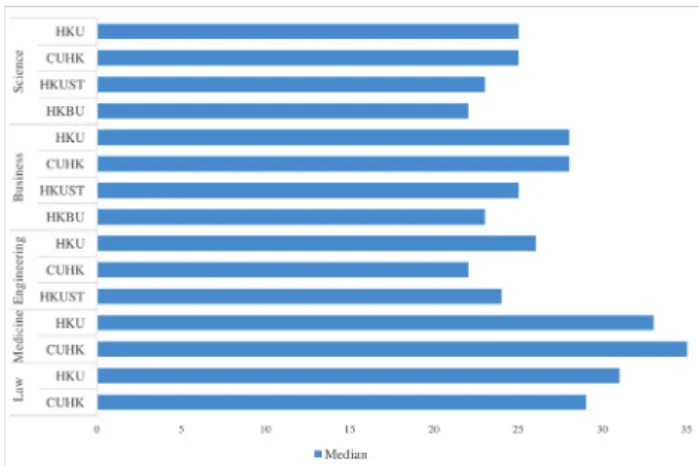
According to the study from Anthony P. Carnevale (2015) that, the highest paying group after graduating from university in the United States is Science, Technology, Engineering, and Mathematics (STEM) group, especially engineering majors which followed by health and business. As a result, talented students in the United States compete for an engineering degree. The situation, however, is totally different in Hong Kong as it is found that science and engineering are considered “undesirable” for Hong Kong students. The 2014 Joint University Programmes Admission System data show that, the admission requirements for engineering and science degrees are significantly lower than those of law and medicine, even business programmes in Hong Kong.
Figure 1. 2014 University Admission Median
In 2015 and 2016 policy address, Hong Kong Government stated that the Education Bureau of Hong Kong SAR will renew and enrich the curricula and learning activities of STEM, allowing students to fully unleash their potential in innovation. The critical problem is how STEM and students attracted each other. Lap-chee Tsui (2015) found that, the major challenge to Hong Kong’s Innovation and technology advancement is STEM programmes face strong competition in attracting students with the best academic results.
To promote STEM and equip student with professional knowledge and practical skills, and to be work prepared, Vocational Training Council (VTC) already applied STEM PBL in Hong Kong Institute of Vocational Education (IVE) Tsing Yi, Engineering Discipline, the project is known as ‘SOPHIE’, a solar car project, and the result showing that STEM give a positive influence to students.
STEM PBL in VTC IVE
In 2010, the IVE Solar Car Team, a team that focuses on developing a solar-powered vehicle, was established by the IVE Engineering discipline of the HKIVE Tsing Yi under VTC. STEM PBL is one of the core values of the team in respect to educating students. The team consists of students from Electrical Engineering and Mechanical Engineering working together and aims to design an innovative and more sustainable vehicle called ‘SOPHIE’ to demonstrate the viability of renewable energy through using the green transportation. From 2010 to 2016, more than two hundred students learnt the core value of the team, among them, around fifteen students were selected to be the core team member every year. They learnt about solar power technology and advanced application, high-tech automotive design and fabrication, logistic management and team cooperation. The vehicle ‘SOPHIE’ allow students to learn by doing and applying ideas, which is the key feature of project based learning which discussed in Bulmenfed (2000). The principle is that students actively construct their understanding by working with and using ideas when they gain a deeper understanding of materials, for example, video camera is used as the side mirror in SOPHIE, responsible
students were initiated that streamline shape cover shall be added on top to maintain the vehicle overall aerodynamic performance.
Till now, six ‘SOPHIEs’ were built under the massive effort of students. Three of them participated in three races under students’ leadership, “Shell Eco-Marathon Asia 2012” with SOPHIE SEM, “World Solar Challenge 2013” with SOPHIE IV and “World Solar Challenge 2015” with SOPHIE V. In each competition, students demonstrated their telnets in building solar vehicles. Students have applied the knowledge learned in classroom to design and fabricate the solar vehicle for competitions and showed their confidence and interest in building the solar vehicle. These experience broaden their view in terms of problem solving, design concept and technology application, thus self-confidence was highly enhanced. From that, it is without doubt that STEM PBL has positively influenced student’s extra-curricular performances. STEM PBL showed positive attitudes toward learning itself, team communication, and collaborative behaviour which were discussed in literature (i.e. Dominguez & Jaime, 2010; Kaldi, Filippatou & Govaris, 2011; van Rooij, 2009). Furthermore, STEM PBL was examined with respect to increasing students’ interest, confidence, and self-efficacy, found by Baran & Maskan (2010), which was highly related to the components of STEM BPL such as collaborations in group work and contextual problems reflecting students’ real world experiences.
In fact, design thinking process is also adopted to the team operation. The process is divided into five stages, including: Empathize, making use of the Internet, social media and local visits to under the design challenges to understand the way and why peoples engaging in similar projects, the needs are then identified; Define, through the empathizing stage, questions are uncovered and actionable problem statement of what needs to be built; Ideate, with the problem statement on hands, the team started to brainstorm and innovate on building the solar car; Prototype, these innovative ideas are realized by prototyping different parts of the solar car and were tested; Test, improved version of these prototypes were put together for testing (e.g. in campus parking lot), to realize the target product is finally delivered, and the project outcomes are being demonstrated.
Workshop to secondary school
To examine more on the extra curricular and academic aspects, a solar car workshop which is similar to the IVE Solar Car Team working operation is designed for senior secondary school students (i.e. S4 to S6). As junior secondary school students (i.e. S1 to S3) or even primary school students may not have the fundamental knowledge on STEM area, senior secondary school students were chosen.
The workshop introduces the basic solar car structure including solar panel working principle, energy conservation, and mechanical system to the participants, with the real product demonstration, (i.e. SPOPHIE) and divided them in group that hands on a project, a small scale solar car model. From the
workshop, it is observed that there are positive effects for students in acquiring content knowledge and nurturing positive attitude toward learning. The primary reasons are the workshop contains hands-on activities and field-based contexts. Moreover, students’ problem solving skills are improved since students were required to solve problems embedded in the project.
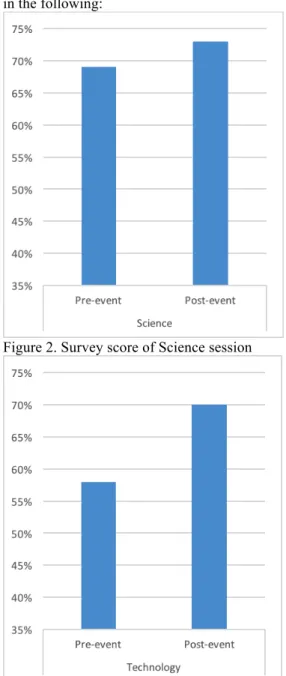
A set of pre-event and post event survey were conducted with the participants. The results are shown in the following:
Figure 2. Survey score of Science session
Figure 3. Survey score of Technology session
Figure 4. Survey score of Engineering session
Figure 5. Survey score of Mathematics session
Result
The figures and the observation deliver that while STEM PBL was implemented, there is an expected positive growth rate in students’ achievement especially in technology and engineering scopes (see Fig. 3 and 4), since these two area are not usually covered in classroom. Collaboration, group projects, ill-defined tasks, and student-centered environments all are inter-relationally function with each other. STEM PBL activities benefitted students in that more additional opportunities were given to students to communicate with peers and teachers than would traditional lectures. Teachers of the senior students appreciate that the workshop is interesting and helpful for students’ learning. To increase the gaining of every STEM areas, the workshop would be further developed.
The effectiveness of implementing STEM PBL in terms of improving students’ science and mathematics has not demonstrated as much improvement, however, the findings of this paper assists teachers to rethink how to promote STEM to students out of the traditional classroom and how the STEM PBL varied with the performance levels and benefit students by engaging in STEM PBL activities. STEM is an important key to nurture creativity, innovation, collaboration and problem solving skills of our next generation and to enhance the international competitiveness of Hong Kong.
References
Anthony P. Carnevale, Ban Cheah, Andrew R. Hanson. (2015) The Economic Value of College Majors. 8-15. Baran, M. & Maskan, A. (2010). The effect of project- based learning on pre-service physics teachers
electrostatic achievements. Cypriot Journal of
Educational Sciences, 5(4), 243–257.
Blumenfeld, P., Fishman, B. J., Krajcik, J., Marx, R. W., & Soloway, E. (2000). Creating usable innovations in systemic reform: Scaling-up technology-embedded project-based science in urban schools. Educational
Psychologist, 35, 149–164.
Chief Executive of Hong Kong SAR. 2015 Policy
Address from
http://www.policyaddress.gov.hk/2015/eng/pdf/PA2015 .pdf
Chief Executive of Hong Kong SAR. 2016 Policy
Address from
http://www.policyaddress.gov.hk/2016/eng/pdf/PA2016 .pdf
Domínguez, C. & Jaime, A. (2010). Database design learning: A project-based approach organized through a course management system. Computers & Education,
55(3), 1312–1320.
Joint University Programmes Admissions Systems.
2014 JUPAS Admissions Scores from
http://www.jupas.edu.hk/f/page/267/af_2014.pdf Kaldi, S., Filippatou, D. & Govaris, C. (2011). Project-based learning in primary schools: Effects on pupils’ learning and attitudes. Education 3–13, 39(1), 35–47. Lap-chee Tsui, Ms Rita Lun, Edwin Cheung. (2015)
The Ecosystem of Innovation and Technology in Hong
Kong. 17.
Van Rooij, S. W. (2009). Scaffolding project-based learning with the project management body of knowledge (PMBOK®). Computers & Education,