Optimised Retrofit and Maintenance
Farid Fouchal,
[email protected]
Loughborough University, UK
Jonathan Masior,
[email protected]
Fraunhofer Institute for Industrial Engineering, Germany
Shen Wei,
[email protected]
Loughborough University, UK
Tarek Hassan,
[email protected]
Loughborough University, UK
Steven Firth,
[email protected]
Loughborough University, UK
Abstract
Optimising energy consumption of new buildings (through design) and reducing energy consumption of existing buildings (using optimised retrofitting or maintenance) are important to achieving the global targets of energy saving and cutting CO2 emissions of buildings. Many decision support tools have been developed for architects and building designers to choose the best building design options with retrofit and maintenance in mind. However, there is a lack of understanding of the required data structures and databases that would support design and enable Facility Management (FM) in making best decisions during retrofit and maintenance for improved energy efficiency (EE). To address these limitations a decision support tool based on Multiple Criteria Decision Making (MCDM) for architects, energy designers and for FM is being developed within an ongoing EU research project “Design4Energy”, to enable design for EE maintenance and retrofit and support the FM in the operation stage. In this paper three aspects are presented: (1) analysis of existing decision support tools; (2) detailing the database requirements in terms of information technology (IT), components and systems, materials and the stakeholders on the basis of a literature search and a survey conducted with of stakeholders from the building sector; (3) a first prototype of a decision support tool for maintenance and retrofit being developed.
Keywords: Decision Support, Database, Building Energy performance, EE
1
Introduction
Many decision support tools have been proposed to help architects and building designers to choose the best design for energy efficient (EE) options, and support retrofit and maintenance projects (Ferreira et al., 2013). However, there is a lack of feedback from end users on the usefulness of these tools, such as how architects and building designers perceive the concept of EE design for maintenance and retrofit. Another limiting aspect is the unavailability of studies on databases requirements to enable EE design that does support FM during operations. Therefore, to develop a user-centred decision support tool within an ongoing EU research project, Design4Energy, a two-stage study was carried out: (1) performing a review of existing decision support tools for EE design, retrofitting and maintaining of buildings and summarising some of their main characteristics (e.g. using building simulation to predict the effectiveness of various retrofit measures) to inform the current development of a dedicated decision support for FM in particular; (2) definition of
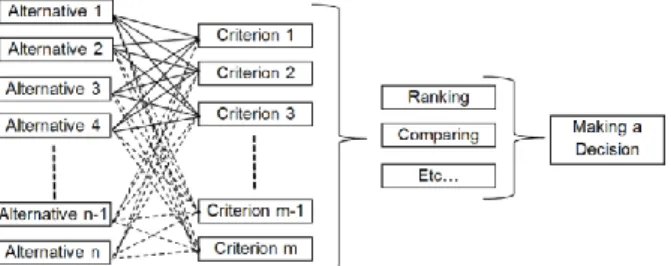
database requirements in terms of components, parameters and indicators for the need of decision support tool, to automatically generate options that will enable architects and energy designers to account in the early design stage for maintenance and retrofitting, to support FM during operation stage in optimising their decisions. A set of databases will consequently be developed for the decision support tool, this development will include identification of the requirements for IT systems, components, energy systems and, materials. The work started by analysing existing database solutions to design the required one for retrofit and maintenance, then validated the databases’ characteristics using focus groups of potential users (architects, energy designers and FM) and finally tuned to suite the decision support. The review of the decision support methods is provided in the following: Multiple Criteria Decision Making (MCDM) integrates multiple indicators into a single meaningful index to allow ranking and comparing options for decision making. It is an efficient statistical method to combine component indices arising from all the information sources into a single overall meaningful index, therefore ranking and comparing are feasible. MCDM has the ability to weight different alternatives and make judgement on various criteria for possible selection of the best/suitable alternative(s). A typical MCDM problem is when there are a number of criteria to assess a list of alternatives. Each alternative is represented by a single value for each of the criteria to permit the assessment and/or ranking, see figure 1. Complex decision requires consideration of multiple criteria (Zeleny, 1982).
Figure 1 Multi criteria decision making (MCDM) process being adopted in D4E
The weighted sum model (WSM) is the simplest of MCDM, which is applicable only when all the data are expressed in exactly the same unit otherwise the final result, is ironic. The weighted product model (WPM) can be considered as a modification of the WSM, and has been proposed in order to overcome some of the WSM weakness. The analytic hierarchy process (AHP), as proposed by Saaty (1994) is a later development and it has recently become popular. Some other widely used methods are the ELECTRE and the TOPSIS methods. Hwang (1993) have developed a number of MCDM techniques to meaningfully integrate many indices to an overall index in order to decide on the ranking of a number of alternatives. They have developed an MCDM approach called technique for order preference by similarity to ideal solution (TOPSIS). Filar (2009) described in detail the TOPSIS method and used entropy as a basis to determine the importance of weights and applied the MCDM technique to assess the possibilities available. An MCDM process include: (i) determining the relevant criteria and alternatives; (ii) attach numerical measures to the relative importance of the criteria and the impact of the alternatives on these criteria and (iii) process the numerical values to determine a ranking of each alternative. If compared WPM uses multiplication of these numerical values in the model instead of addition in WSM. However, the Analytic Hierarchy Process (AHP) method that is based on priority theory decomposes a complex multi-dimensional decision making problem into a system of hierarchies. It uses the relative importance of the alternatives in terms of each criterion. The AHP has the ability to logically incorporate data and expert’s judgement in the model for measurement and prioritising intangibles. As a complex and unstructured situation is broken down, its components are arranged into a hierarchic order including criteria and alternatives. The core of MCDM consists of the construction of pairwise comparison matrices and the extraction of weights by means of the principal right eigenvector. Linguistic variables in a
fuzzy environment in the form of Triangular Fuzzy Numbers (TFNs) are also used to determine the weights of criterion.
OpenStudio is an open source project to create a collection of software tools for energy modelling, daylight analysis and various other simulations. In OpenStudio the community of developers can program plugins, applications, analysis tools to support all kind of stakeholders to design more energy efficient building (OpenStudio, June 2015). The value of design platforms is is in their workflow speed and quality, facilitating team contribution integration, and rapid feedback on energy performance (NREL's OpenStudio, June 2015). For these platforms databases is essential for their functioning. While xBIM is another open source development platform, which allows creating application for BIM based on the IFC standard. The corresponding development library contains far more functions to manipulate the IFC files. The libraries can be integrated in a .net environment and are mostly written in C#. The currently supported IFC version is IFC2x3 (xBIM, June 2015). TNO BIM Server is an open source development platform, which allows to create application for BIM based on the IFC standard. The BIMserver allows mainly querying, merging and filtering the BIM-model and generating IFC files on the fly. Further important functions include versioning, notifications, geo-locating models, authentication and plug-in infrastructure. The libraries can be used in a Java environment. The currently supported IFC version is IFC2x3 (bimserver, June 2015). The BuildingSMART Data Dictionary (bSDD) is a reference library or a framework that aims at supporting improved interoperability in the building and construction industry. It can connect software applications to product databases or attach specific attributes to construction designs. These references can include information from a product manufacturer, typical room requirements, cost data or environmental data. (ifd standards, June 2015), (ifd-library, June 2015).
Component catalogues relational databases are accessible through internet protocols. They contain components of buildings in a format that can be read by CAD software. The most cultivated categories are “lamps” in “electric lightning”, “Packaged Unitary Equipment” and “Boilers” in “HVAC”, and “Photovoltaic Systems” in “On-site Power Generation” (performance.nrel, June 2015). The Building Component Library (BCL) by NREL provides searchable information about EE related technologies and a list of measures to meet energetic issues (Fleming et al., 2012). The included information can represent physical characteristics of buildings such as windows, walls, and doors, or can refer to related operational information such as occupancy, equipment schedules and weather information. Each measure and energy system can be downloaded as a XML, RB and OSM file describing these components (bcl.nrel, June 2015). Data Repository ISES is a cloud-based data repository. It contains information such as climate data or stochastic templates but most interestingly energy product and material catalogues containing energy properties of products and materials. The elements that are saved in this database are
“ifcBuildingElement”, “ifcMaterial”, “IfcMaterialProperties sub-types”, and
“ifcDistributionElement”. They are used for creating physical constructs incorporated into the building out of product and material properties (ISES D4.1, 2014). It aims to bring component manufacturers effectively together with their customers in order to keep the market open for their products. Further it aims at choosing appropriate components by energy-related characteristics due to the high requirements of both designers and MEP specialists. The library uses the PLIB ontology model (based on ISO 13584). All information is saved in the ifc file format (ISES D4.3, 2014). The MagiCAD Product Database is a product catalogue or database that contains over one million products from over hundred manufacturers. A designer can choose components through a plugin directly via the CAD-tool interface. This interface is connected to a plugin on the manufacturers’ site (MagiCAD, 2014). Other proprietary component databases are linked to CAD tools of component libraries with parametric objects provided by the software producer itself or by its developer community. The objects are stored in the CAD specific format, e.g. ArchiCAD library parts, and describe building elements as 2D CAD symbols, 3D models and text specifications for use in drawings, presentations and calculations (ArchiCAD). The Open Energy Information
Platform (OpenEI) is a Media Wiki giving the most current information needed to make informed decisions on energy, market investment, and technology development (openei, June 2015). The NBS National BIM Library for BIM users is a collection of both generic and manufacturer objects which enables the use of BIM objects throughout a project. These contain an extensive number of generic objects that can be used for outlining design stages. Eurobau, the portal eurobau.com provides a data pool of construction materials. It was created for the implementation of the EU directive 89/106/EWG. The data content is generally structured by the application case of the materials, e.g. underground engineering,
insulation or interior construction 0. Masea is a database accessible through a web platform
which contains a set of different materials (such as painting, plaster, stones, insulations, wall cladding and others). The description of the materials contains detailed information about physical and structural parameters, pictures, hints on usage, diagrams with information among others about moisture retention, water absorption, drying process, and further information about manufacturer. The data of each material is downloadable as XML file. Further the database is used in the tools WUFI®, DELPHIN®, and EPASS HELENA (masea-ensan, June 2015), (BINE, June 2015). National Residential Efficiency Measures Database by NREL, providing a national unified database of residential building retrofit measures and associated costs. Wiki of the Climate-Smart Planning Platform, aims at establishing a development community for openly accessible climate planning and modelling tools (climatesmartplanning, June 2015). Building catalogue EMPORIS, collects information on buildings (public and business). It sets information standards for facilitating and connecting the collected data (EMPORIS, June 2015).
During the research on database requirements for decision support, interviews and
questionnaire on SoA review, internal discussions with partners and energy experts,
investigation of the simulation software and BIM technologies have been the main sources.
2
Methodology
The methodology adopted to identify the DB requirements for FM decision support includes: A. Data gathering: (a) Questionnaires and interviews, distributed to project partners and their collaborators, such as EcoShopping, external architects and energy experts; (b) Literature survey that was mainly desktop search supported by internal consultations, review of research projects (of energy–efficient building, retrofit projects, BIM solution, energy simulators); (c) Discussions during the project meetings were carried out;
B. Sources: EU commission website “Cordis”, project websites and official sites of
government organizations, database providers, commercial products and contacts from the building energy, BIM, ICT domain;
C. Analysing data: at internal meetings, between partners meetings and iterative workshops. The questionnaire was designed so that: Stakeholders were the interviewee; decision process is how often and how decisions are made, and factors affecting them; Component were HVAC lighting, envelope including walls, floors, roof, windows, and doors).
This work also involves the development of database of components, parameters and indicators. Therefore, with this objective the identification of the requirements of the IT systems, components and energy systems, materials and stakeholders databases began by analysing existing database solutions. Initially the databases could include parameters for different building components such as wall, roof, floor, windows and doors, lighting system, renewable energy systems and HVAC components such as heat pump, boiler, energy storage and distribution.
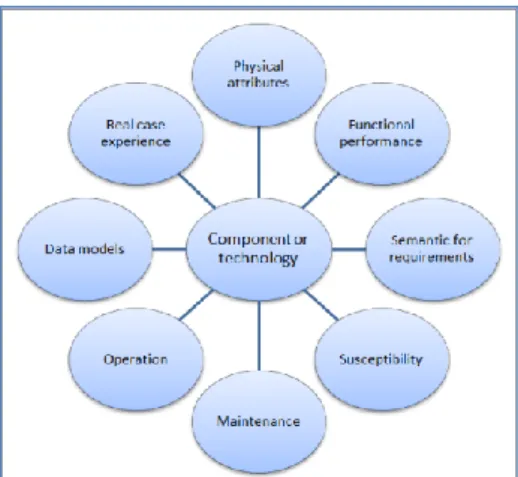
The database stores information on energy systems as smart objects which include their performance attributes. A series of real case data interlinked with the smart objects will help predict performances of the component or systems if the deployement conditions are known. Input and output are supplemented to make interlinked data requests. Stored data is e.g. deterioration curves, cost of operating and replacements, energy performance and demands of components, cost of maintenance, and cost effectiveness of solutions. Figure shows the components of a required database.
Figure 4 Database schema
This survey is conducted in D4E project with the most relevant end users. A total of 30 responses are collected from different sectors Figure 2 and 3, about 23% are Architects and designers, and another 20% are technology and solution providers.
Figure 2 Stake holders participated in the questionnaire Figure 3 Opinion on building component
Building components initially have to be manually stored by users. The DB requirements as reported from the literature search included: (i) User, through interaction has to provide a direct link to BIM models; (ii) Visualising data, makes conclusions possible for building architecture; (iii) BIM models, have to be accessible by relevant stakeholders such as engineers for energy systems; (iv) Solutions with their operational attributes, maturity, deterioration, experienced costs or best practices of similar projects; (v) Material characterization (e.g. type, functionality, thickness, thermal conductivity, density specific heat, internal and external solar absorption, and emissivity); (vi) Team management.
The technology based information sharing goes alongside with the common concept of technology management to identify, evaluate and observe technologies, in this case building components (Spath et al., 2010). All interactions depend on knowledge/information such as budgetary issues, experience of prior projects and performance. In the planned component database the designs or components can be searched by customer requirements or simple attributes. The component database allows browsing energy system by attributes such as performance and estimated life cycle costs (LCC). The three dimensional CAD models can be extended through time information (4D) for the projection of construction activities, cost information (5D) for the integration of quantities, prices etc., and as-built operational data (6D) for the usage of BIM models during the construction process (Smith, 2014). However, the information is not always attached to the data file itself but is provided by different web platforms, service provider or databases. The search for existing database solutions refers to known requirements of the user and can be categorized into three categories: “Construction material databases”; “Component databases”; “Others” such as building type databases.
3
Databases requirements
3.1.1Providers of services and products related data
The participants claimed that the important sources for their design decisions’ are experts such as researchers, databases, technology suppliers, partners, company websites or catalogues, and experience from prior projects. The common services or products provided are software solutions or information, e.g. physical characteristics of buildings or materials, envlope components such as façades or windows, and energy systems (i.e. heat pumps).
3.2DB data structures requirements
Through the survey conducted with the varied range of stakeholders a number of route for possible support in the maintenance and retrofit stage of a building where identified. These are summarised as: support by the energy simulation and actions for environmental influence through provision of energy system performance data and physical characteristics of building materials; Support in cost simulation over the life cycle through e.g. the provision of data from similar real cases; Support in the design process through possibilities to share
design results; Support to the owners’ decision through providing information on the
utilization and sustainability aspects of existing components and energy systems; Support of the FM decision in choosing the optimal action for the available boundary conditions.
3.2.1Decision making on building component
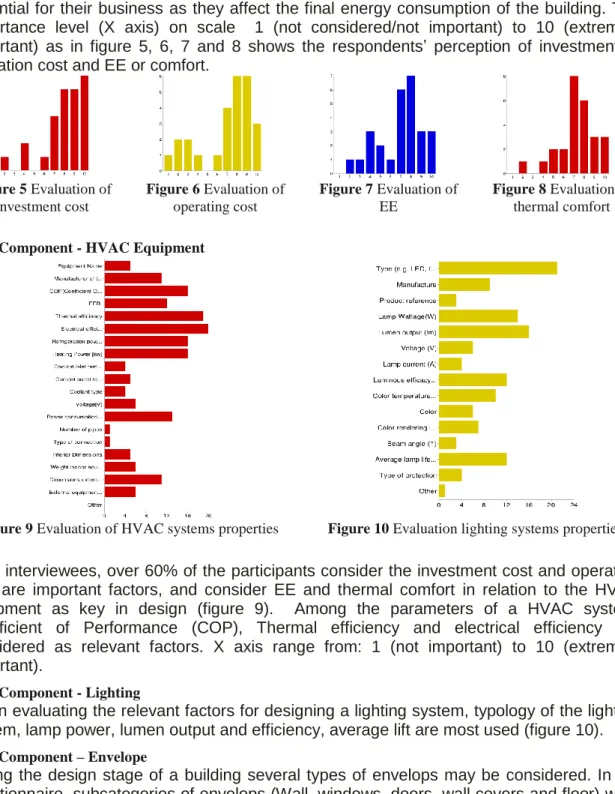
80% of the participants stated that decision making on building components is important or essential for their business as they affect the final energy consumption of the building. The importance level (X axis) on scale 1 (not considered/not important) to 10 (extremely important) as in figure 5, 6, 7 and 8 shows the respondents’ perception of investment or operation cost and EE or comfort.
Figure 5 Evaluation of investment cost Figure 6 Evaluation of operating cost Figure 7 Evaluation of EE Figure 8 Evaluation of thermal comfort
3.2.2Component - HVAC Equipment
Figure 9 Evaluation of HVAC systems properties Figure 10 Evaluation lighting systems properties
Most interviewees, over 60% of the participants consider the investment cost and operation cost are important factors, and consider EE and thermal comfort in relation to the HVAC equipment as key in design (figure 9). Among the parameters of a HVAC system, Coefficient of Performance (COP), Thermal efficiency and electrical efficiency are considered as relevant factors. X axis range from: 1 (not important) to 10 (extremely important).
3.2.3Component - Lighting
When evaluating the relevant factors for designing a lighting system, typology of the lighting system, lamp power, lumen output and efficiency, average lift are most used (figure 10).
3.2.4Component – Envelope
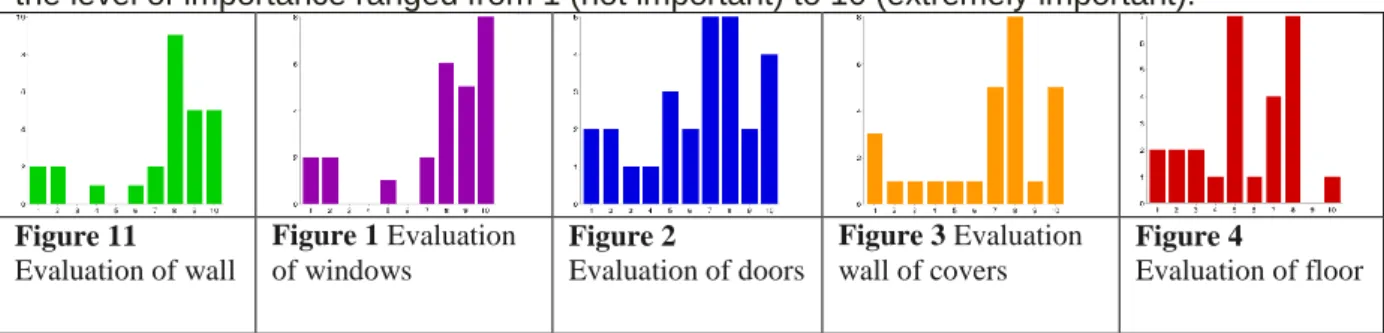
During the design stage of a building several types of envelops may be considered. In the questionnaire, subcategories of envelops (Wall, windows, doors, wall covers and floor) were studied; their evaluation by the participants is positives, which reveals these components
have great effects on the energy performance of a building. Similar to HVAC components, the level of importance ranged from 1 (not important) to 10 (extremely important).
Figure 11 Evaluation of wall Figure 1 Evaluation of windows Figure 2 Evaluation of doors Figure 3 Evaluation wall of covers Figure 4 Evaluation of floor
3.3DB simulation information requirements
3.3.1Energy simulation software
Reliable estimation and quantification of different designs is commonly evaluated through energy simulation and modelling. There are a variety of whole building energy simulation packages, such as Energy Plus, eQUEST, TRNSYS, IES, IDA, HAP etc., that can be used to simulate the thermodynamic characteristics of building designs and retrofit measures.
3.3.2EnergyPlus
EnergyPlus is a whole building energy simulation program that engineers, architects, and researchers use to model energy to optimize the building design to use less energy see figures 17 and Figure
5
. It provides innovative simulation capabilities including time steps of less than an hour, modular systems simulation modules that are integrated with a heat balance-based zone simulation and input and output data structures tailored to facilitate third party interface development. Other simulations include solar thermal, multi-zone airflow, fuel cells. Position, orientation of buildings and influence of neighbouring structures: to model the effect of solar protection EnergyPlus can model remote shading (i.e. effect of other buildings and landscape). Zoning capabilities to distinguish the existing different thermal zones in the building, for which activity, HVAC, lighting system facade orientation are required. This capability allows the user to distinguish the different thermal zones existing in the building. The EnergyPlus engine allows hourly analysis of energy flows (or more usually sub-hourly) time steps and can analyse 8760 hours per year and report results in hourly format.
Figure 5 Energy plus flow chart Figure 6 Energy plus modules
3.4DB requirements for simulation outputs
The main expected outputs from simulation are listed below; this includes the Indoor Air Quality (IAQ), energy consumption and building component performance.
3.4.1IAQ and Energy consumption
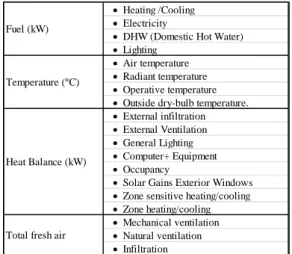
The main requested outputs for a correct valorisation of the IAQ and energy consumption of the building facilities are expected to include the parameters in the following table:
These parameter results could be displayed in sub-hourly or hourly formats for the whole year or for parts of the year.
Table 1 Relevant parameters for radiant heating/cooling system
3.4.2Thermal performance of building components
To perform an energy simulation, thermal properties of the used building components will be needed; each material and component should be defined at least containing these parameters: Thermal conductivity, Density and Specific heat. Solar absorption and emissivity will be only required for both external and internal faces of the envelope wall. This information will be essential for simulation of the thermal performance of the building components, detailed description of these properties will be described in section Error!
Reference source not found..
The expected simulation output will be values of time depended heat balance (kW) or heat flows and temperatures in the different building components, which includes glazing, walls, ceiling, floors, roofs, lighting, window, by showing by zone, block or building level.
3.5DB for operation and maintenance requirements
The methodology adopted to identify the database requirement in terms of design for operation and maintenance besides of review of relevant literature, it included standards and guidelines to first highlight the generic domains of requirement. The survey was conducted with the aim of gauging more specific requirement to different usage groups on databases which will support design for building operation and maintenance.
Among the samples interviewed were academics at Loughborough University who have particular expertise in building services, facility management (FM) and BIM. A second group of interviewees involved real-world practitioners of building operation and maintenance, who were mainly from facility management and energy system design and manufacturing. All interviewees were interviewed on a one to one basis over a 30 minute section each.
3.5.1DB requirements identification
There are different routes to identify/find stakeholders’ requirements for maintenance and retrofit which include: Return to the point of reference which is the original brief from clients; Assess against building regulations; Building design standards from ASHRAE, ISO and CIBSE, or commercial building performance rating methods such as BREEAM and LEED; Engage existing users in workshops or through organised surveys; Need for more double glazing to meet the new standards; Measurement of air tightness; Measurement of natural daylight; Need for the software/smartness to help to do day to day activities; Need to enable informed decision through usage of decision support tools; Review of design life of different components; Sensors data to be fed into the platform such as D4E, to create warnings.
3.5.2DB usage requirements for maintenance and retrofit
FM requires accessing the databases with some capabilities to alter them when necessary, or for acquiring policy on energy target, or information on seasonal weather conditions. All of the involved stakeholders (should have either read access or read and write access). For ease of use users should have customized access to provide them only the relevant information to their activities. To better design buildings for EE these databases and support FM the DB should include: all energy modelling tools; computer aided FM tools (CAFM),
Heating /Cooling Electricity
DHW (Domestic Hot Water) Lighting
Air temperature Radiant temperature Operative temperature Outside dry-bulb temperature. External infiltration External Ventilation General Lighting Computer+ Equipment Occupancy
Solar Gains Exterior Windows Zone sensitive heating/cooling Zone heating/cooling Mechanical ventilation Natural ventilation Infiltration Fuel (kW) Temperature (ºC) Heat Balance (kW)
COBie (that transfers IFC objects & spaces into a spreadsheet); BMS (lighting, HVAC systems, heating etc. monitor and control); Revit (conceptual energy modeller, rough “Good, Medium or Bad”), standard BIM tool; Specific energy modellers (such as DesignBuilder, EnergyPlus, Bentley (Microstation) and Graphisoft (ArchiCAD)).
3.5.3DB for maintenance and retrofit format and sources
In the UK for example the search for new building components is generally undertaken through a number of common databases such as the National BIM library for the UK or search manufacturer/supplier websites. The NBS is an object library and it supports different BIM platforms such as IFC and Revit. Among these attributes used cost is the most important, followed by energy ratings and energy performance. Commercial building performance rating methods, such as BREEAM and LEED, provide adequate criteria for the search, which can guide the choice making process. For example, for civil applications one can use SQual. Some of these criteria would be in the IFC already with some useful check boxes or sliders. Once the information on new components is retrieved the component libraries are linked to BIM. Components used in BIM models need to be linked to parent source/library for automated updates of availability, cost etc. as an example the Google 3D component warehouse, where suppliers continuously putting catalogues on Revit.
4
Decision support prototype
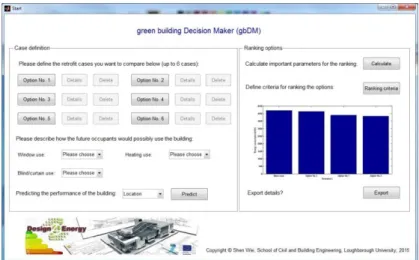
At this stage, a prototype decision support tool has been developed, using the GUI function of Matlab and named as green building Decision Maker (gbDM). The tool has adopted EnergyPlus as the simulation engine to predict the building’s performance under various design conditions. Its main user interface is shown in figure 19.
Figure 19. gbDM Decision support User Interface
The gbDM is developed to help architects design buildings so that FM can select most suitable retrofit/maintenance option for the construction project. The tool contains two main parts, i.e. case definition (left side) and option ranking (right side). In the case definition side, firstly, the user needs to define their interested retrofit/maintenance options to test, in this version up to 6 options each time are possible. The information provided here is directly linked to databases made available for retrofit/maintenance options generation (e.g. upgrading the external wall insulation and improving the boiler efficiency). Due to the high importance of occupant behaviour on the predicted effectiveness of retrofit/maintenance options (Wei et al. 2015), occupant behaviour with respect to their use of windows, heating and blinds are provided. Before running the simulation, the location should be selected including the weather data. After completing the simulation, the users can start calculating important performance indicators, such as total energy consumption or payback time. Then the users will be prompted to define the criteria for ranking the tested options. An example of ranking results is shown in figure 19 as based on the final energy consumption of the building. The results can be also exported.
Conclusions
The work described here identified the required data structures and databases to support design and enable Facility Management (FM) to make decisions on best retrofit and maintenance for improved EE. The databases requirements and functionalities have been detailed. A set of necessary databases were proposed to enable optimal decision making by FM and perform adequate design of new build. The level of detailing the database requirements is provided in terms of information technology (IT), components and systems, materials and the stakeholders. To complete the study a validation by FM of the database is conducted using the new decision support tool for maintenance and retrofit to be used.
Acknowledgements
The Design4Energy project is co-funded by the EU Commission, Information Society and Media Directorate-General, under the Seventh Framework Programme (FP7), Grant agreement no: 609380. The authors wish to acknowledge the Commission for their support.
References
About NREL's OpenStudio Application Suite and Development Platform
https://www.youtube.com/watch?v=ovLt4-q_UEg, Accessed June 2015
ArchiCAD Object Download Sites: http://www.graphisoft.com/downloads/parametric_objects.html Building Component Library: https://bcl.nrel.gov/about, Accessed June 2015
Climate-Smart Planning Platform: https://www.climatesmartplanning.org/wiki, Accessed June 2015 Die größte Plattform für Gebäudeinformationen und Bauprojekte weltweit: http://www.emporis.de/,
Accessed June 2015
European project ISES, Deliverable D4.1, download at http://ises.eu-project.info/documents/ISES-D4.1.pdf, Accessed October 2014
Europäisches Bauinformationssystem: http://www.eurobau.com/, Accessed June 2015
Hwang, Ching-Lai, Young-Jou Lai, and Ting-Yun Liu. "A new approach for multiple objective decision making." Computers & operations research 20.8 (1993): 889-899.
European project ISES, Deliverable D4.3, download at http://ises.eu-project.info/documents/ISES-D4.3.pdf, Accessed October 2014
IFD standards from buildingSMART: http://www.buildingsmart.org/standards/ifd, Accessed June 2015 IFD Library & IFD Library Group for buildingSMART: http://www.ifd-library.org/, Accessed June 2015 Katherine Fleming, Nicholas Long, and Alex Swindler “The Building Component Library: An Online
Repository to Facilitate Building Energy Model Creation”, ACEEE Summer Study on EE in Buildings, Pacific Grove, California August 12-17, 2012
Materialdatensammlung für die energetische Altbausanierung: http://www.masea-ensan.com/, Accessed June 2015
Materialdaten für die energetische Altbausanierun:
ghttp://www.bine.info/publikationen/publikation/materialdaten-fuer-die-energetische-altbausanierung/materialdatenbank/, Accessed June 2015
MagiCAD product database and plugins, source: http://www.magicad.com/en/content/product-database, Accessed October 2014
OpenStudio: http://openstudio.nrel.gov/, Accessed June 2015 Open source BIM Server: http://bimserver.org/, Accessed June 2015
OpenEI: Energy Information, Data and other resource: http://en.openei.org/wiki/, Accessed June 2015 Spath, D. Schimpf, S. & Lang-Koetz, C. (2010). Technologiemonitoring: Technologien identifizieren,
beobachten, bewerten. Stuttgart, Germany: Fraunhofer, Verlag.
Smith, Peter: BIM & the 5D Project Cost Manager, 27th IPMA World Congress, 2014
eXtensible Building Information Modelling (xBIM)Toolkit: http://xbim.codeplex.com/, Accessed June 15 Technology Performance Exchange: https://performance.nrel.gov/about, Accessed June 2015 Saaty, Thomas L. Fundamentals of decision making and priority theory: with the analytic hierarchy
process. Rws Publications, 1994.
Tutz, Gerhard. "Bradley-Terry-Luce models with an ordered response." Journal of mathematical psychology 30.3 (1986): 306-316.
Wei, Shen; Firth, Steven; Hassan, Tarek.M; & Fouchal, Farid. (accepted) 'Impact of occupant behaviour on the energy saving potential of retrofit measures for UK PB. International Conference on Sustainable Development in Building and Environment, 2015. 27-29 July. Zeleny, Milan. Multiple criteria decision making. Ed. J. L. Cochrane. Vol. 25. NY McGraw-Hill, 1982.