råá
p
=
==
=
=
======råáîÉêëáíó=çÑ=pìêêÉó
Discussion Papers in Economics
Department of Economics
University of Surrey
Guildford
Surrey GU2 7XH, UK
Telephone +44 (0)1483 689380
Facsimile +44 (0)1483 689548
Web
www.econ.surrey.ac.uk
ISSN: 1749-5075
THE ANALYSIS OF CATALYSIS: IMF PROGRAMS AND
PRIVATE CAPITAL FLOWS.
By
Graham Bird
(SCIES, University of Surrey)&
Dane Rowlands
(The Norman Paterson School of International Affairs Carleton University)
The Analysis of Catalysis: IMF Programs and Private Capital Flows.
Graham Bird
Surrey Centre for International Economic Studies Department of Economics, University of Surrey
and Dane Rowlands*
The Norman Paterson School of International Affairs Carleton University
Abstract
This paper examines the claim that the IMF catalyzes other capital flows. We identify a series of propositions based on recent theoretical work, use a treatment effects model to deal with selection bias, and examine whether the IMF catalyzes both aggregate private financial flows and important subgroups for middle-income countries. The results presented here support many of the propositions, but also indicate that the sign and significance of catalysis varies according to the type of flow and the circumstances of the country. The finding that catalysis is complex and nuanced has important implications for policy that are briefly discussed.
JEL Classification: F32, F33, F34, O19
Keywords: IMF, catalysis, international capital flows, private capital flows. December 20, 2005
*Corresponding author: Dane Rowlands, NPSIA, Carleton University, 1125 Colonel By Drive, Ottawa, Ontario Canada K1S 5B6 [email protected]
1. Introduction1
A central issue in discussions about the world’s financial system is the nature of the relationship between international financial institutions (IFIs) and private international capital markets. On the one hand they may be viewed as substitutes, with IFIs
becoming involved in countries that have little access to private capital or where private capital outflows have created a short-term external financing vacuum. Those who subscribe to the idea of creditor moral hazard go further and claim that the prospect of future IFI lending in the event of a crisis encourages private lenders to underestimate risk and to lend excessively. The over-lending then causes the crisis which in turn results in private capital outflows and the anticipated bail-out lending by the IFIs. Viewed as complements, on the other hand, IFI lending is claimed to have a catalytic effect on private capital market lending. In this case the IFIs are presented as bailing in private capital through signalling, coordination, or coercion. Through catalysis the IFIs can facilitate balance of payments adjustment with fewer of its own resources. The nature and size of the catalytic effect is therefore of considerable importance. If it is misinterpreted and overestimated the consequence is likely to be deficient amounts of external financing and sub-optimal balance of payments adjustment.
Although rather overlooked in the past, increasing attention is now being paid in particular to the catalytic effect of IMF programs on private capital flows. This is perhaps unsurprising given the incidence of financial crises, the widely perceived problem of capital instability and reduced capital flows, and the reluctance of the IMF’s shareholders to increase its resources. The increasing attention has been reflected by a flurry of papers on different dimensions of the catalytic effect. The
1 We would like to thank, without implicating them in any errors, the British Academy for financial
support, Mejlina Modanu and Jano Bourgeois for research assistance, and Rose Anne Devlin for comments.
literature has become large enough to warrant a survey article (Cottarelli and
Giannini, 2002) that plots out the evolution of the concept, analyses the mechanisms through which it may operate, and evaluates the available empirical evidence relating to its existence. Until recently, however, the analysis of the competing modalities via which catalysis may occur has been largely informal, and the lack of a formal
theoretical framework has impeded the formulation of specific empirical questions. The purpose of this paper is to contribute to the next stage of research into the catalytic effect. Do recent formal theoretical analyses enable us to delineate a finer and more nuanced empirical investigation? Do more subtle results emerge from this investigation, and, if so, do these carry with them new policy insights?
The paper is organised in the following way. Section 2 briefly revisits the conventional analysis of catalysis but goes on to examine recent theoretical contributions. The discussion in this section endeavors to formulate a series of
hypotheses or propositions that can then be tested against the data. Section 3 provides a succinct and representative (rather than comprehensive) summary of the existing empirical research into the catalytic effect. Section 4 explains the method and data used in some new empirical estimations aimed fairly specifically at testing the
propositions that emerge from the recent theoretical work on catalytic finance. Section 5 presents and discusses the results discovered. Finally, section 6 explores the policy implications of the findings reported in the previous section and offers some
concluding remarks that place the concept of catalytic finance into the wider context of capital mobilization and the reform of the IMF.
2. Catalysis: Theoretical Underpinnings
In their review of the catalytic effect, Cottarelli and Giannini (2002) claim that there are five channels through which it may work: policy design, information,
commitment, screening, and insurance. IMF programs may lead to the design of superior economic policies that improve economic performance above and beyond what would have been achieved in their absence. They may carry within them
information that would otherwise be unavailable to private capital markets concerning future economic policy and performance relating to key economic variables. Programs may signal a government’s commitment to reform, and reduce the chances that there will be policy slippages or reversals. They may screen out governments that are not serious about reform. Finally, and as Cottarelli and Giannini present it, the IMF might play an insurance role by acting as a lender of last resort, thereby inducing private capital markets to lend. As noted earlier, however, this effect is more conventionally viewed as creditor moral hazard rather than as catalysis.
In earlier research Rodrik (1996) and Bird and Rowlands (1997) focused on conditionality as the principal modality via which catalysis occurs. The strength of the catalytic effect then depends on the perceived appropriateness of the design of
conditionality, and the chances that it will be implemented. In short, catalysis will tend to work better where conditionality carries credibility. If, however, private markets believe that IMF programs will lead to recession and corporate and financial failure, or that the policies embedded in conditionality will not be implemented, then catalysis will be weak or non-existent. It may even be perverse if IMF programs transmit negative signals.
More recently, and in the aftermath of the East Asian crisis in 1997/98 and subsequent crises, the focus has tended to shift to the role of the IMF in helping to overcome liquidity crises by contributing to short run financing needs. Collective action problems may make capital markets reluctant to lend to a country because of the perceived probability of default. If IMF lending induces a stronger commitment to adjustment, by making the associated policies more sustainable politically, markets
may perceive that default is less likely and may then be more willing to lend. Of course in the absence of conditionality, there is a risk that the additional finance provided by the IMF may allow governments to relax their adjustment efforts and thus increase the default risk. In this context a number of papers have investigated the logic of partial as opposed to complete bailouts, frequently arguing that partial bailouts leave open multiple equilibria that in turn induce private creditors to foreclose and bring about default and a crisis. Creditors are not co-ordinated and only a full bailout that completely fills the financing gap will restore confidence (Zettelmeyer, 2000, Frankel and Roubini, 2001, Jeanne and Wyplosz, 2001).
Recent contributions to the theory of the catalytic effect have concentrated on the impact of IMF lending on the probability of default. Morris and Shin (2003) use a global games framework to analyse the behavior of three players; short- term
creditors, the IMF and debtor governments. In this co-ordination game with limited uncertainty, IMF lending may be necessary and just sufficient to supplement the financial resources a debtor country obtains from adjustment efforts (ie to raise the returns to adjustment) thereby encouraging short-term creditors to roll over their debt despite initial concerns about liquidity (as opposed to solvency). When a country has relatively strong fundamentals and where the government’s commitment to stabilize the economy is clear, there is little risk of illiquidity, little need for additional
resources, and little or no role for IMF-induced catalysis. Where economic problems are fundamental and deep-seated, or where independent adjustment effort would tend to be low, the relatively small increase in resources associated with IMF programs is unlikely to persuade governments to increase their adjustment efforts substantially, and will fail to persuade creditors to roll over debts. Catalysis is therefore unlikely to exist here either, and the Fund’s resources may well be wasted. Where catalysis may occur is for countries on the margin of default. Here an IMF program may provide
just enough resources and incentive to adjust to instil confidence in the markets and induce them to roll over debts.
Similar conclusions emerge from Corsetti, Guimaraes and Roubini (2003), who build a model in which crises are caused by the interaction between poor
fundamentals, self-fulfilling creditor runs, and the policies of investors, governments and the IMF. In the context of this model the IMF can prevent a scramble for liquidity by co-ordinating agents’ expectations and by increasing the number of creditors willing to lend for any given set of fundamentals. The Fund’s influence will increase with the size of its lending and the precision of its information. As with the Morris and Shin model, IMF lending may strengthen a government’s incentive to pursue policies of economic adjustment. Even IMF lending that only partially fills an external financing gap may help to avoid default.
In a related model, Penalver (2003) suggests that it is the implicit subsidy on IMF resources that encourages borrowing countries to exert adjustment effort and to avoid default. By preventing default, IMF lending increases the marginal rate of return to investment and this encourages capital flows. Penalver’s analysis therefore builds an analytical bridge between debt rollovers and new capital flows.
A reasonably simple and well-established point lies behind this ‘new wave’ of catalytic finance model. The catalytic effect relies, to a significant degree, upon the extent to which IMF involvement reduces uncertainty and increases the incentive for indebted countries to pursue desirable (but costly) adjustment policies, either because of lending (as the models themselves accentuate), or due to conditionality. For
countries with fundamental economic problems, IMF involvement may be insufficient to alter the perceptions of private capital markets and indeed may trigger an outflow of private capital by facilitating its substitution with official resources. For economies that appear to be fundamentally fairly sound, IMF involvement will have either no
impact or may transmit a negative signal to private capital markets. For a range of countries between these extremes, however, IMF involvement may help to reduce uncertainty and provide assurances that the added liquidity and adjustment effort will be sufficient to move the economy forward. It is in these situations that, a priori,
catalysis may be expected to be relatively strong.
A common dimension of these models is their emphasis on expected returns to lenders that face uncertainty. By directing our attention to the two elements of risk and return, more insights can be acquired. Return will be related to things such as economic growth and total factor productivity in the borrowing country, while risk may take the form of either default or exchange rate risk. IMF programs will, in principle, have a catalytic effect either by raising returns or reducing risks. Of course different types of capital inflow will have different risk and return profiles, so that the IMF may affect both the volume and composition of flows. For example, the
provision of liquidity may provide security to creditors expecting repayment in the short or medium term, while any recession associated adjustment may discourage investors in equity. Similarly, IMF enforced fiscal stringency may encourage flows that are guaranteed by the recipient government, while leaving non-guaranteed creditors unaffected. Eichengreen, Mody and Kletzer (2006) also point out that bank lending and bonds may be affected differently by IMF involvement.
Ultimately these theoretical models remain conjectural in so far as they
attempt to identify potential foundations for a catalytic effect. By building in different assumptions about uncertainty and signalling, or resource availability and creditor exit, it would be equally possible to build models of negative catalysis. Consequently, questions about catalysis need to be resolved empirically. At the same time, however, these newer models of catalytic finance have begun to refine our understanding of how the IMF may interact with member countries and other creditors. Thus these
theoretical frameworks make it possible to formulate a number of propositions relating to the catalytic effect that can guide empirical investigation. Our reading of the literature suggests the following propositions for testing.
First, IMF programs are more likely to be successful and to be associated with
restoring or establishing satisfactory economic progress if initial conditions are not severely adverse. The catalytic effect will therefore tend to be weak in situations where the economic fundamentals are very poor, but less weak when they are stronger. However, for countries with strong fundamentals IMF arrangements may again exert little catalytic effect and may even exert an adverse one by transmitting a negative signal.
Second, IMF conditionality will be effective at catalyzing private capital flows
only if financial markets judge Fund programs to be both well designed and likely to be implemented. Until we have a clearer understanding of the determinants of implementation, so that it may be predicted ex ante, it is reasonable to assume that
creditors may be inclined to wait and see whether governments keep to the policy commitments they have made, or to take into account a country’s track record of implementation. There are different ways of trying to examine this effect. Here, we examine the effect of past program completion in order to facilitate our focus on the catalytic effect of program signing.2 A history of incomplete IMF programs should discourage catalysis.
Third, leading on from the above, there is a reasonable presumption that the
prolonged use of IMF resources implies either the existence of intractable economic or political problems or a serial reluctance to implement programs. It follows that the
2
An alternative would be to examine end of program effects and link these to program success. In other words, any catalytic effect will be delayed and program announcements alone would not, on these grounds, be expected to have any catalytic effect.
catalytic effect will be stronger for temporary rather than prolonged users of IMF resources.
Fourth, the type of facility under which resources are borrowed from the Fund
gives a further indication of the nature of the economic problems being encountered. Stand-bys tend to be associated with short-term stabilisation while EFFs are
associated with structural adjustment. Given the earlier analysis, it follows that stand-by arrangements may be expected to exhibit a stronger catalytic effect than EFFs.
Fifth, where countries encounter problems of illiquidity, it may be expected
that catalysis will be stronger when IMF lending is large relative to a country’s financing needs. With IMF credits being conditional, the incentive to implement programs may also be expected to be higher in these cases, and this would have a further indirect positive impact on the degree of catalysis. However, it may be a country’s precautionary borrowing potential that is important; the actual use of these resources may negatively affect catalysis.
Sixth, the decision of existing creditors as to whether or not to roll over
existing debt may be determined by a softer set of criteria than the decision of potential creditors with respect to new loans. Existing creditors may be persuaded to undertake defensive lending whereas new creditors have nothing to defend. Existing creditors may therefore be principally concerned to avoid debtor default, while new creditors will be looking for an acceptable risk-adjusted rate of return. Consequently, the catalytic effect may be stronger on the rolling over of existing debt than on new lending and in practice should be stronger on short-term debt.
A seventh and final proposition is that the catalytic effect will vary across
different types of private capital flow, since they are affected by different factors. For example, short-term creditors may be concerned about macroeconomic stability while long-term investors may look beyond this for evidence of structural adjustment.
While these propositions find resonance in recent theoretical papers, some have been identified in the past on the basis of less formal theorizing and observation. What support for them exists in previous empirical research?
3. Existing Evidence on Catalysis
The existing empirical evidence on the catalytic effect has been summarised at some length elsewhere (Bird and Rowlands 2002, Cottarelli and Giannini, 2002, and Hovaguimian, 2003). The methodologies used have included large sample
econometric estimation, case studies and attitude surveys of market operators. The general consensus from this body of research is that there is relatively little evidence in support of the catalytic effect of IMF lending on private capital flows, at least not as a universal, strong and positive phenomenon. Individual studies do, however, discover evidence of a significant positive effect on some flows in specific
circumstances. Can theory tell us why different results have been discovered, and how disparate results can be reconciled?
The theoretical review in the previous section of this paper more
systematically identifies the circumstances in which a catalytic effect may be expected to be at its weakest and at its strongest. Some of the existing empirical research is relevant in this context. In a study of the bond market, Mody and Saravia (2002) find evidence that countries with weak fundamentals do not experience catalysis while those where the fundamentals are less weak encounter a significant positive catalytic effect. Bordo, Mody and Oomes (2004: 18) report similar results, but find a ‘dip and recovery’ pattern, concluding “that IMF programs are most successful at keeping capital flowing to countries with bad, but not very bad fundamentals.” Jensen (2004) and Edwards (forthcoming) find less favorable results for foreign direct investment and portfolio flows respectively. Bird and Rowlands (2002) also find that
disaggregation across time periods, samples, individual lending facilities, and the degree of conditionality, previous experience with the IMF and types of capital flow, make a difference. They recount a complex story for the effect of IMF programs on private flows. However, while these studies have shed important light on the catalytic effect, they do not set out to test specific propositions such as those formulated in the previous section. The remainder of this paper sets out to fill this gap.
4. Estimations, Methods and Data
The most appropriate estimation approach to examine catalysis is open to some debate. Some of the previously published empirical work has avoided using formal selection correction procedures in the estimated equations (Bird and Rowlands 1997, 2002; Rowlands 2000). Instead, less formal approaches were used to try and deal with the problem of selection, as in Bird and Rowlands (2002). In more recent work, Mody and Saravia (2003) undertake some formal selection correction estimations when examining the catalytic effect of IMF programs in the bond market, as do Jensen (2004) and Edwards (forthcoming).
The selection problem may, in principle, be serious. It is well known that when linking economic outcomes to the presence of IMF programs it is problematic to attribute a correlation to the program itself, let alone to assert causality. Countries are generally anticipated to go to the IMF for a program when their balance of payments is unsustainable. There is, therefore, presumably a non-random distribution of countries between those with and those without programs. More specifically, the fragile economic conditions countries are expected to be experiencing when they go to the Fund may be linked to subsequent weak performance. The a priori expectation
is, therefore, that the magnitude of estimated catalytic effects will be biased downwards if not corrected for non-random selectivity bias.
However, the correction procedure and the extent of any bias is itself open to debate. While there is a growing consensus about what factors contribute to a
country’s propensity to turn to the IMF, equations attempting to identify these factors formally have proven disappointing. Many variables turn out to be statistically significant in explaining the presence or absence of a Fund agreement, but they do not seem particularly robust across different samples, nor do they improve the within-sample prediction success level much beyond a straight guess of “no agreement” (see Bird and Rowlands 2001, 2003, 2005). Given the possibility of multiple economic and political reasons for turning to the IMF, and the difficulty of structuring these properly in an estimation procedure, the distribution of IMF agreements may well appear “random” when estimated using current methods. Further, there is mixed evidence about the necessity of selection correction procedures. While Vreeland (2003) finds that the selection problem does introduce bias when studying the effects of the IMF on growth and inequality, the results reported by Edwards (forthcoming) when examining catalysis appear much less sensitive to it.
There is also the question of how to model empirically the selection bias. There are multiple approaches. For example, Vreeland (2003) uses a Heckman correction procedure, while Barro and Lee (2005) use instrumental variables. In this paper we use a treatment effects model as the primary estimation procedure (Brock and Durlauf, 2001, Greene, 2003). Effectively this is an instrumental variables estimation that restricts the program presence estimation to a specific functional form.3 Thus, the estimating model explicitly corrects for selection using the following structure (following Greene, 2003):
Capital inflowsi,t = X’i,t β + δCi,t + ε it,
3 The less restricted instrumental variable approach was also used as a robustness check, and is reported
where the non-treatment variables believed to affect capital flows are in X’i,t , Ci,t is a binary indicator of whether country i has started an IMF program4 – the treatment – in period t. The vector of parameters for the non-treatment variables is β, while δ
captures the effect of the IMF treatment on capital flows. A government’s choice of undergoing IMF treatment, however, is related to an endogenous, but unobservable, latent variable C*i,t that can be modelled as:
C*i,t = Wi,t γ + µi,t , and Ci,t = 1 if C*i,t > 0, and Ci,t = 0 if C*i,t # 0.
The independent variables explaining why the government signs an agreement with the Fund are in Wi,t and their effects are captured by the parameter vector γ. The two error terms, ε it and µi,t , are assumed to have a bivariate normal distribution with zero mean, ε it has variance σ and µi,t has variance 1, and ε it and µi,t have covariance ρ. We can consequently estimate the effect on various capital flows of the IMF program as a treatment, while correcting for the endogenous choice of entering such an agreement. For the primary estimations we use a maximum likelihood procedure that provides for robust variance-covariance estimation by permitting observations on each country to be treated as potentially dependent. The estimations were conducted using Stata.
The data used for the estimation are an unbalanced panel of 868 observations5 on 67 middle-income countries (as classified currently by the World Bank). Although data are collected from 1970, missing data and lag structures restrict the sample to the period 1979-2000. All variable definitions and sources are provided in the appendix.
The dependent variable measuring the catalytic effect is the ratio of a
country’s net private capital flow to its gross domestic product (GDP). Net flows are examined both in total and broken down into their various sub-categories: portfolio
4 There are also, of course, numerous ways of capturing the effects of IMF programs. Here we use the
signing of an agreement, rather than its ongoing presence, as the basis for both identifying the signalling effect of program initiation, as well as the basis for selection correction.
5 Many observations in the original data set were lost because of missing data and the removal of
countries from the sample that could not technically sign an IMF agreement because they were already operating under one.
flows, foreign direct investment, short-term debt, public and publicly guaranteed debt flows in aggregate as well as disaggregated into their components (bonds, bank debt, and other) and non-guaranteed debt flows in aggregate as well as sub-divided into bond and bank components.
The independent variables included in our capital flows equation reflect basic economic conditions. These are: per capita GNP, lagged growth rates, lagged
investment rates, the export to GDP ratio, real international interest rates, the inflation rate, the lagged rate of change in the real exchange rate, a lagged measure of reserve adequacy, the debt-service ratio, the ratio of publicly guaranteed debt to GDP, an indicator of past arrears, and an indicator of past debt rescheduling requirements. Since the current theoretical foundations for explaining international capital flows are inadequate as a basis for identifying a compelling estimating equation, we selected these variables because they have been commonly included in the empirical literature. The expectations about how these variables should affect inflows of capital are
relatively clear. Those variables that suggest robust economic conditions should attract capital, while indicators of difficulty or weak fundamentals will presumably deter inflows.
Finally, we wish to examine how IMF activity affects capital flows. Three IMF-related variables are added to the list of explanatory variables for the capital flow estimations. First, we examine the number of months in which a country was
previously under an agreement (weighted more heavily for more recent years). This measure gives a sense of whether past program experience assists in attracting
additional capital flows. Second, we examine the amount of resources drawn from the IMF as a share of imports and debt service payments in an attempt to separate out the effects of program conditionality from any associated liquidity effects, and to examine the degree of substitution that may occur between IMF funds and other sources of
capital. Third, we examine the record of program completion to determine whether a history of poor implementation affects capital flows.
Finally, we include the IMF treatment variable as indicated by the signing of a non-concessionary program with the Fund, either a standby agreement (SBA), or an Extended Fund Facility (EFF) program. The selection equation to correct for bias uses standard explanatory variables from the literature. However, some economic and all of the political variables were removed in a stepwise fashion because they were statistically insignificant in initial probit equations, and using fewer variables
improved the chances of convergence in the estimations. Consequently our selection equation includes per capita GNI, long-term economic growth, short-term growth, reserve adequacy, changes in reserves, inflation, the current account balance, changes in the current account, real depreciation, the debt-service ratio, debt levels, an
indicator of impending rescheduling needs, an indicator of past IMF presence, and an indicator for the presence of fixed exchange rate regimes. All of these selection variables were lagged to reduce simultaneity.
In addition to the primary estimations on the full sample, we also examined the effects of SBA and EFF programs separately. In addition, we used a probit equation to generate propensities for countries to have an IMF program in different years. These propensities were then used to group observations so that the treatment effects model could also be estimated using sub-samples of countries with similar estimated probabilities of an IMF program.
5. Results.
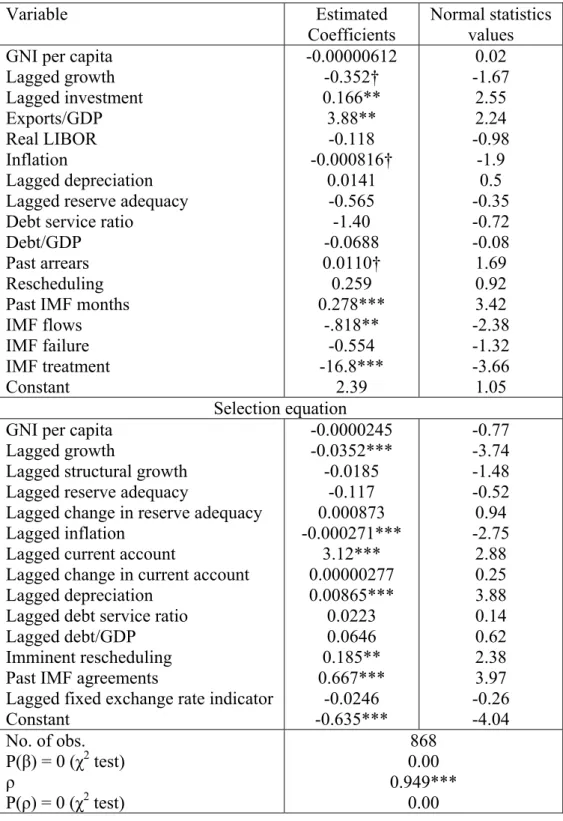
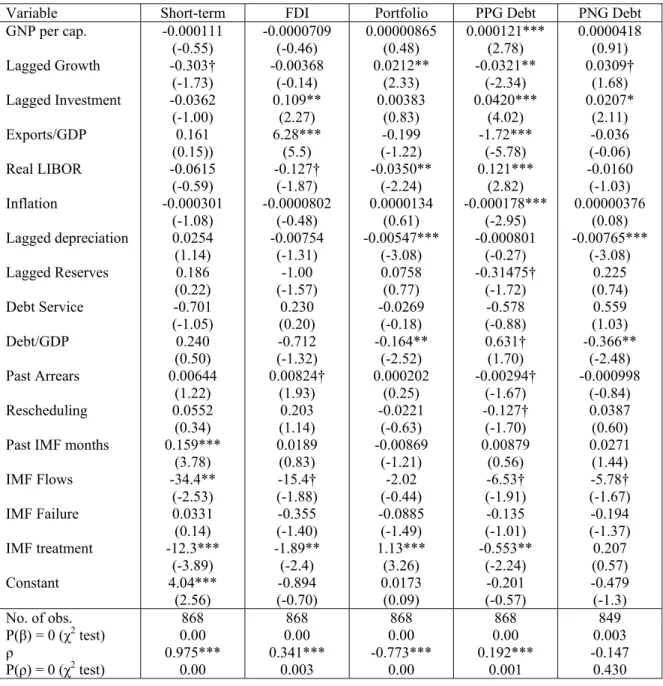
The results of the treatment effects estimations and the selection equation results for the full sample estimates for total capital flows are presented in Table 1a. Tables 1b and 1c present the results for the full sample estimations on the different categories of
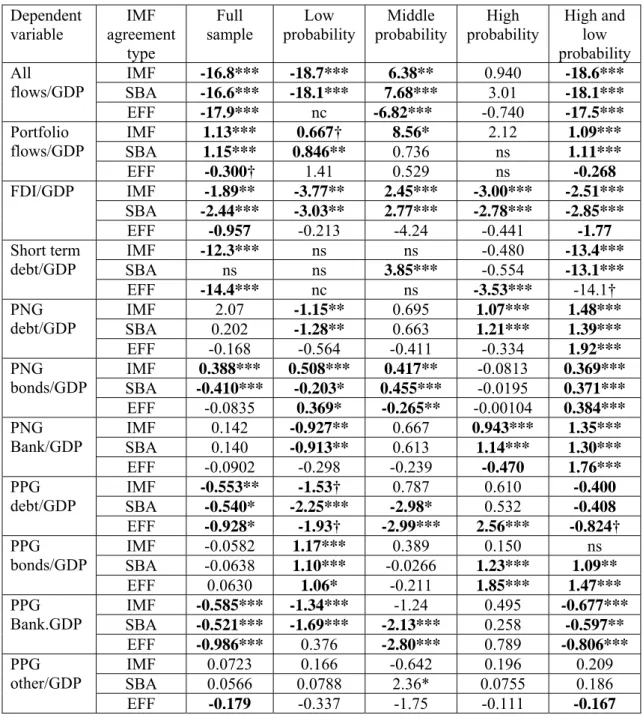
capital flows, though the selection equations are suppressed for brevity. Finally, Table 2 shows the IMF program effects for different IMF non-concessional programs for different sub-samples of countries with similar propensities to have an IMF
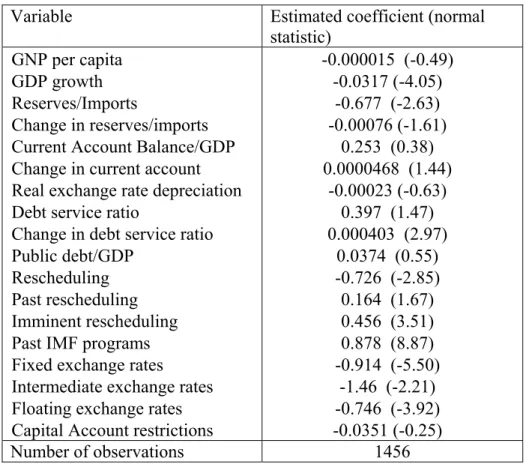
agreement, the latter being calculated from a probit equation the results of which are presented in Table 3.
Before examining the evidence on the seven propositions discussed above, some general observations can be made about the equations. First of all, the
estimating equations perform reasonably well. With the exception of the public and publicly guaranteed bond flow equation, all have an acceptable level of joint coefficient significance. In some estimating equations there are some statistically significant coefficient estimates that conform to our a priori expectations. For
example, from Table 1a we can see that higher investment rates and export-to-GDP ratios encourage capital inflows while high inflation discourages them. However, there are also some interesting anomalies, with past high economic growth discouraging, and past arrears encouraging, additional capital inflows.
In terms of IMF-related effects, past IMF program experience is positively associated with new inflows and for each dollar of IMF funds used there is a reduction in net private inflows.6 Critically, signing an IMF agreement itself seems to have a very large negative effect on capital inflows, amounting to 16.8 percent of GDP. This effect will, of course, generally be diluted by the fact that many IMF program
countries will have had recent past agreements as well. Thus, for example, a country that signs a new IMF agreement after two years of an old agreement experiences a decline in capital inflows of approximately nine percent of GDP.
6 Since the total debt service and imports are on average approximately 50 percent of GDP, the implied
rate of substitution between IMF inflows (as a percentage of imports and debt service payments) and private capital flows is approximately twice the coefficient estimate in the Tables. Thus, for all flows, the rate of substitution is approximately 1.4 dollars of private inflows lost for every dollar of IMF inflows.
For the most part, the equations correcting for selection performed consistently well and selection bias proved unimportant only in the cases of PNG debt, PNG Bank, PPG bond and PPG Other (see Tables 1b,c). Key explanatory variables typically found to be associated with a higher likelihood of an IMF agreement were low economic growth, high inflation, high current account deficits, high rates of real currency depreciation, imminent rescheduling, and past IMF programs.
Finally, several versions of the estimations were examined in order to check the sensitivity of the results. There was no evidence of multicollinearity. Different versions of the treatment effects model, for example including the lagged dependent variable for past capital flows, or using a different estimating algorithm, yielded similar results to those reported here. However, when the model was estimated without selection correction using either ordinary least squares or panel data
procedures, the IMF variables had no statistically significant coefficient estimates for the aggregate capital flow equations. Similarly, when selectivity was corrected using the instrumental variables technique with the same instrument variables as we used in the selection equation, again the IMF effect was insignificant. Therefore not only does selection bias seem important in general, but also the actual method of correction seems to matter. In addition, some of the sub-sample estimations were sensitive to changes in the boundaries defining the group, suggesting that some care is needed in identifying groups for which the catalytic effect is similar. The sensitivity of the results to the method of selection correction highlights the importance of making progress in terms of understanding the determinants of IMF program signing as well as the equations that explain specific capital flows.
Evidence on the propositions
Proposition one suggested that the catalytic effect should be relatively strong for
countries in difficulty but not distress, and relatively weak for countries with either better or worse fundamentals. Evidence on this proposition is provided by a
comparison of the last four columns of Table 2. For example, the overall negative effect of IMF programs on all net capital flows is found primarily in countries with stronger fundamentals. In fact, and consistent with proposition one, IMF programs have a positive effect on countries whose fundamentals are in the middle of the range for the sample. There appears to be no significant effect of IMF agreements for countries with the highest probability of signing an IMF agreement and, therefore, arguably in most distress.
Variable effects across different ranges of the sample are also observed for different components of capital flows. Portfolio flows reacted much more positively to IMF agreements when conditions were in the middle range, as did FDI. Short-term debt flows, which dominated the overall capital inflow results, exhibited the same pattern as the aggregate flow equations. This pattern also existed for both total PNG debt and total PPG debt. Within the components of PNG debt, bonds were again most significantly associated with IMF programs when the propensity to sign a program fell in the middle range of probability; when the probability was high there was no significant effect. PNG bank flows, in contrast, responded positively to IMF agreements when conditions were bad, negatively to them when conditions were strong, and insignificantly when conditions were in the middle. Finally, in terms of PPG debt, IMF agreements provoked increased bond inflows only when conditions were either very good or very bad, while bank flows generally reacted negatively except under very distressed conditions.
Thus proposition one receives broad support in aggregate terms as well as for a number of important subgroups. There are some exceptions, however, reinforcing the message that it is extremely difficult to make generalizations about catalysis in terms of how specific capital flows will respond, and under what circumstances.
Proposition two suggests that poor program implementation will weaken the
catalytic effect. It is difficult to test all of the interpretations of this proposition, so here we focus on the general effect that weak implementation has on catalysis by examining the estimated coefficient for the indicator of previous incomplete programs. Overall there is weak evidence that the effect of past IMF program incompletion on capital flows is negative. Though not reported here for reasons of space7 the presence of past program incompletion seems particularly significant in deterring capital flows when conditions are neither bad nor good; this applies in particular to short-term debt, FDI, and PPG debt flows. Therefore past program failure does seem to have a generally negative effect on capital flows, but not a very
consistent or powerful one.
Proposition three suggests that a lengthy history of IMF programs, even when
completed, will reduce the catalytic effect by signalling structural difficulties. Recidivism is generally associated with poorer countries (Bird, Hussain and Joyce, 2004), so here, and given our focus on middle-income countries, we examine this proposition by looking at a shorter three-year history. The estimations for aggregate net flows do not support the proposition; past IMF programs have a statistically significant positive effect on capital flows, raising them by 0.3 percent of GDP for every recent month of an agreement. While this effect appears fairly constant
regardless of the propensity to sign an IMF agreement, it appears only sporadically for separate categories of capital flows (FDI, short-term debt, and PNG bank flows).
Proposition four suggests that catalysis may vary with the type of IMF
agreement. Short term investors may be looking for the stability given by SBAs while longer term investors are looking beyond this for structural adjustment as reflected in EFFs. In general, SBAs dominate the main results due to their much greater frequency in the sample. For the most part SBA and EFF programs generated fairly similar results, although negative effects were more common in the case of EFFs.
There were some interesting differences in the context of proposition four. On the one hand, potentially short-horizon capital such as portfolio flows, short-term debt, and other PPG debt (such as supplier credits) generally responded more
favourably to SBAs than to EFFs. On the other hand, longer-term commitments such as FDI responded somewhat less negatively to EFFs than to SBAs. In other cases the effects are more nuanced, as with PNG bond flows that responded favourably to SBAs when economic conditions were generally bad and negatively when they were stronger. EFFs had positive effects when conditions were generally relatively good and negative effects for countries where conditions were bad but not disastrous. So it may be the case that EFFs have effects that are less negative on longer-term flows, while SBAs support short-term flows better.
Proposition five suggests that the liquidity effects of IMF programs may
induce capital flows, particularly short term capital, although there may be a difference between used and unused access to IMF resources. When the liquidity measure is taken as actual drawings in a year8, the results indicate a substitution effect between IMF credit and almost all other capital flows. Overall, the substitution effect is that for every one percent equivalent of imports and debt service provided by the IMF, other flows decline by around 0.7 percent of GDP, or a direct substitution effect
8 Estimations using the size of the original agreement as a percentage of GDP, indicating potential
borrowing, had the same qualitative effect. This result is not really surprising, as most of the countries do draw on their agreements very quickly, and these drawings will typically be a fixed proportion of the actual agreement size.
of approximately 1.4 dollars lost of private net flows for every dollar of IMF inflows (see footnote 6). So the direct substitution effect is greater than one. The effect is particularly pronounced for FDI flows, for short-term flows, especially when conditions are reasonably good, and for PNG debt when conditions are bad, but not disastrous. This may imply that the IMF needs to lend more than a country’s anticipated capital shortfall in order to provide it with the desired balance between adjustment and financing. This result could be seen as being consistent with the claim that private capital markets may in some cases want to see a Fund program in place irrespective of the amount of Fund credit involved, but they do not want to see countries having to use them. This conclusion is similar to that drawn by Mody and Saravia (2002).9
Proposition six suggests that IMF programs will have a particularly marked
effect on debt rollovers because of defensive lending. Perhaps the best way of understanding the roll-over phenomenon, given available data, is to examine short-term debt flows, especially if, as Morris and Shin (2003) and Penalver (2004) claim, there will be a spill-over from debt rollovers to short-term lending. However, our estimations provide no evidence in support of the proposition. Instead, we find that short-term debt flows respond very negatively to IMF agreements, particularly in countries with relatively good economic fundamentals. In these cases the signing of an IMF agreement seems to be transmitting a negative signal; any effect on debt rollovers per se is not spilling over to short-term debt in general.
Proposition seven suggests that different types of capital flow are motivated in
different ways and that IMF arrangements may therefore exert different degrees of
9 Mody and Saravia argue that having the Fund’s resources available is seen as a positive signal by
bondholders, but that actually drawing on the resources is indicative of financial problems that may discourage lending. Of course there is interesting endogeneity here: if the positive response to an agreement induces only limited capital inflows, a government may need to draw on its agreement and thereby possibly discourage further lending.
catalysis across them. We find ample evidence to support this proposition as reported above and seen in Tables 1 and 2. Sweeping generalisations about catalysis based on partial research are unsafe. While some of our results are in line with those reported by Mody and Saravia (2003), who focused on bonds, other results are consistent with those reported by Jensen (2004) for FDI. The important point is that the
generalizations made on the basis of examining individual types of capital flow appear to be misplaced; the effects are varied and nuanced.
The key result of this paper is in fact a generalization of this last point. Catalysis affects different types of capital flow in different ways, varies across IMF program type, and depends on the circumstances in which a country signs an IMF program. While we cannot always specify exactly when catalysis will work in a specific manner, the results identify some basic lessons that help make more precise our understanding of how and when IMF programs affect private capital flows.
6. Concluding Remarks.
For many years the IMF has claimed that an important part of its role is to catalyse others to lend either by relieving immediate liquidity crises or more importantly by allowing governments to signal their commitment to reform through conditionality. Early empirical evidence seemed to be inconsistent with this claim. However, this early research dealt with potential selection bias in an informal way, and was not strongly grounded in any formal theoretical foundations. More recent research has attempted to deal with selection problems in more formal ways but it has examined individual flows such as bonds, portfolio flows, and FDI in isolation. The results of these studies point in different directions, however, and making generalizations on the basis of any one of them is dangerous. Theoretical research has formally suggested that the degree of catalysis should depend on specific conditions such as the economic
fundamentals of a country. While corroborating evidence has emerged in the empirical work, the implications from theory have not been explored
comprehensively.
This paper attempts to provide a more complete analysis of catalysis that is guided by theoretical insights, informed by both the necessity of correcting for selection and the limitations of doing so, and expansive in its consideration of which flows IMF programs may affect, and under what circumstances. Based on a treatment effects methodology to deal with selection problems, it explores the empirical
connection between IMF programs and private capital flows in middle-income countries. Unlike other recent studies, it disaggregates across private capital flows as well as across IMF facilities. Rather than simply presenting the evidence, we also relate it to a series of propositions that emerge from recent theoretical models of catalytic finance.
The results confirm that it is unsafe to make generalizations about the catalytic effect on the basis of partial results. There are some circumstances comprising
economic fundamentals in the borrowing country, particular IMF facilities, past use of IMF resources, the record of failure or success, and specific types of capital flow, in which catalysis seems to occur. But there are others in which it does not, or in which the effect is profoundly negative. There is also some worrying sensitivity to the selection procedures; simple selection corrections may well fail to capture the
intricacies of IMF program allocation and lead to incorrect inferences. In the absence of a compelling understanding of the circumstances under which Fund programs are adopted, any results that rely on selection correction must remain tentative.
Given the importance attached by the IMF to catalysis, and given that a belief in its efficacy has consequences for IMF lending and resources, the policy
policy messages. First, policy needs to be much more subtle, recognising the circumstances in which IMF programs are likely or are unlikely to exert a catalytic effect, as well as the detailed and disaggregated nature of this effect. Following on from this observation is the need to examine the ways in which the catalytic effect may be enhanced in order to provide sufficient adjustment assistance with limited IMF resources. Second, the limitations of catalysis need to be more fully accounted for in the design of IMF programs and in thinking about alternative ways of
mobilising external capital in support of economic adjustment, as discussed in Bird and Rowlands (2004). Finally, our results illustrate just how complex catalysis is. Simplistic assumptions about it are theoretically and empirically unjustified, and policies based on them are unlikely to be effective.
Table 1a: Treatment Effects Estimation Results on All Net flows, full sample
Variable Estimated Coefficients
Normal statistics values GNI per capita
Lagged growth Lagged investment Exports/GDP Real LIBOR Inflation Lagged depreciation Lagged reserve adequacy Debt service ratio
Debt/GDP Past arrears Rescheduling Past IMF months IMF flows IMF failure IMF treatment Constant -0.00000612 -0.352† 0.166** 3.88** -0.118 -0.000816† 0.0141 -0.565 -1.40 -0.0688 0.0110† 0.259 0.278*** -.818** -0.554 -16.8*** 2.39 0.02 -1.67 2.55 2.24 -0.98 -1.9 0.5 -0.35 -0.72 -0.08 1.69 0.92 3.42 -2.38 -1.32 -3.66 1.05 Selection equation
GNI per capita Lagged growth
Lagged structural growth Lagged reserve adequacy
Lagged change in reserve adequacy Lagged inflation
Lagged current account
Lagged change in current account Lagged depreciation
Lagged debt service ratio Lagged debt/GDP
Imminent rescheduling Past IMF agreements
Lagged fixed exchange rate indicator Constant -0.0000245 -0.0352*** -0.0185 -0.117 0.000873 -0.000271*** 3.12*** 0.00000277 0.00865*** 0.0223 0.0646 0.185** 0.667*** -0.0246 -0.635*** -0.77 -3.74 -1.48 -0.52 0.94 -2.75 2.88 0.25 3.88 0.14 0.62 2.38 3.97 -0.26 -4.04 No. of obs. P(β) = 0 (χ2 test) ρ P(ρ) = 0 (χ2 test) 868 0.00 0.949*** 0.00
Robust normal test statistics appear in parentheses. The symbols ***, **, * and † indicate statistical significance at the 2%, 5%, 10% and 20% levels for two-tailed tests. The parameter ρ is the covariance between the estimating and selection equation. If ρ = 0, then the selectivity correction is not statistically important.
Table 1b: Treatment Effects Estimation on Net Flow Categories (selection not shown)
Variable Short-term FDI Portfolio PPG Debt PNG Debt
GNP per cap. Lagged Growth Lagged Investment Exports/GDP Real LIBOR Inflation Lagged depreciation Lagged Reserves Debt Service Debt/GDP Past Arrears Rescheduling Past IMF months IMF Flows IMF Failure IMF treatment Constant -0.000111 (-0.55) -0.303† (-1.73) -0.0362 (-1.00) 0.161 (0.15)) -0.0615 (-0.59) -0.000301 (-1.08) 0.0254 (1.14) 0.186 (0.22) -0.701 (-1.05) 0.240 (0.50) 0.00644 (1.22) 0.0552 (0.34) 0.159*** (3.78) -34.4** (-2.53) 0.0331 (0.14) -12.3*** (-3.89) 4.04*** (2.56) -0.0000709 (-0.46) -0.00368 (-0.14) 0.109** (2.27) 6.28*** (5.5) -0.127† (-1.87) -0.0000802 (-0.48) -0.00754 (-1.31) -1.00 (-1.57) 0.230 (0.20) -0.712 (-1.32) 0.00824† (1.93) 0.203 (1.14) 0.0189 (0.83) -15.4† (-1.88) -0.355 (-1.40) -1.89** (-2.4) -0.894 (-0.70) 0.00000865 (0.48) 0.0212** (2.33) 0.00383 (0.83) -0.199 (-1.22) -0.0350** (-2.24) 0.0000134 (0.61) -0.00547*** (-3.08) 0.0758 (0.77) -0.0269 (-0.18) -0.164** (-2.52) 0.000202 (0.25) -0.0221 (-0.63) -0.00869 (-1.21) -2.02 (-0.44) -0.0885 (-1.49) 1.13*** (3.26) 0.0173 (0.09) 0.000121*** (2.78) -0.0321** (-2.34) 0.0420*** (4.02) -1.72*** (-5.78) 0.121*** (2.82) -0.000178*** (-2.95) -0.000801 (-0.27) -0.31475† (-1.72) -0.578 (-0.88) 0.631† (1.70) -0.00294† (-1.67) -0.127† (-1.70) 0.00879 (0.56) -6.53† (-1.91) -0.135 (-1.01) -0.553** (-2.24) -0.201 (-0.57) 0.0000418 (0.91) 0.0309† (1.68) 0.0207* (2.11) -0.036 (-0.06) -0.0160 (-1.03) 0.00000376 (0.08) -0.00765*** (-3.08) 0.225 (0.74) 0.559 (1.03) -0.366** (-2.48) -0.000998 (-0.84) 0.0387 (0.60) 0.0271 (1.44) -5.78† (-1.67) -0.194 (-1.37) 0.207 (0.57) -0.479 (-1.3) No. of obs. P(β) = 0 (χ2 test) ρ P(ρ) = 0 (χ2 test) 868 0.00 0.975*** 0.00 868 0.00 0.341*** 0.003 868 0.00 -0.773*** 0.00 868 0.00 0.192*** 0.001 849 0.003 -0.147 0.430
Robust normal test statistics appear in parentheses. The symbols ***, **, * and † indicate statistical significance at the 2%, 5%, 10% and 20% levels for two-tailed tests. The parameter ρ is the covariance between the estimating and selection equation. If ρ = 0, then the selectivity correction is not statistically important.
Table1c: Treatment Effects Estimation for Net Debt Flow Categories (selection not shown).
Variable PPG Bank PPG Bond PPG Other PNG Bank PNG Bond
GNP per cap. Lagged Growth Lagged Investment Exports/GDP Real LIBOR Inflation Lagged depreciation Lagged Reserves Debt Service Debt/GDP Past Arrears Rescheduling Past IMF months IMF Flows IMF Failure IMF treatment Constant 0.0000624† (1.88) -0.0193 (-1.53) 0.0198*** (2.70) -0.912*** (-4.50) 0.0799** (2.37) -0.0000655** (-2.39) 0.000916 (0.39) 0.00186 (0.01) -0.613 (-1.14) 0.0576 (0.35) -0.000251 (-0.26) 0.0113 (0.21) 0.00646 (0.62) -4.83† (-1.83) -0.0416 (-0.29) -0.585*** (-3.05) -0.118 (-0.41) 0.0000400* (2.09) -0.00868 (-1.26) 0.00411 (0.79) -0.0844 (-0.42) -0.0199 (-1.19) -0.0000370 (-0.96) -0.000191 (-0.13) -0.18473* (-2.12) 0.388 (1.34) -0.0118 (-0.12) -0.000891 (-1.14) -0.0401 (-0.80) 0.0111† (1.84) -0.562 (-0.22) -0.124 (-1.50) -0.0582 (-0.36) 0.159 (0.78) 0.0000183 (0.96) -0.00437 (-0.62) 0.0181*** (2.72) -0.712*** (-3.55) 0.0617*** (3.18) -0.0000767*** (-2.76) -0.00148 (-0.86) -0.131* (-1.98) -0.352 (-1.08) 0.587* (2.06) -0.00180† (-1.71) -0.0976*** (-3.56) -0.00844 (-1.21) -1.12 (-0.59) 0.0322 (0.52) 0.0723 (0.51) -0.243 (-1.28) 0.0000285 (0.73) 0.0252 (1.56) 0.0173* (2.20) 0.0315 (0.06) -0.00733 (-0.51) -0.0000129 (-0.35) -0.00626*** (-2.98) 0.193 (0.73) 0.491 (1.02) -0.315** (-2.37) -0.000841 (-0.73) 0.0372 (0.62) 0.0249† (1.65) -6.13† (-1.65) -0.174 (-1.31) 0.142 (0.53) -0.436 (-1.44) 0.0000157† (1.92) 0.0113*** (3.3) 0.00265 (1.39) -0.0883 (-1.06) -0.00746* (-2.05) 0.0000185 (1.35) -0.00226*** (-2.84) 0.0410 (0.73) 0.0724 (1.04) -0.0632** (-2.48) -0.0000322 (-0.11) -0.0112 (-0.49) -0.00181 (-0.83) 0.598 (0.73) -0.0436* (-2.06) 0.388*** (5.25) -0.0866 (-1.24) No. of obs. P(β) = 0 (χ2) ρ P(ρ) = 0 (χ2) 868 0.00 0.239*** 0.00 868 0.103 0.018 0.842 868 0.00 0.035 0.714 868 0.00 -0.111 0.440 849 0.00 0.802 0.00
Robust normal test statistics appear in parentheses. The symbols ***, **, * and † indicate statistical significance at the 2%, 5%, 10% and 20% levels for two-tailed tests. The parameter ρ is the covariance between the estimating and selection equation. If ρ = 0, then the selectivity correction is not statistically important. Note that the PPG Bond estimates are in italics, signifying (close) rejection of the test of the equation’s significance.
Table 2: IMF treatment effect estimations, different IMF programs and sub-samples Dependent variable IMF agreement type Full sample Low probability Middle probability High probability High and low probability IMF -16.8*** -18.7*** 6.38** 0.940 -18.6*** SBA -16.6*** -18.1*** 7.68*** 3.01 -18.1*** All flows/GDP EFF -17.9*** nc -6.82*** -0.740 -17.5*** IMF 1.13*** 0.667† 8.56* 2.12 1.09*** SBA 1.15*** 0.846** 0.736 ns 1.11*** Portfolio flows/GDP EFF -0.300† 1.41 0.529 ns -0.268 IMF -1.89** -3.77** 2.45*** -3.00*** -2.51*** SBA -2.44*** -3.03** 2.77*** -2.78*** -2.85*** FDI/GDP EFF -0.957 -0.213 -4.24 -0.441 -1.77 IMF -12.3*** ns ns -0.480 -13.4*** SBA ns ns 3.85*** -0.554 -13.1*** Short term debt/GDP EFF -14.4*** nc ns -3.53*** -14.1† IMF 2.07 -1.15** 0.695 1.07*** 1.48*** SBA 0.202 -1.28** 0.663 1.21*** 1.39*** PNG debt/GDP EFF -0.168 -0.564 -0.411 -0.334 1.92*** IMF 0.388*** 0.508*** 0.417** -0.0813 0.369*** SBA -0.410*** -0.203* 0.455*** -0.0195 0.371*** PNG bonds/GDP EFF -0.0835 0.369* -0.265** -0.00104 0.384*** IMF 0.142 -0.927** 0.667 0.943*** 1.35*** SBA 0.140 -0.913** 0.613 1.14*** 1.30*** PNG Bank/GDP EFF -0.0902 -0.298 -0.239 -0.470 1.76*** IMF -0.553** -1.53† 0.787 0.610 -0.400 SBA -0.540* -2.25*** -2.98* 0.532 -0.408 PPG debt/GDP EFF -0.928* -1.93† -2.99*** 2.56*** -0.824† IMF -0.0582 1.17*** 0.389 0.150 ns SBA -0.0638 1.10*** -0.0266 1.23*** 1.09** PPG bonds/GDP EFF 0.0630 1.06* -0.211 1.85*** 1.47*** IMF -0.585*** -1.34*** -1.24 0.495 -0.677*** SBA -0.521*** -1.69*** -2.13*** 0.258 -0.597** PPG Bank.GDP EFF -0.986*** 0.376 -2.80*** 0.789 -0.806*** IMF 0.0723 0.166 -0.642 0.196 0.209 SBA 0.0566 0.0788 2.36* 0.0755 0.186 PPG other/GDP EFF -0.179 -0.337 -1.75 -0.111 -0.167
nc: estimation did not converge for a reasonable range; ns: estimation was not significant. . The symbols ***, **, * and † indicate statistical significance at the 2%, 5%, 10% and 20% levels for two-tailed tests. Bold coefficient estimates came from estimations with significant rho values (i.e. selectivity is important). Probability levels in the last four columns refer to the estimated propensity to have an IMF agreement as derived from the probit equation in Table 3, and in our analysis is associated with the economic fundamentals of a country.
Table 3: Probit Equation for Estimating Propensities to Enter into IMF Agreements Variable Estimated coefficient (normal
statistic) GNP per capita
GDP growth Reserves/Imports
Change in reserves/imports Current Account Balance/GDP Change in current account Real exchange rate depreciation Debt service ratio
Change in debt service ratio Public debt/GDP
Rescheduling Past rescheduling Imminent rescheduling Past IMF programs Fixed exchange rates Intermediate exchange rates Floating exchange rates Capital Account restrictions
-0.000015 (-0.49) -0.0317 (-4.05) -0.677 (-2.63) -0.00076 (-1.61) 0.253 (0.38) 0.0000468 (1.44) -0.00023 (-0.63) 0.397 (1.47) 0.000403 (2.97) 0.0374 (0.55) -0.726 (-2.85) 0.164 (1.67) 0.456 (3.51) 0.878 (8.87) -0.914 (-5.50) -1.46 (-2.21) -0.746 (-3.92) -0.0351 (-0.25) Number of observations 1456
Data Appendix (mean and standard deviation in parentheses).
All net flows: The sum of net portfolio, FDI, short-term debt, PPG debt and PNG debt flows, as a percentage of GDP. Source: World Bank Global Development Finance (3.99, 10.8)
Portfolio: Purchases of shares and related assets by foreigners as a percentage of GDP. Source: World Bank Global Development Finance. (0.145, 0.863)
FDI: Net foreign direct investment into a country as a percentage of GDP. Source: World Bank, Global Development Finance. (2.84, 3.95)
Short-term debt: Net short-term debt flows as a percentage of GDP. Source: World Bank, Global Development Finance. (0.0312, 9.67)
PPG debt: Net public and publicly guaranteed debt flows into a country as a percentage of GDP. Source: World Bank, Global Development Finance.
(0.654, 2.06). Same source for sub-categories.
PNG debt: Net private nonguaranteed debt flows into a country as a percentage of GDP. Source: World Bank, Global Development Finance. (0.324, 1.26). Same
source for sub-categories.
GNI per capita: GNI per capita in $U.S., Atlas method (World Bank, World Development Indicator) deflated by U.S. consumer price index (IMF: IMF Financial Statistics). (2607, 1724)
Lagged growth: Percentage change in GDP, lagged one year. Source: World Bank,
World Development Indicators. (3.58, 5.09)
Lagged investment: Gross investment as a percentage of GDP, lagged one year. Source: World Bank, World Development Indicators. (24.8, 7.61)
Exports/GDP: Ratio of exports to GDP. Source: World Bank, World Development Indicators.(0.378, 0.198)
Real LIBOR: The London Interbank Offered Rate on U.S. 6 month Treasury Bills (annual average) less the rate of U.S. CPI inflation. Source: IMF, IMF Financial Statistics. (3.56, 1.92)
Inflation: Percentage increase in the consumer price index. Source: World Bank,
World Development Indicators.(64.4, 510)
Lagged depreciation: The official number of domestic currency units per $U.S. multiplied by the ratio of the U.S. consumer price index to the country’s consumer price index. This number is calculated for the current year and for three years previously (adjusting for changes in base years) and the difference between the two is expressed as a proportion of the value from three years before. Source: World Bank, World Development Indicators. (2.17, 16.7)
Lagged reserve adequacy: Total foreign reserves divided by total imports of goods and services and debt service obligations (both in current $US), lagged by one year. Source: World Bank, Global Development Indicators. (0.327, 0.313)
Debt Service: Total long-term debt service payments divided by total exports of goods and services (all in U.S. dollars). Source: World Bank, World Development Indicators. (0.0898, 0.139)
Debt/GDP: Total public and publicly guaranteed debt, divided by GDP (both in current $US), lagged by one year. Source: World Bank: World Development Indicators. (0.306, 0.347)
Past Arrears: Total arrears on interest and principle as a percentage of public and publicly guaranteed debt. World Bank, summed for the previous four years.
Global Development Finance.(19.1, 43.1)
Past rescheduling: The number of years out of the previous four in which a country rescheduled some portion of its official or private interest or principal
repayments. Source: World Bank, Global Development Finance. (0.330,
0.840)
Past IMFmonths: Weighted number of months of the past three years in which a standby or EFF agreement is in effect (weights are 1, 0.75, and 0.5 for one, two and three years previously, respectively). Source: IMF, IMF Annual Report,various years. (6.19, 8.28)
IMF Flows: Net borrowing from the IMF in the current year divided by imports and total debt service payments. Source: World Bank Global Development Finance.(-0.000111, 0.0124)
IMF Failure: The number of agreements in the past four years which were
“incomplete” according to the methodology of Killick et al, that is agreements with more than 20% of the commitment undrawn by the country at the time of expiry. Source: IMF Annual Report, various years. (0.296, 0.579)
IMF treatment: The signing of either a standby agreement or EFF agreement with the IMF. Source: IMF Annual Report, various years. (0.226, 0.419)
Lagged structural growth: The simple average of the GDP growth rate for the previous four years. Source: World Bank World Development Indicators
(3.73, 3.76)
Lagged change in reserves: reserve adequacy from the previous year minus the reserve adequacy from two years previously, divided by the reserve adequacy two years previously. Source: World Bank Global Development Indicators.
(1.79, 53.3)
Lagged current account: The current account balance divided by GDP, lagged one year. Source: World Bank Global Development Indicators. (-0.0220, 0.0546)
Lagged change in current account: The absolute difference between the current account balance and its value in the previous year as a percentage of the absolute current account balance in the previous year, all lagged one year. Source: World Bank Global Development Indicators. (-195.65, 2930)
Imminent rescheduling: A binary indicator if a country required a Paris Club or London Club debt rescheduling in the next year, since IMF agreements are required for such a procedure. Source: World Bank Global Development Finance. (.179, .500)
Past IMF agreements: A binary indicator of whether there was any IMF agreement in operation in any of the previous two years. Source: IMF Annual Report.
(0.401, 0.490)
Fixed exchange rate: An indicator if the country operated a fixed exchange rate system according to the Reinhart and Rogoff classification, lagged one year in the main estimations. Source: Reinhart and Rogoff (2004). (0.243, 0.429) Intermediate exchange rate: A binary indicators if the country had either of two
intermediate exchange rate structures as defined in Reinhart and Rogoff. Source: Reinhart and Rogoff (2004). (0.437, 0.496)
Flexible exchange rates: A binary indicators if the country had a flexible exchange rate as defined in Reinhart and Rogoff. Source: Reinhart and Rogoff (2004). (0.158, 0.365)
Capital Account Restriction: A binary indicator of the presence of capital controls in a country. Source: IMF Exchange Arrangements and Exchange Restrictions.
References
Barro, R. and J.W. Lee, 2005, IMF programs: Who Is Chosen and What Are the Effects?Journal of Monetary Economics,52,1245-1269
Bird, G. and D. Rowlands, 1997, The Catalytic Effect of Lending by the International Financial Institutions, The World Economy, 20, 967-991.
Bird, G. and D. Rowlands, 2001, IMF Lending: How Is It Affected by Economic, Political and Institutional Factors? Journal of Policy Reform, 4, 223-271.
Bird, G. and D. Rowlands, 2002, Do IMF Programs Have a Catalytic Effect on Other International Capital Flows? Oxford Development Studies, 30, 229-249.
Bird, G. and D. Rowlands, Financing Balance of Payments Adjustment: Options in the Light of the Elusive Catalytic Effect of IMF-Supported Programs, Comparative Economic Studies, 46, 468-486.
Bird, G., M. Hussain and J. P. Joyce, 2004, Many Happy Returns? Recidivism and the IMF, Journal of International Money and Finance, 23, 231-271.
Bordo, M., A. Mody and N. Oomes, 2004, Keeping Capital Flowing: the Role of the IMF Working Paper 04/197, (IMF, Washington DC).
Brock, W. and S. Durlauf, 2001, Interaction-Based Models, in: J. Heckman and E. Leamer, eds., Handbook of Econometrics, Volume 5, (Elsevier, Amsterdam).
Corsetti, G., B. Guimaraes and N. Roubini, 2003, International Lending of Last Resort and Moral Hazard: A Model of IMF Catalytic Finance, NBER Working Paper No 10125.
Cottarelli, C. and C. Giannini, 2002, Bedfellows, Hostages or Perfect Strangers? Global Capital Markets and the Catalytic Effect of IMF Crisis Lending, IMF Working Paper 02/193, (IMF, Washington DC).
Edwards, M, forthcoming, Signalling Credibility? The IMF and Catalytic Finance, Journal of International Relations and Development,9.
Frankel, J. and N. Roubini, 2001, The Role of Industrial Country Policies in Emerging Market Crises, NBER Working Paper No 8634.
Greene, W, 2003, Econometric Analysis, 5th edition (Prentice Hall, Upper Saddle River, N.J).
Hovaguimian, C, 2003, The Catalytic Effect of IMF Lending: A Critical Review, Financial Stability Review, No 15, 160-169 (Bank of England, London).
Jeanne, O. and C. Wyplosz, 2001, International Lender of Last Resort: How Large Is Large Enough? IMF Working Paper, 01/76 (IMF, Washington DC).
Jensen, N,2004, Crisis, Conditions and Capital: the Effect of International Monetary Fund Agreements on Foreign Direct Investment Inflows, Journal of Conflict
Resolution, 48, 194-210.
Mody, A. and D. Saravia, 2003, Catalyzing Capital Flows: Do IMF-Supported Programs Work as Commitment Devices? IMF Working Paper, 03/100 (IMF, Washington DC). Forthcoming in Economic Journal.
Morris, S. and H. S. Shin, 2003, Catalytic Finance: When Does It Work? Cowles Foundation Discussion Paper No 1400, (Yale University, New Haven)
Penalver, A, 2004, How Can the IMF Catalyse Private Capital Flows? A Model, Bank of England Working Paper No 215 (Bank of England, London).
Reinhart C, and Rogoff K. The Modern History of Exchange Rate Arrangements: A Reinterpretation. Quarterly Journal of Economics; 2004; 119;1-48.
Rodrik, D, 1996, Why Is There Multilateral Lending? in: M. Bruno and B. Pleskovic, eds., Annual World Bank Conference on Development Economics (World Bank, Washington DC).
Rowlands, D, 2001, The Response of Other Lenders to the IMF, Review of International Economics, 9, 531-546.
Vreeland, J, 2003, The IMF and Economic Development (Cambridge University Press, Cambridge).
Zettelmeyer, J, 2000, Can Official Crisis Lending Be Counterproductive in the Short Run? Economic Notes 29, 12-29.