The Wanganui
Community-Managed Restorative Justice
Programme: An Evaluation
Judy Paulin and Venezia Kingi
Crime & Justice Research Centre with
Barb Lash
This report was commissioned by the Ministry of Justice
First published in January 2005 by the Ministry of Justice P O Box 180 Wellington New Zealand www.justice.govt.nz © Crown Copyright ISBN 0-478-20196-6
Community-Managed Restorative Justice Programmes have become an established service in many district courts and communities throughout New Zealand since the Crime Prevention Unit funded the first three trial programmes in 1996. In 2004, 19 programmes will provide approximately 1000 conferences across the country. Many District Court judges have come to regard the programmes as a valuable service in securing better outcomes in their courts. The programmes have also generated widespread support in their communities.
Two of the pilot programmes (Project Turnaround at Timaru and Te Whānau Awhina at Waitakere City) were evaluated in 1998 and 1999. Since that time, community-managed restorative justice programmes have continued to expand and evolve in a variety of ways. There have also been significant changes in the context within which these programmes operate. This includes the statutory recognition given to restorative justice processes in New Zealand’s Sentencing Act 2002 and Victims’ Rights Act 2002, and the focus given to best practice in restorative justice as illustrated by the Ministry of Justice’s May 2004 publication
Restorative Justice in New Zealand: Best Practice.
Given these developments, it was thought useful to undertake evaluations of two current programmes to elicit further information about the effectiveness of current approaches to community-managed restorative justice processes in New Zealand. The evaluations will also inform future development and the implementation of improvement processes. The two programmes selected were the Wanganui Community-Managed Restorative Justice Programme and the Rotorua Second Chance Restorative Justice Programme. The Wanganui programme was selected for evaluation because it was considered to be well managed and effective.
This report presents the outcomes of the evaluation of the Wanganui Community-Managed Restorative Justice Programme, and clearly identifies the strengths of the programme and also areas for future development.
A key issue that arises from both evaluations is the need to develop strategies to ensure that optimum crime prevention benefits are obtained through securing reductions in re-offending, while also enhancing and maintaining the clear benefits that are being obtained for victims. Securing the best possible results for these two major objectives, which are often not easily reconciled, will be a major challenge for the partnership between policy developers and service providers.
Finally the Ministry wishes to express its appreciation to the Wanganui Restorative Justice Trust and all the people involved in this evaluation. Without their willing participation this report would not have materialised.
Belinda Clark Secretary for Justice
Acknowledgements
Researchers at the Crime and Justice Research Centre, Victoria University of Wellington, undertook the evaluation in collaboration with Barb Lash, at the Ministry of Justice.
Our thanks are due to the following people:
Bruce Parr, Julie O’Leary, community panel members and Wanganui Restorative Justice Trust members for their positive approach towards, and participation in, the evaluation; Victims, offenders and key stakeholders who took time to reflect on their experiences of the programme;
the Ministry of Justice, especially Trish Knaggs and Alison Chetwin, for commissioning and managing the evaluation;
Tautari Huirama, Dr Chris Cunningham and Mai Malaulau for their helpful advice and support on cultural issues throughout the fieldwork;
Sue Triggs for guidance on the method used in the reconviction analysis;
Stephanie Reid, our research assistant, who conscientiously performed the data entry and analysis; and
Contents
Foreword 3 Acknowledgements 5 Tables 9 Figures 10 Executive Summary 11 1 Introduction 131.1 Evaluation findings to date 13
1.2 Evaluation of the Wanganui Community-Managed Restorative Justice
Programme 14
1.3 Some terminology 15
2 Describing the Wanganui Community-Managed Restorative Justice
Programme 17
2.1 A short history of the programme 17
2.2 Governance of the programme 17
2.3 Funding and resourcing of the programme 17
2.4 Objectives of the programme 18
2.5 Roles of staff 18
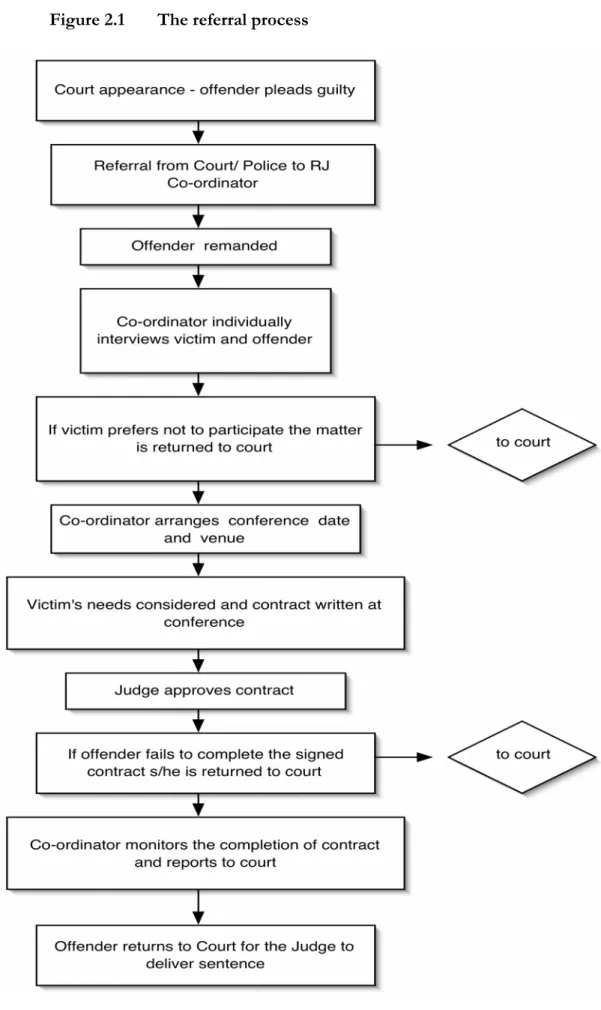
2.6 The referral process 19
2.7 Preparation for the restorative justice meeting 21
2.8 At the restorative justice meeting 21
2.9 Following the restorative justice meeting 21 2.10 Characteristics of offenders in Wanganui 21
3 The evaluation methodology 25
3.1 Reconviction analysis 25
3.2 Interviews with key stakeholders 28
3.3 Interviews with victims 29
3.4 Interviews with offenders 32
3.5 Observations of meetings 35
4 Assessing the effectiveness of the programme in meeting its objectives 37 4.1 The restorative justice process only proceeds when victims of offences
or their agents participate 37
4.2 Community members actively participate in the programme 38 4.3 Victim-offender contracts negotiated with community input have a restorative
effect 39
4.3.1 The contracts 39
4.3.2 Preparation for the restorative justice meeting 41 4.3.3 The restorative justice meeting overall 41 4.3.4 Processes following the restorative justice meeting 44 4.3.5 Reflecting on restorative justice processes 44 4.3.6 Overall assessment against objective 46
programme 47
4.5.1 Comparing reconvictions 48
4.5.2 Types and seriousness of reconvictions 49
4.5.3 Summary 50
5 Meeting the principles of best practice for restorative justice processes 51 6 Contribution of the programme to the partnership between the Government
and the Wanganui community 59
7 Concluding remarks 61
References 65
Glossary of Mäori terms 67
Appendix 1: Reconviction analysis 69
Appendix 2: Interview schedule - key stakeholders 75
Appendix 3: Invitation to potential participants 79
Appendix 4: Consent form 81
Appendix 5: Interview schedule - victims 83
Tables
Table 3.1 Time between the current offence and the most recent past offence for
Wanganui participants and their matched comparison group 26 Table 3.2 Number of convicted cases per year since the age of 14 for Wanganui
participants and their matched comparison group 26 Table 3.3 Demographic characteristics of Wanganui participants and the matched
comparison group 27
Table 3.4 Major offence for which Wanganui participants were referred, and for
which the matched comparison group were convicted 27 Table 3.5 Number of previous convictions and major previous offence committed
by Wanganui participants and the matched comparison group 28 Table 3.6 Characteristics of victims interviewed: number and percentages 30 Table 3.7 The most serious offence that participating victims dealt with 31 Table 3.8 Elements of plans agreed to in the presence of victims 32 Table 3.9 Characteristics of offenders interviewed: number and percentages 34 Table 3.10 The most serious offence that offenders addressed in the meetings 34 Table 3.11 Elements of plans agreed to by offenders 35 Table 4.1 Elements of the contracts negotiated through restorative justice processes
with participating victims 39
Table 4.2 Victims’ perspectives on good features of the plan: number and percent
who agreed 40
Table 4.3 Victims’ and offenders’ perspectives on their experiences at the restorative justice meetings: number and percent 41 Table 4.4 Victims’ perspectives on the offenders’ behaviour at the restorative
justice meeting: number and percent who said yes 42 Table 4.5 Victims’ perspectives on good features of the restorative justice meeting:
number and percent who agreed 43
Table 4.6 Reconvictions within one year of Wanganui participants and matched
comparison group 48
Table 4.7 Major offence committed within one year by Wanganui participants and
the matched comparison group 49
Table 4.8 Seriousness of major reconviction within one year by Wanganui participants
and the matched comparison group 50
Figures
Figure 2.1 The referral process 20
Figure 2.2 Percentage of convicted cases in each age group in Wanganui, 2001 and 2002 22 Figure 2.3 Percentage of convicted cases in each gender in Wanganui, 2001 and 2002 22 Figure 2.4 Percentage of convicted cases in each ethnic group in Wanganui,
2001 and 2002 23
Figure 2.5 Percentage of convicted cases in each offence group in Wanganui,
2001 and 2002 23
Figure 2.6 Percentage of convicted cases for each type of sentence imposed in the
Wanganui courts in 2001 and 2002 24
Figure 4.1 Proportion not reconvicted within one year for Wanganui participants and matched comparison group with 95% confidence intervals 49
Executive Summary
The Ministry of Justice, in consultation with the Wanganui providers, commissioned this evaluation of the Wanganui Community-Managed Restorative Justice Programme in 2003. The programme is funded by central government through the Crime Prevention Unit, Ministry of Justice. The programme was selected for evaluation because it was considered to be well managed and effective.
The evaluation objectives were to:
1. describe the programme – its history, the context in which it operates, delivery, objectives and resources;
2. determine the effectiveness of the programme, in relation to its objectives;
3. contribute to the development of best practice principles for community-managed restorative justice programmes; and
4. describe the extent to which this programme has contributed to the further development of the partnership between government and communities.
The extent to which the programme has developed its services to meet the needs of Mäori, Pacific, and other cultural groups was also to be examined.
The Wanganui Community-Managed Restorative Justice Programme is delivered by the Wanganui Restorative Justice Trust. The programme’s history, governance structure, resources and funding arrangements are presented in this report, along with information about the roles of its staff, the referral process and the restorative justice process. Mäori and Pacific people were perceived as being involved in the Wanganui programme as community panel members, and sometimes as victims and offenders.
The evaluators assess the extent to which the programme met the objectives it had set for itself in its 1999 implementation plan. Although the objectives as set were of equal value and not prioritised in any way, the Wanganui programme provider’s view is that even if re-offending has not been reduced, the programme is still considered to be effective if it has produced restoration to the satisfaction of the victim.
The evaluators confirmed that the Wanganui programme clearly met its first objective that the restorative justice process only proceeds when victims of offences or their agents participate. It also met its second objective that community members actively participate in the programme.
The programme’s third objective is that victim-offender contracts are negotiated with community input and have a restorative effect. The programme met the ‘community input’ test since a community panel member is always present to participate and represent the community at each and every restorative justice meeting.
interviewed for the evaluation, and only one half of participating victims were of the view that their offender had been able to make amends for what s/he had done.
The evaluators assessed the programme as generally meeting its fourth objective to gain acceptance from professionals working in the criminal justice system. The Wanganui community is represented on the programme by its Trust members and community panel members. The programme also has close links with the Wanganui District Council.
The programme’s last objective was to reduce re-offending by offenders who participate in the Wanganui restorative justice programme. The evaluation findings show that the one-year reconviction rate among programme participants was statistically no worse or no better than the one-year reconviction rate among similar offenders dealt with by conventional court processes. Offenders who attended the Wanganui programme were reconvicted of no more or no less serious offences than the matched comparison offenders.
The report also compares practice at the Wanganui programme with the Ministry of Justice’s best practice guidelines. The evaluators formed the view that the Wanganui Restorative Justice Trust programme generally appeared to be operating in the spirit of the Ministry’s eight principles of best practice for restorative justice processes. For example, participation by victims and offenders in restorative justice processes was underpinned by voluntariness and their full participation was encouraged. Areas of practice that the evaluators thought the Wanganui programme might seek improvement on were:
¾ ensuring that a victim’s informed consent is gained prior to proceeding with a restorative justice meeting where that victim chooses not to participate in it
¾ telling victims and offenders explicitly that their agreed plan may be changed by a judge at sentencing
¾ always clearly assigning responsibility to a participant at the meeting (usually the Co-ordinator) for monitoring the offender’s plan
¾ ensuring that the person responsible for the monitoring does indeed monitor the offender’s compliance with his/her plan
¾ ensuring that victims are kept informed of the offender’s progress with, and completion of, his/her plan
¾ ensuring the safety of all participants throughout the restorative justice processes, and providing them with more support if there is any doubt, and
¾ ensuring regular supervision, and providing training and conference opportunities for programme staff each year.
The evaluators hope that the findings presented in this report will inform the Wanganui programme providers, and contribute to the ongoing development of New Zealand’s Crime Reduction Strategy and to international debates about restorative justice.
1
Introduction
Restorative justice has at its core the bringing together of victims and offenders (Hudson, 2003). In conventional criminal justice systems, professionals representing the state make the decisions about how to respond to the offending. In contrast, restorative justice processes provide for victims, offenders and their ‘communities of care’ (Braithwaite, 1989) to come to decisions about how best to deal with ‘their’ offence.
Restorative justice processes operate differently within and across different countries. Allison Morris (2002) has argued that there is no single “right way” to deliver restorative justice.
The essence of restorative justice is not the adoption of one form rather than another; it is the adoption of any form which reflects restorative values and which aims to achieve restorative processes, outcomes and objectives.
Among common law jurisdictions, New Zealand is at the forefront of developments in the delivery of restorative justice processes. In 1996, with the support of the Crime Prevention Unit, New Zealand introduced restorative justice processes into the adult jurisdiction. This initially took the form of three community panel adult diversion programmes. Further expansion into the adult jurisdiction occurred in 2001 with the introduction in four court areas of ‘court referred’ restorative justice conferences that were tasked with dealing with adult offenders and relatively serious offences. Meanwhile, the number of community-based programmes based on the community panel model for adult offenders has continued to grow.
1.1
Evaluation findings to date
Two evaluations of two community panel adult diversion programmes, Project Turnaround and Te Whänau Awhina (Smith & Cram, 1998; Maxwell et al., 1999) show the potential of using restorative justice processes for adult offenders. Interviews with offenders (none were conducted with victims) showed that most of them found the experience to be positive and meaningful. They thought decisions were fair and the process provided an opportunity to deal with matters constructively and to avoid appearing in court or receiving court imposed sanctions. The outcome was often increased understanding of the impact of the offending on the victim, and remorse. Over half those interviewed said they had been involved in the decisions about how to deal with their offending.
However, about one in four of those offenders interviewed at Project Turnaround found the experience a negative one: they said they were not listened to, that decisions were coerced, that they were shamed by the process and commented on not feeling comfortable with the large number of people at the meeting. The small sample of offenders interviewed from Te Whänau Awhina found the process more meaningful because it happened on the marae and
in the meeting house where they were in the presence of their ancestors. Despite the panel being often seen as intimidating and demanding at Te Whänau Awhina, the offenders interviewed said they accepted their decisions.
Both the Project Turnaround and Te Whänau Awhina schemes also demonstrated a reduction in re-offending. One year following the programmes, there were significantly fewer reconvictions among participating offenders compared with control offenders matched for offending history, demographic factors and offence characteristics. Not only was there a reduction in the proportion reconvicted, but for those who were reconvicted, the seriousness of the major offence (as judged by the scale of seriousness based on penalties) was not as great among participants in the schemes as it was among the control groups. In addition, those referred to the schemes who were seen as having successful outcomes were less likely to be reconvicted compared with those who were seen as not having successful outcomes (although the small numbers here make it difficult to be confident of this finding).
1.2
Evaluation of the Wanganui Community-Managed
Restorative Justice Programme
The Wanganui Community-Managed Restorative Justice Programme is the subject of this evaluation report. Originally based on Project Turnaround, the Wanganui programme targets adult offenders, addresses victims’ needs through facilitated meetings with community panel member support, and develops plans between victims and offenders. Where it differs from the Project Turnaround scheme is that the Wanganui programme deals with offenders who are not on diversion, and who are engaged in more serious offending.
The Ministry of Justice, in consultation with the Wanganui programme providers, selected the Wanganui Community-Managed Restorative Justice Programme for an evaluation because it is considered to be well managed and effective. This evaluation, along with the Rotorua Second Chance Restorative Justice Programme evaluation, represent the first steps towards completing Gray’s (2002) evaluation plan.
The objectives of the evaluation of the Wanganui Restorative Justice Programme, as specified by the Ministry of Justice, are to:
1. describe the programme – its history, the context in which it operates, delivery, objectives and resources;
2. determine the effectiveness of the programme, in relation to its objectives;
3. contribute to the development of best practice principles for community-managed restorative justice programmes; and
4. describe the extent to which this programme has contributed to the further development of the partnership between government and communities.
The extent to which the programme has developed its services to meet the needs of Mäori, Pacific, and other cultural groups is also examined.
The evaluation objectives inform the structure and order of this report. Chapter 2 describes the programme and Chapter 3 describes the evaluation methodology. Chapter 4 assesses the effectiveness of the programme in meeting its objectives. Chapter 5 discusses the extent to which the programme conforms with best practice principles for restorative justice processes and Chapter 6 describes the extent to which the programme has contributed to the development of the partnership between government and the Wanganui community. Throughout these chapters the cultural responsiveness of the programme to Mäori, to Pacific peoples, and to other cultural groups is also evaluated. The report ends with some concluding remarks about the Wanganui programme and the evaluation findings.
1.3 Some
terminology
In relation to restorative justice processes, the words “conference” and “meeting” are used synonymously throughout this report to describe the meeting at which the parties meet to discuss the impact of the offending, as are the words “plan” and “contract” to describe the actions agreed to by the participants that the offender is to undertake to repair the harm done to the victim. The word “programme” consists of all of the operational processes used at Wanganui, from the initial contact with potential participants through to the monitoring of offenders’ progress against their plans.
It is hoped that the evaluation findings will contribute to the ongoing development of New Zealand’s Crime Reduction Strategy and to international debates about restorative justice.
2
Describing the Wanganui
Community-Managed Restorative Justice
Programme
2.1
A short history of the programme
Discussions among people at two large community meetings in Wanganui in 1997 led to the establishment of the Wanganui Restorative Justice Trust. According to its Trust Deed, dated 25 June 1999, the Trust comprised three initial trustees – a social worker, a probation officer and a police officer. They, together with other representatives from the community, formed the Trust Committee1 that obtained the initial funding with which to employ a co-ordinator
responsible for the day-to-day running of the programme. The Wanganui Community-Managed Restorative Justice Programme began operating in mid-1999. It originally based its operations on Timaru’s Project Turnaround model that includes a community panel.
Initially, the programme targeted offenders aged 17 to 25 years. However, as the programme has evolved the catchment age has spread considerably.
2.2
Governance of the programme
The Wanganui Restorative Justice Trust committee has overall responsibility for the delivery of its programme. The Trust Committee is responsible for governance, policy and direction. The day-to-day management of the programme is the responsibility of the Co-ordinator.
2.3 Funding
and
resourcing of the programme
The JR McKenzie Trust, the Wanganui Community Trust Bank Trust and the Wanganui Safer Community Council initially funded the programme. On the 30th March 2000 the
Wanganui Restorative Justice Trust entered into an agreement with the Crime Prevention Unit2 (now based within the Ministry of Justice) for it to support and fund the programme
initially for one year, beginning on 31st May 2000. Funding has continued from this source. Currently, the programme employs one full-time co-ordinator and a half-time administrative support person.
1 The Operating Manual states that the Trust Committee has representatives from CYFS, Police, Corrections,
Probation, Safer Community Council, Courts, Tupoho Mätua Whängai, churches, community law, Prisoners Aid and Rehabilitation, Victim Support and members of the wider community of Wanganui.
2 The Crime Prevention Unit moved from the Department of the Prime Minister and Cabinet to the Ministry
2.4
Objectives of the programme
The Wanganui programme set itself objectives that are both process and outcome oriented. The objectives of the Wanganui Community-Managed Restorative Justice Programme are considered to be of equal worth and not prioritised in any way. They are to ensure that:
• The restorative justice process only proceeds when victims of offences or their agents participate;
• Community members actively participate in the programme;
• Victim-offender contracts negotiated with community input have a restorative effect;
• The programme is accepted by interested parties, such as the Judiciary, Department for Courts, Police, and Victim Support;
• There is a reduction in re-offending by offenders who participate in the Community-Managed Restorative Justice programme.
2.5
Roles of staff
The Co-ordinator is the key person responsible for the day-to-day operations of the programme. His role and responsibilities, as stated in the Operating Document (page 6), are to:
• co-ordinate referrals from persons seeking restorative justice;
• negotiate and liaise with Police and appropriate agencies regarding an offender’s suitability for restorative justice;
• liaise with the victim and the offender in order to set up a restorative justice meeting;
• monitor progress and ensure completion of the contract;
• provide reports on progress and completion of the contract as required to Police, court and other identified parties;
• maintain detailed records of the project;
• in conjunction with the Management Committee interview and select members for the Community Panel;
• co-ordinate members of the Community Panel to attend conferences;
• organise training sessions for the Community Panel.
The primary role of community panel members (Operating Document, page 5) is to represent the views of the wider community of Wanganui at the restorative justice meeting and to act as supporters for both the victim and offender. They are not there as decision-makers. Their function is also to ensure the views of both victim and offender are properly communicated and that long term rehabilitation, counselling, work programmes and the like for the offender are considered by participants at the conference.
They are also expected to act in such a way so as to:
• protect the welfare of all participants and take appropriate action if necessary;
• ensure that all participants understand and agree to any outcomes reached;
• ensure that the process is as comfortable and constructive an experience as possible;
• respect the confidentiality of victims, offenders and their families.
Community panel members are chosen for their skills, experience and their links with the local community. Members include people with local knowledge (including knowledge of Mäori protocols), local business people, and people working in the social, education and justice (e.g. Mäori warden) sectors.
When the Trust was first established, it set up two committees, the Wanganui Restorative Justice Trust Committee and a Management Committee, with different functions. Currently the Trust Committee and the Management Committee are one and the same. The Trust Committee is responsible for governance, policy and direction.
There is no formal policy for selecting Trust members. When vacancies have arisen the serving Trust members are asked to identify individuals in the community with the necessary attributes. Discussion is held and a consensus reached as to whom is the most suitable. A personal approach is then made to that individual.
2.6
The referral process
The process, taken directly from the pamphlet is set out below in Figure 2.1.
During a six month period, May 2003 to December 2003, the programme received 124 referrals and held 94 conferences.
2.7
Preparation for the restorative justice meeting
After the offender is referred to the programme, the Co-ordinator meets with them to obtain their consent to proceed with the use of restorative justice processes. If the offender agrees, the permission of the victim is then sought. If the victim does not wish to meet with the offender and does not wish for a support person of the victim to represent them at the meeting, the victim’s permission is sought for the meeting to proceed with a community panel member present to represent their interests. All are briefed about the purpose of the meeting, its format, and likely participants.
2.8
At the restorative justice meeting
Meetings are usually held at the programme headquarters in Wanganui East. The facilitator greets and introduces participants, and states the purpose of, and ground rules for, the meeting. The facilitator reads the summary of facts. The victim, if present, is then invited to speak about the impact of the offence. Next, the offender has the opportunity to provide an explanation for their offending. (They usually offer an apology at this point.) The participants discuss and agree together on the content of the plan, usually guided by the community panel member and the facilitator. Once the elements are agreed, the facilitator guides the quantum of the ‘sentence’, for example, the amount of community work or reparation. Participants are then invited to sign the plan. Finally, the facilitator informs them of the programme’s complaints procedure should they have any concerns, thanks them for their participation, and brings the meeting to a close.
2.9
Following the restorative justice meeting
The Co-ordinator assists with administrative matters such that the offender is able to make a start on carrying out his/her plan. The offender may appear before the court every six weeks during his/her plan. This allows for the court to monitor the offender’s compliance with it. If the offender completes the plan, the judge usually accepts the plan in about eight out of ten cases and reflects that in a sentence of conviction and discharge. In about two out of ten cases the judge may add further to the offender’s sentence. If the offender is not complying with their plan, the judge may draw the plan to a close, and sentence the offender in the usual way.
2.10 Characteristics of offenders in Wanganui
In 2001, there were 4115 prosecutions in the Wanganui District, Youth, and High Courts combined. About 58 percent of these prosecutions resulted in a conviction. The following year, there were 4178 prosecutions, about 56 percent of which resulted in a conviction.
The age, gender and ethnicity distribution of convicted cases in Wanganui in 2001 and 2002 are shown graphically in the following three figures. The patterns for Wanganui generally reflect patterns nationally for both these years (Spier 2002, pp 27 - 29, and Spier & Lash 2004, pp 172 - 176).
As expected, the greatest numbers of offenders were aged 20-24 years. (Spier 2002, p 29, and Spier & Lash 2004, p 176).
Figure 2.2 Percentage of convicted cases in each age group in Wanganui, 2001 and 2002 0 5 10 15 20 25 14-16 17-19 20-24 25-29 30-34 35-39 40+ Age Percent of cases 2001 2002
Note Excludes 19 cases in 2001, and 7 cases in 2002, where the age of the offender was unknown.
Again, as expected, about four-fifths of Wanganui offenders were male. (Spier 2002, p 27, and Spier & Lash 2004, p 172.)
Figure 2.3 Percentage of convicted cases in each gender in Wanganui, 2001 and 2002 0 10 20 30 40 50 60 70 80 90 100 Male Female Gender Percent of cases 2001 2002
Note Excludes 9 cases in 2001, and 5 cases in 2002, where the gender of the offender was unknown, or recorded as a corporation.
In 2002, 56% of Wanganui offenders were Mäori (higher than the national figure of 41%, Spier & Lash 2004, p 174) and 41% were NZ European (lower than the national figure of 47%, Spier & Lash 2004, p 174).
Figure 2.4 Percentage of convicted cases in each ethnic group in Wanganui, 2001 and 2002 0 10 20 30 40 50 60 70 80 90 100
Mäori European Pacific Other
Ethnicity Percent
of cases
2001 2002
Note Excludes 84 cases in 2001, and 72 cases in 2002, where the ethnicity of the offender was unknown.
The distribution of convictions across offence groups is shown graphically for convicted cases in Figure 2.5.
Figure 2.5 Percentage of convicted cases in each offence group in Wanganui, 2001 and 2002 0 5 10 15 20 25 30 35 40 45 50
Tra ffic P rope rty Viole nce Offe nce a g a ins t jus tice
Good orde r
Drug Mis c Othe r offe nce a g a ins t pe rs on Type of offe nce
P e rce nt of ca s e s
2001 2002
The proportion of convictions according to offence groups is similar each year. For example, the proportion of convictions for violence was 12% in 2001 and 13% in 2002, and that for property offences was 19% in 2001 and 20% in 2002.
And finally, the sentences imposed in the Wanganui courts in 2001 and 2002 are displayed in Figure 2.6. “Other” includes sentenced to come up for sentence if called upon. The proportion sentenced to “other” and convicted and discharged, at 6% and 11% in 2002 respectively, are similar to national figures. (Spier & Lash 2004, p 62.)
Figure 2.6 Percentage of convicted cases for each type of sentence imposed in the Wanganui courts in 2001 and 2002
0 5 10 15 20 25 30 35 40 45 50
Monetary Community Custodial Convicted and discharged Other Type of sentence Percent of cases 2001 2002
3
The evaluation methodology
The evaluation design and the associated data collection were guided by the Ministry of Justice’s project brief requiring that the evaluators obtain information through interviews with offenders, victims and other key stakeholders, for example, community panel members, Department for Courts (now Ministry of Justice) staff and Department of Corrections staff. In June 2003, three of the evaluation team visited the Wanganui Community-Managed Restorative Justice Programme to meet with programme staff and several members of the Wanganui Restorative Justice Trust. The purpose of our visit was to facilitate a collaborative working relationship with the programme providers and to ensure that the data collection requirements of the evaluation had minimal impact on the day-to-day workings of the programme.
3.1
Reconviction analysis
The reconviction analysis was undertaken by a researcher, from the Research & Evaluation Unit at the Ministry of Justice. This involved performing a comparative re-offending analysis of some Wanganui restorative justice programme participants against a matched comparison sample of offenders who had been dealt with solely through the courts. A conviction was used as the measure of assessing any re-offending.
The Co-ordinator of the Wanganui programme supplied the Ministry of Justice with a list of participants who completed the programme between 1 September 2001 and 31 August 2002. The list included the name, age or date of birth, date referred to programme, offence for which referred to programme, and next court date. The Ministry of Justice used this information to find the conviction records of the programme participants. These conviction records were used to find information about convictions before the participant was referred to the programme as well as reconvictions within one year of referral to the programme. The comparison groups were matched using variables identified by a logistic regression model (see Appendix 1) by gender, age group, ethnicity (Mäori, European, other), current offence (traffic, property and other), and two criminal history variables (time since the last conviction and rate of past convictions). Although whether the person had been convicted in the past, and whether the current offence was a violent offence, were significant in the logistic regression model, these variables were not used in the matching process because limiting the number of variables increased the chances of finding a match, and these variables were the last entered in the model.
Table 3.1 shows that the Wanganui participants and their matched comparison group were well matched for the time between the current offence and the most recent past offence.3
Table 3.1 Time between the current offence and the most recent past offence for Wanganui participants and their matched comparison group
Time between the current offence and
the most recent past offence1 Participants Comparison group
1 month or less 6 6 > 1 month – 1 year 39 39 >1 – 4 years 39 39 >4 years 65 65 Total 149 149 Note:
1 If there was no past offence, this variable has a value of the person's age at the time of the current offence less 13 years. This corresponds to the time eligible to offend, as a person generally cannot be convicted until the age of 14.
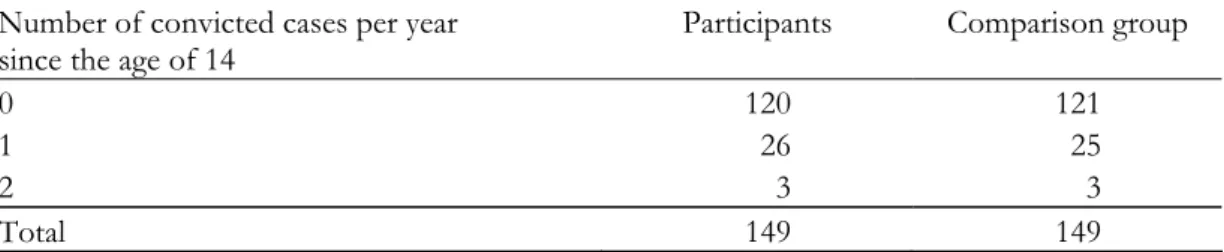
Table 3.2 shows the match of the second variable in the model, the number of convicted cases per year since the age of 14. The table shows that the Wanganui participants and their matched comparison group were well matched for the number of convicted cases per year since the age of 14.
Table 3.2 Number of convicted cases per year since the age of 14 for Wanganui participants and their matched comparison group
Number of convicted cases per year
since the age of 14 Participants Comparison group
0 120 121
1 26 25
2 3 3
Total 149 149
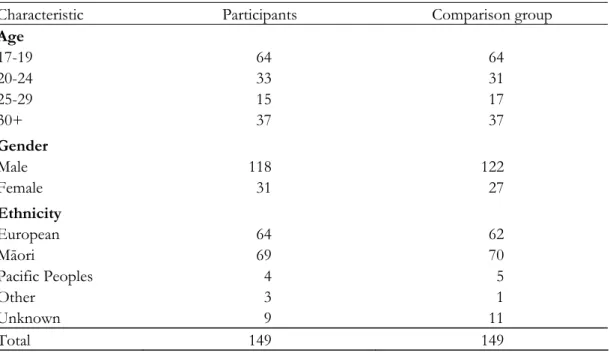
Table 3.3 shows the matching of the variables Age, Mäori, European, and Male. It shows that the demographic characteristics of the comparison group for the Wanganui participants were similar to those of the participants.
In addition, the gender and ethnic breakdowns of offenders who participated in the Wanganui restorative justice programme were reasonably similar to those offenders in Wanganui generally (see Figures 2.2 and 2.3). However, offenders who participated in the programme tended to be younger than offenders in Wanganui generally (Figure 2.1).
3 The variable in the model was actually lndurp=logarithm of the time (in days) between the current offence
and the most recent past offence. See Appendix 1 for an explanation of the reconviction analysis methodology.
Table 3.3 Demographic characteristics of Wanganui participants and the matched comparison group
Characteristic Participants Comparison group
Age 17-19 64 64 20-24 33 31 25-29 15 17 30+ 37 37 Gender Male 118 122 Female 31 27 Ethnicity European 64 62 Māori 69 70 Pacific Peoples 4 5 Other 3 1 Unknown 9 11 Total 149 149
Table 3.4 uses the type of the major offence to show the matching of the variables Traffic, and Property. The Table shows that the matched comparison group for the Wanganui participants have fewer violent offences, and more drug offences than the participants. The two groups match well on the variables related to the types of offences that were included in the model (i.e. traffic and property offences), and which are most likely to be associated with a reconviction. The model also showed that those with violent offences were less likely to be reconvicted, but this variable was not used in the matching process. As the participant and comparison groups had different proportions of violent offences, this difference may have had a slight effect on the likelihood of reconviction.
Table 3.4 Major offence for which Wanganui participants were referred, and for which the matched comparison group were convicted
Major offence Participants Comparison group
Violence offences 32 19
Other against persons 2 6
Property offences 68 60
Drug offences 0 20
Offences against justice 4 1
Good order offences 17 16
Traffic offences 22 20
Miscellaneous offences 4 7
Total 149 149
In addition, participants in the Wanganui restorative justice programme were about twice as likely to be dealing with violent offences than were the Wanganui courts generally (see Figure
2.4). For example, about 21% of offenders (32 out of 149 in Table 3.4 above) had participated in the programme to deal with a violent offence whereas 13% of all convictions in Wanganui in 2002 were for a violent offence. Property offences were also proportionately more likely to be dealt with in a conference than by the courts there.
The comparison group and the participants were not matched on the type of major previous offence or the number of previous convictions, but these characteristics for each group are compared in Table 3.5.
Table 3.5 Number of previous convictions and major previous offence committed by Wanganui participants and the matched comparison group
Participants Comparison group
Number of previous convictions
None 53 63
1 – 5 55 44
Six or more 41 42
Major previous offence
Violence 15 15 Property 31 33 Drug 6 9 Against justice 6 3 Good order 7 7 Traffic 29 19 Miscellaneous 2 0 None 53 63 Total 149 149
Both groups had similar profiles for most of these characteristics. However, the comparison group had more people with no previous offences, and fewer with between one and five previous offences, and fewer people whose major previous offence was a traffic offence than the participants.
3.2
Interviews with key stakeholders
Key stakeholders were identified by the evaluation team in consultation with the programme staff and members of the Wanganui Restorative Justice Trust. Face-to-face interviews (see Appendix 2 for interview schedule) were carried out during September and October 2003 with eight key stakeholders including representatives of the Wanganui Restorative Justice Trust, the community panel, the Wanganui Safer Community Council, Department of Corrections, the Judiciary and Iwi social services groups.
3.3
Interviews with victims
An evaluator visited the Wanganui programme and went through records to draw down details of restorative justice conferences that had been held between October 2002 and July 2003. Information relating to 50 conferences4 that were held during this period were
obtained and entered into a Crime & Justice Research Centre (CJRC) password protected Filemaker Pro database.5 This information included the date of the conference, details of the
victims (and offenders) involved, the nature of the offences, the plan decided on at the conference and whether or not the victim was present at the conference.
Victims were posted letters inviting their participation in the evaluation (Appendix 3) and consent forms (Appendix 4). They could ‘opt out’. Pre-paid envelopes were provided to enable victims to do this. Fifty victims6 were contacted. We were subsequently unable to
contact 10 victims, 12 refused to participate and we interviewed 28 in total – 21 who had attended a restorative justice conference and seven who had not. In seven cases both the victim and offender were interviewed for the same conference.
Interview schedules
The interview schedules were adapted from those already developed for the evaluation of the court referred restorative justice pilot and from some family group conference research. Prior to their finalisation in August 2003, the schedules underwent several drafts and review by the Ministry of Justice’s evaluation advisory group and programme providers. The schedules for victims and offenders7 were mainly mirror images of each other.
The interviews with victims
Interviews with 28 victims were carried out between August and October 2003 (see Appendix 5 for interview schedule). Interviews were carried out face-to-face or by telephone, depending on the preference of the interviewee. Written consent was obtained from those interviewed face-to-face while those interviewed by phone gave their verbal agreement to the process. Following the interview, victims were offered a $20 koha for their time and imparting of their views.
We interviewed 21 victims who had attended a restorative justice conference. Similar proportions of these victims were interviewed either face-to-face (48%) or over the phone (52%). The venues for the face-to-face interviews included the victim’s workplace (24%), the victim’s home (14%) and the motel where the researchers were staying (10%).
4 At 37 of these conferences at least one victim was present, and community panel members represented the
interests of the community and victims at the other 13 conferences.
5 CJRC files are destroyed after three years.
6 In all fifty-two victims were involved. However, one had died since the conference and there were
insufficient details on another to enable us to invite this victim to participate in the research.
7 Two interview schedules were developed for victims. One for those who had attended the restorative justice
Interviews with seven victims who did not attend a restorative justice conference were quite short and took less than half an hour. All except one was interviewed over the phone. The one face-to-face interview took place at the victim’s home.
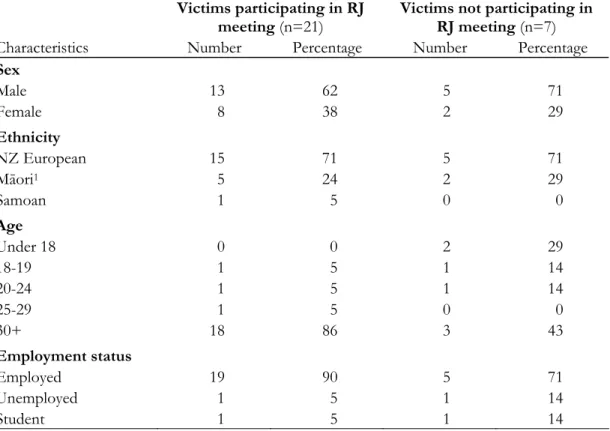
The characteristics of the victims interviewed are set out in Table 3.6.
Table 3.6 Characteristics of victims interviewed: number and percentages (N = 28)
Victims participating in RJ
meeting (n=21) Victims not participating in RJ meeting (n=7)
Characteristics Number Percentage Number Percentage
Sex Male 13 62 5 71 Female 8 38 2 29 Ethnicity NZ European 15 71 5 71 Māori1 5 24 2 29 Samoan 1 5 0 0 Age Under 18 0 0 2 29 18-19 1 5 1 14 20-24 1 5 1 14 25-29 1 5 0 0 30+ 18 86 3 43 Employment status Employed 19 90 5 71 Unemployed 1 5 1 14 Student 1 5 1 14 Note:
1. These data include those victims who identified as part-Mäori.
Sixty-two percent of victims interviewed who had attended the conference and 71% of those interviewed who had not attended the conference were men. In fact, almost two-thirds (64%) of the victims interviewed were men.
Almost three-quarters (71%) of both groups of victims interviewed identified as New Zealand European and similar numbers for both groups8 identified as Mäori or part-Mäori. One of
the victims interviewed who had attended the conference identified as Samoan.
More than four-fifths (86%) of those victims interviewed who had attended conferences were over the age of 30, as were almost half (43%) of those who had not attended conferences. The remainder of those interviewed in both groups were between the ages of 18 and 29. On the whole, victims interviewed tended to be over the age of 30 (75%).
8 Twenty four percent of victims who had attended conferences and 29% of victims who had not attended
Of those victims who had attended conferences 19 reported being employed and one said that s/he was unemployed. One was a full-time student. Five of the victims interviewed who had not attended conferences reported being employed. Of the other two, one was a full-time student and one was unemployed.
Almost two-fifths (39%) of the victims interviewed9 said that they had known the offender
before the offence.
Table 3.7 presents the most serious offences for which victims participating in a restorative justice meeting were dealing with. Nearly one-quarter dealt with violent offences and just over a half dealt with property offences.
Table 3.7 The most serious offence that participating victims dealt with (N=21)
Most serious offence Number Percentage1
Male assaults female 1 5
Assault 3 14
Threaten to kill 1 5
Sub total – violent offences 5 24
Burglary 5 24
Receiving stolen goods 1 5
Motor vehicle conversion 3 14
Fraud 1 5
Wilful damage 1 5
Sub total – property offences 11 52
Trespassing 1 5
Sub-total – against good order 1 5
Driving causing injury 3 14
Careless driving 1 5
Sub-total – traffic 4 19
Total 21 100
Note:
1 The percentages in this table may not add to 100 because of rounding.
In five of the restorative justice meetings, where victims were present, two offences were dealt with and in one of the meetings four offences were dealt with.
Table 3.8 presents elements of the plans agreed to by victims who participated in a restorative justice meeting in Wanganui. The plans almost always included more than one element, and some included more than one programme. For example, at a meeting at which a victim and offender were present to deal with offences of threatens to kill, possession of an offensive weapon and two charges of common assault, the plan developed included an apology letter, attendance at an anger management programme, relationship counselling, and 125 hours community work (or completion of the limited service volunteer course at Burnham army camp).
9 Forty-three percent of those who had attended conferences and 29% of those who had not attended
Table 3.8 Elements of plans agreed to in the presence of victims (N=21)
Element Number Percentage
Apology 18 86
Community work 12 57
Reparation 12 57
Programme attendance 11 52
Other 1 5
Note: A plan may have more than one element.
Eighty-six percent of the plans included a written apology. The amount of community work varied from 20 hours for receiving to 400 hours for committing multiple property offences. The amount of reparation varied from $20 for receiving to $3,000 for committing theft as a servant. Meetings in which burglary was dealt with resulted in three plans containing reparation amounts of $750, $800 and $940.
Programmes addressing alcohol and drug problems were included in the plans of three offenders, and programmes on anger management, budget advice, advanced driving and skills training were each included in plans of two offenders. Other programmes included as an element of the offender’s plan were mentoring, relationship counselling and the limited service volunteer course at Burnham army camp.
In the seven meetings where victims we interviewed were not present at the meetings, two dealt with assault, one with burglary, two with motor vehicle conversion, one with receiving and one with intentional damage. These meetings resulted in the development of plans containing an apology (5), reparation (5), community work (4), training (3), and programme attendance (2).
3.4
Interviews with offenders
An evaluator visited the Wanganui programme and went through records to draw down details of restorative justice conferences that had been held between October 2002 and July 2003. Information relating to 50 conferences10 that were held during this period was obtained
and entered into a CJRC passworded Filemaker Pro database. This information included the date of the conference, details of the offenders (and victims) involved, the nature of the offences, the plan decided on at the conference and whether or not the victim was present at the conference.
Offenders were posted letters inviting their participation in the evaluation (see Appendix 3). They could ‘opt out’. Pre-paid envelopes were provided to enable offenders to do this. Thirty-one offenders were contacted. Offender interviews were conducted by a quota sampling method until 15 had been interviewed. Four offenders refused to participate. In seven cases both the offender and the victim were interviewed for the same conference.
10 At 37 of these conferences at least one victim was present, and community panel members represented the
Interview schedules
The interview schedules were adapted from those already developed for the evaluation of the court referred restorative justice pilot and from some family group conference research. Prior to their finalisation in August 2003, the schedules underwent several drafts and review by the Ministry of Justice’s evaluation advisory group and programme providers. The schedules of offenders and victims were mainly mirror images of each other.
The interviews with offenders
Face-to-face interviews with 15 offenders were carried out between August and October 2003 (see Appendix 6 for interview schedule). All had participated in a restorative justice meeting. Written consent was obtained from those interviewed face-to-face while those interviewed by phone gave their verbal agreement to the process. Following the interview, offenders were offered a $20 koha for their time and imparting of their views.
These usually took place in the afternoon or evening (60%) at the offender’s home (80%).11
Although the majority of the interviews took place at the offender’s home, in only one case was another family/whänau member present during the interview. Interviews took on average, about half an hour. Table 3.9 below sets out the characteristics of the 15 offenders interviewed.
Almost three-quarters (73%) of the offenders interviewed were men.
Slightly more than half (53%) of the offenders interviewed identified as Mäori or part-Mäori and more than two-fifths (47%) identified as New Zealand European.
Many of the offenders interviewed were quite young: 20% were under the age of twenty and three-fifths were between 20 and 25. Overall, the majority (80%) of the offenders interviewed were under 25.
Only four offenders reported being employed, two stated they were beneficiaries and seven said that they were unemployed. Two were full-time students.
One-third of the offenders said that they had known their victim before the offence.
11 One interview took place in the researcher’s car and two others at homes of friends/relatives of the
Table 3.9 Characteristics of offenders interviewed: number and percentages (N = 15)
Characteristics Number Percentage1
Sex Male 11 73 Female 4 27 Ethnicity NZ European 7 47 Māori2 8 53 Age 18-19 3 20 20-24 9 60 25-29 1 7 30+ 2 13 Employment status Employed 4 27 Beneficiary3 2 13 Unemployed 7 47 Student 2 13 Notes:
1 The percentages in this table may not add to 100 because of rounding. 2 These data include those offenders who identified as part-Mäori. 3 These data include those on the domestic purposes or sickness benefits.
Table 3.10 presents the most serious offences for which offenders participating in a restorative justice meeting were addressing. Nearly three-quarters dealt with property offences and one-fifth with violent offences.
Table 3.10 The most serious offence that offenders addressed in the meetings (N=15)
Most serious offence Number Percentage
Assault 2 13
Threaten to kill 1 7
Sub total – violent offences 3 20
Burglary 5 33
Theft 2 13
Receiving stolen goods 1 7
Motor vehicle conversion 1 7
Fraud 2 13
Sub total – property offences 11 73
Careless driving 1 7
Sub-total – traffic 1 7
Total 15 100
In five of the meetings two offences were dealt with and in one of the meetings four offences were dealt with.
Table 3.11 presents elements of the plans agreed to by offenders who participated in a restorative justice meeting. As mentioned above, the plans almost always included more than one element, and some included more than one programme. For example, an offender who had committed assault agreed to a plan that included an apology letter, the attendance and completion of an alcohol and drug programme and a YMCA meat processing course.
Table 3.11 Elements of plans agreed to by offenders (N=15)
Element Number Percentage
Apology 14 93 Community work 11 73 Reparation 7 47 Donation 1 7 Programme attendance 6 40 Training 3 20 Other 1 7
Note: A plan may have more than one element.
All bar one of the plans included a written apology. The amount of community work varied from 20 hours for shoplifting to 125 hours for committing assault. The amount of reparation varied from $139 for receiving to $3,000 for committing fraud. The donation of $50 was an element of a plan in another meeting dealing with fraud.
The plans were as diverse as including elements of counselling, anger management programmes, budget advice, attendance at the limited service volunteer course, completion of a YMCA meat processing course, and training about gardening and landscaping.
3.5 Observations
of
meetings
The evaluators wanted to observe some restorative justice meetings in order to understand the context in which they operated. Our observations of such meetings were not intended to be part of the evaluation itself.
With the participants’ consent, the evaluators observed three restorative justice meetings. The meetings had the same facilitator. The offences involved unlawfully entering a yard, assault, and theft.
4
Assessing the effectiveness of the
programme in meeting its objectives
The Wanganui Restorative Justice Programme was selected by the Ministry of Justice for evaluation because it is considered to be well managed and effective. This chapter examines the extent to which the programme is successful in meeting the objectives it set for itself. These objectives, as outlined in the project brief, are to ensure that:1. The restorative justice process only proceeds when victims of offences or their agents participate.
2. Community members actively participate in the programme.
3. Victim-offender contracts negotiated with community input have a restorative effect. 4. The programme is accepted by interested parties, such as the Judiciary, Department
for Courts (now the Ministry of Justice), Police, and Victim Support.
5. There is a reduction in re-offending by offenders who participate in the Community-Managed Restorative Justice Programme.
The objectives are considered to be of equal weight and not prioritised in any way. However, even if re-offending has not been reduced, the programme providers still consider their programme effective if it has produced restoration to the satisfaction of the victim.
The supporting material for our assessment is drawn from interviews with victims (three-quarters of whom took part in a restorative justice meeting), offenders, and key stakeholders, and data gathered and analysed by the Ministry of Justice for the examination of re-offending. We examine each objective in turn and make an assessment.
4.1
The restorative justice process only proceeds when victims
of offences or their agents participate
The Co-ordinator and Wanganui Restorative Justice Trust members confirmed that the restorative justice process does not proceed without a victim or a community panel member present. Thus, the programme meets its objective in this respect.
In about three-quarters12 of the cases the victim participates in the restorative justice process
along with a community panel member. In the remaining cases a community panel member acts, in part, as the victim’s agent.
We understood that in all cases the victim was invited to participate in the process. If the victim refused, s/he needed to give his/her consent to the restorative justice process going ahead. However, one in seven non-participating victims we interviewed could not recall being invited to attend a restorative justice meeting and two in seven could not recall being asked whether the meeting could proceed in their absence.
4.2 Community
members
actively
participate in the programme
One of the primary roles of a community panel member is to act as a supporter for both the victim and the offender throughout the restorative justice process. All except one (95%) of the victims and 73% of the offenders felt they had sufficient support at the meeting.
Community panel members also contribute to the restorative justice meetings by suggesting options that may be included in the offender’s plan. Evidence from the interviews with victims and offenders suggests that panel members contribute appropriately there. For example, all except one (95%) of the participating victims and all of the offenders were agreed that no one person dominated the meeting.
Sixty-two percent of victims and 27% of offenders perceived community panel members to be involved in the collective decision-making of the details of the plans. In two instances13
their participation was such that the community panel member was perceived as having decided alone the details of the plans.
The three community panel members we interviewed were enthusiastic about their programme, describing its strengths as:
• the people involved - the Co-ordinator14, panel members and administrative staff
• its success with offenders over the past five years15,
• its support from the Ministry of Justice, and
• the opportunity it provided for people to make a positive contribution to their local community.
What inhibits their increased participation is their status as unpaid volunteers and their perception of the programme as being restricted from expansion.
Could become more effective in the community if it was allowed to grow. It needs to be able to have the follow up. It needs to grow into other crimes.
13 One case involved a victim. The other involved an offender.
14 Described by one as a “very good leader”. All three rated their relationship with the Co-ordinator as “very
good”, the top of a five point scale.
There is no doubt that community panel members play a vital role in the operation of the programme and actively support the Co-ordinator in the day-to-day operations of it. A community panel member is present each time a restorative justice meeting is held. For the most part, their participation accords with their assigned roles.
4.3 Victim-offender
contracts
negotiated with community input
have a restorative effect
A community panel member provides community input at each restorative justice meeting (see section 4.1). Panel members were perceived as negotiating either collectively or individually the contents of the contracts by two-thirds of victims and one-third of offenders we interviewed. All negotiations over the details of the plans resulted in agreement.
Crimes that were dealt with by restorative justice processes included some serious offending. The offences that victims and offenders we interviewed had experienced were presented earlier in Chapter 3 (Table 3.7 for victims, and Table 3.10 for offenders). About half of the crimes in which victims chose to deal face-to-face with their offender were for property offences and about one-quarter were for violent offences (one charge of male assaults female, three assault charges and one charge of threatening to kill). About seven in ten offenders we interviewed were attending a restorative justice meeting for a property offence and about two in ten for violent offending (two assault charges and one threatening to kill). The elements of the contracts agreed to by victims and offenders were presented in Tables 3.8 and 3.11 respectively.
4.3.1 The
contracts
Two elements of contracts that can be described as “restorative” are the tendering of an apology to the victim and recompense to the victim. Eighty-six percent of the participating victims’ plans involved an apology and 57% involved reparation to the victim (Table 4.1). In addition, over half of the plans included reintegrative or rehabilitative elements usually in the form of attendance at a programme.
Table 4.1 Elements of the contracts negotiated through restorative justice processes with participating victims (N=21)
Elements of plan Number Percentage
Restorative apology 18 86 reparation 12 57 Reintegrative or rehabilitative programmes 11 52 other 1 5 Sanctions community work 12 57
On reflection, 57% of victim participants indicated that they were very satisfied with the plan overall and 90% indicated their satisfaction by choosing a rating of 5 to 7. While one victim gave the scale a rating of 3 and another a rating of 4, none expressed dissatisfaction in the range 1 to 2. The findings for offenders were similar to those for victims with 93% of offenders indicating their satisfaction by choosing a rating of 5 to 7. One rated his satisfaction with the plan as a ‘3’.
When asked whether the plan was “too harsh”, “about right” or “too soft”, a majority of participating victims (81%) and offenders (79%) responded that it was “about right”. None thought it was “too harsh” but 19% of participating victims and 21% of offenders thought the plan was “too soft”.
Victim participants thought that good features of the plans included restorative features such as receiving an apology or reparation from the offender (33% each), the offender being able to help themselves (14%) or to help others (10%). “Other” good features mentioned included the offender being made accountable, shaking their hand, and feeling a sense of closure. While one mentioned it wasn’t all about punishment another volunteered that the offender got what she deserved.
Table 4.2 Victims’ perspectives on good features of the plan: number and percent who agreed (N = 21)
Good features Number Percentage
Offender apologised in writing 7 33
Receiving reparation 7 33
Offender being able to help themselves 3 14
Offender being able to help others 2 10
Offender didn’t go to prison 1 5
Other 9 43
Offenders’ views of the plans mostly coincided with those of victims. Offenders thought that good features of the plans included being able to apologise (47%), being able to help themselves (27%) and not going to prison (27%). Other good features mentioned by offenders included:
Being able to get the weight off my shoulders. Being accountable. I faced up to my responsibility. [Gave] me another chance to set things right.
A majority of victim participants (76%) and offenders (87%) could not identify a bad feature of the plan. Of the five victims who did, three identified not elements of the plan but issues subsequently.
Weren’t kept informed of progress.
Perhaps a lack of follow-up on performance.
One victim was unhappy with the reparation and the other being pressured to agree to the plan.
About 70% of victim participants and 80% of offenders thought that it was not at all important for the plan to take account of their cultural needs and expectations. Of those who did, all felt that the plan had succeeded in taking their cultural needs and expectations into account.
4.3.2 Preparation for the restorative justice meeting
Twenty-nine percent of victim participants indicated that they were very well prepared for the restorative justice meeting and 86% indicated their general preparedness by choosing a rating of 5 to 7, with 7 being very well prepared. While one victim gave the scale a rating of 3 and another a rating of 4, none expressed dissatisfaction in the range 1 to 2.
Thirteen percent of offenders felt very well prepared for the meeting and 80% indicated their general preparedness by choosing a rating of 5 to 7. None gave the scale a rating of less than 4.
4.3.3 The restorative justice meeting overall
All victim participants felt they were treated with respect, had the chance to explain the impact of the offence on them, and felt involved in and understood what was going on in the restorative justice meeting (Table 4.3). However, one victim indicated that s/he was not given sufficient opportunity for input, another felt intimidated to freely express herself, and another felt unsafe at some time during the restorative justice meeting.
Table 4.3 Victims’ and offenders’ perspectives on their experiences at the restorative justice meetings: number and percent (N=21 and N=15)
Perspectives Victims Offenders
Number Percentage Number Percentage
Felt involved 21 100 13 87
Understood what was going on 21 100 13 87
Had the chance to explain how the offence
had affected them/why happened 21 100 13 87
Treated with respect 21 100 15 100
Had the opportunity to say what they wanted
to say 20 95 14 93
Felt too scared to say what they really felt 1 5 2 13