(First draft)
The extent of low-wage work in Germany is hotly debated. In international comparisons from the mid-90s, Germany is often classified as a country with a low wage dispersion. Compared to the USA and UK, Germany has a relatively equal income structure and a small proportion of low-paid workers (OECD 1996; OECD 1997). Only in the Scandinavian countries is income inequality even lower. Furthermore, the OECD’s international comparative studies show that the chances of low-paid workers obtaining a better-paid job are higher in Germany than in the United States, a country with more income inequality. This is frequently the justification given for political measures and reforms that seek to extend low-wage work. The low level of income inequality in Germany was seen as being due to Germany’s particular product portfolio and the institutional financial, product and labour-market structures in Germany on which this was based. Thanks to good quality and a highly innovative content, despite high prices German companies, with their diversified quality production, were exporting successfully on the world market. The supporting structures were all geared to long-term relationships. In the financial market, not only many production companies but also many financial companies were interlinked as a result of reciprocal share ownership, which thus promoted joint strategies. There was a high proportion of public ownership in important parts of the infrastructure, such as power, water, transport and telecommunications, and this too encouraged long-term strategies. Sophisticated systems of technical and quality standards, binding on all companies, meant that companies in many sectors were geared to quality competition. The dual system of vocational training, which supported the emphasis on quality, industry-wide collective agreements, co-determination in companies’ supervisory boards and via works councils within companies, and employment legislation that made it difficult for employees to be dismissed also provided a lasting basis for labour relations and employment contracts, and wages were taken out of competition. In the past few years, however, the cracks in the German employment model have become obvious. Since the end of the 1990s, wage inequalities and the proportion of low-wage jobs have been increasing (European Commission 2004: 168). Within the EU, at the start of the new millennium the United Kingdom was the only country where the prospect of escaping from a low-wage job to a better-paid job was as poor as it was in Germany (European Commission 2004: 172). Like our own calculations (see section 3), these figures indicate a changing trend, for which there are many reasons, like the increasing number of active women in an employment model that was not prepared for this. In the past few years, however, the most important factor has been the reunification of Germany, the high consequential costs of which were a burden on the welfare system and which, as a result of the high unemployment initially in East Germany and subsequently in Germany as a whole, intensified wage competition. Owing to Germany’s central location, the opening up of borders to Eastern Europe increased wage competition on the labour market in Germany and also caused East Germany to become a high-wage country in an international comparison.
These various external shocks for the German model have weakened Germany’s capacity for growth and broken up the internal consensus among the players, which was really the cement holding things together for the gradual reforms of previous decades. Many employers and
their associations are calling for a change in the system, and are being supported in this not only by the Christian Democrat and Liberal parties, but also by a large part of the Social Democratic camp. The demand for greater wage differentiation is a key element in the programme for change in the system. The red/green coalition German government, which was still backing further development of the German welfare model in its first term in office, decided to undertake radical reforms of the labour market at the beginning of its second term (as from 2002). These will probably lead to greater wage dispersal in the medium term. We suppose that one of the driving forces for the increase of low-wage work is the decrease in the coverage of workers by unions and works councils. Therefore we will analyse this aspect in detail in the next section. In section 3 we will analyse the development of low-pay over time and by structural characteristics of low-paid workers and enterprises.1
Trade union membership fell from 11,86 Mil in 1993 to 8,89 Mil in 2003. The DGB membership declined from 10,29 Mil in 1993 to 7,3 Mil in 2003 (Eiro 2004) After unification trade union membership went substantially up when the West-German unions took over the East German unions in the beginning of the 90’s. Because of the quasi mandatory membership the East German Trade unions federation organized nearly all employed and had a trade union density over 95%. Due to a retreat of many trade union members in East Germany after the political change, the loss of power of the unions to provide special social benefits to their members (like organizing holidays etc.) and firms closures and dismissals mainly in East Germany after the breakdown of the East-German economy but also in West-Germany with the structural change to the service sector the unions lost many members and trade union density fell from 35% in 1980 to 25% in 2000 (OECD 2004a: 145).
OECD Figures show that the coverage by collective agreements in Germany fell from 80% (rank 4 of OECD countries) in 1980 to 63% (rank 13) in 2000 (OECD 2004a: 145). More detailed data on coverage, based on a survey of 9000 enterprises (questionnaires actually completed), are available from the enterprise panel of the IAB (Institut für Arbeitsmarkt- und Berufsforschung) since 1995. The figures on collective agreement coverage reveal striking differences between Eastern and Western Germany. In Eastern Germany, many of the newly established companies have not affiliated to an employers’ association, while others have terminated their membership in order to be able to pay lower wages. Others are covered by a collective agreement but pay less than the negotiated wage for reasons of economic weakness, in some cases with the agreement of their works councils, in others by taking advantage of derogation clauses (Bosch 2004). Industry-wide collective agreements are being eroded in Western Germany as well, although not to the same extent. Coverage rates are particularly low in the rapidly expanding private service sector (Table 1). Thus as a result of German unification as well as of high unemployment across the country as a whole, collective agreements have lost some of their binding power, which encourages the spread of low-wage work.
70% of West German and 54% of East German employees were covered by an industry or enterprise collective agreement in 2003. The differences between industries are considerable,
1 The analysis presented in this paper is has been carried out in the project "Low-skill" jobs compared across
countries (RSF). German study of the international research network "Low wage employment in Europe and USA - opportunity in the workplace". This project is funded by the by the Russell Sage Foundation (RSF), which has its headquarters in New York.
for example from 95% in mining/energy to 35% in business services in West-Germany (Table 1). Many companies not covered by an agreement, however, take the collective agreements as a point of reference to reduce transaction costs and to avoid unionization. More detailed data analysis shows, that coverage increases with size of company. new enterprises are less likely to be covered than older ones, substantial numbers of companies switch from industry to company agreements or individual contracts and vice versa.
Table 1: Shares of employees in Western and Eastern Germany covered by collective agreements (figures in %, 2003)
Industry-wide
agreement Company agreement
No collective agreement (% for whom collective agreement is point of reference)
Industry
West East West East West East
Agriculture 60 19 8 6 33 (35) 75 (46)
Mining/ Energy 82 65 13 23 5 (45) 12 (76)
Raw material processing 71 40 7 12 22 (73) 48 (58)
Capital goods 65 27 9 16 26 (65) 57 (51) Consumption goods 68 36 8 13 24 (54) 51 (49) Construction 78 39 2 8 20 (71) 54 (69) Distribution/ repair 63 34 5 8 32 (58) 58 (50) Transport/ news 52 21 21 34 27 (49) 44 (38) Banking/ insurance 86 72 6 5 8 (42) 24 (69) Business services 29 33 6 8 66 (37) 59 (42) Other services 58 45 7 11 36 (56) 44 (56) Non-profit- organisations 61 37 7 12 32 (55) 52 (67) Regional authorities/ social
security 89 92 9 7 2 (57) 1 (40)
Total 62 43 8 11 30 (53) 46 (52)
Source: IAB Establishment Panel 2003, taken from Ellguth/Kohaut 2004: 451
Until 1990 the industry wide collective agreements were binding for all covered companies. The agreements were effectively monitored by unions and works councilors. Wages and working hours were taken out of competition. This changed after the unification. Many East German companies paid wages below the collectively agreed rate in order to ensure the company’s survival. In most cases, the works councils agreed to lower wages. In view of the high level of unemployment and the lower wages paid by firms not covered by collective agreements, they had no choice. Non-compliance with the agreed standards became acceptable and was even supported publicly by important representatives of the employers’ associations. (Bispinck 1998: 13) In order to stem the flood of companies withdrawing from the collective agreements, the unions agreed to so-called “hardship clauses”, which enable firms in difficult economic circumstances to undercut collectively agreed pay rates. The unions tried without success to limit the expansion of hardship clauses to East-Germany. Today, however, the German system of industry-wide collective agreements is being called into question also by international cost competition for investment projects. At the beginning of the 1990s, large German firms such as Daimler, BMW or Siemens were mainly national players. They exported products but produced mainly in Germany.
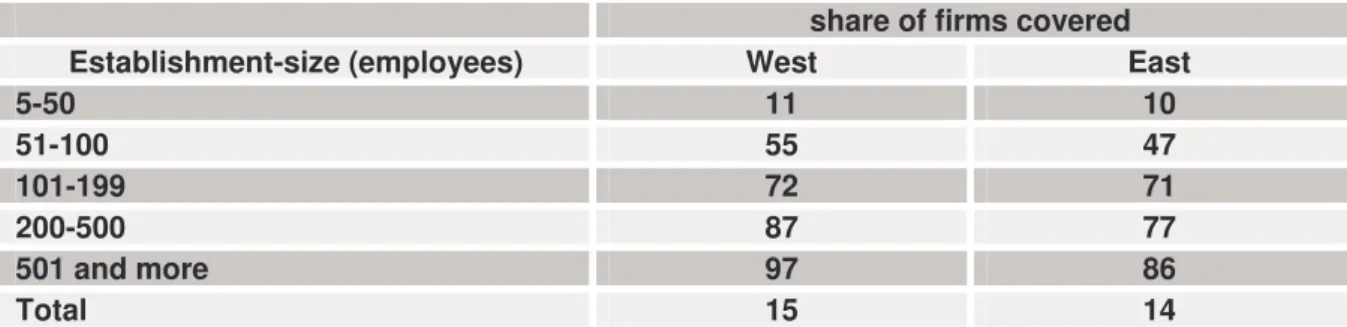
In practice, however, there is increasing overlap between collective and plant agreements. For a long time, works councils have not limited themselves to mere implementation of collective agreements but have been negotiating relatively independently on a growing number of topics. Moreover, works councils have now become, de facto, the grass-roots trade union organizations. Trade union shop stewards are active now in only a few workplaces. The existence of works councils is often the factor that determines whether a company joins the employers’ associations and adheres to the collective agreements. In big plants the works council consists mainly of full-time professionals which regularly attend training in trade union schools and are highly professionalised. If a firm consists of several plants the works councils of these plants may form a firm works council. In small and medium-sized firms in particular, it is difficult for the trade unions and employees to set up a works council (table 2). Table 2: Coverage by works councils and personnel committees by establishment size (2003)
share of firms covered
Establishment-size (employees) West East
5-50 11 10 51-100 55 47 101-199 72 71 200-500 87 77 501 and more 97 86 Total 15 14
Source: Ellguth/Kohaut 2004, Basis: IAB Establishment Panel 2003; Basis: privat companies with 5 or more employees (without agriculture)
Since the average size of companies is declining and work councils are less likely to be set up in small and medium-sized companies, the real impact of collective bargaining on working and employment conditions has diminished. To set up a works council in an often hostile environment is not easy because the long bureaucratic election procedures laid down in the old Works Constitution Act gave management many opportunities to put pressure on possible candidates and the work force. The Red-Green Alliance of SPD and Green Party therefore amended the Works Constitution Act in 2001. The main intention of the reform was to facilitate elections in small and medium-sized companies and to strengthen works councils in these companies.
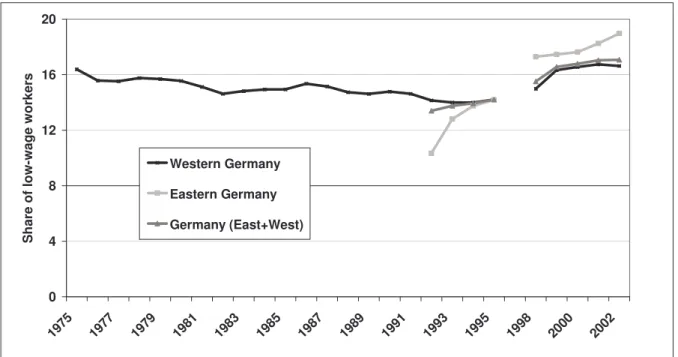
Figure 1 provides an overview of the trend over time in the percentage of low-wage workers among employees subject to compulsory social security contributions.2 In 1975 the percentage of low-wage workers among full-time employees subject to compulsory social security contributions was 16.4%, but by 1994 this figure had decreased to 14%. Since then, however, this percentage has risen again, reaching 16.6% in 2002.
The trend over time coincides with the OECD analyses (1996), which show a reduction in income inequality in Germany in the low-wage sphere (comparison D5/D1) between 1983 and 1993. This makes Germany the only country in which income inequality had lessened. However, this trend appears to have reversed since the mid-1990s. According to our analysis,
2 With the focus on employees covered by social security the BA-employee panel covers about 80% of all
employees. Self-employed and civil servants are not included. Our analysis focuses on full-time employees only, which excludes part-time work. Besides this we excluded apprentices.
in 2002, 16.6% of full-time employees in West Germany and 19.0% of full-time employees in East Germany earned less than 2/3 of the relevant median income (West Germany: less than €1709 per month; East Germany: less than €1296 per month [gross]). The mean value for Germany as a whole derived from these figures is 17.1% low-wage employment.
Figure 1: Share of low-wage workers among full-time employees covered by the social security system
The analysis is based on administrative data of the Federal Employment Services. We will mainly use two data sets which cover different periods, currently up to the end of 2002. The IAB employment sub-sample is a file for academic use containing anonymous data on 1% of all employees registered with the social security system within the given period of 21 years (1975-1995) (for details, cf. Bender et al. 2000). The BA-employee panel contains similar information on 1.92% of all employees covered by social security schemes for the period between 1998 and 2002.3
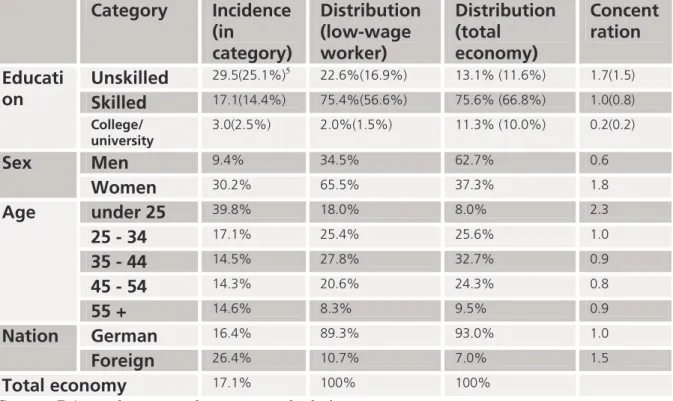
Having shown that there is already a substantial amount of low-wage employment in Germany today, in this section we shall go on to elicit information on which groups of persons are particularly affected by low wages. The structural analysis shows particularly high proportions of low-wage employees among persons with no vocational training (25.1%), women (30.2%), young people (39.8%) and non-nationals (26.4%) (see Table 3).
These groups have a high concentration of wage employment, since their shares in low-paid employees are substantially higher than their shares in the economy as a whole. However, it is not only the groups cited that are affected by low-wage employment – 75.4% of low-paid employees have completed a course of vocational training, 34.5% are men, the
3 The BA-employee panel (BA-Beschäftigtenpanel) is drawn from anonymised quartile statistics from the
employee statistics of the Federal Employment Agency. This data-set is provided by the „Zentralarchiv für Empirische Sozialforschung, Köln“. The federal employment agency has no responsibility for the use of this data in the following analysis.
0 4 8 12 16 20 1975 1977 1979 1981 1983 1985 1987 1989 1991 1993 1995 1998 2000 2002 S ha re o f l ow -w ag e w or ke rs Western Germany Eastern Germany Germany (East+West)
majority of them (73.8%) are not young people (being aged 25-54), and 89.3% of all low-paid employees are German nationals.4
Table 3: Structural characteristics of low-wage workers (Western and Eastern Germany, 2002, full-time workers) ! " # $ " # $ " # ! % 5 & ! ' ( ) * * + * ++ +* *+ , ** -. /
Source: BA employee panel, our own calculations
If we perform this calculation for East Germany, some unusual features emerge. In East Germany, the low-wage proportion is significantly higher, at 19.0%, than it is in West Germany (16.6%). The low-wage concentration within the various skills levels is very similar to the level found in West Germany. In the case of low-skilled workers, the low-wage concentration in East Germany is slightly lower than it is in West Germany, while in contrast it is slightly higher for employees who have completed a course of vocational training. For workers with a qualification from a vocational college or institute of higher education, there is very little difference between East and West Germany. Because of the higher importance of vocational training in the former GDR the proportions of low-skilled workers in the economy as a whole in East Germany (5.3%) and in the low-wage sector (9.1%) are considerably lower than in West Germany (15.0%; 26.5%). In East Germany, almost 90% of low-wage workers have completed a course of vocational training, whereas in West Germany the corresponding figure is only 72%. Therefore in East Germany, the low-wage sector appears to extend further into the group of employees who have completed a course of vocational training.
4Similarfindings for the characteristics cited are reported by Bispinck et al. 2003, Rhein et al. 2005. 5In 11.6% of all cases, no data on vocational training are available. In the analysis that follows, we have
assumed that the cases where this information is missing are equally distributed across all training levels (see Reinberg/Hummel 2002, Riede/Emmerling 1994, Reinberg/Schreyer 2003). Since the low-wage proportion of the cases where the information is missing is, at 37.8%, even higher than that found for persons with no vocational training, it is likely that the involvement of low-skilled workers is slightly underestimated as a result of this procedure. The effect of this correction has been shown by citing the uncorrected values in brackets, although these values do not add up to 100%. The missing percentages represent the proportion of persons in the category concerned for whom no training information is available.
Both the risk of being low-paid and the low-wage concentration are lower for women in East Germany than in West Germany. On the other hand, both values are higher for men in East Germany. Generally speaking, the participation of women in employment is higher in East Germany (Their share in all employees in our sample is 44.3% in East Germany as against only 35.6% in West Germany). Their higher participation in employment appears to have led to better pay and hence a lower proportion of low-wage workers. Non-nationals are more likely to be affected by low wages in East Germany than in West Germany. At 35.8%, their risk of being low-paid is substantially higher (West Germany: 25.9%). Their low-wage concentration, with a factor of 1.8, is also higher than it is in West Germany (1.5), i.e. not only is the higher risk of being low-paid associated with the generally higher risk of being low-paid in East Germany, but the income situation of non-nationals is also worse in relation to other workers. The situation of non-nationals appears to be particularly precarious in East Germany, given that they represent only 1.7% of all employees in East Germany (West Germany: 8.3%).
0 $
In the BA employee panel, branches of economic activity can be analysed at the level of two decimal places, although some branches of activity are aggregated in the process. Information on 48 branches of economic activity is available for the qualifying date 31.12.2002. In order to begin by providing a general overview, these will be combined to form overall groups, and then branches of economic activity with very high and very low proportions of low-wage workers will be analysed. A system developed by the IAT (Institute for Work and Technology) will be used to analyse employment by groups within the economy. This system is, above all, characterised by the fact that the service sector is depicted in detail.6
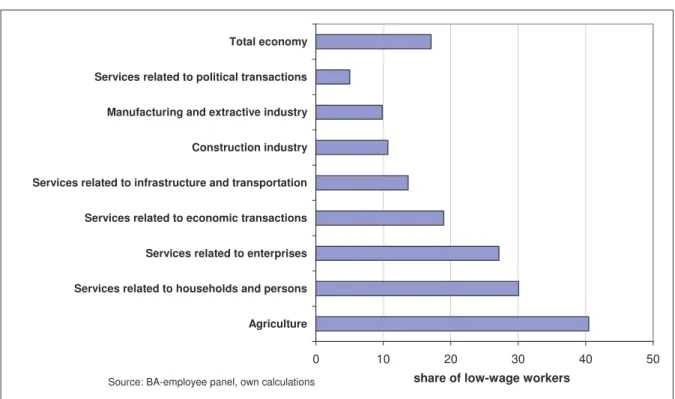
Figure 2: Low-wage workers by aggregated sectors, Germany 2002 (full-time workers)
The analysis of aggregated groups within the economy shows high proportions of low pay in agriculture, in services related to households and persons, and in services related to enterprises. Services related to economic transactions are at about the same level as the
6For the system used, see Worthmann 2002.
0 10 20 30 40 50
Agriculture Services related to households and persons Services related to enterprises Services related to economic transactions Services related to infrastructure and transportation Construction industry Manufacturing and extractive industry Services related to political transactions Total economy
share of low-wage workers
economy as a whole. Services related to infrastructure and transport, the construction industry, manufacturing industry and services related to political transactions all have lower proportions than the economy as a whole.
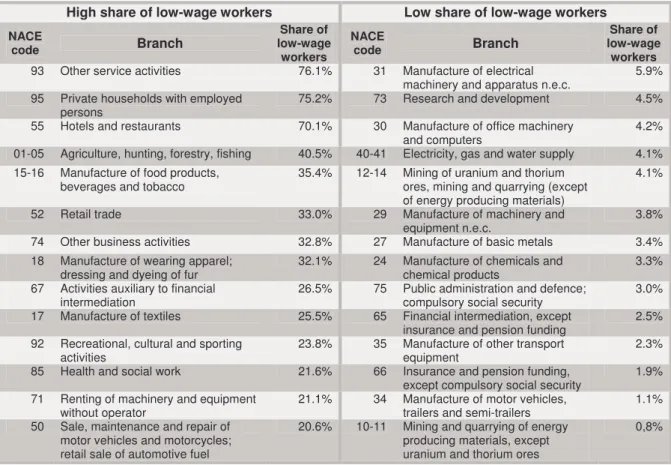
Differentiated analyses (Table 4) show that branches of economic activity with very high proportions of low-wage workers are found in the service sector in particular. Furthermore, the proportions of low-wage workers are above average in agriculture, in food and tobacco processing, and in the textile and clothing industries (level in the economy as a whole: 17.1%).
Table 4: Low-wage workers by single branches, Germany 2002 (full-time workers)
High share of low-wage workers Low share of low-wage workers
NACE code Branch Share of low-wage workers NACE code Branch Share of low-wage workers
93 Other service activities 76.1% 31 Manufacture of electrical
machinery and apparatus n.e.c. 5.9% 95 Private households with employed
persons 75.2% 73 Research and development 4.5%
55 Hotels and restaurants 70.1% 30 Manufacture of office machinery
and computers 4.2%
01-05 Agriculture, hunting, forestry, fishing 40.5% 40-41 Electricity, gas and water supply 4.1% 15-16 Manufacture of food products,
beverages and tobacco 35.4% 12-14 Mining of uranium and thorium ores, mining and quarrying (except of energy producing materials)
4.1%
52 Retail trade 33.0% 29 Manufacture of machinery and
equipment n.e.c. 3.8%
74 Other business activities 32.8% 27 Manufacture of basic metals 3.4%
18 Manufacture of wearing apparel;
dressing and dyeing of fur 32.1% 24 Manufacture of chemicals and chemical products 3.3% 67 Activities auxiliary to financial
intermediation 26.5% 75 Public administration and defence; compulsory social security 3.0% 17 Manufacture of textiles 25.5% 65 Financial intermediation, except
insurance and pension funding 2.5% 92 Recreational, cultural and sporting
activities 23.8% 35 Manufacture of other transport equipment 2.3%
85 Health and social work 21.6% 66 Insurance and pension funding,
except compulsory social security 1.9% 71 Renting of machinery and equipment
without operator 21.1% 34 Manufacture of motor vehicles, trailers and semi-trailers 1.1% 50 Sale, maintenance and repair of
motor vehicles and motorcycles; retail sale of automotive fuel
20.6% 10-11 Mining and quarrying of energy producing materials, except uranium and thorium ores
0,8%
Source: BA employee panel, our own calculations
Fourteen out of 48 branches of economic activity have above-average proportions of low-wage workers, while the remaining 34 have levels below that of the economy as a whole. Coal mining has the lowest proportion of low-wage workers. A possible explanation of this could be the very strong position of employee representatives as a result of co-determination in the coal and steel industries, the high level of coverage of collective wage agreements (see Table 1) and the high percentage of skilled workers. Similar arguments could be put forward for automotive manufacture (low-wage proportion 1.1%) and other industries in manufacturing (manufacture of electricity generators and office machinery, computers, mechanical engineering, metal manufacture and processing, chemicals industry/coking plants, oil processing), but also for some areas of the service sector – research & development, power and water supply7, insurance industry, banking, public administration, defence, social
security.
7Power and water supply is not normally included in the service sector, although service workers are likely to
The analysis of sectors with high shares of low-pay conforms with our analysis of occupations. The highest levels (between 70% and 93%) are found among hairdressers, other occupations involving bodily care, florists, ‘other guest attendants’, launderers, pressers, and interior cleaning personnel. Other occupational groups with high levels of low-wage workers are food manufacturing and processing as a production-oriented occupation, domestic occupations, retail workers and the like (pharmacy assistants, chemists, sales assistants, petrol station attendants), agricultural workers/zookeepers and occupations in textile and leather manufacturing/processing. Among these occupational groups, the following have particularly high proportions of low-wage employment: seamstresses (65.1%), fish processors (61.9%), petrol station attendants (61.5%), domestic carers (60.7%) and agricultural workers (44.8%).
0 $ $ 1
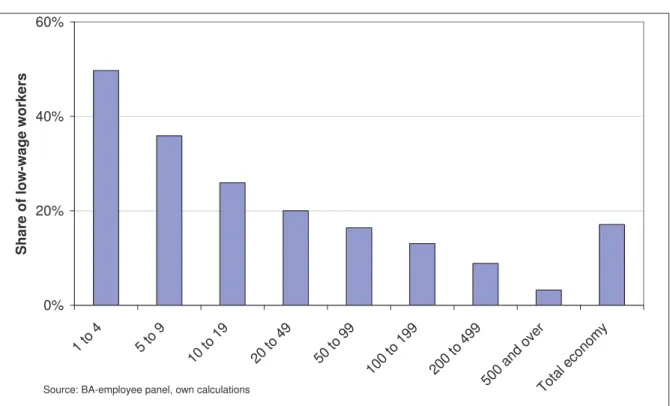
There is a strong correlation between establishment size and low wages in Germany. As the enterprise size increases, the proportion of low-wage employees decreases.
Figure 3: Low-wage workers by establishment size8, Germany 2002 (full-time workers)
The most important reasons for this correlation is that the coverage by collective agreements and trade union density are lower in smaller establishments. In addition smaller establishments often do not have works councils who are a major actor in enforcing collective agreements or their works councils are less skilled and powerful. In larger enterprises works councils are larger bodies in terms of the number of representatives, they are better trained, get more support from the unions and are increasingly released from work to perform their duties. Employees also have greater protection against dismissal as the size of the enterprise increases. This strengthens their bargaining power with the consequence that employment conditions are often better than in smaller establishments and the proportions of low-wage workers are to be anticipated to decrease as enterprise size increases.
8All employees subject to compulsory social security contributions and also those doing ‘marginal‘ part-time
work are relevant in calculating enterprise size categories. As in the overall analysis using IAB data, the low-wage proportions relate to full-time employees only.
0% 20% 40% 60% 1 to 4 5 to 9 10 to 19 20 to 49 50 to 99 100 t o 199 200 t o 499 500 a nd ov er Total econ omy S ha re o f l ow -w ag e w or ke rs
+ !
The traditional institutions of the German diversified quality production model are still strong. This model has been further developed via modernisation of vocational training or strengthening of co-determination in the works councils of small and medium-sized enterprises. At the same time, however, the model is no longer characteristic of all industries and activities, as it was in the past. Improvements in wages and working conditions in Germany’s leading industry, the metal industry, no longer automatically lead to corresponding improvements in other industries. The German model is divided into continuing high numbers of employees in modernised occupational and internal labour markets and growing numbers of employees in peripheral labour markets with worse pay and less favourable working conditions.
The institutions that have hitherto limited the development of low-wage jobs have become fragile. In Germany, wages are negotiated by branch-based trade unions. Hitherto the coverage of collective agreements was so high that the unions could organise appropriate pay for most employees via an autonomous collective bargaining policy. In contrast to many neighbouring countries, the state, the unions and employers unanimously rejected the introduction of a statutory minimum wage, because legislative intervention could endanger the pre-eminent position of collective bargaining policy.
In the past few years, however, income inequality in Germany has increased. The actual extent of the inequality is likely to be greater than the statistically measured figure, since many low-wage jobs paid in Germany are held by legally or even illegally posted or employed non-nationals, who are not included in the statistics, or at least not in German statistics. The collective bargaining system no longer fulfils its former comprehensive protective function for employees on the fringes of the labour market. There are growing numbers of people working in peripheral employment and for a low wage. There are a number of reasons for this:
- Owing to the fragile financial situation of many East German companies, the transfer of institutions from West to East Germany was ineffective. Many companies escaped from the collective bargaining system in order to survive, and this then became a model for West Germany.
- High unemployment following reunification intensified competition on the labour market, since there was an increase in the number of workers who were willing to work even for a wage below the collectively agreed level.
- Companies in the high-wage industries bound by collective agreements outsourced many labour-intensive activities to zones not bound by such agreements or to areas with lower collectively agreed wages.
- The privatisation of public services led to competition between good public wages and lower private wages, with the result that the unions had to accept concession bargaining. - Owing to the traditional policy on families, many of the sharply increasing numbers of
women seeking work are being forced into badly paid mini-jobs, which are, however, subsidised by the social security system.
- Since 2002 in particular, the Federal Government has implemented a change in policy. As a result of the labour-market reforms in 2003/4, the unemployed are to be compelled to accept worse-paid jobs, even if the wage is below the collectively agreed level.
- Some employers have withdrawn from the German social security model and are threatening to withdraw from industry-wide collective agreements. At the same time, the employers’ associations are blocking the order imposing extension of collective agreements in the Collective Bargaining Committee, as a result of which de facto
minimum wages could be introduced in individual industries, as happened in the past with the retail trade.
Besides these general trends that lead to an increase in the overall rate of low-pay our analysis leads to the following conclusions about the correlation between low pay and company or individual characteristics:
- We found high shares of low-wage workers especially in the service sector, where the coverage by collective agreements is relatively low. A further loss of influence of unions might enforce the trend of a growing low-wage sector.
- The share of low-wage workers is particularly high in small establishments. This phenomenon could be linked to the low coverage by works councils. The increasing importance of small establishments for the total employment could lead to an increase in low-pay.
- Women are particularly affected by low wages. The increasing employment rates of women could therefore also be a reason for the increase in low-pay. If our analysis would also cover part-time and marginal part-time work we suppose that the difference in low-pay between men and women would be even higher.
- Non-national workers have higher shares in low pay than Germans. By the enlargement of the EU to the east the share of foreign workers in the total employment could increase after the transitional periods of up to seven years. This could also lead to an increase in low pay in the future.
- The decreasing share of workers without a certificate of vocational training should lead to a decrease in low-pay, but the comparison of East- and West Germany suggests the opposite effect. With a lower share of qualified workers in East Germany the low-wage sector is extended further into the area of qualified work. One explanation might be the oversupply of qualified workers because of the high unemployment in East Germany. This might force qualified workers to accept low-wage work to a greater extent.
Particularly in Germany these developments seem to be problematic, because in contrast to almost all western neighbors in Europe, Germany has no lower „cushion“ in form of a minimum wage. The German government tries to limit the development of low-wage jobs by the extension of the law on the posting of workers (AEntG) to other sectors than the construction industry to fight the increase of a low-wage competition by posted workers from East Europe, which lead already to the loss of jobs for Germany butchers in slaughters firms. As Czommer/Worthmann (2005) showed for the case of the German meat processing industry this extension of the AEntG might be difficult, because in most sectors no generally binding minimum standards exist.
References:
Bender, S./ Haas, A./ Klose, C. (2000): IAB Employment Subsample 1975-1995. Opportunities for Analysis provided by the Anonymised Subsample. IZA discussion paper 117. Bonn
Bispinck, Reinhard (1998): Wage setting system – an analysis of differentiation, decentralization, and deregulation of sectoral collective agreements. In: Hoffmann, Reiner et al.(eds.): The German model of industrial relations between adaptation and erosion. Düsseldorf: Hans-Böckler-Stiftung, p. 9-26.
Bispinck, Reinhard / Kirsch, Johannes / Schäfer, Claus (2003): Mindeststandards für Arbeits- und Einkommensbedingungen und Tarifsystem. Projektbericht, herausgegeben vom Ministerium für Wirtschaft und Arbeit des Landes Nordrhein-Westfalen. Düsseldorf.
Bosch, G. (2004): Towards a new standard employment relationship in Western Europe. In: British journal of industrial relations 42, pp. 617-636
Czommer, Lars/ Worthmann, Georg (2005): Von der Baustelle auf den Schlachthof. Zur Übertragbarkeit des Arbeitnehmer-Entsendegesetzes auf die deutsche Fleischbranche. IAT-Report 3/2005. Gelsenkirchen: Institut Arbeit und Technik. EIRO (2004): European industrial relations observatory on-line, Trade union membership
1993-2003
(
http://www.eiro.eurofound.eu.int/2004/03/update/tn
0403105u.html
)Ellguth, Peter/ Kohaut, Susanne (2004): Tarifbindung und betriebliche Interessenvertretung * Ergebnisse des IAB-Betriebspanels 2003. In: WSI-Mitteilungen, Jg. 57, H. 8. S. 450-454.
European Commission (2004), Employment in Europe 2004, Luxemburg OECD (1996), Employment Outlook, Paris
OECD (1997), Employment Outlook, Paris OECD (2004a): Employment Outlook. Paris
Reinberg, Alexander / Hummel, Markus (2002): Qualifikationsspezifische Arbeitslosenquoten - reale Entwicklung oder statistisches Artefakt? IAB-Werkstattbericht 4. Nürnberg: Institut für Arbeitsmarkt- und Berufsforschung.
Reinberg, Alexander / Schreyer, Franziska (2003): Studieren lohnt sich auch in Zukunft. IAB-Kurzbericht 20. Nürnberg: Institut für Arbeitsmarkt- und Berufsforschung.
Rhein, Thomas/ Gartner, Hermann/ Krug, Gerhard (2005): Niedriglohnsektor. Aufstiegschancen für Geringverdiener verschlechtert. IAB-Kurzbericht 3/2005. Nürnberg: IAB.
Riede, T./ Emmerling, D. (1994): Analysen zur Freiwilligkeit der Auskunfterteilung im Mikrozensus. Sind Stichprobenergebnisse bei freiwilliger Auskunfterteilung verzerrt? Wirtschaft und Statistik 9/1994.
Worthmann, Georg (2002): Systematisierung von Dienstleistungen: Beispiele aus dem IAT. In: Institut Arbeit und Technik: Jahrbuch 2001/2002, S. 103-111. Gelsenkirchen.