THE ROLE OF THE ILLINOIS SCHOOL DISTRICT SUPERINTENDENT IN COMMON CORE STATE STANDARDS IMPLEMENTATION: A CASE STUDY
BY
JOHN ROLAND FILIPPI
DISSERTATION
Submitted in partial fulfillment of the requirements
for the degree of Doctor of Education in Educational Organization and Leadership with a concentration in Educational Administration and Leadership
in the Graduate College of the
University of Illinois at Urbana-Champaign, 2015
Urbana, Illinois Doctoral Committee:
Professor Donald G. Hackmann, Chair Associate Professor Yoon Pak
Assistant Professor Anjalé Welton Clinical Assistant Professor Linda Sloat
Abstract
Standards-based curricular reform is at the forefront of change in the American public education system. The Common Core State Standards (CCSS), a new set of learning standards in English and mathematics, have become the new bar for students in the vast majority of the nation’s public schools. While scholars and practitioners debate the merits of the CCSS, educators have been faced with the challenge of implementing them in the classroom. This challenge is particularly acute for school superintendents. Scholarship has suggested that transition to standards-based models like the CCSS will challenge school leaders to restructure school organizations, facilitate change, and foster knowledge- and skill-building activities (Vogel, 2010).
To deeply examine the leadership practices and behaviors of successful
superintendent leadership in this domain, this case study examined the leadership of one Illinois school district superintendent with a reputation for exceptional leadership for CCSS implementation in her school district. Three research questions framed this study: (a) in what behaviors and activities does an effective superintendent engage, as they lead the implementation of the CCSS; (b) how does a distributed approach to leadership from the superintendent unite stakeholder visions for implementation of the CCSS; and (c) what challenges did the superintendent face as they worked to unite stakeholder visions of curricula with the CCSS? To guide data collection and analysis, this research utilized a conceptual framework founded on tenants of policy implementation theory, distributed leadership, and leadership for learning.
Findings revealed that the superintendent engaged in four primary behaviors that supported effective CCSS implementation: facilitating collaboration, assessing the school district’s capacity for implementation, demonstrating a deep understanding of the CCSS, and providing/coordinating professional development and instructional coaching.
Findings also evidenced a distributed approach to leadership for CCSS implementation from the superintendent. The superintendent facilitated collaboration, engaged
stakeholder’s in efforts to learn about the CCSS together, facilitated and monitored goal setting for implementation of the CCSS, and provided and protected time necessary for teachers to plan for implementation of the CCSS. Even though these leadership behaviors were reported to be associated with a positive CCSS implementation result in the study school district, challenges remained. The need for effective communication, more professional development, and attention to teacher stress were all noted to be areas that presented challenges for the superintendent.
Implications from this study focused on the superintendent coordinating distributed leadership, deliberately engaging with internal school district stakeholders, and practicing tenants of the leadership for learning framework. Multiple
recommendations for further study, development of policy, and professional practice are presented to advance effective leadership practices for implementation of the CCSS.
Acknowledgments
Completing the doctoral dissertation is like reaching the summit of a mountain. While it is a culminating achievement, it began with a single step at the foot of the mountain. I would be remiss if I did not thank and acknowledge the contributions of so many people from the start of my doctoral coursework through the completion of my dissertation.
First, to Elaine, I am thankful for your inspiration, mentorship, and your belief that I could go the distance. You saw something in me before I saw it in myself; without your guidance I would have never found my way to the start of the journey up the mountain.
To my doctoral colleagues—Andy, Iris, Mike, Joe, and Jason—with whom I spent countless hours: I was inspired by your thinking, supported by your experiences, and I will always look back fondly on all of the laughs we shared along the way. This is a journey you cannot complete alone and you have all helped me in more ways than I can count.
To my family and friends: thank you for supporting me and giving me much needed pep talks along the way. Thank you for believing in me and never letting me quit.
Finally, to my dissertation Chair, Dr. Donald Hackmann: thank you for your tireless support, focused attention to detail, and acting as a mentor from my first course in the program through the completion of my dissertation. I knew I could always count on you and I will forever be in your debt for helping me to reach the summit.
Table of Contents
Chapter 1 Introduction ...1
Chapter 2 Review of the Literature ... 13
Chapter 3 Methodology ... 60
Chapter 4 Findings ...73
Chapter 5 Discussion, Implications, and Recommendations ...133
References ... 161
Appendix A Email Soliciting Candidates ...172
Appendix B Follow-up Email Soliciting Candidates for IASA Members or ROE Superintendents Not Responding ...173
Appendix C Solicitation Message For Professional Contacts ...174
Appendix D Email Notifying Candidates Of Their Nomination ...175
Appendix E Follow-up Email For Nominated Candidates Not Responding ...176
Appendix F Initial Superintendent Phone Interview ...177
Appendix G IRB Application/Approval ...179
Appendix H Informed Consent: Superintendent ...180
Appendix I Informed Consent: Focus Group Interview ...182
Appendix J Informed Consent: Focus Group Follow-up Interview ...184
Appendix K Informed Consent: Site Observation ...186
Appendix L Superintendent Interview #1 Questions ...188
Appendix M Superintendent Interview #2 Questions ...189
Appendix N Focus Group Interview Questions ...191
Appendix P Site Observation Protocol ...194 Appendix Q Interview Log ...195 Appendix R Site Observation Log ...196
Chapter 1 Introduction
The march toward a national set of curricular standards has been in constant motion for over 30 years. In 1983, publication of A Nation at Risk asserted the United States public education system had succumbed to a “rising tide of mediocrity” (National Commission on Excellence in Education [NCEE], 1983, p. 5). According to this report, mediocrity threatened the geopolitical and economic dominance of the United States, and supporters of the report asserted that weak academic standards were to blame (Kirst & Wirt, 2004; NCEE, 1983). This document touched off decades of standards-based curricular reforms in which being clear about what students should know at specified grade levels, incorporating modes of assessment designed to measure student progress in comparison with those goals, and holding educators accountable for ensuring students meet learning targets have become commonplace (Kirst & Wirt, 2009; Porter, Polikoff, & Smithson, 2009). Support for standards-based reforms largely has been situated in
political and policy-making discourse, while scholarly support for the efficacy of academic standard setting is comparatively thin (Mathis, 2010). Still, the dominant political ideology asserts that if high standards are set for American public education students, comparatively high achievement will follow.
The proliferation of standards-based reforms in public education has created a shift in focus for those charged with leading public schools. Educators in formal
leadership roles in schools—especially school superintendents—gradually have had their role transformed from one in which they were primarily concerned with buffering the
system to one in which they are responsible for spurring instructional reforms and organizational change (Elmore, 2000; Kowalski, 2006). Standards-based reforms, with their focus on learning targets determined in settings far removed from the implementing school systems, challenge the loosely coupled structure through which school
organizations traditionally have functioned. These reforms have made guiding
instructional and organizational change difficult for school leaders (Elmore, 2000; Meyer & Rowan, 1983; Rowan, 1990; Swanson & Stevenson, 2002; Weick, 1976).
The current iteration of the standards movement, the Common Core State Standards (CCSS), compounds this challenge because it replaces disparate state-derived curricular standards with national standards developed in settings even more far removed from the implementing school sites. Even the No Child Left Behind (NCLB) legislation, which was responsible for the most stringent set of federal accountability measures placed on public schools before the CCSS, allowed states to retain authority for the development and adoption of their own state-derived standards (Kirst & Wirt, 2009; Yell & Drasgow, 2005).
Statement of the Problem
As the CCSS have become a reality for public school systems, superintendents must adapt their leadership behaviors to this significant challenge. Three decades of standards-based education reforms have oriented the nation’s schools toward the
importance of aligning school practice to standards for academic achievement, and there is little indication this trend will shift in the future (Kirst & Wirt, 2009; Mathis, 2010).
Scholarship has suggested that transition to a standards-based model will
challenge school leaders to restructure school organizations, facilitate the change process on macro and micro levels, and facilitate knowledge- and skill-building activities to ensure those charged with delivering standards-based education are appropriately prepared to do so (Vogel, 2010). To guide their practice, superintendents need a
leadership framework upon which to ensure standards are understood and implemented within their districts in a manner that brings together the visions of those creating the standards with those charged to implement them.
Several frameworks—distributed leadership, leadership for learning, and policy implementation—demonstrate promise for assisting superintendents in their leadership efforts. Set apart, each offers an incomplete lens through which to focus leadership for CCSS implementation. When combined, however, these frameworks suggest a promising framework for effective leadership for CCSS implementation. Scholarship is needed to understand how the frameworks articulate as school district superintendents work to lead CCSS implementation.
Purpose of the Study
The purpose of this study was to understand how one successful school district superintendent effectively led for CCSS implementation. Scholarship has suggested that distributed leadership offers a promising framework for leadership for standards-based reform (Harris, 2006a). However, research on distributed leadership typically is divorced from specific policy prescriptions (Youngs, 2009) and primarily has focused at the school
level rather than on central office leadership. Additionally, distributed leadership has no mechanism for addressing how policies are implemented in school settings and how an explicit focus on learning focused leadership can be further developed. By incorporating these frameworks into the conceptual framework for this study, a unique framework was developed. This study sought to understand how an approach to leadership that involved distributed leadership, leadership for learning, and tenets of policy implementation theory worked in concert to assist the school superintendent as they lead effective
implementation of the CCSS in their school district.
Research Questions
This study addressed the following research questions:
1. In what behaviors and activities does an effective superintendent engage when leading the implementation of the CCSS?
2. How does a distributed approach to leadership from the superintendent unite stakeholder visions for implementation of the CCSS?
3. What challenges did the superintendent face when working to unite stakeholder visions of curricula with the CCSS?
Conceptual Framework
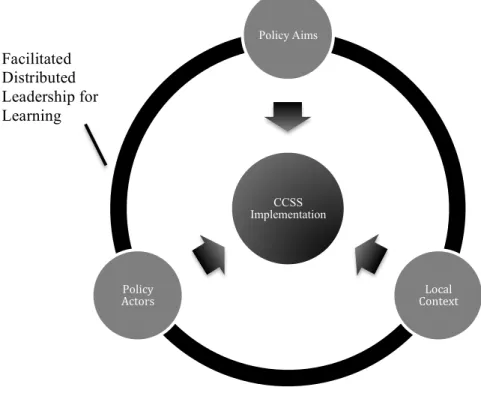
Three theoretical frameworks informed this work: policy implementation theory, distributed leadership, and leadership for learning. Policy implementation theory provides a construct by which the relationships among policies, policy actors, and policy
implementation sites can be explored and their influence on implementation understood (Honig, 2006). Distributed leadership offers a supportive leadership paradigm whereby
school leaders can mobilize multiple actors within the school community to work in a synergistic, concertive fashion toward the implementation result (Gronn, 2000, 2002, 2008; Spillane, 2005, 2006). Leadership for learning provides direction; it accounts for superintendents’ steadfast focus on the core function of schooling—teaching and learning (Murphy, Elliot, Goldring, & Porter, 2007). Combined, these theoretical frameworks offer a mediating conceptual framework for leadership of the CCSS whereby student learning focused implementation of the CCSS will be a reflection of all influencing factors, rather than the product of a blunt instrument made to fit the organization.
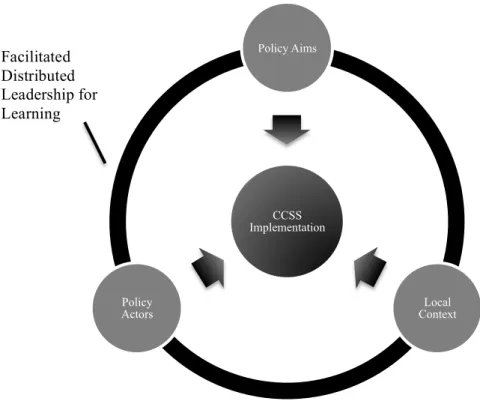
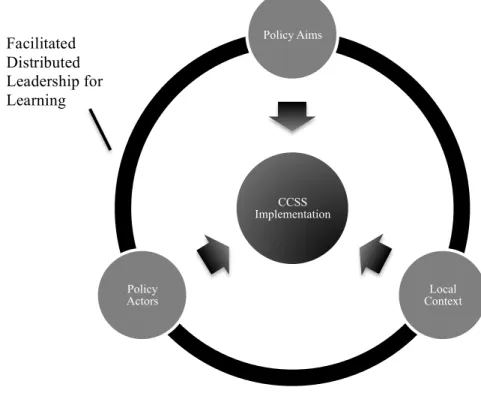
Figure 1. Conceptual framework for leading implementation of the CCSS.
CCSS Implementation Policy Aims Local Context Policy Actors Facilitated Distributed Leadership for Learning
Overview of the Research Methodology
This study examined the leadership behavior of one school district superintendent as she worked to lead for the implementation of the CCSS. A single case study design was employed because case study methods are ideal when the goal is to provide a holistic description of a contemporary event (Yin, 2009). The participant was selected through a purposeful, chained-referral method. Members of the 25-member governing board of representatives of the Illinois Association of School Administrators (IASA), Illinois Regional Office of Education (ROE) superintendents, and professional contacts of the researcher were contacted to solicit recommendations for study candidates.
Semi-structured interviews were conducted with the superintendent and focus group interviews were conducted with groups of administrators and CCSS implementing teachers/instructional coaches. Additionally, site observations were conducted and applicable documents reviewed. The data were coded and organized by relevant themes.
Limitations
Because is not possible to structure a perfect research study, it is a chief responsibility of the researcher to clearly articulate the limitations associated with the study they plan to conduct (Mertens, 2009). This study was limited in five ways: (a) generalizability, (b) sampling procedures, (c) self-reporting by study participants, (d) duration of the study, and (e) inability to connect a metric to assess the efficacy of studied district’s implementation of the CCSS.
First, because this study was structured in a case study format, generalizability to a larger sample of sites or participants cannot be claimed. Qualitative forms of research like case studies are, by nature, situated in a particular context (Creswell, 2009). Instead of connecting the results from case study sites to other particular school sites, the results and findings from this study should be interpreted in a manner that promotes an expanded understanding of the theoretical underpinnings that inform the conceptual framework for this study (Yin, 2009).
The chained-referral sampling procedures presented also may have caused potential study sites to be overlooked. Even though the IASA’s regional directors, ROE superintendents, and professional contacts of the researcher represent all potential study sites in Illinois, it is conceivable that one or more regional directors or superintendents do not have intimate knowledge of superintendents’ leadership practices. Thus, potential matches for the study may not have been nominated for the study.
Similarly, in selecting the study site and in collecting data, this study relied heavily on self-reports by the superintendent, administrators, teachers, and other adults closely involved with implementation of the CCSS in the selected study site. It is
recognized that the information that participants provided may not reveal the entirety of a situation, nor may their perceptions of their work or others reflect the reality of
implementation.
In addition, 9 hours of site observations, numerous documents, and 11 interviews were conducted and reviewed for this study over an 8-month period. The work to lead for implementation of the CCSS in Ericsson School District was an enormous task and this
study only captured a small portion of this work. Had more time been available to the researcher, it is possible additional information would have further enhanced the findings and implications associated with this study.
Finally, the establishment of the study site as a district where implementation of the CCSS was considered exemplary was reliant on subjective reports during the chained-referral sampling process. Because no metric to determine efficacy of CCSS
implementation was established or in use across Illinois during the duration of the study, it was not possible to critique Ericsson School District’s work to implement the CCSS.
Delimitations
In addition to noting limitations associated with this study, it is important to recognize that several delimitations were imposed. Delimitations included: (a) school site location, (b) school site performance, and (c) length of superintendent tenure.
When seeking a site for this study, the pool of potential sites was restricted to the state of Illinois. In addition, school district site performance served as a delimiting factor. Because this study sought to investigate the practice of an effective superintendent, the selected school district study site must have demonstrated evidence of consistently meeting or exceeding, or have showed evidence of progress toward meeting or exceeding, standards on the Illinois Standards Achievement Test (ISAT) and/or the Prairie State Achievement Examination (PSAE). Also, the school superintendent charged with leading the district must have served the district for a minimum of three consecutive
years—in the role of superintendent—while positive performance on ISAT or PSAE was noted.
Significance of the Study
This study is significant for several reasons. First, and most importantly, this study developed understanding of strategic leadership behaviors that fostered effective implementation of the CCSS. Scholars have suggested that implementation of standards-based reforms such as the CCSS present significant leadership challenges for
superintendents. This research—research directed toward a school district site where implementation unfolded in a positive fashion—helps to inform scholarly and practitioner-focused understandings of an effective CCSS implementation process.
More broadly, this work contributes to the empirical research literature in the area of distributed leadership. Distributed leadership has been described as a fashionable framework for educational leadership (Harris, 2006a), but empirical support for such an approach is still emerging. More scholarly work is needed to advance understanding of how leadership is distributed in schools (Spillane & Healey, 2010). Also, because distributed leadership needs to be coordinated or facilitated in some fashion throughout the organization (Mascall, Leithwood, Strauss, & Sacks, 2008), greater attention needs to be directed toward superintendents who evidence such a leadership style at the district level.
In addition, this study contributes to recent research in policy implementation. While a robust field that has covered many decades, contemporary approaches to policy
implementation research have focused heavily on the interdependence among policies, people, and places (Honig, 2006). Research in this vein continues to evolve and more focused attention to the role of superintendent leadership in the educational policy implementation process serves to expand on similar, recent research that examined central office leadership influence on the implementation process (Honig, 2003; Honig, Copland, Rainey, Lorton, & Newton, 2005).
Definition of Terms
Common Core State Standards. A set of K-12 learning standards in the academic areas of English/Language Arts and mathematics. Currently, 43 states in the United States have adopted the standards (Common Core State Standards Initiative, n.d.).
Distributed leadership. Distributed leadership offers a conceptualization of leadership that puts the unit of analysis in practice, rather than that of the individual (Spillane, Halverson, & Diamond, 2001). Distributed leadership reaches beyond the heroics of individuals and recognizes that leadership practice is a product of the interaction among leaders, followers, and their situation (Spillane, 2006).
Leadership for learning. An educational leadership framework that suggests leadership be focused on the following key dimensions: (a) establishing a focus on learning, (b) building professional communities that value learning, (c) engaging external environments that matter for learning, (d) acting strategically and sharing leadership, and (e) creating coherence (Copland & Knapp, 2006, p. x).
Policy implementation. Educational policy implementation examines the negotiated interactions among policies, people, and places that combine to produce the implementation result (Honig, 2006).
Summary
This chapter has provided a broad overview of the research study. The research problem and purpose for the study were discussed and the research questions that guided the study were presented. The chapter also included an overview of the research
methodology, presented the conceptual framework that was used to situate the study, and provided discussion of limitations, delimitations, the significance of the study, and a definition of terms.
Chapter Two focuses on a review of the extant literature related to the study. The chapter addresses the following five areas: (a) standards-based educational reform, (b) conceptualizations of the superintendency, (c) distributed leadership; (d) leadership for learning, and (e) policy implementation theory. The chapter culminates with a description of the conceptual framework for the study.
In Chapter Three, a detailed presentation of the research methodology is provided. The chapter details the following areas: (a) the research design; (b) population, site selection, and participants; (c) ethical considerations and validity; (d) data collection procedures; (e) data analysis procedures; and (f) a timeline of the study.
Chapter Four provides an overview of the findings from this study. Nine emergent themes that supported effective implementation of the CCSS in Ericsson School District
are put forward. These themes include: (a) all stakeholders learning together; (b) collaboration; (c) goal setting; (d) the superintendent as a learning leader; (e) the superintendent working to assess school system capacity; (f) the superintendent communicating/messaging with stakeholders; (g) the superintendent identifying and relieving stress in the school system; (h) the superintendent positioning staff correctly for implementation; and (i) the superintendent providing/coordinating professional
development and instructional coaching.
Chapter Five focuses on interpretation of the research findings as related to the conceptual framework and literature review. Implications for further research and professional practice are discussed in detail.
Chapter 2
Review of the Literature
This chapter focuses on the superintendent and the need to cultivate a district-level distributed approach to leadership for learning that is responsive to the policy context within which school superintendents work. Using the Common Core State Standards (CCSS) as a focal policy for study of this leadership work, this review centers on seven areas. First, a historical chronology of the standards movement explores the development of educational standards, the purported benefits and critiques of the standards movement, and challenges to school leadership in the standards era. Second, the role of the school superintendent is defined with particular focus on the lead district administrator’s role with regard to management, politics, and instructional leadership. Next, two leadership frameworks—distributed leadership and leadership for learning— are explored as models for superintendent leadership in the 21st century. Then, policy implementation theory is reviewed from a developmental and conceptual lens to aid in developing an understanding of how context influences leadership in the standards-based era. Finally, a conceptual framework that pulls from distributed leadership, leadership for learning, and policy implementation is presented as a model for superintendent leadership for CCSS implementation.
History of the Standards Movement
From the early 1980s, the movement toward a national set of curricular standards has been in constant motion. Since the publication of A Nation at Risk (National
Commission on Excellence in Education [NCEE], 1983)support for a series of reforms in public education has been fostered by fears of the United States’ waning global economic competitiveness (Kirst & Wirt, 2009). A Nation at Risk accused public education of producing a “rising tide of mediocrity” (NCEE, 1983, p. 5) that threatened the future of the nation and its people. The primary cause of such mediocrity was alleged to be low academic standards in the nation’s elementary and secondary schools and, as a result, a great deal of enthusiasm was generated for a movement toward establishing curriculum standards (Porter, 1994).
The notion of curricular standards was not a new one. Porter (1994) reported that content standards and tightly aligned performance measurements reach back over 100 years in our nation. However, increased openness to greater centralization of the educational system paved the way for a wave of standards-based reforms predicated on the notion that being clear about what students should know and be able to do, enacting tests to measure what students know and can do, and holding educators accountable for outcomes would improve student achievement (Kirst & Wirt, 2009; Porter, Polikoff, & Smithson, 2009).
Early efforts to establish national content standards involved the administration of President George H. W. Bush. The White House, acting in conjunction with the National Governors Association (NGA), “declared that by 2000, the nation would meet such goals as ensuring all children begin school ready to learn and American students are to be first in the world in mathematics and science achievement” (Kirst & Wirt, 2009, p. 22). Although the efforts of the George H. W. Bush administration fell short in establishing a
national curricular framework, this administration set the stage for the further expansion of state educational standards under the subsequent administrations of Presidents William Clinton and George W. Bush (Kirst & Wirt, 2009).
The reauthorization of the Elementary and Secondary Education Act in 2001, known colloquially as No Child Left Behind (NCLB), marked the creation of the most stringent set of standards and accountability measures in the United States to date. More rigorous state standards for curricula, high-stakes accountability tests, and federally backed sanctions for a failure to meet Adequate Yearly Progress on state-defined measures of academic progress have defined the last decade of public education in the United States (Kirst & Wirt, 2009; Yell & Drasgow, 2005). President Barak Obama’s Race to the Top initiative recently moved the standards movement to new terrain with incentives to adopt the CCSS (American Recovery and Reinvestment Act [ARRA], 2009). The Common Core math and English language arts standards represent a shift from disparate content guidelines across states, to standards of consensus in grades K-12 (Common Core State Standards Initiative, n.d.; Porter, McMaken, Hwang, & Yang, 2011). Led by the NGA and the Council of Chief State School Officers (CCSSO), the CCSS give definition to the knowledge and skills students must master in grades K-12 for English language arts and mathematics (Common Core State Standards Initiative, n.d.). As of mid-2014, 43 states in the Union had signed on to implement the standards (Common Core State Standards Initiative, n.d.).
The CCSS purport to be evidence based and informed by the educational practices of other top performing countries and the most successful standards of practice that were
previously developed by states (Common Core State Standards Initiative, n.d.). Collectively, the CCSS are considered to be significantly more rigorous than past standards created by the individual states, and implementation is expected to require significant shifts in instructional practice in the nation’s schools (Kober & Rentner, 2012).
Purported benefits of the standards movement. In large part, the essence of the argument in favor of standards-based reform is contained within the major political documents found throughout the standards-reform era. For example, the need for educational standards was fervently advocated in A Nation at Risk (NCEE, 1983). President George W. Bush (2004) extolled the virtues of his signature NCLB legislation and articulated his “plan to raise educational standards for every child and to require accountability from every school” (p. 114). Most recently, President Barack Obama outlined his vision for education in his blueprint for reauthorization of ESEA. He argued, “we must raise expectations for our students, for our schools, and for ourselves” (United States Department of Education, 2010, p. 1).
Within this context, expectations to be raised are tightly coupled to the implementation of college- and career-ready standards (United States Department of Education, 2010). However, evidence for why standards-based reform is the solution to the shortcomings of the public education system referenced in these documents is
decidedly absent. In fact, President George W. Bush (2004) most eloquently captured the leap from the statement of need for educational reform to the suggestion of
standards-based reforms: “When expectations are high, America’s children will rise to meet them” (p. 114).
Critiques of the standards movement. The absence of clear research-based evidence supporting standards-based reform is notable. Today’s calls for standards-based reform to address issues of global economic competitiveness and equity are oddly similar to calls from A Nation at Risk. From a layman’s perspective, to commit further on a mode of reform that has not yet addressed the key complaints advanced three decades ago appears to ensure that the status quo be maintained. This position, coupled with the reality that research support for standards-based reform and accountability is weak, contributes to the argument that the next iteration of standards reform is just another stop on an otherwise uneventful journey (Mathis, 2010).
This movement has been criticized by some scholars for focusing on the wrong standards of achievement and for forcing school districts to restrict students’ studies to a narrowed curriculum that focuses on breadth of coverage rather than depth and content mastery (Meier, 2010; Porter, 1994). Scholars also have argued that the standards-based reform movement is inherently inequitable: To mandate one set of standards of what students should know and be able to do is to ignore the role “culture, emotions, personal backgrounds, prior experiences, prior knowledge, and stages of cognitive and social development” play in the development of the student (Tienken, 2011, p. 61). Others have criticized the movement because it provides little to no evidence that its primary aim—an increase in the global competitiveness of the American student—has been or will be achieved through standards-based reform (Zhao, 2010).
Criticisms of the CCSS abound; there exist concerns that standardization diminishes the variety of experiences students receive to spur higher-order thinking (Mathis, 2010). A concern also has been voiced that the CCSS will be unaccompanied by capacity building efforts that will ensure teachers are prepared to implement the standards and avoid punitive consequences associated with failure to get students to meet the
standards (Mathis, 2010). Professional critiques from such organizations as the National Council of Teachers of Mathematics and the National Council of Teachers of English also have challenged the efficacy of the standards (Mathis, 2010).
Challenges to school leadership in the standards era. Despite these critiques, there is little indication the trend toward a greater focus on standards-based education will diminish in the future (Kirst & Wirt, 2009; Mathis, 2010). With this reality recognized, there is need to understand the challenges—and by extension leadership opportunities—those charged with leading schools in this era must negotiate. Vogel (2010) suggested leaders be prepared to provide leadership in three areas: (a) the
structure of school organizations may not be conducive to standards implementation, (b) standards-based reforms will require leaders to facilitate a great deal of change among teachers and students, and (c) implementation of standards-based reforms will require a focus on building knowledge, skills, and learning across the organization.
Challenges associated with organizational structure in schools. The
organizational structure of public schools historically has been predicated on a system of loose coupling in which teachers have enjoyed great discretion in what gets implemented in the classroom (Weick, 1976). Vogel (2010) contends that the result of loose coupling
is an insulating effect on teachers’ practice in the classroom. Positively, this result may prevent classroom instruction from being negatively impacted by poor leadership. However, it also means the work of positive changes to teaching and learning in schools do not always take hold (Vogel, 2010). Swanson and Stevenson (2002) provide a more detailed description of this phenomenon:
teachers’ professional autonomy provides an additional buffer from efforts to change practices initiated by educational administrators at the district, state or other higher order system levels. As a result, the technical core of instruction is surprisingly resistant to external influences for change. (p. 2)
The loose coupling practices of public schools at the local level have been noted to be in conflict with the overarching themes of greater coordination and control featured in standards-based reforms (Fusarelli, 2002). In addition, the need for change has
prompted new thinking about the need for tighter controls to spur efficiency,
effectiveness, and change in schools (Meyer, 2002). In response to this thinking, scholars have noted that administrators have engaged in developing organizational practices that promote tighter coupling of curriculum, instruction, and assessment to ensure curricula are implemented with fidelity. In their qualitative study of four K-8 schools in Chicago, Spillane, Parise, and Sherer (2010) found that school leaders enacted organizational routines such as coordinated reviews of standards-based assessment data to selectively couple classroom practice to the focus of governmental reforms. The importance of coupling practice also is echoed by Rorrer, Skrla, and Scheurich (2008). Having
conducted an exhaustive review of literature pertaining to how district-level leaders spur reform, Rorrer et al. posited that introducing modes of tight coupling at the district level can help school districts achieve systemic reform. However, Rorrer et al. are careful to
suggest that a variable approach to coupling—one that includes both tight and loose controls—is critical to organizational progress. Overreliance on tight coupling “extinguishes the advantage of local adaptiveness” (Rorrer et al., p. 339).
Challenges associated with fostering change in schools. The need to shift schools from loosely coupled systems to systems that incorporate simultaneously loose and tight forms of control is not just one of changing organizational structures and routines, it is one of moving the people within the system. To understand how systems change, scholars highlight distinctions between first and second order change. In schools, first order change is focused on making small changes that are an extension of past practices, whereas second order change focuses on making a distinct break with the past (Waters & Marzano, 2006). For example, first order change may focus on making a small change to curriculum; in contrast, second order change may be focused on adjusting a longstanding institutional norm (Leithwood, Aitken, & Jantzi, 2001).
Fullan (2001) contends the change process involves a degree of “messiness” (p. 31). To foster change toward standards-based education is an example of this complex process and requires leadership. Specifically,
beliefs regarding data and professional interactions must change, and all the barriers associated with change must be addressed by those leading this change. Resistance to change can take many forms, from active opposition to passive nonparticipation, and be justified by a variety of rationales. (Vogel, 2010, p. 74) These rationales may be born out in the ways that various stakeholders experience change. For example, Waters and Marzano (2006) argue that what may constitute a second order change for one teacher may present as a first order change for another. To
provide effective leadership, superintendents must estimate accurately the order of magnitude change presents for each of the involved stakeholders (Waters & Marzano).
Challenges associated with building knowledge, skills, and learning across the organization. Transition to standards-based reforms also requires leadership to work to build knowledge and skills across the organization (Vogel, 2010). Using data gathered from surveys of deputy state superintendents or their designees in 37 states and the District of Columbia, Kober and Rentner (2012) found that preparing teachers for the new CCSS was viewed as a major challenge. Demands associated with developing and providing sustained professional development for teachers dominated respondents’ thinking. Related concern focused on the need to develop educator evaluation systems to hold teachers and principals accountable for student performance in a CCSS-aligned system (Kober & Rentner).
In addition to providing new training and professional development to teachers for CCSS implementation, leadership must encourage staff to feel safe taking risks and engage with teachers in constant reflective dialogue (Vogel, 2010). To facilitate such support requires that school leaders “have a clear understanding of what a standards led system looks like in a classroom so that they can assist teachers with making the
necessary instructional changes that are required” (Vogel, 2010, p. 127). This need can be particularly difficult for school leaders to meet as they are required to develop the
necessary knowledge and skills in a shorter timeframe than teachers. Additionally, school leaders must be prepared to support staff in implementing standards-based reforms in multiple content areas.
These leadership challenges associated with transitioning schools to systems ready to implement standards-based reforms are significant. In response, the role of the school superintendent has experienced a historical shift toward a greater focus on providing leadership in these areas (Bredeson & Kose, 2007; Fessler, 2011; Kowalski, 2006; Murphy, 2003).
Varying Conceptualizations of the Superintendency
As the standards movement has progressed and evolved, so too has the position of the school superintendent. Glass, Bjork, and Brunner (2000) suggest, “The
superintendency is so very different from district to district that making generalizations is hazardous. In fact, there is no such thing as the superintendency; instead, there are many superintendencies. Often they are more unlike than like each other” (p. 15). The assertion by Glass et al. (2000) is apt; scholars have noted that contextual variables have
implications for what it means to be successful in a school leadership position (Bredeson, Klar, & Johansson, 2011). Factors such as enrollment, geographic location, grade levels of schools, district size, organizational culture, fiscal situation, and political climate may all play a role in determining how school leaders structure their work (Bredeson et al., 2011; Leithwood, Louis, Anderson, & Wahlstrom, 2004).
Although each superintendency may place differing demands on the individual who occupies the position, superintendents experience similar responsibilities regardless of the location of the district they serve. In their study of contextual variables influencing superintendent practice, Bredeson et al. (2011) investigated the leadership practices of
school district superintendents in Sweden and the mid-western United States. Even among a sample of superintendents from different countries, they found that respondents indicated there were more similarities than differences regarding their work
responsibilities.
The similarities noted by Bredeson et al. (2011) also are borne out in thematic roles that have emerged for school superintendents in the literature. Kowalski’s (2006) review of the responsibilities of the superintendency prompted his categorizing the role into five general conceptualizations: the superintendent as applied social scientist, communicator, organizational manager, democratic statesman, and teacher-scholar. These descriptions are not static: As public education has evolved, so too have the role conceptualizations for the superintendent. At times, one or more of these roles has achieved prominence over others. Today, manager, democratic statesman, and teacher-scholar—terms Cuban (1998) labeled as managerial, political, and instructional—are at the forefront of contemporary superintendents’ practice (Bredeson & Kose, 2007; Fessler, 2011; Kowalski; Murphy, 2003).
The superintendent as organizational manager. Prior to the 20th century, the
superintendent was thought of as a scholarly figure who had a great deal to do with instructional programming in schools (Cuban, 1998; Kowalski, 2006). While that role has carried through to the present day, it was significantly marginalized in the early 1900s. The prominence of classical theory, such as Taylor’s (1916) scientific principles of management, pressed school superintendents to redefine their organizations and their leadership practices. Classical theory hallmarks that involve defining work in terms of
systematic processes and division of labor became commonplace (Kowalski, 2006; Shafritz, Ott, & Jang, 2005; Tyack & Hansot, 1982). Management tasks dominated superintendents’ work as they focused increasingly on applying principles of classical theory to budgeting, facilities operation, and personnel management (Callahan, 1962; Kowalski, 2006).
Following the stock market crash of 1929, the inclination toward classical management theories faded. As these principles lost their favor, organizational theorists including Maslow (1943) and McGregor (1957) shifted the focus from rigidly structured systems that managed workers in a factory-like manner, to systems that sought to
promote individuals’ self-direction so that employees could work not only toward the organization’s goals but also toward their own goals for self-actualization.
As thinking about organizations and management evolved, scholars refined old concepts and also introduced new conceptual understandings of how organizations were managed best. Seminal works have promoted thinking about the importance of
organizational structure (Mintzberg, 1979), culture in the workplace (Schein, 1993), and systems-oriented feedback loops that promote constant learning in an organization (Senge, 1990). Throughout these evolutions, the focus on the need for school
superintendents to remain sound managers has been rarely questioned (Kowalski, 2006). However, while contemporary approaches to management in public education have continued to stress the importance of smooth and efficient budgeting and operations, traditional notions of personnel management have given way to discussion of personnel in the context of leadership (Cuban, 1998; Kowalski, 2006).
Scholarly literature and practitioner-focused publications targeted toward school superintendents are rife with discussion of leadership (Green, 2009; Guthrie &
Schuermann, 2010; Rosberg, McGee, & Burgett, 2006). The reality for today’s
superintendents “is not choosing between leadership and management, it is establishing equilibrium between these two essential roles” (Kowalski, 2006, p. 42). As a greater focus on leading personnel toward organizational goals has emerged, so too has the need to astutely manage the political realities of negotiating compromise.
The superintendent as political leader. A focus on political leadership for the school superintendent first gained prominence as schools sought to compete for scarce resources during The Great Depression. The superintendent emerged as a figure who would lobby on behalf of the school district to secure limited state funding from other competing governmental entities (Kowalski, 2006). However, the focus on competing for funds, while still a critical role, was soon only one part of a much more expanded
political role.
The superintendency operates at a nexus of conflict. Incompatible goals and divergent interests expressed by boards of education, policymakers, teacher unions, and parent groups all contribute to situate the superintendency in perpetual turbulence
(Crowson, 1987; Cuban, 1998; Kirst & Wirt, 2009; Lashway, 2002). Compounding these challenges is the reality that as the educational reform movement has trended toward greater centralization, superintendents have found themselves facing these same political dilemmas with less power, having lost control to state and federal legislators (Kirst & Wirt, 2009).
In the political domain, superintendents carry out their work by structuring negotiations and other coalition building efforts with a variety of stakeholders (Cuban, 1998). The majority of their time is spent engaging in conversation with numerous individuals as they seek to build political consensus (Kirst & Wirst, 2009; Kowalski, 2006). However, political leadership should act as a means to an end. Instruction should operate at the apex of the school district’s agenda and superintendent leadership in the political domain should act to support an “overriding goal of continuous instructional improvement” (Lashway, 2002, p. 5).
The superintendent as instructional leader. In its infancy, the superintendency primarily was concerned with teaching and learning practices within the school system (Kowalski, 2006; Peterson, 1996). This role conceptualization has remained important for school superintendents over many decades, but the focus on management efficiency in the early 1900s and political maneuvering in the mid 20th century somewhat marginalized the instructional role of school superintendents (Kowalski).
In recent decades, educational reform movements and efforts to restructure schools have reintroduced the importance of the instructional leadership function for school superintendents (Murphy, 1994). Responding to pressures associated with academic standards-based reforms, the superintendency once again has begun to lean more heavily on the instructional leadership role conceptualization to create communities of professional practice that maintain a focus on student learning (Lashway, 2002). How superintendents structure their leadership practice in response to the demands associated with the accountability movement is less clear. Still, Bredeson and Kose (2007) argued
that “whether one is speaking of direct, indirect, distributed, or other ways of asserting instructional leadership, increased attention and responsibility in superintendent
instructional leadership is a desirable response to educational reform and accountability” (p. 2).
In their meta-analysis of 27 quantitative studies representative of 2,817 school districts, Waters and Marzano (2006) begin to address this dearth of knowledge on
superintendent leadership behaviors that support student learning. They concluded that an instructional leadership focus by superintendents correlates positively with improved student achievement and suggested that effective leadership behaviors in this vein
include: (a) engaging in collaborative goal-setting with all stakeholders, (b) ensuring that the goal-setting process results in non-negotiable targets for student achievement, and (c) continuous monitoring of student progress toward achievement goals (Waters &
Marzano).
While the scholarly work by Waters and Marzano begins to inform effective superintendent instructional leadership practice, relatively little other empirical research has been directed toward superintendent leadership for student learning in response to educational reform and accountability (Bredeson & Kose, 2007). In addition, there has been an insufficient focus on research that examines the leadership behaviors of school superintendents within the various contexts within which they work (Bredeson et al., 2011). Bredeson et al. (2011) suggest “even less research has focused on the manner in which superintendents work to recognize, understand and shape the contextual influences found within their school districts” (p. 3).
Fortunately, several promising theoretical frameworks for thinking about school leadership have emerged in recent years and a growing body of research has developed to support these frameworks. In addition, thinking about how policies similar to the CCSS get implemented has evolved to a point in which a focus on the contextual factors influencing implementation is paramount. Here, distributed leadership, leadership for learning, and policy implementation are examined from a conceptual perspective and recent empirical research works are noted.
Distributed Leadership
The educational leadership literature is rife with examples of distributed
leadership practices. Unfortunately, this discussion is muddled by scholarship that uses the same terminology—distributed leadership—to describe a variety of approaches to leadership in schools (Harris, 2006a). Descriptions of shared, collaborative, democratic, team, and participative forms of leadership all weave in and out of the distributed leadership literature (Harris, 2006a; Spillane, 2005). These conceptualizations of leadership can both complement and contradict one another, and the confusion that surrounds the differing descriptions of distributed leadership often lead scholars to talking past one another and arriving at false notions of consensus (Harris, 2006a; Mayrowetz, 2008; Spillane & Healey, 2010). Moreover, discussion of the varied perspectives of distributed leadership range from theoretical to pragmatic, and the empirical support for such conceptualizations is embryonic and often divergent (Lashway, 2003; Mayrowetz, 2008).
Fortunately, as scholarship on this topic has advanced, common thematic elements have begun to emerge to define a distributed approach to leadership. Future scholarship needs to take stock of the varying conceptualizations of distributed
leadership, explore the empirical anchors to such conceptualizations, and extend research and study operations to help develop a more complete understanding of how leadership is distributed within schools (Spillane & Healey, 2010). Such scholarship should help advance augmented conceptualizations of distributed leadership and contribute to
evaluations of such conceptualizations (Youngs, 2009). To that end, this section explores the conceptual and theoretical roots of distributed leadership, details the empirical works that have emerged in response to such conceptualizations of distributed leadership, critiques the empirical research on this topic, provides a description of the tenets of distributed leadership as they have emerged with support in the empirical literature, and suggests a definition of distributed leadership for this study.
Conceptual and theoretical roots of distributed leadership. Distributed leadership is not a new concept (Harris, 2005; Youngs, 2009). Gronn (2008) indicated that more than 60 years ago the notion of distributing leadership began to take shape with the assistance of several scholars. Benne and Sheats (1948) spoke of diffusion of
leadership and emphasized the importance of shared responsibility, Gibb (1958) challenged the notion that leadership was the duty of a single individual, French and Snyder (1959) envisioned leadership being distributed among members of a group, Katz and Kahn (1978) recognized the need to share the leadership function, and Schein (1988) connected effectiveness with optimal distribution. Although these early scholars
discussed the notion of distributing leadership, they stopped short of exploring their ideas empirically (Gronn, 2008). It was not until the late 1990s that, in response to an
overabundance of scholarship that emphasized the merits of heroic individualism with regard to school leadership, the concept of distributing leadership reemerged (Gronn, 2000, 2008; Lashway, 2003; Leithwood et al., 2004; Spillane, 2006, 2009; Spillane & Hunt, 2010).
At the beginning of the 21st century, working separately, Gronn (2000) and Spillane (2005) presented their theoretical cases for a distributed approach to leadership in schools. Although their descriptions vary, common ground exists and both have argued “that their theorizing should be used as a means to better understand leadership practice, rather than prescribe distribution of leadership work” (Youngs, 2009, p. 379).
The leader-plus and practice aspects. Spillane’s conceptualization of distributed leadership is informed by distributed cognition and activity theory (Spillane, Halverson, & Diamond, 2001). Distributed cognition refers to the understanding that an individual’s thoughts cannot be simply understood as a function of individual agency but instead must recognize the interdependence that occurs between the individual, others, and their environment (Nardi, 1996; Spillane et al., 2001). In activity theory, context is again emphasized. However, activity theory purports that an activity does not occur within a prescribed context but instead the “activity itself is the context” (Nardi, 1996, p. 76).
The interdependence that is foundational to distributed cognition and activity theory informs the two components that are central to Spillane’s conceptualization of distributed leadership: the leader-plus aspect and the practice aspect (Spillane, 2006;
Spillane et al., 2001). Important to the leader-plus aspect is recognition that leadership does not only reside in the offices of those occupying formal leadership positions in school districts (Spillane, 2006). The leader-plus aspect argues that leadership is the product of the cumulative efforts of many individuals who exert leadership throughout the organization. Conceptualized in this fashion, leadership not only encompasses those exerting influence through formal positions like that of the superintendent and principal but also includes leadership from traditionally informal sources such as teachers and curriculum specialists—individuals who do not hold formal administrative appointments within the school system (Spillane, 2006).
The leader-plus aspect, while important, is insufficient without consideration of the practice aspect. The practice aspect references the interactions that occur between leaders, followers, and their situation (Spillane, 2006; Spillane, Halverson, & Diamond, 2004). In this view, and once again connecting to activity theory, leadership activity is “distributed in the interactive web of actors, artifacts, and situation (Spillane et al., 2004, p. 20). In this regard, leadership is “stretched” (Spillane et al., 2001, p. 25) across this web. This notion contrasts starkly with previous top-down conceptions of leadership.
Numerical action, concertive action, and conjoint agency. Like Spillane, Gronn (2000) set out on a journey to redefine thinking about leadership. Gronn (2002)
problematized the traditional leader-follower relationship, insisting that the existing leadership-followership orthodoxy prescribed practice rather than described it. Similarly influenced by activity theory, Gronn (2000) conflated leadership with influence and
suggested that a distributed approach to understanding leadership provided a “helpful and useful bridge between organizational structures and the actions of agents” (p. 334).
Gronn (2002) conceptualized distributed leadership in two main categories: numerical action and concertive action. Numerical action emerged in response to descriptions of focused leadership. According to Gronn,
if focused leadership means that only one individual is attributed with the status of leader, an additive or numerical view of distributed leadership means the aggregated leadership of an organization is dispersed among some, many, or maybe all of the members. (p. 429)
Numerical action does not assign more importance to leaders serving in formal positions over those serving in informal positions, but instead leadership is merely the “sum of its parts (i.e., the sum of the attributed influence)” (Gronn, p. 429).
Concertive action is similar in that leadership is conceptualized as a conflagration of all individual inputs, but it differs in that it suggests leadership may be more than just the sum of its parts. Instead, concertive action implies coordinated leadership acts rather than individual actions (Gronn, 2002). Concertive leadership action can occur in three ways: spontaneous collaboration, intuitive working relations, and institutionalized practices (Gronn, 2002). Spontaneous collaboration refers to situations in which groups of individuals with varying skill sets pool their collective expertise around a problem and achieve “brief bursts of synergy which may be the extent of the engagement or the trigger for ongoing collaboration” (Gronn, 2002, p. 430). Intuitive working relations advance the notion of spontaneous collaboration and build on organizational membership and close working relationships. In such instances, individuals form work units that rely heavily on one another “and the partners are aware of themselves as co-leaders” (Gronn, 2002,
p. 430). Finally, the third concertive form of distributed leadership—institutionalized practices—refers to formal organizational structures put into place to foster collaborative leadership behavior. Such arrangements often include leadership teams and task forces (Gronn, 2002).
These three modes of concertive leadership represent successive stages toward conjoint agency (Gronn, 2002). Conjoint agency stresses the importance of
interdependence among individuals working together and represents a strengthening of the “coincidence of effort, goals, and resources in the pursuit of mutually agreed ends” (Gronn, 2002, pp. 431-432).
Other conceptualizations of distributed leadership. While the work of Gronn (2000, 2002, 2008) and Spillane (2005, 2006) forms the majority of the contemporary theoretical underpinnings of distributed leadership in the literature, other scholars have contributed to a more comprehensive understanding of this practice. Fullan (2001) argued that effective organizational change is predicated on a delicate balance between
professional relationships within the organization and collective knowledge building and sharing. Silins, Mulford, and Zarins (2002) spoke of distributed leadership as a relational concept “exerted through social interactions” (p. 622), and Wallace (2002) argued that in schools, “principals are key, but not exclusive, leaders and managers” (p. 167). These conceptualizations and others contribute to Gronn’s (2000, 2002, 2008) and Spillane’s (2005, 2006) assertions that distributed leadership involves cultivating interdependence and developing leadership capacity across the actors working in an educational system.
Empirical works defining distributed leadership in practice. The theoretical definitions of distributed leadership have been regarded as quite useful for thinking about leadership in schools, and the popularization of the term has led to “a high level of theoretical and practical uptake” (Gronn, 2008, p. 141). However, when considering application of distributed leadership thinking to leadership for standards-based reforms, this enthusiasm must be tempered with the recognition that few empirical studies have focused on application of distributed leadership principles at the district level.
Additionally, the empirical studies conducted thus far have not employed a unified definition of the term. Some studies develop a conceptualization of distributed leadership built on a foundation of the leader-plus, practice, and conjoint agency concepts, while others hardly define the term at all (Law, Galton, & Wan, 2010; Spillane, Camburn, & Pareja, 2007).
Mayrowetz (2008) noted that while nearly all researchers cite work conducted by Gronn (2000, 2002, 2008) and Spillane (2005, 2006) as having informed their thinking on distributed leadership, few actually utilize a conceptualization of distributed leadership that is grounded in the descriptive orientation of Gronn and Spillane’s work. Instead, scholars have merged the thinking of Gronn and Spillane with other conceptualizations from the field of educational leadership. Mayrowetz’s inventory of the literature on distributed leadership led him to conclude that four usages of the term distributed leadership have evolved: (a) distributed leadership as a theoretical lens for studying the activity of leadership, (b) distributed leadership as a lever for democracy, (c) distributed
leadership to promote efficiency and effectiveness, and (d) distributed leadership as a mechanism for human capacity building within the organization.
Reviewing the empirical research that had been conducted thus far, Youngs (2009) indicated the studies on distributed leadership can be categorized in two ways: descriptive studies and normative studies. Descriptive studies focus on providing a narrative of distributed leadership practice in educational settings, while normative studies seek to identify linkages between distributed leadership and modes of increased organizational performance (Harris, 2006a; Youngs).
Mayrowetz (2008) argued that future studies utilizing distributed leadership should clearly define what is meant by the term and make a strong connection to how the “research will inform efforts at school improvement and leadership development”
(p. 432). Here, empirical studies in the descriptive and normative veins are reviewed, and a unified conceptualization of the term is presented.
Descriptive studies. A number of studies have emerged that give credence to the leader-plus, practice, and conjoint agency components of distributed leadership. Spillane et al. (2007) set out to explore the leader-plus and practice aspects of distributed
leadership by focusing their research lens on the school principal. Using a
mixed-methods approach, this study collected data on the professional experiences of 52 school principals serving elementary, middle, high, and special schools in a mid-sized urban school district. Principals were paged at random intervals throughout the day and were directed to report whether they were engaged in administrative, curriculum and
reported whether they were leading or co-leading the activities in which they were engaged and, if co-leading, the individual with whom they were co-leading. Results indicated that co-leadership between the principal and others in the schools studied was quite commonplace. Spillane et al. concluded that the results are supportive of distributed leadership theoretical propositions that posit the work of leadership is spread across multiple actors.
Similarly, Park and Datnow (2009) found that a distributed approach to leadership and decision making was present in effective school data teams. Using multiple-case study methodology, purposeful sampling was used to select four urban school systems. Two selected school districts were mid-sized public school districts with long histories of service to the community and the other two systems were relatively new charter
management organizations. The researchers found that student achievement data was made relevant to instruction by distributing “decision-making authority in a manner that empowered different staff members to utilize their expertise (Park & Datnow, p. 477). However, unlike Spillane et al. (2007), Park and Datnow found that, although these practices were shared among administrators and staff, the school systems centralized some authority for some decision-making areas while decentralizing still others.
Spillane, Healey, and Parise (2009) found that a similar distributed perspective to leadership existed with regard to school administrators’ and other school leaders’
opportunities to develop professionally. Spillane et al. build from an emerging literature base that connects professional development to improved student achievement. Using principal and staff questionnaires, the researchers investigated formal and informal
opportunities for school administrators and teacher leaders to engage in professional development at 44 elementary, middle, and high schools in a mid-sized urban school district in the southeastern United States. They concluded that specific research attention to professional development opportunities for leadership should not be relegated to the school principal but instead should be focused on those in leadership positions across the organization—targeting those in administrative roles and teacher leadership roles.
Spillane and Hunt (2010) also found evidence of distributed leadership in the practice of school principals. Using data collected on 38 principals in a mid-size urban school district in the southeastern United States, Spillane and Hunt used a mixed-methods approach and found that a group of elementary, middle, and high school principals defied the traditional notion of school principals as “lone rangers” (p. 303). This group, termed “people-centered practitioners” (Spillane & Hunt, p. 305), spent half of their time co-leading activities with students, parents, and teachers.
Leithwood et al. (2007) investigated distributed leadership practices from a district-level perspective. Using a qualitative approach, the researchers focused on four elementary schools and four secondary schools in the context of a large urban/suburban school district in southern Ontario, conducting interviews with district administrators, building administrators, school leaders who were not in formal administrative positions, and teachers. Their findings indicated that formal district and school leaders were critical in fostering productive patterns of distributed leadership.
Normative studies. While useful for developing conceptual ideas and enthusiasm for a distributed approach to leadership, descriptive studies do little to advance the
argument for fostering distributed forms of leadership in school settings because the studies are divorced from connections to student achievement or school improvement. In response, a small number of scholars have begun to conduct normative studies that seek to “establish causal links between a greater degree of leadership distribution and
improved student outcomes” (Youngs, 2009, p. 380). The picture painted by such studies remains unclear and warrants further investigation.
Utilizing a quantitative approach, Hallinger and Heck (2010) investigated the connection between distributed leadership and changes in school improvement capacity and student growth in learning over time. To begin, they randomly selected a longitudinal cohort of 13,391 third-grade students within 197 elementary schools in a western state in the United States. Using survey data from teachers supporting these students, Hallinger and Heck found significant, indirect effects of distributed leadership practice on student learning in mathematics and reading and noted that the evidence “suggests that change in distributed leadership can be empirically linked to change in school improvement
capacity and subsequent growth in student learning” (p. 881).
Firestone and Martinez (2007) focused their research on examining how
distributed leadership practices from the district office influenced teaching practice in the classroom. Using case study methodology, the researchers studied teachers and
administrators engaged in math and science reform at four schools containing grades PreK-8. All schools were designated to receive special state aid to equalize funding with wealthier districts in the state. Two schools belonged to the same district, while two others represented different school districts. Using data collected from interviews, site
observations, and document review, the researchers concluded that district leaders and teacher leaders can work in concert to procure materials, monitor improvement, and professionally develop people. Deliberate efforts by administrators to support teacher leaders were found to have contributed to the overall ability of the district to influence teaching practice in the classroom.
Other studies have found a more tenuous relationship between distributed
leadership and school outcomes. Using quantitative methods to examine the relationship between school-level factors like the presence of distributed leadership and school outcome measures, Silins et al. (2002) studied 96 secondary schools in Australia. They found no significant relationship between distributed leadership and their two school outcome variables: student engagement and student participation. The researchers posited that this undesirable outcome was attributable to the possibility that “distributed
leadership within the current schools’ structures and systems may affect teachers as an additional burden, which may stretch teachers to their limits” (Silins et al., p. 638).
Hulpia, Devos, and Van Keer (2011) also completed empirical work that sought to connect distributed leadership to school outcomes. Using survey data from 1,522 teachers from 46 large secondary schools in Belgium, hierarchical linear modeling techniques were used to analyze components of distributed leadership in relation to teachers’ organizational commitment. The results indicated a relationship between the quality of support provided by formal leadership and the organizational commitment of teachers, but the influence of those serving in informal leadership roles was negligible (Hulpia et al.).