DEVELOPMENT AND OPTIMIZATION OF AN INTEGRATED
POST-HARVEST MANAGEMENT SYSTEM FOR THE
HANDLING AND STORAGE OF FRESH TOMATOES IN
SOUTH AFRICAN SUPPLY CHAINS
Kipchumba Cherono
Submitted in fulfilment of the academic requirements of
Doctor of Philosophy
in Agricultural Engineering School of Engineering
College of Agriculture, Engineering and Science University of KwaZulu-Natal
Pietermaritzburg South Africa
Supervisor: Prof. Tilahun Seyoum Workneh
i
PREFACE
The research contained in this thesis was completed by the candidate while based in the Discipline of Agricultural Engineering, School of Engineering of the College of Agriculture, Engineering and Science, University of KwaZulu-Natal, Pietermaritzburg, South Africa. The research was financially supported by the Post-Harvest Innovation Programme (PHI) and the Tomato Producer Organization (TPO).
The contents of this work have not been submitted in any form to another University. Except where the work of others is acknowledged in the text, the results reported are due to investigations by the candidate.
Supervisor: Prof. Tilahun Seyoum Workneh
Signed:
ii
DECLARATION OF PLAGARISM
I, Kipchumba Cherono declare that:
(i) the research reported in this thesis, except where otherwise indicated, is my original work; (ii) this thesis has not been submitted for any degree or examination at any other university; (iii) this thesis does not contain other persons’ data, pictures, graphs or other information,
unless specifically acknowledged as being sourced from other persons;
(iv) this thesis does not contain other persons’ writing, unless specifically acknowledged as being sourced from other researchers. Where other written sources have been quoted, then:
(a) their words have been re-written, but the general information attributed to them has been referenced; and
(b) where their exact words have been used, their writing has been placed inside quotation marks, and referenced.
(v) where I have reproduced a publication of which I am an author, co-author or editor, I have indicated, in detail, which part of the publication was actually written by myself alone and have fully referenced such publications; and
(vi) this thesis does not contain text, graphics or tables copied and pasted from the Internet, unless specifically acknowledged, and the source being detailed in the thesis and in the references sections.
Signed:
iii
DECLARATION OF PUBLICATIONS
I declare that this thesis is my individual work, written solely by myself, and that the work has not been submitted for the award of any other degree or professional qualification. In cases where the work has formed part of jointly-authored publications, a declaration is given hereunder, explaining my role and the contributions of other authors.
List of publications:
1. Cherono K and Workneh TS. 2017. A review of the role of transportation on the quality changes of fresh tomatoes and their management in South Africa and other emerging markets. International Food Research Journal (IFRJ). In Press, with a manuscript ID, IFRJ17247.R1.
2. Cherono K, Sibomana MS and Workneh TS. 2017. Effect of infield handling conditions and time to precooling on the quality and shelf-life of tomatoes. Brazilian Journal of Food Technology (BJFT). In press, with a manuscript ID, BJFT-2017-0016.R1.
3. Cherono K, Workneh TS and Melesse S. 2017. Application of logistic statistical modelling in the evaluation of suitable conditions for the supply of fresh tomatoes in selected South African supply chains. Submitted to Engineering in Agriculture, Environment and Food (EAEF). Under review, with a manuscript ID, EAEF_2017_117.
4. Cherono K and Workneh TS. 2017. Chemical and nutritive quality changes of fresh tomatoes subjected to various transportation and disinfection treatments under commercial conditions in South African supply chains. Submitted to Biological Agriculture and Horticulture (BAH). Under review, with a manuscript ID TBAH-2017-0319.
List of conference presentations:
1. Cherono K, Shezi S and Workneh TS. 2016. Common postharvest defects and handling practices in tomato fruit. Post-harvest Innovation Programme (PHI) symposium, held on 20th November 2017 to 23rd November 2017 in Cape Town, South Africa.
2. Cherono K and Workneh TS. 2016. Effect of long distance transportation on the physicochemical and subjective quality of tomatoes in selected South African supply chains. Post-harvest Innovation Programme (PHI) symposium, held on 20th November 2017 to 23rd November 2017 in Cape Town, South Africa.
3. Cherono K and Workneh TS. 2017. Efficacy of biocontrol treatment in controlling spoilage of tomato fruit in South African commercial supply chains. Pan African Society of
iv
Agricultural Engineering (PASAE) conference held in Nairobi, Kenya, on the 19th to 23rd November 2017.
4. Cherono K and Workneh TS. 2017. Effect of transportation conditions and pre-storage treatments on the quality of fresh tomatoes in selected South African supply chains. 22nd Biennial South African Association for Food Science and Technology (SAAFoST) international congress held on 3-6 September 2017 in Cape Town, South Africa.
v
ABSTRACT
In South African tomato fruit supply chains, transportation activities dominate the supply operations, with 60 % of total fruit produced in the country being grown in the Limpopo Province and supplied countrywide to markets as far as Cape Town. Although it has been established that poor transportation conditions lead to the loss of quality and mechanical damage in fresh tomatoes, the role of road quality and various tomato postharvest treatment conditions in contributing to quality losses of tomatoes during long distance transportation is not well known. This study investigates the effects of long distance transportation and in-field handling practices on the quality of tomatoes in South African tomato supply chains, with the aim of developing an integrated post-harvest management system for transporting fruit from farms to domestic markets. Tomatoes were harvested from two farms in Limpopo in the morning and afternoon. They were transported, using large bins and smaller lugs, pre-cooled within two and six hours and stored under ambient and cold storage conditions. Transportation experiments were also conducted in the summer and winter, where tomatoes of red, green and pink maturity stages were harvested and transported from three farms in Limpopo to Pietermaritzburg. They were then subjected to seven integrated disinfection treatments and stored under ambient and cold storage conditions. Route distances and road quality were measured during transportation. Fruit colour, firmness, marketability, pH, weight-loss, lycopene, sugars and ascorbic acid (AA) contents were also analysed over a 30-day storage period. The data was used to develop logistic and kinetic models for the supply of tomatoes. A transportation planning model was also developed using data from all the experiments that minimised logistical costs, while meeting consumer quality requirements for a given demand. The study showed that up to 17 % of tomato post-harvest losses in emerging economies occur during transportation. Harvesting in the morning and pre-cooling within two hours improved fruit marketability and weight-loss by up to 20 % and 75 kg ton-1, respectively, compared to harvesting in the afternoon and pre-cooling after six hours. The Esmefour-Pietermaritzburg route (ZZ) was longer than the Point Drift-Pietermaritzburg (PD) and Steve Mohale’s Farm-Pietermaritzburg route (EM) by 263.44 and 223.81 km, respectively. Seventy percent (70 %) of the EM road length had International Roughness Index (IRI) values less than 2.5 m km-1, while the ZZ and PD routes had 63 and 58 % of their road length recording IRI values less than 2.5 m km-1, respectively. Combining biocontrol treatment with chlorinated water (Chl+Bio) or anolyte water (Ano+Bio) effectively controlled the fruits’ weight-loss. Ano+Bio gave tomatoes
vi
with comparable visual appearance to fruit treated with chlorinated water, but with better visual appearance and marketability, compared to fruit treated with biocontrol, hot water, HWT+Bio or tap water (control). Fruit transported along the EM route had a 5 and 10 % higher mean marketability, compared to fruit transported along the PD and ZZ routes, respectively. The developed logistic model showed that the probability of fruit marketability was comparatively lower for fruit transported over rough roads, compared to the probability of marketability of fruit transported over smoother roads. Fruit transported over moderately rough roads, that were furthest from the market, had the lowest probability of marketability. Fruit harvested at the green maturity stage, transported through the shortest, smoothest roads, stored under refrigerated environment and treated with Ano+Bio, resulted in fruit with the highest probability of marketability. The chemical and nutritional analyses of samples of selected treatments showed that fruit dipped in Ano+Bio had the least AA loss, compared to fruit subjected to other treatments. Fruit transported over moderately rough surface road surface profile and the longest distance (ZZ) lost the highest AA of all the routes. Fruit harvested and transported in the winter had a 14 % and 9 % decrease in AA content during the 30-day storage period for samples stored in ambient and cold storage conditions, respectively. On the other hand, fruit harvested and transported in the summer showed an 85 % and 35 % decrease in AA concentration over the 30-day storage period, for ambient and cold stored fruit, respectively. Fruit transported through the shortest, smoothest road (EM), had a mean lycopene content of 40.9 mg kg-1. In contrast, fruit transported over the longest distance, with roads that had moderately rough surface profile (ZZ), had a mean lycopene content of 37.6 mg kg-1. The disinfection treatments and harvesting season significantly (p≤0.05) influenced the sugar content of stored tomatoes. The study showed that tomato postharvest nutrient losses in commercial supply chains are not only affected by environmental and post-harvest practices, but also by road quality. In a typical scenario, the transportation planning model was shown to improve the profits of the growers by over 8000 ZAR per truckload of fruit compared to cases where the model was not used, while ensuring that consumers’ fruit quality requirements are met. The novel aspects of the research lie in the establishment of the effects of long-distance transportation on the quality and shelf-life of tomatoes under practical supply conditions. Guidelines for in-field handling and the long-distance transportation of fresh tomatoes have been developed, as well as environmentally-friendly disinfection treatments for commercial and emerging farmers. The developed transportation planning model that integrates key tomato quality attributes and other supply chain parameters is another novel output of the study.
vii
ACKNOWLEGEMENTS
I thank the almighty God for his grace, love and good health throughout the journey of this study. Indeed, all praise goes to Him for He is the giver of all. I am grateful to my distinguished supervisor, Professor Workneh, for his support, guidance and mentorship, on an academic and personal level, throughout the entire period of this study. I also thank my beloved wife, Cathryne for her support, encouragement and prayers. To my son, Gabriel, thanks for enduring the long evenings with me, while working on my research. To my beloved parents, I thank you for teaching me so well and for encouraging and supporting me throughout my educational career. A special thanks to my Dad, for his prayers and encouragement, while I was pursuing my studies away from home. To Nkosi and Elsie, senior technologists at the Department of Horticulture and Food Science, I thank both of you for your technical assistance throughout the course of this study. I also thank my friends and colleagues at the Department of Bioresources Engineering for their help, support and provision of a conducive environment, while undertaking this study. Lastly, I thank our staff at the Biosystems and Agricultural Engineering Department of the Jomo Kenyatta University of Agriculture and Technology for their support, especially Professor Mutwiwa, for his constant encouragement and incessant prayers.
viii
TABLE OF CONTENTS
Page
PREFACE ... i
DECLARATION OF PLAGARISM ... ii
DECLARATION OF PUBLICATIONS ... iii
ABSTRACT ... v
ACKNOWLEGEMENTS ... vii
1. INTRODUCTION ... 1
1.1 Rationale for the Study ... 1
1.2 Justification... 4
1.3 Aim of Study ... 5
1.4 Objectives ... 5
1.5 Roadmap of Study ... 6
1.6 References ... 7
2. A REVIEW OF THE ROLE OF TRANSPORTATION ON THE QUALITY CHANGES OF FRESH TOMATOES AND THEIR MANAGEMENT IN SOUTH AFRICA AND OTHER EMERGING MARKETS ... 10
2.1 Abstract... 10
2.2 Introduction ... 10
2.3 The Structure of Tomato Supply Chains in South Africa ... 12
2.3.1 Production ... 12
2.3.2 Market size ... 13
2.3.3 Marketing and procurement structure ... 14
2.4 Logistical Planning ... 15
2.5 Important Quality Changes during the Handling and Transportation of Tomatoes ... 16
ix
2.5.1 Physical quality changes ... 16
2.5.2 Chemical quality changes ... 18
2.5.3 Nutritive quality changes ... 18
2.5.4 Changes in bioactive compounds ... 18
2.5.5 Changes in sensory quality ... 19
2.6 Contribution of Transportation to Post-Harvest Quality Losses of Tomatoes ... 20
2.7 Impact of Packaging Materials and Handling during Transportation of Tomatoes ... 22
2.8 Emerging Trends in Post-Harvest Quality Management of Fresh Tomato in South African Supply Chains ... 26
2.8.1 Biotechnological and biocontrol approaches ... 26
2.8.2 Surface disinfection... 27
2.8.3 Edible coatings ... 28
2.8.4 Packaging ... 29
2.8.5 Temperature and humidity control ... 30
2.8.6 Integrated postharvest management approaches ... 30
2.9 Modelling Approaches in Tomato Supply Chain Planning ... 31
2.9.1 An overview of the use of planning models in tomato supply chains ... 31
2.9.2 Modelling tomato quality changes during transportation and storage ... 32
2.10Conclusion ... 35
2.11Acknowledgement ... 36
2.12References ... 36
3. EFFECT OF INFIELD HANDLING CONDITIONS AND TIME TO PRE-COOLING ON THE SHELF-LIFE AND QUALITY OF TOMATOES ... 44
3.1 Abstract... 44
x
3.3 Materials and Methods ... 46
3.3.1 Tomato fruit samples ... 46
3.3.2 Sample preparation ... 47 3.3.3 Experimental design ... 47 3.3.4 Data collection ... 47 3.3.4.1 Fruit temperature ... 47 3.3.4.2 Colour ... 48 3.3.4.3 Firmness ... 48 3.3.4.4 pH ... 48 3.3.4.5 Weight-loss ... 48
3.3.4.6 Subjective quality analysis ... 48
3.3.5 Data Analysis ... 49
3.4 Results and Discussion ... 49
3.4.1 Storage temperature conditions ... 49
3.4.1.1 Colour ... 49
3.4.1.2 Fruit Flesh firmness (FFf) ... 52
3.4.1.3 Weight loss ... 55
3.4.1.4 pH ... 57
3.4.1.5 Subjective quality analysis results ... 59
3.5 Conclusion ... 61
3.6 Acknowledgements ... 62
3.7 References ... 62
4. EFFECT OF TRANSPORTATION CONDITIONS AND PRE-STORAGE TREATMENTS ON THE QUALITY AND SHELF-LIFE OF FRESH TOMATOES IN SELECTED SOUTH AFRICAN SUPPLY CHAINS ... 64
xi
4.2 Introduction ... 65
4.3 Materials and Methods ... 67
4.3.1 Tomato fruit samples ... 67
4.3.2 Transportation conditions ... 67
4.3.3 Experimental design ... 68
4.3.4 Data collection ... 68
4.3.4.1 Measurement of temperature conditions and road quality ... 68
4.3.4.2 Colour ... 69
4.3.4.3 Fruit firmness ... 69
4.3.4.4 pH ... 69
4.3.4.5 Physiological weight-loss ... 69
4.3.4.6 Subjective quality evaluation ... 69
4.3.5 Data analysis ... 70
4.4 Results and Discussion ... 70
4.4.1 Road conditions... 70
4.4.2 Air temperature and relative humidity during transportation ... 71
4.4.3 Colour... 72 4.4.4 Fruit firmness ... 81 4.4.5 Physiological weight-loss ... 89 4.4.6 Fruit pH ... 97 4.4.7 Subjective quality ... 104 4.4.7.1 Visual observations ... 104 4.4.7.2 Marketability ... 105 4.5 Conclusions ... 113 4.6 Acknowledgements ... 114
xii
4.7 References ... 114
5. EFFECT OF PACKING UNITS DURING LONG DISTANCE TRANSPORTATION ON THE QUALITY AND SHELF-LIFE OF TOMATOES UNDER COMMERCIAL SUPPLY CONDITIONS ... 118
5.1 Abstract... 118
5.2 Introduction ... 118
5.3 Materials and Methods ... 120
5.3.1 Tomato fruit samples ... 120
5.3.2 Transportation conditions ... 120
5.3.3 Experimental design ... 120
5.3.4 Data collection ... 121
5.3.4.1 Measurement of road quality ... 121
5.3.4.2 Colour ... 121
5.3.4.3 Fruit firmness ... 121
5.3.4.4 pH ... 122
5.3.4.5 Physiological weight-loss ... 122
5.3.4.6 Subjective quality evaluation ... 122
5.3.5 Data analysis ... 122
5.4 Results and Discussion ... 123
5.4.1 Colour... 123
5.4.2 Firmness ... 124
5.4.3 pH ... 125
5.4.4 Physiological weight-loss ... 126
5.4.5 Subjective quality and marketability ... 127
5.5 Conclusion ... 130
xiii
5.7 References ... 131
6. APPLICATION OF LOGISTIC STATISTICAL MODELLING IN EVALUATION OF SUITABLE CONDITIONS FOR THE SUPPLY OF FRESH TOMATOES IN SELECTED SOUTH AFRICAN SUPPLY CHAINS ... 133
6.1 Abstract... 133
6.2 Introduction ... 134
6.3 Materials and Methods ... 136
6.3.1 Tomato fruit production ... 136
6.3.2 Transportation conditions ... 136
6.3.3 Experimental design ... 137
6.3.4 Application of pre-storage treatments ... 137
6.3.5 Data collection ... 138
6.3.5.1 Fruit colour ... 138
6.3.5.2 Subjective quality evaluation ... 138
6.3.5.3 Fruit firmness ... 138
6.3.5.4 Fruit pH ... 139
6.3.5.5 Physiological weight-loss ... 139
6.3.6 Logistic modelling of tomato quality data ... 139
6.4 Results and Discussion ... 140
6.4.1 Transportation conditions ... 140
6.4.2 Storage conditions ... 141
6.4.3 Changes in fruit marketability with storage period ... 142
6.4.4 Effect of categorical variables on the probability of marketability ... 142
6.4.5 Prediction of tomato fruits’ probability of marketability from their quality parameters ... 145
xiv
6.4.7 Validation of the overall model ... 147
6.5 Conclusion ... 148
6.6 Acknowledgement ... 148
6.7 References ... 148
7. CHEMICAL AND NUTRITIVE QUALITY CHANGES OF FRESH TOMATOES SUBJECTED TO VARIOUS TRANSPORTATION AND DISINFECTION TREATMENTS UNDER COMMERCIAL CONDITIONS IN SOUTH AFRICAN SUPPLY CHAINS ... 152
7.1 Abstract... 152
7.2 Introduction ... 153
7.3 Materials and Methods ... 155
7.3.1 Tomato fruit production ... 155
7.3.2 Transportation conditions ... 155
7.3.3 Disinfection and storage treatments ... 156
7.3.4 Temperature and relative humidity measurement ... 156
7.3.5 Experimental design ... 156
7.3.6 Analysis of chemical and nutritive quality changes... 156
7.3.6.1 Sugars ... 156
7.3.6.2 Ascorbic acid ... 157
7.3.6.3 Lycopene ... 157
7.3.7 Data analysis ... 158
7.4 Results and Discussion ... 158
7.4.1 Road quality conditions ... 158
7.4.2 Air temperature and relative humidity during transportation and storage .... 159
7.4.3 Ascorbic acid content ... 161
xv
7.4.5 Sugars (Glucose and Fructose) ... 173
7.5 Conclusion ... 179
7.6 Acknowledgement ... 180
7.7 References ... 180
8. MULTIVARIATE ANALYSIS OF QUALITY ATTRIBUTES OF TOMATO FRUIT SUBJECTED TO DIFFERENT DISINFECTION TREATMENTS, TRANSPORTATION AND STORAGE CONDITIONS USING PRINCIPAL COMPONENTS ANALYSIS ... 183
8.1 Abstract... 183
8.2 Introduction ... 183
8.3 Materials and Methods ... 184
8.3.1 Tomato fruit production ... 184
8.3.2 Transportation conditions ... 185
8.3.3 Disinfection treatments ... 185
8.3.4 Experimental design. ... 186
8.3.5 Analysis of tomato fruits’ physicochemical quality ... 187
8.3.5.1 Fruit colour ... 187
8.3.5.2 Firmness ... 187
8.3.5.3 pH ... 187
8.3.5.4 Weight-loss ... 188
8.3.5.5 Fruit marketability ... 188
8.3.6 Analysis of chemical and nutritive quality ... 188
8.3.6.1 Sugars ... 188
8.3.6.2 Ascorbic acid ... 189
8.3.6.3 Lycopene ... 189
xvi
8.3.7.1 Theoretical background of principal components analysis ... 189
8.3.7.2 Principal components analysis of tomato fruit quality data ... 190
8.4 Results and Discussion ... 191
8.4.1 Classification of tomato fruit quality data using PCA ... 193
8.4.1.1 Physicochemical quality parameters ... 193
8.4.1.2 Chemical and nutritive quality parameters ... 197
8.5 Conclusion ... 200
8.6 Acknowledgement ... 200
8.7 References ... 200
9. MODELING QUALITY KINETICS OF TOMATO FRUIT SUBJECTED TO VARIOUS TRANSPORTATION, DISINFECTION AND STORAGE TREATMENTS ... 203
9.1 Abstract... 203
9.2 Introduction ... 203
9.3 Materials and Methods ... 205
9.3.1 Tomato fruit production ... 205
9.3.2 Transportation conditions ... 205
9.3.3 Disinfection treatments ... 206
9.3.4 Experimental design ... 206
9.3.5 Analysis of tomato fruits’ physicochemical quality ... 207
9.3.5.1 Colour ... 207
9.3.5.2 Firmness ... 207
9.3.5.3 pH ... 208
9.3.5.4 Weight-loss ... 208
9.3.5.5 Fruit marketability ... 208
xvii
9.3.6.1 Sugars ... 209
9.3.6.2 Ascorbic acid ... 209
9.3.6.3 Lycopene ... 209
9.3.7 Modeling tomato fruit quality degradation kinetics ... 210
9.3.7.1 Theoretical considerations ... 210
9.3.7.2 Modeling approach ... 211
9.4 Results and Discussion ... 212
9.4.1 Identifying kinetics of quality degradation of tomatoes ... 212
9.4.1.1 Fruit colour (Hue angle) ... 212
9.4.1.2 Fruit firmness ... 214
9.4.1.3 pH ... 215
9.4.1.4 Weight-loss ... 216
9.4.1.5 Marketability ... 217
9.4.1.6 Ascorbic acid content ... 218
9.4.1.7 Glucose content ... 220 9.4.1.8 Fructose content ... 221 9.4.1.9 Lycopene content ... 221 9.5 Conclusion ... 222 9.6 Acknowledgements ... 223 9.7 References ... 223
10. TRANSPORTATION PLANNING MODEL FOR THE SUPPLY OF FRESH TOMATOES: AN APPLICATION TO SOUTH AFRICAN CONDITIONS WHILE CONSIDERING TOMATO FRUIT OF DIFFERENT MATURITY STAGES ... 227
10.1Abstract... 227
10.2Introduction ... 228
xviii
10.4Model Formulation ... 231
10.4.1 Problem description ... 231
10.4.2 Mathematical formulation ... 233
10.4.3 Implementation of model in selected tomato supply chains ... 234
10.4.4 Modelled quantities fruit required to be meet market demand ... 235
10.5Benefits of Implementation of the Model ... 238
10.6Discussion... 238
10.7Conclusion ... 239
10.8References ... 240
11. CONCLUSIONS AND RECOMMENDATIONS ... 242
11.1Conclusions ... 242
11.2Recommendations ... 245
APPENDIX A ... 246
Required fruit capacities from different growers ... 246
APPENDIX B ... 247
CPLEX code for the developed transportation planning model ... 247
APPENDIX C ... 248
xix
LIST OF FIGURES
Figure 2.1 A Pictorial view of various packaging materials used in South African tomato industry. Cardboard boxes (A) are commonly-used transport fruit to the retail markets. Bulk bins (B) are used by large growers to transport fruit from the field to pack houses. Plastic crates (C) are used during harvesting by commercial growers (see B) and transportation of fruit from the farm to pack houses by emerging farmers. Wooden crates (D) were previously used by emerging farmers to transport tomato fruit to the market... 24 Figure 2.2 Transportation of tomatoes by a commercial producer in South Africa through
a farm road (A), with (B) depicting hired trucks used by emerging farmers. (C) shows a wooden crate and grass used as cushioning material during transportation of tomato fruit in Tanzania (Njenga, 2015), while (D) shows the poor road infrastructure and some of the transport systems used by farmers in Kenya to transport produce (Njenga, 2015) ... 25 Figure 3.1 A photographic presentation of a large plastic bins (A) and smaller lugs (B)
used to transport tomato fruits to the pack houses under commercial conditions ... 46 Figure 3.2 Surface temperature of tomato fruit stored in ambient and cold storage
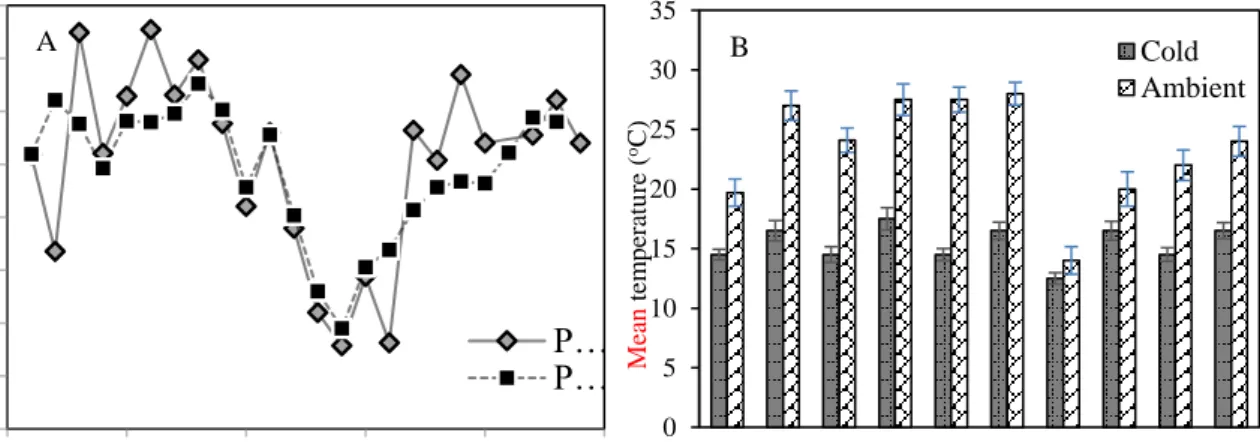
conditions (A), and ambient temperature conditions at Rietpol (PH1) and Digale (PH2) pack-houses (B) ... 49 Figure 3.3 Effect of handling using lugs or bins on the rate of fruit colour change of
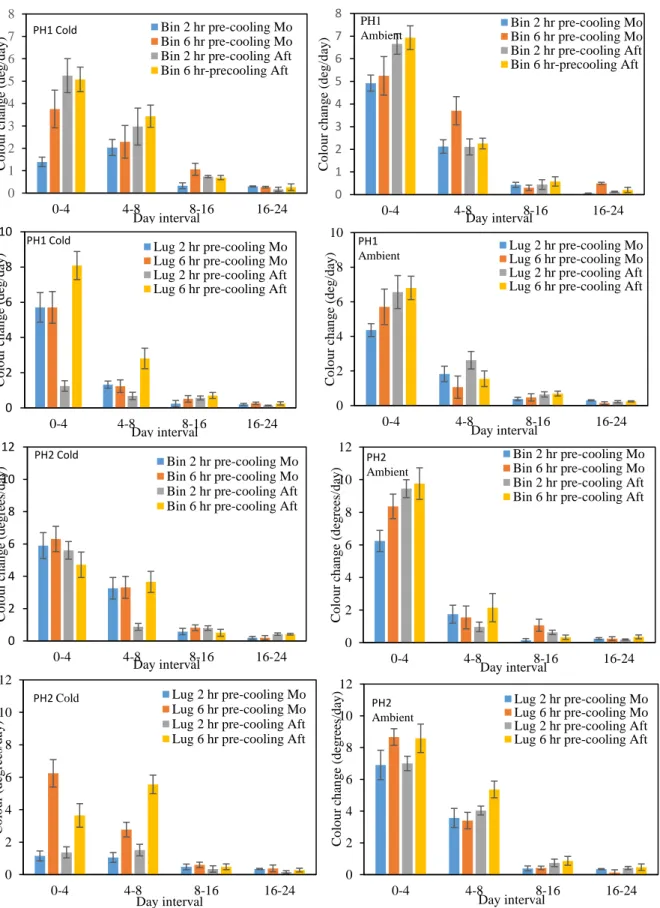
tomatoes subjected to different times to precooling and harvesting times of the day ... 51 Figure 3.4 Effect of various postharvest practices on the rate change of tomato fruit
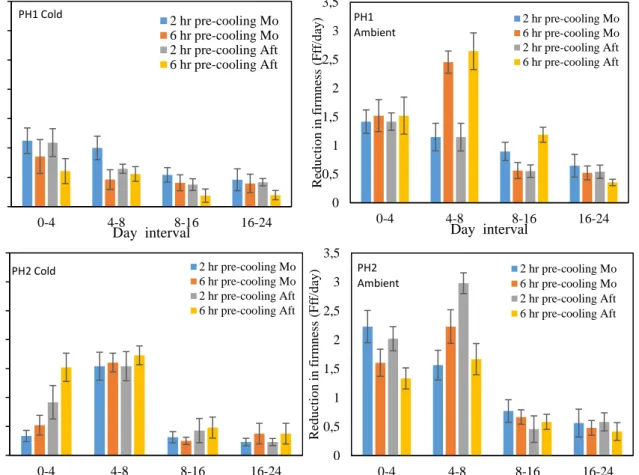
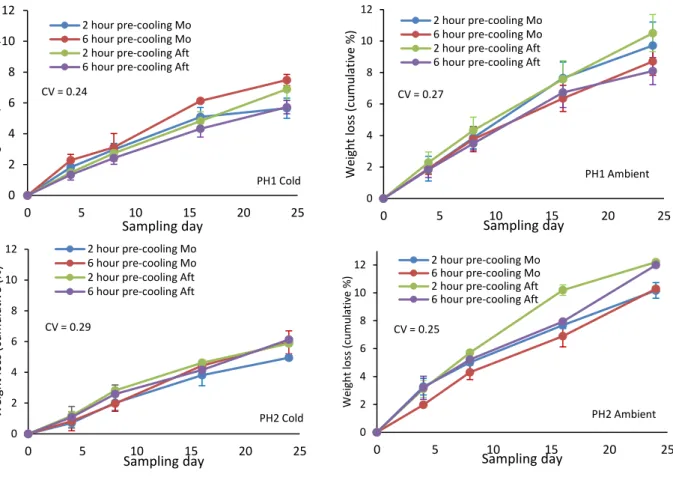
firmness. PH1 and PH2 are 40 and 5 km from their respective Pack houses, with a majority of road length connecting the farm to PH1 being of smoother road length than PH2. PH1 mainly comprised of dirt road. ... 54 Figure 3.5 Cumulative weight loss of ambient and cold-stored sample tomato fruit as
influenced by various postharvest practices with storage period. PH1 and PH2 are 40 and 5 km from their respective Pack houses, with a majority of
xx
road length connecting the farm to PH1 being of smoother road length than PH2. PH1 mainly comprised of dirt road ... 56 Figure 3.6 Typical images of tomato products depicting damage at the bottom of bins
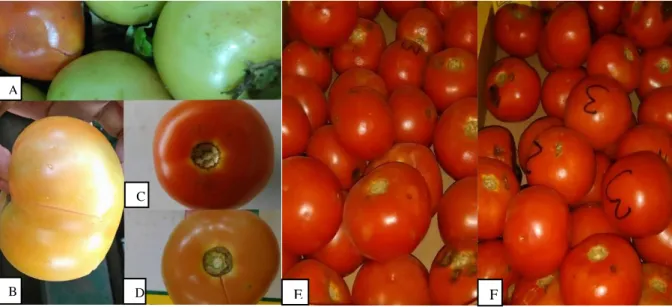
(A), flattening (C) and cracking (D) of samples transported in bins as well as side cuts of samples transported in lugs (B). Images on the right depict the long term effect of bruising on tomato fruit that became pronounced in samples handled in bins (F) compared to lugs (E) ... 59 Figure 3.7 Variation of marketability with storage duration for tomato samples stored in
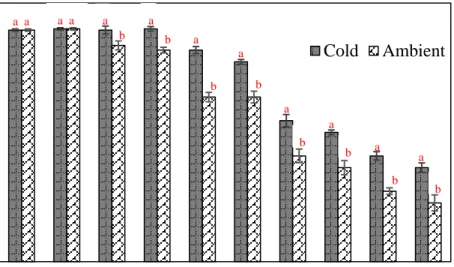
Rietpol (PH1) and Digale (PH2) pack houses. The farm supplying fruit to PH1 was approximately 40 km from the pack house and comprised mainly of smoother roads, while the farm suppling fruit to PH2 was approximately 5 km from the pack house and comprised mainly of dirt roads. Bars marked with different letters pairwise are significantly (p≤0.05) different... 60 Figure 4.1 Experimental design with (A) as transportation conditions, (B) the fruit
maturities at harvest and (C) ambient and cold storage conditions (11 oC). The experiment was carried out in summer and winter. The seven pre-storage treatments were triplicated in a full factorial experiment ... 68 Figure 4.2 Relative humidity conditions in the trucks during transportation of tomatoes.
Winter conditions are depicted in (A) and summer conditions in B (n = 3) ... 71 Figure 4.3 Average temperature conditions in the trucks during transportation of
tomatoes. Winter conditions are depicted in (A) and summer conditions in (B) (n = 3) ... 71 Figure 4.4 Effect of the pre-storage treatments on the visual appearance of tomato fruit
after 24 days of storage. (A) is fruit treated using hot water, (B) chlorinated water, (C) Chl+Bio, (D) Ano+Bio and € Biocontrol treatment ... 105 Figure 5.1 A schematic representation of the experimental design with (A) as the
transportation conditions, (B) the fruit maturities at harvest and (C) the packaging units (bins and boxes) during transport. The two disinfection treatments (chlorinated water and tap water) were applied on fruit and sampling and analysis carried out over a 30-day storage period. (D) designates cold (11 oC) and ambient storage conditions. ... 121
xxi
Figure 5.2 Effect of handling conditions on the changes in hue angle with storage across various transportation conditions. (A) designates fruit handled using bins and (B) fruit handled using boxes ... 123 Figure 5.3 Effect of different handling and transportation conditions on the changes in
tomato fruit firmness. (A) represents fruit handled in bins and (B) those handled using boxes ... 124 Figure 5.4 Variation in tomato fruit weight-loss with storage period for fruit transported
using bins (A) and boxes (B), across, PD, EM and ZZ routes from Limpopo to Pietermaritzburg ... 127 Figure 5.5 Visual appearance of tomatoes harvested at red maturity stage and transported
using boxes (A) and bins (B) ... 128 Figure 5.6 Effect of handling conditions on the changes in marketability of tomatoes
with storage. (A) designates fruit transported using bins, while (B) designates tomatoes transported using boxes ... 129 Figure 6.1 Schematic representation of the experimental design with (A) as
transportation conditions, B the fruit maturities at harvest and (C) ambient and cold storage conditions (11 oC). The experiment was carried out in summer and winter. The seven pre-storage treatments were triplicated in a full factorial experiment. Chl designates chlorinated water, Bio biocontrol treatment, HWT hot water treatment and Ano anolyte water ... 137 Figure 6.2 A side-by-side comparison of the temperature and RH conditions during
storage of tomato fruit during winter (A) and summer season (B)... 141 Figure 6.3 Variation in tomato fruit marketability with days of storage ... 142 Figure 6.4 Effect of pre-storage treatments on the probability of marketability of tomato
fruit ... 145 Figure 7.1 Average temperature conditions in the trucks during transportation of
tomatoes. Winter conditions are depicted in (A) and summer conditions in (B) (n = 3) ... 159
xxii
Figure 7.2 Relative humidity (RH) conditions in the trucks during transportation of tomatoes. Winter conditions are depicted in (A) and summer conditions in (B) (n = 3) ... 160 Figure 7.3 Side by side comparison of the variation in temperature and RH conditions in
ambient and cold storage rooms during storage of tomato fruit in winter (A) and summer season (B) (n = 3) ... 161 Figure 7.4 Changes in AA concentration during storage of tomatoes subjected to
different disinfection treatments ... 169 Figure 7.5 Changes in sample tomato fruit AA content during storage of tomatoes
harvested at different maturity stages and transported in the summer and winter season. ... 169 Figure 7.6 Comparison of the mean lycopene content of tomato fruit harvested at
different maturity stages, subjected to different transportation, disinfection and storage conditions during the summer and winter ... 171 Figure 7.7 Changes in lycopene content during storage of tomatoes subjected to different
disinfection treatments ... 172 Figure 8.1 A schematic representation of the experimental design with (A) designating
transportation of fruit from three farms with varying road surface profile and distances to the market, (B) the fruit maturities at harvest and (C) designating ambient and cold storage conditions (11 oC). The experiment was carried out in summer and winter. Fruit was sampled and analysed from each replicate on Day 1 and after 8, 16, 24 and 30 days of storage ... 186 Figure 8.2 Changes in the marketability of fruit subjected to various disinfection
treatments ... 191 Figure 8.3 Changes in the consumer acceptability of fruit subjected to various
disinfection treatments ... 192 Figure 8.4 Scree-parallel plot with observed and parallel analysis-derived and estimated
eigenvalues ... 193 Figure 8.5 Visualization of the correlation coefficients between variables and the
xxiii
Figure 8.6 Visualization of the correlation coefficients between variables and the principal components, PC2 and PC3 ... 196 Figure 8.7 Scree-parallel plot with observed and parallel analysis -derived estimated
eigenvalues ... 198 Figure 8.8 Visualization of the correlation coefficients between variables and the
principal components PC1 and PC2 ... 199 Figure 8.9 Visualization of the correlation coefficients between variables and the
principal components PC2 and PC3 ... 199 Figure 9.1 A schematic representation of the experimental design with (A) designating
transportation of fruit from three farms with varying road surface profile and distances to the market, (B) designating fruit maturities at harvest and (C) representing ambient and cold storage conditions (11oC). The experiment was carried out in summer and winter. Fruit was sampled and analysed from each replicate on day 1 and after 8, 16, 24 and 30 days of storage ... 207 Figure 9.2 A typical plot of the experimental and predicted hue angle of tomato fruit
based on Equation 9.8 ... 214 Figure 9.3 A plot of predicted and observed tomato firmness based on Equation 9.26 ... 215 Figure 10.1Framework for the supply for tomato fruit by commercial and emerging
farmers to different markets... 232 Figure A.1 Suggested algorithm for the models implemented in CPLEX. Under the strict
quality configuration, line 32-34 is excluded. The .dat file links cost data and quality kinetics data to the model ... 247
xxiv
LIST OF TABLES
Table 2.1 The contribution of South African provinces to national tomato production (Michael and Gundidza, 2012) ... 13 Table 3.1 Variation of the mean pH of tomato fruit transported using lugs and bins with
storage duration. Harvesting was done in the morning and afternoon, and the fruit precooled within 6 and 2 hours after harvesting. PH1 and PH2 designates samples stored in Rietpol and Digale pack-house, respectively ... 58 Table 4.1 A summary of road conditions during transportation of tomatoes from three
commercial farms in Limpopo to Pietermaritzburg... 70 Table 4.2 A summary of changes in hue angle with storage period for tomato fruit
harvested and transported during the summer season ... 73 Table 4.3 The effect of various experimental factors on changes in hue angle with
storage period for tomato fruit harvested and transported during the winter season ... 77 Table 4.4 A summary of changes in tomato fruit firmness with storage for tomato fruit
harvested and transported in the summer ... 82 Table 4.5 A summary of changes in firmness of tomato fruit harvested and transported
in the winter season ... 86 Table 4.6 A summary of changes in tomato fruit physiological weight-loss during
storage for fruit harvested and transported in the summer ... 90 Table 4.7 Changes in fruit weight-loss during storage of tomatoes harvested and
transported in the winter season across various storage and transportation conditions ... 94 Table 4.8 A summary of changes in tomato fruit pH of different maturity stages
subjected to various disinfection, transportation and storage conditions during the summer season ... 98
xxv
Table 4.9 A summary of changes in tomato fruit pH of different maturity stages subjected to various disinfection treatments, transportation and storage treatments during the winter season ... 101 Table 4.10 A summary of changes in marketability of tomato fruit with storage period
for fruit harvested at the green, pink and red maturity stages, and transported in summer ... 106 Table 4.11 A summary of changes in marketability of tomatoes of different maturity
stages with storage across different transportation and storage conditions, for fruit harvested and transported in winter ... 110 Table 5.1 Effect of handling conditions on changes in tomato fruit pH with storage ... 126 Table 6.1 A summary of road conditions during transportation of tomatoes from three
commercial farms in Limpopo to Pietermaritzburg... 140 Table 6.2 Variation of the probability of marketability of tomato fruit of various
maturity stages with days of storage across different seasons, transportation and storage conditions ... 143 Table 6.3 Model parameters when all categorical factors are used as predictors of
probability of marketability of tomato fruit ... 146 Table 6.4 The statistical parameters for validation of the overall model ... 147 Table 7.1 A summary of road conditions during transportation of tomatoes from three
commercial farms in Limpopo to Pietermaritzburg... 158 Table 7.2 A summary of changes in ascorbic acid concentration of tomatoes harvested
at different maturity stages and transported through various supply routes during the summer ... 163 Table 7.3 A summary of changes in ascorbic acid concentration during the storage of
tomatoes harvested and transported during the winter ... 166 Table 7.4 A summary of changes in glucose and fructose contents with storage for
tomato fruit subjected to various disinfection treatments, storage and transportation conditions ... 174
xxvi
Table 7.5 A summary of changes in sucrose equivalent of tomato fruit samples with storage period... 177 Table 8.1 Correlation between variables and the three principal components
(Component loadings) ... 194 Table 9.1 Nomenclature of the developed models ... 212 Table 9.2 Kinetic equations for colour degradation of tomato fruit ... 213 Table 9.3 Model functions for tomato fruit firmness degradation kinetics ... 214 Table 9.4 Model functions for the degradation kinetics of tomato fruit pH ... 216 Table 9.5 Kinetic functions for degradation kinetics of tomato fruits’ weight-loss ... 217 Table 9.6 Kinetic model functions of tomato fruit marketability ... 218 Table 9.7 Kinetic model equations developed to predict changes in ascorbic acid
content of tomato fruit ... 219 Table 9.8 Model functions developed to predict changes of glucose content of tomato
fruit during transportation and storage ... 220 Table 9.9 Model functions for the degradation of fructose in tomato fruit during
transportation storage... 221 Table 9.10 Kinetic functions for lycopene degradation in tomato fruit during storage ... 222 Table 10.1 Nomenclature of tomato fruit transportation planning model ... 233 Table 10.2 Modelled quantities of tomato fruit in kg to be supplied under summer
transportation conditions and storage in ambient storage conditions ... 235 Table 10.3 Modelled quantities in kg of tomatoes to be transported under summer
conditions and storage in cold storage conditions ... 236 Table 10.4 Modelled quantities of tomato fruit in kg to be supplied under winter
transportation conditions and storage in ambient storage conditions ... 237 Table 10.5 Modelled quantities of fruit in kg to be supplied under winter transportation
conditions and storage in cold storage environment ... 237 Table 12.1 Maximum capacities of fruit of each maturity stage that can be supplied from
xxvii
Table 12.2 Model fits for tomato quality degradation kinetics under four transportation and storage temperature regime ... 248 Table 12.3 Model coefficients for tomato quality degradation kinetics under four
xxviii
LIST OF ABBREVIATIONS AND SYMBOLS
The following is a list of abbreviations, acronyms and symbols that are used throughout this thesis. It gives the acronym, abbreviation or symbol, its meaning and the page where it is used for the first time.
Abbreviation or symbol
meaning Page
FFV Fresh fruits and vegetables 1
MAP Modified atmospheric packaging 3
GDP Gross domestic product 11
FPM Fresh produce market 13
L* Lightness colour parameter 16
a* Redness colour parameter 16
b* Yellowness colour parameter 16
AA Ascorbic acid 18
IP Intellectual property 26
B-13 Yeast isolate B13 26
CFU Colony forming unit 27
RMAP Required modified atmospheric packaging 29
LDPE Low density polyethylene 29
PVC Polyvinyl chloride 29
CA Controlled atmosphere 29
RH Relative humidity 29
1-MCP 1 methylcyclopropene 30
MIP Mixed integer programming 31
CPLEX® CPLEX solver optimization studio 31
K Reaction rate constant 33
Ea Activation energy 33
PH1 Rietpol packhouse 45
PH2 Dikgale packhouse 45
Fff Fruit flesh firmness 47
h Hue angle 48
CFD Computational fluid dynamics 53
SEM Standard error of the mean 56
PD Point drift to Pietermaritzburg transportation route 62
EM Steve Mohale’s farm to Pietermaritzburg transportation route 62
ZZ Esme four to Pietermaritzburg transportation route 62
IRI International roughness index 62
C Chroma 67
Chl Chlorinated water at 100 ppm 66
Bio Biocontrol treatment using B-13 66
HWT Hot water treatment 66
Chl+Bio Integrated treatment of chlorinated water and biocontrol 66
HWT+Bio Integrated treatment of hot water and biocontrol 66
Ano+Bio Integrated treatment of anolyte water and biocontrol 66
LSD Least significant difference 124
xxix Abbreviation or
symbol
meaning Page
y* Probability of marketability 137
τ Fruit marketability threshold 137
x Quality attribute 138
Pi Logistic probability of a binary variable 138
dos Days of storage 140
p̂ Estimated probability of marketability of tomato fruit 140
GAP Good agricultural practice 152
DCIP 2, 6 Dichlorophenolindophenol 154
PCA Principal components analysis 186
EPCA Exploratory principal components analysis 189
KMO Kaiser -Meyer-Olkin Measure of Sampling Adequacy 190
Ci Compositional factors affecting food quality 206
Ej Environmental factors that drive food quality deterioration 206
RMSE Root mean square error 207
R2 Coefficient of determination 208
TA Titratable acidity 212
TP Transportation activities of tomatoes from farm to Packhouse 227
RQ1 Road quality and distance to emerging farmer’s Packhouse 227
RQ2 Road quality and distance to commercial farmer’s Packhouse 227 RQ3 Road quality and distance to commercial farmer’s Packhouse 227
TL Transportation from Pack houses to distribution centres 227
1
1.
INTRODUCTION
1.1 Rationale for the Study
The world’s population has been shifting from rural areas to cities globally over the last few decades, with estimates showing that urban areas held more than half of the world’s population by 2014 (Seto et al., 2011). The United Nations (UN) projected that the growth of global rural population plateaued by the dawn of the new millennium (UN, 2017). On the contrary, the global urban population has been growing and is projected to reach 66 % of the world’s total by 2050 (Montgomery, 2008). The growth of urban populations in Africa and Asia is projected to grow faster than other cities in the world, with nearly an additional 2.5 billion people living in urban cities by 2050 (UN, 2017). Sustainable development challenges will, therefore, be one of the most pressing issues globally in the next few decades as the world continues to urbanise (Brenner and Schmid, 2014).
There is evidence to show that food systems, which are one of the most important components that sustain urban populations globally, are gradually evolving, and efficiency has become one of the focal points (Louw et al., 2007). In the African continent for instance, food supply chains in some of the emerging markets are rapidly starting to exhibit attributes similar to those of food supply chains in developed markets (Greenberg, 2013). Large supermarket outlets are beginning to dominate these markets, necessitating changes in organization, coordination and management of these supply chains (Louw et al., 2007). The fresh fruit and vegetable (FFV) segment globally has also been showing growth due to changes in consumer patterns (Jedermann et al., 2014). Similarly, increasing urbanisation has compelled foods to be produced in remote areas that are far from the markets, necessitating long distance transportation (van der Vorst et al., 2007; Macheka et al., 2017). The increase in global income levels has also caused a shift of eating habits from dry foods to fresh foods, including FFV, that are healthier and have a high water content (Jedermann et al., 2014). Coupled with heightened consumer awareness and a health-conscious global population, there is pressure on FFV systems to continually deliver high quality products efficiently and sustainably, at competitive prices.
Tomato fruit is one of the most widely produced FFV globally whose importance is only second to potatoes (Jones et al., 2017). The global tomato production stood at 164 million tons in 2014, with China being the leading producer (FAOSTAT, 2015). In 2014, tomato production in South
2
Africa was estimated at 580851 metric tons (FAOSTAT, 2016) and contributed 24 % of the total vegetable production, from an area of 6000 hectares (NDA, 2015). The major tomato-producing areas in South Africa are Limpopo, Mpumalanga, Lowveld and Middleveld areas of the KwaZulu-Natal Province, as well as the southern parts of the Eastern and Western Cape (Pillay and Rogerson, 2013).
When ripe, the tomato fruit is high in nutritional and health-promoting compounds that include reducing sugars (mainly glucose and fructose), Vitamin E, A and C, polyphenols, organic acids, and lycopene, an important bioactive compound which imparts red colour (Canene-Adams et al., 2005; Helyes and Lugasi, 2006). Lycopene and other antioxidants in tomatoes are thought to be responsible for reducing the risk of occurrence of degenerative health conditions through several mechanisms (Canene-Adams et al., 2005). These important phytochemicals in tomato fruit can be maximized through cultivar selection, control of environmental factors, appropriate agronomic practices, selection of the right stage of harvest and suitable postharvest management and handling practices from the field to the consumer (Dorais et al., 2008). The quality of tomato for fresh produce market in terms of its freshness and general quality attributes is affected by pre-harvest factors, as well as the handling and storage conditions after harvesting. It is estimated that 30-40 % of tomato fruit in emerging markets is lost due to postharvest spoilage (Moneruzzaman et al., 2009). These losses may constitute a loss in physical quality or losses in essential nutrients, including vitamins and minerals (Nasrin et al., 2008). Recent studies have reported 20-50 % of postharvest losses of fresh tomatoes in tropical countries occurring during handling and transportation (Mujtaba and Masud, 2014). Although the exact level of postharvest losses in tomatoes during their transportation under South African conditions is not known, estimates by Sibomana et al. (2016) for the overall supply chain peg it at 10.1 %. These estimates are at best conservative, and in many instances, do not account for practicalities in the supply of tomato fruit under commercial conditions. This is especially critical since commercial farmers contribute 95 % of the total tomato fruit supplied to South African markets (DAFF, 2015).
The perishable nature of tomatoes necessitates quality management practices to be put in place. Research on the technologies and approaches for maintaining tomato fruits’ quality have been increasingly explored in recent times in a bid to improve the prospects of lengthening their shelf-life, improving their market value and keeping quality.
3
Storage and packaging conditions are important factors that determine the quality and shelf-life of tomatoes. For instance, changes in the phytochemical and nutrient attributes of tomato fruit can occur at different rates depending on the storage conditions. Environmental control strategies where both temperature and humidity are controlled have also been widely studied and reported (Shewfelt and Prussia, 2009; Kubo, 2015). Controlled atmospheric storage and Modified Atmospheric Packaging (MAP) are some of the strategies that have been implemented in industrial and commercial applications to improve the quality and shelf-life of harvested tomatoes by regulating metabolic processes that lead to deterioration in quality (Ali et al., 2004; Sandhya, 2010). There is still need to further understand how in-field environmental conditions contribute to changes in the quality of tomato fruits downstream the supply chain.
Surface treatments are important in managing microbial contamination of tomato fruit and thereby protecting them against spoilage, hence ensuring that these products meet the legal microbial quality standards. The use of surface disinfectants such as chlorine (Wei et al., 1995; Guo et al., 2014) and electrolysed water (Deza et al., 2003) have been investigated in an attempt to optimize their efficacy in inactivating a host of different microbial pathogens on tomatoes. The use of edible coatings such as chitosan, bee waxes, gum Arabic and mineral oil have recently gained interest due to the dual effects of exerting antimicrobial properties and having barrier properties that extend tomato shelf-life, as well as having compounds that confer health benefits to consumers (Mahfoudhi et al., 2013; Guerreiro et al., 2015). The increased need for environmentally-friendly processing technologies on fresh foods has also made surface disinfection of tomatoes using chlorine unpopular (Pinheiro et al., 2014), hence the need for alternative technologies and techniques. The use of biocontrol agents in extending the shelf-life of tomatoes has also not been assessed yet it has shown promising results in other fruit. The nutritional quality and shelf-life of harvested tomato depend, partly, on proper handling and harvesting practices (Arah et al., 2015). Moneruzzaman et al. (2009) reported that all tomato cultivars have the longest shelf-life when harvested at the mature green stage. Different post-harvest handling practices also affect quality attributes, such as firmness during storage, colour development, the product's weight-loss and shelf-life. The maturity stage at harvest, as well as chemical and physiological treatments, coupled with the storage and handling conditions, can be managed, to maximize the shelf-life of tomatoes, with a minimal loss of physical and nutritive quality (Moneruzzaman et al., 2009).
4
Integrated agro-technologies have also been studied to evaluate the beneficial synergies of various treatments in maintaining the post-harvest quality and extending the shelf-life of harvested tomatoes. Multilayer edible coatings have been used by Dávila-Aviña et al. (2014) to preserve the quality of tomatoes, without negatively affecting their bioactive compounds. Workneh et al. (2009) also used MAP, evaporative cooling and ComCat® treatments to maintain the keeping quality and marketability of tomato fruit stored in an evaporative cooler for 24 days. Although integrated agro-technologies have shown good results in maintaining the quality of tomato, the potential of some of the integrated agro-technologies have not been assessed under commercial conditions.
Transportation activities play a critical role during the supply of tomatoes to the markets, yet no studies have been carried out to gain insight into the effects of long distance transportation on the quality and shelf-life of tomatoes under practical conditions. Simulations have been carried out that, at best give estimates of these effects, but do not account for practicalities during the supply of tomato fruit, especially in commercial conditions (Linke and Geyer, 2002; Aba et al., 2012).
1.2 Justification
Tomatoes in South Africa are produced in regions far north of the country and transported over large distances to their markets. The growing areas are concentrated in the Limpopo Province in South Africa, and the province hosts some of the largest commercial fresh tomato growers in the southern hemisphere (Munyeka, 2014). The province supplies over 60 % of the total fresh tomatoes sold in various markets, nationwide (DAFF, 2013). This spoke-and-wheel supply configuration makes transportation one of the most important operations that needs careful planning in order to minimise postharvest losses, enhance profitability of the growers and ensure the overall sustainability of the enterprises involved. The physiological nature of tomatoes makes them some of the most perishable FFVs. Their short shelf-life and climacteric nature makes the supply of tomatoes to distant markets without appreciable losses in quality a challenge. The effect of long distance transportation of tomato in commercial South African set-ups has not been investigated, particularly from a quality perspective.
The careful application of various post-harvest management strategies to fresh tomato fruit throughout its supply chain will ensure that products supplied meet the quality requirements of consumers. The understanding of the changes in tomato quality during their supply through
5
different supply chain routes, from field-to-market, is necessary for the development of an integrated post-harvest management system. This in-depth understanding of quality losses, and effective approaches to minimize them have to be studied to establish the optimum supply conditions that maximize quality and minimize the overall postharvest handling and storage costs. With a broad range of tools that can be used to model and optimize production processes, process optimization of the post-harvest management of tomatoes can help reduce post-harvest losses and yield products that meet a complex mix of quality and supply chain criteria.
1.3 Aim of Study
The aim of this study is to investigate the effects of different handling and transportation conditions on the quality and shelf-life of fresh tomato using empirical and modelling approaches.
1.4 Objectives
The specific objectives of this study are:
(a) to quantify in situ post-harvest losses of fresh tomato due to different handling practices in South African commercial production set up,
(b) to investigate the effect of various handling, storage and transportation practices, on the physicochemical quality of tomato fruit of different maturity stages supplied along three South African supply chain routes,
(c) to assess the effect of different transportation and storage conditions on the chemical and nutritional quality of fresh tomatoes supplied along three South African supply chain routes,
(d) to develop integrated post-harvest treatments for maintaining the quality of fresh tomato fruit in south African supply conditions, and
(e) to model and optimize firmness, colour and ascorbic acid content as predictors of the quality of fresh tomato along three supply chain routes, while taking into account logistical costs, demand and quality constraints.
6
1.5 Roadmap of Study
This study is centred on establishing the effect of long distance transportation on the quality and shelf-life of fresh tomatoes under commercial supply conditions in South Africa. An in-depth analysis of fruit quality losses from the field to the market is carried out under practical commercial supply chain conditions. Quality preservation technologies, handling and storage practices are developed and tested, with the aim of developing fruit handling and transportation guidelines for the South African tomato industry. The study culminates in the development of a transportation planning model targeting commercial growers in the South African tomato industry.
Chapter two is a review of literature related to transportation of fresh tomatoes in South Africa and other emergent markets. It highlights gaps in knowledge and suggests new frontiers of research. Chapter three presents a detailed analysis of the effect of in-field handling, transportation and storage conditions on the quality and shelf-life of tomato fruit supplied under South African commercial conditions. This chapter addresses objective (a) of the study. Chapter four is an in-depth study of the effect of different storage conditions, disinfection treatments and transportation conditions on the physicochemical quality attributes of tomato fruit of different maturity stages. Chapter five is an analysis of the effect of different packaging units during long distance transportation on the physicochemical quality attributes of tomatoes supplied through different supply routes. Chapter six presents a detailed analysis of the suitable storage, handling and surface disinfection treatments for the supply of fruit through different supply routes in South African supply chains, based on their physicochemical quality attributes. A logistic model is developed to assess and select these conditions. Chapter seven presents the effects of different handling, storage and route conditions on the chemical and nutritive quality of tomato fruit. Chapter eight is a multivariate approach that assesses the overall impact of different supply chain parameters on the quality of tomato fruit of different maturity stages. These five chapters address objective (b), (c) and (d). Chapter nine tackles the development of kinetic and shelf-life models during the transportation and storage of tomatoes of different maturity stages under four transportation and storage temperature regimes. Chapter ten borrows from the kinetic and shelf-life models, in the development of the transportation planning model. Chapter nine and ten addresses objective (e). Chapter 11 gives conclusions of the study and suggests new paths for future investigations based on the reported findings.
7
1.6 References
Aba, IP, Gana, YM, Ogbonnaya, C and Morenikeji, O. 2012. Simulated transport damage study on fresh tomato (Lycopersicon esculentum) fruits. Agricultural Engineering International: CIGR Journal 14 (2): 119-126.
Ali, MS, Nakano, K and Maezawa, S. 2004. Combined effect of heat treatment and modified atmosphere packaging on the color development of cherry tomato. Postharvest Biology and Technology 34 (1): 113-116.
Arah, IK, Amaglo, H, Kumah, EK and Ofori, H. 2015. Preharvest and postharvest factors affecting the quality and shelf-life of harvested tomatoes: a mini review. International Journal of Agronomy 1-6.
Brenner, N and Schmid, C. 2014. The ‘Urban Age’ in Question. International Journal of Urban and Regional Research 38 (3): 731-755.
Canene-Adams, K, Campbell, JK, Zaripheh, S, Jeffery, EH and Erdman, JW. 2005. The tomato as a functional food. Journal of Nutrition 135 (5): 1226-1230.
DAFF. 2013. A profile of the south african tomato market value chain.
DAFF. 2015. Market analysis report no 1 of 2015: Tomato. [Internet]. Available from: http://www.nda.agric.za/doaDev/sideMenu/Marketing/Quartely%20Bulletins%20Upl oaded/Tomato%20Market%20Analysis%20Report%20No%201%202015.pdf. [Accessed: April 15, 2015].
Dávila-Aviña, JE, Villa-Rodríguez, JA, Villegas-Ochoa, MA, Tortoledo-Ortiz, O, Olivas, GI, Ayala-Zavala, JF and González-Aguilar, GA. 2014. Effect of edible coatings on bioactive compounds and antioxidant capacity of tomatoes at different maturity stages.
Journal of Food Science and Technology 51 (10): 2706-2712.
Deza, MA, Araujo, M and Garrido, MJ. 2003. Inactivation of Escherichia coli O157:H7,
Salmonella enteritidis and Listeria monocytogenes on the surface of tomatoes by neutral electrolyzed water. Letters in Applied Microbiology 37 (6): 482-487.
Dorais, M, Ehret, DL and Papadopoulos, AP. 2008. Tomato (Solanum lycopersicum) health components: from the seed to the consumer. Phytochemistry Reviews 7 (2): 231-250. FAOSTAT. 2016. Food and Agricultural commodities production. [Internet]. Available from:
http://faostat.fao.org/site/339/default.aspx. [Accessed: 10th March 2018].
Greenberg, S. 2013. Smallholder and agri food value chains in south africa: emerging challenges and practices. In: ed. Chikazunga, D, Determinants of smallholder farmers’
participation in modern food markets: the case of tomato supply chains in Limpopo. PLAAS Institute for Poverty, Land and Agrarian Studies, UWC, South Africa.
Guerreiro, AC, Gago, CML, Faleiro, ML, Miguel, MGC and Antunes, MDC. 2015. The effect of alginate-based edible coatings enriched with essential oils constituents on Arbutus unedo L. fresh fruit storage. Postharvest Biology and Technology 100 226-233.
Guo, Q, Wu, B, Peng, X, Wang, J, Li, Q, Jin, J and Ha, Y. 2014. Effects of chlorine dioxide treatment on respiration rate and ethylene synthesis of postharvest tomato fruit.
Postharvest Biology and Technology 93 9-14.
Helyes, L and Lugasi, A. 2006. Formation of certain compounds having technological and nutritional importance in tomato fruits during maturation. Acta alimentaria 35 (2): 183-193.
Jedermann, R, Nicometo, M, Uysal, I and Lang, W. 2014. Reducing food losses by intelligent food logistics. 1-20.
Jones, RK, Storey, SG, Knoetze, R and Fourie, H. 2017. Nematode Pests of Potato and Other Vegetable Crops. In: Nematology in South Africa: A View from the 21st Century. Springer.
8
Kubo, Y. 2015. Ethylene, Oxygen, Carbon Dioxide, and Temperature in Postharvest Physiology. In: eds. Kanayama, Y and Kochetov, A, Abiotic Stress Biology in Horticultural Plants. Springer, Japan.
Linke, M and Geyer, M. 2002. Postharvest behaviour of tomatoes in different transport packaging units. International Conference: Postharvest Unlimited 599, 115-122. Louw, A, Chikazunga, D, Jordaan, D and Biénabé, E. 2007. Restructuring food markets in
South Africa: Dynamics within the context of the tomato subsector. International Institute for Environment and Development (IIED) London.
Macheka, L, Spelt, E, van der Vorst, JG and Luning, PA. 2017. Exploration of logistics and quality control activities in view of context characteristics and postharvest losses in fresh produce chains: A case study for tomatoes. Food Control 77 221-234.
Mahfoudhi, N, Chouaibi, M and Hamdi, S. 2013. Effectiveness of almond gum trees exudate as a novel edible coating for improving postharvest quality of tomato (Solanum lycopersicum L.) fruits. Food Science and Technology International 20 (1): 33-43. Moneruzzaman, K, Hossain, A, Sani, W, Saifuddin, M and Alenazi, M. 2009. Effect of
harvesting and storage conditions on the post-harvest quality of tomato (Lycopersicon esculentum Mill) cv. Roma VF. Australian Journal of Crop Sciences 3 (2): 113-121. Montgomery, MR. 2008. The urban transformation of the developing world. Science 319
(5864): 761-764.
Mujtaba, A and Masud, T. 2014. Enhancing Post-Harvest Storage Life of Tomato (Lycopersicon esculentum Mill.) Cv. Rio Grandi Using Calcium Chloride. American-Eurasian Journal Agricultural & Environment Scientia 14(2), 143-149.
Munyeka, W. 2014. Price mediation in tomato commerce of Limpopo province of the republic of South Africa. Mediterranean Journal of Social Sciences 5 (20): 778-784.
Nasrin, T, Molla, M, Hossaen, MA, Alam, M and Yasmin, L. 2008. Effect of postharvest treatments on shelf-life and quality of tomato. Bangladesh Journal of Agricultural Research 33 (4): 579-585.
NDA. 2015. Production guidelines for tomatoes. [Internet]. Available from: http://www.nda.agric.za/docs/Brochures/ProdGuideTomato.pdf. [Accessed: 25th February 2015].
Pillay, M and Rogerson, CM. 2013. Agriculture-tourism linkages and pro-poor impacts: The accommodation sector of urban coastal KwaZulu-Natal, South Africa. Applied Geography 36 49-58.
Pinheiro, J, Alegria, C, Abreu, M, Sol, M, Gonçalves, EM and Silva, CL. 2014. Postharvest Quality of Refrigerated Tomato Fruit (Solanum lycopersicum, cv. Zinac) at Two Maturity Stages Following Heat Treatment. Journal of Food Processing and Preservation 39 (6): 697-709.
Sandhya. 2010. Modified atmosphere packaging of fresh produce: Current status and future needs. LWT - Food Science and Technology 43 (3): 381-392.
Seto, KC, Fragkias, M, Güneralp, B and Reilly, MK. 2011. A meta-analysis of global urban land expansion. PloS one 6 (8): 1-9.
Shewfelt, RL and Prussia, SE. 2009. Chapter two - Challenges in Handling Fresh Fruits and Vegetables. In: eds. Florkowski, WJ, Shewfelt, RL, Bernhard and Prussia, ES,
Postharvest Handling (Second Edition). Academic Press, San Diego.
Sibomana, MS, Workneh, TS and Audain, K. 2016. A review of postharvest handling and losses in the fresh tomato supply chain: a focus on sub-Saharan Africa. Food Security
8 (2): 389-404.
UN. 2017. World Population Prospects: The 2017 Revision, Highlights. Department of Economic and Social Affairs. Population Division, United Nations.
9
van der Vorst, JG, van Kooten, O, Marcelis, W, Luning, P and Beulens, AJ. 2007. Quality controlled logistics in food supply chain networks: integrated decision-making on quality and logistics to meet advanced customer demands. Presented at the 14th international Euroma Conference, 17-20 June, Ankara, Turkey, pp 1-11.
Wei, CI, Huang, TS, Kim, JM, Lin, WF, Tamplin, ML and Bartz, JA. 1995. Growth and survival of Salmonella montevideo on tomatoes and disinfection with chlorinated water.
Journal of Food Protection 58 (8): 829-836.
Workneh, TS, Osthoff, G and Steyn, M. 2009. Integrated agrotechnology with preharvest ComCat® treatment, modified atmosphere packaging and forced ventilation evaporative cooling of tomatoes. African Journal of Biotechnology 8 (5):4258-4263.
10
2.
A REVIEW OF THE ROLE OF TRANSPORTATION ON THE
QUALITY CHANGES OF FRESH TOMATOES AND THEIR
MANAGEMENT IN SOUTH AFRICA AND OTHER EMERGING
MARKETS
2.1 Abstract
This review is a summary of emerging approaches in the maintenance of tomato quality, from a supply chain planning perspective, in South Africa and other emerging markets. The review systematically covered as much literature as was available, which is related to postharvest management of fresh tomato fruit quality in South Africa and selected African nations. It focuses on the increasingly important role that transportation conditions play in the postharvest quality management of fresh tomato fruit in the current global environment, where fresh food supply chains are ever more vertically integrated and coordinated. The review established transportation being one of the important operations that accounts for up to 20 % of the postharvest quality loss in fresh tomato supply chains in Africa and other emerging economies. There is also limited literature on the mechanics and the driving factors of postharvest quality losses during long distance transportation of tomato fruits. The use of old approaches in logistical and supply chain planning, where the experience of managers is relied upon increases uncertainty in the performance of these supply chains. The study recommends further research on the impact of transportation conditions on the loss of nutritive elements from fresh tomatoes. The multiple nutrient deterioration kinetics of tomato fruit can be integrated into robust planning models that can aid the supply of quality fresh tomatoes at competitive prices.
Keywords: agro-technologies; mechanical damage; planning models; postharvest quality losses; road quality
2.2 Introduction
Tomato (Solanum Lycopersicum) is the second most important vegetable globally, after potatoes, that is produced for its edible fruit (Mujtaba and Masud, 2014). In its fresh form, it is eaten in fruit salads, on sandwiches and in salsa, or it is processed into pastes, preserves, juices and soups (Mujtaba and Masud, 2014; Pinheiro et al., 2014). Many dishes incorporate tomatoes and their consumption in this way is interwoven into the cultures of different communities, hence explaining its global appeal in meal preparation (Beckles, 2012). When ripe, tomatoes