
Cornerstone: A Collection of
Scholarly and Creative Works for
Minnesota State University,
Mankato
All Theses, Dissertations, and Other CapstoneProjects Theses, Dissertations, and Other Capstone Projects
2016
A Wavelet Transform Module for a Speech
Recognition Virtual Machine
Euisung Kim
Minnesota State University Mankato
Follow this and additional works at:http://cornerstone.lib.mnsu.edu/etds
Part of theComputational Linguistics Commons, and theSystems and Communications Commons
This Thesis is brought to you for free and open access by the Theses, Dissertations, and Other Capstone Projects at Cornerstone: A Collection of Scholarly and Creative Works for Minnesota State University, Mankato. It has been accepted for inclusion in All Theses, Dissertations, and Other Capstone Projects by an authorized administrator of Cornerstone: A Collection of Scholarly and Creative Works for Minnesota State University, Mankato.
Recommended Citation
Kim, Euisung, "A Wavelet Transform Module for a Speech Recognition Virtual Machine" (2016).All Theses, Dissertations, and Other Capstone Projects.Paper 603.
Recognition Virtual Machine
by
Euisung Kim
A Thesis Submitted in Partial Fulfillment of the
Requirements for the Degree of
Master of Science
in
Electrical Engineering
Minnesota State University, Mankato
Mankato, Minnesota
Examining Committee:
Dr. Rebecca Bates, Chairperson
Dr. Vincent Winstead
I must give my special thanks to my thesis adviser, Dr. Bates, for her great care
and discipline. I met her just two years ago when I had started grad school. She
gave me an opportunity to work as her graduate assistant for her research project
and I became interested in her research. Unfortunately, my energy didn’t last long
and I had a meltdown due to personal problems. I could have easily lost the assistant
opportunity and dropped out of school if she hadn’t shown her trust and encouraged
me. I hadn’t even originally planned on writing a thesis because it seemed unrealistic
to me. It was her spending a great deal of her time advising me in both research
and writing that made me see theres hope. It would have been entirely impossible to
complete this thesis work without her care and discipline.
I would like to thank Dr. Winstead. He has been very supportive of me during
my grad school and helpful in technical difficulties. I especially want to show thanks
for the time he told me not to lose hope when I thought I had came to a dead end
and had almost given up on my thesis work.
I would also like to thank Dr. Zhang. Many of his insightful in-class talks during
my graduate experience had a very positive influence on my thesis work. He also gave
me great feedback during my oral defense and showed me how I could improve my
presentation.
I am also very thankful that Dr. Hardwick and Dr. Kelley shared their time to
answer my questions throughout my last semester in grad school and showed their
Kim. I know what they had to give up for me to continue my education in the
US and how they tried to keep me from worrying about their sacrifices they made
so I can focus only on my work. Over the last six and half years, I learned not
Abstract
This work explores the trade-offs between time and frequency information
dur-ing the feature extraction process of an automatic speech recognition (ASR) system
using wavelet transform (WT) features instead of Mel-frequency cepstral coefficients
(MFCCs) and the benefits of combining the WTs and the MFCCs as inputs to an
ASR system. A virtual machine from the Speech Recognition Virtual Kitchen
re-source (www.speechkitchen.org) is used as the context for implementing a wavelet
signal processing module in a speech recognition system. Contributions include a
comparison of MFCCs and WT features on small and large vocabulary tasks,
appli-cation of combined MFCC and WT features on a noisy environment task, and the
implementation of an expanded signal processing module in an existing recognition
system. The updated virtual machine, which allows straightforward comparisons of
Table of Contents
1 Introduction 1
2 Background 5
2.1 Signal Processing . . . 5
2.1.1 Mel-frequency Cepstral Coefficients (MFCCs) . . . 7
2.1.2 Wavelet Transform (WT) . . . 10
2.1.3 Time and Frequency Resolutions of the WT . . . 18
2.1.4 Wavelet Software Libraries . . . 19
2.2 Training an Acoustic Model . . . 20
2.2.1 Gaussian Mixture Model . . . 21
2.2.2 Hidden Markov Model . . . 24
2.3 Training a Language Model . . . 25
2.4 Decoding . . . 27
2.5 Speech Recognition Virtual Kitchen . . . 29
2.6 Summary . . . 31
3 Data 32 3.1 TI-Digits . . . 32
3.2 TED-LIUM . . . 33
3.3 Noizeus . . . 33
4 Methodology 35 4.1 The ASR Context . . . 35
4.2 Wavelet Transform Features . . . 37
4.2.1 Discrete Wavelet Transform . . . 38
4.2.2 Stationary Wavelet Transform . . . 39
4.2.3 Wavelet Packet Transform . . . 40
4.3 Combined Features from the Two Methods . . . 43
4.3.1 Wavelet Sub-band Energy . . . 43
4.3.2 Wavelet Denoising . . . 44
4.4 Performance Evaluation . . . 46
4.5 Summary . . . 47
5 Results 48 5.1 Wavelet Transform Features . . . 49
5.2 Combined MFCC and WT Features . . . 51
5.2.1 Adding Wavelet Sub-band Energy to MFCC Feature Vectors . 51 5.2.2 Wavelet Denoising . . . 53
5.3 Summary . . . 61
6 Conclusion 62 6.1 Summary . . . 62
Bibliography 64
A Experiment Preparation 72
A.1 Directory Block . . . 72
A.2 Installing the Wavelet Library . . . 73
A.3 Compiling Commands . . . 74
B Source Code 75 B.1 Discrete Wavelet Transform Features . . . 76
B.2 Stationary Wavelet Transform Features . . . 78
B.3 Wavelet Packet Transform Features . . . 80
B.4 Wavelet Sub-band Energy . . . 83
B.5 Wavelet Denoising . . . 85
Table of Figures
1.1 The Haar Wavelet [8] . . . 3
2.1 A Typical ASR System . . . 6
2.2 The MFCC Method . . . 7
2.3 Symlet Wavelet Family with Scales of 2, 3, 4, and 5 [18] . . . 15
2.4 Coiflet Wavelet Family with Scales of 1, 2, 3, 4, and 5 [18] . . . 15
2.5 Daubechies Wavelet Family with Scales of 2, 3, 4, 5, 6, 7, 8, 9, and 10 [18] . . . 16
2.6 Biorthogonal Wavelet Family with Scales of 1.3, 1.5, 2.2, 2.4, 2.6, 2.8, 3.1, 3.3, 3.5, 3.7, 3.9, 4.4, 5.5, and 6.8 [18]. . . 16
2.7 Resolution Grids of the Short Time Fourier Transform and the Wavelet Transform [31] . . . 19
2.8 3-State HMM . . . 20
2.9 Architecture Diagram of the SRVK [44] . . . 29
2.10 The Kaldi Recognizer Overview [45] . . . 30
4.1 An ASR System with Multiple Options for Signal Processing . . . 36
4.2 The Kaldi Recognizer Overview [45] . . . 36
4.3 Three Level Discrete Wavelet Transform Decomposition . . . 39
4.4 Three Level Stationary Wavelet Transform Decomposition . . . 40
4.5 Two Level Wavelet Packet Transform Decomposition . . . 42
4.6 Combining Wavelet Features with the MFCC Features . . . 44
4.7 The Wavelet Denoising Process . . . 44
4.8 Hard Thresholding and Soft Thresholding [54] . . . 45
4.9 An Example of Aligned Reference and Hypothesized Word Strings from TED-LIUM . . . 46
List of Tables
5.1 Baseline MFCC Results . . . 48
5.2 Recognition WER Results Using 2.2 Scale Biorthogonal Wavelet
Trans-forms with 15 Features for TI-Digits and TED-LIUM. . . 50
5.3 Computation Time and Memory Usage of the Wavelet Transforms . . 50
5.4 Combining Daubechies Sub-band Energy Results with MFCCs . . . . 52
5.5 Combining Biorthogonol Sub-band Energy Results with MFCCs . . . 52
5.6 Combining Symlet and Coiflet Sub-band Energy Results with MFCCs 52
5.7 Baseline Clean Noizeus Result using MFCCs . . . 53
5.8 Baseline Noisy Noizeus Results using MFCCs . . . 53
5.9 Results for Wavelet Denoising with Scale 4 Daubechies Wavelet . . . 54
5.10 Results for Wavelet Denoising with Scale 8 Daubechies Wavelet . . . 54
5.11 Results for Wavelet Denoising with Scale 12 Daubechies Wavelet . . . 55
5.12 Results for Wavelet Denoising with Scale 2.2 biorthogonal Wavelet . . 55
5.13 Results for Wavelet Denoising with Scale 3.7 biorthogonal Wavelet . . 56
5.14 Results for Wavelet Denoising with Scale 5.5 biorthogonal Wavelet . . 56
5.15 Results for Wavelet Denoising with Scale 1 Coiflet Wavelet . . . 57
5.16 Results for Wavelet Denoising with Scale 3 Coiflet Wavelet . . . 57
5.17 Results for Wavelet Denoising with Scale 5 Coiflet Wavelet . . . 57
5.18 Results for Wavelet Denoising with Scale 3 symlet Wavelet . . . 58
5.19 Results for Wavelet Denoising with Scale 6 symlet Wavelet . . . 58
5.20 Results for Wavelet Denoising with Scale 9 symlet Wavelet . . . 59
5.21 WER Improvement by Wavelets in Different Noisy Environments . . 59
Introduction
Humans have developed machines to share their tasks. Although machines cannot
outperform humans at many complex tasks, it is known that machines can run simple
and repetitive computations very quickly. Unfortunately, the way humans interact
with machines is far from ideal because mechanical peripherals are the main means
of exchanging data. By using them, it is assumed that users can press buttons
and move mouse cursor positions. These are difficult constraints when people with
disabilities interact with machines. Using mechanical peripherals is also not
natu-ral to humans because humans do not interact with each other by pressing buttons
and moving mouse cursor positions. This brings challenges for human-friendly
in-teractions between humans and machines. In order to tackle the challenges, human
speech enabled interfaces such as SIRI have been developed [1, 2, 3, 4]. Machines
can easily handle digitized signals from the mechanical peripherals (ASCII code from
a keyboard, for instance) without additional conversion processes. Human speech,
on the other hand, is not so natural to the machines because it is a continuous
sig-nal and additiosig-nal conversion processes are needed to digitize the speech sigsig-nal and
then transform that input to appropriate commands. Feature extraction is a part of
the digitization process and extracts characteristics of a phone, the smallest unit of
speech typically labeled by linguists. Feature coefficients should contain both time
and frequency information because they both contain information about the speech
signal.
Fourier transforms (FT) allow the representation of the frequency information of
the speech signal. One of the most popular feature extraction methods based on the
FT for speech processing is Mel-frequency cepstral coefficients (MFCCs) [4, 5]. The
MFCC method is based on the cepstrum, the result of taking the inverse Fourier
transform of the log magnitude of the FT. It is useful to separate the spectra of
vocal excitation and the vocal tract of the speech signal for better phone recognition.
However, the speech signal has the spectra of the two multiplied together. By taking
the log of the spectra, they have an additive relationship rather than multiplicative.
Taking the inverse FT of linearly combined log spectra of the vocal excitation and
the vocal tract separates the information from vocal excitation and the vocal tract
and returns the information to the time domain. Unfortunately the output of the
FT has no time information from the original signal because the FT operates in the
frequency domain. The short time Fourier transform (STFT) can be used to partially
solve this problem [6]. The STFT is applied to time segments of the signal. The size
of the time segments correspond to time resolutions. This means that time-frequency
resolutions are constant because the size of the time segments do not change. Since
time and frequency information of speech is not evenly concentrated, having constant
time-frequency resolutions may not represent speech well.
An alternative approach, wavelet transforms (WTs) [7], can provide both time
and frequency information with varying resolutions at different decomposition levels.
The WT is based on the idea of representing a signal as shifted (related to time) and
example of a wavelet is the Haar wavelet shown in Figure 1.1. An advantage of the
WT method is that it represents local time-frequency content with varying resolutions,
which has potential for a higher degree of flexibility and an increase in algorithmic
efficiency when desired time-frequency components are not evenly concentrated. Since
Figure 1.1: The Haar Wavelet [8]
the acoustic information extracted by wavelet transforms is different from MFCCs,
the following research questions can be asked in the context of automatic speech
recognition (ASR) for both clean and noisy speech environments:
1. Can a wavelet transform signal processing module be added to an existing ASR
system?
2. Can WT features match the performance of MFCCs?
3. Are there benefits to combining the MFCC and WT methods?
This thesis begins with some background to describe the process of automatic
speech recognition including the two feature extraction methods. The data used in
experiments is presented, followed by a description of the experimental approach to
answer the research questions. Recognition results for WT coefficients and MFCCs on
to combining features are presented with a comparison of results.
A virtual machine with both MFCC and wavelet transform modules from the
Speech Recognition Virtual Kitchen resource (SRVK) is used to make comparisons
and to demonstrate recognition performance improvements when addressing noisy
conditions. Along with addressing the research questions, a major contribution of
this work is the implementation of a new signal processing module in a publically
available, open source virtual machine, which can be used for further research or
Background
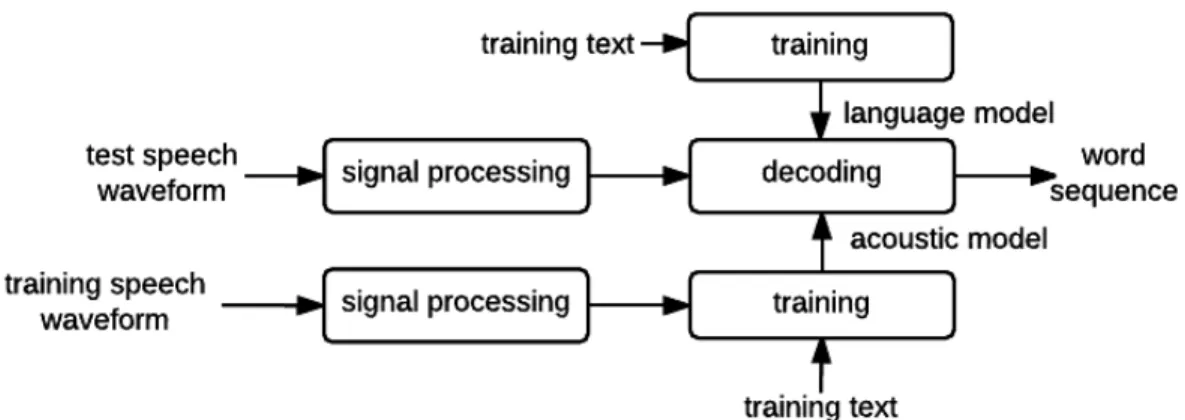
In this chapter, the major components of an automatic speech recognition (ASR)
system shown in Figure 2.1 will be explained. The training speech waveform first
goes through signal processing of some sort, whether MFCCs or WTs. Then, the
following training block takes the output from the signal processing of the training
speech waveform, along with matching transcriptions, to produce acoustic models.
Similarly, training text is fed into its training block to produce language models.
Finally, the test speech waveform goes through the same signal processing and gets fed
into the decoding block. The decoding block then takes these three inputs (acoustic
model, language model, and the output from the signal processing of the test speech
waveform) and produces hypothesized word sequences for the input waveforms.
2.1
Signal Processing
The signal processing, or feature extraction, portion of an ASR system takes the
speech and splits it into many utterances, typically during silence, or in the case
of multiple speakers, during speaker changes. Utterances can have different lengths
depending on duration, but are analogous to sentences. Utterances contain one or
more words, which are built with phones (the smallest labeled unit of sound). An
Figure 2.1: A Typical ASR System
example utterance is “Cats are awesome”. A sequence of vectors which represent
the acoustic characteristics of phones from each utterance can be generated using
feature extraction methods such as Mel-frequency cepstral coefficients (MFCCs) and
the wavelet transform (WT). Filter banks are typically used in both MFCC and WT
method implementations. A filter bank refers to a series of filters that takes an input
and separates it into multiple components based on frequency. A single frequency
sub-band of the original signal is carried by each filter. The MFCC method applies
fixed-duration time windowing and the Mel filter bank to obtain associated time
information from the windowing and frequency information that differentiates phones.
The WT method, on the other hand, provides varying time-frequency resolutions at
different decomposition levels. Sub-band coding describes the basic behaviors of the
decomposition using a pair of filter banks, created from a low pass filter and a high
Figure 2.2: The MFCC Method
2.1.1
Mel-frequency Cepstral Coefficients (MFCCs)
The MFCC method consists of several sub-processes shown in Figure 2.2. The first
sub-process is called pre-emphasis and is responsible for increasing the energy levels
in the high frequencies. Since more energy can be found at the low frequencies than
at the higher frequencies, having more detail in the high frequencies can improve
speech signal processing. The reason more energy is in the low frequencies is due to
the glottal pulse used to generate human speech. This energy drop between high and
low frequencies is called spectral tilt [9].
The second sub-process is called windowing. Small windows of approximately 20
to 25ms are applied to an utterance signal with a 10ms frame shift rate to simulate
piece-wise stationarity of the utterance signal when it is considered non-stationary
because of the changing sounds. Phones are generally a minimum of three windows
long so piece-wise stationarity holds for the windows. The feature extraction process
is applied to obtain coefficients for each time window. The coefficients will have
higher time resolutions if the window size is small and have lower time resolutions if
used in the MFCC method, where w[n] = 0.53−0.46 cos(2Lπn), if 0≤n≤L−1 0, else.
The third sub-process is called the discrete Fourier transform (DFT), which
en-ables representations of a signal or the windowed utterance signal in the frequency
domain. The DFT is defined as
N−1
X
n=0
x[n]e−j2πknN .
A fast Fourier transform (FFT) algorithm is typically used to implement the DFT.
The FFT reduces the complexity of computing the DFT from O(n2) to O(nlog(n)),
where n is the data size.
The next sub-processes are the mel filter bank and application of the logarithm.
The mel scale separates or compresses frequencies into bands that are perceived as
equal by listeners. Since human hearing is more sensitive below roughly 1kHz,
in-corporating this into the mel scale improves speech signal processing. The mel scale
is linear below 1kHz but logarithmic above 1kHz. Implementation of this can be
achieved by using a bank of filters collecting each frequency band. One
implementa-tion has the first 10 filters spaced linearly below 1kHz and then addiimplementa-tional filters are
spaced logarithmically above 1kHz. The mel frequency can be obtained by
mel(f) = 1127 ln(1 + f 700)
wheref is the raw acoustic frequency. Taking the log of the output separates the vocal
excitation from the vocal tract information and it may help address power variations
The next sub-process is the inverse discrete Fourier transform (DFT−1). The in-verse DFT enables representations of a signal or the windowed utterance signal in
the time domain. So this overall process can be defined as the inverse DFT of the log
magnitude of the DFT of the signal:
c[n] = N−1 X n=0 log(| N−1 X n=0 x[n]e−j2πknN |)ej 2πkn N
where c[n] is a cepstral vector and x[n] is the windowed signal.
The final sub-process is delta and energy computation. The energy computation
is literally obtaining the energy of the framed signal:
Energy =
t2
X
t=t1 x2[n]
wheret1andt2 are frame starting and end points. The delta coefficients are computed
by taking the difference between nearby frames for each element of the cepstral vector
d[n] = c[n+ 1]−c[n−1] 2
where d[n] is the delta value and c[n] is the cepstrum. Typically a delta order of two
is used. The first delta computation represents the rate of change and the second
delta computation represents a rate of change of the first rate of change.
The results of this process are cepstral coefficients with deltas which can be used
as inputs to an ASR system. The cepstral coefficients represent information solely
about the vocal tract filter, cleanly separated from information about the glottal
source. Signal processing and recognition performance using MFCCs is fairly good
[4, 10], primarily because the process has been used and tuned by many people to
2.1.2
Wavelet Transform (WT)
Wavelet transforms were motivated by the shortcomings of the Fourier transform.
When the FT represents a signal in the frequency domain, it can not tell where those
frequency components are present in time. Cutting the signal at a certain moment
in time (windowing) and transforming that into the frequency domain to obtain a
relevant time sequence of frequency information is equivalent to convolving the signal
and the cutting window, resulting in possible smearing of frequency components along
the frequency axis [11, 12]. Wavelet transforms address this by using small waves of
integral 1 with a finite duration and represented by
γ(s, τ) =
Z
f(t)ψ∗s,τ(t)dt (2.1.1) wheref(t), the signal to be represented, gets decomposed into a set of basis functions
ψs,τ(t) called the mother wavelet
ψs,τ(t) = 1 √ sψ( t−τ s )
with scale parameter sand shift parameterτ. t−sτ from the mother wavelet definition determines different scaled and shifted versions of the wavelet. ψs,τ(t) can be selected
from a range of wavelet types. Since the mother wavelet can be either real-valued or
complex-valued, the conjugate term is added to compensate the inversion of imaginary
parts after transforming [13], and this is shown in Equation 2.1.1. Obtaining the
correlation between the the signal f(t) and the scaled and shifted versions of the
mother wavelet results in wavelet coefficients.
However, in practice there are problems with wavelet transforms. First, since
scalable function over a signal, it produces a lot of redundancy. Second, by definition
the WT needs an infinite number of wavelets for covering all frequency bands. Third,
the WT generally has no analytical solutions for most functions, but instead can only
be solved with numerical computation requiring some sort of fast algorithm. A
piece-wise continuous version of the function called the discrete mother wavelet therefore
should be considered: ψj,k(t) = 1 q sj0 ψ(t−ks j 0 sj0 )
where j and k are integers and s0 > 1 represents fixed integer scale steps. This
discretized wavelet can now be sampled at discrete intervals. In order for the Nyquist
rate to hold true for any given frequency of the signal, dyadic sampling is typically
chosen as an optimal sampling pattern. A sampling pattern is dyadic if the mother
wavelet is shifted by k2j and scaled by 2j. Therefore, the value of s
0 is usually 2.
The discrete wavelet transform (DWT) can be thought of as a special case of the WT
with wavelets scaled and shifted by factors of powers of 2. The DWT coefficients can
then be obtained from
γ(s, τ) = Z f(t)√1 2sψ( t−τ2s 2s )dt
where the mother wavelet is
ψs,τ(t) = 1 √ 2sψ( t−τ2s 2s ).
Even though the wavelet can be sampled at discrete intervals with the discretized
wavelets, an infinite number of scales and shifts are still required. The way to solve
ϕ(t),introduced by Mallat [7]
ϕ(t) =X
j,k
γ(j, k)ψj,k(t),
which covers the remaining wavelet spectra of the signal.
In order to use these equations, there are two conditions that should be met:
admissibility and regularity. The admissibilitycondition is defined as
Z |ψ(w)|2
|w| dw <+∞
where ψ(w) is the FT of ψ(t). The equation means that ψ(t) vanishes at the zero
frequency producing a band-pass-like spectrum
|ψ(w)|2 |
w=0 = 0↔
Z
ψ(t)dt= 0
where the average value of the wavelet in the time domain is zero.
The second condition is regularity [14]. Notice in Equation 2.1.1 that the WT of
a one-dimensional function,f(t),becomes a two-dimensional function,γ(s, τ),a
two-dimensional function, f(t1, t2), becomes a four-dimensional function, γ(s1, s2, τ1, τ2),
and so on. The time-bandwidth of the wavelet transform product is the square of
the original signal, which causes problems in most WT applications. This undesired
property motivates regularity: to decrease the value of wavelet transforms with a
factor s.
Implementing the WTs requires using a filter bank. The scaling function behaves
like a low pass filter and covers the remaining spectrum of the wavelets by reducing
an infinite set of wavelets into a finite set of wavelets. Taking as a given that Fourier
theory says compression in time is equivalent to stretching the spectrum in the
spectrum of the wavelet by a factor of two. This means the finite spectrum of the
signal can be described with the spectra of scaled wavelets. Therefore, a series of
scaled wavelets and a scaling function can be seen as a filter bank.
Implementing such a filter bank can be described by sub-band coding. One way to
apply this is to build a number of bandpass filters with different ranges of bands. This
could take a long time because all individual filters need to be specifically designed.
Another way to implement this is to have a low pass filter (LPF) and a high pass
filter (HPF). By iteratively applying the pair of filters on the outputs of each low
pass filter, a desired number of bands can be obtained. Down-sampling is applied
after each filtering in order to keep the output of a discrete WT the same size as the
original signal. The advantage of this building method is the simplicity of designing
filters as only two filters are needed, a low pass and a high pass.
This method requires a special technique called the lifting scheme [17], where the
LPF and HPF pair can be achieved by taking the average and difference between
polyphase representation of even and odd components of the original signal. The
Z-transforms of the polyphase components are used to take the average and difference
between the even and odd polyphase components. Since the LPF and HPF are
achieved by taking the average and difference respectively, the outputs are called
approximation coefficients when taking the average and detail coefficients when taking
the difference. There is another more intuitive way to describe why the coefficients are
called the approximation and detail coefficients. The low frequency signal has a longer
period than the high frequency signal and thus represents a close approximation of the
original signal. However, the high frequency signal represents detailed information
The resulting coefficients from each sub-band represent correlations between the
original signal and a wavelet that is shifted and scaled by some factor of τ and s. τ
and s change as they go through a series of filters. Convolving the signal and the
filters results in wavelet coefficients. Since the τ and s factors are not constant, the
coefficients from each band have different (varying) time-frequency resolutions, unlike
MFCCs.
The wavelet type (shape) can also further characterize the acoustic features and
an optimum type for a given context can be found experimentally. There are four
different wavelet shapes with different scales that are likely to be useful for ASR
applications. Figures 2.3, 2.4, 2.5, and 2.6 show sample wavelets from the symlet
(sym), Coiflet (coif), Daubechies (db), and biorthogonal (bior) families. Different
wavelet scales correspond to different time-frequency resolutions. The larger wavelet
scales (narrower wavelet width) give better the time resolution. Similarly smaller
wavelet scales (wider wavelet width) give better the frequency resolution.
Wavelet types can be described by orthogonality, symmetry, vanishing moment
condition, and compact support. Wavelets are orthogonal if the inner products of
a mother wavelet and its shifted and scaled version of wavelet are zero, which
en-ables decomposing a signal into non-overlapping sub-frequency bands [19]. In Figure
2.6, wavelet pairs are used for decomposition (left) and reconstruction (right)
be-cause biorthogonal wavelets require two scaling functions for a relaxed orthogonal or
biorthogonal condition [16]. The symmetry property of a wavelet ensures that the
mother wavelet can serve as a linear phase filter; lacking this property can cause
phase distortion [19]. The moment vanishing condition is defined by the number of
Figure 2.3: Symlet Wavelet Family with Scales of 2, 3, 4, and 5 [18]
Figure 2.4: Coiflet Wavelet Family with Scales of 1, 2, 3, 4, and 5 [18]
series of order n γ(s, τ) = √1 s[f(τ)M0s+ f(1)(τ) 1! M1s 2 + f (2)(τ) 2! M2s 3 +...+f (n)(τ) n! Mns n+1 ] (2.1.2)
where f(p) is pth derivative of f and Mp is a wavelet moment defined as
Mp =
Z
tpψ(t)dt.
A wavelet has N vanishing moments if N number of Mp terms go to zero in
Equa-tion 2.1.2 [12]. The more vanishing moments a wavelet has, the better the scaling
function can represent complex functions. Equivalently, the higher the number of
zero moments, the higher the number of zero derivatives and the smoother the signal
decays from the center frequency to the zero frequency in the frequency domain [20].
The db wavelet has N vanishing moments, the bior wavelet has N −1 vanishing
moments, the coif wavelet has 2N vanishing moments, and the sym wavelet has N
Figure 2.5: Daubechies Wavelet Family with Scales of 2, 3, 4, 5, 6, 7, 8, 9, and 10 [18]
Figure 2.6: Biorthogonal Wavelet Family with Scales of 1.3, 1.5, 2.2, 2.4, 2.6, 2.8, 3.1,
3.3, 3.5, 3.7, 3.9, 4.4, 5.5, and 6.8 [18]. Two wavelets are shown for each bior wavelet.
The wavelet on the left is used for decomposition and the wavelet on the right is used
compactly supported, their duration is finite and non-zero, which provides good
lo-calization of time and frequency [21]. These different wavelet shapes can be useful for
distinctly localized signals, like spikes or bursts [22] and identifying the symmetry and
orientation of the signal [23]. Wavelets that can provide better frequency localization
(db and coif wavelets), linear phase characteristic (bior wavelet), and orientation (sym
wavelet) could be beneficial for speech processing.
Types of wavelet transforms include the stationary wavelet transform (SWT) and
wavelet packet transforms (WPT). The stationary wavelet transform solves the lack of
time invariance by not taking down-samples from each decomposition step. However,
this requires more memory space and computation time than the discrete wavelet
transform. The wavelet packet transform applies decomposition through both a low
pass filter that outputs approximation coefficients and a high pass filter that outputs
detail coefficients. This can provide more information because of the additional detail
coefficients but again requires more memory space and computation time on the order
of 2N whereN is the decomposition level.
The results of wavelet transforms are coefficients that can be used as inputs to an
ASR system by, for instance, calculating the normalized energy in each sub-band:
Wavelet Sub-band Normalized Energy =
t2
X
t=t1 x2[n] t2−t1
where t1 and t2 are are sub-band start and end points. WT coefficients have been
used in pitch detection and formant tracking [24], and phone classification [25], which
shows potential for wavelet transform usefulness in the realm of speech processing.
Equivalent rectangular bandwidth (ERB) scaling has also been implemented using
mel scaling in speech processing or not [26, 27]. None of these studies made direct
numerical comparisons with MFCCs. Combining the wavelet transform with already
existing feature extraction methods such as linear predictive coding [28] and MFCCs
[29] showed improvements by 0.6% when using clean data and by 6% when using data
with additive white Gaussian noise at different signal to noise ratio (SNR) levels. This
suggests that recognition performance could improve when combining the MFCC and
WT methods.
2.1.3
Time and Frequency Resolutions of the WT
Fourier transform based feature extraction methods use fixed-duration time
window-ing and therefore provide constant resolutions over the time-frequency axes unless
additional frequency scaling processes are applied. If a signal has time and
fre-quency content evenly spread out along the axes, this is reasonable. However in
practice, speech signals have lower frequencies that are usually longer in time and
higher frequencies that are usually shorter. This property of unevenly spaced time
and frequency content is typical for most non-stationary signals [30]. The MFCC
method has separate steps such as windowing and mel-scaling in order to
compen-sate. The WT method, on the other hand, is designed to represent energies at high
frequencies with good time resolution and give energies at low frequencies with good
frequency resolution. Consider Figure 2.7, which shows the time-frequency
resolu-tions for a short time Fourier transform and a discrete WT. It can be seen that at
high frequency, the time window is narrower for the WT, which corresponds to good
corre-Figure 2.7: Resolution Grids of the Short Time Fourier Transform and the Wavelet
Transform [31]
sponds to good frequency resolution. Wavelet transforms have the potential to better
describe speech signals. However, MFCCs have been used for ASR for decades and
systems have been finely tuned to work with them.
2.1.4
Wavelet Software Libraries
There are multiple wavelet libraries written in different languages such as Blitzwave
C++ Wavelet Library [32], the University of Washington Wavelet Library [33], and
The Imager Wavelet Library [34]. Some are available as binaries and some as open
source tools. The “C++ Wavelet Libraries” package [35] was chosen, because the
recognition system used is also written in C++ (see Section 2.5 for more
informa-tion). This library provides discrete and stationary wavelet transforms with code
for the four wavelet families of Daubechies, biorthogonol, Coiflet, and symlet. Other
transform functions in libraries usually take five input arguments: an input signal
vector, decomposition levels, wavelet type and its scale, lengths of respective
approx-imation and detail vectors to the decomposition level, and an output signal vector.
The output signal vector contains the wavelet transform coefficients. The coefficients
from the output signal vector can be used as acoustic feature vectors in an ASR
system.
2.2
Training an Acoustic Model
An acoustic model describes the likelihoods of the observed spectral feature vectors
given linguistic units (words, phones, or sub-parts of phones). A commonly used
statistical model for this is the hidden Markov model (HMM) [36]. Figure 2.8 shows a
3-state HMM including the special start and the end states, whereaij is the transition
probability matrix from state i to j, and bi is a set of observation likelihoods, which
are typically represented by mixtures of Gaussian models.
Figure 2.8: 3-State HMM
word “translate” is made of the following eight phones “T R AE N Z L EY T”. There
are two ways these phones can be modeled, as monophone or context-independent
models, and as triphone or context-dependent models. Monophone models ignore the
surrounding context so there would be seven models representing T, R, AE, N, Z,
L, and EY. Triphone models include the left and right context of the neighboring
phones: T+R, T-R+AE, R-AE+N, AE-N+Z, N-Z+L, Z-L+EY, L-EY+T, and
EY-T. Monophone models would have a single model for each phone, typically 41. In the
case of triphones, there could be up to 413 individual models, but in practice, this is
reduced because not all triphones appear in English and some may be acoustically
similar to others. Training triphone models requires significantly more training data.
2.2.1
Gaussian Mixture Model
A Gaussian mixture model (GMM) is often used to represent the observation
likeli-hoods ([37] p.425-p.435). The Guassian, or normal, distribution is a function with
two parameters, mean and variance. The Gaussian function can be written as
f(x|µ, σ) = √ 1
2πσ2 exp(−
(x−µ)2 2σ2 ).
For a discrete random variableX, the mean,µ,and the variance,σ2,can be computed
using µ=E(X) = N X i=1 p(Xi)Xi σ2 =E(Xi−E(X))2 = N X i=1 p(Xi)(Xi−E(X))2
where p(Xi) is the probability mass function. The mean is the weighted sum over
mean.
If the possible values of a dimension of an observation feature vector ot can be
assumed to be normally distributed, the univariate Gaussian probability density
func-tion can represent the output probability of an HMM state j determining the value
of a single dimension of the feature vector. The observation likelihood function bj(ot)
can be then expressed with one dimension of the acoustic vector as a Gaussian and
written as bj(ot) = 1 √ 2πσ2 exp(− (ot−µj)2 2σ2 j ).
For each HMM state j, the Gaussian parameters of the mean and the variance can
be computed by taking the average of the values for each ot and taking the sum of
the squared difference between each observation and the mean respectively.
Since multiple dimensions are typically used, for instance 13 dimensions for MFCCs
(12 + 1 energy coefficient) and at least 9 dimensions for WT coefficients (8 + 1
en-ergy coefficient), multivariate Gaussians are used to estimate the probabilities of the
HMM states. The variance of each dimension and the covariance between any two
dimensions can be described by the covariance matrix Σ where X and Y are two
random variables Σ = E((X−E(X))(Y −E(Y))) = N X i=1 p(XiYi)(Xi −E(X))(Yi−E(Y)).
Then a mean vector with a dimensionality matching the input dimension and the
covariance matrix can define a multivariate Gaussian
f(~x|~µ,Σ) = 1 (2π)D2|Σ| 1 2 exp(−1 2(x−µ) TΣ−1(x−µ)), (2.2.1)
where~x and~µare vector notations and Dis the dimensionality of ~µ. When different
feature dimension is equivalent to a diagonal covariance matrix, where only the
diag-onal of the matrix has non-zero elements. A non-diagdiag-onal covariance matrix models
the correlations between the feature values in multiple dimensions. A Gaussian with
a full covariance is therefore a better model of acoustic likelihood. However, diagonal
covariances are often used because the full covariance has high implementation
com-plexity and requires more training data with more parameters. The estimation of the
observation likelihood of a D-dimensional feature vector ot given HMM state j using
a diagonal covariance matrix can be written as
bj(ot) = D Y d=1 1 q 2πσ2 jd exp(−1 2 (otd−µjd)2 σ2 jd ),
which is simplified from Equation 2.2.1 keeping the mean and the variance for each
dimension.
However, each dimension of feature vector may not be a normal distribution.
Mod-eling the observation likelihood with a weighted mixture of multivariate Gaussians
should be considered. Based on Equation 2.2.1, this modeling is called a Gaussian
mixture model where
f(x|µ,Σ) = M X k=1 ckfk(x|µ,Σ) f(x|µ,Σ) = M X k=1 ck 1 p 2π|Σk| exp((x−µk)TΣ−1(x−µk))
and where M is the number of Gaussians summed together and ck is the mixture
weight for each Gaussian. The output observation likelihood is
bj(ot) = M X k=1 cjk 1 p 2π|Σjk| exp((x−µjk)TΣjk−1(ot−µjk)).
This likelihood is used for individual output observation in the acoustic model
2.2.2
Hidden Markov Model
A classical approach to modeling acoustic information is the hidden Markov model
(HMM). The Markov assumption is used to describe the HMM, allowing a particular
state to depend on a certain number of previous states instead of all past states. This
reduces the number of hidden states of the HMM that are included in the model.
Obtaining the likelihood of a particular observation sequence P(U|λ) given an
HMM model λ = (A, B) and an observation sequence U can be done by using the
forward algorithm with the efficiency of O(N2T) where N is the number of hidden
states andT is the number of observations from an observation sequence. The forward
algorithm finds the probability of the observation sequence by using a table that saves
intermediate values and summing over the probabilities of all possible hidden state
paths that get implicitly folded into a single forward trellis [38]:
αt(j) = N
X
i=0
αt−1(i)aijbj(ut)
where αt−1(i) is the previous (t−1) time step forward path probability, aij is the
transition probability, andbj(ut) is the state observation likelihood of the observation
symbol ot given the current statej. This is equivalent to obtaining the probability of
being in state j after getting the firstt observations given the HMMλ.
Finding the best hidden sequence Q given an observation sequence U and an
HMM model λ= (A, B) can be done by using the Viterbi algorithm with a dynamic
programming trellis [39]:
vt(j) = N
max
i=1 vt−1(i)aijbj(ut)
wherevt−1(i) is the previous Viterbi path probability,aij is the transition probability,
probable sequence of states Q = q1, q2...qT given an HMM state and a sequence of
observations U =u1, u2...un.
Training the HMM parameters AandB given an observation sequenceU and the
set of states in the HMM, where A denotes the transition probability and B denotes
the emission probability, can be done by using the Baum-Welch algorithm [40]. This
algorithm makes uses of the backward probability
βt(i) =P(ut+1, ut+2, ...uT|qt=i, λ)
where it views the partial observations from Ut+1 to the end given that the HMM is
in stateiat time t and the HMM modelλ. This algorithm is based on two intuitions.
The first intuition is to improve the estimate by computing iteratively. The second
intuition is to get estimated probabilities by computing the forward probability for
an observation and dividing that probability mass among all the different paths that
contributed to this forward probability.
In automatic speech recognition, the acoustic model refers to statistical
represen-tations for observed feature vector sequences. This is combined with the language
model to perform word transcription.
2.3
Training a Language Model
A language model describes the probability of a word sequence. A large amount of
transcribed or written sentences may be used to create statistical language models.
The probability of a sentence or a sequence of words is
where P(W) is the probability of an entire n word sequence and P(wi) is the
prob-ability of each word, wi. The joint probability of a sentence or a sequence of words
can be computed using the chain rule of probability. The chain rule of probability
produces the product rule by rearranging the conditional probability equations
P(A, B) =P(A|B)P(B).
By applying the chain rule to a word sequence, extending the conditional probabilities
on words, the probability of the entire sequence of words can be written as
P(wn1) =P(w1)P(w2|w1)P(w3|w21)...P(wn|w1n−1) = n Y k=1 P(wk|w1k−1) (2.3.1) wherewn
1 =w1...wn is a sequence of words. Modeling such statistical word sequences
results in language models.
In practice, storing the entire word sequence is almost impossible due to memory
constraints. In order to solve this, reasonable shortened sequences, N-grams, are
modeled [41]. N-grams allow the prediction of a next word from the previous (N−1)
words. Bi-grams (N = 2), tri-grams (N = 3), and 4-grams (N = 4) are typically used
in the word prediction. The Markov assumption allows depending on only a word’s
recent history rather than looking at the complete history. An N-gram model is a
(N −1) order Markov model. Applying the assumption, the conditional probability
of the next word in a sequence can be written as
P(wn|w1n−1)≈P(wn|wnn−−1N+1).
Substituting the bi-gram into Equation 2.3.1, the probability of a complete word
sequence can be written as
P(wn1)≈
n
Y
k=1
Estimating the N-gram probabilities can be done by maximum likelihood
estima-tion (MLE) [42]. The generalized N-gram parameter estimaestima-tion can be calculated
using
P(wn|wnn−−N1+1) =
C(wnn−−1N+1, wn)
C(wnn−−N1+1) ,
whereC is count of the word or word sequence. The numerator represents the count
of the observed word given N −1 preceding words. The denominator represents the
count of the N−1 word sequence. This is also called a relative frequency.
There are some special cases where this LM can be replaced. When all the possible
word-to-word transitions are known, a finite state grammar can be used. For instance,
small corpora such as digits are comprised of sequences of digits from zero to nine.
In that case, since the input words are limited to that range, a finite state grammar
can replace the LM.
The decoding process takes the acoustic and language models, a dictionary
map-ping words to phone strings, and an input speech waveform to produce a matching
word sequence, which is discussed next.
2.4
Decoding
The goal of decoding is to obtain the string of words with the highest posterior
probability given the training data represented by the acoustic and language model
and contained by a dictionary representing the vocabulary. The highest value from
can be assumed ([37] p.1). Such value can be obtained from
W = arg max
W
P(O|W)P(W)
where P(O|W) is the likelihood or the model of the noisy channel producing any
random observation, P(W) is the hidden prior term, and W stands for the entire
string of words.
Since the acoustic model produces the likelihood of a particular acoustic
observa-tion or a frame given a particular state or a sub-phone, multiplying such probabilities
together from each frame to get the probability of the whole word introduces a drastic
range difference between the two probabilitiesP(O|W) andP(W). A language model
scaling factor (LMSF) is used to better scale the probabilities. When the acoustic
model has more influence than the language model, longer words are more likely to
be recognized as a sequence of short words, even if that sequence is not likely
ac-cording to the language model. In order to compensate for this, a word insertion
penalty (WIP) is used. Increasing the penalty keeps the decoding processing from
including additional words in the output, which can reduce the number of insertion
errors. Since calculations are done in logarithms in order to avoid underflow errors in
computing, the highest value from the two probabilities can be written as
W = arg max
W
(logP(O|W)P(W) +LM SFlogP(W) +NlogW IP),
2.5
Speech Recognition Virtual Kitchen
The Speech Recognition Virtual Kitchen (SRVK), available at www.speechkitchen.org,
is a project that “aims to extend the model of lab-internal knowledge transfer to
community-wide dissemination via immediate, straightforward access to the tools
and techniques used by advanced researchers” [43]. In order to use most speech
recognition systems, a lot of programming tasks and experiment setups are required.
The SRVK solves this through the use of virtual machines with scripts, data, and
pre-compiled code as shown in Figure 2.9.
Figure 2.9: Architecture Diagram of the SRVK [44]
A virtual machine (VM) is a tool where users can load an operating system (OS)
of their choice on top of their running OS. Open source resources such as Debian
Linux derivatives for a base OS and pre-installed open source, C++ speech
recognizer includes features such as integration with finite state transducers, linear
algebra support, open source software (http://kaldi.sourceforge.net), and databases
from the Linguistic Data Consortium. Four layers of components shown in
Fig-ure 2.10 define the Kaldi recognizer structFig-ure. All layers can be modified to expand
the recognition system. Other VMs may vary in data sets, test challenges,
recogni-Figure 2.10: The Kaldi Recognizer Overview [45]
tion system, or task. For complex systems, VMs enable infrastructure for meeting
numerous challenges in ASR research and education by providing repositories that
facilitate exchanges among ASR community members [44].
The work of this thesis is based on SRVK VMs. The processes of learning an ASR
system, implementing sub-processes of the system, and conducting experiments using
the VM are all done using and modifying VMs from the SRVK. Because this is an
open source project, the extensions developed in this work will be made available as
2.6
Summary
A standard ASR system was introduced in this chapter. Since this work focuses
on the signal processing components, two feature extraction methods, MFCCs and
WTs, were presented, with MFCCs being the baseline standard and WTs providing
a different approach to time-frequency resolution. Finally, the SRVK virtual machine
framework used in experiments was discussed. The first research question is addressed
by successfully implementing a wavelet module based on an open source library into
an SRVK VM. Conducting different experiments with MFCCs and WTs will address
Data
ASR systems require a large amount of data for training and testing a system. The
process of creating a data corpus includes recording and transcribing speech. Further
processing can be done to cut waveforms into smaller segments, label data at the
sub-word, or phone level, as well as sentence level, and add different types of noise to the
data. Three datasets, or corpora, are used in this work: TI-Digits (small vocabulary)
[46], TED-LIUM (large vocabulary) [47], and Noizeus (noisy data) [48].
3.1
TI-Digits
The TI-Digits corpus contains speech collected by Texas Instruments to design and
evaluate algorithms for speaker-independent recognition of digit sequences [46].
Be-cause it was collected in 1982, it has been used in many systems (e.g., [49, 50]). Digit
sequences were read into a high quality, close-talking microphone. 326 speakers are
included in the data (111 men, 114 women, 50 boys, and 51 girls). Each speaker
pro-nounced 77 digit sequences, with a total of more than 25,000 digit sequences. There
is 4 hours of data, sampled at 20kHz. The data has been partitioned into a test set of
12,551 words and a training set of 12,551 words. The vocabulary is small, comprised
of the ten digits, with two pronunciations of 0, “oh” and “zero”. Example strings are
“7 3 8 7 oh” and “3 8 zero zero”. Because of the small vocabulary size, 21 phones
are sufficient to describe the sounds used in TI-Digits.
3.2
TED-LIUM
The LIUM corpus [47] contains speech collected from TED talks [51].
TED-LIUM speech is planned and delivered in a formal presentation to a large audience.
685 speakers are included in the 122 hours of speech (85 hours of male speech and 37
hours of female speech). The data has been partitioned into a test set of 28,000 words
and a training set of 2,560,000 words. This data is sampled at 16kHz. The vocabulary
is large, comprised of 156,700 number of words. The corpus includes labels for show
names, channels, speaker IDs, start and end times, genre identifications, silences,
fillers, and pronunciation variants. An example sentence is “What I’m going to tell
you about in my eighteen minutes is how we’re about to switch from reading the
genetic code to the first stages of beginning to write the code ourselves.” The
TED-LIUM dictionary used in this work describes word pronunciations in terms of 41
unique phones.
3.3
Noizeus
The Noizeus corpus contains speech collected by the University of Texas at Dallas
[48]. Six speakers (3 adult male and 3 adult female) each recorded 5 sentences. The
data consists of a test set of 241 words. The vocabulary size is small, comprised of 167
hyper-articulate. Example sentences are “A good book informs of what we ought to
know.” and “The lazy cow lay in the cool grass.” Eight different noisy conditions,
airport, babble, car, exhibition, restaurant, street, and train noises, were added to
each utterance at 0dB, 5dB, 10dB, and 15dB SNRs. Sentences were originally sampled
at 25kHz but were down-sampled at 8kHz by the corpus creators. Because the Noizeus
corpus does not have enough data to train either acoustic or language models, it is
Methodology
Three research questions were posed in Chapter 1:
1. Can a wavelet transform signal processing module be added to an existing ASR
system?
2. Can WT features match the performance of MFCCs?
3. Are there benefits to combining the MFCC and WT methods?
This chapter shows how the questions are answered given the background from
Chap-ter 2 and using the data described in ChapChap-ter 3. First, the ASR virtual machine
context is presented. Then the WT features and the combined features from the two
methods are shown. Finally, the performance metrics used to compare approaches
are presented.
4.1
The ASR Context
In a typical ASR system, the test speech waveform and the training speech waveform
go through signal processing that produces the MFCCs. In this work, the signal
pro-cessing extends to include WTs and combinations of WTs and MFCCs as shown in
Figure 4.1. In order to implement this, “C++ Wavelet Libraries” (version 0.4.0.0)
Figure 4.1: An ASR System with Multiple Options for Signal Processing
[35] was added to the Kaldi recognizer (version 1.0) [45] on an SRVK VM. Figure 4.2
is an updated version of Figure 2.10 showing where the C++ Wavelet Libraries and
new functions were added to the system. All layers needed modification except for the
external library component in experiments presented in this work. Since the Kaldi
Figure 4.2: The Kaldi Recognizer Overview [45]
have to be converted into the base C++ variable types when interfacing with the
wavelet libraries in “featbin”. Options for feature extraction such as the number of
features and time window duration were changed in header files from “feat” in order to
match the baseline experiments of this work. In shell scripts, to run experiments,
op-tions such as whether the input will go through cepstral mean variance normalization
or not were changed since MFCCs use this option by default but the WT features do
not. These options can be changed in different header files. Appendix A.1 describes
where these header files are located and how these options can be changed.
4.2
Wavelet Transform Features
Three different types of wavelet transforms were used to extract acoustic features
and compare to MFCCs. For each WT, maximum energy values from each
decom-position level are taken as features with varying time window durations. Varying
time-frequency resolution is provided for by the varying window whereas the MFCC
method typically uses a fixed 25ms window. There was a limitation with this
ap-proach, because the Kaldi recognizer checks intermediate values in ways that they
are finely tuned for MFCCs. This made it difficult to adjust the process to use
appro-priate values for the wavelet features. For instance, the duration of the frame window
can only go up to 50ms, otherwise the process was terminated for having bad values.
This negates the benefit of varying resolutions, one of the advantages the WT has
4.2.1
Discrete Wavelet Transform
The discrete wavelet transform (DWT) decomposes a signal using a set of low and
high pass filters followed by down-sampling that outputs approximation and detail
coefficients respectively. By definition, the decomposition takes place on only low
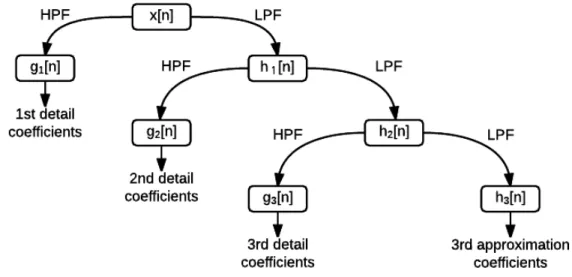
pass filters. Figure 4.3 shows an example three level decomposition where g[n] is
the output of the high pass filter and h[n] is the output of the low pass filter. If a
16kHz sampled signal with 10,000 sample points is assumed, the first detail coefficients
have the frequency band range from 8kHz to 16kHz with 5,000 sample points, the
second detail coefficients have the frequency band range from 4kHz to 8kHz with
2,500 sample points, the third detail coefficients have the frequency band range 2kHz
to 4kHz with 1,250 sample points, and the third approximation coefficients have the
frequency band range from 0Hz to 2kHz with 1,250 sample points. Changing the
duration of the window has trade-offs: the longer the duration of window, the better
the frequency resolutions and the shorter the duration of window, the better the
time resolutions. The maximum energies from each decomposition level with a 50ms
window and a 25ms frame rate are taken as input features to the ASR system using
Figure 4.3: Three Level Discrete Wavelet Transform Decomposition
4.2.2
Stationary Wavelet Transform
The stationary wavelet transform (SWT) also decomposes a signal into a set of low
and high pass filters but without down-sampling. Figure 4.4 shows a three level
decomposition as an example. Omitting the down-sampling processes ensures that
the output size from each decomposition is the same as the original signal. This
solves the lack of time-invariance with respect to the DWT but brings redundancy.
This trade-off needs to be considered when the stationary WT is used, as the output
10,000 sample points is assumed, the frequency band range will be the same as the
previous example, but the number of sample points is different as it keeps the same
10,000 sample points at all decomposition levels. The maximum energies from each
decomposition level with a 50ms window and a 25ms frame rate are taken as input
features to the ASR system using the SWT function. For details, see the SWT source
code in Appendix B.2.
Figure 4.4: Three Level Stationary Wavelet Transform Decomposition
4.2.3
Wavelet Packet Transform
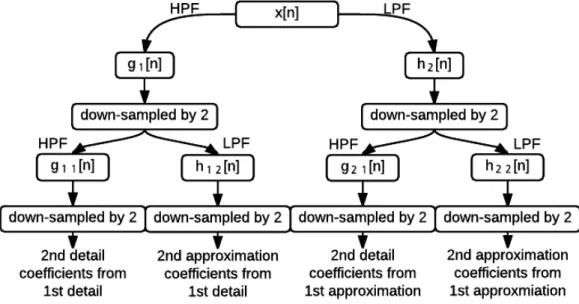
The wavelet packet transform (WPT) is very similar to the DWT but differs in that
it applies decomposition at both the high pass filter and low pass filter. Figure 4.5
shows an example of two level decomposition. The WPT uses more memory space
and computation time than DWT or SWT, but provides more information at all levels
10,000 sample points is assumed, the second detail coefficients from the first detail
coefficients have the frequency band range from 12kHz to 16kHz with 2,500 sample
points, the second approximation coefficients from the first detail coefficients have
the frequency band range from 8kHz to 12kHz with 2,500 sample points, the second
detail coefficients from the first approximation coefficients have the frequency band
range from 4kHz to 8kHz with 2,500 sample points, and the second approximation
coefficients from the first approximation coefficients have the frequency band range
from 0Hz to 4kHz with 2,500 sample points.
The WPT was not originally implemented in the selected wavelet library. Since
the only different between the WPT and the DWT is whether to decompose detail
coefficients from the HPF or not, the WPT was implemented by decomposing the
coefficients from the HPF. Decomposing the coefficients from the HPF required
ad-ditional temporal values, which explains why the WPT uses more memory space and
computation time. Another option for WPT was to extend the SWT in a similar
manner. Extending the SWT to implement the WPT required even more temporal
values, so was not done. The maximum energies from each decomposition level with
a 50ms window and a 25ms frame rate are taken as input features to the ASR system
using the WPT function. Window energies are obtained in the same way for all WT
approaches. For more detail of the WPT source code, see in Appendix B.3.
Implementing these three WTs provides a means to addressing the second research
question, whether using WTs can provide comparable performance to MFCCs in an
ASR system. The DWT provides varying time-frequency resolutions with the use of
a pair of filters and a down-sampler. The SWT also provides varying time-frequency
Figure 4.5: Two Level Wavelet Packet Transform Decomposition
memory space and computation time than the DWT. The WPT provides varying
time-frequency resolutions by decomposing the output of the HPF and providing
more information in the detail coefficients, which also requires more memory space
and computation time than the DWT.
Different wavelet families, Daubechies, biorthogonal, Coiflet, and symlet, were
used to simulate qualities such as frequency localization, linear phase characteristic,
and orientation of speech signals. Orthogonality, symmetry, vanishing moment
con-ditions, and compact support of a wavelet determines which wavelet families better
describe the speech signals. The best family shape for the ASR tasks examined here
4.3
Combined Features from the Two Methods
Two ways of combining the two feature extraction methods are considered in orderto address the third research question. The first is adding wavelet features to the
MFCC feature vector. Since the wavelet feature vector contains different information
about the speech signal, it can be appended to the MFCC vector. However, the same
limitation discussed in the previous section should be considered: how the duration
of the window is limited by the ASR system to 50ms. The second approach is using
the WT as a pre-processing step to address noise before MFCC processing. For each
experiment, different wavelet families and scales can be applied as desired. Since that
produces so many possible combinations, three wavelets with different scales from
different wavelet families were used to address noise before the MFCC processing.
4.3.1
Wavelet Sub-band Energy
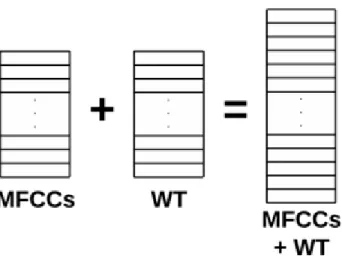
The first way to combine features is to add wavelet features to the MFCC feature
vectors as shown in Figure 4.6. Since the wavelet coefficients have different
time-frequency resolutions than MFCC’s mel-scaled resolutions, the wavelet coefficient
energies contain different information about the speech signal. Wavelet shapes can
also make a difference in the energy level from different time-frequency resolutions
provided by wavelet shapes. Another option to this approach is to replace MFCC
feature with WT features. The number of feature added or replaced can vary as
desired. For details about appending and replacing WT features, see the source code
Figure 4.6: Combining Wavelet Features with the MFCC Features
4.3.2
Wavelet Denoising
The second way to combine features is to pre-process the acoustic signal using a
wavelet transform then process the MFCCs as shown in Figure 4.7. The stationary
WT is known to give good denoising performance [52, 53]. Different wavelet shapes
are used to see what types give better denoising performance under different noise
conditions. The speech signal is decomposed into a desired number of sub frequency
bands by taking the stationary WT. The next step is to define an absolute value that
limits or modifies the signal value. This absolute value is called the threshold value.
Applying the threshold value to the noisy signal,d, provides an updated signalδλ(d)
where δλ(d) = 0 if |d| ≤λ, d−λ if d > λ , d+λ if d <−λ ,
and λ is the threshold value, typically the variance of a signal. For every value ofd,
the threshold value is compared and either forces the signal value to zero, subtracts
the threshold value from the signal value, or adds the threshold value to the signal.
Since threshold value parameters such as mean and variance were implemented in the
source code, other thresholding methods, such as hard thresholding, could be used.
Figure 4.8 shows hard and soft thresholding methods. For details about thresholding,
see the source code in Appendix B.5. The last step is taking the inverse stationary
WT to the thresheld signals and recover the signal to compute MFCCs. To test the
denoising performance, recognition experiments are done using the Noizeus corpus.
4.4
Performance Evaluation
Word error rate (WER) is commonly used to evaluate speech recognition systems. It
is based on how much the hypothesized word string differs from the reference
tran-scription. The WER is the number of words substituted, inserted, and deleted in
the hypothesized string divided by the number of words in the reference
transcrip-tion string. The reference and hypothesized strings are dynamically aligned so that
substitutions, insertions, and deletions can be identified. An example alignment is
shown in Figure 4.9. Then using the WER equation
%WER = (S+D+I
N )×100
where S is the number of substituted words, D is the number of deleted words, I is
the number of inserted words, and N is the number of words in the reference string,
the example results in a WER of (8+2+2)/(26)×100% = 46.1%. Other measures for
Figure 4.9: An Example of Aligned Reference and Hypothesized Word Strings from
performance evaluation are computation time and memory usage. A shell script was
used to keep track of the execution time in seconds and the memory usage was seen
using the Linux “top” command and kept in a separate text file.
4.5
Summary
In order to address the research questions, three different types of wavelet
forms were introduced: the discrete wavelet transform, the stationary wavelet
trans-form, and the wavelet packet transform. The DWT and SWT provide varying
time-frequency resolutions, although the SWT avoids the problem of time invariance. The
WPT provides more information through additional detail coefficients. Two different
combining methods were introduced: using wavelet sub-band energy in the MFCC
feature vector and wavelet denoising as a pre-process. Results for these methods are
Results
The first research question has been addressed by creating the signal processing
mod-ule, allowing for three different types of wavelet transforms, DWT, SWT, and WPT
with four different wavelet families: Daubechies, biorthogonal, Coiflet, and symlet.
This chapter presents results that answer the second and third research questions
posed in Chapter 1. The baseline MFCC results with 13 features (+ deltas and delta
deltas features) with the window size of 25ms and frame rate of 10ms are shown in
Table 5.1 for the TI-Digits and TED-LIUM systems. The systems were trained using
matching acoustic data.
Table 5.1: Baseline MFCC Results
WER
TI-Digits 0.48%
TED-LIUM 21.4%
![Figure 2.6: Biorthogonal Wavelet Family with Scales of 1.3, 1.5, 2.2, 2.4, 2.6, 2.8, 3.1, 3.3, 3.5, 3.7, 3.9, 4.4, 5.5, and 6.8 [18]](https://thumb-us.123doks.com/thumbv2/123dok_us/1286066.2672623/29.918.305.665.445.878/figure-biorthogonal-wavelet-family-scales.webp)
![Figure 2.7: Resolution Grids of the Short Time Fourier Transform and the Wavelet Transform [31]](https://thumb-us.123doks.com/thumbv2/123dok_us/1286066.2672623/32.918.248.729.146.433/figure-resolution-grids-short-fourier-transform-wavelet-transform.webp)
![Figure 2.9: Architecture Diagram of the SRVK [44]](https://thumb-us.123doks.com/thumbv2/123dok_us/1286066.2672623/42.918.297.677.509.795/figure-architecture-diagram-of-the-srvk.webp)


![Figure 4.8: Hard Thresholding and Soft Thresholding [54]](https://thumb-us.123doks.com/thumbv2/123dok_us/1286066.2672623/58.918.180.786.739.990/figure-hard-thresholding-and-soft-thresholding.webp)
