
Video Capture based on a Spatio-Temporal Video Graph
Iveel Jargalsaikhan
B.E, M.TechA Dissertation submitted in fulfilment of the requirements for the award of
Doctor of Philosophy (Ph.D.)
to the
Dublin City University
School of Electronic Engineering
Supervisors: Prof. Noel E O’Connor, Dr. Suzanne Little
I hereby certify that this material, which I now submit for assessment on the programme of study leading to the award of Ph.D is entirely my own work, that I have exercised reasonable care to ensure that the work is original, and does not to the best of my knowledge breach any law of copyright, and has not been taken from the work of others save and to the extent that such work has been cited and acknowledged within the text of my work.
Sign: Student ID No.: 12210695
This dissertation represents my research work during my PhD studies. I have been accompanied and mentored by numerous people, and it is now with great pleasure I acknowledge their support.
I sincerely thank my supervisor, Prof. Noel E. O’Connor. He has supported me continuously during my PhD studies and has afforded me with patience and knowledge. In addition, I would like to acknowledge the support of Dr. Suzanne Little, who has always mentored me on my PhD journey. It has been a great privilege for me to work along with many good friends and colleagues at Insight@DCU, especially folks at N207. Also, I would like to express my gratitude to my family.
Finally, I would like to thank Insight Centre for Data Analytics funded through Science Foundation Research for funding me during my studies and NVIDIA corporation for providing me the technical support.
1 Introduction 1
1.1 Overview . . . 1
1.2 Motivation . . . 3
1.3 Problem Statement and Research Questions . . . 4
1.4 Applications . . . 8
1.4.1 Video surveillance . . . 9
1.4.2 Home Monitoring and Elderly care . . . 9
1.4.3 Human computer interaction . . . 11
1.5 Thesis Structure . . . 11
2 Literature Review 14 2.1 Overview . . . 14
2.2 Action Recognition Methods . . . 14
2.2.1 Approaches based on global features . . . 15
2.2.2 Approaches based on local features . . . 17
2.2.3 Approaches based on mid-level representations . . . 20
2.3 Datasets . . . 21 2.3.1 Weizmann actions . . . 22 2.3.2 KTH actions . . . 22 2.3.3 UCF-Sports . . . 23 2.3.4 YouTube Actions . . . 24 2.3.5 Hollywood Actions . . . 24 2.3.6 HMDB51 and J-HMDB . . . 25 2.4 Summary . . . 27
3 Baseline System 29
3.1 Overview . . . 29
3.2 Introduction . . . 29
3.3 Baseline Recognition Framework . . . 31
3.3.1 Feature Detection . . . 31
3.3.2 Feature Description . . . 34
3.3.3 Video Representation . . . 36
3.3.3.1 Bag-of-Features (BoF) . . . 37
3.3.4 Classification Technique . . . 37
3.3.4.1 Support Vector Machines . . . 38
3.3.4.2 Kernel Methods . . . 38
3.3.4.3 Normalization . . . 40
3.4 Experimental Evaluation . . . 40
3.4.1 Evaluation of Local Features and Codebook Generation . . . 41
3.4.1.1 Evaluation Framework . . . 41 3.4.1.2 Classification Technique . . . 42 3.4.1.3 KTH Dataset . . . 42 3.4.1.4 UCF-Sports . . . 43 3.4.1.5 HOHA . . . 43 3.4.1.6 Discussion . . . 43
3.4.2 Evaluation of different kernel functions . . . 44
3.4.2.1 Results . . . 45
3.4.3 Evaluation of local descriptors in the presence of occlusion . . 46
3.4.3.1 Synthetic Occlusion . . . 47
3.4.3.2 Experimental Results . . . 48
3.4.3.3 Discussion . . . 51
4 Action recognition based on a video graph 53
4.1 Overview . . . 53
4.2 Introduction . . . 53
4.3 Framework Overview . . . 56
4.4 Video Graph Construction . . . 58
4.4.1 Local features . . . 58
4.4.2 Video Graph Construction . . . 59
4.5 Recognition problem formulation over the video graph . . . 63
4.5.1 Energy Minimization Methods . . . 65
4.5.1.1 Graph Cuts Optimization . . . 66
4.5.2 Estimation of Likelihood (E1) and Prior (E2) . . . 66
4.6 Experimental Evaluation . . . 68
4.6.1 Comparative analysis result with the baseline . . . 71
4.6.1.1 J-HMDB dataset . . . 71
4.6.1.2 KTH dataset . . . 72
4.6.2 Comparison to the state of the art . . . 72
4.6.2.1 HOHA dataset . . . 73
4.6.2.2 UCF-Sports dataset . . . 74
4.6.2.3 Localisation results on the J-HMDB dataset . . . . 75
4.6.3 Discussion . . . 76
4.7 Summary . . . 76
5 Evaluation of different video graph construction techniques 78 5.1 Overview . . . 78
5.2 Introduction . . . 78
5.3 Graph construction techniques . . . 80
5.3.1 Fixed-Grid (FG) approach . . . 82
5.3.1.1 Node Structure . . . 82
5.3.2 Adaptive-Region (AR) approach . . . 83 5.3.2.1 Node Structure . . . 83 5.3.2.2 Linking Strategy . . . 84 5.3.3 Supervoxel-based (SV) approach . . . 84 5.3.3.1 Node Structure . . . 85 5.3.3.2 Linking Strategy . . . 86
5.4 Evaluation of graph construction techniques . . . 86
5.4.1 Evaluation framework and results . . . 86
5.4.1.1 KTH dataset . . . 87
5.4.1.2 UCF-Sports dataset . . . 89
5.4.1.3 J-HMDB dataset . . . 91
5.4.1.4 Computational complexity considerations . . . 92
5.4.1.5 Parameter sensitivity evaluation . . . 92
5.5 Summary . . . 96
6 Spatial-localization of human action in video 98 6.1 Overview . . . 98
6.2 Introduction . . . 98
6.3 Related Work . . . 100
6.4 Proposed Framework . . . 101
6.4.1 Video Graph Construction . . . 102
6.4.1.1 Regional feature . . . 103
6.4.1.2 Local feature . . . 104
6.4.1.3 Classifier training and node discriminative score . . 104
6.4.2 Edge weight . . . 106
6.5 Action localization in the video-graph . . . 108
6.6 Evaluation . . . 109
6.6.1 Datasets . . . 109
6.6.3 Results . . . 109 6.6.3.1 UCF Sports . . . 109 6.6.3.2 J-HMDB dataset . . . 110 6.7 Conclusion . . . 114 7 Conclusion 115 7.1 Overview . . . 115 7.2 Thesis Summary . . . 115
7.3 Research questions addressed . . . 118
7.4 Future Work . . . 121
[1] Peer-reviewed: Iveel Jargalsaikhan, Suzanne Little, Remi Trichet and Noel E O’Connor “Action recognition in video using a spatial-temporal graph-based feature representation” InIEEE International Conference on Advanced Video and Signal Based Surveillance (AVSS), Germany, 2015.
[2] Peer-reviewed: Iveel Jargalsaikhan, Cem Direkoglu, Suzanne Little and Noel E O’Connor “An evaluation of local action descriptors for human action classification in the presence of occlusion” In MultiMedia Modeling International Conference (MMM), Springer, 2014.
[3] Peer-reviewed: Iveel Jargalsaikhan, Suzanne Little, Cem Direkoglu and Noel E O’Connor “Action recognition based on sparse motion trajectories” In
International Conference on Image Processing (ICIP), IEEE, 2013.
[4] Workshop: Suzanne Little, Iveel Jargalsaikhan, Rami Albatal, Cem Direkoglu, Noel E O’Connor et al. “SAVASA project@ TRECVid 2013: semantic indexing and interactive surveillance event detection” In TRECVID, 2013.
[5] Workshop: Suzanne Little, Iveel Jargalsaikhan, Kathy Clawson, Hao Li, Marcos Nieto, Cem Direkoglu, Noel E O’Connor et al. “SAVASA Project@ TRECVid 2012: Interactive surveillance event detection.” In TRECVID, 2012.
K Visual dictionary size
H Bounding box height
W Bounding box width
GSpatio-temporal video-graph
V Set of video-graph nodes
E Set of video-graph edges
E(L) Total energy with label configuration L
E1 Energy first term, likelihood
E2 Energy second term, prior
h Bag-of-Features (BOF) histogram
ci Bag-of-Features (BOF) visual code wordith ui Local descriptor vector
(x, y) Coordinate vector in spatial dimension
tTemporal index
xi Local descriptor position vector in space and time β Learned bias constant for SVM classifier
α Learned weight vector for SVM classifier
C Set of supervoxel regions
m Spatial cell size dimension
rt Action candidate region at video framet fcColor similarity term
fdDescriptor similarity term fg Geometric similarity term lAction category label
LSet of labels
wOptical flow field
S Video sub-volume
λSmoothing constant for energy function
d(i, j) Distance between nodesi,j
gi Cluster group i qi Grid celli
Maximum search radius
rsp Spatial radius rtmp Temporal radius vcat Visual category
3.1 Popular kernel functions and feature normalization techniques . . . . 40 3.2 The mean average accuracy (MAP) performance on the KTH dataset 44 3.3 The mean average accuracy (MAP) performance on the UCF-Sports
dataset . . . 44 3.4 The mean average accuracy (MAP) performance on the HOHA dataset 45 3.5 The kernel function performance with different descriptor on the
HOHA dataset . . . 45 3.6 The precision and recall rate for different combination of descriptors.
Here, the precision is defined as P% = (T PT P+F P)×100,where TP is true positive, FP is false positive. The Recall (i.e. detection rate) is defined as R% = (T PT P+F N)×100, where TP is true positive and FN is false negative. In this table, all of the measures must be high for a method to show that it can provide sufficient discrimination and classification. . . 49 3.7 The ranking is computed on the F-Score measure. The F-score is
a measure of accuracy that considers precision and recall rates to compute the score as follows: F% = 2×P recision×Recall
P recision+Recall. This table shows the ordered list of descriptor combination in terms their F-Score measure in the partial occlusion case. A higher value indicates better performance . . . 50 3.8 width=5cm . . . 51
4.2 The meta-label statistics by action class for the J-HMDB (Split 1) dataset. The column “Camera Motion” represents the percentage of the videos for a certain class ,e.g golf, that has the camera motion whereas the column “video quality” represents the average video quality where the good quality being ’1’. The column “camera view-point” represents the percentage of the video by shot camera
angle likewise the “Visible body part” column by four type. . . 70
4.3 The environment variable correlation with the classification performance . . . 70
4.4 The state-of-art comparison for KTH dataset . . . 72
4.5 The state-of-art comparison for HOHA dataset . . . 74
4.6 The state-of-art comparison for UCF-Sports dataset . . . 75
4.7 The state-of-art comparison for J-HMDB localisation dataset . . . . 76
5.1 Average accuracy for graph construction/descriptor combinations for the KTH dataset . . . 89
5.2 Average accuracy for graph construction/descriptor combinations for the UCF-Sports Dataset . . . 90
5.3 The recognition accuracy for each action in the J-HMDB Dataset ( Split 1) . . . 90
5.4 Two group action categories that performed best for the baseline and graph-based approaches . . . 91
5.5 The average frame rate at runtime for the two datasets . . . 92
5.6 The parameter sensitivity evaluation for AR technique . . . 93
5.7 The parameter evaluation for FG technique . . . 94
5.8 The parameter sensitivity evaluation for SV technique . . . 95
6.2 The meta-label statistics by action class for the J-HMDB (Split 1) dataset. The column “Camera Motion” represents the percentage of the videos for a certain class,e.g golf, that has the camera motion whereas the column “video quality” represents the average video quality where the good quality being ’1’. The column “camera view-point” represents the percentage of the video by shot camera angle likewise the “Visible body part” column by four type. . . 112 6.3 The different video settings correlation with the performance . . . . 113 6.4 The effect of feature fusing . . . 114 6.5 Comparison of the method with the state-of-the-art methods . . . . 114
1.1 Examples of three different data capture environment: controlled ( first row),constrained ( second row) and uncontrolled (last row) . . 2 1.2 A typical processing pipeline for the local features-based approaches 4 1.3 Video surveillance camera and an example office for CCTV camera
monitoring . . . 9 1.4 Sample video frames of Health Smart Home (HIS) dataset contain
different activity scenarios such as Sleeping, Resting, Eating and Hygiene etc. . . 10 1.5 The application of gesture and action recognition technology for user
interaction with computer without controller devices. . . 11
2.1 Motion History Images (MHI) and motion energy images (MEI) [14] 15 2.2 Space-time volumes for action recognition generated from silhouette
information [110] . . . 16 2.3 Optical flow based human-centered action modelling [34] . . . 16 2.4 Spatio-temporal interest points from the motion of the legs of a
walking person: (left) 3D plot of a leg pattern and the detected local interest points; (right) interest points overlaid on the single frames in the original video sequences [56] . . . 18 2.5 (Top) Visualization of human actions with dense trajectories.
(Bottom) The dense trajectory feature generation pipeline; First, dense feature sampling is performed. Then, features are tracked using dense optical flow and feature descriptors are computed [101] . 19
2.6 Sample screen shots of action categories of the Weizmann actions dataset. . . 22 2.7 Example frames of action classes from the KTH actions dataset. . . 23 2.8 Example shots from UCF Sports action dataset. . . 24 2.9 Screen shots of the 11 action classes of the Youtube action dataset [63]. 25 2.10 Two action class examples from the Hollywood dataset: ( kissing
and,answering a phone) . . . 26 2.11 Sample video shots from the HMDB dataset. . . 26
3.1 The typical Bag-of-Features ( BoF) based action recognition framework pipeline . . . 32 3.2 The information captured by the different descriptors; HOG
(Gradient Information), HOF (Optical Flow) and MBH (Motion Boundaries) [101] . . . 34 3.3 A typical process to construct the codebook dictionary . . . 37 3.4 Let us assume that data separating surface is the ellipse (non-linear)
drawn on the left figure. However, transforming the data into a 3-dimensional space through the mapping shown in the figure would make the problem much easier since, now, the points are separated by a linear plane. This embedding on a higher dimension is called thekernel trick . . . 39 3.5 The sample shots where the different degree of random occlusion is
applied into KTH video sequence. The red boundary is manually drawn in order to set an action boundary for each action performer. The green rectangles are occlusion regions randomly selected with 4 different occlusion sizes: 10%, 25%, 50% and 75% of the active region 46
4.1 The application of graph structure in computer vision problems . . . 55 4.2 Action recognition is formulated as a graph cut optimization problem
4.3 The recognition pipeline of our proposed system. During training, the standard BOF model is applied. However, at prediction stage, we have exploited the graph structure to embed spatio-temporal cue for video representation which is a major weakness in BOF model. . 57 4.4 The extended dbscan algorithm does not suffer from restriction of
a pre-defined grid boundary and the resulting graph is sparse and intuitive. . . 59 4.5 The node structure variation with varying parameter values of
spatial radius and minPts where the dark blue colour represents the disconnected node (noise). . . 60 4.6 The node structure variation with varying parameter values of spatial
radius and temporal radius. Each colour represents a different cluster group. . . 61 4.7 The confusion matrix for the KTH dataset. . . 73 4.8 The confusion matrix of the proposed approach for the UCF dataset. 75
5.1 A possible taxomony of the different graph construction techniques for video-data representation . . . 79 5.2 Different types of cell connectivity in 3D space . . . 81 5.3 The f ixed-grid (FG) approach divides a video volume into a fixed
grid ofδt×δx×δyand the feature points inside the space-time volume constitutes nodeui in the video-graph. . . 83 5.4 Theadaptive−region(AR) approaches do not suffer from restriction
of a pre-defined grid dimension and the resulting graph is sparse and more intuitive compared to f ixed-grid (FG) . . . 84 5.5 The Supervoxel-based (SV) uses a video segmentation method in
the pre-processing step which results in a superior region where the object boundaries are well preserved. The colour-code indicates the different segmented regions. . . 85
5.6 The evaluation framework. . . 87 5.7 Visualization of different graph construction techniques where each
node is color coded. . . 88 5.8 Video frames showing the effect of merging thresholdCand minimum
segment area M in on the number of resulting supervoxels using a LIBSVX video segmentation tool (each supervoxel is color-coded) . . 95
6.1 A directed video graph construction process . . . 102 6.2 The regional feature calculation process . . . 103 6.3 The procedure of calculating the node score of the action graph. We
use two different feature types: local and region-based. Each feature is aggregated into final node score using late-fusion method. . . 105 6.4 The maximum path in the graph considered to be the localized
action. In the experiment, we use the Boykov-Kolmogorov method to calculate the maximum flow between node S,T . . . 108 6.5 AUC for varying IoU thresholds for UCF-Sports Dataset . . . 110
“ An Action Recognition Framework For Uncontrolled Video Capture based on a Spatio-Temporal Video Graph”
Iveel Jargalsaikhan
The task of automatic categorization and localization of human action in video sequences is valuable for a variety of applications such as detecting relevant activities in surveillance video, summarizing and indexing video sequences or organizing a digital video library according to the relevant actions. However it remains a challenging problem for computers to robustly recognize action due to cluttered backgrounds, camera motion, occlusion, view point changes and the geometric and photometric variances of objects.
An important question in action recognition is how to efficiently and effectively represent a video scene while maintaining the discriminative appearance, motion and contextual cues of the scene. Recently, local feature-based action recognition methods have gained popularity due to their simplicity and the-state-of-the-performance with various benchmarking datasets. However, the existing feature representation schemes e.g, Bag-of-Features, Fisher and VLAD, ignore the the spatial and temporal cues in the local features e.g, the spatio-temporal location and relationship. Inspired by this fact, this thesis aims to overcome the underlying limitation of the feature representation by proposing a new way to construct graph structure that aims to capture the spatial and temporal relationship between the local features while maintaining discriminative power. The key contributions can be summarized as follows (i) comprehensive evaluation of the several key elements in the recognition pipeline (ii) novel video graph based human action recognition framework (iii) evaluation of the different techniques involved in the video graph construction process and (iv) extension of the proposed video graph based video analysis to the challenging problem of action localization.
Introduction
1.1
Overview
With the rapid increase in the number of digital videos and archives, the intelligent management and retrieval of video data have become one of the most active research topics in the field of computer vision. In particular, human action recognition is crucial in understanding the semantic meaning of a video sequence. Therefore, extensive research efforts have been devoted to developing novel approaches for action-based video analysis. A video analytics system is a critical component for many video management applications especially in surveillance and security, sports video and video archive search and indexing. In recent years, researchers have tackled the problem in various ways. However, due to the complex nature of the video, it is still considered an open problem.
There are various levels of abstraction for describing human action. Human activity can be categorized into three different levels [1] based on their complexity:
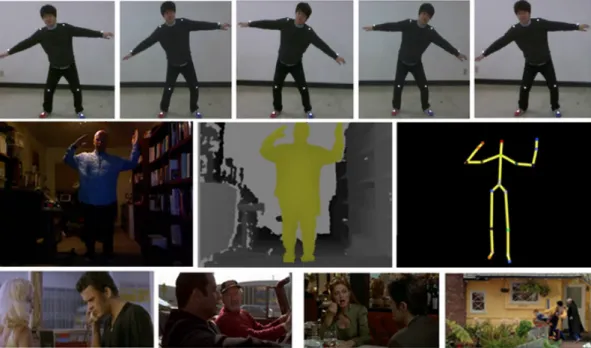
action primitive (atomic), action and activity. Anaction primitive is defined as a basic and atomic motion movement such as raising a hand, stretching a leg etc. In contrast, an action is built using these action primitives. For instance, walking, running and punching are examples of action. Anactivity is a higher semantic act such as playing sports or dancing that is comprised of a set ofactions. Along with the categories of action, many works have varying degrees of explicit or implicit assumptions on the environment where the video data is captured. According to the taxonomy of Klaser [50], this environment can be classified into controlled,
Figure 1.1: Examples of three different data capture environment: controlled ( first row),constrained ( second row) and uncontrolled (last row)
constrained and uncontrolled as shown in Figure 1.1. Controlled video data is recorded in a way to encourage for automated processing. For instances, specific markers can be attached to human actor joints to capture their movement in space and time. In contrast, constrained video data can influence environmental parameters to a limited degree. This is the case for commercial video game platforms based on visual interfaces, such as the Microsoft Kinect, which makes certain assumptions such as a single person is fully visible or favourable lighting conditions, etc. Uncontrolled video data is recorded under conditions that cannot be influenced. This is the case for, i.e., TV and cinema style movie data, sports broadcasts, music videos, or user generated content. Only very few assumptions, if any, of a rather general nature can be made, such as humans are present and visible. The main challenges for analysinguncontrolled video data include multiple potential subjects of interest; changes in viewpoint, scale, and lighting conditions; partial occlusion of humans and objects, cluttered backgrounds, abrupt movement; The thesis focuses on the problem of action recognition in uncontrolled video
data such as surveillance footage, movie and youtube videos. In particular, we are interested in the case where a video has been temporally segmented to contain only the execution of human actions (i.e.,., post action detection). The objective is to identify the action class for such video accurately. The remainder of this chapter continues with the motivation of this dissertation and introduces how action recognition from video data works and discusses the potential applications. The problem statement and the research questions are introduced followed by the thesis structure.
1.2
Motivation
Over the past two decades, information technology has been one of the most successful industries throughout the globe. From government to personal level, the digital revolution has had a tremendous influence on virtually all aspect of daily life. Growing storage capacity and network infrastructure have enabled us to store and analyse a large amount of data that was impractical a decade ago. Today, video data has become more accessible, and its role in our society, in general, is increasing. Video content can be routinely created by commonly used consumer devices such the mobile phone and digital cameras and the digital ecosystem now have the capacity to store and share the content in very efficient ways. For instance, the social media site Facebook has reported that the video content upload increased by 75% compared to 20141. According to Cisco Mobile Traffic forecast, it is projected that the video content bandwidth will reach 15 exabytes2 per month by 20203.
Despite the rapid accumulation of the video content and on-going improvements in computer vision, there is still no vision-based analytics system that is capable of performing the range of vision tasks at a human level. However, there are promising projects in the field of deep neural networks such as DeepMind
1http //tubularinsights.com/facebook-video-uploads-overtake-youtube/ 2
it would take an individual more than 5 million years to watch such amount of video.
3
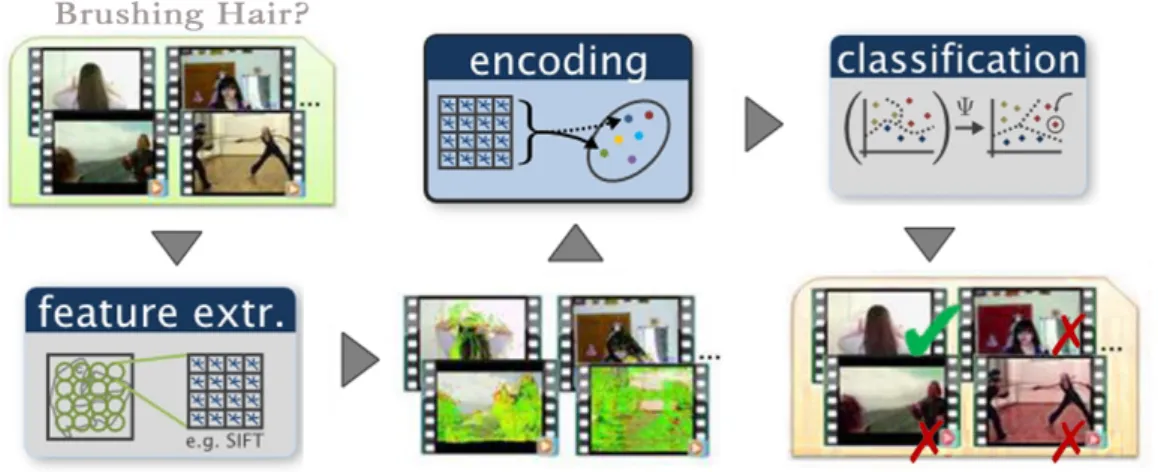
Figure 1.2: A typical processing pipeline for the local features-based approaches
AlphaGo4 which has outperformed humans. The ability to automatically analyse and mine the semantic insight from videos is still in its development stage and has not progressed significantly into the application. For instance, video search in large scale database archives requires considerable effort associate with manual annotation. Web search engines commonly rely mainly on textual information, such as content descriptions or metadata, to retrieve relevant videos. In surveillance domain, intensive work to analyse the CCTV video footage is still mainly performed using human effort5.
1.3
Problem Statement and Research Questions
Vision-based recognition of human action is becoming one of the most prominent fields of study in computer vision. There exists a vast body of literature on the subject. However, due to the complicated nature of the problem, it is still regarded as a challenging task especially in realistic scenarios captured in unconstrained circumstances. The difficulties arise from a significant amount of intra-class variation, occlusions, background clutter and illumination changes.
Numerous research has been developed over the last three decades in the action 4http //en.wikipedia.org/wiki/AlphaGo/
5
https //www.newscientist.com/article/dn3918-smart-software-linked-to-cctv-can-spot-dubious-behaviour/
recognition domain. Earlier methods were focused on the structure of the entire human body, and the video representation is strongly related to the features such as silhouette and modelling the action regarding the evolution of shapes over time. More recently, local feature-based methods have gained popularity due to their simplicity and the-state-of-the-performance [57] [101] [50] in the various datasets with different degrees of complexity.
The majority of local feature-based action recognition pipeline consist of three main steps as shown in Figure 1.2 : feature extraction, video representation (encoding) and classification. In the first step, a set of local features is extracted from a given video. These features encode the image cues that is useful for recognition of the action in a numerical vector form. This is followed by the feature encoding step where the extracted features are aggregated to form a final representation of a video. This representation may be as simple as a histogram of feature occurrence or a high-level model such as action poses. Finally, a discriminative model for each action of interest is learnt using the obtained representation using the labelled training videos. Once a model is trained, given a test video, the system identifies the class of the given video sequence.
The local features have been proved to be not only efficient but also highly discriminative and less computationally intensive. They are robust even if there are variations in the scale, illumination and viewpoint and does not require the actor localisation in comparison to the global features. Therefore it is well suited for any scenario. However, the existing feature representation (encoding) schemes, e.g., Bag-of-Features, Fisher and VLAD, ignore the spatial and temporal cues in the local features e.g., the spatio-temporal location and relationship. The resulting representation not only limits the discriminative power of the action modelling but also prevents the identification of the region where the action is taking place. In particular, it hinders the performance significantly [89] for the uncontrolled video dataset that consists of videos captured in the complex environment that have significant background clutter and multiple actors or actions.
Recently, many authors noted that incorporating the spatial and temporal cues in an action recognition process can improve the system performance [74] [24]. In this thesis, the objective is to overcome the underlying limitation of the feature representation by proposing a graph structure that aims to capture the spatial and temporal relationship between the local features while maintaining its discriminative power. The graph is a simple and powerful representation method to model the relationship between the individual elements of the system. In particular, for 2D image understanding, it is a well-established data abstraction approach due to its intuitive representation of capturing the underlying image spatial structure. Consequently, based on the challenges and potential solutions discussed about the task of action recognition, the following research questions are addressed in this thesis:
RQ1. Does incorporating spatio-temporal cues in the video representation stage increase action recognition performance?
A novel video representation is the fundamental research problem in the action recognition that aims to build the compact description of the video. The research question (RQ1) explores the effectiveness of incorporating the spatial and temporal cue in the video representation process and investigate the impact on the overall system accuracy. To address this question, the following implementation and experimental works have been studied in the thesis.
– Implementation of the baseline recognition framework using a Bag-of-Features (BOF) representation approach that captures no spatio-temporal structure and the comprehensive evaluation of the key processing components in the pipeline. (Chapter 3)
– Implementation of the proposed video-graph action recognition framework that incorporates the spatio-temporal cue in the video representation process and comparative evaluation with the baseline
using several datasets (Chapter 4).
RQ2. Can a graph-based video representation provide an effective method for incorporating spatio-temporal cues?
As earlier mentioned, the major limitation of associated with the popular encoding schemes (i.e. the Bag-of-Features and Fisher) is that they only take account of the global statistics of local features for video representation, ignoring their spatio-temporal information. There are various ways to overcome this limitation. However, the research question explores the effectiveness of the graph-based representation to model the relationship between the local features explicitly. As part of the research question, we also propose a novel recognition process well suited for the video graph representation using a graph-cut optimisation. The following works have been performed to explore the research question:
– Implementation of the proposed video graph based recognition process and the video graph construction techniques (Section 4.4, Chapter 4) – Formulation of the action recognition problem on the constructed video
graph (Section 5, Chapter 4)
– Experimental evaluation of the proposed approach to the state-of-the-art (Section 6, Chapter 4)
RQ3. What is the effective technique for constructing the video graph ?
In practice, there are many ways to achieve a graph representation of video that encodes the spatio-temporal relationship between the local descriptors. The research question (RQ3) will explore various techniques involved in this process. In particular, we investigate their advantages and limitations in the context of action recognition task and their impact on the recognition accuracy. The following experimental works have been outlined to address the question:
– Comparative analysis of the different graph construction techniques and performance evaluation (Section 4.1.1, Chapter 5).
– Parameter sensitivity analysis of the selected graph construction techniques and their associated computational complexity (Section 4.1.2, Chapter 5).
RQ4. Can the video graph be further improved to address the challenging problem of action localisation?
The research question (RQ5) explores the effectiveness of the video graph-based technique for action localisation task. In this context, we develop a video graph that accommodates not only local features but also region-based features to encourage the localisation. The action localisation is performed by maximising the score associated with the node and the edge in the video graph. The following implementation and experiment are conducted to address the research question:
– Implementation of the improved video graph with the regional features i.e. region-based convolutional features for action localisation task (Section 4.1, Chapter 6).
– Implementation of the maximum-path finding (MPF) technique for action localisation on the constructed graph (Section 5, Chapter 6).
– The experimental evaluation of the proposed approach with two popular action localisation datasets (Section 6, Chapter 6).
1.4
Applications
Despite the challenging nature of the task, the successful recognition of human activities from videos enables several important applications in many interesting areas. The potential application fields are examined in this section.
Figure 1.3: Video surveillance camera and an example office for CCTV camera monitoring
1.4.1 Video surveillance
Video surveillance is increasingly becoming an integral part of modern society. Video surveillance systems aim to monitor people and object of interest using a variety video capturing devices. In particular, the closed-circuit television (CCTV) camera is widely adopted at large scale, and it can be found at airports, metro stations, public buildings and parking lots. For instance, the city of London has installed about 1 million closed-circuit television (CCTV) cameras and the capital, China has 0.8 million security cameras operating daily basis.
With the increased demands for and dependence on networks of devices, the effective video-based surveillance system that is capable of monitoring, identifying and preventing security breach is becoming a necessity. In particular, for human induced security threats such as fighting, burglary, disputes, harassment, etc. are the scenarios where an action recognition system is well suited. Furthermore, given the availability of vast amounts of surveillance videos, the labour intensive analytics process will be greatly improved by an automatic action detection system.
1.4.2 Home Monitoring and Elderly care
According to data from UN’s World Population Ageing report 20156, almost every country in the world is experiencing a rapid growth in the proportion of older people
6
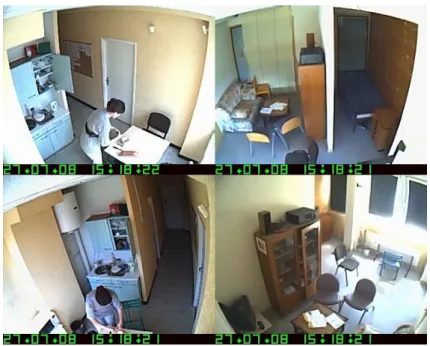
Figure 1.4: Sample video frames of Health Smart Home (HIS) dataset contain different activity scenarios such as Sleeping, Resting, Eating and Hygiene etc.
in their population. Globally, the number of people aged over 60 years is projected to grow by 56 percent from 901 million to 1.4 billion between 2015 and 2030. By 2050, the number is expected to double its size reaching nearly 2.1 billion and people aged 60 will outnumber the children aged between 0 - 15. Population ageing is poised to become one of the most significant societal transformation of the twenty-first century, with implications for nearly all sectors of society, from healthcare to economics.
The recently, the application of human action and behaviour recognition is becoming more relevant for the purpose of health monitoring of elderly people in the home environment. The automatic recognition of human action in daily life such as food preparation, walking, exercise will allow medical experts to devise strategies related to exercise, diet and treatment adherence. Related projects in this area are GatorTech [41] and Dem@care [9]. The system supports the wellbeing of the people in the home environment by providing feedback on the daily activities in the house, raising alarms when unexpected activities happen.
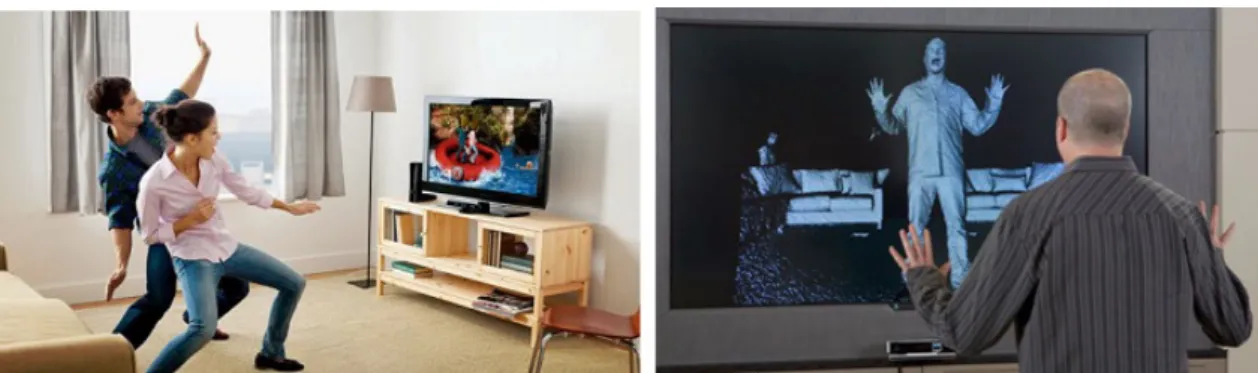
Figure 1.5: The application of gesture and action recognition technology for user interaction with computer without controller devices.
1.4.3 Human computer interaction
A further application area is human-computer interaction such as the computer games, for which video-based gesture and action analysis has gained a lot of attention. Popular related project is Microsoft’s Project Natal7. The project’s
framework allows for full-body motion capture, facial recognition, voice recognition, and acoustic source localisation. This is achieved by combining information from several sensors: a video camera, a depth sensor and a microphone. This allows users to play video games without controller devices and to interact in a virtual world using their full bodies in a natural way. Therefore, the improved gesture and action recognitions will provide a natural and intuitive method of human communication with devices.
1.5
Thesis Structure
The remainder of the thesis is structured as follows:
• Chapter 2 introduces a review of the literature in the action recognition domain. In this chapter, the prominent research works are structured into three class of approach. Also, a comprehensive summary of popular benchmarking datasets and their evaluation protocols is presented.
7
• Chapter 3 presents a baseline recognition system based on the Bag-of-Features (BoF) model and comprehensively evaluates it. In particular, we discuss how different encoding schemes, codebook sizes and other parameters have an impact on the recognition performance using several datasets. Also, the baseline system performance will act as a performance reference to the proposed approaches in the following chapter.
• Chapter 4 introduces a novel action recognition framework based on the video graph. The proposed approach aims to overcome the underlying weakness of the Bag-of-Features (BoF) by incorporating the spatio-temporal relationship among the local features as a graph structure. Furthermore, we explore the application of the Graph-Cut optimisation method from 2D image segmentation to 3D spatio-temporal volumes to investigate its effectiveness for action recognition in video. The effectiveness of the proposed framework is investigated and benchmarked with the state-of-art using the popular datasets.
• Chapter 5introduces the various strategies on the video graph construction and investigates the associated effect on the performance of the recognition process. In particular, we examine three techniques as a representative to the identified taxonomy of approaches and perform a comparative analysis regarding their impact on the recognition accuracy, parameter sensitivity and computational complexity.
• Chapter 6propose an action localisation framework based on the video graph. In the framework, we develop a video graph that accommodates not only local features but also region-based features to encourage localisation. The additional cues such as local, motion and region geometry are captured as the graph edges. We perform the localisation by the maximising the path score in the constructed video graph. The effectiveness of the proposed approach is investigated and benchmarked to the state-of-the-art using two different
localisation datasets.
• Chapter 7 summarises and concludes the thesis highlighting the research contributions, addresses the research questions and discusses future research directions.
Literature Review
2.1
Overview
This chapter introduces a review of the prominent works in action recognition (Section 2.2) and the related benchmarking datasets (Section 2.3). In particular, we identify the taxonomy of the existing methodologies (global, local and
mid-level) based on the type of action feature and their associated video representation strategies in the recognition process.
2.2
Action Recognition Methods
Action recognition methods can be divided into three classes: global, local and
mid-level. Global methods encode the observation in a holistic manner. These representations are typically obtained in a top-down fashion and on the basis of accurate human detector, background subtraction or tracking. In contrast, local
approaches are based on a set of local features extracted from an image region called a patch in sparse or dense manner. This representation is considered to be resistant to the viewpoint changes and scales. Mid-level representations attempt to model an action using intermediate level parts designed to encode the spatio-temporal structure within the video data.
Figure 2.1: Motion History Images (MHI) and motion energy images (MEI) [14]
2.2.1 Approaches based on global features
Global representations encode the region of interest of an action in a holistic manner. The region of interest is typically captured through background subtraction or tracking. This class of approaches typically build an action model using silhouettes, counter or optical flow. The earliest works examining the use of silhouettes were done by Yamato et al [118] and Bobick et al [14]. In the work [14], authors integrated the silhouettes to form the accumulated frame differences over time, called the binary motion energy image (MEI) and motion history images (MHI) as shown in Figure 2.1. The MEI and MHI essentially encode the region where motion takes place. In [106], the scale and translation invariance technique is proposed for effective silhouettes representation. To deal with the scenes where background segmentation is difficult, Weinland et al [108] proposed to use the
chamfer distance to eliminate the need for background subtraction. Instead of silhouettes, some works [26] [105] explored the use of contour based representation. In [26], the star skeleton model is used to represent the action contours. Wang et al [105] proposed the approach that integrates the contour and silhouettes into a single representation.
When there are multiple cameras available, silhouettes can be obtained from each to increase the effectiveness silhouettes based representation. In this context, Huang et al [116] used the camera setup where two orthogonally placed cameras at similar height and distance to the actor to obtain envelope shape. Another work [28] also
Figure 2.2: Space-time volumes for action recognition generated from silhouette information [110]
Figure 2.3: Optical flow based human-centered action modelling [34]
use orthogonally placed cameras to achieve the combined silhouettes features. Such methods are view-invariant but fail when the arms cannot be distinguished from the body. Weinland et al. [110] proposed to combine silhouettes from multiple cameras into a three-dimensional voxel model (See Figure 2.2). The method is discriminative however it requires accurate camera calibration. For action representation, authors use motion history volumes, which is an extended version of the MHI [14] and its view-invariance is achieved using Fourier transforms.
Instead of silhouettes, the global action representation can be built using motion information. This type of approaches do not rely on background subtraction unlike the silhouettes-based representations and encode the region of interest using dense optical flow or the frame difference from consecutive frames. An early work using optical flow is done by Polana et al [69] where the authors propose temporal-texture model that integrates both the first- and second-order motion statistics. The resulting representation can be used when background subtraction cannot be performed. Efros et al [34] calculate optical flow in
human-centered frames ( See Figure 2.3) in sports footage. They divide the optical flow field into different components to form 4 distinct features which are separately matched. Ahad et al. [3] use these four flow components to address the self-occlusion artefact in an MHI approach. Furthermore, inspired by the physics concept, Ali and Shah [5] proposed the kinematic features (divergence, vorticity and symmetry) using the optical flow field. In the works [49, 59], the Viola-Jones object detection is extended by computing image features on the dense optical flow fields.
2.2.2 Approaches based on local features
This class of methods describe the video scene as a collection of local features or patches. The key advantages of these approaches are: (i) do not require accurate human detection/localisation and background subtraction, (ii) invariant to changes in viewpoint/scale, person appearance and (iii) able to deal with partial occlusions. Local features can be computed either densely or at a sparse set of regions. Local action recognition approaches, based on space-time representation [56] 2.4 , were introduced to extend the concept of local 2D image features already used in image classification to action recognition domain.
Space-time approaches are based on bottom-up strategies, and they build the action model by analysing spatio-temporal local regions in videos. A typical pipeline for space-time approach is as follows. Given a video sequence, first, detect and describe the salient points and then assign each region to a set of pre-computed dictionary features. Next, the action model is built using the statistics of the dictionary feature within the video sequence and used to assign an action class for unlabelled input video.
In this context, Laptev [56] first developed the space-time interest point detector by extending the notion of Harris Corner Detector into 3D space (See Figure 2.4). Scovanner et al. [79] proposed the 3-D extension of the SIFT descriptor, similar to cuboid features [32]. Liu et al. [64] presented a methodology to prune cuboid features
Figure 2.4: Spatio-temporal interest points from the motion of the legs of a walking person: (left) 3D plot of a leg pattern and the detected local interest points; (right) interest points overlaid on the single frames in the original video sequences [56]
to choose important and meaningful features. Bregonzio et al. [17] proposed an improved detector for extracting cuboid features, and presented a feature selection method similar to [64]. Rapantzikos et al. [73] extended the cuboid features to utilise colour and motion information as well, in contrast to previous features that only used intensities.
Trajectory based action recognition methods have gained significant interest. In these approaches, an action is interpreted as a set of space-time trajectories. The typical procedure for this type of approaches is that they compute dense or sparse trajectories and then they process these trajectories to represent and recognise actions. In this context, Sheikh et al. [82] represent an action as a set of joint trajectories in a four-dimensional space. To derive the view-invariant similarity between two sets of trajectories, they use an affine projection to obtain normalised trajectories of an action. Yilmaz et al [120] also use a set of joint trajectories to compare actions in videos obtained from moving cameras. In the work of [20],
Figure 2.5: (Top) Visualization of human actions with dense trajectories. (Bottom) The dense trajectory feature generation pipeline; First, dense feature sampling is performed. Then, features are tracked using dense optical flow and feature descriptors are computed [101]
authors transform the joint trajectories into low-dimensional phase spaces to achieve view invariance and represent human actions. Rao and Shah [72] extract meaningful curvature patterns from the trajectories for action representation. Wang et al. [101] proposed the state-of-art approach based on the dense trajectories (See Figure 2.5. The dense points are sampled and tracked using the displacement information from a dense optical flow field for a short duration. Local descriptors of HOG, HOF and MBH are calculated along the resulting trajectories.
Recently, deep learning features for action recognition [46, 48, 84, 93] have been explored due to the great success in image based tasks [52, 85, 123]. Taylor et al. [93] used Gated Restricted Boltzmann Machines (GRBMs) to learn the motion features in an unsupervised manner and then resorted to convolutional learning to fine tune the parameters. Ji et al. [46] extended 2D ConvNet to video domains for action recognition on relatively small datasets, and Karpathy et al. [48] tested ConvNets with deep structures on a large dataset, called Sports-1M. However, these deep models achieved lower performance compared with shallow hand engineered local features [32, 50, 101]. This might be ascribed to two facts: firstly, available action datasets are relatively small for deep learning; secondly, learning
complex motion patterns is more challenging. Simonyan et al. [84] designed two-stream ConvNets containing spatial and temporal networks by exploiting the large ImageNet dataset1 for pre-training and explicitly calculating optical flow for capturing motion information, and it achieved performance on par with the state-of-the-art. Weinzaepfela et al. [111] introduced a method to combine both local features and deep learning features by fusing with a track descriptor and achieved further improvement. This shows that combining the deep learning features with local features (hand-engineered) that are complementary to each other improves the performance.
2.2.3 Approaches based on mid-level representations
The approaches based on mid-level representation aim to recognise an action based on the video parts that encodes the spatial or temporal structure in the data. Early works have been focused on the stochastic methods to capture the temporal variability [112] [87] [42] [71]. Robertson et al. [78] model human action as a stochastic time sequence based on HMM. Brendel and Todorovic [19] used a time series of activity features for identification of the salient action region in the time domain using a Markov chain. These approaches, however, make the firm presumption that the duration of the action spans the whole length of the video and furthermore their action model is limited encoding only the temporal pairwise relationship between the video parts.
To overcome this problem, Wang and Mori [107] were the first to propose a hidden conditional random field (HCRF) part-based model that encodes spatial pairwise relationships. In particular, a human action was modelled as a configuration of parts of video observations whereby pairwise relationships among spatial patches are captured explicitly. The representation of the video part uses the combined features ( global and local patch-based features). However, the method adopted the classification process that performs at a frame level while considering only the
spatial grouping.
Niebles et al. [68] extended the notion of a mid-level part from a spatial domain [19] [107] to take into account of the temporal evaluation of the video frames. The proposed method can accommodate both the global and local features. The discriminative model was derived from the popular part-based model [37] of the object recognition domain. The local features decompose the video volume into a set of temporal segments to construct temporal composition. However, the resulting model requires the ability to spatially localise action parts.
There is a considerable amount of work [61, 66, 113] that exploits the directed graph network to model the action classes. In particular, various types of Dynamic Bayesian Network (DBN) have been proposed for recognizing different activities in the literature. For instance, Muncaster et al [66] use a dynamic Bayesian network to perform complex event recognition. Wu et al [113] present a DBN that combines RFID and video data to infer the activity and object label. Also, Laxton et al. [61] formulate a hierarchical DBN taking account of temporal, contextual and ordering constraints to recognize complex activities.
Raptis et al [74] proposed an action-part based graphical model and formulated the action recognition task as a Markov random field (MRF) problem. However, this method is not generic and fine-tuned only with trajectory features to construct nodes in the video graph. On the other hand, Chen at al [24] introduced a sub-graph based model for detection and localisation. It uses high-level features, that relies heavily on person and object detection. However, the underlying assumption restricts its applicability where the actor’s figure is occluded in the video scene.
2.3
Datasets
In this section, we present the most popular action recognition datasets that are used in evaluating action recognition methods.
Figure 2.6: Sample screen shots of action categories of the Weizmann actions dataset.
2.3.1 Weizmann actions
The Weizmann dataset is one of the earliest datasets created for action recognition analysis and was recorded in 2005. The dataset has a homogeneous background, and a single person is performing in each frame. It contains 90 low-resolution video sequences showing nine different people, each performing ten natural actions such as running, walking, skipping, jumping-jack, jumping forward, jumping in place, gallop sideways, waving two hands, wave one-hand and bending as shown in Figure 2.6. Each frame is accompanied by the respective actor silhouette as ground truth.
2.3.2 KTH actions
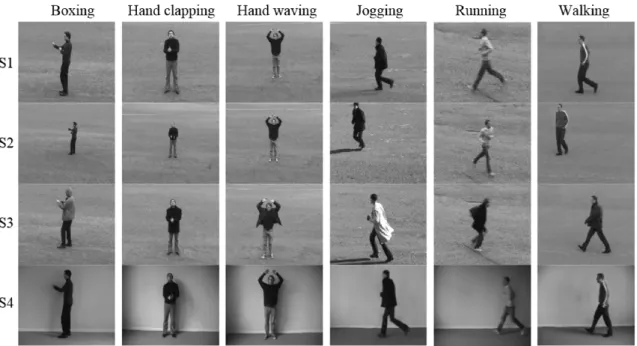
The KTH Royal Institute of Technology compiled the dataset [13] in 2004. It is considered as one of the most popular datasets in the computer vision community. It consists of six human actions (walking, jogging, running, boxing, waving, and clapping as shown in Figure 2.7). Each action is performed several times by 25 subjects. The sequences were recorded in four different scenarios: outdoors, outdoors with scale variation, outdoors with different clothes and indoors. The background is homogeneous and static in most of the sequences. In total, the data
Figure 2.7: Example frames of action classes from the KTH actions dataset.
consists of 2391 video samples. The ground truth is given in a text-file format where each frame is annotated with meta-data that consists of the actor, action type and environment (static homogeneous background (SHB), SHB with scale variation, SHB with different clothing, SHB with illumination variation). The authors provide the evaluation protocol, and the average accuracy is a commonly accepted performance metric for the dataset.
2.3.3 UCF-Sports
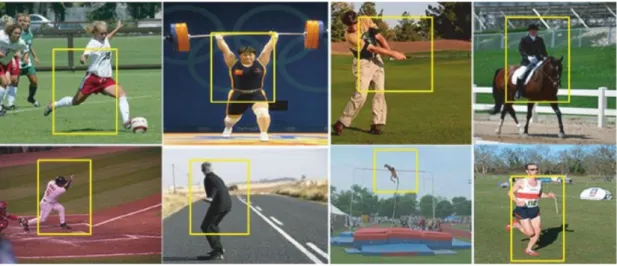
The UCF-Sports dataset [21] consists of multiple action snapshots captured from various sporting events in 2008. It comprises an original set of actions performed in several scenes and viewpoints. The video sequences are collected from various sources such as BBC Motion gallery and GettyImages. The dataset contains 150 videos with 10 different action classes includingdiving, golf swinging, kicking, lifting, horse-back riding, running, skating, swinging and walking as shown in Figure 2.8. The dataset is considered challenging due to the large displacements that most of the actions contain, the cluttered background, and the large intra-class variability.
Figure 2.8: Example shots from UCF Sports action dataset.
2.3.4 YouTube Actions
The dataset [63] was compiled in 2009 with videos recorded from a video sharing website YouTube. It consists of 11 different action categories: cycling, basketball shooting, diving, horseback riding, golf swinging, soccer juggling, swinging, tennis swinging, trampoline jumping, volleyball spiking and walking a dog as shown in Figure 2.9. The dataset is characterised by large variations in camera motion, object appearance and pose, viewpoint, cluttered background, lighting condition. For each action category, the video sequences divided into 25 groups with more than four action clips. The grouping is based on the similarity based on the actor, background, viewpoint, etc. The ground truth is formatted in VIPER 2 where the bounding box and action category is provided for each frame.
2.3.5 Hollywood Actions
The Hollywood Actions (HOHA) dataset [58] contains 430 videos with 8 different actions (See Figure 2.10). This dataset is extremely challenging: each video sequence, in addition to the action being performed, contains challenging
2
Language and Media Processing Laboratory, Viper: The video performance evaluation resource, November 2011. http://viper-toolkit.sourceforge.net/
Figure 2.9: Screen shots of the 11 action classes of the Youtube action dataset [63].
conditions such as significant camera motion, rapid scene changes and occasionally significant clutter. Moreover, even though the included actions (e.g., sit down or kiss) can manifest themselves in a wide variety of conditions, only a tiny portion of them are sampled in the training set. Furthermore, many actions are not performed by a single agent (such as sit down) but involve interactions with other agents (kiss) or objects (get out of the car). The dataset is divided into a test set collected from 20 movies and two training sets (automaticand clean training set) obtained from 12 movies. In particular, the automatic training set is obtained using automatic script-based action annotation and contains 233 video samples with approximately 60% accurate action labels. In contrast, theclean training set contains 211 manually labelled video clips. The ground truth is generated by frame ranges and the corresponding actions.
2.3.6 HMDB51 and J-HMDB
The Serre lab at Brown University, USA, developed the HMDB dataset. The videos were obtained from several sources, i.e. P relinger archive, Y ouT ube and Google videos. The dataset comprises of 6849 clips divided into 51 action
Figure 2.10: Two action class examples from the Hollywood dataset: (kissing and,
answering a phone)
categories, each containing a minimum of 101 clips ( See Figure 2.11). To date, it is the largest and the most diverse action recognition dataset available. The action classes can be divided into five groups: general facial actions, facial actions with object interaction, general body movement, body movement with object interaction and human interaction. Each video is associated with a comprehensive meta-data information that includes visibility of body parts, camera motion, camera viewpoint respective to the actor, the number of people involved in the action and video quality. The dataset is considered to be very challenging due to the use of video clips obtained from real-world videos which suffer from a range of artefacts.
J-HMDB is a subset of the HMDB51 with fewer action categories. This dataset focuses on the single person action and it is considered more challenging than the original dataset. In particular, the dataset contains 21 categories involving a single person in action: brush hair, catch, clap, climb stairs,golf, jump, kick ball, pick, pour, pull-up, push, run, shoot ball, shoot bow, shoot gun, sit, stand, swing baseball, throw, walk, wave.
2.4
Summary
This chapter introduced the literature review of various approaches for action recognition and the related benchmarking datasets. We identify and assess three class of approach: Global, Local and Mid-level. In the literature, the earlier methods were developed focused on the relatively simple video settings that have clean background and single actor in the scene. This led to the development of the global methods that model the action in a holistic manner. These techniques are typically based on human localisation that is challenging to be accurately obtained in the uncontrolled environment. However, the local features based methods can be applied to various settings. The local features are known to be robust under the scale, viewpoint changes and and do not require a human body model or
localisation. The mid-level based approaches aim to model the action decomposed as parts and capture the spatial and temporal structure in the data. These techniques often result in a complex recognition process. There are many research works on-going to attain the effective mid-level representation.
In this thesis, we focus on methods based on local features and targets
uncontrolled video capture. This class of approach is shown to be not only efficient but also provides excellent results compared to other complex approaches whilst being of a low computational complexity. However the existing local feature encoding schemes, i.e., BoF, Fisher, ignore the information of the spatio-temporal positions of features and relations among the features whereas such cues may be important for action recognition. In the remainder of the thesis, we propose to overcome this limitation by developing the notion of a video graph that aims to capture the spatial and temporal relationship between the local features as a graph structure. Chapter 4 presents a novel action recognition framework based on the video-graph. Chapter 5 focuses on the various video graph construction techniques to encode the spatio-temporal relationship and their potential impact on the recognition performance. Chapter 6 explores the action localisation problem using an extended version of the video graph. For validation and evaluation purpose, we will focus on the J-HMDB dataset in the thesis. This dataset contains videos with a variety of action classes captured in an uncontrolled environment and it is used for both the classification and localisation task. Also, each video is provided with the detailed meta-data information that enables further analysis on the experimental results. Next chapter presents the baseline framework and the evaluation of the different processing steps in the recognition system.
Baseline System
3.1
Overview
This chapter introduces the baseline action recognition framework used in this thesis. In the literature, Bag-of-Features (BoF) model with SVM is the most popular method used to compare and benchmark the proposed feature detectors, descriptors and even recognition algorithms. In this chapter, this framework has been chosen to investigate the various key components, i.e., the local feature type, SVM kernel function, in the recognition process and the impact on overall performance. The baseline framework will be used as the basis for comparison performance in the following chapters.
3.2
Introduction
Over the years, a considerable amount of research has been conducted into human action recognition. Among the successful methodologies, the local feature based approaches have become the most popular. In particular, the Bag-of-Features (BoF) paradigm has become well-established in the field. Bag-of-Features (BoF) methods adopt a structure-less model that treats the feature descriptors as an orderless collection. Due to its simplicity and discriminative nature, the Bag-of-Features (BoF) based approach has become the standard recognition pipeline in the action recognition community to compare and evaluate the different algorithms and their various processing components
There is research carried out [70] for evaluation of the bag-of-features based recognition framework. Many efforts have been focused on the individual components of the framework in different settings. For instance, Wang et al [102] performed the comprehensive evaluation of various feature descriptors and encoding schemes with a standard bag-of-features model. However they mainly focused on the feature extraction technique of the framework and imposed a restriction on the rest of the framework such as constraining the dictionary size to a certain value and using the same kernel function in all experimental work. In contrast, this chapter aims to provide a comprehensive evaluation of the Bag-of-Features (BoF) framework with datasets of varying degrees of complexity. In particular, we investigate the choice of the local descriptor, kernel function and size of the codebook dictionary. Also, this chapter examines the impact of the choice of the local descriptor has on the performance of human action recognition in the presence of static occlusion. This question is crucial when designing a recognition framework to uncontrolled video data that is noisy, complex and incomplete. To our knowledge, evaluation and comparison of classification performance of local action description methods, in the presence of occlusion, has not been done in the past. However, several authors [109] [33] have evaluated the impact of occlusion on their own work. A number of key survey papers in human action recognition [70] [11] [2] stated the necessity of occlusion tolerant action recognition methods. In particular, Poppe [70] wrote “ the question [of] how to deal with more severe occlusions has been largely ignored”. The rest of the chapter is organised as follows:
• Section 3.3 gives an introduction to the standard recognition framework and describes each processing stage in the pipeline. Also, we introduce the popular classification technique - Support Vector Machines (SVM) and the several types of kernel and normalisation methods used for building an action model.
components of the framework and their effect on the overall system performance. In particular, we evaluate four state-of-the-art local descriptors, four different dictionary sizes in three prominent action datasets.
• Section 3.4.2 focuses on the evaluation of the learning step in the pipeline. In this section, we examine the popular kernel methods using a SVM classifier.
• Section 3.4.3 evaluates the local feature descriptors and their possible combinations in the presence of varying degrees of occlusion. The experimental work is focused on static occlusion and the objective is to understand how the missing local descriptors, i.e. due to occlusion, affect action recognition performance.
3.3
Baseline Recognition Framework
The standard recognition pipeline is adopted for the baseline recognition system as shown in Figure 3.1. The recognition pipeline consists of four main processes: feature detection, feature description and video representation followed by classification. The feature detection process aims to find a point or a set of points of the video that corresponds to a potentially informative local region. Feature description captures the local statistics of the patch or region. For the video representation, firstly, the visual dictionary is constructed by clustering the features extracted from the training stage. Given a video, feature descriptors are assigned to their nearest matching cluster centre (visual-word) from the visual dictionary. The histogram of the quantized feature descriptors will form a vectorized representation of the video sequence that is used to train or validate the classification model.
3.3.1 Feature Detection
Intelligent selection and detection of feature points plays an important role in an action recognition system. According to the sampling strategy, the feature detection process can be divided into two categories: sparse and dense. In the former methods,
Figure 3.1: The typicalBag-of-Features ( BoF) based action recognition framework pipeline
the feature points are selected from the salient regions determined by intensity changes. The popular methods include the Harris3D detector [86], and the Cuboid detector [115]. In contrast, the dense approaches sample the feature points at regular grids in space and time. According to the local feature survey [102], it was found that dense sampling methods typically outperform the sparse representation as it is more discriminative and robust. In particular, the dense trajectory-based representation resulted in outstanding performance. Hence in this research, the dense trajectory was adopted in the experimental work.
Dense Trajectory (DT) Detector
Wang et al [101] proposed a feature detection technique based on dense motion trajectories (DT). In this method, the dense motion trajectories are extracted at multiple different spatial scales using optical flow fields. They applied the global smoothness constraints to obtain more robust trajectories compared to tracking or matching points independently. Each point Pt is matched to the next frame by a median filtered optical flow as follows:
Pt+1 = (xt+1, yt+1) = (xt, yt) + (M∗w)|(xt,yt) (3.1) where w is the optical flow field, M is the median filter kernel and (xt, yt) is the approximated position of (xt, yt). Then tracked points form a trajectory. To avoid the drifting problem1, the length of the trajectory is limited to a fixed L long. When a trajectory length reaches this threshold, it is removed from the tracking process. A new trajectory is initialized when there are no tracking points found in a W ×W spatial neighbourhood. To deal with the homogeneous area, the method adopts the criterion proposed by Shi and Tomasi [83]. During the feature point sampling process, the smaller eigenvalue of the autocorrelation matrix is checked. If the value is below a threshold, these points will not be included in the tracking. The dense trajectories are shown to be more robust than the trajectories obtained
1
Figure 3.2: The information captured by the different descriptors; HOG (Gradient Information), HOF (Optical Flow) and MBH (Motion Boundaries) [101]
via the KLT (Kanade-Lucas) tracker.
3.3.2 Feature Description
Along with the determination of where feature exists in a video, there is a separate field of study focused on how to represent the local spatio-temporal region of the detected feature. The process is called feature description. The naive approach is to use the pixel intensity values of the particular region. Ideally, a local descriptor should have a compact representation of the local neighbourhood that is robust to various changes such as illumination, view points and camera angle. In practice, a spatio-temporal video patch is extracted from the detected features and information inside the volume is used to form a representative descriptor vector. The most popular descriptor methods typically use a histogram of responses of various gradient filters.
In the experiment, four different descriptors are used to describe the features of the detected trajectory features. The local neighbourhood is chosen as spatio-temporal volumes along the detected trajectories. The size of the volume is N×N pixels andL frames, withN = 32 and L= 15 in our experiments. For each trajectory, the four different types of descriptors are calculated, in a constructed 3D volume, to capture the different aspects of motion trajectory. Among the

![Figure 2.4: Spatio-temporal interest points from the motion of the legs of a walking person: (left) 3D plot of a leg pattern and the detected local interest points; (right) interest points overlaid on the single frames in the original video sequences [56]](https://thumb-us.123doks.com/thumbv2/123dok_us/1298414.2673947/37.892.212.777.162.517/figure-spatio-temporal-walking-detected-overlaid-original-sequences.webp)

![Figure 2.9: Screen shots of the 11 action classes of the Youtube action dataset [63].](https://thumb-us.123doks.com/thumbv2/123dok_us/1298414.2673947/44.892.181.799.171.483/figure-screen-shots-action-classes-youtube-action-dataset.webp)