A systematic framework for infrastructure development through public
private partnerships
Xueqing Zhang
⁎
, Shu Chen
Department of Civil and Environmental Engineering, The Hong Kong University of Science and Technology, Clear Water Bay, Kowloon, Hong Kong
a b s t r a c t
a r t i c l e i n f o
Article history: Received 13 June 2012
Received in revised form 30 October 2012 Accepted 2 November 2012
Keywords: Concession Financial regulation Infrastructure
Public private partnership Privatization
Source selection
Public–private partnerships (PPPs) play an important role in bringing private sector competition to public monopolies in infrastructure development and service provision and in merging the resources of both public and private sectors to better serve the public needs. However, in worldwide practices, there are mixed results, substantial controversy, criticism and conflict over PPPs. This paper proposes a systematic framework for the delivery of public works and services through PPPs in general. Justified by public procurement principles, aimed at a public–private win–win solution, and based on worldwide best industrial practices and lessons from unsuccessful projects, this framework integrates the four broadly divided stages that repeat over time: (1) design of a workable concession, (2) competitive concessionaire selection, (3)fi -nancial regulation, and (4) periodic reconcession and rebidding. The four-stage framework takes into account the requirements of public services, realignment of responsibility and reward among multiple participants in PPPs, the monopolistic rights of the concessionaire, and the wide range of risks and uncertainties in the long concession period. Varying competition elements are incorporated in each of the four stages for continuous performance improvement in the delivery of public works and services. The design of the right concession forms the base on which other stages are implemented in addition to planning the project and allocating risks for enhanced efficiency. Thefinancial regulation allows the government to address changing conditions and to regulate the concession for efficient operation with due discretion, whereas the competitive conces-sionaire selection and periodic reconcession and rebidding play critical roles in achieving innovation, effi cien-cy and cost effectiveness through direct competition rather than government discretionary intervention.
© 2012 International Association of Traffic and Safety Sciences. Production and hosting by Elsevier Ltd. All rights reserved.
1. Introduction
There is a huge demand on public infrastructure and services world-wide whereas the government budget of any country is always limited. In addition, the public sector often lacks the technologies, skills and ex-pertise required for efficient infrastructure development. Furthermore, civil servants often have less incentive to invest wisely than private pro-ject managers[1]. Facing these problems, governments worldwide are exploring innovative means for improved infrastructure development, and consequently different types of public–private partnerships (PPPs) have been practiced. PPPs are contractual relationships governing a long-term public sector acquisition and private sector pro-vision of public works and services[2]. PPP projects have the following
common characteristics[3]: (1) a private partner provides the design, construction,financing and operation of the infrastructure, in return for payments either from the users of the infrastructure or from the public client itself; (2) public and private partners share risks and jointly manage them through better utilization of resources and improved pro-ject control; and (3) PPP propro-jects are usually based on a long-term contract to encourage innovations and low life cycle costs.
PPPs play an important role in bringing private sector competition to public monopolies in infrastructure development and service provision, and in merging the resources of both public and private sectors to better serve the public needs that otherwise would not be met. A great num-ber of infrastructure projects have been successfully developed through PPPs with significantly increased value and substantial cost savings[4]. For example, it is reported that U.S. state and local governments have routinely experienced 10–40% cost savings and improvements in ser-vice quality and asset management through PPPs[5]. On the other hand, many privatized projects suffered disastrous consequences be-cause of construction cost/duration overruns, changing market de-mand, depreciation of local currencies and/or reduction in tolls/tariffs by utilities. Some of them had been postponed or abandoned by the sponsors, and others had to be bailed out by host governments[6–8].
⁎ Corresponding author.
E-mail address:[email protected](X. Zhang).
Peer review under responsibility of International Association of Traffic and Safety Sciences.
0386-1112/$–see front matter © 2012 International Association of Traffic and Safety Sciences. Production and hosting by Elsevier Ltd. All rights reserved. http://dx.doi.org/10.1016/j.iatssr.2012.11.001
Contents lists available atSciVerse ScienceDirect
IATSS Research
Accompanying the mixed results mentioned above, substantial controversy, criticism and conflict exist over PPPs. The division in thinking over PPPs is as wide as the world itself. Opponents argue that (1) the profit-making objective of the private sector motivates them to seek cost savings at the expense of quality services, and there-fore, is antithetical to the public's well-being; and (2) the involvement of private sector in public services results in loss of jobs of public em-ployees and consequently a counterproductive relationship with unions of public employees[9]. In contrast, proponents contend that the profit motive of the private sector does not necessarily comprise service qual-ity or reduce public jobs. Instead, improved level of service via cost ef-fective solutions are possible as the private sector can become more accountable to the public through well-designed PPPs, which provide the public sector sufficient control over the works and services being provided by the private sector while allowing the management skills, technologies andfinancial resources of the private sector to come into play. The National Council for Public–Private Partnerships (NCPPP) of the United States provides successful PPP examples in transportation, urban development, schools, water/wastewater and other infrastruc-ture sectors to support these contentions[5].
The worldwide interest in PPPs, problems encountered in many countries and the substantial controversy over PPPs call for an improved methodology for improved infrastructure and service delivery through PPPs. The writers have thus conducted research corresponding to this call. This research results in a better under-standing of PPPs and the development of a framework that inte-grates different stages in the delivery of public works and services and systematically addresses the key issues in each stage in order to achieve continuous efficiency improvement. This framework is
based on worldwide best industrial practices and lesions from un-successful projects, aimed at public–private win–win outcomes, and justified by public procurement principles. Details of the re-search outputs are provided in the following sections.
2. Framework for a systematic approach 2.1. Four-stage systematic framework
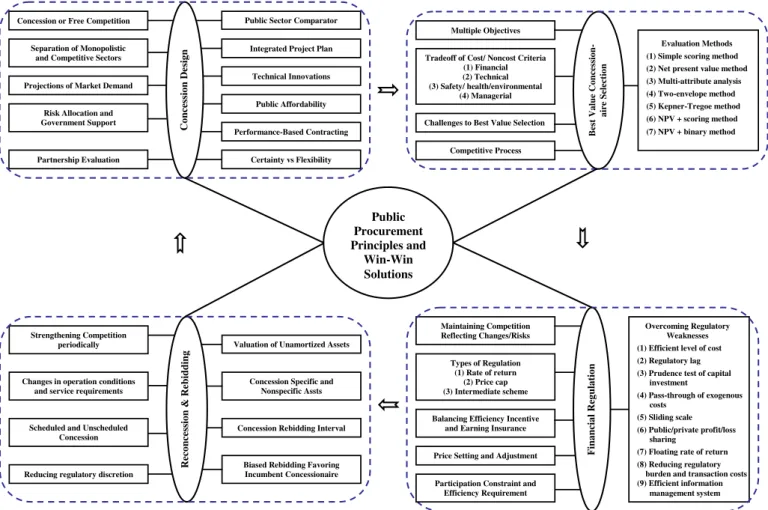
A systematic approach is taken in the proposed framework for infrastructure development through PPPs in general. Basically, the proposed framework (please seeFig. 1) integrates four broadly divid-ed stages in the infrastructure and service delivery process, including (1) design of a workable concession, (2) competitive concessionaire selection, (3) financial regulation of the selected concessionaire during the concession period, and (4) periodic reconcession and rebidding to allow changes and adjustments of the concession, and new entry for the concession. This general framework is proposed on the realization that although there are many aspects that are project, sector, and/or country-specific, the concept, process and key principles in infrastructure and service delivery through PPPs are essentially identical, which is supported by the World Bank and the Inter-American Development Bank[1].
A validation process had been conducted to justify the proposed framework and evaluate its potential application in the industry. In this regard, opinions of experts and practitioners in PPPs from Canada, China and United Kingdom had been solicited. Sixteen professionals participated in this validation process. In general, most of them agreed that this framework was well-developed and that it included key issues
Concession or Free Competition
Separation of Monopolistic and Competitive Sectors
Projections of Market Demand
Risk Allocation and Government Support
Partnership Evaluation
Public Sector Comparator
Integrated Project Plan
Technical Innovations Public Affordability Performance-Based Contracting Certainty vs Flexibility Concession De sign Multiple Objectives
Challenges to Best Value Selection Tradeoff of Cost/ Noncost Criteria
(1) Financial (2) Technical (3) Safety/ health/environmental (4) Managerial Competitive Process Evaluation Methods (1) Simple scoring method (2) Net present value method (3) Multi-attribute analysis (4) Two-envelope method (5) Kepner-Tregoe method (6) NPV + scoring method (7) NPV + binary method
Best Value Concess
io n -aire Selec tio n Strengthening Competition periodically
Changes in operation conditions and service requirements
Scheduled and Unscheduled Concession
Reducing regulatory discretion
Valuation of Unamortized Assets
Concession Specific and Nonspecific Assts
Concession Rebidding Interval
Biased Rebidding Favoring Incumbent Concessionaire Reconcession & Re bid ding Maintaining Competition Reflecting Changes/Risks
Balancing Efficiency Incentive and Earning Insurance
Types of Regulation (1) Rate of return
(2) Price cap (3) Intermediate scheme
Price Setting and Adjustment
Overcoming Regulatory Weaknesses (1) Efficient level of cost (2) Regulatory lag (3) Prudence test of capital
investment (4) Pass-through of exogenous costs (5) Sliding scale (6) Public/private profit/loss sharing
(7) Floating rate of return (8) Reducing regulatory
burden and transaction costs (9) Efficient information
management system
Financial Reg
ulation
Participation Constraint and Efficiency Requirement Public Procurement Principles and Win-Win Solutions
to be dealt with in a systematic approach to infrastructure development through PPPs, although some suggested that some aspects of the frame-work need to be modified or improved.
2.2. Public procurement principles
The acquisition of public works and services should follow relevant procurement principles, mainly including accountability, transparency, value for money and fair competition[10]. Accountability requires clarity in assigning responsibilities to project participants and answer-ability of the concessionaire to the government, regulator, and the gen-eral public. Transparency necessitates an open approach to decision-making, which enables the establishment of a mutual trust between public and private sectors. In this regard, the government must make explicit (1) its objective and requirements in a business transaction, (2) key assumptions about risk definition, assessment and allocation, (3) the format of the tender proposal and the definition of a non-responsive proposal, (4) the tender evaluation criteria and their relative importance, (5) contracting monitoring methods, (6) payment methods, and (7) incentive schemes. Value for money requires that costs associated with the acquisition of a public work and/or service should be justified by the value generated from such a business transac-tion. Measures should be taken to ensure that the profit motive of the private enterprise does not lead to an undermining of the public good.
2.3. Public–private win–win solution
Successful infrastructure development through PPPs necessitates the adoption of a public–private win–win solution that adequately ad-dresses the concerns of both sectors and guarantees the interests of each of them. This win–win solution means that the PPP project agree-ment should be designed in a way that on the one hand it allows the pri-vate partner to make adequate returns to its capital investments which are usually sunk and subject to social, political, economic, technical and environmental risks and that on the other hand it allows the public partner to achieve social objectives, and productive and allocative effi -ciency, and to maintain appropriate quality, environmental, and health standards. The requirement of a win–win solution is confirmed by Laffont and Tirole[11], who maintain that the regulator should design a contract that is (a) acceptable to the regulatedfirm and (b) as good as possible for society as a whole. This equivalently means that a con-cession agreement should satisfy the“participation constraint”to pre-vent the concessionaire from bankrupting and to provide it with incentives to be efficient[12].
2.4. Rationale of the framework
The public procurement principles and public–private win–win solution act somewhat as guidelines or constraints for decisions made in each of the four stages of the framework, which repeat over time possibly as long as the service is needed. The four-stage framework takes into account the requirements of public services, re-alignment of responsibility and reward among multiple project par-ticipants in PPPs, the monopolistic rights of the concessionaire, and the wide range of risks and uncertainties in the long concession peri-od. The design of the right concession forms the base on which other stages are implemented in addition to planning the project and allo-cating risks for enhanced efficiency. Thefinancial regulation allows the government to address changing conditions and regulate the con-cession for efficient operation with due discretion, whereas the com-petitive concessionaire selection and periodic reconcession and rebidding play an important role in achieving innovation, efficiency and cost effectiveness through direct competition which extracts mo-nopoly rents without government discretionary intervention.
Varying competition elements are incorporated in each of the four stages for continuous performance improvement in the delivery of
infrastructure and services. In the concession design stage, risks are effectively controlled through appropriate risk allocation and right selection of a PPP model. In the concessionaire selection stage, the most competent consortium available is chosen through competitive bidding, which would offer cost-effective services at required quality standards. During the concession, thefinancial regulation maintains a competition environment to address potential efficiency problems related to the incumbent concessionaire's monopolistic rights and to ensure its continuous efficiency improvement. By periodic reconcession and rebidding at the end of each concession, a new entrant is allowed to compete for the concession and this enhances competitive efficiency for the following concession by choosing a new concessionaire that is more competent than the incumbent. Periodic rebidding also keeps the in-cumbent concessionaire under pressure to improve performance dur-ing the term of the current concession in order to raise its chances of keeping the following concession, and to offer competitive service in the following concession if selected.
3. Design of concession 3.1. Concession or not
Typically in a PPP project, the public client entrusts through a con-cession a private entity (i.e., the concon-cessionaire) with predefined rights (1) to implement a project, in which the concessionaire is responsible for and has some freedom to choose the means for achieving the spec-ified performance targets related to construction of infrastructure facil-ities, long-term operation and maintenance of these facilfacil-ities, and provision of relevant services; and (2) to collect fees for its services. Concessions are maneuvered to achieve one or both of the two main purposes: (1) bringing competition to government monopolies and (2) attracting private funds, technology, knowledge and expertise. The concession option should be evaluated against two other alternatives, i.e., one that completely relinquishes government monopoly and allowing direct competition in the market, and another that continues government self-provision through a traditional public procurement approach. If it is determined that the concession is the best option, then the next step is to focus on designing an appropriate concession that reflects the country and sector specific conditions and demon-strates the best value. Several key issues need to be dealt with in conces-sion design, and these issues are discussed in detail in the following sections of this part.
3.2. Separation of monopolistic sectors from competitive ones
A pure monopoly has the following characteristics: (1) a company is a single provider of a product/service, (2) there are no close substi-tutes to the product/service of this company, (3) this company con-trols the total supply of the whole industry and is able to exert a significant degree of control over the price by changing the quantity of supply, and (4) entry to the market is blocked by some economic, technological and/or legal barriers [13]. A monopolistic company has the power to limit production and raise the price above what would be a competitive price and/or to use price discrimination to maximize its profits[14].“Natural monopoly”refers to an industry where the provision of a product/service involves huge capital costs but minimal variable costs, and consequently, it is more economically efficient for a single company to provide this product/service than free entry of many companies to compete for the provision of this product/service[14,15].
PPP projects have been successfully developed in a wide range of industries, including both competitive sectors and naturally monopo-listic sectors. For a competitive industry, newcomers can enter the in-dustry freely and there is no monopolistic power associated with a PPP project in this industry. A PPP project is subject to competition from other projects. For an industry that is naturally monopolistic,
competitive concessions create a certain degree of competition to the industry by allowing companies to compete for the market periodically. Concessions are most suitable for naturally monopolistic infrastructure sectors. Therefore, there is a need to differentiate monopolistic indus-tries from competitive ones. The“natural”reason for this industry to be a monopoly is that it has large economies of scale: the average production/service cost declines as the quantity of production or the number of users increases due to more intensive utilization of resources. Natural monopoly arises typically in network industries. It is often wasteful to have more than one provider in a specific area be-cause of the high costs of duplicating the infrastructure, e.g., parallel railway systems or water/sewerage pipe networks. The World Bank and the Inter-American Development Bank[1]list (1) the following sec-tors as natural monopolies and therefore the most suitable candidates for concessions: water distribution, power transmission and distribu-tion, gas transmission and distribudistribu-tion, railway infrastructure, and roads; and (2) the following sectors as potentially competitive and therefore ordinary competition should be consideredfirst before using concessions: power generation and supply, gas production and supply, long-distance and mobile telecommunications and rail services. Furthermore, an infrastructure sector may contain potentially com-petitive and inherently monopolistic segments. Comcom-petitive seg-ments (e.g., power generation and retail supply) may be separated from monopolistic ones (e.g., power transmission and distribution). In general, it is advisable that the government allow ordinary market competition to play in the potentially competitive sectors/segments and design competitive concessions for sectors/segments that are naturally monopolistic. However, please note that concessions may not necessarily be the wrong option for potentially competitive sec-tors/segments. For example, if the industry is too small to support ef-fective competition, a competitively awarded concession may be an appropriate option. Nonetheless, before turning to a concession op-tion, the ordinary market competition alternative should be exam-ined to see whether it works or whether it can be made to work by reforming and restructuring the industry.
3.3. Projections of market demand
PPP projects are often based on a project-financing principle, that is, debt and equity used tofinance the project are supposed to be paid back from revenues to be generated by the project, and lenders have no recourse or only limited recourse to the general funds or assets of the project sponsors[16]. The selection of a PPP project to be devel-oped through project-financing should be justified by a sound fore-cast of the future market demand of the product/service from the project. The project scope needs to be realistic andflexible to reflect the situations of future market demand, and different investment sce-narios should be carefully planned for alternative market possibilities so that they are adaptable to changes in the long concession period, instead offixing the milestones of investments. Inappropriate project selection, overly ambitious project scope/size, or rigid investment plan may cause serious problems[17].
3.4. Risk allocation and government support
The allocation of risks among project participants is at the core of the concession design. Public and private sectors have different capa-bilities and may deploy different measures to mitigate different types of risks. In general, risks should be allocated to the party who is best positioned to manage them, for example, in terms of possession of in-formation and accessibility to necessary risk hedging instruments. The World Bank and the Inter-American Development Bank[1]have summarized the main types of risks encountered in infrastructure projects and the way in which they should normally be allocated, not only between the government and the concessionaire, but also between other parties, such as contractors, suppliers, insurers, and
users. The government should only transfer risks that can be better managed by the private sector, and retains risks that are beyond the control of the private parties. Furthermore, private sector investors are usually risk averse. The government may even share some of the risks that are supposed to be better managed by the private sector to encourage more private parties to take part in the bidding process, thereby enhancing competition and consequently increasing the chance of obtaining the best offer. However, the government should limit its contingent liabilities and ensure that the risk sharing mecha-nism should not result in the concessionaire's weak incentives to take measures to minimize risks or its adopting other types of uneconomic behavior.
3.5. Evaluation of partnership models
A concession is defined by the underlying contractual arrangement of the particular PPP model adopted. There is a spectrum of contractual models for PPPs with different scenarios of responsibility and risk allo-cation among project participants. For example, the United States Gen-eral Accounting Office[18]has defined the following models of PPPs: build–own–operate, build–operate–transfer (BOT), buy–build–operate, design–build–operate, and build–develop–operate. However, please note that these PPP models are not always used consistently across countries or even within a country. What matters most are the risk allo-cation and incentives built into a specific PPP scheme. Therefore, de-signing a scheme that strikes the right balance between the interests of the public and private sectors and thatfits the conditions of the in-dustrial sector and the country concerned is pivotal[19].
In partnership evaluation, the government compares different PPP models against its business missions and strategic needs, and conse-quently chooses an appropriate one for the project under consideration. In the United Kingdom, the following approaches are taken in partner-ship evaluation: (1) determining the need within the public client's strategic context, (2) formulating alternative PPP models, and identify-ing, quantifying and valuing the costs, benefits, risks and uncertainties associated with each model, (3) checking each PPP model against the public client's business needs, policy objectives and available resources, (4) estimating the potential cost savings and/or service quality im-provement of each PPP model, (5) examining the likelihood of success-ful development of each model in light of the particular conditions of the project, such as the operational needs, risk structure, the proposed scope of risk transfer to the private sector, and the interest and capacity of the private sector, and (6) presenting the results and recommenda-tions to the management forfinal decisions[20,21].
3.6. Comparison with traditional procurement approaches
The chosen PPP model may need to be compared with a public sector comparator (PSC) to demonstrate value for money and enhance the partnership evaluation. This is practiced in the United Kingdom. The PSC describes a traditional public procurement option for the project under consideration. However, the PSC does not necessarily mean the government providing all assets and services directly, but assuming some greater degree of involvement in project development. The key issue of the PSC is to identify all the costs and benefits to the public if the project were to be provided by a traditional means of the full range of services required under the chosen PPP model. In this regard, one point that needs to be paid attention is that the PSC should include the quantified costs of risks being retained by the government such as construction cost overruns, and technological obsolescence in addition to the capital expenditure, operation and maintenance costs. Such com-parison should be made over the whole contract life and reflect all the constituents of the contract. Alternative benchmarks may be used as the PSC forfinancial comparisons with the PPP approach. This may be a“do nothing”option, the costs and rates of return available in the current market, a similar recent privatelyfinanced project, or a quite
different way to achieve the same objectives as required under the PPP model[22–24].
3.7. Integrated project plan
Two approaches may be taken to integrate projects for improved concession design and consequent better infrastructure development and management. One is to package a new project or projects to an existing project or projects. The Yan'an Donglu tunnel project in Shanghai, China provides an example. The 30-year long BOT project includes two tunnels, the Yan'an Donglu 1st Tunnel, which has been in operation since 1988, and the Yan'an Donglu 2nd Tunnel, which is a new tunnel. The concessionaire is a joint venture of the Chinese state-owned Shanghai Huangpujiang Tunnel Company and Hong Kong Jingli Company Ltd., with each company contributing 50% of the total investment in the project. The investment of the former was the asset value of the Yan'an Donglu 1st Tunnel while the latter inputs in cash[25]. The other is to bundle nonprofitable and/or less profitable projects to profitable projects so that profitable projects cross-subsidize less profitable and/or nonprofitable ones. For example, in Japan, a toll revenue pooling system is adopted, where tolls are set at equal levels for the entire national expressway network regardless of the costs or traffic levels on the individual segment[26]. The private sector usually lacks interest in developing a non or less profitable project on their own. Without bundling, they would call on the govern-ment to provide part of thefinance and/or charge prohibitive prices for services provided by the project. In the former the government may not have money while in the latter strong public opposition may be incurred by the unaffordable price.
The practices of packaging and bundling projects allow for expan-sion and improvement of the network at a faster pace and produces economies of scale, reduce transaction costs, diversify risks, and provide
flexibility to the design of a concession. They enable projects that lack self-financing ability due to low levels of usage and/or high construction costs to be developed without government financial inputs. These practices also increase the usage of infrastructure facilities due to reduced prices. However, please note that cross-subsidies may be distortionary and anticompetitive, and measures should be taken to counter this negative effect.
3.8. Competitive neutrality
Distortions often exist between private sector activities and those of the public sector. The government needs to set out necessary policies or legal measures to ensure competitive neutrality, that is, public and pri-vate parties are treated objectively and uniformly in their competition for public works and services. A competitively neutral procurement process plays an important role in maintaining integrity of the procure-ment process, sustaining competition, enhancing technical andfi nan-cial innovations, improving resource allocation, increasing efficiency and reducing costs[27].
3.9. Performance-based contracting
Performance-based contracting (PBC) relates payments, bonuses and penalties to performance levels of the concessionaire in the current concession and even to future contract award decisions. It creates a powerful incentive for the concessionaire to achieve excellence and customer satisfaction[28]. For example, in the Argentine road conces-sions, the serviceability index was used to measure performance[17], and in highway concessions in the United Kingdom, payments are linked to performance measures such as the availability of carriageways and footways, road accidents, operational standards, bus journey time reliability, junction delays, and queue lengths[29].
3.10. Technical innovations
A PBC approach also encourages technical innovations by empha-sizing“end results”instead of the process or means to achieve the perceived end results. PBC requires that effective and efficient project development functions be designed and structured around the mis-sion objective of the public client in order to maximize end outcomes. The public client may provide a preliminary design as a reference for the private sector to add innovations. However, the client should not set out detailed design and technical specifications. Otherwise, it may lose opportunities to explore the knowledge and expertise of the pri-vate sector for a potentially improved design that may significantly reduce project life-cycle costs and increase efficiency. Furthermore, the public client may require the private sector to design the project, or initiate a design competition to solicit innovative designs. In either case, a value engineering process may be conducted in the early de-sign stage, where the government and the private sector participants (e.g., designer, contractor and operator) meet to generate innovative ideas to improve the constructability, operationability and maintain-ability of the project.
3.11. Affordability
PPP projects often involve large amounts of construction costs and long-term service delivery. The government needs to specify its af-fordability threshold for a proposed PPP project. This afaf-fordability threshold acts as a price target for the private sector bidders to devel-op innovative solutions. A bid exceeding the government's affordabil-ity will be dropped in the selection process[30]. The affordability criterion works like a two-edged sword in maximizing the value of the proposed project. On the part of the public client, it moves the at-tention concerning consortium selection away from the lowest price to other important issues, one of which is value for money. On the part of the private sector consortium, criteria other than price are used to endear the client, of which innovative solutions are the key to surpass competitors and meet the affordability threshold[31].
3.12. Certainty versusflexibility
Although the concession can be designed in detailed and strict terms on the rights and responsibilities of both public and private sec-tors, there is a need for a certain degree of discretion for the govern-ment to address possible changes and new developgovern-ments of the project in the long concession period. Three main factors affect the level of government discretion: (1) level of country risk, (2) reputa-tion of the private parties involved in the project, and (3) characteris-tics of the infrastructure sector and the particular condition in which the project will operate. A high level of discretion is allowed when the country has a stable political, social, legal and economic environment for private investments, and the private parties involved have good reputation. In a country without a sound legal system, a high level of discretion may significantly increase the private sector's perception of risks and, consequently the increase in the cost of capital. The pri-vate sector is usually concerned that the government's discretionary power may be misused. To alleviate this concern, necessary recourses may be provided to the private sector against the government's pos-sible inappropriate discretionary decisions.
4. Best value concessionaire selection 4.1. Best value source selection and its challenges
The best value source selection (BVSS) is a multi-criterion evalua-tion methodology that allows tradeoffs among cost and non-cost criteria. The BVSS encourages creativity and innovation from interested parties in meeting the requirements of a public project and provides the
public clientflexibility to select a project proposal that offers the best value. However, the BVSS is open to wide criticism by many contracting specialists from both the private and public sectors who think that the process could be used with broad discretion to award public contracts and is often subjective[32]. For example, strong challenges to the BVSS have occurred from private sector participants, who (1) question how the government has made its decision based on price and non-price criteria, and whether it has conducted a thorough analysis and fully documented the contract award decision, (2) doubt whether they have received fair evaluation during a BVSS process, (3) question what are, and argue against, the discriminators that led to their nonselection, (4) allege that the increased value of the chosen proposal does not merit its additional cost, and (5) criticize the government for using the best value technique to ensure that the party of its choice re-ceives the contract.
4.2. Best value source selection methodology
The courts have considered the challenges to the BVSS and the legal decision has upheld the BVSS as long as the government documents its rationale for the tradeoff between cost and non-cost criteria[32]. There-fore, the public client should develop a sound BVSS methodology that meets the requirement of the legal decision in order to withstand any protest proceeding concerning a contract award in a BVSS. The essence of a sound BVSS methodology lies in (1) the adoption of a competitive source selection process that encourages innovative solutions, (2) the establishment of a set of cost and non-cost evaluation criteria that effectively “predict” the private sector participants' capability and their potential contributions to the public client's best value objectives, (3) the development of a sound evaluation method that ensures the right“tradeoff”between these criteria such that a defensible contract is awarded to the right private sector partner, whose proposal is per-ceived to be able to maximize the outcome of the project under consideration.
4.3. Competitive source selection process
A competitive environment should be maintained throughout the BVSS process to motivate the private sector toward innovative and cost-effective solutions, efficient management of risks, and quality service. A competitive process has the potential to significantly in-crease the outcomes of the acquisition. Governments should change their mind setting and encourage private sector competition, for which two measures may be taken. One measure is to invite the ex-press of interest from a wide range of industrial sectors by publishing a notice in newspapers and/or journals/magazines. For example, PPP projects in the UK that are above a specified threshold project value are required to advertise in the Official Journal of the European Com-munity. The other measure is to compensate for an appropriate level of the tendering costs of the private sector participants whose pro-posals are not successful. In view of the large amount of tendering costs, potential private sector participants may not be willing to take part in the competition and as a result the chance of the public client to get the best offer is reduced. However, while the compensa-tion should be adequate to cover the substantial design effort of pri-vate sector participants in preparing proposals, it should not be set so high that parties will offer proposals merely to make a profit on the compensation. It is argued that a reimbursement at one-third of the auditable design hours of the party making an offer will offset the designers' actual costs without decreasing competition[31,33].
4.4. Transparent and valid evaluation criteria
The public client's best value objective should be translated into an appropriate set of effective evaluation criteria that measure a private sector party's capability and predict its potential level of contributions
to the public client's best value objective. The criteria should be unam-biguous. This not only provides transparency in the selection process, but also avoids unnecessary complications resulting from tradeoffs be-tween offers on multiple criteria by competing bids[17]. The criteria and their weighting should also be justified. Otherwise, the best value objective of the public client may be impaired in addition to the possible protestsfiled by unsuccessful tenderers. Therefore, actual project data need to be collected and correlated to the completed project value, and sensitivity analysis needs to be conducted to determine the appro-priate value of technical weighting and the cost weighting in order to achieve the“real”best value through an equitable BVSS process[33].
Zhang[34]has developed a four-package evaluation criterion set for PPP projects in general. The four packages are (1)financial, (2) techni-cal, (3) safety, health and environmental, and (4) managerial. Statistical analyses of the responses from a structured questionnaire survey of in-ternational experts on the relative weighting of the four packages and the relative significance of the criteria within each package have con-cluded that the four-package criterion set may be used as a common set of evaluation criteria for PPP projects in general, and be tailored for a specific PPP project by making appropriate adjustments to reflect the uniqueness of the project, such as the type and scope of the project, the PPP model chosen, and the allocation of responsibilities and risks among project participants.
4.5. Suitable evaluation methods
A number of tender evaluation methods for PPP projects are current-ly in use. These include the simple scoring method, net present value (NPV) method, multi-attribute analysis, Kepner–Tregoe decision analy-sis technique, two envelope method, NPV method + scoring method, and binary method + NPV method. Zhang[35]provides a brief discus-sion of these methods. The binary method, simple scoring method and two-envelope method may be more appropriate for small and simple projects. For projects in which technical issues are not a problem and there exists proven construction technology, the NPV method may be more suitable. For complex projects, the multi-attribute analysis and the Kepner–Tregoe decision analysis technique may be morefitting. Furthermore, financial aspects are the most important issue that needs to be considered in concessionaire selection. Hence, thefinancial package is usually assigned a much higher weight than other evaluation packages, and the NPV method is often used in conjunction with other evaluation methods to enhance the appraisal offinancial aspects.
5. Financial regulation
5.1. Objective offinancial regulation
In general, the objective offinancial regulation is to maximize the incentive of the concessionaire to operate efficiently while respecting the participation constraint (discussed in detail in a following sec-tion) for continued provision of services in order to safeguard the in-terests of both public and private sectors. This objective is achieved through the following measures: (1) preventing the concessionaire from abusing its monopoly rights associated with the concession to realize supra normal profits, (2) maintaining a fair competition envi-ronment to ensure cost-effective and quality services, (3) sustaining a relatively stable and public-affordable price regime, and (4) address-ing either ex ante or ex post the changes in the concession period to enable the concessionaire to achieve a“reasonable but not excessive”
level of profits.
5.2. Types offinancial regulation
Financial regulation mechanisms may be broadly divided into three categories: (1) rate of return, (2) price cap, and (3) intermedi-ate scheme that lies in between (1) and (2)[36].
5.2.1. Rate of return
Rate of return regulation is also called cost of service regulation in that it essentially allows the concessionaire to pass through those costs which are deemed necessary for the concessionaire to provide the required services at the specified quality. A pure form of rate of re-turn regulation protects the concessionaire against anyfinancial loss and guarantees a predetermined rate of return to the investments of the concessionaire in each period of the concession. The rate of return is determined in part based on the cost of capital to the industry to which the project belongs. These“necessary”costs are the base on which to derive the required level of revenues, which in turn deter-mines the prices to be charged for services provided by the concession-aire. The price is regulated to ensure that the resultant revenues are just sufficient to cover the costs incurred. If the revenues are less than the re-quired amount, the price will be increased and/or the excessive reve-nues in previous years are used to compensate for the revenue shortage in the current year, and to ensure adequate revenues for future years. Conversely, revenues in excess of the required amount are reverted to the public sector and/or prices are frozen or even reduced for the following years[1]. Therefore, as the price is regulated up or down,fluctuations in demand and costs will not affect the concession-aire's level of profit.
5.2.2. Price cap
The price cap regulation limits the highest price the concession-aire could possibly charge in each year of the concession for the ser-vices it provides at the minimum required standards, usually taking into consideration inflation (which is measured by the consumer price index) and efficiency improvement in that year. The World Bank and the Inter-American Development Bank[1]provide the fol-lowing mathematical definition of the price cap regulation:
Pt≤Pt−1½1þIt−Xt ð1Þ
wherePt= price in yeart;It= inflation in yeart; andXt= efficiency
improvement in yeart.
As shown in Eq.(1), it is important to set an appropriate level of price for thefirst year of the concession. This is usually done based on the capital expenditure (actual or estimated), predicted values of the key components of the operation and maintenance costs, the pre-dicted average demand of services, the affordability of the users, the length of the concession, and a reasonable level of return to the in-vestments of the concessionaire.
Except for the price cap and the requirements on service standards, the revenues of the concessionaire are unconstrained. The concession-aire can keep the profits resulting from reduced costs, improved effi -ciency and/or increased demand. Conversely, if these parameters go in the opposite direction, the concessionaire assumes the consequent losses no matter how severe these losses are. This is true even though at the beginning of the concession the price are set to a level high enough to cover the cost of service based on the estimates of key vari-ables that affect the project's profitability (e.g., costs, efficiency gains and revenues) because the concessionaire is fully exposed to the vari-ability between the estimate and the actual value of these variables[12].
5.2.3. Intermediate scheme
Both advantages and disadvantages exist in either the rate of re-turn or the price cap regulation. In practice, usually an intermediate regulatory scheme is adopted, which is a variant or hybrid of the two extremes designed to achieve a balance between efficiency in-centives and earnings insurance. For example, an intermediate scheme may set the price at a level that enables the concessionaire to recover an efficient level of costs ex ante, but ex post the conces-sionaire is given incentives to improve efficiency as the prices will not be reviewed for a certain period. At the beginning of a following price review period, the price is adjusted to reflect the efficiency
improvement achieved in the previous period, but the benefits of the concessionaire made in the previous period are not clawed back
[12].
5.3. Price setting and adjustment mechanism
Central to afinancial regulation regime is the price setting and ad-justment mechanism, as all regulations must have regard to the par-ticipation constraint and implement it through price setting and adjustment. A workable price setting and adjustment mechanism should (1) establish clear rules on defining the price structure of dif-ferent categories of users, the concessionaire's freedom to vary the price structure such as surcharging tariffs and interrupting services to some types of users in times of high demand, and redistributing profits or losses between the concessionaire and the public client, and (2) develop a sound methodology to assess the impacts of the main factors that affect the cost structure/total costs, revenue struc-ture/total revenues, efficiencies and profitability of the project in order to allow the concessionaire to achieve a“reasonable but not ex-cessive”level of return. These factors include project costs (capital ex-penditure, operation and maintenance costs, etc.), the reasonable level of return to private investments, concession period, types of users and their demand of services, efficiency improvement, and inte-gration with the overall pricing system.
5.4. Balancing efficiency incentive and earning insurance
The concession arrangement is a principal–agent maximization problem[37], in which the principal is the public client and the agent is the concessionaire. In solving such a problem, various requirements have to be met. In particular, there are two generic constraints that should be satisfied: participation constraint and incentive compatibility constraint[38]. A PPP model that satisfies the two constraints would have a built-in mechanism, which ensures that the concessionaire ben-efits if it behaves in the public interest and suffers if it does not. The two constraints are also the necessary requirements of a public–private win–win principle.
The participation constraint requires that a PPP project provide the concessionaire with a minimum level of compensatory return to its capital investments, under which investors and lenders will with-draw from the project and turn to other more profitable opportunities
[39]. The participation constraint requires that in setting the level of price the government needs to take into account the costs to be in-curred by the concessionaire or by an efficient benchmarked compa-ny that provides the same service. The incentive compatibility constraint requires that the concessionaire act in accordance with a defined solution in the interest of the public sector. For example, this solution may require that the concessionaire continuously im-prove efficiency and share the resultant benefits with consumers. Without the incentive compatibility constraint, the solution might be economically meaningless for even though the solution could pro-duce an optimal outcome, the concessionaire might choose not to act in accord with it[38].
5.5. Further improvements infinancial regulation
The following points are useful in further improvingfinancial reg-ulatory practices. First, the regreg-ulatory framework should provide the right pressure and incentives for the concessionaire to continuously improve efficiency, cost-effectiveness, and service quality. Second, a balance should be achieved in granting essential discretion to the reg-ulator and providing the concessionaire certain necessary recourses against the decisions of the regulator. Third, the regulatory process should be protected from both industry and short-term political pres-sures. It is better to be conducted by a body that is politically andfi -nancially independent from the government or the concessionaire.
This minimizes the negative effects of the government's role as regu-lator and as a project party, and protects customers from abuse of power by the monopolistic concessionaire. Fourth, the regulation should be credible. Members of the regulatory body should be ac-knowledged professionals, who would benchmark performance, set price levels and ensure the rationalization of the existing system and improve the system if necessary[1,17,26].
6. Reconcession and rebidding 6.1. Scheduled/unscheduled reconcession
Reconcession refers to the contractual arrangements to terminate the original concession and design a new concession to reflect changes and new needs. This may be classified into two categories: (1) scheduled reconcession, corresponding to the case in which the current concession ends at the scheduled termination date as defined in the concession agreement and (2) unscheduled reconcession, which is deemed necessary to deal with significant changes that hap-pened before the expiration of the current concession, for example, the concessionaire becomes bankrupt or fails to fulfill its obligations that justifies the government's termination of the concession, and a force majeure risk makes it difficult to implement the initial conces-sion. The government usually reserves the right to terminate the con-cession before its scheduled end, and it may terminate the concon-cession in terms of the general interest of the public even though the conces-sionaire has fulfilled its contractual obligations.
6.2. Periodic rebidding of concession
Periodic rebidding allows new competitors to challenge the in-cumbent concessionaire for the concession periodically. Theoretically, there is no big difference between a rebidding and the initial bidding of the concession. Rebidding usually focuses on the unamortized as-sets of the current concessionaire, new construction, rehabilitation and maintenance of existing and newly built facilities, and the prices offered to consumers. Periodic rebidding is sometimes called a Chad-wick–Demsetz auction, as Edwin Chadwick proposed this idea in 1859 and Harold Demsetz resurrected it in 1968[19]. Generally, peri-odic rebidding of concession is more economical than either free entry or a long-lasting concession for an infrastructure sector that is naturally monopolistic.
There are several specific reasons for periodic rebidding. First, the initially chosen concessionaire may not still be the most competitive at the end or even before the end of the current concession period even thoughfinancial regulation is implemented over the concession period to maintain the incumbent concessionaire's operational effi cien-cy. This is partly because the exclusive rights of the concessionaire to provide relevant services may lead to its lack of incentive to improve efficiency, and technical advancements result in the obsolescence of the technologies and the management practices of the incumbent con-cessionaire. Second, periodic rebidding serves as a means to reduce reg-ulatory discretion of the government as it provides the government with better information for price setting and adjustments. This may also reduce the premiums required by the private sector on regulatory risks[40]. Third, periodic rebidding forces the private companies to re-duce costs and charge the lowest profitable price for the services pro-vided and maintains pressure on the concessionaire for continuous quality service. Fourth, periodical rebidding facilitates contract adjust-ments to significant changes.
6.3. Valuation of the incumbent's unamortized capital
In addition to the initial construction costs, substantial capital in-vestments may also be needed for rehabilitation of existing facilities and possible new construction during the concession period. These
capital costs cannot be adequately predicted at the beginning of the concession. The initial construction costs and the capital investments made during the concession, particularly those made toward the end of the concession, may not be fully amortized before the concession expiration date. If the incumbent loses the concession in rebidding, its unamortized assets should be reimbursed either by the govern-ment or the new concessionaire. The unamortized assets include both concession specific and non-specific assets. Concession specific assets refer to those that are difficult if not possible to be used for pur-poses other than the concession such as underground water systems, and assets that are not specific to the concession refers to those that can be easily transferred/sold to be used for other purposes other than the concession, for example, vehicles and equipment used to maintain highways[40].
A sound asset valuation methodology including advanced measure-ment instrumeasure-ments is needed to reasonably determine the value of the unamortized assets and to factor them into the new concession before putting it out for bidding[40]. Appropriate valuation and compensation of unamortized assets provide incentives for the incumbent to make proper capital investments for necessary new construction and rehabil-itation, and to maintain infrastructure facilities timely, which would lead to a low life cycle cost of services. This in essence ensures fair com-petition and long-run viability of the periodic concession rebidding, which aims to achieve continuous efficiency improvement.
6.4. Concession rebidding interval
For simplicity, the public client may set equal interval for the con-cession to be rebid, for example, every ten years in power distribution in Argentina. However, the concessions to be rebid do not have to be of equal length. The suitable length of a concession depends on many factors, including:
1. Capital expenditure and project revenues. Normally, for afixed level of projected revenues, the higher the capital expenditure is expected from the new entrant (e.g., related to new construction, major reha-bilitation of existing facilities, and the unamortized assets of the in-cumbent), the longer the concession should be. A short concession is usually advisable if the new concessionaire is only required to be responsible for routine operation and maintenance.
2. Bidding costs to the industry. The bidding cost as a percentage of the total project development cost is different for different types of projects. To save costs to the industry as a whole, the frequency of concession rebidding needs to be reduced if it is perceived that high bidding costs will be involved, and vice versa.
3. The level of complexity in transferring concession from the incum-bent concessionaire to the new winner. A varying number of issues need to be addressed in the transfer of concession, depending on the features of the specific industry and the concession model of the particular project. High transaction costs may be incurred if com-plicated issues are involved, for example, the settlement of the pos-sibly large number of employees of the incumbent concessionaire. In addition, the concession transfer may interrupt services to the public. Therefore, more frequent concession rebidding may be prac-ticed if the transfer process is not complex, and vice versa.
6.5. Biased rebidding favoring the incumbent
Recognizing that it may lose the concession in the upcoming rebidding, the incumbent concessionaire tends to skimp on capital in-vestment and maintenance of assets whose quality is hard to measure, especially toward the end of the concession. In addition, any investment or improvement by the incumbent in the concession's assets (including both human capital and physical assets) would benefit the new winner, further reducing the incumbent's interest in investing and maintaining the assets. For example, the incumbent may have a weak incentive in
training its employees as the winner in a concession rebidding is nor-mally required to hire the employees of the incumbent. Klein[40] ar-gues that a biased rebidding in favor of the incumbent is generally advisable to deal with the incentive of the incumbent to make necessary investments timely. This approach gives the incumbent a greater chance to keep the concession as the concession is awarded to a com-petitor only if its bid beats the incumbent's by more than a specified margin. Such biased biddings have been used for traditional contracts for equipment and civil works in the United States. However, this mar-gin should not be too large so that the competitive efficiency is lost.
7. Conclusions
PPPs play an important role in bringing private sector competition to public infrastructure monopolies and in merging the resources of both public and private sectors to better serve the needs of the public that otherwise would not be met. The worldwide interest in PPPs, problems encountered in many countries and the substantial controversy over PPPs call for an improved methodology for improved infrastructure and service delivery through PPPs. This paper proposes a systematic framework for infrastructure development through PPPs in general, on the realization that although there are many aspects that are project, sector, and/or country-specific, the concept, process and key principles in infrastructure and service delivery through PPPs are essentially iden-tical. This framework integrates four broadly divided stages in the infra-structure and service delivery process, including (1) design of a workable concession, (2) competitive concessionaire selection, (3)fi -nancial regulation of the selected concessionaire during the concession period, and (4) periodic concession rebidding to allow new entry for the concession.
The public procurement principles and public–private win–win solution act somewhat as guidelines or constraints for decisions made in each of the four stages of the framework, which repeat over time possibly as long as the service is needed. The four-stage framework takes into account the requirements of public services, re-alignment of responsibility and reward among multiple participants in PPPs, the monopolistic rights of the concessionaire, and the wide range of risks and uncertainties in the long concession period. The de-sign of the right concession forms the base on which other stages are implemented in addition to planning the project and allocating risks for enhanced efficiency. Thefinancial regulation allows the govern-ment to address changing conditions and regulate the concession for efficient operation with due discretion, whereas the competitive concessionaire selection and periodic reconcession and rebidding play an important role in achieving innovation, efficiency and cost ef-fectiveness through direct competition.
Varying competition elements are incorporated in each of the four stages for continuous performance improvement of the concessionaire in the delivery of infrastructure and services. In the concession design stage, risks are effectively controlled through appropriate risk allocation and right selection of a PPP model. In the concessionaire selection stage, the most competent consortium available is chosen through competi-tive bidding, which also forces the chosen concessionaire to offer cost-effective services at required quality standards. During the conces-sion, thefinancial regulation maintains a competition environment to address potential efficiency problems related to the incumbent conces-sionaire's monopolistic rights and to ensure its continuous efficiency improvement. By periodic rebidding at the end of each concession, a new entrant is allowed to compete for the concession and this enhances competitive efficiency for the following concession by choosing a new concessionaire that is more competent than the incumbent. Periodic rebidding also keeps an incumbent concessionaire under pressure to improve performance during the term of the current concession in order to raise its chances of keeping the following concession, and to offer competitive service in the following concession if selected.
Acknowledgment
This study isfinancially supported by the Research Grant Council of the Government of Hong Kong Special Administrative Region (Pub-lic Po(Pub-licy Research, HKUST6002-PPR-11).
References
[1] World Bank, Inter-American Development Bank, Concessions for infrastructure: a guide to their design and award, in: World Bank Technical Paper No. 399, Washington, D.C, 1998.
[2] X.Q. Zhang, Web-based concession period analysis system, Expert Systems with Applications 38 (11) (2011) 13532–13542.
[3] Ministry of Finance of Slovak Republic, Public private partnership,http://www. finance.gov.sk/EN/Documents/1_Adresar_redaktorov/Hylova/PPP/
PPPPolicyFinal.rtf2005(July 8, 2006).
[4] X.Q. Zhang, M.M. Kumaraswamy, BOT-based infrastructure development in China, Journal of Infrastructure Systems 7 (1) (2001) 18–25.
[5] The National Council for Public–Private Partnerships, Critical Choices: the Debate over Public–Private Partnerships and What It Means for America's Future, 2003. (Washington, DC).
[6] S.O. Ogunlana, Build operate transfer procurement traps: examples from trans-portation projects in Thailand, in: Proc., CIB W92 Symposium on Procurement, IF Research Corporation, Montreal, 1997, pp. 585–594.
[7] S.D. Ye, R.L.K. Tiong, NPV-at-risk method in infrastructure project investment evaluation, Journal of Construction Engineering and Management 126 (3) (2000) 227–233.
[8] A.R. Abdul-Aziz, Unraveling of BOT scheme: Malaysia's Indah Water Konsortium, Journal of Construction Engineering and Management 127 (6) (2001) 457–460. [9] The National Council for Public–Private Partnerships, For the Good of the People:
Using Public–Private Partnerships to Meet America's Essential Needs, 2002. (Washington, DC).
[10] Department of Finance and Personnel for Northern Ireland, Public Procurement Policy, 2002. (Belfast, United Kingdom).
[11] J.J. Laffont, J. Tirole, A Theory of Incentives in Procurement and Regulation, MIT Press, Cambridge, Mass, 1993.
[12] H. Ergas, J. Small, Price Caps and Rate of Return Regulation,http://www.necg. com.au/pappub/papers-ergas-org-may01.pdf2001(June 13, 2005).
[13] E.G. Wiens, Monopoly, Wikipedia: the Free Encyclopedia, Wikimedia Foundation, Inc., St. Petersburg, Florida, 2006.bhttp://en.wikipedia.org/wiki/Monopoly> (July 7, 2006).
[14] F.E. Foldvary, Natural monopolies, in: The Progress Report, 1999,http://www. progress.org/fold74.htm> (July 6, 2006).
[15] S.V. Berg, J. Tschirhart, Natural Monopoly Regulation, Cambridge University Press, 1988.
[16] Merna, Dubey, Financial Engineering in the Procurement of Projects, Asia Law & Practice Publishing Ltd, Hong Kong, 1998.
[17] A. Estache, J. Carbajo, Designing toll road concessions—lessons from Argentina, Public Policy for the Private Sector, The World Bank Group, Washington, D.C., 1996. (Note No. 99).
[18] United States General Accounting Office, Public–Private Partnerships: Terms Re-lated to Building and Facility Partnerships, 1999.
[19] P. Guislain, M. Kerf, Concessions—the way to privatize infrastructure sector mo-nopolies, Public Policy for the Private Sector, The World Bank Group, Washington, D.C., 1995. (Note No. 59).
[20] Scottish Further Education Funding Council, Business Planning Guidance: Ap-praising Investment Decisions, 2000. (Edinburgh, United Kingdom).
[21] HM Treasury, Appraisal and Evaluation in Central Government, 2003. (London, United Kingdom).
[22] Higher Education Funding Council for England, Practical Guide to PFI for Higher Education Institutions, 1997. (Bristol, United Kingdom).
[23] Construction Industry Council, Constructors' Key Guide to PFI, Thomas Telford Publishing, London, United Kingdom, 1998.
[24] Treasury Taskforce (Private Finance), Technical Note No. 5: How to Construct a Public Sector Comparator, 2000. (London, United Kingdom).
[25] W.R. Zhang, S.Q. Wang, R.L.K. Tiong, S.K. Ting, D. Ashley, Risk management of Shanghai's privatelyfinanced Yan'an Donglu tunnels, in: Engineering, Construc-tion and Architectural Management, Blackwell Science Ltd, vol. 5, No. 4, 1998, pp. 399–409.
[26] F. Vazquez, S. Allen, Private sector participation in the delivery of highway infra-structure in Central America and Mexico, Construction Management and Eco-nomics 22 (2004) 745–754.
[27] W.D. Eggers, Competitive neutrality: ensuring a level playingfield in managed competitions, How-to Guide, No. 18, 1998.
[28] Office of Federal Procurement Policy (OFPP), Office of Management and Budget, Executive Office of the President, A Guide to Best Practices for Performance-based Service Contracting,final edition, 1998. (Washington, D. C.).
[29] United Kingdom Highways Agency, DBFO—Value in Roads: a Case Study on the First Eight DBFO Road Contracts and Their Development, 1997. (London, United Kingdom). [30] Treasury Taskforce (Private Finance), Technical Note No. 7: How to Achieve
De-sign Quality in PFI Projects, 1999. (London, United Kingdom).
[31] A. Akintoye, C. Hardcastle, M. Beck, E. Chinyio, D. Asenova, Achieving best value in privatefinance initiative project procurement, Construction Management and Economics 21 (5) (2003) 461–470.
[32] M.J. Mickaliger, Best value contracting: selection by perception, in: Association of Proposal Management Professionals spring edition, 2001, pp. 52–56.
[33] K.R. Molenaar, D.E. Johnson, Engineering the procurement phase to achieve best value, Leadership and Management in Engineering 3 (3) (2003) 137–141. [34] X.Q. Zhang, Criteria for selecting the private-sector partner in public–private
partnerships, Journal of Construction Engineering and Management 131 (6) (2005) 631–644.
[35] X.Q. Zhang, Concessionaire selection: methods and criteria, Journal of Construc-tion Engineering and Management 130 (2) (2004) 235–244.
[36] P. Burns, A. Estache, Infrastructure concessions, informationflows, and regulatory risk, Public Policy for the Private Sector, The World Bank Group, Washington, D.C., 1999. (Note No. 203).
[37] J.J. Laffont, D. Martimort, The Theory of Incentives: the Principal–Agent Model, Princeton University Press, 2001.
[38] J.M. Nelson, C. Tilly, L. Walker, Transforming Post-communist Political Economies, National Academies Press, Washington, D.C., 1998.
[39] Chisari, O. O., and Ferro, C. (2004).“Macroeconomic shocks and regulatory dilemmas: the affordability and sustainability constraints and the Argentine de-fault experience,”paper prepared for the conferenceThe Regulation of Develop-ment and the DevelopDevelop-ment of Regulation, April 23–24, 2004, University of Illinois, Urbana-Champaign (http://www.ciber.uiuc.edu/developmentconference/papers. html).
[40] M. Klein, Rebidding for concessions, Public Policy for the Private Sector, The World Bank Group, Washington, D.C., 1998. (Note No. 161).