Coupled MCMC in BEAST 2
1
Nicola F. M¨ullera,b,1and Remco Bouckaertc,d,1
2
aETH Zurich, Department of Biosystems Science and Engineering, 4058 Basel,
3
Switzerland 4
bSwiss Institute of Bioinformatics (SIB), Switzerland
5
cUniversity of Auckland, New Zealand
6
dMax Planck Institute for the Science of Human History, Germany
7 1Corresponding authors 8 Contacts: [email protected];[email protected] 9 Abstract 10
Coupled MCMC has long been used to speed up phylogenetic analyses
11
and to make use of multi-core CPUs. Coupled MCMC uses a number of
12
heated chains with increased acceptance probabilities that are able to
13
traverse unfavourable intermediate states more easily than non heated
14
chains and can be used to propose new states. While more and more
15
complex models are used to study evolution, one of the main software
16
platforms to do so, BEAST 2, was lacking this functionality. Here, we
17
describe an implementation of the coupled MCMC algorithm for the
18
Bayesian phylogenetics platform BEAST 2. This implementation is able
19
to exploit multiple-core CPUs while working with all models and packages
20
in BEAST 2 that affect the likelihood or the priors and not directly
21
the MCMC machinery. We show that the implemented coupled MCMC
22
approach is exploring the same posterior probability space as regular
23
MCMC when MCMC behaves well. We also show our implementation
24
is able to retrieve more consistent estimates of tree distributions on a
25
dataset where convergence with MCMC is problematic.
26 27
Introduction
28
Phylogenetic method are being increasingly used to study complex
pop-29
ulation dynamics by using ever larger datasets. These analyses however
30
also require an increasingly large amount of computational resources. Tree
31
likelihood calculations (Suchard and Rambaut, 2009) often assume
inde-32
pendent evolutionary processes on different branch and nucleotide site
33
and can be easily parallelised (Suchard and Rambaut, 2009). In contrast
34
to that, it can be very complex or even impossible to for example
paral-35
lelise tree prior calculations to make use of multi-core CPUs. As a results,
36
Markov chain Monte Carlo (MCMC) runs can be very time consuming,
37
which limits the datasets that can be studied and the complexity of
mod-38
els that can be used to do so. Alternatively, coupled Markov Monte Carlo,
39
also called parallel tempering, Metropolis coupled MCMC, or MC3, can
40
be used in Bayesian phylogenetics Altekar et al. (2004). This approach is
41
based on running multiple MCMC chains, each at a different
“tempera-42
ture”, which effectively flattens the posterior probability space. This leads
43
to less favourable moves being accepted more often, and in turn increases
44
the chance to travel between local optimas. After some amount of
itera-45
tions, two chains are randomly exchanged in what is essentially an MCMC
46
move. In such a move, the parameters of the two chains are exchanged,
47
but each chain keeps its temperatures. While the heated chains do not
48
explore the true posterior probabilities, the one cold chain does.
49
In BEAST 2 (Bouckaert et al., 2014), where a lot of novel Bayesian
50
phylogenetic model development takes place (Bouckaert et al., 2018), this
51
approach is currently missing. Here, we provide such an implementation of
52
the coupled MCMC algorithm of Altekar et al. (2004) in BEAST 2. This
53
implementation makes use of multiple CPU cores, allowing virtually any
54
analyses in BEAST 2 to be performed on multi-core machines increasing
55
the size of datasets that can be analysed and the complexity of models
56
that can be used to do so.
57
We first show the correctness of our implementation of the coupled
58
MCMC by comparing summary statistics of multi type tree distributions
59
sampled under the structured coalescent (Vaughan et al., 2014) to the
60
summary statistics received when using regular MCMC. Additionally, we
61
validate that the inference between regular MCMC and our
implemen-62
tation of coupled MCMC match, when applying both to infer the past
63
population dynamics of Hepatitis C in Egypt (Ray et al., 2000; Pybus
64
et al., 2003). We then compare MCMC with coupled MCMC using
dif-65
ferent levels of heating on two different datasets. First, we apply it to
66
the Hepatitis C dataset, where we do not expect regular MCMC to be
67
stuck in local optimas. Then, we apply it to a dataset which has been
68
described to be easily stuck in local optimas (Lakner et al., 2008; H¨ohna
69
and Drummond, 2011).
70
Methods and Material
71
Background
72
Coupled MCMC makes use of runningndifferent chainsi= 1, ..., nat
dif-73
ferent temperature (Geyer, 1991; Gilks and Roberts, 1996; Altekar et al.,
74
2004). Each of the different chains works similar to a regular MCMC
75
chain. In regular MCMC, a parameter space is explored as follows: Given
76
that the MCMC is currently at statex, we propose a new statex0 from
77
a proposal distributiong(x0|x) given the current state. At this new state,
we calculate the likelihoodP(D|x0) of the dataDgiven the state and the
79
prior probability of the new stateP(x0) and compare it the to old state.
80
The acceptance probability of accepting this new state is then calculated
81 as follows: 82 R= min h 1,P(D|x 0 )P(x0) P(D|x)P(x) g(x|x0) g(x0|x) i (1) IfRis greater than a randomly drawn value between [0,1], the new state
83
x0 is accepted as the current state, otherwise it is rejected and we remain
84
in the same state. If we keep proposing new statesx0 and accept these
85
using (1), we eventually explore parameter space with the frequency at
86
which values of a parameter are visited being its marginal probability
87
(Geyer, 1991).
88
One of the issues of using this approach is that acceptance probabilities can be quite low, which makes it hard to move between different states in parameter space. Alternatively, an MCMC chain can be heated by using a temperature scalerβi = 1+(i−11)∆t, withibeing the number of
the chain (Altekar et al., 2004). Heating of an MCMC chain changes its acceptance probabilityRheatedto:
Rheated=min h 1, P(D|x0)P(x0) P(D|x)P(x) βig(x|x0) g(x0|x) i
For a heated chain however, the frequency at which a value of a parameter is visited does not correspond to its marginal probability any more. How-ever, heated chains can be used as a proposal to update the non heated chain by using what essentially is an MCMC move. This move proposes to swap the current states of two random chainsiandjwith the temper-atureβiandβjsuch thatβi< βj. Exchanging the states of chainsiand
jis accepted with an acceptance probabilityRij of:
Rij=min h 1,P(xi|D) βjP(x j|D)βi P(xi|D)βiP(xj|D)βj i
As for a regular MCMC move, swapping the states of the two chains is
89
accepted when a randomly drawn uniformly distribution value in [0,1] is
90
smaller thanRij. 91
Implementation
92
In our implementation of the coupled MCMC, we runndifferent MCMC
93
chains, with each chain i ∈ [1, . . . , n] running at a temperature βi = 94
1
1+(i−1)∆t. Chain number 1 is therefore the only cold chain and explores 95
the state space like a regular MCMC chain.
96
Upon initialisation, we first sample at random at which iteration the
97
states of two chains with which number are proposed to be exchanged. We
98
then initialise each chain to be run in its own Java thread using multiple
99
CPU cores, if available. Each chains is then run for as many iterations
100
until it reaches the next time an exchange of states with another chain
101
is proposed. This means than every chain runs independently of each
102
other until an iteration at which it actually participates in a proposed
103
exchange, minimising the crosstalk between threads Altekar et al. (2004).
104
If the exchange of states between different chains is accepted, we exchange
105
the temperature of the two chains instead of the states themselves. The
106
states can be quite large and exchanging them across different chains
107
is potentially quite time consuming. Alongside exchanging the states, we
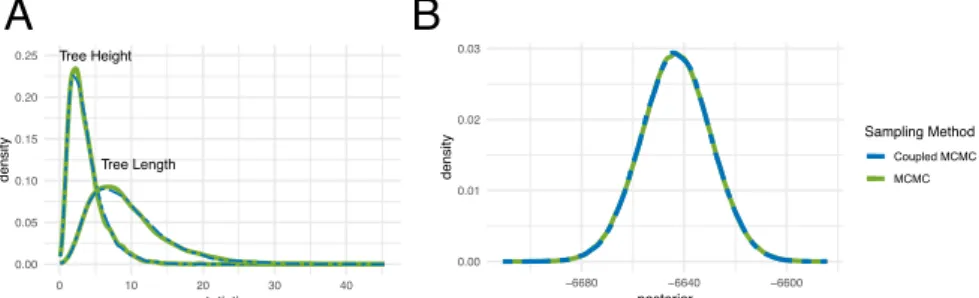
Figure 1: Comparison of inference between coupled and regular MCMC. A Comparison of the distribution of tree heights and tree lengths sampled under the structured coalescent using MultiTypeTree (Vaughan et al., 2014). The inferred distribution of tree heights and tree lengths match up be-tween MCMC and the cold chains in coupled MCMC. B Comparison of the distribution of posterior probability estimates of a Bayesian Coalescent Sky-line (Drummond et al., 2005) analysis of Hepatitis C in Egypt (Ray et al., 2000).
exchange the operator specifications and logger. We exchange the operator
109
specifications such that the step size of operators can be optimized to run
110
at specific temperatures. The loggers are exchanged such that each heated
111
chain logs its states to the log file that corresponds to its temperature and
112
not the number of the chain.
113
We implemented the coupled MCMC algorithm such that finished runs
114
to be resumed. In case that chains did not fully convergence just yet, it
115
is not necessary to restart the analysis scratch, which is of great practical
116
value.
117
Usually, a graphical user interface called BEAUti is used to set up
118
BEAST 2 analyses. Setting up analyses with coupled MCMC works
dif-119
ferently depending on whether a BEAUTi template is needed to set
120
up an analysis as required for some packages. If no such template is
121
needed, an analysis can be set up to run with coupled MCMC directly
122
in BEAUTi and we provide a tutorial on how to do this on https: 123
//taming-the-beast.org/tutorials/CoupledMCMC-Tutorial/
(Barido-124
Sottani et al., 2017).
125
Data Availability and Software
126
The BEAST 2 package coupledMCMC can be downloaded by using the
127
package manager in BEAUti. The source code for the software
pack-128
age can be found here:https://github.com/nicfel/CoupledMCMC. The
129
XML files used for the analysis performed here can be found inhttps: 130
//github.com/nicfel/CoupledMCMC-Material. All plots were done using
131
ggplot2 (Wickham, 2016) in R (Team et al., 2013).
132
Validation
133
Similar to the validation of MCMC operators, we can sample under the
134
prior to validate the implementation of the coupled MCMC approach. To
135
do so, we sampled typed trees with 5 taxa and two different states under
136
the structured coalescent using MultiTypeTree (Vaughan et al., 2014).
Figure 2: Convergence of coupled MCMC and regular MCMC using posterior ESS values and Kolmogorov Smirnov distances. A Here, we show the distribution of posterior ESS values after 4∗107 for regular MCMC
and after 1∗107 for coupled MCMC with 4 chains. The cold scenario uses
coupled MCMC, but does not use any heating. The warm scenario uses slightly heated chains and the hot scenario relatively hotter chains.BHere we show the distribution of Kolmogorov Smirnov distances between individual runs and the concatenation of all individual runs. We assume that all 400 runs concatenated describe the true distribution of posterior values and then take the KS distance as a measure of how good an individual run approximates that distribution. The smaller a KS value, the better the true distribution was approximated.
We did this sampling once using regular MCMC and once using coupled
138
MCMC. If the implementation of the coupled MCMC algorithm explores
139
the same parameter space as regular MCMC, parameters sampled
us-140
ing both approaches should match. We ran coupled MCMC proposing to
141
exchange states between chains every 1000 iterations. In figure 1A, we
142
compare the distribution of different summary statistics of typed trees
143
between MCMC and coupled MCMC. For all the summary statistics
con-144
sidered here, the distributions are the same.
145
Next, we validate that the coupledMCMC package estimates the same
146
parameters in a Bayesian coalescent skyline (Drummond et al., 2005)
anal-147
ysis of Hepatitis C in Egypt (Ray et al., 2000). To do so, we analysed the
148
Hepatitis C dataset once using coupled MCMC with 4 chains and once
us-149
ing regular MCMC. We find that the inferred posterior probability density
150
is the same between the two approaches(see figure 1B).
151
Results
152
The effect of heating on exploring the posterior
153
In order to explore how heating affects exploring the posterior probability
154
space, we first compare effective sample size (ESS) values between regular
155
and coupled MCMC at different temperatures on a dataset where we do
156
not expect any problems in exploring the posterior space caused by several
157
local optimas. To do so, we ran the Bayesian coalescent skyline
(Drum-158
mond et al., 2005) analysis of Hepatitis C in Egypt (Ray et al., 2000)
159
for 4∗107iterations using regular MCMC in 100 replicates. Additionally,
160
we performed 100 replicates using coupled MCMC on 4 different chains
161
for 1∗107 iterations using 3 different temperature scalers referred to as
162
cold, warm and hot. The different chains lengths are chosen such that the
163
overall number of iterations over the cold and heated chains is the same
164
for coupled as for regular MCMC. In the cold scenario, we did not use any
heating and exchanges between chains were accepted with a probability
166
of about 100%. In the other two scenarios, we used heating such that
ex-167
changes between chains were accepted with around 50% in the warm and
168
with about 25% in the hot scenario. After running all 4 times 100
anal-169
yses, we computed the ESS values of the posterior probability estimates
170
using loganalyser in BEAST 2 (Bouckaert et al., 2014).
171
As shown in figure 2, the average ESS values are highest for the cold
172
scenario when using coupled MCMC and drop the stronger the
temper-173
ature scaler becomes. Regular MCMC gets in average slightly lower ESS
174
values when using 4 times longer chains. The trends of ESS values are the
175
same when calculating ESS values using coda (Plummer et al., 2006) (see
176
figure S1).
177
In order to assess if coupled MCMC approximates the true distribution
178
of posterior values better than regular MCMC, we compared
Kolmogorov-179
Smirnov (KS) distances between individual runs and the true distribution
180
of posterior values. Since we can not directly calculate the true distribution
181
of posterior values, we concatenated the 400 regular and coupled MCMC
182
runs and used the concatenated distribution of posterior values as the
183
true distribution. Figure 2 shows the distribution of KS distances between
184
individual runs using regular and coupled MCMC to what we assume to
185
be the true distribution. In contrast to the comparison of ESS values,
186
we find that the distribution of KS distances is fairly comparable across
187
all methods. This indicates that in this analysis, coupled MCMC with 4
188
individual chains performs equally well as regular MCMC run for 4 times
189
as long.
190
We next compare the inference of trees on a dataset DS1 that has
191
proved problematic for tree inference using MCMC (Lakner et al., 2008;
192
H¨ohna and Drummond, 2011; Maturana Russel et al., 2018). This dataset
193
has many different tree island, transitioning between which is highly
un-194
likely due to very unfavourable intermediate states (H¨ohna and
Drum-195
mond, 2011).
196
We ran the dataset using regular MCMC for 5∗107iteration and
cou-197
pled MCMC for 5∗107 with 4 different chains. We ran coupled MCMC
198
without heating (cold) with a maximum temperature of 0.2 (warm) and
199
the maximum temperature being 1.0 (hot). MCMC converges to different
200
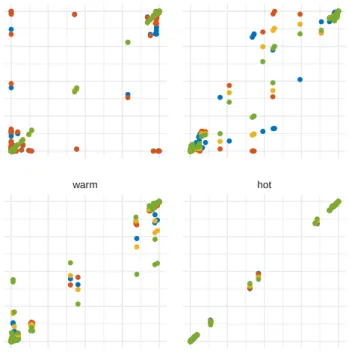
optimas, resulting in differences between inferred clade credibilities across
201
different runs (see figure 3). The clade credibilities are more comparable
202
when using multiple chains but no heating (cold). The increased
consis-203
tency of clade credibilities across runs is in this case due to the main
204
chain essentially being an average over 4 MCMC runs. When using
heat-205
ing (warm and hot), the heated chains are able to more easily cross the
206
unfavourable intermediate states in tree space, resulting in a better
con-207
sistency of clade credibilities across different runs for the warm scenario
208
and essentially the same clade credibilities across different runs in the hot
209
scenario.
210
Conclusion
211
Next generation sequencing has made ever larger datasets of genetic
se-212
quence available to researcher. To study these, more and more complex
213
models are developed, many of which are implemented in the Bayesian
214
phylogenetic software platform BEAST 2 (Bouckaert et al., 2014).
Par-215
allelising these models can often be hard or even impossible and MCMC
● ● ● ● ● ● ● ● ●●●●● ● ● ● ●●● ● ● ●● ● ● ● ● ● ● ● ● ● ● ● ● ● ● ● ●● ● ● ● ● ●● ● ● ● ●● ●●● ● ● ● ● ● ● ● ●● ● ● ●● ● ● ● ● ● ● ● ● ● ● ● ● ● ● ● ● ● ● ●● ● ● ● ● ● ● ● ● ● ● ● ● ● ●●●●●●●●● ● ●●● ● ● ● ● ● ● ● ● ● ● ● ● ● ● ● ● ● ● ● ● ● ● ● ● ● ● ● ● ● ● ● ● ● ● ● ● ● ● ● ● ● ● ●●●●●● ● ● ● ●●●● ●● ● ● ● ● ● ● ● ● ●●● ● ● ● ●● ● ● ● ● ● ● ● ●● ●● ●● ● ● ● ● ● ● ● ● ● ● ●● ● ● ● ● ● ● ● ● ● ● ● ● ● ● ● ● ● ● ● ● ● ● ● ● ● ● ●● ● ● ● ● ● ●●●●●●●●●●● ● ●●● ● ● ● ● ● ● ● ● ● ● ● ● ● ● ● ● ● ● ● ● ● ● ● ● ● ● ● ● ● ● ● ● ● ● ● ● ● ● ● ● ● ● ● ● ● ● ● ● ● ● ● ● ● ● ● ● ● ● ● ● ● ● ● ● ● ● ● ● ● ● ● ● ● ● ● ●● ● ● ● ● ● ● ●● ● ● ● ● ● ● ● ● ● ● ● ● ● ● ● ● ● ● ● ● ● ● ● ● ● ● ● ● ● ● ● ● ● ● ● ● ● ● ● ● ● ● ● ● ● ● ● ● ● ● ● ● ● ● ● ● ● ● ● ● ● ● ● ● ● ● ● ● ● ● ● ● ● ● ● ● ●● ● ● ●● ● ● ● ● ● ● ● ● ● ● ● ● ● ● ● ● ●● ● ●●●●●● ●● ● ● ● ● ● ●● ●● ● ● ●● ● ● ● ● ● ● ● ● ● ● ● ● ● ● ● ● ● ● ● ● ● ● ● ● ● ● ● ● ● ● ● ● ● ● ● ● ● ● ● ● ● ● ● ● ● ● ● ● ● ● ● ● ● ● ● ● ● ● ● ● ● ● ● ● ● ● ● ● ● ● ● ● ● ● ●● ● ● ● ● ● ● ● ● ● ● ● ●● ●● ● ● ● ●●●●●●●●●●●●●●● ● ● ● ● ● ●● ● ● ● ● ● ● ●● ● ● ● ● ● ● ● ● ● ● ● ● ● ● ● ● ● ● ● ● ● ● ● ● ● ● ● ● ● ● ● ● ● ● ● ● ● ● ● ● ● ● ● ● ● ● ● ● ● ● ● ● ● ● ● ● ● ● ● ● ● ● ● ● ● ● ● ● ● ● ● ● ● ● ● ● ● ● ● ● ● ● ● ● ● ● ● ● ● ● ●● ● ● ● ●● ● ●● ●● ● ● ●● ● ● ● ● ● ● ● ●●●●●● ● ● ● ● ● ● ● ● ● ● ● ● ● ● ● ● ● ● ● ● ● ● ● ● ● ● ● ● ● ● ● ● ● ● ● ● ● ● ● ● ● ● ● ● ● ● ● ● ● ● ● ● ● ● ● ● ● ● ● ● ● ● ● ● ● ● ● ● ● ● ● ● ● ● ● ● ● ● ● ● ● ● ● ● ● ● ● ● ● ● ● ● ● ● ● ● ● ● ● ● ● ● ● ● ● ● ● ● ● ● ● ● ● ● ● ● ● ● ● ● ● ● ● ● ● ● ● ● ● ● ● ● ● ●● ● ● ● ● ●●●●●●●●●●●●●●●●● ●●● ● ● ● ● ● ● ● ● ● ● ● ● ● ● ● ● ● ● ● ● ● ● ● ● ● ● ● ● ● ● ● ● ● ● ● ● ● ● ● ● ● ● ● ● ● ● ● ● ● ● ● ● ● ● ● ● ● ● ● ● ● ● ● ● ● ● ● ● ● ● ● ● ● ● ● ● ● ● ● ● ● ● ● ● ● ● ● ● ● ● ● ● ● ● ● ● ● ● ●●● ● ●● ●●●● ● ● ● ●● ● ● ● ● ● ● ● ●● ● ●●● ●●●●●●●●● ● ● ● ● ● ●●●● ● ●●● ● ● ● ● ● ● ● ●●● ● ● ● ● ● ●● ● ● ● ● ● ● ● ● ● ● ● ● ● ● ● ● ● ● ● ● ● ● ● ● ● ● ● ● ● ● ● ● ● ● ● ● ● ● ● ● ● ● ● ● ● ● ● ● ● ● ● ● ● ● ● ● ● ● ● ● ● ● ● ● ● ● ● ● ● ● ● ● ● ● ● ● ● ● ● ● ● ● ●● ● ●● ● ● ● ● ● ● ● ● ● ● ● ● ● ● ● ●● ● ● ● ●● ● ●● ●● ● ●● ● ● ● ● ● ● ● ● ● ●● ●●● ● ● ● ● ● ● ● ● ● ● ● ● ● ● ● ● ● ● ● ● ● ● ● ● ● ● ● ● ● ● ● ● ● ● ● ● ● ● ● ● ● ● ● ● ● ● ● ● ● ● ● ● ● ● ● ● ● ● ● ● ● ● ● ● ● ● ● ● ● ● ● ● ● ● ● ● ● ● ● ● ● ● ● ● ●●●●●●●● ● ● ●●●●●● ● ● ● ● ● ●● ● ●● ●● ●●● ● ●●● ● ●● ● ●● ● ● ● ● ● ● ● ● ● ● ● ● ● ● ● ● ● ● ● ● ● ● ● ● ● ● ● ● ● ● ● ● ● ● ● ● ● ● ● ● ● ● ● ● ● ● ● ● ● ● ●●● ●●● ● ● ● ● ● ● ● ● ● ● ● ● ● ● ● ● ● ● ● ● ● ● ● ● ● ● ● ● ● ● ● ● ● ● ● ● ● ● ● ● ● ● ● ● ● ● ● ● ● ● ● ● ●●● ●●● ● ● ● ● ● ● ● ● ●● ●●● ● ● ● ●●● ● ●● ●●● ●●● ● ●● ●● ● ● ● ● ● ● ● ●● ● ● ● ● ● ● ● ● ● ● ● ● ● ● ● ● ● ● ● ● ● ● ● ● ● ● ● ● ● ● ● ● ● ● ● ● ● ● ● ● ● ● ● ● ● ● ● ● ● ● ● ● ● ● ● ● ● ● ● ● ● ● ● ● ● ● ● ● ● ● ● ● ● ● ● ● ● ● ● ● ● ● ● ● ● ● ● ● ● ● ● ● ● ● ● ● ● ● ● ● ● ● ● ● ● ● ●●● ●●● ● ● ● ● ● ● ● ● ● ● ● ● ● ● ● ● ● ●● ●●● ●●●● ●●●● ●● ● ● ● ● ● ● ● ● ● ● ● ● ● ● ● ● ● ● ● ● ● ● ● ● ● ● ● ● ● ● ● ● ● ● ● ● ● ● ● ● ● ● ● ● ● ● ● ● ● ● ● ● ● ● ● ● ● ● ● ● ● ● ● ● ● ● ● ● ● ● ● ● ● ● ● ● ● ● ● ● ● ● ● ● ● ● ● ● ● ● ● ● ● ● ● ● ● ● ● ● ● ● ● ● ● ● ● ● ● ● ● ● ● ●● ● ● ● ● ● ● ●● ● ● ● ● ● ● ● ● ● ● ● ● ● ● ● ●● ● ● ●● ●● ● ● ● ● ● ● ● ● ● ● ● ● ● ● ● ● ● ● ● ● ● ● ● ● ● ● ● ● ● ● ● ● ● ● ● ● ● ● ● ● ● ● ● ● ● ● ● ● ● ● ● ● ● ● ● ● ● ● ● ● ● ● ● ● ● ● ● ● ● ● ● ● ● ● ● ● ● ● ● ● ● ● ● ● ● ● ● ● ● ● ● ●● ● ● ● ● ● ● ● ● ● ● ● ● ● ●● ● ● ● ● ● ● ● ● ● ●●● ● ● ● ● ● ● ● ● ● ● ● ● ● ● ● ● ● ● ● ● ● ● ● ● ● ● ● ● ● ● ● ● ● ● ● ● ● ● ● ● ● ● ● ● ● ● ● ● ● ● ● ● ● ● ● ● ● ● ● ● ● ● ● ● ● ● ● ● ● ● ● ● ● ● ● ● ● ● ● ● ● ● ● ● ● ● ● ● ● ● ● ● ● ● ● ● ● ● ● ● ● ● ● ● ● ● ● ● ● ● ●● ● ● ● ● ● ● ● ● ● ● ● ● ●● ● ● ● ● ● ● ● ● ● ● ● ● ● ● ● ● ● ● ● ● ● ● ● ● ● ● ● ● ● ● ● ● ● ● ● ● ● ● ● ● ● ● ● ● ● ● ● ● ● ● ● ● ● ● ● ● ● ● ● ● ● ● ● ● ● ● ● ● ● ● ● ● ● ● ● ● ● ● ● ● ● ● ● ● ● ● ● ● ● ● ● ● ● ● ● ● ● ● ● ● ● ● ● ●● ● ● ● ● ● ● ● ● ● ● ● ● ●● ● ● ● ● ● ● ● ● ● ● ● ● ● ● ● ● ● ● ● ● ● ● ● ● ● ● ● ● ● ● ● ● ● ● ● ● ● ● ● ● ● ● ● ● ● ● ● ● ● ● ● ● ● ● ● ● ● ● ● ● ● ● ● ● ● ● ● ● ● ● ● ● ● ● ● ● ● ● warm hot mcmc cold 0.00 0.25 0.50 0.75 1.00 0.00 0.25 0.50 0.75 1.00 0.00 0.25 0.50 0.75 1.00 0.00 0.25 0.50 0.75 1.00
clade probabilities in replicate run
clade probabilities in first r
un replicate run ● ● ● ● 2 3 4 5
Figure 3:Inferred clade probabilities between different replicate runs.
Here we compare inferred clade credibilities between one run (y-axis) and four replicates from different starting points (x-axis) using MCMC and coupled MCMC run at different temperature increments.
analyses often have to be run on single CPU cores. Alternatively, coupled
217
MCMC can make use of multiple cores, but a full featured version was
218
so far not available in BEAST 2. Here, we provide an implementation of
219
the coupled MCMC algorithm for BEAST 2.5 (Bouckaert et al., 2018).
220
We showed that this implementation explores the same posterior space as
221
regular MCMC and we give an example for when the heating of chains
222
can drastically improve convergence. While ESS values are higher on
cou-223
pled MCMC runs with 4 chains and no heated than on regular MCMC
224
runs that are run for 4 times longer, the distribution of posterior
proba-225
bility values was not better approximated by those runs. This indicates
226
that convergence statistics like the scale reduction factor (Brooks and
227
Gelman, 1998), might be better suited to assess convergence than ESS
228
values. Since the coupled MCMC runs required 4 times less iterations of
229
the cold chain to approximate the distribution of posteriors values as well,
230
coupled MCMC can help speed up analysis by a factor that is
approxi-231
mately proportional to the number of CPU’s used. This implementation
232
is compatible with other BEAST 2 packages, so works with any model
233
that works with MCMC.
234
Acknowledgement
235
NFM is funded by the Swiss National Science foundation (SNF; grant
236
number CR32I3 166258).
237
Authors contribution
238
NFM and RB implemented the code, NFM performed the analyses and
239
NFM and RB wrote the paper.
240
References
241
Altekar, G., Dwarkadas, S., Huelsenbeck, J. P., and Ronquist, F. (2004). Parallel
242
metropolis coupled markov chain monte carlo for bayesian phylogenetic inference.
243
Bioinformatics,20(3), 407–415.
244
Barido-Sottani, J., Boˇskov´a, V., Plessis, L. D., K¨uhnert, D., Magnus, C., Mitov, V.,
245
M¨uller, N. F., PeˇcErska, J., Rasmussen, D. A., Zhang, C., et al. (2017). Taming
246
the beast?a community teaching material resource for beast 2. Systematic biology,
247
67(1), 170–174.
248
Bouckaert, R., Heled, J., K¨uhnert, D., Vaughan, T., Wu, C.-H., Xie, D., Suchard,
249
M. A., Rambaut, A., and Drummond, A. J. (2014). Beast 2: a software platform
250
for bayesian evolutionary analysis. PLoS computational biology,10(4), e1003537.
251
Bouckaert, R., Vaughan, T. G., Barido-Sottani, J., Duchene, S., Fourment, M.,
252
Gavryushkina, A., Heled, J., Jones, G., Kuhnert, D., De Maio, N., et al. (2018).
253
Beast 2.5: An advanced software platform for bayesian evolutionary analysis.
254
BioRxiv, page 474296.
255
Brooks, S. P. and Gelman, A. (1998). General methods for monitoring convergence
256
of iterative simulations. Journal of computational and graphical statistics,7(4),
257
434–455.
258
Drummond, A. J., Rambaut, A., Shapiro, B., and Pybus, O. G. (2005). Bayesian
coa-259
lescent inference of past population dynamics from molecular sequences. Molecular
260
biology and evolution,22(5), 1185–1192.
261
Geyer, C. J. (1991). Markov chain monte carlo maximum likelihood.
Gilks, W. R. and Roberts, G. O. (1996). Strategies for improving mcmc. Markov
263
chain Monte Carlo in practice,6, 89–114.
264
H¨ohna, S. and Drummond, A. J. (2011). Guided tree topology proposals for bayesian
265
phylogenetic inference. Systematic biology,61(1), 1–11.
266
Lakner, C., Van Der Mark, P., Huelsenbeck, J. P., Larget, B., and Ronquist, F. (2008).
267
Efficiency of markov chain monte carlo tree proposals in bayesian phylogenetics.
268
Systematic biology,57(1), 86–103.
269
Maturana Russel, P., Brewer, B. J., Klaere, S., and Bouckaert, R. R. (2018). Model
se-270
lection and parameter inference in phylogenetics using nested sampling. Systematic
271
biology,68(2), 219–233.
272
Plummer, M., Best, N., Cowles, K., and Vines, K. (2006). Coda: convergence diagnosis
273
and output analysis for mcmc. R news,6(1), 7–11.
274
Pybus, O., Drummond, A., Nakano, T., Robertson, B., and Rambaut, A. (2003). The
275
epidemiology and iatrogenic transmission of hepatitis c virus in egypt: a bayesian
276
coalescent approach. Molecular biology and evolution,20(3), 381–387.
277
Ray, S. C., Arthur, R. R., Carella, A., Bukh, J., and Thomas, D. L. (2000). Genetic
278
epidemiology of hepatitis c virus throughout egypt. The Journal of infectious
279
diseases,182(3), 698–707.
280
Suchard, M. A. and Rambaut, A. (2009). Many-core algorithms for statistical
phylo-281
genetics. Bioinformatics,25(11), 1370–1376.
282
Team, R. C. et al. (2013). R: A language and environment for statistical computing.
283
Vaughan, T. G., K¨uhnert, D., Popinga, A., Welch, D., and Drummond, A. J. (2014).
284
Efficient bayesian inference under the structured coalescent. Bioinformatics,
285
30(16), 2272–2279.
286
Wickham, H. (2016). ggplot2: elegant graphics for data analysis. Springer.