Department of Computer Science and Software Engineering University of Canterbury
September 2007
Fitting Free-Form Question-Asking and
Spatial Ability into ITS Development
A thesis submitted in partial fulfilment of the requirements
for the Degree of Master of Science in Computer Science
in the University of Canterbury by
Nancy Milik
Supervisor: Associate Professor Dr. Antonija Mitrovi´c
1Associate supervisors: Dr. Michael Grimley
2and Associate Professor
Dr. Timothy Bell
1Examiner: Vania Dimitrova
31Department of Computer Science and Software Engineering, University of Canterbury 2Department of Education, University of Canterbury
Acknowledgements
Thank you God for allowing me to survive the challenges of this research, especially writing a thesis!
I’d like to thank my awesome supervisor, Dr. Tanja Mitrovi´c, for her constant and valuable support and guidance throughout this research project; it is a privilege to work under her supervision. Thank you to Dr. Mick Grimley for his advise on the spatial abilityaspect of this project and feedback on drafts of this thesis. Thank you also to Dr. Tim Bell for feedback on earlier states of this project.
A huge thank you to my fellow ICTGers: Amali Weerasinghe, Amanda Nicholas, Devon Barrow, Jay Holland, Konstantin Zakharov, Moffat Mathews, Nilufar Baghaei, Pramudi Suraweera and Dr. Brent Martin. Thank you so very much for all the help, support, laughs, chats, jokes, technical tips and social time. Thanks for providing enter-tainment, good laughs and unforgettable memories, and for just being good friends.
I’d like to especially thank Amali, Jay and Kon for all their help and support through-out this research and in particular over the past couple of months. Thank you for the various tips and technical shortcuts, and for proof-reading bits and pieces of this docu-ment, especially thanks fortryingto keep my sanity and for all the pep-talks. Also I’ve to thank Kon for introducing me toWinEdt and for the numerous latex tips and tricks that produced this document.
There are not enough words to express how blessed I am with my parents and broth-ers; where would I be without you or your prayers. In particular to this research, thank you dad and mum for all your encouragements that made surviving this challenge pos-sible. My talented brother Fady, thanks for designing the posters presented in this re-search. My baby brother Bassam, thank you for putting up with me especially during the last period. Thank you for being the best family ever!
done, may the Lord reward you in His ways.
There is so much I’d like to say here but I realise this isn’t an Oscar award speech. So to sum it up thank you to everyone who I have met over the duration of this research, each one has influenced this work in one way or another. Thanks to all those who brought a smile to my face, especially over the past period.
Finally, thanks is due togoogle for easing the information retrieval/research aspect of this research. This research was supported by an ICTG scholarship.
Contents
Acknowledgements i
List of Figures vii
List of Tables ix
Abstract i
Chapter 1 Introduction 1
1.1 The Learning Battle . . . 1
1.2 The Learning Process . . . 3
1.2.1 Model of Learning . . . 3
1.2.2 Information Processing and Memory . . . 4
1.3 Research Content . . . 5
1.4 Thesis Structure . . . 7
Chapter 2 Background 9 2.1 Intelligent Tutoring Systems . . . 10
2.1.1 Student Modelling . . . 12
2.1.2 Constraint Based Modelling . . . 13
2.1.3 Constraint-Based Tutors . . . 14 iii
2.2 Meta-Cognitive Skills . . . 15 2.3 Individual Differences . . . 17 Chapter 3 ERM-Tutor 21 3.1 The Task . . . 22 3.2 Overview of ERM-Tutor . . . 25 3.2.1 Student Interface . . . 26 3.2.2 Problem Representation . . . 30 3.2.3 Problem Solver . . . 31
3.2.4 Domain and Student Models . . . 32
3.3 Enhancements to ERM-Tutor . . . 34
3.3.1 The Constraint Set . . . 35
3.3.2 The Interface . . . 36
Chapter 4 Question Asking 39 4.1 Question Generation . . . 40
4.1.1 Nature of Questions . . . 41
4.1.2 Types of Questions . . . 43
4.2 Relevant Research in ITSs . . . 45
4.2.1 ALPS . . . 45
4.2.2 AutoTutor . . . 45
4.2.3 Biology Circulatory System . . . 47
4.2.4 VTA . . . 48
4.3 Our Question-Asking Module . . . 48
4.3.1 Questions Database . . . 50
4.3.2 Information Retrieval Mechanism . . . 51
Contents v
Chapter 5 Spatial Ability 59
5.1 Cognitive Theory of Multimedia Learning . . . 60
5.2 Spatial Ability . . . 65
5.2.1 Measuring Spatial Ability . . . 67
5.3 Our Spatial Ability Module . . . 70
5.3.1 Feedback Messages . . . 71 5.3.2 Customisation of ERM-Tutor . . . 73 Chapter 6 Evaluation 77 6.1 Preliminary Evaluation (2005) . . . 78 6.1.1 Procedure (2005) . . . 79 6.1.2 Results (2005) . . . 80 6.1.3 Summary (2005) . . . 82 6.2 Evaluation Study (2006) . . . 82 6.2.1 Procedure (2006) . . . 84 6.2.2 Results (2006) . . . 85 6.2.3 Summary (2006) . . . 90 6.3 Evaluation Study (2007) . . . 90
6.3.1 Variations in contrast to the 2006 Study . . . 91
6.3.2 Procedure (2007) . . . 93 6.3.3 Results (2007) . . . 94 6.4 Discussion . . . 115 Chapter 7 Conclusions 123 7.1 Research Contribution . . . 124 7.1.1 Question-Asking Module . . . 125
7.2 Future Work . . . 128
References 133
Appendix A Information and Consent Form 145
Appendix B Domain Knowledge Tests 147
B.1 Test Version A . . . 147 B.1.1 solution . . . 150 B.2 Test Version B . . . 150
Appendix C Questionnaire 153
Appendix D Spatial Ability Tests 157
D.1 Paper Fold Test . . . 157 D.2 Card Rotation Test . . . 160
Appendix E ITS 2006 Short Paper 163
E.1 Presented Poster . . . 167
Appendix F NZCSRSC 2007 Paper 169
Appendix G AIED 2007 Short Paper 179
G.1 Presented Poster . . . 183
List of Figures
1.1 Model of Learning . . . 3
1.2 Architecture of our memory system . . . 4
2.1 Architecture of a typical ITS . . . 11
3.1 Architecture of ERM-Tutor . . . 27
3.2 Snapshot of the original version of ERM-Tutor . . . 28
3.3 Graphical problem representation in ERM-Tutor . . . 30
3.4 A snapshot of the modified version of ERM-Tutor . . . 37
3.5 Steps-line showing Step 4 as the current step . . . 38
4.1 Snapshot of question-asking in ALPS . . . 46
4.2 Basic idea of the question asking module . . . 49
4.3 Architecture of ERM-Tutor . . . 54
4.4 ERM-Tutor interface with Questions module . . . 56
4.5 Close up on the Questions module . . . 57
5.1 The dual learning channel . . . 62
5.2 An annotated illustration . . . 63
5.3 Paper folding test instruction . . . 68
5.4 Paper folding test example . . . 68 vii
5.5 Card rotations test instruction . . . 69
5.6 Card rotations test example . . . 69
5.7 Example of a constraint in multimedia representation . . . 73
5.8 Architecture of ERM-Tutor . . . 74
5.9 Snapshot of ERM-Tutor with a multimedia feedback message . . . 76
6.1 The newly added question to tests A and B . . . 93
6.2 Groupings of participants . . . 97
6.3 Pre- and post-test scores for the four groups . . . 99
6.4 Number of attempted problems by the four groups . . . 104
6.5 Learning curve for all participants . . . 106
6.6 Learning curves for the four groups . . . 107
6.7 Learning curves for the different groupings of participants . . . 108
6.8 Number of constraints learnt for the four groups . . . 109
List of Tables
3.1 Summary of ER diagram notation . . . 24
5.1 Principles for the design of multimedia messages . . . 64
6.1 Mean system interaction details (standard deviation) (2005) . . . 80
6.2 Percentage of question types asked (2005) . . . 81
6.3 Evaluation study experimental design (2006) . . . 83
6.4 Spatial ability test scores (2006) . . . 86
6.5 Participants assignment to groups (2006) . . . 86
6.6 Pre-test and post-test scores (2006) . . . 87
6.7 Mean (sd) pre-test and post-test scores for groups (2006) . . . 87
6.8 Spatial ability test scores (2007) . . . 95
6.9 Participants assignment to groups (2007) . . . 96
6.10 Pre-test and post-test scores (2007) . . . 98
6.11 Mean (sd) pre-test and post-test scores for groups (2007) . . . 98
6.12 Mean (sd) pre-test and post-test scores for all classifications (2007) . . . 100
6.13 ANCOVA results (2007) . . . 101
6.14 Summary of means (sd) of system interaction results (2007) . . . 103
6.15 Percentage of question types asked (2007) . . . 110
6.16 Summary of means (sd) of subjective results for ERM-Tutor (2007) . . 113
6.17 Examples of students subjective comments (2007) . . . 116 6.17 Examples of students subjective comments (2007) continued . . . 117
Abstract
Intelligent Tutoring Systems (ITSs) are problem-solving environments that provide individualised instruction and are able to adapt to the abilities and needs of each individ-ual student in order to maximise effective learning. They provide feedback on students’ actions, but a problem arises when students do not always understand the feedback they receive. Therefore, it would be beneficial for students to be able to ask for additional clarifications at any time, and to receive feedback customised to their individual dif-ferences. This research focuses on providing an additional help channel in ITSs where students are able to ask free-form questions, as well as accounting for the students’ psychometric measure of spatial ability.
We describe ERM-Tutor, the test-bed ITS chosen for implementing our research framework. ERM-Tutor is a constraint-based tutoring system for teaching logical database design. Students practise this procedural task in ERM-Tutor by solving each step and receiving feedback on their solutions.
We also present our approach to addressing the meta-cognitive skill of question-asking in ERM-Tutor. We added a question-question-asking module that enables students to ask free-form questions and receive the most appropriate answers stored in the system. In addition, we investigated the potential of tailoring the feedback messages towards the learners’ psychometric measure of spatial ability. We modified ERM-Tutor to provide not only textual feedback messages, but also multimedia messages, containing a com-bination of text and pictures.
We performed a series of evaluation studies in order to evaluate the effectiveness of our proposed solutions. All our studies were conducted with tertiary students enrolled in
design and were asked to use ERM-Tutor to develop and practise their mapping skills. The results show an overall improvement in performance and learning gain for all students using ERM-Tutor. Interactions with the question-asking module show that most questions asked by students were task-focused, directly requesting help on spe-cific errors. The results confirm the need for addressing students’ questions inside an ITS environment. Furthermore, there were no conclusive results to support a difference in effectiveness of the textual versus multimedia feedback presentation modes with re-spect to the students’ spatial ability. However, we observed a number of trends indicat-ing that matchindicat-ing the instruction presentation mode towards the students spatial ability influences their perception of the system and motivation to use it, more than their learn-ing gain. Our results show promislearn-ing indications for further explorations.
We present our approaches, full analyses of the collected data from our evaluation studies, as well as our research contributions to the ITSs field. We also portray a number of future directions that will contribute towards maximising the effectiveness of learning in ITSs.
CHAPTER
1
Introduction
Learning, or constructing new knowledge, is an inevitable operation that faces everyone in their daily life. We have long been aware that individuals differ in their perception, processing and storage of information. In particular, we differ in how we select as well as extract the meaningful insights from the ‘big picture’, how we comprehend and make sense of any given feedback, and how we mentally represent the ‘finished’ piece of knowledge. Nonetheless there has been little research in the way of catering for our individual differences in learning. Through this research, we present our contribution to enhancing the learners’ experience by providing an additional channel for asking questions as well as catering for their spatial ability.
1.1 The Learning Battle
Let us start by defining the term ‘learning’. Some scholars have defined learning as solv-ing, or fitting in the pieces of, an unassembled jigsaw puzzle. In this view, information is the scrambled pieces of the jigsaw puzzle and knowledge is when it is constructed into its coherent shape or scene, that is, when it makes sense together.
We constantly face the challenge of acquiring new skills and knowledge. Rapid and widespread developments in technology have made information available and easily ac-cessible more than ever before. Such ease of access alone however, does not necessary result in a better learning gain. This has lead to an apparent trend in utilising tech-nology to facilitate learning. Although e-learning tools, such as WebCT [WebCT and Lane, 2002], are becoming more popular in educational institutions, they still do not effectively support learning. While they make it easier for teachers to present instruc-tional material and carry out some administrative tasks, they do not provide students with individualised feedback based on their performance, which is crucial for success-ful learning. An effective solution that provides adaptive pedagogical assistance for each student is Intelligent Tutoring Systems (ITSs).
ITSs are interactive computerised tutors that provide an environment where stu-dents carry out problem-solving activities, and receive feedback on their actions. As the student interacts with the system, it tracks their behaviour and produces, as well as maintains, a model of the student’s knowledge. This model is used in adapting the envi-ronment towards the needs, knowledge, learning abilities and preferences of the student. This includes decisions about the timing and content of teaching actions and feedback to be presented to each individual student. Such adaptations have been shown to result in significant improvement over simplistic e-learning tools, especially in fields that require practical proficiency [Koedinger et al., 1997; Mitrovi´c et al., 2001]. Nevertheless, this is still a growing discipline that is utilising findings in educational and psychological theories, new developments in the field of Artificial Intelligence and advancements in software and hardware technologies.
1.2. The Learning Process 3
1.2 The Learning Process
If learning is about knowledge, its construction and retention, then it is necessary to take a closer look at the existing model of learning as well as the learner’s memory system.
1.2.1 Model of Learning
A commonly used model of learning in today’s society [Kort and Reilly, 2002] is il-lustrated in Figure 1.1. It begins with a set ofdata given to the student. This data is a collection of answers to some unasked questions. The databecomesinformationonly when the appropriate question is asked, that is, in order for the data to be transformed into a piece of information, the learner must find the Question-Answer pairs that tie the data together. These Question-Answer pairs are organised into a structure, with new questions arising as questions are answered and stored. A deeper thought process, which includes reasoning about the new information and integrating it with previous experiences, is needed for assembling information intoKnowledge.
Figure 1.1: Model of Learning
From this model it can be concluded that the process of building and correcting knowledge structures is driven by the questions we ask. Therefore, asking good ques-tions is considered as a crucial meta-cognitive skill that plays a central role in learning. Meta-cognition is often referred to as “thinking about thinking”, which can be used to help studentslearn how to learn. In other words, meta-cognition refers to higher order
thinking that involves active control over the thinking processes involved in learning. Research has shown that those with greater meta-cognitive abilities tend to be more successful thinkers.
1.2.2 Information Processing and Memory
The learning process involves three main phases, as illustrated in Figure 1.2; sensing, processing and storing information. Firstly, we use our sensors to select the relevant information from our environment. Secondly, we organise the selected information into its logical structure, construct it into new knowledge and integrate it with the our previous knowledge, all of which takes place in our working, or short-term, memory. Finally, knowledge is then transformed into permanent storage, inside our long-term memory, via the process of encoding.
Figure 1.2: Architecture of our memory system
Successful learning requires a great deal ofattention. Dedicated attention is needed in selecting and processing the appropriate information. Moreover, in contrast to our long-term memory, the working memory is limited in its capacity. Therefore, to max-imise the learning gain, it is necessary not to overload the learner with information. It would be ideal for an effective learning environment to simplify the selecting phase and aid in the processing phase.
A possible way of making the selection of information simpler for learners is to ac-count for their spatial ability. Spatial ability is the ability to visualise and manipulate
1.3. Research Content 5
objects in space. We differ in the level of which we can spot, comprehend, and process information in its various forms. For instance, some learners may cope better with writ-ten text than with diagrams and charts. Since we react differently to the various forms of information, learning through our most effective form will minimise the overhead processing needed.
1.3 Research Content
One-to-one tutoring is a powerful method of promoting knowledge construction. There is substantial empirical evidence that human tutoring is extremely effective when com-pared to typical classroom environments [Bloom, 1984; Cohen et al., 1982; Corbett, 2001]. However, the high student-to-teacher ratio in many educational environments makes it unrealistic to provide the ideal one-to-one tutoring for every student. ITSs are an effective solution to this problem.
ITSs are believed to be a powerful technology in the educational process with the goal of maximising the learning effects. ITSs are effective learning tools due to the level of adaptive pedagogical assistance they provide. They make decisions about the timing and content of the teaching instructions and feedback to each student based on their individual state. Although ITSs provide feedback on students’ actions, the students do not always understand the feedback they receive. Therefore, it would be beneficial for students to be able to ask for additional clarifications at any time, and to receive feedback customised to their individual differences.
In particular, research has proven the need for further investigations of modelling meta-cognitive skills that enhance knowledge acquisition and facilitate deep learning. It is also shown that sophisticated learning environments should stimulate learner ques-tions and facilitate the process of receiving answers to the quesques-tions that learners ask,
thereby facilitating their ability to learn. Furthermore, it is believed that a one-size-fits-all scheme when dealing with learners is not the most effective nor efficient way of teaching.
In this research, we develop an environment that allows students to ask free-form questions, as well as provides feedback corresponding to the learner’s spatial ability, which are aimed to improve the effectiveness of the learners by enhancing deeper/mean-ingful learning. There are four main objectives to our research:
• Develop an environment designed to engage learners in question-asking during problem solving.
• Evaluate the effectiveness of such environment on learning.
• Extend the feedback module to incorporate a multimedia representation for learn-ers with high spatial ability.
• Evaluate the effectiveness of accommodating for different spatial ability levels. Building on successful work in constraint-based tutors, the project involves incorpo-rating a question-asking module into an existing ITS, mainly because building an ITS is beyond the main focus of this research. ERM-Tutor (Entity Relationship Mapping Tutor) [Marshall, 2004; Milik et al., 2006], an ITS developed at the Intelligent Com-puter Tutoring Group (ICTG)1, at the University of Canterbury2, has been chosen for its well-structured, close-ended task. The tutor allows students to design the relational schema for a given ER (Entity Relational) diagram using the standard seven-step map-ping algorithm [Elmasri and Navathe, 2000].
This research looks into the implication of providing a question-asking module that allows students to ask fee-form questions. It also investigates the potential of tailoring
1http://www.cosc.canterbury.ac.nz/tanja.mitrovic/ictg.html 2http://www.canterbury.ac.nz
1.4. Thesis Structure 7
the feedback messages to students’ ability to engage in spatial cognition. These goals are being tested through two hypotheses. The first hypothesis is that answering students’ open-ended questions will clarify their understanding and result in higher performance. The second hypothesis is that presenting the system’s responses tailored to the students’ individual differences will lead to more effective learning and higher learning gain.
The evaluation of these hypotheses involved conducting a number of studies at the University of Canterbury, in a second-year introductory database course offered by the department of Computer Science and Software Engineering, involving students learning entity relationship mapping.
The main contribution of this research is therefore, to evaluate the added value of question-answering in combination with adaptation to the learners’ spatial ability in an ITS learning environment.
1.4 Thesis Structure
The remainder of this thesis presents the context, approach and contributions of our research. Chapter 2 presents an overview of the relevant background information related to this research. In particular it describes ITSs and their typical architecture, as well as the constraint-based modelling approach to implementing them. This approach is used in implementing Tutor, the test-bed system for our research. We describe ERM-Tutor in Chapter 3, giving an overview of its problem-solving task, architecture and a number of key modifications made to enhance the learning experience while interacting with it.
Chapter 4 presents the question-asking aspect of our project. It describes the relevant background information to question-asking, focusing on the nature and importance of generating questions in a learning setting. It also discusses the question-asking module,
which was added into ERM-Tutor in order to respond to the students free-form questions while interacting with the system.
Chapter 5 details our approach to accounting for the students’ spatial ability. It discusses the Cognitive Theory of Multimedia Learning, which is used as the foundation for this research in customising the instructional messages to maximise the students’ effective learning.
Chapter 6 describes the series of evaluation studies conducted to test the hypotheses of this research. It presents a description of the studies, detailed analyses of the col-lected data and a discussion of the results. Finally, Chapter 7 concludes this thesis by presenting the conclusions of this research, as well as outlining future directions that will extend this research.
CHAPTER
2
Background
One-to-one human tutoring provides the most effective learning environment [Bloom, 1984]. However, high student-teacher ratio in traditional educational environments proves that one-to-one tutoring for every student is unrealistic. ITSs are an effective solution to this problem. ITSs are knowledge-based systems that provide an individu-alised learning environment, adapting to the knowledge, learning abilities and individual differences of each individual learner.
Research has found evidence that the effectiveness of ITSs is due to the level of the adaptive pedagogical assistance they provide. This ability to adapt is largely based on student models constructed by the ITS as a representation of the student’s current knowledge state. In recent years, there has been an increasing interest in modelling and accounting for the student’s meta-cognitive skills and abilities to enhance the learning experience. In addition, there is a shift in the field towards implementing educational and psychological theories, such as the effect of motivation on learning and how ITS can increase motivation [de Vicente and Pain, 2002].
This chapter introduces ITSs and highlights some relevant concepts to this research in the field. Section 2.1 presents a high level description of ITSs and their typical
chitecture. It also describes the constraint-based modelling approach to implementing them, which is used in ERM-Tutor, the test-bed system for this research. Section 2.2 presents an overview of the meta-cognitive skill of question-asking, while Section 2.3 presents an overview of individual differences that have an effect on learning. Addi-tional background material relevant to question-asking and spatial ability are discussed in the Chapters 4 and 5 respectively.
2.1 Intelligent Tutoring Systems
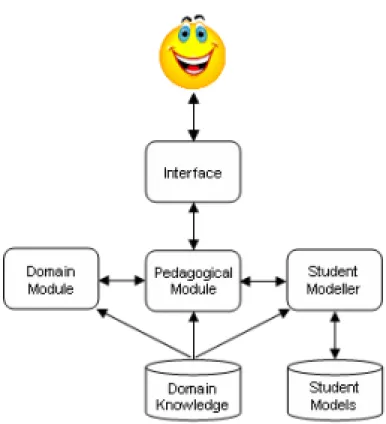
A question that is often asked is what makes ITSs intelligent? Pioneers in the field have attributed the intelligence of an ITS to its behaviour in terms of its adaptive course sequencing, problem-solving support, student diagnosis, adaptive feedback generation, adaptive problem generation, fading of scaffolding, and adaptive dialogue management. ITSs are being developed in accordance to many educational theories, ranging from the ones that support Socratic teaching, to the ones that accommodate for collaborative learning. The underlying architecture however, remains fairly consistent across these different types. A typical ITS consists of four main components [Alpert et al., 1999]: a domain module, a student modeller, a pedagogical module and an interface, as shown in Figure 2.1. The domain module contains explicit representation of the material to be taught. This material is displayed via the interface which is the communication medium between the student and the system. Upon the student’s interactions with the system the student modeller develops a representation of the student’s state, keeping track of the student’s progress over time. Then, based on the student model, the pedagogical module makes decisions about the timing and content of the instructions and feedback.
Figure 2.1: Architecture of a typical ITS
2.1.1 Student Modelling
Student modelling is the process of gathering relevant information to infer the current cognitive state of the student, thus forming a student model. The student model serves as an analogue to the representation of the student’s knowledge and skill level that a hu-man tutor develops during their interactions. Huhu-man tutors however, have an inherent advantage over computer tutors. In addition to assessing their students’ skills, they ob-serve and infer their meta-cognitive behaviour, personalities, learning styles, and affect states. They simply have a much wider variety of cues to work with when perceiving their students that the current computer tutors do not have. Although it has been shown that a student model can be useful even without being very accurate [Self, 1990], it is clear that the more accurate it is, the more effective it becomes.
Several studies have focused on investigating different aspects of the student mod-els, including what attributes to model and how to provide means for visualisation and inspection. It is evident that modelling mouse clicks and key presses is not sufficient enough to customise the learning process for the student. Many efforts therefore, have been invested in mimicking several of the features that human tutors effortlessly use when tutoring their students.
Various methods have been utilised to construct more personalised student models. These include inducing meta-cognitive skills from student interactions with the system, for example the use of help [Aleven et al., 2004] and self-explanation [Chi et al., 1994], and using additional tools ranging from personality questionnaires to new technologies such as input speech recognition, facial expression monitoring, and eye tracking.
2.1. Intelligent Tutoring Systems 13
2.1.2 Constraint Based Modelling
Constraint based modelling (CBM) [Ohlsson, 1994] is one of many modelling tech-niques that are used to model the student’s state as well as drive the pedagogical pro-cess. Based on the theory of learning from performance errors [Ohlsson, 1996], the domain is represented in terms of state constraints. Each constraint is an ordered pair
<Cr,Cs >, where Cr is the relevance condition and Cs is the satisfaction condition. The student solution is matched againstCr. The constraint whose relevance condition matches the student solution is considered satisfied if the student solution satisfies the Cs. Violated constraints signify errors that violate fundamental concepts of the domain. In other words, constraints are of the form:
“If<relevance condition>is true, then<satisfaction condition>had bet-ter also be true, otherwise something has gone wrong.”
For example, a constraint for driving in New Zealand roads, where the speed limit is 50km/h, could be written as:
“If<I am driving in New Zealand, and my speed limit is xkm/h>, then it ought to be the case that<x is less than or equal to50km/h>, otherwise something has gone wrong.”
The CBM approach reduces computational effort of student modelling to just pattern matching. It does not require a runnable expert module which are difficult to build for many domains, or extensive bug libraries which enumerate students’ misconceptions about the domain. Moreover, since CBM evaluates the problem state rather than the path taken to arrive at the state, it stands robust in the face of creative solutions from students as well as inconsistent problem solving strategies.
A number of constraint-based tutors have been developed within the Intelligent Computer Tutoring Group (ICTG) at the University of Canterbury [Mitrovi´c et al., 2004]. We present an overview of constraint-based tutors in the following subsection.
2.1.3 Constraint-Based Tutors
Constraint-based tutors represent the domain knowledge as a set of constraints. These constraints are used for evaluating the student’s solution for syntax and semantic er-rors. This knowledge base enables the ITS to identify correct student solutions by first matching all relevance patterns in the student solution against the problem state, then testing the satisfaction conditions. If the satisfaction condition is met by the student so-lution, the solution is correct, otherwise it is incorrect and the appropriate pedagogical action is taken. The student knowledge is also represented as a set of constraints. The short-term student model consists of a list of satisfied and a list of violated constraints for the current solution attempt. The long-term model includes the history of usage for each constraint. This information is used by the pedagogical module to adapt the ITS towards the students needs, for example to select the next appropriate problem for the student to work on, and to generate feedback.
Constraint-based tutors have been shown to enhance learning in a variety of do-mains [Mitrovi´c et al., 2001]. In EER-Tutor [Suraweera and Mitrovi´c, 2004; Mitrovi´c et al., 2004] students learn how to develop conceptual database schemas, and in SQL-Tutor [Mitrovi´c, 1998; Mitrovi´c and Ohlsson, 1999; Mitrovi´c et al., 2002] students learn how to pose queries on relational databases. These two tutors teach open-ended design tasks, while NORMIT [Mitrovi´c, 2002; Mitrovi´c et al., 2004; Mitrovi´c, 2005] teaches the procedural task of data normalisation. ERM-Tutor [Marshall, 2004; Milik et al., 2006] is another database tutor that teaches logical database design. This tutor
com-2.2. Meta-Cognitive Skills 15
pletes the constraint-based database suite [Mitrovi´c et al., 2004]. We chose ERM-Tutor as the test-bed for our research based on its relatively small domain-knowledge size and its well-structured, close-ended task. We present a detailed description of ERM-Tutor in Chapter 3.
Constraint-based tutors have also been developed in the area of language learning. In particular, CAPIT [Mayo and Mitrovi´c, 2001] teaches the rules of punctuation and capitalisation in English and LBITS [Martin, 2001] teaches vocabulary. Also in the area of foreign language acquisition there is a system that teaches verb endings in a German language tutor [Martin and Nicholas, 2007]. Moreover, in the area of Object-Oriented software design, COLLECT-UML [Baghaei et al., 2005] is a tutor that encourages col-laboration between students while learning UML design.
2.2 Meta-Cognitive Skills
Meta-cognition is defined in Webster’s New Millennium Dictionary of English [Web-ster, 2004] as the awareness and understanding of one’s thinking and cognitive pro-cesses. This awareness and understanding differentiates deep from shallow learning. Deep learning, as defined by Bloom [1956], requires the ability to use higher-order cog-nitive skills such as analysis (compare, contrast) and synthesis (integrate components into a new whole, draw relationships between concepts). Those learners who master such skills are intrinsically motivated and incorporate new ideas they are learning with existing knowledge and personal experiences, hence what they learn goes beyond get-ting the right answer or reproducing knowledge, and often lasts well after the course of study has ended [Bransford et al., 2000; Chi et al., 1994; Graesser and Person, 1994; Snow, 2002].
This area has been studied quite extensively in social contexts such as class-rooms [Karabenick, 1998]. Theories, such as inquiry learning, have focused on encour-aging learners to ask questions, formulate hypotheses, plan tests of hypotheses, collect and analyse data, explain results, and communicate findings to peers. However, it re-mains an interesting area for further exploration in interactive learning environments such as ITSs.
Researchers in the field of ITSs have explored various strategies to enhance meta-cognitive skills, such as self-explanation [Chi et al., 1994], help-seeking [Roll et al., 2007] and question-asking [Corbett et al., 2005]. The latter is a new concept that we are interested in exploring further.
Recent research in the field of ITSs has focused on assisting students with additional help facilities, investigating the students’ behaviour towards such facilities and evaluat-ing their impact on learnevaluat-ing. Research has shown that learners’ do not take advantage of many such opportunities because they either abuse the help function, or do not use the help function when it is appropriate [Aleven et al., 2004]. This has shifted the research to not only investigate how to get the students to learn the desired meta-cognitive skills but also how to get students to use them [Roll et al., 2007].
ITSs have the potential of responding to students’ questions as well as developing the students’ question generation skills. Allowing students to ask questions in a con-trolled learning environment, such as an ITS, will ensure that the answers returned are relevant to the problem-solving task. This is because for instance, although popular search engines, such as google1, are effective in retrieving a good match to the sub-mitted query, they do not always return the answer relevant for a particular domain. For example, when“what is an entity”is submitted into the google search engine, the returned results include general descriptions of an entity as a concept as well as
2.3. Individual Differences 17
scriptions from a number of fields including law, open system architecture, J2EE SDK, database management systems (DBMS) and computer games. In contrast, a controlled environment provided by an ITS has the added advantage of assisting the student to stay focused on the problem solving task. We present our approach to incorporating question-asking in an ITS environment in Chapter 4.
2.3 Individual Differences
It is clear that a one-size-fits-all in teaching does not meet the needs of all learners. In-dividual difference psychologyexamines how people are similar as well as different in their thinking, feeling and behaviour [Tyler, 1965]. Moreover, establishments by mod-ern cognitive science and educational psychology have discussed many categories of student diversity that have an impact on learning. Each person has an individual profile of characteristics, abilities and challenges that influence their perception and processing of information and learning. Examples of such diversities typically considered in re-search include gender, ethnicity, age, personality, motivation, intelligence, IQ, abilities, prior experiences, creativity, cognitive styles, learning styles, interests, self-efficacy, and the capacity to process information.
The literature is rich with theories and models that have been developed for classify-ing and addressclassify-ing such diversities to maximise the individual’s learnclassify-ing experience. In particular,psychometrics is the field of study concerned with the theory and technique of educational and psychological measurements. Psychometric measurements include the measurement of knowledge, abilities, attitudes, and personality traits. The field is primarily concerned with two research tasks: first, the construction of instruments and procedures for measurement; second, the development and refinement of theoretical approaches to measurement.
The first psychometric instruments were designed to measure the concept of intelligence. The commonly known historical approach is the Stanford-Binet IQ Test [Thorndike et al., 1986; Fancher, 1985], involving measurements of attention, memory and verbal skills. An alternative to measuring intelligence has been measuring cognitive capacities. Cognitive capacities within individuals include a general compo-nent, or general intelligence factor [Jensen, 1999], as well as cognitive capacity specific to a given domain. Psychometrics is applied widely in educational assessment to mea-sure cognitive abilities in domains such as reading, writing, and mathematics. Examples of such assessments include theClassical Test Theory[Crocker and Algina, 1986],Item Response Theory[Lord, 1980] andRasch Measurement Models[Rasch, 1980].
Another major focus in psychometrics have been on personality testing. There is a wide range of theoretical approaches to conceptualising and measuring personality. Some of the most known instruments include the Minnesota Multiphasic Personality Inventory[Butcher, 1992], the Five-factor Model(or “Big 5”) [McCrae and Costa Jr, 1987] and theMyers-Briggs Type Indicator [Pittenger, 1993]. Individual attitudes and subjective impressions have also been studied extensively in psychometrics. A common approach to their measurement is the use of theLikertscales.
There is an apparent trend towards the development of ITSs with pedagogical mate-rial being adaptively presented to users according to their domain-independent cognitive abilities. ITSs are essentially multimedia environments, utilising multiple forms of in-formation content in presenting instructional messages to the users. Some of the skills that are required to engage fully in multimedia learning seem to closely resemble the definition of spatial ability. Therefore, spatial ability is of interest to us.
Spatial ability refers to the ability of mentally manipulating two-dimensional and three-dimensional objects/figures. It is typically measured with simple cognitive tests and is suggested to be predictive of user performance with some types of user interfaces
2.3. Individual Differences 19
and domains [Steinke et al., 2004]. We present our approach to accounting for the students’ spatial ability in Chapter 4.
CHAPTER
3
ERM-Tutor
ITSs have proven to be successful learning tools, producing significant learning gains in a variety of domains. However, there is still room for expansion and improvement. For instance, there is still a gap between the theories ITSs currently address and research in related fields such as education and psychology; that is, there are a number of theories and strategies presented in the literature that have not been utilised in the development of ITSs. Our research addresses two such theories; students need to ask questions as well as receive instruction and feedback in accordance to their spatial ability, described in detail in Chapters 4 and 5, respectively.
In order to evaluate the effectiveness of our research an implementation of the pro-posed environments was necessary. We decided to use an existing ITS, mainly because building an ITS is beyond the main focus of this research. ERM-Tutor (Entity Rela-tionship Mapping Tutor) [Marshall, 2004; Milik et al., 2006], an ITS developed at the Intelligent Computer Tutoring Group (ICTG)1, at the University of Canterbury, was chosen as our test-bed ITS for its well-structured, close-ended task.
1http://www.cosc.canterbury.ac.nz/tanja.mitrovic/ictg.html
In this chapter, we present ERM-Tutor, a constraint-based tutor that teaches logical database design (i.e. mapping conceptual to logical database schemas). ERM-Tutor is a problem-solving environment, in which students practice this procedural task. The tu-tor allows students to design the relational schema for a given ER (Entity-Relationship) diagram using the standard seven-step mapping algorithm [Elmasri and Navathe, 2000]. ERM-Tutor complements classroom teaching; it is assumed that students have already learnt the mapping algorithm in lectures and are familiar with the database theory. Stu-dents are led sequentially through the seven steps of the mapping algorithm, through which the system analyses their solutions, and provides the students with tailored feed-back messages based on their knowledge.
ERM-Tutor was first developed in 2004 as part of an honours project [Marshall, 2004]. We have made a number of notable changes to ERM-Tutor in order prepare it for use in our evaluation studies. Some of these changes are presented in this chapter.
In the next section (Section 3.1), we present a general description of the problem solving task in ERM-Tutor. Section 3.2 describes the general architecture and function-ality of the system, while Section 3.3 outlines a number of the key enhancements made to ERM-Tutor.
3.1 The Task
Developing a database consistent with the user requirements is a complex task [Elmasri and Navathe, 2000]. Initially, the user requirements need to be analysed, and then a high-level representation of the database is produced; this process is calledconceptual data modelling. Conceptual data modelling is probably the most labour intensive and time consuming phase of the development process. A database schema is a conceptual representation of the data structures that are required by a database. The data structures
include the data objects, the associations between data objects, and the rules which govern operations on the objects. The goal of the database schema is to make sure that the all data objects required by the database are completely and accurately represented. Because the database schema uses easily understood notations and natural language, it can be reviewed and verified as correct by the end-users.
A database schema is also detailed enough to be used by the database developers as a blueprintfor building the physical database. The information contained in the database schema will be used to define the relations, primary and foreign keys. A poorly designed database will require more time in the long-term. Without careful planning for example, a database may be created that omits data required to create critical reports, produces results that are incorrect or inconsistent, and is unable to accommodate changes in the user’s requirements.
The most commonly used data model for conceptual database design is the Entity-Relationship (ER) model. This model, originally proposed by Chen [1976], describes the conceptual structure of a database in the form of entities and relationships; a sum-mary of the ER diagram notation is shown in Table 3.1. Because there are no database management systems (DBMS) based on conceptual data models, this high-level schema needs to be translated to a schema in a data model supported by the chosen DBMS; this process is known as the logical database design. The relational data model is usu-ally taught in introductory database courses, as well as the algorithm for mapping ER schemas into relational ones.
ERM-Tutor teaches the ER-to-Relational mapping algorithm as defined in [Elmasri and Navathe, 2000]. The algorithm consists of seven well-defined steps. Each step in the algorithm maps one concept from the ER diagram by either creating a new relation, or altering previously created relations by adding foreign keys and attributes. The seven steps of the algorithm are as follows:
Regular Entity Weak Entity Relationship Identifying relationship Simple Attribute Multivalued Attribute Composite Attribute Derived Attribute Key Attribute
Partial Key Attribute
1:1 Cardinality Ratio
1:N Cardinality Ratio
M:N Cardinality Ratio
Total Participation
N-ary Relationship
Table 3.1: Summary of ER diagram notation (Adapted from [Elmasri and Navathe, 2000])
3.2. Overview of ERM-Tutor 25 • Step 1: Map all regular entities and their simple attributes.
• Step 2: Map all weak entities and their simple attributes. • Step 3: Map all 1:1 relationship types.
• Step 4: Map all 1:N relationship types. • Step 5: Map all M:N relationship types. • Step 6: Map all multivalued attributes. • Step 7: Map all N-ary relationship types.
Although the algorithm is well-defined and short, students typically find it hard to learn and apply consistently. Therefore the existence of an intelligent and adaptive learning environment would be beneficial for students. The architecture of ERM-Tutor is discussed in the following section.
3.2 Overview of ERM-Tutor
ERM-Tutor is a web-based ITS, with a centralised architecture, where all tutoring func-tions are performed on the server side and all the data structures are also kept on the server side. Figure 3.1 illustrates the architecture of ERM-Tutor and the interaction between its components. ERM-Tutor is implemented in Lisp and runs within Alle-groServe, an extensible web server provided with Allegro Common Lisp (ACL)2. The main components include the pedagogical module, problem solver, student modeller, session manager and user interface. The tutor also contains a set of predefined prob-lems along with their ideal solutions which are specified by a human expert, a set of
constraints representing the domain knowledge and student models representing each student’s state.
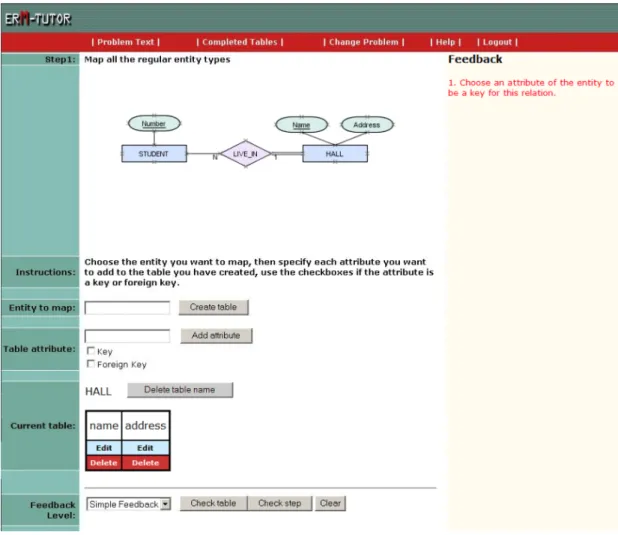
The student interacts with the system through its user interface (shown in Fig-ure 3.2). First, the student is required to log into the system. Upon a successful login, a session is established and the student’s model is retrieved, or a new model is created for those who login for the first time. The student can choose any problem to work on. The problems are ER diagrams to be mapped into relational schemas.
The problem-solving process is broken into seven tasks, corresponding to the seven steps of the mapping algorithm. The order of the steps is fixed, and the student is required to go through the steps of the algorithm in their specified order. Each step is presented to the student on a separate page. The student has to correctly complete the current step in order to move on to the next step. Once the student has completed a step, the interface for composing the solution for the next step is presented, and the student has access to all previously mapped relations. The student can at any time ask ERM-Tutor to analyse their solution. The student is also free to change the problem at any time.
Each of the major modules is described in more detail in the following subsections.
3.2.1 Student Interface
The interface, shown in Figure 3.2, is the communication medium between the student and the system. Students are able to view problems, work on their solutions and receive feedback. The problem-solving area is the main part of the page, and its general layout is the same for all steps. First, there is a short description of the student’s task for the current step. For example, for step two the task text reads“Map all weak entities”. This is basically to remind the student what is required at this step, rather than be educational
Figure 3.1: Architecture of ERM-Tutor
material in its own right. The problem is presented to the student as an ER diagram, but the student also has an option of seeing a textual description of the database, by clicking theProblem Textbutton. Underneath the diagram, brief instructions on what is expected in this step and how to use the input boxes to create or alter a table are presented. At any time, the student can view the solution developed so far by clicking theCompleted Tablesbutton; this pops up a window containing all the relations defined by the student for the current problem in the previous steps.
Figure 3.2: Snapshot of the student interface in the original version of ERM-Tutor
The interface provides the student with the working area to create or alter one rela-tion at a time. Each step of the algorithm is broken into subtasks. For example, in step
3.2. Overview of ERM-Tutor 29
one, the student maps one regular entity type at a time, and the system checks the result-ing relation before movresult-ing on to the next entity type. Figure 3.2 illustrates a situation when the student has mapped theHALL entity type, and has specified a relation, with the same name, with two attributes (NameandAddress). For each attribute, the student can specify whether it is a primary or foreign key. When the student completes the re-lation, they can request the system to check the solution. If there are any mistakes in the solution, ERM-Tutor provides feedback to the student. In Figure 3.2, for example, the system informs the student that a primary key needs to be specified for theHALL
relation. If the solution is correct, the student can move on to the next entity type, or to the following step of the algorithm. The interface displays to the student a record of each correct relation for the current step.
When submitting a solution, the student can also specify the desired level of feed-back. There are five levels of feedback available, from the most general to the most specific.Simple Feedbacksimply indicates whether the submitted solution is correct or not. If it is incorrect, the number of errors is given.Hintgives a clue to remedy the first violated constraint. Detailed Hintprovides more details on the first violated constraint.
List All Errorsprovides the student with a list of errors (i.e. constraint violations), each with its detailed explanation. Finally,Solutiondisplays the ideal solution.
For each new step in a problem, the pedagogical module (PM) starts the student at theSimple Feedbacklevel. For each subsequent feedback request for the same step, the PM increments the feedback level until it reachesList All Errors, which it will reside on for the remaining attempts on that step. Ideal solutions are only available on student’s request; PM will not reach theSolutionlevel automatically. When the submitted solution is correct, regardless of the feedback level, the PM shows the message“Well done! Your answer is correct.”
The feedback/help area occupies the top right side of the screen. A help page is displayed to the student by default when a task page is first displayed. This provides a textual description of how to use the interface. When the student submits a solution, the help page is replaced by the appropriate feedback. The help page can be redisplayed any time by clicking on theHelpbutton.
3.2.2 Problem Representation
The problems are stored in a problems definition file that is loaded at the initialisation of the system. Each problem has a unique number and name, the name of the image file associated with the problem, a textual description of the problem, and the textual representation of the problem. The textual representation of a problem is stored as four lists: entities, relationships, attributes and connections. Each of the lists is made up of entries where the beginning of each entry is delimited by a “@” followed by a unique identifier for its type. For example, the ER diagram in Figure 3.3 (also shown in Figure 3.2) is represented internally as illustrated in Listing 3.1.
Figure 3.3: Graphical problem representation in ERM-Tutor
Currently there are 27 problems in ERM-Tutor. New problems can easily be added to the system by altering the problem definition file and supplying a corresponding im-age of the ER diagram. The current problems are taken from the EER-Tutor problem set.
3.2. Overview of ERM-Tutor 31
1 (5;;unique identifier
"Some students live in student halls. Each hall has a name (unique) and an address. Each student has a number (unique). Assume that there are students living in every hall.";;textual description
3 (("ENTITIES" "@ E1 STUDENT regular @ E2 HALL regular")
("RELATIONSHIPS" "@ R1 LIVE_IN regular")
5 ("ATTRIBUTES" "@ E1K1 Number key simple E1 @ E1S1 Name simple simple E1 @ E2K1 Name key simple E2 @ E2S1 Address simple simple E2")
("CONNECTIONS" "@ total 1 R1 E2 @ partial N R1 E1"));;textual representation
7 "5.jpg";;image filename
"Student Halls");;problem name
Listing 3.1: Internal problem representation in ERM-Tutor
EER-Tutor is a tutoring system in which students learn to create an Entity-Relationship diagram from a textual problem description. The next logical step in database creation is to map the diagram into relational tables. As this is the focus of ERM-Tutor, it is a natural progression after using the EER-Tutor. Using the same problems means the students can see the progression of a database problem description through to relational database tables.
3.2.3 Problem Solver
As mapping ER schemas to relational ones is a well-structured, close-ended procedural task, it was possible to implement a problem solver to dynamically generate ideal so-lutions, rather than having to specify them manually for each problem. In the mapping algorithm, often there is more than one correct way of mapping the relations. For exam-ple, there may be more than one option for a student to choose as the primary key for a relation, and this is a choice that follows through and affects future steps in the algo-rithm when specifying foreign keys. For this reason, it is important to have a problem solver in the system that generates ideal solutions, rather than relying on pre-specified ideal solutions, which can not take into account earlier decisions of a student.
The problem solver comprises of fourteen different functions, two for each step of the algorithm. The first function deals with the creation or alteration of a relation. It typically depends on the student having specified an element of the ER diagram they are attempting to map. For example, in step one the student must specify the regular entity type they are working on. The problem solver then performs the mapping, which is used to diagnose the student’s solution and is also shown to the student as the ideal solution when requested.
The second function determines all the elements from the ER diagram that need to be mapped. For example, for step 6 the problem solver will identify every multivalued attribute that needs a relation created for it. This is used to check whether a student’s solution is complete or not.
3.2.4 Domain and Student Models
As ERM-Tutor is a constraint-based tutoring system, its knowledge base is represented as a set of constraints. The constraints are restrictions on correct solutions in the do-main, and therefore represent the basic principles of the domain. Originally there were 121 constraints in the domain model; this was later extended as described in the next section. Syntactic constraints deal with the syntax of a student’s solution independently of the problem. Semantic constraints, on the other hand, are concerned with the rela-tionship between the student’s and ideal solution, and therefore check the semantics of the problem. Although semantic constraints make up the majority of the constraints in ERM-Tutor, they are problem independent; they do not contain any elements of prob-lems directly.
Each constraint consists of a relevance condition, a satisfaction condition and two feedback messages. For example, constraint 21, shown in Listing 3.2, is relevant for step
3.2. Overview of ERM-Tutor 33
2 (mapping weak entity types), when there are some weak entity types in the problem (i.e. in the ideal solution, IS), and the student has produced a relation corresponding to a weak entity type, and an identifying relationship type. In that case, the student’s solution is correct if there is a foreign key which corresponds to the key of the owner entity type. The hint message is given to the student when the feedback level is set to
Hint, and the explanation is given for theDetailed hintandList all errorslevels.
(21;;unique identifier
2 "Make sure you include a foreign key.";;hint message
(and(equalp(current−task SS) ’step2);;relevance condition
4 (not(null(mapped IS)))
(not(null(current−table SS)))
6 (bind?t(current−table SS))
(match’(?∗d1"@"?tt?t"weak"?∗d2)(entities SS)bindings)
8 (not(null(current−rel SS)))
(bind?r(current−rel SS))
10 (match’(?∗d3"@"?rt?r"ident"?∗d4)
(relationships SS)bindings)
12 (match’(?∗d5"@"?p1?c1?rt?tt?∗d6)
(connections SS)bindings))
14 (not(null(current−fkey SS)));;satisfaction condition "Step 2";;step number
16 "The key of the owner entity must be included as a foreign key in the new relation.");;explanation
Listing 3.2: Example of a constraint
The short-term student model is the result of the solution diagnosis, and consists of a list of satisfied and a list of violated constraints. This model is used by the pedagog-ical module to present feedback to the student. ERM-Tutor also maintains a long-term student model, which records the history of each constraint as well as other useful infor-mation that can be used in visualising the student’s state, such as a list of the attempted and solved problems.
3.3 Enhancements to ERM-Tutor
We modified ERM-Tutor extensively in order to prepare it for running our evaluation studies. From a user’s perspective, the interface should be self explanatory, appealing and easy to use. Furthermore, it is vital that the system is robust, consistent and accurate as much as possible. This is important in order for us to have agoodworking system that will appeal to students to use and hence yield enough data for testing our hypotheses.
The modifications were based on what we experienced, as well as observed from watching students interact with the system during our evaluation studies. We also took into account the students’ feedback from the questionnaires submitted from the evalua-tion studies.
In particular, it was apparent that although restricting the students to follow the step process was helpful in learning the steps of the algorithm (in fact students praised it in their comments), it took some time for the students to realise that eachconceptcan only be mapped in its allocated step. Although the current step number, description of its task and a short set of instructions are always shown in the interface, as shown in Figure 3.2, the students did not attend to them and were oftenlostin the order of steps. Moreover, it was frustrating for students to discover that they have been mapping an incorrect concept for the step after spending sometime working on it, and to have to clear their input, navigate to the correct step and re-enter their solution. For this reason we decided to clarify following the step process, which is reflected in our modifications to the interface.
The modifications can be categorised into:
• The constraint set • The interface
3.3. Enhancements to ERM-Tutor 35
3.3.1 The Constraint Set
We enhanced the constraint set to include more constraints, making the system more robust, as well as addressing additional domain representations. For instance, we added constraints for testing whether the current step is necessary for the problem (i.e. whether there are any constructs to be mapped in that particular step), as opposed to just testing whether or not the entered label correctly matches that in the ideal solution. For ex-ample, if a student maps a construct in Step 3 but there are no 1:1 relationships in the current problem, the new feedback message they receive is“For Step 3 of the algorithm, only map the 1:1 relationships. Check if there are any 1:1 relationships to map!”, as opposed to receiving“The relationship you map must have the same name as a rela-tionship in the ER diagram.” This provides more specific feedback to help the student in recognising and correcting their mistakes.
We also modified a number of constraints to be more specific in diagnosing the student solutions. For example, we added specific checks testing whether there are missing attributes and whether the entered attributes are the correct ones for the current step, as opposed to just checking whether the submitted attributes match those in the ideal solution. Moreover, we modified a number of the feedback messages to include the current step number, making it more obvious to the student which step they are currently working on. For example, if the student does not complete all tables for a particular step, they will receive a message similar to the message shown in Figure 3.4: “Almost there - there are still one or more tables that need to be completed for this step (Step 4).” Also, the “Well done!” messages have been modified to include the name of the particular construct that was successfully completed. For example, “Well done! You have mapped the Hall regular entity correctly!” is given as soon as the
students to know where they are currently at in the problem-solving task and aids them in formulating what is required to successfully complete the mapping task.
3.3.2 The Interface
As shown in Figure 3.2, the original version of ERM-Tutor presented the students with all the input boxes required at all times for the current step. For example, for Step 1 thetext-boxesalong with theCreate tableandAdd attributebuttons where presented at the same time although the student could only submit one entry (click on one button) at any one time. To clarify the process of specifying the various constructs we changed the interface to initially only show the input box toCreate table, and only when a table is created the input box toAdd attribute is shown to the student. The student is able to modify the entered labels by clicking on theEditlinks provided. Figure 3.4 shows the modified interface for Step 4, where the student is expected to first enter the name of the relationship to be mapped, then the interface will present the next input box for entering the name of the table to be modified, followed by the attributes to be added.
Furthermore, we modified the navigation buttons displayed in the Feedback Level
area, shown in Figure 3.2, to clarify the navigation process between steps. In particular, when a step’s page is first displayed to the student, the student is presented with two navigation buttons: the Next step and Check problem buttons. The student is able to click onNext stepif they believe that there are no constructs to be mapped for the current step. TheCheck problemis used when the student believes that there are no more steps required for solving the current problem, that is, rather than navigating through each step and clickingNext step, they are able to click once onCheck problem. As the student is not currently mapping nor modifying any tables,Check tablebutton is not shown. When a student starts working on a particular step the navigation area is updated to show the
Figure 3.4: A snapshot of the modified version of ERM-Tutor
Check tablebutton. Once the table is successfully completed for the step, the page is refreshed to show its initial input boxes and navigation buttons, with the difference of showing the names of the successfully completed tables for the current step. Figure 3.4 shows the interface when a student clicks on theNext stepbutton before mapping the 1:N relationship presented in the ER diagram.
We also included an additional graphicalcuethat will easily alert the students to the current step they are working through while solving a problem. We called it a steps-line. Thesteps-linewas added to the top of the problem area to visually indicate to the students which step they are currently at. As shown in Figure 3.5, the current step is shown in bold on the steps-line with an arrow pointing towards it. The previous steps are shown greyed out to indicate that they have been solved and can not be revisited while solving this problem. The following steps are also shown to the students to keep track of where they are currently at, stressing the order of the seven procedural steps. Figure 3.5 shows the interface with our addedsteps-line.
CHAPTER
4
Question Asking
The process of building and correcting knowledge structures is proposed to be driven by the questions we ask. Research has shown thatgood help-seeking behaviour, such as asking good questions, is a crucial meta-cognitive skill that plays a central role in learning. Although the act of asking questions has the potential to greatly facilitate the learning process, question generation by students is infrequent in traditional set-tings, such as a classroom [Graesser et al., 2005; Graesser and Person, 1994; Cohen et al., 1982]. When students do ask questions, the questions are about how to behave in the classroom rather than requests for meaningful explanations. Moreover, most of the questions directed toward the students by teachers are shallow level questions con-centrating on factual information that can be memorised. Schools are oriented toward telling students answers and rewarding the repetition of answers, rather than rewarding them for good questions and allowing them to figure things out for themselves.
Research in the field of ITSs has shown that interactive computerised tutors are ef-fective for enhancing learning [Anderson et al., 1995] as well as developing such meta-cognitive skills [Gama, 2004]. It is evident that meta-meta-cognitive skills are mastered only through experience [Brown, 1987]. ITSs have the potential of engaging the students
more actively in learning, by allowing them to generate questions and develop their asking skill that fosters deep learning. This research incorporated a question-asking module into an ITS that tests the hypothesis that answering students’ open-ended questions will clarify their understanding and result in higher performance.
This chapter presents the meta-cognitive skill of question-asking and details our ap-proach in incorporating a question-asking module into ERM-Tutor. Section 4.1 elab-orates on the importance of question generation to learning, as well as presents an overview of the nature of questions and highlights a number of question types. Sec-tion 4.2 describes the relevant research on quesSec-tion-asking in ITSs. SecSec-tion 4.3 details our design decisions and implementation of the question-asking module, which enables students to type in their free-form questions and receive the system’s answers.
4.1 Question Generation
Question-asking is still a young concept in the ITSs field. Previous research has yielded some promising results with plenty of scope for further exploration [Anthony et al., 2004]. Researchers in cognitive science, psychology and education have reported learning benefits for environments that encourage students to generate questions [Beck et al., 1997; Dillon, 1988; King, 1994; Miyake and Norman, 1979; Pressley and Forest-Pressley, 1985]. Question generation is believed to be a primary attribute of active learning which reveals how deeply the learner has mastered the material and even shifts the students’ goals from performance-orientation toward learning-orientation [Graesser and Olde, 2003; Otero and Graesser, 2001; Scardamalia and Bereiter, 1985; Wisher and Graesser, 2005]. However, it is suggested that not all processes of generating questions achieve this.
4.1. Question Generation 41
Research suggests that only good questions facilitate the learning process. Good questions, also known as deep questions, are defined as those that require students to use higher-order thinking or reasoning skills. Shallow questions, on the other hand, concentrate on factual information that can be memorised. Sanders [1966, p. ix] states, “Good questions recognize the wide possibilities of thought and are built around varying forms of thinking. Good questions are directed toward learning and evaluative thinking rather than determining what has been learned in a narrow sense.”
While some studies and popular belief favour asking high-level-cognitive ques-tions, other studies reveal the positive effects of asking low-level cognitive questions. Gall [1984, p. 41], for example, cited that “emphasis on fact questions is more effective for promoting young disadvantaged children’s achievement, which primarily involves mastery of basic skills; and emphasis on higher cognitive questions is more effective for students of average and high ability. . . ”
Therefore, it is important for our question-asking module to accommodate a com-bination of low-level-cognitive and high-level-cognitive questions. The hope is that students’ question asking skills and the resulting learning will radically improve when they are immersed in learning environments that encourage question-asking and provide good answers.
4.1.1 Nature of Questions
Research indicates that question-asking plays a vital role in learning. Although there are different types of questions, which are generated in different ways, they share common characteristics. Questions are said to point to holes in our memory structures that we wish to fill. They provide a starting point for processing and integrating new information into memory, tie old information together in new ways, create new paths for retrieving
stored knowledge, and co
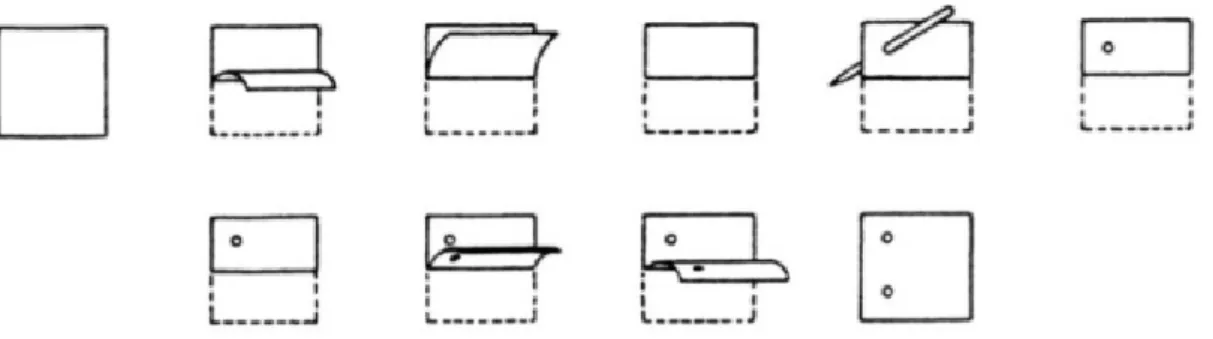
![Table 3.1: Summary of ER diagram notation (Adapted from [Elmasri and Navathe, 2000])](https://thumb-us.123doks.com/thumbv2/123dok_us/614059.2573605/40.892.239.624.126.1047/table-summary-er-diagram-notation-adapted-elmasri-navathe.webp)





![Figure 5.2: An annotated illustration [Mayer, 2001, Figure 2.1, p. 25]](https://thumb-us.123doks.com/thumbv2/123dok_us/614059.2573605/79.892.314.582.379.669/figure-annotated-illustration-mayer-figure-p.webp)