edited by
Małgorzata Nycz
Mieczysław Lech Owoc
Publishing House of Wrocław University of Economics Wrocław 2011
232
PRACE NAUKOWE
Uniwersytetu Ekonomicznego we Wrocławiu
RESEARCH PAPERS
of Wrocław University of Economics
Knowledge Acquisition
and Management
Reviewers: Grzegorz Bartoszewicz, Witold Chmielarz, Halina Kwaśnicka, Antoni Ligęza, Stanisław Stanek
Copy-editing: Marcin Orszulak Layout: Barbara Łopusiewicz Proof-reading: Barbara Łopusiewicz
Typesetting: Beata Mazur
Cover design: Beata Dębska
This publication is available at www.ibuk.pl
Abstracts of published papers are available in the international database
The Central European Journal of Social Sciences and Humanities
http://cejsh.icm.edu.pl and in The Central and Eastern European Online Library
www.ceeol.com as well as in the annotated bibliography of economic issues BazEkon http://kangur.uek.krakow.pl/bazy_ae/bazekon/nowy/index.php
Information on submitting and reviewing papers is available on the Publishing House’s website www.wydawnictwo.ue.wroc.pl
All rights reserved. No part of this book may be reproduced in any form
or in any means without the prior written permission of the Publisher
© Copyright by Wrocław University of Economics Wrocław 2011
ISSN 1899-3192 ISBN 978-83-7695-200-0
The original version: printed Printing: Printing House TOTEM
Contents
Preface ... 7
Iwona Chomiak-Orsa: Selected instruments of controlling used in the area of knowledge management ... 9
Roman V. Karpovich: Creating the portfolio of investment projects using fuzzy multiple-criteria decision-making ... 19
Jerzy Korczak, Marcin Iżykowski: Approach to clustering of intraday stock quotations ... 29
Antoni Ligęza: A note on a logical model of an inference process. From ARD and RBS to BPMN ... 41
Maria Mach: Analysing economic environment with temporal intelligent systems: the R-R-I-M architecture and the concept of quasi-objects ... 50
Alsqour Moh’d, Matouk Kamal, Mieczysław L. Owoc: Integrating busi-ness intelligence and theory of constraints approach ... 61
Eunika Mercier-Laurent: Future trends in knowledge management. Knowl-edge EcoInnovation ... 70
Małgorzata Nycz: Business intelligence in Enterprise 2.0 ... 79
Mieczysław L. Owoc: Key factors of Knowledge Grid development ... 90
Maciej Pondel: Data mining with Microsoft SQL Server 2008 ... 98
Maria Radziuk: Multi-agent systems for electronic auctions ... 108
Tatiana V. Solodukha, Boris A. Zhelezko: Developing a multi-agent system for e-commerce ... 117
Jerzy Surma: Case-based strategic decision-making ... 126
Paweł Weichbroth: The visualisation of association rules in market basket analysis as a supporting method in customer relationship management systems ... 136
Radosław Wójtowicz: Office online suits as a tool for supporting electronic document management ... 146
Radosław Zatoka, Cezary Hołub: Knowledge management in programming teams using agile methodologies ... 156
Presentations
Markus Helfert: Current und Future “Trends” in Knowledge Management – A management capability perspective ... 1676
ContentsStreszczenia
Iwona Chomiak-Orsa: Wybrane instrumenty controllingu wykorzystywane
w obszarze zarządzania wiedzą ... 18
Roman V. Karpovich: Tworzenie portfela projektów inwestycyjnych przy użyciu wielokryterialnych rozmytych metod podejmowania decyzji ... 28
Jerzy Korczak, Marcin Iżykowski: Próba klasteryzacji dziennych notowań giełdowych ... 40
Antoni Ligęza: Uwaga na temat logicznych modeli procesu wnioskowania. Od ARD i RBS do BPMN ... 49
Maria Mach: Analiza środowiska ekonomicznego przy pomocy inteligent -nych systemów temporal-nych – architektura R-R-I-M i koncepcja quasi--obiektów ... 60
Alsqour Moh’d, Matouk Kamal, Mieczysław L. Owoc: Integracja business intelligence z teorią ograniczeń ... 69
Eunika Mercier-Laurent: Przyszłe trendy w zarządzaniu wiedzą. Ekoinno -wacje wiedzy ... 78
Małgorzata Nycz: Business intelligence w koncepcji Enterprise 2.0 ... 89
Mieczysław L. Owoc: Kluczowe czynniki rozwoju Knowledge Grid ... 97
Maciej Pondel: Drążenie danych w MS SQL Server 2008 ... 107
Maria Radziuk: Wieloagentowy system wspierający aukcje elektroniczne ... 116
Tatiana V. Solodukha, Boris A. Zhelezko: Budowa systemów wieloagento -wych na potrzeby handlu elektronicznego ... 125
Jerzy Surma: Podejmowanie strategicznych decyzji w oparciu o analizę przypadków ... 135
Paweł Weichbroth: Wizualizacja reguł asocjacyjnych w analizie koszykowej jako metoda wspierająca systemy klasy CRM ... 145
Radosław Wójtowicz: Pakiety biurowe on-line jako narzędzia wspierające zarządzanie dokumentami elektronicznymi ... 155
Radosław Zatoka, Cezary Hołub: Zarządzanie wiedzą w zespołach progra -mistycznych przy użyciu metodyk zwinnych ... 164
PRACE NAUKOWE UNIWERSYTETU EKONOMICZNEGO WE WROCŁAWIU nr 232
RESEARCH PAPERS OF WROCŁAW UNIVERSITY OF ECONOMICS
Knowledge Acquisition and Management ISSN 1899-3192
Alsqour Moh’d, Matouk Kamal, Mieczysław L. Owoc
Wrocław University of EconomicsINTEGRATING bUSINESS INTELLIGENCE
AND THEORY OF CONSTRAINTS APPROACH
Summary: Information technology’s (IT) projects face many complexities, challenges, and constraints such as uncovering and defining multiple dimensions of information and making data flexible enough to allow querying and mining. The key is to identify those constraints that affect the system’s efficiency. For those reasons and more, analysing and documenting business intelligence (BI) requirements creates a need for special knowledge. In this paper, a TOC-based method was developed to enhance the efficiency of BI, and the authors’ argument
for supporting it is illustrated. Based on the analysis and discussion results, the authors show
that the TOC-based method can improve BI efficiency and suggest, accordingly, several guidelines that can be followed for the efficient utilisation of BI applications.
Keywords: business intelligence (BI), theory of constraints (TOC), key performance indica
-tor (KPI).
1. Introduction
The survival of organisations in today’s business environments upheaval is dependent on their an ability to proactively respond to new business opportunities or emerging threats that could positively affect their growth. In such environments, businesses
seek access to adequate, timely, and reliable information through the use of BI [Papadopoulos, Kanellis 2010]. BI is an umbrella term for a set of tools and applica-tions that allow corporate decision makers to gather, organise, analyse, distribute, and act on critical business information with the goal of helping companies make faster, better, and more informed business decisions [Gupta, Sharma 2004, p. 2], and provide the business community easy access to business data [Moss, Atre 2003, p. 4].
The ability to make fast, reliable decisions based on accurate and usable
information is essential to most business enterprises. BI solutions aim at achieving
critical business advantage by providing knowledge workers with easy access to the
right information, on demand, from wherever it is created and/or maintained within an organisation. With the right strategy, an organisation can transform data from
various disparate sources into a usable format that can provide timely knowledge of business critical information [Gupta, Sharma 2004, p. 2]. Nowadays, organisations
62
Alsqour Moh’d, Matouk Kamal, Mieczysław L. Owoc need to optimise their business processes in order to be profitable in the long run. Inorder to do this, managers need detailed information about what is going on with their business, in terms of their products, customers, and services. Furthermore, organisations can also get a competitive edge when they have information that their
competitors do not have yet [Terborg 2009]. Gathering and analyzing requirements
for BI projects have several components that are unique on IT projects. One of the
complexities includes uncovering and defining multiple dimensions of information that users want to see reported. Another challenge is to make data flexible enough to
allow querying and mining. Finally, the BI tools and applications premised on the
notion of helping make future predictions and support decision-making. For these
reasons, analyzing and documenting BI requirements create a need for special
knowledge, methods, and skills. This paper addresses those issues to help build the skills of those who work on defining the requirements and constraints of BI. Therefore, the aim of this paper is to present the TOC and its analytical roadmap in the context
of BI.
2. TOC’s five steps methodology
A TOC-based method was developed to enhance the efficiency of business processes [Rhee, Cho, Bae 2008]. Since its development, it has been producing startling bottom
line results to companies worldwide. Hence, many independent studies of the TOC’s implementations around the world found that huge results were consistently achieved.
The TOC initiated by Eliyahu Goldratt [Wahlers 1993; Balakrishnan 1999; Schwain
2004; Westerlund 2004] is a management philosophy based on the principle of achieving continuous improvement by focusing on a system constraint. A system constraint limits the performance of a system, thus all efforts should be aimed at
maximizing the performance of that constraint. The crucial insight of the TOC is that
only a few constraints in an organisation control the results of its entirety. The TOC
identifies those constraints and focuses the entire organisation on simple, effective solutions to problems that seemed insurmountably complex and unsolvable. The TOC is a proven method that can be used by existing personnel to increase throughput. The three dimensions [Boyd, Gupta 2004] of throughput orientation are an
organisational mindset, which is a measure of the underlying attitudes, assumptions, and beliefs of management, performance measurement systems, and
decision-making. Goldratt [1999] claimed that although the goal is to make money, the significance of necessary conditions such as quality products, customer satisfaction, employee security, and equitable pay should not be underestimated. Some items that
might be used to measure organisational mindset. The primary emphasis of improvement projects is cost reduction. Management believes that everyone must
work hard and be efficient in order for a company to maximise its profitability. One of management’s top priorities is to maintain a satisfying working environment for all employees, and our employees understand the importance of satisfied customers
Integrating business intelligence and theory of constraints approach
63
to our business. Companies that are high in all three dimensions would be expectedto have better performance than companies that are low in one or more of the
dimensions. Companies that are high in all three dimensions would be expected to
have better performance than companies that are low in one or more of the dimensions
[Boyd, Gupta 2004]. Successful organisations also adopt the TOC to help making
strategic decisions for continuous improvement. The theory says that the higher the degree of throughput orientation is, the greater organisational performance will be
[Boyd, Gupta 2004]. Boyd and Gupta [2004] argue that what is inherent in the concept of throughput as defined in the TOC is the role of constraints in limiting the
performance of an organisation with respect to its goal.
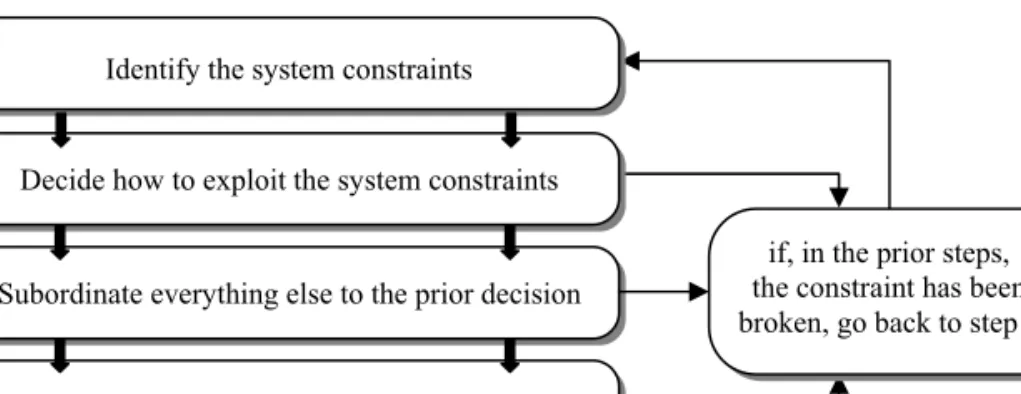
Goldratt [1999, pp. 5-6] listed five focusing steps [Balakrishnan 1999; Westerlund
2004] used to identify, manage, and eliminate constraints for continuous improvement
as shown in Figure 1. The five steps are very targeted. They focus process improvement on the items having the maximum impact on the system at any point in time-on the constraints [Boyd, Gupta 2004].
Figure 1. The TOC hierarchy methodology
Source: authors’ own study.
What is prior to the first step is the recognition that every system was built for a purpose. Thus, every action taken by an organisation should be judged by its impact
on the overall purpose. Before dealing with the improvement of any section of a
system, we must first define a system’s goal and the measurements that will enable
us to judge the impact of any subsystem and any local decision on this goal. Once
these are defined, we can describe the next steps in two different ways. The one in
which we are using the terminology of the system that we are trying to improve; the other using the terminology of the improvement process itself. According to Goldratt, both descriptions are very helpful and only when both are considered together, does
a non-distorted picture emerge [Goldratt 1999, p. 4]. How to sort out the important
few from the trivial many? Goldratt argues that the key lies in the recognition of the
important role of system’s constraints. According to Goldratt, a system’s constraint
if, in the prior steps, the constraint has been
broken, go back to step 1 Decide how to exploit the system constraints
Identify the system constraints
Elevate the system constraints
64
Alsqour Moh’d, Matouk Kamal, Mieczysław L. Owocis anything that limits a system from achieving higher performance versus its goal
[Goldratt 1999, p. 4]. Goldratt stated that any taken action is to be judged by its
overall impact with respect to the global objective. This implies that targeting the global objective of a system is prerequisite to being able to carry out improvements
or successful change strategies. In addition, in reality any system is influenced by at least one constraint. Therefore, the TOC recognises system’s constraints as the key elements in seeking ways to leverage a system. Accordingly, identifying system’s
constraints implies the process of locating the limiting factors of a system. In addition, identifying constraints implicitly proposes that constraints are prioritised according to their individual impacts on the global objective. Goldratt concludes that the
exploitation of all unconstrained resources should be adjusted to the maximum level of performance of the weakest link. This stems from the fact that the overall
performance of a system is sealed as dictated by constraints. By subordinating all other operations to the solution agreed upon in step two, the possibility of redundant or futile effort is eliminated. The fourth step, elevating system’s constraints, simply
addresses the issue of reducing the limiting impact of the identified constraints even
further. The desired result is to enhance global throughput; targeted measures have
to be taken in order to ensure the leverage of the inhibiting factors. Continuously elevating a constraint will inevitably cause this constraint to break. Thus, to avoid inertia in the system being empowered, one must go back to the first step and repeat
the whole process. Hence, emphasis must be placed on not allowing inertia to bring about a system constraint.
3. Using business intelligence to achieve organisational goals
BI, the act of capturing raw data, then transforming and combining that data into information that can be proactively used to improve business, is an integral part of successful business management. The goal of BI is not just functionality of an application, but the data and information themselves must be useful as a tool to
empower decision-makers and allow them to make better and faster decisions. Better decisions make better business. This end result of BI should be higher net income, increased growth, low operating costs, effective marketing campaigns, and efficient decision-making. Most businesses have very similar data needs for strategic goals and objectives, and fast and effective decision-making. Some companies have difficulties in keeping up with those items, in addition to user requirements and
customer demands. It must be understood that no technology stands alone or becomes
successful on its own. Successful BI systems must be driven by the way information
will be used. The IT group building out a BI system must be focused on a business
as a whole with the system development knowledge. In addition, any BI system is the linkage of day-to-day activities to company’s strategic goals and visions.
Integrating business intelligence and theory of constraints approach
65
organisation. Clearly define and measure the strategy, the goals that achieve thatstrategy, and the desired behavior needed to meet those goals. Many goals are based on KPI, which originates from multiple, disparate sources, such as CRM systems and accounting systems. Each system is isolated from the other, and each system reports data differently. Different managers use different metrics, and different
executives use different reports. There is no mechanism to visualise the entire
organisation performance or correlate metrics from one system to another. As a
result, an organisation data is not collected, shared, or defined in a consistent manner
throughout an organisation. A single, shared, BI solution will allow an organisation to align and communicate performance results and actions at all levels. At this point,
one should understand the core business problems that BI can solve, by examining
the business value that a BI solution can add to their organization. The most common
information issue facing executives is their inability to connect and combine data
collected from one system to the data collected in another system, raw data may also contain information that is not relevant to the business issue being addressed. Almost every business or business unit has strategies which are measured in some tangible
way. Hence, without tangible, measurable goals, how would you know whether you
were successful? Those measurable goals are called KPI. KPI does not necessarily have to be monetary in nature. Customer service departments, for instance, might
want to measure how many service complaints they receive, marketing to measure
campaign return rate, product sales, service complaints, product returns, etc. BI allows organisations to visualise KPI information in a multitude of ways. A good BI solution allows for a near-real-time visualisation of this information. Furthermore, good BI solutions should proactively monitor KPI information and notify
decision-makers when a predetermined threshold has been reached. BI leads to better business decision-making through providing access to enterprise data for easy analysis against KPI. This is achieved through having more information available at all the levels of an enterprise and enabling each management level to be more responsive to current
market trends. People at all levels of an organisation need information. BI allows an organisation to empower people to make decisions. This empowerment is achieved by providing every knowledge worker with the ability to visualise information. By providing knowledge workers with this ability, an organisation overall strategy can
be fully implemented in the form of goals with measurable performance metrics. Though, the data and information delivered must be actionable, accurate, and timely. In implementing a great BI system, planning and documentation are critical to success. Not only do those activities ensure the right data is delivered to the right person in the right format, but also the actual development time can be shortened.
Good BI systems require not only excellent IT resources and knowledge, but they must keep focused on how information is used to meet business needs. BI systems need to keep strategic goals and organisational missions in mind when recommending solutions, identifying opportunities, and implementing new tools.
66
Alsqour Moh’d, Matouk Kamal, Mieczysław L. Owoc4. BI and TOC
As mentioned in Section 2, BI allows corporate decision-makers to gather, organise,
analyse, distribute, and act on critical business information with the goal of helping
companies make faster, better, and more informed business decisions. Therefore,
constraints which obstruct the business’s ability to accomplish its goals are the
objectives for BI to face. Hence, BI produces timely information for decision-makers,
and to retrieve stored data are particularly appropriate to BI to deal with.
The TOC is a logic-driven approach that focuses on system improvement. It
views the system as a chain of interdependent links that work together toward the
primary goal of transforming inputs into sold outputs, thereby increasing throughput.
The performance of the entire system is limited by the weakest constraint. All improvement efforts should be aimed at this constraint through the use of five steps.
Before applying the TOC to the management of BI and integrating the TOC to BI, let us have a glimpse at the successful implementation of BI. As shown in Figure 2,
implementation factors (constraints) influence the successful implementation of the
BI system, those constraints pertain to organisational, project, and technical constraints. Organisational, project, and technical implementation success leads to data and information quality, decision quality, and system quality success, which in contrast enhance the performance, success, or throughput of the system.
Figure 2. BI implementation success factors (constraints) Source: authors’ own study.
As BI systems are important to both the delineation of business strategy and tactical decisions [Papadopoulos, Kanellis 2010]. Not surprisingly, the implementation
of BI has been accompanied by several lists of suggestive critical success factors
[Papadopoulos, Kanellis 2010].
How firm’s goals are aligned with the BI’s goals? We are of the belief that BI
goals and business goals are to be aligned when a company achieves a stable BI system and managers are able to set goals. How can BI support those important business goals? The answer is that reliable and available BI would align well with
maintaining high integrity. Help desk improvement, business continuity planning,
and strong security policies would be the pathway to achievement here.
To provide an in-depth overview of the way all elements may be brought together, this paper uses a hypothetical company and examples as a mean. The question is where to start. To begin with, go to the company’s (hereafter XYZ) mission statement
Data and information quality, decision quality and system
quality success Implementation
Factors
(constraints)
Organisational, project and technical
implementation success
Integrating business intelligence and theory of constraints approach
67
and find significant goals such as, incrementally increase revenue,reduce costs, and
improve profitability. Suppose one of XYZ’s goals is to improve profitability decision-makers are responsible for defining the system’s goal at the business level. The measures of performance include sales and market share, XYZ recognises that
the quality of the product hinders the achievement of its goal. This implies that while other goals such as increasing revenue and reducing costs are important, their
importance is secondary. The next step is to translate the system’s goal at the technical and project level. This is accomplished by TOC’s five steps methodology as shown in Figure 1. XYZ exploits the quality constraint by focusing its restricted quality improvement resources on the product (X), the XYZ’s most successful product.
Minor goals such as customers’ and employees’ satisfaction should be viewed as
necessary conditions that must be met before attempting to improve profitability and are subordinated to the quality goal. They are undertaken only if they do not compete
for resources with the quality goal and provided that their introduction adds to the product’s quality. The quality constraints is elevated by training users to focus on the
quality issue, measure the quality of the tasks that they perform and improve the
quality of the data and information which are delivered by their BI system. The elevation of the quality issue will remove quality from its status as the constraint to
XYZ and replace it by some other issue. At some time in the future, XYZ may achieve excellent quality. Seeking better quality, at that stage, would indicate that
inertia has become the system’s constraint.
Accordingly, let us assume that XYZ implemented BI system with the goal of supporting decision-making process. In achieving this goal, three constraints faces the system throughput (see Figure 2). The first potential constraint is organisational (business) such as historical data needs, data currency needs, summarisation needs,
requirements volatility, data sharing culture, and regulatory and compliance issues.
Technology reflects actual limitations on the system, such as data source, technology adoption, data quality, transformation challenges (e.g., ETL), architectural maturity,
and performance. Project constraints such as budget and resources, change man-
agement, expectations management, and maintaining executive support. Applying the TOC to BI should start by defining a goal or goals for the implementation of BI tools (BI professionals and designers are responsible for defining the system’s goal). We assume that the key to the system’s success is right data, right measures, right format,
right questions, on time information, actionable conclusions, and valuable insight.
Since BI is subordinated to the organisation, the organisation’s goal should be stated first, and then locate the system’s constraints. The next step is to implement TOC’s five step constraint identification. As BI system has many constraints, the key is to
identify the constraint that affects the system success or performance more than any other. Common system constraints within the BI in addition to the above mentioned constraints include challenges with metadata, challenges with sources of data and
data cleanliness, lack of resource commitment and availability, and unclear or unknown requirements. XYZ recognises that quality of the data hinders the
68
Alsqour Moh’d, Matouk Kamal, Mieczysław L. Owocneeds, summarisation needs, data sharing culture, and data source should be viewed as necessary conditions that must be met before attempting to improve data quality
and are subordinated to the quality goal; they are undertaken only if their introduction
will add to the data’s quality. The quality constraints are elevated by training users to focus on the quality issue, data source, and improve the quality of the data and information which are delivered by their BI system. The elevation of the quality
issue will remove quality from its status as the constraint to XYZ and replace it by some other issue. At some time in the future, XYZ may achieve excellent data quality. Seeking better quality, at that stage, would indicate that inertia has become the
system’s constraint.
5. Analysis and conclusion
The TOC translates into a five-step methodology for the identification of system’s
constraints and their confrontation. The measures of success or performance need to be proper measures of the actual throughput of a system. Even though many
constraints may be important, one primary constraint should be identified and all other constraints within the system should be staggered in order to get the maximum value from the primary constraint without overloading it. The key to the third step is to make the primary constraint the focus of attention and eliminate rules and assumptions that inhibit the maximum value that can be provided by the primary
constraint. Once all other factors have been subordinated to the primary constraint,
it is possible that the primary constraint will become a further bottleneck within the system flow. At this point, additional time and resources can be added to the primary constraint in order to increase the system flow. Finally, as long as the identified
system constrain no longer becomes the primary system constraints, steps 1 through 5 should be repeated again to identify new constraints.
In this paper a framework for the application of the TOC to the management of
BI is presented. This paper starts with the introduction of the hierarchical model and foundation of the TOC. Thereafter, a TOC based method was developed to enhance
the efficiency of BI. Based on the analysis and discussion results, we show that the TOC based method can improve BI efficiency, particularly under limited resources.
A case study, systematic and quantitative view will be presented for the application of the TOC in BI in a separate supplementary paper; this will be done employing the
operational research technique of linear programming (LP).
References
Balakrishnan J. (1999), Using the theory of constraints in teaching linear programming and vice versa
advantages and caveats, Production and Inventory Management Journal, second quarter, pp. 11-16.
Boyd L., Gupta M. (2004) Constraints management – what is the theory? International Journal of Op-erations & Production Management, Vol. 24, 3/4, pp. 350-371.
Integrating business intelligence and theory of constraints approach
69
Goldratt E.M. (1999), Theory of Constraints, 1st Edition, North River Press.
Gupta J.N.D., Sharma S.K. (2004), Intelligent Enterprises of the 21st Century (Knowledge Economy and Intelligent Enterprises), Idea Group.
Moss L.T., Atre S. (2003), Business Intelligence Roadmap – The Complete Project Lifecycle for Deci
-sion-Support Applications, Pearson Education.
Papadopoulos T., Kanellis P. (2010), A path to the successful implementation of business intelligence – An example from the Hellenic banking sector, OR Insight, Vol. 23, No. 1, pp. 15-26.
Rhee S-H., Cho N.W., Bae H. (2008), Increasing the Efficiency of Business Processes Using a Theory of Constraints, Information Systems Frontiers, Springer, Netherlands.
Schwain K.D. (2004), Prioritization and Integration of Lean Initiatives with Theory of Constraints, Massachusetts Institute of Technology, 2004.
Terborg P. (2009), The First Decade of Business Intelligence, Vrije Universiteit van Amsterdam, BMI. Wahlers J.L. (1993), A Study of Performance Measure in an Intermittent Synchronous Manufacturing
Environment, Dissertation Abstracts with the Theory of Constraints at the University of Georgia, www.umi.com/hp/Products/DisExpress.html (date of access: 01.05.2010).
Westerlund M.C. (2004), Theory of Constraints Revisited – Leveraging Teamwork by Systems Intelli-gence, Mat-2.108 Independent Research Project in Applied Mathematics.
INTEGRACJA BUSINESS INTELLIGENCE Z TEORIą OGRANICZEŃ
Streszczenie: Projekty IT napotykają wiele zawiłości, wyzwań i ograniczeń, takich jak od
-krycie i określenie wielu wymiarów informacji, uczynienie danych wystarczająco elastyczny
-mi do tego by umożliwić wykonwanie zapytań i drążenie danych. Kluczowe jest zidentyfiko
-wanie tych ograniczeń, które wpływają na efektywność systemu. Między innymi z tych powodów, analizowanie i dokumentowanie business intelligence (BI) wymaga stworzenia specjalnej wiedzy. W niniejszym artykule została opracowana metoda oparta na teorii ograni
-czeń (TOC) w celu zwiększenia efektywności BI. W oparciu o analizę i omówienie wyników autorzy pokazują, że metoda oparta na TOC może poprawić wydajność BI i podają, kilka wskazówek, które mogą być stosowane do skutecznego wykorzystania aplikacji BI.
Słowa kluczowe: business intelligence (BI), teoria ograniczeń (TOC), kluczowe wskaźniki efektywności (KPI).