POLICIES AND
PROCEDURES
April, 2006
Table of Contents
I. Strategic Plan
II. Administrative and Operational Policies & Procedures New Student Orientation
Academic Calendar
Academic Grievance Procedures) Computer seminars at UIC
Crime Statistics for UIC campus
CUPPA Administrative Reminders and Due Dates
CUPPA Computer Lab (Rm. 251) Reservation Schedule CUPPA Computer quality standards
CUPPA Graduate Research Assistant FAQ CUPPA Building Emergency Procedures
Computer lab (UIC campus) reservation - classroom/seminar Computer systems status for CUPPA, UIC Data about the Chicago, IL region and other useful items
Facilities Management Problems, to report Graduate College Calendar
Great Cities Logo, digitized copy Human Resources Forms—UIC IRB forms
Laptop (UPP) how to set up for presentations Listserv instructions
Moving Procedure for New Employees
Multimedia classroom (UIC campus) reservation
How to avoid Parking Tickets when using 412 S. Peoria loading dock Phone numbers to connect a computer to UIC from home
Policies--UIC
Principal Investigator resources
Promotion and Tenure Policies and Procedures
Putting announcements to the UIC Announcement system Reimbursement rates, "per diem," for travel, meals, lodging Relocation information from UIC for new faculty, staff
"Shopping bot" as an aid to purchasing due diligence Stationery, UIC-CUPPA,WordPerfect version
Time to NIST standards
Vending Machine Refunds & Repairs
Videotape/video conference your class or event Viruses and Hoaxes Web pages
Grants and Contracts Administration Guidelines for requesting the Anticipation Accounts for Grants Guidelines for Budget Transfers
Records – Retentions & Storage Glossary – Research Terms
III. Fiscal Policies & Procedures
Summary of Daily Transactional Procedures Accounts Payable
Accounts Receivable Transaction Log Parking Sticker Log Purchase Card Transactions Employee Travel
Accounting for Active Funds (Projects) Monthly Financial Report Procedures Accounting for Inactive Funds (Projects) Billing Procedures for Sponsored Projects Annual Operating Budget
Accounting for Capital Assets
Cost Sharing & Match – Accounting & Reporting IV. Human Resources Policies & Procedures Introduction to Banner and Related Applications
New Employee Benefit Materials New Employee Checklist
Hiring Proc. for New Grad. Res. Asst. & Grad. Asst. – Non-Res. Aliens
Hiring for New Grad. Res. Asst. & Grad. Asst. Graduate Assistantship Salary Minima
Hiring of Acad. & Acad. Professional Employees Hiring of Civil Service Employees
Hiring of Student Employees Hiring of Other Employees
Reappointments – Unit’s Responsibilities
Academic Notices of Non-reappointments/Terminal Contracts Employee Exit Checklist
Employee Attendance Employee Time Reporting
Unit’s Reporting of Academic Vacation & Sick Leave Other Types of Time off & Leaves
Ethics Training Sexual Harassment
Occupational Injury or Illness Report Employee Training & Development Payroll Adjustments
V. Information Technology Policies and Procedures Operations and Maintenance
Acceptable Use Policy
Password Policy
Information Sensitivity Policy
Server Security Policy Physical Security Policy
Email Use Policy
Guidelines on Anti-Virus Process
VI. Gifts
Overview
A Policy is any stated principle that requires, guides, or restricts action to achieve the CUPPA’s stated objectives. Policies MUST:
Be clearly stated in writing and properly approved by CUPPA’s management.
Confirm with applicable state and federal laws and regulations, and consistent with the CUPPA’s objectives.
Be designed to promote the conduct of authorized activities in an effective, efficient, and economical manner and provide a satisfactory degree of assurance that the resources of the University are safeguarded.
Be systematically communicated to all officials and employees of CUPPA.
Procedures will be the methods employed by CUPPA to carry out its activities in conformity with prescribed policies and their principles. These specify how recurring tasks will be executed and enumerate both the steps and sequence to be followed. Procedures may not be overlapping, expensive, repetitive, and duplicative and coordinated in a way that one employee’s work is automatically checked by another who is independently performing separate prescribed duties. This reduces the possibilities of fraud or error.
If Policies and Procedures at CUPPA are not clear and comprehensive, and effectively communicated to users, the decisions made and actions taken might not be in accordance with University of Illinois/CUPPA’s policies and procedures, state and/or federal laws etc.
CUPPA’s policies and procedures are therefore written specifically for CUPPA’s operations. These policies and procedures will provide general guidelines for problem-solving and decision-making to CUPPA’s management and employees and will ensure that CUPPA’s operations are consistent, conform to applicable legislation, regulations, plans, technical/professional and/or ethical standards, and promote achievement of the CUPPA’s mission, goals, and objectives.
In cases where CUPPA’s does not have a policy/procedure, the one set forth by the University will be followed. Please refer to the following websites for the University’s and CUPPA’s policies and procedures:
CUPPA: http://www.uic.edu/cuppa/admin/howto/
CUPPA’s Policies & Procedures Manual is divided into six sections: Strategic Plan
Administrative and Operational Fiscal
Human Resources
Information Technology Gifts
The policies & procedure manual should be reviewed and updated at least once per year.
For suggestions/comments please contact Suresh Sharma, Business and Financial Systems Specialist, College of Urban Planning and Public Affairs (CUPPA), University of Illinois at Chicago, 412 S. Peoria, Rm. 119, M/C 350, Chicago, IL 60607-7064. Voice (312)996-2162, Fax (312) 413-8095 Email: [email protected]
Welcome to CUPPA 2010
You hold in your hands a copy of the CUPPA 2010 Strategic Plan. This document is the fruit of 18 months intensive work by the faculty, staff and students of the College of Urban Planning and Public Affairs (CUPPA) at the University of Illinois at Chicago (UIC).
The plan is informed by a thorough understanding of the history of this remarkable college together with an analysis of the alternative future scenarios that are likely to shape higher education in the US in general as well as UIC in particular. By working together – and by listening to each other - we have created a new mission for the College:
To provide innovative urban planning and public management education that puts engaged research to purposeful use at home and abroad
More than that the CUPPA 2010 Strategic Plan shows how, by building on our key strengths and by articulating and adhering to our core values, we intend to shift the College from respected leader to national prominence and, ultimately, to global recognition.
The plan is sensitive to the difficult budget environment that has constrained innovation at UIC in recent years but the plan is not dominated by short-term considerations. Rather, it examines the performance of the College since 1995, articulates a vision for what the College should aspire to be like in 2010 and maps out a practical strategy for delivering this bold vision.
The preparation of this plan has been a collective effort. Over 100 people have worked on it. I am most grateful to everyone involved for putting so much energy, insight and sheer hard work into this very important deliberative approach to shaping the future direction of this exceptional college.
A successful Strategic Plan is not a static document. In the years ahead we will conduct an annual assessment of the progress we have made and of the new challenges that are opening up, not just for CUPPA but for US higher education as a whole. We look forward to discussing and developing our forward thinking not just with our many colleagues elsewhere in UIC, but also with our partners in this great city and further afield.
Robin Hambleton
Acknowledgements
It is impossible to list all those who have contributed to this new vision and strategy for the College. However, a number of faculty, staff and students have carried specific responsibilities in relation to this work and I would like to acknowledge them.
The Directors of the various Units in CUPPA have been involved throughout and I am most grateful to them for their continuous inputs and support: Phil Bowman, Tim Johnson, Charlie Hoch, Sue McNeil, Mike Pagano, David Perry, Laxmi Ramasubramanian, Brent Ryan, Nik Theodore, Curt Winkle, and Pat Wright.
At the beginning of the process a Strategic Planning Committee shouldered responsibility for preparing for and following up on our first ‘Awayday’ and I would like to thank the members of the committee for getting our strategic planning process off to a great start: Lauri Alpern, Veronica Anderberg, Angela Ebreo, Doug Gills, Allyson Holbrook, Kazuya Kawamura, Julia Melkers, Al Schorsch, Jodi White and Pat Wright. Some 55 people participated in the first ‘Awayday’ and I would like, in particular to thank the students who joined in – Michael Anderson, Karl Nollenberger, Kathleen O’Dell, Juan Fernando Ortega, and Jill Ronco – and Ellen Cull, our excellent facilitator.
Nine Task Groups carried out research and analysis during 2002/03 and these groups were led by: 1) Jodi White, 2) Julia Melkers, 3) Laurie Alpern, 4) Al Schorsch, 5) Eric Welch, 6) Charlie Hoch and Mike Pagano, 7) Allyson Holbrook, 8) Doug Gills, 9) Joanne Sims and Curt Winkle. Their Task Group Reports are impressive and remain a valuable resource as we move into the implementation stage of the CUPPA 2010 Strategic Plan.
An important CUPPA seminar on ‘engaged research’ was held in September 2003 as part of our CUPPA Expo. I would like to thank the presenters who helped clarify and take forward our thinking: Phil Bowman, Sharon Mastracci, Vonu Thakuriah and Rachel Weber.
In the Fall of 2003 a Strategic Thinking Group was charged with reviewing all the work and pulling the first drafts of the strategy together. I am most grateful to: Loretta Foote Casey, Charlie Hoch, Allyson Holbrook, Al Schorsch and Rachel Weber.
Finally, behind the scenes, the Dean’s Office has carried out a great deal of important
administrative work to support this process and I want to thank: Veronica Anderberg, Michael Clark, Loretta Foote Casey, Jim Marek, Al Schorsch, Cathy Sanders, Joanne Sims, Jodi White and our two hard working Graduate Assistants – Sarah Fleming and Jennifer Martin.
Robin Hambleton Dean
Contents
Page
CUPPA 2010 Strategic Plan – Executive Summary 4
1) Introduction: the College 5
2) The CUPPA 2010 Strategic Plan 5
3) The CUPPA track record – An Overview 6
4) CUPPA mission and values 7
The UIC Great Cities Commitment The CUPPA mission statement Core values
The distinctive contribution
5) CUPPA – Goals for 2010 9
External Goals Internal Goals
6) CUPPA 2010 - Strategy for delivery 11
Enhancing established centers of excellence 11
Initiatives 13
1) Undergraduate Degree in Urban and Public Affairs 2) CUPPA International
3) Municipal Finance Center (MFC)
Innovations 14
Teaching programs CUPPA students
Academic publications and policy advice Research funding and College advancement International activities
Organizational culture
7) The budget context 22
Annex 1: A Guide to CUPPA 23
Annex 2: The CUPPA Strategic Planning Process 35
CUPPA 2010 Strategic Plan - Executive Summary
The vision. Although the College of Urban Planning and Public Affairs (CUPPA) at the University of Illinois (UIC) is less than ten years old it has already established itself as a respected leader in its field. CUPPA is widely recognized for its unique combination of education, research and community engagement in support of cities and metropolitan areas. CUPPA will continue to make significant contributions to public policy and practice in the Chicago metropolitan region and Illinois as a whole. By building on the achievements of the past the new CUPPA 2010 Strategic Plan aims to shift the College from respected leader to national prominence and, ultimately, to global recognition.
College strengths. This ambitious aim is credible for three main reasons. First, the College has a dynamic track record – it has a creative and entrepreneurial culture and has demonstrated that it can expand its activities and improve quality year after year. Second, the faculty is very well respected in the field of urban planning and public affairs. The rising academic reputation of the College stems from faculty contributions to: scholarship and the advancement of knowledge; public policy and practice; and student learning. In particular, a caring concern for students and their learning experience has led to continuing improvements in teaching quality which, in turn, have led to exceptionally positive support from College alumni. Third, faculty and staff have a shared view not just of what the College stands for and should aspire to in 2010, but also of how to deliver this new vision of a world-class college valued at home and abroad.
Track record. Created in 1995 as part of the UIC Great Cities Initiative, the College brought together several successful units. By pursuing a bold, outgoing strategy and an active approach to research bidding, the College has expanded at a remarkable rate. Graduate student numbers have grown by 52% (from 210 in 1995 to 320 in 2003). The Urban Planning and Policy (UPP) program is now one of the largest graduate planning programs in the USA and the Public
Administration (PA) program is the fastest growing PA program in Illinois. Research activity has mushroomed resulting in a tripling of College non-state income – from $3.4 million in 1995 to $10.1 million in 2003.
The CUPPA 2010 Strategic Plan. Our plans for the future build on this dynamic track record. Following an eighteen-month period of intensive strategic planning – an inclusive process involving all faculty and staff as well as students and alumni – the College has developed a sophisticated forward plan. The new mission of the College is: To provide innovative urban planning and public management education that puts engaged research to purposeful use at home and abroad. Three commitments – to innovative education, to engaged research and to making an influential contribution to policy and practice - will remain at the heart of the CUPPA mission. The key challenge is to ensure that these three commitments reinforce each other in the coming period. By strengthening our existing centers of excellence, increasing collaboration between units, identifying a number of key college-wide initiatives, and offering new incentives, the CUPPA 2010 Strategic Plan provides a practical set of proposals for moving towards our aim of creating a world-class college at UIC valued at home and abroad.
1) Introduction: the College
The College of Urban Planning and Public Affairs (CUPPA) was established in 1995 as a key element of the University of Illinois at Chicago’s (UIC) Great Cities Initiative (now
Commitment). Recognized nationally as an innovator in education, research and engagement in support of the nation’s cities and metropolitan areas the College comprises:
Two graduate programs offering Masters degrees and Doctor of Philosophy degrees – through the Public Administration (PA) program and the Urban Planning and Policy (UPP) program– plus certificate programs in urban development, non-profit management and related topics
Over 300 enrolled students studying for higher degrees and over 1,200 alumni
Two research institutes serving faculty and students across the whole of UIC – the Great Cities Institute (GCI) and the Institute for Research on Race and Public Policy (IRRPP) Five CUPPA research units carrying out a wide range of research activities for as many as 100 clients at any given time – the Survey Research Laboratory (SRL), the Urban Transportation Center (UTC), the Center for Urban Economic Development (CUED), the Nathalie P. Voorhees Center for Neighborhood and Community Improvement and the Great Cities Urban Data Visualization Laboratory (GCUDVL). In addition, the college collaborates closely with the College of Architecture and the Arts in the work of the City Design Center (CDC)
Active partnerships with more than fifty public service organizations and private companies in the Chicago area, with many offering internships and employment opportunities for CUPPA students
Extensive international links with urban planning and public administration research institutions in Europe, China, Latin America and elsewhere
Annex 1 provides a brief guide to the College and its various units.
2) The CUPPA 2010 Strategic Plan
In September 2002, at a retreat involving over fifty faculty, staff and student representatives, newly appointed Dean Robin Hambleton launched a college-wide Strategic Planning Process. The retreat agreed the following aims for this process:
To develop a shared understanding of the dynamic environment in which the college operates
To create a consensus on a strategic direction for the college in the context of that environment
To bring about increased interaction and synergy among the units of the college so they can more effectively pursue this strategic direction
This major review exercise has now been completed and this document – the CUPPA 2010 Strategic Plan – articulates a new vision for the College. It will serve as a coherent guide for the development of CUPPA through the next five years or so.
The proposals in this plan stem from a process that has involved all stakeholders in the College. The details of this inclusive Strategic Planning Process are presented in Annex 2. The CUPPA 2010 Strategic Plan is not dominated by short-term considerations. Rather the plan examines the performance of the College in recent years, articulates a vision for what the College should aspire to be like in 2010 and maps out a practical strategy for delivering this bold vision.
3) The CUPPA track record – An Overview
The evidence from a range of sources shows that the College is on a rising trajectory. Although the College is relatively small compared to other UIC colleges, it plays a vital role in delivering the UIC Great Cities Commitment. Annex 3 provides a factual account of College progress in the period from 1995 using the following headings:
Teaching programs CUPPA students
Academic publications and policy advice Research funding and College advancement International activities
Organizational culture
This account shows that the College has grown at a remarkable rate in relation to both student numbers and external fund raising. Both the Urban Planning and Policy (UPP) and the Public Administration (PA) programs can report impressive growth in student numbers in recent years and an even steeper growth in student demand.
Both the graduate programs are held in high esteem in academic circles. The UPP program is one of the largest urban planning programs in the country. In a recent, independent study of the scholarship produced by US planning schools in the period of 1998-2002 the UPP program was ranked 5th in the country (“Faculty quality at US planning schools: an NRC style study” by Professor Bruce Stiftel, July 2003). The PA program is also highly regarded. The 2004 US News and World Report on ‘America’s Best Graduate Schools’ ranks the Graduate Program in Public Administration as 6th in the country for city management and urban policy.
In addition to the two graduate programs, CUPPA offers a small number of undergraduate courses as well as a growing range of On-line and Post-experience courses. These are both area earmarked for expansion in the plan.
Regarding external research income, it is clear that the research institutes and research centers in the College have been extremely successful in generating funds to support a wide range of research and scholarly activities. Non-state income to the college has grown from $3.4 million in
1995 (itself a high figure for a small college) to $10.1 million in 2003. This represents a dramatic increase and is particularly impressive given the increase in competition for grant support both locally and nationally. The record shows that in recent years every ‘state dollar’ invested in the College has generated a further 2.3 in ‘non-state dollars’ of activity.
CUPPA’s research centers engage in dozens of long-term strategic partnerships with community-based, civic and governmental organizations at both the local and national levels.
The rising academic reputation of the College stems from faculty contributions to: scholarship and the advancement of knowledge; public policy and practice; and to student learning. As explained more fully in Annex 3 CUPPA has excelled in all three areas.
4) CUPPA mission and values
The UIC Great Cities Commitment.Chancellor Manning has expressed the Great Cities Commitment in the following way: ‘The Great Cities Commitment transforms the traditional university concept of public service into a vital engagement with UICs community, its city, and greater metropolis, dedicated to bringing the campus’s wealth of research capacity and human creativity to bear upon the challenges of Chicago and other great cities of the nation and world. ‘Great Cities’ underlies UIC’s commitment to set uncompromising standards of academic performance for all of its students and to provide for their education faculty with the highest levels of achievement in their fields.’
The CUPPA mission statement
To provide innovative urban planning and public management education that puts engaged research to purposeful use at home and abroad.
Core values
We share a commitment to:
Striving for academic excellence and providing inspirational learning experiences for our students
Making a contribution beyond the university that informs and empowers citizens, clients and communities in the neighborhood, city, region, state, nation and across the globe Respect for the unique individual contributions of faculty to scholarship, students to learning, and staff to service with a concern for each member’s intellectual and professional development
Encouraging cultural diversity in the composition of faculty, staff and students given the importance of multi-cultural understanding for effective governance of a rapidly
urbanizing world
Collaboration that crosses disciplines, programs and other institutional divides to generate more successful inquiry, learning, and service outcomes than insulated approaches
Innovation in the pursuit of new resources and responsibility in the stewardship of existing ones
Learning that anticipates future needs and crafts sustainable solutions The distinctive contribution
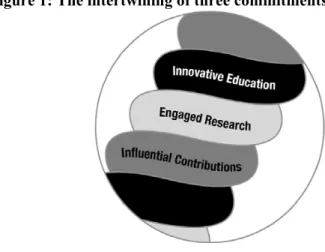
The College pursues its mission by weaving together three commitments: to innovative
education, to engaged research, and to making an influential contribution to policy and practice. The intertwining of these three strands of multi-disciplinary scholarship is special. Day in and day out CUPPA strives to interweave the discovery of new knowledge with the education of students and the application of research findings to pressing public problems.
Figure 1: The intertwining of three commitments
CUPPA faculty, students and staff design and implement multi-disciplinary scholarship using knowledge, tools, resources and talents drawn from the domains of education, research and service. The collaboration adds value to more routine activities within each domain. For example, classroom learning is enlivened by new research and practical case studies, research reports are informed by relevant policy concerns, and collaboration with partners gives access to excellence for those outside the university.
By offering innovative courses attracting talented students and professionals, by working closely with colleagues in other UIC colleges to enhance urban scholarship, by attracting funds from external organizations and individuals, and by providing informed advice to city leaders, public service professionals and urban communities, CUPPA aims to show how UIC can make a difference locally, nationally and internationally to the discourse about urban planning and public affairs as well as the practice of city planning and public management. The CUPPA 2010 Strategic Plan aims to build on the achievements of the past and, by intertwining three
commitments aims to shift the College from respected leader to national prominence and, ultimately, global recognition.
5) CUPPA – Goals for 2010
In order to pursue the mission set out above the College has agreed to the following goals for the next five to ten years. These respond to emerging thinking relating to the university-wide vision of UIC in 2010 and, in particular, contribute to the UIC Great Cities Commitment. We have divided these into ‘external’ and ‘internal’ goals. By ‘external’ goals we refer to the way CUPPA seeks to interact with its external environment. By ‘internal’ goals we refer to the way CUPPA seeks to improve performance within the organization. Naturally these two sets of goals are inextricably linked, but we gain coherence by setting them out separately.
External goals
Goal 1: Intellectual contributions. Make significant contributions to theoretical and applied knowledge about urban and public affairs that are valued locally, nationally and abroad
Goal 2: Preparing students. Combine research, teaching and public service to 1) prepare students to be effective professionals working mainly in the public sector (federal, state, city and local governments, nonprofits etc) and 2) prepare students to be leading scholars in the field of urban planning and public affairs
Goal 3: External quality of life. Demonstrate understanding of the global forces impacting cities and city regions and conduct research and public service projects that improve the quality of life in urban areas at home and abroad
Goal 4: Inclusiveness. Attract people from groups who have traditionally been excluded from the opportunities provided by higher education
Goal 5: Professional applications. Contribute to the advancement of professional practice by building closer links with the professions by sharing knowledge, research, and
solutions generated in CUPPA
Goal 6: External partnerships. Strengthen partnerships with external stakeholders who identify with the CUPPA mission
Goal 7: Policy contributions. Make an influential contribution to the policy discourse about urban and public affairs by attending to and disseminating information to a range of partners and media organizations
Internal goals
Goal 8: UIC mission. Make a valued contribution to the central mission of UIC, particularly the Great Cities Commitment
Goal 9: Intellectual debate. Increase the opportunities for intellectual debate in the College and lift the quality and visibility of CUPPA programs, particularly the PhD programs
Goal 10: Entrepreneurial and development activity. Increase the level of entrepreneurial and development activity within CUPPA leading to an expansion of funding from a range of sources
Goal 11: Efficient allocation of current resources. Manage state resources creatively to maintain progress on the plan
Goal 12: Diversity. Achieve greater diversity in the composition of faculty, staff and students in CUPPA
Goal 13: Technology. Develop and maintain a technological infrastructure to support innovative education, engaged research, and influential contributions.
Goal 14: Faculty and staff development. Grow and develop all faculty and staff through improved approaches to personnel development at the level of the individual, the academic unit, and the College as a whole
Goal 15: Internal quality of life. Improve the quality of the working environment and computing and other facilities in CUPPA Hall to the benefit of faculty, staff and students
6) CUPPA 2010 - Strategy for delivery
In order to achieve the goals set out above the College has devised a practical ‘strategy for delivery’ involving action at the level of the individual, the unit and the College as a whole. The
strategy takes account of the budget context that is discussed further in Section 7 below. Three kinds of actions are proposed:
Enhancing established excellence. As described in Annex 1 the College comprises two graduate programs and a cluster of research units. The plan seeks to enhance these established centers of excellence
Initiatives. These are significant new initiatives CUPPA plans to take to shift the College forward in this next period
Innovations. These measures form part of our continuing campaign to improve the quality of College activities in line with our mission statement and core values
Enhancing established centers of excellence
The College contains many respected and well-established units: Graduate Program in Public Administration
Graduate Program in Urban Planning and Policy Great Cities Institute
Great Cities Urban Data Visualization Laboratory Institute for Research on Race and Public Policy
Natalie P. Voorhees Center for Neighborhood and Community Improvement Survey Research Laboratory
Urban Transportation Center
Center for Urban Economic Development
City Design Center (a joint center with the UIC College of Architecture and the Arts) It is vital that the quality of the work carried out by all the existing units is sustained in the years ahead. This presents challenges during a period when state funds have been cut back, but a focused approach to planning and continuous improvement of each unit represents a positive response to these challenges. The CUPPA Annual Report on 2002/03, published in September 2003, represented a step forward in purposeful planning in the College. Each Unit produced a short statement using the following headings:
Introduction and highlights Aims overall
Main activities in 2002/03 (examining how successfully goals were achieved) Goals for 2003/04
These statements were brought together in a single volume, which includes a section on the overall performance of the College prepared by the Dean. This new process provides the first step in our move towards ‘mission-driven annual planning’. This new approach gives explicit and forward-looking attention to the work of each unit. It enables the units to be inventive in pursuing their own specific goals while also contributing in a more organized and systematic way to the achievement of College-wide goals.
The CUPPA 2010 Strategic Plan depends for its success on having both a well-written document setting out a clear vision and strong arrangements for delivering shifts in culture and practice within all the units to move the College towards the vision. It is critical for the College to strengthen its approach to goal setting, monitoring progress towards goals and regularly revising and reshaping goals in the light of experience. The College will introduce mission-driven annual planning to strengthen accountability within the organization and ensure that our energies and investments focus on College priorities.
A learning organization learns effectively about its environment and adapts accordingly. In CUPPA we intend to institutionalize this learning process at three levels:
At the individual level, introduce Faculty Development Plans (FDPs)
At the Unit level, each Unit will, building on the CUPPA Annual Report on 2002/03, report in a systematic way on the previous academic year and set out clear measurable targets for the coming two academic years
At the College level there will be similar assessment of the previous year with clear target setting for the next two years.
There will, of course, be strong interplay between these three levels. Individual plans will influence Unit plans and vice versa. Unit plans will influence College plans and vice versa. By introducing this purposeful approach across the whole College we will be able to monitor our progress towards the 2010 vision.
A key challenge for all units concerns recovering from the drastic expenditure reductions in state funding the College has experienced in the period since FY02. The growth in student numbers documented in Annex 3 has been achieved against a decline in the number of faculty lines. A consequence has been higher teaching loads for faculty, which is a concern. The state support to the College, which is crucial for both the academic programs and the research centers, has been reduced to a point where quality and performance are threatened. It is vital for the achievement of the College mission that, over a period, the level of state funding is increased. Specific budget requests – supported by clear evidence – will be brought forward by College Units as part of the new ‘mission-driven annual planning process. All Unit plans will build on the entrepreneurial approach that the College has adopted over the years. By leveraging additional non-state funding at a rate of at least 2.3 non-state dollars to every state dollar received the College will continue to provide good returns on investment to UIC.
To support the work of the various units the College will:
Continue to improve communication and collaboration between the units of the College Actively promote the work of the units within the university, within the city region, and further afield
Assist the units in managing the tensions between short term, responsive activities and longer term expansion requiring more space and improved facilities
Take steps to improve state funding to units
Work with the units to recruit new faculty to support strategic growth of the College. The local and national standing of the College has been built on the existing units of the of the College and our strategy for the period to 2010 is to deepen and strengthen the work of these units.
Initiatives
The College will pursue three new Initiatives in this next period as follows: 1) Undergraduate Degree in Urban and Public Affairs (UPA)
As a key part of the CUPPA contribution to the UIC Great Cities Commitment the College will launch a completely new Undergraduate Degree in Urban and Public Affairs (UPA). This new, broad based degree is designed to expand UIC’s undergraduate offerings in a way that takes special account of the extraordinary ethnic and cultural diversity of the Chicago metropolitan area. It will make a particularly important contribution to UIC’s diversity agenda as active steps will be taken to appeal to and to recruit future urban leaders from a range of ethnic backgrounds. Special attention will be given to undergraduate advising. The proposal is also designed to strengthen CUPPA’s PhD programs by offering teaching opportunities in the College for PhD students. State support is needed to make this significant step forward in the work of the College.
2) CUPPA International
The impact of global forces on cities and regions is transforming the nature of urban planning and public management in all countries. CUPPA has made a significant academic
contribution to understanding the nature of these changes and the ‘CUPPA International’ initiative is designed to give more visibility to this ongoing work and to grow cross-national comparative research College-wide. This growth in our commitment to making an
influential contribution to global debates is signaled by the City Futures international conference the College is organizing on behalf of UIC in July 2004. Backed by Mayor Daley and a string of sponsors the City Futures conference will bring together some 200 leading urban scholars and policy makers from 40 countries to share research findings on urban issues and examine future urban scenarios. CUPPA International will build on the City Futures conference and involve the creation of strategic partnerships with a number of leading universities in other countries – initially in Europe, China and Latin America. External funds will be sought to support faculty and student exchanges and to carry out cross-national comparative research. The Dean’s International Lectures, bringing leading figures from around the world to UIC, will continue. And the College will introduce CUPPA International Fellowships bringing the best scholars in the world for short visits to meet with faculty and students (with Fellows funding themselves).
3) Municipal Finance Center (MFC)
The College plans to create, in partnership with the National League of Cities (NLC), a new Municipal Finance Center that will aim to become the ‘go to’ center in the country for
understanding and analysis of urban finance. External funds will be sought to underpin this initiative. The new center will aim to shape and inform policy and scholarly discourse and debate on government and public finance by planning and executing research and providing periodic reports, informed analysis, and venues for discussion of fiscal and governmental issues. The partnership brings together the Great Cities Institute, colleagues in both the Public Administration Program and the Urban Planning and Policy Program as well as experts in NLC who have links to some 26,000 US cities. As well as serving a national agenda the center will, over time, develop special capacities in relation to: municipal finance in the Chicago metropolitan area, advance cross-national dialogue and exchange in relation to urban finance, and alternative approaches to local taxation. This initiative will form part of a broader effort to develop the research capacity of UIC to study and contribute to the development of urban and regional governance.
Innovations
In addition to the three Initiatives outlined above, the College plans a significant number of additional measures. These are described as ‘Innovations’ as they involve departures from past practice. Some of these are fairly significant actions in themselves. All involve the taking of concrete actions and, as described earlier, College progress on delivering these actions will be monitored through the new mission-driven annual planning process. The sub headings below follow the format used in Annex 3 to describe the CUPPA track record to date:
- Teaching programs - CUPPA students
- Academic output and policy advice
- Research funding and College advancement - International activities
- Organizational culture
However, it should be stressed that these various initiatives are highly inter-connected. At every stage our proposals strive to link the three academic strands articulated in Figure 1 – innovative education, engaged research, and influencing policy and practice.
Teaching programs
The teaching programs will remain the ‘core business’ of CUPPA. It is essential that the College maintains and enhances the existing high quality educational programs in Urban Planning and Policy (UPP) and in Public Administration (PA). Given changes in the external environment both programs will need to continue to innovate in course development – particularly picking up on international trends - to ensure that courses are competitive and attractive. More specific teaching program priorities are as follows:
Action 1: Work to create a more direct connection between the work of our research units and the teaching programs delivered to students.
Action 2: The existing PhD programs have increased the quality and quantity of PhD scholarship activity at CUPPA and we build on this. The aim should be to create an environment that attracts the best PhD candidates in the world to come and study at CUPPA. This has implications for the PhD student experience in the College as well as the marketing of higher degree opportunities at CUPPA and funding support for PhD students. The CUPPA Scholarship fund needs to be expanded to support up to six new doctoral students each academic year starting in 2007
Action 3: Ensure continuing recognition of both the Urban Planning and Policy (UPP) and Public Administration (PA) masters programs by the relevant accrediting bodies and lift the visibility of these programs in academic and professional circles. To enhance student learning and improve cost effectiveness, increase the level of collaboration between the teams teaching the MUPP and MPA degrees and, as a first step, design and introduce a common graduate level research design and methods course across the PA and UPP criteria
Action 4: Introduce, in collaboration with the College of Business Administration, a new Masters Degree in Real Estate (proposal approved in 2003)
Action 5: As part of a strategy to internationalize our teaching programs consider introducing an accredited MPA program for Chinese government officials
Action 6: By drawing on the high level of expertise in the CUPPA Survey Research Laboratory (SRL) enhance UIC offerings relating to Survey Methodology in two ways: 1) in collaboration with colleagues in other UIC colleges offer a new graduate
concentration in Survey Methodology and 2) once the graduate concentration is
established offer a non-degree Certificate in Survey Methodology to attract new students to CUPPA
Action 7: The College will carry out a ‘scoping study’ to examine the opportunities for expanding CUPPA offerings to support the professional development of mid-career and senior officials in urban planning, public administration and related fields. This
initiative, known as the Professional Advancement Initiative, will involve establishing closer dialogue with colleagues in the professions – the American Planning Association (APA) and the American Society of Public Administration (ASPA) – and other partners, including College Alumni. Possibilities to explore as part of this initiative include: revitalizing the Urban Developers Program for non-degree students, expanding the current portfolio of On-line courses for public service professionals, introducing an Executive MPA program for high level executives, and introducing refresher courses for those in leadership roles in city planning departments. If this investigation demonstrates a clear set of needs and market viability, the College will create a new CUPPA Office for Professional Advancement (OPA) to orchestrate this initiative in close collaboration with College academic programs and research units and the UIC Office of Continuing
Education. CUPPA students
The proposals relating to teaching programs set out above have implications for CUPPA students. The College continues to have multiple responsibilities to its students: to provide high quality, up-to-date instruction that prepares graduates for both professional and academic careers; to maintain a flexible learning community that recognizes the diverse needs and expectations of all its members; to stimulate outstanding scholarship by CUPPA students, particularly our PhD students; to provide meaningful professional development experiences during the program and linkages to employment opportunities; and to provide, in close collaboration with the CUPPA Alumni Association, on-going professional development opportunities after graduation.
In addition to these commitments the CUPPA 2010 Strategic Plan envisions expanding our provision of educational opportunities undergraduates – via the introduction of the new Undergraduate Degree in Urban and Public Affairs (Initiative 1).
To achieve the goals outlined earlier the College will:
Action 8: Continue to enhance the College technological infrastructure that supports student learning
Action 9: Consult further with existing students and the Alumni Association on ways of improving the student experience at CUPPA and institute annual postgraduate focus group assessment of recent graduates to assess educational satisfaction
Action 10: Continue to offer – and, ideally, expand – research assistantship opportunities in College research and academic units as a way of supporting graduate students as well as the research efforts of CUPPA
Action 11: With the introduction of the Undergraduate Degree in Urban and Public Affairs create several teaching assistantship opportunities for CUPPA PhD students Action 12: Improve the marketing of CUPPA courses via improved recruitment materials, enhanced use of the World Wide Web, and the development of more sophisticated student support services
Action 13: Embark on an effort to secure new forms of financial support for students, including considering a Graduate Public Service Internship Program
Action 14: Consult with the Alumni Association and local partners about the proposal to create an Office for Professional Advancement (see Action 7) and, if seen as attractive, enlist their direct involvement and support
Academic publications and policy advice
In Section 3 reference was made to the growth in College contributions to scholarship in urban planning and public affairs as well as to CUPPA policy contributions to the urban challenges facing the Chicago metropolitan area and other towns and cities in Illinois and the country as a whole. The CUPPA 2010 Strategic Plan requires faculty in the College to continue to create outstanding scholarship that is valued at home and abroad. For a college aspiring to global
recognition there can be no substitute for delivering high quality published outputs valued and recognized by academic peers in our field. This is one of the reasons why the College is committed to introducing Faculty Development Plans (FDPs)
Given our desire to blend multi-disciplinary scholarship with the provision of practical advice to city leaders, public service professionals and local communities on urban issues, faculty need to continue to make an influential contribution to the discourse about urban planning and public affairs as well as the practice of city planning and public management. To support faculty in managing the creative tension between traditional scholarship and the application of academic understanding to specific urban problems the College will:
Action 15: Create regular opportunities for intellectual debate about alternative
approaches to engaged, urban research. The successful CUPPA Expo, held in September 2003, provides one possible model – it created not only a seminar setting for exchange of views, but also an opportunity for more informal sharing of ideas linked to displays of research outputs prepared by all CUPPA units using a marketplace format (see also Action 19)
Action 16: The College plans to explore whether there would be value in creating a handbook of case studies designed to illustrate a range of ethical dilemmas that arise in urban planning and public affairs. Faculty, staff, students and alumni will be encouraged to participate in this enterprise if considered attractive
Research funding and College advancement
The importance of growing the research capacity of the College, by increasing external funding to CUPPA, is critical to our strategy of lifting the College from respected leader to national prominence and global recognition for two reasons. First, it is only by carrying out path-breaking research that CUPPA can generate the quality of scholarship needed to win respect from academic peers and provide the sound evidence base to underpin advice to policy makers and practitioners. Second, as discussed further in Section 7, the funding outlook for US higher education in general and for UIC in particular, is such that ambitious academic plans must show that they can attract funding from a variety of sources. As noted in Annex 3 the College has been extremely successful in generating external funds and this trajectory needs to be maintained. Future research expansion will largely be built around the forward plans of the existing research units. The College research institutes and centers have built up their own successful track records and these units need to be valued and supported in their efforts. Colleagues who have less experience of research bidding need to be encouraged. To strengthen research funding and College advancement the College will:
Action 17: Submit a full proposal for the permanent state funding of the Institute for Research on Race and Public Policy (IRRPP). This UIC-wide research institute, founded formally in 2000, has established sound collaborative links with colleagues in a range of UIC colleges. The institute is pursuing a successful strategy involving cutting edge research on race and ethnic issues, providing effective support to graduate and undergraduate students with a minority backgrounds from across UIC, and fruitful partnering with ethnic minority interests in Chicago and further afield
Action 18: To support research bidding activity the College will redeploy an existing member of staff within the Dean’s Office to support faculty in grant getting. Working closely with the Assistant Dean for Advancement this member of staff will work with colleagues in CUPPA to: seek support in the form of grants from corporations, private foundations, and government agencies; develop, maintain and expand relationships with appropriate funding bodies; and develop the capacity of the College to engage in strategic monitoring and analysis of grant getting activity
Action 19: Recognise the valued contribution of Research Faculty not just in generating research funds and scholarly activity but also in contributing to the intellectual life of the College. Ensure their collaborations in seminars, etc (see Action 15).
Action 20: Continue to improve the presentation of the College in published materials and on the World Wide Web. New College style and identity guidance, consistent with UIC policy, will be introduced to achieve a unified house style and the new CUPPA mission statement will be incorporated in promotional and marketing materials Action 21: Work to support College technology infrastructure through systematic inclusion of technology components in grants and contract.
As a result of these and other measures noted above the College seeks to increase the level of external research and contract support received as well as the level of support generated from other methods of fund raising (see Section 7 for more on the budget context). Fund-raising priorities will include developing long-term strategies for establishing endowed chairs and professors and student support.
International activities
The College already has a strong international dimension – largely due to the international diversity of our faculty. The CUPPA 2010 Strategic Plan builds on this strength and seeks to enhance cross-national, comparative work leading to a step change in the international profile of UIC and CUPPA. Members of faculty in CUPPA have written several books on the impact of global forces on cities and urban management. The evidence from this and other research
suggests that global trends are likely to have increasing significance for the future of cities – and, as a consequence, for those concerned with the planning and management of cities.
Powerful international, economic, political and social forces are reshaping the context within which local decision makers operate in all countries. This was true even before the terrorist attacks of September 2001 heightened social tensions and spurred ethno-religious conflicts not just in US cities but also across the world. Students of urban planning and public affairs need to acquire an understanding of the dynamics of these global forces and to develop an awareness of the benefits of learning about experience with city planning and public administration in other countries. Initiative 2 speaks to this ‘CUPPA International’ agenda. In addition, the College will:
Action 22: Continue to contribute to the UIC Great Cities London Program, which has a significant urban planning and public affairs dimension.
Action 23: Explore seeking funding from the Federal Government and the European Commission to establish formal partnerships with three European universities to facilitate faculty and student exchanges and create cross-national comparative research projects Action 24: Launch the CUPPA International Fellowships program. This new program aims to create a steady stream of visiting scholars from other countries that will become ‘scholars in residence’. The scholars will visit CUPPA for periods of from four weeks to six months and will contribute to the intellectual development of the College by giving seminars, interacting with faculty and students etc. The financing needs further consideration but one model would involve the scholars financing themselves and the College providing an academic home and basic services (e.g., an office with computer and access to the library). The CUPPA International Fellows program will be used to build strategic alliances with particular universities in other countries and forms part of the CUPPA International initiative
Action 25: Explore the development of a ‘special relationship’ with China. The College has longstanding good relations with colleagues in urban and public affairs in China and, given our shared interests, it would be desirable to consider firming up links with selected institutions to facilitate fruitful dialogue and exchange
Organizational culture
Reference is made in Annex 3 to the supportive organizational culture that has been fostered in the College over a long period of time. The culture of CUPPA is hard working but friendly, ambitious but collegial. Students and employees are treated with consideration. Faculty and staff have a problem-solving attitude. Messengers are encouraged, not killed. Doors are open, not closed. It is not surprising that visitors and short-term employees often make favorable comments about the inter-personal atmosphere at CUPPA.
The faculty and staff who work at CUPPA care about their work, care about the impact they are making and care about each other. These are remarkable advantages for any organization and the CUPPA 2010 Strategic Plan seeks to retain and enhance this supportive organizational culture. This means paying attention to the needs of those already involved in CUPPA – whether as faculty, staff, students or alumni. It also means paying attention to thoughtful succession planning over the longer term so that, with changes in personnel, college values are nurtured and sustained. To sustain and improve the quality of working life at CUPPA the College will:
Action 26: Introduce Faculty Development Plans (FDPs). These personal plans will take stock of achievements in the previous year and set out proposals for academic endeavor in the next three-year period. The plans will take account of the CUPPA mission and core values and will, in particular, include proposals for inter-unit collaboration within CUPPA and proposals for raising external funds. The College recognizes that the creative energies of faculty are absolutely critical to the success of the College. The FDP approach will enable us to ‘organize around enthusiasms’. Incentives will be offered to stimulate bold action in line with the CUPPA mission.
Action 27: Offer incentives to faculty (whether as individuals or small groups) to put forward new proposals designed to improve the effectiveness of the College in achieving its mission. Known as CUPPA Innovation Grants (CIGs) the awards will be made on the basis of clear criteria related to the CUPPA mission and core values
Action 28: The College will strive to delegate responsibility and authority as much as possible so that unit teams and individuals can work creatively and independently, while sustaining commitment to the CUPPA mission and the achievement of agreed upon common goals. As part of this the College will work to simplify and streamline procedures wherever possible.
Action 29: Alongside the new Faculty Development Plans (FDPs) (see Action 26), the College will continue to make full use of the UIC Employee Development Plan (EDP) instrument on an annual basis. The importance of enhancing the skills of staff, especially in relation to technological change, is particularly important.
Action 30: Consult CUPPA Research Faculty on whether they would value a mentoring program tailored to their needs and, if considered desirable, introduce such a program Action 31: Revise and update the College By-Laws to take account of changing needs and circumstances, including improving the status of research faculty.
Action 32: Continue the consultative style of decision-making that has grown up in the College and update the CUPPA constitution relating to the various decision-making and advisory groups as necessary
Action 33: Colleagues working in practice make an invaluable contribution to both the Public Administration program and the Urban Planning and Policy program as well as to the work of our research centers. The same is probably true of many other UIC colleges. In consultation with other parties the College would like to explore inventing a new UIC formula for engaging with practice involving ‘Practitioner Professors’. In essence, the scheme would give skilled and knowledgeable practitioners proper recognition for the services they provide to UIC and would enhance the teaching capacity of the College. This new role would demonstrate the value UIC places on the contribution reflective practitioners can make to pedagogy in modern higher education and also help build new partnerships with organizations designing and implementing public policy in the Chicago metropolitan region. The criteria for appointment as a Practitioner Professor would need to be examined and the nature of an appropriate contract would also need to be explored.
7) The budget context
Like all colleges and administrative units at UIC the College has faced major budget challenges in recent years. State funding to the College has been cut substantially over the last three years. A budget rescission in FY02 involved a budget reduction of 2.5% during the financial year. This was followed by an 8.5% cut in FY03 and a further 11.1% cut in FY04. A cut of $1,029,595 (or 22%) in three years is a major reduction in state support and has worked against the achievement of College objectives. Further reductions in state funding will make it impossible to achieve the CUPPA 2010 aim of creating a world-class UIC college.
The CUPPA 2010 Strategic Plan is not, however, dependent on a massive injection of state funds to the College. On the contrary the strategy is to be financed by a combination of state funding and external funding. Annex 3 documents the CUPPA track record in grant getting and fund raising. This shows that external funding has increased from $3.4 million in 1995 to $10.1 million in 2003. Indeed, the flair shown by faculty and staff in attracting external funding has meant that the overall spending of the College has grown even during the period of severe cutbacks in state funding. Total spending in 2003 was $14.5 million – a record-breaking year. This achievement demonstrates an impressive leverage ratio. In 2003 each state dollar invested in CUPPA generated a further $2.3 dollars of academic activity.
As part of our work on the CUPPA 2010 Strategic Plan we have examined financial trends and this analysis suggests that a ‘mixed’ approach to funding the plan is needed. The vision of creating a world-class college here at UIC can be financed by:
Adjusting tuition fees for students while taking account of our core values
Lifting the level of entrepreneurial activity in CUPPA as a whole to generate more income from research, continuing education, individual giving, and fund raising
Fostering a culture of ‘investing in success’, with the aim of improving the leverage ratio achieved by scarce state dollars
Making modest increases in state funding to the College in the coming period to support identified strategic initiatives, which are aligned with statewide goals, clearly propelling the College to world-class status
In conclusion, it should be stressed that the CUPPA 2010 Strategic Plan is not dominated by short-term considerations. Rather the plan recognizes the difficult budget environment facing the whole of UIC but refuses to allow short-term setbacks to deflect us from creating a world-class college at UIC valued at home and abroad.
Annex 1: A Guide to CUPPA
The CUPPA missionThe College of Urban Planning and Public Affairs (CUPPA) at the University of Illinois at Chicago (UIC) has the following mission:
To provide innovative urban planning and public management education that puts engaged research to purposeful use at home and abroad.
The College pursues this mission by weaving together three commitments: to innovative education; to engaged research; and to making influential contributions to policy and practice. The intertwining of these three strands of engaged scholarship lie at the heart of how we organize and shape our activities.
Figure 1: The intertwining of three commitments.
The organization of CUPPA The College comprises:
Two graduate programs offering Masters degrees and Doctor of Philosophy degrees – the Public Administration program (PA) and the Urban Planning and Policy program – plus certificate programs in urban development, information technology, budgeting and financial management, management of public organizations and related topics.
Two research institutes serving faculty and students across the whole of UIC – the Great Cities Institute (GCI) and the Institute for Research on Race and Public Policy (IRRPP)
Five CUPPA research units carrying out a wide range of research activities for as many as 100 clients at any given time – the Survey Research Laboratory (SRL), the Urban Transportation Center (UTC), the Center for Urban Economic Development (CUED), the Nathalie P. Voorhees Center for Neighborhood and Community Improvement and the Great Cities Urban Data Visualization Laboratory (GCUDVL). In addition, the college collaborates closely with the College of Architecture and the Arts in the work of the City Design Center (CDC)
The following diagram shows how these different parts fit together in the organization of
CUPPA. This is followed by a short statement about the main goals and activities of each unit in the College.
Figure 2: The organization of the College
Public Administration program
Goals of the UnitThe Graduate Program in Public Administration strives for academic excellence in the interdisciplinary field of public management.
To be placed among the best public administration programs in the nation, to strive for global recognition by making a distinctive and influential contribution to public management, and to improve the human condition at home and abroad, the faculty and staff are dedicated to
providing a modern curriculum to our students, to remaining active and engaged scholars in our profession and communities, and to inspiring the next generation of public and non-profit leaders and of academic researchers.
Profile and Activities
The Graduate Program in Public Administration is the only Masters in Public Administration program in Chicago that is certified by the National Association of Schools of Public Affairs and Administration. The program also offers three Certification programs in Information
Technology, Budgeting and Financial Management, and Management of Public Organizations. Faculty and students work alongside colleagues in Urban Planning and Policy as well as in the college’s seven research centers. Faculty also collaborate with government and non-profit agencies in the Chicago region and nationally, including the State of Illinois, US Internal
Revenue Service, City of Chicago, Government Finance Officers Association, Federal Executive Board, National League of Cities, and the Coalition for the Homeless.
The Public Administration program has identified four core competencies within the curriculum, reflecting the critical research areas of the faculty. The four are: Management of Public
Organizations; Financial Management; Information Technology and Science and Technology Policy; and Survey Research Methods. Faculty research areas include cross-cultural survey research, environmental regulatory policy, transformation of the IRS, performance management, science and technology assessment, urban fiscal stress, workforce diversity, explaining non-responses to surveys, infrastructure management, municipal finance, and quality management. Faculty have published in the discipline’s premier journals, including Public Administration Review, the Journal of Public Administration and Theory, Administration and Society, Journal of Policy Analysis and Management, American Review of Public Administration, Public Opinion Quarterly, Public Productivity and Management Review, State and Local Government Review, Public Budgeting & Finance, Evaluation Review, Policy Studies Journal, Urban Affairs Review, Policy Sciences, Journal of Urban Affairs, Policy, and Politics, as well as top presses, including Johns Hopkins University Press, M.E. Sharpe, Inc., Georgetown University Press, and Jossey-Bass. Faculty have secured external grants from IBM Center for the Business of Government, the Brookings Institution, and the Government Performance Project of the Pew Charitable Trusts. Due to their professional reputations, PA faculty are frequently invited to speak on their areas of expertise in the United States, Canada, Japan, England, Mexico, Italy and elsewhere. Faculty have received national awards, including the prestigious Mosher Award twice (best article in Public Administration Review), the Kaufman Award (best paper presented at the American Political Science Association’s annual meeting), and best article in Review of Public Personnel Administration.
The program is committed to a diverse faculty and student body. The student body has grown by more than 50% in 3 years and counts among its 113 students 40% minority students and 6% foreign students. The undergraduate grade point average for the entering MPA class has been steadily increasing, reaching 3.38 in 2003. All of our pre-service graduates are placed in
appropriate positions at all levels of government and in the non-profit sector, including City of Chicago, NASA, U.S. EPA, Cook County, United Way, City of Dallas, Museum of
Contemporary Art, and the Illinois Council against Handgun Violence.
Urban Planning and Policy program
Mission of the UnitThe Urban Planning and Policy Program fosters scholarship about cities, educates people to plan for cities and offers advice to city makers and users.
Profile and Activities
The Urban Planning and Policy Program (UPP) offers graduate professional education for people who want to engage in city planning, study urban policy, and create innovative improvements for human settlements in the region, the nation and abroad. It is one of the largest graduate planning programs in the country, training approximately 200 students per year. It is the only accredited planning Master of Urban Planning and Policy Degree program in the Chicago region. Its Ph.D. in Urban Planning and Policy trains future educators and researchers. Specialized training is provided in five areas: community development, economic development, international development, physical planning and urban transportation. The Program offers several
undergraduate courses and, with the Great Cities Institute, a training program for developers of low and moderate income housing. In addition, UPP contributes to courses for students in the Master of Urban Real-estate Program of the College of Business. Almost half of UPP’s graduate students are supported though research work in the College during their studies. The program has over 1000 graduates who work in government, nonprofit and for-profit agencies including the City of Chicago Department of Planning, the U.S. Department of Transportation, The Chicago Community Trust, the Near West Side Community Development Corporation, and The Habitat Company.
The Program creates, disseminates, and applies multi-disciplinary knowledge about urban and public affairs. The Urban Planning and Policy Program faculty rank number five in number of refereed journal articles published among planning faculties nationally and have published 13 books in the past four years. Faculty conduct research in a range of areas including housing policy, planning theory, globalization, gentrification, community organizing, data visualization technology, water planning, tax increment financing, human services, freight transportation, social capital, comparative urbanization, brown fields development, day labor, and the
interaction of transportation and labor markets. Research is conducted in collaboration with the seven CUPPA research centers, with community partners and independently. Work is published in a range of respected venues including Social Forces, Journal of Planning Education and Research, Journal of the American Planning Association, Housing Studies, Journal of Environmental Planning and Management, Law & Zoning Digest, Transportation Research Record, Journal of Digital Creativity, Journal of Public Works Management and Policy,
Planning Theory, Journal of Urban Design, Environment and Planning B: Planning and Design, Journal of Health & Social Policy, Housing Policy Debate, Urban Studies, Economic
Geography, Economic Development Quarterly, Urban Affairs Review, Journal of Urban Affairs, Urban Studies, and Policy and Politics.
The Program also conducts educational, research and public service activities that improve human settlement, especially in metropolitan regions. Recently, a team of faculty and students completed a business district plan for the City of Oak Park, Illinois. Another team of students are currently working to develop a plan for the City of Lisle and another on a cultural heritage museum in North Lawndale community of Chicago. Faculty work with research centers and independently on a range of service-oriented projects such as those designed to improve
accessibility to food pantries and to understanding the gaps between rental housing and incomes in the Chicago area.
Great Cities Institute (GCI)
Goals of the UnitThe Great Cities Institute serves as the focal point for UIC ‘s Great Cities Initiative. GCI is a research unit committed to “engaged research” i.e., research that ideally, from the protocol forward,(i) is built on partnerships between traditional and non-traditional sites of knowledge and (ii) is interdisciplinary (iii) has an impact on both the construction of our knowledge of the urban and the on the quality of life in the “great cities” of the world, of which Chicago is one. Profile and Activities
The University has housed GCI in the College of Urban Planning and Public Affairs (CUPPA). The work of GCI is carried out in a transdisciplinary environment by Scholars, Fellows,
academic professionals, graduate students and staff representing all facets of university scholarship and coming from every college on campus. The core programs of the Institute combine with GCI’s affiliate centers to produce the following:
Great Cities Faculty Scholars: In the