Final Report
2008 Process Evaluation of California
Statewide Aggregator Demand
Response Programs
Prepared For:
Prepared By:
Jane S. Peters, Ph.D. Dulane MoranResearch Into Action, Inc. August 6, 2009
=
ACKNOWLEDGEMENTS
We would like to thank the program staff members at Pacific Gas and Electric, San Diego Gas and Electric, and Southern California Edison for their time and willingness to discuss their experiences with the Capacity Bidding Program, the Aggregator Managed Portfolio, and the Demand Response Resource Contracts. We appreciate the insight and perspectives offered by Kathy Rios and John Hernandez at PG&E; Theron Mehr, Pat Boyd, and Amy Broussard at SCE; and Joe Semerad at SDG&E.
Additionally, we would like to thank contacts at both active and inactive aggregation firms for their willingness to discuss their experience with these programs and their perspectives on these activities in California.
Finally, we want to acknowledge the program participants – representatives from all types of organizations throughout California – for their willingness to speak with us about their experiences with the program and with demand response curtailment activities in general.
=
=
TABLE OF CONTENTS
EXECUTIVE SUMMARY ... I
EVALUATION OVERVIEW ... I DATA COLLECTION AND SURVEY SAMPLE DESIGN... II KEY FINDINGS... II CONCLUSIONS AND RECOMMENDATIONS...V
1. INTRODUCTION ... 1
SCOPE OF THE EVALUATION...1
PROGRAMS EVALUATED...1
Capacity Bidding Program...1
Bilateral Contract Programs...2
Logic Model and Program Theory...2
Program Theory ...5
METHODOLOGY AND POPULATIONS...6
THIS REPORT...7
2. PROGRAM DESCRIPTIONS ... 9
DEMAND RESPONSE PROGRAM PORTFOLIOS ...9
Aggregator-Driven Programs...10
THE CAPACITY BIDDING PROGRAM...12
Trigger ...12
Marketing...12
Other Features...13
Nomination and Settlement...13
Utility-Specific Experiences: CBP at Pacific Gas & Electric ...15
Utility Specific Experiences: CBP at Southern California Edison...17
Utility Specific Experiences: CBP at San Diego Gas & Electric...18
BILATERAL CONTRACT PROGRAMS ...20
PG&E’s Aggregator Managed Portfolio (AMP) Program...21
LESSONS LEARNED...28
Respect for Aggregators ...28
Utility-Process Barriers...29
Role of Account Executives...30
SUMMARY ...31
3. AGGREGATOR EXPERIENCES ... 33
POPULATION AND SAMPLE ...33
Aggregator Characteristics...35
SUMMARY & FINDINGS ...46
4. PARTICIPANT EXPERIENCES ... 49
METHODOLOGY...49
Guidelines for Reading this Chapter...52
Participant Profile ...53
Program Awareness and Reasons for Participation ...56
Decision-Making...57
Technologies...59
Event Notification...63
RESPONSE, CURTAILMENT & PAYMENT...67
Response to Curtailment Events ...67
Backup Generation...70
CURTAILMENT EXPERIENCE...70
SETTLEMENT AND PAYMENT ...71
SATISFACTION ...73
Satisfaction with Program Experiences ...73
Program Expectations ...74
Suggestions for Improvement ...78
SUMMARY AND FINDINGS...81
Summary ...81
Findings ...81
5. POST-EVENT SURVEY RESULTS... 84
POPULATION AND SAMPLE ...84
SUMMARY ...85
SURVEY RESULTS ...86
Demand Response Goals and Strategies...87
Method, Timeframe, and Frequency of Notifications...89
Internal Communication and Coordination...90
Demand Response Performance ...91
Communication with the Aggregator...94
Overall Experience with the Program...94
6. CONCLUSIONS AND RECOMMENDATIONS ... 96
KEY FINDINGS...96
CONCLUSIONS AND RECOMMENDATIONS...99
APPENDICES
APPENDIX A: METHODOLOGY ...A-1 Survey Instrument Design...A-1 Sampling Strategy and Plan ...A-1 Obtaining Customer Contacts... A-1 Merging Curtailment Responses and Load Data ... A-3 Identification of the Population and Samples... A-4 Data collection ...A-6 General Participant Survey... A-6 Post-Event Survey ... A-7 Final Data and Weighting ...A-7 Data Analysis ...A-10 APPENDIX B: GENERAL PARTICIPANT SURVEY...B-1 APPENDIX C: POST-EVENT PARTICIPANT SURVEY ...C-1
ES
EXECUTIVE SUMMARY
EVALUATION OVERVIEW
This process evaluation is Volume 3 of a three-part project focused on aggregator-driven demand response programs operating in California in 2008. Volume 1 presents the results from an ex post and ex ante impact evaluation focused on estimating the load impacts.1 Volume 2 presents the results from a baseline analysis study.2
This evaluation investigated three demand response programs operating in the territories of California’s electric investor-owned utilities (IOUs): Pacific Gas & Electric (PG&E), Southern California Edison (SCE), and San Diego Gas and Electric (SDG&E).
The three demand response programs include:
Capacity Bidding Program (CBP) – a statewide program operating in the territories of
all three IOUs
Aggregator Managed Portfolio (AMP) – offered by PG&E Demand Response Resource Contracts (DRC) – offered by SCE
While CBP is a statewide program, some components and processes vary between the IOUs. The evaluation focuses on the experiences of the utilities, aggregation firms, and customers involved in the programs during Program Year 2008.
This project included process and impact evaluation activities designed to assess how effectively the programs have been administered and to develop information on customer awareness of and response to the programs. This volume presents the results of the process evaluation work, which included:
Developing a logic model and program theory for the portfolio of aggregation programs Conducting in-depth interviews with program staff and representatives from aggregation
firms
1
Christensen Associates Energy Consulting, LLC. 2008 Load Impact Evaluation of California Statewide Aggregator Demand Response Programs. Volume 1: Ex Post and Ex Ante Report. May 1, 2009.
2
Christensen Associates Energy Consulting, LLC. 2008 Load Impact Evaluation of California Statewide Aggregator Demand Response Programs. Volume 2: Baseline Analysis of AMP Aggregator Demand Response Program. May 1, 2009.
Fielding participant phone surveys
Conducting surveys with a sub-set of consistent and inconsistent load providers.
This evaluation was performed under the guidance of the Demand Response Measurement and Evaluation Committee, consisting of representatives from each of the three electric IOUs, the California Energy Commission (CEC) and the California Public Utilities Commission (CPUC). DATA COLLECTION AND SURVEY SAMPLE DESIGN
This process evaluation included in-depth interviews with representatives of each of the five programs reviewed: AMP, DRC, and CBP contacts at each of the three participating IOUs. In addition, we conducted two sets of surveys with participants. The first survey comprised a statistically valid sample of over 200 participants and covered a range of process issues, including: communication and interaction with the program; expectations from participation; overall satisfaction with various components of the programs; and future demand response intentions. The second survey was a qualitative conversation with a subset of participants that had been previously categorized as consistent or inconsistent responders, based upon the load impact analysis completed by the impact evaluation team.3
KEY FINDINGS
The following are the key findings from this current process evaluation.
Program processes had become more streamlined and routine in 2008. Staff at all
three utilities reported improvements to their program processes in 2008. Most often, these involved efforts to streamline and facilitate enrollment. Many program processes that were new or under development in 2007 had become routine in 2008. Contacts from aggregation firms and from the three utilities reported developing solid working
relationships with each other. These factors made the 2008 program year a positive experience for everyone involved.
The value and expertise of the aggregation firms has become apparent to utility staff. Utility contacts expressed appreciation for the work of the aggregation firms and
their perceived ability to identify and recruit a variety of customers for demand response curtailment; utility contacts also described becoming more aware of the specific benefits of working with aggregators.
Utility contacts were optimistic that aggregation firms were tapping into customers who had not already participated in demand response programs. This belief was confirmed
3
during the participant surveys, in which over 75% of contacts reported that their organization had not previously participated in demand response programs. Both utility contacts and those from aggregation firms reported that account
representatives had been reluctant advocates for aggregation demand response programs. However, while over half of participants surveyed reported they had first heard of the program from their aggregator, 25% reported hearing of the program first from their account representative, indicating that account representatives are marketing the program.
Aggregators enroll participants in a specific program by considering the price paid per curtailed kW and the level of risk. Aggregators participating in multiple programs
consider payment levels and risk in deciding between the CBP and AMP or DRC. Aggregators enrolled in only one program have no choice when nominating load for the month. However, aggregators enrolled in multiple programs in one service territory must decide between programs. Aggregation contacts report enrolling customers and
nominating load based on the price paid for capacity and the potential for risk if the customer fails to meet curtailment goals. Other contacts sought to benefit from particular features of the CBP, or used the program as a reserve for load they were considering adding to their DRC or AMP contract. Because of these comments, we expect that, as aggregators begin to exceed their contractual obligations associated with DRC and AMP, they will increasingly place excess capacity into the CBP.
Participants reported no major problems with their 2008 program experience. Only
about a quarter of the contacts reported having questions that had to be resolved prior to enrollment, of this group, the most common concern centered on penalties and program flexibility. In general participants reported:
• The notification strategy worked well for their organization.
• Payment amounts met or exceeded their expectations.
• The payments were received within the timeframe they expected.
• They intended to participate in the 2009 program.
We found few discernable differences between participants characterized as
consistent and inconsistent responders. The post-event survey results revealed no
discernible differences in how consistent and inconsistent responders answered questions related to their setting load reduction goals, their experience of event notifications, the actions they typically took to curtail, their methods for tracking demand response performance, and their communications with aggregators
The results of the participant survey indicate that having a specific curtailment plan was related to the effectiveness of demand response activities. Consistent responders were
significantly more likely to report possessing a specific action plan than inconsistent responders.
Enabling technology is installed to facilitate participation, but most participants continue to rely on manual curtailment activities. When asked what type of action
they took in response to the curtailment request, most participants reported manually shutting down equipment. This was followed, somewhat distantly, by manually launching an automatic curtailment system or program.
A majority of participant contacts reported not having an EMS system installed prior to enrollment, and few reported installing one after enrolling in the aggregator’s demand response program. In general, participant contacts who reported that they or their aggregator had installed equipment to enable participation could only vaguely describe the type of equipment – most mentioned metering equipment or consumption monitoring equipment.
There is some indication that participants enrolled in SCE’s DRC program have more equipment installed – particularly sub-meter, PIB, and communication equipment. These participants were significantly more likely to report that their aggregators had installed technologies in their facilities when compared to other programs.
Participants report taking actions in response to curtailment requests, but many contacts believe their participation is optional. Almost all participants that received a
notification request reported taking action to reduce their energy use. The most common action was to manually shut down equipment. However, more than three-quarters believed that their response to the curtailment request was optional. We found no difference between programs or utility territory, indicating a widespread perception among participants that they do not necessarily have to curtail when called. It is not clear whether this is communicated to them by their aggregator, or if the aggregators are unaware of this perception.
Few participants are turning to backup generation to assist in curtailment. While
almost 40% of participant contacts reported having access to back up generation, only 5% ultimately reported that they used this equipment to comply with curtailment requests.
The diffuse and opaque nature of the aggregated load providers and their
relationships with their aggregators creates challenges in obtaining information and characterizing participants. We were able to interview 10 of the 11 active aggregators,
but experienced difficulty obtaining the customer contact information required to launch the customer survey. Several aggregation firms were unresponsive to requests for customer contact information, while others were quick to provide this information. In some cases, utility staff had to compile lists from paper enrollment files. Regardless of
the source of contact information, it remained quite difficult to link a specific contact to a service agreement (SA ID) as reported in the data files provided to the impact evaluation.
• Since SA ID numbers do not necessarily map to one meter or badge number, or even one location, the process evaluation contact lists had to be linked to organizations as they appear in the utility customer information system. This listing may or may not match the organization name as reported by the
aggregator, and thus, for about 40% of cases, we were unable to link the contact name to a specific event.
• Additionally, since the actual curtailment goals are established in agreements between aggregators and their customer load providers, the impact analysis can only assess if a response occurs, not whether or not participants are consistently or inconsistently meeting their demand response goals.
The post-event surveys were too distant from curtailment events to permit in-depth assessment with contacts. We used the results of the impact team’s load impact
coefficient analysis to classify participants into categories of consistency. This strategy did not allow for an in-depth understanding of the differences between consistent and inconsistent responders, particularly since interviews followed curtailment events by six months or more. A post-event survey conducted immediately after a demand response event would be more likely to yield detailed responses, but could fail to identify meaningful differences between consistent and inconsistent responders because:
• Curtailment goals could be so low that they fail to emerge in post-event analyses of performance.
• Participants may not have a clear sense of their demand response performance relative to their load reduction commitments.
CONCLUSIONS AND RECOMMENDATIONS
In light of the findings from this process evaluation, we make the following conclusions and recommendations:
Conclusion 1: Opportunities for simplifying the eligibility and enrollment process should be explored. All three utilities require the Add/Delete form for the CBP, which
they developed collaboratively when they agreed to hire APX and use the same enrollment form. AMP also requires an Add/Delete form in order to formally enroll a participant. However, in some cases, an SA template, a Customer Information
Standardized Request form (CISR) or a Third Party Authorization (TPA) may also be required. Contacts from utilities and aggregation firms both noted the difficulties associated with the CISR and wondered if this form could be replaced. Only DRC does not require an Add/Delete form, instead relying on the CISR alone.
The enrollment forms serve two major purposes: (1) they ensure that the customer is qualified to participate in the aggregator’s demand response program; and (2) they ensure that the customer is aware of and agreeing to participate in the program. It may be
possible to design a form that fulfills both purposes. The CISR contains no specific reference to demand response program enrollment, but can be used to determine
eligibility, while the Add/Delete form clearly indicates that the customer is enrolling in a demand response program with an aggregation firm, regardless of eligibility.
Recommendation A: Consider enabling eligibility verification of a given SA ID
or customer on-line through a log-in feature
Recommendation B: Consider replacing the CISR with a form designed
specifically for aggregation demand response activities, and/or merging the CISR and Add/Delete into a single form
Conclusion 2: The APX interface caused problems for aggregators with numerous enrolled meters. In 2008 the interface required aggregators to re-load their entire
nomination list every month by dragging and dropping each SA ID into the web-based form. Providing access to prior month’s lists or defaulting to the last nomination list could simplify and speed up the process for aggregators, who could then focus only on making specific, relevant changes.
Recommendation: Encourage APX to improve the nomination interface by
creating a nomination process that defaults to the prior month.
Conclusion 3: Ways of speeding up the settlement process should be explored. Staff
from all programs described a somewhat complicated process of receiving, verifying, and confirming meter data prior to releasing it to aggregators. Obtaining settlement-quality meter data generally requires the involvement of multiple people or departments and can take time. While staff reported getting this information out to aggregators within 60 days, this could result in statements being delivered to participants up to 90 days after an event. Aggregators noted that the timeframe for settlements and payments was problematic, with more than half of them saying it could take months to receive payment.
Recommendation A: Compare the initial meter data with the final
settlement-quality meter data. If the difference between the two data sets is nominal, consider developing a true-up process, whereby initial curtailment is calculated and
adjusted if necessary in the next program month to address any difference between the initial calculation and the SQMD.
Recommendation B: Consider assigning all participants to calendar billing to
Conclusion 4: Demand response program options should be streamlined and the features of each clarified on utility websites. Documenting the program listings on the
utility websites confirmed comments from aggregator contacts that numerous demand response programs are listed on utility websites. Given the large number of demand response programs listed on utility websites, it is difficult for many customers (and aggregators) to gauge eligibility and determine which program is most appropriate.
Recommendation: Consider allowing customers to enter their account or SA ID
information to obtain a list of demand response programs for which they are eligible.
Conclusion 5: Aggregators can be helped in marketing demand response programs by translating the triggers into meaningful social and individual benefits.
Aggregators struggled to explain the trigger and/or likelihood of events to potential CBP participants. The official heat-rate trigger is difficult for aggregators to explain or predict. Few aggregators reported they were able to predict the likelihood of curtailment events, particularly for the CBP. Post-event survey respondents indicated that knowing the reason behind the demand response event could help them enlist the cooperation of others by helping them communicate about the event to large groups of students, staff, or customers.
Participants believe they are curtailing because of grid-reliability issues. When asked if they knew why they had been asked to curtail in 2008, almost half reported they believed they were responding to grid-reliability issues, including a subset specifically mentioning they were asked to curtail to avoid brownouts and rolling blackouts.
Demand response programs often appeal to participants for both social and individual benefits, and both are important motivators for participation. Improved understanding of when and why curtailment events are called could help aggregators recruit customers and help customers understand why they are being called to curtail.
Recommendation: Consider clarifying or refining the reasons for demand
response with both social and individual benefits to make it easier for aggregators to communicate to their customers the circumstances under which curtailment events are likely.
Conclusion 6: Many organizations appear poised to undertake a variety of energy efficiency upgrades and/or consider all options of reducing their peak demand, including investments in permanent demand reduction. All participant contacts were
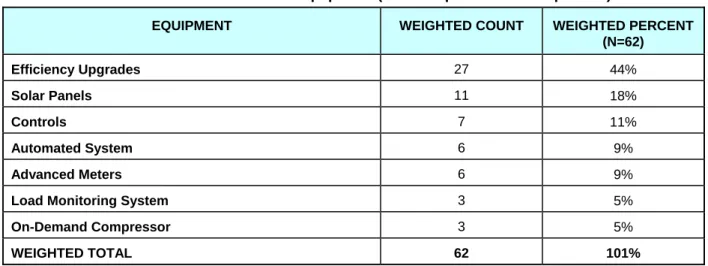
asked if they were considering installing additional equipment or technologies that might allow for additional demand response during events. Twenty-three percent reported considering additional equipment. When asked to describe the equipment, contacts
and HVAC upgrades) and solar panels that might reduce the organization’s overall demand, but would be unlikely to help them drop additional load during a curtailment event. The frequency of the solar panel response is notable because the net metering that generally accompanies solar panel installation would disqualify an organization from participating in any of the aggregator-driven demand response programs as currently structured.
Recommendation A: Explore the possibility of including participants with solar
net metering.
Recommendation B: Identify strategies for linking participants with energy
efficiency programs, as many of these organizations are committed to doing everything possible to reduce their energy use.
1
INTRODUCTION
This process evaluation is Volume 3 of a three-part project focused on aggregator-driven demand response programs operating in California in 2008. Volume 1 presents the results from an ex post and ex ante impact evaluation focused on estimating the load impacts.4 Volume 2 presents the results from a baseline analysis study.5
SCOPE OF THE EVALUATION
This evaluation investigated three demand response programs operating in the territories of California’s electric investor-owned utilities (IOUs): Pacific Gas & Electric (PG&E), Southern California Edison (SCE), and San Diego Gas and Electric (SDG&E). The evaluation focuses on the experiences of the utilities, aggregation firms, and customers involved in the programs during Program Year 2008.
The three demand response programs include:
Capacity Bidding Program (CBP) – a statewide program operating in the territories of
all three IOUs
Aggregator Managed Portfolio (AMP) – offered by PG&E Demand Response Resource Contracts (DRC) – offered by SCE
While CBP is a statewide program, some components and processes vary between the IOUs. PROGRAMS EVALUATED
Capacity Bidding Program
The Capacity Bidding Program (CBP) is a statewide price-responsive program developed to succeed the California Power Authority’s Demand Reserves Partnership program that ended in 2006. The CBP is a tariff program that provides specific payments to nonresidential customers who volunteer to reduce their energy use (load or capacity) by a specific amount for each month
4
Christensen Associates Energy Consulting, LLC. 2008 Load Impact Evaluation of California Statewide Aggregator Demand Response Programs. Volume 1: Ex Post and Ex Ante Report. May 1, 2009.
5
Christensen Associates Energy Consulting, LLC. 2008 Load Impact Evaluation of California Statewide Aggregator Demand Response Programs. Volume 2: Baseline Analysis of AMP Aggregator Demand Response Program. May 1, 2009.
of the CBP season (May through October). The CBP first was implemented in 2007.
Bilateral Contract Programs
Following direction from the CPUC, PG&E and SCE each issued an RFP to establish bilateral agreements for additional demand-response resources. In May 2007, the Commission approved five such demand-response agreements between PG&E and third-party aggregators. These contracts became the Aggregator Managed Portfolio (AMP). The CPUC approved one such agreement for SCE in early 2007. SCE proposed eight additional aggregator contracts in October 2007; in March 2008, the CPUC approved four of them. These contracts became the Demand Resource Contracts (DRC) program.
Aggregator Managed Portfolio (AMP)
PG&E’s Aggregator Managed Portfolio (AMP) allows aggregators to negotiate agreements with PG&E to deliver a specified amount of demand response for a price established in the contract. As negotiated bilateral contracts, the terms (both the level of demand-response capacity
promised and the price paid for it) between PG&E and each aggregator can vary. Demand Resource Contracts (DRC) Program
SCE’s Demand Resource Contracts (DRC) program procures demand response capacity through aggregators responsible for marketing the opportunity, identifying and enrolling eligible
customers, notifying those customers of curtailment events, and reconciling payments for customers who curtail their energy use during events. The DRC program is guided by contracts negotiated between each aggregator and SCE. As in the AMP program, the terms (both the level of demand-response capacity promised and the price paid for it) between SCE and each
aggregator can vary.
Logic Model and Program Theory
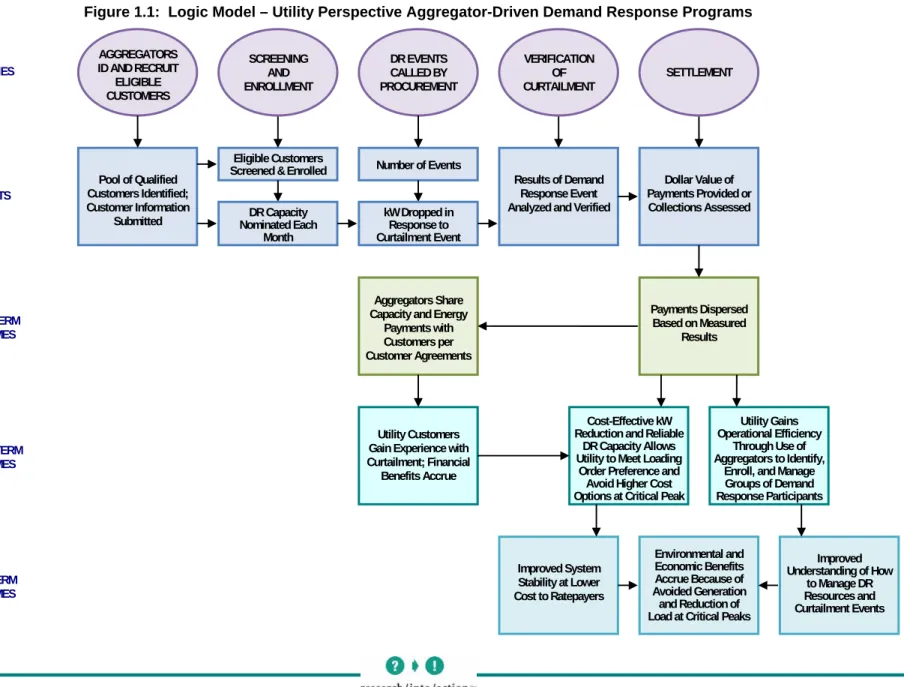
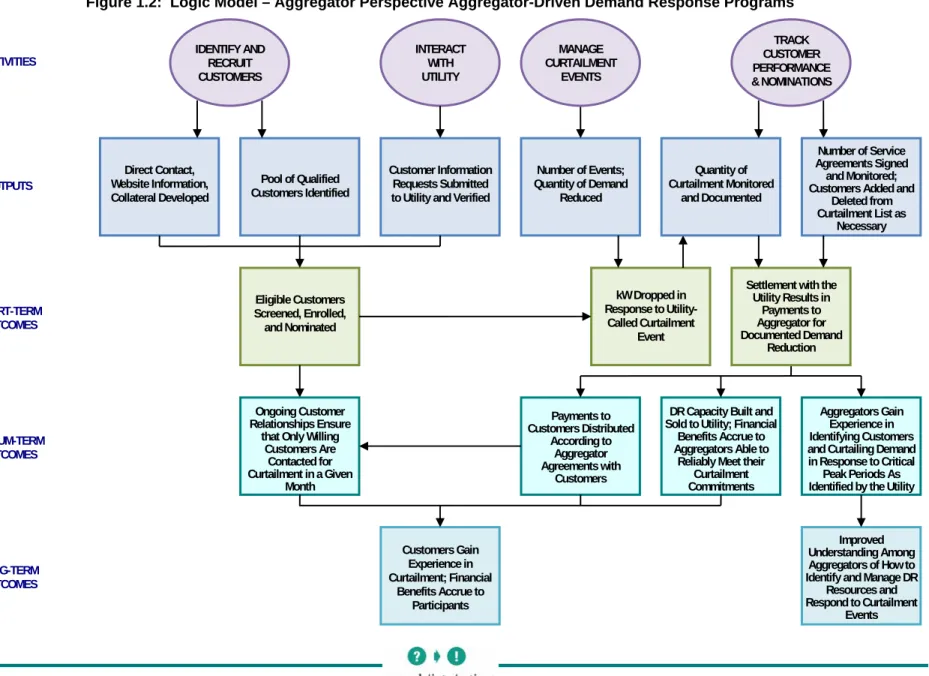
Prior to beginning any of the data-collection work, the evaluation team developed a program logic model for the statewide CBP from both the utility and aggregator perspectives (Figure 1.1 and Figure 1.2, respectively). These two components implement the program to meet their own goals and objectives. Ultimately, we reviewed these logic models and revised them to reflect the broader logic inherent in the aggregator-driven program model.
We found that, while the programs vary slightly in process (requiring different forms, payment amounts that vary by tariff or contract terms, whether or not the settlement occurs in-house or is calculated by the third-party vendor, APX), they do not vary significantly in theory or logic: all five programs rely upon aggregators to identify and recruit customers capable of reducing their energy use when requested by the utility in exchange for payment.
Figure 1.1: Logic Model – Utility Perspective Aggregator-Driven Demand Response Programs Improved System Stability at Lower Cost to Ratepayers Payments Dispersed Based on Measured Results Improved Understanding of How to Manage DR Resources and Curtailment Events Cost-Effective kW
Reduction and Reliable DR Capacity Allows Utility to Meet Loading
Order Preference and Avoid Higher Cost Options at Critical Peak Aggregators Share
Capacity and Energy Payments with Customers per Customer Agreements Eligible Customers
Screened & Enrolled Pool of Qualified Customers Identified; Customer Information Submitted AGGREGATORS ID AND RECRUIT ELIGIBLE CUSTOMERS LONG-TERM OUTCOMES ACTIVITIES OUTPUTS SHORT-TERM OUTCOMES MEDIUM-TERM OUTCOMES Number of Events DR EVENTS CALLED BY PROCUREMENT Results of Demand Response Event Analyzed and Verified
Dollar Value of Payments Provided or Collections Assessed Utility Gains Operational Efficiency Through Use of Aggregators to Identify,
Enroll, and Manage Groups of Demand Response Participants Utility Customers
Gain Experience with Curtailment; Financial Benefits Accrue VERIFICATION OF CURTAILMENT SETTLEMENT SCREENING AND ENROLLMENT DR Capacity Nominated Each Month kW Dropped in Response to Curtailment Event Environmental and Economic Benefits Accrue Because of Avoided Generation and Reduction of Load at Critical Peaks
Figure 1.2: Logic Model – Aggregator Perspective Aggregator-Driven Demand Response Programs Customers Gain Experience in Curtailment; Financial Benefits Accrue to Participants kW Dropped in Response to Utility-Called Curtailment Event Improved Understanding Among Aggregators of How to Identify and Manage DR
Resources and Respond to Curtailment
Events DR Capacity Built and
Sold to Utility; Financial Benefits Accrue to Aggregators Able to
Reliably Meet their Curtailment Commitments Eligible Customers Screened, Enrolled, and Nominated Pool of Qualified Customers Identified Direct Contact, Website Information, Collateral Developed IDENTIFY AND RECRUIT CUSTOMERS LONG-TERM OUTCOMES ACTIVITIES OUTPUTS SHORT-TERM OUTCOMES MEDIUM-TERM OUTCOMES Customer Information Requests Submitted to Utility and Verified
INTERACT WITH UTILITY Number of Events; Quantity of Demand Reduced Quantity of Curtailment Monitored and Documented
Settlement with the Utility Results in Payments to Aggregator for Documented Demand Reduction Aggregators Gain Experience in Identifying Customers and Curtailing Demand in Response to Critical
Peak Periods As Identified by the Utility
Number of Service Agreements Signed and Monitored; Customers Added and
Deleted from Curtailment List as Necessary Payments to Customers Distributed According to Aggregator Agreements with Customers Ongoing Customer Relationships Ensure that Only Willing
Customers Are Contacted for Curtailment in a Given Month MANAGE CURTAILMENT EVENTS TRACK CUSTOMER PERFORMANCE & NOMINATIONS
The most significant variation occurs in SCE’s DRC program and involves a technical
assessment analysis that results in a reasonableness review of the curtailment as nominated by DRC aggregators, and allows SCE to adjust the contract payments accordingly. This is discussed in more detail in Chapter 2. DRC is also the only program operating year-round. However, both of these components affect the process of implementing the program, not the underlying logic.
Program Theory
Program Theory from the Utility Perspective
The utility program theory (Figure 1.1) assumes that by recruiting aggregators to organize and coordinate the demand response activities of groups of customers, the California utilities will gain access to a previously unknown pool of qualified customers. Screening and enrollment activities conducted by the utilities will ensure aggregator-identified customers are enrolled in demand response programs.
Utility procurement departments will call demand response events when needed. Verification activities will ensure the utility pays only for demand response that actually occurs during events. Aggregators will then distribute capacity and energy payments with their enrolled customers, as outlined in agreements previously executed with each customer.
These program activities will result in a reliable response to curtailment events. The actual level of demand response that occurs will be analyzed and verified, and financial payments will be made or penalties assessed per the payment terms established by tariff (for CBP) or by contract (AMP and DRC). Implementation of the aggregator-driven demand response programs will augment existing demand response resources and will result in California utilities: meeting loading order preference; avoiding high-cost purchases during periods of critical peak; and improving system stability.
It is also expected that the utility, aggregators, and customers will gain experience with demand response. Utility experiences will result in improved operational efficiency and understanding of how to manage demand response resources and to call events. Aggregators will gain experience in enrolling and managing groups of customers. Customers will gain experience with actual curtailment. Financial benefits will accrue to aggregators and customers for successful demand response. Finally, economic and environmental benefits will accrue from avoided generation and reduction of load during periods of critical peak.
Program Theory from the Aggregator Perspective
Aggregators identify potentially qualified customers (Figure 1.2) and recruit them to CBP, AMP, or DRC, depending upon a variety of factors, including: the program in which the aggregator is
enrolled, the price paid per curtailed kW, and the level of risk perceived by the aggregator with a given customer.6 Through interaction with the customer’s utility, aggregators are able to screen, enroll, and consolidate a quantity of demand response capacity. In the case of AMP and DRC, the quantity of demand response capacity should match the amount they have committed to nominate. Aggregators manage this demand response capacity through ongoing interaction with a data exchange website (for CBP) and through other tracking activities.
Aggregators will shed capacity as promised during a utility-called demand response event. The utilities will analyze and verify the results of these events and aggregators will receive payments from the utility according to existing agreements for documented curtailment. Aggregators will distribute these payments to customers according to agreements previously executed with each customer. Through communication, payments, and curtailment assistance, aggregators will build and maintain on-going customer relationships that help them manage customer expectations and avoid conflicts over requests to drop load. Customers will gain experience with curtailment activities, and also realize financial benefits from demand response and their relationship with an aggregator.
Aggregators will gain experience in identifying customers and managing curtailment activities during an event, and will become better able to build and sell demand response capacity to the utility. Aggregators will profit from this activity and build larger and more reliable portfolios of demand response. Aggregators will develop a better understanding of how to identify and manage demand response resources, and will respond successfully to future curtailment events. METHODOLOGY AND POPULATIONS
This process evaluation included in-depth interviews with representatives of each of the five programs reviewed: AMP, DRC, and CBP contacts at each of the three participating IOUs. In addition, we conducted two sets of surveys with participants. The first survey comprised a statistically valid sample of over 200 participants and covered a range of process issues, including: communication and interaction with the program; expectations from participation; overall satisfaction with various components of the survey; and future demand response intentions. The second survey was a qualitative conversation with a subset of participants that had been previously categorized as consistent or inconsistent responders, based upon the load impact analysis completed by the impact evaluation team.
For a more extensive description of the methodology and sampling strategy, see Appendix A.
6
Assuming that when they have choice, aggregators are most likely to enroll customers into the program that offers the best price per kW curtailed with the least amount of risk. For example, if an aggregator is skeptical that a customer will meet the load curtailment targets established, that aggregator would likely enroll the customer in the program where underperformance will cost the least.
THIS REPORT
Following this introduction are five chapters. Chapter 2 presents a fuller description of each of the programs, and incorporates information and lessons learned from the in-depth interviews with staff contacts. Chapter 3 describes the experience and opinions of enrolled aggregators. Chapter 4 presents the results of the general participant survey, and Chapter 5 presents the findings from the smaller post-event survey. Finally, we offer conclusions and recommendations in Chapter 6.
2
PROGRAM DESCRIPTIONS
This chapter presents a brief description of each program and the experiences of the program staff.
DEMAND RESPONSE PROGRAM PORTFOLIOS
The California IOUs offer a variety of programs covering all aspects of demand response. Each utility offers a portfolio of demand response programs that includes both reliability and price-responsive programs. In some cases, a program will offer a specific rate to a customer willing to interrupt or reduce demand during a system emergency (e.g., the Base Interruptible Program or Critical Peak Pricing). In other cases, a customer will sell their capacity through a bid to the utility (e.g., the Demand Bidding Program).
Reliability programs are called when the system is at risk because of high-demand, instability, or because of transmission and distribution constraints. These programs include direct load control, large customer emergency and capacity programs, and voluntary interruptible or curtailable rate schedules. Reliability programs do not necessarily compensate enrolled customers for the load they drop during a called event. This is particularly true when the program provides ongoing benefits to participating customers through lower rates in exchange for potential or occasional requests to drop load.
Price-responsive programs, on the other hand, pay a specific, established price for demand response capacity and may include penalties for nonperformance. These programs tend to be called when prices or demand are particularly high, thus serving as a hedge against volatility in the wholesale power markets. Many utility representatives do not regard the capacity nominated through price-responsive demand response programs as a firm resource, but rather as a strategy for improving the overall efficiency of electricity markets.7
The characteristics of each program are not necessarily obvious to potential participants, or even participating aggregators. As is demonstrated in Table 2.1, each of the utilities offers multiple pricing and bidding programs.
7
Hopper, Nicole, Charles Goldman, Ranjit Bhharvirkar, and Dan Engel. The Summer of 2006: A Milestone in the Ongoing Maturation of Demand Response. See: http://eetd.lbl.gov/EA/EMP/reports/62754-revised.pdf.
Table 2.1: Utility-Based Demand Response Options
PG&E SCE SDG&E
PeakChoice Program Agricultural and Pumping Interruptible Program
Base Interruptible Program
Base Interruptible Program Automated Demand Response Capacity Bidding Program Capacity Bidding Program Time of Use Base Interruptible
Program
CleanGen
Critical Peak Pricing Large Power Interruptible Program Critical Peak Pricing Demand Bidding Program Capacity Bidding Program Critical Peak Pricing – Emergency Optional Binding Mandatory
Curtailment Plan
Critical Peak Pricing Peak Generation
Pilot Optional Binding Mandatory Curtailment Plan
Demand Bidding Program
Smart AC™ Optional Binding Mandatory Curtailment Program Summer Discount Plan
Note: These represent demand response program options listed on utility websites as of March 31, 2009.
Aggregator-Driven Programs
This evaluation focused on the three programs that rely on curtailment service providers to aggregate eligible, but usually not-yet-participating, customers and to coordinate their curtailment activities when activated by the utility. These aggregators are a diverse group of energy service firms operating in California, with headquarters throughout the nation. The three aggregator-driven programs reviewed here are the statewide Capacity Bidding Program (CBP), PG&E’s Aggregator Managed Portfolio (AMP), and SCE’s Demand Resource Contracts (DRC) program.
All three of the programs are price-responsive. That is, in response to a notice from the utilities, aggregators ask customers to curtail their energy use in exchange for a payment established prior to the notice. The most distinguishing difference between the programs is the mechanisms through which prices are established for nominated capacity and curtailed energy.
For the CBP, price-per-unit of nominated capacity and curtailed energy is established by tariff. That is, unlike programs with bilateral agreements, all participating aggregators receive the same capacity credit payment per kilowatt-hour they nominate. These prices vary depending on the type of product selected (day-of, or day-ahead) and the length of the curtailment promised in hours-per-day (4, 6, or 8 hours). Participants may adjust their nominations each month, including their day-of/day-ahead choices and event duration. CBP aggregators earn energy payments based on the level of delivered energy relative to nominated capacity for any month in which there is an event.
For the AMP and DRC program, the price paid to aggregators per unit of nominated capacity and curtailed energy is set in bilateral contracts negotiated between aggregation firms and the utilities (PG&E and SCE, respectively).
While differing in the mechanisms through which prices are set, the three programs have many similar and important components. (Table 2.2) Other differences include whether or not the nominations and settlement calculations are managed by the utility (in the case of AMP and DRC) or through APX (in the case of CBP) and how penalties are assessed. SCE’s DRC is the only program operating year-round.
Table 2.2: Major Program Components: Summary Table
COMPONENT CBP AMP DRC
Utilities Offering Statewide (All) PG&E SCE
Prices Established By Tariff1 Contract Contract
Trigger Called by procurement, guided by the heat rate of
the generation portfolio
Called by procurement at utility discretion Called by procurement at utility discretion Aggregator Only No In 2008 customers could participate directly2 Yes Yes
Collateral Required SCE, SDG&E only Yes Yes
Monthly Nomination Yes Yes Yes
Capacity Payments Yes Yes Yes
Energy Payments Yes Yes Yes
Penalties Yes
(For delivery of less than 50% of nominated load)
Yes
(For delivery of less than 50% of contracted load)3
Yes4
Who Calculates Settlement APX with utility input Utility Utility
Baseline Calculation Method 3 in 10 3 in 10 3 in 10
Eligible Customers Over 20 kW: must have an IDR
Size not specified: must have IDR meter and
Internet access
Size not specified: must have IDR meter and
Internet access
Season May-October May-October Year-round (usually called in the summer)
1
CBP tariff contains language noting that curtailment events may be triggered when generating resources reach a resource dispatch equivalence of 15,000 btu/kWh heat rate or as system conditions warrant (including high temperatures, supply constraints, system emergencies).
2
Only SCE had directly enrolled customers in 2008; there were fewer than five.
3 Penalties do not apply to test events. 4
Aggregators that fail to deliver promised load reduction during a DRC event are charged $4,000 for the first MW of missed load reduction and $1,000 for each additional MW of missed load reduction. However, these penalties are not necessarily based on the amount of capacity specified in the DRC contract, because SCE has developed a process whereby they test and adjust the expectations and associated payments based on the capacity actually demonstrated in a test event.
THE CAPACITY BIDDING PROGRAM
The CBP is a statewide, voluntary demand response program that offers customers incentives for reducing energy consumption upon request. This price-responsive program was developed in 2006 to succeed the California Power Authority’s (Power Authority) Demand Reserves Partnership program. As noted above, CBP is a tariff-driven program that provides specific payments to nonresidential customers that volunteer to reduce their energy use by a pre-specified amount during the CBP season (May-October). CBP was first implemented in 2007.
Trigger
The earlier Power Authority program had operated with a firm strike price, or trigger whereby the program could be called whenever the market price for power reached a certain threshold. With the program’s migration to the utilities, the trigger was changed. Currently, the utilities can initiate the CBP whenever the electric resource generation facilities reach or exceed a heat rate of 15,000 BTU/kWh. Theoretically, using a generation heat-rate threshold means the demand response program would be triggered when utilities must rely on dirtier, less efficient generation resources. Each utility’s internal energy procurement group monitors its unique generation-portfolio efficiency and decides when to call the program. Thus, the trigger reflects the
generation portfolio efficiency of each utility. The utilities consider this proprietary information and will not share it with third parties. According to program contacts, the generation heat rates cannot be completely transparent without a risk of gaming by other load-serving entities or independent power producers that regularly sell power to the California IOUs.
The CBP contacts at all three utilities reported that procurement departments track the generation heat rate and call events. While the heat-rate trigger is established in the program guidelines, it is viewed as more of a principle than a rule, since the program can be called whenever the utility forecasts that resources may not be adequate. According to CBP staff contacts, this soft trigger can occasionally create communication challenges for program staff because it is hard to explain and is based on confidential information.
Marketing
The three utilities conduct almost no marketing of the CBP. Instead, the utilities rely on
curtailment service providers to market the program to potential participants. These aggregators are responsible for contacting and enrolling customers, identifying demand response capacity, aggregating the load represented by these customers, and selling this resource to the utility via monthly nominations of demand response capacity.
CBP staff members at each of the IOUs interact primarily with the aggregation firms, not the participating end-user customers. However, the utilities do offer limited direct CBP marketing activities, including flyers or website information, combined with information presented directly to account executives.
SCE holds periodic meetings for aggregators and account executives. The utility also
gathers its account executives each year to inform them about the its energy efficiency and demand response program portfolio. There are opportunities during this meeting to answer questions and make presentations about existing programs and any changes for the current program year.
PG&E relies on information posted on its website and on aggregators’ efforts to inform
and recruit new customers.
SDG&E posts information and program brochures on its website.
Staff at all three utilities report occasionally interacting with end-use customers who call to check on the legitimacy of the aggregation firm, ask questions about the settlement process or payment stream, or to get help resolving an issue with their aggregator.
Other Features
As noted above, aggregators sell their portfolio of demand response capability to the utilities per the terms of the CBP tariff. The terms of curtailment commitment represented by each customer and the payment terms established between the aggregator and customer are not known to the utility. As established in the tariff, the utilities pay aggregators 20% more per enrolled kW than they pay their directly-enrolled customers. This additional charge compensates aggregators for their efforts to recruit customer load providers, for managing the notification and curtailment activities, and, in some cases, for absorbing the risk of potential penalties for underperformance when a demand response event is called.
By the end of 2008, the CBP had been implemented for two years. At all utilities, customers are enrolled through their Service Account numbers (SA ID) and participation can be measured in the number of service accounts nominated. Each customer has a unique customer number; however, customers may have multiple service accounts if they have multiple locations, or even multiple meters at the same location.
Nomination and Settlement
A distinguishing feature of the CBP (when compared to the AMP or DRC) is the program’s dynamic nomination process. This means an aggregator can vary the level of load nominated each month, based on the load profile of individual customers. Each of the IOUs has contracted with the same third-party, web-based service provider – APX – to manage the nomination and settlement process for the CBP. Each aggregator manages their nominations through the APX system. Each utility’s data is separate, so an aggregator participating statewide has three passwords and could have three upload tasks each month.
When the procurement department at an IOU decides to call an event, they contact APX. APX sends a signal to the aggregators, identifying the CBP option and product to be called. The CBP
operates two options (day-of or day-ahead) and three products (durations of 1-4 hours, 2-6 hours, and 4-8 hours). This means the CBP offers more flexibility than the bilateral programs, but requires that aggregators specify both the product and the duration for each SA ID during each month’s nomination. Once an event is called, aggregators inform customers and launch their respective curtailment activities at the required interval.
At the end of any month in which an event was called, the IOUs work with APX to track
observed performance and calculate credits based on observed load reductions. This information is sent to the aggregators in the form of a settlement payment or penalty notice. The utilities provide settlement information to the aggregation firms no later than 60 days after the event month has ended. Aggregators distribute payments to individual customers.
CBP staff at all IOUs must interact with APX frequently (particularly during the CBP season) and less frequently with the California Independent System Operator (CAISO). CBP staff at each of the IOUs also participates in regular conference calls with their counterparts at the other utilities. These conference calls provide an opportunity for CBP staff statewide to coordinate activities, discuss emerging issues or lessons learned, and identify opportunities to improve coordination or communication with APX. Utility staff informs CAISO whenever a demand response program is called. In addition, CBP staff from all three IOUs meets at least annually to discuss: lessons learned; pending changes or upgrades to the program or APX systems; and, more recently, progress in the state’s Market Redesign and Technology Upgrade (MRTU) effort.8
In 2008, each of the CBP options (day-of and day-ahead portfolios) was called by all three utilities at least once (Table 2.3).
Table 2.3: Number of 2008 CBP Events by Utility
UTILITY: OPTION JUNE JULY AUGUST SEPTEMBER OCTOBER TOTAL
PG&E: Day-Of 1 — — — — 1
PG&E: Day-Ahead — — 1 (Test) — — 1
SCE: Day-Of — — — — 2 2 SCE: Day-Ahead — 5 8 4 3 20 SDG&E: Day-Of — — — — 2 2 SDG&E: Day-Ahead — 2 — — — 2 8
This effort is focused on ensuring that power suppliers have fair and open access to the transmission system within the ISO control area, resulting in the delivery of the least-cost electricity to consumers. Features are likely to include a day-ahead market for energy, an integrated forward market, and locational pricing. For more information, see the CAISO website: www.caiso.com.
SCE’s day-ahead option was activated far more than were the other utilities’. The actual number of portfolios (represented by option, duration, and aggregator) activated during an event can vary, making it difficult to say whether or not every CBP customer enrolled in a given month would have experienced each event.
The utility-specific experiences as described to us by contacts at each of the three IOUs are presented below.
Utility-Specific Experiences: CBP at Pacific Gas & Electric
Enrollment and Nomination
In order to be enrolled as an aggregator at PG&E, a firm needs to complete the aggregator enrollment form provided on the utility’s CBP page on the PG&E website. PG&E does not require a collateral deposit from enrolled aggregators.9 In 2008, there were 12 aggregators enrolled in the program, but only six were active, in that they had nominated load for the 2008 program. According to program contacts, this is likely because of the time required to identify, recruit, and enroll participants: aggregators who enrolled late in the 2008 season or those without existing customers in California may have recruited customers too late to participate in 2008. Aggregators use the Notice to Add or Delete Customers Participating in the Capacity Bidding Program (Add/Delete form) to add or delete SAs from their portfolios. PG&E program staff confirms eligibility by checking that customers are on an eligible rate schedule (are not a wholesale customer, on standby rates, or net-metered) and that they have an interval data recorder (IDR). In PG&E territory, any meter with over 200 kW peak demand is eligible for a free IDR. 10 New IDR meters for locations with less than 200 kW peak demand are installed at aggregator or customer expense.11
Once a customer is determined to be eligible, an aggregator can enroll load by nominating SA numbers of the customer. An accepted customer is placed in the APX system and is eligible for CBP nominations. The CBP season officially runs May through October, but since there are no payments for May or October at PG&E, the season is effectively June through September.
9
This is listed under aggregators on the PG&E website.
10
This is defined in Electric Schedule E-CBP tariff as bundled service customers with a maximum demand of 200 kW or greater for three consecutive months in the past 12 billing months.
11
An exception to this policy applies to the small- and medium-sized commercial customers enrolled through the San Francisco Community Power Small Customer Aggregation Pilot Program. PG&E provides interval meters and communication equipment at no cost to these participants.
In 2008, customers were allowed to enroll directly in PG&E’s CBP program; however, none had done so as of December 2008. In 2009, customers will not be allowed to enroll directly in the CBP.
Events, Settlements, and Payments
In 2008, PG&E called two events: one of and one ahead event (Table 2.3). The day-ahead event was a test event and the day-of event was an actual called event. According to program contacts, response to the events was about 75% to 80% of nominated capacity, but neither event occurred during extremely hot weather.
When an event is called, metering agents hired by APX collect the interval data. PG&E also is involved in collecting the interval-meter data in its territory because of the prevalence of radio frequency meters.12 From the end of each operating month, PG&E has 60 days to settle with the aggregators. PG&E’s system does not verify the curtailment until a monthly re-cycle date occurs (similar to a billing cycle).
PG&E requires settlement-quality meter data (SQMD) before validating the results and
reconciling the event with CAISO energy prices for that day. Reconciled event data are sent to APX. APX is directed to release the information to aggregators, who are then able to log into the system and see each customer’s load usage and data. The baseline usage is calculated as an aggregate baseline; customer-specific baseline data is not reported. Program staff expects aggregators to have other methods of tracking individual customer performance during curtailment.
The original 2009-11 filing indicated PG&E was considering options or entities other than APX to provide settlement services. However, staff reported that the invoicing and payment processes have gone smoothly, and the utility plans to continue to contract with APX in 2009. In addition, they noted that APX provides other valuable services, including managing trades with direct-access customers at the CAISO.13
12
Only PG&E can collect radio frequency meter data.
13
Direct access customers enrolled in demand response programs must schedule a power delivery to the sponsoring utility equal to the amount of their curtailment. Since these customers are not bundled or delivery customers of the regulated utility, their curtailment activities would not materially benefit the sponsoring utility system without a corresponding delivery of power.
Utility Specific Experiences: CBP at Southern California Edison
Enrollment and Nomination
To enroll in CBP at SCE, an aggregator must complete a CBP Aggregator Agreement and a CBP Credit Application. Staff ensures the agreement and credit application are signed, validated, and acknowledged. They scan the documents and send them to the corporate credit department for approval. The approval process ranges from a few weeks to a few months. Aggregators must provide a deposit of at least $4,000 before SCE will list them as an aggregator on the SCE website. As aggregators commit to or nominate more demand response capacity, they must deposit additional funds per the CBP Deposit Requirements table posted on the CBP page of SCE.com.14 According to program contacts, waiting for aggregators’ required deposits can stall the process. Once the application and credit deposit have been received, an aggregator is listed on the website and can begin recruiting and enrolling customers.
A Customer Information Standardized Request (CISR) form and an Add/Delete form must be submitted for each customer an aggregator seeks to add to its portfolio. The CISR form authorizes the utility to release customer information to the aggregator. Each CISR must be signed, and have the correct SA numbers and addresses of service. In addition, the customer name listed on the CISR must match that listed in SCE’s customer information system. Generally, the customer information system name matches the name listed on the bill. Occasionally, the names do not match and SCE returns the CISR form to the aggregator.15 The Add/Delete form often is submitted after the CISR. According to staff, aggregators will submit a CISR as a strategy to investigate the eligibility of the account. The CISR will reveal whether or not an account qualifies and is a viable candidate (e.g., that the customer is on a qualifying rate schedule or has an appropriate peak load). In these cases, an aggregator will submit an Add/Delete form only when they know they want to nominate a given customer. Aggregators are required to send in the Add/Delete form with the customer’s original signature. CBP staff report new aggregators occasionally are surprised by this requirement and may fail to send in the original form.
Upon enrollment in the CBP, the customer’s billing cycle is changed to calendar billing so that their meter is read on the first of each month.16
14
The CBP deposit requirements range from $4,000 for aggregated load under 400 kW to $100,000 for aggregated load between 7,501 and 10,000 kW.
15
A further complication of the CISR-S form is that it requires applicants to indicate a specific expiration date. It is possible that the CISR-S could expire long before the program is over and the aggregator or customer has left the program.
16
Calendar billing is helpful to aggregators because all load providers (or participating meters) are read early in the month. Without calendar billing, obtaining settlement-quality meter data can take longer, as aggregators must wait for those with billing dates later in the month to cycle through the system.
Meter Funding
All three IOUs require CBP-enrolled customers to have an eligible IDR meter. In SCE territory, service accounts over 200 kW should already have a valid meter, so this becomes an issue only for smaller customers. During 2007 and 2008, SCE enabled hundreds of smaller customers to enroll in CBP through a special meter funding program that allowed customers with meters as small as 50 kW to obtain an IDR meter at no charge.17 Funding for this effort was exhausted at the end of 2008.
Events, Settlement, and Payment
In 2008, SCE had called twenty day-ahead events and two day-of events. The number of aggregators and portfolios called varied somewhat by event, as did the hours called.18 Staff report that the responses to called events were “seamless” and that the staff had received no complaints about notification. According to CBP staff at SCE all participating aggregators met their requirements for the year. However, penalties were levied against one aggregator for two months for failing to deliver the minimum required load reduction.
By the end of 2008, SCE had streamlined the internal data entry process for the CBP by enabling export directly to the APX system. This change allows staff to enter customer information only once. CBP staff would like to be able to see the load curtailment information at the service account level and are working with APX to produce this report.
APX processes the settlement calculations for the CBP and sends the information to SCE staff for verification. Once verified and agreed upon, aggregators are invited to log into the APX website to view the final event performance details. According to CBP staff, the calculation and settlement processes through APX were improved in 2008, in response to a few problems with calculations that occurred in 2007. The CBP tariff allows SCE 60 days from the close of the event month to settle with CBP aggregators. Staff reported no delays in this process and said they have been able to meet this deadline every month.
Utility Specific Experiences: CBP at San Diego Gas & Electric
Enrollment and Nomination
CBP staff at SDG&E report the 2008 program processes for the CBP were more streamlined and efficient than they were in 2007, which was the first year of the program. During 2007, CBP
17
DRC enrollees were not eligible for meters through this program.
18
For more detail on actual program event dates and hours, see Volume I of this report: Ex Post and Ex Ante Report.
staff established the contract, procedures, reporting, and settlement processes at APX, and finalized the content and format of the input screens.
SDG&E relies on APX to manage much of the tracking and invoicing processes for the CBP. Since APX essentially manages the program processes for SDG&E, program staff focuses on enrolling customers and new aggregators, verifying information, and managing customer performance data.
SDG&E requires potential aggregators to submit a Third Party Authorization form (TPA), which is similar to the CISR-S.19 When a third party requests information about a customer’s energy use, the customer is required to sign the TPA releasing this information.20 SDG&E also requires an Add/Delete form. SDG&E staff uses the information to verify that the customer has an IDR meter and meets the 20-kW threshold, and therefore qualifies to participate in the program. Like the other IOUs, SDG&E is installing IDR meters on-site for every large customer. In 2007, the CBP had to compete with SDG&E’s meter group for attention within the utility, which
occasionally delayed the pace of meter installation. In 2008, this was less of a problem because the pace of new enrollments slowed and SDG&E gave CBP meter installation priority.
SDG&E also contracts with the individual customers of participating aggregators. The contract does not set participation terms, but notifies customers that SDG&E could require them to pay a penalty that might accrue if an aggregation firm defaults on its obligations to the utility. Since aggregators often focus on enrolling customers for the next event month, these contracts occasionally are overlooked. For this reason, SDG&E does not have such a contract for every customer.
Once a customer is enrolled, SDG&E uploads that information to the APX interface. As is the case at the other utilities, the APX database is a critical part of the program – this is where aggregators log in and nominate customer load.
SDG&E program staff focuses on meeting the needs of participating aggregators and ensuring the program works for them. Staff views aggregators as the customers for this program and does not discuss aggregators or specific contract terms with utility customers.
There were no end-use customers enrolled directly in the CBP in San Diego in 2008. Events, Settlements, and Payments
In 2008, SDG&E called one day-of and one day-ahead event. After an event, SDG&E forwards the meter data to APX, so APX can calculate performance relative to baseline and assess the
19
These forms were developed in 1999 in preparation for deregulation; they were not developed for the CBP.
20
performance of aggregated load compared to nominated load. Settlements are calculated by APX for every month of the CBP program year, including months in which no events are called. Under their agreement with SDG&E, APX earns additional payments for preparing invoices. The invoices are forwarded to CBP staff for review and, ultimately, to the accounts payable department. Delays in processing by SDG&E staff occasionally have slowed payments to aggregators.
BILATERAL CONTRACT PROGRAMS
Following the heat storms that gripped California in the summer of 2006, the CPUC directed PG&E and SCE to issue requests for proposals to purchase additional demand response resources through bilateral contracts, and then to seek approval for those contracts from the Commission in early 2007. 21
At PG&E, these contracts were the basis of the Aggregator Managed Portfolio (AMP) program. The AMP allows aggregators to enter into bilateral contracts with PG&E to deliver a specified amount of demand response for a price established in the contract. As negotiated bilateral contracts, the terms (both the level of demand response capacity promised and the price paid for it) between PG&E and each aggregator may vary.
At SCE, the activities associated with these contracts became the Demand Resource Contracts (DRC) program, offered by SCE to procure demand response capacity through aggregators responsible for marketing the opportunity, identifying and enrolling eligible customers, notifying those customers of curtailment events, and reconciling payments for customers who curtail their energy use during events. The contracts are negotiated between each aggregator and SCE, as are the terms: the amount of load curtailment contracted, the price paid for each nominated
megawatt, the price paid for energy reduction, and the duration and notification terms.
Both programs operate with capacity incentives and energy incentives. Capacity incentives are based on the promise to reduce load during called events. Aggregators and their load providers receive capacity payments, even if no event is called. However, if an event is called and the promised load curtailment does not materialize, aggregators may have to forgo capacity payments or may be penalized. Depending upon the specifics of their agreements with customers, aggregators may pass these penalties on to their load providers. The utilities pay incentives only for measured energy savings that occur during an event.
21