Attribute-Based Access Control Model and
Implementation
by
Shadha Mohamed Sulaiyam ALAmri
A Doctoral Thesis
Submitted in partial fulfilment
of the requirements for the award of
Doctor of Philosophy
of
Loughborough University
18th September 2017
Abstract
The cloud computing paradigm introduces an efficient utilisation of huge com-puting resources by multiple users with minimal expense and deployment effort compared to traditional computing facilities. Although cloud computing has in-credible benefits, some governments and enterprises remain hesitant to transfer their computing technology to the cloud as a consequence of the associated se-curity challenges. Sese-curity is, therefore, a significant factor in cloud computing adoption. Cloud services consist of three layers: Software as a Service (SaaS), Plat-form as a Service (PaaS), and Infrastructure as a Service (IaaS). Cloud computing services are accessed through network connections and utilised by multi-users who can share the resources through virtualisation technology. Accordingly, an efficient access control system is crucial to prevent unauthorised access.
This thesis mainly investigates the IaaS security enhancement from an access control point of view. IaaS requires an access control model that can cope with its dynamic and scalable features. Attribute-based Access Control (ABAC) is identified as the most appropriate model that can support IaaS features. How-ever, ABAC does encounter challenges regarding its conceptual characteristics and formal specifications.
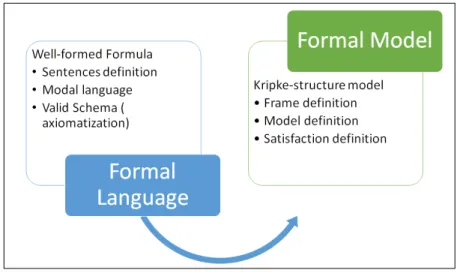
Thus, a novel intelligent attribute-based access control model known as ABACsh is proposed in this thesis for IaaS cloud. ABACsh is an enhanced attribute-based access control that supports a context-aware mechanism and the Separation of Duty (SoD) security principle. The intelligent framework for ABACshis presented based on a knowledge agent, as logic is used to infer an access decision. Hence, there is a requirement to formulate a suitable logic that is able to specify, verify and reason ABAC models. A formal logic known as Access Control Logic-Deontic Logic (ACL-DL) is further proposed in this thesis. ACL-DL involves a formal lan-guage definition and a Kripke-structure model definition. ACL-DL logic is used to formally specify ABACsh properties and to logically reason about ABACsh access requests.
To present the feasibility of the proposed access control model in an IaaS platform, a demonstration of ABACsh prototype is studied in an open-source IaaS-platform known as OpenStack; proposing an enforcement framework that is designed based on agent architecture. Furthermore, an extended Policy De-cision Point (PDP) is implemented based on a logical inference algorithm known as forward chaining.
Formal verification proves that the ACL-DL satisfaction problem is PSPACE solvable, and its model-checking problem is PTIME solvable. Evaluation of the logic complexity profile illustrates that ACL-DL logic is computationally
determ-inable, in contrast with classical logic categories. Evaluation of the ABACsh com-putation complexity and access control quality metrics reveals superior results in comparison with two existing ABAC models. The experimental results in an Open-Stack testbed deployment demonstrate the feasibility of the ABACsh approach and promise an enhanced and secure access control model for IaaS cloud.
Keywords
IaaS; Cloud Computing; Security; Attribute based Access Control; Modal logic; Deontic Logic; Artificial intelligence; OpenStack
To Allah, who provides me with unlimited strength and guidance, and who was beside me all the time when no one was able to understand me and when the PhD stress reached its peak. To you, my lord, my profound gratitude and thanks.
To my husband, Ahmed AL-Harbi, and my two sons, Emran and Hamzah, who accompany me on my challenging and prolonged journey.
To my father, Mohamed, and my mother, Sharifa, the most precious gifts I have in this life, who have instilled the love of learning in me and my nine siblings, Ahmed, Faisal, Shaima, Hamed, Husam, Omar, Bader, Mustafa and Shahed. We are a big family with a big heart and strong bonds. My thanks to my lovely family.
My further acknowledgement and thanks to my beloved country Oman for supporting me in my higher education since my BSc (Sultan Qaboos University, 2005) and providing full scholarships for both my MSc (Loughborough, 2007) and PhD (Loughborough, 2017).
To all my teachers throughout my life who have participated in building my teaching and learning skills.
To my supervisor Dr.Lin Guan, who has given me her best guidance and sup-port.
To Loughborough University college of science, department of computer sci-ence, and all its student support facilities.
To all my friends, sisters and PhD colleagues in Loughborough.
Published Conference Proceedings
AL Amri, S. and Guan, L. (2016). Infrastructure as a service: Exploring network access control challenges. In: 2016 SAI Computing Conference (SAI). [online] IEEE digital library, pp.596-603.
AL Amri, S. and Guan, L. (2016). Exploring the Firewall Security Con-sistency in Cloud Computing during Live Migration. In: the 7th Interna-tional Conference on Computing Communication and Networking Techno-logies (ICCCNT’16). [online] ACM digital library, article no.40.
To be Submitted Journal
AL Amri, S. and Guan, L., 2017. ”IaaS-Cloud Security Enhancement: An Intelligent Attribute-based Access Control Model”. Elsevier Journal of Com-puters & Security.
– it has been accepted for the 1st round but then rejected as the inform-ation provided is too excessive.
– the content of this Journal will be divided into two sections. To be submitted to two Journals
AL Amri, S.M. and Guan, L., 2017. ”Empirical Study on the Security of Live Virtual Machine Migration(LVMM) in Cloud Computing”. Elsevier Journal of Future Generation Computer Systems.
– An article answering the question: How an an Intelligent Attribute-based Access Control Model can participate in mitigating LVMM un-authorized access breach in IaaS cloud?
ABAC : Attribute-Based Access Control ACL : Access Control Logic
ACL-DL : Access Control Logic-Deontic Logic DAC : Discretionary Access Control
DL : Deontic Logic
IaaS : Infrastructure as a Service JSON: JavaScript Object Notation
LVMM : live virtual machine migration process MAC : Mandatory Access Control
PaaS : Platform as a Service PAP: Policy Administration Point PDP: Policy Decision Point
PEP: Policy Enforcement Point PIP: Policy Information Point QoS : Quality of Service
RBAC : Role-Based Access Control SaaS : Software as a Service
SoD : Separation of Duties VM: Virtual Machine
Acknowledgements iv Publications v Glossary vi 1 Introduction 1 1.1 Context Background . . . 1 1.2 Problem Statement . . . 2
1.3 Aim and Objectives . . . 4
1.4 Original Contributions . . . 5
1.5 Thesis Structure . . . 7
2 Literature Review 8 2.1 Introduction . . . 8
2.2 Security Challenges of IaaS . . . 8
2.3 Example of a Security Breach in IaaS During LVMM Process . . . . 10
2.4 IaaS Firewall System . . . 12
2.4.1 Security Group Approach . . . 13
2.4.2 IaaS Firewall Security Threats and Limitations . . . 13
2.4.3 Firewall Approaches in IaaS . . . 15
2.5 Access Control Model . . . 17
2.5.1 Background and Challenges . . . 17
2.5.2 Access Control Models Approaches in IaaS . . . 21
2.6 Attribute-Based Access Control (ABAC) . . . 23
2.6.1 Background and Challenges . . . 24
2.6.2 ABAC in IaaS Cloud . . . 26
2.7 Access Control Model Formal Specification, Verification and Reas-oning . . . 26
2.7.1 Formal Logic in Access Control . . . 26
2.7.2 Decontic Logic (DL) . . . 28
2.7.3 Access Control Logic (ACL) . . . 28
2.8 Artificial Intelligence in IaaS Cloud Security . . . 29
2.9 Summary and Discussion . . . 29
3 The proposed Model:ABACsh 31 3.1 Introduction . . . 31
3.2 Context-Awareness Mechanism . . . 31
3.2.1 Overview . . . 31
3.2.2 Analytical Study of Context-Aware in ABAC . . . 32
3.2.3 Context-Aware Deployment in IaaS by ABACsh . . . 33
3.3 Separation of Duty (SoD) Principle . . . 34
3.3.1 Overview . . . 34
3.3.2 Analytical Study of SoD in ABAC . . . 34
3.3.3 SoD Design and Deployment in Access Control System . . . 36
3.3.4 SoD Deployment in IaaS by ABACsh . . . 36
3.4 Evaluating ABACsh Computational Complexity and Quality Metrics 37 3.4.1 Overview . . . 37
3.4.2 Evaluation Results . . . 38
3.5 Summary and Discussion . . . 39
4 The Proposed ACL-DL Logic for ABACsh 41 4.1 Introduction . . . 41
4.2 Analytical Study: Why Modal Logic is Suitable to be Used in IaaS Access Control? . . . 43
4.3 The Contribution of This Study to Access Control Logic Research . 44 4.4 The Formal Logic Language . . . 45
4.4.1 Syntax . . . 46
4.4.2 Language Operators . . . 46
4.4.3 Principals Expressions Definition . . . 47
4.4.4 Formulas Definition . . . 48
4.5 The Formal Model Structure . . . 49
4.5.1 Background . . . 49
4.5.2 Semantic Definition . . . 50
4.5.3 Satisfaction Definition . . . 51
4.5.4 Axiom . . . 51
4.5.5 Validity, Soundness, and Completeness . . . 52
4.6 ACL-DL Formal Verification . . . 53
4.6.1 Finite Model . . . 53
4.6.3 Satisfiability Verification . . . 54
4.6.4 ACL-DL Model Checking . . . 55
4.6.5 Conclusion . . . 55
4.7 ACL-DL Logic Complexity Profile Evaluation . . . 55
4.8 Summary and Discussion . . . 56
5 Formal Specification and Logical reasoning 57 5.1 Introduction . . . 57
5.2 ABACsh properties . . . 57
5.3 Formal Specification . . . 59
5.3.1 Primitive Proposition . . . 59
5.3.2 ABACsh possible worlds (states)W . . . 59
5.3.3 Binary Relation R . . . 60
5.3.4 Mapping Function V and Rules Creation . . . 61
5.3.5 ABACsh Sentences Formal Description . . . 62
5.4 Case Study . . . 63
5.5 Logical reasoning . . . 65
5.5.1 Overview . . . 65
5.5.2 Reasoning Methodology . . . 65
5.5.3 Reasoning about ABACsh . . . 67
5.6 Summary and Discussion . . . 68
6 An Intelligent Framework for ABACsh 69 6.1 Introduction . . . 69
6.2 AI scope for the Proposed Framework . . . 70
6.3 Logical-Based Agent Architecture . . . 72
6.4 ABACsh Conceptual Requirement . . . 73
6.5 The Proposed Framework . . . 75
6.6 Summary and Discussion . . . 76
7 ABACsh Implementation 78 7.1 Introduction . . . 78
7.2 Preliminaries . . . 79
7.2.1 Open source IaaS-Cloud Test-bed . . . 79
7.2.2 OpenStack Overview . . . 81
7.2.3 OpenStack Access Control Model (OSAC) . . . 82
7.2.4 Policy Engine . . . 84
7.2.5 Nova Authorisation Data-Flow . . . 85
7.2.6 Forward-Chaining Algorithm . . . 85
7.3.1 Enforcement Architecture . . . 86
7.3.2 Prototype Implementation . . . 88
7.4 Performance Evaluation . . . 91
7.4.1 Experiment Content . . . 92
7.4.2 Experimental Results and Discussion . . . 92
7.4.3 Limitations of Experiment . . . 95
7.5 Comparative Study of ABAC Models Implementation in OpenStack 96 7.6 Summary and Discussion . . . 97
8 Conclusions and Future Work 99 8.1 Conclusion . . . 99
8.2 Future Work . . . 100
1.1 Overall thesis research components . . . 3
1.2 Problem Definition of this research . . . 4
1.3 Thesis Contributions . . . 5
2.1 Recommended mitigation for some of IaaS security challenges . . . 10
2.2 LVMM Process Steps [204] . . . 11
2.3 IaaS firewall limitations . . . 14
2.4 Access Control building blocks as explained by [97] . . . 19
2.5 Access Control building blocks as explained by [187] . . . 19
2.6 Google Scholar Results for the keywords Model vs. Policy for Access Control Types . . . 20
2.7 Unified ABAC Model Structure [108] . . . 23
4.1 ABAC formal Modelling steps . . . 42
4.2 Why Modal Logic is Used in IaaS Access Control . . . 43
5.1 ABACsh model flow-chart . . . 58
5.2 ACL-DL Serial relation for ABACsh model . . . 61
5.3 ABAC policy Example 1 . . . 63
5.4 ABAC policy Example 2 . . . 63
5.5 preparations for reasoning process . . . 66
5.6 Reasoning process . . . 67
6.1 ABAC mechanism function points based on XACML framework . . 69
6.2 Basic structure of a rule-based expert system (Negnevitsky 2011) . 70 6.3 AI scope for the proposed framework . . . 71
6.4 The proposed Intelligent Framework for ABACsh. . . 75
6.5 ABACsh processing stages . . . 76
7.1 Number of hits in variety of academic search engines related to IaaS platforms . . . 80
7.2 OpenStack Components [164] . . . 81
7.3 OpenStack Conceptual Model [161] . . . 83
7.4 OpenStack Access Control (OSAC) [25] . . . 84
7.5 Nova authorization data-flow [109] . . . 85
7.6 proposed ABACsh for Openstack nova . . . 87
7.7 Telemeter process . . . 88
7.8 OpenStack testbed in physical machines . . . 89
7.9 The prototype Implementation Data flow . . . 90
7.10 real-time for access control processing in nova . . . 94
2.1 Firewall approaches in dynamic network . . . 16
2.2 Recent proposed Access Control Models for IaaS . . . 21
2.3 Comparing Modal Logic with Classical Logic . . . 27
3.1 Complexity evaluation between ABAC models . . . 39
3.2 Quality metrics evaluation between some ABAC models . . . 40
4.1 AC-DRL operators with intended informal meaning . . . 47
4.2 Deontic operators derivation . . . 47
4.3 principle syntax expression . . . 47
4.4 ACL formula syntax . . . 48
4.5 ACL Sub-formula syntax . . . 48
4.6 Multimodal Kripke-structure restriction . . . 50
4.7 ACL-DL model relation properties . . . 50
4.8 ACL-DL semantic . . . 51
4.9 modality reading for defined relation in M . . . 51
4.10 Satisfaction Definition . . . 52
4.11 ACL-DL Axiomatization . . . 52
4.12 ABACsh sentences formal description . . . 56
5.1 ABACsh sentences formal description . . . 62
5.2 formal description for Example 1 . . . 64
5.3 formal description for Example 2 . . . 64
6.1 A generic Knowledge-based agent function [182] . . . 72
6.2 mapping knowledge-based agent with ABAC requirements . . . 73
7.1 OpenStack core components . . . 80
7.2 OpenStack core components . . . 82
7.3 Comparing Forward-chaining with Backward-chaining . . . 86
7.4 Forward chaining algorithm . . . 86
7.5 Performance evaluation metrics . . . 91
7.6 Experimental Results . . . 93 7.7 Comparing real-time values . . . 94 7.8 Comparing sys-time values . . . 95 7.9 Compare the ABACsh implementation in OpenStack with related
work . . . 96
Introduction
1.1
Context Background
The cloud computing paradigm is constructed based on several technologies such as virtualisation, Service-Oriented Architecture (SOA), autonomic computing, and grid computing [41]. Cloud computing involves three main services: Software as a Service (SaaS), Platform as a Service (PaaS) and Infrastructure as a Service (IaaS). The focus of this research is to enhance an access control model to cope with the IaaS environment without redesigning or modifying IaaS technology structures. Virtualisation technology is one of the main building blocks in deploying IaaS. Hence, the hypervisor affects the efficiency of the access control system. The hy-pervisor introduces a security threat to the virtual machine (VM) access control because of the single point of access. A trusted VM within an untrusted hyper-visor has a higher risk than an untrusted VM within a trusted hyperhyper-visor [119]. For example, based on empirical experiments on a live virtual machine migration process (LVMM) [158], it has been recommended to review the existing access control system to avoid unauthorised access during LVMM process. The LVMM process is considered as one of the critical processes in IaaS beside the virtual machine provisioning process [41]. Moreover, access-control security tools in IaaS such as firewalls and security groups cannot support context-aware mechanisms or dynamic access control [8]. The optimisation between the information flow security and IaaS flexibility is getting high consideration as sensitive information maybe leaked to unauthorized entities[227, 203]. Therefore, a well-designed access control system in IaaS is vital.
Security aspects are essential in motivating customers to adopt cloud com-puting services. For instance, an IDS survey illustrates that 75% of customers consider satisfaction with the degree of security and privacy as the main motiv-ations to adopt cloud computing services [121]. In particular, the access control
aspect is a critical security issue in the IaaS cloud [9, 197]. In contrast to the traditional computing environment, the IaaS cloud has specific characteristics of elasticity, multitenancy, configurability, and dynamicity. Thus, conventional ac-cess control models face flexibility challenges and fine-grained limitations when it comes to their implementation and deployment in IaaS [9].
Because IaaS is a multi-tenant environment it is required to handle a variety of user access requirements, accordingly the IaaS access-control system needs to be a context-aware to support fine-grained policy [191]. The traditional access control models such as Discretionary Access Control (DAC) and Mandatory Access Control (MAC) lack scalability and adaptability to dynamic changes. Even though most cloud access control systems such as Amazon, Racspace, Dimansion Data and Verizon use Role-Based Access Control (RBAC) [100], RBAC cannot cope with a dynamic environment because it supports coarse-grained access which creates a restricted access control policy. Also, RBAC access policy rules must be predefined before the access-control process begins.
There is a trend to move from RBAC to Attribute-Based Access Control (ABAC), as the latter is more flexible, supports context-awareness, supports fine-grained policies, and also supports a dynamic computing environment. It is pre-dicted that by 2020, 70% of enterprises will deploy ABAC [70] since there is an interest among industries and governments to deploy access control based on ABAC [99]. Further, ABAC is dynamic and requires less human administration interaction than traditional access control models, because its authorisation pro-cess can be computed at the time of the request, where permission is not required to be pre-assigned to users [108]. The findings and analysis of this research match the recommendations of several researchers to use ABAC over RBAC in a cloud computing environment such as in [37, 44, 242].
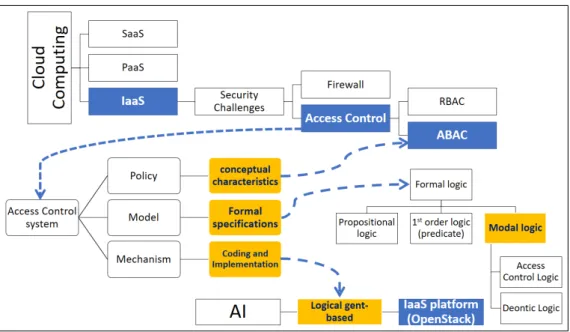
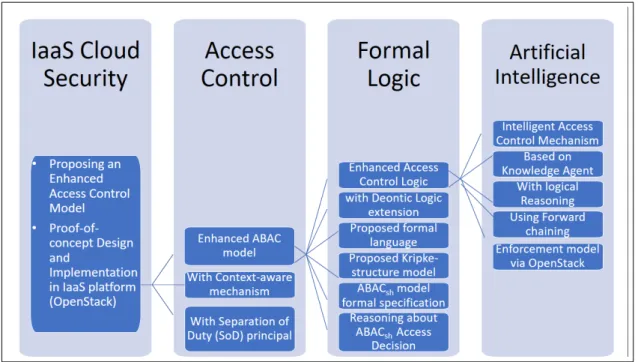
Figure 1.1 illustrates the scope of this research. The investigation of IaaS security challenges detailed in Sections 2.2 to 2.4 identify a research gap in the area of access control systems. The problem statement will be elaborated in Section 1.2. Four domains of computer science form the basis of this thesis contribution, as will be explained in Section 1.4. These domains are: IaaS cloud, Access Control, Formal Logic, and Artificial Intelligence. Furthermore, Figure 1.1 illustrates the research flow between the four domains.
1.2
Problem Statement
This thesis researches two problems, as illustrated in the tree diagram in Figure 1.2. The first problem is related to fulfilling IaaS access control requirements. Three requirements have been identified. The first requirement is to implement a
Figure 1.1: Overall thesis research components
context-aware mechanism that supports a fine-grained access feature. The second requirement is to emphasise access-control security principles. With an access control system in cloud computing, the principles of least privilege and separation of duty(SoD) are critical [47, 119, 193]. This research focuses on deploying SoD. The third requirement is to meet the dynamic characteristics of IaaS because it is a changeable environment where users join and leave frequently. Furthermore, the virtual machine configurations change based on the customer’s specifications. To the best of our knowledge, these three requirements: context-aware mechanism, SoD security principle, and support of dynamic characters are not addressed in the prior literature on IaaS access control models as will be demonstrated in Chapter 3. ABAC is considered as the most appropriate access control model for IaaS as illustrated in Section 2.5. This thesis works towards solving ABAC challenges discussed in Section 2.6
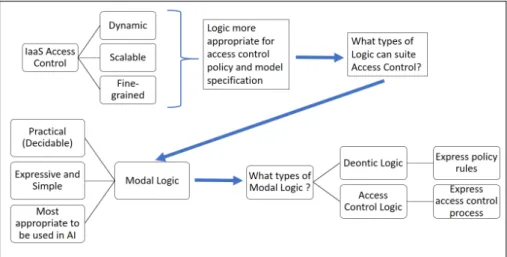
The second problem discussed in this thesis is related to developing an access control logic that is capable of specifying, verifying and reasoning ABAC mod-els. To the best of available knowledge, a formal logic for ABAC models is not addressed in the prior literature. The required logic should be decidable for it to be implemented in a computing system. The access control logic challenge is two-fold: firstly, it is necessary to find a suitable formal logic category for access control security representations; secondly, a suitable formal language (also called computational language) that can formally interpret ABAC model properties is required. Based on the literature, the modal logic has been found to be the most appropriate formal logic that can present access control models as justified in Sec-tion 2.7. Regarding the ABAC, to date, no formal language has been defined.
Figure 1.2: Problem Definition of this research
Liner-time Temporal Logic (LTL) and Computation Tree Logic(CTL) are used for model checking. However, LTL formulas are evaluated on paths while CTL formulas are evaluated on states [102]. In order to evaluate attribute based access control system we need to consider states and paths as will be demonstrated in Chapter 5
1.3
Aim and Objectives
Given the challenges that have been identified concerning the access control model in IaaS cloud, this thesis aims to enhance IaaS cloud security by proposing an intelligent attribute based access control model. This goal will be satisfied by completion of the followed objectives:
Obj.1 To identify The IaaS access control model requirements, and explore the lim-itations of traditional access control enforcement techniques in IaaS clouds.
Obj.2 To investigate how access control models need to change to meet IaaS access control requirements, and identify the access control model best suited to IaaS characteristics.
Obj.3 To propose an access control model enhancement that meets IaaS require-ments.
Obj.4 To introduce a formal logic that is able to specify, verify and reason about the proposed access control model
Obj.5 To design an intelligent framework for the proposed access control model that supports the dynamic and scalable features of IaaS.
Obj.6 To implement and test a prototype of the proposed access control model in OpenStack IaaS cloud testbed.
An extensive literature review has been carried out towards fulfilling Obj.1 and Obj.2. As a result, the problem statement in Section 1.2 has been identified. Objectives Obj.3, Obj.4, Obj.5 and Obj.6 are four steps to achieving the main aim of this thesis. The original contributions of this thesis are explained in Section 1.4.
1.4
Original Contributions
Figure 1.3 summarises the contributions of this thesis and the motivation for cover-ing the four computer science fields: IaaS Cloud Security, Access Control, Formal Logic, and Artificial Intelligence. The big picture concerns the enhancement of IaaS security by improving the access control model via the employment of artifi-cial intelligence agent-architecture and modal logic formalisation.
Figure 1.3: Thesis Contributions
The thesis contributions are as follows:
– Propose an enhanced attribute based access control model for IaaS (ABACsh) that supports context-awareness mechanisms and the SoD principle.
– Propose an enforcement architecture design for ABACshbased on Open-Stack components.
– Demonstrate ABACsh implementation in OpenStack. Based on access control QoS metrics, the performance evaluation ofABACsh PDPis meas-ured by calculating the time taken to reach an access decision.
Access Control
– Conduct an extensive study to determine the proper access control model for IaaS.
– Define the concept behind the context-aware mechanism and the SoD security principle in an ABACsh model.
– Perform a comparativeanalysis of ABACshwith ABACαand HGABAC that involves ABACsh computational complexity and QoS (Quality of Service) metric evaluations.
Formal Logic
– Introduce Access Control Logic-Deontic Logic (ACL-DL) as a modal logic that is capable of specifying, verifying and reasoning ABAC mod-els.
– ACL-DL combines Access Control Logic (ACL) modality says with Deontic Logic (DL) modality obligation.
– Define a formal language and a Kripke-structure model for ACL-DL logic
– Formally specify ABACsh via ACL-DL logic.
– Logically reason ABACsh access decisions via ACL-DL logic Artificial Intelligence
– Propose an Intelligent framework for implementing ABACsh based on knowledge-agents o
1.5
Thesis Structure
The thesis is organised into eight chapters. Chapter 2 introduces the literat-ure review, which identifies a need to enhance the access control system in IaaS. The chapter also includes a literature review of concepts used to solve the iden-tified problem. Chapter 3 presents the enhanced Attribute-Based Access Con-trol (ABACsh) and its computational complexity and quality metrics evaluation. Chapter 4 explains the proposed logic that combines the Access Control Logic (ACL) with Deontic Logic (DL). The ACL-DL logic is used to specify, verify and reason about ABACsh, as illustrated in Chapter 5. A proposed intelligent frame-work for ABACsh is demonstrated in Chapter 6. A prototype of this framework is implemented and tested on an IaaS platform called OpenStack, as explained in Chapter 7. Chapter 8 concludes this thesis and suggests future improvements and enhancements.
Literature Review
2.1
Introduction
This chapter investigates and analyses the motivation for this research based on the literature review. It consists of eight sections. As a reference to Figure 1.1 from the introduction, Sections 2.2 to 2.4 explore IaaS security challenges associated with unauthorised access. Section 2.5 studies access control models which leads to a conclusion to build the proposed access control model enhancement based on an ABAC model. ABAC is explored in Section 2.6. The lack of a formal logic that is able to specify, verify and reason about ABAC models leads to Section 2.7, which researches the access control logics. Finally, there is a need to design a dynamic access control which leads to investigating the AI field to propose a framework that is dynamic and scalable. AI in IaaS security is discussed in Section 2.8.
2.2
Security Challenges of IaaS
The characteristics of Infrastructure as a Service (IaaS) encouraged ICT customers to adopt it as the next generation model for outsourcing IT infrastructure [238]. IaaS is capable of controlling and managing the virtualised environment repres-ented in a virtual machine life circle by providing the virtual machine (VM) with the requested resources, such as storage, network and processing power [65].
IaaS features offer business advantages, such as rapid elasticity and fast re-source pooling, since IaaS deploys virtualisation technology which supports several innovations, such as multi-core chips and live migrations [41]. A key component in building a virtualisation environment is to operate it via the hypervisor, although the hypervisor on its own cannot build IaaS. Therefore, a cloud-stack is required to build IaaS, such as OpenStack, CloudStack and OpenNebula. According to the current industry, OpenStack is likely to become a dominant cloud-stack [100].
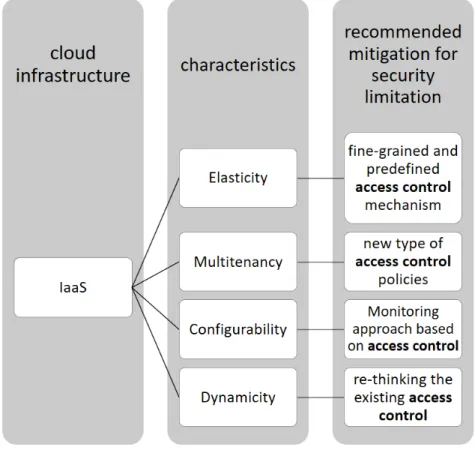
On the other hand, the flexibility characteristics of IaaS introduce several se-curity challenges linked to access control implementation.The elasticity feature of IaaS allows the cloud user (customer) to scale up and scale down to meet their project requirements. This leads to a rapid change in the infrastructure configura-tions. However, elasticity introduces security challenges in respect to providing an administrative separation between the customer virtual environments. There is a need for a security mechanism that enforces a proper configuration and change management, as well as a fine-grained and predefined access control mechanism [170].
The multitenant nature of IaaS which facilitates the ideal usage of infrastruc-ture by sharing resources between multiple users faces some security challenges as well [100]. Therefore, it is more likely that there is a need for a new type of ac-cess control policy between tenants in intra-cloud communication [173]. A tenant can be an enterprise in the context of a public cloud or a department within an enterprise in the context of a private cloud [26].
The flexibility feature of IaaS enables the user to configure their own virtual machines and computing infrastructure [237]. Hence, it is prone to misconfigura-tion that can lead to a security violamisconfigura-tion [27]. Therefore, there is a need to monitor cloud behaviour to figure out unexpected errors. For example, in April 2011 an infrastructure outage caused Amazon’s Compute Cloud EC2 to be unavailable for its customers [63]. Therefore, there is a need to monitor IaaS behaviour. In the literature, an approach constructed on role-based access control has been proposed [177].
The dynamicity of IaaS facilitates virtual machine (VM) mobility among phys-ical machines for different aspects, such as server consolidation, load balancing, data recovery and green computing is achieved through a technique called live virtual machine migration (LVMM). LVMM allows the movement of virtual ma-chines between the physical mama-chines during run time with a minimum downtime [67]. Although live migration supports IaaS dynamicity, it introduces some se-curity threats. The protocol used for live migration moves the virtual machine state in plain text, which allows hackers to snoop it through the network links. Even encryption is not able to secure it, as illustrated experimentally in [158]. Therefore, there is a need for re-thinking the existing access control and isolation mechanism.
Moreover, the dynamicity feature of IaaS affects firewall functionality since the VM gets a dynamic IP address through a DHCP server that assigns a lease time for the client IP address. The virtual machine must renew its IP address when the lease time expires. Upon renewing its IP address, it may or may not receive the same IP address that it received previously [128]. A source IP address and
Figure 2.1: Recommended mitigation for some of IaaS security challenges
a destination IP address are basic information to generate a firewall rule. The firewall rules remain constant unless there is an explicit need to change the policy, as a result the firewall cannot adapt to real-time threats [210]. Any system that uses predetermined and fixed IPs might impose some limitation on the dynamism and the scalability of IaaS [215].
A firewall is a critical network access control mechanism, therefore it will be discussed in more detail in Section 2.4. The above IaaS security challenges ana-lysis shows that there are several security vulnerabilities occurring as a side effect of the substantial IaaS characteristics. Figure 2.1 reveals that a proper design and implementation of access control is a critical element that can contribute to mitigating the majority of the security IaaS challenges.
2.3
Example of a Security Breach in IaaS
During LVMM Process
The IaaS layer consists of several components, such as virtualization, networking, storage and processing. Virtualisation is one of the key components; furthermore, the main core services in IaaS are Virtual Machine (VM) provisioning and VM mi-gration [41]. Security of the live virtual machine mimi-gration (LVMM) is considered
Figure 2.2: LVMM Process Steps [204]
one of the major challenges in IaaS and a critical research topic [13, 41, 148, 222]. There is a default LVMM algorithm in most popular hypervisors, such as Xen, VMWare and KVM [141]. A typical LVMM mechanism consists of four main stages, as shown in Figure 2.2 , which start with several iterations that aim to transfer VM memory pages from the source physical machine to the destination, where a new location for VM has been selected.
The ideal migration process is to copy the complete state of the VM, including memory, disk and network connection [141]. From a networking point of view, there are two categories of LVMM: moving VMs belonging to the same sub-network and moving VMs between different sub-networks. The latter requires a change of IP address and introduces another challenge that limits migration in cloud computing [208].
LVMM has been penetrated via man-in-the-middle attacks, as well as suc-cessfully attacked by through flag migration [158, 218, 66]. LVMM introduces important security issues because it includes VM state transfer through commu-nication links, which can be attacked by ARP spoofing, DNS spoofing and route Hijacking [172].
Live Virtual Machine Migration (LVMM) security vulnerabilities are related to the security exposures in virtualisation technology [13, 91, 172, 190, 223, 235, 241]. The following illustrates LVMM vulnerabilities, which have been categorised into three sources of threat, as follows:
The first vulnerability is through the network link, as live migration involves a lot of network state transfer. Encryption techniques can be involved in mitigating this risk, but there should be a careful consideration of down-time since LVMM runs in real down-time. IPsec has been used in some security approaches to mitigate live migration threats, although it introduces a com-putational delay [201, 194]. Moreover, encryption is not able completely to mitigate this security hole [158].
The second vulnerability is through the host (physical machine), where it can be attacked or it can host an untrustworthy VM. As a consequence, the migrated VM security can be compromised since it will be in a shared environment with malicious components. Attacks can also be initiated in
migrated VMs through the hypervisor if its corresponding host has been successfully compromised.
The third vulnerability is based on security configuration consistency and efficiency. This is as a result of the different natures of physical appliances and virtual appliances, such as a firewall. This vulnerability occurs due to various factors, such as firewall placement and the policy configurations [228]. Moreover, elasticity introduces security flaws caused by misconfiguration after a migration is triggered [105]. Network state consistency can also be affected after migration where some network packets might be lost during LVMM downtime [130].
To sum up, LVMM main security issues arise as a consequence of an environ-ment shared between different customers (cloud users), which is a multi-tenancy feature of IaaS, as well as dynamicity and elasticity features which raise the need to update access control policies as the virtual machine changes its location. We can conclude that LVMM security is a critical issue in IaaS and it faces serious security challenges that need to be addressed and considered as an open research topic.
There is a trend to secure LVMM through vTPM [58]. Nevertheless, TPM-based measurements are ineffective for detecting a malicious cloud service provider as well as having limitations in verifying the hypervisor integrity in public clouds via remote attestation [33]. To secure LVMM, there is a need to design an access control policy that allows the administrator to manage migration privileges. The existing access control model in IaaS should be upgraded to cope with the emerging security challenges [158]. Similarly, existing firewall approaches should be modified to meet IaaS characteristics.
2.4
IaaS Firewall System
IaaS dynamicity and rapid infrastructure changes, due to adding and removing virtual machines and virtual machine migration, introduce a challenge to the fire-wall as there is a need to update firefire-wall entries frequently. This leads to increasing maintenance overheads as firewall policies need to be updated in such large scale environment [173]. If the firewall is not well constructed, managed and updated, the IaaS will be at risk, resulting in facilitating for hackers the access to the cloud interface on behalf of legitimate users [33, 60].
2.4.1
Security Group Approach
A firewall system is a critical network access control enforcement mechanism in most computing environments. A cloud service provider (CSP) provides firewall functionality in the form of a security group. For example, Amazon, Windows Azure and OpenStack implement the concept of the security group to provide a firewalling service to their customers.
In general, security groups are set to deny everything by default and individual services must be enabled by the client. The security group allows customers to restrict traffic to and from their VMs. All VMs which belong to the same security group will have the same firewall policy [100]. This makes a cloud firewall service relatively user-friendly, but it lacks many of the features commonly found on local firewall products [54]. The security groups alone are insufficient to prevent attackers from communicating with the external network [126].
There are two methods of setting up firewall policy through security group: either to create an entry for each VM in the security group or to group VMs in one entry based on their IP prefix. The first method faces scalability limitations in IaaS, while the second method complicates VM address management [173]. Therefore, cloud can bring some potential security threats to the organisation by not having an organisation specific firewall [132].
2.4.2
IaaS Firewall Security Threats and Limitations
As IaaS provides several features that introduce flexibility into the cloud infra-structure, it initiates complexity in firewall configuration and installation. Due to the large scale of IaaS infrastructure, a simple policy can lead to a large number of fine-grained rules [147].The effectiveness of firewall security depends on its policies. However, firewall policies are often error prone due to the complex nature of firewall configura-tions as well as the lack of systematic analysis mechanisms and tools [95]. In a distributed environment, detecting anomalies in firewalls has become a com-plex task [79]. According to an empirical study of middle-box failures over two years in a service provider network, it was found that firewalls crash more than other security systems, such as IPDS and VPN, and that 33% of firewall failures are due to misconfiguration, faulty failovers and software version mismatch [175]. Therefore, the firewall policy management area is an evolving research field, as policy correctness and consistency among firewall systems is an essential element for enhancing firewall security [64, 184]. To get a cloud firewall policy configura-tion pattern, intensive experiments are needed to make security policy complete [124].Therefore, several researchers are concerned with improving firewall policy
Figure 2.3: IaaS firewall limitations
strategy; for example, the Tree-Rule firewall, which uses the NF-IP-FORWARD algorithm to improve the performance of firewalls in cloud policy configurations [92].
Another problem with firewalls in cloud computing is their placement; too few firewalls can cause a large number of communication flows. The placement of firewalls in cloud computing is critical in maximising the security benefits they offer. Traditional firewall placement is not sufficient in cloud computing, as it will introduce traffic overhead to the network switches and hypervisors [147].A major network security risk in cloud computing is due to the limits of traditional firewall connections [71]. Traditional firewall settings are not sufficient for op-timal fine-grained decisions and application-level as they are not able to deal with dynamically opened server ports for encrypted connections [226].
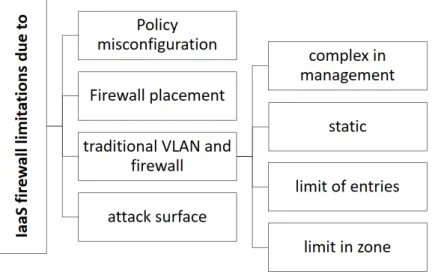
Several researchers consider firewalls and VLAN to be less effective in the cloud environment, due to several challenges such as time consuming in configuration and management, limitation of the geographic zones, limitation to the number of users and static nature [130, 155, 173, 215].The firewalls can be breached in cloud environments by a mechanism using UDP coordinating with TCP [133]. An analytical experiment shows that there is a time interval where LVMM is not under firewall protection. A firewall cannot differentiate normal traffic from attack traffic if it accesses the network through port 80 [146]. Moreover, 42% of firewall failures are due to DDoS attack at the network layer [175]. Traditional packet-level firewall mechanisms are not suitable for cloud platforms in cases of complex attacks [232].
The limitations of firewall configuration in cloud computing according to this investigation are summarised in Figure 2.3. We can notice that traditional access control enforcement mechanisms are not sufficient in cloud computing. Therefore,
there is a need to redesign a firewall system that suits IaaS characteristics.
2.4.3
Firewall Approaches in IaaS
Cloud users, such as companies and governments, might not rely on cloud-based firewalling approaches as these approaches still experience severe performance and reliability issues [87].Ensuring network security in the current complex infrastruc-ture which involves different vendors and cloud service providers (CSP) turns out to be difficult and time-consuming. Each CSP has their own API to manage the security mechanisms, such as traditional firewalls, virtual firewalls and security tools. Therefore, what looks like a simple application change may require tens or even hundreds of configurations [90].
As shown by Table 2.1 , IaaS firewall approaches from the literature agree that the traditional firewall needs to be improved or replaced in order to cope with the IaaS environment. A trend of deploying virtual firewall is illustrated in most of the approaches. Firewall virtualisation allows dynamic deployment, so it suits IaaS characteristics and it can effectively improve firewall configuration [87, 224]. Most of the academic research assumes that the insiders in cloud service pro-viders are not trusted [100, 132, 210]. To improve the trust in the cloud environ-ment, a bridge virtual firewall can be designed and installed on the virtual machine in IaaS so that the cloud user can have full control on their firewall [132]. A bridge firewall improves the performance, but it limits the security of the live migration as this type of firewall cannot manage different types of policies. Moreover, massive attacks may compromise a virtual firewall if they originate from outside the virtual domain [87].The virtual firewall side effect can be mitigated if a proper firewall is designed among virtual machines and suitable firewall policies are defined [124].
Table 2.1 indicates the two approaches discussed regarding firewall systems administration in IaaS, which are centralised and distributed. The centralised approach was found to be less prone to misconfiguration failure as it monitored continually [175]. On the other hand, it has several drawbacks: it may lead the centralised controller to reach a bottleneck, it attracts more DDoS attacks and can introduce a single point of failure [173]. The centralised firewall set-up is argued to be unfeasible in the cloud due to performance and cost issues [129]. The distributed approach is used by many enterprises on the network edge [147]. To handle dynamic policy update in IaaS, a distributed firewall needs a complicated revocation and re-propagation mechanism [96].
Table 2.1: Firewall approaches in dynamic network
Ref Main Problem Proposed Solution Admin
Type [173] Conventional network
access contorl: firewall and VLAN face several limitation in IaaS
Take the policy enforce-ment point out from the network and place it into the hypervisor
Centralised
[96] Network states and traffic are frequently changed
Firewall Framework to cope up with SDN en-virnomnt
Centralised
[147] fine-grained rules are needed by CSP to get better control over individual network flows
For better scalability and performance, place the access control policy on both hypervisor and switch
Centralised
[87] Cloud firewalling suffers from performance and re-liability issues
Propose a framework consisting of phyical firewall and virtual firewall
Centralised
[232] Packet level firewall mechanisism can not handle a complex attack on the cloud
Cloud firewall framework involves event level de-tection chain with dy-namic resource allocation
Not men-tioned
[210] Network topology is not well defined, insiders are not trusted. Policies in Conventional firewalls are static and can not ad-apt to real-time threats
Propose a distributed firewall with a distrib-uted active response by moving policy enforce-ment point from network firewall to end host
Distributed
[132] CSP is not fully trusted Propose a firewall system monitored by the cloud customers
2.5
Access Control Model
Authentication, access control, and audit together provide the foundation for in-formation and system security. Consequently, access control is applied after au-thentication has been established [189]. In cloud computing, the auau-thentication technique is fulfilled through identity management that supports access control based on user attributes [212]. Vaquero studied several virtualised (multitenant) datacentres and concluded that most reported systems employed access control techniques to secure their environment [215].
As has been discussed in IaaS security challenges in Section 2.2, it was found that an appropriate access control mechanism is needed to mitigate most of the explored threats. Unfortunately, the classical access control models such as man-datory, discretionary and role-based are not suitable for IaaS due to its character-istics [19, 110, 145]. Several attributes should be taken into consideration to set up proper access control for the cloud environment [103, 137, 173]. These are:
The method of access to the cloud and cloud architecture. The users in the cloud are identified by their attributes or their characteristics, not by fixed IP address. Therefore, a dynamic access control is needed to achieve cross-domain authentication. The cloud access control should be network independence.
The multi-tenancy feature in IaaS requires flexibility in seating access policy as different users are sharing the same infrastructure, although they are most probably not from the same organisation or country.
2.5.1
Background and Challenges
As a general principle, an access-control model aims to protect objects from un-authorised subjects based on a specific access control policy. Authorisation means that an authenticated subject is allowed to perform an operation on an object. Each access-control policy has a model that it follows. Each access-control model consists of a well-defined framework and a set of boundaries that describes the relations used to combine the objects, the subjects, the operations and access rules in order to generate an access-control decision. There are four main access control models: Discretionary Access Control (DAC), Mandatory Access Control (MAC), Role-Based Access Control (RBAC), and Attribute-Based Access Control (ABAC). Several research scholars have described these access control model's properties and their limitations [10, 20, 94, 109, 113, 125, 137, 138, 189, 233, 236]. Access-control models can be categorised based on the main entity that is in-volved in the creation of the access policy rules. For example, the entities can
be the subject or the object. Identity-Based Access Control (IBAC) categories, such as DAC and RBAC, face scalability challenges in a large system since they are based on the subject identity. Moreover, they are cumbersome and lack the ability to adopt dynamic policy changes. DAC has two main limitations: the first limitation relates to delegation issues since its read access is granted transitively. The second limitation is due to its access structure concept being dependant on subject identification. Therefore, it allows the program to inherit the identity of the invoking user, which is considered a security vulnerability. RBAC has been standardised and used widely in most economical computing systems [76]. Its role is considered as a link between users and permissions in order to permit or deny access [47]. RBAC faces several limitations, such as role expansion in dynamic systems. It is static as its access rules must be pre-defined before the system is running [59, 94]. Lattice-based access control categories, such as Mandatory Access Control (MAC), are centralised models where the security administrator assigns fixed security labels to objects. MAC faces similar scalability challenges to RBAC and DAC. The last access-control model category is based on system attributes such as Attribute-based Access Control (ABAC). It controls access by evaluating rules against the attributes of several elements, including the entities (subject and object), the operations, and the environment. It is the most suit-able candidate for the IaaS access control model because ABAC is scalsuit-able and supports a dynamic environment.
The challenges facing the design and implementation of the access-control sys-tem are as follows [21, 89, 94]:
It is a complex system that is divided into three layers: policy, model, and mechanism. The interaction and the relation between these is sophisticated
Translating the business policy to the access control rule set is a complex process. It requires an expressive tool such as formal logic that is able to specify the policy statements into rules that can be computed by machines
There is no perfect access-control model that will fit all types of comput-ing systems. Each access control model involves a trade-off and limitations. Therefore, the selection of the proper model is based on the system require-ments and the business functions
The access control state is safe if no permission can be taken by an unau-thorised principal. The safety computation has been proven to encounter an undecidable problem in traditional access control models such as access matrix.
Figure 2.4: Access Control building blocks as explained by [97]
Figure 2.5: Access Control building blocks as explained by [187]
In order to facilitate the process of designing and implementing the access con-trol system, it has been divided into three layers: policy, model, and mechanism. The definitions of these three building blocks are explained below [10, 21, 94, 98, 104, 186, 187].
Access Control Policy.To distinguish the access-control policy from other usages of the term'policy', it is defined as a specification of the system behaviour [16]. This will produce a set of Allow/Deny rules that reflect the business owner's objectives and security policies.
Access Control Model. This is an intermediate layer between the higher level, which is the policy, and the lower level, which is the mechanism. In some cases, the policy is implemented directly into the mechanism without formally
defining the access-control model if the policy is application-specific and imple-mented by a particular vendor. However, in cases where the access-control policy spans multiple computing platforms or consists of several security factors, there is a necessity to formally define an access-control model. Mainly, the model specifies how the policy can be implemented and enforced via the access-control mechanism.
Access Control Mechanism. This involves functions that implement the control obligated by the access-control policy stated in the model. It can be written in the form of pseudocode which can be implemented in a hardware layer or a software layer by using a programming language.
Figure 2.4 illustrates the access control building blocks by [97]. The policy re-flects the protection concepts where the model can formally be specified. However, Figure 2.5 bring the term policy model which can be formally specified by [187]. In [206], Tang used the term Policy to refer to his proposed ABAC enhancement for multi-tenant IaaS where the term Enforcement model was used to refer to his proposed framework. It was found that the term 'access-control policy'is used interchangeably with the term 'access-control model'. However, it is common to refer to RBAC, ABAC, DAC and MAC as access control models instead of access control policies as Figure 2.6 shows results from Google scholar.
Figure 2.6: Google Scholar Results for the keywords Model vs. Policy for Access Control Types
It can be concluded that the term 'policy'is used to describe the architecture that is followed to create access rules, where the term'model'refers to the formal specifications that are used to express the access control system properties. The access-control models: MAC, DAC, RBAC and ABAC are occasionally referred to as policies since they indicate how the access rules are created. MAC rules are based on object-labelling. DAC rules are based on subject-identity. RBAC rules are based on subject-roles. ABAC rules are based on attributes. This research
will refer to them as 'access control models'to avoid ambiguity, and will use the term 'policy'when discussing authorisation rules.
2.5.2
Access Control Models Approaches in IaaS
Several access control models are proposed in the literature which address various access control problems in IaaS. Table 2.2 summarises IaaS cloud access-control models which have been published recently. The most common limitation found among them is the performance overhead, which leads to an increase in computa-tional cost that affects QoS (Quality of Service). The access control policies and models presented by Nguyen and Tang [152, 206] use RBAC and ABAC as a basis for their proposed models. Their architectures are implemented via XACML and provide a proof of concept via OpenStack.
Table 2.2: Recent proposed Access Control Models for IaaS
Ref. Access Control requirement Proposed solution Used tools
[152] expressive and fine-grained access control as prior models are not suitable
PBAC (Provenance-based Access Control) a sub-set of ABAC
XACML and
OpenStack
[206] a fine-grained access control model for multi-tenant collabor-ation
Multi-Tenant Role-Based Access Control (MT-RBAC)
XACML and
OpenStack
[1] support multi-tenant hosting and hetero-geneity of security policies, rules and domains
Access Control model for Cloud Computing (AC3)
theoretical
[14] manage access from users or entity that be-long to different au-thorization domains
Capability-based Ac-cess Control
theoretical
[122] flexible and fine-grained access control for VM-level
IaaS-oriented Hy-brid Access Control (iHAC)
iVIC as IaaS
Ref. Access Control requirement Proposed solution Used tools
[123] a user-centric access control for mobile Cloud environments
Context-Aware Attribute-Based Techniques
XACML
[239] balance between in-formation security and resource sharing
hierarchical secure information and re-source sharing model
OpenStack
[27] virtual resources in IaaS are configured using software, and hence prone to mis-configurations attribute-based con-straints specification and enforcement OpenStack [150] Multi-tenant ac-cess control is not supported
ABAC that support multi-tenant access
OpenStack
[134] centralized access me-diation and flexible policy customization
least-invasive access control framework
OpenStack
[22] The relation between users and resources in cloud computing is ad hoc and dynamic
Extend RBAC with trust relation
CloudSim in Planet Lab
The proposed model by A. Younis et al and Anggorojatiet al [1, 14] presents a great work regarding security policy design based on attributes, but it does not present a security model architecture. The proposed model and the enforcement implementation presented by Liet al [122] is remarkable, as it does not consider IP address as the main attribute in the access-control policy, instead it uses security type.
However, their model does incur a performance overhead. A concentration on multi-tenant access-control is investigated by Ngo et al [150] and an ABAC model is proposed to cope with this feature. A cloud user-centric access control model is proposed by Li [123] which targets customer privacy within mobile cloud applications rather than IaaS cloud. Luoet al in [134] investigate the improvement of access control models in an OpenStack IaaS cloud. RBAC is still used in most cloud computing, Behera and Khilarin in [22] extend it with a trust-relation.
Figure 2.7: Unified ABAC Model Structure [108]
2.6
Attribute-Based Access Control (ABAC)
The definition of Attribute-Based Access Control (ABAC) in this section is extra-polated based on the knowledge obtained from various ABAC references such as [52, 98, 221].
Attribute is the base element in calculating the access decision in ABAC models as illistrated in Figure 2.7. UA is the user attributes, SA is the subject attrib-utes and OA is the object attribattrib-utes. Attribute is defined as a pair of (name: value), where value can be a complex data structure. They can be associated with different entities such as users, actions, subjects, objects, context and envir-onment. Policy rules convert the combination of attributes into access rights in real-time. Therefore, the permissions in ABAC are not listed beforehand. The use of predefined attributes instead of predefined permissions in decision making adds flexibility to the access-control system. For example, in RBAC, the permission engineering process requires the grouping of permissions into roles; users are then assigned to these roles. However, as the system scales up, these processes become more complex and face a roles-explosions problem [98].
One of the critical differences between ABAC and previous access control mod-els is that ABAC access decisions are not associated with user-identity, making ABAC dynamic and able to cope with changes. Therefore, if the system ad-ministrator intends to update access control policy, the only place which must be changed is the policy-rules file. In contrast, it is difficult to determine which places need to be updated in identity-bounded models such as ACL (Access Control List) which is used with DAC and RBAC models.
This thesis defines ABAC as follows: ABAC generates its access control de-cision based on a collection of attributes driven from the involved entities in the access-request and the system environment. Attributes enable the ABAC model to be fine-grained, flexible and able to express a complex Boolean rule-set. ABAC
supports a real-time access-decisions and a dynamic access control system since it is identity-free based.
2.6.1
Background and Challenges
ABACα is described in the literature as a foundation of the ABAC model's func-tionality. Therefore, it is essential to identify ABACα limitations so as to be able to propose enhancements to ABAC. The list of challenges is stated below [108, 118, 192, 193]:
ABACαfocuses on the ABAC basic with minimal features. It does not take into consideration the object and the subject hierarchies
It does not involve environment and context attributes
It does not formally express the fundamental access-control security prin-ciples such as separation of duty (SoD)
It does not take into consideration the delegation feature
It is considered as one of the first contributions in formalising the ABAC model, however, the policy language used is insufficient for real-world ap-plications such as handling multiple policy compositions or policy conflict
The authors in [195] present ABACαin OWL. Their investigation concludes that ABACα does not cover static or dynamic separation of duty principles nor does the subject involve an attribute that reflects its contextual inform-ation
More precisely, the ABACα author recommendations are as follows:
The proposed Common Policy Language (CPL) is not a complete language as it does not specify the values of the symbols set and atomic variable. These two values have a significant effect on each configuration point. Therefore; there is a need to investigate a policy language that is able to detect mis-configuration and can present compliance with privacy expectations
Attribute engineering might add complexity to ABAC. In addition to the difficulty in policy expression and comprehension due to the policy config-uration point proliferation
It can be deduced that ABAC challenges are two-fold: The first is related to its conceptual definition and the second is related to its formal definition. These
two challenges are detected as well by [118, 188, 193]. The conceptual definition includes the features supported by the ABAC model, such as the separation of duty security principle and the context aware mechanism. The formal definition includes a formal language that is able to formally specify ABAC model properties. The use of formal logic in the design of ABAC policy rules is a convenient ap-proach for two distinct reasons [30]. The first being that formal logic is straight-forward since it does not have an up-front cost, unlike RBAC role engineering. The second reason is that formal logic is flexible, since its attributes facilitate the expression of complex policy rules.One of the earliest works related to the logical based framework for ABAC was carried out by Wanget al [221], using the constraint logic programming language. Bijon et al in [28] developed a declar-ative language for Attribute Based Constraint specification (ABCL). Hence, the declarative language is specific since it focuses on specified constraint values of the attributes held by the ABAC model. However, ABCL did not specify the values of the attribute related to authorisation policy rules.
There are several policy specification languages, including SecPAL, DYNPAL, SMP, Binder, SPKI/SDSI, XACML and EPAL. However, they all focus on specify-ing and evaluatspecify-ing authorisation policy, and none present comprehensive formal models for ABAC. Jin in [108] defined a template called Common Policy Language (CPL), although it is not a complete language as the symbol set and atom are left unspecified. There is an open research in policy specification languages related to misconfiguration detection and privacy compliance [108]. Most of the logic-based formalisations presented for ABAC lack the ability to manage attributes and en-gineer security policy rules [118]. Considerable attention is given to improving the use of XACML as a policy language for ABAC because it is compatible with many web applications. However, XACML does face limitations related to policy semantics [195, 200]. An Interesting work was carried out by Crampton & Willi-ams in [53] regarding the completeness of the ABAC model using XACML formal logic, where they introduce the use of three-valued policy in XACML.
The techniques used for the ABAC policy specification are either formal logic or enumeration. Examples of the first category are ABACα, HGABAC and XACML. Examples of the second category are Policy Machine (PM) and 2-sorted-RBAC [30]. This study selects the formal logic technique for ABAC specification since it allows the research to verify and reason ABAC. The Section 2.7 justifies the selection of formal logic approch.
2.6.2
ABAC in IaaS Cloud
The ABAC model concept is context-aware in the sense that it can utilise the attributes concept in its authorisation decision. However, ABACα [108] does not indicate the context-aware feature. Instead, the author contains some concepts of context in his ABACβ which is designed for the purpose of unifying RBAC exten-ded models. Smari et al [198] extended ABACα with context, privacy, and trust features where context is involved in access-control policy beside subject and ob-ject. Thus far, there is no illustration regarding system complexity evaluation nor policy language formalisation. Servos and Osborn [192] proposes HGABAC where the ABAC model takes into consideration hierarchal features. Servos & Osborn used some context-awareness by involving the network-connection and environ-ment attributes. However, they did not consider the separation of duty concept or delegation feature. Their policy language is also based on Kleene K3 logic. The formal languages used in ABACα and HGABAC are a type of propositional logic. Therefore, they face the satisfiability problem of NP-complete during policy update or policy review. Even if a formal language based on first-order logic is used to express the ABAC policy, it will face an undecidable computational prob-lem [30].The focus of this research is to specify the context-aware mechanism and separation of duty security principle in ABAC model.
2.7
Access Control Model Formal Specification,
Verification and Reasoning
2.7.1
Formal Logic in Access Control
Access control is an essential and widely used security mechanism. One of the critical challenges in implementing access control is its policy specification and management. There is a limitation in the available tools that allow administrators to mitigate this challenge. Therefore, policy misconfiguration is the cause of a huge number of security breaches cases [106].
Based on the literature, access control specification can follow a graph-based approach or logic-based method. The graph-based approach is used to represent access control models. However, the logic-based method is more convenient when it comes to reasoning and computing [24]. Logic-based access control models are suited to large dynamic systems as they are expressive and able to represent a variety of authorisation policies [93]. Using formal logic for specifying, reason-ing and verifyreason-ing access control systems is an active research area. The logical approach is more appropriate for this access control research scope than
calculus-based approaches since it allows the detection of patterns of correct or incorrect reasoning [16, 47].
In early 1973, the status of logic in computer science was not clear, and its usefulness was not identified because of a lack of mechanical testing to validate predicate logic. Furthermore, Boolean logic is intractable. Classical logic was established to provide a formal language to describe how mathematics works us-ing proven methods [45]. Classical logic (also known as sentential logic), such as propositional logic and predicate logic (also known as First Order Logic or FOL), formulas are either true or false in any model. Non-classical logic such as modal logic (also known as symbolic logic) differ from classical logic as they replace the concept of truth, which consists of two values: true or false, with the concept of constructive provability. The constructive provability operations preserve justific-ations with respect to evidence and provability rather than truth value.
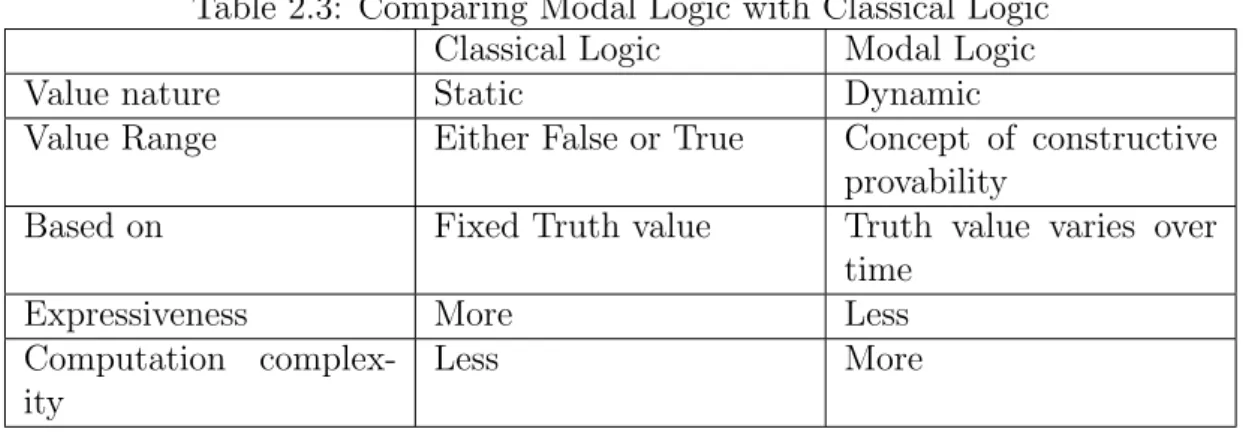
In natural language, there are various truth modes such as it is believed to be true (doxastic logic), it is always held (temporal logic), it is known to be true (epistemic logic), and it ought to be the case that it is true (deontic logic) [102]. Therefore, modal logic is more appropriate to reason in a dynamic situation where a truth value varies over time. On the other hand, classical logic has a static neuter [219]. First order logic might be more expressive then modal logic, but in term of validities, modal logic is decidable where first order logic is undecidable. Therefore, modal logic strikes a balance between expressive power and computational complexity [214]. Table 2.3 compare modal logic with classical logic. [214] Modal logics tend to be decidable ; and their validities can be described in transparent variable-free notations. Understanding the trade-off between the expressive power and axiomatizability is essential in formal logic reasoning.
Table 2.3: Comparing Modal Logic with Classical Logic Classical Logic Modal Logic
Value nature Static Dynamic
Value Range Either False or True Concept of constructive provability
Based on Fixed Truth value Truth value varies over time
Expressiveness More Less
Computation complex-ity
2.7.2
Decontic Logic (DL)
Modal logic extends the classical logic operators with modal operators that al-low the representation of possibility and necessity [68]. Deontic logic is a type of modal logic that involves operators such as obligations, prohibitions and permis-sions. It is used in normative systems such as computer security, legal systems and electronic commerce [39]. Information Systems (IS) store real-world data. The property that exists in this world that is known to be true is called an integ-rity constraint. Different logics can be used for normal (hard) constraints. On the other hand, the exceptional (soft) constraints which are the desirable properties can be violated. Therefore, there is a demand for a logic that is able to cap-ture soft constraints such as deontic logic, because deontic logic has an advantage of reasoning between the ideal and the actual behaviour [49]. Furthermore, de-ontic logic supports formal languages in avoiding the ambiguity of access control policy specifications and is consistent because its soundness and completeness are achieved through its axiomatic characteristics. As a consequence, it supports an access control implementation level [144].
Deontic logic receives a large degree of attention in the field of computer science [6, 181]. Chevy & Cuppens [49] presents one of the earliest logical reasoning approaches to the properties of security policy in access control based on deontic logic. Furthermore, Glasgowet al in [85] propose a formal framework for specifying and reasoning about security policies called Security Logic (SL), where deontic logic had been involved in the formal language used. However, SL did not involve any access control logic operators. An application of deontic logic in Role-Based Access Control (RBAC) is introduced by Koaczek [116]. Another work using deontic logic in access control was presented by Abou El Kalam [5], where a framework is proposed that can help the system administrator to automatically derive the consequences of their policies.
2.7.3
Access Control Logic (ACL)
Several researchers contribute in defining and establishing Access Control Logic (ACL). Chin and Older [47] use similar semantics to the logic of Abadi and his colleagues, who have several contributions in this field such as [4, 2, 3, 120] and their cooperation with Deepak [82, 81]. The ACL conducted by Abadi is con-sidered as one of the foundations for ACL researchers. However, ACL has not been used to formally define ABAC in the literature. Boella et al [34] proposes a logical framework named Fibred Security Language (FSL). FSL aims to study
says operators. The FSL is based on a multi-modal logic methodology which uses a fibring mechanism to combine logic based on the work of Gabbay [80].
Several researchers have used intuitionistic logic to enhance ACL. Intuitionistic logic is also known as constructive logic. Genoveseet al[84] propose an ACL modal (M-ACL) based on intuitionistic multimodal logic. M-ACL extends intuitionistic propositional logic with says binary modality and speaks-for binary operator between principles. Genoveseet al prove the language soundness and completeness using first order logic. Genovese et al in [83] present another modal called ACL+ for access control policy specification, reasoning, and enforcement to overcome specific limitations of the basic ACL. These limitations are implicit permissions, control or delegable permissions, and information flow versus acceptance. Massacci [139] presents a logic for practical reasoning with RBAC based on Abadi ACL in addition to a decision method based on analytic tableaux. Whereas Kosiyatrakul [117] extends Abadi ACL, with four relations to reason about an RBAC policy model.
2.8
Artificial Intelligence in IaaS Cloud
Security
To the best knowledge of the author, no prior work addresses the use of a knowledge-agent in access control model implementation in IaaS. The knowledge-knowledge-agent is a type of l
![Figure 2.4: Access Control building blocks as explained by [97]](https://thumb-us.123doks.com/thumbv2/123dok_us/196790.2517969/33.892.217.729.108.380/figure-access-control-building-blocks-explained.webp)
![Figure 2.4 illustrates the access control building blocks by [97]. The policy re- re-flects the protection concepts where the model can formally be specified](https://thumb-us.123doks.com/thumbv2/123dok_us/196790.2517969/34.892.241.718.609.883/figure-illustrates-control-building-protection-concepts-formally-specified.webp)
![Figure 2.7: Unified ABAC Model Structure [108]](https://thumb-us.123doks.com/thumbv2/123dok_us/196790.2517969/37.892.237.712.108.324/figure-unified-abac-model-structure.webp)