UNESCO
TEACHER EDUCATION
THROUGH DISTANCE LEARNING
TECHNOLOGY - CURRICULUM - COST - EVALUATION
Summary of
Case Studies
Brazil, Burkina Faso, Chile, China, India, Mongolia,
Nigeria, South Africa (two studies), United Kingdom
UNESCO
Education Sector, Higher Education Division, Teacher Education Section
in cooperation with E-9 Initiative
UNESCO editorial co-ordination: Ratimir Kvaternik
The studies were designed and executed by the International Research Foundation for Open Learning under the direction of Hilary Perraton, under contract with UNESCO.
Contracted principal authors:
Hilary Perraton, Bernadette Robinson, Charlotte Creed
International Research Foundation for Open Learning, (IRFOL), Cambridge, UK
Contracted authors of the country contributions:
Bernadette Robinson – Mongolia Charles Potter – South Africa
Cristian Cerda, Miriam Leon, Miguel Ropoll - Chile Joao Batista Oliveira- Brazil
Jean-Francois Terret – Burkina Faso Ram Narain Mehrotra - India
Rashid Ederinoye - Nigeria Rob Walker – United Kingdom Wei Yuan Zhang, Niu Jian – China
The authors are responsible for the choice and presentation of facts contained in this book and for the opin-ions expressed therein, which are not necessarily those of UNESCO and do not commit the Organization. The designations employed and the presentation of materiel throughout this publication do not imply the expression of any opinion whatsoever on the part of UNESCO concerning the legal status of any country, territory, city or area or of its authorities, or concerning the delimitation of its frontiers or boundaries.
Any part of this document may be freely reproduced with the appropriate acknowledgement.
For further information please contact:
UNESCO
Higher Education Division, Teacher Education Section 7, place de Fontenoy, 75352 Paris 07 SP, France
Fax: +33 (0)1 45 68 56 26
©UNESCO 2001 Printed in France
PREFACE
IV
1 INTRODUCTION
1
1.1 Why the case studies
1
1.2 Educational needs and problems
1
1.3 The case studies
2
1.4 Background – open and distance learning
3
2 CASE STUDIES
5
Television-Plus: Journalism in the service of teacher development, Brazil
7
Professional development of headteachers in Burkina Faso
9
Teachers learning to use information technology, Chile
11
Reaching teachers through television, China
13
Developing primary teachers’ knowledge and skills in child guidance, India
15
Re-orienting primary teachers to new teaching approaches, Mongolia
17
An alternative route to primary teacher qualifications, Nigeria
19
Interactive radio for supporting teachers of English as a second language,
OLSET, South Africa
21
New routes to teacher education degrees, South Africa
23
Using ICT to support school-based initial teacher education, United Kingdom
25
3 CONCLUSIONS
27
3.1 What is it being used for ?
28
3.2 How effective is it ?
30
3.3 What does it cost ?
32
3.4 What media and technologies is it using ?
33
3.5 How is it managed ?
36
3.6 How is it funded ?
36
4 WHAT DO WE STILL NEED TO FIND OUT ?
38
TABLE 1: THE CASE STUDIES
4
TABLE 2: TYPES OF PROVIDERS
35
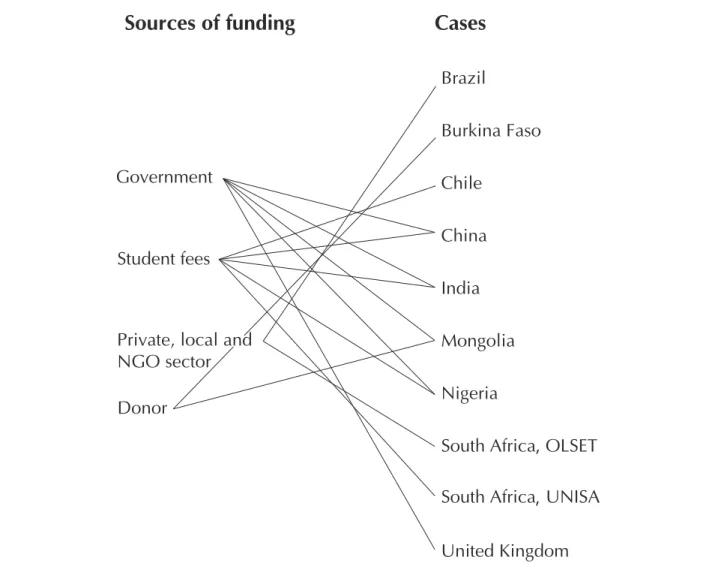
FIGURE 1: FUNDING SOURCE
37
REFERENCES
39
C
O
N
T
E
N
T
S
The present document is a summary of ten case studies currently in process of
publi-cation. By releasing this summary document early it is hoped that Member States will
be able to consider the overall trends and national experiences described therein, in
their present teacher training development activities. The rich detail, which will follow
in the individual full-text case studies, is intended for use by programme planners and
researchers during 2002-2003.
These case studies represent a major activity in one of UNESCO’s main lines of action,
as summarized in the Organization’s Approved Programmes and Budget for
2000-2001 (30 C/5), paragraph 01240. In that paragraph reference is made to the fact that
“The General Conference authorizes the Director-General: (a) to implement an
inter-sectoral project entitled ‘The status of teachers and teacher education in the
informa-tion society’, in order to assist Member States in renewing teaching methods and the
training of teachers at all levels, and, using open and distance education approaches,
adapting them to the emerging information society, and…”
These case studies also follow up the recommendations concerning teacher education
using distance learning that were made by the World Conference on Higher Education
(WCHE, Paris, October 1998), the World Forum on Education (Dakar, April 2000), and
the Seventh Sesssion of the Joint ILO/UNESCO Committee on the Application of the
Recommendations concerning the Status of Teachers (Geneva, September 2000).
The studies represent an interesting mix of applications of different modes of distance
learning. Distance education still remains, at heart, a reflection of individual national
infrastructures and a wide complex of educational, social, cultural and economic
issues, including the willingness and capacities of teachers themselves to become
engaged in these modes in their various learning institutions and communities.
Within UNESCO itself and with our Member States and partners (chiefly those of the
Dakar and WCHE follow-up groups), we intend to use these studies as a basis from
which to develop guidelines on the application of distance learning in teacher education.
We thank the contributors to these studies, which we hope will find wide
applicabili-ty in Member States.
John Daniel
Assistant Director-General for Education
P
R
E
F
A
C
E
P
R
E
F
A
C
E
1
INTRODUCTION
The world needs better teachers and more teachers. The Dakar conference revealed that there were still more than 100 million children out of school: they need teachers as the world moves towards the 2015 target of education for all. And we need to raise the skills of the existing 60 million teachers, too many of whom are untrained and unqualified. Beyond that, the skills and knowledge all teachers need are no longer fixed and familiar targets but moving ones. Teachers therefore need more opportunities than ever before to go on learning throughout their careers. One of the ways of strengthening the teaching profession is to use distance education or open and distance learning.
1.1 Why the case studies
UNESCO commissioned this set of case studies because of demands from Member States for guidance on implementing programmes of distance education for teachers. The studies are therefore intended to document experience on which to base the Guidelines for teacher education at a distance, a separate document from this, to be published in 2002.
More specifically we wanted to find out what open and distance learning was being used for in teacher education, how effectively it was working, and what methods it was using. In asking how effectively it was working, we wanted to examine its record in attacking the major problems confronting teacher education. There are two kinds of question here: about effectiveness and about relevance. To gauge effectiveness we were looking for data on completion rates and comparative costs and for any indicators of effects on the work of teachers in the classroom or the community. To assess relevance we wanted to discover whether the initiatives were a significant, sustainable, part of the service of teacher education or a small, peripheral, activity with little chance of making any major impact on the problems.
If open and distance learning for teachers is effective, and working on a big enough scale to be actually or potentially significant, then it is worth going on to ask how it is managed. We therefore went on to ask about the curriculum of open and distance learning initiatives, and the extent to which this matches that of other forms of teacher education and professional development. We also looked at organisational structures, and the kinds of organisations that provide teacher-education programmes, and the different patterns of funding. We looked at the technologies, ranging from print to computers, and the relationship between work done through the technologies and work done face-to-face, including all-important issues about classroom practice.
1.2 Educational needs and problems
Many countries still do not have enough teachers. In some, the expansion needed in the teaching force is far beyond the capacity of traditional colleges. The supply of teachers is also adversely affected in countries where retention rates are low for newly trained teachers or where significant numbers of teachers are being lost through HIV-AIDS or in rural areas which have difficulties in recruiting and retaining teachers.
Teacher quality is an issue in most countries. Many teachers are untrained or underqualified or teaching subjects in which they are not qualified or trained. In addition, teachers face a widening range of demands and roles. National governments, international organisations and specific circumstances continually set new goals: gender parity by 2005 and universal basic education by 2015; inclusive education; education for democracy, peace and social cohesion; multi-grade teaching; increased accountability for achieving learning targets; the development of learners who are self-managing and independent, skilled in critical thinking and problem solving, equipped with life-skills; the preparation of learners who are competent for knowledge-based economies, capable in the use of information technology; and the expansion of teachers’ roles to include social work in communities where child-headed households and orphans are common as a result of HIV-AIDS.
The attention given to teacher education and their continuing professional development has in many cases lagged behind that given to other parts of the education system. Some countries lack a policy for it, though the importance of teachers is emphasised in many international reports (e.g., UNESCO 1998, UNESCO 2000, OECD 2001). Although there is wide recognition that teacher education, training and professional development need to be integrated, in ways that operationalise lifelong learning for teachers, the resources allocated to it are usually inadequate and the opportunities too few. In some countries teachers can expect one week’s in-service professional development once every five to ten years. On average, countries spend around one per cent of their annual education expenditure on the continuing professional development of teachers (business and industry typically spend 6 per cent on staff development).
All of this creates new challenges for teacher education and continuing professional development: the need to find ways of using existing resources differently, of expanding access to learning opportunities at affordable cost, of providing alternative pathways to initial teacher training, of drawing on new constituencies of the population to work as teachers, of using technologies appropriately to enrich a teachers’ context and support practice, of stimulating and supporting teachers’ active learning and of reconceptualising the traditional organisation of initial teacher education and continuing development.
Can open and distance learning respond to these challenges ? The case studies here offer some answers, in describing a range of uses of open and distance learning for both initial and continuing teacher education, using a variety of technologies.
1.3 The case studies
Initial teacher education and training is the programme of studies which leads to qualified teacher status according to the official standards of a country. It is the basic or first level of qualification for a teacher. It may be taken as a pre-service programme (before a trainee teacher begins work as a teacher) or an in-service one (while an untrained teacher is working as a teacher).
Continuing professional development enables teachers to extend existing knowledge and skills and develop new ones. Some of this takes the form of long structured courses leading to formal qualifications (diplomas or bachelor’s or master’s degrees). Other forms are shorter, concentrate on skills in managing children’s learning or curriculum change and do not lead to additional qualifications. In some countries, qualified and unqualified teachers alike participate in continuing professional development. It may be provided as in-service activities (on-the-job learning) or out-of-school courses of varying length (off-the-job or in vacations).
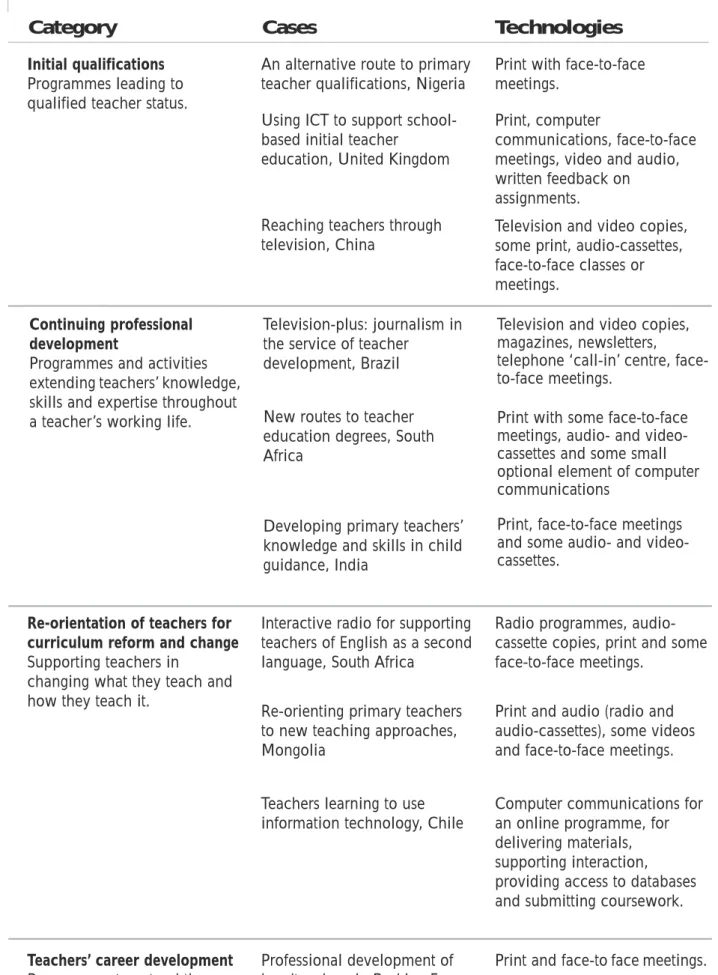
We have categorised the case studies in four ways. First, some countries have used distance education to provide a route to initial qualifications for significant numbers of teachers, both new entrants to teaching and experienced unqualified teachers. The China Television Teachers College and the National Teachers’ Institute in Nigeria have long experience of this approach and have become a recognised and institutionalised part of the regular education system in their countries. In a programme that reflects an official policy shift towards more school-based training, the Open University in Britain has run a school-based qualifying programme for graduates who want to enter teaching but have had no professional teacher training.
Second, initial teacher education is no longer seen as enough. Distance education is therefore also being
used to raise the skills, deepen the understanding and extend the knowledge of teachers. Some programmes are broadly focused while others are targeted at specialist groups. Programmes are taken either by individuals or by groups of teachers who are encouraged to participate by their schools or their employers, as can be seen in these case studies. For example, a non-profit television station is taking the lead on supporting school groups in Brazil. In other cases, programmes are available for individual teachers who want to improve their skills and their status, often enrolling on an individual basis, and at their own expense. Indira Gandhi National Open University in India has a number of programmes of this kind of which its Certificate in Guidance is one. The University of South Africa also offers programmes on this basis.
Their BEd programmes are for experienced underqualifed teachers and also new entrants to teaching, which serve to meet individual goals as well as contributing to the policy goal of a graduate teaching force. Some programmes are aimed at the upgrading of teachers’ qualifications required by official policy as new standards are set in a country (as in China).
Third, distance education can have a role in programmes of curriculum reform which aim to change either
the content or the process of education. In South Africa, the Open Learning Systems Educational Trust is using radio to improve the teaching of English, and to support teachers in this work. In Mongolia, radio and print are used across large distances to re-orient teachers to official changes in curriculum and teaching methods within a country in transition. In response to policy initiatives aimed at establishing the use of ICT in schools, the Universidad de la Frontera in Chile is using ICT to support teachers who are teaching these subjects.
Fourth, distance education has been used for teachers’ career development. As they seek promotion, or aim
for the next qualification level, or aspire to become a headteacher, or work in a teachers’ college, or become an inspector, teachers need to acquire new skills. A multinational distance education project in West Africa has developed a training programme in school management for headteachers and aspiring heads.
These categories inevitably overlap: career development may be regarded as part of continuing professional development; it blurs a distinction between the initial education of new recruits to teaching and of experienced but unqualified teachers. Some of the programmes have more than one audience, qualified and unqualified teachers, teachers studying for initial qualifications and those using the same programmes to upgrade their qualifications.
In general, distance education programmes have been developed with varied intentions: of widening access to teaching qualifications; of disseminating good practice; of strengthening the education system as a whole by reaching not only teachers but the wider community; in enabling school-based training and professional development and as a means of strengthening the links between theory and practice, focusing on the school as a site of teachers’ learning. The case studies (listed in table 1) reflect these purposes.
1.4 Background: open and distance learning
Distance education been used to teach, support and develop teachers for many years: UNESCO was a pioneer through its UNRWA/UNESCO Institute of Education which was training teachers for refugees forty years ago. While the success of programmes has varied, experience demonstrates that distance education can be used to enable teachers to learn and to gain qualifications. The use of new information and communication technologies has drawn new attention to open and distance learning and offers new possibilities.
Distance education has been defined as an educational process in which a significant proportion of the teaching is conducted by someone removed in space and/or time from the learner. Open learning, in turn, is an organised educational activity, based on the use of teaching materials, in which constraints on study are minimised in terms either of access, or of time and place, pace, method of study, or any combination of these. The term ‘open and distance learning’ is used as an umbrella term to cover educational approaches of this kind that reach teachers in their schools, provide learning resources for them, or enable them to qualify without attending college in person, or open up new opportunities for keeping up to date no matter where or when they want to study. The flexibility inherent in open and distance learning, and the fact that it can be combined with a full or near full-time job, makes it particularly appropriate for the often widely-distributed force of teachers and school managers. Some open and distance learning programmes lead to a qualification, others do not; some are addressed to individuals and others to groups; some are tightly organised and others essentially a way of making learning resources available to teachers. All fall under this one umbrella of open and distance learning.
Teachers’ career development
Programmes to extend the careers of qualified teachers.
Professional development of headteachers in Burkina Faso
Print and face-to face meetings.
Note: The technologies listed in table 1 are those used for delivering the programmes. More are used in developing the materials or, in some cases, in training tutors, and computers play a large role in materials development and production.
Table 1: The case studies
Category Cases
Technologies
Initial qualifications
Programmes leading to qualified teacher status.
An alternative route to primary teacher qualifications, Nigeria
Using ICT to support school-based initial teacher
education, United Kingdom
Reaching teachers through television, China
Print with face-to-face meetings.
Print, computer
communications, face-to-face meetings, video and audio, written feedback on assignments.
Television and video copies, some print, audio-cassettes, face-to-face classes or meetings.
Continuing professional development
Programmes and activities extending teachers’ knowledge, skills and expertise throughout a teacher’s working life.
Television-plus: journalism in the service of teacher
development, Brazil
New routes to teacher education degrees, South Africa
Developing primary teachers’ knowledge and skills in child guidance, India
Television and video copies, magazines, newsletters,
telephone ‘call-in’ centre, face-to-face meetings.
Print with some face-to-face meetings, audio- and video-cassettes and some small optional element of computer communications
Print, face-to-face meetings and some audio- and video-cassettes.
Re-orientation of teachers for curriculum reform and change
Supporting teachers in
changing what they teach and how they teach it.
Interactive radio for supporting teachers of English as a second language, South Africa
Re-orienting primary teachers to new teaching approaches, Mongolia
Teachers learning to use information technology, Chile
Radio programmes, audio-cassette copies, print and some face-to-face meetings.
Print and audio (radio and audio-cassettes), some videos and face-to-face meetings.
Computer communications for an online programme, for delivering materials, supporting interaction, providing access to databases and submitting coursework.
2
CASE STUDIES
Within the constraints of the ten case studies we wanted to get a geographical balance, to look at the use of a variety of technologies, and to include programmes with differing purposes. A further constraint was that we were not attempting to commission or support original research: the case studies are mainly based on existing data.
We wanted generally to find researchers within the countries in which they were working (although we made exceptions in the case of Mongolia, where one of the planning team was currently working as a consultant, and Burkina Faso where the project was developed in association with RESAFAD, whose headquarters is in France). We also tried to ensure that authors had both a knowledge of the institution on which they were writing and an appropriate distance from it. In some cases we did this by seeking joint authorship from within and outside the institution. Our bias was towards developing-country experience but we were pushed by the technologies and the inherent interest of the case studies concerned to include two more developed countries; there is so little documented developing-country experience so far of the use of computer-based technologies in teacher education that it made sense to look also at Britain and Chile.
Outline plans for the research were drawn up by the International Research Foundation for Open Learning and refined at a meeting with UNESCO staff and researchers from three of the case-study countries in Paris in March 2001. All writers were then asked to write to the same brief and the same timetable. We are grateful to them for trying to do this, for their support and interest, and for the wealth of interesting experience that they have reported to us.
The following summary versions of the case studies are based on the full versions, to be published separately by UNESCO, and have been drafted by the authors of this volume.
T
ELEVISION
-P
LUS
: J
OURNALISM IN THE SERVICE OF TEACHER DEVELOPMENT
, B
RAZIL
A-Plus is a daily television series designed to stimulate interest in education, teaching and learning among teachers and in the broader community. Taking a journalistic approach, it uses a private educational television channel to reach an audience of 13 million across Brazil. It also helps mobilise teachers into follow-up action through its Community Mobilisation Networks.
The context
The Brazilian education system has large numbers of primary and secondary teachers who have low levels of qualification. The poor quality of many teachers has been a matter of concern. As a result, many initiatives have been taken by a variety of state and private providers for in-service teacher development. Teachers in Brazil are well-provided with all kinds of professional development opportunities though their relevance and effectiveness are sometimes questioned. Many of the initiatives offer distance education, usually print and other media. Some of the providers are non-governmental organisations (NGOs) and private sector organisations. One of these is TV-Futura, a non-profit educational television channel sponsored by a consortium of 14 public and private institutions. TV-Futura (‘The Learning Channel’) has sponsored the popular A-Plus television series. The target audience is educators at large: primarily teachers but also parents, social workers, nurses, childcare providers, and the community. TV-Futura states that its mission starts when the broadcast ends so one of its goals is to mobilise viewers (especially teachers) through its Community Mobilisation Network.
The programme
Its purpose is to help educators deal more critically and effectively with practical matters of concern to them and the community. The 15-minute daily TV programmes have a magazine format, combining general educational news with an in-depth documentary. Each programme shows two examples of real-life applications of the programme topic, for example, a method of literacy teaching or using videos in the classroom or conducting PTA meetings. An education expert comments in a challenging way on the examples or presents arguments designed to lead viewers to reflect. Suggestions for further activities and references to other sources of information are given at the end of each broadcast. Twice a week, the programme is supplemented by two sets of commentaries, one based on relevant research, the other introducing literature to help viewers apply the topic in real-life situations. Follow-on activities and monthly meetings are organised around these programmes for teachers’ groups that opt in to the ‘plus’ part of the programme. A-Plus provides 60 Community Officers who facilitate the Community Mobilisation Network which supports this activity. The programme has no set curriculum but aims to be responsive to teachers’ needs, drawing on several sources of guidance.
Brazil
Population (millions) 168.2
Size (’000 km2) 8,547
GDP per capita (purchasing power parity US$) 7,037 Human Development Index 0.750
Educational data Primary Secondary Teaching force 1,388,247 326,827
total ’000
’000 female --Gross enrolment ratio
All students 125 56 Female
--Pupil teacher ratio 24
--Source: UNDP 2001; UNESCO 2000; UNESCO 2001
Media and technology
A-Plus programmes are broadcast daily by TV-Futura, the philanthropic division of the GLOBO communications network in Brazil. Television was chosen to provide national coverage, build on a tradition of educational television in Brazil and exploit the high ownership of televisions at home and in schools (36 million out of 40 million households and 50 per cent of 118,000 urban schools have it). Production standards are high and its status as an independent provider helps it take a broad approach to programme content, avoiding adherence to a particular pedagogic doctrine. Some urban schools video-record the programmes though rural schools are less equipped to do this. From 2001, local TV stations will be able to rebroadcast the programmes. There are two main categories of audience: a general pay-TV audience (a potential 40 million) and the captive audience of institutions and educators that have joined the Community Mobilization Network. Print is used for a bi-monthly Network newsletter and a quarterly magazine for viewers, giving schedules and background reading.
Funding and costs
TV-Futura has an annual budget of US $78.7 million, financed by 14 sponsors, including private national and multinational firms and Chambers of Industry. Its financing structure determines the budget of specific programmes. Budgets cover costs for staff and development but not facilities for production, broadcasting, administrative and infrastructure costs. Like other TV programmes, A-Plus has high front-end production costs and low per user costs. The average cost of a 15-minute programme includes US $1,750.00 direct production costs, US $750.00 indirect costs and US $1,000.00 travel costs (on location). Broadcast costs are 2 per cent of total costs or a few cents per viewer per year. The annual cost of the Community Mobilisation Network is US $720,000 for the total officers (av. US $12,000.00 per officer). On present participation figures this amounts to annual unit costs of US $84 per institution, US $18 per teacher and 60 cents per potential beneficiary. Cost per viewer (based on 7 million per day and a daily transmission cost of US $24,000.00) is less than 10 cents per viewer per programme. Participating institutions receive free cabling by TV-Futura or receivers by NET SKY (6.3 million subscriptions in January 2001). TV-Futura is a high-risk and vulnerable initiative since it relies totally on private funding and being an educational channel, it cannot sell advertising. However, there is potential for fund-raising though joint ventures.
Quality, effectiveness and outcomes
The programmes have a large regular viewing audience. Surveys reveal 13 million regular viewers, mainly teachers (60 per cent) but also parents, social workers, nurses and child carers. Most (78 per cent) view at home and 12 per cent in schools. Reasons given for viewing include personal development (65 per cent), to get lesson plans (39 per cent), to stimulate classroom discussion (30 per cent), as background material for homework (26 per cent) and for content information (14 per cent). About 70 per cent of viewers are women.
The Community Mobilization Network is active. It currently includes 8,600 participating institutions (schools, hospitals and prisons). Schools are 90 per cent of participating institutions and serve a potential 1,200,000 educators. So far, 40,000 teachers and educators have participated in training and other Network activities. The programmes are exploited in different ways in different regions but appropriate to their schools and communities. Through these activities, teachers have also become familiar with the use of video for educational purposes.
Although there is no hard data about how much is learned and used by teachers, there is plenty of evidence that the programme communicates with them, addresses relevant needs, prompts varied action and suggests new approaches. Unlike many of the other professional development programmes, A-Plus allows teachers to observe, discuss, probe and interact with what other teachers are doing or trying to do. It addresses educational issues determined by teacher interest rather than educational authorities. Its pedagogy encourages educators to reflect on a variety of educational approaches and to extend their practices in ways that include community involvement. Its content avoids domination by a particular educational dogma but draws on many points of view and sources.
P
ROFESSIONAL DEVELOPMENT OF HEADTEACHERS IN
B
URKINA
F
ASO
In association with RESAFAD (the African Network for Education at a Distance) Burkina Faso has developed a course for the in-service professional development of headteachers. The programme benefited from the use of new information and communication technologies to help the process of course development but used print, coupled with meetings of headteachers, to reach its scattered audience. Over four years it reached about a quarter of Burkina Faso’s headteachers.
The context
More than 80 per cent of Burkina Faso’s population is rural so that its schools are widely scattered, some of them being many kilometres from district education offices. The need to develop in-service programmes for headteachers was recognised at a meeting of ministers of education in 1992 and carried forward by RESAFAD in a joint programme initially involving Burkina Faso, Guinea, Mali and Togo. Distance education was identified as an appropriate methodology to reach headteachers, and to offer them professional upgrading without their having to lose their jobs.
The programme
The intention of the programme was to strengthen the management capacity of headteachers. The programme contained material on pedagogy, practical teaching, educational principles and values, environment and the local community, concentrating above all on school management. Plans for the course were developed in association with RESAFAD, which works to develop regional uses of distance education, and with the other member countries in the region. But the materials used within Burkina Faso were developed in-country, by the staff of teachers’ colleges there, who received training about distance education through RESAFAD. Three cohorts of headteachers went through the programme between 1997 and 2000. The programme concentrated on the heads of larger schools – those with more than three classes. The headteachers themselves had varied background education: while a small number had a university diploma some had no more than six years of primary and three years of junior secondary education. The programme did not lead to any formal qualification but this is not reported to have caused difficulty or raised objections.
Burkina Faso
Population (millions) 11.2
Size (’000 km2) 274 GDP per capita (purchasing power parity US$) 965 Human Development Index 0.320
Educational data Primary Secondary Teaching force 14,037a
total ’000 --’000 female 3,412a --Gross enrolment ratio
All students 40 Female 31 Pupil teacher ratio 50
--Source: UNDP 2001; UNESCO 2000; UNESCO 2001
Media and technology
In view of the limited communications infrastructure of Burkina Faso it was decided to use the simplest technologies for this course. Radio was considered but the idea was not pursued. The course therefore consisted of a series of printed modules which were backed by two-day meetings of heads organised on a district basis.
During the design phase there was discussion of the possibility of using more sophisticated technologies and, indeed, to develop their use within education. At the same time there was considerable scepticism about the new technologies from some countries of the region which were unhappy with earlier experiences. Some of the new technologies were used to help the process of course development and to enable those working on the course nationally and internationally to keep in touch. Thus e-mail was used to keep course designers in touch with each other within Burkina Faso and a CD-ROM of materials was developed for them. RESAFAD used Listserv and Web links were used to keep in touch with its collaborators.
Funding and costs
The programme was funded within the framework of a bilateral aid agreement between Burkina Faso and France. Headteachers were not required to pay a fee and received a per diem allowance when they attended face-to-face sessions. The course was developed in close cooperation with the ministry of basic education and literacy and used resources within the national education system as well as external funds by, for example, drawing on staff time and expertise from teachers’ colleges. But the reliance on external funding meant that the project was fragile. Funding came to an end in 2000 and, although it had by then reached only about a quarter of the total number of headteachers, it was not possible to continue it for a further period. A full costing of the course is not available but indicative figures suggest that the costs of any face-to-face alternative would have been significantly greater than that of the distance education version, as well as requiring headteachers to take time away from their schools in order to do so.
Quality, effectiveness and outcomes
The programme was not formally evaluated. It reached 70 headteachers, within two districts of one region of Burkina Faso in the first, trial, year; 920 heads in 30 districts of three regions in the second year and 1,275 heads when it reached 34 districts in four regions in the third year. A total of 1,275 headteachers participated over the three years though within this number some may have participated twice if posted to another district. Most of the heads enrolled were men, varying from 98 per cent of total enrolments in the northern region to 72 per cent in the central region. Very few dropped out of the course which suggests that participants valued it. Headteachers who had gone through the programme reported favourably on it, identifying ways in which it had resulted in changes in ways in which they managed their schools, and that it had increased their confidence in their work. They had valued the opportunity of face-to-face meetings to share experiences and broaden their understanding of the ground covered by the programme. There is some evidence from reports of school inspectors of more efficient school management as a consequence of the course.
The programme also had some side benefits, in developing national capacity in distance education, including the writing of materials, and in promoting international cooperation in this area. In the last analysis, however, despite the varied evidence of success, the programme was not seen as having sufficient priority for its continuation to be funded from national resources.
T
EACHERS LEARNING TO USE INFORMATION TECHNOLOGY
, C
HILE
This in-service programme enables teachers to learn to use information and communications technology (ICT) in their teaching. It uses ICT to teach teachers to use ICT. Distance education, though fairly new to Chile, was chosen in order to extend the geographical reach of the programme and to meet the teachers’ needs for new skills and knowledge created by the recent widespread provision of computers to schools.
The context
The Children’s education system is undergoing a major reform, with a shift of emphasis from teaching to learning, changes in the curriculum, and moves towards decentralisation. With an advanced communications infrastructure, the country has equipped all of its secondary schools, and about half of its primary schools, with computers under its Enlaces project. This in turn has created a demand for teacher in-service programmes in the use of information technology. There are about seven face-to-face programmes on information technology available for teachers in Chile and one distance education programme offered by the Instituto de Informática Educativa of the Universidad de la Frontera, an independent public university.
The programme
This programme is designed mainly for primary and secondary school teachers interested in learning how to use ICT in their teaching. It has been offered to four cohorts of students so far with annual enrolments of about 100 students a year each year from 1997 to 2000. About a quarter of the students have been from primary schools, nearly a half from secondary schools and the rest from other professions. In the group starting in 2000, about a quarter of students were from outside Chile and one special programme has been run for students from Colombia. The programme consists of seven modules, on education and on the application of communication technologies, and a project, requiring 1,068 hours of study on the part of the students over a period of 15 months. Satisfactory completion of the programme leads to the award of a diploma from the Universidad de La Frontera. Though valued by employers the diploma does not earn a title or lead towards a further degree qualification.
Chile
Population (millions) 15.0
Size (’000 km2) 757 GDP per capita (purchasing power parity US$) 8,652 Human Development Index 0.825
Educational data Primary Secondary Teaching force 73,960 51,042a
total ’000
’000 female 53,593 26,762a Gross enrolment ratio
All students 101 75 Female 100 78 Pupil teacher ratio 30
--Source: UNDP 2001; UNESCO 2000; UNESCO 2001
Media and technology
The course is entirely computer-based. The institute chose this approach in order to reach a new audience of teachers who could not attend its face-to-face courses, for which demand was falling within the university’s locality. It was influenced, too, by the provision of computers and Internet connections to schools through the Enlaces project. Teaching materials were developed by a team of instructional staff at the institute. Students obtain their teaching materials by downloading them from the Web. Their interaction with tutors and with other students is through ‘Learning Space’ software which replaced an earlier ‘home-made’ learning environment. In the last phase of the course students develop a collaborative project on the use of ICT in school. They have six months to plan and implement it. Their project proposal is reviewed by teaching staff of the institute and a mid-term and final project report is assessed by one of the institute staff and an external assessor. Some students reported that they would have welcomed opportunities for face-to-face contact but over 80 per cent reported favourably on their computer-based interaction with tutors.
Funding and costs
The programme is funded entirely by student fees. The programme fee is US $860 which is about 10 per cent of the average student income. It includes costs for Internet access but in addition students spend about US $15 per month on telephone charges. Some teachers gain an increment of about 3 per cent of salary on completing the programme. One problem in funding is the difficulty in getting students to pay their fees and a significant proportion of fees remain unpaid; improvements are needed in the system for their collection. The average cost per student of this programme and its face-to-face equivalent were about the same although the breakdown of expenditure was different. About 75 per cent of the costs of the Web-based version of the programme were fixed, with about 40 per cent being used for the work of the instructional teams who were developing the courses. Since the teams used existing print materials from the face-to-face programme, adapting them for Web use, the course development costs were fairly modest. The remaining 25 per cent of costs covered tutorial work, reproduction costs and software licenses. Thus there would be considerable scope to achieve economies if it were possible to increase the enrolment in the programme from its present modest levels.
Quality, effectiveness and outcomes
The programme has a good reputation, in part because of the status of the university which provides it and is responsible for quality assurance. Formal measures are in place to check the quality of the teaching materials as they are developed. Generally the fact that the programme is an exact parallel to a conventional, face-to-face one, demanding the same workload and credits and taught by the same instructors, is seen as a guarantee of quality. Completion and graduation rates are available for two cohorts of students. Of the total 169 students who enrolled in 1998 and 1999, 87 (51.5 per cent) dropped out, 7 (4.1 per cent) failed and 75 (44.4 per cent) graduated. There is some evidence that headteachers and students felt that the programme was rewarding and useful: almost all the teachers interviewed by the researchers reported favourably on what they had gained from the programme. In one respect the distance education programme was more effective than its face-to-face equivalent. Teachers participating in it made more use of the virtual working environment than those on the face-to-face programme and developed a ‘network communication culture’ through their constant use of it. Because of this there was better integration of theory with practice. However, there is little information on how much and how effectively teachers have used ICT in their teaching as a result of the programme.
R
EACHING TEACHERS THROUGH TELEVISION
, C
HINA
This case describes the provision of large-scale teacher education through a national distance teaching institution, the China Television Teachers College (CTVTC), a part of the China Central Radio and Television University (CCRTVU) since 1994. Distance education is included in China’s strategic planning for teacher education and plays a significant role in initial teacher education and continuing professional development.
The context
China has about 1,100 institutions for pre-service teacher education and 2,200 for in-service (universities, colleges and secondary level training schools). Distance education is an established part of the provision through a number of specialised institutions as well as departments of conventional ones. Much of the provision is aimed at enabling unqualified serving teachers to gain initial qualifications or qualified teachers to upgrade. Though China has made huge strides towards a qualified teaching force and raised minimum qualification standards, all teachers are not yet qualified. About a million (11 per cent of all primary and secondary teachers in 1998, many in rural areas) lack initial qualifications and training. In addition, to improve quality, the government’s ‘Gardeners’ Promotion Project Across the Centuries’ (a component in the ‘Action Scheme for Invigorating Education Towards the 21stCentury’) states an ambitious goal of providing 240 hours of non-degree in-service training, including computer literacy, to all kindergarten, primary and secondary teachers in most regions over three years. Altogether, these represent a considerable range and volume of teacher training needs and the Ministry of Education has emphasised a strong role for open and distance learning in meeting them.
The programmes
The China Television Teachers College (CTVTC) provides a range of distance education programmes for serving primary and secondary teachers, school principals and administrators. CTVTC is part of China Central Radio and Television University (CCRTVU), the apex institution of a nation-wide system of 44 Provincial Radio and Television Universities (PRTVUs). CTVTC is in charge of the compulsory (60 per cent) core courses in teacher education programmes; these have a unified syllabus, materials, timetable and assessment methods throughout China. PRTVUs are responsible for learner support and local organisation (enrolling students and putting into practice the teacher training plans set by CTVTC). Award-bearing programmes lead to initial and further qualifications (diplomas and, since 1999, degrees). There are also continuing education programmes (non-award-bearing) through television series (for example, ‘Friends of Primary School Teachers’) with an estimated viewing audience of two million teachers a year.
China
Population (millions) 1,264.8 Size (’000 km2) 9,597a GDP per capita (purchasing power parity US$) 3,617 Human Development Index 0.718
Educational data Primary Secondary Teaching force 5,735,790 4,217,947
total ’000
’000 female 2,718,842 1,537,605 Gross enrolment ratio
All students 123 70 Female 123 66 Pupil teacher ratio 24 17
Source: UNDP 2001; UNESCO 2000; UNESCO 2001
Media and technology
The main teaching medium is television. Through the use of satellite technology, most areas of China can receive television. China has over 100 educational television channels operating at national and regional levels. CCRTVU transmits its programmes through China Central TV and China Education TV (about 9,000 hours per year). CTVTC programmes are part of these. Through CETV-3 (Channel 3 of China Education TV, dedicated to basic education), CTVTC provides 750 hours a year of continuing education programmes for teachers and school principals. Video-cassette recordings of television programmes are made at local levels (district and county) for use in face-to-classes or meetings at local centres. Face-to-face meetings are held at local study centres for registered students on award-bearing programmes. Some related printed materials are available, often in the form of regular textbooks. Audio-cassettes are used to a lesser extent and radio very little. Recently, some multi-media packages have been developed (print, audio- and video-cassettes). The government has also begun to implement national plans for the provision of ICT-based distance education and 31 universities have been granted licences by the Ministry of Education to offer online programmes. CTVTC will follow this trend as CCRTVU develops greater ICT use in the future, in line with Ministry and Government policy.
Funding and costs
Detailed information on funding and costs was not available. In general, the total public expenditure per student at China’s RTVUs is about one-tenth that of students on conventional programmes. The annual cost per graduate of RTVUs is said to be one-third to two-fifths that of graduates from conventional institutions. Students pay tuition fees for award-bearing programmes. Fees for an RTVU college diploma programme are US $399-544 (an annual average of US $133-181). Tuition fees for a Bachelor’s programme for students who already have a college diploma are US $604-725 (with an average of US $40-48 per course).
Quality, effectiveness and outcomes
Quality tends to be judged on the numbers of qualified teachers produced and the reputation of academics and presenters. The television presenters and textbook writers were all well-known professors and scholars in teacher education in China and this was taken as an indicator of the quality of the courses.
Annual figures for enrolment and completion rates were not available, but some cumulative figures were. Between 1987 and 1999, 717,300 unqualified primary teachers gained certificates (the award for secondary school level teacher training) through CTVTC and became qualified for primary teaching, and 552,000 unqualified secondary school teachers (mostly junior-secondary) gained diplomas. A new trial programme (‘Open Entrance Programme’) was begun in 1997 to upgrade qualified primary teachers from certificate to diploma level. This allowed teachers to enrol for the programme without taking the customary entrance examinations and giving longer to complete (8 years). For this, the diploma examinations are set and assessed by the Self-Taught Examinations Office (an independent examination body under the Ministry of Education) while CTVTC provide the programmes. Up to 1999, 85,000 teachers were enrolled. In 1999, a second new programme (and CCRTVU’s first degree programme) was begun (‘Pilot Programme of Open Education’), offering degrees and diplomas, similar to the ‘Open Entrance Programme’ but differing from it in locating control over assessment with CCRTVU. As part of this venture, CTVTC began in 1999 to offer a programme in educational management leading to a college-level higher diploma for primary school principals and administrators. By April 2001, 29,000 students were registered for this programme. Finally, the continuing education series of television programmes are estimated to reach two million teachers annually
Though efficiency, cost-effectiveness and quality is difficult to judge on the limited data available, there is wide acceptance in China that, without the distance education programme, numbers of teachers and school principals, especially in rural areas, would not have been able to qualify as teachers, or upgrade their qualifications, or have access to continuing education programmes.
D
EVELOPING PRIMARY TEACHERS
’
KNOWLEDGE AND SKILLS IN CHILD GUIDANCE
, I
NDIA
This case describes a programme in Child Guidance for primary teachers, parents and social workers, provided by the Indira Gandhi National Open University (IGNOU) in India. Using printed text, audio and video materials it provides a practically-oriented non-specialist programme which is not otherwise available. The numbers of students have been relatively small (less than a thousand per year).
The context
Though the study of child development and guidance has become a low priority subject in education in India, the need for it is increasingly recognised by teachers and parents. It is included in teacher education pre-service programmes and a small number of post-graduate ones of a theoretical nature, but easily accessible, basic level programmes of a practical nature were lacking. A perceived need for one by individual staff at the National Council of Educational Research and Training (NCERT) and some parent-teacher associations led to the development of the Certificate in Guidance. This was produced through a collaboration between NCERT and the Indira Gandhi National Open University (IGNOU), the apex distance teaching university in India). NCERT developed the curriculum, content and materials, first in English, then in Hindi, and IGNOU ran the programme.
The programme
The Certificate in Guidance programme aims to extend understanding about child development (ages 5-11) and to suggest practical strategies to facilitate children’s all-round development. It takes about 480 hours of study over six months but students can extend this to two years. The four constituent courses are provided in two languages, Hindi and English (a limitation for speakers of other Indian languages). Printed materials (nine booklets) are supplemented by five audio-cassette and four video-cassettes. Twelve optional face-to-face tutor-led meetings are provided at weekends at local study centres. Students complete two assignments of a practical nature per course (a total of eight) and sit an examination. On successful completion they are awarded a Certificate in Guidance by IGNOU.
India
Population (millions) 992.7
Size (’000 km2) 3,288
GDP per capita (purchasing power parity US$) 2,248 Human Development Index 0.571
Educational data Primary Secondary Teaching force 1,789,733
--total ’000
’000 female 584,953 --Gross enrolment ratio
All students 100 49 Female 90 39 Pupil teacher ratio 47 33
Source: UNDP 2001; UNESCO 2000; UNESCO 2001
Media and technology
IGNOU is equipped to use a variety of media and technology (radio and television, audio-teleconferencing, audio- and video-cassettes, phone-in radio programmes and print). However, for the Certificate in Guidance programme, appropriate technology choices were print, audio- and video-cassettes (low cost to produce and use, accessible by students). Print materials were the main medium for the programme and, for some students, the only one they used. Print alone was available in the early years of the programme and audio-and video-cassettes were added later as supplementary material. The video-cassettes are available at local study centres for viewing there, usually during the tutor-led sessions. In practice, a low level of use of audio and video materials is reported, mainly because of low student attendance at study-centre sessions. The materials have had no revision since their production in 1993 and some students have found the level of language difficult.
Funding and costs
The development costs of print (borne by NCERT) are estimated to be US $10,000 in 1993. Programme delivery (including print costs, tutorial support, distribution, examinations and administration) is funded by IGNOU. The Certificate programme is a small half-year programme out of a total of about 50 larger and longer programmes provided by IGNOU and cost data on it is limited and difficult to disentangle from other IGNOU programmes and services. The cost per successful student is not available but the total cost per enrolled student is about US $76. The costs of learning materials per enrolled student are about US $3 for printing the booklets, US $10 for developing them, and US $4 for the set of audio and video materials. Teaching costs (tutoring and study centre facilities) are US $36. Because of the low numbers, the Certificate programme costs more per student in teaching costs than other IGNOU programmes. Fees charged to students are Rs.500 (the equivalent of US $16 in 1993 and US $10 in 2001). Other costs borne by students are between US $12 and US $24, an affordable sum for primary teachers (whose salary is around US $1,800 a year) or for middle-class mothers but not for those with lower incomes. Like other short-term updating or refresher programmes for teachers, the Certificate does not attract any financial increment to a teacher’s salary.
Quality, effectiveness and outcomes
The programme is regarded by the providers (NCERT and IGNOU) as a good one, with high quality curriculum, assignment design and printed materials (purchased by those outside the programme too). It has been able to take advantage of its location in a large distance teaching university and the services and resources that this can offer. The providers see the programme as serving a useful social purpose and meeting needs otherwise neglected. However, they are also concerned at the relatively small numbers enrolling (less than a thousand each year) and low completion rates. Between 1993 and 2001 a total of 6,546 students enrolled for the programme (an average of about 700 students a year). Of the 5,659 students enrolling between 1993 and 2000, 887 (15.7 per cent) have successfully completed it. One reason for this appears to be the heavy study demands of the programme which is constrained by the assessment requirements of a credited course. The question of whether or not a course of this kind should be examined and accredited has been debated by the providers. Other reasons identified include weaknesses in the learner support provided, a need for simpler language in the study materials and speedier feedback to students on their written work, and the heavy workload involved. No evaluation has been done of the impact of the programme on teachers’ work in schools. The programme has attracted more women than men: 68 per cent female and 32 per cent male for students enrolling 1999-2001; 15 per cent of students come from Deprived Sections of Society (according to the Government’s classification; 50 per cent of places in educational institutions are reserved for Deprived Sections as affirmative action).
R
E
-
ORIENTING PRIMARY TEACHERS TO NEW TEACHING APPROACHES
, M
ONGOLIA
This case describes a project for primary teachers in Mongolia at a time of rapid change and reduced resources for education. Though new to the country, distance education was chosen as an affordable means of reaching more teachers more quickly more often than traditional provision, to re-orient them to new teaching approaches and curricula.
The context
During the 1990s, Mongolia made the transition from a single-party socialist state and command economy to a multi-party democracy and market economy. This had a major impact on the education system. It resulted in new curricula, new teaching approaches and examinations, an inflow of ideas from other countries, reduced finances for education, a scarcity of information and learning materials for teachers, and the decentralisation of budgets and decision-making to the provincial level. Primary teachers were qualified but needed in-service development for a changing environment. The traditional in-service model of residential summer courses in the capital city, Ulaanbaatar, was no longer affordable or even appropriate, given the need for the rapid re-orientation of all teachers. A different approach was needed, one which could reach more teachers more quickly more often. Distance education was chosen as a means of doing this despite the challenges presented by the country’s size, weak communications infrastructure and unfamiliarity with distance education.
The project
The project (1994-2001) was funded by UNICEF in partnership with the Ministry of Science, Technology, Education and Culture (MOSTEC) and implemented by the National Institute for In-service Teacher Education, the School of Educational Development (SED). Its aim was to help primary teachers adapt to changes in curriculum, pedagogy and management of learning in primary classes (Grades 1-4 for children from 8-12 years of age). Learning materials (mainly print and radio) were developed to provide information and guidance for teachers. Content focused on integrated subject-teaching, multi-grade and child-centred teaching, and active learning methods. Workshops were organised in provinces, regions and Ulaanbaatar. This was not a structured formal course with assessment and accreditation but had more of the characteristics of open learning, where learning resources are provided and teachers make choices about how they will use them.
Mongolia
Population (millions) 2.5 Size (’000 km2) 1,567 GDP per capita (purchasing power parity US$) 1,711 Human Development Index 0.569
Educational data Primary Secondary Teaching force 7,587 13,171
total ’000
’000 female 6,812 8,686
Gross enrolment ratio
All students 88 56
Female 91 65
Pupil teacher ratio 31 15
Source: UNDP 2001; UNESCO 2000; UNESCO 2001
Media and technology
The main media were printed materials and audio (radio and audio-cassettes) with a limited amount of video. Print was chosen because it was accessible, affordable, familiar and provided a permanent resource that several teachers could use. Radio was widely accessible through national and provincial radio stations and was affordable too. Programmes were made and transmitted at the national level by Mongol Radio and additional ones by provincial radio stations. Audio-cassette recordings of radio programmes were distributed on request and schools provided with equipment to make their own recordings. Television was available in population centres but development and transmission costs were high and access restricted. Five television programmes were made in 1998, four of them using content coming from teachers and schools. Video-tapes of these were distributed but access to video-cassette players was limited. Computers did not play a role because they are still scarce in most areas of the country and electricity supplies not always reliable or available; connectivity is limited and expensive. The media choices were shaped by four factors: their purpose (for example, telling, showing, illustrating through examples or motivating teachers), accessibility, development and delivery costs and infrastructural constraints. New kinds of uses were made of familiar media and existing technology. Teachers use the print most often and then audio.
Funding and costs
The main funding (about US $30,000 most years, US $60,000 in two of them) came from UNICEF though the salaries and institutional costs of staff taking part were carried by MOSTEC who collaborated closely. Work was carried out by staff already in post at SED and provincial education centres. There was no charge to teachers. The project’s records for managing and auditing project finances do not allow much analysis of the costs of the distance education project. They were kept for a different purpose. It was also impossible to estimate the costs of people’s time, especially in retrospect, where activities for this project were only part of their work or coincidental with it. However, some costs can be identified. The development and transmission costs of one 20-minute national radio programme with one repeat transmission was US $110 (estimated costs of content preparation: US $30; production and transmission costs US $80). Printed booklets were produced for about US $1 a copy.
Quality, effectiveness and outcomes
The project introduced a new approach to in-service teacher education. Materials were constructed with the input of teachers and methodologists and capacity built in operating distance education. The printed materials still have some way to go in achieving good quality as self-study materials and provide too small a resource so far but they represent an important beginning. Further development is needed with some technical assistance: the project had little and limitations in materials and strategic planning resulted, since distance education was unfamiliar.
Since there was no structured course or assessment, there are no completion and graduation rates to report. Over 5,000 primary teachers took part in project activities (and still more used the radio and print resources) though the extent of their participation is not known. There is no systematic data on the project’s impact on teaching methods but plenty of anecdotal evidence and informal report and examples in schools around the country. The ‘UNICEF Project’ is well known in the country though it lacked a clear project title and is well-regarded by teachers.
The project began in four provinces and Ulaanbaatar in 1994 and by 2000 had reached over half of the country’s primary teachers. The current funding for the traditional in-service model is only sufficient to provide a teacher with a one-week residential course every ten years. What the project demonstrated was a new way of using limited resources. Whereas the traditional model spent 85 per cent of its budget on travel costs and accommodation the distance education approach spent a much greater proportion on the provision of learning resources and workshop activities.
A
N ALTERNATIVE ROUTE TO PRIMARY TEACHER QUALIFICATIONS
, N
IGERIA
This case describes the National Certificate in Education (NCE) programme offered by the National Teachers Institute in Nigeria. It provides an alternative but equivalent route to initial teaching qualifications for working primary teachers in a country very short of qualified teachers and where conventional college output cannot meet demand.
The context
An acute shortage of qualified primary teachers led to the establishment in 1976 of the National Teachers’ Institute (NTI), a distance education college for teachers. Its mission was to provide initial teacher qualifications and upgrade the quality of teachers through distance education. Its courses and qualifications were equivalent to those of conventional teachers’ colleges. NTI is a parastatal organisation, with headquarters in Kaduna and offices in 36 states. It has made a significant contribution to teacher supply (48,204 NCE graduates between 1990-1999) and is now an institutionalised part of the teacher education system. Though there is little government policy on distance education and no Ministry section with overall responsibility for it, distance education has played an enduring role in Nigeria’s teacher education and, to meet EFA targets, is likely to do so in the future.
The programme
The NCE programme leads to the national standard qualification for primary teachers. It combines printed self-study materials, tutorials, field trips and supervised teaching practice over four years (the college-based equivalent takes three years). The curriculum covers general (50 modules) and specialist (36) academic subjects, education (36), communication and the use of English (4), field trips and four weeks of supervised teaching practice each year. Learner support is provided at weekends and in school vacations in 220 study centres around the country. Students attend them for tutorials, revision and examination sessions. Supervision of practical teaching in schools is carried out by educators from local higher education institutions who visit students three times during each four-week period and assess them against standardised performance-based assessment criteria. Continuous assessment, tests and practicals constitute 40 per cent of the final grade, examinations for 60 per cent. Teaching practice is compulsory but to qualify for it, students have to attain a grade of 60 per cent in coursework.
Nigeria
Population (millions) 110.8
Size (’000 km2) 924
GDP per capita (purchasing power parity US$) 853 Human Development Index 0.455
Educational data Primary Secondary Teaching force 435,210a 152,596a
total ’000
’000 female 201,905a 54,949a Gross enrolment ratio
All students 98 33
Female 87 30
Pupil teacher ratio 37
--Source: UNDP 2001; UNESCO 2000; UNESCO 2001
Media and technology
The NCE programme is print-based. Supplementary audio- and video-cassette materials are produced for use in study centres. Study centres are intended to serve as access points to telephone, radio and television, newsletters and mini-libraries but, in practice, most study centres are devoid of these facilities and resources. Given the country’s infrastructure and resource levels, the choice of media and technologies is limited.
Funding and costs
NTI is funded directly by the Federal Ministry of Education. It generates some income through its printing press, publishing, resource and conference centre. Students buy their own course materials at the study centres or state NTI office but even these relatively low costs to students are not always easily affordable: recent teachers’ strikes and slow salary payments by the government have affected trainees’ ability to pay and may account for some drop-outs.
Limited data is available on costs but the evidence suggests that of 5,167 students completing in 1999, 2,872 passed the examination at a unit cost of US $203 while the other 2,295 graduated, after retakes, at a unit cost of US $259. This produces an average cost per graduate of US $ 228 which includes loss through drop-out. This compares with a unit cost per graduate in a regular college of education of US $317 (1998), US $469 (1999) and US $529 (2000).
Quality, effectiveness and outcomes
Accreditation and quality control for all NCE programmes in Nigeria, including the distance one, is undertaken by the National Commission for Colleges of Education (NCCE). This body visits centres, appraises the quality and quantity of tutors and sets the grading and assessment system. Teaching practice and examination scripts are externally moderated. The learning materials are acknowledged to have a value wider than the distance education programme alone and have been used in other West African countries (Sierra Leone, Gambia and Ghana).
The programme has steadily rising enrolment rates: 7,324 (1994-97 cohort), 7,581 (1995-98), 8,398 (1996-99) and 8,521 (1997-2000). However, these are matched by significant drop-out rates: 27 per cent (1994-97 cohort), 30 per cent (1995-98), 35 per cent (1996-99) and 39 per cent (19(1994-97-2000). Of those completing the course, only 56.5 per cent passed in the 1994-97 cohort, 66 per cent in 1995-98, 61.4 per cent in 1996-99 and 55.6 per cent in 11996-997-2000. Several reasons are given for high drop-out rates: the inability of trainees to afford course materials; the time needed for other income-generating activities; the disruption to the studies of female trainees as they follow a re-located husband; the demands of busy farming periods at examination time (especially in the northern states like Sokoto and Kano); late delivery of materials because of poor postal services; long distances to travel to study centres; failure to participate in the practical teaching element (a compulsory part of the course) and low pass rates in assignments and tests. Some problems in the quality of learner support play a role. Study centres are under-resourced and overstretched, dealing with more students than planned for when established; appropriate local tutors are difficult to recruit; and the activities provided at study centres tend to mimic the formal practices of conventional colleges or traditional ways of teaching, eroding the intention of providing opportunities for interaction between learners and learners and tutors.
Despite the problems, the NTI’s NCE programme has made a significant numerical impact on teacher supply in Nigeria. 21,000 trainees graduated with the NCE qualification in 1994, a number comparable with the total admissions of the 58 regular colleges of education.
I
NTERACTIVE RADIO FOR SUPPORTING TEACHERS OF
E
NGLISH AS A SECOND
LANGUAGE
, OLSET, S
OUTH
A
FRICA
This South African radio project has two audiences: primary school children and their teachers. Through a well-structured curriculum and active learning approaches, the children learn English while the teachers improve both their English and their teaching of it.
The context
In 1994 the new post-apartheid government in South Africa faced enormous challenges in redressing great inequalities in education. Wide disparities existed between schools for different ethnic groups in funding, resources, pupil-teacher ratios and teaching qualifications and skills. About 29 per cent of teachers were underqualified and 7 per cent unqualified. Since then the government has created a single unified system of education but schools and teachers still vary in quality. The in-service training of teachers is not well developed. This limits the possibilities for improvements in teacher quality and for implementing the many changes facing them, for example, the policy shift from a content-based to outcomes-based curriculum. The ‘English in Action’ programme has attempted to address these issues in the context of teaching English as a second language. In South Africa, English is an official language but for many children and teachers, it is their second or third or even fourth language. The project was begun in 1993 and is run by a non-governmental organisation, the Open Learning Systems Education Trust (OLSET).
The programme
‘English in Action’ is an interactive radio programme series. ‘Interactive radio’ is an approach used in several countries. It designs radio lessons to structure children’s and teachers’ learning activities as the radio lessons proceed, with pauses left for responses and action. In using it for English language teaching, it also provides a good model of pronunciation and language use if teachers have weak spoken English. In the O