ASO 8600.1F
0 6 MAR 2015
b. Concept of Operations. Commanders ensure strict compliance with the instructions contained herein. None of the instructions contained in this Order are construed to nullify orders from higher commands or to prevent the exercise of sound judgment and initiative by the senior person present when unforeseen circumstances arise.5. Administration and Logistics. Recommendations concerning the contents of this Order are invited. Forward recommendations to the Commanding Officer
(Attn: SUP), MCAS CHERPT via the appropriate chain of command. 6. Command and Signal
a. Command. This Order is applicable to MCAS Cherry Point, its subordinate and tenant commands, and all personnel having association with, or requesting services from the Ordnance Department of the Supply Directorate.
b. Signal. This Order
DISTRIBUTION: A
LOCATOR SHEET
Subj: STANDING OPERATING PROCEDURES FOR AMMUNITION AND EXPLOSIVE MATERIAL (SHORT TITLE: SOP FOR ORDNANCE)
Location:
ASO 8600.1F
0 6 MAR 2015
RECORD OF CHANGES
Log completed change action as indicated.
Change
Date of
Date
Signature of Person
Number
change
Entered
Incorporating Change
'
IDIDITII'ICATION Chapter 1 1000. 1001. 1002. 1003. Figure 1-1 Figure 1-2 Chapter 2 2000. 2001. Chapter 3 3000. 3001. 3002. 3003. Chapter 4 4000. 4001. 4002. 4003. 4004. Chapter 5 5000. 5001. 5002. 5003. 5004. 5005. 5006. 5007. 5008. Chapter 6 6000. 6001. TABLE OF CONTENTS ORGANIZATION General Mission Organizational Control Internal Control Organizational Control Internal Control
DUTIES AND RESPONSIBILITIES General
Duties and Responsibilities
SAI'ETY
General
Ordnance Safety In-Briefs
Ammunition and Explosive Material
Incidents
Use of Service Ammunition for
Operational Training SECURITY General Command Security Access Vehicular Movement
Security of Storage Areas
REQUISITION, ISSUE, AND TURN-IN General
Allowances
Responsibilities
Requisitioning Procedures
Requisitioning Class V(A} Material Requisitioning Class V(W} Material Requisitioning Cartridge Actuated and Propellant Actuated Devices
Turn-In Procedures
Reclassification and Disposition
CLASS V(W} REPORTING RBQUIRKMBNT
General Re'sponsibilities Devices ~ 1-1 1-1 1-1 1-1 1-1 1-2 1-3 2-1 2-1 2-1 3-l 3-1 3-1 3-2 3-2 4-l 4-1 4-1 4-1 4-1 4-1 5-1 5-1 5-1 5-1 5-2 5-4 s-5 5-7 5-8 5-9 6-1 6-1 6-1
Chapter 7 7000. 7001. 7002. 7003. 7004. Chepter 8 8000. 8001. 8002. 8003. 8004. 8005. 8006. Figure 8-1 Chepter 9 9000. 9001. Chepter 10 10000. 10001. 10002. 10003. A B
c
D E F GSTORAGB AND HANDLXHG General
Types of Storage Inspections
Explosive Storage Site Approval
Waiver~ and Exemptions
TRANSPORTATION OF CLASS V MATBRIAL General
Requirements
Commercial Delivery of A&E Material suspect commercial Delivery
Authorization for Off-Station Transportation
Ordnance Access After Working Hours Safe Haven
Explosive Traffic Routes
ORDHAHCB DBPARTIIBNT RBADY ARBA General
Operations in Ready Area MILITARY MDHITIOHS RULB {MMR) General
Waste Military Munitions (WMM) storage Procedures for WMM
Emergency Planning and Community Right-To-Know Act (EPCRA)
APPENDIX ACCESS ROSTER
DELEGATION OF AUTHORITY
CLASS V(A) QUARTERLY REQUIREMENTS CLASS V(W) QUARTERLY REQUIREMENTS STANDARD FORM (SF) 344 ASO 8600.1F
0 6 MAR 2015
7-1 7-1 7-1 7-4 7-5 7-5 8-1 8-1 8-1 8-3 8-3 8-4 8-4 8-4 8-6 9-1 9-1 9-1 10-1 10-1 10-1 10-1 10-2DEPARTMENT OF DEFENSE (DD) FORM 1348-1A INERT CERTIFICATION LETTER
Chapter 1
Organization
1000. General. The Ordnance Department, Supply Directorate is an integral part of MCAS CHERPT. Its primary role is to provide Class V(A) and Class V(W) A&E materia~ in support of 2d MAW operations and other units as directed by the Commandant of the Marine Corps (CMC)
in
coordination with the Chief of Naval Operations (CNO) . Refer to this Order for information relative to thedaily operations of receiving, storing, managing, issuing, shipping,
transporting, disposing, salvaging, and safety of Class V(A) and Class V(W) A&E material aboard MCAS CHERPT.
1001. Mission. The Ordnance Department has two mission statements, a
primary and a secondary.
1. Primary Mission. To receive, stow, manage, issue, ship, transport,
dispose, salvage, and ensure safety of Class V(A) and Class V(W), air and ground respectively, A&E material aboard MCAS CHERPT and outlying areas as directed by higher authority.
2. Secondary Mission. To receive, store, and issue A&E material for units
temporarily located at MCAS CHERPT, such as Marine Corps Reserve units and
United States Coast Guard units.
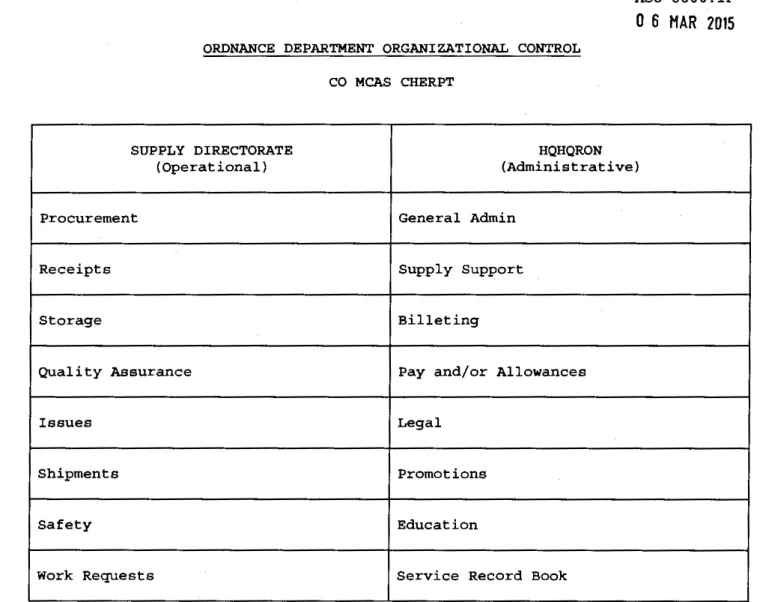
1002. Organizational Control. Control of the Ordnance Department is two-fold, administrative and operational. Figure 1-1 provides a simplified
diagram with assigned responsibilities.
1. Administration. Headquarters and Headquarters Squadron (HQHQRON) is responsible for the upkeep and accurate recording of pertinent and personal
information for all military personnel assigned to the Ordnance Department. All administrative matters are submitted via the chain of command to the
Commanding Officer (CO), HQHQRON, for appropriate action.
2. Operational. The Ordnance Department is under the direct operational
control of the Supply Directorate. Requests for A&E material go directly to
the Ordnance Department via the appropriate chain of command in accordance with the procedures outlined in this Order.
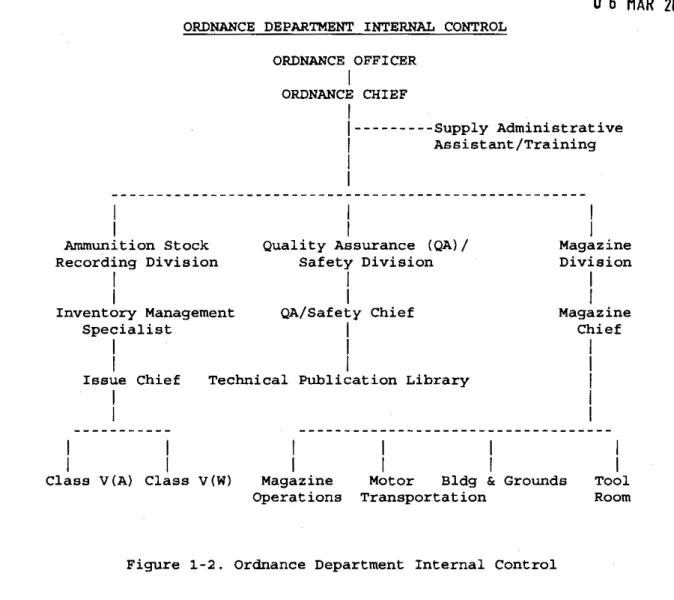
1003. Internal Control. The Ordnance Department is required to perform
several functions to provide the necessary support to requesting units. A
chain of command and delegation of authority is essential for efficient
support. Figure 1-2 provides an overview of this organizational internal
control.
ASO 8600.1F
0 6 MAR 2015
ORDNANCE DEPARTMENT ORGANIZATIONAL CONTROLCO MCAS CHERPT
SUPPLY DIRECTORATE HQHQRON
(Operational) (Administrative)
Procurement General Admin
Receipts Supply Support
Storage Billeting
Quality Assurance Pay and/or Allowances
Issues Legal
Shipments Promotions
Safety Education
Work Requests Service Record Book
.
Figure 1-1. Ordnance Department Organizational Control
ORDNANCE DEPARTMENT INTERNAL CONTROL Ammunition Stock Recording Division
I
I
Inventory Management SpecialistI
I
ORDNANCE OFFICERI
ORDNANCE CHIEFI
/---Supply Administrative / Assistant/TrainingI
I
Quality Assurance (QA)/ Safety Division
I
I
QA/Safety ChiefI
I
I
Magazine DivisionI
I
Magazine ChiefIssue Chief Technical Publication Library
I
I
I
I
I
Class V(A) Class V(W)
I
I
Magazine Operations
Motor Bldg & Grounds
Transportation
Figure 1-2. Ordnance Department Internal Control
Tool
Room
ASO 8600 .1F
0 6 MAR 2015
Chapter 2
Duties and Responsibilities
2000. General. This section outlines specific duties and responsibilities
of key personnel within the Ordnance Department.
2001.
Duties and Responsibilities
1.
Station Ordnance Officer.
The following duties are the responsibility of
the Ordnance Officer:
a.
Performs all functions within the scope of Military Occupational
Specialty (MOS) 6502.
b.
Assists the Explosive Safety Officer (ESO) in monitoring the
Explosive Safety Program and updating the Explosive Safety SOP.
c. Administers the Installation's Marine Corps Personnel Qualification
and Certification (QUAL/CERT) Program for Class V A&E for personnel engaged
in the handling and safety of A&E aboard the Installation and its outlying
areas; chairs the Installation's Class V Ammunition and Explosives Qualification and Certification Board.
d.
Assists the Manpower Military Personnel Officer in the assignment of
Ordnance Marines.
e. Advises the CO, MCAS CHERPT, in matters relating to Class
Vmaterial;
apprises the Director of Supply in matters pertaining to the functions of the
Ordnance Department; and drafts ordnance related correspondence requiring the
signature of the CO, MCAS CHERPT or the Director of Supply.
f.
Maintains current SOPs for recurring processes involving all aspects
of A&E material aboard the Installation, ensuring they are reviewed annually
for applicability.
g.
Maintains an updated Technical Publication Library (TPL) of all
applicable instructions and directives.
h. Ensures timely submission of required reports.
i. Ensures all A&E material safety, security regulations, and
precautions are disseminated, understood, and strictly enforced with immediate, corrective action to resolve identified discrepancies.
j.
Assists Facilities Development of the Facilities Directorate, in the
planning and submission of new magazine and infrastructure requirements.
k.
Monitors stored A&E material (Load Plan) to ensure on-hand quantities
support existing training (e.g., Non-Combat Expenditure Allocation (NCEA),
Fly-In Contingency Support Package, and Navy Marine Corps (NAVMC) 8011
Allowance) .
1.
Monitors existing Explosive Safety Quantity Distance (ESQD) arcs to
guard against encroachment.
m.
Serves as the MCAS CHERPT Hazards of Electromagnetic Radiation to
Ordnance (HERO) Officer.
Assists the Frequency Spectrum Manager, whose
position is aligned under the Telecommunications and Information Systems
Directorate (TISD), in updating the Emissions Control Bill, and ensures signs
reflecting hazardous areas are posted throughout the Installation.
n.
Provides supervision and prepares performance evaluations for
civilian personnel.
2.
Ordnance Chief.
The Ordnance Chief, who reports directly to the Ordnance
Officer, performs the following duties:
a. Assumes the duties and responsibilities of the Ordnance Officer in
his/her absence.
b.
Assists the ESO.
c. Assists the Ordnance Officer in the planning and submission of new
magazine and infrastructure requirements.
d.
serves as a member on the Installation's Class v Ammunition and
Explosives Qualification and Certification Board.
e.
Supervises and monitors daily ordnance handling operations.
f.
Ensures timely submission of required reports.
g. Maintains a current organizational chart.
h.
Assigns incoming personnel to their appropriate work and duty
section.
i. Plans, assigns personnel, and directs various work details and
non-routine tasks, as needed.
j. Ensures a read and initial board is established, maintained, and that
personnel are aware of posted information.
k.
Reads message traffic daily to ensure dissemination of applicable
information.
3.
Supply Administrative Assistant.
who reports directly to the Ordnance
performs the following duties:
The Supply Administrative Assistant,
Officer or the designated relief,
a.
Assists the Ordnance Officer with administering the QUAL/CERT Program
for Class v A&E; coordinates briefing sessions with applicants and dispenses
QUAL/CERT Program application packages. Ensures Ordnance Department
personnel; designated range operations personnel; Provost Marshal's Office
(PMO) personnel; and designated personnel from Visiting Aircraft Line (VAL),
Marine Transport Squadron One (VMR-1), and HQHQRON, responsible for AA&E
ASO 8600.1F
0 6 MAR 2015
safety and handling operations aboard MCAS CHERPT and outlying areas, meetand maintain qualification standards and certification training requirements
as outlined in applicable Navy and Marine Corps directives.
b. Utilizes the Advanced Skills Management (ASM) web-based system to
update and monitor completion, renewal, and expiration dates; completed
training and certifications (e.g., MOS, Professional Military Education (PME)); mandatory annual trainings, QUAL/CERT Program for Class V A&E;
medical and security screenings; licensing; etc.; for all Ordnance
Department personnel. Accesses both the ASM system and locally created
spreadsheets on a routine basis to ensure records are current and accurately
reflected.
c. Monitors Medical Surveillance and Hearing Conservation Program
requirements, Medical Examiner's Certificates (e.g., Material Handling
Equipment/Forklift Operator, Military Department of Transportation Explosives
Motor Vehicle Operator, etc.), and advises Ordnance Department personnel of
renewal dates. Generates reports for the Ordnance Officer and higher
echelons, as requested.
d. Creates and submits a weekly projected spending plan to the Ordnance Officer for approval; monitors the departmental budget to ensure funds are available; utilizes the Government Commercial Purchase Card (GCPC) or submits an open Purchase Request (PR) document to procure materials, equipment, and
services required to support ordnance operations; and serves as the Ordnance
Department point of contact (POC) for issues related to the obligation and expenditure of funds.
e. Composes, routes for signature, distributes, and files a copy of all
outgoing, non-technical correspondence; receives, routes, and files all incoming non-technical correspondence. Ensures correspondence prepared for
signature (e.g., Ordnance Officer, Director of Supply, and CO) comp~ies with Navy Correspondence Manual and Supply Directorate administrative procedures.
f. Prepares and routes technical correspondence and other documentation
(e.g., messages, memoranda, appointment letters) through appropriate channels and maintains aggregate subject matter files and records by Standard Subject
Identification Code (SSIC), chronological or numerical order, or as they
relate to special projects, specific functional areas, or programs of special interest.
g. Prepares and maintains a variety of reports and schedules (e.g.,
morning reports; budgets; Command Chronology; and physical fitness training, rifle/pistol range, and phone watch schedules). Maintains a variety of lists and documents (e.g., required reading list, hazardous control sign off
sheets, recall rosters). Updates and briefs the Ordnance Officer, Ordnance Chief, and other key personnel on all schedules and rosters.
h. Screens telephone calls and visitors to determine appropriate action;
schedules and/or reschedules appointments for the Ordnance Officer; and
schedules local conferences and/or meetings as required. Arranges all
aspects of facility support.
4. Magazine Division Chief. The Magazine Division Chief, who reports
directly to the Ordnance Officer or the designated relief, performs the
following duties:
a.
Ensures the safe receipt and shipment of A&E material entering or
departing the magazine area, respectively.
b.
serves as a member on the Installation's Class v Ammunition and
Explosives Qualification and Certification Board.
c.
Coordinates with the Inventory Management Specialist and Issue Chief
to ensure the timely and safe receipt, storage, handling, issue, and shipment
of A&E material.
d. Supervises functions of the Magazine Division, ensuring compliance
with directives governing the receipt, storage, issue, and shipment of A&E.
e.
Ensures all unloading, storing, loading, and shipping of A&E material
within the magazine area is accomplished by qualified and certified
personnel.
f.
Ensures the preparation of A&E material for shipment by air, rail,
water, or truck is accomplished in accordance with reference (k) and other
applicable Department of Transportation directives.
g.
Ensures vehicles and support equipment used in explosive evolutions
meet applicable operational safety requirements.
h. Ensures personnel assigned to perform A&E material inspections,
packaging, etc., are qualified and certified prior to assignment.
i. Reviews message traffic for action items affecting A&E material
handling requirements.
j. Ensures proper security is provided for sensitive or classified A&E
material.
5. Inventory Management Specialist.
who reports directly to the Ordnance
performs the following duties:
The Inventory Management Specialist,
Officer or the designated relief,
a.
Serves as the Ordnance Information System-Retail (OIS-R) POC.
Provides instruction to users on the OIS-R web-based system (e.g., obtaining
access, processing data, file accessing and search strategies, database
security, testing techniques, etc.).
b. Inputs receipt and issue documents into OIS-R, as required. Operates
OIS-R related equipment and resolves issues with access or connectivity.
c. Directs and supervises operation of the Ammunition Stock Recording
Division to document and process the receipt, storage, transfer,
replenishment, disposition, and issue of AA&E material held within the
0 6 MAR 2015
or turn-ins) of AA&E material through proper documentation between authorized users.
d. Assists the Magazine Division with administrative functions related
to the receipt, storage, inventory, issue, and shipment of A&E material.
e. Ensures adequate quantities of A&E material are on hand, or on order,
to support applicable training allowances. Submits requisitions to replenish
stock.
f.
Ensures submission of operational reports and messages
{e.g.,
Ammunition Transaction Reports, Transaction Item Reports, and Supply
Requisition Status Messages) .
g.
Ensures compliance with applicable directives when A&E material is
received at, or issued from, MCAS CHERPT. Ensures ammunition records are
maintained in accordance with current applicable instructions.
h.
Liaises between the Ordnance Department and the DLA Distribution
CHERPT Shipping Office.
i. Serves as the Military Munitions Rule (MMR) Coordinator.
6.
Issue Chief.
The Issue Chief, who reports directly to the Ordnance
Officer or the designated relief, performs the following duties:
a.
Serves as the Assistant OIS-R POC.
Provides instruction to users on
the OIS-R web-based system {e.g., obtaining access, processing data, file
accessing, search strategies, database security, testing techniques).
b. Inputs receipt and issue documents into OIS-R, as required. Assists
the OIS-R POC in resolving issues with OIS-R access or connectivity.
c. Serves as a member on the Class V Ammunition and Explosives
Qualification and Certification Board.
d. Assists the Inventory Management Specialist with administrative
functions related to the receipt, storage, inventory, issue, and shipment of A&E material.
e. Ensures ammunition records are maintained in accordance with current
applicable instructions.
f. Ensures adequate quantities of A&E material are on hand, or on order,
to support applicable training allowances.
g. Ensures accountability for transfer (e.g., requests, issues, or
turn-ins) of A&E material through proper documentation between aUthorized users.
h.
Ensures accurate information for the requisition of replenishment
stock is provided to the Inventory Management Specialist.
i. Ensures A&E material is correctly identified by lot, serial number,
and Material Condition Code in accordance with applicable directives.
j. Prepares documentation to effect disposition of unserviceable and/or
obsolete Class V ordnance through Explosive Ordnance Disposal (EOD), DLA
Disposition Services, or off-station ordnance shipments to include A&E
material is handled under the MMR governing munitions as hazardous material and/or hazardous waste.
7. Quality Assurance(QA)/Safety Chief. The QA/Safety Chief, who reports directly to the Ordnance Officer or the designated relief, performs the following duties:
a. Assumes the duties and responsibilities of the Ordnance Chief in
his/her absence.
b. Ensures compliance with all applicable safety procedures and
precautions.
c. Serves as a member on the Class V Ammunition and Explosives
Qualification and Certification Board.
d. Ensures safe operating procedures are followed.
e. Certifies all monthly magazine inspections, both host and tenants,
for compliance with Net Explosive Weight (NEW) limitations, storage
compatibility constraints, and other applicable storage directives, and ensures all noted discrepancies are reported and corrected immediately.
f. Establishes and maintains a current TPL in support of AA&E material
operations.
g. Observes personnel to ensure compliance with authorized procedures
and safe handling practices; monitors compliance with QUAL/CERT Program
requirements.
h. Conducts Type 1 Hazard Control briefings for Ordnance Department
personnel; Facilities Maintenance, Facilities Directorate personnel; and
contractor personnel on an as needed basis.
i. Establishes and maintains the process of on and off- station A&E
material shipment certification, to include the certification of "empty" containers prior to shipment.
j. Establishes and monitors a read and initial board for information
relevant to the safety, morale, and welfare of personnel.
k. Inspects magazines to ensure compliance with A&E material storage
ASO 8600.1F
0 6 MAR 2015
Chapter 3Safety
3000. General. A&E devices are designed and manufactured for many purposes.
Explosive actuated devices assist in extinguishing aircraft engine fires; rocket motors propel aviators from crippled aircraft; demolition charges clear paths for new construction; and some material is designed for the sole
purpose of applying destructive force. It is rare that an individual can
mishandle explosive material Without consequence. It is imperative that the
knowledge obtained from the mistakes of others, safety precautions, notes,
and warnings outlined in the references and this Order are strictly observed and applied.
3001. Ordnance Safety In-Briefs
1. Background. Constant rotation of commands between ship and shore deployments has heightened the Air Station's awareness of the need to keep
these rotating commands abreast of the ever-changing requirements involving
A&E material handling ashore. To assist in highlighting the differences between these operational environments, the ESO, aligned under the Safety and Standardization Directorate, has developed A&E material safety briefs.
2. Requirements. Returning tenant-based commands deployed longer than four
months, and transient commands coming aboard the Air Station to conduct A&E
material exercises, are required to attend and complete these safety briefs. a. Safety Brief
(1) Contact the ESO at 252-466-3994 to schedule briefs. Personnel involved in A&E material evolutions must attend. Requests for A&E material will not be processed until this brief is completed and recorded by the ESO.
(2) All Station/tenant-based command safety briefs are given in the
respective units' locations.
(3) Transient command safety briefs are given in an area determined
by the host unit.
(4) Commands may request this brief in support of their annual safety
training requirements.
(5) Safety Brief OVerview (a) CO's Brief
(b) EOD Procedures
(c) Ready Service Locker (RSL) Inspection Check-in and Check-out
Procedures
(d) Fuel Pit Requirements
(e) Explosive Driver Requirements
A&E.
(f) Explosive Material Transportation Requirements
(g) Ordnance Vehicle Check-in and Check-out Procedures (h) Authorized Loading Areas
1 Loading and Unloading 2 Arming and De-arming
(i) Aircraft Gun and Chaff Buildup Areas (j) HERO Requirements
(k) Weather Conditions and Prohibited Operations
(1) Ordnance Requisition and Turn-in Procedures
(m) Personnel Qualification and Certification Program for Class V
b. Requisition/Receipt Brief. An additional Requisition/Receipt Brief
is required at the Ordnance Department prior to issuing A&E material to any requesting unit.
3002. Ammunition and Explosives Material Incidents
1. Accident. A&E material accidents are reported per reference (a) for
Class V(W) material and per references (a) and (b) for Class V(A) material. 2. Missing, Lost, Stolen, and/or Recovered (MLSR). Missing, lost, stolen, and/or recovered A&E material is reported per chapter 10 of reference (c) .
Appropriate personnel must take the necessary corrective action within 48 hours of becoming cognizant of the incident.
3. Personal Injury. P~rsonal injury or death resulting from an A&E material
incident is reported per. reference {a).
4. Fire. Ammunition and explosives material exposed to fire is reported per
chapter 7 and Appendices B and C of reference (d) .
3003. Use of Service Ammunition for Operational Training. To reduce hazards
to personnel and potential damage to material, service ammunition is not used for operational training (e.g., MOS training, contingency or embarkation
ASO 8600.1F
0 6 MAR 2015
Chapter 4
security
4000.
General.
Commanding Officers are responsible for the physical
security of AA&E material within their respective commands.
Items of major
concern are those that are man-portable and those used for law enforcement,
making them more vulnerable to theft or terrorist purposes. Some examples
include, but are not limited to, the following: small arms ammunition, hand
grenades, hand operated pyrotechnics, bulk explosives, blasting caps, and
initiating devices.
4001.
Command Security.
The Provost Marshal is the designated
representative for the CO, and, as such, is responsible for the planning, implementation, enforcement, and supervision of command A&E material security.
4002. Access. Units requiring access to the Magazine Area and/or the Ready
Area, building
1200,must submit an Access Roster, Appendix A, listing
personnel authorized to receive A&E material. In addition to name and rank,
the individual's Electronic Data Interchange Personal Identifier (EDIPI) must
be included, which is located on the back of the Common Access Card (CAC) .
The roster must be updated quarterly or as changes in personnel occur. Visitors whose names do not appear on an Access Roster (e.g., contractors,
maintenance personnel), are issued visitor badges by the Ordnance Department,
which are worn at all times while in the Ordnance Department compound.
Badges must be returned to the Ordnance Department prior to leaving.
All
personnel must check-in at building
4810prior to entry and prior to their
departure.
4003. Vehicular Movement. All vehicular movement within the ordnance
compound is restricted to government or authorized contractor-owned vehicles.
Authorized contractor vehicles are only those vehicles that are either
company owned, rented, or leased.
The use of privately owned vehicles within
the ordnance compound is strictly prohibited.
4004.
Security of Storage Areas.
All areas where A&E material is stored
(magazine or open-site) are afforded the degree of security required for the
highest category of A&E material present. Security checks and measures are
coordinated per reference (c) .
Chapter 5
Requisition, Issue, and Turn-In
5000. General. Class V(A) and Class V(W) A&E material, whether explosive or inert, must be tracked and reported to higher headquarters. The Ordnance Information System- Wholesale (OIS-W), established to ensure the accurate reporting of both expendable and reusable Class V material, demands strict
compliance with the instructions outlined in this chapter and, as such, is
mandatory for all units requisitioning and/or turning-in A&E material. 5001. Allowances. Class V(A) and Class V(W) A&E material are not issued unless an organization is authorized to expend the material. Allowances to expend A&E material are obtained from, and approved by, higher headquarters. Two specific types of allowances used aboard MCAS CHERPT are the NCEA for Class V(A) material and the NAVMC 8011 Allowance for Class V(W) material for training, programmed testing, and security. Requisitions by 2d MAW units for Class V(A) material not specifically identified on their allowance list are submitted to the CG, 2d MAW (ALD-D); requisitions by 2d MAW units for Class V(W) material not specifically identified on their allowance list are
submitted to the CG, 2d MAW, G-4 Infantry Weapons Coordinator (IWC); and
requisitions from Station units for Class V material not specifically
identified on the unit's allowance list are submitted to the Class V(W)
Manager for Station.
5002. Responsibilities
1. Requisitioning Unit
a. Delegation of Authority. Submit a Delegation of Authority, Appendix B, signed by the
co
or personnel granted •sy direction• authority, to the Ordnance Department as specified in this Order. In addition to name and rank, the individual's EDIPI must be included, which is located on the back of the CAC.b. Signatures on Documents. Ensure requisitions, receipts, and turn-in
documents are signed by the authorized, delegated person in accordance with
the applicable instructions provided in paragraphs 5003 through 5008 of this chapter.
c. Delivery Times and Dates. Cite a valid date and required time of
delivery on each requisition.
d. Transportation Requirements. Ensure vehicles and personnel used to transport A&E material meet the criteria outlined in this Order and
applicable references.
e. Turn-Ins.
Department meets
references.
Ensure all Class V material being returned to the Ordnance the criteria outlined in this Order and applicable
f. Submission of Requests. Submit all requests with a lead-time sufficient for processing the request to meet the operational requirements for the material. Lead-times are defined in paragraph 5003.3 of this
ASO 8600.1F
0 6 MAR 2015
chapter. Information regarding forms to be used to request Class V material
is provided in paragraph 5003.4.
g.
Class V(A) Quarterly Requirements.
Submit Class V(A) quarterly
requirements for projected training to be conducted during each quarter.
Format the letter as per Appendix C and submit requirements by the lOth day
of July for the period of October through December; the lOth day of October
for the period of January through March; lOth day of January for the period
of April through June; and the lOth day of April for the period of July
through September.
h.
Class V(W) Quarterly Requirements.
Submit Class V(W) quarterly
requirements for expected training to be conducted during each quarter.
Format the letter as per Appendix D and submit requirements by the lOth day
of July for the period of October through December; the lOth day of October
for the period of January through March; lOth day of January for the period
of April through June; and the lOth day of April for the period of July
through September.
2.
Ordnance Department
a. Requisitions. Ensure requested material is made available by the
required delivery date and time as indicated on the requisition.
b.
Signatures.
Verify requisitions are generated by authorized
personnel, as identified by the requisitioning unit's Delegation of Authority
submitted to the Ordnance Department in accordance with paragraph 5002.l.a.
of this chapter. Appendix B provides the format for the Delegation of
Authority letter. The authorized individual, whose signature appears on the
requisition, cannot sign for the receipt of the requisitioned items.
c.
Authorized Personnel.
Ensure only authorized, delegated personnel
request, receive, and turn-in Class V material.
d. Transporting Explosive Material.
explosive Class V material is transported provided in the references.
Ensure all outgoing or incoming in accordance with the guidance
e. Turn-Ins. Ensure incoming Class V material meets the criteria
outlined in this Order and applicable references.
f.
OIS-W Reporting.
Ensure the submission of all transactions involving
Class V material is timely and in accordance with OIS-W guidelines.
g.
Authorized Allowances.
Ensure all Class V material authorized by a
specific allowance list is either available for issue or pending status as to
availability of asset.
5003. Requisitioning Procedures. A requisition must be presented to the
Ordnance Department before material is issued to the requesting unit.
CUstomers must adhere to the following when requisitioning Class V material:
1.
Delegation of Authority/Explosive Safety" Officer Assignment Letter.
Prior to the issue of any Class V material, the CO or Officer in Charge of a
requisitioning unit must submit a Delegation of Authority letter, Appendix B, to the Ordnance Department via their appropriate chain of command. The
Delegation of Authority letter must be in the possession of the Ordnance
Department prior to any issue of Class V material. As specified in
references (g) and (h), all unit commands that requisition, receipt, handle, store, or transport A&E shall designate a responsible Explosive Safety
Representative to conduct all applicable aspects of the unit explosive safety program and serve on the Explosive Safety council. It is the sole
responsibility of the requisitioning unit to keep delegation letters current to avoid
mission
delays resulting from unauthorized personnel attempting to receive the' requisitioned material. A copy of the letter designating the responsible Explosive safety Representative shall be forwarded to the Installation ESQ.2. Personnel. Class V A&E material is issued from the magazine by Ordnance Department personnel only and then turned over to a unit's authorized
delegated individual outside the magazine.
3. Lead-Time. Lead times are established to provide sufficient time for processing requisitions so that requested material can be issued to the
requisitioning unit to ensure mission requirements are completed on schedule.
There are three types of lead-time allowed and they are administered as follows:
a. Routine. Allow a two working day lead-time to process routine
requisitions for Class V material.
b. Special. Allow a one working day lead-time to process requisitions for Class V material when the need exists for a 2d MAW validated requirement. Requirements must be validated by the CG, 2d MAW (ALD-D or G-4) prior to the
requested issue.
c. Emergency. Issues from on-hand stock are made immediately upon
receipt of the requisition. All bona fide emergencies must be substantiated,
in advance of material issue, by either the CG, 2d MAW (ALD-D or G-4 IWC), or by the Marine Aviation Logistics Squadron (MALS) Ordnance/Maintenance
Officer.
4. Requisition Form. A Multiuse Standard Requisitioning/Issue System Document (SF 344) is utilized to request Class V material. Instructions on completing the SF 344 and a sample form are provided per Appendix E. Type all routine' requisitions to prevent misinterpretation of the data elements. Print emergency requisitions legibly. Additionally, a Military Standard
Requisitioning and Issue Procedures (MILSTRIP) requisition, sent via email by
the authorized requestor, may be utilized.
5. Requisition Cancellation. Units must promptly cancel outstanding
requisitions for Class V material when the requirement no longer exists.
Requisition~ not accepted at the specified delivery time are cancelled unless
prior arrangements are made with the Ordnance Officer or Ordnance Chief.
6. Pre-staging. Units requiring after-hours pickup must ensure the A&E
material is loaded on their vehicles on the last working day prior to the
ASO 8600.1F
0 6 MAR 2015
in
the Ready Area, building 1200.
After-hours access to the Ready Area
isobtained via the PMO.
7. Emergency Issues. Issues are made immediately upon receipt of the SF
344, Appendix E. All emergencies must be substantiated, in advance of
material issue, by either the CG, 2d MAW (ALD-D or G-4 IWC), or by the MALS
Ordnance/Maintenance Officer.
Print all requests legibly to prevent
misinterpretation. Additionally, a MILSTRIP requisition, sent via email by
the authorized requestor, may be utilized.
8.
Transport Vehicles.
Prior to all issues of Class V AA&E material
requiring transport, the vehicle must meet the safety and inspection criteria
established in this Order and applicable references.
Vehicles that are
inviolation of these requirements will not be loaded.
Vehicles must be
operated by qualified and certified explosives drivers, be properly
placarded, and have an onboard safety observer when towing trailers.
Personnel who transport up round ordnance on trailers are required to be
supervised by a qualified and certified team leader (TL) or above
inaddition
to having an ~A" Driver who must occupy a seat in the cargo compartment as
specified in reference (i).
In both cases, the driver must possess an
Optional Form (OF) 346 for the vehicle being utilized, be designated on the
OF 346 as an EXPLOSIVE DRIVER and MUST HOLD A CURRENT MEDICAL CERTIFICATE ON
THEIR PERSON.
9.
Hours of Operation.
Routine issues are processed Monday through Friday
from 0730 to 1130.
Emergency issues are processed as they occur.
Emergency
requisitions consist of an urgent or critical requirement for an explosive
device to meet a flight schedule. No issues are made during times when
lightning is within 10 miles of the Air Station; however, requisitions are
accepted.
5004.
Requisitioning Class V(A) Material
1.
Requisitioning Unit.
The originator of the requisition retains one copy
of the document for recording purposes.
The remaining copies of the
requisition are submitted to the Ordnance Department, Ammunition Stock
Recording Division, building 4810.
It is the requesting unit's
responsibility to notify the Ordnance Department of any off-station
transportation requirements to ensure proper planning.
Failure to do so may
cause unnecessary delays in the receipt of material needed to support that
unit's mission.
2. Ammunition Stock Recording Division. Upon receipt of the requisition,
the Aviation Ordnance Systems Technician performs the following:
a.
Checks the requisitioning unit's Delegation of Authority letter to
verify the requisition is signed by an authorized requisitioner.
Rejects the
requisition if the signature on the requisition is not on the Delegation of
Authority letter.
of
is
b.
Checks the requisition for
issue, and requisiti9ner code. incomplete or incorrect.
the required delivery date and time, unit
Rejects the requisition if the information
c. Annotates the requisition with the date and time to attest
information on the requisition is correct.
d. Checks the quantity reque·sted against the unobligated quantity shown in OIS-R. If the requested quantity does not exist, the amount required to fill the requisition plus additional quantities required to maintain the high, on-hand quantity (as determined by the Load Plan) are ordered.
e. Reserves the requested item and generates a Shipment Preparation
Worksheet (SPW) for use by the Magazine Divi$ion to prepare the issue.
f. Prints the OIS-R generated Issue Release/Receipt Document (DD Form
1348-lA), Appendix F, upon completion, and returns the SPW.
g. Posts the DD Form 1348-1A issue document and the applicable SPW on the issue board.
3. Magazine Division. Prior to issue, the Magazine Division conducts an
inventory of the requisitioned material. If discrepancies are found, the
Issue Chief is notified immediately. Upon confirmation of correct
quantities, barcodes are changed instantly to reflect the correct, on-hand balance. The Magazine Division personnel sign and date the DD Form 1348-1A in block 28, Issued By, and block 32, Inspected By.
5005. Requisitioning Class V(W) Material 1. MCAS CHERPT Units other than 2d MAW
a. Requisitioning Unit. The originator of the requisition retains one
copy of the document for recording purposes. The remaining copies of the
requisition are submitted to the Ordnance Department, Ammunition Stock
Recording Division, building 4810. It is the requisitioning unit's
responsibility to notify the Ordnance Department of any transportation
requirements to ensure proper planning. Failure to do so may cause
unnecessary delays in the receipt of material needed to support that unit's
mission.
b. Ammunition Stock Recording Division. Upon receipt of the
requisition, the Aviation Ordnance Systems Technician performs the following: (1) Checks the requisitioning unit's.Delegation of Authority letter to verify the requisition is signed by an authorized requisitioner. Rejects the requisition if the signature on the requisition is not on the Delegation of Authority letter.
(2) Checks the requisition for the required delivery date and time,
unit of issue, and requisitioner code. Rejects the requisition i f the
information is incomplete or incorrect.
(3) Annotates the requisition with the date and time to attest
information on the requisition is correct.
(4) Checks the quantity requested against the unobligated quantity shown in OIS-R. If the requested quantity does not exist, the amount
ASO 86.Q0
1
.ll'0 6 l1AK
Ul~required to fill the requisition plus additional quantities required to maintain the high, on-hand quantity (as determined by the Load Plan) are ordered.
(5") Enters the requisition into the Total Ammunition Management Information System (TAMIS) .
(6) Reserves the requested item and generates a SPW for use by the
Magazine Division to prepare the issue.
(7) Generates an OIS-R DD Form 1348-1A issue document upon completion and returns the SPW. If Notices of Ammunition Reclassification (NAR),
Ammunition Information Notices (AIN), and/or Overhead Fire (OHF) restrictions
are applicable to the requested item, the Aviation Ordnance Systems
Technician initials the DD Form 1348-1A in block 28, Issued By, and stamps the back page for future use by the Magazine Division personnel.
(8) Posts the DD Form 1348-1A issue document and the applicable SPW on the issue board.
c. Magazine Division. Prior to issue, the Magazine Division conducts an
inventory on the requisitioned material. If discrepancies are found, the
Issue Chief' is notified immediately. Upon confirmation of correct
quantities, barcodes are changed instantly to reflect the correct, on-hand balance. Magazine Division personnel initial and date the back of the DD Form 1348-lA.
2. 2d MAW Units
a. Requisitioning Unit. The originator of the requisition retains one
copy of the document for recording purposes. The remaining copies of the
requisition are submitted to the 2d MAW (G-4.IWC) for processing in TAMIS. When finished, the requisition is initialed and stamped by the 2d MAW (G-4 IWC) then submitted to the Ordnance Department, Ammunition Stock Recording
Division, building 4810. It is the requisitioning unit's responsibility to
notify the Ordnance Department of any off-station transportation requirements
to ensure proper planning. Failure to do so may cause unnecessary delays in the receipt" of material needed to support that unit's mission.
b. Ammunition Stock Recording Division.- Upon receipt of the TAMIS or
Security/Force Protection requisition, the Aviation Ordnance Systems
Technician performs the following:
(1) Checks the requisition for the required delivery date time, and requisitioner code. Contacts the 2d MAW (G-4 IWC) for clarification if
required information is incomplete or incorrect.
(2) Checks the quantity requested against the unobligated quantity shown in OIS-R. If the requested quantity does not exist, the amount required to fill the requisition plus additional quantities required to maintain the high, on-hand quantity (as determined by the Load Plan) are ordered.
(3) Enters the transaction into the TAMIS and forwards to the applicable clerk for processing.
(4) Reserves the requested item and generates a SPW for use by the
Magazine Division to prepare the issue.
(5) Generates an OIS-R DD Form 1348-1A issue document. If NAR, AIN, and/or OHF restrictions are applicable to the requested item, the Aviation Ordnance Systems Technician initials block 28, Issued By, of the DD Form 1348-1A and stamps the back page for future use by the Magazine Division
personnel.
(6) Posts the DD Form 1348-1A issue document and applicable SPW on the issue board.
c. Prior to issue, the Magazine Division conducts an inventory on the
requisitioned material. If discrepancies are found, the Issue Chief is notified immediately. Upon confirmation of correct quantities, barcodes are changed instantly to reflect the correct on-hand balance. Magazine Division personnel sign and date the back of the DD Form 1348-1A.
3. Units training at other installations such as Marine Corps Base, Camp
Lejeune, submit requisitions for A&E material to that installation's Ammunition Supply Point (ASP) .
5006. Requisitioning Cartridge Actuated Devices and Propellant Actuated
Devices. Cartridge Actuated Device (CAD) and Propellant Actuated Device
(PAD), components in aircraft ejection seats, aircraft canopy jettison systems, and fire suppression systems, are manufactured in limited numbers
due to their limited service life. CAD and PAD material are not stocked in
quantity by either the Ordnance Department or the using activity.
Requisitions are usually processed as a one-for-one replacement.
1. The Fleet Readiness Center-East (FRC-East), VMR-1, and Marine Aircraft Group (MAG)-14 units requisition CAD and PAD material via the Virtual Fleet Support (VFS) web-based application. The requisitioning unit is responsible for tracking their orders using the VFS Order Confirmation Number or the Federal Express (FedEx) tracking number. CAD and PAD material are shipped directly to the requisitioning unit. In the event that the requisitioning unit is unable to receive the material, the Ordnance Department is the
default point of delivery. In such situations, the Ordnance Department does
not open packages unless there is obvious damage.
2. The FRC-East and VMR-1 must forward a copy of the requisition and FedEx receipt to the Ordnance Department's Ammunition Stock Recording Division for
processing. After processing, the Ordnance Department contacts the unit to
schedule the issue. Issues are accomplished within one working day for
priority requisitions and two working days for routine. The requisition and
FedEx receipts are maintained by the Ordnance Department, Ammunition Stock Recording Division.
3. The MAG-14 units must forward a copy of the requisition and FedEx receipt to the MALS-14 Aviation Ordnance Department vice the Station Ordnance
ASO 8600.1F
0 6 MAR 2015
processing, MALS-14 contacts the appropriate MAG-14 unit to schedule theissue.
4. The requisitioner is responsible for initiating discrepancy reports for
discrepant material received (e.g., damaged, wrong item, quantity mismatch). CAD and PAD replacements are ordered by the requisitioner via VFS. The requisitioner must notify the Station Ordnance Department or MALS-14 to
initiate OIS-R reporting for inventory tracking purposes.
5. The requisitioner is responsible for initiating immediate or emergency
replacement requests via the VFS system for a CAD or PAD that has been
depleted (e.g., damage from maintenance, damage discovered upon issue,
accidental or in-flight expenditure) .
5007. Turn-In Procedures. There is no limit on the number of turn-in documents or item quantities which may be returned by a unit. Items of the same Navy Ammunition Logistics Code (NALC), National Item Identification Number (NIIN), and Material Condition Code are turned-in on the same DD Form 1348-1A, as identified in Appendix F. All Class V A&E material, submitted for turn-in, must be properly packaged and marked in the prescribed shipping
container. Correctly identifying Class V A&E material and its serviceability
condition is crucial. Every effort should be made to reuse the original
packaging per the applicable references.
1. Hours of Operation. Routine turn-ins of Class V A&E material are
processed Monday through Friday from 0730 to 1130. Exceptions must be
approved by the Ordnance Officer or Ordnance Chief. Emergency turn-ins are
processed as they occur such as explosive devices removed from an aircraft
scheduled for rework. Turn-ins are not accepted during times when lightning
is within 10 miles of the Air Station.
2. CAD and PAD. ADD Form 1348-1A is completed per Appendix F and must accompany the CAD or PAD in its shipping container along with the proper shipping caps or other dunnage. Containers must be properly marked with the
opened date, installed date, expiration date, lot and serial number, NSN,
NALC, Mark/Modification/Model (MK/MOD), Material Condition Code, and applicable aircraft Bureau Number .(BUNO) to be accepted for turn-in.
3. Ammunition Details. The term •ammunition details" refers to those inert
accessories used in packaging, protecting, and handling A&E material.
Pallets must be stacked and banded per the appropriate MIL-STD. Containers are inspected; the old markings obliterated and then re-marked "EMPTY" in accordance with reference (g).
4. Ammunition, Explosives, and other Dangerous Articles (AEDA) Residue
Inspection and Certification. Generating units must ensure that all AEDA and
ammunition details are properly inspected to determine the presence or absence of explosive hazards prior to turn-in to the Ordnance Department or
referral to Defense Logistics Agency (DLA) Disposition services. The
inspection of AEDA and ammunition details for residue is performed by
qualified and certified inspectors or other technically qualified personnel designated by the unit's CO.
a. Units must submit to the Ordnance Department the Inert Certification
Letter, Appendix G, designating certified personnel authorized to verify AEDA
and ammunition details for residue prior to turn-in to the Ordnance
Department br referral to DLA Disposition Services. Personnel certifying and
verifying the inspection must submit a DD Form 1348-lA, disposal turn-in document, with the following statement in block 27 as shown on page 4 of
Appendix F:
•This certifies and verifies the Ammunitions, Explosives, and Dangerous Articles (AEDA) residue, range residue, and/or Explosive or Contaminated
Property (ECP) listed have been 100-percent properly inspected by us and, to the best of' our knowledge and belief, are inert and/or free of explosives or
other dangerous materials.• ·
b. Inert certifications require dual signatures. The first signature
(certifier) may be either qualified DoD or qualified contractor personneL The second signature (verifier) must be a technically qualified DoD personnel and a United States citizen who has special knowledge of the characteristics
and requirements relating to the items to be certified in accordance with the
QUAL/CERT Program for Class V A&E.
c. If culpability is determined, certifiers and verifiers are held
accountable for fraudulent certifications and violations.
d. On the DD Form 1348-1A, Appendix F, certification and verification signatures must be directly above the respective typed, clearly stamped, or legibly printed full name, along with rank/rate, complete organization name and address, and both the commercial and Defense Switched Network (DSN) telephone numbers.
5. Transient Ammunition or Components. Units turning-in ammunition or
components from transient aircraft or units must prepare the material for
turn-in as required above. The Ordnance Department enters the ammunition
into stock or requests disposition, whichever is appropriate.
6. Damaged or Malfunctioned A&E Material. A Conventional Ordnance
Discrepancy Report (COOR) is submitted via the deficiency reporting website, All Weapons Information System, https://awis.navair.navy.mil/awis/index.asp, on any items that are damaged or do not function as designed and are returned to the Ordnance Department for disposition. If the CODR contains classified
information, or if there is no internet access, a naval message is forwarded
per reference (b) . The damaged or malfunctioned A&E stock is maintained
until dispoSition instructions are received ..
5008. Reclassification and Disposition. 11Reclassification,n as used in this
Order, refers to a change of an item's Material Condition Code. Reference
(e), contains a comprehensive listing of explosive material declared to be
unsuitable for unrestricted use as originally designed.
1. NAR. NAR's are distributed in message format to disseminate information
related to the safety of personnel and equipment. Individual messages are
ASO 8600.1F
0 6 MAR 2015
2. Responsibilities. Upon receipt of a NAR, the Ordnance Department is
responsible. for the following:
a. Determining if stock on-hand or issued A&E material includes any of
the affected lots or types.
b.
Taking immediate action to ensure the use or issue of the affected
stock is consistent with the newly assigned Material Condition Code.
c.
Repprting items affected by the reclassification action via Naval
message to the appropriate item manager, higher headquarters, and all tenant
units that may be affected.
3. Files. A NAR file is maintained to track incoming NAR messages providing
a readily available means of cross-referencing.
4. Disposition. Periodically, A&E material maintained by the Ordnance
Department falls into one of the following categories:
a.
Suspended.
If already issued, the stock is immediately recalled.
On-hand stock is identified and marked to prevent further issue.
The
suspended stock is maintained until disposition instructions are received.
b.
Restricted.
Restrictions are evaluated to determine applicability to
current stock.
Affected stock may be recalled until the restriction is
rescinded or the stock is modified. On-hand stock is identified and marked
to prevent further issue. The restricted stOck is maintained until
disposition instructions are received.
c.
Unserviceable.
unserviceability occurs when an item does not meet
the criteria for which it was originally designed.
If already issued, the
affected stock is immediately recalled. On-hand stock is identified and
marked to prevent further issue.
The unserviceable stock is maintained until
disposition· instructions are received. unse~iceable stock deemed or
determined to be unsuitable or unsafe for storage by an authorized EOD
representative is turned-in for disposal.
Chapter 6
Class V(W) Reporting Requirements
6000. General. The purpose of this chapter is to establish the reporting requirements for all Class V(W) ammunition issued or expended by units aboard MCAS CHERPT. Possession of Class V(W) material is not to be considered
permission to expend beyond the unit's authorized allowance.
6001. Responsibilities
l.. MCAS CHERPT Class V(W) Using Unit
a. Requisitions. Each requisition is submitted to the Ordnance
Department for processing in TAMIS.
b. Expenditure Reports. Each unit submits weekly expenditure reports
for Class V(W) ammunition under their cognizance to the Ordnance Department
for reconciliation.
c. Inventory of Stored Ammunition. Monthly inventories of all Class
V(W) ammunition are conducted by Ordnance Department personnel and a Class V(W) using unit representative. Authorized personnel escort the inventory
team through all RSLs, sub-custody magazines, and other secured ammunition locations assigned to the unit.
2. Class V(W) Procedures
a. Requisitions. All requisitions for Class V(W) material must follow the procedures outlined in chapter 5 of this Order and meet the guidelines in
reference· (f). Each requisition is screened for authorized signatures,
allowances, and remaining balances. Accepted requisitions are forwarded for
further processing.
b. Expenditure Reports. Each expenditure report received is screened
both for quantities and authorized allowances for each Department of Defense Identification Code (DoDIC) . Discrepancies in quantities, lot numbers, or
quantity on-hand must be reconciled by the Ordnance Department and the Class
V(W) using unit representative prior to processing.
c. Inventory of Stored Ammunition. Coordination and execution of the
monthly inventory is made by the Ordnance Department. A qualified unit
representative must be present for the inventory. The Ordnance Department
prepares a written inventory report, provides a copy to the unit
representative, and maintains the original for the Ordnance Department's records.
Chapter 7
Storage and Handling
ASO 8600.1F
0 6 MAR 2015
7000. General. The safe storage of A&E material at all Marine Corps shore
units, including MCAS CHERPT and its outlying fields, is under the cognizance
of the Commander, Marine Corps Systems Command (COMMARCORSYSCOM) Program
Manager for Ammunition (PMAM), as delegated by reference (g).
At a minimum,
the CO, MCAS CHERPT must review all storage authority requests on an annual
basis.
Requests for storage are granted only for those types and quantities
required to meet security force and safety requirements, and must be
submitted to the ESO for review and approval.
Copies of all approved
requests are provided to the COMMARCORSYSCOM PMAM.
This chapter provides
guidance for all units aboard MCAS CHERPT storing and handling A&E material,
and as such, the ESO strictly monitors all requirements stated herein for
compliance.
References (h) and (i) provide definitive technical direction
and procedures for the receipt, storage, handling, issue, shipment, and
explosive safety requirements of Class
VA&E material.
7001.
Types of Storage.
Three types of storage are approved for A&E
material:
1. Magazine Storage. This type of storage is used when A&E material is not
expected to be moved within a 72 hour or greater period of time.
Structures
used for this type of storage must maximize protection from·the elements of
nature, loss, compromise, or sabotage. The Department of Defense Explosive
Safety Board (DDESB) and Naval Sea Systems Command approved magazines within
the Ordnance compound and building 1224 (MALS-14 Ordnance) are the only
approved locations for this type of storage at MCAS CHERPT.
All magazines
and magazine areas are under the cognizance of the Ordnance Officer and are
administered and maintained as outlined below:
a. When personnel are working in a magazine or explosive assembly area,
a red (Bravo) flag is prominently displayed (hoisted) near the entrance.
b. When personnel are working inside a magazine, the magazine doors must
remain open, the lock secured to door hasp, a cleared exit maintained, and the keys in possession of authorized personnel.
c. When a magazine is unsecured, the two-man rule applies in the
interest of personnel safety and the security and accountability of A&E material.
d.
Working personnel must adhere to the minimum number required to
perform the operation safely and properly.
e. Appropriate chemical hazard and fire division symbols must be posted
to denote contents of all A&E material storage sites. Storage sites must
display a placard labeled "EMPTY" when no A&E material is present.
Inert
storage areas must display a placard to identify this category.
All
additional posting requirements are adhered to in accordance with applicable references.
f. When not in possession of authorized personnel, or in use, magazine
keys to Category I and II A&E material must be secured in a Class V General
Services Administration (GSA) approved security container or equivalent and
located within a restricted area. Equivalent is defined