CHAPTER 2
THE RIGHT OF ACCESS TO ADEQUATE HOUSING 1. INTRODUCTION
The right to adequate housing as one of the most important of all basic human rights is recognised in a number of international human rights instruments and treaties.1 Shelter from the elements; a place to eat; sleep; relax and raise a family are some of the basic things people need for survival. Section 26(1) of the Constitution provides that everyone shall have the right of access to adequate housing. Accessibility means that the State must create conducive conditions for all its citizens, irrespective of their economic status, to access affordable housing. Section 26(3) of the Constitution prohibits evictions of persons from their homes and the demolition of their homes without a court order. A court of law ordering such eviction or demolition must do so after taking into account all relevant factors. Legislation permitting arbitrary evictions is also prohibited by the same provision.
In Government of the Republic of South Africa v Grootboom the Constitutional Court interpreted the right to have access to adequate housing as follows:
Housing entails more than bricks and mortar. It requires available land, appropriate services such as the provision of water and the removal of sewage and the financing of all these, including the building of the house itself. For a person to have access to adequate housing all of these conditions need to be met: there must be land, there must be services, and there must be a dwelling. The right of access to adequate housing also suggests that it is not only the State that is responsible for the provision of houses, but that other agents within society, including individuals themselves, must be enabled by legislative and other measures to provide housing2
1
Universal Declaration of Human Rights, 1948, Art 25; European Convention on Human Rights and Fundamental Freedoms, 1950, Art 8(1); International Convention relating to the status of Refugees, 1951, Art 21; European Social Charter, 1961, Art 16, 19(4) and Art 4 of Additional Protocol; International Covenant on Economic, Social and Cultural Rights, 1966, Art 11; International Convention on the Elimination of All forms of Racial Discrimination, 1966, Art 5(e)(iii); International Convention on the Suppression and Punishment of the Crime of Apartheid, 1973, Art 11(b) and (d); International Convention on the Elimination of All Forms of Discrimination against Women , 1979, Art 14(2)(h); International Convention on the Rights of the Child 1989, Art 27(3).
2
Government of the Republic of South Africa and Others v Grootboom and Others, 2000 (11) BCLR 1169, para 41.
This point is further emphasised by the UN Committee on Economic, Social and Cultural Rights, which stipulated the following conditions, as being necessary3 for a meaningful enjoyment of the right to housing:4
• Legal security of tenure
• Affordability
• Availability of services, materials, facilities and infrastructure
• Habitability
• Accessibility
• Location
• Cultural adequacy
The Court in Grootboom used reasonableness as a yardstick to measure policy, legislative and other measures adopted by government in order to achieve the progressive realisation of the right of access to adequate housing. Reasonableness in a sense that the courts can require an explanation from the State of the measures chosen to fulfil the right pertaining of access to adequate housing and all other economic and social rights. The courts can also require the State to give an account of its progress in implementing these measures. In short, the State has an obligation to justify the means it chooses to fulfil its obligations to realise economic and social rights.
Grootboom,5 found that the measures taken by the State to provide housing were unreasonable because no provision was made for shelter for homeless people. Such inaction on the part of the government was unreasonable because it ignored the plight of the marginalised section of our society. However, the obligation of the State towards the realisation of the rights pertaining to housing and other social and economic rights is qualified, in that the measures to be taken by the State must be within resources available to the State and must also be progressive in the realisation of the rights.6 The qualification does not mean that the State must detract from its constitutional obligation, but provide a basis for a determination of whether the reasons the State may provide as the non-fulfilment of the rights are rational and justifiable.
The Copenhagen Declaration and Programme of Action, also provides for the right to housing. Commitment 2 of the Declaration requires States to eradicate poverty and to provide basic human needs such as food, shelter, water, and sanitation.7 This also includes improving access to land to enable people to improve their economic situation.8
3
For more details on these criteria please refer to the 3rd Economic and Social Rights Report by the South African Human Rights Commission, Chapter six: Access to Adequate Housing, 1999/2000, p.250.
4
General Comment No. 4, para 8 of the Committee on Economic, Social and Cultural Rights, 1991.
5
Op. cit. paras 41-44.
6
Sections 26(2) and 27(2) of the Constitution of South Africa, Act 108 of 1996.
7
ICSW The Copenhagen Consensus - A summary of Principal Commitments of the World Summit for Social Development, para. B, 7, 1995.
This chapter, will therefore, assess the measures taken by government to provide adequate housing in view of its constitutional provisions, read together with relevant provisions of international human rights law. Relevant provisions of the Grootboom case on the concepts pertaining to the obligations of the State towards the realisation of economic and social rights will form part of the assessment.
2. POLICY MEASURES AND PROGRAMMES National Department of Housing
This section reflects the various policies, programmes and projects that were instituted and implemented by the National Department of Housing (NDH) during the reporting period, April 2000 to March 2002:
• Amendment to the Housing Subsidy Scheme to enable persons owning unsubsidised residential properties to access housing subsidies (2000/2001)
• Environmentally Sound Low Cost Housing (2000/2001)
• Peoples Housing Process (2000/2001)
• Developer Driven Individual Subsidy Programme (2000/2001)
• Savings Linked Subsidy Scheme (2001/2002)
• Rental Housing Policy Framework (2001/2002)
• Programme for Housing Development in Emergency Circumstances (2001/2002)
These policy measures will be discussed in detail below. Note that as these programmes and policy refinements are still fairly new, much of their impact on the housing sector and communities has not been felt as yet.
Amendment to the Housing Subsidy Scheme to enable persons owning unsubsidised residential properties to access housing subsidies9
According to the NDH, the eligibility criteria for the housing subsidy was, in the past, based on a person who was acquiring fixed residential property for the first time. This means that persons who acquired ownership of residential properties with their own resources, without any assistance from the government's housing subsidy scheme, (even though they met all the other qualifying requirements of the scheme), were disqualified from applying for a housing subsidy. A substantial number of such persons, who bought sites from private developers, could not access private finance for the construction of houses. As a result, they were only able to construct a basic informal structure that seldom met the minimum health and safety requirements, and the National Norms and Standards in respect of the Permanent Residential Structures. To address these shortcomings, the NDH introduced an amendment to the Housing Subsidy Scheme in terms of which these qualifying beneficiaries could apply for subsidies on condition that a subsidy is used to building or completing a house that will comply with the Ministerial National Norms and Standards in Permanent Residential Structures.
9
Environmentally Sound Low Cost Housing
The national and provincial departments of housing are required in terms of the National Environmental Management Act (NEMA)10 to prepare an Environmental Implementation Plan (EIP)11 for any housing development activities that will have an impact on the environment. The implementation plan has to be monitored and reviewed regularly. The first edition of the EIP for the NDH was prepared in accordance with the imperatives of the Act. The final draft EIP of the National Department of Housing was approved in November 2000. One of the key proposals of the first edition of the EIP was the expansion of the Environmentally Sound Low Cost Housing Task Team to include a broader range of stakeholders. The task team, which was established in January 1998, has been operating as an interdepartmental committee with representatives of the Departments of Environmental Affairs and Tourism, Health, Housing, Minerals and Energy, and Water Affairs and Forestry. During the period 2000/2002, the task team completed a number of projects on housing, including the following:
• A green financing feasibility study which investigates the development of a financing mechanism to support environmentally efficient housing
development, and
• A Cabinet resolution to promote energy-efficiency in the housing sector. In addition, through the close interaction between the Department and NGOs working in the field of environmentally sound housing, the following were achieved during the period 2000/2001 and 2001/2002:
• Influencing the design of approximately 60 000 planned housing units throughout the country to promote energy efficiency through the Green Professional Programme of Sustainable Homes Initiative;
• A National Sustainable Housing Training Course and other capacity building initiatives by the Sustainable Energy Environment and Development (SEED) programme which focused on building the capacity of government officials; decision-makers; NGOs and previously disadvantaged communities; and
• Planting approximately 57 000 trees with new subsidised homes through the Trees for Homes programme and the establishment of a National Urban Greening Fund which will continue to support residential greening projects.
Peoples Housing Process
The main objective of the People’s Housing Process as set out in the National Housing Code is to enable the provision of adequate housing to people earning less than R3 500 per month. Between the year 2000 and January 2002, 296 268 subsidies were approved.
10
National Environmental Management Act, No. 107 of 1998.
11
Developer- Driven Individual Subsidy Programme12
This programme targets small-scale developers that are unable to execute large subsidy projects. The mechanism provides flexibility and allows for the deduction of funds based on the value of work completed and milestones agreed to in a structured manner. The programme does not require the use of a conveyancer to administer the subsidy funding.
Savings Linked Subsidy Scheme13
The Savings Linked Subsidy Scheme forms part of the National Savings Programme. Its aim is to engender a culture of saving in South African communities, to facilitate access to banking and other financial services for low-income people who have hitherto been excluded from accessing such services. The Savings Linked Subsidy Scheme is also aimed at mobilising additional funding for low-income housing, in order to facilitate the development of houses for a better standard and quality than is currently being delivered where the subsidy is the only funding. Through this scheme, people are encouraged to be decision-making housing consumers rather than just ‘beneficiaries’.
Rental Housing Policy Framework14
The NDH has initiated investigations into the rental market with a view to developing proposals for a Rental Housing Policy Framework that could culminate in a government assisted Rental Housing Subsidy programme. It is envisaged that the Special Presidential Lead Project, also referred to as the Job Summit, will be used to enable delivery of approximately 15 000 rental units
Programme for Housing Development in Emergency Circumstances
Due to the effects of natural disasters such as severe floods and other emergencies around the country that causes families to loose their homes, and in light of the Grootboom judgement, the NDH is presently developing a housing development programme to address the emergency housing needs of affected persons. The main objective of the programme is to provide a funding and development framework to undertake housing projects in emergencies that will ensure that people that have no
12
The programme came into effect on February, 15 2002
13
The programme came into effect on 1 April, 2001.
14
The policy was developed in terms of section 2 of the Rental Housing Act of 1999. The government has to:
• promote a stable and growing market that progressively meets the latent demand for affordable rental housing among persons historically disadvantaged by unfair discrimination and poor persons, by the introduction of incentives, mechanisms and other measures that- 1. improve conditions in the rental housing market;
2. encourage investment in urban and rural areas that are in need of revitalisation and resuscitation; and correct distorted patterns of residential settlement by initiating, promoting and facilitating new development in or the redevelopment of affected areas.
• facilitate the provision of rental housing in partnership with the private sector.
• National Government must introduce a policy framework, including norms and standards, on rental housing to give effect to the above.
access to land, adequate housing and are living in intolerable conditions or crisis situations, receive some form of shelter. The programme is not only meant to introduce a shortened process of acquiring land, but also aimed at making provision for the township establishment processes.
Vulnerable and Marginalised Groups
Women
The NDH reported that the instituted measures do not discriminate against women. The Housing Subsidy Scheme's general qualification criteria have been developed on the principles of, inter alia, the gender equality requirements. For example, the Developer Driven Housing Subsidy Programme and the expenditure priorities for female contractors and developers reflect the department’s commitment to women not only as beneficiaries, but also as active participants and service providers in the delivery of housing.
Child-headed households and Girl-children heade-households
According to the NDH the instituted measures do not accommodate child-headed households as the general qualification criterion for the National Housing Subsidy Scheme requires that beneficiaries must be over 21 years old and legally competent to contract.
Racial groups disadvantaged by past discriminatory laws and practices
These groups qualify for subsidies in terms of the Amendment to the Housing Subsidy Scheme to enable persons with unsubsidised residential properties to access housing subsidies as well as the National Programme for the disposal and transfer of State-financed residential properties.
Refugees and asylum seekers
All the measures instituted do not apply to refugees because the general qualification criterion for the National Housing Subsidy Scheme is that beneficiaries must either be South African citizens or must have permanent resident permits.
Persons with disabilities
Persons with disabilities and earning less than R3 500 per month also qualify for housing subsidies like everybody. They can enhance their subsidy with additional funds from the subsidy scheme specifically targeted at people in their position.
One of the targets of the housing subsidy scheme is homeless people. The measures identified such as the amendment to the housing subsidy scheme progress payment system, assist to streamline the processes for housing delivery to the homeless.
Provincial Departments Of Housing15
The following section describes policies, programmes and projects instituted by the respective provincial departments of housing. During the period 2000/2001 and 2001/2002, the Eastern Cape Department of Housing and Local Government reported that it was operating within the provisions of the Amendment of the Housing Subsidy Scheme. As will be shown below, the other provincial departments of housing indicated that they have instituted the following measures:
• Special Needs Policy
• Stabilisation of the Rental Housing Sector Policy
• Protection of the Housing Consumer Policy
• Farm worker housing16 Special Needs Policy Programme
Only the Free State, Gauteng, and the Northern Cape provinces instituted this policy. The Free State Department of Housing reported that it is currently running a housing programme for the aged in conjunction with the Free State Department of Social Development. The houses being provided are designed to suit the needs of the aged. As will be shown below, the Gauteng Department of Housing has reported that although its policy framework cuts across all the programmes within its department, its main focus was on housing people infected with and affected by the AIDS epidemic and women.
GDH response to HIV/AIDS
This is part of the department’s integrated approach to the provision of housing. The subsidy provided is referred to as the Transitional Housing Subsidy. The GDH developed the policy in response to numerous concerns from communities about people dying of AIDS, and leaving children without means of support. The measures adopted are meant to give assistance those affected and infected by the AIDS epidemic.
Women in Housing
The policy recognises the different categories of women involved in housing, such as women in construction, professionals and beneficiaries. The policy has ensured that 10 per cent of the capital budget for housing is set aside to address the needs of women in the housing sector and put together a rooster that would ensure that women receive preferential treatment.
15
Please note that the following information is provided by the respective provincial departments of housing, and where the department is not mentioned under a specific measure, means that the information was not provided by that particular provincial department.
16
Stabilisation of the Rental Housing Sector policy
The only provincial housing departments that provided some information on this policy are Gauteng, Northern Cape and the North West. The policy is aimed at developing key strategic interventions that will contribute towards stabilising the Rental Housing Sector. The principal stakeholders involved are the Deaprtment of Housing, the tenants, landlords, estate agents, and civic organisations. In developing this policy the GDH considered all the needs, values and responsibilities of the stakeholders already mentioned. The department developed the policy because it was inundated with problems such as high rentals, disputes between tenants and landlords, and lack of maintenance of buildings. These problems made the department to realise the need for government to assist in order to bring law and order into the sector. The Northern Cape reported on the measure, but did not provide any information on what it entails. The North West only indicated that the Rental Tribunal as part of the Rental Policy was established to normalise relationships between landlords and tenants, and to also combat unfair practices in the rental market.
Protection of the Housing Consumer Policy
The GDH reported that the policy enable it to work with the Consumer Court in addressing complaints pertaining to consumer matters. Housing consumers lodged complaints about developers that promised to build them houses but failed to fulfil their promises. The Northern Cape Department of Housing also reported on the measure, but did not provide the objectives.
Programmes
Provincial departments of housing reported that during the period 2000/2001 and 2001/2002 they have implemented the following programmes within the National Housing Subsidy Scheme:17
• Rural Housing Subsidy
• Disaster Intervention programme
• Project -Linked Subsidy
• Consolidation Subsidy
• Hostel Redevelopment Programme
• Right-Sizing Subsidy
• Institutional Subsidy
• Individual Subsidy
• Relocation Subsidy
• Discount Benefit Scheme
• Social Housing Programme
• People's Housing Process
• Rapid Land Release Programme
17
Rural Housing Subsidy
This is a special housing programme that was established to cater for the special demands of rural areas in respect of minimum survey requirements and the extensive use of long term lease agreements as opposed to freehold title. According to the provincial departments of housing in the provinces of Mpumalanga, Northern Cape, Limpopo and the North West, this relaxation in terms of tenure and survey requirements, allows, for the first time, access to housing subsidies by beneficiaries in rural areas. To qualify for this subsidy the total income of the households should be less than R3 500 per month.
The KwaZulu-Natal Department of Housing (KZNDH) also submitted that as most of the rural land in that province is tribal land, which vests in the Ingonyama Trust or the Department of Land Affairs, it is often impossible to transfer erven to the beneficiaries. Since security of tenure is a fundamental principle upon which the provision of subsidies is based, it has developed its own Rural Housing Guideline. In this instance, the granting of long-term leases is considered sufficient security of tenure to satisfy the requirements of the housing subsidy for rural households.
Disaster Intervention Programme
The Mpumalanga Department of Housing developed the Disaster Intervention Programme which was hence prescribed by the NHD directing that each province must set aside funding for housing people that are rendered homeless as a result of natural disasters. The programme seeks to ensure that provincial housing departments are able to respond swiftly whenever there is an emergency within their province. For example, in Mpumalanga the Zaaiplaas project was instituted in order to construct houses for those affected by floods in the rural areas. At the time of reporting, there were approximately 200 houses, which were already completed for 290 beneficiaries.
Project Linked Subsidy
The programme seeks to give beneficiaries the opportunity to acquire ownership of fixed residential properties. The people that qualify for the subsidy are those earning less than R3 500. The provinces that provided information on this programme are the Free State, Northern Cape and Limpopo. The achievement of this programme are summarised in the table below:
Table 1 Beneficiaries of the Project linked subsidy Province Achievements/ goals attained
Free State 20 708subsidies were allocated, of which 1 460 were driven by women. To date 76 000 units have been completed
Northern Cape 4 964 people have benefited through the subsidy programme
Limpopo Province The NPDH did not quantify the beneficiaries, but only stated in its report that shelter was provided to the needy
Consolidation Subsidy
According to the provincial departments of housing in Free State and Limpopo, the objective of the programme is to assist beneficiaries who already have land to acquire funds for building the top structure.
Hostel Redevelopment Programme
The objective of the programme is to create humane living conditions in the public sector hostels by converting them to family units. The only provincial departments that provided information on this programme are Free State and Limpopo. During the 2001/2002 financial year 1 284 units were converted to family units in the Free State. However, no figures were provided in the case of Limpopo Province.
Right-Sizing Subsidy
The objective of this programme is to normalise the housing sector through forming partnerships with banks. It is meant for defaulted mortgage bondholders. The only achievement to date in the Free State is the approval of an application for a project with 200 beneficiaries.
Institutional Subsidy
The institutional subsidy allows beneficiaries to rent houses with the option to purchase at a later stage. The Eastern Cape reported that the programme is meant to include middle income earners in the low cost housing market. The Eastern Cape built and transferred 1 345 houses to new owners. In the Free State, the programme that targets middle-income earners18 had completed and allocated 300 subsidised houses. Although the Limpopo province also provided information on the programme, it did not, however, provide the number of beneficiaries.
Individual Subsidy
The individual subsidy is aimed at providing people with the opportunity to acquire fixed residential properties. The programme, which is based on the provisions of the National Housing Subsidy Policy, has the same qualifying criteria as all the other housing subsidy programmes, that is, a household must be having an income of R3 500 or less per month. In the Northern Cape, 736 individuals have benefited from the programme. The Limpopo province also reported on the measure, but did not provide information on the number of people that benefited from the programme during the period under review.
Relocation Subsidy
The relocation subsidy's main objective is to assist defaulting borrowers to gain access to alternative housing. The Limpopo Province Department of Housing instituted the measure in terms of the provision of the National Housing Code. The department
indicated that there is no information on the number of beneficiaries for the period under review.
Discount Benefit Scheme
The discount benefit scheme was instituted to assist households to upgrade their security of tenure. According to the Free State Department of Housing, the scheme is targeted at residents of previously state-financed houses. It further indicated that to date 23 494 households have received title deeds. The Limpopo Province Department of Housing also reported that the scheme is aimed at promoting home ownership in terms of housing stock created in the previous dispensation, and the only people that qualify are tenants that occupied State owned houses before 16 March 1994.
Social Housing Programme
The social housing programme is based on the provisions of the Rental Housing Policy. According to the North West Department of Housing, the main objective of the programme is to provide affordable rental housing, and to normalise the rental housing market. The department's achievements to date include the establishment and operation of the Rental Housing Tribunal, the approval of approximately 1 000 rental housing subsidies in four projects and the reserved 1 200 subsidies for the financial year 2002/ 2003.
Peoples Housing Process
The peoples housing process forms part of the capital housing subsidy scheme, and its objective is to ensure the involvement of communities in the building of their own houses. Through this process, the Eastern Cape Department of Housing and Local Government indicated that skills would be developed through the provision of housing. The programme is targeted at people without homes and those living in informal settlements and rural areas.
Rapid Land Release Programme
The Eastern Cape Department of Housing and Local Government indicated in its report that this is one of its flagship programmes. It is an initiative embarked upon by the department to re-sequence the housing delivery protocol by ensuring that activities relating to the delivery of houses are carried out in advance. This programme would enable the Eastern Cape Department of Housing and Local Government to split the delivery process into two distinct phases. The land acquisition, township establishment, servicing and transfer process constitute part of the first phase. The second phase, called the Housing Impact Programme, focuses on the provision of the top structures.
Vulnerable and Marginalised Groups
The Departments of Housing in the Free State and KwaZulu-Natal indicated that all the provincial policies are open to all South African citizens and do not differentiate between gender, race, age or any ethnic group. No South African citizen is deprived of a housing subsidy. A person will only be denied a subsidy if s/he is not a first time homebuyer or s/he has received government assistance before and if his/her income is more than R3 500. The beneficiary must also have dependants, be married or co-habiting. The departments further indicated that child-headed household and girl children do not qualify for a subsidy because they are under 21 years, and cannot sign a contract.
The GDH has allocated the highest number of subsidies to female-headed households, and women now have 10 per cent of the capital budget set aside for them. The needs of child headed households are catered for within the GDH's response to HIV/AIDS. Most beneficiaries of the GDH policies and programmes are people who have been victims of past racial injustices and practices. The transitional housing subsidy caters for people in transition such as refugees and asylum seekers. The GDH has through incremental housing ensured that people in informal settlements have secure tenure through the provision of land, essential services such as water and sanitation on an incremental basis. All the projects of the GDH allocate 5 per cent of their budget for people with disabilities and the housing subsidy scheme has variations for persons with disabilities. Older persons are treated as a special group as the policy on special needs caters for them as well. There is a draft policy that is being developed to cater for the needs of people living with and affected by HIV/AIDS.
In KwaZulu-Natal the qualifying criteria enables women and female-headed households to be eligible for assistance and not to be discriminated against. The housing subsidy amount is R20 300 and beneficiaries have to contribute R2 479 in order to access a subsidy. Female-headed households with an income of less than R800 per month, and that have children below the age of 18 years are exempt from contributing the required R2 479. They are instead, granted an extra R2 500 from the State so that they may be at par with other beneficiaries.
Special subsidies are available to provide houses with the necessary structural facilities and features suitable for people with disabilities. Extra funds are also allocated, for example, R720 for ramp access to the house or paving, R300 for kick doorplates, R1 100 for grab rails and lever action taps in bathrooms and R700 for visual bell indicators.
A specific policy called relocation assistance exists for the aged. The elderly may be allowed to continue residing in the property and be awarded financial assistance so that they may continue residing on the property. The aged persons do not have to contribute the required R2 479 in order to access a subsidy as already discussed above, but instead will receive an extra R2 500 from the State to ensure that they get houses like other beneficiaries.
The KwaZulu-Natal province has developed an Aids policy to provide specialised housing to assist HIV affected people and Aids orphans. As part of this policy the province makes provision for the establishment of cluster homes or children’s villages
for Aids orphans and the provision of transitional housing for adults infected with Aids. In the Northern Cape research is still being conducted for the development of a policy that will address the needs of people infected and affected by AIDS.
3. LEGISLATIVE DEVELOPMENTS National Sphere
Housing Act, No. 107 of 1997 is one of the central pieces of legislation that provides for the NDH to fulfil its obligations and undertake its mandate. According to the NDH, the four main objectives of this Act are to:
• Provide the framework within which the housing delivery process must operate;
• Provide for the facilitation of a sustainable housing development process;
• Prescribes fundamental principles binding all spheres of government in respect of housing development; and
• Create certainty among all role players regarding the government.
Legislative measures instituted by the National Department of Housing during the 2000/2001 financial year, included an amendment to the Housing Act19 as well as the Home Loan and Mortgage Disclosure Act No63 of 2000.
Housing Amendment Act No. 4 of 2001
The most significant amendment to the Act has been the insertions of sections 10A and B. These insertions serve to restrict the voluntary and involuntary sale of State-subsidised housing. The amendment restricts a person that received a housing subsidy in terms of any of the national housing programmes from selling his or her dwelling within a period of 8 years after acquiring such property. The provision grants the relevant provincial departments of housing the first preference of purchasing the property were it to be sold. The main objective of the amendment to the Housing Act is to ensure that properties that have been developed with State subsidies are not sold for less than what the State had spent in their development.
Home Loan and Mortgage Disclosure Act No.63 of 2000
The need to mobilise housing credit is critical to the national housing programme. Access by the poor to housing credit has been limited for a number of reasons, and not just affordability. Redlining by some financial institutions and unfair discrimination in general are some of the factors limiting access to financing for the poor. The Act is thus necessary to increase the level of investment in the low-income housing sector. The Act addresses some of the limiting factors that influence access of the poor to finance by:
• promoting fair lending practices among financial institutions that provide home loans;
19
• requiring financial institutions to disclose information regarding the provision of home loans; and
• establishing an Office of Disclosure to monitor compliance with the
disclosure requirements of the Act and to rate financial institutions in relation to their compliance.
Vulnerable and Marginalised Groups
Women/Female-headed households/Racial Groups Disadvantaged-by-Past Discriminatory Laws and Practices
The Home Loan and Mortgage Disclosure Act, 2000 will assist in revealing any unfair discriminatory lending patterns by financial institutions involved in the housing loan market, especially along gender lines, towards previously disadvantaged racial groups, persons with disabilities, and persons living with HIV/AIDS. The Act also allows the Minister of Housing to institute measures to promote the provision of home loans to under-serviced segments such as women, the poor and previously disadvantaged racial groups.
Persons Living in Rural Areas/Informal Settlements/Low-Income Groups
Both the Amendment to the Housing Act and the Home Loan and Mortgage Disclosure Act are relevant to persons living in rural areas and low-income groups. The Home Loan and Mortgage Disclosure Act will reveal lending patterns of institutions and the department will be able to determine if people living in rural areas and low income groups are being discriminated against and institute measures to address this situation. This also applies to persons with disabilities, older persons, and persons living with and affected by HIV/AIDS.
Provincial Sphere
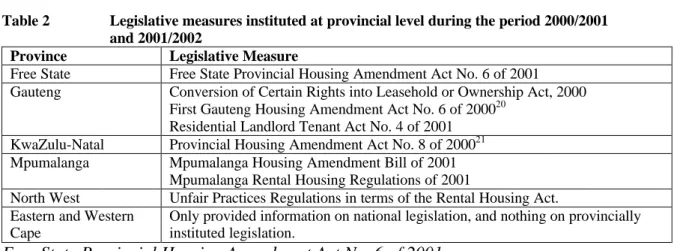
The information provided by the provincial departments of housing on the legislative measures instituted during the period under review has been summarised in the table below:
Table 2 Legislative measures instituted at provincial level during the period 2000/2001 and 2001/2002
Province Legislative Measure
Free State Free State Provincial Housing Amendment Act No. 6 of 2001 Gauteng Conversion of Certain Rights into Leasehold or Ownership Act, 2000
First Gauteng Housing Amendment Act No. 6 of 200020 Residential Landlord Tenant Act No. 4 of 2001 KwaZulu-Natal Provincial Housing Amendment Act No. 8 of 200021 Mpumalanga Mpumalanga Housing Amendment Bill of 2001
Mpumalanga Rental Housing Regulations of 2001
North West Unfair Practices Regulations in terms of the Rental Housing Act. Eastern and Western
Cape
Only provided information on national legislation, and nothing on provincially instituted legislation.
Free State Provincial Housing Amendment Act No. 6 of 2001
Provisions of the Act include the establishment of institutions that evaluate, approve and fund housing development projects. It also makes provision for the restriction of sale of State subsidised houses.
Conversion of Certain Rights into Leasehold or Ownership Act of 2000
This Act provides for security of tenure to persons occupying properties that belonged to the Gauteng Provincial Housing Advisory Board.
First Gauteng Housing Amendment Act No. 6 of 2000
The amendment provides the legislative framework for the transfer of residential properties and to establish adjudication and appeal panels.
Residential Landlord Tenant Act No. 4 of 2001
This Act provides for the repeal of the provincial Act in order to allow landlord and tenant matters to be dealt with in terms of the Rental Housing Act No. 50 of 1999.
20
The First Gauteng Housing Amendment Act No. 6 of 2000 is an amendment to the Gauteng Housing Act No. 6 of 1998, whichprovides for the promotion and facilitation of housing development within the Province of Gauteng.
21
To improve on its service delivery, Kwa-Zulu Natal amended the Provincial Housing Act No.12 of 1998 which provides a vehicle for functioning of a holistic, sustainable and integrated housing delivery process in Province. The Provincial Housing Act is said to be based on the National Housing Act No. 107 of 1997.
Provincial Housing Amendment Act No. 8 of 2000
The Act instituted by the KwaZulu-Natal Department of Housing has the following primary objectives:
• Provide for the promotion and facilitation of housing development within the province;
• Set out powers and duties of the MEC for Housing;
• Abolish the KwaZulu-Natal Housing Development Board;
• Dispose of the KwaZulu-Natal Housing Development Board's assets by transferring them to the Provincial Department of Housing;
• Provide for the determination of procurement policy in terms of housing;
• Provide regulations of State-funded housing, including an eight year pre-emptive right; and
• Provide for expropriation of land for housing development. Mpumalanga Housing Amendment Bill, 2001
The Bill seeks to amend the Mpumalanga Housing Act No. 15 of 1998 by abolishing the Mpumalanga Housing Development Board. The Bill transfers powers, duties, rights and obligations of the Mpumalanga Housing Development Board to the MEC for Housing and Land Administration. It also provides for the establishment of a panel of not more than six persons to advise the MEC for Housing and Land Administration on any matter relating to housing development, and puts in place regulatory measures to restrict the sale or alienation of State-subsidised housing.
Mpumalanga Rental Housing Regulations, 2001
The Mpumalanga Rental Housing Regulations 2001, read with the Rental Housing Act No. 50 of 1999, seeks to promote the provision of rental housing property and access to adequate housing by providing for the establishment of mechanisms that will ensure the proper functioning of the rental housing market. It also establishes the Rental Housing Tribunal, defines the functions, powers and duties of the Rental Housing Tribunal and lays down general principles governing conflict resolution in the rental housing sector. The Regulations provide for the facilitation of sound relations between tenants and landlords.
Mpumalanga submits that the ultimate promulgation of the Housing Rental Regulations will inevitably bring about sound and fair property lease principles whereby landlords would not have complete discretion in evicting tenants.
The regulatory measures restrict the sale or alienation of State-subsidised housing. These measures protects the people’s right to have access to adequate housing by prohibiting creditors from selling people’s subsidised houses for purposes of collecting unpaid debts illegally. The measures also prohibits people from alienating their subsidy houses for purposes of making a profit and thus ultimately subjecting them to homeless.
The Mpumalanga Department of Housing (MDH) reported that it will conduct workshops with all the stakeholders on the provisions of the Mpumalanga Housing Amendment Bill of 2001 and the Rental Housing Regulations. The workshops will be aimed at setting out the practical implications of the above-mentioned legislative measures.
4. BUDGETARY MEASURES National Sphere
Table 3 Budget for the National Department of Housing Year Total allocation in
Rand(s) Actual amount received from other sources in Rand(s) Actual expenditure in Rand(s) 2000/2001 3 439 355 000 19 189 000 3 330 036 000 2001/2002 3 785 031 000 - 3 721 239 625
The dash (-) in all the tables denotes that the information requested was not made available to the Commission.
Variances in the budget allocation of the NDH were due to nominal decrease in the budget allocation for the period 2000/2001 and increase for the year 2001/2002. The information in table 3 above indicates that the NDH under-spent for both the financial years. Although the NDH admits to under-spending, it does not provide any reasons.
National Housing Fund
Table 4 Budget allocation for the National Housing Fund Year Total allocation in
Rand(s)
Allocation as a % of the department’s total revenue
Actual expenditure in Rand(s)
2000/2001 2 998 000 000 87 3 039 702 000
2001/2002 3 225 957 000 85 2 326 828 000*
* Expenditure up to the end of February 2002
The variance in the budget allocation for the National Housing Fund was due to the nominal increase in the budget for 2000/2001 to 2001/2002 financial years. The NDH over spent for the period 2000/2001, and under-spent for the period 2001/2002. The reason for under-spending was due to unclaimed funds for capital projects.
Vulnerable and Marginalised Groups
Currently 10 per cent of Provincial Housing Department's allocation should be utilised for housing projects undertaken by female developers and contractors. The National Housing Programmes specifically targets racial groups disadvantaged by past discriminatory laws and practices, persons living in rural areas, older persons and low income group households with an income of R3 500 per month or less. The majority of the approved beneficiaries for the housing subsidy earn less than R1 500 per month.
Persons with Disabilities
The Housing Subsidy Scheme makes provision for a variation in the subsidy amount to make provision for the needs of persons with disabilities. The variance on the subsidy amount allows persons with disabilities to make design adjustments on their housing units to enable them to live independently. A national priority of 5-6 per cent has been set aside for the allocation of housing subsidies to persons with disabilities.
Budget adequacy
The NDH indicated that the budget allocation was inadequate for housing programmes, especially because of the housing backlog and the number of households that are currently living in abject conditions. The lack of capacity at all levels of government influences the optimum and efficient utilisation of the funds. Therefore, to address this problem of budget inadequacy the NDH negotiated with National Treasury and managed to secure an increase in the housing budget. An increase of R3 billion was approved for the 2002/2003 financial year. Additional amounts of R579 million and R574 million were also approved for the subsequent financial years. According to the NDH the increase will result in real growth in housing expenditure to about 6 per cent a year. This increase is expected to deal with the adjustment in housing subsidies, to keep pace with annual price changes, and to meet the minimum norms and standards requirements for housing.
Under and over-expenditure
There was, however, under-spending by the NDH during the period under review due to the capital nature of housing subsidy projects. Thus requiring careful planning and monitoring to ensure that the delivery of the final product is of an acceptable quality and meets the expected norms and standards. In an effort to prevent the abuse of public funds, stringent procedures have been instituted to ensure that developers comply with the necessary requirements. Provincial Housing Departments identified the following as accounting for under spending:
• Under performance by developers and conveyancers.
• Section 118 of the Local Government Municipal Systems Act of 2000, which requires that all outstanding payments due to municipalities must be paid before clearance certificates are issued for property to be transferred or registered in the name of beneficiary.
• In some instances the requirements of the National Environmental
Management Act, has resulted in delays in the implementation of housing projects until a proper assessment is done.
• Out of season rainfall.
• Lack of capacity of newly established local authorities to undertake approvals and provide other services.
According to the NDH, under-spending has no impact on service delivery and the realisation of the right to adequate housing, because it does not necessarily imply a lack of housing delivery, but rather that payments are not being claimed or processed timeously. In order to address this under-spending, senior officials in the National Department of Housing visit the provinces concerned to discuss disconcerting issues.
The reasons for the-under spending were investigated and corrective action identified. Furthermore, the following measures have been proposed to deal with under spending:
• Addressing the legal issues that result in delays in project implementation;
• Addressing capacity constraints of municipalities;
• Improving inter governmental co-operation between all spheres of government; and
• Improving co-ordination between national government departments.
Provincial Sphere
The various departments of housing were requested to provide information on the total budget allocation for the provision of the right to have access to adequate housing. The information has been summarised in table 5 below:
Table 5 Budget for the Provincial Departments of Housing Province Year Total Allocation in
Rand(s) Projected Expenditure in Rand(s) Actual Expenditure in Rand(s) 2000/2001 756 086 000 756 086 000 762 054 000 Eastern Cape 2001/2002 1 127 011 000 1 127 011 000 602 470 000 2000/2001 124 000 000 - 100 500 000 Gauteng 2001/2002 143 600 000 113 842 000 - 2000/2001 272 108 000 241 864 000 241 864 000 Mpumalanga 2001/2002 451 246 000 451 246 000 440 898 000 2000/2001 58 100 000 - 58 100 000 Northern Cape 2001/2002 65 475 000 - 65 475 000 2000/2001 279 022 381 314 714 190 271 778 239 Limpopo Province 2001/2002 - - - 2000/2001 522 286 000 522 286 000 497 900 000 North West 2001/2002 540 838 000 540 838 000 476 338 000 2000/2001 341 466 000 363 238 610 363 238 610 Western Cape22 2001/2002 325 861 444 327 727 588 327 727 588 Variance(s)
For the Eastern Cape Department of Housing the variances were due to delays in the transfer of funds. Funding for the period 2001/2002 was only transferred at the close of the financial year, which led to some funds being under-spent. The GDH did not clearly explain the reasons for the variances in the budget, whilst MDH also did not provide reasons for the variance in the budget allocation.
With regard to the North West, the variance in the allocation was due to the reallocation and shifting of resources for the different projects within the department, and the delays in the disbursement of funds and tender processes for projects.
In the Western Cape, the variances resulted from over spending due to the increasing demand for housing, as well as insufficient budget to meet its target of housing the
22
The same information was provided for the departmental allocation, Housing Fund and Housing Subsidy Programme.
homeless. As a result, municipalities were encouraged to enter into bridging finance arrangements with the Development Bank of South Africa.
Budget Adequacy
The Eastern Cape, Gauteng, Mpumalanga and North West Departments of Housing indicated that the budget was adequate. The GDH further stated in its report that there was no over- or spending. With regard to the MDH budget there was an under-spending of about 2,29 per cent, which was as a result of the unavailability of suitable land for building houses.
The Northern Cape Department of Housing experienced serious budget constraints because the allocation was inadequate, and as a result it became impossible to fund development projects as planned.
Under- and Over-Expenditure
The Eastern Cape Department of Housing indicated that whilst a number of subsidies have been approved, construction progress is slow, as a result the allocated budget does not get fully utilised. Therefore, the main reason for under spending was due to insufficient capacity at municipal level. The impact of this under spending is that not all the houses planned were built, thus slowing down the rate of delivery and affecting the right to have access to housing for those in need.
The Limpopo Department of Housing under spent due to the limited capacity for housing administration, and the unavailability of suitable land. The increasing demand for housing also exceeds the available funds. Measures instituted to address this problem include capacity building of departmental officials, improved expenditure patterns, and budget motivation that led to the increase in budget allocation.
The Western Cape over spent its budget allocation due to increasing demand for housing, which surpassed the financial resources allocated to the department. To address the problem of over expenditure, the WCDH instituted stricter cash-flow management and the monitoring of projects.
National Housing Fund
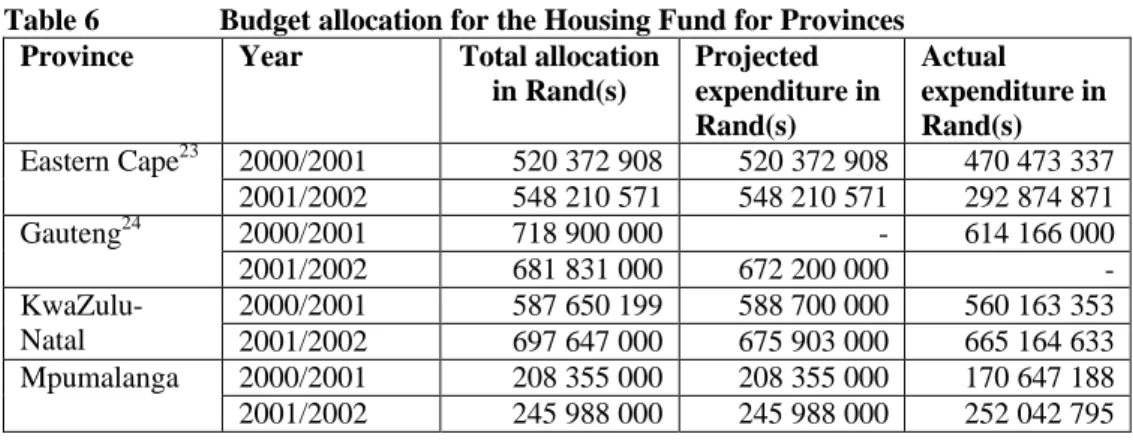
The provincial departments of housing were requested to provide information on the budget allocation for their share of the National Housing Fund. The information has been summarised in table 6 below:
Table 6 Budget allocation for the Housing Fund for Provinces Province Year Total allocation
in Rand(s) Projected expenditure in Rand(s) Actual expenditure in Rand(s) 2000/2001 520 372 908 520 372 908 470 473 337 Eastern Cape23 2001/2002 548 210 571 548 210 571 292 874 871 2000/2001 718 900 000 - 614 166 000 Gauteng24 2001/2002 681 831 000 672 200 000 - 2000/2001 587 650 199 588 700 000 560 163 353 KwaZulu-Natal 2001/2002 697 647 000 675 903 000 665 164 633 2000/2001 208 355 000 208 355 000 170 647 188 Mpumalanga 2001/2002 245 988 000 245 988 000 252 042 795 Variance(s)
The variance in the budgetary allocation for the GDH was due to the priority shift of the National Housing MinMec to focus more on rural rather than urban housing during the 2001/2002 financial year. This resulted in the reduction of Conditional Grant allocation because in Gauteng there is less demand for rural housing than in other provinces. The increase between 2001/2002 and the 2002/2003 financial years was due to the provision made for inflation increases in the quantum of the housing subsidy, which has not been adjusted for more than two years.
Vulnerable and Marginalised Groups
Provincial Departments of Housing reported that between 8 and 10 percent of the budget was set aside for women contractors or those providing professional service for the financial year 2001/2002. Approximately 60-65 per cent of the beneficiaries of the housing subsidy are female-headed households. Low-income groups benefit from the housing subsidy scheme because it targets households earning less than R3 500 per month.
In Gauteng the budget allocation represents a monetary value of between R40 million and R50 million per annum for women. The GDH spends R800 million per annum to provide housing for racial groups disadvantaged by past discriminatory laws and low-income groups
23
The same information was provided for the Housing Subsidy.
24
This is a Conditional Grant allocation to the Gauteng Housing Fund in terms of the Division of Revenue Act only. The same information was provided for the Housing Subsidy.
Persons with Disabilities/Older Persons
The Eastern Cape Department of Housing indicated in its report that 5 per cent has been allocated for people with disabilities. Persons with disabilities and older persons constitute 2,5 per cent respectively, of the beneficiaries for housing subsidies in Gauteng. People infected and affected by HIV/AIDS are not catered for in the National Housing Code. However, the GDH is in the process of developing a provincial housing policy that will accommodate such persons in the housing subsidy scheme.
In Mpumalanga the financial institutions and parastatals have been brought on board to assist people with low and middle-income to access finance for housing. 4 per cent of houses built are given to people with disabilities.
Budget Adequacy
Although the budget was adequate for the provision of housing, lack of capacity at local government level in both the Eastern Cape and Gauteng Department of Housing, contributed to their failure to spend the allocated funds. This under spending, however, did not negatively affect the key performance indicators of the Department.
National Housing Subsidy
Information on the National Housing Subsidy Scheme was provided differently per provincial department of housing. Therefore, the information has been summarised in different tables per province as indicated below:
Table 7 KwaZulu-Natal Department of Housing Year Total allocation in
Rand(s) Projected expenditure in Rand(s) Actual expenditure in Rand(s) 2000/2001 579 500 199 524 274 000 514 517 031 2001/2002 544 303 000 544 303 000 584 820 884
Table 8 North West Department of Housing Year Total allocation in
Rand(s)
Projected expenditure in Rand(s)
Actual expenditure in Rand(s)
2000/2001 268 800 000 268 800 000 264 200 000
2001/2002 263 600 000 263 600 000 257 200 000
The North West Department of Housing indicated in its report that the budget allocation is inadequate to meet the housing demands and needs of the province. The current allocation only covers the growth in housing needs of 16 000 households per annum which represents R256 million in the form of subsidies required and does not address the backlog of an estimated 486 000 households that require funding to the value of R7, 776 billion.
Under- and Over-expenditure
There was under spending by the North West Department of Housing. However, the various housing programmes are multi-year programmes, thus any under-expenditure for a specific financial year is automatically rolled-over. To address this problem, expenditure was expedited and during 2001/2002, the department achieved 97 per cent.
Rural Housing Subsidy
Information provided by the Gauteng Department of Housing shows the budget allocation for two projects from the Gauteng Housing Fund. The GDH allocated R3, 7 million for the Rural Housing Subsidy for the financial year 2002/2003. This represented 0,36 per cent of the GGP, with a projected expenditure similar to the allocation. No information was provided about the expenditure because the project was only initiated during the period 2002/2003 financial year. Thus no information is yet available on variances. Similarly, the MDH has only one allocation for the rural housing subsidy programme. The MDH allocated R4, 6 million for the financial year 2001/2002, and expenditure for that period was R1, 9 million.
The KwaZulu-Natal Department of Housing only provided information on the actual expenditure, without indicating what the allocation was in the first place, and no reasons were provided for the lack of information. The department has spent R3 987 268 for the year 2000/2001, and R2 795 493 for the year 2001/2002.
Table 9 Rural Housing Subsidy allocation
Year Year Total allocation in Rand(s) Projected expenditure in Rand(s) Actual expenditure in Rand(s) 2000/2001 11 761 600 11 761 600 5 372 868 Eastern Cape 2001/2002 21 600 000 21 600 000 - 2000/2001 76 000 000 76 000 000 81 200 000 North West 2001/2002 96 000 000 96 000 000 85 000 000 Variance (s)
The timeous release of land and the issuing of letters of consent by the Minister of Land Affairs are the main challenges facing the Eastern Cape Department of Housing (ECDH) in the implementation of the Rural Housing projects. These problems have resulted in the allocated budget not being fully utilised for the different financial years.
The North West Department of Housing stated in its report that the variances are due to unspent funds that are rolled over to the next financial year.
Under and over-expenditure
Table 9 above bears testimony to the problems being encountered by the ECDH, as less than half of the budget was not spent. However, the department has stated that it is looking at fast tracking mechanisms to facilitate the housing delivery process.
Table 10 Western Cape Department Housing Rural Subsidy allocation Year Total Allocation in
Rand(s) to housing in rural areas. Allocation as a % of departments Housing allocation Projected expenditure Actual Expenditure 2000/2001 185 193 686 54,2 185 193 686 185 193 686 2001/2002 111 349 089 34,2 111 349 089 111 349 089
In the Western Cape Department of Housing (WCDH) rural subsidies are construed to be any subsidy given to beneficiaries living outside of the metropolitan area. The budgetary allocation was available to all of the categories mentioned provided that the beneficiaries qualified in all respects for housing subsidies in terms of the prescribed criteria. According to the WCDH the budget was insufficient to meet the needs of the homeless in the province within a reasonable time.
The overall conditional grant for housing was over-spent to allow for more beneficiaries to gain access to the right to housing than would have been possible had the Department remained within the allocated budget. To address this problem the Department instituted stringent cash-flow management procedures and project monitoring measures.
Physical Infrastructure
For this section, only the GDH provided information. The other provinces indicated that there is no separate budget for physical infrastructure as it forms part of the housing subsidy. The information is on the Alexandra Renewal Project (ARP), which has been funded from the Department’s operational budget. The project was instituted during the financial year 2000/2001, and the allocation was R74 million. The amount has nominally increased to R75 million for the financial year 2001/2002. The ARP report indicated that at the end of the 2001/2002 financial year, 89 per cent of the budget had already been spent. The original budget allocation was insufficient to address the total budget requirement for the project.
Vulnerable and Marginalised Groups
There is a range of supportive mechanisms that targets women under threat, as well as victim support facilities, trauma centres, referral centre and safe houses. This project, however, has no specific focus on female-headed households, or on refugees and asylum seekers. The Department of Social Development only addresses the needs of child-headed households.
Previously disadvantaged individuals are given preference in accordance with the Preferential Procurement Act, and also provided with tender and contractor training, mentoring and small medium and micro enterprises support.
As part of the Alexandra Renewal Project (ARP) persons living under hazardous conditions (floodplains, landfills, gas pipelines, and road reserves) will be relocated to the low-income houses. Others will have their homes upgraded through the provision of access to engineering services, and where possible security of tenure.
The GDH reported that persons with disabilities will benefit from the ARP, as 5 per cent of the constructed houses are earmarked for them and the aged.
5. INDICATORS
The national and provincial departments of housing were requested to provide information on the state of housing for both the urban and rural areas, and the different racial groups. However most of the departments did not provide the information as requested, as a result one could not include the response in one table. The following tables show the different information as provided by the national and different provincial departments.
Table 12 National Department of Housing Statistics25
Category Total
Number of households granted State subsidies
Source: Housing Subsidy Scheme and Provincial Housing Governments
1 422 285 (1994 up to January 2002)
296 268
(2000 up to January 2002) Number of houses built by the sState
Source: Housing Subsidy Scheme and Provincial Housing Governments
317 841
(2000 up to end January 2002) Number of houses built through self help housing schemes with some
assistance from the State
Source: People’s Housing Process Partnership and Provincial Housing Governments
13 246
The information provided in table 12 above forms part of the information on indicators, however there is no demographic breakdown. Other information provided by the NDH on the indicators was not for the period under review, therefore could not be included for the analysis.
Table 13 Beneficiaries of female-headed households per province in December 2001 PROVINCE % of Female-headed households % of Housing subsidies
allocated to women Eastern Cape 50.09 41 Free State 34.22 35 Gauteng 29.03 37 KwaZulu-Natal 39.95 47 Limpopo 35.70 45 Mpumalanga 29.25 32 Northern Cape 52.16 54 North West 37.27 33 Western Cape 27.73 28
The information in table 13 above shows the progress made by the NDH in providing housing to female-headed households and women in general. The province that
25
seems to have benefited the most is Limpopo, where more than 50 per cent of the female-headed households have received subsidies.
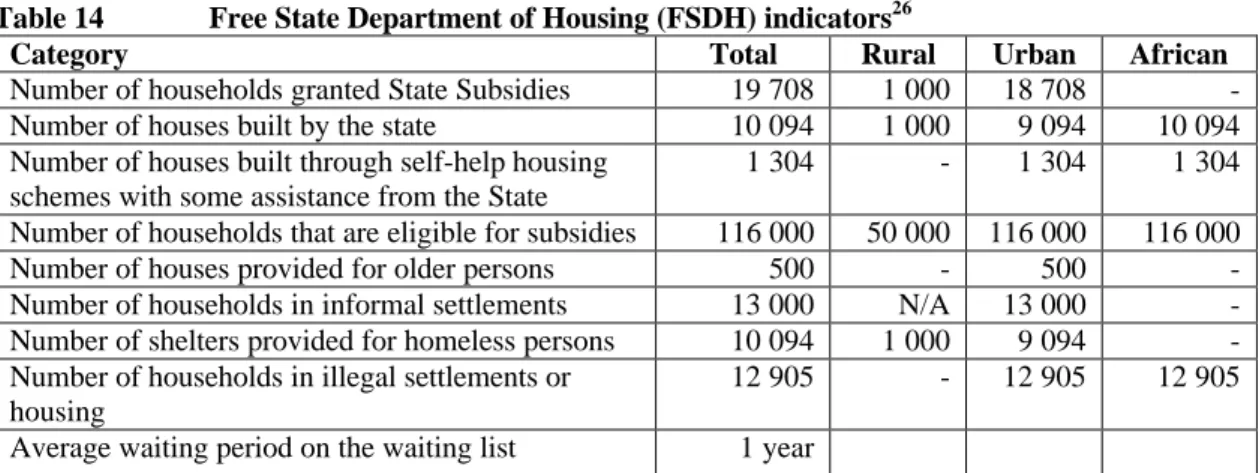
Table 14 Free State Department of Housing (FSDH) indicators26
Category Total Rural Urban African
Number of households granted State Subsidies 19 708 1 000 18 708 - Number of houses built by the state 10 094 1 000 9 094 10 094 Number of houses built through self-help housing
schemes with some assistance from the State
1 304 - 1 304 1 304 Number of households that are eligible for subsidies 116 000 50 000 116 000 116 000 Number of houses provided for older persons 500 - 500 - Number of households in informal settlements 13 000 N/A 13 000 - Number of shelters provided for homeless persons 10 094 1 000 9 094 - Number of households in illegal settlements or
housing
12 905 - 12 905 12 905 Average waiting period on the waiting list 1 year
The information in table 14 above was not provided as requested in the protocol with the complete racial breakdown. The FSDH did not provide any explanation for the lack of information.
Table 15 Gauteng Department of Housing
Category Total Rural Urban African Coloured Indian White
Number of households granted State subsidies
50 828 - 50 828 50 320 203 203 102 Number of houses built
by the State
41 805 - 41 805 41 387 167 167 84 Number of houses built
through self-help housing schemes, assisted by the State
6 278 - 6 278 6 215 25 25 13
Number of households that are eligible for subsidies 535 247 26 762 508 484 529 894 2 141 2 141 1 071 Number of homeless persons 468 838 23 442 445 396 464 150 1 875 1 875 938 Number of households in informal settlements 180 000 - 180 000 178 200 720 720 360 Number of people on the
housing waiting list
535 247
26 762
508 484 529 894 2 141 2 141 1 071 Average waiting period
on the waiting list
+/-5 to 8 years +/-5 to 8 years +/-5 to 8 years +/-5 to 8 years +/-5 to 8 years +/-5 to 8 years +/-5 to 8 years 26
The report from the FSDH did not clearly indicate the period, that is, whether it is 2000/2001 or 2001/
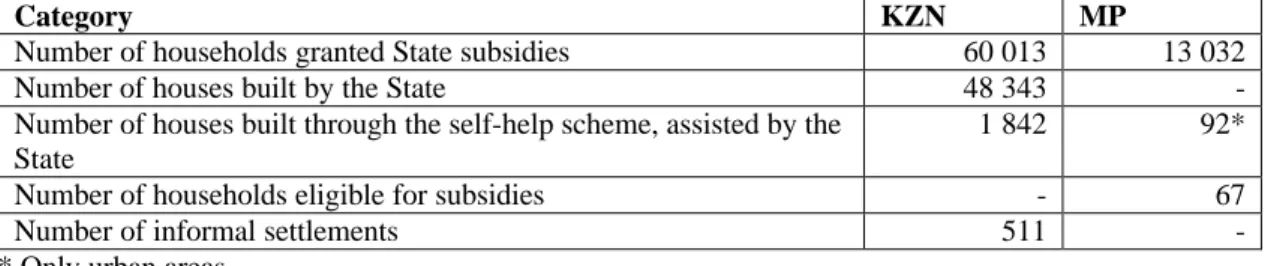
Table 16 Housing indicators
Category KZN MP
Number of households granted State subsidies 60 013 13 032
Number of houses built by the State 48 343 -
Number of houses built through the self-help scheme, assisted by the State
1 842 92*
Number of households eligible for subsidies - 67
Number of informal settlements 511 -
* Only urban areas
Table 17 Western Cape Department of Housing indicators27
Category Total
Number of households granted state subsidies 73 982
Number of houses built by the State (complete and under construction)28 25 119- houses 23 578-sites
serviced Number of houses built through self-help housing schemes with assistance
from the state
5 691 Number of households that are eligible for subsidies Not Known
Number of homeless persons 312 000 families
Number of households in informal settlements 267 000 (estimate) Number of households in illegal settlements or housing Not Known Number of people on the housing waiting list* 292 000 families Average waiting period on the waiting list 10 years * There is no consolidated waiting list kept at Provincial level. Waiting lists are kept individually by municipalities.
The only information provided by the Northern Cape Department of Housing was that 3 600 households were granted state subsidies. The municipalities keep the list with the number of people on the housing waiting list.
National Action Plan (NAP)
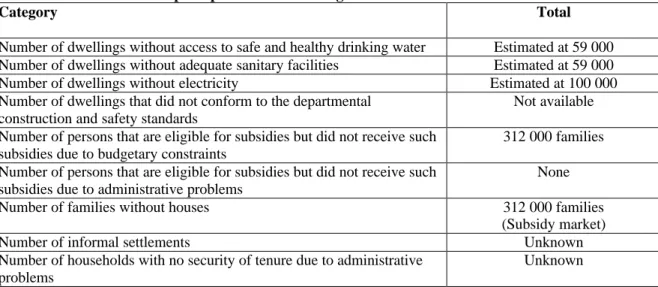
The NAP identifies numerous indicators with respect to challenges affecting the right to have access to adequate housing that need to be addressed. The NDH provided information on indicators for the year 1999, and the only information provided for the year 2001 was on the number of informal settlements. There are 1 088 informal settlements in the whole country.
Provincial Sphere
Only the Free State, Gauteng and Western Cape Departments of Housing provided information regarding NAP. The other provinces reported that the information is unavailable. KwaZulu-Natal only reported that there are 511 informal settlements in the province.
27
The WCDH reported that statistics are not kept for individual racial categories
28
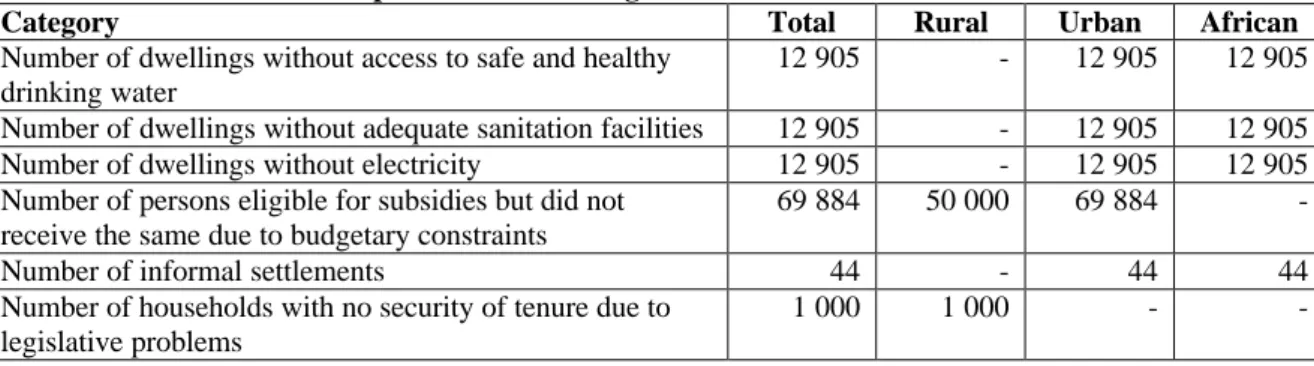
Table 18 Free State Department of Housing NAP indicators
Category Total Rural Urban African
Number of dwellings without access to safe and healthy drinking water
12 905 - 12 905 12 905 Number of dwellings without adequate sanitation facilities 12 905 - 12 905 12 905 Number of dwellings without electricity 12 905 - 12 905 12 905 Number of persons eligible for subsidies but did not
receive the same due to budgetary constraints
69 884 50 000 69 884 -
Number of informal settlements 44 - 44 44
Number of households with no security of tenure due to legislative problems
1 000 1 000 - -
Table 19 Gauteng Department of Housing NAP indicators
Category Total Rural Urban African Coloured Indian White
Number of dwellings without access to safe and healthy drinking water 300 000 15 000 285 000 300 000 - - - Number of dwellings without adequate sanitation facilities 300 000 15 000 285 000 300 000 - - - Number of dwellings without electricity 400 000 20 000 380 000 400 000 - - - Number of dwellings that did not conform to the departmental construction and safety standards 180 000 9 000 171 000 180 000 - - - Number of families without houses 500 000 25 000 475 000 495 000 2 000 2 000 1 000 Number of informal settlements +/-181 - 181 181 - - - Number of households with no security of tenure due to administrative problems 200 000 10 000 190 000 198 000 800 800 400