Degree Programme of Computer Science and Engineering
Rushil Dave
Mobile Virtual Network Operator
Systems on Cloud:
An Architectural and Cost-benefit Study
Master’s Thesis Espoo, August 8, 2011
Supervisor: Professor Antti Yl¨a-J¨a¨aski Instructor: Yrj¨o Raivio Lic.Sc. (Tech.)
Degree Programme of Computer Science and Engineering MASTER’S THESIS Author: Rushil Dave
Title:
Mobile Virtual Network Operator
Systems on Cloud: An Architectural and Cost-benefit Study
Date: August 8, 2011 Pages: 9+ 98
Professorship: Data Communication Software Code: T-110 Supervisor: Professor Antti Yl¨a-J¨a¨aski
Instructor: Yrj¨o Raivio Lic.Sc. (Tech.)
Cloud computing technology is growing rapidly in the market providing elastic-ity, virtualization and most importantly cost savings to the computing industry. Today, telecom operators especially MVNOs face challenges such as reduction of ARPU, need of differentiations and competition from all fronts of software in-dustry. Cloud provides major opportunities to telecom operators to reduce their operational costs, drive new differentiations and be active in cloud ecosystem. Telecom operators can take advantages of cloud by selling the cloud offerings to their customers by using already established infrastructure as well as by using cloud to deploy their own software systems to reduce operational costs.
In this research, the techno-economic analysis has been carried out to analyze implementation of telecom systems on cloud in Business Support Systems domain. The research focuses on application mapping strategy required and financial cost-benefits gained for MVNOs if their systems are implemented on cloud. The thesis research involves Delphi method based study in which expert interviews are conducted in two rounds to get expert views on the subject. The responses and related analyses are drawn while introducing a proof-of-concept hybrid cloud architecture to implement MVNO systems. An innovative solution of billing-as-a-service on cloud is discussed in the thesis as well. The implications and future prospects are presented evaluating the thesis results. In the end, conclusion is derived to summarize the thesis research.
In summary, most of the MVNO systems are viable candidates for cloud imple-mentation and significant benefits can be achieved. Cloud will help MVNOs to make transition from CAPEX to OPEX based model while reducing OPEX and gaining other advantages like economy of scale, SaaS based solutions, lower time-to-market, enhanced performance etc. There are certain implications related to data security, availability and government regulations which can impose difficul-ties on MVNO systems while moving them to the cloud. However, the future of cloud in telecom industry seems bright with emergence of everything-as-a-service model.
Keywords: MVNO, BSS, cloud, cost-benefits, hybrid, SaaS, SLA, OPEX Language: English
This work was done as a part of the Cloud Software Program of Tivit (Strategic Centre for Science, Technology and Innovation in the Field of ICT, www.tivit.fi).
I wish to express my gratitude to the people that have supported me during this thesis research.
Firstly, I would like to thank Professor Antti Yl¨a-J¨a¨aski, who acted as a supervisor for the thesis and helped me to initiate the thesis research.
Secondly, I would like to extend my sincere gratitude to Mr. Yrj¨o Raivio, who was the instructor during thesis research. His guidance, support and comments helped me a lot throughout the research process to carry out the thesis research.
I also thank all the experts and researchers for their anonymous partici-pation in the interview process providing expert knowledge and comments.
I would also like to thank Amit Soni and Koushik Annapureddy, who helped me to setup the CRM proof-of-concept on hybrid cloud and review the thesis.
Last but not the least, I thank my family and friends for their support.
Espoo, August 8, 2011 Rushil Dave
4G 4th Generation (Communication Systems) APAC Asia Pacific
API Application Programming Interface AR Account Recievable
ARPU Average Revenue Per User B2B Business to Business B2C Business to Customer BSS Business Support Systems CAPEX Capital Expenditure
CDR Call Detail Record or Charging Data Record CPU Centralized Processing Unit
CRM Customer Relationship Management CSP Communication Services Provider CSR Customer Service Representative DDoS Distributed Denial of Service ERP Enterprise Resource Planning EU European Union
HLR Home Location Register HTTP Hyper Text Transfer Protocol IaaS Infrastructure-as-a-Service
IMSI International Mobile Subscriber Identity I/O Input/Output
IPDR Internet Protocol Data Record IP Internet Protocol
IT Information Technology KPI Key Performance Indicator LTE Long Term Evaluation Mbps Mega bit per Second MNO Mobile Network Operator
MSS Mobile Switching System (Server) MVNE Mobile Virtual Network Enabler MVNO Mobile Virtual Network Operator NAS Network Attached Storage
NIST National Institute of Standards and Technology OPEX Operational Expenditure
OSS Operation Support Systems PaaS Platform-as-a-Service
PHP Personal Home Page (Hypertext Preprocessor) RAM Random Access Memory
ROI Return On Investment SaaS Software-as-a-Service SIM Subscriber Identity Module SLA Service Level Agreement SMS Short Messaging Service SP Service Provider
STOF Service Technology Operation Finance TCO Total Cost of Ownership
VAT Value Added Tax
VLAN Virtual Local Area Network VOIP Voice over Internet Protocol xDR x (Call or IP) Data Record
Abstract ii
Acknowledgements iii
Abbreviations & Acronyms iv
List of Tables viii
List of Figures ix 1 Introduction 1 1.1 Background of Research . . . 1 1.2 Research Questions . . . 2 1.3 Research Objectives . . . 3 1.4 Research Methodology . . . 4 1.5 Scope of Research . . . 5
1.6 Structure of Thesis Report . . . 6
2 Overview 9 2.1 MVNO Architecture and Systems . . . 9
2.2 Business Support Systems . . . 11
2.3 Cloud Environment and Architecture . . . 14
2.4 Existing Scenario with Telecom Systems on Cloud . . . 19
2.5 Application Mapping and Finance . . . 22
2.5.1 Application Mapping . . . 22
2.5.2 Finance . . . 24
3 Action Research 27 3.1 Action Research Methods . . . 27
3.1.1 Action Research Setup . . . 28
3.1.2 Qualitative Data Analysis . . . 28
3.2 Expert Interviews Setup . . . 31
3.3 Interview Responses . . . 34
3.3.1 MVNO Systems . . . 34
3.3.2 MVNO on Cloud . . . 41
3.3.3 Cost-benefits . . . 48
3.3.4 Implications and Future Prospects . . . 51
3.3.5 Round 2 Results . . . 53
4 Techno-economic Analysis 55 4.1 Mapping MVNO Systems to Cloud . . . 55
4.1.1 Interview Analysis . . . 55
4.1.2 Application Mapping . . . 57
4.1.3 Strategy . . . 60
4.1.4 Hybrid Cloud Setup Experiment . . . 61
4.1.5 Analysis of Round 2 . . . 65
4.2 Cost-Benefits . . . 67
4.2.1 Cost Calculations . . . 68
4.2.2 Opportunity Gains . . . 70
4.3 Parameters Evaluation . . . 71
4.3.1 Importance in MVNO Context . . . 71
4.3.2 Influence of Cloud in MVNO . . . 73
5 Discussion 76 5.1 Billing as a Service . . . 76
5.2 Business Model Analysis . . . 79
5.3 Implications . . . 80
5.4 Future Prospects . . . 83
6 Conclusion 86 Bibliography 87 A Appendix 95 A.1 Questionnaire for Interview Round # 1 . . . 95
3.1 MVNO in Finland, adapted from [30] . . . 38
3.2 Results for mapping MVNO systems on cloud . . . 46
3.3 Results for parameter analysis . . . 48
3.4 Results for interview round 2 . . . 54
4.1 Analysis for mapping MVNO systems attributes on cloud sce-narios . . . 60
4.2 Cost Calculations for MVNO . . . 69
4.3 Cost Calculations for SugarCRM Implementation . . . 70
4.4 Cost Comparison for SugarCRM Implementation . . . 70
A.1 Mapping of MVNO systems on cloud . . . 97
A.2 Parameters affected while moving MVNO systems to cloud . . 97
A.3 Resource needs of MVNO systems . . . 98
1.1 Thesis Research Methods. . . 5
1.2 Structure of Thesis Report . . . 7
2.1 MVNO Positioning . . . 10
2.2 MVNO Types . . . 11
2.3 Telecom Operator Systems . . . 12
2.4 MVNO Business Support System Processes . . . 13
2.5 Cloud Computing Structure . . . 16
2.6 Advantages of Cloud Computing Services . . . 17
2.7 Cloud Implementation of Telco Systems by Carrier Grade Require-ments, adapted from [45] . . . 21
2.8 Telecom Cloud Offerings . . . 22
2.9 Possible MVNO Applications Mapping on Cloud . . . 24
2.10 Cost Analysis Parameters for MVNO Cloud . . . 25
3.1 Delphi Method in Research Environment . . . 31
3.2 Expert Interview Setup Scenario . . . 33
3.3 Layer wise cloud deployment possibilites in Telco . . . 36
4.1 Snapshot - MVNO systems in brief . . . 56
4.2 MVNO systems on cloud analysis . . . 57
4.3 MVNO systems mapping according positive response . . . 58
4.4 Snapshots - MVNO on cloud advantages . . . 61
4.5 Hybrid cloud setup for Telco . . . 62
4.6 Hybrid cloud setup experiment architecture . . . 64
4.7 Analysis of interview round 2 responses . . . 65
4.8 Snapshots - MVNO Cost analysis . . . 68
4.9 Analysis of important parameters in MVNO context . . . 72
4.10 Parameter analysis for MVNO on cloud . . . 74
5.1 Billing-as-a-Service conceptual architecture . . . 78 5.2 Major implications while implementing MVNO systems on cloud . 81
Introduction
1.1
Background of Research
Telecom operators are moving towards the flat network architectures and sharing of network resources is now possible in this domain by introduction of Long Term Evolution (LTE) and 4G standards [46]. The flat network architecture is lowering the barrier to network sharing initiatives also en-abling the sharing possibilities of Telecom IT systems. The network sharing was started taking place in the past when MVNOs [30] were introduced. MVNOs share network resources with MNOs and they implement their own Customer care, inventory management and billing systems as part of their IT systems. Most of the MVNOs are aggressive on the pricing of telecom products and services offered and price differentiation is vital in MVNO busi-ness operations. MVNOs pay large amount of their spending on buying the network capacity from MNOs as they introduce products and services while competing against the MNO offerings. So it’s important for MVNOs to lower the operational expenditures by lowering the cost of running their IT systems in place to stay in the highly competitive market.
Now the cloud computing technology [6] has given possibility to host sys-tems which require high processing power and large data storage capacity in an efficient manner. In addition to that, cloud computing environments provide possibility of hosting Infrastructure, Platform and Software as ser-vice by dynamically setting up the use of different types of cloud. Private cloud gives possibility to share in-house IT resources efficiently while sharing with the processes, batch jobs and services in a highly secured and reliable fashion. Public cloud gives possibility to use public computing resources dy-namically and on pay-as-you-go basis which gives very cost-beneficial setup for processing the complex data. Hybrid cloud combines private and public
cloud computing space for managing sensitive data storage and processing in-house and consuming the public computing resources whenever there is a need [64].
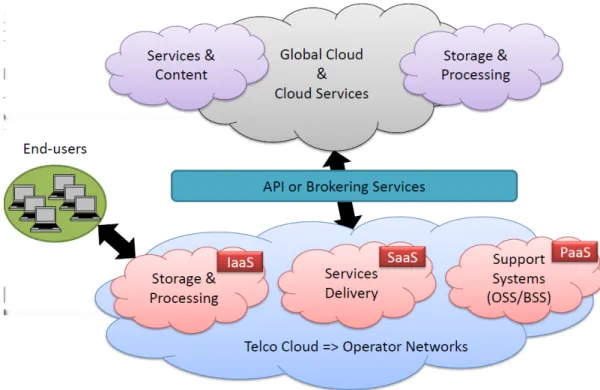
In highly competitive market of telecom offerings, every operator is trying to reduce the operational expenditure in one or the other way and cloud en-vironment gives such possibility to minimize the expenditure and maximize the revenues. Telecom networks have various functions and network elements that might be implemented in clouds, called a Telecom Cloud. Operators can utilize all kinds of cloud computing services, including Infrastructure (IaaS), Platform (PaaS) and Software as a Service (SaaS). On IaaS layer communication, computation and storage services can be provided by the clouds. PaaS layer has close links to Business and Operations Support Sys-tems (BSS/OSS) [40]. Finally, SaaS matches the service delivery platforms. The Telecom Cloud can be supported with private, public and hybrid clouds located outside of the operator domain, and separated by open APIs [13].
In cloud environment, however, the mapping of application is also impor-tant as to meet with critical SLA and throughput requirements [45] in telecom sector. Also nature of applications in Telecom IT systems vary significantly and mapping of applications allows choosing cloud deployable applications according to their attributes. Mission critical telecom systems may have impact of the complex telecom operations and using cloud for such systems may not be a good choice for telecom operators. Cloud provides cost-benefits while sharing the ideal IT resources with other in-house or public applica-tions, security and availability is a concern for telecom operators as some of the telecom operators think cloud is not ready for some of the telecom systems. It’s also important for telecom operators to know how and what cost-benefits can be driven by implementing their telecom systems on cloud as there factors involved such as application migration, network usage, in-tegration and enhancement possibilities which may impact the operational expenditure for telecom operators. So the architectural changes and cost-benefits are very important factors here to consider while moving telecom systems to the cloud.
1.2
Research Questions
In the highly competitive telecom services market, every operator seeks possi-bilities to reduce the costs and to maximize the revenues [58]. The cloud tech-nologies provide several ways like IaaS, PaaS and SaaS to improve CAPEX and OPEX values by migrating or implementing telecom systems on cloud. Because MVNOs share various network resources with MNOs, MVNOs can
become natural appliers of clouds. However, the mapping of MVNO ar-chitecture to the cloud has to be carefully planned because of the business sensitivity of MVNO systems. The research questions for this thesis are de-rived in the direction of MVNO applications mapping possibilities and related cost-benefits on cloud computing architecture. The main research question is followed by the sub-questions which are narrowed-down to illustrate im-portant areas of the thesis research.
Main Question:
How and which Business Support Systems (BSS) can be deployed for MVNO on Cloud computing environment as to offer high performance, cross-location architecture and cost-effective system to share resources among other operators?
Sub Questions:
1. Which BSS can be deployed on cloud? (BSS Application Mapping on Cloud)
2. How will the current architecture be affected in this case?
3. If high-performance will be gained with cloud implementation? How? (SLA, Throughput in focus)
4. How much cost-benefits can be driven? How much cloud resources should MVNO buy?
5. What are the implications of BSS cloud deployment? (Like security, government laws etc.)
6. How much carbon footprints can be saved by using Cloud?
7. How big is the market? What changes will business models have in this case?
1.3
Research Objectives
The objective of the research defines the criteria and framework for answering the research questions. It also defines the evaluation criteria for research and a structure for research while deriving step by step procedure to answer the research question.
The main objective of the thesis research is to design the mapping of BSS applications on Cloud for MVNOs and do financial analysis to find out the cost-benefits related to the implementation. The following objectives
establish the research direction for the thesis while answering the research questions stated in section 1.2:
1. Define criteria and methodology for the thesis research to map MVNO systems to the cloud and finding related cost-benefits.
2. Gather qualitative data from industrial and research partners related to the thesis area of research and analyze it further to derive the results. 3. Conduct architectural and design changes study for MVNO system and map MVNO systems to the cloud taking qualitative data into consideration.
4. Calculate cost-benefits while finding impact on MVNO capital and op-erational expenditures when moving MVNO systems to the cloud. 5. Evaluate parameters like performance, revenue, market, carbon
foot-prints, cloud resources and business model changes for the MVNO sys-tems on cloud implementation.
6. Discuss the solution for providing Billing as a Service for MVNOs using cloud computing environment using the analysis conducted during the thesis research.
7. Describe the technical and other implications for the MVNO system implementation on cloud. Also discuss the future prospects for the thesis research based upon the input gathered during qualitative data analysis.
1.4
Research Methodology
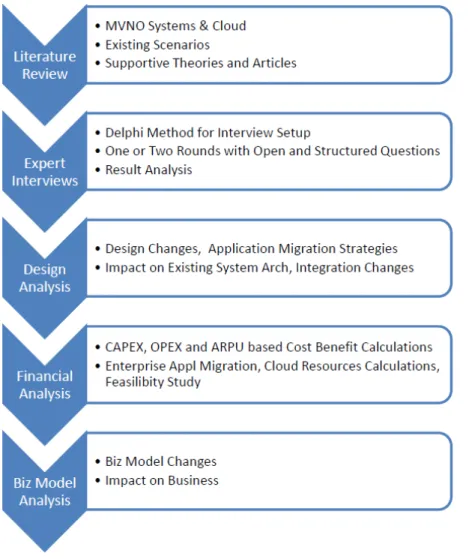
Action research will employed as the main research method involving re-searchers and practitioners together. Expert interviews will be conducted based upon their area of expertise with pre-formatted and validated ques-tionnaire. The Delphi method [49] will be exercised for the interview for-mations. The business critical information and knowledge imparted from interviews will remain confidential and anonymous in the thesis report and research publications.
Following methods shall be employed during the thesis research for which the a brief agenda is illustrated in Fig. 1.1:
Figure 1.1: Thesis Research Methods
• Expert Interviews
• Design/Architectural Study
• Statistical/Financial Analysis
• Business Model Analysis
1.5
Scope of Research
Scope of the research is limited to the MVNO systems and especially the business support systems in place for the MVNOs. This is due to the fact
that most of the MNOs have implemented complex in-house telecom IT sys-tems which hold large amount of customer sensitive data. Telecom operators believe that the cloud is not yet ready to hold such complex, mission critical and data sensitive systems [38].
MVNOs, on other hand, have systems which are light weight in nature and hold small amount data and configurations. Some of the MVNOs have also outsourced their IT systems to the Business process outsourcing compa-nies. So it’s easy for the MVNO systems to move to the cloud compared to the IT systems of large MNOs. Also the Operation Support Systems include network elements and switches which are required to fulfill carrier grade SLA and in these cases, telecom operators believe that cloud is not yet ready to hold such systems. So to make the viable case of telecom systems imple-mentation on cloud, MVNOs and their Business Support Systems have been considered for this thesis research. MVNO in this thesis research includes MVNE, Service Providers (SP), and resellers in telecom value chain.
1.6
Structure of Thesis Report
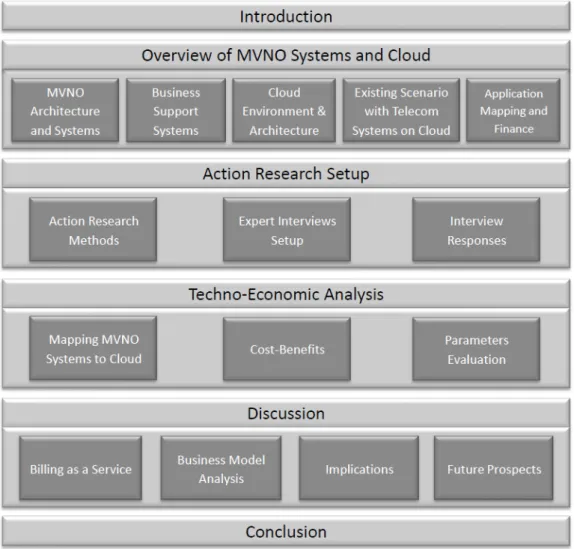
The structure of the report will provide information on how the report will proceed and what types of different research methods are used to support the objectives of the thesis. Fig. 1.2 depicts the structure and blocks of thesis report which are explained as following.
The first part of report starts with Introduction to the report. Intro-duction also includes research problem, research question and sub-questions, research objectives, research methods and also the research framework or design. It also comprises of background and scope of the research being conducted as part of the report.
The second part mentions some theoretical aspects needed to build the background of the report. This part consists of several topics supported by literature reviews and expert interviews. First topic on MVNO systems ex-plains the MVNO positioning in telecom operator environment and different MVNO types along with MVNO operation and business in brief. Second topic focuses on the business support system along with its positioning in telecom IT systems environment and processes involved in MVNO context. Third topic describes the cloud computing architecture and related benefits of cloud implementation. Fourth topic discusses the existing scenario of cloud in telecom system environments. Fifth topic illustrates the theoretical part for the application and finance related to the MVNO systems implementation on the cloud.
Figure 1.2: Structure of Thesis Report
action research methods and the results are described in detail. First sub-section mentions different action research methods used in the thesis in detail. Second sub-section describes the expert interview setup and the Delphi pro-cess followed while conducting interviews. Third sub-section demonstrates the results gathered for the semi-structured interviews conducted as part of the thesis research.
Fourth part analyzes the gathered results with techno-economic meth-ods in a structured fashion. First topic maps the MVNO systems on cloud taking views from the action research conducted. Second topic calculates related cost-benefits taking the cost-structure and pricing information into consideration. Third topic evaluates different parameters mentioned in the
research questions.
Fifth part discusses different aspects derived from the thesis action re-search which are related to the telecom systems implementation on cloud. First section discusses and analyzes an innovative solution of “Billing-as-a-service” for telecom operators using cloud architecture. Second section ana-lyzes market and business model changes for telecom system on cloud. Third topic demonstrates technical and other implications while moving telecom system on cloud. Fourth section discusses future prospects in the direction of thesis research.
Sixth part concludes the thesis research while briefly reviewing all parts of the thesis report.
Overview
2.1
MVNO Architecture and Systems
Mobile Virtual Network Operator i.e. MVNO [30] is a telecom services provider that does not own licenses for radio frequency spectrum. MVNO buys communication bandwidth or radio frequency spectrum from Mobile Network Operators (MNO) which allow physical channel usage for MVNO. MVNO does not require having all infrastructures needed for telecommuni-cation but it shares such infrastructure with MNOs paying rent for the leased spectrum and/or systems.
MVNOs usually compete with the price differentiation rather than service differentiation [56] as to offer the lowest possible prices to their customers for the service offerings. They provide telecommunication services in form of voice and data services along with several value added services in general. Several MVNOs also have a long term exit strategy in place. MVNOs can also work across multiple geographical locations and thus having geographical differentiation. In this way, MVNO’s versatile operations background can be divided into categories like:
• Fixed network operations
• Network operations in different geographical market
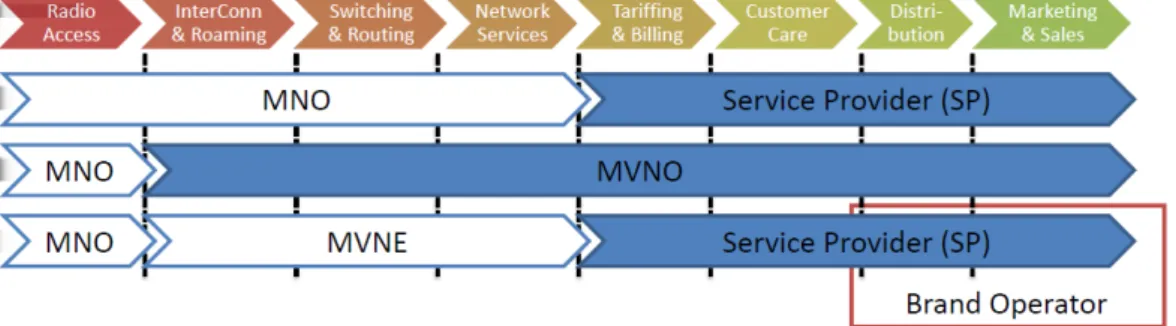
• Operations with non-telecom business (must have strong brand) Mobile network operators have classifications based upon their area of functioning across the telecom services systems and processes. MNO has ability to control the whole value chain as it owns all or most of the systems and processes across the mobile telecom service provider value chain. MNO can rent their systems, network and services to other participants in the value
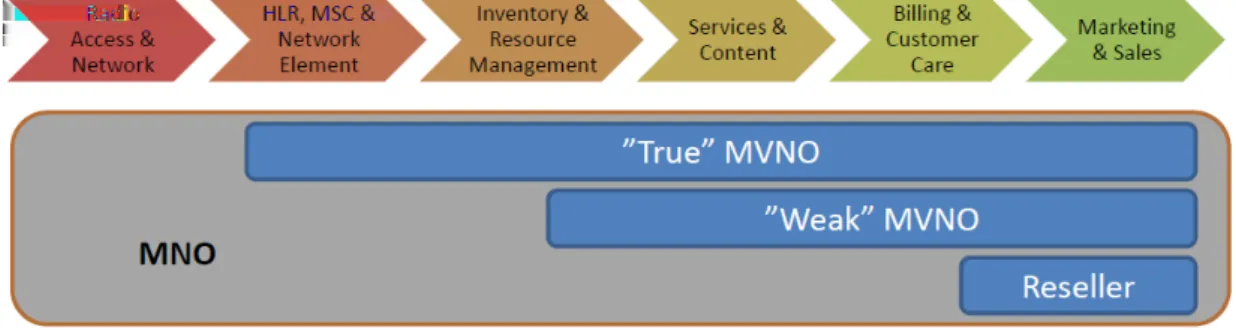
Figure 2.1: MVNO Positioning
chain based upon the contracts or agreements [8]. MVNO and MVNE buy network capacity from MNO while paying the network usage cost on pay-as-you-go manner. MVNO further provides services to the end-users owning billing and marketing systems. MVNE sells network capacity and services [48] to service providers and in some cases to MVNOs. Service provider sells services to the end-users and in some cases it focuses solely on marketing, branding and reselling the services i.e. Brand Operator. Fig. 2.1 shows the classification and positioning of network operator types in mobile network service providers value chain.
MVNO generally owns services and content delivery, billing, customer management and marketing systems. In some cases, MVNO also implements switching and networking elements on its own to have more service fulfillment possibilities [9]. MVNO has full control in different ways over their inventory, resource management, SIM card delivery, marketing and branding systems.
Depending on the market share and financial situations, MVNO buy or implement telecom software elements for itself which differentiates it from other MVNOs. Below are the types of MVNO [30] based upon the systems it implements or owns also presented in Fig. 2.2:
1. “True MVNO” implements HLR, Switching and Intelligent Network platform on their own in addition to Services, Billing and Marketing. Such MVNO has control over service and tariff design, service imple-mentation and differentiation and service marketing as well as brand-ing.
Figure 2.2: MVNO Types
2. “Weak MVNO” implements Billing, Customer care and Marketing while sharing HLR, Switching and Services with MNO. Such MVNO has control over service and tariff design and service marketing as well as branding.
3. “Reseller” sales network services by implementing Marketing and Brand-ing. It only sales pre-packaged services while buying it from other op-erators. Usually, resellers own just marketing, branding and in some cases, customer management integrated with other operators.
On an additional note, MNO shares network capacity or radio spectrum with MVNOs and MVNO runs the similar business while selling telecom products and services to the subscriber base. This scenario generally cre-ates the competitions among MNOs and MVNOs depending on the service offerings and subscriber group in focus. MVNOs have to pay high cost to buy the network capacity from incumbent MNOs [17] and MVNOs spend the large part of their expenditure for buying the network capacity. In some cases, MVNOs pay the cost for getting the network capacity on no of existing subscribers (churn) basis and in this case, such network expenditure can be taken OPEX [57] for MVNOs.
2.2
Business Support Systems
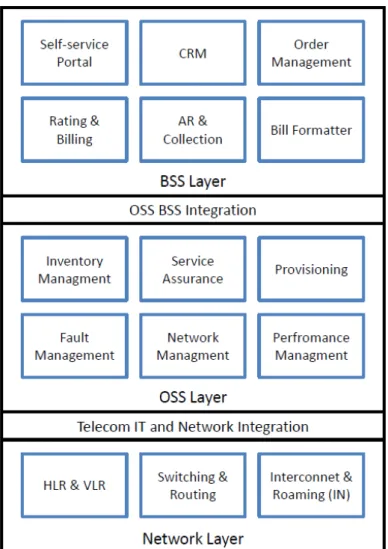
Fig. 2.3 shows the traditional architecture of telecom operator system [40] which consists of three layers:
• Business Support System (BSS) Layer
Figure 2.3: Telecom Operator Systems
• Network Layer
Along with the system layers, operator systems also include integration enablers to provide the interconnection between layers [21] which provides application connectivity and solution flexibility. Each of three layers has specific functions for the operator systems which are explained below:
1. BSS layer: BSS layer focuses towards the customer and financial transactions segments of telecom operator systems. It also manages partner and marketing functions of operator systems. The front-end operations for self-service portal for the end-users as well as for cus-tomer service representatives (CSR) are included as part of BSS. BSS
Figure 2.4: MVNO Business Support System Processes
has integrations with OSS which can be configurable.
2. OSS layer: OSS layer has systems for managing network functions of telecom operator systems. The layer is built around the products, services and resources inventory. OSS also includes several service man-agement systems and provisioning. OSS layer has complex integrations with network layer.
3. Network layer: Network layer has systems managing network in-frastructure for telecom operator systems. Network layer can manage multiple networks together with one system in place.
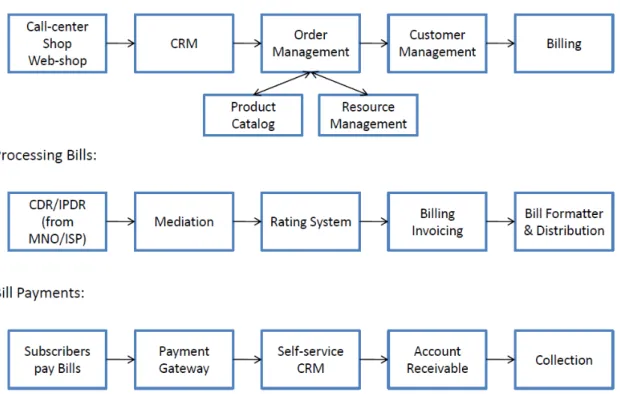
As shown in Fig. 2.4, MVNO business support systems mainly possess three processes [14] involving various BSS components or systems [29] [27] in place mainly in case of post-paid subscriptions scenario:
1. Taking subscription orders: When subscriber (end-user) wants to buy subscription from MVNO shop or web-shop; the self-service portal
or CRM comes into the picture. Subscriber herself or Customer Ser-vice Representative (CSR) enters subscriber details along with the price plan, offers and discount plan are added to the system via CRM. Order management system then processes the order made in CRM or portal getting offer related information from product catalog. Order manage-ment system then gets information of resources such as MSISDN, SIM, IMSI, Data number etc from resource management system or resource inventory. Customer management system then enters customer-specific details like one time and recurring charges of the offers to the billing system database. After successful order completion BSS informs OSS and network systems to activate the subscriber’s SIM and MSISDN. 2. Processing bills: MVNO gets the Call Details Records (CDR) from
the network operators from whom MVNO has bought the network ca-pacity or radio spectrum. Call detail records hold the information of the calls (voice and data) being made including the destination, call start and end time, duration, call type etc. Mediation system gets the CDRs as an input from different network operator systems, analyses the data and prepares data in a generalized format for the usage rating purpose. Rating system rates the calls based upon the prices fetched from product catalog. Billing system calculates individual charges both one time and recurring for the subscribers and enter the detail into the database. Bill formatter gets the data from all BSS systems to prepare the printable bills and pass it to the distribution channel further. 3. Bill payments: Subscriber pays the bill via MVNO shop or web-shop
or via online payment gateway. BSS has integration with the payment gateways to receive payments from the subscribers. Account receivable system takes care of integration with CRM as well as payment gateways and makes database entry for the payments received from subscribers. Collection system collects the data from Account receivable and bars subscriber services if payment hasn’t been made until the payment due date. Collection also informs OSS and network systems to block the network services for subscriber. After payment received for subscriber, collection unbars subscriber services again.
2.3
Cloud Environment and Architecture
According to US National Institute of Standards and Technology (NIST) [6], “Cloud computing is a model for enabling convenient, on-demand
network access to a shared pool of configurable computing re-sources (e.g., networks, servers, storage, applications, and ser-vices) that can be rapidly provisioned and released with minimal management effort or service provider interaction.”
Cloud computing [5] is a utility service for computing resources just like water or electricity where users utilize services sharing with others and paying the cost on pay-as-you-go or subscription basis. Cloud is a mixture of data-center hardware and software. Cloud provides benefits to use several server instances simultaneously for complex processing tasks. For example, large batch-processing task can be executed using 1000 cloud instances in one hour which is equivalent one server for 1000 hours.
Cloud computing provides three aspects in form of hardware virtualiza-tion point of view:
1. Illusion of infinite processing power for cloud consumers. 2. Elimination of up-front investment in buying server capacity.
3. Ability to utilize computing resources on pay-per-use model just like the utility services.
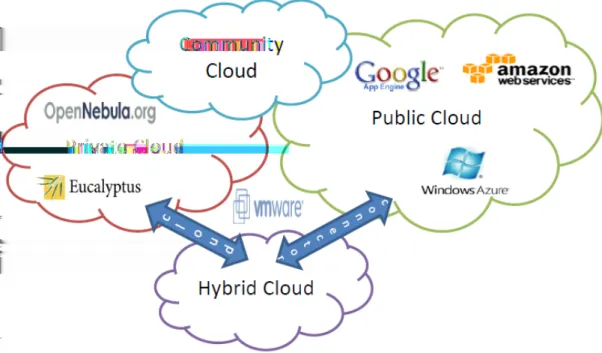
As defined by US National Institute of Standards and Technology (NIST) [6], there are four different cloud computing deployment models (See Fig.2.5) giving possibilities to use cloud deployment according to the application or system infrastructure needs:
Private cloud: The cloud infrastructure is operated solely for an organization. It may be managed by the organization or a third party and may exist on premise or off premise.
Community cloud: The cloud infrastructure is shared by several organizations and supports a specific community that has shared concerns (e.g., mission, security requirements, policy, and com-pliance considerations). It may be managed by the organizations or a third party and may exist on premise or off premise.
Public cloud: The cloud infrastructure is made available to the general public or a large industry group and is owned by an or-ganization selling cloud services.
Hybrid cloud: The cloud infrastructure is a composition of two or more clouds (private, community, or public) that remain unique entities but are bound together by standardized or proprietary technology that enables data and application portability (e.g., cloud bursting for load-balancing between clouds).
Figure 2.5: Cloud Computing Structure
US National Institute of Standards and Technology (NIST) [6] has defined three main types of cloud services models which can be used to build cloud based services or application deployments on cloud:
Infrastructure as a Service (IaaS): The capability provided to the consumer is to provision processing, storage, networks, and other fundamental computing resources where the consumer is able to deploy and run arbitrary software, which can include operating systems and applications. The consumer does not manage or control the underlying cloud infrastructure but has control over operating systems, storage, deployed applications, and possibly limited control of select networking component (e.g., host fire-walls).
Platform as a Service (PaaS):The capability provided to the con-sumer is to deploy onto the cloud infrastructure concon-sumer-created or -acquired applications created using programming languages and tools supported by the provider. The consumer does not manage or control the underlying cloud infrastructure including network, servers, operating systems, or storage, but has control over the deployed applications and possibly application hosting
Figure 2.6: Advantages of Cloud Computing Services
environment configurations.
Software as a Service (SaaS): The capability provided to the con-sumer is to use the provider’s applications running on a cloud in-frastructure. The applications are accessible from various client devices through a thin client interface such as a Web browser (e.g., Web-based email). The consumer does not manage or control the underlying cloud infrastructure including network, servers, oper-ating systems, storage, or even individual application capabilities, with the possible exception of limited user specific application configuration settings.
There are certain attributes for the cloud [14] which define the archi-tecture and related services on the cloud. These attrbitues are categorized as following while explaining how they provide various functionalities and benefits to the IT industry in general:
• Cloud Infrastructure provides virtualization of hardware resources. Cloud infrastructure is simply the virtual servers in cloud. It’s beneficial for large-processing tasks where virtualization is used to reduce time and
cost significantly. With ability of cloud to provide server instances al-most infinitely, it eliminates need to buy server resources and provide economy of scale by sharing cloud resources.
• Cloud Storage is an effective and efficient medium of storing enor-mous amount of data with pay-you-you-go service model. In this case, cloud also provides services like data synchronization, Network Attached Storage (NAS), database-like functionality and also unstruc-tured data services. Data access to large amount of data is possible anytime anywhere by using cloud storage infrastructure and services. There are certain limitations due to issues with availability, transaction support and data transfer bottlenecks in cloud.
• Cloud Platform is used to build, test, deploy, and manage applications on cloud with storage and processing power of cloud itself. Cloud platforms are low-cost, reliable, accessible anywhere anytime and highly scalable with provision of web-based services environment. Portability is an issue because as soon as applications or services start running on one cloud platform. It becomes complicated task to move systems deployed on one cloud platform to another cloud platform or back to the original platform.
• Cloud Applications provide Software-as-a-service model which further eliminates the need to install & configure applications on cloud. Along with this, it also provides cloud benefits related to virtualization & storage. Another model is S + S (Software + Service) on cloud in which cloud hosts use rich client applications interface into an extremely hosted environment with ability to work in offline mode and synchronize data when online.
• Cloud Core Services provide customer services such as service-to-service integration, payment, billing services, identity management, search, business process management services etc which can be consumed in-dividually or on system to system integration basis.
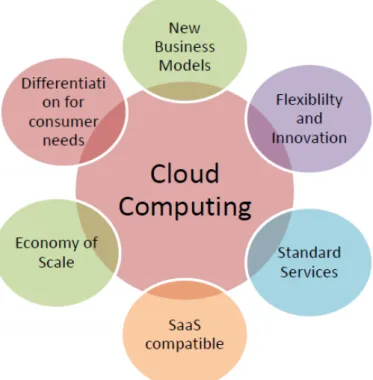
Cloud computing provides several technological and business related ad-vantages as presented in Fig.2.6. Cloud can provide different deployment services models as described earlier. So in a way; cloud can provide anything as a service including infrastructure, platform, software etc. New models like Software + Services provide use rich client application hosted on cloud and an interface to work with such application. Cloud provides different archi-tectures as well as deployment service models and by using them it’s possible to drive resource cost disruption and delivery innovation.
Cloud provides several standard services [4] which are also known as core cloud services mentioned in one of the cloud attributes earlier. These services enhance the functionalities at customer end and provide tools to monitor cloud usage, activities, performance, transaction etc. Different cloud services and deployment models also provide differentiations as per customer needs and they help in changing end customer behavior patterns.
It’s important for any platform to generate complementary products and services to achieve network externality and positive feedback [33] in the mar-ket. Cloud has ability to be flexible because of the virtualization and the storage platform it provides. Along with different service delivery models, it’s possible to innovate different services and products [18] by using cloud platform. Also the economy of scale is easily achievable due to the fact that cloud provides an illusion of infinite hardware resources for processing complex tasks and storing large amount of data.
New business models like flat rate pricing, pay-per-use can be established successfully using cloud architecture. Also it’s possible to cut the CAPEX completely or partly for any company by using cloud services cleverly and along with it, cloud drives reduction in the OPEX sharing computing re-sources with others [63]. This way cloud helps future business architectures in transition.
2.4
Existing Scenario with Telecom Systems
on Cloud
Cloud in Telco is believed to be a new consumption and delivery model [11]. Cloud implementation in Telco provides benefits like;
• Economy of scale: Cloud provides very flexible architecture of using computing and storage resources on utility basis only when required. Cloud is an illusion of infinite for hardware resources available on de-mand for complex processing tasks and large data storage. This was it’s possible to achieve economy of scale for telecom systems whenever needed. In telecom systems, many systems have peak load of user traf-fic at particular hours in a day and cloud gives flexibility to utilize IT resources catering to any amount of peak load when necessary.
• Resource sharing and centralization: Cloud eliminates the need of in-dividual IT hardware and software resources where it provides pos-sibility to run the systems at one centralized location and users can share software and services by web-based clients. The SaaS and S +
S models mentioned in section 2.3 can be utilized here for sharing re-sources. Cloud also provides sharing possibilities which is useful to consume ideal resources from other system for processing tasks or let other systems use ideal resources. This is possible in case of telecom IT systems including self-service portals, CRM, billing systems and other individual IT resources.
• Cost reduction: Cloud has business model of pay-per-use payments which gives possibility to let machines go when they are out of quirement. Cloud also gives option to start with small amount of re-sources and increasing resource utilization further when there is a need. This elastic attributes make cloud a strong candidate to reduce telecom CAPEX and OPEX.
• Cloud services to enterprises and consumers: Cloud is relatively new business phenomena in the market which gives telecom operators a possibility to innovate and introduce new cloud based services to the consumer and enterprise market. Also telecom operators can using the network, branding image and marketing channels to sale cloud based offerings to the consumer market.
In the current scenario, Major Telcos are more focused on the providing cloud computing services rather than implementing their systems on cloud computing platforms [10]. The main reason behind this is the critical SLA re-quirements defined for telecom systems and services especially in OSS area. Service Level Agreement or SLA is an important requirement as well as parameter for telecom systems delivering various telecom carrier-grade ser-vices. SLA is a document that specifies the rules of legal contract between subscribers and service providers also stating technical performance details. In telecom industry, SLAs are critical and often regulated by government. Telecom vendors and operators often claim that clouds cannot yet meet the telecom Service Level Agreement (SLA) requirements [45] [26]. For that rea-son a cautious approach is recommended. According to that a three step roadmap depending on the carrier grade requirements is proposed as shown in Fig. 2.7. Firstly, operators can utilize clouds in their support systems, then step into tactical systems and finally to strategic systems [66].
Telecom systems have functions and services that are being implemented on cloud by several operators, service providers and software vendors. The possible scenario of cloud implementation of telecom software and services [45] is depicted in Fig. 2.8.
Cloud implementation for telecom systems vary as per the application features and attributes. There are different patterns [35] to deploy telecom
Figure 2.7: Cloud Implementation of Telco Systems by Carrier Grade Require-ments, adapted from [45]
systems on cloud using utility based services model. Cloud implementation for telecom software and services [22] can be divided into three categories mentioned below, considering the model as one of the possiblities to deploy telecom systems on cloud:
1. Infrastructure-as-a-service (IaaS):Telco operators store large amount of customer data ranging from network usage, billing data, marketing data and customer specific details. Cloud provides efficient medium to store data which can be utilized further for the processing on cloud computing environment. Processing of xDRs (CDR and IPDR), billing system and business intelligence platforms require large amount of pro-cessing and cloud infrastructure provides cost beneficial platform for this. Networking especially I/O operations among IT systems on cloud provides performance optimizations for these system operations. 2. Platform-as-a-service (PaaS): Cloud provides a platform to deploy
BSS/OSS or part of these support systems on cloud to drive cost-benefits and better performance. Along with this economy of scale is important for these systems as to possess ability to tackle situations with support system operations on special events for e.g. New Year’s Eve generate large amount of SMS traffic and a significant delay has been seen in such cases. Cloud provides a platform to process extra amount of data without buying permanent resources.
Figure 2.8: Telecom Cloud Offerings
3. Software-as-a-service (SaaS):Cloud is used to deploy service deliv-ery platforms and enterprise applications thus providing software-as-a-service with cost-benefits and economy of scale. A good example is salesforce.com which provides online CRM service on cloud for enter-prises.
Public and private both cloud architectures could be used along with the mixture of both of them i.e. hybrid cloud. Telco and several other generic APIs are used as connectors between cloud and Telco domain.
2.5
Application Mapping and Finance
2.5.1
Application Mapping
Application mapping [14] is important as not all application can be hosted on cloud or developed on cloud architecture or migrated to the cloud. It will be important to answer questions before implementing or migrating applications on cloud:
• Will the application run successfully on cloud?
• Will it be possible to migrate existing application to cloud successfully without any impact?
• Could new functions or applications be developed on cloud without adding complexity to the integration?
• Will migration on cloud architecture be cost-beneficial?
Answers to the above mentioned questions may not be the same for all ap-plication as the answers depends on several attributes of apap-plication which will be mapped to the cloud. Each application solves a purpose and de-pending on the purpose application can be mapped to different attribute, for example, Billing and Order Management system have attributes such as transaction, locking and integration with other external systems. Two approaches shall be taken into consideration to decide whether to move ap-plication on cloud or not:
1. Identify the application attributes and key factors important for ap-plication to work seamlessly on cloud. Map these attributes to the cloud service attributes to validate if cloud implementation for that application will be feasible or not.
2. Evaluate cloud services providers to see if application or system at-tributes are matched can be hosted feasibly along with cost-benefits gained from the implementation.
Based upon the common theories; several MVNO systems can be put into the cloud computing environment such that the service delivery, customer management and telecom carrier grade requirements are least affected. As presented in Fig. 2.9, resource inventory, Services & content delivery, Billing & customer care systems [18] [15] are the viable candidates to move MVNO Telco systems to Cloud. MVNOs can share such systems on cloud with each other which ultimately leads to higher cost-benefits for the MVNOs. However, the analysis and evaluation shall be done for these systems or applications to find out if they are actually the viable candidates for the cloud implementation. The thesis analysis for application is done in section 4.1 taking results of action research into consideration.
A Common Cloud Business Management platform [51] can be built for MVNOs which can provide:
Figure 2.9: Possible MVNO Applications Mapping on Cloud
• On-demand platform to deliver services as well as related content
• On-demand run for the billing system
• Hosting resource inventory and large customer database
2.5.2
Finance
Network operators focus on maximizing their profits from the subscriber base and relative ARPU (Average Revenue per User) [50]. The basic calculation for network operator profit can be presented with the below equation [30] :
P rof it=ARP U ∗Subscribers−OP EX−CAP EX (2.1) Where;
• ARPU = Average Revenue per User includes roaming and termination apart from the revenue billed from subscribers. To maximize profits, network operators try to increase the usage of the services and offerings by providing more and better products.
• Subscribers = Number of subscribers including existing subscriber base and target subscriber base for the period of profit calculation. To maxi-mize profits, network operators try to maintain existing subscriber base (churn) and acquire new subscribers by service or price differentiations.
Figure 2.10: Cost Analysis Parameters for MVNO Cloud
• OPEX = Operational Expenditure which includes administrative cost, marketing and branding expenses as well as expenditure on human resources.
• CAPEX = Capital Expenditure which includes network setup, equip-ment, licenses expenditures. In case of MVNO, fees to the MNOs for network usage can be taken as CAPEX. Network operators generally split up the CAPEX to be covered in the course of 2-5 years of their operations.
While implementing MVNO systems on the cloud, CAPEX and OPEX are the most affected factors in MVNO profit calculations. It’s obvious from the profit calculation equation that as we decrease CAPEX and OPEX for MVNO, the profit increases. So while analyzing the cost for MVNO systems’ migration to the cloud, CAPEX and OPEX are very important parameters to be considered [11]. Along with CAPEX and OPEX, several additional Non-OPEX parameters as well as opportunity gains should be taken into consideration as well. Fig. 2.10 presents cost analysis parameters and related components while implementing MVNO systems on the cloud.
1. CAPEX: CAPEX is a capital expenditure required by telecom opera-tors to spend while building the new systems or infrastructure. Devel-oping or migrating existing applications to the cloud requires spending expenses for enhancements in applications. Cloud deployment and in-tegration requires expenses for setting hybrid or private cloud infras-tructure and integration among systems.
2. OPEX: When hybrid or public cloud comes into the picture, the ex-penditures shall be counted as operational exex-penditures. Cloud related OPEX includes per unit charge for processing, per GB charge for stor-age and high bandwidth network charges.
3. Non-OPEX: Carbon taxes, VAT and other surcharges shall be taken into account as non-OPEX charges and shall be counted in the cloud cost calculations.
4. Opportunity Gain: By using cloud, there are benefits gained apart from cost reduction as well. Shorter time-to-market [39] and optimum use of hardware resource driven by cloud elasticity shall be taken as opportunity gained via cloud.
Action Research
3.1
Action Research Methods
Action research [42] is done for real situations and real organizations sug-gesting improvements at the end as a result. Action research is an important method as it consists of actual practices, data and results. In action research researchers and practitioners come together. Problem finding, action analysis and result reflections are important in action research.
For information systems, action research serves as an important process where current situation analysis will find problems. Action intervention will prepare the solution while designing, developing and implementing it along with reflective learning which analyzes the collected data and discuss lessons learned from the analysis. Researchers take tasks such as analysis, interviews, team support, observations, findings and result publishing. One another important aspect regarding industry or area specific action research is that research helps industry and institutions to understand the problem situation while tackling down the resolution for the problem.
The role of action researcher is very important for practicality of the research. Researcher should be neutral to the situation while collecting as well as analyzing details and data related to the situation. Researcher should take a look at both positive and negative aspects of the data or evidence for the situation. Researcher should set himself free of any perception or biased opinions he has regarding the situation. Also sensitivity is another aspect to be taken care of by the researchers to respond to delicate distinctions of data.
3.1.1
Action Research Setup
To setup the action research project, there are certain steps need to followed in order to get correct results. These steps are defined as following:
• Problem Diagnosis: Find a practically relevant problem which also has research potential. Obtain a general and comprehensive understanding of the topic.
• Action Intervention: Develop and define action research methods and the research setup. Conduct the research and analyze the results.
• Reflective Learning: Derive final results while gathering them from all sources of research evidences. Build the report and documents repre-senting the research objectives.
3.1.2
Qualitative Data Analysis
Qualitative data analysis [42] focuses on relatively small samples selected purposefully. Logic and power of purposeful selection derives from the em-phasis on in-depth understanding of the research topic. Sample size depends on what you want to know, what will be useful, what will have credibility, and what can be done with available time and resources. It’s also impor-tant to know if the sampling strategy supports study purpose. The validity, meaningfulness and insight gained through qualitative data analysis have more to do with the information richness of the cases selected and observa-tional/analytical characteristics of the researcher than the sample size.
Three principles are defined for qualitative data collection: [62]
• Use multiple sources of evidence
– Triangulation of data sources (data triangulation)
– Triangulation among investigators (investigator triangulation) – Triangulation of perspectives to the same data set (theory
trian-gulation)
– Triangulation of methods (methodological triangulation)
• Create a cases study database
– Case study notes, documentation
– The principle is to allow an external observer (reader) to follow the derivation of any evidence, ranging from initial research question to ultimate case study conclusions.
Six sources of evidence are supported for the qualitative data analysis: [62] 1. Documentation 2. Archival records 3. Interviews 4. Direct observation 5. Participant observation 6. Physical artifacts
Three kinds of qualitative data can be taken into consideration derived by following action research methodologies: [42]
1. Interviews 2. Observations
3. Documentations/Literature Reviews
The main method of research in this thesis is supported by Delphi process which involves all of the above mentioned methods. The expert interviews are the most important method which is involved in the thesis action research and therefore this method is described below in detail.
3.1.3
Interviews
Interviews [62] are considered as one of the very effective method of qual-itative data research where expert opinions and practical knowledge of the interviewees help forming the qualitative results. The basic strategy for the interview is to gather multiple sources of evidences, create case study like database and maintain chain of evidences. During the qualitative data anal-ysis involving interview as primitive method of analanal-ysis, there are certain points to be considered. Planning for the interviews is the first step in which the data collection techniques should be linked to research questions. Goals for the interview analysis should be defined afterwards keeping interviews within the scope of the topic and not forgetting the sensitivity. Formulating
interview questions is an important part to have neutrality and address right topics throughout the process. Validation by testing / piloting the questions for interview is necessary to make sure the quality of action research.
Techniques such as audio-visual recording and note taking can be em-ployed to collect the interview responses. Identifying interviewees is also important where interviewees can be an individual or part of research / fo-cus group. Format of questions decides the structure of the interview and responses. Questionnaire can be survey based, structured, Semi-structured, thematic or open depending on the research requirements. Order of ques-tions is essential to derive and formulate the results. Response types can be selection from predefined choices, quantity, and frequency. Open ques-tionnaires often have responses in interviewees’ own words including their opinions, explanations etc. Interview can be in format of an open discussion among interviewees in focus groups and interviewer herself. It’s sometimes meaningful to also note the noticing pause, hesitation, laughter, defensive excuse from interviewees.
3.1.4
Delphi Method
Delphi method [49] is an iterative process to collect and filer out the anony-mous opinions from the group of experts or customers or researchers using the data collection tools and techniques interwoven with the feedbacks and intermediate result analysis.
The goal of Delphi research is to improve understanding of the problems, processes, future prospects, opportunities, solutions, ideas or to develop fore-casts. Classic Delphi method varies by the group size, question formats, data collections processes as well as tools and techniques involved in the research [47].
Some of the important aspects of Delphi method are described as below:
• Anonymity of interviewees or participants
• Iteration and feedback mechanism
• Result aggregation of the responses received
The basic structure of classic Delphi method is described in Fig. 3.1: The classic Delphi method involves steps [49] described below in brief: 1. Develop the Research Question
Figure 3.1: Delphi Method in Research Environment
3. Research Sample
4. Develop Delphi Round One Questionnaire 5. Release and Analyze Round One Questionnaire 6. Develop Round N Questionnaire
7. Release and Analyze Round N Questionnaire 8. Verify, Generalize and Document Research Results
Based upon the above described method the expert interview setup method for the action research in this thesis has been derived. In the exit interview setup for this research, two rounds have been considered following the steps described in this section. The exit interview setup and also the steps for the Delphi method involved in the setup are described in detail in next section.
3.2
Expert Interviews Setup
The expert interview setup is based on the Delphi method described in the last section. This setup includes two interview rounds of interview where first
round is done with the broader questions and scenarios while in the second round questions are narrowed down with research specific data gathering scenarios only. Fig. 3.2 describes the process flow of the expert interview setup derived from the Delphi method.
1. Develop the Research Question: The research question was derived in this research with help of the instructor and supervisor. Instructor’s and researcher’s own industry experience helped with research problem formation and inputs were also taken from the research program in which thesis acts as part of the study. The literature reviews and pilot studies done as part of the research program helped to formulate the research background. Research questions were then derived from main research problem and narrowed-down further to attain the research targets. Research objectives were defined which denotes what research goals will be achieved as part of the thesis research.
2. Design the Research: Research design is defined to plan the research on micro level while reviewing different research methods taking their pros and cons into consideration. The qualitative data analysis was selected as a method of research with the expert interviews as a primary technique of analysis for the thesis research. Research proposal was then developed to formalize the research process and propose the idea to the potential experts participating in the interview.
3. Research Sample: Selecting the participants for the Delphi process is important as Delphi method considers the opinions of interviewees as the expert opinions. Experts for the thesis research were selected with focus on both technical and financial side of the telecom software industry. The experts were from various telecom operator companies, telecom software vendors, companies dealing with MVNO business pro-cess outsourcing and researchers from universities dealing in the MVNO and telecom software domain. The research proposal was sent to the experts for the interview considerations. Total 9 experts from 6 differ-ent companies and institutions considered the request and took part in the research.
4. Develop and Conduct Delphi Round One: Delphi round one is developed while doing literature review [66] [55] [29] with the broad questions explaining the background and introduction of the research. Round one questionnaire in the thesis research was semi-structured which included open questions for discussions and structured questions which include multiple-choice answers taking the reasons for the choice
Figure 3.2: Expert Interview Setup Scenario
into consideration. Questions were validated by the instructor and questionnaire is modified taking the instructor’s feedback into concern. Round one was organized as face-to-face interviews so that discussions are possible with the experts. Interview responses were recorded and notes are taken down to analyze the responses further.
5. Release and Analyze Round One: Intermediate responses were collected from the Delphi round one results and analyzed to get the common answers to the questions. Results were formatted for both open and structured question-answers.
6. Develop and Conduct Round Two: Questionnaire for Delphi round two was structured questionnaire narrowed-down for the thesis specific analysis of application mapping and finance related to MVNO systems. Feedback was added from the round one so that experts get the com-mon opinion and responses considered by the other experts.
7. Release and Analyze Round Two: Round two responses were col-lected from the responses got for the structured questionnaire and an-alyzed to modify the round one response where it was necessary.
8. Verify, Generalize and Document Results: The results were ver-ified further with all the responses received from the experts in both rounds of Delphi process. Results were then generalized where com-mon results were taken together and differences were marked and docu-mented as well. Further analysis was done and docudocu-mented in following section based upon the interview results.
3.3
Interview Responses
3.3.1
MVNO Systems
Question:
How does MVNO system work? (The main focus is on Business Support Systems). What are the integral parts of the system? Please explain the architecture in brief. Also explain MVNO business and operations in brief.
Response:
When setting up the MVNO, the first question need to be answered at initial stage is “why to setup MVNO?” It generally takes 50-150 million euros to setup a small to medium size MVNO. MVNO start-up decisions are made based on the calculations of ARPU it will receive and no of subscribers in nearly 2 years (called break-even point). Most MVNOs target to capture the market as fast as possible and then make an exit (to be sold out). MVNOs mainly work on service and price differentiation where time to market is important due to fierce competition in the market. MVNOs should define at initial stage whether they are a Telco, Media company or Media partner. Some MVNOs also work as mobile advertisements aggregators.
Fundamentally MVNOs operate exactly the same as MNOs. Most oper-ators have split their internal structure in three parts:
1. Customer relations and services, branding, marketing
2. Service layer includes product management, pricing, service manage-ment
3. Network, infra management, radio, network management
MNOs possess BSS systems and also network related systems i.e. OSS and they have their own pricing structures for the products and services they offer. In traditional MNO, IT systems are very complicated called legacy jun-gle but MVNO do not have such complex systems and also integration bur-den to replace the systems. MVNOs want to have bare minimum interface. They buy network (the lower layer) from MNO or MVNE and implement
or outsource service and customer layer in from of managed services. Fig. 3.3 shows the layer wise telecom systems classification especially for MVNO environment settings.
In MVNO case, MVNOs can possess BSS and sometimes OSS systems too. MVNO do not have much OSS but mostly they have CRM and self-service and in some case the whole BSS. Billing and rating systems are lighter in MVNO case than traditional systems. MVNOs have small and limited in house CRM system. Ordering has to be integrated with MNO provisioning system as well as debt collection systems.
MVNO may use their own billing systems where they get CDRs from other operators or they can use network operator owned MNO owned billing systems. They can also outsource the billing or managed services as a whole. MVNO might even consider taking all systems from other providers and in this case, MVNO not only rent network but also outsource billing and CRM systems. However, MVNOs would like to retain branding, campaign management, resell marketing systems and operations to themselves.
It has been seen in some cases of MVNOs across Europe that when MVNO are small they want to outsource or rent everything but when they get bigger they start investing and implementing some systems. MVNO doesn’t really own radio network but they might own some network elements. MVNOs might have switching and other network systems along with billing systems. In case of prepaid, MVNOs use MNO network but own CRM system. They might have some elements under CRM dealing with real time charging and network systems.
Branding building, distribution and cost factors are very important for MVNOs. In case of MVNO, communication services can never be as better as MNO. MNO provide raw material and MVNOs rebrand and distribute it to potential customers. Some MVNOs sell mobile and customer related marketing data to generate revenue while providing discounts to the end-users.
MVNO can be run by 5-10 people working in area of sales, branding, mar-keting, product management, distribution, partner management. For exam-ple, an MVNO Tele Finland started with only 5 persons organizing it several years ago. The managing director, marketing director, business controller and two other consultants managed the MVNO. They used only outsourced resource not TeliaSonera IT processes. The idea was to build operator inde-pendent environment to offer other services as well. They wanted to service for other parties as well than TeliaSonera. They outsourced billing systems to star cell now Qvantel. Tele Finland didn’t have any systems managed by them but all systems were outsourced.
Figure 3.3: Layer wise cloud deployment possibilites in Telco
MNO and other partners. MVNO collaborate among partners to whom cer-tain tasks have been outsourced. Service integration is also very important for MVNO especially integration with MNOs and other partners in business. MVNO need to choose the focus group or target customers while mov-ing towards smaller segments of the market. They need to be much more focused but the question is whether to focus on retail or enterprise sales. Differentiation strategy creates base for MVNO strategy. Demographic, ser-vice, product, pricing differentiations can be adopted by MVNO. For exam-ple, an MVNO can target Russian speaking callers in Finland by providing inexpensive calls to Russia. Some MVNOs also target niche markets of tele-com services. For example, TeliaSonera targeted corporate customers during initial stage with high quality of services by charging premium prices to cus-tomers. MVNOs focus mainly on post-paid residential market, so subscriber hierarchy is simple. They need to focus on only one market at a time or at a place. MVNOs can provide bundle solutions along with voice and data services. In case of bundle solutions partner management is also important for MVNO. Price differentiation is easy for MVNO but service differentiation is limited due to dependency of OSS and network system on MNO. Most of the MVNOs are price sensitive and keep ARPU at low level as to do effective price differentiation. They have low cost and agile operations in place to
reduce OPEX. MVNOs work on price differentiation and tend to have happy customers along with higher KPI. They have their own pricing structures for the products. Subscribers win due to lower prcing mechanism but telecom industry suffers because of high system administration cost. Telco industry is a challenging business to be in due to fierce competition and so MVNOs always look for additional revenue streams.
In recent years, it has been observed that MVNOs outsource as much as possible because their operations are not about system but they are all about the business. MVNOs don’t care about system architecture and its implementation. They just care about quality, branding, cost-benefits, SLA agreements and customer satisfaction as well as retention. MVNOs use Busi-ness process outsourcing. BusiBusi-ness process outsourcing in telecom domain provides BSS as a service but it’s not Software-as-a-Service as there are cus-tomizations done for every telecom operator systems according to customer needs.
MVNOs need lean business operations, business process outsourcing and very effective as well as efficient systems and operations. MVNOs follow rapid service delivery, development and marketing and so they need very agile framework to support it. For MVNO to work there is no need to have own processes, large organization and just by outsourcing it is possible to run MVNO. Outsourcing is possible even outside the country but data security and legal issues are critical.
MVNO do not invest on network so capital spending is low and they rent network on pay-per-use or fixed monthly fees. CAPEX is low for MVNO. They invest to get customer base and volume in the market and define thresh-old to acquire customer base. MVNOs want to have good discount as to get volumes. They are getting the network capacity from already existing play-ers so it’s regulated and competition is fierce for MVNO. MVNO pay some fixed fees and also fees per subscriber. Subscriber churn is high in European market around 20% and that makes churn very expensive for operators. For MVNO, more you are dependent on MNO more challenges you have on dif-ferentiation side. Since MVNOs introduce competition in market, MNOs don’t want to give network capacity to MVNOs very easily.
Telecom network infra providers (MNO) rent the radio spectrum to other MVNOs with high rates as they will face competition from those MVNOs in future. Telecom network infra providers have lower rates for their own operators, service providers.
Table 3.1 presents a situation in past with finnish telecom operator in-dustry. There are several MVNO examples given below which were discussed during the interviews:
![Figure 2.7: Cloud Implementation of Telco Systems by Carrier Grade Require- Require-ments, adapted from [45]](https://thumb-us.123doks.com/thumbv2/123dok_us/9581410.2444059/30.892.261.639.201.464/figure-cloud-implementation-systems-carrier-require-require-adapted.webp)