ISSN(Online): 2320-9801
ISSN (Print): 2320-9798
I
nternational
J
ournal of
I
nnovative
R
esearch in
C
omputer
and
C
ommunication
E
ngineering
(A High Impact Factor, Monthly, Peer Reviewed Journal)
Website: www.ijircce.com
Vol. 7, Issue 5, May 2019
Feasibility of Implementing Multi-Factor
Authentication Schemes in Mobile Cloud
Computing
Miss. Nikita Borade1, Prof. Dr. J.R. Prasad2
PG Students, Dept. of Computer Engineering, Sinhagad College of Engineering, Pune, India
Professor, Dept. of Computer Engineering, Sinhagad College of Engineering, Pune, India
ABSTRACT: Previous technology is major challenge in cloud and mobile cloud computing is to ensure security and privacy of users personal information (e.g., financial data, health record, location information) from malicious attacks. It is important for a cloud service provider (CSP) to establish trust and gain confidence by providing proper security and privacy to the clients. Authentication is important for establishing accountability and authorization of the users while allocating cloud resources. In this system, we discuss different authentication techniques proposed method is knowledge based and location based. In the knowledge based module the username and password is required for user authentication. In Location based module if user is accessing a file within particular geographical location then only user can access files otherwise not. We categorize the algorithms based on its input, i.e. the credentials required for validating users. However, we emphasize that the classification is not precise, as it is difficult to classify the authentication algorithms relying on more than one user credentials (multi-factor authentication). The proposed authentication process is more efficient, secure and user friendly.
KEYWORDS: Cloud Computing, Mobile Cloud Computing, Multi-factor Authentication
I. INTRODUCTION
Mobile and handheld devices are constrained due to resource limitations primarily caused by limited battery life requiring recharging, constrained size of memory or limited power of the processor especially during roaming and challenge of being seamlessly connected throughout mobility or even limited size of physical persistent storage. Execution of high computational tasks in a mobile device may also drain the battery power very quickly. To address these limitations of mobile devices, cloud computing can be an obvious choice, this means that mobile users offload processing intensive and storage demanding portion of mobile application from resource constraint mobile device to resource enriched cloud. The offloading of the processing intensive and storage demanding portion(s) of mobile application enhances the capabilities of mobile devices in term of processing, storage, and battery.
II. LITERATURE SURVEY
In this Paper system proposes a location-aware attribute-based access control scheme for cloud storage, in which the location information is flexibly set as trapdoors inside fundamental access policies of CP-ABE, and trapdoors are released with the help of location servers. The trapdoor approach makes that the change of users’ locations will not cause revocation of users’ attributes. Our analysis shows that the above approach is effective and our proposed LABAC brings little overhead to data consumers, attribute authorities and the cloud. [1]
ISSN(Online): 2320-9801
ISSN (Print): 2320-9798
I
nternational
J
ournal of
I
nnovative
R
esearch in
C
omputer
and
C
ommunication
E
ngineering
(A High Impact Factor, Monthly, Peer Reviewed Journal)
Website: www.ijircce.com
Vol. 7, Issue 5, May 2019
applications to be mobile cloudy. We tried to prove that this technology will conquer the challenges and the problems of preceding technologies. Mobile cloud computing models are presented. These models try to alleviate the problems concerning the limited resources in mobile devices. Despite the enormous development of mobile devices and the support of mobile cloud computing to mobile devices, they still take a lot of attention of researcher because a number of challenges encounter this technology. We are interested to work in this domain and, for future research; we will concentrate on its challenges and explore it deeply. [2]
In this paper, we have undertaken a systematic literature review of mobile cloud computing (MCC), in order to understand the trend of research interests so far in MCC, in terms of the least and most researched issues. We were able to highlight some of the challenges in MCC such as privacy, security and trust, fault tolerance, mobility management, network congestion, heterogeneity and connection protocols, resource constraint and platform heterogeneity, context awareness, presentation and usability issues, battery life and energy awareness, and cloud API Security Management. [3]
In this paper, we tend to propose a unique authentication theme for mobile cloud computing, Data Digest-based Authentication consists of 3 phases: registration, authentication, and update. With these phases, Data Digest Authentication utilizes hashing, additionally to traditional user id and secret primarily based authentication, to make sure confidentiality and integrity throughout the authentication method. It can survive a range of various attacks, like man-in-the-middle, replay attacks, etc. [4]
Cloud computing is the present and futuristic resource pooling paradigm which converges with the Internet of Things (IoT). However, there are authentication and key management issues to be resolved. Identifying users is not an easy task in cloud. As a result in this article we proposed a provably secure multi-factors authentication scheme with trusted third party. In our approach, trustee distributes the authentication tokens on behalf of cloud service providers and allows the cloud servers just to verify the hashed key credential data. This approach also ensures the mutual authentication of the communication entities. We used multi-party station to station Diffie-Hellman key exchange protocol which overcomes many key management problems. Our proposed mechanism preserves the privacy of the remote authentication details in the cloud and significantly helps to protect the stakeholder’s sensitive information from the inside and outside malicious attackers. [5]
III. EXISTING SYSTEM
In the existing system several challenges, including security and privacy are raised from the adoption of this IT paradigm. A major challenge in cloud and mobile cloud computing is to ensure security and privacy of users personal information (e.g., financial data, health record, location information) from malicious attacks. It is important for a cloud service provider (CSP) to establish trust and gain confidence by providing proper security and privacy to the clients.
IV. PROPOSED SYSTEM
ISSN(Online): 2320-9801
ISSN (Print): 2320-9798
I
nternational
J
ournal of
I
nnovative
R
esearch in
C
omputer
and
C
ommunication
E
ngineering
(A High Impact Factor, Monthly, Peer Reviewed Journal)
Website: www.ijircce.com
Vol. 7, Issue 5, May 2019
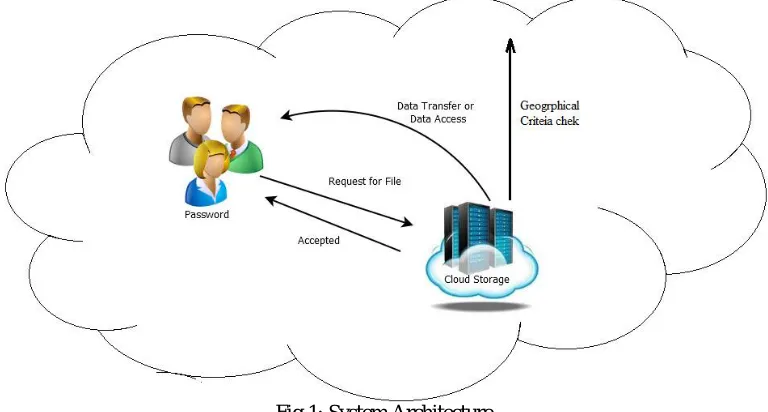
gathered from all the mobile devices that are participating to solve the problem of processing power and limited storage.
Fig 1: System Architecture
V. ALGORITHM
Algorithm 1: AES Key Expansions
For each round AES requires a separate 128-bit round key block plus one more. Initial Round
Add Round Key with a block of the round key, each byte of the state is combined using bitwise XOR. Rounds
Sub Bytes in this step each byte is replaced with another byte.
Shift Rows for a certain number of steps, the last three rows of the state are shifted cyclically.
Mix Columns a mixing operation which operates on the columns of the state, combining the four bytes in each column. Add Round Key
Final Round (no Mix Columns) Sub Bytes
Shift Rows
VI. RESULT
The system has been developed in java. Each entity is tested by deploying them on individual machines. The cloud, Owner, AA, CA and Observer deployed on core I3 processor with 4GB RAM. Client system uses I3 processor with 2GB RAM. JRE-1.8 is installed on each system. The system used jdk 1.7, IDE: Netbeans 8.2 and Adrive cloud for development. Mysql 5.3 database is used for database storage. For implementation of the system users business structure has been followed. The system user’s structure along with designation given below:
• Consider a situation, where a user wants to share his/her data with manager and developer of branch 1 and 2 and to generate keys following attributes will be required.
ISSN(Online): 2320-9801
ISSN (Print): 2320-9798
I
nternational
J
ournal of
I
nnovative
R
esearch in
C
omputer
and
C
ommunication
E
ngineering
(A High Impact Factor, Monthly, Peer Reviewed Journal)
Website: www.ijircce.com
Vol. 7, Issue 5, May 2019
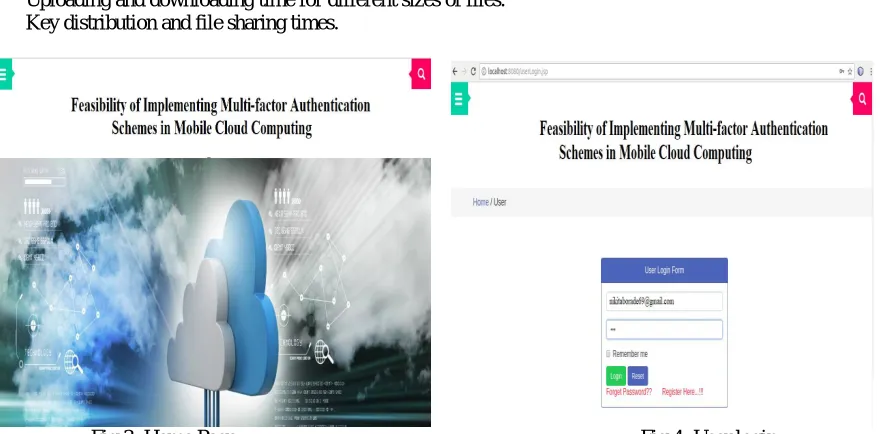
Fig 2: Work Break-Down Structure
Table: Performance Analysis
• The system calculated time needed for key generation. For 10 users the average time needed is 30 mili Seconds. The system is working on secret key distribution and its management. Finishing the complete system implementation, the system will evaluate its performance with
• Uploading and downloading time for different sizes of files. • Key distribution and file sharing times.
ISSN(Online): 2320-9801
ISSN (Print): 2320-9798
I
nternational
J
ournal of
I
nnovative
R
esearch in
C
omputer
and
C
ommunication
E
ngineering
(A High Impact Factor, Monthly, Peer Reviewed Journal)
Website: www.ijircce.com
Vol. 7, Issue 5, May 2019
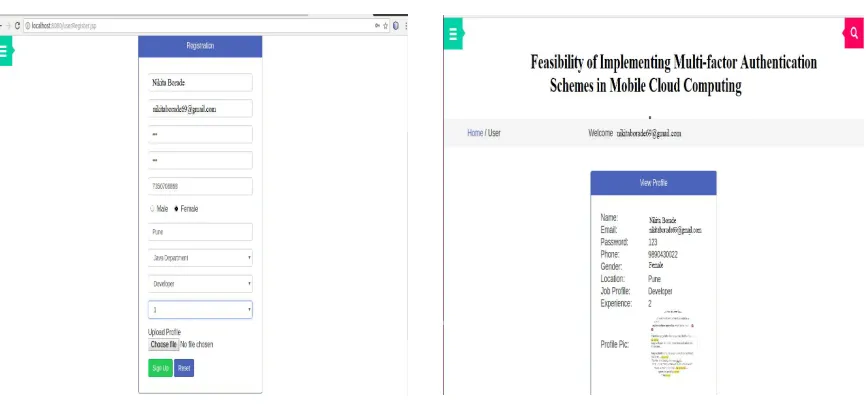
Fig 5: User Registration Fig 6: View Profile
VII. CONCLUSION
This system proposed an authentication mechanism in mobile cloud computing with combining the two factor authentication and one time dynamic password called OTP token that suitable for mobile device. The generated token is based on geographical location system. To protect user confidential information, data should be accessible to authenticated people. To gain this aim, different authentication methods are proposed. In multi-factor authentication, more than one authentication factor is used. However, this kind of authentication offers better security and privacy. The proposed scheme provides a fine-grained, robust and efficient access control with one-CA/multi-AAs for public cloud storage. This scheme employs multiple AAs to share the load of the time-consuming legitimacy verification and standby for serving new arrivals of users requests. It has been proposed an auditing method to trace an attribute authority’s potential misbehavior. It has been conducted detailed security and performance analysis to verify that this scheme is secure and efficient.
REFERENCES
[1] Yingjie Xue, Jianan Hong, A Location-aware Attribute-based Access Control Scheme for Cloud Storage.
[2] Erlangung des doktorgrades, Biometric cryptosystems: authentication, encryption and signature for biometric identities. [3] Ahmed Dheyaa Basha, Mobile Applications as Cloud Computing: Implementation and Challenge.