1
SAS® Certification As a Tool for Professional Development
Susan J. Slaughter, Avocet SolutionsAndra M. Northup, Advanced Analytic Designs, Inc.
SAS is a great career. It can sometimes be hard to get that first job, but once you have the first couple of years under your belt you will never be without a job.
–Molly Meade Hall, Synchrony Solutions ABSTRACT
In today’s competitive job market, both recent graduates and experienced professionals are looking for ways to set themselves apart from the crowd. SAS certification is one way to do that. SAS Institute Inc. offers a range of exams to validate your knowledge level. In writing this paper, we have drawn upon our personal experiences, remarks shared by new and longtime SAS users, and conversations with experts at SAS. We discuss what certification is and why you might want to pursue it. Then we share practical tips you can use to prepare for an exam and do your best on exam day. All information is accurate as of June 2015.
OVERVIEW OF CERTIFICATION
Over 82,594 SAS certification credentials have been awarded to 59,208 SAS Certified Professionals, 13,383in 2014 alone. Currently, 46% of credentials have been awarded to test takers in the United States, and 54% to those taking exams outside the United States. There has been double digit growth in the number of certifications awarded each year for the last five years. The rate of growth varies among the certifications offered. For example, the number of Statistical Business Analyst certificates awarded is growing at a faster rate than those for Base and Advanced Programming.
This is a global program with complete portability. The same certification exams are available everywhere, but training options may vary. The online options (practice exams and e-learning
opportunities) are the same in all countries, but instructor-based classes may differ in the frequency with which they are offered. All development of training materials and classes is done in the United States, and is then customized for other countries. All exams are offered in English and most are also offered in Japanese, but exams are not offered in any other languages.
HISTORY OF CERTIFICATION
The certification program was launched in 1999 in response to customer requests for a benchmark that could be used to validate the skill level of SAS programmers. The first publicly available exam in the United States was called SAS Professional and it approximated the current SAS Base Programmer exam.
Originally, SAS credentials expired after just three years and people had to retake exams to maintain certification. In 2006, SAS moved to a system where credentials no longer expire, but instead are tied to a particular version of SAS. This means that while credentials never expire, they can become obsolete. For example, the Base SAS certification for version 8 is no longer current. Individuals must decide whether they want to recertify. About 20% of version 8 Base Programmer credential holders have recertified to version 9.
Over the years, the certification program has changed to reflect current needs and interests. For example, the Data Warehousing certification was dropped as the need for it diminished. Additional certifications, such as BI and Platform Administration, have been added as needs have been identified. The newest exam is SAS Certified Visual Business Analyst: Exploration and Design Using SAS Visual Analytics. Another exam, SAS Certified Data Quality Steward for SAS 9, is under development.
2 CERTIFICATION TRACK & EXAM OVERVIEW
Currently nine exams are publicly offered, and they are divided into five tracks: SAS Foundation
SAS Certified Base Programmer for SAS 9 SAS Certified Advanced Programmer for SAS 9 SAS Certified Clinical Trials Programmer Using SAS 9 SAS Advanced Analytics
SAS Certified Predictive Modeler Using SAS Enterprise Miner 7
SAS Certified Statistical Business Analyst Using SAS 9: Regression and Modeling SAS Business Intelligence
SAS Certified BI Content Developer for SAS 9
SAS Certified Visual Business Analyst: Exploration and Design Using SAS Visual Analytics SAS Data Management
SAS Certified Data Integration Developer for SAS 9 SAS Certified Data Quality Steward for SAS 9 (in beta) SAS Administration
SAS Certified Platform Administrator for SAS 9
There are also non-public exams (for example, SAS Certified Intelligence Platform Migration Specialist for SAS 9.4) which are offered only to SAS employees and partners.
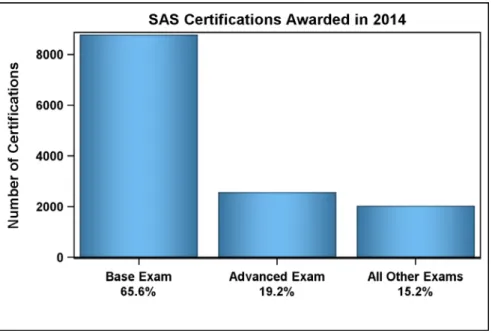
The largest proportion of credentials awarded are either the Base Programmer or Advanced Programmer certifications. Of the 13,384 credentials awarded in 2014, 8,781 were for the Base exam, 2,571 were for the Advanced exam, and only 2,032 were for a different certification. See Figure 1.
Figure 1. Certifications awarded in 2014 by type of exam.
The Base Programmer credential is a prerequisite to the Advanced Programmer certification exam. Presently, when a new version of SAS is released, a person holding the Base and Advanced Programmer certifications may retake the Advanced Programmer exam without having to retake the Base Programmer exam. Although there is no guarantee this policy will continue, there is no change anticipated in the foreseeable future.
There are two versions of the Clinical Trials Programmer exam. One is an advanced test requiring Base Programmer certification. It focuses on skills specific to clinical trials programming. The other version
3
does not require the Base Programmer certification and instead includes testing on that skillset as well as the skills specific to clinical programming.
While SAS Institute tracks the rate of success on each exam and the average number of times exams are retaken before success – no doubt with a SAS program – they declined to share that information. They do indicate, though, that the pass rate is similar to rates for certification exams offered by other IT
companies. Terry Barham (Manager of SAS Global Certification) stressed that the main factor in success is preparation. Well-qualified candidates usually pass, unqualified candidates usually do not, and
minimally qualified candidates straddle the pass/fail bar. Surprisingly, the Advanced SAS Programmer exam has a higher rate of success than the Base Programmer exam.
Advanced SAS is actually easier than Base SAS for most, as its topics are more focused: reporting, SQL, macros and performance. However, you must have passed Base SAS beforehand.
–Phil Holland, SAS consultant at Holland Numerics
Also, there is a wide variation among SAS certification exams in pass rates. For example, BI Content Developer and Platform Administrator have higher pass rates. Barham says that such differences are attributable to the complexity of the product being tested.
WHY DO IT
It is difficult to quantify the return on investment of certification for an individual. The benefits will vary depending on the person’s level of work experience and peer recognition. Possible reasons to pursue certification include:
• Demonstration of mastery
• Development of new skills and knowledge • Personal satisfaction
• Enhanced credibility • Improved job security
• Increased compensation possibilities
SAS users have varying views about certification. When certification was first introduced, many experienced programmers felt they did not need it:
When I started using SAS, they didn’t exist. When they were introduced, I felt myself beyond that.
–Erik Tilanus, SAS consultant at Synchrona Others were big supporters:
I had previously worked on a number of projects where big consultancies had sent "SAS consultants" to the client, who were, at best, trainees. They added little to project, but a lot to the client's costs. With SAS certification these consultancies could be asked to provide SAS consultants that had some sort of proof that they could actively contribute to a project.
–Phil Holland, SAS consultant at Holland Numerics Unfortunately, certification is not always a reliable indicator of ability:
We had a completely incompetent employee at one organization who was sent to get SAS certified. He passed a couple of the exams and I don’t know how because he was as incompetent as ever. We wanted to fire him but we were told “Well, he’s SAS certified, he must be competent.” We never did figure that one out.
4
The recent dramatic growth of SAS programming, and the strong desire to get a "SAS job", which pays good money, has resulted in the prevalence of certification question dumps being sold, or even candidates paying for someone else to take the exam for them. This has meant the exams have become more of a test of memory, not a test of competence. I know [the people at] SAS have been trying to clamp down on this practice. However, employers should still be extremely wary of any job candidates with SAS certification, but no SAS experience.
–Phil Holland, SAS consultant at Holland Numerics Some people take the exam once, but then don’t bother to recertify:
I took the Base exam a long time ago, since then the content has not changed very much. I could take it again but I feel that I don't need to because I am very familiar with the content through my teaching.
–Rebecca Ottesen, Instructor at California Polytechnic University, San Luis Obispo Many people feel that certification is useful for students or other people who are new to SAS:
I think for students coming right out of school a certification speaks to their ability to work with and understand SAS programming. It is a nice addition to their resume. It would be the same for people switching into a career that involves SAS.
–Rebecca Ottesen, Instructor at California Polytechnic University, San Luis Obispo Certification can help you find a job or move up in your current position:
Being certified can help you to stand out among other analysts. Certification, even at the base level, is not an easy task and proves to hiring managers you truly are a competent SAS programmer as opposed to someone who uses proc freq once a month…. All my managers definitely know if there is a SAS question or complex question to be answered, to come to me. Being certified has led to me becoming the SAS trainer for our division.
–Joseph Lei, Research Analyst with California Department of Health Care Services Place yourself in the position of an employer or client interviewing two candidates for a position. Both have similar resumes, similar training, similar experience, similar
references. But one is SAS certified, the other is not. All things being equal, which one is likely to be employed? The one with independent validation of their SAS knowledge.
–Andrew Howell, SAS consultant and trainer at ANJ Solutions But certification does not guarantee a SAS job:
I have heard mixed things. Some of my students get interviews and their foot in the door because the certification is listed on their resume. However, I have heard from others that the certification doesn't really mean anything to them.
–Rebecca Ottesen, Instructor at California Polytechnic University, San Luis Obispo Employers don’t usually ask for SAS certification, per se, but it doesn’t hurt. Recent graduates or candidates that don’t have as many years of experience can definitely benefit from having the SAS certification.
–Molly Mead Hall, IT placement professional at Synchrony Solutions
I have received MANY requests from non-SAS users trying to use certification as an entry point into the SAS world. I politely disappoint them by pointing out my personal opinion that certification was never intended as an entry point. It is not a “means to an end.” It is in fact an assessment of having reached that “end”… SAS certification won’t get you the job, but it certainly may get you on the shortlist. However, landing the job is ultimately up to you.
5
Many people feel that certification could be helpful for consultants, but not everyone agrees: I have NEVER had a client that was interested in certifications of any kind. Most clients have never heard of them.
–Art Carpenter, SAS consultant and trainer at California Occidental Consultants
For employers who invest in training for staff, certification demonstrates the effectiveness of that training: Anyone can sit through a training course, but to follow up with certification is a way to
ensure they are gaining value for their company by ensuring their staff have taken on and can apply what they have learned.
–Andrew Howell, SAS consultant and trainer at ANJ Solutions
Studying for a certification exam is a good way to learn, even for experienced SAS programmers: If their employer paid for it and they had spare time, I know even very experienced people who take the certification say it fills in some gaps in their knowledge.
–AnnMaria De Mars, SAS consultant at The Julia Group
I actually learned a few things and found the process of preparing enjoyable, especially with the online course.
–Miriam Cisternas, SAS consultant at MGC Data Services
The process of obtaining SAS certification taught me the skills I needed to fulfill and excel at my job role. Before I took the coursework leading up to certification, I learned by trial and error and independent research. Taking the coursework first would have accelerated my progress and saved me 6 months of steep learning curve.
–Joseph Lei, Research Analyst with California Department of Health Care Services
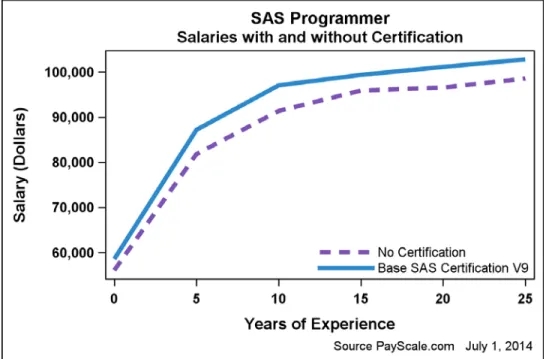
According to the website PayScale.com, SAS programmers who are certified earn somewhat more than those who are not. See Figure 2. Over a lifetime, this increase could make a substantial difference in total compensation. Of course, correlation is not causation: It is possible that people who earn more are more likely to pursue certification in the first place.
6 TIPS ON PREPARING FOR AN EXAM
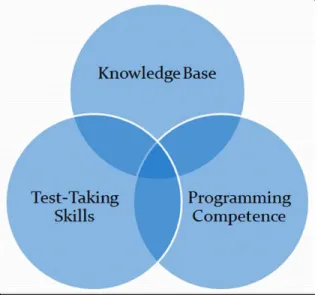
Being a competent coder and analyst is not enough! Figure 3 illustrates the three components of test-taking success. Obviously, having a good knowledge of SAS is necessary, but that alone does not guarantee success. Programming competence ensures the ability to apply that knowledge correctly in the context provided. However, even a highly qualified test taker may struggle if her or his test-taking skills are poor or rusty. Success on multiple choice exams is a specific skillset that a test taker may need to acquire or sharpen, especially if out of school for some time.
Figure 3. Components of test-taking success.
Below are a variety of suggestions for test preparation. Consider which would be most useful in your specific situation given the area or areas you feel you need to concentrate on.
SAS Institute offers many ways to prepare for exams. Some of these methods cost thousands of dollars, but others are inexpensive or even free. Here are ways to prepare with their approximate costs:
$1,300-2,000 Instructor-based “Classroom” and “Live Web” classes
$1,100 SAS Certification Review: Base Programming (both “Classroom” and “Live Web”) $750-1,250 Online self-paced e-Learning classes
$150 Certification Prep Guides, Base and Advanced $100 Course notes from classes offered by SAS Institute
$55 Online practice exam, Base and Advanced (good for six months) $50-75 Books recommended on support.sas.com (See Appendix 2.) FREE SAS University Edition software (free for lifelong learners)
FREE SAS Programming 1: Essentials online Self-Paced e-Learning course
FREE Statistics 1: Introduction to ANOVA, Regression, and Logistic Regression Self-Paced e-Learning course
FREE List of exam topics on support.sas.com (See Appendix 1.) FREE Sample questions on support.sas.com
FREE Blogs and third party online courses
Preparation options available from SAS Institute vary depending on the certification exam. Prep guides are available only for the Base and Advanced Programming exams. Practice exams are available for the Base and Advanced Programming exams as well as the Predictive Modeler exam. Sample questions are available for all exams except the Data Quality Steward exam, which is just being released in beta in summer 2015.
7
Be aware that while the certification prep guides are a good way to find out what type of questions are on the exam and to practice answering questions, they are not the best way to learn new material. Also, the prep guides do not cover every topic that is on the exam, and some people have reported that they found typos in the prep guides.
What works best depends on the individual person. People who have taken the exams shared these recommendations:
Check the online outlines. They do a good job of telling you the things you will need to know. Work on the things that you are uncomfortable with on the exam. You will not get the same questions, but the topics will be similar.
–Art Carpenter, SAS consultant and trainer at California Occidental Consultants Pick up a certification guide. Try to work with practice problems or incorporate
techniques into your work. Reading the book is one thing, but really understanding how SAS deals with syntax and data is another.
–Rebecca Ottesen, Instructor at California Polytechnic University, San Luis Obispo I found the online review course offered by SAS to be very helpful.
–Matthew Slaughter, recent university graduate
I have to say as a visual learner with a busy work schedule that the e-courses were definitely the way to go. The flexibility of the e-courses allowed me to work my full time job while progressing through the material at my own pace. The visual animations of the e-course format allowed me to understand the concepts of the business scenarios and to see code as it was being written and executed. If I had to attend courses in person, I would have had to wait 3 months AND block out three full days for travel and training, AND expense to my employer hundreds if not thousands of additional dollars. While taking e-courses and working full time takes longer than 3 full days in a single SAS course sitting, being able to absorb the information being taught over a longer period of time, while working with the concepts live at my job will, in my opinion, lead to higher level of retention over time.
–Joseph Lei, Research Analyst with California Department of Health Care Services Everyone agreed that the most important thing is to study the material on the exam.
Take as many practice questions as you can, prioritize this over reading summaries of the material or re-watching lectures. When you are reviewing your practice questions, have a version of SAS open so you can try code you don’t understand, and even to double check answers you find online, they are not always 100% accurate! Write or type a notes page with critical things you find as you study, research items you don’t
understand and add them to your sheet, add syntax you commonly have problems with, add examples, acronyms, absolutely anything you need to help you remember! If a question comes up in different forms time after time across different question banks, it is probably very important and is often asked on the real exam. If you see practice
questions about topics that were not covered in your courses, absolutely study them, for some reason SAS includes a couple questions on “new” topics that are not covered via the education! Is it fair? Not necessarily, but if you are prepared for this, they become free points for you on the exam instead of cutting into your 30% pass margin.
–Joseph Lei, Research Analyst with California Department of Health Care Services Study. Distributed practice – in other words, don’t cram for it, study regularly over a period of time.
8 Practice, practice, practice.
–Phil Holland, SAS consultant at Holland Numerics Re-read, practice, practice, practice.
–Rebecca Ottesen, Instructor at California Polytechnic University, San Luis Obispo Watch out for scams that promise too much.
Be wary of any organization (especially non-credentialed training institutes) which claims to guarantee certification (or guarantee employment).
–Andrew Howell, SAS consultant and trainer at ANJ Solutions
The amount of time to allow for preparation depends on your current knowledge and experience level – and also contending demands in your life. For example, Damir Olejar, a programmer who had no prior knowledge of SAS but had to become SAS-certified as a job prerequisite studied four to eight hours a day for 25 days and successfully passed the Base Programmer exam (Miller, 2012). Mark Stevens, a SAS Certification Developer, who had a technical background though not as a programmer, spent a little over three months successfully preparing for the Base Programmer exam (Stevens, 2010). Gongwei Chen, a self-described intermediate-level SAS programmer with more than ten years’ experience, expected that preparation for the Base Programming exam could take up to two hours a day for six months. However, he passed the Base exam with just four weeks of preparation, and the Advanced Programming exam with less than three months additional preparation (Chen, 2010).
One final piece of advice,
If you have been putting off taking an exam, schedule your exam to force yourself to focus and get it done.
–Mark Stevens, SAS Certification Developer for SAS Institute TIPS ON REGISTERING
You can register to take certification exams at a Pearson VUE testing location, or on-site just before conferences (SAS Global Forum and PharmaSUG in the spring, and regional users groups in the fall). Registration with Pearson VUE can be done online (http://www.pearsonvue.com/sas/) or by phone. If you are taking the exam at a Pearson VUE test site, then you may have a choice of locations. For example, a search for locations near San Diego showed five locations.
If you choose to take an exam at a Pearson VUE testing site, you should realize that some locations may be better than others:
I highly recommend that you visit the location of your choice before the day of the exam, and if possible even before you sign up for the exam. When I took the exam, it turned out to be a nightmare. I signed up to take the exam at the nearest location about 30 minutes from my home at a small airport. When I arrived at the address, I found an industrial park, but I couldn’t find the airport. I parked and walked around until I found someone working there, but it turned out that they had no idea where the airport was!! I was forced to drive around randomly looking for the site. Fortunately, I did find it in time, but the entrance to the test site turned out to be on a totally different street than the one in the address. And then it got worse. The computer equipment at the test site was so bad that the screen was hard to read. By the time the test was over, I had a spectacular migraine from staring at that horrible screen for so long. Fortunately, I somehow
managed to pass the test.
9
Discounts on exam registration are sometimes offered in conjunction with SAS conferences. In some cases, these discounts may be available even if you are not attending the conference. There may also be free or discounted training associated with taking an exam at that time. SAS UK offers particularly generous certification programs at conferences:
Most of my recent certification exams have been at the SAS Forum UK and SAS Professionals Convention, where the exam fees are included in the conference fees. Training webinars prior to the conference are also included. These exam days have broken records each year for the most concurrent exam takers and the most exams passed.
–Phil Holland, SAS consultant at Holland Numerics However, some people prefer not to mix exams and conferences.
It is so easy to take the exam at a testing facility. I personally think time spent at a conference should be focusing on the content at the conference, and not mixed up with last minute studying for the certification test. If there is a discount in taking the test at the conference that might help certain people.
–Rebecca Ottesen, Instructor at California Polytechnic University San Luis Obispo Currently, the cost of the Base SAS Programmer exam is $180 in North America. To hold down your costs, consider all of the possible discounts available. In addition to academic discounts and possible discounts at conferences, SAS offers discounts to veterans and employers.
If you are a student or academic professional planning on using an academic discount, get the voucher ahead of time. SAS needs a few days to process your request. Then you can register for the test with the voucher.
–Rebecca Ottesen, Instructor at California Polytechnic University, San Luis Obispo If you find you are not ready to take an exam, it is possible to reschedule:
Register a reasonable time in advance so you have a hard deadline to push towards, not having an exam date as a goal will give you a reason to extend your preparation time. Exams can be re-scheduled with proper advance notice and will not forfeit your registration fee, if you are truly not ready in time.
–Joseph Lei, Research Analyst with California Department of Health Care Services TIPS FOR THE DAY OF THE EXAM
On the day of the exam, arrive at least 15 minutes early. Be sure to bring two forms of ID including one with a photo such as a driver’s license or passport. Both forms must show your signature. You are not allowed to bring any reference materials, backpacks or electronic devices. Test takers are given writing materials to use during the exam (often a small erasable whiteboard and marker). Before you start the exam, write down anything you are worried about remembering! Any notes you make during the exam will be collected at the end. You are not allowed to remove anything from the test site.
Request more writing materials than you think you’ll need (laminate sheets), because you can’t erase anything you write on them. I asked for four sheets (can use front and back) and I used 3 of them.
– Joseph Lei, Research Analyst with California Department of Health Care Services Be prepared for the unexpected.
10
Recently, a friend went to her certification test appointment at the Pearson Vue test site only to be told that her exam time had actually been scheduled for another person (who was not there). Multiple phone calls by the proctor to Pearson Vue yielded the
information that the person supposedly scheduled for that slot had a later time she had actually scheduled. Pearson Vue had no explanation for how my friend’s appointment had been assigned to someone else, or how someone could have two exam slots for the same test. Unfortunately, Pearson Vue could only tell her to reschedule for another time.
–Andra Northup, SAS consultant at Advanced Analytic Designs, Inc.
When I arrived to take the exam, the proctor typed a code into the computer but there was some problem. The proctor had to call another test site to get a new code, but that didn’t work either. So the proctor called for a third code which fortunately worked and I was able to take the exam.
–Matthew Slaughter, recent university graduate
If you have found any particular approach to test-taking helpful in the past, use it! Drink OJ that morning (a professional test tutor told me this once).
–Rebecca Ottesen, Instructor at California Polytechnic University San Luis Obispo Relax and don’t stress.
–Art Carpenter, SAS consultant and trainer at California Occidental Consultants
During the exam, you can go backward and forward at any time. In addition, you can mark questions for review. Then at the end of the exam, you will be automatically prompted to return to those questions. If you are not sure of an answer, sometimes you can use the exam to help you figure it out:
While taking the exam you may find that one question reveals or suggests the answer to another question.
–Matthew Slaughter, recent university graduate
Here is an example of how one question can help you answer another:
1. There are 500 observations in the data set company.usa. What is the result of submitting the following program?
data work.usa; obsnum=_n_;
set company.usa (keep=manager department); stop;
run; a. An error
b. An empty data set
c. A data set with 500 observations d. A data set with one observation
The correct answer is b, an empty data set. But suppose that you cannot remember what a STOP statement does. Then this question might help you to answer the first question:
2. Usually SAS writes each observation to a data set at the end of the DATA step. What statement would you use to stop executing a DATA step without writing any observations?
a. A DATA _NULL_ statement b. An OUTPUT statement c. A STOP statement
11
If you can eliminate the other answers (a DATA _NULL_ does not stop a DATA step, an OUTPUT statement does write observations, and you’re pretty sure that it IS possible to override this behavior), then the answer must be c, a STOP statement. Now you know what a STOP statement does and you can answer the first question.
Remember that you are taking a test! It is not enough to know the material. Be on guard for sleight of hand questions where it appears the question is about a particular piece of content, when in fact it is testing whether you catch something completely different. Multiple choice questions can be tricky: There may be more than one answer with some truth in it. You are looking for the best answer, the one that is more true than the others.
If it has been a while since you have been in a test-taking situation, practice your allocation of time by taking practice tests. Remember that test-taking is a separate skillset, distinct from analyzing problems and coding efficient solutions in the real world.
You will receive your score immediately after finishing the test. AFTER THE EXAM
Successful candidates are emailed a link to the certificate which they can print out. On the main certification webpage, when an individual enters the SAS Certification Records Management System, they are given a yes/no option whether they wish their name to be published in the Registry. Even if you choose not to have your name published, you can still obtain a private 1-to-1 link to confirm your
credential to a potential employer if needed.
For some reason, I was never asked whether I wanted to be listed in the Public Registry of SAS Certified Professionals. When my name hadn’t shown up after a couple months, I logged into my account and changed the setting. Within minutes, my name was listed.
–Matthew Slaughter, recent university graduate
Unfortunately, not everyone passes the exam. Some people find that they are not adequately prepared. I know a man who did not pass the Base Programmer exam. He is an expert SAS
programmer with many years of experience, but did not study for the exam and was tripped up by things like PROC IMPORT. Even the most experienced SAS programmer needs to study because nobody uses all these features all the time.
–Susan Slaughter, SAS consultant at Avocet Solutions
They took too long between the course and taking the test. Some of them did not get enough practice on programming problems.
–Rebecca Ottesen, Instructor at California Polytechnic University, San Luis Obispo They assumed that they did not need to even check what was on the exam let alone prepare for it.
–Art Carpenter, SAS consultant and trainer at California Occidental Consultants
Although preparation is the single most important factor in exam success, many other things can impact the outcome, such as illness, work demands, and family needs. If you are not successful, rethink certification in light of your current life situation. If it makes sense, try again. You must wait two weeks before retaking the exam.
CERTIFICATION EXAMS AT EDUCATIONAL INSTITUTIONS
SAS collaborates with universities and high schools to offer on-campus certification exams (generally for the Base SAS certification exam). About 40 different universities have worked with the SAS Global Certification Program to conduct SAS exam sessions onsite at their campuses, and SAS anticipates continued growth in this area.
12
We certify the professor as a SAS exam proctor and then they can administer an exam session on a pre-arranged date and time. We enable the necessary mechanisms (for the appointed time only) and monitor the session remotely.
–Terry Barham, Manager of SAS Global Certification
Overall I am very grateful to have had the opportunity to provide this exam on campus to my students at the end of the quarter. The information is fresh in their heads so it is the logical time to take the test. Previously they would wait to take it over the break and often end up not taking it because they put it off for too long. I agree with the students that taking the exam in our classroom was ideal. It is very convenient and a comfortable environment for them. It was a bit stressful for me to watch them take the exam and find out their results right there, but I am so proud of them for all their hard work and
preparation this quarter. SAS made it very easy to administer this exam, they made sure to answer all my questions throughout the process. I am very pleased and plan to do this again.
–Rebecca Ottesen, Instructor at California Polytechnic University, San Luis Obispo Ottesen reports that the pass rate for students taking certification exams is generally in the 50-70% range. While it is difficult to determine the exact number of students who have become SAS certified through on-campus exams, Barham estimates that approximately 1,000 students per year attain certification in this manner.
Developing a course to prepare students for a certification exam in an academic environment is a challenge. Students generally have little or no prior experience with SAS, and the course must move quickly to cover all the material on the exam in one quarter or semester. Turner and others at the University of Pennsylvania have developed a successful course that incorporates lectures, in-class labs, virtual labs, readings, homework and exams (Bonney and Keith, 2013). Ottesen at California Polytechnic State University, San Luis Obispo teaches a one quarter Introduction to SAS class, followed by a one quarter Base Certification preparation class, and a third quarter to prepare for Advanced Certification (Ottesen et al., 2011, Appendix 3).
SAS JOINT CERTIFICATE PROGRAM
SAS also collaborates with universities through the SAS Joint Certificate Program which is entirely separate and distinct from the SAS Global Certification Programdespite the similarity in names. About 60 universities have teamed up with SAS to offer joint certificates. For a joint certificate, universities identify 12 semester units of courses (which may be new or existing courses) covering subjects such as data analysis, data mining, business analytics and statistical modeling. The course content is reviewed and approved by SAS Institute. The university verifies which students have completed the certificate requirements, and SAS Institute co-signs the certificates. Students receive a certificate of completion. Six different types of certificates are awarded through the Joint Certificate Program:
Applied Econometrics and Data Science Foundations Using SAS Business Analytics/Business Intelligence
Statistical Analysis Data Mining
Marketing Research and Analytics SAS Programming and Data Analysis
A list of institutions offering the Joint Certificate Program is available on SAS’s website in the SAS Global Academic Program section.
NEW DEVELOPMENTS
A new credential, the SAS Certified Data Quality Steward for SAS 9, is being beta tested in summer 2015.
13 CONCLUSION
SAS certification does not guarantee a job. However, it can be one more arrow in your quiver setting you apart in a competitive job market and demonstrating expertise with newer skills such as business
intelligence or clinical trials.
It is always good to grow your credentials. It also shows a certain amount of drive and follow through. It certainly doesn’t hurt.
–Molly Mead Hall, IT placement professional at Synchrony Solutions Good luck determining the right choice for your individual situation!
REFERENCES
Bonney, C. and Keith, M. (2013). SAS skill learning and certification preparation in a graduate school setting. Proceedings of the SAS Global Forum Conference, San Francisco, CA, SAS Institute, Cary, NC, paper no. 182-2013.
Chen, G. (2010). Get certified as an advanced SAS programmer in six months or less! Proceedings of the SAS Global Forum Conference, Seattle, WA, SAS Institute, Cary, NC, paper no. 189-2010.
Delwiche, L. D. Slaughter, S. J. (2012). The Little SAS Book: A Primer, Fifth Edition. SAS Institute, Cary, NC.
Howell, A. (2013). SAS certification: Understand the benefits of SAS certification, which SAS
certifications are available, and what SAS certification can do for you. Proceedings of the SAS Global Forum Conference, San Francisco, CA, SAS Institute, Cary, NC, paper no. 191-2013.
Miller, M. (2012). Mission: SAS certification in 25 days. The SAS Training Post blog, November 20, 2012, http://blogs.sas.com/content/sastraining/2012/11/20/mission-sas-certification-in-25-days/. Ottesen, R., Doi, J., Lund, U. McGaughey, K. (2011). This is how we do it: Teaching SAS in the Cal Poly
Statistics Department, Proceedings of the Nineteenth Annual Western Users of SAS Software Conference, San Francisco, CA.
PayScale Salary Reports, (2014). Salary data collected July 1, 2014 using www.payscale.com/mypayscale.aspx.
SAS Institute (2011). SAS Certification Prep Guide: Base Programming for SAS 9, Third Edition. Cary, NC.
Stevens, M. (2010). Zero to SAS Certified Base Programmer in 3 Months (Part I). The SAS Training Post blog, July 1, 2010, http://blogs.sas.com/content/sastraining/2010/07/01/zero-to-sas-certified-base-programmer-in-3-months-part-1/.
Stevens, M. (2010). Zero to SAS Certified Base Programmer in 3 Months (Part II). The SAS Training Post blog, July 22, 2010, http://blogs.sas.com/content/sastraining/2010/07/22/zero-to-sas-certified-base-programmer-in-3-months-part-ii/.
ACKNOWLEDGMENTS
The authors are extremely grateful to the following people who agreed to be interviewed for this paper: Terry Barham Manager of SAS Global Cert., SAS Institute, Cary NC support.sas.com
Art Carpenter California Occidental Consultants, Anchorage, AK www.caloxy.com Miriam Cisternas MGC Data Services, Carlsbad, CA www.mgcdata.com AnnMaria De Mars The Julia Group, Santa Monica, CA www.thejuliagroup.com Molly Meade Hall Synchrony Solutions, Los Angeles, CA www.synchrony-solutions.com Philip Holland Holland Numerics Ltd, Royston, UK www.holandnumerics.com
14 Andrew Howell ANJ Solutions, Melbourne, Australia
Joseph Lei California Department of Health Care Services Rebecca Ottesen California Polytechnic St. Univ., San Luis Obispo Matthew Slaughter Rensselaear Polytechnic University, Troy, NY
Mark Stevens Certification Developer, SAS Institute, Cary, NC support.sas.com Erik Tilanus Synchrona, Netherlands
Herb Turner University of Pennsylvania, Philadelphia, PA CONTACT INFORMATION
The authors welcome your comments and suggestions, and can be contacted at: Andra M. Northup [email protected]
Susan J. Slaughter [email protected]
SAS and all other SAS Institute Inc. product or service names are registered trademarks or trademarks of SAS Institute Inc. in the USA and other countries. ® indicates USA registration.
15 APPENDIX 1
SAS Certified Base Programmer for SAS 9 Credential 64 multiple-choice and short-answer questions
(must achieve score of 70% correct to pass) 110 minutes to complete exam
Exam topics include: Accessing Data
Use FORMATTED and LIST input to read raw data files.
Use INFILE statement options to control processing when reading raw data files.
Use various components of an INPUT statement to process raw data files including column and line pointer controls, and trailing @ controls.
Combine SAS data sets. Access an Excel workbook. Creating Data Structures
Create temporary and permanent SAS data sets. Create and manipulate SAS date values.
Export data to create standard and comma-delimited raw data files.
Control which observations and variables in a SAS data set are processed and output. Managing Data
Investigate SAS data libraries using base SAS utility procedures. Sort observations in a SAS data set.
Conditionally execute SAS statements. Use assignment statements in the DATA step.
Modify variable attributes using options and statements in the DATA step. Accumulate sub-totals and totals using DATA step statements.
Use SAS functions to manipulate character data, numeric data, and SAS date values. Use SAS functions to convert character data to numeric and vice versa.
Process data using DO LOOPS. Process data using SAS arrays. Validate and clean data.
Generating Reports
Generate list reports using the PRINT procedure.
Generate summary reports and frequency tables using base SAS procedures.
Enhance reports through the use of user-defined formats, titles, footnotes and SAS System reporting.
Generate reports using ODS statements. Handling Errors
Identify and resolve programming logic errors. Recognize and correct syntax errors.
16 APPENDIX 2
Books Recommended by SAS Press for Certification Preparation Base Programmer Exam
Bailer, J. (2010). Statistical Programming in SAS. SAS Institute, Cary, NC. Cody, R. (2007). Learning SAS by Example. SAS Institute, Cary, NC.
Delwiche, L. D. Slaughter, S. J. (2012). The Little SAS Book: A Primer, Fifth Edition. SAS Institute, Cary, NC.
SAS Institute (2013). Step-by-Step Programming with Base SAS 9.4. Cary, NC.
SAS Institute (2011). SAS Certification Prep Guide: Base Programming for SAS 9, Third edition. Cary, NC.
Advanced Programmer Exam
Burlew, M. (2014). SAS Macro Programming Made Easy, Third Edition. SAS Institute, Cary, NC. Carpenter, A. (2012). Carpenter’s Complete Guide to Innovative SAS Techniques. SAS Institute, Cary,
NC.
Carpenter, A. (2004). Carpenter’s Complete Guide to the SAS Macro Language, Second Edition. SAS Institute, Cary, NC.
Lafler, K.P. (2013). PROC SQL: Beyond the Basics Using SAS, Second Edition. SAS Institute, Cary, NC.
Prairie, K. (2005). The Essential PROC SQL Handbook for SAS Users. SAS Institute, Cary, NC. SAS Institute (2014). SAS Certification Prep Guide: Advanced Programming for SAS 9, Fourth edition.
Cary, NC.
Shreier, H (2008). PROC SQL by Example: Using SQL within SAS. SAS Institute, Cary, NC.
Virgile, R. (2013). SAS Macro Language Magic: Discovering Advanced Techniques. SAS Institute, Cary, NC.
17 APPENDIX 3
Description of an On-campus Certification Exam
By Rebecca Ottesen, Instructor at California Polytechnic State University, San Luis Obispo At the beginning of the quarter I wrote to [email protected] and explained that I had heard they would allow me to proctor the Base SAS Certification exam for my class. I was contacted by Terry Barham from SAS who sent me a proctor agreement form. I turned in the signed copy of the proctor agreement and he said that they would be in touch again a few weeks before the scheduled exam.
A week before the exam, they sent instructions about how to create a Pearson VUE account. Students use this account to access their exam on the day of the test. They do NOT preschedule their exams like a person taking the exam at a Pearson VUE facility would. Students need to create their account 5 days before the scheduled exam to ensure that it is activated. (One of my students created the account ahead of time but didn't realize he had to activate it. He activated it on the night of the exam and it worked for him. I wouldn't recommend this though, as it was stressful.)
On the day of the exam, I received instructions for how to access the exams. My students were eligible for the 50% off academic discount and we were provided with the special discount code. They logged onto Pearson VUE, followed the day-of instructions, entered credit card information and the discount code. The instructions are very clear, but there were a few hang-ups (for example, clicking on the correct box) mostly due to nerves and being the first time that any of us had done this. I did have two students who had the screen lock up during this registration process. I told them to try on the computer next to them and they got in just fine. So it was good that I had extra machines available in the room. They were able to print their receipt before starting the exam. They were allowed a few sheets of scratch paper and a pencil, but I had to collect and discard all papers after the test was over.
Once the exam is started, the computer literally locks them out of any other application. They cannot right click on the screen to do anything. The test even sends you a message and won't let you continue if you have not scrolled down to the bottom of the screen to view all possible answers (on the long ones). The questions appear on the screen one at a time and you click next and previous to go back and forth. There is a timer at the top that keeps track of the time left on the exam.
At the end there is a review button that lets you review your answers. Then you click submit and instantly receive a score. They do not tell you exactly what questions you miss but they do break the score down by percentage in content areas (Accessing Data, Creating Data Structures, Generating Reports, Handling Errors, and Managing Data).
I was expecting to have to pace the room to keep an eye on what was on the screen. I did have to make sure that they were not accessing any of their hard copy materials or cell phones, but I had a clear view of all of that.
Overall, I was very impressed with the capability of the test once we all got settled in. The students said that they liked taking it with me as the proctor and in the familiar classroom environment where they learned SAS. I liked that they took this test at the end of the quarter while it was all fresh in their heads. We go on to the advanced certification prep next quarter so I am happy that they have this behind them. A few of them didn't pass tonight which is disappointing, but they said that they will try again after the waiting period is up (14 days).