45
A COMPARATIVE DISCOURSE ANALYSIS OF THE SEVENTH-DAY ADVENTIST THEOLOGICAL SEMINARY’S STATEMENT “ON THE UNIQUE HEADSHIP OF CHRIST IN THE CHURCH”
AND THE RESPONSE STATEMENT, “AN OPEN APPEAL” Eun-Young Julia Kim
Andrews University Abstract
This article comparatively analyzes two written statements on women’s ordination that were issued in 2014 by two groups of Seventh-day Adventist scholars who represent opposing views. Taking the approach of Critical Discourse Analysis, the study focuses on intertextual and interdiscursive relationships and the use of language. By analyzing formal and linguistic aspects of the texts, it seeks to identify contrasting ideologies and discursive strategies manifested in the texts. The analysis shows that both texts include heavy references to the Bible and Ellen G. White’s writings, but the two groups’ different understandings of the Trinity leave no room for negotiation. Further, a lack of consensus on the definition of “headship” and “leadership” keeps the groups from effectively engaging in the debate. The article argues that if the church wishes to move the discussion forward, it is important to come to a consensus on its definition of pastoral leadership and its view of the Trinity. Keywords: women’s ordination, critical discourse analysis, interdisciplinary studies on religion
Introduction
Currently, one of the most divisive issues within the Seventh-day Adventist Church is women’s ordination. Numerous Seventh-day Adventist theologians on both sides of the debate have presented impassioned arguments to address critics and bring harmony,1 and yet division within the church seems to intensify, as both leaders and lay members of the church sense an impending crisis ahead in the current milieu of the denomination.2 These developments
1John W. Reeve, ed., Women and Ordination: Biblical and Historical Studies (Nampa, ID: Pacific Press, 2015), offers a collection of essays written by
Seventh-day Adventist theologians supporting an egalitarian view. A website maintained by Seventh-day Adventist pastors includes a plethora of resources promoting a complementarian view (see Council of Adventist Pastors, “Ordination Truth.com: Committed to Scripture, Subordinated to Jesus, Called to Unity,” 2016, www.ordinationtruth.com).
2The significance of the issue of women’s ordination in today’s Seventh-day
Adventist Church is illustrated by the title of a symposium on the supremacy of male headship, “Crisis Ahead!,” held in Bakersfield Hillcrest Seventh-day Adventist Church in Central California in June 2015 (see Jared Wright, “Head of Headship
in the Seventh-day Adventist Church are not happening in a vacuum. Other denominations have faced and are facing similar crises. In fact, a broad discussion of the doctrine of God and human gender issues is under way within the wider Christian community.3
So far, women’s ordination has been approached mainly from a theological perspective. Scholars such as Mark Chaves believe that “there is no compelling reason internal to the Bible to grant interpretive primacy either to the texts opposing gender equality or to the texts supporting gender equality.”4 However, many others hold polarized views. Some contend that
Warns ‘Crisis Ahead,’” Spectrum News, [19 May 2015], http://spectrummagazine. org/node/6819). Recently, several entities of the Seventh-day Adventist Church have issued statements opposing the Annual Council of the General Conference vote on the “Unity in Mission: Procedures in Church Reconciliation” document, which outlines disciplinary procedures for addressing denominational institutions that are said to be out of compliance with deonomination policies (Adventist News Network Staff, “United for Mission: Implementing the Process for Unity,” Adventist Review News, [11 January 2017], http://www.adventistreview.org/church-news/story-united-for-mission-%E2%80%93-implementing-the-process-for-unity). For more information about this discussion, see Adventist Review/Adventist News Network Staff, “Church Governance and Unity to Be Discussed at Annual Council,” Adventist Review News, (25 September 2016), http://www.adventistreview.org/church-news/story4391-church-governance-and-unity-to-be-discussed-at-annual-council; General Conference Communication Staff, “Recommendation on Non-Compliance to Go to Annual Council,” Adventist Review News, (6 October 2016), http://www.adventistreview. org/church-news/story4433-recommendation-on-non-compliance-to-go-to-annual-council; Andrew McChesney and Mark A. Kellner, “Annual Council Approves Measure to Encourage Adherence to Church Policies,” Adventist Review News, (11 October 2016), http://www.adventistreview.org/church-news/story4458-annual-council-approves-measure-to-encourage-adherence-to-church-policies; Adventist News Network, “Important Responsibility in Following Voted World Church Actions,” Adventist Review News, (3 November 2016), http://www.adventistreview. org/church-news/story4509-important-responsibility-in-following-voted-world-church-actions; North American Division Communication Staff, “NAD Year-End Meeting Discusses Unity Document,” Adventist Review News, (3 November 2016), http://www.adventistreview.org/church-news/story4501-nad-year-end-meeting-discusses-unity-document; North American Division Office of Communication, “NAD Executive Committee Votes Continued Support of World Church,” Adventist Review News, (3 November 2016), http://www.adventistreview.org/church-news/story-nad-executive-committee-votes-continued-support-of-world-church.
3See Gilbert M. Valentine, “Flying Bishops, Women Clergy, and the Processes of
Change in the Anglican Communion,” AUSS 51.2 (2013): 219–266; Kevin Giles, The
Trinity & Subordinationism: The Doctrine of God & the Contemporary Gender Debate
(Downers Grove, IL: InterVarsity Press, 2002); Dennis W. Jowers and H. Wayne House, eds., The New Evangelical Subordinationism? Perspectives on the Equality of God
the Father and God the Son (Eugene, OR: Pickwick, 2012).
4Mark Chaves, Ordaining Women: Culture and Conflict in Religious Organizations
male headship is God-ordained,5 and others argue that the Bible as a whole promotes gender equality.6 Both sides present their arguments based on what they confidently assert to be solid biblical principles.
However, since hermeneutics is subjective and artful, to a certain extent, examining various arguments through a nontheological lens could provide triangulation to the hermeneutical/exegetical studies. Recognizing the usefulness of taking multidisciplinary approaches to religious texts, Frank Wijsen, for instance, encouraged religious scholars to take an interdisciplinary approach by incorporating discourse analysis into their studies.7 Since human cognition is mediated through language,8 and religious beliefs and doctrines are often promulgated through written texts, examining various claims and arguments in the texts through a linguistic lens could shed further light on the debate concerning women’s ordination.
Various discourse analysts have examined religious language and persuasive strategies used in sermons and other speeches.9 However, deeply divisive issues, such as women’s ordination, have remained outside the purview of discourse analysts. This could be partly due to the fact that various religious beliefs are formed based on the Scripture, which is assumed to transcend logical reasoning and verifiable truths. Recently, however, I have illustrated how examining implicit macro-propositions and various local meanings employed in a religious text could help readers identify the process of doctrinal formation and various persuasive tactics, by analyzing an article which legitimizes the current position of the Southern Baptist Convention on women’s ordination.10 The current study extends this line of inquiry by examining the arguments put forth by Seventh-day Adventist scholars on this issue.
5For example, see John Piper and Wayne Grudem, Recovering Biblical Manhood and Womanhood: A Response to Evangelical Feminism (Wheaton, IL: Crossway, 2012); Mary
A. Kassian, Women, Creation and the Fall (Westchester, IL: Crossway Books, 1990).
6For example, see Stanley N. Gundry and James R. Beck, eds., Two Views on Women in Ministry (Grand Rapids: Zondervan, 2005); Ronald W. Pierce,
Rebecca Merrill Groothuis, and Gordon D. Fee, eds. Discovering Biblical Equality:
Complementarity Without Hierarchy (Downers Grove, IL: InterVarsity Press, 2005). 7Frank Wijsen, “Editorial: Discourse Analysis in Religious Studies,” Religion 43.1
(2013): 1–3.
8Peter Carruthers, “The Cognitive Functions of Language,” Behavioral and Brain Sciences, 25.6 (2002): 657–674; Edward Sapir, “The Status of Linguistics as a Science,” Language 5.4 (1929): 207–214.
9E.g., Yari Neuman, Yotam Lurie, and Michele Rosenthal, “A Watermelon
Without Seeds: A Case Study in Rhetorical Rationality,” Text & Talk 21.4 (2001): 543–565; Mark Garner, “Preaching as a Communicative Event: A Discourse Analysis of Sermons by Robert Rollock (1555–1599),” Reformation and Renaissance
Review 9.1 (2007): 45–70; Snobra Rizwan, “Religion, Ideology and Discourse: A
Critical Discourse Analysis of Majlis-e-Hussain,” Mathal/Mashal 1.1 (2011): 1–34.
10See Eun-Young Julia Kim, “Persuasive Strategies in a Chauvinistic Religious
Discourse: The Case of Women’s Ordination,” Critical Approaches to Discourse Analysis
The Two Texts
This article comparatively analyzes two texts: (1) the Seventh-day Adventist Theological Seminary’s 2014 statement titled “On the Unique Headship of Christ in the Church” and (2) a statement titled “An Open Appeal from Faculty, Alumni, Students, and Friends of the Seventh-day Adventist Theological Seminary,” which directly responds to the Seminary’s statement (see appendices). Some background information regarding these documents might be helphful for those who are unfamiliar with them. At the 2015 General Conference Session held in San Antonio, TX—the quinquennial meeting of the denomination’s decision-making body made up of Seventh-day Adventist leaders and delegates from around the world—the decision was made not to grant authority to divisions for making decisions regarding ordination practices in their own regions. Prior to this decision, the faculty at the Seventh-day Adventist Theological Seminary, which is the denomination’s flagship institution for pastoral training on the campus of Andrews University, collaboratively created a statement, “On the Unique Headship of Christ in the Church,” denouncing top-down, headship-oriented male leadership in the church.11 Soon after the statement was posted on the Seminary’s website, a group of Seventh-day Adventist theologians, pastors, administrators, students, and alumni came together to create the “Open Appeal,” which asked the Seminary to reconsider its statement. This appeal was published on the Adventist Review website in October 2014.12
These documents are similar in length, with the Seminary’s Statement containing 3,859 words and the “Open Appeal” containing 4,273.13 Since these are high-stakes texts, written and endorsed by theologians within the Seventh-day Adventist Church who represent polarized views, the texts warrant an in-depth study, not only by theologians, but also by Seventh-day
11Seventh-day Adventist Theological Seminary, “On the Unique Headship
of Christ in the Church: A Statement of the Seventh-day Adventist Theological Seminary,” (9 September 2014), https://www.andrews.edu/sem/about/statements/9-19-14-updated_web_version-unique_headship_of_christ_final.pdf. See also Andrew McChesney, “Andrews Theologians Approve Statement on Headship,” (22 August 2014), http://www.adventistreview.org/church-news/andrews-theologians-approve-statement-on-church-leadership. The Seminary’s Statement reflects the majority view of the current faculty at the Seventh-day Adventist Theological Seminary.
12“An Open Appeal from Faculty, Alumni, Students, and Friends of the
Seventh-day Adventist Theological Seminary to Faculty of the Seventh-day Adventist Theological Seminary Regarding the Recent Statement from the Seminary on the Unique Headship of Christ in the Church,” (6 October 2014), http://www.adventistreview.org/ assets/public/news/2014-10/242011032-Appeal-to-the-Seminary-Faculty_1_.pdf. See also Andrew McChesney, “Appeal Made Over Andrews Statement on Headship,” (7 October 2014), http://www.adventistreview.org/church-news/appeal-made-over- andrews-statement-on-headship; idem, “Statement from Andrews Seminary in Response to Headship Appeal,” (13 October 2014), http://www.adventistreview.org/ church-news/statement-from-andrews-seminary-in-response-to-headship-appeal.
13These numbers include the endnotes but exclude the list of individuals who
Adventist lay members who care about the denomination’s current positions on controversial social issues.
The current study approaches the two texts from the perspective of Critical Discourse Analysis by focusing on the intertextual and interdiscursive relationships and the use of language. By focusing on formal and linguistic aspects of the texts, the study seeks to identify contrasting ideologies and discursive strategies manifested in the texts. For convenience, the two documents will be abbreviated as the Seminary’s Statement and the “Open Appeal” hereafter. Before proceeding to the analysis, I provide a brief overview of basic tenets of Critical Discourse Analysis, and one of its methods, the Discourse-Historical Approach, which serves as the underlying conceptual framework of this study.
Critical Discourse Analysis
Critical Discourse Analysis (CDA), a branch of linguistics, examines how various ideologies are shaped through texts.14 A relatively new sub-field of applied linguistics, CDA continues to seek new avenues of inquiry and methods of analysis. Some of the widely recognized methods include Dialectal-Relational Approach, Socio-Cognitive Approach, and Discourse-Historical Approach.15 CDA is heterogeneous in nature in that boundaries between methods are somewhat malleable. Nevertheless, these methods share a commonality of examining discursive means meshed with ideology. Critical discourse analysts are particularly interested in uncovering manipulative tactics, especially those that are “enacted and reproduced by subtle, routine, everyday forms of text and talk that appear natural and quite acceptable.”16 Central to its studies are themes such as how power is legitimized and reproduced through text and talk.17
Discourse-Historical Approach
Among various methods of CDA, Discourse-Historical Approach (DHA) focuses on discovering any inconsistences, self-contradictions, paradoxes, and dilemmas in the text-internal structures by examining intertextual and interdiscursive relationships between texts.18 Intertextuality refers to the connections that a text establishes with other texts through direct
14Norman Fairclough, “Critical and Descriptive Goals in Discourse Analysis,” Journal of Pragmatics 9.6 (1985): 739–763.
15Providing an overview of these different methods would be a study of its own. For
a helpful overview of the field, see Encarnacion Hildalgo Tenorio, “Critical Discourse Analysis: An Overview,” Nordic Journal of English Studies 10.1 (2011): 183–210.
16Teun A. Van Dijk, “Principles of Critical Discourse Analysis,” Discourse and Society 4.2 (1993): 249–283.
17See Ruth Wodak and Michael Meyer, eds., Methods of Critical Discourse Analysis
(London: Sage Publications, 2009).
18Wodak and Meyer provide specific steps critical discourse analysts can follow to
references and allusions, and it takes the form of re-contextualization or de-contextualization. The former occurs when certain quotes are taken from one text to justify arguments made in another argument, while the latter occurs when those quotes are taken out of context and applied to a new context. Interdiscursivity refers to embedded discourses/topics within a particular text. Since discourses are often hybrid, identifying and studying the connections between embedded discourses allows a critical discourse analyst to examine the overall structure of the arguments and identify any inherent fallacies.
The DHA has been adopted for this study because both the Seminary’s Statement and the “Open Appeal” include heavy references to the Bible and Ellen G. White’s writings, and various embedded discoursal topics that form the basis of argument for their opposing positions on women’s ordination. The following analysis compares their patterns of textual interaction, embedded discourses, and language use.
Intertextuality Patterns of Citations
As mentioned, intertextuality refers to the connections that a text establishes with other texts through direct references and allusions. Both of the texts under analysis make intertextual references to two main bodies of literature: (1) the Bible and (2) the writings of Ellen G. White. First, both texts include numerous citations from the Bible and repeatedly use phrases such as “according to Scripture,” “the Bible teaches,” and many other variations. The Seminary’s Statement includes ten such phrases (lines 104, 124, 164, 167, 175, 180, 182, 203, 212, 240) and the “Open Appeal” includes thirteen (lines 30, 50, 59, 68, 88, 91, 126, 186, 237–238, 290–291, 299, 328, 343).19 The “Open Appeal” emphasizes the importance of using the Bible as the only authoritative text for finding answers, repeating phrases such as “the Bible and the Bible only” (line 30) and “comparing Scripture with Scripture” (lines 91, 237–238, 290–291). For some readers, the fact that the two texts utilize different versions of the Bible as indicated in the endnotes—the New American Standard Bible (NASB) for the Seminary’s Statement and the New King James Version (NKJV) for the “Open Appeal”—could be seen as more than a casual difference.
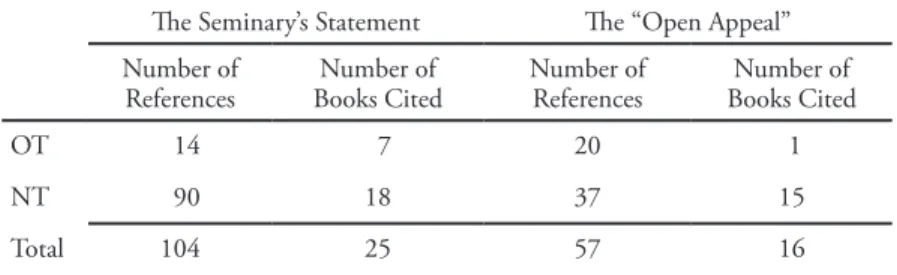
The majority of references to the Bible are given as parenthetical citations in both texts, without actual biblical texts. As table 1 shows, the Seminary’s Statement includes approximately twice as many references to the Bible compared to the “Open Appeal.”20 In addition, it includes citations
19Line numbers refer to those in each statement as they appear in the appendices. 20A verse included in multiple references was counted as one instance. However,
when the subsequent citations included additional verses, they were counted separately. To illustrate, the Seminary’s Statement cites Eph 5:23, Eph 5:21–23, and Eph 5:23, 25 as separate references. These were counted as three because the second and the third references add additional verses. However, repeated inclusion of Eph 5:23 occurring in other parts of the text was excluded from the count, as it was already included in the previous three. Multiple verses continuously following were
from more books than the “Open Appeal,” especially in the case of the Old Testament. The “Open Appeal” draws entirely from the book of Genesis, with ten of the twenty Old Testament references taken from Gen 2. At the end of the text, the “Open Appeal” lists male leaders who led Israelites after the exile as evidence that God appointed only male leaders.
Another observed difference is that the Seminary’s Statement includes twenty-eight references to the Gospels, including eleven references from Matthew, two from Mark, and fifteen from John, whereas the “Open Appeal” includes two—one of which is from John and the other from Matthew. On the one hand, the Seminary’s Statement draws from the book of John to point out an equal relationship between God and Christ, and Christ’s authority and power to defeat the prince of this world. It uses verses from Matthew and Mark to emphasize servanthood and love as core elements defining human leadership and relationships. On the other hand, the “Open Appeal” quotes John 17:21–23 to support its argument that a hierarchal relationship in the Godhead transfers to family. In these verses, Christ, expressing His oneness with the Father, prays to God for complete unity for His followers. The “Open Appeal” interprets being one with Jesus and God as being in a hierarchal relationship, contending that Jesus “declared” it so in these verses (lines 61–62).
Table 1. Citations from the Bible
The Seminary’s Statement The “Open Appeal” Number of
References Books CitedNumber of Number of References Books CitedNumber of
OT 14 7 20 1
NT 90 18 37 15
Total 104 25 57 16
Secondly, references to the writings of Ellen G. White also abound in these texts, each making over twenty references to her various writings. Each text includes references to more than a dozen different White publications, seven of which are cited in both, including the same pages and chapters. To illustrate, the Seminary’s Statement uses statements from her book, Patriarchs and Prophets, to support that Eve was created equal to Adam because she was “to stand by his side as an equal” (lines 209–210).21 Contrarily, the “Open counted as separate items when they were separated by semicolons or cited separately. For instance, in the “Open Appeal,” Gen 2:15, 16, and 17 are all mentioned separately, and therefore were counted as three different references, whereas Gen 1:29–30, used in the “Seminary Statement,” was counted as one. When a text mentions a certain chapter as a whole and then later includes specific verses from that chapter, the instance of mentioning that chapter was excluded from the count. Books that consist of two parts (e.g., 1 Peter and 2 Peter) were counted separately.
Appeal” draws from the same chapter, entitled “The Creation,” in order to highlight the fact that Adam, not Eve, was the “representative of the whole human family” (lines 225–226).22 Another example is the use of the same page in The Acts of the Apostles by both texts to argue their opposing positions.23 There White describes the authoritative position that men had in early times, and the “Open Appeal” argues that ordained male elders/overseers function as Christ’s representatives (lines 141–143), endowed with the same authority as Christ (lines 162–166). The Seminary’s Statement, however, includes The Acts of the Apostles as evidence for the importance of humility for church leaders (lines 134–137).24 Throughout the text, the “Open Appeal” draws heavily from White’s writings to argue that various passages in her writings clearly affirm Adam’s headship and authority over Eve.
The Same Texts, Serving Different Functions
Different interpretations are also rendered for the same biblical passages. Out of 161 combined references to Bible passages, five are used in both texts for framing their support. The two texts often incorporate some of the same biblical references for antithetical purposes. For example, the Seminary’s Statement uses Rev 13:6–8 in order to draw a parallel between the anti-Christ system of government that usurps the authority of Jesus and the headship-oriented, top-down church leadership (lines 77–84), whereas the “Open Appeal” uses Rev 13:825 to make the case for functional differences in the Godhead by stating that Jesus was “committed to the function of the Lamb of God that was to take away the sins of the world” (lines 194–197).
Another important biblical passage that is quoted by both texts is 1 Cor 11:3,26 which the “Open Appeal” confidently uses to confirm men’s authority over women. Conversely, the Seminary’s Statement includes this verse, along with Eph 1:22–23; 5:23; Col 1:18; 2:19; 1 Cor 11:3; and Col 2:10, to argue that “Christ is the only Head of the Church and the human members of Christ’s Church collectively (male and female) make up the body of Christ” (lines 175–178). In doing so, the Seminary’s Statement inserts a parenthetical phrase “(male and female)” and thereby selectively focuses on the notion of 1890), 46.
22See ibid., 48.
23See idem, The Acts of the Apostles (Mountain View, CA: Pacific Press, 1911), 360. 24See ibid., 359–360.
25The NASB reads, “All who dwell on the earth will worship him, everyone whose
name has not been written from the foundation of the world in the book of life of the Lamb who has been slain. The NKJV reads, “All who dwell on the earth will worship him, whose names have not been written in the Book of Life of the Lamb slain from the foundation of the world.”
26The NASB reads, “But I want you to understand that Christ is the head of
every man, and the man is the head of a woman, and God is the head of Christ.” The NKJV reads, “But I want you to know that the head of every man is Christ, the head of woman is man, and the head of Christ is God.”
the body of Christ and Christ’s sole headship indicated in the various verses, while disregarding Paul’s controversial remark that ostensibly recognizes men as head of women, namely, “the man is the head of a woman” (NASB).
How the two texts interpret 1 Tim 5:1727 also highlights the artful, subjective nature of hermeneutics. This biblical passage frames the argument of the Seminary’s Statement, which contends that church leaders, as humble servants, should be respected and “deeply appreciated for their diligent labor” (lines 137–139), whereas the same verse is used to bestow headship authority to men as God’s representatives in the “Open Appeal” (lines 163–166).
Overall, the Seminary’s Statement exhibits denser intertextuality and draws from a wider range of biblical texts. Furthermore, although both texts consider the Bible and White’s writings as the most authoritative sources to consult concerning the issue of woman pastors, the ways in which the two texts interpret these sources partly demonstrate the subjective nature of exegesis as differing core principles drive their interpretations, leading to conflicting versions of truth.
Interdiscursivity
As was discussed above, interdiscursivity refers to embedded discourses/topics within a particular text. Various topics can be found embedded within the two texts under analysis here, along with supporting statements. Figure 1 illustrates the embedded discourse topics outlined in the two texts.
27The NASB reads, “The elders who rule well are to be considered worthy of
double honor, especially those who work hard at preaching and teaching.” The NKJV reads, “Let the elders who rule well be counted worthy of double honor, especially those who labor in the word and doctrine.”
The Seminary’s Statement The “Open Appeal”
The original government was based on mutual love, equality, service, and free will.
The original government was based on hierarchy and functional differences, which entail headship and submission.
The Trinity provides the “ultimate model” of “love and self-sacrifice” for humans.
The Trinity provides a perscriptive model of hierarchy and functional differences for the family and church structure in which men lead as the head.
God created Adam and Eve as equal beings with equal authority over the earth.
At creation, Adam was given the dominant position as head over Eve. E. G. White never mentioned the co-leadership of Eve.
There is a great controversy between Christ and Satan, in which the enemy seeks to exalt himself to be like God.
At the fall, women have a “new sin-borne” desire to resist men’s authority and headship.
The anti-Christ system of church government (papacy) usurps Christ’s unique headship. Yet no human authority equals that of Christ.
During the history of Israel, God appointed men to lead His people.
The system of the sea beast sets the stage for the climactic events at the eschaton (Rev 13–14).
Christ delegates His leadership authority in the church to His appointed officers/elders.
The body of Christ has one unique Head, and its members are equal and called to serve one another in unselfish love with unique gifts, which are given to all.
Paul said the church is God’s family; thus the same hierarchical gender relations apply.
Figure 1. Discourse Topics
The Seminary’s Statement follows a distinct storyline, framed around the Adventist doctrine concerning the sea beast in Rev 13–14. Words such as “woman” and “women” are not mentioned until more than halfway through the text (line 205). Unlike many other papers supporting women’s ordination, which typically center on topics such as women leaders in the Bible,28
metaphorical meaning of “head” in Paul’s writings,29 or other biblical texts that seem to affirm an egalitarian view, the Seminary’s Statement opens with a description of the original government before the fall of humanity that was founded on mutual love and free will. The “interpersonal relationships within the Trinity” characterized by “love and self-sacrifice” are said to “provide the ultimate model” for this pre-fall government (lines 171–173). This is in contrast to a “top-down governmental structure . . . within the Church” (lines 172–174). It then proceeds to explain the Great Controversy between Christ and Satan and the anti-Christ government that usurps Christ’s authority over church. It likens this system to that of the sea beast in Rev 13–14 and emphasizes that there is only one Head, who is Christ. It elaborates on His servant leadership, referring to Greek terms, such as δοῦλος and διάκονος. Finally, it highlights the body of Christ as consisting of members who are equal and receive unique, individual gifts from God.
The “Open Appeal” also begins with the original government before the fall of humanity, but understands it as having a hierarchical character. This is based on a particular view of the Trinity that models a structure of headship and submission. This hierarchical pattern was the original plan that was supposed to be reflected in human relationships between men and women. It contends that, since human beings were created in the image of God and since the Trinity is hierarchical, then human relationships are also hierarchical. It claims to derive this reasoning from 1 Cor 11:3, which is said to teach functional differences between the persons of the Trinity, namely, that the Father is the head of the Son; the Son, then, functions in a submissive role to the Father. Thus, these functional differences, according to the “Open Appeal,” entail headship, authority, and submission. It argues that 1 Cor 11:3 prescribes a hierarchical relationship between men and women that resembles the functional differences in the relationship between Christ and God.
It responds to the Seminary’s rebuke of the authoritarian system of the Roman Catholic papacy by denying any semblance between the headship it presents and the coercive headship of post-apostolic Christianity. Nevertheless, it still echoes such a connotation when it asserts that ministers are Christ’s ambassadors who “carry the same authority as the person they represent” (lines 163–164). The “Open Appeal” points out that woman was the first to transgress in the Garden of Eden, and therefore, God “encourage[d] Adam’s role by way of command” (line 272). Semantically incongruous words, “encourage” and “command,” are presented as harmonious concepts, masking the potentially coercive nature of “command” with a gentler notion of “encouragement.” According to the “Open Appeal,” Eve was the one who changed at the fall. She was originally happy to fully submit to Adam’s headship over her,
Evaluation,” in Women and Ordination: Biblical and Historical Studies, ed. John W. Reeve (Nampa, ID: Pacific Press, 2015), 121–142.
29For example, see Teresa Reeve, “Should Women Be Ordained as Pastors? New
Testament Considerations,” in Women and Ordination: Biblical and Historical Studies, ed. John W. Reeve (Nampa, ID: Pacific Press, 2015), 218–219.
but now she competed against him, trying to be his equal. Furthermore, it argues that White’s writings nowhere recognize women’s co-leadership.
Thus, figure 1 highlights different theological paradigms represented in the two texts. The Seminary’s Statement views men and women as equally created beings, denying predestined gender hierarchy. It also contends that headship is unique to Christ, and the body of Christ consists of equal members who receive unique gifts from God. It forewarns readers of a rather dramatic and dismal outcome of exercising headship authority, as such system will set “the stage for the climactic events of the final conflict in Revelation” (lines 85–86). In contrast, the “Open Appeal” believes that, just as the relationship between God and Christ is hierarchical with functional differences, so is the relationship between men and women.30 Notably, as the “Open Appeal” applies the doctrine of the Trinity to justify male headship over women, the “position” of the Holy Spirit—the third person of the Trinity—goes unmentioned.
The writings of Paul are also heavily quoted in both texts. However, the two texts paint incompatible pictures of Christianity, even though they both draw from Paul. The Seminary’s Statement sees Christianity as centered on unselfish love, which should be reflected in humble service to one another within the church (lines 249–251), whereas the “Open Appeal” sees headship and submission as key principles, which must be reflected in the relationships of human beings, who bear the image of God (lines 68–70).
In brief, various embedded discourses in the two texts point to contrasting theological paradigms. Whereas the Seminary’s Statement considers claiming headship authority by any humans condemnable, the “Open Appeal” sees it as perfectly aligning with biblical principles.
Use of Language Lexico-Semantics
Lexico-Semantics is a study of the meanings of individual lexical items and relationships between words. The analysis in this section focuses on the meaning of two key words, namely, “headship” and “leadership,” since the different semantic designations of these terms seem to partly explain the contrasting epistemological stance in each text.
In the scholarly literature on organizational behaviors, the two terms are differentiated. C. R. Holloman defines headship as “being imposed on
30Recently, evangelicals have begun to employ argumentation in the discussion of
women’s ordination that appeals to a hierarchical Trinity, in which the Son is eternally, functionally subordinated to the Father, as the model for the functional subordination of women to the headship of men in the family and the church. As such, only men should be ordained to pastoral leadership. For an example, see Wayne Grudem,
Evangelical Feminism & Biblical Truth: An Analysis of More Than One Hundred Disputed Questions (Wheaton, IL: Crossway, 2012), 46. Seventh-day Adventists who
endorse the “Open Appeal” objecting to the ordination of women seem to have picked up on this argumentation (see lines 36–60). For an example outside of the “Open Appeal,” see Council of Adventist Pastors, The Adventist Ordination Crisis: Biblical
the group but leadership as being accorded by the group.” 31 In the same vein, C. A. Gibb, in his oft-cited work, states, “In headship there is a wide social gap between the group members and the head, who strives to maintain this social distance as an aid in the coercion of the group.”32 Gibb further characterizes headship in the following terms: “Domination or headship is maintained through an organized system and not by the spontaneous group recognition, by fellow group members, or the individual’s contribution to group locomotion. . . . In the domination or headship relation there is little or no sense of shared feeling or joint action in pursuit of the given goal.”33
The Seminary’s Statement distinguishes between these two terms, applying “headship” solely to the divine realm. When “headship” is used, this text emphasizes its major tenets as in the following statements:
No other human being may rightfully claim a headship role in the Church (lines 10–11).
Headship in the Church is unique to Christ and is non-transferable (lines 185–186).
The word “leadership” appears often clustered with other words, such as “service” and “servant”:
Christ reflected God’s moral government of love by exemplifying service leadership (lines 94–95).
All leadership within the Church must be servant leadership (line 125). Leadership in the Church should be modeled after Christ’s servant leadership and grounded in love, with the recognition that Christ’s manner of leadership is to be reflected by Christian leaders (lines 297–299).
In contrast, the “Open Appeal” uses these two terms synonymously, often in juxtaposition. The following statements illustrate this point (italics supplied):
In the Seminary statement, the headship of Christ in relation to the
headship/leadership of the New Testament offices is not carefully presented
(lines 152–153).
Paul explains the headship/leadership principle of man as “the head of the woman” (lines 242–243).
On the historical development of headship/leadership Ellen White comments . . . (lines 320–321).
Another example of this reciprocity is found in the statement, “Jesus clearly calls some people to leadership in the church. What, then, does the statement mean by ‘non-transferable’ headship?” (lines 121–123; italics supplied).
31Bernard M. Bass, Handbook of Leadership: Theory, Research & Managerial Applications (New York: Free Press, 1990), 18–19. See C. R. Holloman, “Leadership
and Headship: There Is a Difference,” Personnel Administration 31.4 (1968): 38–44, idem, “‘Headship’ vs. Leadership,” Business and Economic Review 32.2 (1986): 35–37.
32C. A. Gibb, “Leadership,” in The Handbook of Social Psychology, 2nd ed., ed.
Gardner Lindzey and Elliott Aronson, 5 vols. (Reading, MA: Addison-Wesley, 1969), 4:205–282.
The above quotes seem to suggest that lack of differentiation between the two terms—which the Seminary’s Statement differentiates in the context of women’s ordination—keeps the “Open Appeal” from more effectively engaging in the debate. In the Seminary’s Statement, the term “headship,” devoid of the negative connotation noted in the literature on leadership styles, is vertical, limited to the relationship between Christ and His people, whereas the term “leadership” is horizontal, applying to relationships between all of His people. It rejects an elitist headship authority of any humans. The “Open Appeal,” however, presents both “headship” and “leadership” as vertical relations, with no differentiation between the two. The closing statements of the two texts further showcase these differing conceptualizations. The Seminary’s Statement ends its text by emphasizing its bottom-up view of church leadership, stating that “the highest level to which any leaders can ‘ascend’ corresponds directly to the depths to which they are willing to descend in loving and humble service” (lines 285–287). The “Open Appeal” ends its text by expressing concerns for the church’s and the Seminary’s potential loss of authority and honor because of the Seminary’s Statement, which, it asserts, “may hurt the Seminary’s reputation, trust, and credibility” and “undermine our credibility among thinking scholars in other denominations” (lines 348–351). Modality
The role of modality in persuasive discourses has been studied extensively by discourse analysts.34 Conveying a speaker/writer’s degree of certainty and knowledge, modality often is signified through modal auxiliary verbs. It can be either deontic or epistemic; the former expresses the notion of obligation or permission, and the latter connotes certainty or possibility. Speakers/writers also “boost” their arguments with specific adjectives (e.g., “certain,” “clear”), adverbs (e.g., “certainly,” “supremely”), or verbs (e.g., “affirm,” “prove”).35 These boosters function as “pseudo logical devices”36 when they are used to add supreme value to assertions without providing convincing evidence.
Both texts express high levels of certainty and confidence in their statements through various words. In the case of the Seminary’s Statement, the most notable example of epistemic modality involves the word “affirm.” It includes ten statements with “affirm,” mostly in the last section, where it lists its major tenets on headship and ordination. It also expresses certainty of its interpretation of biblical texts with statements, such as “Scripture affirms . . .” (line 164), “Scripture also affirms . . .” (line 167), and “Scripture emphatically excludes . . .” (lines 240–241). The booster, “obviously,” is also used. Notice its assertion that “one’s role in the home obviously does not
34See Pekka Sulkunen and Jukka Törrönen, “The Production of Values: The
Concept of Modality in Textual Discourse Analysis,” Semiotica 113.1–2 (1997): 43–69.
35See Ken Hyland, “Hedges, Boosters and Lexical Invisibility: Noticing Modifiers
in Academic Texts,” Language Awareness 9.4 (2000): 179–197.
36For example, see Malka Muchnik, “Discourse Strategies of Maxzirim Bitshuva:
translate into a similar or analogous role in one’s workplace” (lines 196–197; italics supplied). This suggests that the truth value of its logic can be verified through common sense based on everyday experience of the real world.
The most notable example of epistemic modality in the “Open Appeal” involves emphatic adjectives and adverbs. For example, it tries to solidify the credibility of its arguments by repeated use of “careful” and “carefully,” portraying the creators of the Seminary’s Statement as lacking careful thinking. The following statements exemplify this point (italics supplied):
We need to be careful not to project this distorted Catholic model onto the Seventh-day Adventist Church (lines 41–42).
In the Seminary statement, the headship of Christ in relation to the headship/leadership of the New Testament offices is not carefully presented (lines 152–153).
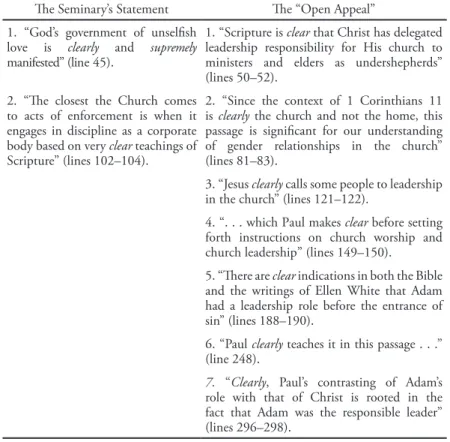
Boosters, such as “clear” and “clearly,” appear in both texts, indicating a high level of certainty about their interpretations of certain biblical texts, but the usage is far more frequent in the “Open Appeal” (see tab. 2):
Table 2. The Use of the Booster Adjectives and Adverbs
The Seminary’s Statement The “Open Appeal” 1. “God’s government of unselfish
love is clearly and supremely manifested” (line 45).
1. “Scripture is clear that Christ has delegated leadership responsibility for His church to ministers and elders as undershepherds” (lines 50–52).
2. “The closest the Church comes to acts of enforcement is when it engages in discipline as a corporate body based on very clear teachings of Scripture” (lines 102–104).
2. “Since the context of 1 Corinthians 11 is clearly the church and not the home, this passage is significant for our understanding of gender relationships in the church” (lines 81–83).
3. “Jesus clearly calls some people to leadership in the church” (lines 121–122).
4. “. . . which Paul makes clear before setting forth instructions on church worship and church leadership” (lines 149–150).
5. “There are clear indications in both the Bible and the writings of Ellen White that Adam had a leadership role before the entrance of sin” (lines 188–190).
6. “Paul clearly teaches it in this passage . . .” (line 248).
7. “Clearly, Paul’s contrasting of Adam’s
role with that of Christ is rooted in the fact that Adam was the responsible leader” (lines 296–298).
The two texts emphasize contrasting concepts; the Seminary’s Statement boosts love and equality, while the “Open Appeal” boosts men’s headship authority as clear biblical principles. Examining sentences that indicate deontic modality through the use of “should” reveals contrasting ideologies even further (see tab. 3):
Table 3. The Usage of “Should”
The Seminary’s Statement The “Open Appeal” 1. “Church leaders should be humble
servants” (lines 137–138). 1. “Jesus declared that the relationship between His followers should resemble the relationship existing between the [sic] Himself and the Father” (lines 61–62). 2. “They [leaders] should be respected
and deeply appreciated . . .” (line 138). 2. “It is as essential that as a father he should improve the talents God has given
him for the purpose of making the home a symbol of the heavenly family. . .” (lines 108–109 [quote from E. G. White]). 3. “Thus appointed leaders become
stewards of a power that should be exercised on behalf of Christ and for the benefit of those they lead” (lines 144–146).
3. “. . . as that in the work of the ministry, he should make use of his God-given powers to win souls for the church . . .” (lines 109–111 [quote from White]). 4. “Those leading out should seek to
allow their decision to be guided . . . by the group” (lines 148–150).
4. “She continued, ‘As the priest in the home, and as the ambassador of Christ in the church, he should exemplify in his life the character of Christ . . . ’” (lines 111–113 [quote from White]). 5. “Woman should fill the position which
God originally designed for her, as her husband’s equal” (lines 217–219 [quote from White]).
5. “We should definitely consult the New Testament . . .” (line 240).
6. “Humans should manifest the love of God in their family relationships” (lines 231–232).
6. “It [authority within the home (and also within the church)] should be expressed in loving care for the wife” (lines 284–285). 7. “The unselfish love that is central
to God’s moral government should be reflected in humble service to one another . . .” (lines 250–251).
7. “The importance of this statement [in which White confirms male headship]
should not be underestimated” (line 305).
8. “The church should be modeled after Christ’s servant leadership and grounded in love . . .” (lines 297–298).
9. “The root proistemi, here translated ‘rule,’ literally refers to those who ‘stand before,’ beneficially leading and ministering to the community, and
should not be confused with some kind of
monarchical rulership” (lines 322–324). Italics supplied.
Seven out of the nine instances of the use of “should” in the Seminary’s Statement involve the context of humility and service (e.g., statements 1, 2, 3, 4, 6, 7, 8). Further, it quotes from White to emphasize gender equality (statement 5). In the “Open Appeal,” three sentences including “should” also come from White’s writings (statements 2, 3, and 4), in which she admonishes ministers to be faithful in family life. The “Open Appeal” includes those statements to justify “an intimate connection between leadership in the home and leadership in the church” (lines 91–92). The other three statements (1, 6, and 7) also emphasize men’s headship authority. In statement 6, the “Open Appeal” juxtaposes semantically distant notions such as “authority” and “loving care,” making the meaning somewhat ambiguous. Lexical Frequencies
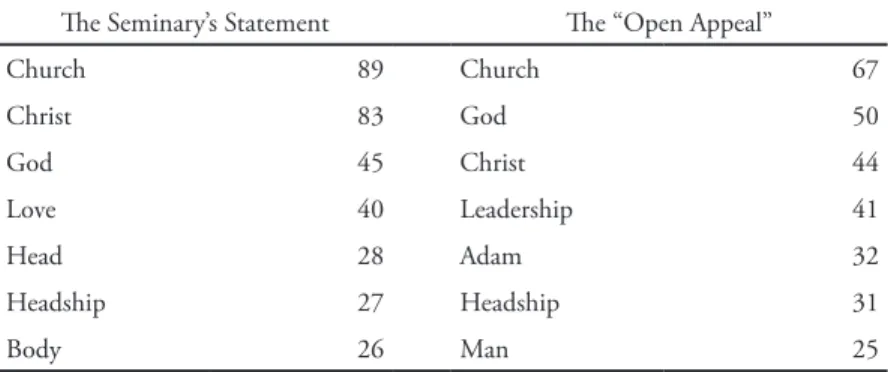
Discourse analysts often examine lexical density, diversity, and frequency in order to measure lexical richness and identify prominence given to certain words in a written text. This section focuses on lexical frequencies in the two texts to examine any potential relationships between the differing ideological stances and word usage. Although making a direct connection between the lexical frequencies and the attitudes toward women’s ordination is not possible, examining the word usage can serve as an additional means to triangulate the analysis as it illustrates the centrality of ideas that certain words play as building blocks for framing various arguments. Table 4 represents the key words that are used twenty or more times in each text.
Table 4. Words Used Twenty or More Times
The Seminary’s Statement The “Open Appeal”
Church 89 Church 67 Christ 83 God 50 God 45 Christ 44 Love 40 Leadership 41 Head 28 Adam 32 Headship 27 Headship 31 Body 26 Man 25
The following word clouds generated through NVivo 11 help the reader to visualize and, thus, to identify more quickly the lexical frequencies in the two texts that are represented in table 4 (see figs. 2–3). The most prominent terms are located in the center, with the font size indicating the degree of frequency of some of the most frequently used words in the texts.
Figure 2. Word Cloud for the Seminary’s Statement
As can be seen in table 4 and figures 2–3, the Seminary’s Statement and the “Open Appeal” both include, not surprisingly, “church,” “God,” and “Christ” as their three highest frequency terms. A notable difference, however, is that the word “love” is the fourth frequently occurring word in the Seminary’s Statement, whereas “leadership,” “Adam,” and “headship” are the next frequently occurring words in the “Open Appeal.” The fact that “love” is a high-frequency item in the Seminary’s Statement may not be surprising to readers in that, throughout the text, it focuses on the servant leadership of Christ, which His followers are to model. The fact that the “Open Appeal” seeks to make the case for the headship/leadership authority for men is also demonstrated in the lexical data, as it repeatedly refers to Adam’s authority over Eve in the Garden of Eden to justify predestined gender hierarchy.
As can be seen, different semantic boundaries of key terms—“headship” and “leadership”—manifested in the two texts render the debate ineffectual. Moreover, the high level of certainty that the two groups try to convey through various linguistic devices leaves no room for negotiation as they define Christianity in contrasting terms.
Conclusion
The brief linguistic analysis presented in this article sought to demonstrate how the Seventh-day Adventist Church’s two contrasting views on women’s ordination could be examined from a nontheological perspective. Although this article is limited in its scope, as it focuses on a few selected aspects of formal and linguistic properties of the texts, some insights can be gleaned.
First, the analysis shows that a lack of consensus on the definition of “headship” and “leadership” keeps the two groups from more effectively engaging in the debate. In the Seminary’s Statement, “headship” is entirely designated to the divine realm, whereas “leadership” is based on horizontal human relationships based on equality. In the “Open Appeal,” the two terms are interchangeable. As noted earlier, scholarly literature makes a distinction between the two, with headship relations typically representing those observed in business or military settings, where the power is granted due to the position, rather than functions. The semantic designations of these terms may need to be adjusted when used in the religious context. If the church wishes to move the discussion forward, it would be important to clearly define these terms by examining how these notions are operationalized by local and global constituents of the church in various areas of ministries.
Second, the analysis indicates that contrasting viewpoints articulated in the two texts reflect largely different theological paradigms, projected through the two groups’ differing views of the Trinity. Whereas the Trinity serves as “the ultimate model of love and self-sacrifice” in the Seminary’s Statement (lines 172–173), it serves as a model of “headship and submission,” which constitute “principles of heaven belonging to the Godhead” in the “Open Appeal” (lines 68–69). Both texts begin with the original government. However, in the Seminary’s Statement, principles of love and equality serve as building blocks in the subsequent arguments,
guiding its interpretation of the Bible and White’s writings, whereas in the “Open Appeal,” headship and submission serve as organizing principles shaping its interpretation of those texts. We have seen these paradigms being fully operational as the two groups define how Christianity should be through their main propositions and the use of deontic modality.
Some may argue that the two sets of paradigms are not necessarily antithetical nor contradictory. However, in these two texts, these different paradigms function as contrasting ideologies, affecting not only textual interactions, but also overall interdiscursive structures of arguments.
Also, both texts attempt to convey a strong sense of credibility of their arguments by reiterating phrases such as “Scripture affirms” (the Seminary’s Statement) and “Scripture with Scripture” (the “Open Appeal”). The analysis has partly demonstrated what scholars such as Bultmann, Kaiser and Silva, and Jensen, as well as many other theologians, have long noted concerning the difficulty of being completely objective and impartial in interpreting biblical texts.37 The number of biblical references does not determine the level of biblicality of an argument. And yet, the sense of interpretive supremacy the “Open Appeal” tries to convey through more frequent, repeated use of terms, such as “carefully” and “clearly,” and through its emphasis on “comparing Scripture with Scripture by consulting the whole Bible,” (lines 237–238) seems problematic when it draws from a narrower range of biblical texts, and the meanings of key terms are fused. In sum, findings of this study suggest that the Seventh-day Adventist Church’s current debate concerning women pastors seems to center not so much on which side interprets the Bible and White’s writings more carefully; the analysis shows that there is no shortage of statements in them for either side to draw from to support its position. Rather, the debate seems to hinge upon how the church defines pastoral leadership and with which theological paradigm it aligns its view of the triune God, who “is infinite and beyond human comprehension.”38
37Rudolph Bultmann, “Is Exegesis Without Presuppositions Possible?” in Existence and Faith: Shorter Writings of Rudolf Bultmann (Cleveland, OH: The Word,
1965), 289–296; Walter C. Kaiser Jr. and Moisés Silva, Introduction to Biblical
Hermeneutics (Grand Rapids: Zondervan, 2007); Alexander Jensen, Theological Hermeneutics (London: SCM, 2007).
38Seventh-day Adventist Church, “28 Fundamental Beliefs,” 2015 ed. (Silver Spring,
MD: General Conference of Seventh-day Adventists, 2015), 3, https://www.adventist. org/fileadmin/adventist.org/files/articles/official-statements/28Beliefs-Web.pdf.