Reliability of knee extension and flexion measurements
using the Con-Trex isokinetic dynamometer
Nicola A. Maffiuletti1, Mario Bizzini1, Kevin Desbrosses2, Nicolas Babault3and Urs Munzinger1 1
Neuromuscular Research Laboratory, Schulthess Clinic, Zurich, Switzerland,2Occupational Physiology Laboratory, National Institute for Research and Security, Nancy, France, and3Performance Expertise Centre, Faculty of Sport Sciences, University of Burgundy, Dijon, France
Correspondence
Nicola A. Maffiuletti, Schulthess Clinic, Lengghalde 2, 8008 Zurich, Switzerland
E-mail: [email protected] Accepted for publication Received 13 March 2007; accepted 25 May 2007 Key words
fatigue; hamstring; quadriceps; torque; work
Summary
The aim of this study was to evaluate the reliability of isokinetic and isometric assessments of the knee extensor and the flexor muscle function using the Con-Trex isokinetic dynamometer. Thirty healthy subjects (15 males, 15 females) were tested and retested 7 days later for maximal strength (isokinetic peak torque, work, power and angle of peak torque as well as isometric maximal voluntary contraction torque and rate of torque development) and fatigue (per cent loss and linear slope of torque and work across a series of 20 contractions). For both the knee extensor and the flexor muscle groups, all strength data – except angle of peak torque – demonstrated moderate-to-high reliability, with intraclass correlation coefficients (ICC) higher than 0Æ86. The highest reliability was observed for concentric peak torque of the knee extensor muscles (ICC = 0Æ99). Test–retest reliability of fatigue variables was moderate for the knee extensor (ICC range 0Æ84–0Æ89) and insufficient-to-moderate for the knee flexor muscles (ICC range 0Æ78–0Æ81). The more reliable index of muscle fatigue was the linear slope of the decline in work output. These findings establish the reliability of isokinetic and isometric measurements using the Con-Trex machine.
Introduction
In both rehabilitation and sports medicine, accurate measure-ments of muscle function are required to assess the impact of therapeutic interventions or the effects of physical training. To this aim, isokinetic dynamometry has been introduced in the late 1960s and for more than two decades it has been the standard research tool to investigate muscle function of single muscle groups, more particularly the thigh muscles. Isokinetic muscle strength is typically measured as peak torque, average work and power (Perrin, 1993; Brown, 2000; Wrigley & Strauss, 2000). Isometric muscle strength can also be measured with these machines that includes the assessment of maximal voluntary contraction (MVC) torque and rate of torque development (RTD). Muscle fatigue (or endurance) – i.e. the decline in torque⁄work output across a series of contractions – is another feature that can be assessed using isokinetic techniques, usually at a relatively fast concentric velocity over 20–50 consecutive maximal-effort repetitions (Thorstensson & Karls-son, 1976; Kannus et al., 1992; Kannus, 1994; Emery et al., 1999; Pinciveroet al., 2001).
Trustworthy isokinetic and isometric results require reliable measurement techniques. Reliability refers to the consistency of a
test and can be expressed as intra and intersession. The measuring device itself, the procedure for conducting measurements, and the steadiness of the subject being measured are all helpful to determine the reliability of the method. Different studies have demonstrated acceptable intra and intersession reliability for various kinds of isokinetic machines, such as the Biodex (Brown et al., 1993; Lund et al., 2005), Cybex (Bandy & McLaughlin, 1993; Liet al., 1996), Kin Com (Tredinnick & Duncan, 1988) and Merac (Capranicaet al., 1998). Other isokinetic dynamom-eters have been used in scientific studies (Lido, Orthotron, Technogym, etc.); however, the majority of these dynamometer manufacturers have left the market in the recent years.
The Con-Trex MJ isokinetic machine has been recently introduced to the rehabilitation-sports training community. Several scientific studies have used this device to assess static (isometric) and dynamic (eccentric and concentric) function of both the knee extensor and the flexor muscles (Cotte & Ferret, 2003; Bardis et al., 2004; Harrison et al., 2004; Mackey et al., 2004; Kolleret al., 2006; Kilgallonet al., 2007). However, there is a lack of information on the reliability of the Con-Trex machine for the assessment of isometric and eccentric variables – including isokinetic angle of peak torque – as well as for muscle fatigue assessment.
The aim of this study was to investigate test–retest reliability (both within and between sessions) of the knee extensor and the flexor muscle function (strength and fatigue) assessment using a new isokinetic device, in a group of healthy individuals from both sexes.
Methods
Subjects and experimental procedures
According to the recommendations of Walteret al. (1998) on sample size for reliability studies, 15 healthy men and 15 healthy women of age ranging from 23 to 42 (mean age ± SD: 30 ± 5 years, height: 175 ± 8 cm, mass: 70 ± 13 kg) were included in this study. All 30 were recreational athletes without known cardiovascular and orthopaedic problems. They were recruited from the Clinic staff. The study protocol was approved by the local ethical committee and written consent forms were signed prior to participation. The study was conducted according to the Declaration of Helsinki. Subjects were instructed to maintain their regular training regimens through-out the experimental period and not to take part in any vigorous physical activity for 2 days prior to their test date.
Testing
The subjects were tested during two identical sessions held 7 days apart, at the same time of day. All measurements were recorded by the same experimenter (NAM) to avoid intertester variability. The thigh muscles of the dominant limb (the limb
used to kick a ball) were tested by using a commercially available dynamometer (Con-Trex MJ; CMV AG, Du¨bendorf, Switzerland), which allows instantaneous isokinetic and iso-metric torque recording. Subjects were comfortably seated on the dynamometer chair, with the hip joint at about 85
(0= full extension). The distal shin pad of the dynamometer was attached 2–3 cm proximal to the lateral malleoulus by using a strap. To minimize extraneous body movements during thigh muscle contractions, straps were applied across the chest, pelvis and mid-thigh. The alignment between the dynamometer rotational axis and the knee joint rotation axis (lateral femoral epicondyle) was checked at the beginning of each trial. Gravity effect torque was recorded on each subject throughout the range of motion and this was used to correct torque measurements during all tests. The participants were given standardized (verbal) encouragement by the investigator (see below), and were asked to position their arms across the chest with each hand clasping the opposite shoulder during the testing procedure. On-line visual feedback of the instantaneous dyna-mometer torque was provided to the subjects on a computer screen.
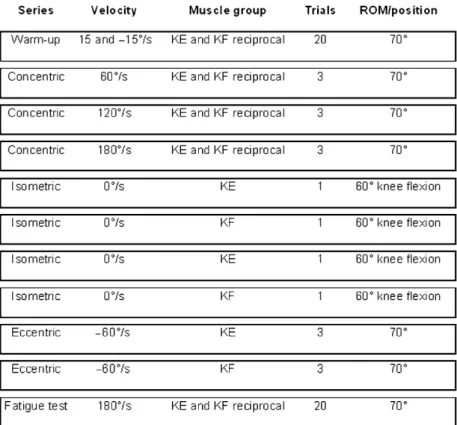
The overview of the experimental protocol is depicted in Fig. 1. Subjects warmed-up by performing 20 submaximal (20–80% of the estimated maximum effort) concentric and eccentric contractions of the thigh muscles (reciprocal for knee extensors and knee flexors) at slow angular velocities (15 and)15s)1, respectively). Subjects were also asked to complete two to three submaximal practice repetitions prior to each test series. For the isokinetic trials, range of motion was 70, from 80to 10of knee flexion (0corresponding to knee
Figure 1 Experimental protocol. Rest periods of 1 min were interspersed between series. KE, knee extensors; KF, knee flexors; ROM, range of motion.
fully extended). Concentric measurements involved three continuous, reciprocal (maximal) knee extensions and flexions, which were performed at three preset constant angular velocities, in the following order: 60, 120, 180s)1(slow to fast) (Wilhiteet al., 1992). Eccentric measurements consisted of three maximal contractions at a single velocity of )60s)1. Knee flexor and extensor trials were performed as discrete movements in a single direction (i.e. non-reciprocal). For both concentric and eccentric repetitions, subjects were exhorted to push⁄pull as hard and as fast as possible and to complete the full range of motion. For the isometric trials, the knee joint was fixed at an angle of 60of flexion, which has been demonstrated to be the angle of maximal isometric force generation (Thorstensson et al., 1976). Two isometric knee extensions and flexions were performed, and subjects were consistently asked to produce their maximal force rapidly (as fast and forceful as possible) and then to maintain the contraction for 4–5 s. After the maximal isokinetic and isometric contractions, subjects completed a fatigue test consisting of 20 continuous, reciprocal (maximal) knee extensions and flexions, which were performed at 180s)1(total duration20 s). Throughout the fatigue test, subjects were exhorted to push⁄pull as hard and as fast as possible and to complete the full range of motion. It was consistently verified that the average peak torque of the first three to five contractions was similar to the values recorded during the three-repetition series performed at 180s)1in the first part of the session, to ensure the maximal effort. Whatever the action mode and the velocity, subjects recovered passively for 60 s between series of measurements (isokinetic trials) or between repetitions (isometric trials). The Con-Trex software consistently indicated the duration of both contraction and rest phases.
Criterion measures
Torque, position and angular velocity data were recorded from the isokinetic dynamometer with a sampling rate of 100 Hz. For concentric and eccentric strength trials, the software calculated a large number of parameters, but we retained only those commonly used in isokinetic studies, namely the peak torque, the average work, the average power and the angle of peak torque (Brownet al., 1992; Perrin, 1993; Brown, 2000; Wrigley & Strauss, 2000). These variables were calculated for the knee extensor and the flexor muscles. For each angular velocity, only the two trials giving the highest peak torque were considered. The velocity throughout each repetition was analysed and it was also verified that, at the faster angular velocity, peak torque was developed during the constant velocity period. Isometric torque data were exported and analysed with Windows-based software (Acqknowledge; Biopac Systems Inc., Santa Barbara, CA, USA). Isometric MVC torque, i.e. the highest torque value, and maximal RTD, i.e. the highest positive value from the first derivative of the torque signal (greatest slope of torque-time curve), were calculated for all knee extensor and flexor trials. For the fatigue test, only peak torque and average work
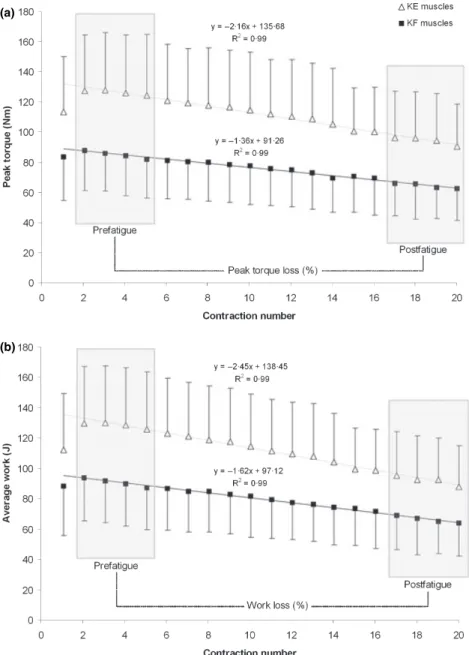
associated with the 20 consecutive repetitions were retained. Data associated with the first contraction of each series were consistently removed from the analyses (see Fig. 2). For respective muscles, torque (Fig. 2a) and work (Fig. 2b) values associated with the first four repetitions (contraction 2–5) and last four repetitions (contraction 17–20) of the series were averaged and considered as prefatigue and postfatigue data, respectively. Peak torque and work losses were then calculated as the per cent difference between postfatigue and prefatigue data (Thorstensson & Karlsson, 1976). Moreover, the decline in torque and work via the negative slope was determined by linear regression analysis from the second to the last (20th) repetition (Pinciveroet al., 2000, 2001), for respective muscle groups (see Fig. 2).
Statistical analyses
For muscle strength parameters (peak torque, work, power, angle of peak torque, isometric MVC torque and RTD), within-session (trial 1 versus trial 2) and between-within-session (average of trials 1 and 2 of session 1 versus session 2) reliability were calculated. For muscle fatigue variables (prefatigue, postfatigue, per cent loss and slope of both peak torque and work data), only test–retest reliability was calculated.
Relative reliability concerns the degree to which individuals maintain their position in a sample with repeated measurements (Atkinson & Nevill, 1998). We assessed this type of reliability with the intraclass correlation coefficient (ICC) (2,1), a two-way random effects model with single-measure reliability in which variance over the repeated session is considered (Shrout & Fleiss, 1979). The ICC indicates the error in measurements as a proportion of the total variance in scores. As a general rule, we considered an ICC over 0Æ90 as high, between 0Æ80 and 0Æ90 as moderate and below 0Æ80 as insufficient (Vincent, 1999). Absolute reliability is the degree to which repeated measure-ments vary for individuals (Atkinson & Nevill, 1998); this type of reliability is usually expressed as a proportion of the measured values, i.e. coefficient of variation (CV). CV refers to intrasubject variation between two measurements. For each subject, CV was calculated as: (SD of two measurements⁄mean of two measurements)·100. To interpret the CV values, we used the arbitrary suggestions made by Stokes (1985) with an analytical goal of 15% or below.
Following a repeated measures ANOVA on trials within the same session, paired sample t-tests (bilateral) were used to determine whether the average muscle strength and fatigue data obtained in the session 1 were significantly different from session 2. Statistical significance was set atP<0Æ05. All statistical procedures were performed with SPSS 12.0.1 statistical software (SPSS Inc., Chicago, IL, USA).
Results
For all the criterion measures, as (i) CV were not significantly different (unpaired Studentst-test) and (ii) average ICC were 2007 The Authors
almost identical between men and women, all data were collapsed across gender.
Muscle strength
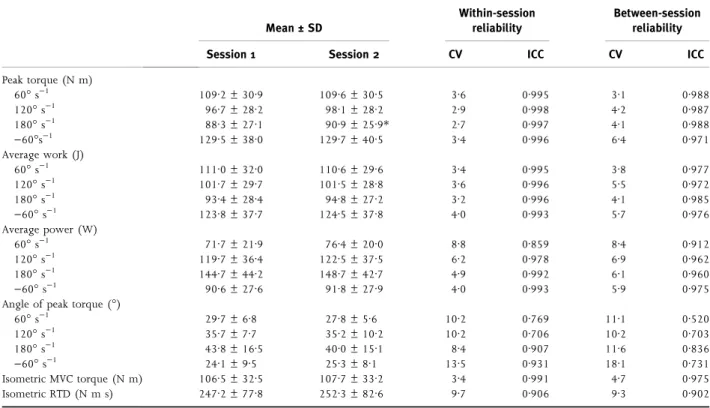
Mean isokinetic and isometric strength data for sessions 1 and 2, together with the associated CV and ICC for within and between-session reliability are presented in Table 1 (knee extensors) and Table 2 (knee flexors). For both muscle groups, isokinetic peak torque, work and power as well as isometric MVC torque and RTD demonstrated moderate-to-high reliabil-ity, with CV lower than 9Æ7% and ICC higher than 0Æ86. Concentric peak torque at the fastest velocity (180s)1) significantly increased from session 1 to session 2 for both the knee extensor and the flexor muscles (P<0Æ05). In the same way, eccentric peak torque (P<0Æ05), work (P<0Æ01) and power
(P<0Æ01) of the knee extensor muscles as well as angle of peak torque at 60s)1(P<0Æ05) significantly increased from session 1 to session 2. For the knee extensor muscles, angle of peak torque data showed a high reliability for the concentric but not for the eccentric mode (low ICC). Both within and between-session reliability for the knee flexors angle of peak torque was insufficient (low ICC), except for 180s)1.
To gain insight into (between-session) reliability results, CV and ICC data were grouped as a function of muscle group (knee extensors versus flexors), isokinetic variable (peak torque versus work versus power versus angle of peak torque) and angular velocity ()60 versus 0 versus 60 versus 120 versus 180s)1). We observed the highest ICC and the lowest CV (i.e. better reliability), respectively, for knee extensors (Fig. 3a), peak torque (Fig. 3b) and 180s)1data (Fig. 3c), while knee flexors, angle of peak torque and eccentric data showed the lowest reliability. (a)
(b)
Figure 2Decline in knee extensor and knee flexor peak torque (a) and average work (b) across the 20 repetitions (mean values of 30 subjects, session 1). The error bars represent SD. The average values of contraction 2–5 and 17–20 (shaded areas) were considered as prefatigue and postfatigue values, respectively. The difference between prefatigue and postfa-tigue data (peak torque and work loss) was calculated in per cent values. Moreover, torque and work losses were quantified as the slope of the linear fit for respective muscle groups. KE, knee extensors; KF, knee flexors.
Table 1 Reliability of isokinetic and isometric muscle strength data for the knee extensors. Mean ± SD Within-session reliability Between-session reliability
Session 1 Session 2 CV ICC CV ICC
Peak torque (N m) 60s)1 177Æ7 ± 46Æ1 177Æ6 ± 45Æ9 2Æ8 0Æ996 3Æ2 0Æ978 120s)1 152Æ4 ± 40Æ2 154Æ9 ± 40Æ4 1Æ9 0Æ998 2Æ8 0Æ991 180s)1 132Æ5 ± 37Æ9 135Æ6 ± 38Æ9* 1Æ9 0Æ999 3Æ3 0Æ993 )60s)1 202Æ4 ± 68Æ0 211Æ4 ± 61Æ2* 3Æ4 0Æ995 7Æ0 0Æ965 Average work (J) 60s)1 169Æ9 ± 42Æ1 168Æ1 ± 41Æ2 2Æ7 0Æ996 4Æ1 0Æ966 120s)1 152Æ9 ± 40Æ8 152Æ9 ± 38Æ4 2Æ1 0Æ998 3Æ7 0Æ979 180s)1 136Æ7 ± 39Æ7 137Æ5 ± 38Æ4 2Æ4 0Æ999 4Æ0 0Æ986 )60s)1 172Æ0 ± 56Æ4 182Æ6 ± 53Æ3** 3Æ9 0Æ994 7Æ2 0Æ971 Average power (W) 60s)1 119Æ0 ± 28Æ1 120Æ4 ± 30Æ1 2Æ8 0Æ996 4Æ7 0Æ956 120s)1 187Æ1 ± 48Æ5 188Æ9 ± 46Æ2 2Æ6 0Æ996 3Æ4 0Æ983 180s)1 218Æ8 ± 64Æ1 223Æ0 ± 64Æ3 2Æ9 0Æ998 4Æ6 0Æ981 )60s)1 125Æ3 ± 41Æ0 133Æ5 ± 39Æ9** 4Æ3 0Æ993 7Æ3 0Æ971
Angle of peak torque ()
60s)1 53Æ4 ± 6Æ9 55Æ2 ± 7Æ4* 4Æ0 0Æ927 4Æ3 0Æ914 120s)1 47Æ6 ± 7Æ1 48Æ1 ± 6Æ7 3Æ5 0Æ968 4Æ3 0Æ920 180s)1 47Æ1 ± 6Æ6 47Æ2 ± 6Æ8 4Æ1 0Æ943 4Æ0 0Æ911 )60s)1 60Æ4 ± 7Æ1 62Æ3 ± 7Æ9 6Æ9 0Æ766 7Æ1 0Æ483 Isometric MVC torque (N m) 214Æ1 ± 61Æ9 221Æ4 ± 57Æ6 4Æ4 0Æ983 5Æ5 0Æ972 Isometric RTD (N m s) 521Æ2 ± 161Æ3 513Æ2 ± 143Æ9 8Æ3 0Æ923 9Æ1 0Æ874 CV, coefficient of variation; ICC, intraclass correlation coefficients; MVC, maximal voluntary contraction; RTD, rate of torque development. Signifi-cantly higher than session 1 at *P<0Æ05 and **P<0Æ01, respectively.
Table 2 Reliability of isokinetic and isometric muscle strength data for the knee flexors.
Mean ± SD
Within-session reliability
Between-session reliability
Session 1 Session 2 CV ICC CV ICC
Peak torque (N m) 60s)1 109Æ2 ± 30Æ9 109Æ6 ± 30Æ5 3Æ6 0Æ995 3Æ1 0Æ988 120s)1 96Æ7 ± 28Æ2 98Æ1 ± 28Æ2 2Æ9 0Æ998 4Æ2 0Æ987 180s)1 88Æ3 ± 27Æ1 90Æ9 ± 25Æ9* 2Æ7 0Æ997 4Æ1 0Æ988 )60s)1 129Æ5 ± 38Æ0 129Æ7 ± 40Æ5 3Æ4 0Æ996 6Æ4 0Æ971 Average work (J) 60s)1 111Æ0 ± 32Æ0 110Æ6 ± 29Æ6 3Æ4 0Æ995 3Æ8 0Æ977 120s)1 101Æ7 ± 29Æ7 101Æ5 ± 28Æ8 3Æ6 0Æ996 5Æ5 0Æ972 180s)1 93Æ4 ± 28Æ4 94Æ8 ± 27Æ2 3Æ2 0Æ996 4Æ1 0Æ985 )60s)1 123Æ8 ± 37Æ7 124Æ5 ± 37Æ8 4Æ0 0Æ993 5Æ7 0Æ976 Average power (W) 60s)1 71Æ7 ± 21Æ9 76Æ4 ± 20Æ0 8Æ8 0Æ859 8Æ4 0Æ912 120s)1 119Æ7 ± 36Æ4 122Æ5 ± 37Æ5 6Æ2 0Æ978 6Æ9 0Æ962 180s)1 144Æ7 ± 44Æ2 148Æ7 ± 42Æ7 4Æ9 0Æ992 6Æ1 0Æ960 )60s)1 90Æ6 ± 27Æ6 91Æ8 ± 27Æ9 4Æ0 0Æ993 5Æ9 0Æ975
Angle of peak torque ()
60s)1 29Æ7 ± 6Æ8 27Æ8 ± 5Æ6 10Æ2 0Æ769 11Æ1 0Æ520 120s)1 35Æ7 ± 7Æ7 35Æ2 ± 10Æ2 10Æ2 0Æ706 10Æ2 0Æ703 180s)1 43Æ8 ± 16Æ5 40Æ0 ± 15Æ1 8Æ4 0Æ907 11Æ6 0Æ836 )60s)1 24Æ1 ± 9Æ5 25Æ3 ± 8Æ1 13Æ5 0Æ931 18Æ1 0Æ731 Isometric MVC torque (N m) 106Æ5 ± 32Æ5 107Æ7 ± 33Æ2 3Æ4 0Æ991 4Æ7 0Æ975 Isometric RTD (N m s) 247Æ2 ± 77Æ8 252Æ3 ± 82Æ6 9Æ7 0Æ906 9Æ3 0Æ902 CV, coefficient of variation; ICC, intraclass correlation coefficients; MVC, maximal voluntary contraction; RTD, rate of torque development. *Sig-nificantly higher than session 1 atP<0Æ05.
Muscle fatigue
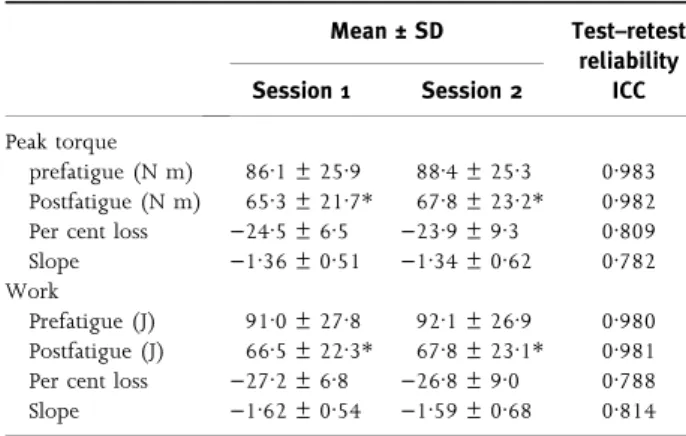
Isokinetic muscle fatigue data for respective sessions, together with the associated ICC are presented in Table 3 (knee extensors) and Table 4 (knee flexors). Absolute isokinetic peak torque and work (P<0Æ001) of the knee extensor and flexor muscles significantly decreased in the fatigued state. Isokinetic knee extension torque (but not work) was significantly higher at retest compared to session 1, both pre- and postfatigue (P<0Æ05).
For both muscle groups, pre and postfatigue isokinetic variables (absolute data), demonstrated high between-session reliability, with ICC higher than 0Æ98. Test–retest reliability of isokinetic fatigue indices (per cent loss and linear regression slope) was moderate for the knee extensor muscles (ICC range 0Æ84–0Æ89) and insufficient-to-moderate for the knee flexor muscles (ICC range 0Æ78–0Æ81).
In order to speculate on the reliability of fatigue variables, we grouped the ICC data reported in Tables 3 and 4 as a function of muscle group (knee extensors versus flexors), isokinetic variable (peak torque versus work) and method of fatigue calculation (per cent loss versus slope). As a general rule, the highest ICC (i.e. better reliability) was observed for knee extensors (Fig. 4a), work (Fig. 4b) and slope (Fig. 4c) data, respectively. On the other hand, knee flexor muscles, peak torque and per cent loss had the lowest ICC.
Discussion
In the present study, the reliability of concentric, eccentric and isometric muscle strength assessment using the Con-Trex dynamometer was high for both the knee extensor and the flexor muscles. On the other hand, reliability varied from insufficient to high for angle of peak torque. The findings of this study also showed that test–retest reliability of fatigue indices was moderate for the knee extensor and insufficient-to-moderate for the knee flexor muscles.
Figure 3 Between-session CV and ICC for strength variables collapsed across muscle group (a), isokinetic variable (b) and angular velocity (c). Mean values and SEM. CV: coefficient of variation; ICC: intraclass correlation coefficient.
Table 3Reliability of muscle fatigue data for the knee extensors.
Mean ± SD Test–retest
reliability
Session 1 Session 2 ICC
Peak torque
Prefatigue (N m) 127Æ6 ± 38Æ5 131Æ2 ± 37Æ5** 0Æ987 Postfatigue (N m) 95Æ0 ± 30Æ1* 97Æ8 ± 33Æ0*,** 0Æ988 Per cent loss )25Æ6 ± 6Æ4 )26Æ0 ± 5Æ7 0Æ840 Slope )2Æ16 ± 0Æ85 )2Æ20 ± 0Æ67 0Æ847 Work
Prefatigue (J) 129Æ1 ± 37Æ4 131Æ6 ± 35Æ7 0Æ979 Postfatigue (J) 92Æ5 ± 27Æ9* 94Æ0 ± 28Æ7* 0Æ987 Per cent loss )28Æ3 ± 7Æ0 )28Æ9 ± 5Æ5 0Æ869 Slope )2Æ45 ± 0Æ96 )2Æ51 ± 0Æ71 0Æ889 ICC, intraclass correlation coefficients. *Significantly lower than prefa-tigue atP<0Æ001. **Significantly higher than session 1 atP<0Æ05.
Table 4 Reliability of muscle fatigue data for the knee flexors.
Mean ± SD Test–retest
reliability
Session 1 Session 2 ICC
Peak torque
prefatigue (N m) 86Æ1 ± 25Æ9 88Æ4 ± 25Æ3 0Æ983 Postfatigue (N m) 65Æ3 ± 21Æ7* 67Æ8 ± 23Æ2* 0Æ982 Per cent loss )24Æ5 ± 6Æ5 )23Æ9 ± 9Æ3 0Æ809 Slope )1Æ36 ± 0Æ51 )1Æ34 ± 0Æ62 0Æ782 Work
Prefatigue (J) 91Æ0 ± 27Æ8 92Æ1 ± 26Æ9 0Æ980 Postfatigue (J) 66Æ5 ± 22Æ3* 67Æ8 ± 23Æ1* 0Æ981 Per cent loss )27Æ2 ± 6Æ8 )26Æ8 ± 9Æ0 0Æ788 Slope )1Æ62 ± 0Æ54 )1Æ59 ± 0Æ68 0Æ814 ICC, intraclass correlation coefficients. *Significantly lower than prefa-tigue atP<0Æ001.
The reliability of isokinetic measurement procedures and devices must be substantiated before dynamometers can be used for legitimate research or patient evaluation. To our knowledge, there are nowadays three main manufacturers vending isokinetic devices throughout the world: CSMI solutions (Stoughton, MA, USA) for Humac Norm (Cybex), Biodex Medical System (Shirley, NY, USA) for Biodex system 3 and CMV AG for Con-Trex MJ. In the last 20 years, test–retest reliability for the assessment of thigh muscle strength using Cybex and Biodex machines has been the focus of a series of manuscripts (Feiring
et al., 1990; Bandy & McLaughlin, 1993; Bemben & Johnson, 1993; Brown et al., 1993; Li et al., 1996; Drouin et al., 2004; Lundet al., 2005). Conversely, the reliability of measurements performed on the Con-Trex system, which is increasingly used to study thigh muscle function in both sports medicine (see e.g. Kolleret al., 2006) and research settings (see e.g. Mackeyet al., 2004), has not been clearly documented. Even if the comparison between studies is only anecdotal, the highest ICC for peak torque were obtained in this present investigation, both during concentric (ICC > 0Æ98 here versus 0Æ87–0Æ97 in the aforemen-tioned studies) and eccentric (ICC > 0Æ96 versus 0Æ83–0Æ84) actions. Another unique aspect of this study is the assessment of isometric strength and isokinetic fatigue in addition to isokinetic (eccentric and concentric) strength variables, for both the knee extensor and the flexor muscles.
All isokinetic and isometric strength outcomes based on torque recordings demonstrated moderate-to-high reliability. In contrast, the angle of occurrence of isokinetic peak torque, which is an important diagnostic parameter to consider (Bemben & Johnson, 1993), was quite unreliable for eccentric actions of the knee extensor muscles and for both concentric and eccentric actions of the knee flexor muscles. It is therefore recommended that this parameter – as provided by Con-Trex software – should be interpreted with caution. In order to provide methodological recommendations in the choice of variables that should be used in future studies to describe thigh muscle strength, reliability data (ICC and CV) were collapsed across muscle group, isokinetic variable and angular velocity (see Fig. 3). In line with Liet al. (1996) reliability was higher for the knee extensor compared to knee flexor muscles, and for peak torque compared with work and power. It is, therefore, recommended that the more reliable strength test performed with the Con-Trex dynamometer would consist of maximal-effort concentric isokinetic knee extensions, for which peak torque will be retained.
By using the same procedure, we demonstrated that test– retest reliability of muscle fatigue indices was better for (i) work rather than peak torque, (ii) linear slope rather than per cent decrease and (iii) knee extensor rather than knee flexor muscles. Isokinetic work is quantified as the area under the torque versus angle curve, and therefore characterizes muscle performance over the entire range of motion (70 in this study), whereas peak torque is recorded at one specific joint position. In the same way, the decrease in muscle performance via the negative slope was determined by considering all the repetitions (except the first), while per cent loss was calculated using the first and last four contractions of the series. Thus, it is evident that reliable fatigue measurements require the quantification of the greatest amount of data, both within a single contraction (work versus peak torque) and throughout a series of fatiguing contractions (slope versus loss). We conclude that the more reliable index of muscle fatigue through 20 maximal isokinetic repetitions performed with the Con-Trex device is the linear slope of the decline in work output. These results confirm and extend those of Pincivero et al. (2001); however, this method
Figure 4 Average ICC for fatigue variables collapsed across muscle group (a), isokinetic variable (b) and method of fatigue calculation (c). Mean values and SEM. ICC: intraclass correlation coefficient.
remains to be consistently used in the literature and included by manufacturers in isokinetic evaluations and reports.
The present findings establish the reliability of isokinetic and isometric muscle strength and fatigue measurements using the Con-Trex MJ machine. Future studies should determine (i) whether the results obtained on this isokinetic dynamometer are interchangeable with respect to machines of different brands and (ii) the reliability of the present muscle strength and fatigue assessments in patient populations.
Acknowledgments
The authors are grateful to Mr Michael Phieler (Schulthess Clinic) for assistance.
References
Atkinson G, Nevill AM. Statistical methods for assessing measurement error (reliability) in variables relevant to sports medicine.Sports Med
(1998);26: 217–238.
Bandy WD, McLaughlin S. Intramachine and intermachine reliability for selected dynamic muscle performance tests.J Orthop Sports Phys Ther
(1993);18: 609–613.
Bardis C, Kalamara E, Loucaides G, Michaelides M, Tsaklis P. Intrama-chine and intermaIntrama-chine reproducibility of concentric performance: A study of the CON-TREX MJ and the Cybex Norm dynamometers.
Isokinet Exerc Sci(2004);12: 91–97.
Bemben MG, Johnson DA. Reliability of the Biodex B2000 isokinetic dynamometer and the evaluation of sport-specific determination for the angle of peak torque during knee extension. Isokinet Exerc Sci
(1993);3: 164–168.
Brown L.Isokinetics in Human Performance(2000). Human Kinetics, Cham-paign, IL, 472 pp.
Brown LE, Whitehurst M, Bryant JR. Reliability of the Lido active isokinetic dynamometer concentric mode. Isokinet Exerc Sci (1992); 2: 191–194.
Brown LE, Whitehurst M, Bryant JR, Buchalter DN. Reliability of the Biodex System 2 isokinetic dynamometer concentric mode. Isokinet Exerc Sci(1993);3: 160–163.
Capranica L, Battenti M, Demarie S, Figura F. Reliability of isokinetic knee extension and flexion strength testing in elderly women.J Sports Med Phys Fitness(1998);38: 169–176.
Cotte T, Ferret JM. Comparative study of two isokinetics dynamometers: CYBEX NORM vs CON-TREX MJ.Isokinet Exerc Sci(2003);11: 37–43. Drouin JM, Valovich-mcLeod TC, Shultz SJ, Gansneder BM, Perrin DH. Reliability and validity of the Biodex System 3 pro isokinetic dyna-mometer velocity, torque and position measurements.Eur J Appl Physiol
(2004);91: 22–29.
Emery CA, Maitland ME, Meeuwisse WH. Test–retest reliability of isokinetic hip adductor and flexor muscle strength. Can J Sports Med(1999);9: 79–85.
Feiring DC, Ellenbecker TS, Derscheid GL. Test–retest reliability of the Biodex isokinetic dynamometer.J Orthop Sports Phys Ther(1990);11: 298–300.
Harrison AJ, Keane SP, Coglan J. Force-velocity relationship and stretch-shortening cycle function in sprint and endurance athletes.J Strength Cond Res(2004);18: 473–479.
Kannus P. Isokinetic evaluation of muscular performance: implications for muscle testing and rehabilitation.Int J Sports Med(1994);15: S11– S18.
Kannus P, Cook L, Alosa D. Absolute and relative endurance parameters in isokinetic tests of muscular performance.J Sport Rehab(1992);1: 2–12.
Kilgallon M, Donnelly AE, Shafat A. Progressive resistance training temporarily alters hamstring torque-angle relationship.Scand J Med Sci Sports(2007);17: 18–24.
Koller A, Sumann G, Schobersberger W, Hoertnagl H, Haid C. Decrease in eccentric hamstring strength in runners in the Tirol Speed Mara-thon.Br J Sports Med(2006);40: 850–852.
Li RC, Wu Y, Maffulli N, Chan KM, Chan JL. Eccentric and concentric isokinetic knee flexion and extension: a reliability study using the Cybex 6000 dynamometer.Br J Sports Med(1996);30: 156–160. Lund H, Sondergaard K, Zachariassen T, Christensen R, Bulow P,
Hen-riksen M, Bartels EM, Danneskiold-Samsoe B, Bliddal H. Learning effect of isokinetic measurements in healthy subjects, and reliability and comparability of Biodex and Lido dynamometers.Clin Physiol Funct Imaging(2005);25: 75–82.
Mackey AL, Donnelly AE, Turpeenniemi-Hujanen T, Roper HP. Skeletal muscle collagen content in humans after high-force eccentric con-tractions.J Appl Physiol(2004);97: 197–203.
Perrin DH. Isokinetic Exercise and Assessment (1993). Human Kinetics, Champaign, IL, 212 pp.
Pincivero DM, Gear WS, Sterner RL, Karunakara RG. Gender differences in the relationship between quadriceps work and fatigue during high-intensity exercise.J Strength Cond Res(2000);14: 202–206.
Pincivero DM, Gear WS, Sterner RL. Assessment of the reliability of high-intensity quadriceps femoris muscle fatigue.Med Sci Sports Exerc(2001); 33: 334–338.
Shrout PE, Fleiss JL. Intraclass correlations: uses in assessing rater reli-ability.Psychol Bull(1979);86: 420–428.
Stokes M. Reliability and repeatability of methods for measuring muscle in physiotherapy.Physiother Pract(1985);1: 71–76.
Thorstensson A, Karlsson J. Fatiguability and fibre composition of human skeletal muscle.Acta Physiol Scand(1976);98: 318–322. Thorstensson A, Grimby G, Karlsson J. Force-velocity relations and fiber
composition in human knee extensor muscles.J Appl Physiol(1976); 40: 12–16.
Tredinnick TJ, Duncan PW. Reliability of measurements of concentric and eccentric isokinetic loading.Phys Ther(1988);68: 656–659. Vincent WJ.Statistics in Kinesiology(1999). Human Kinetics, Champaign,
IL, 294 pp.
Walter SD, Eliasziw M, Donner A. Sample size and optimal designs for reliability studies.Statist Med(1998);17: 101–110.
Wilhite MR, Cohen ER, Wilhite SC. Reliability of concentric and eccentric measurements of quadriceps performance using the KIN-COM dynamometer: the effect of testing order for three different speeds.J Orthop Sports Phys Ther(1992);15: 175–182.
Wrigley T, Strauss G. Strength assessment by isokinetic dynamometry. In:Physiological Tests for Elite Athletes(ed. Gore, CJ) (2000), pp. 155–199. Human Kinetics, Champaign, IL.