DOI 10.1007/s10726-011-9277-z
Selection of a Representative Value Function for Robust
Ordinal Regression in Group Decision Making
Miłosz Kadzi ´nski · Salvatore Greco · Roman Słowi ´nski
Published online: 1 December 2011
© The Author(s) 2011. This article is published with open access at Springerlink.com
Abstract In this paper, we introduce the concept of a representative value function in a group decision context. We extend recently proposed methods UTAGMS-GROUP and UTADISGMS-GROUP with selection of a compromise and collective preference model which aggregates preferences of several decision makers (DMs) and represents all instances of preference models compatible with preference information elicited from DMs. The representative value function is built on results of robust ordinal regression, so its representativeness can be interpreted in terms of robustness concern. We propose a few procedures designed for multiple criteria ranking, choice, and sort-ing problems. The use of these procedures is conditioned by both satisfysort-ing different degrees of consistency of the preference information provided by all DMs, as well as by some properties of particular decision making situations. The representative value function is intended to help the DMs to understand the robust results, and to provide them with a compromise result in case of conflict between the DMs.
Keywords Group decision·Robust ordinal regression·Additive value function· Representative value function·Compromise
M. Kadzi´nski (
B
)·R. Słowi´nskiInstitute of Computing Science, Pozna´n University of Technology, 60-965 Pozna´n, Poland e-mail: [email protected]
S. Greco
Faculty of Economics, University of Catania, Corso Italia, 55, 95129 Catania, Italy e-mail: [email protected]
R. Słowi´nski
Systems Research Institute, Polish Academy of Sciences, 01-447 Warsaw, Poland e-mail: [email protected]
1 Introduction
Decision aiding is defined as an activity of using some models which help answering questions asked by stakeholders in a decision making process (Roy 1985). Conclu-sions which stem only from the analysis of performances of considered alternatives on a set of criteria are usually too weak to significantly contribute to the elements of these answers. Therefore, working out a recommendation relies to a high degree on the preference information elicited from the stakeholders playing the role of decision makers (DMs). This information may be either direct or indirect. In the first case, it specifies directly values of some parameters used in the preference model. In the other case, the preference information is composed of some examples of holistic judgments on a subset of alternatives AR ⊆ A, which are called reference alternatives and play the role of a training set. Indirect preference information is used in the disaggrega-tion-aggregation paradigm (Jacquet-Lagrèze and Siskos 1982). The idea of inferring compatible instances of a preference model which restore the exemplary statements provided by a DM, has been employed in methods involving three main families of preference models: an outranking relation (Mousseau and Słowi´nski 1998), a set of decision rules (Greco et al. 1999), and a value function (e.g., the UTA method Jacquet-Lagrèze and Siskos 1982;Siskos et al. 2005).
Since there are many parameters of the preference model to be estimated, there are, typically, many alternative optimal solutions, i.e. compatible instances of a preference model. As a result, the output of the method may vary substantially depending on which solution is selected. Traditionally, existing approaches based their outcomes only on a single compatible instance of a preference model. Computing final recom-mendation, they, indeed, neglected the fact of possible existence of many alternative instances of a preference model inferred from the provided preference information. Thus, it seemed reasonable to take into account all instances of a preference model compatible with the preference information provided by the DM, and to work out a recommendation for the set of alternativesAtaking into account all these compatible instances. As a result, the principle of robust ordinal regression has been proposed (Greco et al. 2010c), and two new methods based on this principle, UTAGMS(Greco et al. 2008) and GRIP (Figueira et al. 2009), have been presented. These methods consider the whole set of value functions compatible with the preference information provided by the DM, while traditional UTA-like methods are using only one such value function or a limited subset of such functions. InKadzi´nski et al.(2012a), one has extended these methods by an analysis of extreme ranking results. Having con-sidered complete rankings that follow the use of all compatible value functions, one can determine the best and the worst ranks taken by each alternativea ∈ A. Further, robust ordinal regression has been adapted in the UTADISGMSmethod to deal with sorting problems (Greco et al. 2010b), and in ELECTREGKMS, which is a general scheme implementing this paradigm to outranking methods (seeGreco et al. 2011b, 2009). Robust ordinal regression has also been applied to preference model based on Choquet integral in order to handle interaction among criteria (Angilella et al. 2010). All these methods supply the DM with two kinds of results: necessary and possible. The necessary result (ranking or assignment) specifies the most certain recommen-dation worked out on the basis of all compatible instances of a preference model
considered jointly, whereas the possible result identifies a possible recommendation which stems from the use of at least one compatible instance of a preference model.
The family of robust ordinal regression methods has been originally designed to deal with preferences expressed by a single DM. However, inGreco et al.(2011a) andGreco et al.(2009) this principle has been enlarged on group decision. The main multiple cri-teria decision methods to which robust ordinal regression has been applied are consid-ered there, and corresponding methods for group decision have been obtained. Within the framework of UTAGMS-GROUP, UTADISGMS-GROUP, and ELECTREGKMS -GROUP, several DMs can cooperate to make a collective decision. They share the same description of the decision problem, i.e. the set of alternatives, consistent family of criteria, and evaluation matrix. For each DM, who expresses her/his individual pref-erence information, we use the respective GMS or GKMS method, and check whether the necessary and possible preference relations or assignments hold either for at least one or for all DMs. Thus, we consider two levels of certainty. The first level is related to verification of the necessary and possible consequences of preference information provided by each DM. The other level involves indication whether in the considered set of DMs the specific outcome is confirmed by at least one DM (possibly) or by all DMs (necessarily). In this way, we are reasoning in terms of the necessary and possible outcomes and coalitions of DMs, and we arrive to four types of results: nec-essary-necessary (i.e., result which is necessary for all DMs), necessary-possible (i.e., result which is necessary for at least one DM), possible-necessary (i.e., result which is possible for all DMs), and possible-possible (i.e., result which is possible for at least one DM).
The main aim of this paper is to introduce the concept of a representative value func-tion in robust ordinal regression applied to multiple criteria group decision problems. Despite the interest of the robust rankings and assignments provided by the family of GROUP methods, for some decision-making situations we need to provide a univocal recommendation, and, e.g., assign a single score to each alternative. Moreover, the robust results might not be understandable to some DMs. Therefore, we propose to work out a single preference model and representative results which follow its use, without loosing advantage of knowing all compatible value functions for all DMs. We have already considered similar requirements with respect to a single DM (seeGreco et al. 2011c;Kadzi´nski et al. 2012b). The representative value function is about to highlight the most stable part of the robust results, i.e., the necessary-necessary pref-erence relation for problems of ordering alternatives from the best to the worst, and possible-necessary assignments for sorting problems. In order to control the differ-ences between values of alternatives we use a maximin rule. Moreover, we distinguish three types of decision making situations conditioned by different degrees of consis-tency of the preference information. Precisely, we consider cases where preference information provided by all DMs can or cannot be represented jointly by at least one value function, and a case where preference information of each DM is compatible when analyzed individually.
Till now, UTA-like methods have been used in several works for conflict resolution in multi-actor decision making (Jacquet-Lagrèze and Shakun 1984;Jarke et al. 1987; Matsatsinis and Samaras 2001). In the introduced approach, we extend the family of GROUP methods, not only supporting DMs with a very intuitive representation of the
output of robust ordinal regression, but also providing an insight into an achieved con-sensus solution. Consequently, we combine the robustness analysis conducted within UTAGMS-GROUP and UTADISGMS-GROUP with the clarity of classical UTA-like methods. The presented approach may be of interest to researchers in management and business with such applications as, e.g., evaluation of consumers’ preferences, personnel selection, or allocation of priorities to projects. However, it is important to stress that following the assumption of the GROUP methods, the introduced proce-dure could be used only in these group decision problems where performances of all considered alternatives on the common family of criteria are the same for all DMs.
The paper is organized in the following way. In the next section, we recall the basic principles of robust ordinal regression methods within Multi-Attribute Utility Theory (MAUT), i.e. UTAGMSand UTADISGMS along with their extensions dealing with preferences expressed by several DMs. Section3is devoted to presentation of the rep-resentative value function in the context of multiple criteria group decision. Section4 presents two didactic examples relative to applications of the presented methodology aiming to recommend the best choice, or ranking, or sorting of alternatives. We pro-vide the detailed results of the robust ordinal regression methods, and present the way these outcomes may be enriched with selection of the representative value function. Finally, Sect.5provides conclusions and avenues for future research.
2 Reminder on Robust Ordinal Regression Methods Within the Framework of Multi-Attribute Utility Theory
We are considering decision situations in which a finite set of alternativesA = {a1, a2, . . . ,ai, . . . ,an}is evaluated on a consistent family of criteriaG= {g1,g2, . . . ,gj,
. . . ,gm}. The evaluation ofai ∈ A on criteriongj ∈ Gis denoted bygj(ai). The
set of all different evaluations ongj is denoted by Xj, and ordered values ofXj are
denoted as:x1j,x2j, . . . ,xnjj, withxkj <xkj+1, k=1,2, . . . ,nj−1, nj ≤n.
In order to represent DM’s preferences, we use a preference model in the form of an additive value functionU(a) = mj=1uj(gj(a)) ∈ [0,1], whereuj is the
marginal monotone value function for criterion gj,uj(x1j)= 0,for all j ∈ J, and m
j=1uj(x nj
j )=1. The comprehensive value serves as an index used to decide the
position in the ranking, or presence in the subset of the best alternatives, or the assign-ment to the predefined ordered classes.
In this section, we recall two groups of robust ordinal regression methods in the framework of MAUT. One of them is designed to deal with ranking and choice prob-lems, whereas the other is intended to support decision processes related to sorting problems. Note that we are considering the choice problem as a particular case of the ranking problem.
2.1 Robust Ordinal Regression for Ranking and Choice Problems
The idea of considering the whole set of compatible value functions to deal with ranking and choice problems was originally introduced in the UTAGMS method
(Greco et al. 2008). The initial idea of selecting a value function representing the pos-sible and the necessary preference relations was introduced inFigueira et al.(2008). In the same vein the procedure for selecting a representative value function among all compatible ones was proposed inKadzi´nski et al.(2012b). Finally, the approach was extended in UTAGMS-GROUP to handle a group decision context (seeGreco et al. 2011a,2009).
The UTAGMS procedure starts with asking the DM for preference information in the form of pairwise comparisons for some reference alternatives. Then, it leads through the statement of appropriate ordinal regression problems which define the set of compatible value functions, i.e. such value functions that can restore all pairwise comparisons provided by the DM. The method results in calculation of two binary preference relations on the set of all alternatives:
– necessary weak preference relationN, in caseU(a)≥U(b)for all compatible value functions;
– possible weak preference relationP, in caseU(a)≥U(b)for at least one com-patible value function.
From the two weak preference relationsN andP, one can get preference, indif-ference, and incomparability in a usual way.
Robust ordinal regression for ranking and choice problems has been applied to group decision in the UTAGMS-GROUP method. Let us denote the set of DMs byD = {d1, . . . ,dp}. For eachdr ∈D⊆D, who expresses her/his individual preferences
as in UTAGMS, we consider all compatible value functions, and, subsequently, we calculate the necessary and possible preference relationsdNr anddPr. With respect to all DMs, four situations are interesting for a pair(a,b)∈ A×A:
– aDN,N b: adNr b forall dr ∈D ,
– aDN,P b: a dNr b forat least one dr ∈D ,
– aDP,N b: adPr b forall dr ∈D ,
– aDP,P b: a dPr b forat least one dr ∈D .
On the basis of these four relations, we can identify results reflecting sure and possible with respect to the preference information provided by at least one or all DMs.
2.2 Robust Ordinal Regression for Sorting Problems
The principle of robust ordinal regression has been applied to sorting problems in UTADISGMS(Greco et al. 2010b). Then, the concept of a representative value func-tion was presented inGreco et al.(2011c), and the method was extended to the case of several DMs in UTADISGMS-GROUP (seeGreco et al. 2011a,2009). Let us denote predefined preference ordered classes, each having a specific semantic definition, by
C1,C2, . . . ,Cp, whereCh+1is preferred toCh, h =1, . . . ,p−1.
In UTADISGMS, the DM is asked for preference information in the form of a set of assignment examples, each one consisting of an alternativea∗ ∈ AR ⊆ A
and its desired assignmenta∗ → [CLD M(a∗),CRD M(a∗)]. The set of inferred com-patible value functions consists of such value functions that are able to reproduce all
assignments given by the DM for reference alternatives. The method returns two kinds of assignments for any alternativea∈ A:
– the possible assignment CP(a)determines the set of indices of classes Ch for which there exists at least one compatible value functionU∈UAR assigningato
Ch:
CP(a)= [LUP(a),RUP(a)] = {h∈ H : ∃U ∈UAR :h∈ [LU(a),RU(a)]},
– the necessary assignmentCN(a)specifies the set of indices of classesChfor which
all compatible value functionsU∈UAR assignatoCh:
CN(a)= [LUN(a),RUN(a)] = {h ∈H : ∀U ∈UAR :h∈ [LU(a),RU(a)]},
where LU(a)and RU(a) are, respectively, the worst and the best class to which an alternativeais assigned by value functionU.
Within UTADISGMS-GROUP method, for eacha∈ Aand for eachdr∈D⊆D, we determine the necessaryCdN
r(a)and possibleC
P
dr(a)assignments as in UTADIS
GMS. Then, for each subset of DMs,D⊆D, we define the following four types of assign-ment: – CDP,P(a)=dr∈DC P dr(a), C N,P D (a)=dr∈DC N dr(a), – CDP,N(a)=dr∈DC P dr(a), C N,N D (a)=dr∈DC N dr(a).
By analogy to UTAGMS-GROUP, these assignments reflect sure or possible results for at least one or all DMs.
3 Selection of a Representative Value Function in Group Decision Making In this section, we introduce the concept of a representative value function in the con-text of multiple criteria group decision. The representative value function provides synthetic representation of all compatible value functions, it returns a numerical score for each alternative, and it permits assessing relative importance of criteria understood as their maximal share in a comprehensive value. In the proposed methodology, out-comes of all compatible preference models are represented by a single value function. When applied to group decision problems, the representative function serves moreover as a compromise group solution. Since the analysis of a single representative value function is less abstract than that of the whole set of compatible value functions, we facilitate understanding of the results of robust ordinal regression, and enable easy and intuitive comparison of consequences of one’s preferences with the consensus representing the whole group of DMs. Thus, the motivation for extending the family of GMS and GROUP methods with this approach is even more sound than for MCDA approaches considering preferences of just a single DM.
The idea underlying our proposal for selection of the representative value function is to stress the differences between values of some alternatives taking into account the most stable part of the robust results, i.e. necessary-necessary preference relations
for multiple criteria ranking problems, or possible-necessary assignments for multiple criteria sorting problems. Generally, we wish to emphasize the difference between values of alternatives if one can observe the evident advantage of one alternative over the other, or diminish this difference when it is impossible or very difficult to indi-cate the better alternative. Consequently, we use minimax and maximin rules to control the difference between values of alternatives. Whether we maximize or minimize the difference betweenU(a)andU(b)for a given pair of alternatives(a,b)∈ A×A, is conditioned by satisfying specific binary relations. Precisely, if one alternative is better than the other for all compatible value functions, i.e. its rank is higher or a class assigned to it is better, the difference between their values should be as large as possi-ble. On the contrary, if two alternatives are necessarily indifferent or incomparable in terms of all compatible rankings or assignments, the difference between their values should be minimized. In this way, we are building the representative value function on the outcomes of robust ordinal regression. As a result, the selected value function is representative in the sense of robustness concern.
In the following sections, we consider different types of decision making situations. Firstly, if pieces of preference information provided by all DMs are complementary when considering jointly, then, in order to identify a representative value function, we suggest employment of a suitably adapted procedures for a single fictitious DM whose preferences consist of pairwise comparisons or assignments given by all DMs. Secondly, if exemplary statements of each DM are consistent when considered indi-vidually, but not necessarily consistent when considered jointly, we refer to the results of the corresponding GROUP method, and we make the desired difference between values of specific alternatives dependent on the number of DMs for whom the relation holds. Precisely, this intensity is connected with the inclusion relation on the set of all subsets of DMs. Note that distinction between these two cases may also be made on a different ground. If the set of alternatives is numerous, and the DMs serve as experts only with respect to its small disjoint subsets of alternatives, then it is reasonable to combine their knowledge into preference information of a single fictitious DM. On the other hand, if the DMs have outlook of the whole set of alternatives (usually, when it is small), and their exemplary decisions are interrelated, then it is more suitable to analyze their statements separately, and examine subsequently the spaces of agree-ment and disagreeagree-ment. However, this remark should only be treated as a suggestion for the case of an automatic choice of the procedure. Nevertheless, in general, it is the matter of the analyst which procedure will be used.
3.1 Representative Value Function for the Case of Preference Information of All DMs Considered Jointly
In this section, we consider a decision making situation where pieces of preference information provided by all DMs can be represented together by at least one additive value function composed of general marginal value functions. To verify whether it is possible for the set of DMsD ⊆ D, preference information given by all DMs fromDis translated into the set of constraints,EDAR,X, where for ranking problems (EDAR,X)=(E
AR
U(a∗)≥U(b∗)+ε if a∗dr b∗ U(a∗)=U(b∗) if a∗∼dr b∗ ⎫ ⎬ ⎭ ∀(a,b)∈ BdRr, dr ∈D ⎫ ⎬ ⎭(EA R D,r ank),
whereas for sorting problems(EDAR,X)=(E AR
D,sor t), such that: U(a∗)≥U(b∗)+ε, ∀a∗∈ AdR i, b ∗∈ AR dj such thatLdi(a∗) >Rdj(b∗), di,d j ∈D (EDAR,sor t).
Along with constraints ensuring monotonicity of the marginal value functions and nor-malization of the comprehensive values to the range between 0 and 1, this set forms the set of linear constraintsEDAR, which defines the set of compatible value functions. Then, we consider the following linear program:
Maximize:ε s.t. (EDAR,X) uj(xkj)−uj(x(jk−1))≥0, j=1, . . . ,m, k=2, ...,nj uj(x1j)=0, j =1, . . . ,m, m j=1uj(x nj j )=1 ⎫ ⎬ ⎭ (EA R D,base) ⎫ ⎪ ⎪ ⎪ ⎬ ⎪ ⎪ ⎪ ⎭ (EDAR).
Let us denote byε∗the maximal value ofεobtained from the above program (i.e., ε∗ =maxε, s.t. EAR
D). The set of compatible value functionsUD is not empty if
EDAR is feasible andε∗ > 0. If there is no value function compatible with the pref-erence information provided by all DMs, i.e.ε∗ ≤ 0 or EDAR is infeasible, one may either identify reasons of incompatibility in order to remove it, or determine the rep-resentative value function for the maximal number of DMs whose statements are not contradictory. Dealing with the incompatibility issue is discussed in Sect.3.3.
If preference information provided by all DMs fromDis consistent, one may select the representative value function considering jointly all pieces of preference informa-tion supplied by these DMs. In this case, for multiple criteria ranking problems one obtains two preference relations, such that for any pair of alternatives(a,b)∈ A×A: – aDN b:ais ranked at least good asbif and only if,U(a)≥U(b)for all compatible
value functionsU∈UD;
– a DP b:a is ranked at least good asbif and only if,U(a)≥U(b)for at least one compatible value functionsU ∈UD.
The truth and falsity of the necessaryDN and possibleDP preference relations is verified by solution of appropriate LP problems. To check whethera DN b, we cal-culateε∗ =maxε, subject toEDAR incremented with a constraintU(b)≥U(a)+ε. Ifε∗≤0, thenaDN b. On the other hand, to check whethera DP b, we calculate
ε∗ =maxε, subject toEAR
D incremented with a constraintU(a)≥U(b). Ifε∗>0, thenaDP b.
Necessary weak preference relationDN is a partial preorder (i.e., it is reflexive (a DN a, since for alla ∈ A, U(a)=U(a)), and transitive (for alla,b,c ∈ A, ifa DN bandb DN c, thena DN c). Possible weak preference relationDP is a strongly complete (i.e. for alla,b ∈ A, a DP b or b DP a), and negatively transitive (i.e.∀a,b,c∈ A,ifnot(a DP b)andnot(b DP c), thennot(a DP c)) binary relation.
Binary relationsDNandDP satisfy the following interesting properties. Proposition 31 For any subset of decision makersD⊆D, ifUD = ∅, then: 1. DN,N⊆DN,
2. DP ⊆DP,N,
Proof Notice that all compatible value functions of each DM fromD do not nec-essarily represent all preferences of all DMs fromD. It is the case, because UD constitutes intersection of the sets of compatible value functions of particular DMs fromD. SinceUD = ∩dr∈DUdr ⊆ ∪dr∈DUdr, then on condition thatUD is not
empty, for alla,b∈ A:
1. aND,Nb⇒aDN b, i.e.DN,N⊆DN.
2. aDP b⇒a DP,N b, i.e.DP ⊆DP,N.
SinceDN⊆DPandDP,N⊆DP,P, we also know thatDN⊆DP,NandDP⊆DP,P. Thus, the following inclusion relations are true:
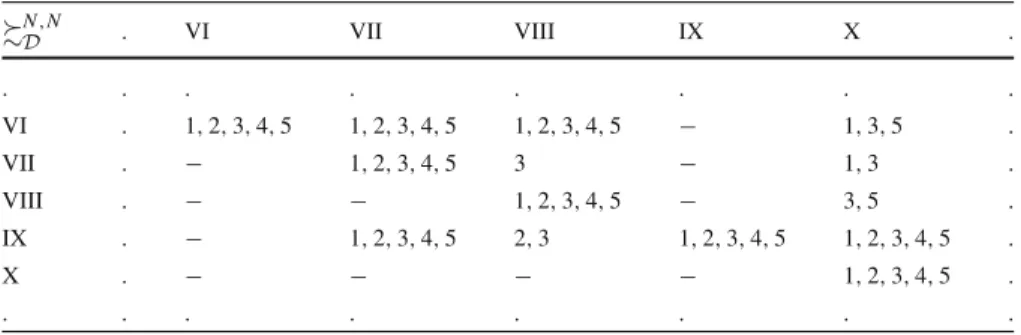
N,N
D ⊆DN ⊆DP ⊆DP,N⊆DP,P .
Proposition 32 Considering two subsets of DMs,D⊆D⊆D, ifUD = ∅, then: 1. DN ⊆ND,
2. DP⊆DP.
Proof Notice thatD⊆Dimplies thatUD ⊆UD. If so: 1. DN⇒DN, i.e.DN ⊆DN.
2. DP⇒DP, i.e.DP⊆DP.
For multiple criteria sorting problems, one obtains two kinds of assignments for any alternativea ∈ A:
– CDP(a)= {h ∈ H,∃U ∈UD :h∈ [LU(a),RU(a)]}, i.e. a set of indices of
clas-sesChfor which there exists at least one value functionU ∈ UD assigningato
– CDN(a)= {h∈H,∀U∈UD :h∈ [LU(a),RU(a)]}, i.e. a set of indices of classes Chfor which all value functionsU ∈UDassignatoCh.
Reasoning analogously to the conclusions drawn for ranking problems, we can state that assignmentsCDNandCDP satisfy the following interesting properties.
Proposition 33 For any subset of decision makersD ⊆ D and for all a ∈ A, if
UD = ∅, then:
1. CDN,N(a) ⊆ CDN(a), 2. CDP(a) ⊆ CDP,N(a),
Proof Analogously to the proof of Proposition31, with the proviso that we consider the assignment of alternativeato classC(a)rather than the weak preference relation
ab.
Proposition 34 Considering two subsets of DMs,D⊆D⊆D, ifUD = ∅, then: 1. CDN(a) ⊆ CDN(a),
2. CDP(a) ⊆ CDP(a).
Proof Analogously to the proof of Proposition32. In order to translate the concept of representativeness into mathematical formulations, at first we need to define binary relations which build on the results of robust ordinal regression. They allow easy indication of the better alternative within a given pair of alternatives, or provide evidence about indifference or incomparability of the alterna-tives with respect to the outcomes of all compatible instances of the preference model. The truth of these relations for some specific pairs would condition the desired dif-ference between their comprehensive values. With respect to multiple criteria ranking problems, let us consider the following binary relations for pairs(a,b)∈ A×A: – a DN b, i.e.a DN bandnot(bDN a)—in this case the advantage ofaoverb
is evident, since for all compatible value functionsU ∈UD,ais at least good as
b, while the opposite relation is not true;
– not(a DN b)andnot(b DN a)—in this case neithera is strongly necessarily preferred tob, norbis strongly necessarily preferred toa; as a result, they are either necessarily incomparable, i.e.a RDNb, or necessarily indifferent, i.e.a ∼DN b; in the former case, for someU1∈UD,ais preferred tob, but for some otherU2∈UD,
bis preferred toa; in the other case (a∼DN b), the comprehensive values ofaand bare equal for all compatible value functions.
Considering the above relations, in a representative case, we wish to maximize the difference betweenU(a)andU(b)for(a,b), such thata N b, and to minimize this difference for(c,d), such thatnot(cN d)andnot(d N c).
With respect to multiple criteria sorting problems, let us consider the following binary relations:
– a →D b, which means that for all compatible value functions U∈UD, a is assigned to a class better than the class of b, i.e. for all U ∈ UD, such that
– a ∼→D bora ≺→D b, where the former relation means that for any compatible value functionU ∈ UD,ais assigned to the same range of classes asb, i.e. for allU ∈ UD, such that LU(a) = LU(b) and RU(a) = RU(b), and the latter
relation means that the order of classes for alternativesa andb is not univocal (i.e. for some compatible value functions alternativea is classified better thanb
whereas for some other compatible value function it is classified worse: there exist
U1,U2∈UD, such thatLU1(a) > RU1(b)andLU2(b) > RU2(a)).
Analogously to the interpretation presented for the case of ranking problems, in a representative case, we aim to maximize the difference betweenU(a)andU(b)for
a,b∈ A, such thata → b, and to minimize this difference forc,d ∈ A, such that
c∼→ dorc≺→ d. Notice that we would like to achieve these targets for a single value function. However, according to the experiments we have conducted, if we first maximized the difference between values of some specific pairs of alternatives, there would not be much space for its minimization with respect to some other pairs of alternatives. Therefore, within the proposed framework, we look for the best possible compromise between these two targets. If after the proper procedure there is still more than one optimal value function, we choose the one for which the sum of elementary components is maximal.
Obviously, it is possible to conduct optimization of these differences taking advan-tage of other rules that have been proposed in the literature (see, e.g.,Bous et al. 2010; Despotis et al. 1990). However, we have decided to apply a maximin rule, and search for such a function in the feasible space, which maximizes the smallest distance to any introduced constraint. The selected solution is equivalent to the center of the largest circle that can be inscribed into this space. Note that in this case, the obtained results could be easily interpreted. For example, for ranking problems, we can observe what is the minimal difference between comprehensive values of alternatives related by the necessaryDN relation, and what is the maximal difference between comprehensive values of alternatives which are related by necessary incomparabilityRDN. In this way, we could examine the extent to which it was possible to emphasize the results of robust ordinal regression.
Procedure for Selection of a Representative Value Function for Group Ranking Problems
In order to select a representative value function for group ranking problems one may use the following procedure:
1. Ask all DMs fromDfor pairwise comparisons of reference alternatives. 2. Verify if the set of compatible value functionsUDis not empty.
3. Check the truth of the necessaryND and the possibleDP weak preference rela-tions for alla,b∈ A.
4. For all quadruples of alternatives(a,b,c,d)∈ A×A×A×A, such thata DN b andnot(cDN d)andnot(d ND c), add the following constraints to the linear programming (LP) constraintsEDAR for ranking problems:
U(a)−U(b)≥U(c)−U(d)+ε(a,b,c,d),
ε(a,b,c,d)≥ε.
5. Maximizeε, subject to the set of LP constraints from point 4). This amounts to the following optimization:
maxU∈UD{mi na,b,c,d∈A{[U(a)−U(b)] − [U(c)−U(d)],
fora,b,c,d ∈ A, such thata DN bandnot(cND d)andnot(d DN c)}}. 6. Add the constraintε=ε∗, withε∗=maxεfrom the previous point, to the set of
LP constraints considered in point 5). 7. Maximize a,b,c,d:aN
Dbandnot(cDNd)andnot(dDNc)ε(a,b,c,d), subject to the set of LP constraints from point 6).
After optimizations, for all alternatives in Awe are able to read off the representa-tive comprehensive values and their marginal components from the solution of the LP problem. On this basis, we are able to draw representative marginal and comprehensive
UDR value functions. The comprehensive values assigned to considered alternatives can be used to rank the alternatives.
Procedure for Selection of a Representative Value Function for Group Sorting Problems
In case of group sorting problems, the following procedure for selection of a repre-sentative value function corresponds to the previously discussed concept of represen-tativeness:
I. Ask all DMs for possibly imprecise assignment examples of reference alterna-tives.
II. Verify if the set of compatible value functionsUD is not empty.
III. Determine the possible sortingCDP(a)and the necessary sorting CDN(a) for each considered alternativea ∈ A. For all pairs of alternatives(a,b)∈ A×A, check the truth or falsity of relationsa →D b,a ∼D→ b, anda ≺→D b (the corresponding algorithms are described inGreco et al. 2011c).
IV. For all quadruples of alternatives(a,b,c,d)∈ A×A×A×A, such thata →D b andc∼→D d orc≺→D d, add the following constraints to the LP constraints EDAR for sorting problems:
U(a)−U(b)≥U(c)−U(d)+ε(a,b,c,d),
V. Maximizeε, subject to the set of LP constraints from point IV). This amounts to the following optimization:
maxU∈UD{mi na,b,c,d∈A{[U(a)−U(b)] − [U(c)−U(d)],
fora,b,c,d ∈ A, such thata→D band(c∼→D d orc≺→D d)}}. To save space, we do not provide similar explanations for the optimizations con-ducted in the procedures presented in the following sections. They would be analogous to these which are presented here.
VI. Add the constraintε=ε∗, withε∗=maxεfrom the previous point, to the set of LP constraints considered in point V).
VII. Maximizea,b,c,d:a→
Dband(c∼→Ddorc≺→Dd)ε(a,b,c,d), subject to the set of LP constraints from point VI).
After the above optimizations, for all alternatives in A we are able to read off the representative comprehensive and marginal values. The preference model selected according to the above principles, can be used along with the assignment examples supplied at the beginning by all DMs to drive an autonomous example-based sort-ing procedure (see Greco et al. 2011c,2010b), which would deliver representative assignments to classes for all considered alternatives.
In the above procedures we account for two targets. One of them consists in maxi-mization of the difference between values of alternatives satisfying a specific binary relation which confirms the advantage of one alternative over the other alternative. The other target consists in minimization of the difference between values of alternatives satisfying some other binary relations which indicate that the result of the comparison of a pair of alternatives is not univocal. Although in a general case, we recommend selection of a value function that would reflect the best compromise between these two targets, one can also imagine iterative optimization of these targets. Then, in the following iterations we would account for the values of already optimized targets. In this case, the selected value function would be the most discriminant with respect to pairs of alternatives related by the necessary relation for ranking problems, or pairs for which the intervals of assigned classes are always disjoint for sorting problems. On the other hand, if one would perform minimization in the initial step, the function would account first and foremost for equalization of the values of alternatives not related by the necessary preference, or alternatives being in the same class for all compatible value functions or those for which the order of classes is not univocal.
3.2 Representative Value Function for the Case of Preference Information of Each DM Considered Individually
In this section, we consider a decision making situation where preference information provided by each DM is consistent when analyzed separately, i.e.UAR,d
h = ∅,for
alldh∈D, while preference information of all DMs considered jointly is not neces-sarily consistent. If the set of compatible value functions for each DM is not empty, we compute results of a corresponding GROUP method, and we employ an adapted
procedure for selection of the representative value function. It consists in consider-ation of the same conditions as in procedures presented in Sect.3.1, but the desired intensity of difference between comprehensive values of specific alternatives depends on the inclusion relation on the set of all subsets of DMs for whom these relations hold. Precisely, the greater the number of DMs for whom the specific relation holds, the greater or the less the difference between values of alternatives depending whether originally we wanted to maximize the minimal difference or minimize the maximal difference, respectively.
Procedure for Selection of a Representative Value Function for Group Ranking Problems
The procedure for selection of a representative value function for group ranking deci-sion problems is based on the exploitation of the necessary-necessary preference rela-tion and weighting the desired difference between values of alternatives by the number of DMs for whom the specific conditions hold. The general idea is to maximize the difference between values of alternatives which are related by the necessary-necessary preference relation for any subset of DMs. The more DMs for whom this condition holds, the greater the difference should be. Simultaneously, we minimize the differ-ence between values of alternatives which are not necessary-possibly preferred one to another. By analogy, the more DMs for whom aforementioned relation holds, the less the desired difference. Note that applying these rules is conditioned by the truth of the inclusion relation between the subsets of DMs for whom we observe specific results. The following procedure for selecting a representative value function for ranking and choice problems corresponds to the above interpretation of representativeness: 1. Determine the necessary and the possible weak preference relation in the
con-sidered set of alternatives for each DM. Combine them into necessary-necessary, necessary-possible, possible-necessary, and possible-possible results.
2. For all quadruples of alternatives(a,b,c,d)∈ A×A×A×A, such thataDN,Nb andcDN,N dandD ⊂D⊆D, and neitherbDN,P anord DN,Pc, add the following constraints to the LP constraints of UTAGMS:
U(a)−U(b)≥U(c)−U(d)+ε(a,b,c,d),
ε(a,b,c,d)≥ε.
3. Maximizeε, subject to the set of LP constraints from point 2), and conduct the subsequent steps to optimize the sum of elementary componentsε(a,b,c,d) anal-ogously to steps 6 and 7 of the procedure from Sect.3.1.
Let us explain more clearly the idea underlying consideration of the condition specified in point 2 of the above procedure. We identify quadruples(a,b,c,d)∈ A×A×A×A,
such thata DN,N bandcND,N d withD ⊂D ⊆D. Since more DMs confirm the truth of relationN for a pair(a,b)than for(c,d), it is reasonable to require
Notice that at the same time for alldr ∈D\D, we havenot(a dNr b), whereas for
alldh ∈D\D, we havenot(cdN
h d). Therefore, from another perspective, since
(D\D)⊂(D\D), we require the difference betweenU(c)andU(d)to be less
than betweenU(a)andU(b).
Viewing all conditions defined in point 2 as a logical whole, we wish the difference betweenU(a)andU(b)fora,b∈ A, such that for alldr ∈D,aNdr b, to be the great-est, the difference betweenU(c)andU(d)forc,d ∈ A, such that for alldr ∈D⊂D,
cdN
r d, to be slightly less, and the difference betweenU(e)andU(f), such that for
alldr ∈ D,not(e dN
r f), to be the least. We exclude from consideration in this
point such pairsa,b∈ A, for which we can observe the contradictory strict necessary preference relations with respect to the set of DMsD, i.e.aDN,PbandbDN,Pa. In this case, we can simply say nothing about the desired difference betweenU(a)and
U(b), because for some DMsa is preferred tob, whereas for some other DMsbis preferred toa.
Note that in the above procedure, we do not associate the desired intensity of difference between comprehensive values of alternatives directly with the number of DMs confirming the specific relation, but rather with inclusion relation on the set of all subsets of DMs. To explain this proposal, let us consider the set of DMs
D= {d1,d2,d3,d4,d5}, and its subsetsD= {d1,d2,d3}andD= {d4,d5}. In case, a DN,N b andc DN,N d, one may claim that the desired difference betweenU(a) andU(b)should be greater than the difference betweenU(c)andU(d), only because
more DMs support the advantage ofa overbthan the advantage ofcoverd. How-ever, subsetsD andD are not related by the inclusion relation, and thus they are incomparable in terms of the partial order determined by⊆ on the set of all sub-sets of D. If so, one should not formulate any direct requirements with respect to comparison ofU(a)−U(b)andU(c)−U(d). This example proves why, in
gen-eral, it is not justified to relate the desired intensity of difference with the cardi-nalities of subsets of DMs only. Instead, we consider such pairs of alternatives for which the specific results are confirmed by proper (strict) subsets of DMs. In other words, when considering a pair(a,b), such thata DN,N b, withD = {d1,d2,d3}, we may wish that U(a)−U(b) is greater than U(e)−U(f) for pairs (e, f),
such that e ND,N f, with D∈ {∅,{d1},{d2},{d3},{d1,d2},{d1,d3},{d2,d3}}, and less that U(g)−U(h) for pairs (g,h), such that g DN,N h, with D ∈ {{d1,d2,d3,d4},{d1,d2,d3,d5},{d1,d2,d3,d4,d5}}. In this case, one can easily
com-pare arguments supporting the advantage of one alternative over the other.
Procedure for Selection of a Representative Value Function for Group Sorting Problems
The procedure for selection of a representative value function for group sorting prob-lems maximizes the difference between values of alternatives, such that one of them is always assigned to a class better than the other, and minimizes the difference between values of alternatives which do not have this property. Again, the intensity of differ-ence between values of alternatives depends on the inclusion relation on the subsets
of DMs who confirm the specific observation for different pairs(a,b)∈ A×A. The transposition of the above idea into optimization terms is done in a similar way as for ranking problems. The procedure for selection of a representative value function for group sorting problems is presented below:
I. Determine the possible sortingCdP
r(a)and the necessary sortingC
N
dr(a)for each
considered alternativea∈ Afor each DM,dr ∈D. For all pairs of alternatives (a,b)∈ A×A, check the truth or falsity of relationsa →d
r b,a ∼ → dr b, and a≺→d r bfor eachdr ∈D .
II. For all quadruples of alternatives(a,b,c,d) ∈ A× A× A× A, such that
a→d h b,for alldh ∈D , andc→ dk d,for alldk∈D , andD⊂D ⊆D, and neitherb→d r anord → dr cfor anydr ∈D
, add the following constraints
to the LP constraints of UTADISGMS:
U(a)−U(b)≥U(c)−U(d)+ε(a,b,c,d),
ε(a,b,c,d)≥ε.
III. Maximizeε, subject to the set of LP constraints from point II), and conduct the subsequent steps to optimize the sum of elementary componentsε(a,b,c,d)
analogously to steps VI and VII of the procedure from Sect.3.1.
Notice that one can generalize the above formulations in order to deal with the coalitions of DMs, and not just single DMs. This might be required, if prefer-ence information is supplied by experts from different companies or agencies, e.g.,D= {D1,D2, . . . ,Dk}, whereD1= {d1, . . . ,di},D2= {dj, . . . ,dm},. . .,Dk=
{dp, . . . ,ds}. Then, it would be reasonable to treat each coalition of DMs in the way a single DM is treated in the standard formulation of the procedure, and check the truth of inclusion relation in the second point of the above procedures with respect to the coalitionsD1, . . . ,Dk, rather than DMsd1, . . . ,ds,considered individually.
3.3 Analysis of Incompatibility
In case of incompatibility, there is no value functionUcompatible with the preference information provided by all DMs. Notice thatUD corresponds to the intersection of sets of compatible value functions for alldr ∈ D(each one being non-empty). This means that exemplary decisions of at least two DMs are contradictory. Such a situation may occur if some pieces of preference information do not match the additive model, or most often if their decision policy differs substantially. Treating the problem, one may identify some reasons for either removing it, or searching for a representative value function for a minimal magnitude of the error, or a minimal number of contra-dictory statements, or a maximal number of DMs whose reference statements are not contradictory.
Notice that in the first case, one needs to extend the set of constraintsEDAR with an additional inequalityε≥ε∗, such thatε∗=maxε, s.t.EDAR, so that the resulting new constraintsEDAR,extare feasible. Let us rather focus on the latter case, which is more
specific for group decision problems. At first, we need to identify the troublesome pieces of preference information responsible for incompatibility. There may exist sev-eral sets of pairwise comparisons or exemplary assignments which, once removed, make the set of compatible value functions non-empty. Performing these computa-tions for allD⊂Denables to identify coalitions of convergent DMs, for which the necessary and possible consensus rankings or assignments exist. Main steps of the pro-cedure which identifies these coalitions are outlined below. This propro-cedure is inspired by the general schemes for analysis of incompatibility introduced inMousseau et al. (2003) andMousseau et al.(2006).
Identification of the contradictory statements requires solving a mixed integer pro-gramming (MIP) problem. Using binary variablesva∗,b∗associated with each couple
of reference alternatives(a∗,b∗), such that a∗ b∗ for any DM in case of rank-ing problems, orLdi(a∗) > Rdj(b∗)for sorting problems (with the proviso that the
assignments fora∗andb∗may have been provided by different DMs), one rewrites the set of constraints(EDAR)into(EA
R
D). Subsequently, to identify a minimal subset of troublesome exemplary decisions, we solve the following MIP problem:
min f = a∗,b∗∈AR,condi ti on(a∗,b∗) va∗,b∗ s.t. (EDAR,X) (EDAR,base) ⎫ ⎬ ⎭ (EA R D)
where for ranking problemscondi ti on(a∗,b∗)=a∗b∗, and(EDAR,X)=(E AR D,r ank), such that: U(a∗)+Mva∗,b∗≥U(b∗)+ε if a∗dr b∗, dr ∈D U(a∗)+Mva∗,b∗ ≥U(b∗) U(b∗)+Mva∗,b∗≥U(a∗) ⎫ ⎬ ⎭ if a∗∼dr b∗, dr ∈D va∗,b∗is a binary variable ⎫ ⎪ ⎪ ⎪ ⎪ ⎪ ⎬ ⎪ ⎪ ⎪ ⎪ ⎪ ⎭ (EDAR,r ank),
and for sorting problemscondi ti on(a∗,b∗)= Ldi(a∗) > Rdj(b∗)and(EAR
D,X) =
(EDAR,sor t), such that:
U(a∗)+Mva∗,b∗ ≥U(b∗)+ε, for alla∗∈ARdi, b ∗∈AR dj such thatLdi(a∗) >Rdj(b∗), di,d j ∈D va∗,b∗is a binary variable ⎫ ⎪ ⎬ ⎪ ⎭(E AR D,sor t),
Ifva∗,b∗=1, then the corresponding constraint is satisfied whatever the value
func-tion is, which is equivalent to eliminafunc-tion of this constraint. The optimal solufunc-tion indicates one of the minimal subsets of conditions being the cause of incompatibility. Other subsets can be identified by solving this problem with additional constraint that forbids finding again the same solution:
(a∗,b∗)∈Si
va∗,b∗≤ fi∗−1,
where fi∗is the optimal value of the objective function of(EDAR)in thei-th iteration, Si = {(a∗,b∗)∈ AR×AR, a∗dr b∗for ranking orL
di(a∗) >Rdj(b∗)for sorting
andva∗i∗,b∗=1}, andva∗i∗,b∗are the corresponding values of the binary variables at the
optimum.
The solutions identified in this way may still be rather similar to each other. To ensure their greater diversity, we could maximizekindicating the number of pieces of preference information presented as the subset underlying incompatibility in the cur-rent iteration that should not be included in the next proposal. Additionally, we should require that the cardinality of the new subset of pieces of preference information is not too great, i.e. it could be greater than fi∗by a smallt(t ≥0). Proceeding in this way, requires considering the following MIP problem:
Maximize : k s.t. (EDAR) (a∗,b∗)∈Siva∗,b∗≤ f ∗ i −k a∗,b∗∈AR,condi ti on(a∗,b∗)va∗,b∗≤ fi∗+t va∗,b∗is a binary variable ⎫ ⎪ ⎪ ⎪ ⎪ ⎪ ⎬ ⎪ ⎪ ⎪ ⎪ ⎪ ⎭ (EDAR)i+1.
Note that identification of the minimal subsets of inconsistent pieces of preference information in the context of multiple DMs, could lead to removal of a significant subset of preferences of a particular DM, while preserving all statements of all other DMs. Such solution would not be perceived as “fair” by all DMs. To address this problem, one could account for minimization of the maximal number of pieces of preference information of each DM that should be removed. This could be achieved by consideration of the sum of binary variables associated with statements provided by each DM. For example, in case of ranking problems, for eachdr ∈Dwe would introduce the following variable:
vdr =
a∗{dr,∼dr}b∗
va∗,b∗, for eachdr ∈D.
vD = maxdr∈Dvdr, i.e.,vD ≥vdr for eachdr ∈D.
Outcomes of such a procedure may be presented to the DMs as possible ways for removing incompatibility. In this case, the DMs are asked to review their statements. Alternatively, once all the minimal subsets of pieces of preference information causing incompatibility are identified, one may proceed to identification of the minimal subset of DMs who provided contradictory statements. To achieve this, we need to associate pairwise comparisons or exemplary assignments coded asva∗,b∗with identifiers of the
DMs who provided a particular piece of preference information. Knowing the set of identifiers of DMs corresponding to{(a∗,b∗)∈ AR×AR:va∗,b∗ =1}for all
mini-mal subsets of constraints being the cause of incompatibility, we can easily point out the minimal subset of DMs whose preferences cannot be represented together. Subse-quently, we eliminate all pieces of preference information and respective constraints corresponding to the DMs for whomva∗,b∗=1, and pursue the analysis searching for
a representative value function for the maximal number of DMs whose preference statements were consistent. Such a function may constitute a good support for gener-ating reactions from the part of the “excluded” DMs, who may modify the previously supplied preference statements. It may also be used to work out the final recommen-dation, especially in these decision making situations which involve a single DM and several experts who provide their preferences.
Notice that all presented ways of dealing with incompatibility for group decision, i.e. accounting for the minimal magnitude of error, or for the minimal number of contradictory statements, or for the maximal number of DMs whose statements are consistent, may be applied to different formulations of the procedures discussed in Sects.3.1and3.2. Moreover, for the case of considering preference information of each DM individually, we may simply assume that the best compromise is reflected by the value function for which the optimized target is maximal. Obviously, a repre-sentative value function as well as the necessary and possible outcomes resulting from these computations will not fully respect all exemplary decisions initially provided by the DMs.
4 Case Studies
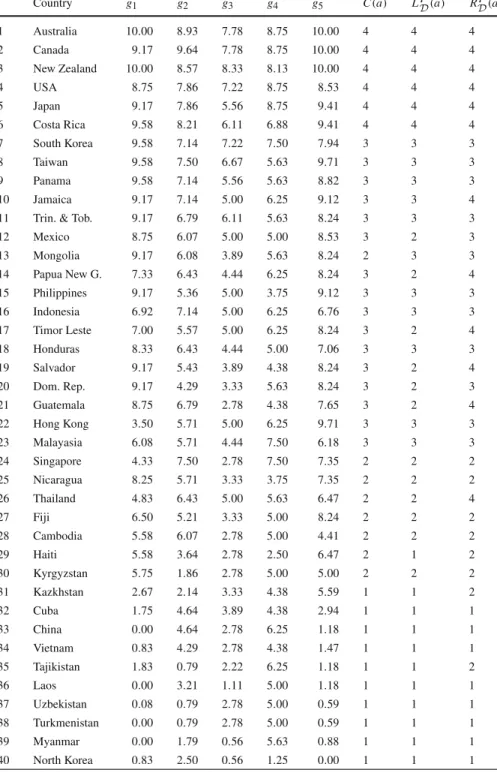
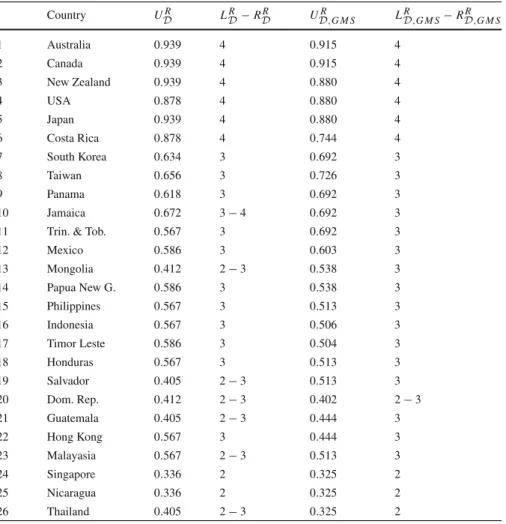
In this section, we report results of numerical experiments with two case studies. In the first case study, we reconsider the problem which has been originally presented inGreco et al.(2008) to illustrate the UTAGMSmethod. We analyze it in the context of several DMs who cooperate to make a collective ranking. We show representa-tive value functions identified according to the different procedures introduced in this paper. The second case study is devoted to the problem of sorting different countries to one of four types of regimes. We use data published by the Economist Intelligence Unit in 2007 for estimation of the democracy index (EIU 2007), and we reconsider the stated problem for 40 countries from different regions of the world. We discuss the necessary and possible assignments for preference information of all DMs considered individually or jointly. Further, we show representative value functions identified for these results by different procedures.
4.1 Assessment of Sales Managers
The CEO of a medium size firm wants to hire new international sales managers. A recruitment agency has interviewed 15 potential candidates which have been evalu-ated on 3 criteria (sales management skills (g1), international experience (g2), and human qualities (g3)) with an increasing direction of preference. Each of the five workers of the agency has attended a few interviews and is able to express a confident judgment about some candidates. The evaluations of candidates are given in Table1, and preference information in form of pairwise comparisons provided by all DMs,
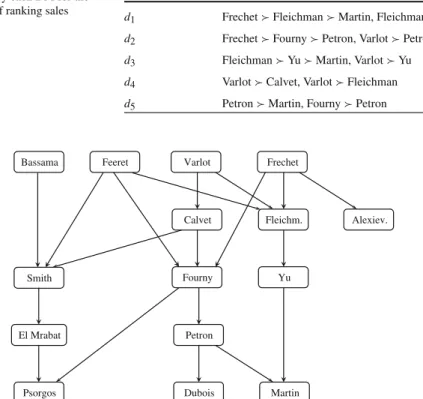
D= {d1,d2,d3,d4,d5}, is summarized in Table2.
Representative Value Function for the Case of Preference Information of All DMs Considered Jointly
Pairwise comparisons provided by all DMs are consistent, and, consequently, a set of compatible value functions compatible with reference statements of all DMs in not empty, i.e.UD = ∅. For this preference information, the necessary and possible weak preference relations are computed using UTAGMS. The Hasse diagram of the necessary relationDN for this particular problem is presented in Fig. 1. Note that the necessary preference relation is transitive. In this perspective, let us remind that arrows that can be obtained by transitivity are not represented in the Hasse diagram.
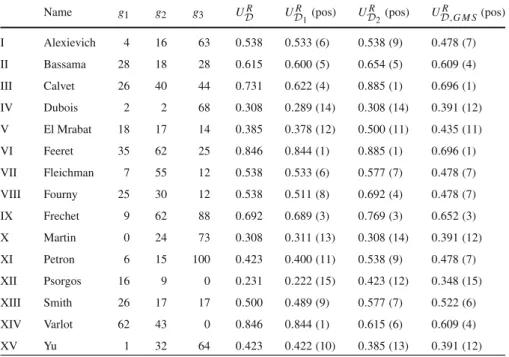
Table 1 Performance matrix and representative comprehensive values resulting from four different pro-cedures for the problem of ranking sales managers
Name g1 g2 g3 UDR UDR 1(pos) U R D2(pos) U R D,G M S(pos) I Alexievich 4 16 63 0.538 0.533(6) 0.538(9) 0.478(7) II Bassama 28 18 28 0.615 0.600(5) 0.654(5) 0.609(4) III Calvet 26 40 44 0.731 0.622(4) 0.885(1) 0.696(1) IV Dubois 2 2 68 0.308 0.289(14) 0.308(14) 0.391(12) V El Mrabat 18 17 14 0.385 0.378(12) 0.500(11) 0.435(11) VI Feeret 35 62 25 0.846 0.844(1) 0.885(1) 0.696(1) VII Fleichman 7 55 12 0.538 0.533(6) 0.577(7) 0.478(7) VIII Fourny 25 30 12 0.538 0.511(8) 0.692(4) 0.478(7) IX Frechet 9 62 88 0.692 0.689(3) 0.769(3) 0.652(3) X Martin 0 24 73 0.308 0.311(13) 0.308(14) 0.391(12) XI Petron 6 15 100 0.423 0.400(11) 0.538(9) 0.478(7) XII Psorgos 16 9 0 0.231 0.222(15) 0.423(12) 0.348(15) XIII Smith 26 17 17 0.500 0.489(9) 0.577(7) 0.522(6) XIV Varlot 62 43 0 0.846 0.844(1) 0.615(6) 0.609(4) XV Yu 1 32 64 0.423 0.422(10) 0.385(13) 0.391(12)
Table 2 Preference infromation provided by each DM for the problem of ranking sales managers
Preference information
d1 FrechetFleichmanMartin, FleichmanYu d2 FrechetFournyPetron, VarlotPetron d3 FleichmanYuMartin, VarlotYu d4 VarlotCalvet, VarlotFleichman d5 PetronMartin, FournyPetron
Feeret Bassama Smith Fleichm. Varlot Alexiev. El Mrabat Psorgos Frechet Calvet Fourny Petron Dubois Yu Martin
Fig. 1 Hasse diagram of the necessary preference relationDNfor the problem of ranking sales managers
The valid necessary relation means that a definite pair of alternatives is ranked in the same way whatever the compatible additive value function. As a result, the DMs may recognize the necessary relations as the certain preference statements. The necessary results reflect also the ability of the inferred model to reproduce all pairwise compar-isons of reference alternatives. In order to choose a representative value function, we analyze the necessary weak preference relation. In the considered problem, there are 49 ordered pairs of alternatives(a,b), for whicha DN b[e.g., (Frechet, Alexievich)]. Since for these pairs the advantage ofaoverbis evident, we would like to emphasize it, maximizing the difference betweenU(a)andU(b). On the other hand, there are also 88 pairs of alternativesc,d∈ A, for whichnot(cDN d)andnot(dDN c)(e.g., Alexievich and Fleichman). These pairs of alternatives are necessarily incomparable or necessarily indifferent, so analyzing robust results one cannot indicate the better alternative among them. Therefore, we wish to minimize the difference betweenU(c)
andU(d). All pairs(a,b)and(c,d)satisfying these specific conditions contribute to the definition of a representative value function according to the procedure presented in Sect.3.1.
In a sense, the employed procedure “flattened” the consequences of applying all compatible value functions to set A by using a single instance of the preference model. The representative value function permits the users to see the score of each
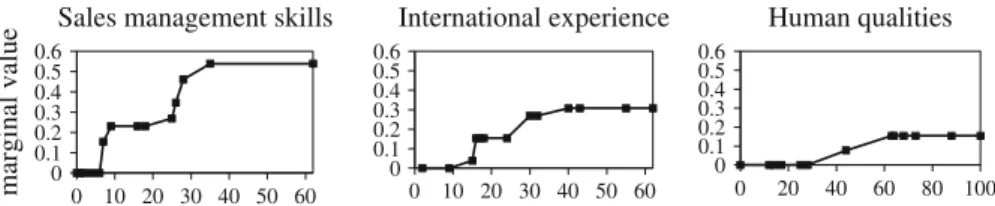
0 0.1 0.2 0.3 0.4 0.5 0.6 0 10 20 30 40 50 60 International experience 0 0.1 0.2 0.3 0.4 0.5 0.6 0 20 40 60 80 100 Human qualities 0 0.1 0.2 0.3 0.4 0.5 0.6 0 10 20 30 40 50 60 mar g inal val u
e Sales management skills
Fig. 2 Representative marginal value functions for the case of considering preference information of all DMs jointly
alternative, and to assess relative importance of the criteria, extending capacity of the robust method in explaining its final output. Figure2illustrates the representative mar-ginal value functions. They form a very intuitive representation of the output of the ordinal regression method, which helps to understand the results of the robust ranking. The characteristic points marked in the figure correspond to the marginal values of the considered alternatives. Although in the figure connections between these points are linear, it would be sufficient if they reflected the monotonic character. For this case, sales management skills criterion has the greatest share in the comprehensive values, whereas human qualities criterion has the least share. The same order can be observed with respect to the variation of marginal values. Such distribution of the shares along with the differentiation of the values by marginal value functions reflect consequences of the preferences of the DMs in the best way.
The resulting representative comprehensive values are presented in Table1 (see columnUDR). Notice that relations between these values represent all pieces of pref-erence information which have been provided by the DMs. Moreover, analyzing the specific pairs of alternatives, one can notice that the difference between their values is either relatively great, because one of them is necessarily preferred to the other [e.g., (Bassama, Psorgos), (Frechet, Alexievich)], or intentionally neglected as they are pos-sibly indifferent (there are a few pairs or triples of alternatives which are assigned equal comprehensive values [e.g., (Alexievich, Fleichman), (Petron, Yu)].
Note that the highest representative comprehensive values are assigned to Feeret and Varlot, which are not necessarily outranked by any other alternative. On the other hand, for Psorgos, Dubois, and Martin the comprehensive values are the smallest. These alternatives are not necessarily better than any other alternative, while being necessarily worse than numerous other candidates. Finally, let us note that although Calvet is necessarily outranked by Varlot, its representative comprehensive value is greater thanUDR(a)for Bassama, which could be possibly ranked at the top of the ranking for some compatible value functions. It is the case, since Calvet is necessarily preferred to a majority of other alternatives, while Bassama is incomparable in terms of the necessary relation even with candidates that could be perceived as the potential worst options, i.e. Dubois and Martin. These observations prove that the represen-tative value function emphasizes the most certain recommendation, and at the same finds a reasonable compromise between all possible recommendations. In this way, the clarity of classical UTA-like methods is combined with the analysis conducted within the framework of robust ordinal regression. Consequently, the ranking which stems