International Standards for System Integration
Richard A. Martin
ISO TC184/SC5/WG1 Convener
Tinwisle Corporation
PO Box 1297
Bloomington, IN 47402
E-mail: [email protected]
Abstract.
The growing complexity of manufacturing systems and the desire to more tightly couple business processes with manufacturing operations is resulting in many efforts to understand the mechanisms and opportunities for system integration in industrial enterprises. To improve the efficiency of beneficial interactions between systems and system components, the international community is adopting a wide range of standards through formal development and review processes. For this presentation, the focus is on the standards efforts for industrial automation conducted by the International Standards Organization Technical Committee 184 Subcommittee 5 working groups (ISO TC184/SC5). The work products range from shop floor communication structures through enterprise level system concept management – all with a process centric orientation. Of particular interest are the enablers of interoperable components along the supply chain and support for systems throughout their lifetime.IMPACT OF STANDARDS ON INDUSTRIAL AUTOMATION
While many aspects of industrial automation can benefit from the use of International Standards, three benefits immediately come to mind. First, standards play an increasingly important role in both physical and logical tool use. From electrical connectors to data transfer protocols, standards support the creation of reusable parts and methods throughout the system life-cycle. Second, standards generally codify existing practice reinforced by substantial research. The Society of Manufacturing Engineers (SME) is a leader in practice development and education for manufacturing enterprises. And third, standards create metrics against which an industrial enterprise can assess it own performance.
An international standard emerges only after the subject matter has been carefully crafted to promote a practice that many agree works well in international commerce. While SME does not maintain formal liaisons with the ISO, its members are constantly using or being exposed to the ISO standards portfolio and some individual members participate in ISO related activities. Beyond the ISO, the SME does participate in identifying and instilling best practices in manufacturing operations. Knowledge of international standards and their sphere of use will enable the benefits of standards use to accrue to the broader industrial engineering community and their companies.
THE INTEROPERATION GOAL
Are we there yet?
The success of our industrial age and our emerging information age is critically dependent upon meaningful interactions among elemental system components. While human elements of behaviour will continue to serve central roles in strategic guidance, we are progressing toward systemic component and system interactions across layers of enterprise structure for which human mediation is no longer essential. The use of adopted international standards enables the uniform selection of interaction mechanisms to drive more efficient and effective system performance.Central to TC184 SC5, as well as many other ISO subcommittees, is the effort to bring forward standardization that supports integration and interoperability in manufacturing enterprises. And while we
have been at this for some time now, the European Commission’s IDEAS 2003 report indicates that we are far from achieving the levels of interoperability among manufacturing systems and components that many believe are essential for significant improvement in manufacturing productivity [1]. We continue the exchange of capital and labor to reduce cost and increase output per unit of expense, and we improve the communication channels that are now essential to production systems. However, as reported by the National Council for Advanced Manufacturing, our dynamic response to changes in strategy, tactics, and operational needs continues to be limited by the paucity of interoperability both between systems, and between components within systems [2].
The extent to which we are successful in providing useful component and system interaction is expressed in current international standards and de-facto industry standards that define information exchange and operational metrics. Having emerged from the automation of tasks and the adoption of information management as a key factor in modern manufacturing, the need for robust interoperability of the kind we seek is rather new. Reliance upon human mediated interoperation is no longer sufficient. Yet enabling sophisticated adaptive component and system interoperation is proving to be very difficult.
ISO TC184 SC5 – INTERNATIONAL FOCUS ON INTEROPERATION
SC5 Scope.
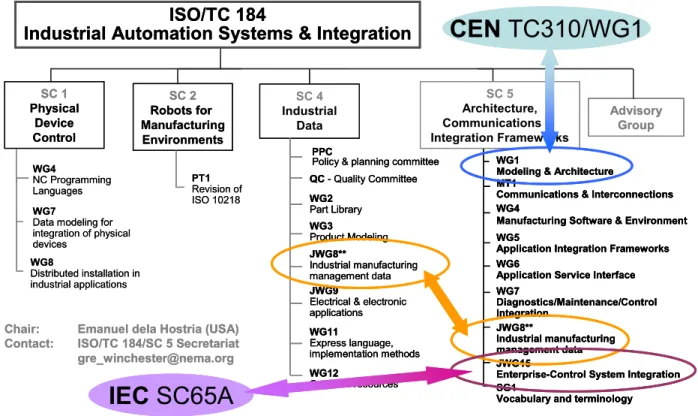
ISO TC184/SC5 develops standards for industrial automation. A complete listing of ISO Technical Committees is found at http://www.iso.ch where TC184 is charged with ‘Industrial automation systems and integration’. The scope of SC5 is standardization in the field of enterprise architecture, communications and processes to enable manufacturing systems integration, interworking, and interoperability. This standardization includes: an automation glossary; process representations (i.e. exchange/negotiation in manufacturing enterprises); requirements for global programming environment; and manufacturing profiles likely to be utilized by industry [3].Figure 1. ISO/TC184/SC5 Organization and Collaborations
Chair: Emanuel dela Hostria (USA)Contact: ISO/TC 184/SC 5 Secretariat [email protected]
ISO/TC 184
Industrial Automation Systems & Integration
SC 4 Industrial Data Advisory Group SC 2 Robots for Manufacturing Environments SC 1 Physical Device Control PT1 Revision of ISO 10218 QC- Quality Committee WG2 Part Library WG3 Product Modeling JWG8** Industrial manufacturing management data JWG9
Electrical & electronic applications WG11 Express language, implementation methods WG12 Common resources PPC
Policy & planning committee
WG8 Distributed installation in industrial applications WG4 NC Programming Languages WG7
Data modeling for integration of physical devices
WG1
Modeling & Architecture MT1
Communications & Interconnections WG4
Manufacturing Software & Environment WG5
Application Integration Frameworks WG6
Application Service Interface
JWG15
Enterprise-Control System Integration WG7
Diagnostics/Maintenance/Control Integration
SG1
Vocabulary and terminology JWG8** Industrial manufacturing management data SC 5 Architecture, Communications & Integration Frameworks
CEN TC310/WG1
IEC
SC65A
Chair: Emanuel dela Hostria (USA) Contact: ISO/TC 184/SC 5 Secretariat [email protected]
ISO/TC 184
Industrial Automation Systems & Integration
SC 4 Industrial Data SC 4 Industrial Data Advisory Group SC 2 Robots for Manufacturing Environments SC 1 Physical Device Control PT1 Revision of ISO 10218 QC- Quality Committee WG2 Part Library WG3 Product Modeling JWG8** Industrial manufacturing management data JWG9
Electrical & electronic applications WG11 Express language, implementation methods WG12 Common resources PPC
Policy & planning committee
QC- Quality Committee WG2 Part Library WG3 Product Modeling JWG8** Industrial manufacturing management data JWG9
Electrical & electronic applications WG11 Express language, implementation methods WG12 Common resources PPC
Policy & planning committee
WG8 Distributed installation in industrial applications WG4 NC Programming Languages WG7
Data modeling for integration of physical devices
WG1
Modeling & Architecture MT1
Communications & Interconnections WG4
Manufacturing Software & Environment WG5
Application Integration Frameworks WG6
Application Service Interface
JWG15
Enterprise-Control System Integration WG7
Diagnostics/Maintenance/Control Integration
SG1
Vocabulary and terminology JWG8**
Industrial manufacturing management data WG1
Modeling & Architecture MT1
Communications & Interconnections WG4
Manufacturing Software & Environment WG5
Application Integration Frameworks WG6
Application Service Interface
JWG15
Enterprise-Control System Integration WG7
Diagnostics/Maintenance/Control Integration
SG1
Vocabulary and terminology JWG8** Industrial manufacturing management data SC 5 Architecture, Communications & Integration Frameworks
CEN TC310/WG1
IEC
SC65A
Figure 1 depicts the organization of SC5 and its relationship to other TC184 units. SC5 is now responsible for six working groups, a vocabulary study group and has working group collaboration in JWG8 with TC184/SC4 ‘Industrial data’. In addition to the collaborations between ISO committees and sub-committees, ISO partners with other international bodies to promulgate standards of common interest. ISO TC184/SC5 and IEC TC65 SC65A through its ISA S95 liaison are working together in JWG15 at the boundary between automation control systems and production management systems.
SC5/WG1 is working closely with CEN TC310/WG1 to produce two standards: ISO/FDIS19439 to articulate a “framework for enterprise modeling” of manufacturing systems targeting executable models; and ISO/DIS 19440 to articulate the modeling constructs necessary to achieve a satisfactory description in the framework context [4]. We also expect to receive substantive material from other European efforts including those of the EC/FP6 ATHENA project in the area of manufacturing interoperability [5].
INDUSTRIAL AUTOMATION STANDARDS FOR INTEGRATION
Describing Industrial Data.
The development of international standards is an evolutionary activity that mimics the evolution of industrial practice as supported by academic and industrial research. One of the most successful standardization efforts toward integration began in 1979 and continues to this day with the activities of TC184/SC4. At that time, the National Institute of Standards and Technology began work in establishing standards for the exchange of engineering drawing elements, beginning with IGES that has evolved through several iterations into IS 10303 and its many application protocol (AP) parts [6]. Today IS 10303, known as STEP by many practitioners, is a robust foundation for the exchange of information about product components and, increasingly, system attributes codified as data elements [7]. One feature of STEP is the EXPRESS language and its graphical extension subset that enables the programmatic description of primitives identified in the standard [8]. IS 10303 continues its evolution with new APs and revisions to established parts and recent publication in HTML format.The Gallaher study of 2002, commissioned by NIST, concludes that the STEP standard accounted for an annual two hundred million dollar benefit for adopting industries in the USA [9]. One key factor in the success of STEP related to that savings is the enablement of information migration between product versions. This reuse of data through changes in operations comprises half of the standard’s benefit to industry. These benefits continue to grow.
Describing Industrial Processes.
Joint Working Group 8 (SC5/JWG8) is a collaborative effort between SC4 and SC5 to provide the Process Specification Language (PSL) as an interchange mechanism for process definition between systems and system components [10]. PSL yields process information representation that is independent of particular processes and models. It is a formal language specification in KIF with a lexicon, ontology, and grammar defined by a core specification, several theory sub-parts, e.g. resource theories stated using core language elements, and sub-part definitional extensions, e.g., temporal and state extensions. This standard codifies appropriate process knowledge as data for exchange between processors in a very rigorous manner. The fragment of Figure 2 details a sequence constraint for an automobile wire harness assembly.Note that the two language standards of TC184, EXPRESS and PSL, go beyond the format definition of descriptive information exchange like EDI to allow a more flexible resolution of rule based information exchange for well defined situations. While PSL can be processed very efficiently by machines, including formal assessment of consistency, it tends to inhibit extensive use by humans for managing content exchange. The expectation is that PSL will serve as the low level intermediary among various process definition and execution systems with its formal rigor allowing for unambiguous conveyance of information. PSL is intended for interaction between machines rather than between humans and machines.
Figure 2. PSL assembly sequence constraint
SC5 collaboration with SC4 also involves a multi-part standard for ‘Industrial manufacturing management data’ known as MANDATE [11]. Using EXPRESS, this standard elaborates a data model for the exchange of manufacturing management information, focusing on discrete manufacturing with an emphasis on data structures for time and resource.
Processes Integration.
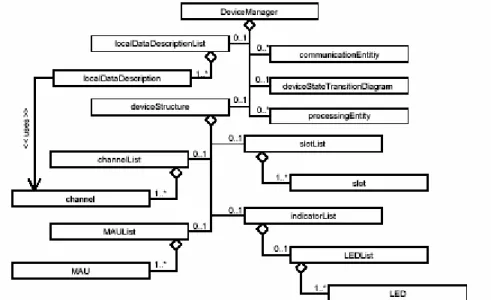
SC5 is producing a series of standards devoted to integration and interoperability. The IS 15745 series targets component to component information exchange protocols as the ‘Open System application integration frameworks’ multi-part standard [12]. An Application Integration Framework (AIF) of elements and rules for integration requirements provides the basis for application interoperability profiles that are interface specifications detailed as UML models with XML schemas for profile templates.Figure 3. CANopen representation of DeviceManager object in IS 15745
The current publications in the series detail both communication network profiles and the communication related aspects of device profiles specific to IS 11898-based control systems, IEC 61158-based control systems, and Ethernet-61158-based control systems. Figure 3 shows the IS 15745-2 DeviceManager class diagram for CANopen technology, an IS 11898 control system, that is further detailed in a template generated to comply with the AIF of IS 15745 [13]. To date, a half-dozen industry(forall (?occ)
(iff (occurrence_of ?occ make_harness_wire)
(exists (?occ1 ?occ2 ?occ3)
(and (occurrence_of ?occ1 extrude)
(occurrence_of ?occ2 twist)
(occurrence_of ?occ3 jacket)
(min_precedes ?occ1 ?occ2 make_harness_wire)
(min_precedes ?occ2 ?occ3 make_harness_wire))))
specifications have been elaborated under the IS 15745 structure. By using a common integration framework, the various specifications become unified at the descriptive level of that framework even though each technology has distinct characteristics and application.
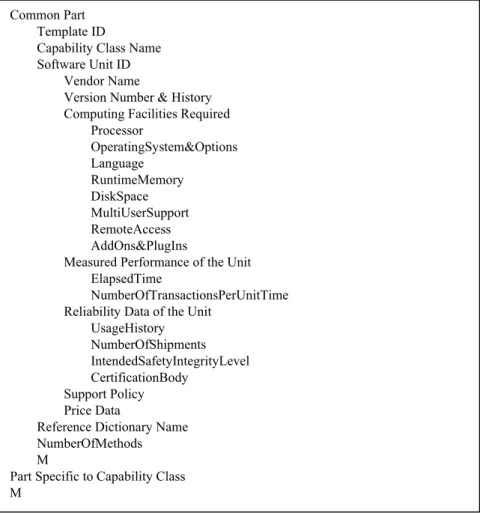
The IS16100 standard series targets the computer-interpretable and human readable representation of a software capability profile [14]. The standards provide a method to represent the capability of manufacturing software relative to its role throughout the life cycle of a manufacturing application, independent of a particular system architecture or implementation platform. Software interface requirements are characterized as manufacturing software units (MSU) with capability elements and rules. An IDEF0 schema grounds the UML models and XML profile schemas. Capability classes for manufacturing (domain, application, information, process, resource, activity, function, software unit), software (computing system, environment, architecture, design pattern, datatype, interface/protocol), and roles are specified. Such a class is outlined in Figure 4. Part 3 of this standard intends to provide a means for matching a MSU that is needed for manufacturing with a MSU that is available for manufacturing.
Figure 4. Example template structure for Capability Class (ISO 16100-2)
These standards codify existing industry practice and focus industrial efforts on common feature support. IS 15745 and IS 16100 are detailed descriptive standards that can be utilized to enable integration and to support interoperability. Kosanke provides a comparison of these two standards and concludes that while they have somewhat different scope, both use profiles to capture information needed to identify the capabilities of entities expected to interact [15]. He also notes a limit in the use of these standards with respect to the human aspects of interoperation where information about the internalCommon Part Template ID
Capability Class Name Software Unit ID
Vendor Name Version Number & History Computing Facilities Required
Processor OperatingSystem&Options Language RuntimeMemory DiskSpace MultiUserSupport RemoteAccess AddOns&PlugIns
Measured Performance of the Unit ElapsedTime
NumberOfTransactionsPerUnitTime Reliability Data of the Unit
UsageHistory NumberOfShipments IntendedSafetyIntegrityLevel CertificationBody Support Policy Price Data
Reference Dictionary Name NumberOfMethods
Μ
Part Specific to Capability Class
structure and dynamics of the application may be more important than information about the potential exchange itself.
SC5/WG7 has begun work on ISO/WD 18435 to define a set of integration methods for use when integrating diagnostics, capability assessment, and maintenance applications with the applications in production, control, and other manufacturing operations [16]. The intent is to provide practical guidelines for generating diagnostics and maintenance interoperability profiles to facilitate system modeling and integration, especially in the design, configuration and operations of a real-time industrial automation system. As depicted by the arrows in Figure 5, the standard involves application integration models and common requirements for interoperability profiles that: provide a diagnostics and maintenance application integration reference architecture for equipment and automation devices to enable integration with other applications; and provide a set of open, diagnostics and maintenance application interoperability profile templates based on selected international and industry standards for use in expressing interoperability with other application interoperability templates.
A4.1 – Intra-enterprise activities: Business Planning, Orders & Production, and
Maintenance
A4.2 – Inter-enterprise activities: Supply Chain Planning, Logistics Strategy
A3.1 - Operations Planning & Scheduling
A3.2 – Capability Assessment & Order Fulfillment
A3.3 - Maintenance Planning & Scheduling
A2.2 - Asset Prognostics and Health, Quality, Safety, & Environmental
Management
A2.3 - Maintenance Execution & Tracking A2.1 - Supervisory Control
& Human-Machine Interface
A1.1- Control, I/O,Data Acquisition, Data Historian, Asset
Utilization,
& Displays
A1.2 - Asset Condition Monitoring & Sample /
Test / Diagnostic & Quality Monitoring
A1.3 - Asset Configuration, Calibration & Repair /
Replace
Resources ( Material / Personnel )
A0.1 - Resource Identification and Location
A0.2 - Asset Identification and Location
Assets
(Equipment / Facilities / Serialized Components / Sensors / Transducers / Software / Documents)
Level R4 Enterprise / Site Level R3 Area Level R2 Work Center Level R1 Work Unit Level R0 Asset A4.1 – Intra-enterprise activities: Business
Planning, Orders & Production, and Maintenance
A4.2 – Inter-enterprise activities: Supply Chain Planning, Logistics Strategy
A3.1 - Operations Planning & Scheduling
A3.2 – Capability Assessment & Order Fulfillment
A3.3 - Maintenance Planning & Scheduling
A2.2 - Asset Prognostics and Health, Quality, Safety, & Environmental
Management
A2.3 - Maintenance Execution & Tracking A2.1 - Supervisory Control
& Human-Machine Interface
A1.1- Control, I/O,Data Acquisition, Data Historian, Asset
Utilization,
& Displays
A1.2 - Asset Condition Monitoring & Sample /
Test / Diagnostic & Quality Monitoring
A1.3 - Asset Configuration, Calibration & Repair /
Replace
Resources ( Material / Personnel )
A0.1 - Resource Identification and Location
A0.2 - Asset Identification and Location
Assets
(Equipment / Facilities / Serialized Components / Sensors / Transducers / Software / Documents)
Level R4 Enterprise / Site Level R3 Area Level R2 Work Center Level R1 Work Unit Level R0 Asset
Figure 5. ISO/WD 18435 Activity Domain Integration Diagram
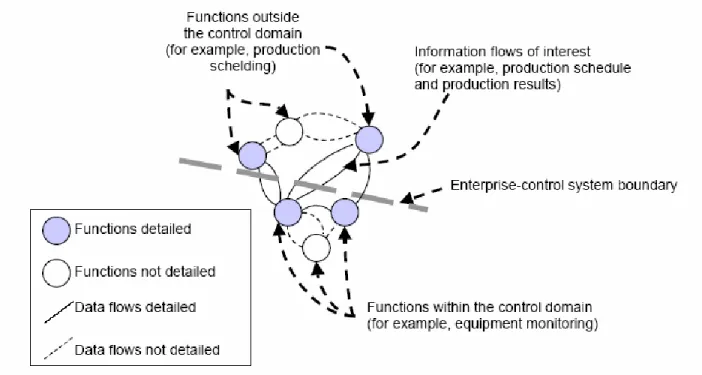
The collaboration with IEC SC65A has resulted in the ISO/IEC 62264 series that articulates the boundary between business process systems of the enterprise and its manufacturing control systems [22]. As shown in Figure 6, the scope of this standard is limited to describing the relevant functions in the enterprise and the control domain, and which objects are normally exchanged between these domains. Part 2 of the standard defines the interface content between manufacturing control functions and other enterprise functions. The interfaces considered are those between Levels 3 and 4 of the hierarchical model referenced by Part 1. This standard is particularly noteworthy because of its acceptance as a basis for the integration of enterprise resource planning (ERP) systems and manufacturing execution systems (MES).
SAP recently announced support for this standard as a basis for integration of their ERP offerings with manufacturing execution systems for the plant floor [23]. Again, a UML based model is used to represent the information objects that have attributes presented in a tabular format.
Figure 6. ISO/IEC 62264 Enterprise-control system boundary
In addition to these published standards, each SC5 working group is developing new proposals to address the issues of integration and interoperation in the manufacturing automation domain. We draw upon successful practices wherever we find them and believe that many of our products are of potential benefit to those outside the manufacturing domain.
Model Architecture.
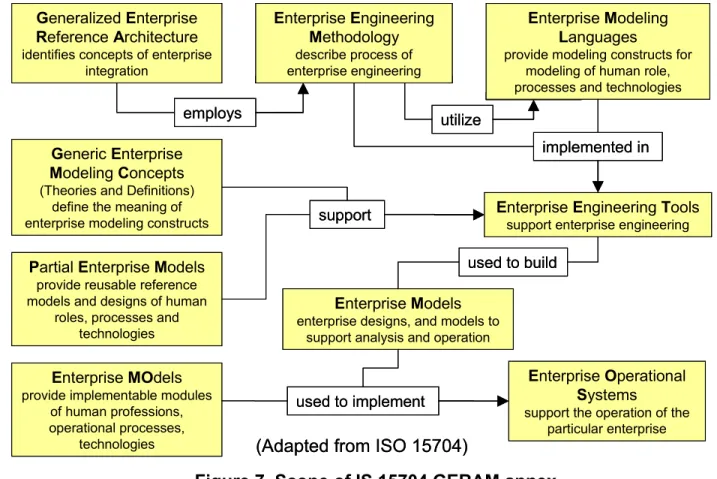
At the other end of the spectrum is IS 14258 that describes concepts and rules for enterprise models [17]. This SC5/WG1 product provides an overview of the issues that must be considered when modeling in the enterprise context. It establishes system theory as the basis for modeling and introduces primary modeling concepts for life-cycle phases, recursion and iteration, distinctions between structure and behavior, views, and basic notions of interoperability.Upon this conceptual foundation, IS 15704 specifies a more detailed model representation and adds concepts for life history, and model genericity [18]. This standard also begins the elaboration of methodologies to support enterprise modeling and identifies the structural features available for further development of model and system interoperability. Recently we have added user centric views, Economic View and Decision View, as informative annexes.
A significant feature of IS 15704 is its informative Annex A that presents the GERAM (Generalised Enterprise Reference Architecture and Methodology) developed by an IFIP/IFAC Task Force on Architectures for Enterprise Integration. The intent of GERAM is to facilitate the unification for methods across disciplines and allow their combined use rather than segregated application. The scope of GERAM includes a description of all elements recommended in enterprise engineering and integration. Each of the components identified in Figure 7, usually abbreviated by the bold capitals, e.g., GERA or EMO, is elaborated to provide criteria that should be satisfied by any set of selected tools and methods.
Generalized Enterprise
Reference Architecture
identifies concepts of enterprise integration
Enterprise MOdels
provide implementable modules of human professions, operational processes,
technologies
Enterprise Engineering Tools
support enterprise engineering
Enterprise Operational
Systems
support the operation of the particular enterprise
Partial Enterprise Models
provide reusable reference models and designs of human
roles, processes and technologies
Generic Enterprise
Modeling Concepts
(Theories and Definitions) define the meaning of enterprise modeling constructs
Enterprise Models
enterprise designs, and models to support analysis and operation
Enterprise Modeling
Languages
provide modeling constructs for modeling of human role, processes and technologies
employs utilize implemented in support used to build used to implement Enterprise Engineering Methodology describe process of enterprise engineering
(Adapted from ISO 15704)
Generalized Enterprise
Reference Architecture
identifies concepts of enterprise integration
Enterprise MOdels
provide implementable modules of human professions, operational processes,
technologies
Enterprise Engineering Tools
support enterprise engineering
Enterprise Operational
Systems
support the operation of the particular enterprise
Partial Enterprise Models
provide reusable reference models and designs of human
roles, processes and technologies
Generic Enterprise
Modeling Concepts
(Theories and Definitions) define the meaning of enterprise modeling constructs
Enterprise Models
enterprise designs, and models to support analysis and operation
Enterprise Modeling
Languages
provide modeling constructs for modeling of human role, processes and technologies
employs utilize implemented in support used to build used to implement Enterprise Engineering Methodology describe process of enterprise engineering
(Adapted from ISO 15704)
Figure 7. Scope of IS 15704 GERAM annex
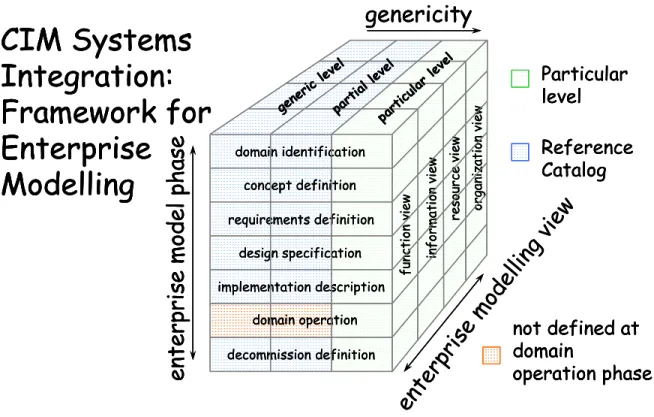
ISO/FDIS19439, in final draft stage, further articulates the concepts of IS 15704 as a framework for enterprise modeling and meets the criteria for a GERA component of GERAM [19]. Three essential dimensions of enterprise modeling are placed in a framework context. The dimension of modeling phase is segmented by life-cycle stage as Domain Identification, Concept Definition, Requirements Definition, Design Specification, Implementation Description, Domain Operation and Decommission Definition. While dependencies between modeling phases exist, there is no assumption of chronology in their articulation. The dimension of model view articulates Function, Information, Resource, and Organization as a minimal group of perspectives for manufacturing enterprises. The dimension of genericity ranges over Generic, Partial, and Particular with increasing specificity. For each defined coordinate in the resulting 3-space, brief descriptions of the expected model content relative to the intersection is given. A graphic representation of the relationship between these dimensions is shown in Figure 8. An informative annex provides an illustrative example taken from the CIMOSA Technical Baseline [20].
The goal of this standard is to further the development and deployment of enactable models for enterprise operation by providing a conceptual structure rich enough to support the articulation and maintenance of such models. We consider enactable models to be a precursor for robust interoperability.
Figure 8. Dimensions of IS 19439 Framework
Relative to this framework, the draft standard ISO/DIS19440 details templates for constructs that can be used to build the model [21]. Defined as generic elements, the characteristics of these core constructs necessary for computer-supported modeling of enterprises are: the provision of an explicit model of Business Processes, with their dynamics, functions, information, resources, organization and responsibilities; sufficient detailing and qualification of its components to allow the creation of a representation to enable operational use. The defined constructs include Domain, Business Process, Enterprise Activity, Event, Enterprise Object, Object View, Product, Order, Resource, Capability, Functional Entity, Organizational Unit, Decision Centre, and Organizational Role. Each construct can be specialized for a unique purpose and additional constructs can be created. The generic constructs can be combined and elaborated to form a partial model of an industrial segment. Partial models and generic constructs can be specialized to meet particular model needs within an enterprise.
STANDARD OPPORTUNITY
All of these standards support the interactions necessary to construct unified manufacturing operations and enhance integration among systems of differing origin. But the difficult tasks of dynamic interoperation are yet to be addressed in a standard for the industrial community. The products of ISO TC184 SC5 provide a wide range of opportunity for system engineers to use known solutions for problems in component and system integration. These past efforts lay a solid foundation and begin to articulate the system and component features necessary to achieve robust interoperability in the future. We invite your support for and use of these international standards. Please contact the author if you wish further information or would like to participate with our efforts.
en
te
rp
ris
e m
od
ell
ing
vie
w
organiz atio n v iew re so ur ce v ie w informa ti on view fu ncti on vi ew requirements definition concept definition implementation description design specification domain operation decommission definition domain identificationenterpri
se
model
ph
as
e
genericity
parti al lev el generi c levelReference
Catalog
Particular
level
not defined at
domain
operation phase
CIM Systems
Integration:
Framework for
Enterprise
Modelling
parti cular leve len
te
rp
ris
e m
od
ell
ing
vie
w
organiz atio n v iew re so ur ce v ie w informa ti on view fu ncti on vi ew requirements definition concept definition implementation description design specification domain operation decommission definition domain identificationenterpri
se
model
ph
as
e
genericity
parti al lev el generi c levelReference
Catalog
Particular
level
not defined at
domain
operation phase
CIM Systems
Integration:
Framework for
Enterprise
Modelling
parti cular leve l organiz atio n v iew re so ur ce v ie w informa ti on view fu ncti on vi ew requirements definition concept definition implementation description design specification domain operation decommission definition domain identificationenterpri
se
model
ph
as
e
genericity
parti al lev el generi c levelReference
Catalog
Particular
level
not defined at
domain
operation phase
CIM Systems
Integration:
Framework for
Enterprise
Modelling
parti cular leve lREFERENCES
[1] IDEAS Roadmaps, “Deliverable D2.3 The Goals, challenges, and vision (2nd version) (M8)”, Information Society Technologies, European Commission, 2003. Available at www.ideas-roadmap.net
[2] National Coalition for Advanced Manufacturing, “Exploiting E-Manufacturing: Interoperability of Software Systems Used by U.S. Manufacturers”. Washington D.C., 2001.
[3] ISO/TC184/SC5 N846. “Report of the ISO/TC 184/SC 5 Secretariat For The 2004-11 TC184 Plenary Meeting in Rosslyn, USA”, 2004. Available at http://forums.nema.org/wb/default.asp?boardid=13 [4] International Organization for Standardization and European Committee for Standardization,
“Agreement on Technical Co-operation between ISO and CEN (Vienna Agreement). Version 3.3”, 2001.
[5] EC/FP6, “IST-507849 Advanced Technologies for Interoperabilities of Heterogeneous Enterprise Networks and their Applications”, 2004. Available at http://www.athena-ip.org
[6] Kemmerer, S, “STEP The Grand Experience NIST Special Publication 939”, Manufacturing Engineering Laboratory, National Institute of Standards and Technology, Gaithersburg, MD, 1999. [7] ISO 10303-1 Industrial automation systems and integration – Product data representation and
exchange - Part 1:Overview and fundamental principles. ISO, Geneva, 1994.
[8] ISO 10303-11 Industrial automation systems and integration – Product data representation and exchange - Part 11: Description methods: The EXPRESS language reference manual. ISO, Geneva, 1994.
[9] Gallaher, M., O’Connor, A., Phelps, T., “Economic Impact Assessment of the International Standard for the Exchange of Product Model Data (STEP) in Transportation Equipment Industries”, RTI International and National Institute of Standards and Technology, Gaithersburg, MD, 2002.
[10] ISO 18629-1 Industrial automation systems and integration – Process specification language – Part 1: Overview and basic principles. ISO, Geneva, 2004.
[11] ISO 15531-1 Industrial automation systems and integration – Industrial manufacturing management data – Part 1: General overview. ISO, Geneva, 2004.
[12] ISO 15745-1 Industrial automation systems and integration – Open systems application integration framework – Part 1: Generic reference description. ISO, Geneva, 2003.
[13] ISO 15745-2 Industrial automation systems and integration – Open systems application integration framework – Part 2: Reference description for ISO 11898-based control systems. ISO, Geneva, 2003. [14] ISO 16100-1 Industrial automation systems and integration – Manufacturing software capability
profiling for interoperability – Part 1: Framework. ISO, Geneva, 2002.
[15] Kosanke, K., “ISO Standards for Interoperability: a comparison”, First International Conference on Interoperability of Enterprise Software and Applications, INTEROP-ESA’2005, Geneva, 2005
[16] ISO/WD 18435-1 Industrial automation systems and integration – Diagnostics, capability assessment, and maintenance application integration – Part 1: Overview and general requirements.
ISO, Geneva, 2005
[17] ISO 14258 Industrial automation systems – Concepts and rules for enterprise models. ISO, Geneva, 1998.
[18] ISO 15704 Industrial automation systems – Requirements for enterprise-reference architectures and methodologies. ISO, Vienna, 2000.
[19] ISO/FDIS 19439 Enterprise integration – Framework for enterprise modelling. ISO, Geneva, 2004. [20] CIMOSA Association, Open System Architecture for CIM: Technical Baseline. Version 3.2,
CIMOSA 1996. Available from www.cimosa.de
[21] ISO/DIS 19440 Enterprise integration -Constructs for enterprise modelling. ISO, Geneva, 2004. [22] ISO/IEC 62264-1 Enterprise-control system integration – Part 1: Models and terminology. ISO,
Geneva, 2003.
[23] SAP, “SAP Drives Accelerated Adoption of Manufacturing Industry Standards”, SAPPHIRE’04, New Orleans, USA, 2004.