
CONCEPTUAL UFE SCIENCE
Cellular Respiration
IntroductionCellular respiration is the oxidative, chemical attack on energy-rich molecules to provide useful energy for the cell. Enzymes catalyze the oxidation reactions. These reactions are known as catabolic reactions because they break molecules down to release energy.
Anaerobic respiration
The first part of respiratory pathways in the cell is anaerobic. This term means that oxygen is not involved. Even cells of organisms that utilize oxygen, such ashumans, have an anaerobic component. The anaerobic component is known as glycolysis and the Embden-Meyerhof pathway carries it out. This pathway produces ATP and NADli as energy-storage molecules. NADH is similar to the NADPH produced in photosynthesis. In anaerobic respiration, this NADH needs to be recycled. The"total anaerobic pathway iric1uding the recycling process is calledfermentation. We will consider two kinds of fennentation reactions. The first will be the laclic acidfermentation as it occurs in muscles. The second will be the alcoholfermentation as it' occurs in yeast.
Glycolysis
Glycolysis is a pathway that the cell uses to oxidize glucose. Some ofthe steps in this pathway are the reverse of steps found in the dark reactions ofphotosynthesis. . Glycolysis is part of the fennentation process found in muscle and yeast cells.
It is important to avoid confusion between photosynthesis and cellular respiration. Photosynthesis is reductive and anabolic. It produces glucose and releases oxygen as a waste product. In contrast, cellular respiration is .oxidative and catabolic. It uses glucose and oxidizes it to produce C<h as the waste product.
Fermentation
Fermentation is used by muscle cells to provide quick energy. Yeast cells use it to produce alcohoJ and C<h. This is why yeast is used for brewing and baking. Lactic acid bacteria produce lactic acid, which is used to make fermented foods like pickles, sauerkraut and yogurt.
Fermentation is required under anaerobic conditions because ofthe need to recycle NADH. The Embden-Meyerhofpathway produces two molecules ofNADH. These cannot be used to make ATP under anaerobic conditions so they are recycled and
oxidized using the fermentation process. This recycling pennits the Embden-Meyerhof pathway to continue functioning.
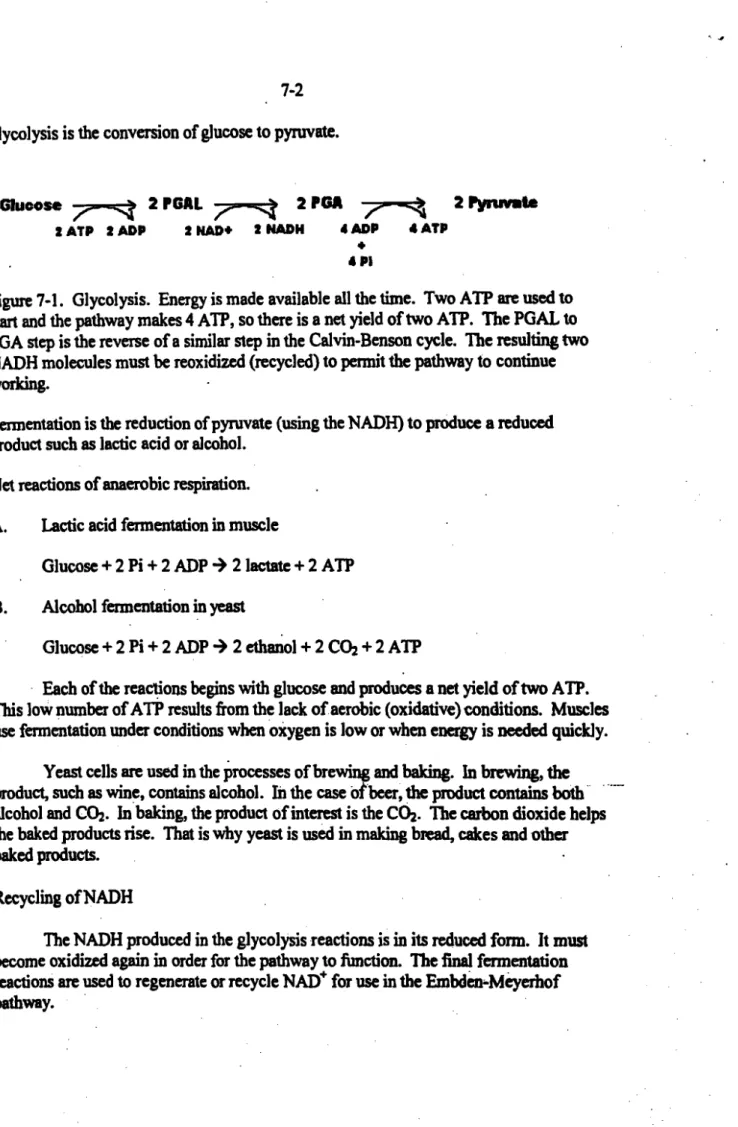
7-2 Glycolysis is the conversion of glucose to pyruvate.
Glucose
7"
~ 2 'GAL7"
~ 2'GA 7"~ 21\fnm11a Z AT' Z AD, Z HAD. Z HADH • AD' • AT'•
• • 1
Figure 7-1. Glycolysis. Energy is made available all the time. Two ATP are used to startand the pathway makes4ATP,so there is a net yield of two ATP. The POALto
PGAstepis the reverse of a similarstepin the Calvin-Benson cycle. The resulting two NADH molecules must be reoxidized (recycled) to permit the pathway to continue working.
Fermentation isthereduction ofpyruvate (using the NADH) to produce 8 reduced
product such as lactic acid or alcohol. Net reactions of anaerobic respiration.
A. Lactic acid fermentation in muscle
Glucose + 2 Pi + 2 ADP
-+
2 lactate + 2 ATPB. Alcohol fermentation in yeast
Glucose + 2 Pi + 2 ADP
-+
2 ethanol + 2 C<h + 2 ATP, Each ofthe rea~onsbegins with glucose and produces anetyield oftwoATP. . This low number ofATP results from the lack ofaerobic (oxidative)conditioDS. Muscles
use fennentation under conditions when oxygen is low or when energy is needed quickly. Yeast cells are used in the processes ofbrewins and baking. In brewing, the
, product, such as wine, contains alcohol. Ii1 the case
of'beer,
the product contains both " ,'. alcohol ande<h.
In baking, the product ofinterest is thee<h.
The carbon dioxide helps the baked products rise. That is why yeast is used in making bJad, cakes and t)therbaked products. Recycling ofNADH
The NADH produced in the glycolysisreactioDS is in its reduced fonn. It must become oxidized again in order for the pathway to function. The final fermentation reactions are used to regenerate or recycle NAD+ for use in the Embden-Meyerhof pathway. '
7-3
a. Reoyelng of NADH In IDUsoIe
2 pyruvate
r
~,
2 ..c....2NADH 2NAif
b. RecycUng of NADH in yeIISt
2 pyruvate
7'""""\)
2 ethanol + 2 CO22 NADH 2 NAD·
Figure 7-2. Production ofNAD+ by recycling.
The central reaction ofthe Embden-Meyerhofpathway requires the oxidized fonn ofNAD+. The pathway converts it to the reduced fonn ofNADH. In order for the pathway to continue, the NADH must be recycled.
In oxidative conditions, the NADH is not recycled but is sent to the Electron TransPOrtlChemiosmosis pathway instead. Under oxidative conditions, fennentation does not take place. The pyruvate resulting from the Embden-Meyerhofpathway is scrit to the Krebs Citric Acid Cycle, instead.
Aerobic respiration
Aerobic respiration consists ofthree parts. • Glycolysis
• Krebs Ci1ric Acid Cycle
• Electron TransportIChemiosmosis Overall reaction of aerobic respiration
Aerobic respiration is the reverse of photosynthesis. The glucose made by the plant is oxidized in the cell to produce the waste products, Cen and H20, and energy. Cellular respiration is the opposite ofphotosynthesis. The energy stored by the plant is released in our cells for our use.
Glycolysis
Glycolysis produces two pyruvates, two ATP and two NADH. Unlike the
situation in fennentation, the two NADH molecules are not recycled. The process occurs
7-4 Krebs Citric Acid Cycle
The Krebs Citric Acid Cycle is a series of eight reactions that go ar01md in a circle. It is found in mitochondria. Each pyruvate molecule resulting from glycolysis enters the cycle and is oxidized to Produce three C02, and the following energy molecules:
4 NADH, I FADH2 and I ATP. Electron TransportlChemiosmosis
This is the final pathway of aerobic respiration. It occurS in the mitochondria. The pathway removes electrons and protons from the NADH and FADH2 molecules. FAD is Flavin Adenine Dinucleotide. It is an electron carrier like NADH. FADH2 is the reduced fonn that carries the electrons and protons.
. Electron Transport and ChemioSJDosis occur in the mitochondria The electrons are passed through the electron transport chain, a series of enzymes that transport electroDS. The electrons eventually end up on oxygen, which is the terminal electron acceptor of the chain. The protODS are pumped out of the mitQChondria through the mitochondrial membrane. The pumping mechanism is called chemiosmosis. Energy. from chemioSJDOsis Produces 3 ATP for each NADH and 2 ATP for each FADH2. So, the result of all ofthese pathways is to make useful energy for the cell in the fonn of ATP.
Final elimination ofelectrons is done by adding electrons and protons to a molecule of oxygen. The result is the production ofhydrogen peroxide (H2(h).
.Hydrogen peroxide is a toxic substance. The cell has an enzyme called catalase that
destroys hydrogen peroxide producing oxygen and water, thereby rendering in harmless by removing it
Figure 7-3. The catalase reaction.
Virtually all enzymes are proteins. Their job is to catalyze biological reactions
and allow these reactions to occur at room temperature. Catalase is the name of a SPeCific enzyme that perfonns the reaction responsible for the destruction ofhydrogen peroxide. Each enzyme is a catalyst, which is specific for its own substrate. The substrate is the specific chemical substance reacted on by the enzyme. The enzyme changes the substrate in~oproducts. In the case of the destruction ofhydrogen peroxide
7-5
by catalase, the substrate was hydrogen peroxide (the starting material) and the products were water and oxygen (the resulting materials).
Total energy yield for one glucose by aerobic respiration
a. Yield from glycolysis: 2ATP direct
6 ATP from 2 NADH
b.
Krebs Cycle (per pyruvate): 1ATP direct2 ATP from FADH2
12 ATP from NADH
c. Total Yield: 8 ATP from glycolysis
30 ATP from 2 pyruvates in Krebs Cycle
38 ATP total yield
Note: Normal totals in eukaryotic ce]]s are 36 molecules of ATP. The figme of 38 ATP comes from prokaryotic cens, which do not have,mitochondria.
Study guide for cellular respiration
A. General considerations
1. Respiration is used to obtain energy. 2. The energy is in the fonn ofATP..
3. The by-products ofrespiratiQn are H20 and CCh.
4. The process of respiration is conducted by aJI living cells, all ofthe time. ,B. Anaerobic respiratiOI.1 (fermentation) .
1. Anaerobic'respiration does not requiJe air or Ch. 2. The process is used to obtain energy.
3. Few ATP molecules (2 ATP) are produced.
4. The end-products
are:
a. muscle: lactic acid b.yeast: alcohol and CO2S. The process occurs in the cytoplasm ofthe cell. C. Aerobic respiration
1. Aerobic respiration uses anaerobic respiration (glycolysis) as the tint set
of reactions.
2. Conversion ofpyruvate to CCh and H20 gives much more energy than anaerobic respiration.
3. Aerobic respiration occurs in the mitochondria. 4. ATP is produced from NAOH and FADH2.

![Real fashion trends. Il manuale del cool hunter-the cool hunter guide: [Italiano] [Capa dura] PD](data:image/gif;base64,R0lGODlhAQABAIAAAP///wAAACH5BAEAAAAALAAAAAABAAEAAAICRAEAOw==)