A Cost-Benefit Approach to Resource Allocation
in Scalable Metacomputers
by
R. Sean Borgstrom
A dissertation submitted to The Johns Hopkins University in conformity
with the requirements for the degree of Doctor of Philosophy
Baltimore, Maryland
September, 2000
© R. Sean Borgstrom 2000
All Rights Reserved
Abstract
A metacomputer is a set of machines networked together for increased computational performance. To build an efficient metacomputer, one must assign jobs to the various networked machines intelligently. A poor job assignment strategy can result in heavily unbalanced loads and thrashing machines. This cripples the cluster’s computational power. A strong job assignment strategy helps a metacomputer complete all of its jobs swiftly.
Resource heterogeneity makes job assignment more complex. Placing a job on one machine might risk depleting its small memory. Another machine might have more free memory but a heavily burdened CPU. Bin packing on memory protects the system against thrashing. Load balancing protects the system against high CPU loads. Combining the two approaches, however, gives an ad hoc heuristic algorithm with no clear theoretical merit.
The Cost-Benefit Framework, developed in this work, offers a new approach to job assignment on metacomputers. It smoothly handles heterogeneous resources by converting them into a unitless cost. We assign (and possibly reassign) jobs to greedily minimize this cost.
This approach gives us an online strategy provably competitive with the optimal offline algorithm in the maximum usage of each resource. It has a weak competitive ratio – logarithmic in the number of machines in the cluster – but even this weak ratio is unprecedented in the literature. No other known method offers any competitive guarantee on more than one resource.
We present experimental evidence that this strategy performs extremely well in practice, comparing it to two important benchmarks: the default round robin strategy of the popular PVM metacomputing system, and the powerful adaptive strategy of the Mosix system.
Metacomputing environments are not homogeneous. In some environments, the scheduler has a great deal of information about submitted jobs. In other cases, it has very little. Some systems can migrate jobs without interrupting their execution. Others cannot. We develop variants of the basic “opportunity cost” strategy of the Cost-Benefit Framework for various metacomputing environments, and prove all of them highly efficient.
Finally, we provide two metacomputing systems – a prototype and a complete system – based on these ideas. The Java Market prototype is a metacomputer built atop Java and web technologies, able to integrate any consenting Internet-connected machine. The Frugal System transforms any Jini network into a metacomputer.
Acknowledgements
I am indebted to and enormously appreciative of my advisor, Dr. Yair Amir, for his selfless dedication to the development of my career and this work. His assistance and contributions to every stage of the research process made this dissertation possible and taught me a great deal. Thank you.
My gratitude to Dr. Rao Kosaraju, similarly, knows no bounds. His guidance, support, and direction over the years have been invaluable.
I thank Dr. Baruch Awerbuch for bringing the theoretical basis for this work to my attention and Yair’s, inspiring the project, as well as for his theoretical work itself. Dr. Amnon Barak’s assistance and advice in evaluating our algorithms and ideas in the context of dynamic systems made a significant portion of this work possible. Dr. Yossi Azar and Arie Keren played important roles in developing the theory for use in a practical context.
I thank Drs. John Cherniavsky and Michel Melkanoff for inspiring me to pursue computer science. Their compassion and their dedication to the field revealed the best in both computer science and humanity.
I appreciate the kindness and good nature shown by all of my associates in the CNDS lab at the Johns Hopkins University. These include Jonathan Stanton, Jacob Green, Cristina Nita-Rotaru, Theo Schlossnagle, Claudiu Danilov, John Schultz, and Tripurari Singh. I regret that I did not have more opportunities to work with them on this project, and have enjoyed the projects that we shared.
My research would not have been possible without the Metacomputing grant from DARPA/ITO (F30602-96-1-0293) to the Johns Hopkins University. Special thanks to Dr. Gary Koob, our DARPA program manager, who had the vision to see that the Cost-Benefit Framework could lead to superior performance in practice.
My parents, Karen and Karl, and my sister, Sonja Britt, have been steadfast supporters through my doctoral studies (and for all my life before that). Thank you.
I am also grateful to Dr. David Allen, Cera Kruger, Trevor Placker, Gretchen Shanrock, Brad Solberg, Geoff Grabowski, Bruce Baugh, Phyllis Rostykus, Cameron and Jessica Banks, Stuart Lin, Margaret, Henry, Conrad Wong, Kit Murphy, Christofer Bertani, Alexander Williams, Chrysoula Tzavelas, Bryant Durrell, Rich Dansky, and Deirdre Brooks, among others, on general principles.
Contents
CHAPTER ONE: INTRODUCTION...1
1.1 OVERVIEW AND HIGHLIGHTS...1
1.2 BASIC CONCEPTS...2 1.3 EXPERIMENTAL METHODOLOGY...3 1.4 THESIS STRUCTURE...4 1.5 RELATED WORK...5 1.5.1 Shadow Objects...5 1.5.2 Matchmaking...5
1.5.3 Java, Jini, and Web Technology...5
1.5.4 MPI...6
1.5.5 PVM: Parallel Virtual Machine...6
1.5.6 MOSIX...7 1.5.7 SNIPE...8 1.5.8 Condor...9 1.5.9 Legion... 10 1.5.10 Globus... 10 1.5.11 HARNESS... 11 1.5.12 Javelin... 12 1.5.13 MILAN... 13 1.5.14 Popcorn... 14 1.5.15 IceT... 15 1.5.16 InfoSpheres... 16
1.5.17 AppLeS and the Network Weather Service... 17
1.5.18 Bayanihan... 17
1.5.19 Bond... 18
1.5.20 Linda, Piranha, Paradise and JavaSpaces... 18
1.5.21 SETI@Home... 19
1.5.22 Economics in Computer Science... 19
CHAPTER TWO: SUMMARY OF THE THEORY...21
2.1 INTRODUCTION AND DEFINITIONS...21
2.2 IDENTICAL AND RELATED MACHINES: THE GREEDY ALGORITHM...22
2.3 UNRELATED MACHINES: ASSIGN-U...22
2.4 ONLINE ROUTING OF VIRTUAL CIRCUITS...23
2.5 UNDERSTANDING THE THEORY: WHY ASSIGN-U WORKS...24
2.5.1 Definitions... 24
2.5.2 Machine Matching... 25
2.5.3 Multiple Jobs per Machine... 26
2.5.4 Jobs of Unknown Size... 26
CHAPTER THREE: STATIC STRATEGIES...28
3.1 THE MODEL...28
3.1.2 Jobs... 29
3.1.3 Slowdown... 30
3.2 FROM THEORY TO PRACTICE...30
3.3 THE SIMULATION TEST BED...33
3.3.1 Simulation Results... 34
3.4 REAL SYSTEM EXECUTIONS...35
CHAPTER FOUR: DYNAMIC STRATEGIES...37
4.1 THE MODEL...37
4.2 FROM THEORY TO PRACTICE...37
4.3 THE SIMULATION TEST BED...40
4.3.1 Simulation Results... 40
4.4 REAL SYSTEM EXECUTIONS...43
CHAPTER FIVE: STRATEGIES WITH REDUCED INFORMATION...45
5.1 THE MODEL...45
5.2 FROM THEORY TO PRACTICE...45
5.3 EVALUATION...46
5.3.1 Simulation Results... 46
CHAPTER SIX: THE JAVA MARKET...50
6.1 DESCRIPTION...50
6.1.1 Basic Concepts... 50
6.1.2 The System... 51
6.1.3 The Resource Manager... 52
6.1.4. The Task Manager... 52
6.1.5. The Market Manager... 53
6.1.6. An Example Scenario... 53
6.2 JAVA MARKET DESIGN...54
6.2.1 Features of Web-Based Metacomputers... 54
6.2.2 Features of the Java Market... 55
6.3 LESSONS LEARNED...57
CHAPTER SEVEN: THE FRUGAL SYSTEM...59
7.1 DESCRIPTION...59 7.1.1 Basic Concepts... 60 7.1.2 Internal Structure... 61 7.1.3 Frugal Resources... 61 7.1.4 Frugal Managers... 62 7.1.5 Miscellaneous Components... 62 7.1.6 Class Structure... 63
7.2 FRUGAL SYSTEM DESIGN...66
7.2.1 Features of Jini-Based Metacomputers... 66
7.2.2 Features of the Frugal System... 67
7.3 LESSONS LEARNED...67
CHAPTER EIGHT: CONCLUSIONS...69
Chapter One: Introduction
1.1 Overview and Highlights
The work described in this thesis develops, tests, and implements several advanced strategies for resource management in a network of machines. Each machine has a number of resources associated with it, e.g. memory and CPU. If any one resource is overused, the system’s performance on some jobs plummets. Therefore, the strategies developed here take multiple resources into account in a reasoned manner. These strategies do not depend on any given model for incoming job flow. Nor do they depend on any particulars regarding the strengths of the various machines in the network.
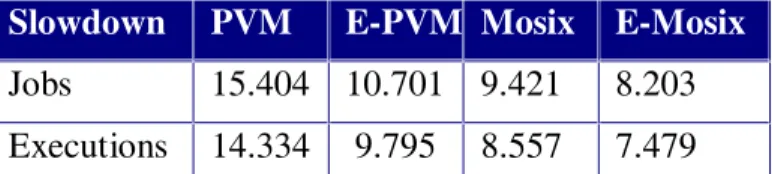
We measure the performance of these strategies in terms of job slowdown. If a job can complete in time tbest while running alone on the most appropriate machine in the system,
and instead completes in time tactual, the job’s slowdown is tactual / tbest. The key
performance measure in our tests was the average slowdown over all jobs. In other words, we evaluated our strategies and a selection of alternate strategies in terms of how much the system load slowed the average job down.
The three new strategies that this thesis develops for managing a metacomputer have a sound theoretical basis. We demonstrate that each of them improves on existing strategies, first in a simulated environment and then in tests on a real system. In other words, using our strategies reduces the average slowdown over all jobs. We explain how to remove certain assumptions in the strategies that may not apply in real systems while preserving most of the performance gain. We also develop two working metacomputers based on these strategies.
The central idea behind our strategies is to convert all of a system’s resources into a homogeneous cost based on their percentile utilization. Historically, memory, CPU, and other resources have been incomparable. One cannot even measure them in the same units – megabytes of memory do not easily convert to seconds of CPU time. By converting both of these resources into a unitless cost, however, we gain the ability to compare them. The cost function used by our strategies is not based on heuristic ideas or experiments, which have a bias towards the system on which they are developed or performed. Rather, it derives from a theoretical framework with certain competitive guarantees. These guarantees apply on any imaginable system and any possible stream of jobs.
The key contributions of this Ph.D. research are:
• Developing a basic strategy for resource management on a metacomputer with a solid theoretical basis and proven experimental validity.
• Developing variations on this strategy for metacomputers where reassignments are possible.
• Developing an approximation technique that allows systems to use this strategy even when they cannot provide the scheduler with the information it needs about incoming jobs.
• Demonstrating, with experiments in simulated and real environments, that these algorithms are effective in comparison to optimized heuristic methods.
• Developing a primitive metacomputer based on web technology as a test bed for these strategies.
• Developing a complete and advanced metacomputer based on Sun’s Jini system that successfully implements several of these strategies.
1.2 Basic Concepts
The performance of any cluster of workstations improves when the system uses its resources wisely. In particular, when the system can assign incoming jobs to any machine in the cluster, and when it employs an intelligent strategy for doing so, it can keep system loads low and prevent memory overutilization and thrashing. Developing strong strategies for job assignment provides a direct payoff in terms of system efficiency.
System resources are heterogeneous. For example, the CPU resource completes a certain number of computation cycles per second. It divides these cycles between its various jobs. A computational task completes when it has received an appropriate amount of computation. The memory resource, on the other hand, contains a certain number of megabytes. The system does not divide available memory evenly among tasks. Rather, each task determines its own memory requirements. When the memory becomes overutilized, the machine begins to thrash and the system’s performance degrades.
One cannot balance CPU cycles against megabytes or vice versa. Nor does either resource convert naturally into communication bandwidth, the unit of measurement for communication resources. In general, no two machine resources are directly comparable. This makes finding the optimal location for a job difficult. Even implementing a greedy strategy, balancing all the system resources across all the machines, is hard. With incomparable resources, this strategy is not well defined.
This work’s new opportunity cost approach, based on economic principles and competitive analysis, provides a unified algorithmic framework for the allocation of computation, memory, communication, and I/O resources. By converting heterogeneous resources to a homogeneous cost, and then minimizing this cost, the system guarantees near-optimal end-to-end performance on every single instance of job generation and resource availability.
The algorithm derived from this approach is an online algorithm that knows nothing about the future, assumes no correlation between past and future, and is only aware of the current system state. Nevertheless, one can rigorously prove that its performance is always comparable to that of the optimal prescient strategy. Unlike other methods, this algorithm achieves this performance bound for every resource simultaneously.
Some systems have requirements, or abilities, which suggest or require adjustments to the basic algorithm presented herein. Job migration, in which jobs move transparently from one machine to another, offers the system a powerful additional tool for improving performance. Our algorithm adapts easily to a dynamic environment that allows job migration. Since the system cannot predict the arrival rate and resource demands of
incoming jobs, any online scheduler must inevitably make “mistakes,” placing jobs on non-optimal machines. Job migration gives the system an unlimited number of opportunities to fix the mistakes it makes. The Mosix [Mos, BL98] system allows this kind of transparent job migration, assigning and reassigning jobs using the heuristically optimized Mosix strategy. Adapting our algorithm to perform job reassignments as well as job assignments yields a large improvement over the single-assignment approach, because it can fix mistakes. More importantly, however, our adapted algorithm yields a significant improvement over the highly tuned Mosix strategy. Even on a powerful system, able to reassign jobs, a carefully chosen strategy improves system performance. Avoiding a mistake does the system more good than fixing it later.
A system might have less information about jobs than a competitive strategy requires. For example, if the system cannot approximate a job’s resource requirements upon its arrival, its worst-case competitive ratio for maximum resource use depends on the disparity between the power of the machines as well as the number of machines. In practice, this work demonstrates that an adapted form of our algorithm can achieve extremely good results with limited information.
1.3 Experimental Methodology
The opportunity cost approach offers good performance in practice. We evaluated opportunity cost-based algorithms against a number of other algorithms, choosing two alternatives as meaningful benchmarks. The first benchmark is PVM's default strategy [PVM]. This is the simple round robin approach to job assignment used in PVM, a dominant utility for job assignment and load balancing in computing clusters. The second benchmark is the Mosix strategy. The Mosix strategy is the highly optimized heuristic strategy used by Mosix, a system permitting dynamic job reassignment. Results for the Mosix strategy always assume that the strategy is permitted to reassign jobs, even when we compare it against a strategy that cannot.
Our primary test bed was a Java simulation of a computing cluster and a stream of incoming jobs. Each execution of the simulation ran for at least 10,000 simulated seconds. The simulated cluster had six machines with a realistic distribution of computing power. We based the job flow on a study of the distribution of real jobs. We compared all strategies against the PVM and Mosix strategies in at least 3,000 scenarios.
To validate the simulation, we performed a second series of tests on a real system. This system consisted of a collection of Pentium 133, Pentium Pro 200 and Pentium II machines with different memory capacity, connected by Fast Ethernet, running BSD/OS [4]. The physical cluster and the simulated cluster were slightly different, but the proportional performance of the various strategies was very close to that of the Java simulation. This indicates that the simulation appropriately reflects events on a real system.
Finally, to demonstrate that our strategies were applicable in the real world, we built a complete metacomputer based on these strategies.
1.4 Thesis Structure
The rest of this thesis is organized as follows.
Section 1.5: Related Work describes relevant previous work in metacomputing. Chapter Two: Summary of the Theory discusses the basic theoretical underpinnings of this work.
Chapter Three: Static Strategies presents our strategy in the context of a static cluster of workstations. Static systems cannot reassign jobs. The key idea in this chapter is our cost function, which measures the cost to the system for using up any portion of any kind of heterogeneous resource. Our strategy assigns jobs to machines in order to minimize the global cost. The experimental results contained in this chapter demonstrate that this strategy performs extremely well in practice. It dramatically outperforms the PVM strategy.
Chapter Four: Dynamic Strategies presents a variant of our strategy in the context of a dynamic cluster of workstations. Dynamic systems can reassign jobs. Our algorithm makes both assignments and reassignments to greedily minimize our cost function. Again, experimental results demonstrate that our strategy performs extremely well in practice, outperforming the highly tuned heuristic strategy used by Mosix. This chapter further compares our static strategy, which makes a single intelligent assignment, with the Mosix strategy and its ability to perform reassignments. Our static strategy performs well in this regard, indicating that using our user-level opportunity cost approach is a viable alternative to implementing the Mosix kernel modifications.
Chapter Five: Strategies with Reduced Information presents a variant of our strategy that does not know the resource requirements of jobs upon their arrival. Experimental results show that this strategy variant performs well despite the adverse conditions under which it operates.
Chapter Six: The Java Market discusses our first metacomputer prototype built around these strategies. This work was successful but ultimately impractical due to factors outside our control (see Section 6.2.1: Features of Web-Based Metacomputers.) Our desire to build a more practical system led directly to the work in Chapter Seven.
Chapter Seven: The Frugal System discusses the Frugal System package for Jini networks. This package transforms any Jini network into a fully functional metacomputer, using our strategies as its decision algorithm.
1.5 Related Work
1.5.1 Shadow Objects
Metacomputing systems contain a number of objects. These include system resources, worker processes that perform jobs, work objects encapsulating jobs that the system must perform, and data objects representing job input and output. Metacomputers obfuscate but cannot presently erase the distinction between local and remote objects. Many jobs have logical relationships with a fixed machine. They are tied, in one manner or another, to that machine’s file systems, input and output channels, and physical computing resources. In addition, implementing communication between the elements of a metacomputing system often depends strongly on the underlying hardware and operating system.
To make metacomputing feasible, many systems implement “shadow objects,” which serve as proxies for a remote object. Condor’s shadow daemons [Con] and Mosix’s deputies [Mos] act as proxy representatives for system resources. When a job uses Condor or Mosix’s migration facilities to move to a remote machine, it performs most system calls through a shadow of its originating system. Bond [BHJM99] uses shadows of remote code objects; in Bond, they facilitate communication between components of a distributed computing system.
1.5.2 Matchmaking
System resources are heterogeneous. This thesis assumes that the difference between machines is purely a performance issue. For example, one CPU might accomplish jobs twice as quickly as another. One memory resource might begin thrashing at 32 Megs when another would be scarcely an eighth full. In some contexts, however, it is more important to realize that certain machines simply cannot run certain jobs. Others may be inherently undesirable matches, regardless of system state.
The common solution to this problem is matchmaking. System resources advertise their properties. Clients advertise their needs and preferences. Some component of the distributed system then matches resources to clients. In Condor [Con], the centralized scheduler performs matchmaking. In Legion [Leg], object wrappers for system resources push their properties into a “Collection” object, which clients can search for appropriate resources. In Bond [BHJM99], object wrappers for system resources – metaobjects – and properties of the clients serve as a “lock and key” system. This system ensures an appropriate match.
1.5.3 Java, Jini, and Web Technology
The Java [Java] programming language uses the idea of a “virtual machine” to overcome the architecture-specific nature of traditional machine code. Programmers write Java programs to run on the architecture of the Java virtual machine. Java interpreters, written for many real systems, translate this program into instructions for their specific
machine. Assuming the correctness of the Java interpreters, a program that runs correctly on any machine will run correctly on every machine. In combination with Java’s widespread popularity and acceptance, this makes Java a very useful metacomputing tool. Many of the problems of machine heterogeneity disappear when only a handful of programs (Java interpreters, operating systems, and specialized native code optimized for high performance) depend on the specific machine whereon they run. Projects using Java include ATLAS [BBB96] and JPVM [Fer98].
Java is integrated with the World Wide Web, a technology with a huge population of users. Through an interface these users understand and use regularly, the web browser, Java code can move from machine to machine. This makes web technology another very appealing metacomputing tool. A number of projects [CCINSW97, SPS97, AAB00, Kar98, BKKK97, RN98, Sar98], including our own Java Market, take advantage of web and Java technology to seamlessly distribute code across wide-area networks. The Java “sandbox” gives these research efforts automatic security against malicious code.
Jini [Jin] builds on Java in a different direction. The Java 1.1 API gave Java programs the ability to execute the methods of Java objects from remote machines. Jini builds a lookup service and a suite of tools for distributed computing on top of this technology. Modular services can interact with one another through the lookup service and using these tools. This simplifies the construction of network-aware applications and metacomputing systems.
1.5.4 MPI
MPI [MPI] is a popular architecture-independent parallel programming system. This “Message-Passing Interface” defines a system for building parallel programs whose components interact by exchanging messages. MPI “Communicator” objects provide a scalable context for message exchange and a scope for group communication. MPI programmers can enhance these objects to build virtual network topologies for the processes participating in a given group – conceptually organizing them in a grid, tree, or other graph.
Many software packages have implemented the MPI standard for many different platforms. Several of these platforms are metacomputers as well as parallel programming environments (e.g. Hector [RRFH96] and Globus [IK97].) Its various implementations in Java [Java, MG97] also offer possibilities for wide-area network metacomputing.
1.5.5 PVM: Parallel Virtual Machine
PVM [PVM] is a metacomputing environment designed for use on a cluster of workstations. PVM automatically distributes jobs and their subtasks to appropriate machines according to a policy instantiated in a Resource Manager. This allows static load balancing using algorithms of arbitrary complexity.
PVM is designed to support a variety of distributed computing paradigms. This includes programs that make a fixed division of their workload among a fixed number of processors, adaptive programs that split their workload between multiple machines as
needed, programs divided into multiple objects that interact with one another, and programs that divide up their input but not their functionality.
Most of PVM’s functionality resides within a set of libraries that programmers can use to parallelize and distribute their jobs. Through these libraries, PVM provides process control, allowing tasks (and subtasks) to discover their unique identifier, spawn subtasks, and stop execution. It provides informational utilities that tasks can use to evaluate the system state. It permits restructuring of the metacomputer, adding hardware to or removing it from the collection of machines the metacomputer uses for tasks. It allows signaling and message passing between tasks, as well as an advanced group-based communication paradigm. PVM also provides a console that users can use to monitor tasks.
PVM daemons running on each host enable this functionality. Each daemon is equipped to start up tasks that the Resource Manager forwards to it, as well as passing messages on behalf of those tasks. Although a PVM daemon must run on each machine for PVM to function, programs can start PVM daemons automatically on authorized hosts.
Since version 3.3, PVM has used a scheduler known as the Resource Manager to make resource allocation decisions. This Resource Manager is just another PVM task, so it can theoretically implement any policy. The default policy for PVM is a straightforward round robin assignment to available machines.
PVM sets a metacomputing standard, with stable code and a large user base. Its simplicity and power appeal to many programmers. Programmers have created variants of PVM designed to work with Java, perl, tcl/tk, Matlab, python, and C++. We often compare our decision-making strategies against the default round robin strategy of PVM. This shows the resource gain from implementing a policy like ours in a standard metacomputing system like PVM.
1.5.6 M
OSIXThe Mosix [Mos] system offers a flexible approach to metacomputing. It can adapt to changing resource conditions on the cluster by transparently migrating jobs from one machine to another. Where the decisions of PVM’s Resource Manager are fixed and cannot be changed, Mosix dynamically responds to load conditions by reassigning jobs to new machines. Combined with its carefully optimized algorithm for making load decisions, Mosix’s transparent process migration facility almost invariably outperforms any online static strategy.
Mosix can move jobs from one machine to another without logically interrupting their execution. The Mosix kernel modifications to the Linux operating system allow the system to perform this transparent migration on ordinary Linux jobs. They also offer additional migration-related tools for programmers developing programs with Mosix in mind. Previous incarnations of Mosix have performed the same function for other Unix-like operating systems.
In this respect – the ability to migrate ordinary jobs – Mosix stands out. Most metacomputing systems require programmers to specifically design programs with the
metacomputing system in mind. Legacy code must be adapted to the metacomputer. In Mosix, however, there is no concept of legacy code. Programs written for Linux become Mosix programs automatically.
Mosix is designed to preserve a job’s state as it moves from machine to machine. To make this possible, Mosix redirects many system calls sent by a job to the machine where the job originated. There, a shadow object called the job’s deputy performs the system call and returns the result. Thus, for example, jobs can read and write files only accessible from their home machine, even when migrated to remote hosts. Current research efforts seek to minimize the number of calls that must go through this deputy. For example, the Mosix team is alpha testing a revision of Mosix that allows local I/O. If the machine a job runs on shares a file system with the machine of its origin, this revision allows the job to access files directly. The Mosix team is also developing migratable sockets that allow migrated processes to communicate without going through their deputies.
Mosix uses a very scalable algorithm for job reassignment decisions. Machines do not attempt to discover the overall system state. Rather, at regular intervals, each machine contacts a random subset of the other machines. If it detects a load imbalance, and the higher load is above a certain level, it reassigns jobs to even the load ratio. Further, like our decision-making strategies, Mosix also attempts to minimize the incidence of thrashing. When a machine starts paging due to a shortage of free memory, a “memory ushering” algorithm takes over the reassignment decisions, overriding the load balancing strategy and migrating a job to a node that has sufficient spare memory.
Mosix is complete, functional, and stable. It has seen many years of use as a production system. We have chosen Mosix as our second major benchmark. In a context where our strategy can migrate jobs, Mosix’s optimized if heuristic scheduler serves as fair competition against ours. In a context where our strategy cannot migrate jobs, Mosix’s performance offers a rough upper limit for what an ideal strategy could achieve.
1.5.6.1 Similar Projects
Some projects similar to Mosix include MIST [APMOW97] and Hector [RRFH96]. MIST enhances PVM with transparent job migration capabilities. This uses a more exact but less scalable load balancing algorithm than Mosix. Hector is an MPI system capable of transparent job migration, making decisions through a central scheduler.
1.5.7 S
NIPEThe SNIPE [FDG97] project seeks to build an advanced metacomputer atop PVM technology. They hope to increase PVM’s scalability and security while adding a global name space, process migration, and checkpointing. They also plan to eliminate PVM’s dependence on a single centralized scheduler.
At the heart of the SNIPE project’s strategy lies the RCDS – the Resource Cataloging and Distribution System. This is a global fault-tolerant data space that contains replicated resources and metadata regarding those resources. The information in this data space is available via a Uniform Resource Name system. SNIPE stores processes, hosts, and data in the RCDS. If an error in communication during process or data migration results in
some process losing track of a collaborator or its data, it rediscovers the necessary information using the relevant URN. As part of SNIPE’s general replicated approach to fault tolerance, the Resource Manager itself is replicated to multiple hosts.
SNIPE hosts can execute mobile code inside “playgrounds,” which, like Java sandboxes, limit the damage that code can do to the local system. This provides tunable security when running a SNIPE system over the entire Internet.
1.5.8 Condor
Condor [Con, LLM88] is a metacomputing system designed to harvest the otherwise unused CPU cycles on an Intranet. Condor is a mature system. Its first version appeared in the 1980s. It has demonstrated its efficiency on clusters of hundreds of machines. Since Condor uses a single central scheduler, its success demonstrates that such schedulers can scale to very large clusters.
Condor provides a set of libraries that ordinary jobs can link to. By linking to the Condor libraries rather than the standard C libraries, jobs gain the ability to checkpoint themselves and perform remote system calls.
When a job checkpoints itself, it converts its entire state into a “checkpoint file.” If the job crashes, it can use this file to restart itself at the last checkpoint. If the system needs to transfer the job to a new machine, it can checkpoint the job and use this file to recreate the job’s state on that machine. The job can logically continue execution uninterrupted since no state information has been lost.
The process of job migration is time-independent – jobs can exist in the form of checkpoint files indefinitely. Users of a Condor system define criteria that establish their machine as idle. Condor checkpoints remote jobs when the system they run on becomes unidle. It places jobs on a machine when that machine becomes idle.
Condor is designed for use with distributively owned machines; that is, machines with a variety of different owners, many of which may not share file systems. Since it does not assume a common file system, Condor must use a shadow object to represent the system a given job originated from. Jobs perform most system calls through this shadow, using the resources of their originating machine. The only system resources they access on the remote machine where they actually run are CPU and memory.
Jobs in Condor come with a list of “requirements” and “preferences” in terms of the hardware the system should execute them on. Condor does not migrate jobs to machines that do not meet their requirements. It also attempts to choose machines that meet the job’s preferences.
Condor is a system of proven value. Installing Condor on a cluster of relatively homogeneous machines can improve computational throughput by one or two orders of magnitude.
1.5.9 Legion
Traditional operating systems mitigate the complexity of computer hardware and low-level software by providing an abstract representation of these resources that functions similarly or identically regardless of the underlying implementation. The high-level components of distributed systems now possess even more complexity and interface diversity than the low-level elements of individual systems. The Legion [GWLt97, Leg] project argues that distributed systems require a second-order operating system to simplify the management and interaction of diverse high-level components. Legion is one such “wide area operating system.”
Legion takes an object-oriented approach to distributed system management. Each system resource has an object encapsulating it, providing a uniform interface by which Legion programmers can manipulate that resource. CPU resource objects (“host objects”) support various features such as reservations. By extending a CPU resource object, a host can enforce a desired policy for the use of its resources. Legion uses matchmaking to find the correct host object for a given code object.
One of Legion’s interesting properties is the full persistence of its objects. As in Condor [Con], the system can checkpoint objects, storing them in “vault objects” (persistent storage). This permits Legion to deactivate objects and then activate them later, possibly on different hosts. A scheduler running on a Legion system could use a migration-based strategy like E-Mosix (see Chapter Four: Dynamic Strategies.)
Legion’s control over code objects relies on “Class Manager” objects, each of which governs a number of Legion objects. Using Class Manager objects, Legion can perform task monitoring and task management. Class Manager objects also implement more specific program controls. Legion can assemble Class Managers into hierarchies, allowing natural scalability.
Legion provides a global namespace for objects. Each object has a unique identifier that encapsulates its public key. An object’s identifier is therefore sufficient information to establish secure communication with that object. Objects can also have Unix-style string pathnames, built atop the underlying identifier structure.
Legion has been fully implemented and is running on a number of sites. Distributed operating systems such as Legion offer an excellent interface to networks of system resources, and accordingly make rich environments for the deployment of intelligent decision-making strategies.
1.5.10 Globus
The Globus project [Glo, IK97] seeks to create a toolkit for building metacomputers. Using the Globus toolkit simplifies the design of metacomputing services and higher-order metacomputing systems. On the whole, Globus focuses on more flexible but lower-level mechanisms than does Legion.
• The need for scalability – matching jobs to resources must remain feasible even in environments with many machines;
• The problem of heterogeneity – computing resources and network resources vary widely;
• The problem of unpredictability – large-scale networks do not remain static, either in the short term or in the long term; and
• Distributed ownership – the components of a metacomputer can have many different owners. These components can have different individual access policies, and can relate to one another in different ways.
Globus includes several components. Globus’ communications toolkit provides an abstraction for communications and network behavior. Developers can build higher-level communications models atop this abstraction. For example, metacomputing systems can build a message passing architecture or a remote method invocation structure atop Globus’ communications component.
In Globus, a metacomputing directory service (MDS) fills some of the roles of Legion’s global object namespace and SNIPE’s RCDS. This service lists pertinent information about a service or resource as a series of attribute-value pairs. (These entries also resemble those used in Jini [Jin].)
Globus provides an authentication model that unifies various security models into a single abstraction. It also includes a remote I/O interface for file operations. Together with the communications toolkit and the MDS, these services provide a basic abstraction for a virtual metacomputer composed, in actuality, of many diverse machines.
On top of this basic abstraction, the Globus team also seeks to develop “middleware,” such as parallel programming tools and a high-level security architecture. The Globus team has ported MPI [MPI], Compositional C++ [CK93], and other parallel environments to Globus.
Full implementations of Globus are in use on a number of sites, as with Legion. If Globus becomes the standard bottom layer for metacomputing applications, it would be worthwhile to port this work’s decision-making strategies to that environment.
1.5.11 H
ARNESSThe Harness [Har] project, from the creators of PVM, has not yet completed its prototype. Nevertheless, some of the ideas developed for this system are worth mentioning.
Many metacomputing projects simulate a single virtual parallel machine on which users run their jobs. Harness abandons this paradigm, proposing a new kind of structure, wherein the network decomposes into an arbitrary number of virtual machines. These virtual machines can join together to perform large tasks or split apart to adopt an agent model.
Most of Harness’ functionality is not native, but rather comes in the form of plug-ins. Like browser plug-ins, Harness loads these plug-ins dynamically to provide the extended
or adapted functionality that currently running programs need or expect. For example, a metacomputer could implement a particular shared-memory paradigm using a plug-in. It could also turn on intelligent resource allocation by replacing the resource allocation module with a new plug-in component.
Harness’ default plug-ins for communications, resource management, and process control will be designed with the uncertain character of distributed computing networks in mind. The system will tolerate machine failures and network partitions. Finally, it will offer group communication semantics to add expressive power to the process management and communications modules.
1.5.12 Javelin
The Javelin [CCINSW97] project, like our Java Market, builds a metacomputer atop web browser and Java technologies. Producer machines, offering computational services to the Javelin system, need only connect to a web page. Javelin can then automatically download work, in the form of Java applets, to their system. This offers a simple interface for producers.
In Javelin, the Java sandbox protects the security of producer machines. It also limits the capabilities of code objects running on those machines. In particular, they cannot write to disk or communicate with machines other than the server that forwarded the code object to that particular producer machine. To overcome these problems, the Javelin project provides libraries that mimic the native Java communication package in interface but (behind the scenes) forward network messages through the server. The results returned by the code, similarly, are stored on the server. While this can produce heavy network loads at the server, it permits applications programmers to create arbitrarily complex parallel applications using Javelin.
Javelin has a native distributed load balancing strategy. The system has three components:
• Clients – consumers of computational resources;
• Hosts – producers of computational resources; and
• Brokers – matchmakers who forward work to hosts.
Client applications use the Javelin libraries to push units of work onto a queue of tasks that the system must accomplish. Brokers manage a pool of hosts and a task queue. If the broker’s pool of hosts cannot perform the work in its queue, it randomly forwards a request through the broker network to find a host that can. If its hosts are idle and its task queue empty, it opportunistically steals work from other brokers.
Despite the limitations of Java and web browser technologies, Javelin demonstrates good performance in practice, achieving speedup factors of at least 75% the number of processors used. The possible benefits of adapting their framework to use an opportunity cost strategy are unknown.
1.5.12.1 Similar Projects
Some projects that resemble Javelin include JET [SPS97], ATLAS [BBB96], and NetSolve [CPBD00].
JET focuses on web-based metacomputing. JET’s tasks decompose into a number of stateless worker processes that communicate with a master process.
ATLAS uses Java (but not web technology) as the backbone for a work-stealing metacomputer. ATLAS’ work-stealing algorithm is particularly interesting in that machines steal work first from other machines in their local cluster, then from sibling clusters, then from siblings of their parents’ cluster, and so forth. This gives participants preferential use of the machines they contribute.
NetSolve uses a client, server, and broker model (much like Javelin’s) to simplify the world of high-performance scientific applications. This division allows client applications to focus on specifying the problem they wish to solve. Server applications can focus on high performance problem solving. The brokers take full responsibility for resource management. NetSolve can use a Condor system as a “server” to provide checkpointing and migration facilities.
1.5.13 M
ILANMILAN [Mil] is a significant metacomputing initiative. At present, it consists of three major projects: Charlotte, Calypso, and KnittingFactory.
Charlotte [Kar98] is a programming environment for parallel computing built on top of the Java [Java] programming language. Programs using Charlotte run on a virtual parallel machine with infinitely many processors and a common namespace. Charlotte provides the translation between this virtual machine and the heterogeneous, failure-prone, ever-changing collection of web-connected machines that serve as the program’s real underlying hardware.
Charlotte programs alternate between serial and parallel steps. On parallel steps, multiple routines can execute simultaneously. Read operations during a parallel step return the object as instantiated when parallel step began. Write operations become visible at the end of the parallel step, and must write the same value. This yields Concurrent Read, Concurrent Write Common (CRCW-Common) semantics.
Charlotte’s shared memory exists in user space, and is not dependent on the underlying operating system. Shared data objects maintain their state:
• not_valid – the object is not instantiated locally;
• readable – the object is instantiated locally; or
• dirty – the object has been modified locally during this parallel step.
Charlotte updates data using a two-phase idempotent execution strategy. Manager objects buffer the changed data associated with a routine’s execution and then update data at the end of a parallel step. This ensures that any number of executions of a code segment is equivalent to executing it exactly once.
Charlotte’s eager scheduling uses this exactly-once semantics to enable efficient load balancing and fault tolerance. Any worker can download and execute a parallel routine that the program needs to execute and has not yet completed, whether or not some other worker is already performing that computation. In consequence, the system need not distinguish between very slow machines and crashed machines. This provides intrinsic fault tolerance.
Calypso [Caly] provides a C/C++ programming environment for metacomputing on a network of workstations. Its basic purpose and techniques resemble those of Charlotte: it uses eager scheduling and a two-phase idempotent execution strategy to realize a virtual parallel machine independent of the failures and performance abilities of the actual machines in the network.
KnittingFactory [BKKK97] is an infrastructure for collaborative systems over the web. Like Javelin and our Java Market, it relies upon Java and browser technology to provide security and simplicity. Unlike these projects, however, KnittingFactory uses Java Remote Method Invocation to circumvent specific portions of the Java sandbox. Applets that use KnittingFactory can communicate directly with one another, rather than routing their requests through the server through which they came. This yields a scalable solution for web-based metacomputing, directly relevant to future efforts in the Java Market mold.
1.5.14 Popcorn
The Popcorn [RN98] project, developed at the Hebrew University of Israel, sought to create an Internet-wide market for computing services. The goal was to realize the computational potential of the Internet by converting machine cycles into abstract currency (“Popcoins.”) Contributors obtained Popcoins by leasing their machine to the system, and then spent Popcoins to buy cycles on remote machines. As with Javelin and the Java Market, Popcorn built on web browser and Java technologies.
Popcorn’s computational model required that programmers develop their programs for use with Popcorn, breaking them down into a series of “computelets” that can run independently. This paradigm permits the use of extensive parallelism, as long as the individual parallel chunks perform enough work to overcome the communication overhead.
The core of Popcorn was the decision-making algorithms that the “markets” implemented for matching computelets to producers of computational resources. Popcorn offered three different algorithms that producers and consumers could employ, drawing on economic theory.
The first decision algorithm used by Popcorn is the “repeated Vickrey auction.” In a Vickrey auction, each computational resource is auctioned to the highest bidder, but that bidder pays the second-highest price. This removes the incentive for buyers to underbid. The dominant strategy is to bid exactly what a resource is worth. The motivation to hack one’s Popcorn code to alter its bidding strategy disappears. A repeated Vickrey auction sells multiple resources in separate auctions. This undermines the Vickrey auction’s guarantee. It potentially allows bidders to strategize based on their knowledge that some
combinations of resources are more valuable to other consumers than others. However, practical strategies for abusing Popcorn’s repeated Vickrey auction do not currently exist. Popcorn’s second approach was conceptually simpler but more strategically complex. Each bidder gave their minimum price and their maximum price, as well as a rate of change. The seller did the same. Bids continued until a buyer’s price met or exceeded a seller’s price.
Finally, Popcorn could compute market equilibria from the current demand and supply curves. The market then performed computelet/resource matchmaking based on these equilibria.
As the Popcorn project shows, many ideas from economics can prove valuable for managing decisions and collections of agents in the metacomputing world. The project’s tests show that computing market equilibria is particularly useful in providing a high level of service to both buyers and sellers of computational resources.
1.5.14.1 Similar Projects
Nimrod/G [ABG00] also uses an economic paradigm to make scheduling decisions. It uses a strategy superficially similar to Popcorn’s market and our Cost-Benefit Framework. Resources assign themselves costs. Clients who wish to perform computation provide a benefit function stating how much they will pay for work completing within a given length of time.
Nimrod/G’s computational economy is not fully developed at this time. It lacks a comprehensive strategy for assigning resource costs and does not have sophisticated negotiation algorithms like Popcorn’s. However, this is a subject of current research.
Nimrod/G is a narrower but more powerful system than Popcorn, designed for quickly carrying out parameterized simulations on metacomputers. It is built atop the Globus [IK97] toolkit. It does not take advantage of Java or web technology, which limits its potential cluster size but improves its efficiency.
1.5.15 IceT
IceT [GS99] offers a metacomputing paradigm with several unusual features. These include dynamically merging and splitting virtual machines, as in Harness, and the use of architecture-independent native code.
The inspiration for the IceT project is the observation that data, code, and virtual machines, as purely abstract concepts, need not be tied to any given physical machine. IceT provides a message-passing architecture for the transfer of data, an “agent” structure for mobile code, and a system whereby researchers wishing to collaborate can merge their virtual machines. This gives increased computational efficiency and makes shared access to various computations possible.
IceT is designed to execute programs on any machine architecture. Its scheduler can place a given job on various dramatically different machines. Naturally, automatically porting native code across architectures is outside the scope of modern systems; what
IceT can do is find the version of a given program compiled for the architecture where it wishes to place the job. Executing a matrix multiplication subprogram on a Linux box, it can automatically locate the Linux source for that program.
IceT, unlike such projects as Mosix and like such projects as Legion, requires that the programmer build their programs within the IceT paradigm.
1.5.16 InfoSpheres
InfoSpheres [Inf] is an exciting project from Caltech. Like Legion, it seeks to build a virtual infrastructure of distributed objects atop the real network. What distinguishes the two projects is not so much the infrastructure model as the paradigm used in its construction. In InfoSpheres, projects and individuals have a loose collection of objects that, in some sense, serves as their network identity. Objects are not anonymous pieces of code owned by various users, but an “InfoSphere” representation of the users themselves. This purely conceptual distinction influences the low-level decisions made by the InfoSpheres team on a number of levels.
The InfoSpheres project seeks to develop a highly composable architecture, where the global behavior of the system emerges from standard interactions between objects. Initiating a collaborative task, such as project development by human users or automated calendar management, requires that the system quickly assemble a virtual network of objects from the relevant InfoSpheres. The project identifies the major problems facing such a system as follows:
• The system must adapt rapidly when the components of the virtual network change;
• The infrastructure must easily extend over any geographical distance, to account for new participants in a collaboration;
• It must scale to billions of active objects, each with multiple interfaces; and
• It must be able to create a logical workflow for collaborative tasks (“virtual organizations.”)
To help overcome these difficulties, InfoSpheres objects have a number of important properties. The underlying hardware and software system does not need to support all of the InfoSpheres objects continuously – objects can be “frozen” and moved to persistent storage, then “thawed” when needed. InfoSpheres is a message-passing architecture: objects have a number of “inboxes” and “outboxes.” They use these mailboxes to exchange asynchronous peer-to-peer authenticated messages. The InfoSpheres project explicitly studies the algorithms and conceptual structures necessary to build composable objects with minimal programmer effort.
An InfoSpheres network resembles a Jini network in many ways. For example, Jini also uses composable services as a standard programming paradigm and includes support for object mailboxes.
InfoSpheres, as designed, does not need or use resource allocation. It concerns itself only with connecting the objects the system already knows must join together to create a
virtual organization. If physical resources were encapsulated in objects, however, as in Legion, then a resource manager could choose which computational resources would participate in a given virtual organization.
1.5.17 AppLeS and the Network Weather Service
AppLeS’ [BW97] offers a metacomputing paradigm where resource schedulers are application-specific. An application’s scheduler takes into account:
• The resources available in the metacomputer;
• The application’s resource needs;
• The formula that connects an application’s performance to the performance of those resources; and
• A predictive picture of the network’s future usage.
From this information, it generates a plan for resource utilization, makes reservations if possible, and schedules the application.
AppLeS schedulers break down into four components.
• The Resource Selector runs on top of a standard metacomputing system such as Globus or Legion. It uses that system’s facilities to locate appropriate collections of resources.
• The Planner uses these resources to compute a possible schedule.
• The Performance Estimator uses predictive techniques (such as those in the Network Weather Service [NetW]) to determine the application’s performance under a given plan.
• Finally, the Actuator implements the best schedule.
The Performance Estimator’s predictive picture of the network’s future use is both more and less sophisticated than the predictive techniques used in this paper. Rather than competitively preparing for all future possibilities, it draws on numerical models, continuous observations of network resource availability, and feedback techniques. With this information, it makes a reasonably precise guess as to what the future will hold.
1.5.18 Bayanihan
The Bayanihan project [Sar98] studies volunteer computing, where users on the Internet cooperate in solving large problems. Bayanihan focuses on building a browser-based Java interface for a metacomputer so that volunteers from the Internet or an Intranet can easily donate their computer’s time.
The developers of the Bayanihan project identify the major research issues in volunteer computing as follows.
• The system must implement adaptive parallelism to handle a dynamically changing collection of volunteer machines;
• It must be fault-tolerant, since machines can crash or lose their network connection to the server while still performing work. Moreover, Byzantine errors are possible;
• It must be secure, since hackers can attempt to subvert the system;
• It must be scalable, since the potential benefits of metacomputing increase with the size of the machine pool. Scalability is particularly difficult in a Java-based web environment, which encourages star network configurations. (But see [BKKK97].)
The Bayanihan prototype does not provide a fixed answer to any of these problems, although [Sar98] lists several possible solutions to each issue above. Instead, it provides a general architecture based on pools of data/work objects that allows programmers to implement their own solutions.
1.5.19 Bond
The Bond project [BHJM99] explores an economic approach to metacomputing based on the stock market [MBHJ98]. This uses the principle that a large collection of agents intent on maximizing personal “profit” can produce intelligent emergent resource management behavior.
Bond creates an object- and agent-oriented world for distributed computing. It wraps system resources (including processors, communication links, sensors, and software resources like libraries and services) in a special class of objects called metaobjects. Communicating with these objects allows software objects to find appropriate resources.
In Bond, all objects use KQML [Fin93] message passing to communicate. This allows Bond to support agents as ordinary members of its object hierarchy. Shadow objects serve as local interfaces for remote objects. All communication passes through them. The only system-dependent elements of Bond’s design reside in the object-shadow object communication module.
The Bond system draws on economic and biological processes for its inspiration. In [MBHJ98], it suggests that an efficient model for high-level computation on top of Bond middleware – and other systems – derives the “price” of a resource, and thus a process or sub-process’ ability to use that resource, from market consensus. In essence, the past performance of a resource, plus the system’s demand for that resource, helps set its cost. In this model, agents buy and sell both resources and options on those resources, much as human agents buy and sell stocks and options.
1.5.20 Linda, Piranha, Paradise and JavaSpaces
Linda [Lin] is a distributed programming environment built around the idea of a “tuple space” – a shared memory occupied by logically grouped collections of data (“tuples.”) Parallel and distributed programs read tuples destructively, read tuples non-destructively, and write tuples into the space. This serves as a generalization of interprocess
communication. With tuples serving as the “output” of completed tasks and the “input” of new tasks, it allows interprocess coordination.
Piranha [Pir] extends the Linda framework to create a metacomputer. Like Condor, Piranha monitors workstations to determine whether they are idle. When they become idle, a Piranha task moves to that machine and begins to compute. When the machine becomes active again, the Piranha task retreats. Communication and coordination uses the tuple space.
JavaSpaces [JavSp] creates a similar tuple space for Java and Jini. This tuple space can store code and data objects, allowing very complex system behavior to emerge from simple and easy-to-understand system components. Augmented with instrumentation to detect and respond to system load conditions, a JavaSpace can become a functional metacomputer.
1.5.21 SETI@Home
SETI@Home [Seti] uses the resources of Internet-connected computers to perform a very large-scale data analysis project: the Search for Extra-Terrestrial Intelligence. This project searches for patterns in the electromagnetic noise radiating to Earth from space – noise that includes universal background radiation, transmissions originating from Earth or its satellites, and, possibly, signals originating from alien worlds.
The SETI@Home phase of the project analyzes data received at the Arecibo telescope in Puerto Rico. The Arecibo telescope has generated 51,166,215 units of data for the project, each unit approximately ¼ of a Megabyte in size. SETI@Home distributes this data to Internet users running the SETI@Home software, which then searches for patterns indicative of alien signal. So far, users have returned 142,250,182 results.
The SETI@Home project has not yet detected extraterrestrial signal. The project will continue another two years, at which point SETI will move on to new approaches to finding extraterrestrial intelligence.
SETI@Home’s users performed work voluntarily, with the SETI@Home software functioning as a screensaver. SETI@Home’s success therefore demonstrates the feasibility of volunteer computing as a method for building efficient metacomputers.
1.5.22 Economics in Computer Science
Spawn [WHHKS92] is an early project integrating economic principles with computer science. Spawn, like Condor, sets out to efficiently use otherwise-idle resources in a computational cluster. It makes resource allocation decisions using a Vickrey auction where processes compete for time slices on various CPUs.
A number of works draw on the idea that intelligent behavior emerges from a market for computational resources [Clear96]. In many cases, as outlined in [WW98], this takes the form of an abstract market where a number of mobile agents bid for raw resources and the services provided by other agents. Such systems can draw on the large body of economic principles to achieve various forms of optimal behavior.
Economic resource allocation in agentless environments is also a significant topic of research. For example, the lottery scheduler for the VINO operating system [SHS99] uses a currency-based negotiation system for resource allocation decisions. This scheduler distributes single-system resource access fairly by handing out numbered “tickets” and holding a drawing to determine who can next access a given resource. Through this probabilistic lottery, each process receives resource access roughly proportional to the number of tickets they possess.
Using the lottery scheduler, individual users can create “currency” backed by these tickets. The total value of their currency equals the total value of their tickets, but the users can distribute currency to their processes as they like. Thus, if every user receives an equal share S of a system resource, a process with currency amounting to 2/3 of a user’s tickets receives about 2/3 S of that resource. Processes can exchange tickets and currency through brokers. A heavily CPU-bound process might sell off some I/O tickets in exchange for extra CPU tickets. Market forces produce intelligent behavior, while the stable number of tickets in the system enforces fairness.
Awerbuch et al. study resource allocation in networks using economic principles [AAP93]. This work produced routing algorithms competitive in their throughput with the optimal algorithm, and is an ancestor of many of this thesis’ ideas.
Chapter Two: Summary of the Theory
This section discusses the theoretical basis for the Cost-Benefit framework and more primitive algorithms for load balancing on a metacomputer. This work measures the effectiveness of online load balancing algorithms using their competitive ratio, measured against the performance of an optimal offline algorithm. An online algorithm ALG is c -competitive if for any input sequence I, ALG(I) ≤c OPT(I) + α, where ALG(I) measures ALG’s performance, OPT is the optimal offline algorithm, OPT(I) measures OPT’s performance, and α is a constant.
This chapter expands the theoretical summary found in [AABBK98], a joint work with Dr. Yair Amir, Dr. Baruch Awerbuch, Dr. Amnon Barak, and Dr. Arie Keren. With the exception of the algorithm described in section 2.5.4, the algorithms summarized in this chapter appear in [BFKV92], [AAFPW97], and [AAPW94] and are not part of this thesis’ contributions.
2.1 Introduction and Definitions
The problem at hand is minimizing the maximum usage of the various resources on a system. In other words, the various algorithms below seek to balance a system’s load. Various practical studies described elsewhere in this work indicate that one algorithm for balancing a system’s load also achieves a far more important goal -- producing good performance for the average job. However, the theory itself does not say anything about performance save that the maximum resource usage is competitive.
Previous work in this area has identified three relevant machine models and two kinds of jobs. The three machine models are:
1. Identical Machines. All of the machines are identical. The speed of a job on a given machine is determined only by the machine’s load.
2. Related Machines. The machines are identical except that some of them have different speeds. Effectively, we divide the load on each machine m by some constant rc(m), an indicator of machine speed.
3. Unrelated Machines. Many different factors can influence the effective load of the machine and the completion times of jobs running there. Job allocation strategies understand these factors. They know the load a given job adds to a given machine, but that load does not need to have any relationship to the load the job would add to another machine.
The two possible kinds of jobs are:
1. Permanent Jobs. Once a job arrives, it executes forever without leaving the system. 2. Temporary Jobs. Each job leaves the system when it has received a certain amount
2.2 Identical and Related Machines: the Greedy
Algorithm
Assume that reassignments are not possible. The only resource is CPU time, and therefore we seek to minimize the maximum CPU load.
For identical machines and permanent jobs, the greedy algorithm performs well. It assigns the next job to the machine with the minimum current CPU load.
Normalize the loads so that the optimal algorithm places at most one point of load on each machine. The total load imposed by all jobs cannot exceed n, the number of machines. Consider the first time greedy achieves its maximum CPU load, when it places
DMREZLWKORDG 7KHPLQLPXP&38ORDGRQWKHV\VWHPEHIRUHSODFLQJWKHMRELVLmin.
The maximum CPU load on the system after placing the job is Lmax = Lmin 6LQFH
every machine has a load at least equal to Lmin, we know that (n * Lmin Q6LQFHQ
1, we maximize Lmax = Lmin LQWKLVHTXDWLRQE\PD[LPL]LQJ $OOMREVKDYHORDG
by the pigeonhole principle. So Lmax = Lmin QQ ±Q
When the machines are related but not identical, the greedy algorithm can give a competitive ratio of O(log n). To see this, consider a set of machines with speeds as follows:
• The fastest machine, with normalized speed 1;
• [20*21] Two slower machines with speed 1/2;
• [21*22] Eight machines with speed 1/4;
• [22*23] Thirty-two machines with speed 1/8; all the way to
• [22k-1] machines with speed 1/2k.
A stream of jobs comes in: first 22k-1 jobs 1/2k in size. Assuming that faster machines are preferred, greedy uses these jobs to bring every machine faster than 1/2k up to a load
of 1. Then come 22(k-1)-1 jobs 1/2k-1 in size. This brings every machine faster than 1/2k-1 to
a load of 2. This continues. Ultimately, the fastest machine achieves a load of k, even though OPT could place these jobs to achieve a maximum load of 1. The best possible competitive ratio is equal to O(log n). The worst-case competitive ratio for greedy on related machines is also O(log n).
2.3 Unrelated Machines: A
SSIGN-U
ASSIGN-U is an algorithm for unrelated machines and permanent job assignments. It
employs an exponential function to measure the ‘cost’ of a machine with a given load [AAFPW97]. This algorithm assigns each job to a machine to minimize the total cost of all of the machines in the cluster. More precisely, let:
• a be a constant, 1 < a < 2,
• l(m,j) be the load of machine m before assigning job j, and
The online algorithm assigns j to the machine m that minimizes the marginal cost, shown in equation 2.1.
.
)
(
l(m,j) p(m,j) l(m,j) ij
a
a
H
=
+−
Equation 2.1: Marginal Cost
This algorithm is O(log n) competitive for unrelated machines and permanent jobs. The work presented in [AAPW94] extends this algorithm and competitive ratio to temporary jobs, using up to O(log n) reassignments per job. A reassignment moves a job from its previously assigned machine to a new machine. In the presence of reassignments, let
• h(m,j) be the load of machine m just before j was last assigned to m.
When any job is terminated, the algorithm of [AAPW94] checks a ‘stability condition’ for each job j and each machine M. This stability condition, with m denoting the machine on which j currently resides, is shown in equation 2.2.
If this stability condition is not satisfied by some job j, the algorithm reassigns j to machine M that minimizes HM(j).
).
(
*
2
( , ) ( , ) ( , ) ) , ( ) , ( ) , (m j p m j h m j l M j p M j l M j ha
a
a
a
+−
≤
+−
Equation 2.2 Stability Condition
For unrelated machines and temporary jobs, without job reassignment, there is no known algorithm with a competitive ratio better than n.
2.4 Online routing of virtual circuits
The ASSIGN-U algorithm above minimizes the maximum usage of a single resource. A
related algorithm for online routing of virtual circuits can extend ASSIGN-U’s competitive
ratio to environments with multiple resources. In the online routing problem, the scheduler is given:
• A graph G(V,E), with a capacity cap(e) on each edge e,
• A maximum load mx, and
• A sequence of independent requests (sj , tj , p:E→[0,mx]) arriving at arbitrary times. sj
and tj are the source and destination nodes, and p(j) is the required bandwidth. A
request that is assigned to some path P from a source to a destination increases the previous load l(e,j)on each edge e∈P by the amount p(e,j) = p(j)/cap(e).
The scheduler’s goal is to minimize the maximum link congestion, which is the ratio between the bandwidth allocated on a link and its capacity.