Running Scientific Codes on Amazon EC2: a
Performance Analysis of Five High-end Instances
Roberto R. Exp´
osito
∗, Guillermo L. Taboada, Xo´
an C. Pardo,
Juan Touri˜
no and Ram´
on Doallo
Computer Architecture Group, Faculty of Informatics, University of A Coru˜na Campus de Elvi˜na s/n, 15071 A Coru˜na, Spain
ABSTRACT
Amazon Web Services (AWS) is a well-known public Infrastructure-as-a-Service (IaaS) provider whose Elastic Computing Cloud (EC2) offering includes some instances, known as cluster in-stances, aimed at High-Performance Comput-ing (HPC) applications. In previous work, au-thors have shown that the scalability of HPC communication-intensive applications does not benefit from using higher computational power cluster instances as much as it could be expected. Cost analysis recommends using lower computa-tional power cluster instances unless high memory requirements preclude their use. Moreover, it has been observed that scalability is very poor when more than one instance is used due to network virtualization overhead. Based on those results, this paper gives more insight into the performance of running scientific applications on the Amazon EC2 platform evaluating five (of which two have been recently released) of the higher computa-tional power instances in terms of single instance performance, intra-VM (Virtual Machine) scala-bility and cost-efficiency. The evaluation has been carried out using both an HPC benchmark suite and a real High-Troughput Computing (HTC) application.
Keywords: Cloud Computing, High Perfor-mance Computing, High Throughput Comput-ing, Amazon EC2, OpenMP
1. INTRODUCTION
Cloud computing [1] is an Internet-based com-puting model which has gained significant pop-ularity in the past several years as it provides on-demand network access to a shared pool of configurable and often virtualized computing re-sources typically billed on a pay-as-you-use ba-sis. Infrastructure-as-a-Service (IaaS) is a ser-vice model which easily enables users to
provi-∗E-mail addresses: [email protected] (R.R. Exp´osito),
[email protected] (G.L. Taboada), [email protected] (X.C. Pardo), [email protected] (J. Touri˜no), [email protected] (R. Doallo).
sion on-demand virtualized computing resources (i.e. storage, compute capacity). Amazon Web Services (AWS) is an IaaS provider whose Elas-tic Compute Cloud (EC2) is nowadays among the most used and largest public cloud platforms. With the reduction of the overhead imposed by virtualized environments in the last years, cloud computing is becoming an attractive option for High Performance Computing (HPC). Some early studies [2; 3] have evaluated public clouds for HPC since 2008 and the main conclusion was that clouds at that time were not designed for running tightly coupled HPC applications. Since then Amazon has released instances specifically tai-lored to HPC applications and other demanding network-bound applications [4], known as cluster instances. These instances provide powerful CPU resources, dedicated physical node allocation and low latency high-bandwith connectivity (10 Gbps Ethernet), allowing users to easily set up a cost-effective virtual cluster for HPC applications. In recent work [5] authors analyzed the main per-formance bottlenecks in HPC application scala-bility on Amazon EC2. A representative body of the NAS Parallel Benchmarks (NPB) [6] was executed using an important number of cores, up to 512, on Amazon EC2 cluster in-stances. It has been observed that scalability was severely limited by the lack of proper net-work virtualization support, specially when exe-cuting communication-intensive NPB kernels us-ing more than one cluster instance. Motivated by those results, this paper further explores the per-formance of running scientific applications on the Amazon EC2 platform. Five high-end, both stan-dard and cluster instances, have been selected for this evaluation (see Table 1). As multi-instance executions showed poor scalability, its focus is on evaluating the performance, intra-VM (Vir-tual Machine) scalability and cost-efficiency of single-instance executions. Moreover, both an HPC benchmark suite (the OpenMP implemen-tation of the NPB kernels) and a representative High-Throughput Computing (HTC) application
(jModelTest [7]) have been used in the evaluation. The structure of this paper is as follows: Section 2 presents the related work. Section 3 explains the virtualization support in the Amazon EC2 plat-form and introduces the main characteristics of the five instances evaluated in this paper. Sec-tion 4 describes the experimental configuraSec-tion, both hardware and software, used in the eval-uation and presents the results that have been obtained. Section 5 summarizes our concluding remarks.
2. RELATED
WORK
The growing interest in cloud computing has mo-tivated multiple works assessing the feasibility of executing HPC applications on public clouds, among which Amazon EC2 is the most com-mon used option. Many studies [2; 3; 8; 9] have shown that computationally-intensive codes present little overhead when running in virtual-ized environments, but communication-intensive (i.e. MPI) applications have poor performance in public clouds mainly due to their poor net-work performance, processor sharing and the use of commodity interconnection technologies (e.g. Gigabit Ethernet) that limit severely the scala-bility of HPC applications.
After the release of HPC-targeted Amazon EC2 cluster instances, many recent works have eval-uated them. Thus, Zhai et al. [10] conducted a comprehensive evaluation of MPI applications on Amazon EC2 cluster instances, revealing a signif-icant performance increase compared with previ-ous evaluations on standard and High-CPU in-stances. However, the interconnection network overhead, especially the high start-up latency (poor small message performance), remains as the main MPI scalability limitation. Sun et al. [11] relied on Amazon EC2 cluster instances for run-ning the Lattice optimization and some addi-tional performance benchmarks, concluding that these instances suffer from performance degrada-tion for large-scale parallel MPI applicadegrada-tions, es-pecially network-bound or memory-bound appli-cations. Rehr et al. [12] confirmed that Ama-zon EC2, using standard and High-CPU instance types, is a feasible platform for applications that do not demand high performance network. Fi-nally, our previous work [5] has shown poor scal-ability when executing communication-intensive applications on multiple EC2 cluster instances due to the network virtualization overhead, but if hybrid shared/distributed memory programming paradigms (i.e. MPI+OpenMP) are used in or-der to minimize network communications, cluster instances are able to achieve reasonable scalable performance.
3. OVERVIEW OF THE
AMAZON
EC2
EVALUATED
INSTANCES
Xen [13] is the Virtualization Machine Monitor (VMM) or hypervisor used in the Amazon EC2 platform. Xen architecture has the hypervisor as the lowest and most privileged layer and above it comes one or more guest operating systems (OSs), which the hypervisor schedules across the phys-ical CPUs. The first guest OS, called domain 0 (dom0), boots automatically when the hypervi-sor boots and receives special management priv-ileges and exclusive direct access to all physical hardware. This dom0 OS is used to manage any further guest OS, called domain U (domU). The virtualization technologies supported for creating these domU guests are full virtualization assisted with hardware support (HVM) and ParaVirtu-alization (PV). On the one hand, HVM allows the virtualization of proprietary OSs because the guest systems kernel does not require modifica-tion, but CPU virtualization extensions in the host CPU are needed. These extensions allow the coordination of the VM and the hypervisor, reducing the use of privileged instructions that are responsible for the major performance penal-ties in full virtualization. On the other hand, PV requires changes to the virtualized OS to be hy-pervisor aware but no virtualization extensions in the host CPU are required. Besides that, and in order to boost performance, fully virtualized HVM guests can use special PV device drivers to bypass the emulation for disk and network I/O. Amazon uses Xen HVM virtualization technol-ogy for its cluster instances, that are specifically designed for HPC and other demanding latency-bound applications. They provide powerful CPU resources, dedicated physical node allocation (one VM per physical node) and are interconnected via a high-speed network (full-bisection 10 Gigabit Ethernet using placement groups). Furthermore they have installed paravirtual drivers for improv-ing network and disk performance, instead of us-ing I/O device emulation which is the default in HVM guests. For the rest of EC2 instance types Xen PV or HVM is used (in fact, for some in-stance types it is possible to select which one to use).
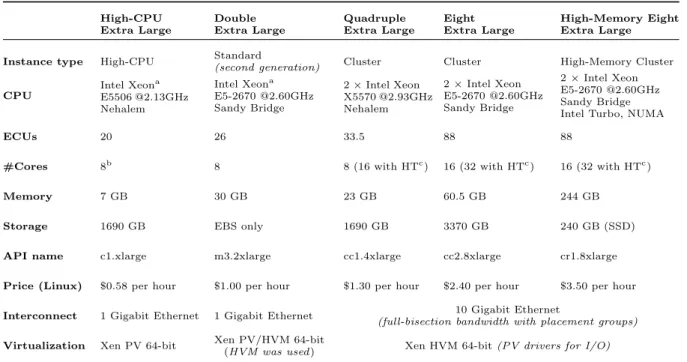
For the purposes of this article five high-end, two standard and three cluster instances, have been evaluated (their main characteristics are summa-rized in Table 1):
• The High-CPU Extra Large instance (c1.xlarge, abbreviated C1) is well suited for compute-intensive applications if not too memory demanding. It has one Intel Xeon E5506 quad-core Nehalem processor with a total computing power of 20 EC2 Compute
Units (ECUs1) and 7 Gbytes of memory. It has been considered the inclusion of this instance in the evaluation because of its low price but still having memory enough as to execute NPB kernels of size Class C without swapping to disk.
• The second generation Double Extra Large instance (m3.2xlarge, abbreviated M3) has been recently released (November 2012) and is the highest processing power standard in-stance. It has one Intel Xeon E5-2670 octa-core Sandy Bridge processor with a total computing power of 26 ECUs and 30 Gbytes of memory. According to Amazon ”second generation standard instances are ideal for applications that require higher absolute CPU and memory performance”.
• The Quadruple Extra Large cluster instance (cc1.4xlarge, abbreviated CC1) is the small-est of the HPC-aimed instances. CC1 in-stances have two Intel Xeon X5570 quad-core Nehalem processors, hence 8 cores per in-stance with a total computing power of 33.5 ECUs and 23 Gbytes of memory.
• The Eight Extra Large cluster instance (cc2.8xlarge, abbreviated CC2) has two Intel Xeon E5-2670 octa-core Sandy Bridge pro-cessors, hence 16 cores per instance with a total computing power of 88 ECUs and 60.5 Gbytes of memory.
• The High Memory Eight Extra Large in-stance (cr1.8xlarge, abbreviated CR1), a re-cently released (January 2013) instance that mimics CC2 processor architecture and pro-vides 244 Gbytes of memory and 240 Gbytes of SSD instance storage. Among the char-acteristics of this instance Amazon indicates that it provides Intel Turbo and NUMA op-timizations, but does not give any details.
4. EVALUATION OF
AMAZON
EC2
INSTANCES
This section describes the configuration and benchmarks used to evaluate the Amazon EC2 instances presented in the previous section and analyzes the evaluation results in terms of perfor-mance, intra-VM scalability and cost-efficiency.
Experimental Configuration
The performance evaluation has been conducted on single C1, M3, CC1, CC2 and CR1 instances of the Amazon EC2 platform. These resources have all been allocated in the US East (North Virginia) 1According to Amazon one ECU provides the
equiva-lent CPU capacity of a 1.0-1.2 GHz 2007 Opteron or 2007 Xeon processor.
region and the executions have been carried out mostly during the night, which can be relevant in the results of C1 and M3 instances as they are not dedicated instances. The Amazon Linux 2012.09.1 AMI with kernel 3.2.39 was used in all cases. Finally, the performance results are the mean of several measurements, generally five. Regarding the software, two different experiments were carried out to evaluate both HPC and HTC codes. For the HPC performance and intra-VM scalability the NAS Parallel Benchmarks (NPB) [6] version 3.3 have been assessed using the official NPB-SER implementation for the serial execution and the NPB-OMP implementation for the OpenMP parallel execution. NPB Class C size problems have been selected because they are the largest workloads that can be executed in all the instances under evaluation without swapping to disk. All the kernels (C/C++ and Fortran) have been compiled with the GNU 4.7.2 com-piler and-O3 -march=native flags. The metrics considered for the NPB kernels are: (1) MOPS (Millions of Operations Per Second), which mea-sures the operations performed in the benchmark (that differ from the CPU operations issued); and (2) MOPS per US$, which measures the cost-efficiency, that is the number of operations di-vided by the cost per hour of each instance. For the HTC evaluation JModelTest [7] version 2.1.3 has been selected. This is a real Java appli-cation commonly used in bioinformatics to carry out statistical selection of best-fit models of nu-cleotide substitution using up to five different model selection strategies. In a shared memory architecture it works by distributing tasks among a pool of Java threads that are initiated and man-aged by the application. The Java Virtual Ma-chine (JVM) used was the OpenJDK Runtime Environment version 1.7.0 09.
Results of the Evaluation
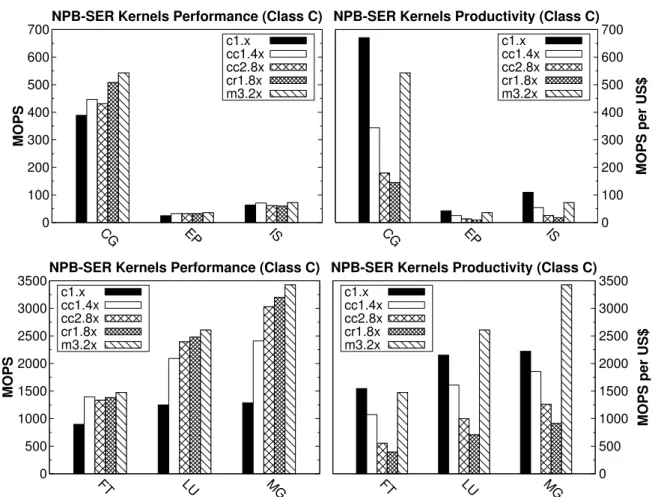
In Figure 1 the performance and cost-efficiency of the serial execution of all the NPB kernels for each of the evaluated instances is shown. For the EP (Embarrassingly Parallel) and IS (Integer Sort) kernels there are not significative differences on the MOPS obtained. For all the other kernels the C1 instance has obtained the lowest result, not surprisingly as it is the instance with the less powerful CPU, and the M3 instance has the best results, beating the cluster instances in all cases. The reason for this remains unclear for us, as this instance seems to have the same CPU as CC2 and CR1 cluster instances have and it is executed in non-dedicated hardware. Regarding the cluster instances, the newest CR1 instance outperforms slightly CC1 and CC2 instances, which could be explained by the Amazon support to the Intel
High-CPU Extra Large Double Extra Large Quadruple Extra Large Eight Extra Large High-Memory Eight Extra Large
Instance type High-CPU Standard(second generation) Cluster Cluster High-Memory Cluster
CPU Intel Xeona E5506 @2.13GHz Nehalem Intel Xeona E5-2670 @2.60GHz Sandy Bridge 2×Intel Xeon X5570 @2.93GHz Nehalem 2×Intel Xeon E5-2670 @2.60GHz Sandy Bridge 2×Intel Xeon E5-2670 @2.60GHz Sandy Bridge Intel Turbo, NUMA
ECUs 20 26 33.5 88 88
#Cores 8b 8 8 (16 with HTc) 16 (32 with HTc) 16 (32 with HTc)
Memory 7 GB 30 GB 23 GB 60.5 GB 244 GB
Storage 1690 GB EBS only 1690 GB 3370 GB 240 GB (SSD)
API name c1.xlarge m3.2xlarge cc1.4xlarge cc2.8xlarge cr1.8xlarge
Price (Linux) $0.58 per hour $1.00 per hour $1.30 per hour $2.40 per hour $3.50 per hour
Interconnect 1 Gigabit Ethernet 1 Gigabit Ethernet 10 Gigabit Ethernet
(full-bisection bandwidth with placement groups)
Virtualization Xen PV 64-bit Xen PV/HVM 64-bit
(HVM was used) Xen HVM 64-bit(PV drivers for I/O)
bFor C1 instances the number of physical cores reported by Amazon (8) does not match the information in/proc/cpuinfo(4) aAs reported by/proc/cpuinfosince Amazon does not provide that information
cHT: Hyper-Threading
Table 1: Description of the high-end EC2 instances evaluated in this paper
Turbo technology in this type of instance, as this technology gets its best performance when only one core is used. Having costs per hour into ac-count, results for all kernels show that it is not worth using cluster instances. Having the best performance and lower prices, the M3 instance is the best option in almost all the cases, being C1 also an instance with a great cost-performance ratio.
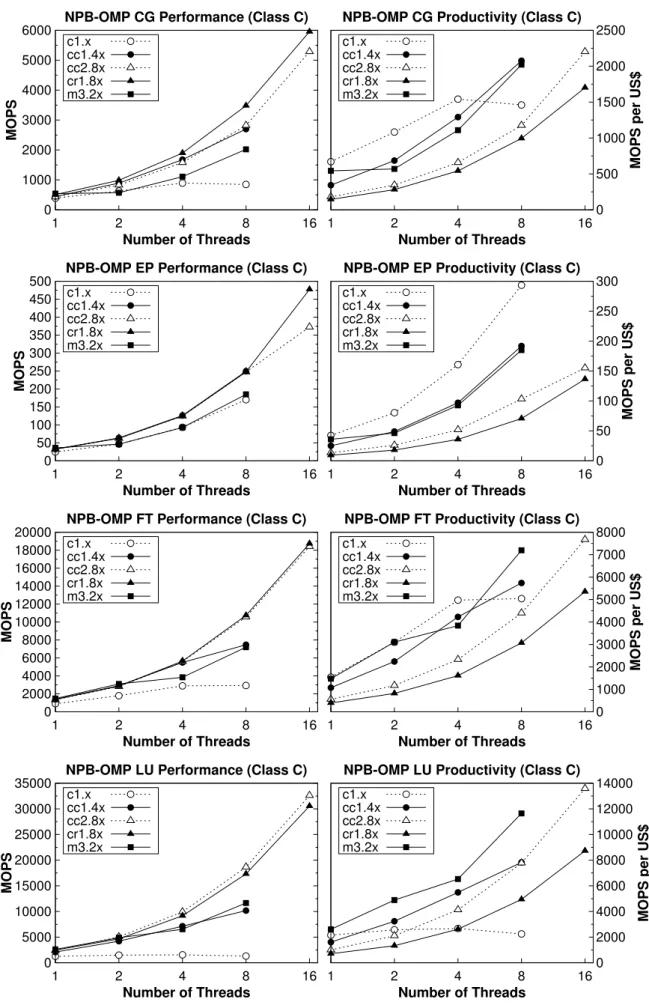
Results from the execution of some of the NPB kernels are shown in Figure 2. Four represen-tative kernels from the OMP implementation of the NPB have been selected and executed on the evaluated instances: CG (Conjugate Gradient), EP (Embarrassingly Parallel), FT (Fast Fourier Transform) and LU (Lower-Upper Gauss-Seidel solver). Executions have been done varying the number of threads until the maximum number of virtual cores of the instance, as reported by Amazon, was reached. The tendency observed for all the kernels is that, as the number of threads increases, cluster instances get the best perfor-mance and high speedup results, being the dif-ferences among them significative only for some kernels when the number of threads approaches the maximum. The newest CR1 instance out-performs CC1 and CC2 instances for 8 and 16 threads for all the kernels except LU, where CC2 instance is slightly better. Although Amazon does not give any details, this better behavior of CR1 if compared to CC2, that has the same CPU, could be explained by the NUMA
optimiza-tions support included in this type of instance. It is also worth noting that the CC1 instance has the worst results among the cluster instances al-though they are close to those of CC2 for some of the NPB kernels (e.g. CG and EP). The sec-ond generation standard instance M3 gets worst results than cluster instances with poor parallel efficiency (around 50% for 8 threads) but it ex-hibits a very regular performance behavior for all kernels. Special mention must be made for the re-sults of the C1 instance, although it obtains bad results in some kernels (e.g. FT or LU), for the EP kernel it obtains figures similar to those of M3 and an speedup near to ideal, making it an eco-nomical option for Monte Carlo-type simulations when 8 threads or less are used.
With regard to cost-efficiency, results show that M3 and CC1 instances have in general the best cost-performance ratio when using 8 threads or less. For some kernels (i.e. CG end EP) the C1 instance shows even best figures when us-ing 4 threads or less, but the variability of its results does not make it the best choice. The worst results in all cases have been those of CC2 and CR1 cluster instances, being CC2 best than CR1. These are the only instances evaluated us-ing 16 threads and it can be concluded that it is not worth using the newest CR1 instance unless high-memory capacity requirements are a must. Finally, for the HTC evaluation two of the models that come with the JModelTest distribution has been selected: aP6.fas and wormsCOI.mafft.fas.
0 100 200 300 400 500 600 700 CG EP IS MOPS
NPB-SER Kernels Performance (Class C)
c1.x cc1.4x cc2.8x cr1.8x m3.2x CG EP IS 0 100 200 300 400 500 600 700
MOPS per US$
NPB-SER Kernels Productivity (Class C)
c1.x cc1.4x cc2.8x cr1.8x m3.2x 0 500 1000 1500 2000 2500 3000 3500 FT LU MG MOPS
NPB-SER Kernels Performance (Class C)
c1.x cc1.4x cc2.8x cr1.8x m3.2x FT LU MG 0 500 1000 1500 2000 2500 3000 3500
MOPS per US$
NPB-SER Kernels Productivity (Class C)
c1.x cc1.4x cc2.8x cr1.8x m3.2x
Figure 1: NPB-SER kernels performance and productivity
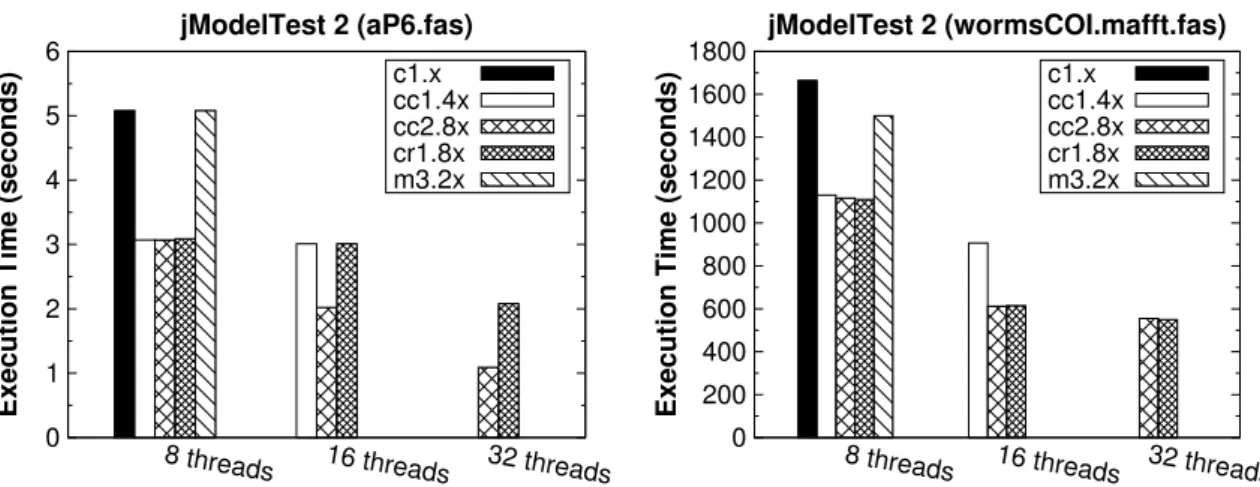
These are two representative models with very different execution times. They have been exe-cuted using the suggested values for the parame-ters and varying the number of threads until the maximum number of logical cores, as reported by the instance, was reached (i.e. using Hyper-Threading when available). Execution times are shown in Figure 3. Not surprisingly cluster in-stances get the best results for both models when using 8 threads and M3 slightly outperforms C1. Among the cluster instances CC1 obtains the worst results and there are no significative differ-ences between CC2 and CR1. Note that for the second model when the number of threads is dou-bled from 8 to 16 the execution time is reduced near to the half, but when Hyper-Threading is used (32 threads instead of 16) the execution time does not improve too much.
5. CONCLUSIONS
Motivated by previous results that have shown that the scalability of HPC communication-intensive applications is very poor when using more than one EC2 cluster instance and that, from an economical point of view, is better to use EC2 lower computational power cluster in-stances, this paper has further evaluated the
single-instance execution of scientific codes on some of the most computationally powerful EC2 instances. In the evaluation two high-end stan-dard instances (C1 and M3) and three cluster in-stances (CC1, CC2 and the newest CR1) have been compared in terms of single instance per-formance, intra-VM scalability and cost-efficiency using both an HPC benchmark suite (the NPB kernels) and a real HTC application (JModel-Test).
From the results the following conclusions can be drawn: (1) in terms of performance and intra-VM scalability, cluster instances obtain the best results both for HPC and HTC codes; (2) in terms of cost-efficiency, M3 and CC1 instances have in general the best cost-performance ratio when using 8 threads or less; (3) due to its higher costs and similar performance it is not worth us-ing the newest CR1 instance as a substitute for the CC2 instance unless high-memory capacity requirements are a must; (4) unless the require-ments of the application in number of threads and memory capacity preclude their use, non-cluster instances (M3 and, in some cases, C1) and less powerful cluster instance CC1 are an economical alternative despite their worst performance and speedup results.
0 1000 2000 3000 4000 5000 6000 1 2 4 8 16 MOPS Number of Threads
NPB-OMP CG Performance (Class C)
c1.x cc1.4x cc2.8x cr1.8x m3.2x 1 2 4 8 16 0 500 1000 1500 2000 2500
MOPS per US$
Number of Threads
NPB-OMP CG Productivity (Class C)
c1.x cc1.4x cc2.8x cr1.8x m3.2x 0 50 100 150 200 250 300 350 400 450 500 1 2 4 8 16 MOPS Number of Threads
NPB-OMP EP Performance (Class C)
c1.x cc1.4x cc2.8x cr1.8x m3.2x 1 2 4 8 16 0 50 100 150 200 250 300
MOPS per US$
Number of Threads
NPB-OMP EP Productivity (Class C)
c1.x cc1.4x cc2.8x cr1.8x m3.2x 0 2000 4000 6000 8000 10000 12000 14000 16000 18000 20000 1 2 4 8 16 MOPS Number of Threads
NPB-OMP FT Performance (Class C)
c1.x cc1.4x cc2.8x cr1.8x m3.2x 1 2 4 8 16 0 1000 2000 3000 4000 5000 6000 7000 8000
MOPS per US$
Number of Threads
NPB-OMP FT Productivity (Class C)
c1.x cc1.4x cc2.8x cr1.8x m3.2x 0 5000 10000 15000 20000 25000 30000 35000 1 2 4 8 16 MOPS Number of Threads
NPB-OMP LU Performance (Class C)
c1.x cc1.4x cc2.8x cr1.8x m3.2x 1 2 4 8 16 0 2000 4000 6000 8000 10000 12000 14000
MOPS per US$
Number of Threads
NPB-OMP LU Productivity (Class C)
c1.x cc1.4x cc2.8x cr1.8x m3.2x
0 1 2 3 4 5 6
8 threads 16 threads 32 threads
Execution Time (seconds)
jModelTest 2 (aP6.fas) c1.x cc1.4x cc2.8x cr1.8x m3.2x 0 200 400 600 800 1000 1200 1400 1600 1800
8 threads 16 threads 32 threads
Execution Time (seconds)
jModelTest 2 (wormsCOI.mafft.fas) c1.x cc1.4x cc2.8x cr1.8x m3.2x
Figure 3: jModelTest 2 execution time
ACKNOWLEDGMENT
This work was funded by the Ministry of Science and Innovation of Spain and FEDER funds of the EU under Project TIN2010-16735, an FPU Grant AP2010-4348, and by an Amazon Web Services (AWS) LLC research grant.
REFERENCES
[1] R. Buyya, C. S. Yeo, S. Venugopal, J. Broberg, and I. Brandic, “Cloud Com-puting and Emerging IT Platforms: Vision, Hype, and Reality for Delivering Computing as the 5th Utility,”Future Generation Com-puter Systems, vol. 25, no. 6, pp. 599–616, 2009.
[2] C. Evangelinos and C. N. Hill, “Cloud Com-puting for Parallel Scientific HPC Appli-cations: Feasibility of Running Coupled Atmosphere-Ocean Climate Models on Ama-zon’s EC2,” inProc. 1st Workshop on Cloud Computing and Its Applications (CCA’08), (Chicago, IL, USA), pp. 1–6, 2008.
[3] E. Walker, “Benchmarking Amazon EC2 for High-Performance Scientific Computing,” LOGIN: The USENIX Magazine, vol. 33, no. 5, pp. 18–23, 2008.
[4] Amazon Web Services LLC, “High Perfor-mance Computing on AWS.” http://aws. amazon.com/hpc-applications/. Last vis-ited: Apr 2013.
[5] R. R. Exp´osito, G. L. Taboada, S. Ramos, J. Touri˜no, and R. Doallo, “Performance Analysis of HPC Applications in the Cloud,” Future Generation Computer Sys-tems, vol. 29, no. 1, pp. 218 – 229, 2013. [6] D. H. Bailey et al., “The NAS Parallel
Benchmarks,”International Journal of High Performance Computing Applications, vol. 5, no. 3, pp. 63–73, 1991.
[7] D. Darriba, G. L. Taboada, R. Doallo, and D. Posada, “jModelTest 2: More Models,
New Heuristics and Parallel Computing,” Nat Meth, vol. 9, p. 772, Aug. 2012.
[8] K. R. Jackson, L. Ramakrishnan, K. Muriki, S. Canon, S. Cholia, J. Shalf, H. J. Wasser-man, and N. J. Wright, “Performance Analy-sis of High Performance Computing Applica-tions on the Amazon Web Services Cloud,” inProc. 2nd IEEE Intl. Conference on Cloud Computing Technology and Science (Cloud-Com’10), (Indianapolis, USA), pp. 159–168, 2010.
[9] P. Luszczek, E. Meek, S. Moore, D. Terpstra, V. M. Weaver, and J. J. Dongarra, “Eval-uation of the HPC Challenge Benchmarks in Virtualized Environments,” in Proc. 6th Workshop on Virtualization in High-Performance Cloud Computing (VHPC’11), (Bordeux, France), pp. 1–10, 2011.
[10] Y. Zhai, M. Liu, J. Zhai, X. Ma, and W. Chen, “Cloud Versus In-House Clus-ter: Evaluating Amazon Cluster Compute Instances for Running MPI Applications,” in Proc. 23th ACM/IEEE Conference on Supercomputing (SC’11, State of the Prac-tice Reports), (Seattle, WA, USA), pp. 1–10, 2011.
[11] C. Sun, H. Nishimura, S. James, K. Song, K. Muriki, and Y. Qin, “HPC Cloud Applied to Lattice Optimization,” in Proc. 2nd Intl. Particle Accelerator Conference (IPAC’11), (San Sebastian, Spain), pp. 1767–1769, 2011. [12] J. J. Rehr, F. D. Vila, J. P. Gardner, L. Svec, and M. Prange, “Scientific Computing in the Cloud,” Computing in Science and En-gineering, vol. 12, no. 3, pp. 34–43, 2010. [13] P. Barham, B. Dragovic, K. Fraser, S. Hand,
T. Harris, A. Ho, R. Neugebauer, I. Pratt, and A. Warfield, “Xen and the Art of Vir-tualization,” inProc. 19th ACM Symposium on Operating Systems Principles (SOSP’03), (Bolton Landing, NY, USA), pp. 164–177, 2003.