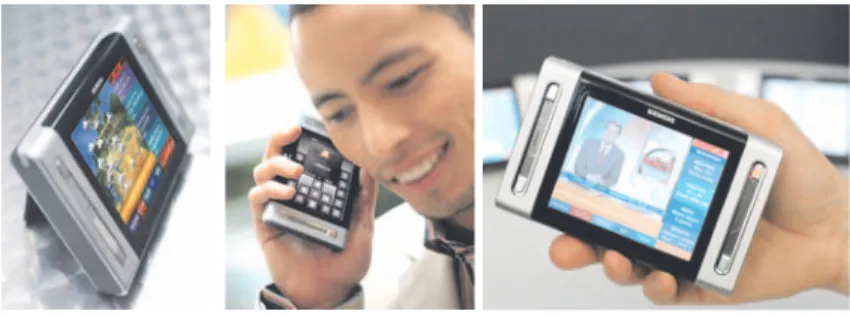
Interactive TV meets Mobile Computing
Uwe RauschenbachSiemens AG, Corporate Technology, CT IC 2, 81730 Munich, Germany [email protected]
Abstract. This contribution presents some recent developments in interactive
digital television and discusses the trends and challenges of bringing TV services to mobile devices. Two areas will be addressed: portable use of mobile devices to complement the TV set in the home and mobile TV services while on the move using the emerging mobile broadcasting technology.
1
Introduction
With the ongoing digitisation of television systems based on the Digital Video Broad-casting (DVB) standards [1], television evolves from pure audio-visual, time-linear ser-vices into rich media, interactive and time-shifted infotainment serser-vices. Due to the digital nature of the systems, transmitting arbitrary content, storing and accessing it becomes possible with any kind of digital multimedia-capable device.
In such a service ecosystem, the TV set will be no longer the only device which is used to access broadcast content. It will be supplemented or even replaced by portable or mobile devices, offering the user convenient access to content whenever and wherever required.
Two scenarios are likely and will be addressed in this contribution. First, supple-mental access to stationary, enhanced TV services using portable devices in the home and second, broadcast networks which are capable to deliver TV-like digital services directly to mobile devices.
2
Stationary Broadcast Services Enhanced by Portable Devices
2.1 Use Cases and System Architecture
Television will develop from a pure "lean-back" medium to a more flexible, interac-tive one where the viewer gains a greater degree of control over what he watches and when he watches it. This will lead to new usage patterns, being a mix between "couch potato" and "program director". New options of interactivity will further change the usage patterns of TV.
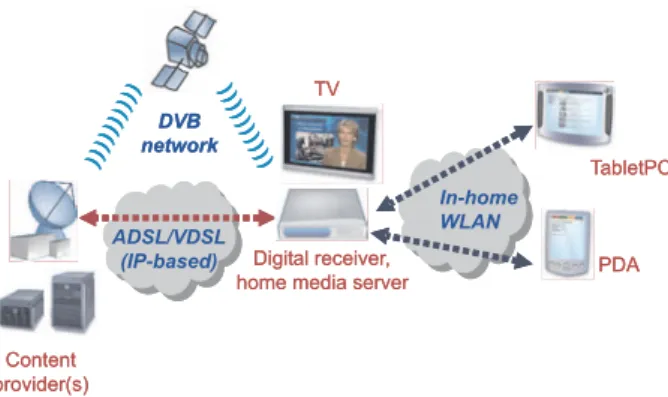
Figure 1 depicts the overall system architecture of a future television system. The heart of the system is formed by a Home Media Server which is capable of receiving content from different network channels and recording it, supporting time-shifted use, personalised content selection and the delivery of interactive services. Classic linear consumption of TV content on the TV set is possible as well as access to TV services by using portable devices, communicating with the Home Media Server by means of Wireless LAN technology.
ADSL/VDSL (IP-based) ADSL/VDSL (IP-based) DVB network DVB network In-home WLAN In-home WLAN Content provider(s) Content provider(s) Digital receiver, home media server
TV
Digital receiver, home media server
TV
PDA TabletPC
PDA TabletPC
Fig. 1. System Architecture
2.2 Scalable Personalised Interactive Rich Media TV Services
Digital technology allows to create new TV services which are more than just audio and video. A Rich Media TV Service can contain arbitrary types of multimedia ele-ments, leading to a rich user experience and supporting scheduled display (push) as well as interactive browsing of additional information, e.g. backgrounders in a News show or scores in a Sports programme. Metadata must be used to signal the relation-ships between the different media instances in such a service.
The combination of the uni-directional broadcast channel with a bi-directional data network allows to create truly interactive services.
Personalisation is possible in two respects. First, additional information may be supplied with the main TV programme, from which the user can select the pieces he is interested in. Second, by sending metadata with the programme, the Home Media Server can record those segments of the TV programme which are of interest to the user according to a specified or learned user profile. This way, a user can create e.g. his own personalised News show.
The use of a variety of portable terminal devices (e.g., PDA, TabletPC) with differ-ent resources w.r.t. display size, processing power or decoding capabilities requires to build scalability into the services. This is a new challenge for television broadcasters because TV has a long tradition of having to support only a single display resolution. To create a scalable service, two solutions must be combined. First, metadata must be used to signal media properties and requirements to terminal capabilities. Second, ei-ther a scalable media format must be used (like JPEG 2000 [7] for pictures or MPEG-21 SVC [8] for video), or the device population must be divided into classes with similar capabilities and a tailored media instance must be transmitted for each device class (simulcast). An alternative to simulcast is the use of a transcoding subsystem in the Home Media Server.
Metadata play a central role to enable this new service category. Figure 2 illustrates an example metadata model developed within the SAVANT project. A more in-depth discussion of this model can be found in [4].
program timeline
TopicTopic …… CategoryCategory Title Abstract Copyright… Title Abstract Copyright…
ACI 3.3 html ACI 3.4 html ACI 3.1 video ACI 3.2 audio … … PI 1 PI 2 PI 3 … PI n PI 1 PI 2 PI 3PI 3 PI n MP4 MP4…MP4 MP4… AAC…AAC…MP4MP4 HTML HTML Sync: PI3 Route: DVB Fig. 2. Metadata
In TV, the program structure is based on a linear schedule. This assumption is re-sembled by the metadata model, building upon the program time line and segmenting it into program items which are atomic, meaningful segments – e.g., an individual news report. This linear content is called the main content of the rich media programme.
For each program item, annotations like title, abstract etc. can be assigned. These metadata allow personalised access to the main content - either by manual selection in the user interface (see figure 3) or by user profiling based on keywords in title and abstract. Details of the personalisation method can be found in [5].
To create a rich media TV service, the program items can be used as anchor points for additional content items. These may be, for instance, HTML pages, audio clips or video clips. Additional content items serve as an abstraction layer to hide the technical aspects of scalability.
The media item layer provides the details of scalability. For each additional content item, one or more media items are assigned depending on the actual system configura-tion. In the case of fully-scalable content formats like JPEG 2000, only one media item is required to support all device classes. In the case of simulcast, one media item per device class is used to support scalability. In the third case – transcoding – one media item must supply a real media essence while further media items may just contain a transcoding instruction to be applied to that essence. The media item descriptor signals the content properties and a URI where the actual media essence can be found. A termi-nal can select the best-suited media item by matching the sigtermi-nalled content properties to its capabilities.
Further control parameters can be attached to an additional content item to allow the transmission of the media objects over different networks (see next section). These parameters influence the decision which network is used to transmit the media object (be it the broadcast network or the IP data network) and the way the additional content is synchronised with the main content (see section 2.3).
Last but not least, the metadata model contains structuring information which al-lows non-linear access to those program items which have been recorded automatically
by the home media server. This information is supplied by the editorial staff of the broadcaster and allows the user to browse the media archive independent from the lin-ear order in which the media items have been broadcast, e.g.. by category or topic.
Group by structur-ing metadata Group by structur-ing metadata Program item Program item Annotations Annotations
Additional content: audio Additional content: audio
Additional content: html Additional content: html
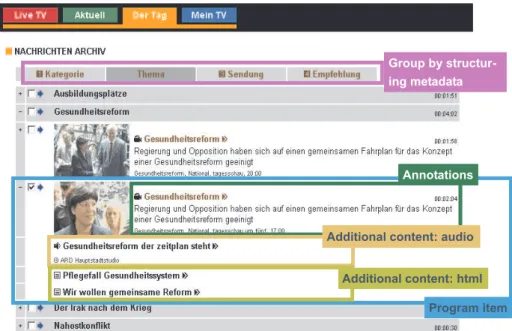
Fig. 3. The News Manager User Interface
Within the SAVANT project [2], a digital News service has been created which illustrates these ideas. Figure 3 shows the NewsManager user interface of this service which provides access to the main and additional content based on the metadata model just described. This NewsManager runs on the TV set, a TabletPC or a PDA. In the figure, the NewsManager for the TabletPC screen is depicted.
The screen shot shows access by topic ("Thema"), allowing to group program items together which report on the same topic regardless when they have been broadcast. Alternative ways to access the content are by category ("Kategorie"), according to the linear schedule ("Sendung") or by using a recommendation engine to show a list of program items based on personal preferences ("Empfehlung").
In the topic view, the topic "Health reform" ("Gesundheitsreform") has been opened by the user. It currently contains two program items. Each program item can be played back immediately or selected for inclusion into the personalised News programme by activating the check box. Furthermore, the figure shows three additional content items for this program item. One item is of type audio and allows the user to access a radio report on the topic. The other two items are web pages with background information regarding the topic, which are provided by the broadcaster on his web site. For the purpose of display in the scalable TV service, the HTML content is reformatted by the content management system to be suitable for usage on TV and on the portable devices.
2.3 Co-Operation of Broadcast and Data Networks
With the digitisation of the broadcast networks, it became possible to create seam-less services which make use of both digital broadcast and digital data networks. This convergence allows to combine the strengths of both network technologies: Broadcast networks allow for economic, high bandwidth transmission of the same content to a virtually unlimited number of users at the same time, and IP data networks support the efficient delivery of personalised content to individual users or small user groups. Furthermore, they provide the interaction channel to enable interactive services.
FTP download Web download RTP streaming RTP streaming File transfer Object carousel MPEG-2 streaming DVB IP over xDSL, UMTS, ... Playout system • Content repository • Scheduling • Delivery control • Routing decision
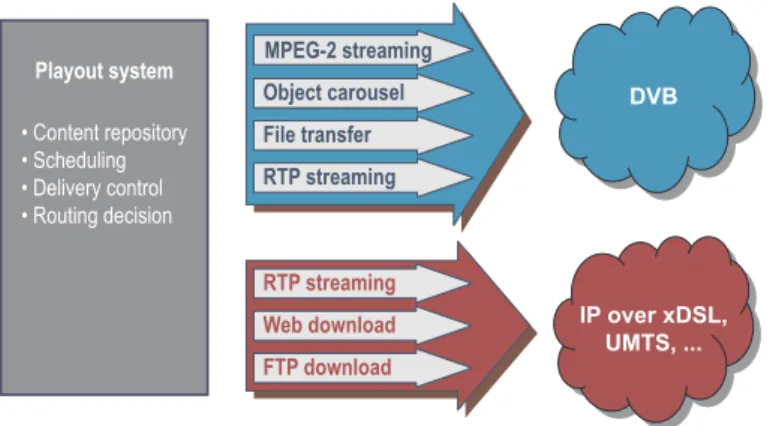
Fig. 4. Available transmission channels in a system which uses co-operating networks
Two aspects are important when realising services which make use of co-operating networks: smart content routing and content synchronisation. Smart routing selects for each media item the transmission channel which is best suited to deliver it, consider-ing content characteristics, network usage, number of users currently consumconsider-ing the content or estimated to do so in the near future and operator settings. Based on these parameters, a routing decision is made determining via which one of the channels de-picted in figure 4 the media item will be transmitted. As a rule of thumb, media items which are of interest to a large number of users are routed over the broadcast network if capacity is available; media items which are of interest to only a few viewers or intended for personalised access are routed over the IP network.
Special attention must be paid to such additional content which has to be in sync with the main TV content. Different camera views into the same scene in a live sports event or a sign language interpreter to support accessibility to TV programs for the hearing impaired are two examples use cases.
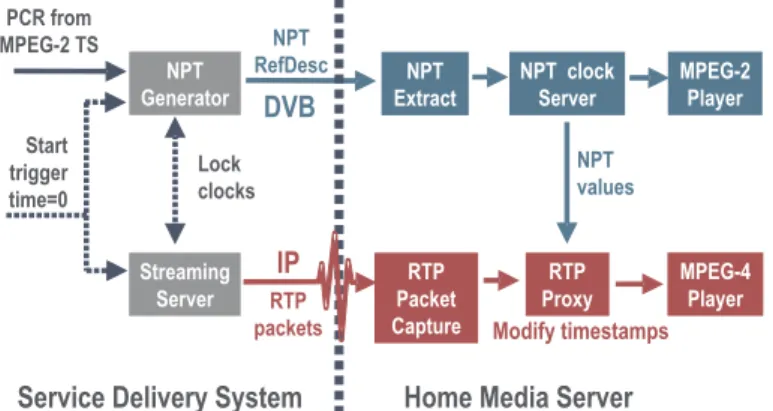
In the SAVANT project, an end-to-end solution has been developed which is able to synchronise content delivered over an IP network with a TV programme delivered over DVB. Figure 5 illustrates the architecture of the synchronisation subsystem.
In the Service Delivery System which plays out the service, the two streams a syn-chronously started, possibly with some compensation for the average delay in the IP
NPT RefDesc NPT Extract NPT clock Server MPEG-2 Player NPT Generator Streaming Server RTP Packet Capture PCR from MPEG-2 TS Lock clocks Start trigger time=0 RTP Proxy MPEG-4 Player RTP packets IP DVB
Service Delivery System Home Media Server NPT values
Modify timestamps
Fig. 5. Synchronisation architecture
channel relative to the DVB channel. The time stamps of the packets in the two differ-ent channels are synchronised in order to make sure the streams stay in sync. The media stream in the DVB channel complies with the MPEG-2 Systems standard [12], whereas the media stream in the IP channel complies with the RTP [13] standard.
On the Home Media Server, the NPT (Normal Play Time) samples in the MPEG-2 stream are forming the time line against which the additional content stream is going to be synchronised. This is achieved by means of a component which captures the RTP packets, adjusts their time stamps according to the main time line and feeds them into the MPEG-4 player which renders them in sync with the main MPEG-2 content. The in-accuracy of the synchronisation is well below one second, which is sufficient to support the sketched applications.
Figure 6 illustrates application – Signer on Demand. Hearing-impaired people can receive an additional video stream of a sign language interpreter over the IP network (e.g., DSL) which is kept in synchronisation with the main programme – in this case a news show. This stream can be switched on and off as required – in contrast to today’s sign-language enabled programmes where the signer is integral part of the main video content and can not be deactivated.
The publication [3] provides more detail on Smart Routing and Inter-network con-tent synchronisation to the readers with a deeper interest in this subject.
3
Broadcasting to Mobile Devices
In recent times, broadcasting technologies which provide content directly to mobile phones have generated a lot of interest. This section tries to give a brief introduction into this area.
3.1 Use Cases
Mobile phone network operators are seeking ways of generating new revenues from data and multimedia services. Television-like services over 3G networks are starting to
Fig. 6. Application of synchronisation: Signer on Demand
take off, but they are based on unicast streaming which is a very bandwidth-inefficient way to deliver live content if many users require it. To circumvent this future bottleneck, broadcasting technologies have recently been developed which provide a second link via which TV-like services can be brought to mobile phones. Together with the cellular network as interactivity channel, this setup offers similar convergence benefits as the co-operative networks introduced for stationary TV in the previous section. Some of the envisioned use cases are briefly described here:
Passive mobile TV: This use case assumes that classic TV channels are
resolution-reduced and re-broadcasted using mobile broadcast technology. The formats will not support any interaction.
Interactive mobile TV: This use case adds interactivity options (e.g., vote, retrieve
additional information, call in) to passive mobile TV.
Buffered personalised entertainment: In carousel mode, different pieces of
con-tent formatted into files or clips are repeatedly broadcast. The terminal device stores this broadcast (or parts of it based on some user preferences) for later off-line consumption.
Massively-parallel multi-player games: Via the interaction channel, a potentially
large number of players can participate in a game with simple interaction. A complex video scene is computed based on these interactions and transmitted to the terminals via broadcast.
Traffic information: Traffic information is real-time in nature and of interest to
a potentially large mobile audience in a certain region. This makes traffic services an ideal use case for mobile broadcast.
3.2 Technology Overview
Several mobile broadcast technologies have been developed in the last few years. This section gives a brief summary, before one particular technology – DVB-H – is discussed in greater detail.
Mobile broadcast technologies have evolved out of different roots. Based on the standards for digital television (DVB - Digital Video Broadcast) and digital radio (DAB
Fig. 7. DVB-H terminal prototypes begin to appear
- Digital Audio Broadcast), the mobile broadcast technologies DVB-H (H for Hand-held) [6] and DMB (Digital Multimedia Broadcast) [9] have been developed. While DVB-H is a European standard based on DVB using IP as transport layer, a Korean consortium has developed DMB based on DAB, relying on MPEG-2 transport streams. The IP layer gives DVB-H an advantage for convergent services.
Based on cellular network technology, MBMS (Multimedia Broadcast Multicast Services) [10] provide a transmission channel in cellular networks which can address multiple or all devices in a cell at once.
Furthermore, Qualcomm’s proprietary MediaFLO [11] technology may play a cer-tain role in the future.
3.3 A Closer Look at DVB-H
DVB-H has been developed by the DVB Project [1] as an extension of their terrestrial broadcasting standard DVB-T. The modifications to DVB-T aim at making the technol-ogy suitable for mobile reception by terminals with limited battery resources. DVB-H transmits all data based on IP – this traffic is encapsulated into the MPEG-2 transport stream by the multi protocol encapsulation method (MPE) as defined by DVB. The following features have been added to DVB-T:
Time slicing: One big challenge in mobile reception of DVB signals is the power
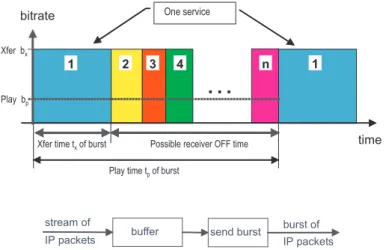
consumption of the receiver circuits. Since classic DVB has been designed for station-ary set top boxes, power consumption has not been an issue yet. DVB-H solves the problem by introducing a time slicing mode. Figure 8 illustrates the idea. Usually, a DVB-H service consumes a bitrate of 200 to 500 kbps (playback bitrate bpin figure 8), whereas the capacity of a typical DVB-H channel is 9 Mbps (transmission bitrate bxin figure 8). Instead of transmitting multiple services in parallel ("bitrate slicing"), the IP encapsulator which generates the DVB-H transport streams collects the IP traffic of each service in a buffer and sends the buffered data at once in short bursts using the full bitrate of the channel (time slicing). Referring to figure 8, the following equation applies: bptp=bxtx. The receiver circuits have only to be switched on during the time periods of the bursts of the currently selected service. This way, battery power is saved.
Error protection: In mobile environments, interference and fading cause
error correction (FEC) to protect the MPE data packets. For each MPE packet, redun-dancy is added in the form of a Reed-Solomon code. If some of the bytes of such an error protected packet are erroneous, the redundant data can be used to recover them.
Modulation: DVB-H defines an additional set of modulation parameters (the
so-called 4k mode). This mode better supports mobile reception at higher speeds than the modes defined by DVB-T which have been optimised for stationary reception.
time
One service
Play time tpof burst
…
1 2 3 4 n 1
bitrate
Xfer time txof burst Xfer bx
Play bp
Possible receiver OFF time
buffer send burst stream of
IP packets
burst of IP packets
Fig. 8. DVB-H timeslicing principle
3.4 Service Layer Standardisation
DVB-H, DMB and MBMS provide the bearer technologies for Mobile TV. However, in order to deliver a full service to the users in an interoperable way, service layer com-ponents are required on top of the bearer technologies. For instance, audio and video codecs must be specified. An electronic service guide must be defined which allows the user to find the desired services. A service and content protection system is required to support pay services and to prevent content piracy. Transport protocols for audio and video must be defined. Last but not least, an interaction middleware must be specified which allows to run a broadcasted interactive TV application on any terminal. These specifications are currently being developed. Both DVB [15] and the Open Mobile Al-liance [14] are currently developing service layer specifications. A Java Specification Request (JSR-272) [16] is currently under way to define a middleware for interactive applications.
4
Conclusion
This contribution has presented some trends joining interactive television and mobile computing. Mobile terminals will in the future play a much greater role in receiving TV
services - both portable as nodes of an in-home network as well as mobile by using mo-bile broadcast technology. The convergence of transport networks, home media servers as core of a home network, metadata, scalability and mobile broadcast are key topics in this field during the next few years.
Acknowledgement
Parts of the work presented have been co-funded by the European Commission under contract number IST-2001-34814. The author wishes to thank the participants of the Dagstuhl seminar 05181 for the interesting and fruitful discussions.
References
1. Homepage of the Digital Video Broadcasting Project. http://www.dvb.org. 2. Homepage of the SAVANT Project. http://www.savant.tv.
3. U. Rauschenbach, G. Stoll, W. Putz, R. Mies and P. Wolf: A Scalable Interactive TV Service Supporting Synchronized Delivery over Broadcast and Broadband Networks. Proc. IBC 2004 conference, Sept. 9-13, 2004, Amsterdam, The Netherlands, pp. 382 ff. 4. P. Wolf, G. Durand, G. Kazai, M. Lalmas and U. Rauschenbach: A metadata model supporting scalable interactive TV services. MMM2005 - The 11th International Multi-Media Modelling Conference, Melbourne, Australia, 12-14 January, 2005.
5. J. Bywater, M-L. Bourguet, G. Kazai, M. Lalmas and A. Pearmain: Scalable and Per-sonalised Broadcast Services. Proceedings of the European Conference on Interactive Television (ECIT): Enhancing the Experience, Brighton, UK, March 2004.
6. DVB-H section of the DVB website. http://www.dvb.org/index.php?id=278 7. JPEG 2000 Homepage. http://www.jpeg.org/jpeg2000/index.html
8. R. Schäfer, H. Schwarz, D. Marpe, T. Schierl, T. Wiegand: MCTF and Scalability Ex-tension of H.264/AVC and its Application to Video Transmission, Storage, and Surveil-lance, Proc. Visual Communications and Image Processing 2005 (VCIP 2005), Beijing, China, July 12-15, 2005.
9. Seung Kyu Lee, Cheon Sup Kwak: Video for Mobile and Handheld Devices: Design and Implementation of the Korean T-DMB System. Proc. IBC 2004 conference, Sept. 9-13, 2004, Amsterdam, The Netherlands, pp. 391 ff.
10. F. Mademann: 3GPP MBMS Bearer Service. Proc. Multiradio Multimedia Communica-tions 2005, 13-14 January 2005, Berlin, Germany.
11. QUALCOMM MediaFLO Homepage http://www.qualcomm.com/mediaflo/
12. Information Technology - Generic Coding of Moving Pictures and Associated Audio: Systems. ITU Recommendation H.222.0, ISO/IEC 13818-1, International Standard 13. RFC 3550 - RTP: A Transport Protocol for Real-Time Applications
http://www.faqs.org/rfcs/rfc3550.html
14. Open Mobile Alliance / Browser and Content / Mobile Broadcast standardization activ-ity. http://www.openmobilealliance.org/tech/wg_committees/bac.html
15. DVB Technical Module, Convergence of Broadcast and Mobile Services. http://www.dvb.org/documents/modules/TM-UMTS.DVB-Scene-0211.pdf
16. Java Specification Request – JSR 272: Mobile Broadcast Service API for Handheld Ter-minals. Java Community Process website, http://www.jcp.org/en/jsr/detail?id=272