Drug treatment for personality disorders
Peter Tyrer & Anthony W. Bateman
Abstract There is some evidence that antidepressants, particularly the selective serotonin reuptake inhibitors and the monoamine oxidase inhibitors, have some benefits in the management of borderline personality disorder, and lesser evidence (partly because of limited trial data) for the benefits of antipsychotic drugs and mood stabilisers. There is not sufficient distinction between the different personality disorders to recommend that any one disorder should be treated by any one drug, and successful treatment is dependent on careful management, sensitive to the patient’s expectations.
Peter Tyrer is Professor of Community Psychiatry and Head of the Department of Psychological Medicine at Imperial College (Charing Cross Campus, St Dunstan’s Road, London W6 8RP, UK. E-mail: [email protected]), and an honorary consultant in rehabilitation psychiatry with Central North West London and West London Mental Health NHS Trusts. He is the current Editor of the British Journal of Psychiatry and Co-Chair of the Section of Personality Disorders of the World Psychiatric Association. Anthony Bateman is a consultant psychiatrist in psychotherapy, research lead of psychotherapy services (Haringey) in Barnet, Enfield and Haringey Mental Health NHS Trust and an honorary senior lecturer at the Royal Free and University College Medical School, London. His interests include treatment of personality disorder and the integration of psychotherapy and psychiatry. Over the past decade he has developed, with Peter Fonagy, a programme for the treatment of borderline personality disorder. This article is the second of three by Anthony Bateman and Peter
Tyrer on personality disorders. The first, which reviews psychological treatments, also appears in this issue of APT (Bateman & Tyrer, 2004a). The third, on service delivery for people with personality disorders (Bateman & Tyrer, 2004b), will be published in the next issue.
Drug treatment is normally considered as an adjunctive rather than a primary treatment for personality disorders (American Psychiatric Associ-ation, 2001), but there is no particular reason for making this judgement, as all the trials of drug treatment in personality disorder have been primary ones. These trials of drug treatment, although admittedly easier to carry out than those of psychological treatment, are at least as good as those of other interventions and the results, for some treatments, more impressive in the short-term; but treatment has seldom persisted beyond a few weeks and has limitations.
Almost all drug trials for personality disorders have been for borderline personality disorder. In evaluating the evidence for efficacy it needs to be stressed that when treating this disorder it is difficult to disentangle mental state from personality components, as depression and other mood disturbance, suicidal behaviour, paranoid ideation and other abnormal thinking may all be present in the condition. There is therefore some doubt, when a drug treatment is effective in this condition, whether it is dealing with the core component of the disorder or a secondary mental state aspect ‘picked out’ from the personality background and treated separately.
Why might drugs help those
with personality disorders?
Several lines of argument support the notion that drugs might have a place in the treatment of personality disorders.
The sub-syndromal or spectrum argument
Personality disorders can be considered as part of a spectrum in which they are envisaged as one component on a continuum of mental disorders (Siever & Davis, 1991) – a sub-syndromal model (Table 1). In this construct, schizotypal and paranoid personality disorders (Cluster A) are a sub-syndrome of schizophrenia; borderline personality and other Cluster B disorders are similarly linked to other impulsive and aggressive disorders; and anxious/ fearful personality disorder (Cluster C) to the common anxiety disorders such as phobic and generalised anxiety disorders. This argument has some face validity and is supported by the frequent associations (comorbidity) of each mental state disorder with its personality counterpart (Tyrer et al, 1997). It remains one of the arguments for dispensing with Axis II and collapsing it into Axis I in any future revision of the DSM.A more elaborate model categorises personality disorder according to four dimensional constructs: cognitive/perceptual organisation, impulsivity/ aggression, affective instability and anxiety/ inhibition. Minor degrees of disorganisation are
equivalent to personality disorder and major ones to mental illness. This notion has not achieved widespread support because it implies that personality disorganisation and disorder are precursors of (the more severe) mental illness, when in practice personality disorder often coexists with mental state disorders (Tyrer et al, 1997) but may also be quite separate from it.
The biological argument
In this argument for drug treatment, personality disorders are deemed to reflect underlying bio-logically determined temperaments, purportedly linked to neurobiological predispositions and vulnerabilities. This is supported indirectly by evidence that personality traits, characteristics or dimensions – the allegedly persistent building blocks of personality organisation – have high rates of heritability of around 50% (Livesley et al, 1993; Jang et al, 1996). But agreement on the key dimensions still needs to be reached, and the continuity between them and personality disorder itself must be substantiated.
Robert Cloninger has had a major influence on the terminology of the neurobiology of personality disorders. Over 15 years ago he introduced the concepts of novelty-seeking, harm avoidance and reward dependence in a three-factor model of personality disorder (Cloninger, 1987).
This linked together personality and neurobiological dimensions (Table 1) and gave some justification for drug treatment. Thus, for example, someone with an impulsive personality disorder who had brief episodes of depression after negative events could be regarded as having high novelty-seeking and low harm avoidance and therefore a candidate for treatment with both antipsychotic drugs and selective serotonin reuptake inhibitors (SSRIs) (Tables 2 and 3). Cloninger subsequently further developed this concept with his Temperament and Character Inventory (TCI), to describe normal and abnormal personality variation (Cloninger et al, 1993). This too can be linked to abnormalities in neurotransmitter function, and Cloninger and his colleagues argue that they also account for differences in regional brain activity, psychophysio-logical variables, neuroendocrine abnormalities and specific gene polymorphisms. The TCI describes seven temperaments (novelty-seeking, reward dependence, harm avoidance, persistence, directedness, cooperativeness and self-transcendence), which can be used to describe variations between different personality disorders. Genetic and psychobiological studies are alleged to have led to identification of biological correlates for each of the TCI dimensions of personality, but currently there is limited empirical support for this, despite its obvious theoretical attractions and research opportunities (Mitropoulou et al, 2003).
Table 1 Putative psychobiology of personality disorder, with implications for drug treatment
Neurotransmitter Personality dimension Axis I and II disorders Theoretically appropriate (abnormality in disorders) in dimension drug treatment Dopamine Cognitive/perceptual Schizophrenia and related Antipsychotic drugs (increased dopamine (high novelty-seeking psychoses; schizotypal and (reduce novelty-activity or increased behaviour with low paranoid personality seeking) sensitivity to dopamine) dopamine activity) disorders
Serotonin Impulsivity/aggression Pathological gambling, SSRIs
(decreased levels of 5-HT (low harm avoidance kleptomania; antisocial and (increase harm and its metabolites) with low 5-HT activity) borderline personality avoidance and
disorders reduce risk-taking)
Noradrenaline Affect regulation Affective disorders; Antidepressants and (increased noradrenaline (reward dependence with borderline personality mood stabilisers activity or increased low adrenergic activity) disorder (stabilisation of mood
sensitivity to by raising central
noradrenaline) noradrenaline levels)
Adrenaline Anxiety modulation Anxiety disorders; Anti-anxiety drugs
(low threshold for (reward dependence with anankastic, anxious (including SSRIs and activation of sympathetic low adrenergic activity) and avoidant personality SNRIs) (e.g. citalopram,
arousal system) disorders clomipramine,
venla-faxine) (raise central adrenergic activity)
After Siever & Davis (1991) and Cloninger et al (1993).
In considering this evidence, the reader should be aware that neuropharmacology offers no clear guidance for the treatment of personality disorder with drugs: it is really a post hoc justification for treatment that has already been given. Abnor-malities in neurobiological function found in personality disorder may not be central to the condition. For example, a patient with a personality disorder who is misusing drugs as well as taking some prescribed ones may show a set of abnormal neurotransmitter functions as a direct consequence only of the drug misuse. The best that pharmacology and physiology can offer is the justification for trying drug treatment: it cannot predict its efficacy. Even when a dimension is agreed (e.g. affective instability as a core feature of borderline personality disorder) its definition may vary. Some (Cloninger et al, 1993) see affective instability in terms of reward dependence, whereas others (Van Reekum et al, 1994) consider it as disinhibition. Which view is taken is of considerable importance when considering drug treatment. Cloninger sees novelty-seeking as being determined through genetic predisposition via the
dopamine system, whereas many others consider affective disinhibition to be related to the seroton-ergic system. When no biological marker is linked clearly to diagnosis answers can only be speculative.
The symptoms argument
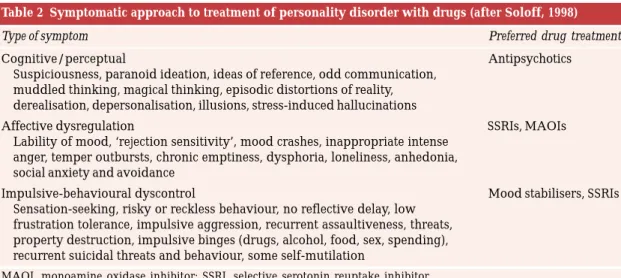
All patients with personality disorders show high levels of symptomatic distress, and groups of symptoms may be defining features of the disorders themselves. Affective and dissociative symptoms and brief psychotic experiences are operational criteria for the definition of borderline personality disorder; and perceptual distortions are an alleged core symptom of paranoid personality disorder. Thus, it becomes possible to develop a symptom-specific approach to drug treatment (Table 2).
Soloff (1998) proposed a classification that has been adopted in the American Psychiatric Association guidelines for the treatment of borderline personality disorder (Oldham et al, 2001). Medication is used according to the balance of symptoms, and much of it can be predicted from knowledge of drug effects in mental state disorders. Overall, the clinician needs to determine whether the primary symptoms summar-ised in Table 2 are related to problems of affect control, impulsivity and aggression, or cognitive/perceptual disturbance, and then prescribe accordingly. The danger with this approach is that, because all patients with personality disorder suffer symptomatically, prescribing in personality disorder has shifted from being an occasional intervention to ‘normal’ practice, with little scientific justification. There is also no independent justification for the algorithm beyond that of expert opinion (albeit a good one in the case of Soloff), and as borderline personality disorder is so heterogeneous it is far from clear which particular component is being treated.
Table 3 Neurotransmitters and personality dimension
System Personality dimension
Noradrenergic Emotional reactivity, arousal, extraversion
Serotonergic Inhibition of impulse/affect Cholinergic Lethargy
Decreased exploration, depression
? Balance for neuroendocrine system
Dopaminergic Novelty-seeking, histrionic traits → → → → →
Table 2 Symptomatic approach to treatment of personality disorder with drugs (after Soloff, 1998)
Type of symptom Preferred drug treatment
Cognitive/perceptual Antipsychotics
Suspiciousness, paranoid ideation, ideas of reference, odd communication, muddled thinking, magical thinking, episodic distortions of reality, derealisation, depersonalisation, illusions, stress-induced hallucinations
Affective dysregulation SSRIs, MAOIs
Lability of mood, ‘rejection sensitivity’, mood crashes, inappropriate intense anger, temper outbursts, chronic emptiness, dysphoria, loneliness, anhedonia, social anxiety and avoidance
Impulsive-behavioural dyscontrol Mood stabilisers, SSRIs
Sensation-seeking, risky or reckless behaviour, no reflective delay, low frustration tolerance, impulsive aggression, recurrent assaultiveness, threats, property destruction, impulsive binges (drugs, alcohol, food, sex, spending), recurrent suicidal threats and behaviour, some self-mutilation
The neurotransmitter argument
Neurobiological research on personality disorder (Table 3) suggests that impulsiveness, self-harm and outwardly directed aggression are associated with dysfunction within the serotonergic system (Linnoila & Virkkunen, 1992), blunted neuro-endocrine responses to fenfluramine (Rinne et al, 2000), and hyper-responsiveness of the hypo-thalamic–pituitary–adrenal axis, especially in female patients with borderline personality disorder and a history of sustained abuse. This effect appears to be independent of a comorbid diagnosis of post-traumatic stress disorder (Rinne et al, 2002). Other neurotransmitter systems have been implicated in emotional reactivity and other personality traits.
Which drugs?
There has been a change in attitude towards the use of drugs in the treatment of personality disorder over the past 30 years, moving from rare use of medication to the current practice of almost universal prescription at some time during treatment. In longitudinal follow-up studies of patients with borderline personality disorder, over 75% had received polypharmacy (Zanarini et al, 2003). Indeed, in borderline personality disorder it is now not unusual for patients assessed for specialist treatment to have received almost all the common types of psychotropic drug at some time during previous management.
Almost every psychotropic drug has been used for the treatment of personality pathology, from hallucinogens to new anti-epilepticssuch as lamotrigine. This probably represents clinical desperation rather than evidence-based prescribing, because the overwhelming proportion of the literature comprises case reports and open or uncontrolled studies of patients who are receiving many different types of therapy.
Despite greater use of drugs, most people with personality disorders do not wish to have treatment and the minority that do should not be regarded as typical. It may be useful to separate personality disorders into type R (treatment-resisting) and type S (treatment-seeking) ones (Tyrer et al, 2003), with only the latter accepting treatment (of any sort) for their disorder on a voluntary basis. Some of the considerable variation between the research evidence for the effectiveness of drug treatment for different personality disorders may be a conse-quence of different proportions of types R and S in the studies. Paranoid and schizoid personalities have been rarely studied, probably because only around 1 in 10 are willing to accept any form of
treatment (Tyrer et al, 2003). One of the reasons why borderline personality disorder has been most intensively researched (see below) is that sometimes patients present persistently with requests, and sometimes demands, for treatment.
As there is little to indicate that any form of psychotropic drug treatment is specific to any one personality disorder it is best to examine each drug class for its usage in the group as a whole, although it is in borderline personality that we have the most evidence.
Typical antipsychotics
These have been studied more than any other drug group in the treatment of personality disorder, but seldom in a satisfactory way. Early open clinical studies suggested that in low dosage these drugs might be effective in the treatment of both schizotypal and borderline personality disorders (Perinpanayagam & Haig, 1977; Brinkley et al, 1979), and details of these have been nicely summarised by Stein (1993). Since then, six randomised controlled trials have been carried out (Table 4)which, although to some extent encouraging, pose more questions than they have answered. Low-dosage typical antipsychotic drugs have some advantages over placebo, but the most impressive of these studies (Soloff et al, 1986), which showed superiority of haloperidol over placebo and amitriptyline, failed to be replicated in a continuation study for 16 weeks. Cornelius et al (1993) reported that haloperidol showed superior-ity over placebo only for the symptom of irritabilsuperior-ity, although it was generally less effective than phenelzine. The high drop-out rate (which is more than twice the rate for placebo) may also have contributed to the poorer outcome.
Antipsychotics have also been used to prevent recurrent self-harm, and in one randomised study (Montgomery & Montgomery, 1982) flupentixol was efficacious in preventing further episodes.
Atypical antipsychotics
Subsequent studies have, unsurprisingly, turned to the use of atypical neuroleptics, and two small trials with olanzapine and risperidone give some support for their efficacy (Zanarini & Frankenburg, 2001; Koenigsberg et al, 2003) (Table 4). There have also been encouraging open studies with clozapine, olanzapine and quetiapine (Frankenburg & Zanarini, 1993; Benedetti et al, 1998; Zullino et al, 2002; Walker et al, 2003) that suggest better compliance as well as efficacy with the atypical antipsychotics than with the typical ones. Olanzapine is currently being tested in
a large-scale multicentre trial of borderline personality disorder.
The jury is still out on the claim that antipsychotic drugs are effective in the treatment of personality disorder, but it seems likely that they have a place in treatment that remains to be defined adequately. They are clearly likely to be effective in the presence of psychotic symptoms. As these are most prominent in people with borderline and schizotypal person-ality disorders the practitioner needs to be aware of this group of drugs as having some therapeutic potential.
Tricyclic antidepressants and selective
serotonin reuptake inhibitors
In the original study by Soloff et al (1986), amitriptyline was not helpful in the treatment of borderline personality disorder (indeed, it was of less value than haloperidol even in the treatment of depression) and its lack of value has become the accepted view. However, it is fair to note than there have been very few studies of tricyclic antidepressants in the treatment of personality disorder and none of the recent ones has included a tricyclic control. In a randomised trial of the treatment of common anxiety and depressive disorders that continued for 2 years after the formal trial was over, those allocated to the tricyclic antidepressant dothiepin had the same outcome irrespective of whether or not they had a personality disorder, whereas those allocated to psychological treatments (self-help and cognitive– behavioural therapy) fared worse if they had
comorbid personality disorder (Tyrer et al, 1993). It is possible that this is because the drug treatment also positively influenced personality status, which has been suggested in another study (Ekselius & Von Knorring, 1998).
In contrast, the selective serotonin reuptake inhibitors have been widely assessed against placebo control in formal trials. They have been found to be effective in reducing aggressive, impulsive and angry behaviour in those with borderline and aggressive personality disorders, as the biological theories would suggest (Salzman et al, 1995; Coccaro & Kavoussi, 1997) (Table 4). The benefit of these drugs is unlikely to be a direct consequence of their antidepressant effect, although it could be connected – a similar study of fluoxetine in patients with depression and alcoholism showed improvement in both depression and drinking behaviour compared with placebo (Cornelius et al, 1997). Although personality disorder was not measured in this study, it is likely that a substantial proportion – about 50%, from prevalence figures in this clinical population (Bowden-Jones et al, 2004) – had this condition.
Self-harm may be a form of anger – self-directed anger – and this too is reduced by SSRIs, with paroxetine giving the best evidence, but again in a population in which personality disorder was highly prevalent but was not recorded (Verkes et al, 1998).
Against this evidence, the prescriber should be aware of the current controversy over the possibility that suicidal behaviour may be provoked by SSRIs in a minority of patients (Healy, 2003).
Table 4 Summary of randomised trials of antipsychotic drugs in the treatment of personality disorder
Antipsychotic tested Personality diagnosis Author(s) Type of study Main results
Haloperidol Borderline Soloff et al, 1986 Randomised Haloperidol (7mg/day) controlled trial superior to both
amitriptyline and placebo Trifluoperazine Borderline Cowdry & Cross-over trial No clear advantages of
Gardner, 1988 trifluoperazine over
other (active) treatments Thiothixene Borderline & Goldberg et al, Randomised Thiothixene superior to
schizotypal 1986 controlled trial placebo in both groups Haloperidol Borderline Cornelius et al, Randomised Haloperidol superior for
1993 controlled trial irritability symptoms alone
Olanzapine Borderline Zanarini & Randomised Olanzapine superior to Frankenburg, 2001 controlled trial placebo, except for
depression (only 9 patients received placebo) Risperidone Schizotypal Koenigsberg Randomised Significant benefit of
et al, 2003 controlled trial risperidone for PANSS
Monoamine oxidase inhibitors
Monoamine oxidase inhibitors (MAOIs) are now used relatively infrequently in treatment despite an impressive record of efficacy (Tyrer & Harrison-Read, 1990), but there is some evidence that tranylcypromine and phenelzine are efficacious in borderline personality disorder (Cowdry & Gardner, 1988; Soloff et al, 1993) (Table 5). However, the high frequency of self-harm and the risks of overdose with these drugs are likely to inhibit prescription. The newer reversible MAOI moclobemide has not been studied in the treatment of personality disorder.
Mood stabilisers
All known mood stabilisers have been used in the treatment of personality disorder and, to some extent, evaluated formally, but again almost entirely in borderline personality disorder, which is charac-terised by marked fluctuations in mood (Table 6). Lithium may stabilise the serotonergic system and, as an effective mood stabiliser, is also an empirically sensible pharmacotherapy to investigate in person-ality disorders. The evidence for the efficacy of lithium is small, but relatively good. In an early study, Sheard et al (1976) showed that lithium
reduced aggression markedly in prisoners with personality disorder (but not formally assessed for the condition), and other studies (Tyrer et al, 1984; Links et al, 1990) support its anti-aggressive properties. Carbamazepine has also some presump-tive evidence of efficacy, but this is not well established as the trials have been limited in numbers (Gardner & Cowdry, 1986; De La Fuenta & Lostra, 1994). Valproate in the form of divalproex sodium has been assessed in the treatment of borderline personality disorder and other disorders in the Cluster B group and two small randomised trials support its efficacy compared with placebo (Frankenburg & Zanarini, 2002; Hollander et al, 2003).
Other drugs
A number of benzodiazepines, particularly alprazolam (Reich et al, 1980; Cowdry & Gardner, 1988), have been tested in the treatment of person-ality disorder, but their use is generally discouraged because of dependence risks. Despite this, in clinical practice benzodiazepines are prescribed widely, and people with personality disorders are much more likely to take them long-term than those without (Seivewright et al, 1991). This might be considered a
Table 5 Summary of randomised trials of antidepressant drugs in the treatment of personality disorder
Antidepressant tested Personality diagnosis Author(s) Type of study Main results
Amitriptyline Borderline Soloff et al, 1986 Randomised Haloperidol (7 mg/day) controlled trial superior to both
amitriptyline and placebo Tranylcypromine Borderline Cowdry & Cross-over trial No clear advantages of
Gardner, 1988 tranylcypromine over
other (active) treatments Phenelzine Borderline & Soloff et al, 1993 Randomised Phenelzine significantly
schizotypal controlled trial superior to haloperidol
and placebo for symptoms of depression, borderline psychopathological symptoms and anxiety Fluoxetine Not clearly specified Coccaro & Randomised Fluoxetine significantly but probably within Kavoussi, 1997 controlled trial reduced impulsive and
antisocial group aggressive behaviour
after 2–3 months of treatment compared with placebo
Fluoxetine Borderline (but Salzman et al, 1995 Randomised Reduced anger and
symptomatic controlled trial aggressive behaviour in
volunteers, not fluoxetine group
patients) compared with placebo
Fluoxetine Alcoholism with Cornelius et al, Randomised Significantly reduced depression 1997 controlled trial depression and alcohol
(personality status consumption in fluoxetine
negative consequence but it might also suggest con-tinued efficacy despite the worry about dependence. Naltrexone (Roth et al, 1996) and venlafaxine (Markovitz & Wagner, 1995) have also been claimed to be of value, but no satisfactory studies have yet been carried out in personality disorder.
Prescribing in clinical practice
Recommendations regarding prescribing practice in personality disorder can be made on the basis of research trial data and clinical consensus (Box 1). In trials, drop-out rates are high and non-compliance with medication dosage and frequency is common. These findings concur with clinical experience and can sometimes lead to despair. Many patients with personality disorder (particularly in the Cluster B group) take medication intermittently, fail to follow prescribing guidance and may use prescribed medication in overdose when in crisis. These facts alone suggest that prescribing must be done carefully and preferably within the context of a trusting therapeutic relationship.
The use and effects of medication need to be discussed with patients prior to prescribing, the target symptoms clearly identified, an agreement made about how long a drug is to be used and a method to monitor its effect on symptoms estab-lished. Most important is the patient’s agreement to take medication in the first place, and the role of the doctor is initially to provide information and to remain neutral. After information has been given to the patient the prescriber may make a recom-mendation, but should not become overly engaged in persuading the patient to follow advice. The more
a prescriber attempts to convince a patient to take a drug, the greater the patient’s resistance may be, and a patient bullied into taking a medication is not likely to maintain its consumption spon-taneously. The physician should not, of course,
Box 1 Summary of guidelines for psycho-pharmacological treatment
Consider the primary symptom complex (e.g. affect dysregulation, impulsivity, cognitive/ perceptual disturbance) and current trans-ference and countertranstrans-ference themes Discuss implementation of medication with the
treatment team
Educate the patient about reasons for medication, possible side-effects and expected positive effects
Make a clear recommendation but allow the patient to take the decision; do not try to persuade the patient to take the medication Agree a length of time for trial of medication
(unless intolerable side-effects) and do not prescribe another drug during this time, even if the patient stops taking the drug
Prescribe within safety limits, e.g. give prescrip-tions weekly
See the patient at agreed intervals to discuss medication and its effects: initially, this may be every few days to encourage compliance, to monitor effects and to titrate the dose Do not be afraid to suggest stopping a drug if
no benefit is observed and the patient experiences no improvement
Table 6 Summary of randomised trials of mood stabilisers in the treatment of personality disorder
Mood stabiliser tested Personality diagnosis Author(s) Type of study Main results Lithium carbonate Antisocial (presumed) Sheard et al, 1976 Randomised Lithium significantly
controlled trial superior to placebo in preventing major (not minor) aggressive incidents
Carbamazepine Borderline Gardner & Cross-over trial No clear advantages of
Cowdry, 1986; carbamazepine over
Cowdry & other (active) treatments
Gardner, 1988
Sodium valproate Borderline Frankenburg & Randomised Sodium valproate or valproic acid (women only) Zanarini, 2002 controlled trial superior to placebo for
aggressive behaviour and interpersonal sensitivity Sodium valproate Cluster B Hollander et al, Randomised Limited benefit for or valproic acid personality disorders 2003 controlled trial Sodium valproate
(mainly antisocial in reducing impulsive
and borderline) aggression but high
remain neutral if there is a reason to advise against a specific drug.
Some patients with personality disorders seek quick results, yet the effects of medication (e.g. anti-psychotics and antidepressants) may take some time to become apparent. It is therefore necessary to warn patients of likely delay, so that drugs will not be stopped if there is no benefit initially. The best way to do this is to take an interest in how the patient responds to the tablets and to arrange regular meetings to discuss symptom change, side-effects and changes in dose. In general, patients should expect to take medication for at least 2–4 weeks (unless there are intolerable side-effects) and this ‘rule’ is best agreed when prescription is started. If the patient stops a drug unilaterally before the agreed time, no other drug should be prescribed until the 2–4 week period is completed. This reduces the demand for drug after drug when no effect occurs within a few days and prevents ‘creeping’ poly-pharmacy. Soloff and colleagues (1993) have suggested that the exception to rules of this type is antipsychotic medication such as haloperidol, as the benefits may occur rapidly but wane within a few weeks. Discontinuation may therefore be appropriate after a short period, although there remains little information on the use of newer antipsychotics.
Discontinuation of medication needs to be done carefully. Many clinicians believe that patients with borderline personality disorder are not only more prone than other patients to placebo responsiveness (Soloff et al, 1993) but are also more sensitive to the side-effects and withdrawal effects of medication, although there is little evidence that this is the case. Nevertheless, reducing medication slowly, even when another is being introduced simultaneously, is probably the best course.
Transference and countertransference
Maintaining sensible rules is harder than it sounds, because patient demand and clinician judgement are influenced by transference and countertransference phenomena. Psychiatrists are not immune from countertransference responses, even if their task is solely to look after medication. They may find it difficult to process their feelings and prescribe in a desire to ‘rescue’ a patient or in a vain attempt to ‘do something’. These reactions may account for the high number of medications that patients with borderline personality disorder take over time, even though polypharmacy is rarely recommended (Zanarini et al, 2003). Conversely, a patient who wishes to stop medication may be persuaded to continue it because of the psychiatrist’s fear of relapse. Often it is patientsthemselves who ask to reduce the number of medications that they are taking, and many begin taking tablets on an intermittent basis without telling their psychiatrist, for fear of causing disappointment.
Conclusions
Despite many reservations, it is clear that medi-cation will continue to be used in the treatment of personality disorder and that it has the potential to be an important intervention. This has recently been formally acknowledged in official guidelines for the treatment of one group, patients with borderline personality disorder (American Psychiatric Associ-ation, 2001), but drugs are suggested only as an adjunctive treatment. However, if recommendations are based on the evidence alone, there is no reason why drug treatment should be regarded as second-ary and psychological treatment primsecond-ary (Tyrer, 2002). Nevertheless, the general level of adherence to drug treatment and its acceptability to patients are low, and if drugs are to be prescribed more consistently this problem needs to be addressed.
References
American Psychiatric Association (2001) Practice guideline for the treatment of patients with borderline personality disorder. American Journal of Psychiatry, 158 (suppl. 2-2), 1– 52.
Bateman, A. W. & Tyrer, P. (2004a) Psychological treatments for personality disorder. Advances in Psychiatric Treatment,
10, 378–388.
Bateman, A. W. & Tyrer, P. (2004b) Organisation of services for personality disorder. Advances in Psychiatric Treatment,
10, in press.
Benedetti, F., Sforzini, L., Colombo, C., et al (1998) Low dose clozapine in acute and continuation treatment of severe borderline personality disorder. Journal of Clinical
Psychiatry, 59, 103–107.
Bowden-Jones, O., Iqbal, M. Z., Tyrer, P., et al (2004) Prevalence of personality disorder in alcohol and drug services and associated co-morbidity. Addiction, in press. Brinkley, J. R., Beitman, B. D. & Friedel, R. O. (1979) Low dose neuroleptic regimes in the treatment of borderline patients. Archives of General Psychiatry, 36, 319–326. Cloninger, C. R. (1987) A systematic method for clinical
description and classification of personality variants.
Archives of General Psychiatry, 44, 573–588.
Cloninger, C. R., Svrakic, D. M. & Pryzbeck, T. R. (1993) A psychobiological model of temperament and character.
Archives of General Psychiatry, 50, 975–990.
Coccaro, E. F. & Kavoussi, R. J. (1997) Fluoxetine and impulsive aggressive behavior in personality-disordered subjects. Archives of General Psychiatry, 54, 1081–1088. Cornelius, J. R., Soloff, P. H., Perel, J. M., et al (1993)
Continuation pharmacotherapy of borderline personality disorder with haloperidol and phenelzine. American Journal
of Psychiatry, 150, 1843–1848.
Cornelius, J. R., Salloum, I. M., Ehler, J. G., et al (1997) Fluoxetine in depressed alcoholics. A double-blind, placebo-controlled trial. Archives of General Psychiatry, 54, 700–705. Cowdry, R. & Gardner, D. L. (1988) Pharmacotherapy of borderline personality disorder: alprazolam, carbamazepine, trifluoperazine and tranylcypromine. Archives of General
Psychiatry, 45, 111–119.
carbamazepine in borderline personality disorder.
European Neuropsychopharmacology, 4, 479–486.
Ekselius, L. & Von Knorring, L. (1998) Personality disorder comorbidity with major depression and response to treatment with sertraline or citalopram. International
Clinical Psychopharmacology, 13, 205–211.
Frankenburg, F. R. & Zanarini, M. C. (1993) Clozapine treatment of borderline patients: a preliminary study.
Comprehensive Psychiatry, 34, 402–405.
Frankenburg, F. R. & Zanarini, M. C. (2002) Divalproex sodium treatment of women with borderline personality disorder and bipolar II disorder. A double-blind placebo-controlled pilot study. Journal of Clinical Psychiatry, 63, 442–446.
Gardner, D. L. & Cowdry, R. W. (1986) Positive effects of carbamazepine on behavioural dyscontrol in borderline personality disorder. American Journal of Psychiatry, 143, 519–522.
Goldberg, S. C., Shulz, S. C., Shulz, P. M., et al (1986) Borderline and schizotypal personality disorders treated with low dose thiothixene versus placebo. Archives of
General Psychiatry, 43, 680–686.
Healy, D. (2003) Lines of evidence on the risks of suicide with selective serotonin reuptake inhibitors. Psychotherapy
and Psychosomatics, 72, 71–79.
Hollander, E., Tracy, K. A., Swann, A. C., et al (2003) Divalproex in the treatment of impulsive aggression: efficacy in Cluster B personality disorders.
Neuro-psychopharmacology, 28, 1186–1197.
Jang, K. L., Livesley, W. J., Vernon, P. A., et al (1996) Heritability of personality disorder traits: a twin study.
Acta Psychiatrica Scandinavica, 94, 438–444.
Koenigsberg, H. W., Reynolds, D., Goodman. M., et al (2003) Risperidone in the treatment of schizotypal personality disorder. Journal of Clinical Psychiatry, 64, 628–634. Links, P. S., Steiner, M., Boiago, I., et al (1990) Lithium therapy
for borderline patients: preliminary findings. Journal of
Personality Disorders, 4, 173–181.
Linnoila, M. & Virkkunen, M. (1992) Aggression, suicidality, and serotonin. Journal of Clinical Psychiatry, 53, 46–51. Livesley, W. J., Jang, K. L., Jackson, D. N., et al (1993) Genetic
and environmental contributions to dimensions of personality disorder. American Journal of Psychiatry, 150, 1826–1831.
Markovitz, P. J. & Wagner, C. (1995) Venlafaxine in the treatment of borderline personality disorder.
Psycho-pharmacology Bulletin, 31, 773–777.
Mitropoulou, V., Trestman, R. L., New, A. S., et al (2003) Neurobiologic function and temperament in subjects with personality disorders. CNS Spectrums, 8, 725–730.
Montgomery, S. A. & Montgomery, D. (1982) Pharmaco-logical prevention of suicidal behaviour. Journal of Affective
Disorders, 4, 291–298.
Newton-Howes, G. & Tyrer, P. (2003) Pharmacotherapy for personality disorders. Expert Opinion on Pharmacotherapy,
4, 1643–1649.
Oldham, J., Phillips, K., Gabbard, G., et al (2001) Practice
Guideline for the Treatment of Patients with Borderline Personality Disorder. Washington, DC: American Psychiatric
Association.
Perinpanayagam, M. S. & Haig, R. A. (1977) Use of depot tranquillisers in disturbed adolescent girls. BMJ, 1, 835– 836.
Reich, J., Noyes, R. & Yates, W. (1980) Alprazolam treatment of avoidant personality traits in social phobic patients.
Journal of Clinical Psychiatry, 50, 91–95.
Rinne, T., Westenberg, H. G., den Boer, J. A., et al (2000) Serotonergic blunting to meta-chlorophenylpiperazine (m-CPP) highly correlates with sustained childhood abuse in impulsive and autoaggressive female borderline patients.
Biological Psychiatry, 47, 548–556.
Rinne, T., de Kloet, E. R., Wouters, L., et al (2002) Hyperresponsiveness of hypothalamic–pituitary–adrenal axis to combined dexamethasone/corticotropin-releasing hormone challenge in female borderline personality disorder
subjects with a history of sustained childhood abuse.
Biological Psychiatry, 52, 1102–1112.
Roth, A., Ostroff, R. & Hoffman, M. (1996) Naltrexone as a treatment for repetitive self-injurious behaviour: an open label trial. Journal of Clinical Psychiatry, 57, 233–237. Salzman, C., Wolfson, A. N., Schatzberg, A., et al (1995)
Effect of fluoxetine on anger in symptomatic volunteers with borderline personality disorder. Journal of Clinical
Psychopharmacology, 15, 23–29.
Seivewright, H., Tyrer, P., Casey, P., et al (1991) A three-year follow-up of psychiatric morbidity in urban and rural primary care. Psychological Medicine, 21, 495–503. Sheard, M. H., Martin, J. L., Bridges, C. I., et al (1976) The
effect of lithium on unipolar aggressive behaviour in man.
American Journal of Psychiatry, 133, 1409–1413.
Siever, L. J. & Davis, K. I. (1991) A psychobiologic perspective on the personality disorders. American Journal of Psychiatry,
148, 1647–1658.
Soloff, P. H. (1998) Algorithms for pharmacological treatment of personality dimensions. Symptom-specific treatments for cognitive–perceptual, affective, and impulsive– behavioral dysregulation. Bulletin of the Menninger Clinic,
62, 195–214.
Soloff, P. H., George, A., Nathan, R. S., et al (1986) Progress in pharmacotherapy of borderline disorders: a double blind study of amitriptyline, haloperidol and placebo. Archives
of General Psychiatry, 43, 691–697.
Soloff, P. H., Cornelius, J. R., George, A., et al (1993) Efficacy of phenelzine and haloperidol in borderline personality disorder. Archives of General Psychiatry, 50, 377–385. Stein, G. (1993) Drug treatment of the personality disorders.
In Personality Disorder Reviewed (eds P. Tyrer & G. Stein), pp. 262–304. London: Gaskell.
Tyrer, P. (2002) Practice guideline for the treatment of personality disorders: a bridge too far. Journal of Personality
Disorders, 16, 113–118.
Tyrer, P. & Harrison-Read, P. (1990) New perspectives in treatment with monoamine oxidase inhibitors. International
Review of Psychiatry, 2, 331–340.
Tyrer, P., Seivewright, N., Ferguson, B., et al (1993) The Nottingham Study of Neurotic Disorder. Effect of personality status on response to drug treatment, cognitive therapy and self-help over two years. British Journal of
Psychiatry, 162, 219–226.
Tyrer, P., Gunderson, J., Lyons, M., et al (1997) Extent of comorbidity between mental state and personality disorders. Journal of Personality Disorders, 11, 242–259. Tyrer, P., Mitchard, S., Methuen, C., et al (2003)
Treatment-rejecting and treatment-seeking personality disorders: Type R and Type S. Journal of Personality Disorders, 17, 265–270. Tyrer, S. P., Walsh, A., Edwards, D. E., et al (1984) Factors associated with a good response to lithium in aggressive mentally handicapped subjects. Progress in
Neuropsycho-pharmacology and Biological Psychiatry, 8, 751–755.
Van Reekum, R., Links, P. S. & Federov, C. (1994) Impulsivity in borderline personality disorder. In Biological and
Neurobehavioural Studies of Borderline Personality Disorder (ed.
K. Silk), pp. 1–22. Washington, DC: APP.
Verkes, R. J., Van der Mast, R. C., Hengeveld, M. W., et al (1998) Reduction by paroxetine of suicidal behavior in patients with repeated suicide attempts but not major depression. American Journal of Psychiatry, 155, 543–547. Walker, C., Thomas, J. & Allen, T. S. (2003) Treating
impulsivity, irritability, and aggression of antisocial personality disorder with quetiapine. International Journal
of Offender Therapy, 47, 556–567.
Zanarini, M. C. & Frankenburg, F. R. (2001) Olanzapine treatment of female borderline personality disorder patients: a double-blind, placebo-controlled pilot study.
Journal of Clinical Psychiatry, 62, 849–854.
Zanarini, M. C., Frankenburg, F. R., Hennen, J., et al (2003) The longitudinal course of borderline psychopathology: 6-year prospective follow-up of the phenomenology of borderline personality disorder. American Journal of
Psychiatry, 160, 274–283.
Zullino, D. F., Haefliger, Q. P. & Stigler, M. (2002) Olanzapine improves social dysfunction in cluster B personality
MCQ answers 1 2 3 4 5 a F a F a T a F a F b T b F b F b T b T c F c F c T c T c F d F d T d T d F d F e T e F e T e F e F
disorder. Human Psychopharmacology, 17, 247–251.
MCQs
1 Drug treatment for personality disorders: a is well established as an effective treatment b is more often used in patients with borderline
personality disorder
c is usually associated with good adherence to treatment
d interferes with the success of psychological therapies
e can be linked to biological abnormalities.
2 Antipsychotic drugs prescribed for personality disorder:
a are more effective in higher than lower dosages b are contraindicated in those with brief psychotic
episodes
c are better given as depot than oral preparations
d are generally better given to patients with borderline disorder rather than to those with dependence e are associated with paradoxical aggression. 3 The following drugs have some evidence of efficacy
(excluding open studies) in the personality disorders: a lithium
b diazepam c sodium valproate d fluoxetine e carbamazepine.
4 Personality disorders should not normally be treated with drug therapy when:
a there is evidence of affective instability
b there are limited means of monitoring progress c there is a history of persistent drug misuse d there is comorbid mental state disorder e there is concurrent learning disability.
5 The following drugs have been shown to be of benefit in preventing recurrence of self-harm: a moclobemide
b paroxetine c amitriptyline d olanzapine e lithium.