“Co’s” in innovating: co-creation within a practice-based view
Tiziana Russo Spena, University of Napoli “Federico II” Cristina Mele, University of Napoli “Federico II”
Work in progress
Abstract Purpose
Despite many studies about co-creation in innovation, a comprehensive understanding of all the elements that shape the process of co-creating innovation is still lacking. We aim to begin filling this gap. This paper is designed to frame innovation as a process of co-creation according to a practice-based view.
Methodology/approach
First, we draw from the work of Frow Payne and Storbacka (2010) and Frow, Brodie, Little, Payne (2010) and conceptualise co-creation as a series of “co.” Second, we adopt a practice-based perspective and conceptualise innovation as a collection of practices.
We outline two research propositions which guide the empirical research carried out on ten companies. We focus our analysis on the encounter process as it involves practices of interaction. Moreover, we analysed a specific encounter contest, “the web sites”.
Findings
Companies developed specific web sites to foster innovation by a network of actors. This practice is a new way to innovate and extends through the Internet. We present the findings according to two dimensions:1 ) the “co‟s” for innovation and 2) the elements of practices. The “co‟s” for innovation can be seen as different phases of innovation processes in which actors interact, collaborate and integrate resources. We identified the following “co‟s”: co-generation of ideas, co-evaluation of ideas, co-design and co-launch. Within each “co,” we identified practices and elements of practices, namely actors, actions, tools, and images.
Practical Implications
This work addressed the need to frame innovation in terms of a group of interactions within a constellation of practices. From this perspective, co-creation in innovation shifts its focus from customer collaboration to the creation of new value proposals by several actors with the focal firm‟s engagement in the creation of practices supporting other actors‟ value-creating processes.
Originality/value
In finding a fresh conceptualization of innovation, the authors move from the outcome to the process, that is, from innovation (as a new artefact) to innovating (as a set of co-creation practices). This works can stimulate the debate about innovation and co-creation.
Introduction
Previous approaches to conceptualising innovation focused mainly on typologies, for example, radical or incremental. Currently the strong focus on categories seems less helpful in reading the innovation‟s contents and boundaries because of hybrid forms of innovative artefacts that are characterised by the blurring between goods and services and radical and incremental innovation.
Innovation research streams have been enhanced with new ideas - namely collaborative innovation (Sawhney, Verona and Prandelli 2005), open innovation (Chesbourough 2003, 2006), and experience innovation (Prahalad and Ramaswamy 2003, 2004a) - which stress process
elements, mainly concerning the involvement of customers and others partners (von Hippel, 2005) and co-creation. The new customers‟ role in innovation has been also emphasised by some studies within Service-Dominant logic (Michel, Brown, Gallan, 2008a, 2008b; Mele, Russo Spena Colurcio, 2010). These studies revealed conceptualising innovation as a process of joint value creation with customers (value co-creation). In this view, innovation is not an outcome – that is, not a new good or a new service. It is a process that involves discovering new ways of co-creating value through more effective participation in resource integration. The value co-creation process not only occurs within a provider and customer dyadic relationship but also involves several participants as dynamic operant resources in a many-to-many perspective (Gummesson, 2008; Mele, Colurcio, Russo Spena, 2009).
Despite many studies about co-creation in innovation, a comprehensive understanding of all the elements that shape the process of co-creating innovation is still lacking. We aim to begin filling this gap. First, we draw from the work of and Frow Payne and Storbacka (2010,) and Frow, Brodie, Little, Payne (2010) and conceptualise co-creation as a series of “co‟s”. Second, we adopt a practice-based perspective and conceptualise innovation as a collection of practices. The practice turn in contemporary social theory conceptualises practices as units of analysis, instead of individuals, organisation and society (Reckwitz 2002;Whittington 2006).
This paper is designed to frame innovation as a process of co-creation according to a practice-based view. We want to move from the outcome to the process, that is, from innovation (as a new artefact) to innovating (as a set of co-creation practices).
This work is part of a large research project on innovation and value co-creation within networks of actors started in 2010. This paper presents preliminary results and it is based on the analysis of ten companies.
The paper is structured as follows. First, we review three main research streams of co-creation and innovation. By highlighting some gaps, we address the potential contributions of some recent studies on co-creation and the practice-based approach. Then, we outline the aim and methods of our research. Next, we present our findings and a discussion of the findings. The paper closes with some implications.
Co-creation in innovation research streams
In the last few years, “co-creation” has emerged as an enticing label used by different research traditions within marketing, management and innovation to depict a new and promising vision of innovative phenomena. (Chesbrough, 2003; Vargo and Lusch 2004, Vargo 2009, Prahalad and Ramaswamy 2004; Michael et al 2008; Prahalad and Krishnan 2008; Payne and Storbacka 2008,
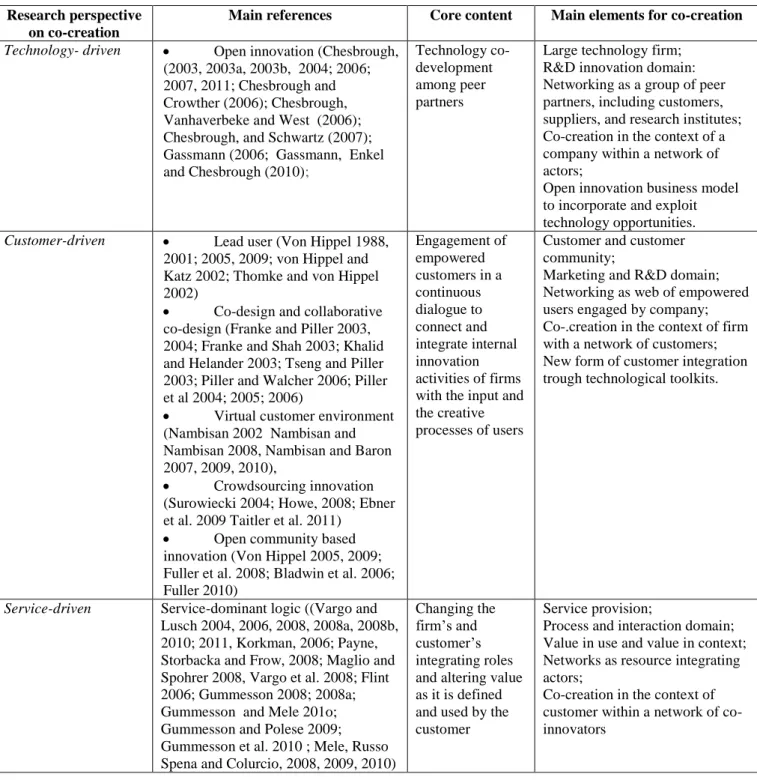
Sawhney and Prandelli, 2000; Sawney, Verona and Prandelli 2005, Vargo, Maglio, Akaka 2008; Ramaswamy and Gouillart 2010). Scholars use the term co-creation to address how social and technological changes enable organisations, groups and individuals to interact, collaborate, and solve problems, by jointly creating value (Ramaswamy and Gouillart 2010; Chesbrough 2011).We identify three main research streams, providing a starting point for the analysis of different co-creation perspectives in innovation management (Table 1).
Table 1 Co-creation perspectives and innovation
Research perspective on co-creation
Main references Core content Main elements for co-creation Technology- driven Open innovation (Chesbrough,
(2003, 2003a, 2003b, 2004; 2006; 2007, 2011; Chesbrough and Crowther (2006); Chesbrough, Vanhaverbeke and West (2006); Chesbrough, and Schwartz (2007); Gassmann (2006; Gassmann, Enkel and Chesbrough (2010);
Technology co-development among peer partners
Large technology firm; R&D innovation domain: Networking as a group of peer partners, including customers, suppliers, and research institutes; Co-creation in the context of a company within a network of actors;
Open innovation business model to incorporate and exploit technology opportunities.
Customer-driven Lead user (Von Hippel 1988, 2001; 2005, 2009; von Hippel and Katz 2002; Thomke and von Hippel 2002)
Co-design and collaborative co-design (Franke and Piller 2003, 2004; Franke and Shah 2003; Khalid and Helander 2003; Tseng and Piller 2003; Piller and Walcher 2006; Piller et al 2004; 2005; 2006)
Virtual customer environment (Nambisan 2002 Nambisan and Nambisan 2008, Nambisan and Baron 2007, 2009, 2010),
Crowdsourcing innovation (Surowiecki 2004; Howe, 2008; Ebner et al. 2009 Taitler et al. 2011)
Open community based innovation (Von Hippel 2005, 2009; Fuller et al. 2008; Bladwin et al. 2006; Fuller 2010) Engagement of empowered customers in a continuous dialogue to connect and integrate internal innovation activities of firms with the input and the creative processes of users
Customer and customer community;
Marketing and R&D domain; Networking as web of empowered users engaged by company; Co-.creation in the context of firm with a network of customers; New form of customer integration trough technological toolkits.
Service-driven Service-dominant logic ((Vargo and Lusch 2004, 2006, 2008, 2008a, 2008b, 2010; 2011, Korkman, 2006; Payne, Storbacka and Frow, 2008; Maglio and Spohrer 2008, Vargo et al. 2008; Flint 2006; Gummesson 2008; 2008a; Gummesson and Mele 201o; Gummesson and Polese 2009; Gummesson et al. 2010 ; Mele, Russo Spena and Colurcio, 2008, 2009, 2010)
Changing the firm‟s and customer‟s integrating roles and altering value as it is defined and used by the customer
Service provision;
Process and interaction domain; Value in use and value in context; Networks as resource integrating actors;
Co-creation in the context of customer within a network of co-innovators
The technology-driven perspective refers to the open innovation research stream starting from the famous work by Chesbrough, published in 2003. His idea of open innovation originated from well-established literature about inter-organisational relationships to stimulate innovation (Powell, Koput and Smith-Doerr1996; Tsai 2001, Tidd 2003;), but the scope has been broadened. According to Chesbrough (2003, 2006) open innovation implies an extensive use of inter-organisational ties; it assumes that firms that desire to advance their innovative efforts can and should use both external and internal ideas as well as internal and external paths to bring successful ideas to market faster. From the view of a large technology firm, open innovation challenges the old paradigm of close innovation, moving the locus of innovation from being deeply embedded within the firm to arising either outside the firm or in a relationship between the firm and external actors. Two key aspects of open innovation are relevant to co-creation. First, the external partners are not seen as suppliers or outsourcers of innovation capacity but as peers to complement and enrich R&D internal activities. This means assigning to the external knowledge an equal or superior importance compared with the internal knowledge. Second, the centrality of an open business model (Chesbrough, 2007) emerges as a meaningful framework to enable companies to be more efficient in creating and capturing value from innovation activities. The open innovation business model relates to the boundaries of an organisation and its multiple relationships with external actors, including customers and users engaged in the value creation process as providers of ideas and as co-developers, testers or distributors of innovation (Chesbrough 2006; Gassmann 2006; Gassman, Enkel and Chesbrough 2010). The networked nature of the innovation process led to the concept of co-creation according to a collaborating domain. As Chesbrough and Schwartz (2007) described, co-development partnerships are increasingly important in open innovation models as they are conducive to value creation through the unlocking of the technology and knowledge that is latent in a network of innovators (Chesbrough 2003, Enkel, Gassmann and Chesbrough 2009; Gassmann, Enkel and Chesbrough, 2010).
In summary, according to this perspective, the co-creation is central to open innovation. It has been explored as a combination of ideas, knowledge and technology distributed among a network of innovating actors.
Customer-driven perspective
The customer-driven perspective embraces the rich research literature that shares a focus on the active role of the consumer as a key component of value co-creation in innovation activities. This perspective incorporates the new form of customer engagement, interaction and integration within a
firm‟s innovation activities (Mohr and Sarin 2009, Sawhney,Verona and Prandelli 2005). The key element of this perspective is the newly empowered and connected customer who harnesses the new technology developments (e.g., the Internet) and tries to seek greater involvement and control over the company‟s innovations.
The customer-driven perspective arises within wide semantic definitions, including lead user (Von Hippel 1988, 2001; 2005), co-design and collaborative co-design (Piller et al 2005, Piller and Walcher 2006), virtual customer environment (Nambisan 2002; Nambisan and Baron 2009), experience co-creation environment (Prahalad and Ramawamy 2004; Ramaswamy and Gouillart 2010) and crowdsourcing innovation (Howe, 2008). All of these terms emphasise the centrality of the customers‟ participation but address different characteristics, such as the following:
i) the nature of customers – lead/common, single/community;
ii) the organisational aspect of the engagement – dyadic/networking, physically/virtually supported;
iii) the stage of the innovation processes – front end/back end process; iv) the scope of the involvement – solution needing/experiencing.
Von Hippel ((2001, 2005, 2009) focuses on the role of “lead users” in co-creating activities with specific reference to the design process. Lead users can be considered to be an elite and skilled group of people whose needs significantly anticipate requirements of the broader market. They are motivated intrinsically to innovate to meet their own needs and therefore, they can supply more concrete and elaborated input to the firm‟s efforts to solve well-identified innovation problems (Thomke and von Hippel 2002).
Other scholars within co-design studies focus on the importance of a more structured approach to foster the integration of customer needs and knowledge as a new basis for design co-creation (Franke and Schreier 2002; Tseng and Piller, 2003; Piller et al. 2004). They promote the use of dedicated design toolkits that allow customers to perform activities, such as defining, configuring, matching, or modifying for a customised solution (Piller 2003, 2004; Franke and Schreier 2002; Khalid and Helander 2003; Tseng and Piller 2003). In addition, Piller et al. (2005) introduce the concept of a collaborative customer co-design to refer to design activities performed in terms of customer-to-customer interaction (online communities).
Customer participation around the social dimension of the community environment also has been emphasised in various studies.
The virtual customer environment (Nambisan 2002, Nambisan and Nambisan 2008, Nambisan and Baron 2007, 2009, 2010) stresses the opportunity provided by social and experiential dimensions of communities‟ platforms to extend the reach and the scope of firm-customer
interactions during collaborative innovation. Nambisan‟s (2002) and Nambisan and Baron‟s studies (2007, 2009) provide important contributions by identifying different customers‟ roles in the innovation processes – resource, co-creator and user – and examining the motives and mechanisms of co-creation.
Differently, the principle of “collective intelligence (Ebner et al. 2009),” “wisdom of crowds (Surowiecki 2004) and “crowdsourcing innovation” (Howe 2008) affirms the increasing of innovation potential when more parties are actively involved because “large groups of people are smarter than an elite few” (Surowiecki, 2004. p.36). Since the early stages of innovation, crowdsourcing (the act of outsourcing innovation tasks through a large interested group of people in the form of an open call) unleashes the creativity and reduces R&D expenses (Ebner et al., 2009; Taitler, Watzke, Saguy 2011). The implementation of crowdsourcing requires an open culture of innovation and processes and technological supports that enforce opportunities to promote and encourage the sharing of ideas (Surowiecki 2004; Taitler et al. 2011).
Some of these contributions have addressed not only consumer empowerment through co-innovation but also the democratic potential of mass collaboration effects that push the users to innovate through self-organised communities. The community, as a user-centric content generation and governed system develops innovation in a highly collaborative and open working environment (Von Hippel 2005) outside the influence of firms and often in competition with them (Fuller et al., 2007; Bladwin et al 2006).
Prahalad and Ramawamy (2004) and Ramaswamy and Gouillart (2010) outline a co-creation experience environment stressing where the customer is involved in creating his own experience in an interaction with firms (and others) as joint problem-solvers collectively creating value.
In summary, notwithstanding the differences in all of the approaches analysed above, there emerges a similar co-creation vision of innovation based on the systematic use of the engagement of competences and experiences of individuals and communities. In the customer-driven perspective, co-creation consists of a continuous process of working with customers in a dyadic or community dimension, alternating outbound and inbound exchanges of information to connect and integrate internal innovation activities of firms with the input and the creative processes of users.
Service-driven perspective
The service-driven perspective enriches the framing of innovation by further revealing its complexity and dynamics (Gummesson and Polese, 2009; Chandler and Wieland, 2010; Mele, Russo Spena and Colurcio, 2010; Sebastiani and Paiola, 2010). This perspective is based on
service-dominant logic (Vargo and Lusch, 2004, 2008a), service logic (Edvardsson et al., 2008;Gronroos, 2008) and Service Science (Maglio and Spohrer 2008, Vargo et al. 2008) and focuses on the notion of value in use and customer as value co-creator.
Vargo and Lusch (2004, 2008a, 2008b) distinguishes between the terms co-creation‟ and „co-production‟, whereas much of the literature uses them interchangeably. Value „co-creation‟ is unique to the individual, as it comprises creating value-in-use through the integration of the firm‟s value offering and the consumer‟s operant resources (Vargo and Lusch 2008a). Co-production instead, encapsulates “participation in the development of the core offering itself” and can occur through inventiveness, co-design, or shared production of related goods” (Lusch and Vargo, 2006, p.284). Thus, other authors, in opposition to much of the extant literature on co-production, posit that it is not the consumer who participates in the firm‟s value creation processes, but that it is the firm creating “opportunities to engage itself with its customers‟ resource integrating or value generating processes” (Grönroos, 2011, p.307).
Within S-D logic and service science, a different view of innovation emerges that challenges the traditional attribute-based view of innovation output. First, the main challenge stems from the understanding that any innovation (or change) in product or process must be seen as change in customer participation, activities and capabilities to create value in interaction with firms (a et al., 2008). Changing the firm‟s and customer‟s integrating roles and altering value as it is defined and used by the customer – not value in production and exchange – defines innovation (Michel et al., 2008b). So, innovation concerns not only a technological newness but also be a new use linked to different context, place or time, as the value of innovation is determined by customer through integration of resources, context, and experience (Vargo and Akaka 2008) in terms of value in use and value in context.
Second, innovation as a continuous and interactive process occurrs not in a dyadic relationship but includes the reconfiguring of the interplay between a group of actors who are interrelated in a dense network (Gummesson, 2008; Mele, Russo Spena and Colurcio, 2008, 2010). The network dimension, mainly advanced by the more recent contributions within service-dominant logic (Vargo and Lusch, 2010, 2011; Gummesson and Polese 2009), changes the model of innovation from one in which the supplier is the innovator and the customer is the user (or perhaps the stimulus and source) of innovation to a model including a range of other stakeholders, who are not merely sources of ideas or providers of goods and services but instead are real co-innovators. Innovation is framed as the outcome of the various contributions of the network‟s members through business-to-business (B2B), business-to-business-to-consumer/business-to-business (B2C/C2B), and consumer-to-consumer (C2C) interactions in an integrated many-to-many context (Gummesson 2008;
Gummesson and Mele 2010). Vargo and Lusch (2011) propose the generic term “actor” to stress an A2A (actor to actor) dynamics of interactions.
In summary, the contribution of the service-driven perspective is to conceptualise co-creation as resulting from interaction and resource integration through which mutual value is expanded together. For companies, the innovation process assumes the nature of an open-ended relational process through which they reconfigure the way in which they cooperate with customers and other stakeholders.
Research framework
Following the review of the three research streams, we point out that innovation is understood as a co-creation process within social and technological networks where actors integrate resources to create value. This is an interesting conceptualisation, but we observe that the studies lack a deeper vision and consider the whole set of elements that shape the process of co-creating innovation. To begin filling this gap, we draw from recent studies on co-creation and on a practice-based approach to outline two propositions, which guide the empirical research and the discussion of findings.
Co-creation as a process of “Co’s”
The different research streams on innovation share the analysis of co-creation as a sort of general concept for customer involvement. Some studies adopting service-dominant logic instead address the need to elucidate the phenomenon by adopting a process view. Payne, Storbacka and Frow (2008) developed a process-based framework based on three processes: (i) customer value-creating processes, which are the processes, resources and practices that customers use to manage their activities; (ii) supplier value-creating processes, which are the processes, resources and practices used by suppliers to manage relationships with customers and other stakeholders; and (iii) encounter processes, which are the processes and practices of interaction and exchange. This framework reveals how customers engage in co-creation by stressing the interaction and dialogue implicit in “co” (as togetherness), which provides a structure for customer involvement. As Payne, Storbacka and Frow (2008, p.85) point out:
““The conceptual framework we develop starts with recognition of the centrality of processes in co-creation … Processes include the procedures, tasks, mechanisms, activities and interactions, which support the co-creation of value. This process view accentuates the need to view the relationship between the provider and the customer as a longitudinal, dynamic, interactive set of experiences and activities performed by the provider and the customer, within a context, using tools and practices that are partly overt and deliberate, and partly based on routine and unconscious behavior”.
The idea of co-creation is further elaborated by Frow Payne and Storbacka (2010) and Frow, Brodie, Little, Payne (2010), who examine not only suppliers and buyers but also other stakeholders. Recognising that value co-creation is a process of multiple interactions and multidirectional resource integration, they deconstruct collaboration processes into “The 12 Co‟s”: conception of ideas, design, production, promotion, pricing, distribution, consumption, maintenance, disposal, outsourcing, creation of meaning, and co-experiencing.
Disentangling the complex concept of co-creation in this way facilitates insight into the process of interaction and resource integration and provides the possibility of new types of service provision.. As Frow, Brodie, Little, Payne (2010, p.27) point out: “The twelve forms of co-creation suggest multiple approaches are appropriate for exploring diverse aspects of co-creative activity …underpinned by a broad spectrum of collaborations that involve resource integration among network partners”
From the above review, we outline a first research proposition:
P.1. Co-creation in the innovation process can be disentangled into several “co” surrounded by several actors‟ value-generating processes.
The practice turn in co-creating innovation
In stressing the process view of co-creation, it becomes important not only to focus on individuals participating the process but also to consider other elements, such as artefacts and knowledge. In the social sciences, recent approaches stress the contribution of a practice-based view in which the unit of analysis is the practice neither the individual nor the organisation. As Schatzi (2005) reveals, service systems, such as companies and customers, are bundles of practices in terms of a set of activities, routines and material arrangements. The idea of practices is not unknown to innovation literature, which codifies innovation processes in terms of a company‟s best practices (Griffin, 1997). However, we advance the traditional vision of practices as well-codified internal routines to adopt a wider meaning of the term “practice”.
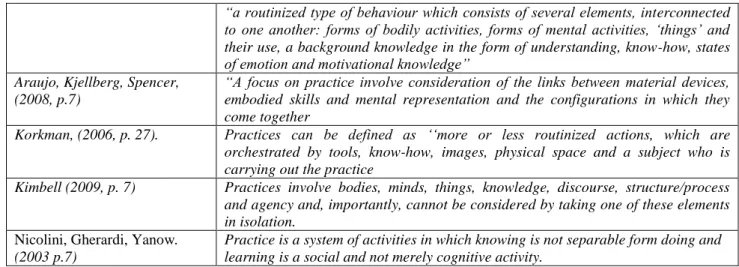
Table 2 highlights some definitions of practices.
Table 2. Definitions of practices
Schatzi (2001, p. 2 practices as “embodied materially mediated array of human activity centrally organized around shared understanding
Reckwitz (2002) a practice “consists of several elements, interconnected to one another: forms of bodily activities, forms of mental activities”.
“a routinized type of behaviour which consists of several elements, interconnected to one another: forms of bodily activities, forms of mental activities, „things‟ and their use, a background knowledge in the form of understanding, know-how, states of emotion and motivational knowledge”
Araujo, Kjellberg, Spencer, (2008, p.7)
“A focus on practice involve consideration of the links between material devices, embodied skills and mental representation and the configurations in which they come together
Korkman, (2006, p. 27). Practices can be defined as „„more or less routinized actions, which are orchestrated by tools, know-how, images, physical space and a subject who is carrying out the practice
Kimbell (2009, p. 7) Practices involve bodies, minds, things, knowledge, discourse, structure/process and agency and, importantly, cannot be considered by taking one of these elements in isolation.
Nicolini, Gherardi, Yanow. (2003 p.7)
Practice is a system of activities in which knowing is not separable form doing and learning is a social and not merely cognitive activity.
A practice can be defined in terms of what it isn‟t and what it is. It is not simply an action and it is more than a process. It is about the subject, the action, the tools and the context. It is not an experience, the result of action or a mental status of individuals. It is a way of doing embedded in the context of inward and outward interlinked elements (Korkman, 2006.), focusing on performance.
According to a practice-based approach, a systemic view is needed instead of linear descriptions of work flows of actions in order to understand how various elements are integrated by actors in their contexts.
We adopt a practice-based view of innovation, as we are interested in the practices actors‟ networks use to co-create innovation. In particular, we draw from Korkman, Storbacka, Harald (2010) because their practice-based approach derived from practice theory and S-D logic literature as their assumptions show (table 3)
Table 3 Assumptions about practices
Practices are fundamental units of value creation Value is created as actors engage in practices
Practices are resource integrators Value is created as customers integrate socio-cultural resources
Firms are extensions of customer practices Customers are not extensions of a firm‟s production processes; value co-creation happens as firms participate in customer practices
Value propositions are resource integration promises Firms enhance value creation by providing resources that „fit‟ into customers‟ practice constellations.
Source: adapted from Korkman, Storbacka, Harald (2010)
The practice-based approach advocates a contextual and process-oriented view of co-creation and innovation. Innovation can be conceptualised not as the simple result of company‟s processes but as formed in practical constellations (Schatzki, 2001), in which actions are performed and
resource elements (tools, images, spaces, competence) are used and integrated. The practice-based approach stresses how resources are implemented as a part of everyday life through action and interaction.
“It is through action and interaction within practices that mind, rationality and knowledge are constituted and social life is organized, reproduced and transformed” (Schatzki, 2001”
.
Focusing on practice enables us to analyse the social connections among individuals, collectives, organisations, institutions, the situated contexts in which these connections take specific form and all the intermediaries utilised. In this view, actors who innovate are carriers of practices.
From the above review, we outline a second proposition:
P.2. Co-creating innovation can be seen as a set of practices.
Research aim, research context and research method
By living through different practices, adopting the competences in the practices and using different tools for performing actions, actors continually strive to improve their practices in order to increase value co-creation. This leads to innovation activities and practices. This paper aims to understand innovation as a co-creation process within a practice-based view. The two propositions guide the empirical research.
We focus our analysis on the encounter process as it involves practices of interaction, “which need to be managed in order to develop successful co-creation opportunities” (Payne Storbacka and Frow 2008, p.86). Moreover, we analysed a specific encounter contest, “the web sites”. Literature on open innovation and communities stresses the role of the Internet in shaping innovation as social interactive and open processes emerging by collaboration of empowered users.
As advocated by Orlikowski (2000) we analysed Web-based encounters to understand the role of technology in shaping practices. In other words, we conceptualise the encounter process as a space for co-creation and the Internet as an enabler of contacts and interactions.
We followed the advice of Gherardi, Nicolini (2006, p. xviii): “the methodological principle of „follows the practices‟ acquires concrete meaning when the researcher observes a situated practices and moves up from it to the institutional order or conversely moves down from it to the individual-in-situation. Or in other words, when she/he explores a connective web which branches in all directions” (see also Nicolini, Gherardi, Yanow, 2003). Moreover, they points out that field of practices “are the context in which the concrete activity of producing and using knowledge becomes
visible and observable as well as describable without one having to delve into what goes inside people‟s heads” (p. xvi )
In view of the nature of the subject matter under investigation, the study adopted a qualitative method utilising multiple case studies. As several researchers note (Yin 2002; Gummesson 2005), qualitative methods are very useful for gaining a novel understanding about existing phenomena.
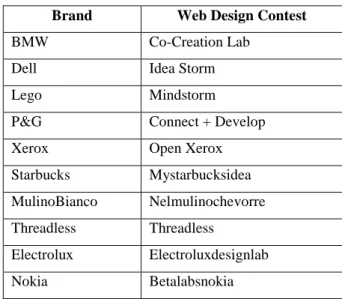
We chose a judgment sample. The companies were chosen from among the 100 companies considered to be the most innovative by the Boston Consulting Group. We followed the assumption of Stake (1995), who recommended that selection of cases should offer the opportunity to maximise what can be learned, knowing that time and other resources are limited. Therefore, during the period of six months we analysed the innovation practices occurring within web contest of ten highly innovative firms (table 4).
To ensure triangulation of information, the data collected from these web contests were augmented with data from various documents, reported cases, and other related materials (Eisenhardt 1989; Yin 1994).
The analysis of the data was initially conducted on an intra-case basis to evaluate each firm’s approach to the management of the investigated phenomena. This stage of the analysis of the multiple case studies was based on so-called “replication logic” – that is, each case was considered as a single qualitative experiment in relation to the theory rather than as a consolidated set of empirical data. Subsequently, a cross-case analysis was conducted (i) to develop an overall view of the matters under investigation and (ii) to identify similarities and differences among cases.
The aims of the process of data reduction and classification were (i) to identify patterns in the data and (ii) to define categories.
Table 4 The investigated web contests
Brand Web Design Contest
BMW Co-Creation Lab
Dell Idea Storm
Lego Mindstorm
P&G Connect + Develop
Xerox Open Xerox
Starbucks Mystarbucksidea MulinoBianco Nelmulinochevorre Threadless Threadless Electrolux Electroluxdesignlab Nokia Betalabsnokia Findings
Companies developed specific web sites to foster innovation by a network of actors. This practice is a new way to innovate and extends through the Internet at a global level. The aim is to find talented people who are adept at implementing improvements, solving problems, and developing projects. This approach to innovating complements traditional research and development activity. It is a way to find partners and create networks to build new business opportunities. These opportunities are linked not only to the core offering of the company but also to new solutions concerning aspects of business offerings, such as design, packaging, brand, distribution, and technology. We found three categories of innovation: technological, product and commercial. We focused on innovation related to products. The partnerships were built with individuals, companies, competitors, venture capitalist, research centres, universities, design institutes, and intermediaries.
We present the findings according to two dimensions: 1. The “co‟s” for innovation and
2. The elements of practices.
The “co‟s” for innovation can be seen as different phases of innovation processes in which actors interact, collaborate and integrate resources. We draw from well-established studies that outline the innovation process as consisting of several phases (Booz, Allen, Hamilton, 1968; Cooper, 1988), and we focus on the joint perspective of co-creation. In this way, we identified the following “co‟s”: co-generation of ideas, co-evaluation of ideas, co-design and co-launch. Within each “co,” we identified practices and elements of practices, namely actors, actions, tools, and images.
Co-generation of ideas
Idea generation is the first seed of innovation. Companies open the idea generation phase to an external network of actors that includes not only lead users but also consumers, customers, partners, professionals and intermediaries who actively participate in idea generation and shaping.
Companies set up web sites as spaces for actors to communicate and share ideas and insights with the organisation. Procter and Gamble benefitted from external ideas in more than 42% of new products.
The practice is quite simple and common in the investigated companies. An actor should register on the web site to enter “the system” and possibly communicate his/her ideas. In doing so, he/she can learn about other ideas and can sometimes respond to these ideas.
The practice of Starbucks with the MyStarbuck idea is a example of practices in idea co-generation (Box 1).
Box 1 The practice of the MyStarbuck idea.
The web site has three sections: 1) “Got an Idea?”; 2) “View Ideas”; and 3) “Ideas in Action.” 1) Anyone can enter an idea
2) Users can vote on different ideas to assess the wisdom of the people
3) Everyone can implement a discussion of an idea by simply commenting on it, which provides an opportunity for ideas to be redefined and enhanced compared to the original submission
4) Each registered user has a mailbox that enables him/her to know when someone responds to an idea
5) Starbucks places the most interesting ideas in the "Ideas in Action" section, which shows what people are doing to implement these ideas.
We found three main ways to co-generate ideas: 1) free proposals, 2) within categories and 3) within specific projects. In the first two ways, idea generation is not an event, but it is conceived through a continuous practice by actors.
A few companies allow people to provide free proposals. BMW set up a virtual innovation agency. The agency, which does not take the form of a contest, enables people to submit ideas and comments to BWM technicians.
Most of companies have specific categories within which actors can suggest ideas and improvements. Barilla-Mulinobianco requests ideas according the following groups: products (e.g., biscuits, bread, snacks), promotions (e.g., competition, and events, packaging (e.g., materials and information) and social and environmental commitment. In addition, Starbucks obtains ideas on several topics that are not strictly linked to its core offering: product ideas (coffee and espresso drinks, food, frappuccino beverages, the Starbucks card, tea and other beverage merchandise and music, and new technology); experience ideas (atmosphere and location, ordering, payment and pick-up); and involvement ideas (building community, social responsibility, and “Outside USA”).
In other cases, companies launched innovative projects that solicit specific ideas. BMW used a web site to launch the Customer Innovation Lab project in 2003. The idea was to generate ideas for innovative products and services related to telematics, online services, guidance and assistance. A total of 1,045 participants produced 215 ideas, of which two were developed for the market. Another BMW innovative project was “Mobility Services”, which involved 550 participants and produced 300 ideas.
In the investigated contests, the practice of co-generating ideas is developed through the use of images, tools and designs. Lego offers software to help people provide their ideas about possible products. MulinoBianco has a tutor to help people submit ideas and comments.
Companies try to widen people interactions (the “co”) through the involvement of social networks (e.g., Facebook) and communities, which are seen as tools that foster social creativity by a group of actors who participate in creative process.
The web site “My Starbucks Idea” has a community link through which it is possible to view proposed ideas and comment on other proposals. The web site enables people to follow Starbucks on Twitter and to share the link to other social networks.
In a co-generation phase implemented through a web site, there are no space and time constrains, in contrast to the usual practices of idea generation (i.e., brainstorming). Actors are free to take part according to their preferences. Dell has developed the “Idea Storm” project. IdeaStorm is designed to provide a direct voice to clients and allows them to share their ideas and counsel each other. The main objective is to identify ideas, products and services desired by customers. In almost four years, approximately 400 ideas have been implemented.
In summary, the phase of co-generation exploits the basis of cognitive and practical mass available from the deployment of activities by a network of actors. Here is how a member of the BMW jury described the role of the contest for co-generating ideas: "Every time we launched a similar initiative, we remain impressed by the creative potential. This contest has shown, once again, how important it is to interact with external sources to develop new services and innovations. The ideas generated have added innovative input and value to this type of service that we are already working and gave us proof that the management is following the right direction. We look forward to further develop the ideas generated and to establish mobility services useful to the world of tomorrow".
Co-evaluation of ideas
The evaluation of ideas is strictly linked to the generation of ideas. However actors can also vote without proposing a idea. In the co-evaluation phase, companies seek to involve actors in the appraisal of proposals. Even more than in the previous phase, the community and the blog perform a crucial role in allowing actors to comment and evaluate ideas. Social networks, such as Facebook, are used to foster appraisal with very simple mechanisms.
The practice of co-evaluation is based on two main activities: commenting and voting. Companies have different procedures to select the most interesting ideas. Mulinobianco has two sections for voting and commenting on their web sites. The votes help determine the ideas that are most popular among those submitted by the community. It‟s possible to comment on the ideas already submitted, describing the reason for the vote and suggesting improvements to the proposed
idea. Then the company announces the 10 ideas that received the most votes. These ideas will enter the evaluation cycle, which is divided into two levels. The first level of assessment involves the top management of MulinoBianco, who provides a business opinion on the idea. This phase lasts approximately six weeks.
At a second level, the idea will be considered in terms of cost-benefit and will enter into business processes. If the idea receives a good evaluation, it will enter the cycle of in-depth analysis and capacity under construction. This phase requires different time periods depending on the characteristics of the idea. to the time lines and methods for realising the idea is announced on the web site.
Starbucks has a dedicated team of idea partners (Starbucks employee experts in their fields) who read the ideas and comments. They select the most popular and innovative ideas and present them to key company decision-makers along with recommendations on how best to implement the ideas. Each user, by voting for the ideas, helps to choose the ideas that will be implemented. After a certain period of time, the ideas can be advanced to the status of under review, reviewed, coming soon, launched or initiated.
In 2009, Dell added to its site a section called “Storm Session,” which creates temporary sessions on topics on which users are asked to comment. Dell starts a session with a topic and invites members to express their opinion through the instrument of feedback, to post their own idea or comment or to vote on other ideas until the session is closed. Then, the staff revisits the ideas and the leader of StormSession communicates how and when Dell will transform the ideas into action. Box 2 highlights the idea life cycle at Dell.
Box 2 Ideas’ life cycle in Dell.
Every idea goes through a life cycle, with several stages:
• Recognised: The IdeaStorm team reads each idea within 48 hours to make sure that the idea has not already been proposed.
• In review: The idea is discussed by the sales team and is ready for further investigation. • Already offered: The idea is already part of a product or service offered by Dell.
• Partially implemented: Some ideas are implemented in several phases, in which case some elements have been implemented, while others have yet to be taken into account.
• Implemented: The idea is put into production.
• Not chosen: The idea, although interesting, is not in line with the business plan and will not be implemented.
• Filed: Any ideas that did not produce comments in one year will be archived. These ideas are no longer visible on the site, but they are still viewed by the team at Dell.
However, firms do not completely delegate the evaluation activities externally. They use their tacit knowledge about technical and market constraints to interpret customer evaluations. The ideas that customers had scored highly do not necessarily advance to other phases of the innovation process. Experts within the firm evaluate the ideas in terms of novelty, cost, and quality of design
and the experts also consider legal matters and the existing catalogue. In summary, companies and actors set up a sort of conversation through the Internet to express preferences about potential products.
Co-design
Co-design encompasses a wide range of practices based on the engagement of many actors linked by a shared contest and interest and is aimed at a more identified purpose: to bridge the gap between identified idea/needs and the possibility of solution.
As the cases show, the move toward co-designing affects the roles of the players in the design process, the results of creative and the dynamics of processes.
In co-design practices, the roles of designers are shuffled. Every user is assigned the role of ”expert” based on his/her knowledge and experience. The user, on the basis of his/her interest, passion and efforts, plays a large role in concept and knowledge development.
The BMW Co-Creation Lab identified a co-design practice of engagement based on emotional and experience connection with hobbyists and experts. BMW launched Idea Contest to get people interested in cars and future automotive concepts. People are asked to work on three topic areas: functionally, emotional/esthetical design, and the creation of new interior concepts in connection with users‟ experience.
P&G‟s Connect + Develop shows a strong orientation toward encouraging advanced users to be involved in the company‟s co-design practices. The firm is focused on ready-to-go innovations that are rapidly introduced into the market. Through a selective registration procedure, participation in design activities is open only to advanced users who could provide solutions that are detailed in terms of project and prototype and that could be fast introduced into practice. In many cases, the participants are not common consumers but firms, research institutions, and intermediaries, which have the capacity to respond to a detailed request from the firm.
In addition, a distinguishing characteristic of the co-design practices is the high learning interactive content. As the case studies show, in generating insights by users, there is the need to support the “expert of his/her experience” to elicit their knowledge in a way that makes it usable to firms and others. The co-design is seen not only as output of inspiration but as a thought process that involves various activities, such as comprising, speaking, writing, drawing, showing, modeling, and constructing. To make users a part of the design team as an “expert of their knowledge and experiences,” the firms take the role of facilitators and provide tools, documents and other
knowledge support, such as software and multimedia, to allow the users to put their knowledge and experience to work.
As Electrolux experience shows to make an individual not only a creative but a designer it is need to engage person with the right expertise/knowledge, interest/passion and effort, and to work in order to catch the most by him. In this case, the practice of “call for competition” is seen as the well suited approach to foster user empowerment.
In addition as the other experiences show the will and possibility to teach is seen as the other side of the successful design processes. Lego Mindstorm NXT succeeded with a co-design orientation framed by a strong focus on knowledge transfer and learning networking. The project was born as a programmable roboticskit released by Lego. Thanks to the continuous insights and upgrading by advanced users, the firm is now experimenting with the upgrade of Mindstorm NXT technology to more compelling challenges, such as the applications to surgery and the educational sector as well as the design of smarter robots. To achive these results, the firm and users also collaborate in innovating and upgrading the tools and software, which is available to the user for its design processes. Lego has collaborated with users in editing books to better explain the Lego Mindstorm NXT technology
Similarly, the Eletrolux, P&G, BMW and Threadlessco design practices foster a dynamic interactive and integrative view on knowledge generation and on tools and practices at both the dyadic (firm-users) level and the multiple (user-to-user) level. All of the firms‟ design Web contests are complemented by the use of other Internet features, such as wikis, blogs, aggregators and forums that enable participants to share comments and materials. In many cases this opens up the documentation and experimentation process for all participants, encouraging them to reflect on the practices and to contribute new ideas. In other cases, this collaborative environment also can foster creativity and learning in an informal and free thinking way. In the Threadless design community, hobbyists as well as professional graphic designers interact in a variety of ways in reviewing submitting designs, helping each another learn new design techniques and discussing the latest test, movie or image posted. These last interaction type concerns design-specific or more general topics that are often only tangentially related to design and challenge the creativity and learning in the community.
Co-test and co-launch
The co-test activity is strictly related to the launch of products and services in the market. It is used to support the improvement of prototype product/services before they are marketed, and it is often used to test the marketability of a product or service.
The Open Xerox Web portal that opened in 2011 depicts the less diffuse practice of crowdsource testing. The Web portal hosts technology prototypes from the Xerox R&D labs, making them accessible to the external user community before the launching of a product offering. The technologies featured are mainly early or incremental releases that have not gone through the rigorous testing and validation generally conducted by product testing groups. In the other cases, the users are asked to test more mature technology of Xerox as the firm finds that it can always benefit from users testing and feedback.
Similarly Nokiabeta labs community invites users to test pre-commercialised applications. By employing crowdsourcing, customer feedback and user testing, the firm can test-market its new applications and obtain ideas for further development. As graduated apps are released in their final versions, the ones that don‟t make it are archived for future reference. Nokia‟s crowdsourcing platform includes a discussion board and a user experience survey.
The co-test practices of Threadless are different. The users are invited to vote on design attractiveness. Only the five highest scoring designs voted every week are ultimately produced. Each design is evaluated by 1,500 users, on average. In addition, the customers‟ work is used more in the launch phase and they take over some market risk, too. Customers assume responsibility for advertising and photographing for catalogues and for soliciting new customers. In addition, they commit to purchasing a favoured design before it goes into production.
Discussion
This paper aims to frame innovation as a process of co-creation according to a practice-based view.
The literature review on innovation and co-creation framed innovation as a co-creation process within open social and technological networks in which actors interact and integrate resources to respond to a complex set of sought benefits (Tollin and Carù, 2008). However, we did not find a comprehensive understanding of elements shaping the process of co-creating innovation. We aimed to begin filling this gap. First, we drew from the work by Payne, Storbacka, Frow (2008), Frow Payne and Storbacka (2010) and Frow, Brodie, Little, Payne (2010). Second, we adopted a practice-based perspective (Schatzki, 2001; Korkman, Storbacka, Harald, 2010;). In doing so, we outlined two propositions as input for the empirical research:
P.1. Co-creation in innovation process can be disentangled in several “co‟s” surrounded by different actors‟ value generating processes.
In deploying the first proposition, we find that co-framework of Frow Payne and Storbacka (2010) and Frow, Brodie, Little, Payne (2010 is a well-suited suggestion for exploring the diverse aspects of co-creation at the different stages of innovation processes.
The analysis of Web contests allows us to reveal different phases of the innovation process. This process could be disentangled in five “co‟s” surrounded by various partners (such as customers, suppliers, users, experts, and intermediaries), value-creating processes and encounter processes. As Figure 1 shows, the five “co‟s” are co-ideation, co-valuation, co-design, co-test and co-launch. Each of these phases is seen as result of a dynamic and ongoing interaction process performed by a group of actors who are interrelated in a dense network. This conceptualisation can contribute to the debate of co-creation in innovation (Prahalad and Ramaswamy, 2004)
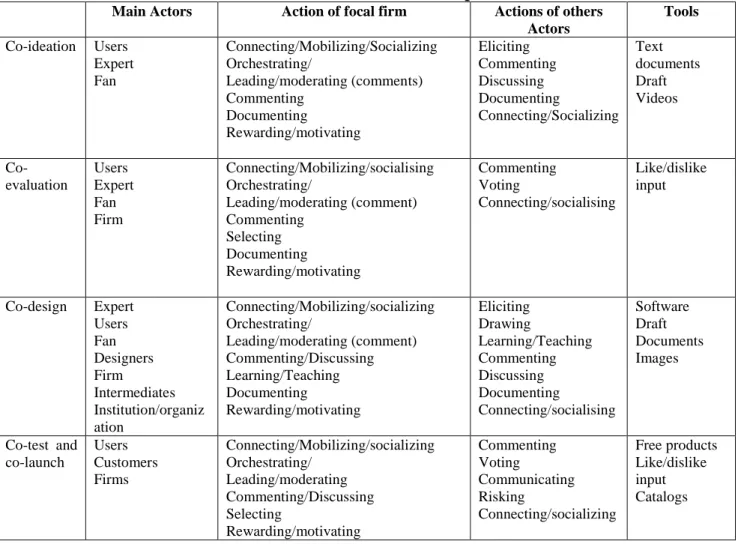
In deploying the second proposition, co-creation phases are addressed as the application of practices that shape a net of connections in action. Co-creation in innovation can be seen as a set of practices including different typologies of actors, actions and tools mapped for each of “co‟s”.
Through an open interaction context fostered by the diffusion of Web technologies, new ideas emerge, and they are selected, developed and launched through collaboration among many actors. In such a context, the innovation is performed not as a planned linear and order-managed process. Instead, innovation emerges through the elaboration of multiple resources, information, knowledge and experience put into practice as a result of activities performed in a shared contest.
In line with Korkman, Storbacka and Harlad (2010) adopting a practice-based view means perceiving innovation as a set of more or less routine actions, which are orchestrated by tools, know-how, images, language by subjects who are carrying out the practice. Table 5 highlights a set of practices of co-innovation.
Co-ideation Co-evaluation Co-design Co-test Co-launch Figure 1 –The “5 Co’s” in innovation
The Web is the contest within which the social connections shape the innovation. It works as a collector of knowledge and experiences of a heterogeneous mass of actors, feeding a strong interchange of ideas, tools, images and languages through which practices are implemented.
The practice-based approach advocates a contextual and ongoing view of innovation. The argument is that innovation is not created in isolated and spot interactions among two or more. Instead, it is formed in practical constellations, enabled by Web technologies in which actions are implemented and resource elements are integrated (Schatzki, 2001). The practices that contribute to shaping innovation are linked to each other through chains of translations involving various actors (Callon 1998).
The front-end activities in co-ideation and co-evaluation involve users, fans, and experts who are mainly engaged by mobilising and leading activities of the focal firm. This firm participates to discuss, select and connect by using text and other draft tools. These results are in line with the research streams on the customer-driven perspective; moreover, they move the focus from an individual perspective to a view on practices where subjects are just one element among actions, tools, and know-how. It is in the integration of resources that practice arises and co-creation occurs (Vargo and Lusch, 2011; Korkman, Storbacka and Harald, 2010).
Back-end activities (in co-design) is characterised by the involvement of specialists whose actions are focused on learning and teaching practices to foster the finalisation of creative activities though the use of more technical and complex tools. In addition, the focal firm‟s action is supplemented by more complex activities such as teaching and learning, which are seen as strictly entangled to foster and finalise the creativity in designing innovation as advocated by Piller et al. (2005).
Finally, the co-test and co-launch activities connect interested users who work to elicit their specific needs by sharing some risks with the company.
Some critical actions characterise practices in all “co‟s” moderating and leading the community, mobilising the creativity and users‟ roles, socialising users‟ knowledge and experience, and rewarding and motivating. The “community” is seen as one of the main actors in practicing innovation. As Sawney and Prandelli (2000) point out, it is a result of the ability of focal firm to attract the right people and network them through socialisation of their knowledge and experience.
In summary, the emerging view on innovation holds that co-creation and practices are interdependent and can be set in terms of social activity. Actors participate and contribute to innovation, which is socially and culturally co-structured and constantly re-co-structured by the activities of all.
Practicing innovation is a collective action that needs a shift from cognitive aspects of innovation (with its focus on the knowledge and information elaboration) to the practical view. We address the necessity to change from the result (the artefact) to the process (innovating). Innovating is the system of ongoing practices performed by people creating the newness by interacting socialising and negotiating knowledge, actions, tools, languages and artefacts.
Table 5 - A set of co-innovation practices
Main Actors Action of focal firm Actions of others Actors Tools Co-ideation Users Expert Fan Connecting/Mobilizing/Socializing Orchestrating/ Leading/moderating (comments) Commenting Documenting Rewarding/motivating Eliciting Commenting Discussing Documenting Connecting/Socializing Text documents Draft Videos Co-evaluation Users Expert Fan Firm Connecting/Mobilizing/socialising Orchestrating/ Leading/moderating (comment) Commenting Selecting Documenting Rewarding/motivating Commenting Voting Connecting/socialising Like/dislike input Co-design Expert Users Fan Designers Firm Intermediates Institution/organiz ation Connecting/Mobilizing/socializing Orchestrating/ Leading/moderating (comment) Commenting/Discussing Learning/Teaching Documenting Rewarding/motivating Eliciting Drawing Learning/Teaching Commenting Discussing Documenting Connecting/socialising Software Draft Documents Images Co-test and co-launch Users Customers Firms Connecting/Mobilizing/socializing Orchestrating/ Leading/moderating Commenting/Discussing Selecting Rewarding/motivating Commenting Voting Communicating Risking Connecting/socializing Free products Like/dislike input Catalogs
Main implications for managers and scholars
This work addressed the need to frame innovation in terms of a group of interactions within a constellation of practices. From this perspective, co-creation in innovation shifts its focus from customer collaboration to the creation of new value proposals by several actors with the focal firm‟s engagement in the creation of practices supporting other actors‟ value-creating processes.
Managers of the focal firm should exploit the creativity in the network aimed to spread utility for the user. In this view, they should influence the co-creation opportunities by contributing to script practices. They should be able to more clearly consider the full options of co-creation activities and be involved in designing and responding to co-creation initiatives. Each activity provides an opportunity for a wide range of actors to collaborate and enhance the value co-creation.
Specific implications come from the analysis of the encounter processes. By using the Web site, managers can set up continuous innovation.
From an academic point of view, we reveal that because companies are ongoing, self-reproducing arrays of shared practices, scholars need to understand practice to understand and describe these systems. The implications of a practice approach are that business individuals,
interactions, actions, systems, institutions, and structures can be studied through the field of practices, as they are embedded in practices. In this view, innovation as a result of learning and knowing can be studied as a social and cultural phenomenon.
References
Araujo, L., Kjellberg, H. & Spencer, R. (2008), "Market practices and forms: introduction to the special issue", Marketing Theory,8 (1), 5-14.
Baldwin, C., Hienerth, C., & Hippel, E. V. (2006), “How user innovations become commercial products: A theoretical investigation and case study”, Research Policy, 35, 1291–1313.
Booz, E., Allen J., Hamilton C., (1982), New product management for the 1980s, New York: Booz-Allen & Hamilton Inc.
Borghini, S., Antonella C.(2008), “Co-creating Consumption Experiences: An Endless Innovation" in A., Carù, K., Tollin (eds.), Strategic Market Creation, New York: John Wiley & Sons, Inc.
Callon, M., 1998. Introduction: the embeddedness of economic markets in economics. In: Callon, M. (Ed.), The Laws of the Markets. Blackwell Publishers, Oxford, pp. 1–57.
Chandler J.r D., Wieland H.(2010), “Embedded Relationships: Implications for Networks, Innovation, and Ecosystems,” Journal of Business Market Management, 4 (4),199-215.
Chesbrough H., Schwartz K. (2007), “Innovating business models with co-development partnerships”, Research Technology Management, 50,:55–59.
Chesbrough, H. (2003), “The Era of Open Innovation.” Sloan Management Review, 44, : 35-41.
Chesbrough, H. (2003a) “Open Innovation: How Companies Actually Do It”, Harvard Business Review, 81, 7 (July): 12-14.
Chesbrough, H. (2003b), Open Innovation: The New Imperative for Creating and Profiting from Technology, Cambridge: Harvard Business School Press.
Chesbrough, H. (2004),“Managing Open Innovation: Chess and Poker,” Research-Technology Management, 47 (1): 23-26.
Chesbrough, H. (2006), “Open Innovation: A New Paradigm for Understanding Industrial Innovation,” in Henry Chesbrough, Wim Vanhaverbeke, and Joel West, eds., Open Innovation: Researching a New Paradigm. Oxford: Oxford University Press, pp. 1-12.
Chesbrough, H. (2007), “The market for innovation: implications for corporate strategy, ”California Management Review, 49 (3): 45–66.
Chesbrough, H. (2011), Open Services Innovation: Rethinking Your Business to Grow and Compete in a New Era, New York,: John Wiley & Sons, Inc.
Chesbrough, H., Crowther A. (2006), “Beyond high tech: early adopters of open innovation in other industries,” R&D Management, 36, 3 (June): 229-236. DOI: 10.1111/j.1467-9310.2006.00428.x Chesbrough, H., Teece D., (1996), “When Is the Virtual Virtuous? Organizing for Innovation,” Harvard
Business Review, 74 (1), 65-73.
Chesbrough, H., Vanhaverbeke W., West J. (2006), Open Innovation: Researching a New Paradigm, Oxford: Oxford University Press.
Cooper, Robert G. (1988), “The new product process: A decision guide for management,” Journal of Marketing Management, 3 (3), 238-255.
Ebner, W., Leimeister, J.M., and Krcmar, H. (2009) "Community Engineering for Innovations -The Ideas Competition as a method to nurture a Virtual Community for Innovations," R&D Management (39:4), pp 342-356
Edvardsson, B., Holmlund, M. and Strandvik, T. (2008), "Initiation of business relationships in service-dominant settings", Industrial Marketing Management, Vol. 37, No. 3, pp. 339-350.
Eisenhardt, K. M. (1989), “Building theories from case study research”, Academy of Management Review, 14(4), 532-550.
Enkel, E., Gassmann O., Chesbrough H. (2009).Open R&D and open innovation: exploring the phenomenon, R&D Management, 39(4), 311-316.
Flint, Daniel J. (2006), “Innovation, Symbolic Interaction, and Customer Valuing: Thoughts Stemming from a Service-Dominant Logic of Marketing,” Marketing Theory, 6 (3), 349-362.
Franke, N., Piller, F. T. (2003), “Key research issues in user interaction with user toolkits in a mass customisation system”, International Journal of Technology Management, 26(5), 578-599.
Franke, N., Piller, F. T. (2004), “Toolkits for user innovation and design: An exploration of user interaction and value creation”, Journal of Product Innovation Management, 21(6), 401-415.
Franke, N., Shah, S. (2003), “How communities support innovative activities: An exploration of assistance and sharing among end users”, Research Policy, 32(1), 157-178.
Frow, P, Payne, A & Storbacka, K, (2010), A Conceptual Model for Value Co-Creation: Designing Collaboration Within A Service System, Proceedings of 39th EMAC Conference, Copenhagen,1 - 4 June 2010
Frow, P., Brodie R., Little V., Payne, A. (2010) Collaboration, Resource Integration and Value Co-creation within the S-D logic: Exploring Research Issues, The Forum on Markets and Marketing: Extending Service-Dominant Logic., University of Cambridge, September 23-26
Füller, J. (2010), “Refining virtual co‐creation from a consumer perspective”, California Management Review, 52(2), 98- 122.
Füller, J., Matzler, K., & Hoppe, M. (2008). Brand community members as a source of innovation, Journal of Product Innovation Management, 25(6), 608-619.
Gassmann O, Sandmeier P, Wecht CH. ( 2006), “Extreme customer innovation in the front-end: learning from a new software paradigm”, International Journal of Technological Management 33:46–66. Gassmann O., Enkel E., Chesbrough H. (2010), “ The future of open innovation”, R&D Management,
40 ( 3) 213-221
Gassmann, O. (2006) “Opening up the innovation process: towards an agenda,” R&D Management, 36 ( 3), 223-226.
Gherardi S., Nicolini D., (2006) Organizational Knowledge: The Texture of Workplace Learning Blackwell Publishing, Ma.
Griffin, A. (1997), "PDMA Research on New Product Development Practices: Updating Best Practices," Journal of Product Innovation Management, 14, 429- 58
Grönroos C. (2011) A service perspective on business relationships: The value creation, interaction and marketing interface Industrial Marketing Management 40 (2011) 240-247
Grönroos, C. (2008), “Service logic revisited: who creates value? And who co-creates?”, European Business Review, 20 (4), 298-314.
Gummesson, E. (2005), “Qualitative research in marketing: roadmap for a wilderness of complexity and unpredictability,” European Journal of Marketing, 39 (3/4), 309-327.
Gummesson, E. (2008), “Customer centricity: reality or a wild goose chase?” European Business Review, 20, (4), 315-330.
Gummesson, E. (2008a), “Extending the New Dominant Logic: From Customer Centricity to Balanced Centricity.” Commentary for Special Issue of The Journal of the Academy of Marketing Science (JAMS) on the New Dominant Logic, 36 (1), 15-17.
Gummesson, E., Lusch R., F., Vargo S.L. (2010), “Transitioning From Service Management to Service-dominant Logic: Observations and Recommendations,” International Journal of Quality and Service Sciences, Special Issue of the 2009 Naples Forum on Service, 2 (1), 8-22.
Gummesson, E., Mele C. (2010), “Marketing as value co-creation through network interaction and resource integration,” Journal of Business Market Management, 4, 181-198.
Gummesson, E., Polese F., (2009), “B2B is not an island”, Journal of Business and Industrial Marketing, 24(5/6), 337-350.
Howe, Jeff (2008): “Crowdsourcing-why the power of the crowd is driving the future of business”, New York: Crown Business
Khalid, H.M., Helander, M.G. (2003), “Facilitating Mass Customization in Web-based Do-It-Yourself Product Design”, In: Tseng. M. and Pillar, F. ( Ed.) The Customer Centric Enterprise: Advances in Mass Customization and Personalization, 247 -266, New York: Springer Verlag.
Kimbel L. (2009), “Beyond design thinking: Design-as-practice and designs-in-practice”, Paper presented at the CRESC Conference, Manchester, September.