1
Deep Multi-View Learning for Visual Understanding
Xiaobin Chang
Submitted in partial fulfilment of the requirement for the degree ofDoctor of Philosophy School of Electronic Engineering and Computer Science
Queen Mary University of London 7 December 2019
3
5
Deep Multi-View Learning for Visual Understanding
Xiaobin Chang
Abstract
Multi-view data is the result of an entity being perceived or represented from multiple perspec-tives. Plenty of applications in visual understanding contain multi-view data. For example, the face images for training a recognition system are usually captured by different devices from mul-tiple angles. This thesis focuses on the cross-view visual recognition problems, e.g., identifying the face images of the same person across different cameras. Several representative multi-view settings, from the supervised multi-view learning to the more challenging unsupervised domain adaptive (UDA) multi-view learning, are investigated. Novel multi-view learning algorithms are proposed correspondingly. To be more specific, the proposed methods are based on the advanced deep neural network (DNN) architectures for better handling visual data. However, directly combining the multi-view learning objectives with DNN can result in different issues, e.g., on scalability, and limit the application scenarios and model performance. Corresponding novelties in DNN methods are thus required to solve them. This thesis is organised into three parts. Each chapter focuses on a multi-view learning setting with novel solutions and is detailed as follows:
Chapter 3 A supervised multi-view learning setting with two different views are studied.
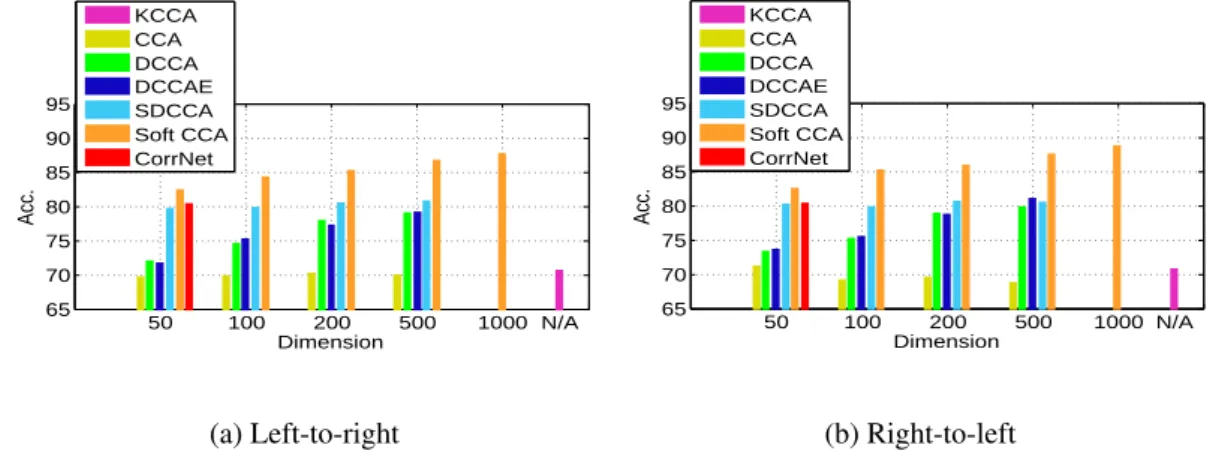
To recognise the data samples across views, one strategy is aligning them in a common feature space via correlation maximisation. It is also known as canonical correlation analysis (CCA). Deep CCA has been proposed for better performance with the non-linear projection via deep neural networks. Existing deep CCA models typically decorrelate the deep feature dimensions of each view before their Euclidean distances are minimised in the common space. This feature decorrelation is achieved by enforcing an exact decorrelation constraint which is computation-ally expensive due to the matrix inversion or SVD operations. Therefore, existing deep CCA models are inefficient and have scalability issues. Furthermore, the exact decorrelation is in-compatible with the gradient based deep model training and results in sub-optimal solution. To overcome these aforementioned issues, a novel deep CCA modelSoft CCAis introduced in this thesis. Specifically, the exact decorrelation is replaced by soft decorrelation via a mini-batch based Stochastic Decorrelation Loss (SDL). It can be jointly optimised with the other training objectives. In addition, our SDL loss can be applied to other deep models beyond multi-view learning.
Chapter 4The supervised multi-view learning setting, whereby more than two views exist,
are studied in this chapter. Recently developed deep multi-view learning algorithms either learn a latent visual representation based on a single semantic level and/or require laborious human annotation of these factors as attributes. A novel deep neural network architecture, called Multi-Level Factorisation Net (MLFN), is proposed to automatically factorise the visual appearance into latent discriminative factors at multiple semantic levels without manual annotation. The main purpose is forcing different views share the same latent factors so that they are can be aligned at all layers. Specifically, MLFN is composed of multiple stacked blocks. Each block
6
contains multiple factor modules to model latent factors at a specific level, and factor selection modules that dynamically select the factor modules to interpret the content of each input image. The outputs of the factor selection modules also provide a compact latent factor descriptor that is complementary to the conventional deeply learned feature, and they can be fused efficiently. The effectiveness of the proposed MLFN is demonstrated by not only the large-scale cross-view recognition problems but also the general object categorisation tasks.
Chapter 5The last problem is a special unsupervised domain adaptation setting called
unsu-pervised domain adaptive (UDA) multi-view learning. It contains a fully annotated dataset as the source domain and another unsupervised dataset with relevant tasks as the target domain. The main purpose is to improve the performance of the unlabelled dataset with the annotated data from the other dataset. More importantly, this setting further requires both the source and target domains are multi-view datasets with relevant tasks. Therefore, the assumption of the aligned label space across domains is inappropriate in the UDA multi-view learning. For example, the person re-identification (Re-ID) datasets built on different surveillance scenarios are with images of different people captured and should be given disjoint person identity labels. Existing meth-ods for UDA multi-view learning problems are aligning different domains either in the raw image space or a feature embedding space for domain alignment. In this thesis, a different framework, multi-task learning, is adopted with the domain specific objectives for a common space learning. Specifically, such common space is proposed to enable the knowledge transfer. The conventional supervised losses can be used for the labelled source data while the unsupervised objectives for the target domain play the key roles in domain adaptation. Two novel unsupervised objectives are introduced for UDA multi-view learning and result in two models as below.
The first model, termedcommon factorised space model (CFSM), is built on the assumptions that the semantic latent attributes are shared between the source and target domains since they are relevant multi-view learning tasks. Different from the existing methods that based on domain alignment, CFSM emphasizes on transferring the information across domains via discovering discriminative latent factors in the proposed common space. However, the multi-view data from target domain is without labels. Therefore, an unsupervised factorisation loss is derived and applied on the common space for latent factors discovery across domains.
The second model still learns a shared embedding space with multi-view data from both domains but with a different assumption. It attempts to discover the latent correspondence of multi-view data in the unsupervised target data. The target data’s contribution comes from a clustering process. Each cluster thus reveals the underlying cross-view correspondences across multiple views in target domain. To this end, a novelStochastic Inference for Deep Clustering (SIDC)method is proposed. It reduces self-reinforcing errors that lead to premature convergence to a sub-optimal solution by changing the conventional deterministic cluster assignment to a stochastic one.
7
Declaration
I hereby declare that this thesis has been composed by myself and that it describes my own work. It has not been submitted, either in the same or different form, to this or any other university for a degree. All verbatim extracts are distinguished by quotation marks, and all sources of information have been acknowledged. Some works have been published or are under review as follows:
Chapter 3
1. Xiaobin Chang, Tao Xiang, and Timothy M. Hospedales.Scalable and effective deep cca via soft decorrelation. In Proc. of the IEEE Conference on Computer Vision and Pattern, Salt Lake City, Utah, USA, June 2018. (CVPR).
Chapter 4
1. Xiaobin Chang, Timothy M. Hospedales, and Tao Xiang.Multi-level factorisation net for person re-identification.In Proc. of the IEEE Conference on Computer Vision and Pattern Recognition, Salt Lake City, Utah, USA, June 2018. (CVPR).
Chapter 5
1. Xiaobin Chang, Yongxin Yang, Tao Xiang, and Timothy M. Hospedales. Disjoint La-bel Space Transfer Learning with Common Factorised Space. In Proc. of the Thirty-Third AAAI Conference on Artificial Intelligence, Honolulu, Hawaii, USA, January 2019. (AAAI).
2. Xiaobin Chang, Yongxin Yang, Tao Xiang, and Timothy M. Hospedales. Unsupervised Domain Adaptive Person Re-Identification with Deep Clustering. Under Review of Proc. of the IEEE International Conference on Computer Vision (ICCV) 2019.
9
Acknowledgements
First of all, I would like to convey my sincere gratitude to my supervisor, Professor Tao (Tony) Xiang. During my four-year study, Tony gives me plenty of valuable advice and unconditional supports. At the same time, I appreciate the detailed guidance on my research from my co-supervisor Dr. Timothy Hospedales. Finally, many thanks to Professor Shaogang (Sean) Gong, who gave me the advice and supports I needed. With their helps and supervisions, I gradually learn how to conduct research independently.
My friends and colleagues are always willing to help. Dr. Xiatian (Eddy) Zhu has the very comprehensive understanding on different research areas and gave me patient explanations when I have doubts. I also learned plenty of deep insights on research from Dr. Yongxin Yang. The system staff, especially Tim Kay and Haris Krikelis, provide me the strongest technical supports. Melissa Yeo is patient to answer all my questions on administrative processes. I will miss the nice coffee and snacks from June Coster. Special thanks to many other colleagues and friends at Queen Mary. The happy moments we had are one of the most precious treasures in my life.
Last but not least, I am really grateful for the endless and selfless love and supports from my family, especially my parents and grandparents. Moreover, in deep memory of my loving grandmother. It is my turn to carry out more duty for the family.
11
Contents
1 Introduction 21
1.1 Multi-View Visual Data . . . 22
1.2 Multi-View Learning Tasks for Visual Understanding . . . 23
1.3 Cross-View Recognition Settings . . . 24
1.4 Challenges, Motivations and Solutions . . . 26
1.5 Contributions . . . 30
2 Literature Review 33 2.1 Visual Recognition Based on Deep Learning . . . 34
2.1.1 Deep Hierarchical Architecture . . . 34
2.1.2 Deep Model Optimisation . . . 35
2.2 Canonical Correlation Analysis . . . 36
2.2.1 Deep Canonical Correlation Analysis . . . 36
2.2.2 Decorrelation Loss . . . 37
2.2.3 Multi-View Canonical Correlation Analysis . . . 38
2.3 Deep Neural Network for Cross-View Recognition . . . 39
2.3.1 Deep Neural Networks for Person Re-ID . . . 39
2.3.2 Related Deep Neural Network Architectures . . . 41
2.3.3 Other Visual Applications with Attributes . . . 42
2.4 Unsupervised Domain Adaptive Multi-View Learning . . . 43
2.4.1 Unsupervised Domain Adaptation with Domain Alignment . . . 43
2.4.2 Disjoint Label Space Transfer Learning . . . 44
2.4.3 Multi-Task Learning . . . 44
2.5 Summary . . . 46
3 Scalable Deep Canonical Correlation Analysis 49 3.1 Scalable Deep Canonical Correlation Analysis via Soft Decorrelation . . . 50
12 Contents
3.1.1 Deep Canonical Correlation Analysis . . . 50
3.1.2 Stochastic Decorrelation Loss . . . 51
3.1.3 Stochastic Decorrelation Loss for Soft Canonical Correlation Analysis . . 53
3.1.4 Applications of Stochastic Decorrelation Loss to Other Deep Models . . 53
3.2 Results and Analysis . . . 54
3.2.1 Soft Canonical Correlation Analysis . . . 54
3.2.2 Factorisation Auto-Encoder with Stochastic Decorrelation Loss . . . 58
3.2.3 Deep Classifier with Stochastic Decorrelation Loss . . . 59
3.3 Summary . . . 62
4 Deep Factorisation for Multi-View Learning 63 4.1 Multi-Level Factorisation Network for Multi-View Latent Factor Discovery . . . 64
4.1.1 Model Architecture . . . 64
4.1.2 Optimisation . . . 66
4.2 Results and Analysis . . . 67
4.2.1 Datasets and Settings . . . 67
4.2.2 Person Re-ID Results . . . 70
4.2.3 Object Categorisation Results . . . 73
4.2.4 Further Analysis . . . 73
4.3 Summary . . . 78
5 Unsupervised Domain Adaptive Multi-View Learning 79 5.1 Common Factorised Space Model . . . 80
5.1.1 Methodology . . . 80
5.2 Results and Analysis on Common Factorised Space Model . . . 84
5.2.1 Unsupervised Domain Adaptive Multi-View Learning . . . 84
5.2.2 Semi-supervised Disjoint Label Space Transfer Learning . . . 86
5.2.3 Unsupervised Domain Adaptation . . . 87
5.2.4 Further Analysis . . . 88
5.3 Stochastic Inference for Deep Clustering . . . 90
5.3.1 Overview . . . 91
13
5.4 Results and Analysis on Stochastic Inference for Deep Clustering . . . 95
5.4.1 Experimental Settings . . . 95
5.4.2 Results . . . 96
5.4.3 Further Analysis . . . 99
5.5 Summary . . . 103
6 Conclusion and Future Work 105 6.1 Conclusion . . . 105
15
List of Figures
1.1 Different types of views in visual data . . . 23
1.2 Three multi-view learning tasks . . . 24
1.3 Unsupervised domain adaptive person re-identification . . . 25
1.4 Discriminative factors of multi-view data exist at multiple semantic levels . . . . 27
1.5 Different frameworks for unsupervised domain adaptive multi-view learning . . . 30
1.6 Overview of the main contents . . . 32
2.1 Discriminative visual semantics in the raw images are not structured . . . 35
2.2 The latent visual attribute that hard to be quantified . . . 40
2.3 Comparing DNN blocks of the proposed MLFN and the relevant ones . . . 42
2.4 Schematic of various transfer learning settings . . . 45
3.1 Schematic of implementing Soft CCA with SDL . . . 51
3.2 Architecture of Factorisation Auto-Encoder (FAE) with SDL . . . 54
3.3 Cross-view digit recognition results on MNIST . . . 56
3.4 Cross-view face recognition results on Multi-PIE . . . 57
3.5 Sociability of different deep CCA models . . . 58
3.6 Qualitative results of handwriting style transfer with different FAE models . . . . 59
4.1 Multi-Level Factorisation Net (MLFN) architecture . . . 64
4.2 Illustration of person Re-ID datasets . . . 68
4.3 Sensitivity of MLFN to dimemsiond . . . 74
4.4 Examples of attribute prediction using our factor signature (FS) feature . . . 76
4.5 Illustration of the highest and lowest values of FSM outputs . . . 77
5.1 Common Factorised Space Model (CFSM) architecture . . . 81
5.2 CFS activations distribution on target data. . . 90
5.3 Illustration of different latent factors learned by CFSM . . . 90
16 List of Figures
5.5 Illustration of the target domain deep features of different models . . . 99
5.6 Comparing the clusters formed by DEC + AE and SIDC . . . 100
5.7 Impact of the cluster numberkon SIDC . . . 101
17
List of Tables
2.1 Comparing decorrelation losses and operations. . . 38
3.1 Correlation strength on MNIST . . . 56
3.2 Correlation strength on Multi-PIE . . . 57
3.3 Disentanglement efficacy of different decorrelation methods . . . 59
3.4 CIFAR10 classification results with decorrelation losses . . . 60
3.5 Comparisons between decorrelation losses and SoTA results on Market-1501 . . 61
3.6 Ablation study on the advantage of SDL over DeCov . . . 62
4.1 Architecture details of FSM modules in different MLFN blocks . . . 69
4.2 Comparison between MLFN and SoTA results on Market-1501 . . . 70
4.3 Comparison between MLFN and SoTA results on DukeMTMC-reID . . . 71
4.4 Comparison between MLFN and SoTA results on CUHK03 setting 1 . . . 72
4.5 Comparison between MLFN and SoTA results on CUHK03 setting 2 . . . 72
4.6 Comparison between MLFN and SoTA network architectures on CIFAR-100 . . 73
4.7 Ablation Results of MLFN on Person Re-ID datasets . . . 74
4.8 Person Re-ID (Market-1501) performance with factor signature (ˆSSS) only . . . 75
5.1 Comparison between CFSM and SoTA results on UDA person Re-ID . . . 85
5.2 Comparison between CFSM and SoTA results on UDA SBIR . . . 86
5.3 Semi-supervised DLSTL image categorisation results . . . 87
5.4 Comparison between CFSM and SoTA results on unsupervised domain adaptation 88 5.5 Ablation study of CFSM on UDA person Re-ID benchmarks . . . 89
5.6 UDA Re-ID (Setting 1) results of SIDC . . . 97
5.7 UDA Re-ID (Setting 2) results of SIDC . . . 98
5.8 Ablation study of SIDC on UDA person Re-ID . . . 99
19
Nomenclature
x A visual data sample X Set of visual dataxN Number of visual data inX
y A non-visual data sample (e.g., label) Y Set of non-visual datay
d Number of feature dimension S Source domain
T Target domain
Major notations of deep neural network
Φ A deep neural network (module / layer)
θ Model parameters ofΦ
`(·) A loss function
∂ Differentiation operator
n Number of samples in each mini-batch
Major notations ofk-means clustering
µµµ A cluster centre feature vector ψ
ψψ A set of cluster centre features
General rules for notation definition
scalar normal lower-case letters set normal UPPER-case letters vector boldlower-case letters
tensor (matrix) boldUPPER-case letters Basic Operations A AAT transpose of matrixAAA tr(AAA) trace ofAAA,∑iaii ||AAA||F Frobenius norm, q tr(AAATAAA)
21
Chapter 1
Introduction
Artificial Intelligence (AI), also called machine intelligence, is the intelligence demonstrated by machines in ’learning’ and ’solving problems’ as a human does. Benefited from the repaid devel-opments of AI theories (e.g., deep learning and reinforcement learning) and computer techniques (e.g., Graph Process Units (GPUs) and massive storage devices), AI systems are applied in a wide range of applications such as self-driving cars, surveillance, stock management, medical diagnosis, etc. Among different data formats, visual data provides an enormous amount and the richest information. For example, self-driving cars usually equipped with multiple cameras for a better understanding of road conditions. Visual intelligence thus plays a crucial role in extracting valuable visual information via effective data analysis. One of the fundamental tasks in under-standing visual data is recognition. It requires the intelligent systems should be able to precisely identify what appears or is happening in the visual input. In the case of the self-driving car, all the people and vehicles around it should be visually recognised for driving safety. However, visual recognition is a challenging task, and one of the main obstacles is the visual appearances of the same entity/instance can be different. This is caused by many factors such as lighting conditions, occlusions, deformations, camera view angles and various recording devices. Such factors are also called views. Different types of views exist and are commonplace in many realistic visual applications. Therefore, understanding the multi-view visual data has attracted great attentions from both research and industrial communities.
22 Chapter 1. Introduction
1.1 Multi-View Visual Data
Visual analytic problems are challenging due to the diverse visual patterns are presented in the highly-uncertain contexts. Many factors are responsible for this. However, some of these factors are only randomly occur in limited scenarios as noises. On the contrary, the factors that can be systematically described and are widely exist in the large scale visual data are more worthy of attention. Such factors are denoted as views. In this thesis, three distinctive views in visual data are studied, as shown in Figure 1.1.
Camera The visual appearance of the same entity captured from different cameras can be
drastically changed. For example, the images of a person recorded by different surveillance cameras can have very different appearance characteristics due to the camera angles and the specified environments.
Modality A view can be a specified modality of the visual data. An object/entity can be
rep-resented in different visual modalities other than the normal RGB mode. For example, the near infrared images are recorded in a face recognition system to compensate the lighting-sensitive RGB ones.
Dataset The independently collected visual datasets with relevant tasks can be treated as the
multi-view data where each dataset corresponds to one view, denoted as a domain. Each domain represents a distinctive visual pattern, and the sampling bias among datasets are called domain gaps. For example, the images of digital numbers collected from hand-writings (MNIST) (LeCun et al, 1998) and street view house numbers (SVHN) (Netzer et al, 2011) form two domains with apparent visual differences. However, they are used for the same task, digit categorisation.
Hybrid Views Different types of views can simultaneously appear in sophisticated visual
learn-ing settlearn-ings. One example is the unsupervised domain adaptive (UDA) person re-identification (Re-ID) problem with two person Re-ID datasets are available. Both of them serve the retrieval purpose based on the visual appearance of people. However, they are built upon different surveil-lance networks with distinctive environments and visual patterns. Each dataset thus corresponds to a domain. Moreover, each Re-ID dataset contains the person images captured by multiple cameras in a specified surveillance network. Therefore, each domain also contains the multi-view data on its own.
Multi-view data is not limited to the visual applications and widely appears in different topics such as translation in natural language processing (NLP). Therefore, many techniques developed
1.2. Multi-View Learning Tasks for Visual Understanding 23
Cam1 Cam2 Cam3 Cam4 Cam5 RGB
Infrared
Airport
Campus
Camera Modality Dataset Hybrid
SVHN
MNIST
Figure 1.1: Illustrations of multi-view visual data. Different types of views are considered. Cameras: person images from different surveillance cameras. Different modalities, e.g., RGB and infrared, can be treated as specified views. Different datasets with relevant tasks as domains, e.g., two digit datasets. The hybrid case, unsupervised domain adaptive person Re-ID. Each Re-ID dataset corresponds to a specified domain. Each domain consist of multi-view data, i.e., person images from different cameras.
here can potentially benefit a variety of tasks in data mining and machine learning.
1.2 Multi-View Learning Tasks for Visual Understanding
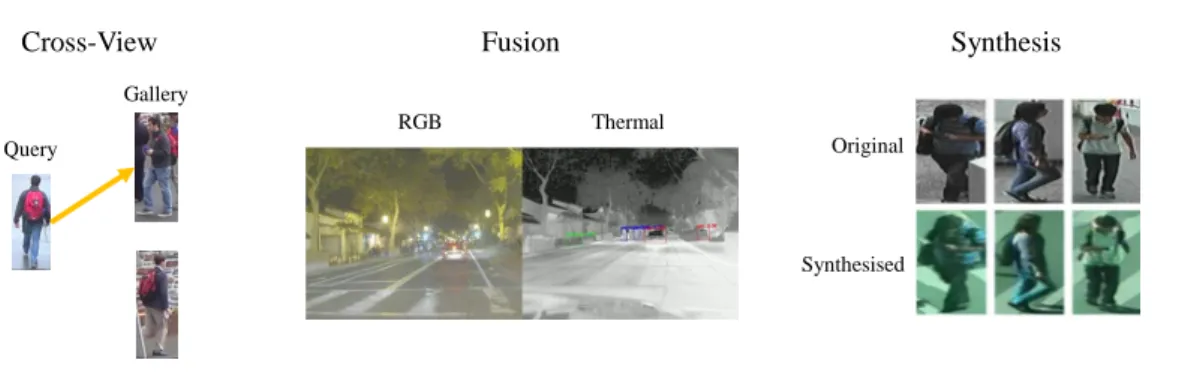
Different learning tasks based on the multi-view visual data can be divided into three main cate-gories, cross-view recognition, multi-view fusion and multi-view synthesis. The main character-istics of these three tasks are detailed as follows.
Cross-View Recognition The main purpose of this task is to match or retrieval the
correspond-ing data samples of the same entity/object across different views. Many visual applications are cross-view recognition problems such as recognising the same person under different non-overlapping camera views in the person re-identification (Re-ID), as shown in Figure 1.2. The main challenge in cross-view recognition comes from the nature of multi-view data where differ-ent views contain the distinctive information of the same visual differ-entity. To overcome this obstacle for better results, the consensus and discriminative information across different views play the key role. The consensus information bridges the gaps across views while the discriminative one helps to distinguish different entities.
Multi-View Fusion The learning objective of multi-view fusion is integrating information from
different views for a more comprehensive understanding of the entity and thus improving the model performance. Taking the visual system of a self-driving car as an example. The thermal images should be captured along with the RGB ones to build a more comprehensive and robust perception on road conditions, as illustrated in the middle case of Figure 1.2. Instead of focusing on the cross-view consensus information, multi-view fusion requires the complementary and discriminative information. That is to find out the orthogonal and irreplaceable information from
24 Chapter 1. Introduction
Cross-View Fusion Synthesis
Query
Gallery
RGB Thermal
Original
Synthesised
Figure 1.2: Three view learning tasks, cross-view recognition, view fusion and multi-view synthesis, are illustrated accordingly. Person re-identification is a typical application of cross-view recognition where the query and gallery person images are from different camera views. Fusing visual inputs from the RGB and thermal views helps the self-driving system to have a better understanding of its environment. The person images with the new styles of the other domain are generated (as shown in the second row). Nevertheless, the main characteristics such as gestures are still kept in the generated images.
each view and then fuse them for better results.
Multi-View Synthesis This final task focuses on generating the visual data samples of specified
or even novel views. One obvious benefit of multi-view synthesis is to alleviate the impact of imbalance or missing data among different views. For example, in person re-identification (Re-ID), Generative Adversarial Networks (GANs) (Goodfellow et al, 2014) can be used to synthesis the person images across domains/datasets for the unsupervised domain adaptive (UDA) Re-ID problems (Deng et al, 2018; Wei et al, 2018). The generated images are adapted to the target style while keeping the main characteristics of an identity.
In this thesis, the cross-view recognition problems, which widely exist in many applications, are the main concerns. Furthermore, it is noteworthy that both cross-view recognition and multi-view fusion belong to broader multi-multi-view recognition. Therefore, many techniques discussed and proposed here for the cross-view recognition can also be generalised to the fusion one.
1.3 Cross-View Recognition Settings
Two separated dimensions can be used to describe the different cross-view recognition settings studied in this thesis. The first dimension is the number of views, and the second dimension is the amount of annotation available for each view.
Number of Views The multi-view data consists of two views only is the most straightforward
1.3. Cross-View Recognition Settings 25
Airport Campus
Unlabelled Target Data Labelled Source Data
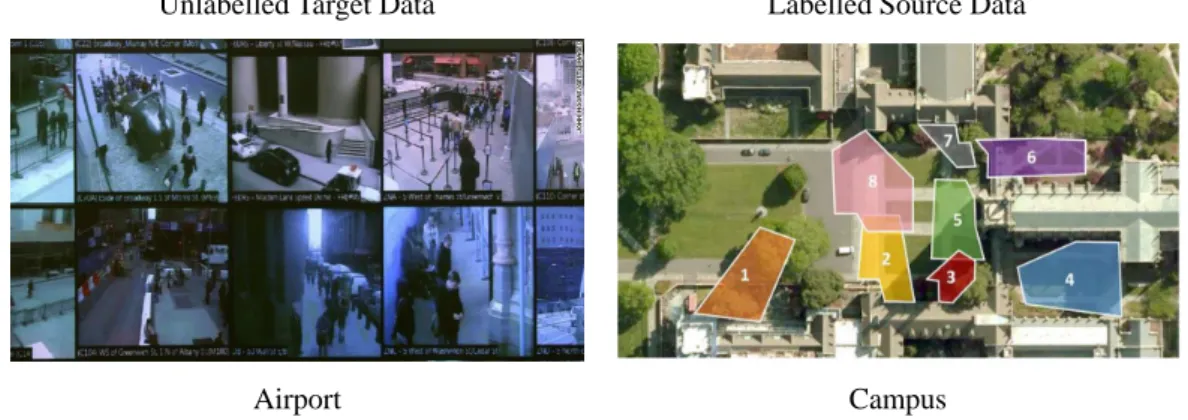
Figure 1.3: Unsupervised domain adaptive (UDA) multi-view learning in person re-identification. The target domain is from an airport surveillance. Labelling such large-scale multi-view visual data is very expensive. The other labelled Re-ID dataset (from a campus sce-nario) is available as source domain to improve the performance of target one.
hand, many problems follow the two-view setting. For example, a self-driving car usually uses the images from RGB and thermal modalities. On the other hand, many multi-view learning algo-rithms are derived from the simple two-view case before generalised to more complex situations. The more sophisticated settings are with data from more than two views. One typical scenario is that different cameras capture visual data from multiple view angles. For example, in the per-son re-identification problems, perper-son images are captured by various non-overlapped cameras from distinctive view-points and environments. Moreover, as the number of views increased, the complexity of cross-view modelling can boosts drastically.
Amount of Annotations for Views In thesupervised multi-view learning, the labels of data samples under different views are available, or the cross-view correspondences are provided as data pairs. However, exhaustively labelling or pairing all different views can be expensive, es-pecially when different domains/datasets are considered. To improve the performance of such unlabelled dataset, another labelled dataset with relevant tasks can be exploited. It is known as the unsupervised domain adaptation (UDA) (Ganin et al, 2016) setting. Moreover, the UDA can be treated as a multi-view learning setting with the fully annotated data from one (source) domain and the unlabelled data from another (target) domain. A special UDA setting called the unsu-pervised domain adaptive (UDA) multi-view learningis the main focus here. Specifically, each domain under the UDA view setting is a view dataset, as the hybrid case of multi-view data described in Section 1.1. Different from the conventional UDA setting which assumes that different domains share the same label space, the UDA multi-view learning does not hold such assumption and only requires different domains have relevant multi-view learning tasks. A
26 Chapter 1. Introduction
concrete example is the unsupervised domain adaptive (UDA) person Re-ID, as illustrated in Fig-ure 1.3. The source and target Re-ID datasets are captFig-ured from different surveillance networks with clear domain gaps. Both the source and target datasets serve the Re-ID purposes, but the people in the two different surveillance networks are non-overlapped and should have disjoint identity labels.
The three representative settings considered in this thesis can be coordinated with the two criteria mentioned above. The supervised two-view setting is first studied, then generalised to the multi-view learning with labels. In the challenging UDA multi-view learning, the target domain is unlabelled and learned with the labelled source domain under relevant multi-view learning tasks, but their label spaces are disjoint.
1.4 Challenges, Motivations and Solutions
To bridge the visual differences of the same entity/object under multiple views, a latent space that is inferred from the original visual space can be used to aligned them. There are differ-ent approaches to project the instances from the visual space to the latdiffer-ent one. The conven-tional paradigm makes use of handcrafted features (e.g., HOG (Freeman and Roth, 1995) and SIFT (Lowe et al, 1999)) to encode the visual information and subspace methods (Oja, 1983) for space transformations. However, the handcrafted features can hardly capture high-level vi-sual semantics and the shallow subspace methods uvi-sually do not have enough model capacities for the sophisticated visual tasks. In this thesis, the more advanced deep neural network (DNN) methods are exploited. They provide end-to-end solutions for learning an effective latent space directly from the visual space. To align multi-view data via DNNs, the learning objectives are either explicitly optimising the deep latent space with the distance/correlation based alignment loss or implicitly forming tight clusters of multi-view data guided by the classification loss.
Challenges and Motivations Despite the promising multi-view learning results achieved by
existing DNN methods, many limitations and open problems still exist and are discussed as follows.
1. The scalability of deep CCA.To align different views in a common space, one learning
strategy is to maximise the mutual correlations across views. It is also known as canonical correlation analysis (CCA) (Hotelling, 1936; Golub and Zha, 1995). The recently pro-posed deep CCA models (Andrew et al, 2013; Wang et al, 2015b) aim to learn nonlinear
1.4. Challenges, Motivations and Solutions 27 Gender: Texture: Colour: handbag floral
black; white; red
floral backpack stripe blue; gray T-shirt; shorts stripe blue; gray Carrying: Clothing: Gender: Texture: Colour: Carrying: Clothing: Gender: Texture: Colour: Carrying: Clothing: Gender: Texture: Colour: Carrying:
Clothing:T-shirt; shorts backpack; bottle male male female female skirt skirt handbag
black; white; red
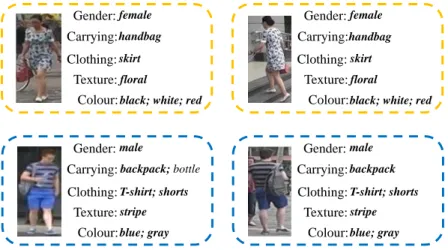
Figure 1.4: Each row shows a person captured by two camera views. A person’s appearance can be described by appearance factors of multiple semantic levels for matching. Factorising the visual appearance aims to automatically discover the discriminative latent factors across views.
projections with deep neural networks rather than kernels and has been shown to be more effective than shallow CCA and KCCA. However, existing deep CCA models are ineffi-cient and have scalability issues. The main reason is that exact or hard decorrelation is adopted. Specifically, the extracted deep feature vector for each view is decorrelated by forcing its correlation matrix over the training batch to be an identity matrix, before be-ing minimised the distances across views in the common embeddbe-ing space. Such exact decorrelation operations are computationally expensive. Either matrix inversion (Andrew et al, 2013; Wang et al, 2015b) or singular value decomposition (SVD) (Wang et al, 2015c) is required at each iteration which severely limits scalability. Furthermore, existing deep CCA models such as (Wang et al, 2015c) typically employ two separate and independent optimisation steps: the feature representation for each view is first decorrelated exactly. These decorrelation operations do not directly affect the following gradient computation and subsequent backpropagation. Without jointly optimising the decorrelation constraint and other objectives, only sub-optimal solutions are achieved.
2. Alignments only happen in the final deep layer. Most recent cross-view learning
meth-ods employ DNNs to learn view-invariant discriminative features. Different alignment losses are directly applied on the features from the final feature layer and the features ex-tracted from such layer are used for matching. Such alignment mainly focuses on the high-level semantic. However, the discriminative visual semantics of multi-view data can be found at multiple levels, as illustrated in Figure 1.4. Therefore, some existing works
(Ku-28 Chapter 1. Introduction
mar et al, 2011; McLaughlin et al, 2017) focused on compensating the final deep feature with attribute supervisions. The application scenarios of these methods are limited by the additional visual attribute annotations, which are usually expensive to be acquired. Some other DNNs (Long et al, 2015a; Fan et al, 2018a; Yang and Ramanan, 2015) are with multi-level feature fusion architectures, but they are not designed for the multi-view learn-ing purposes.
3. Unsupervised multi-view dataset as target domain.The main challenge here is the lack
of annotation in the views. Considering each view corresponds to a dataset, the unlabelled dataset is denoted as the target domain. To improve the target performance, another super-vised dataset is exploited as the source domain together with the unlabeled target data for training. Existing models are developed for the conventional unsupervised domain adapta-tion (UDA) setting with the assumpadapta-tion that the source and target domains are sharing the same label space. Therefore, the domain alignment framework is adopted. Different ap-proaches differ in whether the alignment takes place in the raw image space (Hoffman et al, 2017) or a feature embedding space (Long et al, 2015b; Lin et al, 2018). However, a more challenging UDA setting, the unsupervised domain adaptive (UDA) multi-view learning, is concerned. Specifically, both domains of the UDA multi-view learning are multi-view datasets with relevant tasks. More importantly, it further assumes the label spaces across domains are disjoint, which is opposite to the conventional UDA assumption. As a result, existing domain alignment based approaches are intrinsically inappropriate for the UDA multi-view learning problems, e.g., the UDA person Re-ID.
Solutions In this thesis, different solutions are provided to the corresponding challenges
men-tioned above and resulting in the novel DNN based methods.
1. Soft decorrelation in deep CCA.To address the scalability issues in existing deep CCA
methods, a robust decorrelation loss, called Stochastic Decorrelation Loss (SDL), is adopted in our proposed deep CCA, called Soft CCA. SDL is a softer constraint as the loss is only minimised rather than enforced exact decorrelation (off-diagonal elements of feature co-variance matrix are all zeros). The overall learning objective in Soft CCA is consist of the decorrelation loss SDL and other losses such as the distance losses across views in the embedding space. They are all compatible with the stochastic gradient descent (SGD) in deep learning and thus jointly optimised for more global solutions.
1.4. Challenges, Motivations and Solutions 29 2. Deep factorisation and multi-level fusion. To automatically discover the discriminative
and view-invariant latent factors at multiple semantic levels for the alignment across views, a novel DNN architecture calledMulti-Level Factorisation Net (MLFN)is proposed. The overall network is composed of multiple blocks (each of which may contain multiple con-volutional layers). Each block consists of two components: A set of factor modules (FMs), each of which is a sub-network of identical architecture designed to model one factor, and a factor selection module (FSM) that dynamically selects which subset of FMs in the block are activated. Training this architecture results in FMs that specialise in processing differ-ent types of factors, and at differdiffer-ent blocks represdiffer-ent factors of differdiffer-ent semantic levels. The discovered latent factors can also be considered as latent attributes. More importantly, a compact latent semantic feature can be extracted by aggregating the FSM output vectors at all levels and enables an efficient fusion to complement the final-layer deep features. 3. Multi-task learning for UDA multi-view learning. Instead of following the domain
alignment framework, this study presents a multi-task learning framework for the UDA multi-view learning tasks (Their comparisons are illustrated in Figure 1.5). Specifically, a shared deep feature embedding space is proposed. This space serves the source domain for supervised label prediction and the target domain with different unsupervised learning objectives. Two models are proposed based on the specified assumption made on target domain.
The first model, termed common factorised space model (CFSM), is developed based on the idea that recognition should be performable in a shared latent factor space for both do-mains. In order to automatically discover such discriminative latent factors and align them for transferring knowledge across domains, our inductive bias is that input samples from both domains should generatelow-entropycodes, i.e., near-binary codes, in this common space. This is a weaker assumption than distribution matching, but does provide a criterion that can be optimised to transfer knowledge across domains in the absence of common la-bel space. To assist the process of the knowledge propagates down from higher-level to feature extraction for effective knowledge transfer, a novel graph Laplacian-based loss is proposed. It is built on a graph in the high-level and regularises the lower-level network feature output.
30 Chapter 1. Introduction
Unsupervised Domain Adaptative (UDA) Multi-View Learning
1.Domain alignment 2.Multi-task learning
Feature Space
Image Space CFSM: Common Factorised Space
SIDC: Stochastic Deep Clustering
Figure 1.5: Two different pipelines for the UDA multi-view learning are illustrated. Existing work follows the domain alignment where different domains are aligned in either the image or feature representation space. In this thesis, the multi-task learning framework is adopted. Specified contributions to multi-view learning are made by the source and target domains. CFSM is built on the shared latent attribute discovery while SIDC is based on clustering the target data. based on a simple and sound assumption: They form clusters, data samples of the same entity across views are potentially corresponding to a cluster. However, existing deep k-means methods are based on the hard/deterministic assignment (Xie et al, 2016a) or it-erative optimisation (Yang et al, 2017a). To achieve end-to-end joint feature learning with an unsupervised clustering loss and deal with unreliable cluster assignment during train-ing, a novel deep clustering method for the target domain calledStochastic Inference for Deep Clustering (SIDC) is proposed. Firstly, SIDC treats the assignment as a random variable rather than making the hard assignment of a sample to its nearest cluster. There-fore, a training sample is less likely to get stuck in a wrong cluster and it thus ameliorates the issue of reinforcing errors in deterministic approaches. Secondly, a reparameterisa-tion trick (Jang et al, 2017) is exploited to model cluster assignment differentiably which enables end-to-end joint learning.
1.5 Contributions
The contributions made in each main chapter are summarised as follows:
1. Chapter 3 A novel approach of deep CCA, Soft CCA, has been proposed. Comparing
1.5. Contributions 31 efficient and scalable than existing deep CCA methods - by avoiding computationally ex-pensive operations such as SVD in existing works. On the other hand, by jointly optimising the decorrelation loss with other losses, more globally optimal solutions can be achieved. The proposedStochastic Decorrelation Loss (SDL)plays the central role in our model. It formulates the decorrelation as a soft constraint and can be jointly optimised with other training objectives. Moreover, SDL is mini-batch based and the full batch statistic can be efficiently approximated by using stochastic incremental learning. While the proposed SDL is motivated by the feature decorrelation required by deep CCA learning, it can also be applied as an activation regularisation to any deep model where feature decorrelation is helpful.
2. Chapter 4 A deep factorisation model, called Multi-Level Factorisation Net (MLFN),
is proposed based on a novel deep network architecture. It makes two main contributions to multi-view learning. On the one hand, it learns to discover and dynamically identify discriminative latent factors in the visual inputs across multiple views with no attribute supervision. On the other hand, the factors computed at different levels of the network correspond to latent attributes of different semantic levels. When the selections of the factors are used as a feature and fused with the conventional deep feature, a powerful view-invariant feature representation of multi-view data is obtained. Furthermore, MLFN shows its effectiveness on general object categorisation tasks which demonstrates its potential beyond multi-view learning.
3. Chapter 5 The multi-task learning framework is adopted for the unsupervised domain
adaptive (UDA) multi-view learning problems. Two different models with distinctive as-sumptions made on the unsupervised target domain are proposed.
The first method, common factorised space model (CSFM), is built on the assumption of discovering the discriminative latent attributes across both source and target domains in the shared space. Specifically, an unsupervised factorisation loss is then derived and applied on such common space which serves the purpose of optimising low-entropy criterion for discriminative latent factors discovery. On the other hand, a novel graph Laplacian based loss is proposed to better exploit the more aligned and discriminative supervision from higher-level to improve the deep feature learning. Finally, the proposed CFSM is demon-strated to be simple yet effective for different transfer learning problems other than UDA
32 Chapter 1. Introduction
… …
Cross-View Recognition
Chapter 3. Scalable Deep CCA Chapter 4. Deep Factorisation
Chapter 5.1. Factorisation Based Chapter 5.2. Clustering Based Chapter 5. UDA Multi-View Learning
View 1 View 2
Max correlation with soft decorrelation
Source Domain Target Domain (unsupervised) Source Domain Target Domain (unsupervised) Cluster 1
Cluster 2
Common Space Common Space
Knowledge Transfer Knowledge Transfer Target Domain Target Domain Latent Factor Representations View 1 View 2
Multi-Level Latent Factor Representations
0 1 0 1 0 1 0 1
…
View N … …Figure 1.6: An overview of the main studies carried out in this thesis. Three important cross-view recognition problems are presented. In Chapter 3, the scalability issues of deep canonical corre-lation analysis (CCA) are studied with the supervised data from two views. A deep factorisation network architecture is proposed in Chapter 4 to discover the discriminative latent factors across multiple views. In Chapter 5, we focus on the more challenging unsupervised domain adap-tive (UDA) multi-view learning with an unlabelled multi-view dataset as the target domain. The multi-task learning framework is adopted for this setting and two distinctive models are derived under different assumptions.
multi-view learning.
The contributions of the second model are summarised as follows. First of all, a new unsupervised domain adaptive multi-view learning model based on learning a joint feature embedding that encourages the target domain data to form clusters. Secondly, a novel deep clustering method called Stochastic Inference for Deep Clustering (SIDC) is proposed for the target domain data. It jointly learns representation and clustering by treating cluster assignment as a random, rather than deterministic, variable to alleviate compounding errors at early training. Last but not least, a new triplet loss for target data is also formulated based on the learned cluster centres and stochastic assignments to further boost the performance. Moreover, it is shown that SIDC is effective on its own on the conventional data clustering task.
To deliver a holistic understanding about this thesis, the main studies are summarised and framed into a graphical abstract as illustrated in Figure 1.6.
33
Chapter 2
Literature Review
Multi-View learning (MVL) is one of the fundamental tasks in machine learning where consid-erable effort has been spent and significant improvements have been achieved over the years (Xu et al, 2013; Zhao et al, 2017b; Li et al, 2018b). Many realistic problems can be modelled as the multi-view settings and solved by the corresponding learning algorithms (Tao et al, 2017; Guo and Xiao, 2012; Li et al, 2016). Different types of multi-view visual data are the main fo-cus of this thesis. The common views in visual applications are camera views (Du et al, 2014; McLaughlin et al, 2017) and modalities (Li et al, 2013; Yu et al, 2016). Different datasets with relevant tasks are known as domains (Ganin and Lempitsky, 2015) and are treated as a spe-cial kind of views. In general, these MVL problems can be summarized into three categories, cross-view recognition (Lin et al, 2015b; Li et al, 2017b), multi-view fusion (Yu et al, 2013) and multi-view synthesis (Tian et al, 2018; Sun et al, 2018), as shown in Figure 1.2. In this thesis, the main concentrations are on solving cross-view visual recognition problems. Three representative settings in cross-view recognition are studied. They differ in two axes, the number of views con-sidered and the amount of supervision provided for views. They are listed as follows, evolving from the simple to the more challenging ones,
1. Supervised multi-view data with two views only. This is the most simplified case in MVL where many MVL algorithms starts with. The data samples of the same entity/object across views are paired for model training.
34 Chapter 2. Literature Review
than two views are considered. The supervision of the entities/objectives across different views are also provided.
3. Unsupervised domain adaptive (UDA) multi-view learning. It is the most sophisticated one among the three settings. Different from the previous two settings with full supervision provided, the target domain (a multi-view dataset) is unsupervised. To improve the target performance, a labelled multi-view dataset with relevant task is provided as source domain. Different from the conventional UDA (Ganin and Lempitsky, 2015), the assumption of the aligned label spaces across domains are not hold in the UDA multi-view learning. In contrast, it assumes the disjoint label spaces of different domains.
Substantial efforts have been made towards solving the multi-view learning problems for vi-sual understanding with different deep neural networks (DNNs). A brief overview of the signif-icant deep learning schemes used in the visual recognition problems is provided in Section 2.1. The progress made on the three cross-view recognition settings mentioned above is then re-viewed. Deep CCA combines the Canonical Correlation Analysis (CCA) objective with DNN as non-linear projection for the two-view supervised learning problems. However, existing meth-ods have scalability issues, as detailed in Section 2.2. In Section 2.3, different advanced DNN architectures for the supervised multi-view learning are discussed. They are also compared with the proposed deep factorisation network. Finally, the connections and differences between the unsupervised domain adaptive (UDA) multi-view learning and other transfer learning settings are inspected in Section 2.4.
2.1 Visual Recognition Based on Deep Learning
2.1.1 Deep Hierarchical Architecture
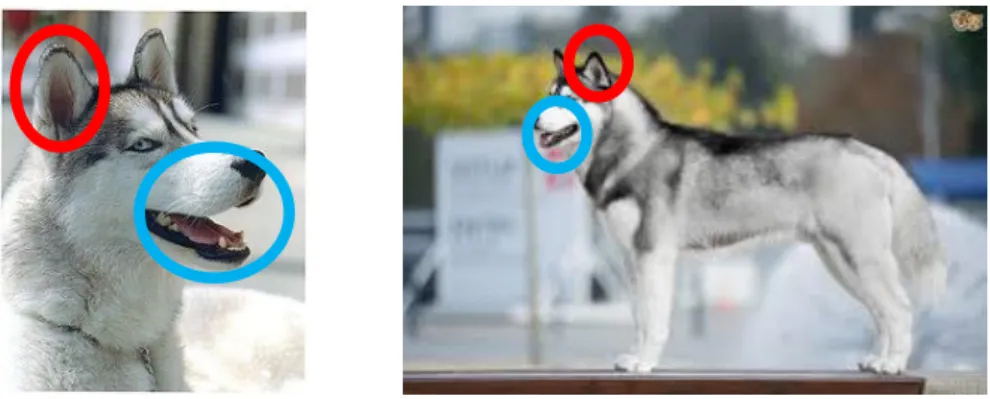
In order to handle the large-scale visual data such as ImageNet (Deng et al, 2009) and surveillance data (Zheng et al, 2017), the convolution based deep neural networks (DNNs) (LeCun et al, 2015; Krizhevsky et al, 2012; He et al, 2016a) are deployed, and such deep models usually achieve better performance than the non-deep/shallow ones. As shown in Figure 2.1, the discriminative semantics in the raw image space are not structured. They are naturally ambiguous, uncertain and highly unreliable due to uncontrollable factors, e.g., cluster context and noise. The DNN provides a unified approach to process the raw visual data and handle these issues. It is widely acknowledged (LeCun et al, 2015; Szegedy et al, 2015a; Jin et al, 2016) that the power of DNN
2.1. Visual Recognition Based on Deep Learning 35
Figure 2.1: The discriminative visual semantics (highlighted with circles) in the raw images are not structured. It is hard to represent them with low-level features only since they are ambiguous and variant to scales, positions as well as view angles.
comes from the multiple levels of representation transformations via stacking non-linear modules from bottom to top to extract the more abstract and higher level of semantics in deep features. Such ability of DNN plays the key role in visual recognition problems.
2.1.2 Deep Model Optimisation
The most widely adopted DNN learning strategy is the stochastic gradient descent (SGD) (Ki-wiel, 2001; Bottou, 2010). The mini-batch organisation and the mini-batch based differentiable objectives are two key components of SGD. Firstly, the full batch learning is inefficient or infea-sible for DNN training with large scale data. Mini-batch input is thus a more reasonable choice by randomly sampling a small amount of instances for one step training and traversal with more iterations. Secondly, the training objectives play the crucial roles in the final performance. Spec-ified training objectives are proposed for different tasks. Several alignment losses are widely used for deep multi-view learning. For example, Canonical Correlation Analysis (CCA) aligns different views in the correlation sense (Andrew et al, 2013). Minimising the Euclidean distance (L2loss) of the corresponding latent features across views can also be a simple alignment loss (Li
et al, 2018b). Another widely used alignment loss is based on the positive and negative pairs in a triplet, known as the triplet loss (Chechik et al, 2010; Schroff et al, 2015; Hermans et al, 2017). It requires the distance between the anchor sample and the negative sample representations is greater than the distance between the anchor and positive representations (with a margin). The losses mentioned above explicitly align instances across views in the latent space. On the con-trary, the classification loss is used for implicit alignment purpose (e.g., in person Re-ID (Zheng et al, 2016a) and face recognition (Parkhi et al, 2015)) of encouraging data samples of the same
36 Chapter 2. Literature Review
entity (has the same labels) form a tight cluster.
2.2 Canonical Correlation Analysis
CCA is a multivariate statistical method for multi-view problems (Uurtio et al, 2018), first de-veloped in (Hotelling, 1936). Conventional CCA is a linear model and it also generalised to the non-linear versions such as kernel CCA (KCCA) (Hardoon et al, 2004) and Deep CCA (Andrew et al, 2013). The linear and non-linear CCA objective can be unified as below following (Golub and Zha, 1995), argmin ω1,ω2 1 2||Pω1(X˜1)−Pω2(X˜2)||2F, s.t.PωT1(X˜1)Pω1(X˜1) =P T ω2(X˜2)Pω2(X˜2) =I, (2.1)
where ˜Xi represents the input data samples from view i,i∈ {1,2} with corresponding
projec-tion funcprojec-tionPωi(·). The generalised case beyond two views will be discussed in Section 2.2.3.
The model parameters ofPωi(·)isωi,i∈ {1,2}. The covariance matrix of each view should be
I ∈Rd×d , i.e., the identity matrix, with d denotes the common space feature dimension. In other words, such objective can be interpreted as the feature dimensions of each view is decorre-lated before different views are maximally corredecorre-lated in a common space. The main differences between linear and non-linear CCA models lie in the definitions ofPωi. Pωi(·)is a linear
func-tion of the input with weight matrixωi:=Wi in CCA. The non-linear projection functions of KCCA is inexplicitly defined by the kernels (Hofmann et al, 2008) used. On the contrary, the non-linear projections in Deep CCA are explicit, the deep neural networks Pωi :=Φθi and the
model parametersωi:=θi.
2.2.1 Deep Canonical Correlation Analysis
Inspired by the success of deep neural networks (DNNs) in representation learning (Zhou et al, 2014), Deep CCA has received increasing interest (Andrew et al, 2013; Wang et al, 2015b,c). A deep CCA architecture was first proposed by Deep CCA (DCCA) (Andrew et al, 2013) which directly computes the gradients of CCA objective and requires both a second-order optimisation method (Nocedal and Wright, 2006) and full-batch training inputs. It thus cannot cope with large training data size. An alternative deep CCA objective and architecture are proposed in Stochas-tic Deep CCA (SDCCA) (Wang et al, 2015c) which make it suitable for mini-batch stochasStochas-tic optimisation. However, due to the exact decorrelation used, SDCCA still requires a costly SVD
2.2. Canonical Correlation Analysis 37 operation at each training iteration. SVD’sO(d3)cost is not scalable to the large layer sizesd (e.g.,d=1024) common in contemporary DNNs. In fact, all existing deep CCA models (Andrew
et al, 2013; Wang et al, 2015b,c) take an exact decorrelation step, which limits their scalability and effectiveness as mentioned earlier. Furthermore, the exact decorrelating operations often do not directly impact the following gradient computations and backpropagation, which could lead to sub-optimal optimisation. The aforementioned issues can be alleviated or handled by for-mulating the decorrelation constraint as a loss which is optimised end-to-end jointly with other losses in a standard SGD procedure, making it both more scalable and more effective.
2.2.2 Decorrelation Loss
Beyond multi-view learning, many other deep models benefit from decorrelation of activations in a neural network layer. For these models, a decorrelation loss such as the proposed Sotchastic Decorrelation Loss (SDL) can be employed. Two such models are studied in this work, namely the Factorisation Autoencoder (FAE), and convolutional neural network (CNN) based classifiers. For each model, an alternative decorrelation loss exists.
FAE and XCov Loss Recently interest has regrown in models for disentangling the underlying
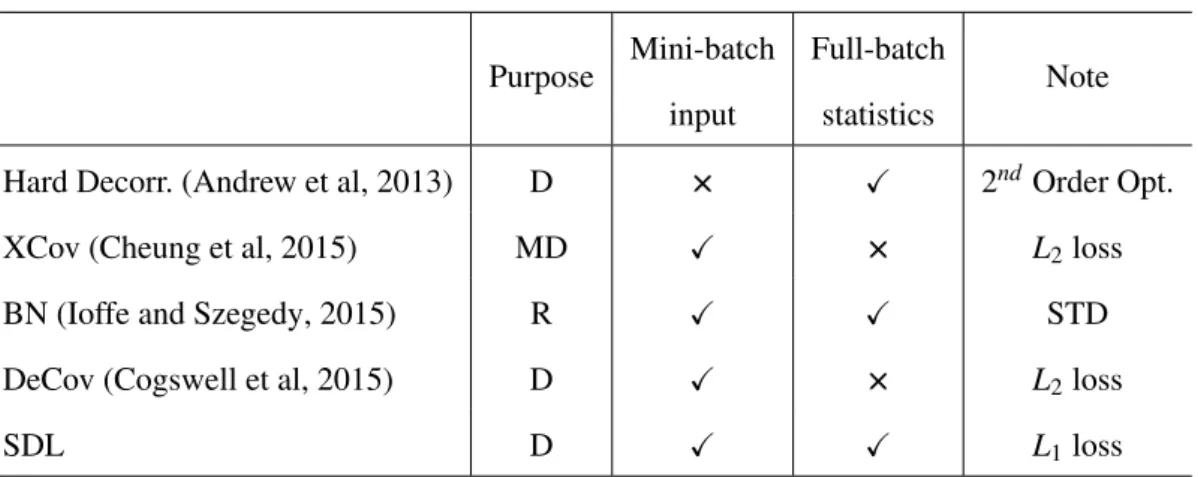
factors of variation in the appearance of objects in images, for example identity and viewpoint (Zhu et al, 2014; Wen et al, 2016; Karaletsos et al, 2015; Veit et al, 2017; Kingma and Welling, 2014; Mathieu et al, 2016; Makhzani et al, 2015). FAE achieves semi-supervised disentangling of latent factors via a two-branch autoencoder. Recently it has been shown in (Cheung et al, 2015) that the efficacy of FAE can be improved by adding a decorrelation loss (termed XCov in (Cheung et al, 2015)) to explicitly decorrelate the computed latent factor representations. Like our SDL, computing XCov is also a mini-batch operation. But it only eliminates correlations across and not within each factor; and it computes covariance only within each mini-batch, while our SDL approximates full-batch statistics using stochastic incremental learning. SDL is demonstrated to be more effective than XCov for helping FAE to disentangle latent factors via the experiments in Sec. 3.1.4.
CNN Classifier and DeCov Loss Using CNN with a classification loss (e.g., cross entropy)
for object recognition is perhaps the most popular application of deep learning in computer vi-sion. CNN classifiers are used for not only object category recognition tasks (Krizhevsky and Hinton, 2009; Krizhevsky et al, 2012) but also object instance/identity recognition/verification tasks such as face verification (Sun et al, 2014) and person re-identification (Xiao et al, 2016).
38 Chapter 2. Literature Review
Purpose Mini-batch input
Full-batch
statistics Note Hard Decorr. (Andrew et al, 2013) D ××× X 2ndOrder Opt.
XCov (Cheung et al, 2015) MD X ××× L2loss
BN (Ioffe and Szegedy, 2015) R X X STD
DeCov (Cogswell et al, 2015) D X ××× L2loss
SDL D X X L1loss
Table 2.1: Comparisons of decorrelation losses and operations. ’D’ stands for decorrelation. ’MD’ denotes mutual decorrelation. ’R’ is regularisation. The first method (Andrew et al, 2013) is hard decorrelation with computational expensive second order optimisation (Nocedal and Wright, 2006). Batch Normalisation (BN) is an operation for standardisation (STD) (Mendenhall and Sincich, 2016) rather than decorrelation.
When training CNNs for classification, avoiding overfitting, saturation and slow convergence are crucial (Glorot and Bengio, 2010). These problems are often alleviated by regularisation such as Batch Normalisation (BN) (Ioffe and Szegedy, 2015) and dropout (Srivastava et al, 2014). Re-cently it was shown that decorrelation losses can also be used for effective overfitting reduction (Cogswell et al, 2015). Compared with the existing decorrelation loss DeCov (Cogswell et al, 2015), our SDL has the following advantages: (1) More accurate covariance statistics due to full-batch approximation instead of the pure mini-batch statistics used in DeCov (Cogswell et al, 2015). (2) SDL uses a more robustL1formuation instead of theL2one in DeCov (Cogswell et al,
2015), which encourages sparser correlation and thus stronger decorrelation.
To highlight the differences and contributions, the comparisons among the different decorre-lation losses mentioned above are listed in Table 2.1.
2.2.3 Multi-View Canonical Correlation Analysis
CCA models can handle the multi-view learning problems with more than two views, following the multi-view CCA (Gong et al, 2014). Assuming the total number of views isV (V >2), the learning objective of multi-view CCA is similar to Eq. 2.1,
argmin ω1,ω2,...,ωV 1 2 V
∑
i,j=1 ||Pωi(X˜i)−Pωj(X˜j)|| 2 F, s.t.PωT i(X˜i)Pωi(X˜i) =P T ωj(X˜j)Pωj(X˜j) =I,i6= j, (2.2)2.3. Deep Neural Network for Cross-View Recognition 39 Eq. 2.2 generalises to the multi-view case by exhaustively pairing different two views and sum-ming up their CCA objectives. It has three main disadvantages in handling the multi-view settings (V >2). (1) The number of exhaustive pairs grows fast, with the speed ofO(V2). For example,
there are 28 different view pairs whenV =8. (2) The overall model size can hardly be
han-dled since CCA requires the view-specified modelling, i.e.,Pωi(·),i∈ {1,2, ...,V}. It grows as
V increases. The situation in Deep CCA can be even worse sinceV independent deep networks are deployed. (3) The training strategies and paces of different view pairs and models can be diverse. Coordinating them for the holistic optimisation in Eq. 2.2 is challenging, especially in deep CCA.
2.3 Deep Neural Network for Cross-View Recognition
Key to effective cross-view recognition is to learn the discriminative and invariant features across views for matching. Most recent works (Li et al, 2018b; Wang and Deng, 2018; Zheng et al, 2016a) are developed based on different deep neural networks (DNNs) with the advanced ar-chitectures. For example, the AlexNet (Krizhevsky et al, 2012) is used for the face recognition problem (Parkhi et al, 2015). The feature representation are extracted from the very top feature layer of a trained model. As a DNN comprises multiple feature extraction layers stacked one on the top of each other, the visual concepts of higher semantic levels are captured when forwarding from the bottom to the top layers, as pointed out in (LeCun et al, 2015; Szegedy et al, 2015a; Jin et al, 2016). It is thus infeasible for the final layer of the network to capture discriminative visual features of all semantic levels on its own. However, for cross-view recognition purposes, discriminative and view-invariant factors of multiple semantic levels should be ideally preserved in the learned features.
2.3.1 Deep Neural Networks for Person Re-ID
Specifically, a challenging cross-view recognition problem, i.e., person Re-ID (Zheng et al, 2016a; Li et al, 2017c; McLaughlin et al, 2017), is investigated. The person images in a Re-ID dataset are captured from a surveillance system with multiple non-overlapped camera views. The visual appearance of the same person across different views can change drastically due to realistic variations such as occlusion, low resolution, illumination changes and blurs (Zheng et al, 2016a; Xiao Wang, 2019).
40 Chapter 2. Literature Review
Figure 2.2: A women in similar dressing, e.g., the red coat, but with distinctive ’looks’ (Hsiao and Grauman, 2017) or ’styles’ (Takagi et al, 2017) which are latent visual concepts and hard to be quantified.
Most recent person Re-ID methods train DNNs with various learning objectives including classification, verification and triplet ranking losses (Xiao et al, 2016; Sun et al, 2017; Li et al, 2017c; McLaughlin et al, 2017). Once trained, these models typically extract visual features from the final layer of a network for matching.
One approach to obtaining an appearance feature containing information from multiple se-mantic levels is training to predict visual attributes (Layne et al, 2012; Lin et al, 2019). By defin-ing and annotatdefin-ing diverse attributes at multiple semantic levels, and traindefin-ing to predict them, these models are forced to encode attribute information using their top-layer features (McLaugh-lin et al, 2017; Schumann and Stiefelhagen, 2017; Lin et al, 2019; Khamis et al, 2014; Matsukawa and Suzuki, 2016). However, learning with the pre-defined attribute labels has two main draw-backs, and limiting the efficiency and effectiveness of corresponding models.
1. The attribute annotation process is costly and error-prone. It usually require a manual definition of the attribute dictionary and large scale image-attribute annotation, making this approach non-scalable.
2. The pre-defined attributes are semantic (’describable’) but not necessarily discriminative (Farhadi et al, 2009; Xiao Wang, 2019; Hsiao and Grauman, 2017). Therefore, only sub-optimal performance can be achieved by learning with such manual attribute labels. Furthermore, some discriminative attributes are with latent semantic and hard to be clearly stated and quantified, as illustrated in Figure 2.2.
2.3. Deep Neural Network for Cross-View Recognition 41 A couple of studies fused representations from multiple levels (Zhao et al, 2017a; Liu et al, 2017), but this required extra effort such as body-part detection (Zhao et al, 2017a) or attention mechanisms (Liu et al, 2017) as the pre-defined auxiliary tasks.
2.3.2 Related Deep Neural Network Architectures
DNNs with Multi-Level Feature Fusion Multi-level fusion architectures have been
devel-oped in other computer vision tasks. In semantic segmentation (Long et al, 2015a; Fan et al, 2018a; Hariharan et al, 2015), feature maps from selected levels are used with shortcut connec-tions to provide multiple granularities to the segmentation output. In visual recognition, deep features from a few selected layers were merged together to improve the final-layer representa-tion (Yang and Ramanan, 2015; Cai et al, 2017; Yu et al, 2017c; Yang et al, 2016b). However, features extracted from limited and manually-specified layers may not reflect the optimal choice for complementing the final representation. Very few fusion architectures on specific tasks, e.g., edge detection (Xie and Tu, 2015), fuse features from all layers/levels. These models are usually designed to have limited levels (e.g., 3∼5), so their expressibility is limited.
Relevant DNN Blocks Instead of constructing each block with holistic modules as in (Krizhevsky
et al, 2012; Simonyan and Zisserman, 2015; He et al, 2016a), a split-transform-merge strategy (Szegedy et al, 2016) is used to construct the modularised block architecture in ResNeXt (Xie et al, 2016b). A group of sub-network modules with duplicate structures are equally activated with their outputs summed up. Our proposed Multi-Level Factorisation Net (MLFN) leverages the ResNeXt design pattern, but extends it to include a dynamic selection of which module subset activates within each block for each image. This allows MLFN blocks to specialise in processing different latent appearance factors, and the FSM output vectors to encode a compact descriptor of detected latent factors at the corresponding level.
Our MLFN block is also related to that of Mixture-of-Expert (MoE) ones (Jacobs et al, 1991; Yuksel et al, 2012; Ahmed et al, 2016). In MoEs, a softmax activation module aims at identifying a single expert to process a given input instance. Mixture-of-Experts Layer (MoEL) methods (Eigen et al, 2014; Shazeer et al, 2017) extend flat MoE to a stacked model. They have been used to separate localisation and classification tasks in a two-level MoEL model (Eigen et al, 2014), or to implement very large neural networks by allowing each node in a cluster to run one expert in one layer of the large network (Shazeer et al, 2017). On the contrary, MLFN dynamically detects multiplelatent factors at each level that explain each input image jointly (e.g., a person can have
42 Chapter 2. Literature Review … … … FSM (b) ResNeXt (a) Resnet (c) MoE (d) MLFN Softmax Activated Sigmoid Activated
Figure 2.3: Four DNN blocks are illustrated for comparison. From (a) to (d), they are build-ing blocks belong to Resnet (He et al, 2016a), ResNeXt (Xie et al, 2016b), Mixture-of-Experts (MoE) (Eigen et al, 2014) and the proposed MLFN. Each blue module represents an independent CNN sub-network. The longer it is, the more channels it handles. The green box is the gating sub-module to modulate the outputs of CNN sub-networks. Its outputs are softmax activated be-fore modulation in MoE. In our MLFN, it is called factor selection module (FSM) with sigmoid activation.
both long hair and carry a bag). Thus MLFN block uses sigmoid activated FSM rather than softmaxas used in MoE/MoEL, which assumes a single expert should dominate. Illustrations of the different DNN blocks, including the proposed MLFN one, are compared in Figure 2.3.
2.3.3 Other Visual Applications with Attributes
Attributes play the important role in aligning multi-view visual data, as mentioned above. The latent factors discovered by our proposed MLFN can also be interpreted as latent attributes with semantic meanings, as demonstrated in Section 4.2.4. According to (Ferrari and Zisserman, 2008), visual attributes are qualities of objects/entities from multiple perspectives such colors, textures and shapes. They are usually considered to be more descriptive than the class/category labels (Farhadi et al, 2009). Therefore, attributes are widely applicable to many other visual tasks such as object categorisation (Nagarajan and Grauman, 2018; Farhadi et al, 2009; Ferrari and Zisserman, 2008) and zero-shot learning (Lampert et al, 2009, 2013; Romera-Paredes and Torr, 2015). However, their visual attributes are mainly come from manual annotations.
2.4. Unsupervised Domain Adaptive Multi-View Learning 43
2.4 Unsupervised Domain Adaptive Multi-View Learning
Labelling a large-scale visual dataset from scratch can be prohibitively expensive (Berinsky et al, 2012; Deng et al, 2009; Zheng et al, 2015). To improve the model performance on the unsu-pervised target dataset, one learning strategy (Zhang et al, 2019; Ganin and Lempitsky, 2015; Luo et al, 2017) is incorporating another labelled source dataset with relevant tasks for training. Each dataset is denoted as a domain and this setting is also known as unsupervised domain adap-tation (UDA) (Long et al, 2015b; Ganin et al, 2016). The main purpose of UDA is to transfer knowledge from the source domain to the target one.
In this thesis, the main concentration is a specified UDA setting, the unsupervised domain adaptive (UDA) multi-view learning, where both domains are multi-view datasets with relevant tasks. Many multi-view visual applications (Zhang et al, 2019; Sohn et al, 2017) follow this set-ting and our main focus is the unsupervised domain adaptive (UDA) person Re-ID (Kodirov et al, 2016; Wei et al, 2018; Wang et al, 2018). The main challenges are the disjoint label (e.g., person identity) spaces across domains and the clear domain gaps, as illustrated in Figure 1.3. Moreover, the relevant transfer learning settings such as the conventional unsupervised domain adaptation (UDA) (Section 2.4.1) and the disjoint label space transfer learning (DLSTL) (Section 2.4.2) are reviewed and compared as in follows.
2.4.1 Unsupervised Domain Adaptation with Domain Alignment
An underlying assumption made by the conventional unsupervised domain adaptation (UDA) is both source and target domains share the same label space. Different domain alignment methods are thus proposed for the UDA based on this assumption. The cross-domain alignments can happen in either the raw image space (Hoffman et al, 2017; Kim et al, 2017) or a deep feature embedding space (Chen et al, 2019; Ganin et al, 2016; Gretton et al, 2009).
Although the UDA person Re-ID problem does not hold such assumption, existing methods still stick to the domain alignment framework. In (Wei et al, 2018; Deng et al, 2018), person style transfer GANs are trained to synthesise images of persons in the target domain styles, with identity information preserved from the source dataset for supervised training in the target domain. Differently, cross camera-view image synthesis in (Zhong et al, 2018) only takes place in the target domain for pseudo identity label generation. By performing joint feature learning using both domains as in our model, (Zhong et al, 2018) achieves the best results thus far. However,