Robert B. Avery, Kenneth P. Brevoort, and Glenn B. Canner, of the Board’s Division of Research and Statistics, prepared this article. Rebecca Tsang and Sean M. Wallace provided research assistance.
[Note: This article is forthcoming in the Federal Reserve Bulletin.]
Since 1975, the Home Mortgage Disclosure Act (HMDA) has required public disclosures from most mortgage lending institutions with offices in metropolitan areas. The release of the information, including the geographic location and other characteristics of the home mortgages lenders originate or purchase during a calendar year, is intended to help the public determine whether institutions are adequately serving their communities’ housing finance needs; it is also intended to facilitate enforcement of the nation’s fair lending laws and guide public- and private-sector investment activities.
For a calendar year, lenders covered by HMDA publicly release their loan data beginning on March 31 of the subsequent year; in the following September, the Federal Financial Institutions Examination Council (FFIEC) releases summary tables pertaining to each lender and lending activity in each metropolitan statistical area, along with a file consolidating virtually all the reported information.1 The nearly 8,900 lenders currently covered by the law account for an estimated 80 percent of all home lending nationwide. Because of its expansive coverage, the HMDA data likely provide a broadly representative picture of home lending in the United States.
Note: The authors would like to express their appreciation for the late Edward M. Gramlich, member of the Federal Reserve Board from November 1997 to August 2005. His vision and persistence in seeking what became the 2002 amendments to the Board's HMDA regulations yielded the loan pricing information that has so enriched the value of the HMDA data.
1
Between March and September, the FFIEC member agencies systematically check the data for errors or omissions. To protect the identity of borrowers, the public data exclude the dates of loan applications and the dates of credit decisions.
After briefly summarizing previously published assessments of the 2004 and 2005 HMDA data and reviewing some prominent issues surrounding pricing in the mortgage market, this article analyzes the 2006 data.2 As in the analyses of the previous two years, this review focuses primarily on the pricing information included in the HMDA data and
differences observed across lending institutions, geographic areas, and population groups. The article concludes with an assessment of factors that account for the variation in rates of serious delinquency on mortgage loans across counties as of March 31, 2007, including information drawn from the HMDA data on the incidence of higher-priced lending and from a data file of credit scores by geographic area.
Increases in market interest rates over the course of 2004 and 2005 were an important contributor to the substantial increase between those years in the reported incidence of higher-priced lending as measured by the HMDA data. For the 2006 data, changes in market interest rates were more subdued, an aspect of the reported incidence of higher-priced
lending for 2006 that will be discussed below. The current disturbances in the subprime sector of the mortgage market emerged primarily in the later portions of 2006. The effects of those disturbances and the associated changes in the regulatory environment will be reflected primarily in the HMDA data for 2007 and subsequent years.
At the outset, HMDA disclosures were limited to summary totals covering loan extensions by type of loan for each census tract but included no information on loan pricing or applications for loans that were denied by the lender. Over the years, the Congress has extended the reach of the law to a broader range of institutions and expanded the types of information that must be reported and disclosed. The most sweeping of the legislative
2
Refer to Robert B. Avery, Glenn B. Canner, and Robert E. Cook (2005), “New Information Reported under HMDA and Its Application in Fair Lending Enforcement,” Federal ReserveBulletin, vol. 91 (Summer), pp. 344-94; and Robert B. Avery, Kenneth P. Brevoort, and Glenn B. Canner (2006), “Higher-Priced Home Lending and the 2005 HMDA Data,” Federal Reserve Bulletin, vol. 92 (September 8), pp. A123-66.
amendments to HMDA, adopted in 1989, required disclosure of the disposition of applications for home loans and the income, sex, and race or ethnicity of the individuals applying for those loans.
That new information prompted widespread public discussion about the fairness of mortgage lending decisions, as analyses of the disclosures revealed wide disparities in the rates of approval of loan applications across racial and ethnic lines.3 Since the 1989 amendments, the HMDA data have formed a basis of public scrutiny of mortgage lending with regard to fairness and have become an important aspect of fair lending enforcement.
In response to significant changes in the mortgage market during the 1990s, particularly the emergence and growth of subprime lending, the Federal Reserve Board in 2002 revised its Regulation C, which implements HMDA (for details, refer to the appendix).4 The revision substantially increased the type and amount of public information available about home lending in HMDA reports, beginning with data for 2004. The most important change was the requirement that lenders identify and disclose information about mortgages with annual percentage rates (APRs, which encompass interest rates and fees) above designated thresholds, mortgages referred to here as “higher-priced loans.”5 Other new disclosures included lien status (whether a loan is a first lien, a junior lien, or unsecured home improvement loan) and whether a loan is secured by a manufactured home or is subject to the protections of the Home Ownership and Equity Protection Act of 1994 (HOEPA).
3
For example, John Goering and Ron Wienk, eds. (1996), Mortgage Lending, Racial Discrimination, and Federal Policy (Washington: Urban Institute Press).
4
Home Mortgage Disclosure Act (12 U.S.C. §§ 2801-11), Regulation C (12 C.F.R. pt. 203), and the staff commentary accompanying Regulation C (12 C.F.R. pt. 203, Supp. I).
5
For loans with spreads above designated thresholds, revised Regulation C requires the reporting of the spread between the APR on a loan and the rate on Treasury securities of comparable maturity. The thresholds for reporting differ by lien status: 3 percentage points for first liens and 5 percentage points for junior, or subordinate, liens. Further details are in note 12, p. A126, of Avery, Brevoort, and Canner, “Higher-Priced Home Lending and the 2005 HMDA Data.”
H
IGHLIGHTS OF THE2004
AND2005
D
ATAFor both the 2004 and 2005 HMDA data, nearly 80 percent of the reporting institutions were depositories (commercial banks, savings associations, or credit unions); independent
mortgage companies or mortgage companies affiliated with banking institutions or their holding companies accounted for the rest. Although mortgage companies represented only 22 percent of the reporting institutions, they submitted information on more than 60 percent of all the reported loans and applications.
Most lenders reported relatively little home lending. The most active lenders (those providing information on 5,000 or more loans or applications) accounted for about 5 percent of the reporting institutions and nearly 90 percent of all the reported loans and applications.
A comparison of the HMDA data for 2004 and 2005 with those from earlier years documented a number of trends, including a growing share of lending to
non-owner-occupants, the growth of “piggyback” lending (homebuyers simultaneously obtaining a first lien and a junior lien loan to finance the purchase of a home), and a substantial decline in the share of all lending insured by the Federal Housing Administration (FHA).
Because of its importance, the new information on loan pricing was the focus of much of the analyses of the 2004 and 2005 data. The reviews found that the incidence of higher-priced lending increased substantially from about 16 percent of all loans in 2004 to 26 percent in 2005. The substantial narrowing of the difference between short- and long-term interest rates in 2005 explained part of the increase in the share of reported loans that exceeded the pricing thresholds established by Regulation C.6 Estimates suggested that the
6
For additional research on the possible reasons for the increase in reported higher-priced lending from 2004 to 2005, refer to Michael LaCour-Little (2007), “Economic Factors Affecting Home Mortgage Disclosure Act Reporting,” paper prepared for the American Real Estate and Urban Economics Association Mid-Year Meeting, Washington, May 29-30. The study finds that, after controlling for the mix of loan types, for credit-risk factors, and for changes in the relationship between short- and long-term interest rates, there was no
changes in interest rates accounted for about 15 percent of the increase in reported higher-priced lending for conventional fixed-rate home-purchase loans and about 20 percent of the increase for similar loans for refinancings. Another portion of the increase in higher-priced lending was attributable to the effects of the narrowing spread between short- and long-term interest rates on adjustable-rate lending, but available data limited the ability to quantify this effect. Besides changes in market interest rates, other factors—changes in borrower credit-risk profiles and changes in lender business practices such as an increased willingness to accept higher-risk borrowers—may also have led to increased higher-priced lending from 2004 to 2005; but again, quantifying the influences was impeded by data limitations.
Analysis of the 2004 and 2005 pricing information also found that the incidence of higher-priced lending varied substantially by geography, by loan characteristic, and across borrower groups. The incidence of higher-priced lending was found to be elevated for borrowers residing in census tracts characterized by larger proportions of individuals with lower credit scores and lower high-school graduation rates; and in census tracts with larger proportions of lower-income households, minority households, and shares of loan applicants that were denied credit.7 The incidence of higher-priced lending was also elevated for smaller-size loans or piggyback loans, for loans made by depository institutions outside their local communities, and for independent mortgage companies regardless of location.
Results of an analysis along racial and ethnic lines were consistent with the results by geography: Blacks and Hispanic whites were more likely, and Asians somewhat less likely, to have received higher-priced loans than non-Hispanic whites. Information included in the HMDA data on characteristics of borrowers and loans—such as income, amount borrowed, statistically significant increase in the volume of higher-priced lending for loans originated directly by lenders, but there was an increase for such loans originated through indirect channels.
7
The term “minority” as used in this article refers to any racial or ethnic identity other than non-Hispanic white.
and property location—do not account fully for the variation in loan pricing across
geographies and groups. However, many factors routinely used by lenders to underwrite and price loans—including loan-to-value (LTV) ratios and measures of borrower credit history (for example, a credit history score)—are not included in the HMDA data and, consequently, cannot be included in an analysis of pricing differences that relies on the HMDA data alone.
The expanded HMDA data have both raised concerns about the fairness of the lending process and created new avenues for lenders, regulators, and the public to address fairness. Lenders are responsible for ensuring compliance with fair lending laws, and the HMDA data can both encourage and facilitate the improvement of their compliance efforts. Likewise, the regulatory agencies have been using the expanded data in their fair lending enforcement activities. The expanded data also increase transparency in the marketplace by identifying lenders active in the higher-priced segment of the market and by allowing a wide variety of analyses that more fully describe higher-priced lending.
L
OANP
RICING IN THEM
ORTGAGEM
ARKETMortgage markets have changed greatly over the years. Historically, mortgage lenders offered consumers a relatively limited array of loan products. The prices (interest rates, points, and fees) at which they offered their loans varied mainly by
• loan type—for example, conventional or government-backed
• loan characteristic—including amount borrowed, term to maturity, and LTV ratio • type of structure securing the loan—traditional “site built” home,
factory-manufactured unit, or multifamily units
The prices did not, however, vary to any great degree by the creditworthiness of the borrower; effectively, borrowers either did or did not meet the underwriting criteria for a particular loan product, and the borrowers who met the criteria all paid about the same price.
In the past quarter century, advances in technology, improvements in access to the credit histories of individuals, and the emergence of a robust secondary market for loans over the full spectrum of credit risks have helped spur remarkable changes in the mortgage
market. The most prominent of those developments has been the explicit risk-based pricing of credit. Over this period, more so than in the past, differences in the creditworthiness of different borrowers lead to different prices for the same product.8 Less creditworthy
applicants, or those either unwilling or unable to document their creditworthiness or income, found it increasingly less likely that they would be turned down for a loan; rather, they were offered credit but at higher prices.
Explicit risk-based pricing has expanded opportunities for homeownership and allowed individuals, including those who otherwise have little access to credit, to more readily purchase homes or borrow against the equity they have accumulated in their homes. Recent developments in mortgage markets have caused some lenders to tighten underwriting and charge higher prices to compensate for perceived risk. However, risk-based pricing continues to be a feature of the mortgage market. Although risk-based pricing has
broadened opportunities for many consumers, it has been accompanied by growing concerns some of which are noted below.
8
Refer, for example, to Souphala Chomsisengphet and Anthony Pennington-Cross (2006), “The Evolution of the Subprime Mortgage Market,” Federal Reserve Bank of St. Louis, Review, vol. 88 (January/February), pp. 31-56.
Segments of the Market
Broadly, borrowers in the higher-priced mortgage market generally fall into one of two “nonprime” market segments: “subprime” and “near prime.” Individuals in the subprime category pay the highest prices because they are considered to pose the greatest risk of
default or prepayment.9 Such borrowers may also impose higher costs of origination as it can be more difficult and time consuming to assess their credit profiles. Borrowers in the prime market pay the lowest prices for loans and near-prime borrowers pay rates between those paid by subprime and prime borrowers. In practice, the dividing line between subprime and near prime is somewhat amorphous, as is the line between the prime and nonprime markets. The distinctions between all these market segments change over time as market interest rates move, as lenders’ appetite for interest rate, prepayment, or credit risk changes, and as the ability to price risk more exactly is changed.
Industry sources provide some data on the relative sizes of these market segments. For example, in 2006 about 20 percent of mortgages were subprime, and about 13 percent were near prime (often referred to as alt-A).10
Nontraditional Loan Products
Sharp increases in home values in many areas of the country over the first half of this decade, along with competitive pressures to innovate, moved lenders to develop loan products that were intended to hold down required monthly payments, at least for the first few years of the loan. These products, such as interest-only loans, adjustable-rate loans with discounted (“teaser”) initial rates, and payment option loans, increase the affordability of home
9
Prepayment penalties are a common feature of loans in the subprime market and are intended to address the elevated risk of prepayment.
10
Inside Mortgage Finance (2007), The 2007Mortgage Market Statistical Annual, vol. 1: The Primary Market (Bethesda, Md.: Inside Mortgage Finance Publications).
purchases and mortgage refinancings, at least in the short term. However, these loan
products sometimes are accompanied by minimal down payments (or a piggyback loan), and the limited or zero repayment of principal in the amortization schedule of many of these loan products means that mortgage payments generate little or no additional equity in the first few years. These loans also generally involve an increase in monthly payments at some point later in the life of the loan. Recently, however, there is some evidence that these so-called nontraditional loan products have elevated incidence of default and foreclosure, particularly when extended in combination with other indicators of elevated credit risk, such as a low credit score or no documentation of income. They have also drawn considerable attention from regulatory authorities, which have provided guidance to banking institutions on the risks posed by such loan products and the importance of providing clear disclosure of the terms and conditions of such loans.11
The Role of Brokers
Another notable development in the mortgage market has been the emergence of brokers as the intermediary through which the majority of individuals now obtain a mortgage.12
Historically, prospective borrowers visited an office of a local banking institution to apply for a loan. Today, mortgage brokers, often working as independent entities, take loan
applications on behalf of a banking institution or other mortgage lender and often provide the only direct contact with the borrower until closing, when the loan documents are signed and
11
For example, on September 29, 2006, the federal financial regulatory agencies (Board of Governors of the Federal Reserve System, Federal Deposit Insurance Corporation, National Credit Union Administration, Office of the Comptroller of the Currency, and Office of Thrift Supervision) issued the press release
“Interagency Guidance on Nontraditional Mortgage Product Risks,”
www.federalreserve.gov/boarddocs/press/bcreg/2006/20060929/default.htm.
12
Industry sources indicate that mortgage brokers initiated 58 percent of the mortgage originations in 2006, down somewhat from 63 percent in 2005 (Lew Sichelman, 2007, “Broker Market Share Down to 58%,” National Mortgage News, July 9, p. 1).
the mortgage is issued. Mortgage brokers play an important role in pricing the loan, and frequently the compensation they receive is based, in whole or in part, on the interest rate and fees paid by the consumer.
The central role played by brokers in the lending process has gained increased attention in the past year or so as delinquencies, defaults, and foreclosures have increased, particularly in the subprime portion of the mortgage market. A number of facets of their role have drawn increased scrutiny, including whether they provide consumers sufficient
information to make sound choices in selecting a mortgage product and whether fraud has sometimes been involved in the broker’s characterization of the borrower’s creditworthiness or in the appraisal of the home being purchased. Also,brokers and, many times, the lenders originating the loan do not bear the credit risk of the loans they sell but share in the profits from originating the loan. This means that the broker or other originating party may not have the incentive to fully pass along to the loan purchasers all relevant information needed to monitor adequately the accuracy and completeness of the information used to underwrite and price the loan.13
Concerns about Loan Pricing
As price flexibility has emerged in the mortgage market, so have concerns about the fairness of pricing outcomes. Such concerns generally fall into four broad categories. First are concerns about possible discrimination based on the race or ethnicity of the borrower. Such concerns are heightened because loan prices are not always determined strictly on the basis of credit risk or cost factors but can involve elements of discretion, in which loan officers or
13
In some cases, brokers and loan originators may be subject to forced repurchase of a loan that was sold if it performs poorly soon after loan origination, or if representations and warranties were violated; but in practice, brokers and some of the firms they sometimes work with have limited capacity to fund a repurchase.
loan brokers may seek prices that differ from those on rate sheets or other techniques used by lenders to establish baseline prices.
Second are concerns about whether borrowers in the higher-priced segment of the loan market are sufficiently informed and whether they are willing or able to shop effectively for the loan terms most appropriate to their circumstances. For example, it may be difficult for borrowers to determine where they fit along the credit-risk spectrum. Also, some borrowers may fail to shop or negotiate for the best available rates and terms because they need funds immediately; such borrowers tend to focus primarily on the amount they can borrow and the size of the monthly payment. Such borrowers may not fully appreciate the potential longer-run consequences of certain loan terms such as prepayment penalties, adjustable interest rates, negative amortization, and balloon payments. Such borrowers may be more easily exploited by loan officers or brokers. Also, such borrowers may be
susceptible to aggressive marketing tactics that may confuse borrowers about the cost and terms of loans.
Third, concerns have been raised about whether competition is adequate to ensure that borrowers in the higher-priced segment of the loan market have access to the full range of credit opportunities. Some believe that prime-market lenders are not present or do not offer or promote their prime products sufficiently in certain geographic markets, including neighborhoods that have larger minority populations. In this view, reduced access to prime lenders and their products limits the opportunities for borrowers in affected communities to access lower-priced loans.
Finally, the elevated default and foreclosure rates currently experienced in the higher-priced portion of the loan market have raised concerns about the sustainability of
loans, and the hardship on borrowers who are losing their homes. Recognizing these concerns the federal and state financial institution regulatory agencies have encouraged lenders and servicers of loans to work with mortgage borrowers facing financial
difficulties.14
These various concerns about the functioning of the mortgage market raise important public policy issues that are beyond the scope of this article. Nonetheless, the expanded HMDA data provide information that has proven useful in understanding and addressing many of these issues.
G
ENERALF
INDINGS FROM THE2006
HMDA
D
ATAFor 2006, lenders covered by HMDA reported information on 27.5 million applications for home loans. Almost all the applications were for loans to be secured by one- to four-family (so-called single-family) houses, as follows: 10.9 million applications to purchase a home, 2.5 million to make home improvements, and 14.0 million to refinance an existing home loan. The balance (about 0.1 million) was for loans secured by multifamily dwellings—those for five or more families (table 1 [tables appear after main text]). These applications resulted in nearly 14 million loan extensions. Lenders also reported information on 6.2 million loans they purchased from other institutions and on 411,000 requests for pre-approvals of home-purchase loans; the pre-approval requests either were turned down by the lender at the time
14
On April 17, 2007, the federal financial regulatory agencies issued guidance to encourage supervised institutions to work constructively with homeowners who are financially unable to continue meeting their mortgage payments (www.federalreserve.gov/boarddocs/srletters/2007/SR0706). On September 4, 2007, the federal financial regulatory agencies and the Conference of State Bank Supervisors (CSBS) issued a statement encouraging federally regulated financial institutions and state-supervised entities that service securitized residential mortgages to determine the full extent of their authority under pooling and servicing agreements to identify borrowers at risk of default and pursue appropriate loss mitigation strategies designed to preserve homeownership (“Federal Financial Regulatory Agencies and CSBS Issue Statement on Loss Mitigation Strategies for Servicers of Residential Mortgages,”
the pre-approval was sought or (not shown in table) were granted but not acted on by the applicant.
The total number of reported applications and purchased loans fell 2.3 million, or 6 percent, from 2005; most of the decline was for refinancings. The number of applications for loans to refinance an existing loan fell 1.9 million, or about 12 percent; the number declined most likely because short-term interest rates increased from the end of 2005 through much of 2006 and thereby reduced the number of existing loans that could be refinanced at a lower rate. Slower house-price appreciation and, in some areas, outright declines in property values also likely diminished the attractiveness of refinancing or the borrower’s ability to refinance.
For 2006, HMDA reporting requirements covered 8,886 institutions—including 3,900 commercial banks, 946 savings institutions, 2,036 credit unions, and 2,004 mortgage
companies (table 2). Of the mortgage companies, two-thirds were independent entities—that is, they were neither subsidiaries of depository institutions nor affiliates of bank holding companies (data derived from table). The total number of reporting institutions was about the same as that in 2005, as was the distribution of reporters by type of institution.
Activity and Size of Lender
As in earlier years, most of the institutions reporting HMDA data are small regardless of whether they are measured by asset size or by some indicator of lending activity such as the number of reported applications or loans (table 3). For 2006, 60 percent of the reporting institutions, each of which provided information on fewer than 250 loans or applications, accounted for just 1.7 percent of all the reported data. At the other extreme, 5 percent of reporting institutions, each of which provided information on 5,000 or more loans or applications, accounted for 87 percent of all the reported data.
Many HMDA reporters are affiliated with each other. If individual HMDA reporters are aggregated to their highest level of corporate organization (such as a bank or thrift institution holding company), the concentration of mortgage lending nationwide is evident. The twenty-five organizations reporting the largest number of applications and loans
accounted for 54 percent of the 2006 data, roughly the same proportions as in the 2004 and 2005 HMDA data (data not shown in tables).
Disposition of Applications, Loan Types, and HOEPA-Related Activities
For purposes of analysis, loan applications and loans can be grouped in many ways; here the analysis focuses on twenty-five distinct product categories characterized by loan and property type, purpose of the loan, and lien and owner-occupancy status. Each product category contains information on the number of total and pre-approval applications, application denials, originated loans, loans with prices above the thresholds, loans covered by the HOEPA, and the mean and median APR spreads for loans priced above the designated reporting thresholds (tables 4 and 5).15
Disposition of Applications
HMDA data are the only publicly available source of information on the disposition of individual applications for home loans. The data include information on the race, ethnicity, and sex of applicants as well as the type and purpose of the loan and the location of the property, so the disposition of applications can be assessed along many dimensions.
15
Transition rules governing the reporting of the expanded HMDA data created problems for assessing the data on loan pricing, manufactured-home lending, and pre-approvals. The transition rules had a large influence on the data reported for 2004 and a much smaller effect on the 2005 data. In the 2006 data, transition rules affected only about 6,000 applications and 1,100 loans; the analysis here excludes those applications and loans for analyses that pertain to pricing, manufactured-home lending, and pre-approvals.
The HMDA data for 2006, like those from earlier years, indicate that lenders approve most of the applications they receive, although the proportion approved or denied varies by loan purpose, type of loan and property, and lien status. In general, denial rates are higher for refinancings and for home-improvement loans than for home-purchase loans, perhaps because of the prequalification and financial counseling activities that many prospective borrowers go through before purchasing a home (table 4). Denial rates are lower for government-backed loans than for conventional loans but are especially high for loans to purchase manufactured homes. Overall, the denial rate for all home loans in 2006 was 29 percent, compared with 27 percent in 2005.
Conventional and Government-Backed Loans
Consistent with earlier years, most reported home loan activity in 2006 involved
conventional loans—that is, non-government-backed loans (table 4). Such loans accounted for about 95 percent of all loan extensions in 2006. FHA-insured loans accounted for about three-fourths of the government-backed loans, and most of the rest involved guarantees by the Department of Veterans Affairs (VA) (data not shown in tables). The share of all
HMDA-reported loans backed by the FHA has fallen over the past several years, from about 16 percent in 2000 to less than 3 percent in 2005 and 2006 (data not shown in tables). (The FHA share of first-lien home-purchase loans has also been trending down and in 2006 was about 5 percent.) The development of a wide range of conventional loan products in recent years, including many nontraditional products involving more-flexible and quicker
underwriting, has attracted borrowers who, in the past, might have sought FHA backing. Among the newer conventional loan products are those intended to serve borrowers seeking to minimize their down payment or initial monthly payments and those who are unable or
unwilling to document their incomes. Also, in some areas of the country, high home prices have diminished the attractiveness of the FHA program, as increases in the maximum loan value that the FHA will insure have failed keep pace with increases in local home values.
For each loan made, the HMDA data show the amount borrowed and the incomes of the borrowers. The analysis that follows immediately considers four loan categories: (1) conventional loans that met the threshold for reporting as higher-priced loans under HMDA, (2) all other conventional loans, (3) FHA-insured loans, and (4) VA-guaranteed loans. The analysis is limited to site-built, owner-occupied, one- to four-family units, and the four categories are applied separately to home-purchase loans and refinancings.
As noted, distinguishing higher-priced loans from others is one way to differentiate lending activity. A second approach is to distinguish loans that fall within the size limits set for loans that Fannie Mae and Freddie Mac are permitted to purchase (conforming loans) and those above those limits (nonconforming, or jumbo). Fannie Mae and Freddie Mac are government-sponsored enterprises that focus on conventional loans that meet certain size limits and other underwriting criteria. Fannie Mae and Freddie Mac hold some of their purchased loans in their own portfolios, but they convert most of them into securities, which they sell to investors. For 2006 the conforming loan size limit was $417,000 for a single-unit property, with limits 50 percent higher for such properties in Alaska and Hawaii. The
conforming loan limits are higher for structures accommodating two, three, or four families; however, the HMDA data do not distinguish among properties with fewer than four units, so the discussion here focuses on the $417,000 limit.16
For 2006, about 90 percent of conventional loans for purchase and likewise for refinancing, whether higher-priced or not, were within the conforming loan limit (table 6).
16
For all the 2006 limits, refer to Fannie Mae (2005), “Fannie Mae Announces 2006 Conforming Loan
Higher-priced loans tended to be somewhat smaller than others; for example, among
conventional home-purchase loans, the mean size of higher-priced mortgages was $209,000, compared with $246,000 for others (table 6, memo item).
By their nature, FHA-insured loans tend to be considerably smaller than conventional loans; the difference reflects the relatively low insurance limits of the FHA and the focus of the program on lower- and middle-income borrowers. For 2006, the mean size of FHA-insured home-purchase loans was $133,000, and nearly half of such loans were for less than $125,000, whereas only about one-fourth of the conventional loans were in that size range.
Borrower incomes differ substantially by loan product (table 7). Not surprisingly, the mean income of borrowers with conventional loans was about double that of borrowers with FHA-insured loans. Among those obtaining conventional home-purchase mortgages, the mean income of individuals with a conforming loan was $82,400, versus a mean income of $258,000 for those with a jumbo loan. And, again among borrowers using conventional loans, those using higher-priced loans either to purchase a home or to refinance had a mean income about 20 percent lower than borrowers not paying higher prices.
Non-Owner-Occupant Lending
Part of the strong performance of housing markets over the first half of this decade can be traced to the growth in sales of homes to investors or individuals purchasing second or vacation homes, units collectively described as “non-owner occupied.” HMDA data can document the role of investors and second-home buyers in the housing market because the data indicate whether the subject property is intended as the borrower’s principal dwelling (that is, as an owner-occupied unit).17 A limitation on this type of analysis is that some
17
buyers do not use home mortgages to finance their purchase; rather, they pay cash for the properties or, in some instances, take out commercial loans. After declining in the early
1990s, the share of non-owner-occupant lending among first-lien loans to purchase one- to
four-family site-built homes began rising in 1994, and it has risen in every year between 1996 (when it was 6.4 percent) and 2005, when it reached 17.3 percent (table 8). For 2006, the share fell somewhat, to 16.5 percent. Further, in line with the experience for home-purchase loans to owner-occupants, the number of conventional first-lien loans to home-purchase homes by non-owner-occupants fell about 17 percent from 2005.
Piggyback Lending
Many first-time homebuyers have relatively limited assets and thus cannot qualify for other than a mortgage with a high LTV ratio. Other borrowers have the financial capacity to make a large down payment but prefer not to do so. Lenders and secondary-market purchasers often require loans with high LTV ratios to be protected with private mortgage insurance (PMI), carried at the expense of the borrower, to indemnify them, at least in part, against the elevated risk of default on such loans.
In recent years, so-called piggyback loans have emerged as an alternative to PMI.18 In piggyback lending, borrowers simultaneously receive a first mortgage and a junior-lien (piggyback) loan. The piggyback loan finances the portion of the purchase price not being financed by the first mortgage and sometimes any cash payment that might have been made; the junior loan may amount to as much as 20 percent of the purchase price. Some borrowers
Non-owner-occupied units—vacation homes and second homes—that are for the primary use of the owner are not considered investment properties. The HMDA data do not, however, distinguish between these two types of non-owner-occupied dwellings.
18
Some individuals take out piggyback loans so that the first-lien mortgage can meet the conforming loan size limits.
have chosen a piggyback loan instead of a loan backed by PMI in part because, until recently, borrower payments for PMI could not be itemized for federal income tax purposes, whereas the interest paid on piggyback loans could be. Also, without the piggyback loan, some home purchases might not have been possible because the underwriting standards applied by PMI companies may have been more conservative than those used by the lender providing the piggyback loan.
The expanded HMDA data document substantial growth in piggyback lending since 2004 and, together with data reported by PMI companies, suggest that such lending played an important role in home sales over the past few years.19 In 2006, lenders covered by HMDA reported on 1.43 million junior-lien loans to purchase homes, almost all conventional loans and a number about 4 percent greater than in 2005 (data not shown in tables). About 22 percent of the 2006 first-lien home-purchase loans on owner-occupied site-built homes for one to four families involved a piggyback loan as identified here, a proportion that was unchanged from 2005 data. The overall increase in the number of reported junior-lien loans taken out to finance a home purchase from 2005 to 2006 is notable because the number of reported conventional first-lien home-purchase loans fell nearly 12 percent from 2005 to 2006. Further, in 2006 piggyback lending apparently continued to gain market share at the expense of PMI, as the number of home-purchase loans backed by PMI declined about 6 percent from 2005 to 2006.20
19
Piggyback loans are not identified explicitly in the HMDA data. However, by matching junior-lien home-purchase loans with first-lien home-purchase loans extended at the same time to borrowers with the same characteristics and census tract location, an estimate of the incidence of piggyback loans, at least for those originated by the same lender, can be derived. About 85 percent of junior-lien loans reported in the HMDA data can be matched in this manner.
20
Manufactured Home Lending
Manufactured homes, which often sell for less than site-built homes, are an important option for many homebuyers.21 However, the credit risks associated with manufactured-home lending also tend to be higher than for site-built homes, and consequently, loans backed by manufactured units carry relatively high interest rates.
Beginning with the 2004 data, HMDA has required lenders to include a code to identify applications and loans involving manufactured homes.22 The 2006 data indicate that 4,477 lenders extended about 256,000 manufactured-home loans, a loan volume little
changed from 2005 (data not shown in tables). Despite the large number of lenders extending at least one mortgage for a manufactured home, such lending is relatively
concentrated: 83 percent of the reported manufactured home loans were reported by just ten lenders. About three-fifths of reported manufactured-home loans were used to purchase homes and a relatively large portion of those mortgages were FHA-insured (18 percent, versus about 5 percent on the purchase of site-built homes).
Delinquency rates on manufactured homes tend to be higher than for other types of home loans, and the resulting lender caution is reflected in very high denial rates for home-purchase applications on such properties (table 4). (The elevated credit risk also is reflected in elevated loan prices, discussed below.) Because the use of manufactured homes varies greatly across populations and geographies, analyses of denial-rate differences across groups should differentiate between site-built and manufactured housing.
21
Unlike site-built homes, manufactured homes are generally assembled in factories and shipped to a home site.
22
In the years preceding 2004, the Department of Housing and Urban Development (HUD) helped users of the HMDA data identify, albeit imperfectly, applications and loans related to manufactured homes by producing each year a list of reporting institutions (typically about twenty) that it believed were primarily in the business of extending such credit. Refer to www.huduser.org/datasets/manu.html.
Loans Covered by HOEPA
Under the Home Ownership Equity Protection Act of 1994 (HOEPA), certain types of mortgage loans that have rates or fees above specified levels require additional disclosures to consumers and are subject to certain restrictions on loan terms.23 Under the 2002 revisions to Regulation C, the expanded HMDA data include a code to identify whether a loan is subject to the protections of HOEPA.
Coverage under HOEPA is determined by a two-part test that considers both the APR and the dollar amount of points and fees. The APR portion of the coverage test is similar to that used to determine which loans are higher priced under HMDA. In the case of HMDA, however, identifying higher-priced loans requires using the Treasury security of comparable maturity for the fifteenth day of the month preceding the date on which the loan rate was set. For HOEPA, the APR portion of the coverage test requires using the Treasury security of
comparable maturity for the fifteenth day of the month preceding the month in which the
application was received. Another difference is that the APR spreads for determining HOEPA coverage are higher than for determining which loans must be reported as higher-priced under HMDA. HOEPA coverage is based on spreads that exceed 8 percent and 10 percent for first- and junior-lien loans, respectively, versus minimum spreads of 3 percent and 5 percent, respectively, in HMDA higher-priced loans.
Before the release of the 2004 data, little information was publicly available about the extent of HOEPA-related lending or the number or type of institutions involved in that activity. Although the expanded HMDA data provide important new information, the data fail to capture all HOEPA-related lending. Some HOEPA loans are extended by institutions not covered by HMDA, and some HOEPA loans made by HMDA-covered institutions are
23
HOEPA is implemented by the Federal Reserve Board’s Regulation Z (www.federalreserve.gov/regulations/default.htm).
not reported under Regulation C, which implements HMDA. Most notably, if the proceeds of a home-secured loan are not used to refinance an existing home loan or to finance home improvements, then the loan may be covered by HOEPA but is not reportable under
Regulation C. The extent of HOEPA-related lending not reported under HMDA is unknown. For 2006, roughly 1,200 lenders reported extending about 15,200 loans covered by HOEPA (table 4). Only 17 lenders made 100 or more HOEPA loans, and most lenders did not report any such loans (data not shown in tables). A majority of the HOEPA loans involved a refinancing, and about two-thirds of these were first-lien loans. In the aggregate, HOEPA-related lending accounts for a very small proportion of the loan market: HOEPA loans accounted for less than 0.1 percent of all the originations of home-secured refinancings and home-improvement loans reported for 2006 (data derived from table 4).
T
HE2006
HMDA
D
ATA ONL
OANP
RICINGThe sections that follow analyze the loan-pricing information in the 2006 HMDA data by lender, loan product, geography, and characteristics of borrowers and their neighborhoods.
Incidence of Higher-Priced Lending
As in 2004 and 2005, most loans reported in 2006 were not higher-priced as defined under Regulation C. Among all the HMDA reported loans, 28.7 percent were higher-priced in 2006, up from 26.2 percent in 2005 (table 4). Later sections of this article focus on the changes in the incidence of higher-priced lending from 2005 to 2006; this section focuses on 2006 pricing patterns across loan products.
The incidence of higher-priced lending differs by loan product (table 4). For example,
• Loans backed by the government—either insured by the FHA or guaranteed by
VA—have a much lower incidence of higher-priced lending than do conventional loans used for the same purpose.
• First-lien home-purchase loans have a lower incidence of higher-priced lending
than do junior-lien loans used for that purpose.
• Manufactured-home loans exhibit the greatest incidence of higher pricing
regardless of purpose.
• First-lien home-purchase loans extended to non-owner occupants have a higher
incidence of higher-priced lending than do comparable loans to owner occupants.
Rate Spreads for Higher-Priced Lending
Variation in APR spreads between home-purchase loans and loans used in refinancings is much smaller than the variations in incidence noted above. For example, for higher-priced conventional first-lien loans for an owner-occupied site-built home, the mean APR spreads were about 5 percentage points above the yields on comparable treasuries both for purchase loans and refinancings (table 4). A similar pattern is found for conventional junior-lien loans: They show a mean spread of about 7 percentage points whether used for home purchase or refinancing.
As noted, loans backed by manufactured homes are substantially more likely to be higher-priced than loans backed by site-built properties. However, for each of those two products, the mean spreads paid by those with higher-priced loans are roughly the same whether the loan is for home purchase or refinancing.
As in 2004 and 2005, only a relatively small proportion (about 10 percent) of first-lien loans have very large spreads—7 percentage points or more. Similarly, only a relatively small proportion of junior-lien loans have spreads of 9 percentage points or more.
Lenders and Higher-Priced Lending
The concentration of higher-priced lending among institutions covered by HMDA fell somewhat in 2006, although it remains fairly high. About 5,000 of the nearly 8,900 lenders covered by HMDA in 2006 reported extending fewer than 10 higher-priced loans (data not shown in tables). At the other end of the spectrum, the roughly 1,250 lenders that reported making at least 100 higher-priced loans in 2006 accounted for 97 percent of all such loans. The share of such lending attributable to the 10 lenders with the largest volume of higher-priced loans dropped from 59 percent in 2005 to 35 percent in 2006.
Another aspect of concentration is the extent to which institutions that extend higher-price loans may be considered to be “specialists” in that activity, that is, to have a large proportion of their lending in the higher-priced category. Such specialized institutions can have a business orientation that is quite different from that of other lenders.24 Taking 60 percent of loans as a benchmark for defining higher-priced specialists, about 25 percent of the roughly 1,250 lenders reporting at least 100 higher-priced loans, or about 4 percent of all
reporting institutions, were specialists. The HMDA data on pricing can only approximately indicate the extent to which a lender specializes in subprime loans because some prime loans are higher-priced, and some subprime loans are not.
Higher-priced lending activity may also be described by type of lender. Four
groupings are provided here—depository institutions and three types of mortgage company,
24
For example, specialists in higher-priced lending may use different marketing practices and may rely quite heavily on the ability to sell loans to secondary-market purchasers.
namely, independents, direct subsidiaries of depository institutions, and affiliates of
depository institutions. Regarding conventional first-lien loans for site-built homes in both 2004 and 2005, independent mortgage companies originated about 50 percent of the higher-priced loans and about 30 percent of all such loans; in contrast, depository institutions originated about 25 percent of the higher-priced loans and about 45 percent of all such loans (table 9).
The overall market shares across the four categories of lender are virtually unchanged from 2005 to 2006. However, there are changes in market shares of higher-priced lending across groups of lenders. Depository institutions have increased their share of the higher-priced loan market while the market share of independent mortgage companies has fallen by about the same number of percentage points. Notably, the incidence of higher-priced lending for independent mortgage companies is unchanged from 2005, which suggests that the
increase in market share for depositories is not caused by independent mortgage companies abandoning that segment of the market.
The recent turmoil in the subprime sector has caused a number of lenders, primarily independent mortgage companies, to cease operations, curtail their activities, or transfer or sell their business to others. As a consequence, the 2007 HMDA data may reveal a notable change in the sources of higher-priced lending, likely with a diminished share coming from independent mortgage companies.
Factors that Influence Higher-Priced Lending
As described in our assessment of the 2005 data, three basic factors may cause the share of lending that is reported under HMDA as higher-priced to change from year to year: (1) changes in the interest rate environment, particularly increases in short-term interest rates; (2)
changes in the business practices of lenders, particularly in the products offered and the willingness or ability of lenders to bear credit risk; and (3) changes in the borrowing practices or credit-risk profiles of consumers. Among the borrowing practices at issue are the relative preference for adjustable-rate versus fixed-rate loans and for interest rate reduction versus cash-out equity when refinancing; a change in credit-risk profiles would include changes in the distribution of credit scores among borrowers, in the down payments they make, and their levels of monthly mortgage payment relative to income. Our previous analysis suggested that all three factors were likely responsible for the very large increase from 2004 to 2005 in the reported incidence of higher-priced lending. Quantifying the precise contribution of each of these factors to the change in higher-priced lending proved difficult, however, largely because of a lack of available information within the HMDA data.25
As noted, the incidence of higher-priced lending increased about 2.5 percentage points overall from 2005 to 2006. However, the incidence of higher-priced lending by loan product differed considerably over the two years. The most notable changes were increases in the incidence for conventional first-lien refinancings for owner-occupied properties, home-improvement lending, and lending to non-owner occupants.26 The following sections analyze those increases in the incidence of higher-priced lending from 2005 to 2006 in terms of the three factors listed above.
25
LaCour-Little, “Economic Factors Affecting Home Mortgage Disclosure Act Reporting.”
26
The increase from 2005 to 2006 in the incidence of higher-priced lending for home-purchase loans on non-owner-occupied properties was notable—from 20.3 percent to 28.6 percent. In contrast, the incidence for the purchase of owner-occupied properties increased only slightly over the period, from 24.6 percent to 25.3 percent.
The Changing Interest Rate Situation
The yield curve shows the relationship between the yield on debt instruments and their term to maturity (figure 1, right; and box “The Yield Curve,” next page). Changes in the relationship between long-term and short-long-term interest rates as reflected in the shape of the yield curve affect the reporting of higher-priced loans under HMDA. Most mortgages prepay in
a relatively short period (typically well before the stated term of the loan is reached) because the individual moves and prepays the loan, or refinances, or defaults. Because mortgages tend to prepay before their stated maturity, lenders use relatively shorter-term interest rates to help set mortgage rates. Regulation C does not direct lenders to compare the APR on a loan with the yield on a Treasury security that matches the expected duration of the mortgage but, rather, that matches the stated maturity of the loan. Thus, the regulation effectively requires lenders to use longer-term rates to determine whether to report a loan as higher priced
because the stated maturity of most home loans, particularly first-lien loans, typically exceeds twenty years.
A consequence of the mismatch between the yields used to set mortgage prices and the approach adopted for determining higher-priced lending under HMDA is that a change from one year to the next in the relationship between short- and long-term rates can cause a change in the proportion of loans that are reported as higher priced, all other things being equal. Most notably, if shorter-term interest rates increase relative to longer-term rates, both
1. Spread between interest rates on thirty-year and five-year Treasury bonds, 1977–2006
1.5 1.0 .5 + _ 0 .5 1.0 1.5 2.0 Percentage points 2006 2002 1998 1994 1990 1986 1982 1978
NOTE: The data are monthly. After March 2002, the spread is between twenty-year and five-year Treasury bonds.
SOURCE: Federal Financial Institutions Examination Council, “FFIEC Rate Spread Calculator,” www.ffiec.gov/ratespread/default.aspx.
July 10, 2006 1.0 2.0 3.0 4.0 5.0 Percent
A. Yield curves on Treasury securities, July 10, 2003 and 2006
1 5 10 15 20 25 30
Maturity (years) July 10, 2003
NOTE: Smoothed yield curves estimated from off-the-run Treasury coupon securities. Yields shown are those on notional par Treasury securities with semiannual coupons.
_____________________________________________
[Box]
The Yield Curve
The yield curve describes the relationship between interest rates on financial instruments of different maturities (figure A).
The yield curve is typically upward sloping because longer-term investments ordinarily involve greater risk (credit risk, market interest rate risk, and inflation premium), and consequently investors require a higher return to be willing to invest their funds for longer periods. Over the past twenty years, longer-term interest rates (for example, as represented by the annual yield on thirty-year Treasury securities) have almost always exceeded shorter-term interest rates (for example, as represented by the yield on five-year Treasury securities). Figure 1, in the main text, portrays this relationship with the spread, or difference, between the yields on thirty-year and five-year Treasuries. As shown there (and as illustrated by the selected dates shown in figure A), the yield curve was especially steep in the 2002-04 period, when short-term rates were quite low by historical standards but has become much flatter since then and has in fact inverted for short periods.
[end box]
_____________________________________________
the number and proportion of loans that exceed the HMDA price-reporting thresholds will rise even if there is no change in lender business practices or in borrower behavior.
Fixed-rate lendingand the incidence of higher-priced lending. The changing interest rate environment from 2005 through 2006 likely explains part of the increase from 2005 in the
share of reported loans that exceeded the pricing thresholds established by Regulation C. Throughout 2004 and 2005, long-term rates exceeded short-term rates (the yield curve was upward sloping), but the difference narrowed over this period as shorter-term rates increased rather steadily (the slope of the yield curve flattened). The yield curve continued to flatten over much of 2006 as shorter-term rates increased, further narrowing the gap between short- and long-term rates.
Using the methodology similar to that described in our analysis of the 2005 data, we estimate that, if all loans were fixed-rate loans, the flattening of the yield curve would have made the 2005-06 rise in the incidence of reported higher-price lending higher than it would have been in the absence of the yield-curve flattening, as follows (data not shown in tables): The flattening would have made the rise for conventional first-lien home-purchase loans 1.9 percentage points higher, and it would have made the rise for similar loans for refinancings about 2.3 percentage points higher.27 Without adjusting for the yield-curve effect, the actual increase in incidence in from 2005 to 2006 was 0.7 percentage point for those home-purchase loans and 5.3 percentage points for those refinancings. Those unadjusted figures imply that if all of the loans reported in HMDA were fixed-rate loans, the change between 2005 and 2006 in the incidence of high-priced lending for first-lien home-purchase loans would have been a modest decline of about 1.2 percentage points (0.7 less 1.9), as opposed to a modest increase. The increase in the incidence for similar refinancing loans would have been about half of the actual reported increase in higher-priced lending (5.3 less 2.3). Overall, our estimate of the roughly 2 percentage point effect on fixed-rate loans was of a similar magnitude to what we estimated for the change between 2004 and 2005.
27
The methodology is described on pp. A147-50 in Avery, Brevoort, and Canner, “Higher-Priced Home Lending and the 2005 HMDA Data.”
Additional analysis suggests that another portion of the increase in higher-priced lending arises from the effects of the flattening of the yield curve on adjustable-rate lending. Evidence provided below suggests that the effects of the flattening of the yield curve on adjustable-rate lending might be larger than on the effect on fixed-rate lending.
Adjustable-rate lending and the incidence of higher-priced lending. When the yield curve is steep, it suggests that the market expects short-term interest rates to rise, yet the method of calculation specified under Regulation Z for deriving the APR for adjustable-rate loans assumes that interest rates will stay the same. Because of this regulatory construct, a
positively sloped yield curve causes the APRs for adjustable-rate loans to be below those for fixed-rate loans of similar term and credit risk. Thus, the flattening of the yield curve can have two effects. First, it can narrow the gap between the longer-term rates used for the HMDA reporting threshold and the shorter-term rates used to price loans. Second, flattening of the yield curve can narrow or even invert the APR gap between adjustable- and fixed-rate loans because, as short-term interest rates increase, it reduces the effect of the comparatively low APR calculations for adjustable-rate loans. The APR gap can be inverted because the expected duration of adjustable- and fixed-rate loans differ—adjustable-rate loan are expected to be outstanding for shorter periods of time. The APR calculations assume the durations are the same for both adjustable- and fixed-rate loans and thus underweight the value to the consumer of low teaser rates offered on many adjustable-rate loans. For these reasons, a likely result of a flattening (or inversion) of the yield curve is an increase in the proportion of adjustable-rate loans that exceed the HMDA price-reporting thresholds.
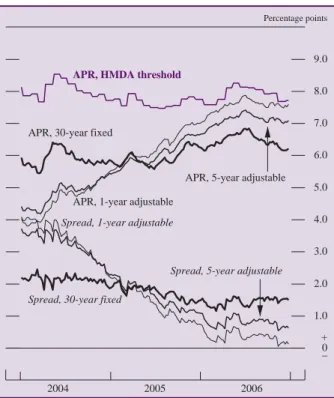
Figure 2 (left) illustrates these effects of a flattening yield curve. The bottom three lines of the figure represent the differences (spreads) between the effective rates (APRs) of three loan types (the top three lines) and the HMDA reporting threshold.28 As noted earlier, the reporting gap between the typical prime thirty-year fixed-rate loan and the reporting threshold narrowed from 215 basis points at the beginning of 2004 to 144 basis points at the beginning of 2006 and rose or fell some over the remainder of the year. For one-year adjustable-rate loans, the gap narrowed much more, from about 400 basis points at the beginning of 2004 to 52 basis points at the beginning of 2006, and then oscillated somewhat over the course of the year, ending at only 20 basis points. This means that at the end of 2006, a one-year adjustable-rate mortgage with a contract rate of only ¼ percentage point above the Freddie Mac prime rate would have been reported as higher-priced under the HMDA reporting rules.
The differences between the APRs and the reporting threshold decreased for both the fixed-rate and adjustable-rate loans, but the decrease for adjustable-rate loans was much
28
The rates are from Freddie Mac’s Primary Mortgage Market Survey for 2004-06. The Freddie Mac
series for five-year adjustable rates did not begin until January 1, 2005. For 2004, we estimate five-year adjustable rates from a statistical model using the one-year adjustable rate and thirty-year fixed rate reported by
Freddie Macand the one- and five-year rates for Treasury securities.
2. APRs of three selected loan types, and the spread between them and the HMDA price-reporting threshold, 2004–06
APR, HMDA threshold
+ _ 0 1.0 2.0 3.0 4.0 5.0 6.0 7.0 8.0 9.0 Percentage points 2006 2005 2004 APR, 30-year fixed
APR, 1-year adjustable
APR, 5-year adjustable
Spread, 1-year adjustable
Spread, 5-year adjustable Spread, 30-year fixed
NOTE: The data are weekly. Threshold and annual percentage rates (APRs) are for prime, conventional, first-lien mortgages amortized on thirty years. For explanation of threshold, refer to text.
SOURCE: APRs are estimated from Freddie Mac, Primary Mortgage
larger. Thus, the gap between the APRs on fixed- and adjustable-rate loans, which was substantial at the beginning of 2004, had been virtually eliminated by early 2005; then the relationship between the two loan types inverted, with APRs on adjustable-rate loans somewhat higher than those on thirty-year fixed-rate loans during most of 2005 and all of 2006. The finding suggests that, as an artifact of regulation, geographic areas may have shown differing incidences of higher-priced lending over the past three years merely because they had differing shares of fixed-rate versus adjustable-rate loans. That is, areas with larger shares of adjustable-rate loans likely had fewer higher-priced loans than areas with larger shares of fixed-rate loans in 2004. This effect should have reversed over the course of 2005 and throughout 2006 as APRs on adjustable-rate loans moved above those on fixed-rate loans.
In the analysis of the 2005 HMDA data, we used information on the mix of adjustable- and fixed-rate loans for each state to derive a rough approximation of the
differential effect of the flattening of the yield curve on the proportion of adjustable-rate and fixed-rate loans that exceeded the HMDA price-reporting thresholds.29 The analysis
indicated that states with higher levels of adjustable-rate lending had both relatively low levels of higher-priced lending in 2004 and larger increases in such lending from 2004 to 2005, a pattern that would have been predicted from the narrowing of the APR gap between adjustable- and fixed-rate loans.
The data illustrated in figure 2 suggest that the relative mix of adjustable- and fixed-rate mortgages should be related to changes in the incidence of higher-priced lending between 2005 and 2006, although the differences between these two years are substantially smaller than those between 2004 and 2005. The data bear this out for home-purchase loans,
29
The mix of adjustable- and fixed-rate loans was derived from data obtained from First American LoanPerformance, www.loanperformance.com.
although the effects are very mild. States with the highest proportion of adjustable-rate mortgages showed a greater increase in the incidence of higher-priced lending than other states (table 10). The pattern for refinancings was not consistent: The states with the largest share of adjustable-rate mortgages showed about an average increase in the incidence of higher-priced lending, which suggests that other factors, such as opportunities to extract equity, played a more dominant role in explaining differences between 2005 and 2006 in the incidence of higher-priced lending for refinancings. The role of these factors is discussed below.
Above, we estimated that if all loans were fixed rate, then the effects of the flattening of the yield curve would have been to add approximately 2 percentage points to the reported incidence of higher-priced lending to first-lien loans in the 2006 HMDA data. The mix of adjustable-rate loan types is unknown. Depending upon the mix, we estimate that the yield-curve effect on the reported incidence on adjustable-rate loans would have been on the order of 4 or 5 percentage points. Thus, depending upon the overall mix of fixed- and adjustable-rate loans, the effect of the yield curve flattening on the incidence of higher-priced loans would have been to increase the incidence on the order of 3 or 4 percentage points. This implies that had there been no yield-curve changes, the incidence of higher-priced home-purchase loans would have fallen and the incidence for refinancings would have shown only a modest increase.
Real Effects on the Incidence of Higher-Priced Lending
To the degree that changes in the incidence of higher-priced lending are caused by yield-curve effects, they are not, to that extent, a result of any changes in the business practices of
lenders nor in the credit-risk profiles or preferences of consumers.30 It is difficult to gauge the importance of the latter two factors in explaining changes in the ‘‘real’’ incidence of higher-priced lending over time.
The housing market, and economic conditions more generally, were favorable in the 2004–05 period. Sales of both new and existing homes in 2005 eclipsed the historic highs reached in 2004. Housing market conditions began moderating in 2006: For the year, home prices rose more slowly in many areas and declined in some others. Nationally, the median price for existing homes increased throughout 2005, reached a high in July 2006, and then fell over the remainder of the year. Overall, the median price of existing homes ended up higher in 2006 than 2005. In addition, a steady climb in short-term interest rates pushed up rates and monthly payments for some existing borrowers with adjustable-rate loans and for those taking out new such loans.31 Thus, nationally, housing affordability fell from 2005 to 2006, which suggests that more borrowers may have had to stretch financially to purchase or refinance the mortgages on their homes.32
Moreover, higher interest rates altered the mix of individuals seeking to refinance their loans. Historically, individuals have refinanced their loans for one or both of the following reasons: to lower the interest rate on the debt or to extract some of the
accumulated equity in their home. The latter purpose (sometimes referred to as cash-out refinancing) is accomplished by borrowing more than is needed to cover the closing costs of the new loan plus the existing balance of the old loan. Increases in interest rates during 2005
30
As discussed in the preceding section, the yield-curve effects are an artifact of the Regulation C definition of a higher-priced loan and the specification in Regulation Z of the method of calculating APRs (particularly for adjustable-rate loans)
31
Because many adjustable-rate loans have an initial period at a fixed rate (often two or three years from loan origination), some borrowers with such loans do not experience an immediate change in their payments if interest rates increase. For new borrowers, an increase in short-term rates generally results in a corresponding increase in the initial rate on the loan.
32
Information on the sales, prices, and affordability of homes is in U. S. Department of Housing and Urban Affairs, U.S. Housing Market Conditions, www.huduser.org/periodicals/ushmc.html.
and the first part of 2006 reduced the opportunities for individuals to benefit from rate-reduction refinancings, so the proportion of borrowers in the refinance market who were seeking equity extraction likely rose in 2006.33
The less-favorable conditions in the housing market and in the interest rate
environment in 2006 undoubtedly account for much of the decline in the number of mortgage originations reported in the HMDA data for 2006, particularly with regard to the sharp
decline in refinancings (about 15 percent). It also likely explains the increase from 2005 in the proportion of borrowers who obtained higher-priced loans in the market for refinancings. The rise in the incidence of higher-priced lending in the refinance market (particularly when compared with the home-purchase market) seems to have come primarily from the
aforementioned rise in the proportion of borrowers in the refinance market who were seeking to raise cash—and equity extraction is a major reason for borrowers in the higher-priced segment market to refinance.34 In short, the increase in the incidence of higher-priced lending in the refinance market, at least relative to the home-purchase market, appears to have been driven mainly by a decrease in the number of prime borrowers in this market rather than by an increase in borrowers with weaker credit profiles.
Industry data provide additional support for the view that real credit quality declined from 2005 to 2006, albeit modestly. However, most of the change in credit quality seems to have taken place in the near-prime, or ‘‘alt-A,’’ portion of the market. For example,
33
Data published by Freddie Mac indicate that the share of refinancings involving cash-outs rose steadily over the course of 2005 and through the third quarter of 2006
(www.freddiemac.com/news/finance/refi_archives.htm).
34
This conclusion follows from the belief that the credit profiles of those extracting equity are, in general, worse than those that refinance purely to benefit from interest rate reductions. Empirical evidence on delinquency rates for refinancings involving equity extraction is generally consistent with this belief. However, in areas that have experienced exceptional increases in home values, the expected credit profiles of those extracting equity may not be worse than others because such borrowers may benefit from relatively low loan-to-value ratios. That condition may explain, for example, the relatively low incidence of higher-priced lending for refinancing in California (table 10), a state with a high incidence of higher-priced lending for home purchases. California had among the largest increases in home values of any state in recent years.